
 From Conventional to Sustainable: Exploring Individual Willingness to Transition to Eco-Friendly Transport in Indonesia
ABSTRACT
Objective: this study explores the factors influencing individuals’ willingness to switch to sustainable transportation, extending the push-pull-mooring (PPM) framework.
Theoretical approach: it examines perceived environmental threat (PET), perceived inconvenience (PI), financial incentive policy (FIP), and green transport system and campaigns (GTC) as push and pull factors, alongside the moderating roles of perceived risk (PR) and environmental concern (EC).
Methods: data from 264 respondents were analyzed using structural equation modeling to test the direct, moderating, and mediating effects on willingness to switch (WS) and switching behavior (SB).
Results: the findings show that PET and PI positively influence WS, while PR negatively impacts it. Both FIP and GTC positively affect WS, which significantly leads to SB. However, PR and EC do not significantly moderate the relationships between these factors and WS. Additionally, WS mediates the effects of push and pull factors on SB.
Conclusions: this research extends the PPM model by incorporating policy and behavioral factors, emphasizing that WS is a crucial mediator in sustainable transportation adoption. The results suggest that policies focused on financial incentives, effective green campaigns, and efforts to reduce perceived risks are key to encouraging behavioral change in transportation choices.
Keywords:
sustainable transportation; electric vehicles; financial incentive policy; perceived risk; switching behavior
RESUMO
Objetivo: o presente estudo explora os fatores que influenciam a intenção dos indivíduos de adotar meios de transporte sustentáveis, estendendo o modelo de impulso-atração-ancoragem (push-pull-mooring - PPM).
Marco teórico: a pesquisa analisa a Ameaça Ambiental Percebida (AAP), a Inconveniência Percebida (IP), a Política de Incentivo Financeiro (PIF) e as Campanhas e Sistemas de Transporte Sustentável (CSTS) como fatores de impulso e atração, bem como os papéis moderadores do Risco Percebido (RP) e da Preocupação Ambiental (PA).
Métodos: foram analisados dados de 264 respondentes, usando modelagem de equações estruturais, de maneira a testar os efeitos diretos, moderados e mediadores sobre a Intenção de Mudança (IM) e o Comportamento de Mudança (CM).
Resultados: os resultados mostram que a AAP e a IP influenciam a IM positivamente, enquanto o RP tem um impacto negativo. No caso da PIF e das CSTS, ambas têm efeito positivo, o que contribui de maneira significativa para o CM. Entretanto, o RP e a PA não moderam de forma significativa a relação entre esses fatores e a IM. Por fim, a IM atua na mediação dos efeitos dos fatores de impulso e atração no CM.
Conclusões: a pesquisa estende o modelo PPM incorporando fatores relacionados a políticas e comportamentos, ressaltando que a IM é um mediador essencial na adoção de transportes sustentáveis. Os resultados sugerem que políticas com foco em incentivos financeiros, campanhas de sustentabilidade ambiental eficazes e esforços para a redução de riscos percebidos são cruciais para promover o comportamento de mudança em relação a escolhas em termos de transporte.
Palavras-chave:
transporte sustentável; veículos elétricos; políticas de incentivo financeiro; risco percebido; intenção de mudança
INTRODUCTION
Indonesia faces significant challenges in managing transportation demand, with motor vehicle ownership reaching an astounding 157 million units as of January 2023 (Badan Pusat Statistik [BPS], 2023). This includes 132,433,679 motorcycles, 18,229,176 passenger cars, 6,091,822 trucks, and 269,710 buses. The dominance of motorcycles, in particular, highlights their crucial role in the country’s transportation system. However, the rapid rise in private vehicle ownership has led to worsening traffic congestion, as well as significant environmental and infrastructure problems, especially in urban areas (S. Wang, 2020; Urbanek, 2021). For instance, Java Island has seen an annual growth rate of over 5% in vehicle numbers (Kresnanto, 2019). This surge has not only exacerbated traffic jams but has also contributed to air pollution and infrastructure decay, particularly in Jakarta, where more than 10.5 million people are exposed to hazardous air quality each day (Syuhada et al., 2023). These trends underscore the pressing need for sustainable transportation solutions to reduce the strain on public health, energy resources, and urban mobility.
Eco-friendly transportation, particularly electric vehicles (EVs), presents a promising solution to mitigate the environmental impact of conventional transportation in Indonesia (Aggarwal & Singh, 2021). Despite their potential, the adoption of EVs has been slow. The main barriers to widespread adoption include insufficient infrastructure - especially the lack of charging stations - concerns about the risks associated with new technologies, and limited public awareness (Murtiningrum et al., 2022). Similar challenges have been observed in other developing nations like India and the Philippines, where the lack of infrastructure and awareness, alongside the availability of tax incentives, are major factors influencing EV adoption (Chhikara et al., 2021; Guno et al., 2021). Indonesia shares these infrastructure- and awareness-related challenges, which have prompted the government to set ambitious EV adoption targets by 2035, supported by progressive policies such as tax incentives (Bahari & Herawaty, 2023). Despite these efforts, the barriers remain, emphasizing the need for a deeper investigation into the psychological and social factors influencing the decision to adopt EVs in Indonesia.
This study aims to examine the factors affecting the adoption of electric vehicles in Indonesia, particularly the psychological, social, and infrastructural elements that shape individuals’ transportation choices. The shift toward sustainable transportation is critical for developing long-term, eco-friendly mobility systems (Kwilinski et al., 2023). While previous studies have shown a positive correlation between public awareness of electric vehicles and sustainability (Bai et al., 2020), widespread adoption in Indonesia remains limited (Murtiningrum et al., 2022). Therefore, to fill the gap in the literature, which focuses mainly on technical and policy aspects, this study applies the push-pull-mooring (PPM) framework to conduct a comprehensive analysis of behavioral and psychological factors in individual decision-making processes, which have yet to be explored extensively.
This study applies the PPM model to explore how psychological, social, and infrastructural factors influence individuals’ decisions to adopt sustainable transportation in Indonesia. The PPM framework, originally developed to analyze migration behavior by examining the driving, attracting, and anchoring factors (Ha et al., 2023), is highly relevant for understanding the adoption of green transportation. For instance, Lu and Wung (2021) used the PPM model to analyze the transition from traditional to digital payments, while Urbanek (2021) applied this framework to study the potential shift from private to public transport in Poland. In Indonesia, the driving factors include concerns about air pollution and traffic congestion, while attraction factors, such as fiscal incentives and pro-environmental campaigns, are key motivators. At the same time, anchoring factors, such as perceived risk related to new technologies (e.g., EV battery life) and uncertainties regarding infrastructure, present significant challenges to this transition.
The choice of the PPM framework is driven by its unique ability to analyze not just adoption intentions but also switching behavior. While popular behavioral theories, such as the theory of planned behavior (TPB) or the technology acceptance model (TAM), excel in explaining the formation of intentions, they do not fully account for the dynamics that push individuals to leave the status quo (push factors) and the obstacles that prevent them from transitioning (mooring factors). In the context of the shift from conventional vehicles, which have long been the norm, to electric vehicles (EVs), which are fraught with uncertainties, the PPM framework offers a more comprehensive analytical approach. This study, therefore, aims to fill the gap in the literature by applying the PPM model to examine these factors. Theoretically, this study contributes by testing and expanding the empirical application of the PPM framework in the context of sustainable transportation adoption in developing countries - an underexplored area. The findings are expected to provide evidence-based insights for policymakers to design more effective incentives and strategies to support Indonesia’s transition toward a sustainable transportation system.
LITERATURE REVIEW AND HYPOTHESES DEVELOPMENT
Sustainable transportation/green transportation
Sustainable transport development (STD) is a planning perspective that considers economic, social, and environmental objectives, including indirect, difficult-to-measure, and far-reaching impacts in space and time. Sustainable transportation requires more comprehensive planning than is commonly undertaken. Continuous planning can provide an opportunity to identify strategies that can help achieve various goals. One of the strategies to achieve STD is transport demand management (TDM) (Online TDM Encyclopedia - Sustainable Transportation and TDM, n.d.). TDM is an effort to reduce the number of private vehicle trips (push) and encourage the development of public transportation services (pull) as part of a sustainable transportation policy, namely, to reduce urban traffic congestion and pollution (Habibian & Kermanshah, 2011; Kresnanto et al., 2022). TDM has very diverse implementation dimensions.
Push-pull-mooring framework (PPM)
The transition to sustainable transportation is a complex process determined not solely by technological availability, but also heavily by changes in individual behavior (Lu & Wung, 2021). Therefore, understanding the psychological and contextual mechanisms underlying individual decisions is crucial. In this context, the push-pull-mooring (PPM) framework is considered highly relevant, as it enables the integration of various pushing, pulling, and inhibiting factors within a single, procedural, and non-linear decision-making framework.
Originally developed to explain migration behavior, the PPM framework has undergone conceptual expansion and is widely applied in the study of switching behavior, including the adoption of new technologies and services (Yoon & Lim, 2021). The PPM framework emphasizes that the decision to switch cannot be understood as a direct response to a single factor, but rather as the result of a dynamic interaction between the negative pressures of existing conditions (push), the attraction of available alternatives (pull), and personal or situational binding factors (mooring) that can reinforce or inhibit behavior change.
In the sustainable transportation literature, push factors such as perceived environmental threats and inconvenience are often identified as early triggers for behavior change (Bai et al., 2020). Normatively, perceptions of the negative impacts of conventional transportation, including air pollution, carbon emissions, congestion, and rising fuel costs, are expected to encourage individuals to consider more sustainable alternatives. Nevertheless, empirical findings suggest that the influence of these factors is inconsistent across contexts, limiting their universal generalizability.
A number of studies indicate that in developed countries, environmental concern can serve as a significant motivator for adopting green transportation. In contrast, in developing countries, the influence of environmental factors is often overshadowed by more pressing economic constraints (Damanik et al., 2025; Pirmana et al., 2023; Veza et al., 2022). When individuals face high initial costs for transportation innovations, such as electric vehicles, environmental awareness or operational inconvenience is often insufficient to drive widespread adoption. This gap between awareness and actual behavior highlights the limitations of approaches that examine drivers in isolation, without considering broader transitional mechanisms and barriers, particularly in the context of developing countries like Indonesia.
On the other hand, pull factors such as financial incentives, green transport policies, and campaigns have consistently been identified as key determinants attracting individuals toward environmentally friendly transportation (Bahari & Herawaty, 2023; Guno et al., 2021). Financial incentives help lower economic barriers, while public policies and campaigns shape perceptions of benefits, legitimacy, and social norms that support adoption. However, the literature continues to debate the relative effectiveness of various incentives and the extent to which they encourage actual behavior change rather than merely fostering positive attitudes. This underscores the need for a more integrated analysis of how policy attractiveness translates into an individual’s readiness to switch before manifesting in actual behavior.
In addition to push and pull factors, mooring factors, particularly perceived risk, play a crucial role in explaining resistance to change. Risks in the context of sustainable transportation are multidimensional, encompassing financial, functional, safety, and social risks (Murtiningrum et al., 2022). Although most studies agree that risk is a significant deterrent, the type and intensity of perceived risks are highly dependent on social context and infrastructure readiness. Therefore, this study views perceived risk not merely as a direct barrier, but as a contextual binding factor that influences how push and pull factors are processed in individual decision-making.
Overall, previous literature has tended to examine push, pull, and mooring factors in isolation, often assuming a direct relationship between attitudes and behaviors. This fragmented approach limits the understanding of how these forces interact within a gradual decision-making process. By adopting the PPM framework, this study does not aim to propose an entirely new causal relationship, but rather to refine the theoretical understanding of the switching process. It positions ‘willingness to switch’ as a transitional mechanism between external stimuli and actual switching behavior, with perceived risk serving as a contextual condition that moderates the strength of this relationship. Thus, the main contribution of this research is both a theoretical refinement and an empirical-contextual expansion; specifically, it reintegrates established relationships into a coherent procedural framework and tests them within the context of developing countries - an area that remains relatively underexplored in sustainable transportation literature.
This research model is grounded in the PPM framework, which conceptualizes the shift from conventional to sustainable transportation as a multi-stage decision-making process. We have developed a set of hypotheses centered around three key themes: (1) the direct factors influencing individuals’ willingness to switch (WS) to sustainable transportation, (2) the process by which willingness to switch (WS) is transformed into actual switching behavior (SB), and (3) the intricate interactions of moderating and mediating factors that shape this transition.
Development of hypotheses
Push-pull-mooring dynamics and willingness to switch
Within the PPM framework, switching behavior is understood as the outcome of a multi-stage decision process, rather than a direct response to isolated drivers (Marx, 2025). Central to this process is willingness to switch, which represents a transitional psychological state reflecting individuals’ readiness to disengage from existing transportation practices before any observable behavioral change occurs (Jing et al., 2023). Conceptualizing WS as an intermediate mechanism allows the framework to capture how dissatisfaction, attraction, and constraint operate jointly rather than independently.
From a push perspective, dissatisfaction with conventional transportation is primarily shaped by perceived environmental threats and perceived inconvenience. Environmental threats reflect growing awareness of pollution, climate change, and health risks associated with fossil-fuel-based transport (Zeng et al., 2023), while inconvenience captures daily experiential burdens such as congestion, inefficiency, and time loss (Baig et al., 2024). These factors exert psychological pressure by eroding the perceived desirability of the status quo, thereby increasing openness to alternatives (Sun et al., 2020; S. Wang et al., 2020). However, prior research also cautions that push effects are context-sensitive and may weaken in developing economies where structural constraints limit feasible options (Jelti et al., 2023).
Complementing push forces, pull factors operate by enhancing the attractiveness and feasibility of sustainable transportation alternatives. Financial incentive policies, including subsidies, tax reductions, and purchase discounts, directly lower economic barriers and improve perceived affordability (Ha et al., 2023). Simultaneously, green transport systems and campaigns strengthen infrastructural availability and normative legitimacy, shaping perceptions of practicality and social approval (Kwilinski et al., 2023). Empirical evidence across diverse contexts indicates that push-related dissatisfaction alone is insufficient; meaningful willingness to switch emerges when attractive alternatives are perceived as both accessible and legitimate (Anisah et al., 2024; Hu et al., 2023; Li et al., 2025; L. Zhang et al., 2020).
Despite these motivating forces, the PPM framework emphasizes that behavioral change is often constrained by mooring factors, with perceived risk playing a central role. Perceived risk encompasses financial uncertainty, functional reliability concerns, and social acceptance issues, which are particularly salient in the context of electric vehicles and green energy transitions (Choo et al., 2024; Vafaei-Zadeh et al., 2022). Elevated risk perceptions anchor individuals to existing behaviors by amplifying loss aversion and uncertainty, thereby suppressing willingness to switch even when push and pull forces are present (Munshi et al., 2022; X. Zhang et al., 2018).
Taken together, these arguments suggest that willingness to switch is jointly shaped by dissatisfaction with current transport modes (push), attraction toward sustainable alternatives (pull), and constraining risk perceptions (mooring), rather than by any single factor in isolation.
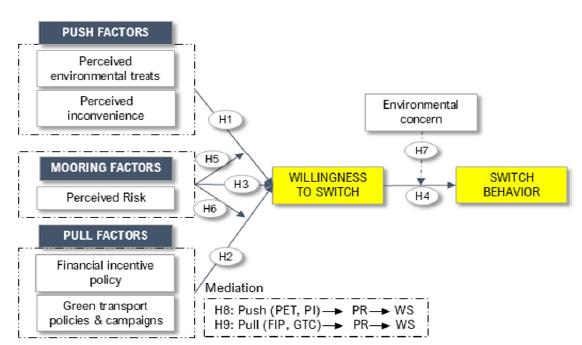
H1-H3: Push factors positively, pull factors positively, and perceived risk negatively influence willingness to switch.
Willingness to switch to switching behavior
Within a process-oriented interpretation of behavioral change, willingness to switch does not constitute an endpoint, but rather functions as a necessary precursor to actual switching behavior. Willingness reflects psychological readiness and openness to change, whereas switching behavior requires the translation of this readiness into action under situational constraints (Hu et al., 2023; Sajjad et al., 2020). This distinction addresses the widely documented intention-behavior gap in sustainability and transportation research.
Empirical studies consistently demonstrate that individuals exhibiting stronger willingness are significantly more likely to adopt sustainable transportation options when enabling conditions - such as infrastructure access and policy support - are present (Chen et al., 2021; Jiang et al., 2024). In this sense, willingness serves as a proximal antecedent that channels motivational forces into observable behavior.
H4: Willingness to switch positively influences switching behavior.
Contextual moderation: Perceived risk and environmental concern
While willingness provides a critical bridge between motivation and action, the PPM framework recognizes that this bridge is not equally stable for all individuals. Two contextual conditions - perceived risk and environmental concern - are therefore introduced to explain heterogeneity in how motivational forces are processed. High levels of perceived risk weaken the effectiveness of both push and pull factors by reinforcing uncertainty and loss aversion, leading individuals to maintain existing behaviors despite dissatisfaction or policy incentives (X. W. et al. Wang, 2021; J. Zhang et al., 2022). Conversely, environmental concern strengthens the willingness-behavior relationship by increasing moral commitment, tolerance for transitional costs, and persistence in the face of uncertainty (Duong, 2022; ElHaffar et al., 2020). These moderating mechanisms highlight that identical structural conditions may produce divergent outcomes depending on individual-level psychological contexts.
H5-H6: Perceived risk negatively moderates the effects of push and pull factors on willingness to switch.
H7: Environmental concern positively moderates the relationship between willingness to switch and switching behavior.
Willingness to switch as a mediating mechanism
Beyond moderation, willingness to switch is positioned as a central mediating mechanism through which push and pull factors exert their influence on actual switching behavior. Prior research suggests that environmental dissatisfaction and policy attractiveness rarely trigger immediate behavioral change; instead, they operate by reshaping individuals’ readiness to abandon existing practices (Lu & Wung, 2021; Phoon et al., 2024). By explicitly modeling this mediation pathway, the study avoids treating push and pull factors as parallel or redundant predictors. Instead, it conceptualizes switching behavior as the culmination of an integrated psychological process in which willingness functions as the key transmission channel, consistent with the core logic of the PPM framework.
H8-H9: Willingness to switch mediates the effects of push and pull factors on switching behavior.
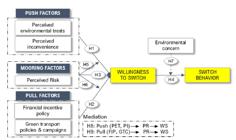
The research framework in Figure 1 illustrates the complexity of the relationship between driving factors, pulling factors, mooring factors, willingness to switch, and behavior.
RESEARCH METHODS
Samples and data collection procedures
This study uses a quantitative approach with a cross-sectional design to understand consumers’ behavior in transitioning from conventional vehicles to environmentally friendly ones in Indonesia. This approach was chosen because it allows researchers to observe the relationships between variables simultaneously over a specific period, which is relevant for analyzing the intentions and readiness of individuals to switch to sustainable modes of transportation.
Because data on the population of private vehicle users in Indonesia are not publicly available, this study uses a non-probability sampling method with purposive sampling techniques. This technique is appropriate because it allows researchers to select participants who meet certain criteria relevant to the research objectives (Etikan et al., 2015). The inclusion criteria are set as follows:
-
(1) respondents are over 17 years old, and
-
(2) have a valid driver’s license (SIM).
The age criterion of over 17 years old was chosen because, at that age, individuals are legally qualified to have a driver’s license and are considered capable of making rational decisions regarding the ownership and use of private vehicles (Law Number 22, 2009 concerning road traffic and transportation). Driving license ownership is also an indicator that respondents have real experience in driving and have the potential to be directly involved in the transition process to environmentally friendly transportation. Respondents who do not meet these criteria are automatically excluded from the data analysis process to maintain the validity of the research results.
Furthermore, a priori power analysis was carried out using G*Power software to determine the minimum number of participants required. This analysis refers to the parameters of statistical power of 0.90, significance level (α = 0.05), and moderate effect size (f² = 0.15), as recommended by Cohen (1992). Considering the six predictive variables in the proposed research model, the calculation results show that at least 123 respondents are required to achieve adequate statistical power to detect significant effects in the model.
The data were collected from August 12 to September 9, 2024, using an online questionnaire (Google Form). The questionnaire links were disseminated through social media platforms such as WhatsApp and Instagram, as these two platforms have a high penetration rate in Indonesia and effectively reach the productive age group, who are active users of private vehicles. Before the main data collection, a pilot test was carried out with 30 respondents to ensure the clarity of the items and the reliability of the instruments. Based on the pilot results, some items that did not meet the validity and reliability criteria were removed or revised.
Out of a total of 300 questionnaires distributed, 270 responses were successfully collected. After screening and eliminating four outlier data points that did not meet the criteria, 264 valid responses were obtained and used in the final analysis.
The ethical aspects of the research were strictly considered throughout the research process. Participation was voluntary, and all respondents received a research information sheet explaining the objectives, procedures, and confidentiality of the data. Informed consent was obtained electronically before respondents could access the questionnaire. No personal identity data were collected, and all responses were kept anonymous and used only for academic purposes. This research follows the principles of international research ethics, including the Committee on Publication Ethics (COPE) guidelines, in ensuring transparency, integrity, and protection of participants. Since this research is not under the supervision of a formal ethics committee, ethical considerations were managed directly by the research team in accordance with international ethical standards for social and behavioral research.
Measures
The measurement instruments in this study are adapted from previous questionnaires that have been proven valid and reliable. The adaptation process was carried out carefully to maintain conceptual consistency while adjusting to the cultural context and characteristics of respondents in Indonesia. Some items underwent editorial and contextual adjustments to make them easier to understand without changing their original theoretical meaning (Beaton et al., 2000).
All questionnaire items were then translated from English to Indonesian using the forward-backward translation technique, as recommended by Brislin (1970). The translation process was carried out by an expert translator fluent in English and Indonesian, with a background in behavioral science. After the translation was completed, the research team re-examined the equivalence of meaning and clarity of terminology to ensure that the Indonesian version retained semantic and conceptual equivalence with the original version.
The measurement of each construct in this study refers to credible previous sources. Items for perceived environmental threat (PET) and perceived inconvenience (PI) were adapted from S. Wang et al. (2020). The financial incentive policy (FIP) construct was adapted from Ha et al. (2023) and S. Wang et al. (2018), while green transport system and campaigns (GTC) were adapted from S. Wang et al. (2020). The variables perceived risk (PR) and willingness to switch (WS) were adapted from Hu et al. (2023) and S. Wang et al. (2020). In addition, environmental concern (EC) was adapted from Ha et al. (2023), and switching behavior (SB) was adapted from S. Wang et al. (2020). Each construct was measured using three to five items that represented respondents’ perceptions, attitudes, or intentions toward environmentally friendly transportation behavior.
All items were measured using a five-point Likert scale, ranging from 1 (‘strongly disagree’) to 5 (‘strongly agree’). The five-point scale was chosen because it is considered efficient, easy to understand, and capable of capturing variation in respondents’ attitudes accurately. In addition, previous research has shown that the five-point scale provides reliable and valid results and is more appropriate for respondents with diverse educational and cultural backgrounds (Krosnick et al., 2012). This scale also maintains a balance between measurement sensitivity and respondents’ cognitive load, as well as reducing potential fatigue when completing questionnaires. Therefore, the use of this scale is considered appropriate for the context of social and cross-cultural behavioral research.
RESULTS AND DISCUSSION
Data analysis
We chose SEM-PLS because it is more suitable for studies with limited sample sizes, such as in purposive sampling-based studies by Henseler et al. (2014). SEM-PLS can handle models with many latent variables, indicators, and moderation and mediation relationships more efficiently than CB-SEM, which requires a larger sample size to produce valid results. This research is also predictive, aiming to understand how particular elements affect the intention and behavior to use environmentally friendly transportation; therefore, using SEM-PLS is more appropriate.
This study uses a two-step SEM-PLS approach, as recommended by Hair, Hult et al. (2017). First, we test the model, which consists of outer loadings, AVE, Cronbach’s alpha, composite reliability, and validity discrimination. The outer loading value must be above 0.7, while the AVE, Cronbach’s alpha, and CR must be above 0.5. The second structural approach consists of SRMR, R-squared, and Q-squared. The SRMR value should be below 0.1, while for the R-squared value, Hair et al. (2019) stated that the Q2 value was 0 for low influence, 0.25 for moderate influence, and 0.50 for high influence.
Results of data analysis
This study included 264 respondents, with the majority residing in the Special Region of Yogyakarta. Respondent characteristics were classified according to several demographic and ownership variables, including region of origin, gender, age, employment status, educational background, average monthly income, and ownership of both conventional and electric vehicles, two-wheeled and four-wheeled. A detailed breakdown of these classifications is presented in Table 1.
The largest group of respondents resides in Sleman (30.7%), followed by Yogyakarta City (20.1%) and Bantul (19.7%). Male respondents outnumber females (54.9% vs. 45.1%). The dominant age group is over 40 years (39.0%), with significant proportions in the 17-25 (21.2%) and 26-30 (22.3%) age ranges. Educationally, 36.4% of respondents have a master’s degree, and 26.9% hold a bachelor’s degree. Regarding employment, 29.5% are private employees, followed by 19.7% students and 19.7% teachers/lecturers. In terms of income, the majority (33.7%) earn between IDR 2,000,000 and IDR 4,999,999. Vehicle ownership data show that two-wheeled conventional vehicles are the most common, with 34.5% owning two units, while 47.7% own one four-wheeled conventional vehicle. Electric vehicles have minimal penetration, with 87.9% of respondents not owning a two-wheeled electric vehicle and 97.3% not owning a four-wheeled electric vehicle.
Common method bias test (CMB)
In survey research filled in by respondents, there is potential for the emergence of common method bias (CMB), a bias tendency that arises from using a single data source to measure all research variables. This bias can cause the relationships between variables to appear stronger or weaker than the actual conditions (Podsakoff et al., 2003). CMB often arises due to factors such as respondents’ desire to give answers that are considered correct (social desirability), general perceptions of research topics, or answering patterns that tend to be consistent.
To minimize these risks, preventive measures were carried out from the questionnaire design stage, including using neutral statement language, placing variable items randomly, and ensuring the anonymity of respondents so that they feel comfortable and provide honest answers. Once the data were collected, empirical testing was carried out to ensure that CMB did not occur.
The first step used Harman’s single-factor test, which aims to identify the extent to which one common factor dominates data variance. The test results showed that the first factor explained only 23.212% of the total variance, well below the 50% threshold. This indicates that there is no single dominant factor, so the potential for CMB is low.
However, the Harman test is often considered less sensitive in detecting bias. Following Podsakoff et al. (2012), additional testing was carried out using the full collinearity test recommended by Kock (2015). This test uses the variance inflation factor (VIF) to assess whether there is excessive collinearity that could indicate CMB. The threshold value used is 3.3. The test results revealed that all constructs’ VIF values ranged from 1.115 to 2.596, well below the threshold. Initially, two items (WS2 and EC4) had VIF values above 3.3, so they were removed from the model. After this adjustment, all constructs met the recommended criteria, indicating no issues with collinearity or common method bias.
Therefore, it can be concluded that the data in this study are free from common method bias (CMB), ensuring that the analysis results regarding the relationships between variables are reliable. These steps align with the guidelines of the PLS-SEM approach, highlighting the importance of CMB testing to validate the accuracy and reliability of research findings (Kock, 2015).
Outer model test results
Evaluation of the measurement model is carried out to ensure the reliability and validity of the constructs. Convergent validity was assessed based on factor loadings, average variance extracted (AVE), Cronbach’s alpha (CA), and composite reliability (CR). As shown in Table 2, the measurement model demonstrates strong convergent validity.
All remaining items exceed the recommended criteria after removing four items with factor loadings below the 0.70 threshold (GTC1, PR4, SB3, and EC5). All constructs also achieved satisfactory AVE, CA, and CR values (above 0.5 and 0.7, respectively), confirming high internal consistency. Furthermore, discriminant validity was assessed using the heterotrait-monotrait ratio (HTMT) criterion, where all values were below the threshold of 0.85 (see Table 3). These results show that each construct in the model is empirically distinct from the others. Overall, this test confirms that the measurement model used in this study is valid and reliable.
Evaluation of the goodness of fit model
This study uses partial least squares structural equation modeling (PLS-SEM) to evaluate the theoretical model, focusing on prediction accuracy. Key evaluation metrics include R², Q², and SRMR. The analysis results show that the model can substantially explain the variance in switching readiness (WS), with an R² value of 50.8% and Q² of 0.325 (Table 4), indicating moderate predictive relevance and accuracy. However, the model’s explanatory power for actual switching behavior (SB) is much lower, with an R² value of 23.4% and Q² of 0.117. This lower R² value, while seemingly limited, is a theoretically important finding and needs to be discussed explicitly. It highlights the well-documented ‘intention-behavior gap’ in the literature, where strong intentions do not always translate into concrete action. In the Indonesian context, this gap can be attributed to several strong external factors that were not measured in the psychological model. First, the economic constraint: EVs still have a very high initial cost, which is a real barrier for most people, even those with strong intentions to switch. Second, habitual inertia: the habit of using conventional vehicles, formed over many years, is difficult to change and often overrides momentary intentions. Third, social and economic considerations: major purchasing decisions in Indonesia often involve family considerations that may not align with individual intentions. Therefore, a moderate R² value for SB is not a weakness of the model, but rather an important finding that psychological readiness alone is insufficient to predict complex and high-cost behavioral changes such as EV adoption in developing countries. The model’s SRMR value of 0.083 indicates a good overall fit.
Hypothesis testing
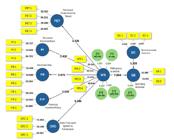
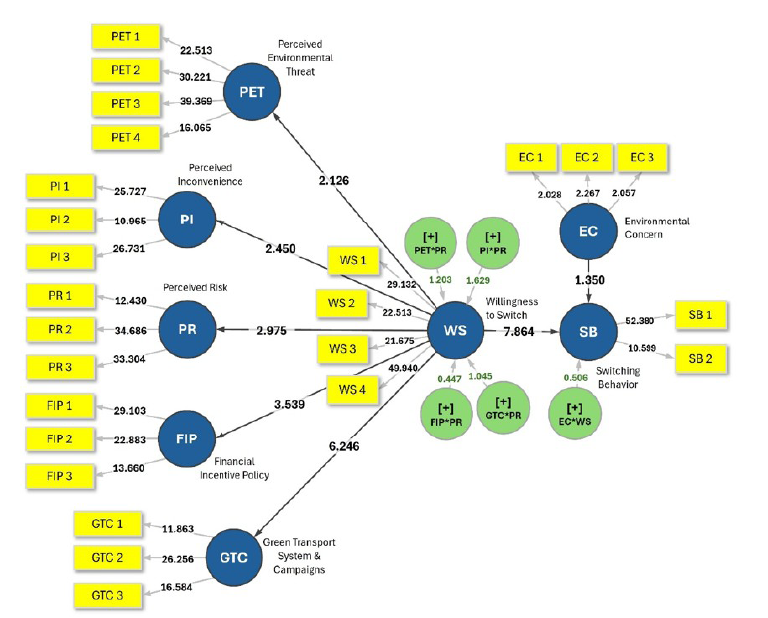
This study examined 15 proposed hypotheses, of which five were not supported, while 10 others showed statistical significance. Hypothesis testing was conducted using SmartPLS software through bootstrapping, with the t-value and p-value as the key statistical indicators. A t-statistic value greater than 1.96, a p-value below 0.05 (5%), and a positive beta coefficient were the criteria for statistical support, as outlined by Hair, Hollingsworth et al. (2017). For further details on the hypothesis testing results, please refer to Table 5.
Direct effects
Table 6 presents the direct, moderating, and mediating effects examined in this study, showing the significance of each hypothesized relationship. Hypothesis 1 (PET → WS) is supported (β = 0.129, t = 2.164, p = 0.032), indicating that PET significantly influences WS. Similarly, (PI → WS) is supported (β = 0.131, t = 2.519, p = 0.012), showing that PI also positively affects WS. Hypothesis 2 (FIP → WS) is supported (β = 0.208, t = 3.576, p = 0.000), demonstrating that FIP has a significant positive influence on WS, while GTC → WS is strongly supported (β = 0.373, t = 6.468, p = 0.000), highlighting the critical role of GTC in promoting WS. Hypothesis 3 (PR → WS) is also supported (β = -0.165, t = 2.874, p = 0.004), indicating that PR negatively impacts WS. In line with this, Hypothesis 4 (WS → SB) is supported (β = 0.469, t = 7.804, p = 0.000), suggesting that WS significantly influences SB.
Moderation effect
Regarding the moderating effects, Hypothesis 5 (PETPR → WS) was not supported (β = -0.038, t = 1.157, p = 0.248), which indicates that PR does not significantly moderate the effect of PET on WS. Similarly, (PIPR → WS) (β = 0.038, t = 1.544, p = 0.123), Hypothesis 6 (FIPPR → WS) (β = 0.013, t = 0.463, p = 0.644), and (GTCPR → WS) (β = -0.034, t = 1.106, p = 0.241) were also not supported, indicating that PR is not able to significantly moderate the relationship between push and pull factors and WS. Furthermore, Hypothesis 7 (WSEC → SB) was not supported (β = 0.029, t = 0.515, p = 0.606), highlighting the insignificant role of EC in EC on the influence of WS and SB.
Mediating effect
Lastly, the mediating effects of WS on the relationships between PET, PI, FIP, and GTC on SB were significant, confirming that WS acts as a key mediator. Specifically, Hypothesis 8 (PET → WS → SB) (β = 0.06, t = 2.14, p = 0.033), and (PI → WS → SB) (β = 0.061, t = 2.343, p = 0.020), Hypothesis 9 (FIP → WS → SB) (β = 0.097, t = 3.178, p = 0.002), and (GTC → WS → SB) (β = 0.175, t = 5.009, p = 0.000) were all supported, demonstrating that WS mediates the effects of these factors on SB.
DISCUSSION
This study provides a more nuanced understanding of the dynamics of the transition toward sustainable transportation in developing countries by positioning Indonesian consumers as pragmatic actors oriented toward practical feasibility. Overall, the findings indicate that willingness to switch is more strongly influenced by factors that offer tangible benefits and structural support (pull factors) than by normative pressures or dissatisfaction with existing conditions (push factors). This pattern underscores that, in developing country contexts, changes in transportation behavior cannot be explained solely by environmental awareness, but rather by the interaction of economic rationality, perceived risk, and the readiness of supporting systems.
The results show that perceived environmental threats and perceived inconvenience have a positive effect on WS, in line with prior studies that identify environmental awareness and dissatisfaction with conventional transportation as initial triggers of behavioral change (Jing et al., 2023; S. Wang et al., 2020; Zeng et al., 2023). Within the PPM framework, these factors function as external pressures that encourage individuals to reassess the sustainability of their current transportation choices. However, the findings also reveal that the influence of PET and PI in the Indonesian context remains relatively limited and does not evolve into a primary determinant of switching decisions. This reflects Indonesia’s cultural and economic realities, where environmental awareness tends to be collective and normative in nature but is not yet fully internalized in high-cost consumption decisions. In this context, environmental threats and the inconveniences of conventional transportation function more as psychological triggers than as autonomous drivers of behavioral change. Limited purchasing power, household economic priorities, and a high dependence on conventional vehicles weaken the capacity of normative pressures to induce behavioral change in the absence of concrete policy support and economic incentives.
From a policy perspective, environmental narratives in Indonesia remain relatively fragmented and insufficiently integrated into everyday transportation policies. As a result, although awareness of air pollution and congestion has increased, these pressures have not yet translated into a strong sense of individual urgency to shift toward electric vehicles. This finding enriches the literature by demonstrating that the effectiveness of push factors is highly contingent on institutional and economic contexts, thereby challenging universal assumptions in sustainable behavior research that position environmental awareness as the primary driver of behavioral change.
In contrast, financial incentive policies and green transportation policies and campaigns exhibit a stronger influence on WS. This finding highlights that, in the Indonesian context, decisions to adopt electric vehicles are highly sensitive to price considerations, economic incentives, and the availability of supporting infrastructure. These results are consistent with Ha et al. (2023) and Krishna et al. (2020), who emphasize that in developing countries, the adoption of environmentally friendly technologies tends to be predominantly cost-driven.
Within the PPM framework, FIP and GTC function as pull factors that not only symbolically attract consumers but also reduce economic and operational uncertainty. Subsidies, tax incentives, and the development of charging infrastructure enhance perceived feasibility and lower entry barriers, thereby accelerating the transformation from awareness to readiness to act. These findings suggest that the transition toward sustainable transportation in Indonesia is more accurately characterized as a policy-driven rather than a value-driven process, distinguishing it from patterns commonly observed in developed country contexts.
The study also confirms that perceived risk negatively affects WS, reinforcing its role as a mooring factor within the PPM framework. Risks related to high upfront costs, uncertainty regarding technological performance, and limited charging infrastructure serve as ‘anchors’ that keep consumers tied to conventional transportation modes, despite the presence of both push and pull forces encouraging change. The consistency of these findings with Vafaei-Zadeh et al. (2022) and Munshi et al. (2022) indicates that, in Indonesia, pragmatic considerations and practical risks outweigh environmental considerations in shaping consumer decisions. An important implication is that policies and campaigns that emphasize sustainability values without systematically reducing perceived risks are likely to have a limited impact on actual adoption behavior. The finding that WS positively influences switching behavior (SB) reinforces the view that transportation behavior change is a gradual process rather than an instantaneous decision (Jiang et al., 2024). Within the PPM framework, WS functions as an internal mechanism that bridges external pressures and attractions with actual behavioral outcomes.
In the Indonesian context, these results suggest that while environmental awareness and policy support can enhance WS, the realization of switching behavior remains strongly constrained by affordability and infrastructural readiness. Accordingly, WS should be understood not merely as an individual intention, but as an indicator of systemic readiness that reflects the alignment between individual motivation and structural support. The absence of significant moderating effects of PR and environmental concern (EC) contrasts with several prior studies (Choo et al., 2024; Duong, 2022; J. Zhang et al., 2022). Theoretically, this finding suggests that in contexts where structural barriers and practical risks remain dominant, psychological moderation mechanisms tend to be attenuated. Consumer decisions are driven more by objective feasibility and market conditions than by complex reflective evaluations. This finding contributes to the literature by demonstrating that universal assumptions regarding the role of moderation in the PPM framework must be interpreted contextually. In developing countries such as Indonesia, economic and infrastructural constraints can diminish the influence of higher-order psychological factors, indicating that the PPM model should be applied in a more adaptive and context-sensitive manner.
Overall, this study does not seek to claim entirely novel causal relationships, but rather to refine the PPM framework by emphasizing the role of willingness to switch as a transitional mechanism and perceived risk as a dominant contextual constraint. By integrating push, pull, and mooring factors within a processual framework, this study provides a more realistic understanding of how sustainable transportation transitions unfold in developing countries, while extending the relevance of the PPM framework beyond developed country contexts.
CONCLUSION
This study provides important insights into the factors influencing consumers’ transition from conventional to electric vehicles in Indonesia. Based on the findings, PET and PI positively affect WS, which then encourages SB. In addition, FIP and GTC policies have proven to be pull factors that strengthen WS, further accelerating the switch to electric vehicles. However, PR serves as a hindering factor in the transition, suggesting that despite pushes from policy and EC, the risks perceived by consumers remain significant barriers. This research supports the PPM theory, which emphasizes the importance of external factors that drive and attract consumers in the transition process. Managerial and policy implications suggest that improved financial incentive policies and better electric vehicle infrastructure development will accelerate the adoption of electric vehicles in Indonesia, although price and infrastructure challenges remain major obstacles. This research contributes to the literature on consumer behavior in adopting green technology, especially in developing countries such as Indonesia, and provides direction for more effective marketing policies and strategies in driving the transition to environmentally friendly vehicles.
Implication, limitation, and direction for future research
Managerial implications
The findings of this study provide valuable insights for automotive company managers and electric vehicle service providers to design more targeted strategies to encourage consumers to switch to electric vehicles. First, FIP has been shown to play a key role in improving WS and SB. Therefore, automotive companies can work with governments to introduce or enhance more attractive financial incentive policies, such as price discounts, subsidies, or tax reductions, which can reduce high price barriers and increase the attractiveness of electric vehicles in the eyes of consumers. In addition, GTC, which involves the development of electric vehicle infrastructure such as charging stations, should be a top priority for companies. Company managers can invest in developing charging networks or establish partnerships with governments and infrastructure service providers to ensure better accessibility. Companies can increase WS more effectively and accelerate SB by focusing on these two factors - financial incentives and infrastructure - while giving consumers more confidence to switch to electric vehicles.
Policy implications
From a policy perspective, these findings show that the government needs to strengthen FIP and GTC policies to accelerate the adoption of electric vehicles in Indonesia. FIP policies that involve fiscal incentives such as subsidies, electric vehicle tax reductions, or more affordable financing schemes can accelerate consumers’ decisions to switch. Therefore, the government must evaluate and improve these incentive policies to provide greater consumer benefits, especially in the face of relatively high electric vehicle prices. In addition, developing GTC, including expanding charging stations and upgrading green transport infrastructure, should be a priority in national transport policy. This policy also needs to be balanced with more transparent information campaigns and public education about the advantages of electric vehicles and how to use them, in order to reduce PR, which remains high among consumers. Given infrastructure and price challenges, the government can implement more comprehensive incentives to increase the adoption of electric vehicles, while supporting the development of a more environmentally friendly transportation sector in Indonesia.
Limitations and direction for future research
This research has several limitations that need to be considered. First, purposive sampling limits the generalization of findings, as the sample is not randomly drawn from the entire Indonesian population. Future research should use probability sampling to improve data representativeness. Second, the cross-sectional design only allows analysis at a single point in time and cannot capture long-term changes in consumer behavior. Therefore, a longitudinal design is recommended to monitor changes in WS and SB and the impacts of policies over time. Third, although FIP and GTC had significant effects on WS and SB, the moderation effects of PR on these relationships were not significant. Further research should explore other factors that may moderate these relationships, such as socioeconomic status or perceptions of new technologies. Finally, future research needs to delve deeper into the barriers faced by Indonesian consumers, such as distrust of new technologies and limited charging infrastructure, as well as develop behavioral intervention models to increase the adoption of electric vehicles. Thus, while these findings are important, there remains substantial room for further research on consumer behavior in Indonesia’s transition to electric vehicles.
REFERENCES
-
Aggarwal, S., & Singh, A. K. (2021). Electric vehicles the future of transportation sector: A review. Energy Sources, Part A: Recovery, Utilization, and Environmental Effects, 47(1), 1-21. https://doi.org/10.1080/15567036.2021.1976322
» https://doi.org/10.1080/15567036.2021.1976322 -
Anisah, T. N., Wahyudi, D., & Harnaji, B. (2024). Fashion revolution: Unveiling the path to sustainable style in the era of fast fashion. E3S Web of Conferences, 475, 02005. https://doi.org/10.1051/e3sconf/202447502005
» https://doi.org/10.1051/e3sconf/202447502005 - Badan Pusat Statistik Statistics Indonesia. (2024). Number of Motor Vehicles by Province and Vehicle Type (Jumlah Kendaraan Bermotor Menurut Provinsi dan Jenis Kendaraan
-
Bahari, Y. R., & Herawaty, V. (2023). Motor vehicle tax fiscal incentives, tax socialization, and electronic one-stop administration services office influence on taxpayer compliance with taxpayer awareness. Devotion: Journal of Research and Community Service, 4(8), 1557-1570. https://doi.org/10.59188/devotion.v4i8.532
» https://doi.org/10.59188/devotion.v4i8.532 -
Bai, L., Sze, N. N., Liu, P., & Guo Haggart, A. (2020). Effect of environmental awareness on electric bicycle users’ mode choices. Transportation Research Part D: Transport and Environment, 82, 102320. https://doi.org/10.1016/j.trd.2020.102320
» https://doi.org/10.1016/j.trd.2020.102320 -
Baig, F., Talpur, A., Das, G., Talpur, M. A. H., & Lee, J. (2024). Willingness to shift towards biogas-fueled bus rapid transit in Karachi, Pakistan. KSCE Journal of Civil Engineering, 28(4), 1501-1512. https://doi.org/10.1007/s12205-024-1636-9
» https://doi.org/10.1007/s12205-024-1636-9 -
Beaton, D. E., Bombardier, C., Guillemin, F., & Ferraz, M. B. (2000). Guidelines for the process of cross-cultural adaptation of self-report measures. Spine, 25(24). https://journals.lww.com/spinejournal/fulltext/2000/12150/guidelines_for_the_process_of_cross_cultural.14.aspx
» https://journals.lww.com/spinejournal/fulltext/2000/12150/guidelines_for_the_process_of_cross_cultural.14.aspx -
Brislin, R. W. (1970). Back-translation for cross-cultural research. Journal of Cross-Cultural Psychology, 1(3), 185-216. https://doi.org/10.1177/135910457000100301
» https://doi.org/10.1177/135910457000100301 -
Chen, C.-F., Eccarius, T., & Su, P.-C. (2021). The role of environmental concern in forming intentions for switching to electric scooters. Transportation Research Part A: Policy and Practice, 154, 129-144. https://doi.org/10.1016/j.tra.2021.10.010
» https://doi.org/10.1016/j.tra.2021.10.010 -
Chhikara, R., Garg, R., Chhabra, S., Karnatak, U., & Agrawal, G. (2021). Factors affecting adoption of electric vehicles in India: An exploratory study. Transportation Research Part D: Transport and Environment, 100, 103084. https://doi.org/10.1016/j.trd.2021.103084
» https://doi.org/10.1016/j.trd.2021.103084 -
Choo, S. Y., Vafaei-Zadeh, A., Hanifah, H., & Thurasamy, R. (2024). Predicting electric vehicles adoption: A synthesis of perceived risk, benefit and the NORM activation model. Research in Transportation Business & Management, 56, 101183. https://doi.org/10.1016/j.rtbm.2024.101183
» https://doi.org/10.1016/j.rtbm.2024.101183 -
Cohen, J. (1992). Statistical Power Analysis. Current Directions in Psychological Science, 1(3), 98-101. https://doi.org/10.1111/1467-8721.ep10768783
» https://doi.org/10.1111/1467-8721.ep10768783 -
Damanik, N., Saraswani, R., Hakam, D. F., & Mentari, D. M. (2025). A comprehensive analysis of the economic implications, challenges, and opportunities of electric vehicle adoption in Indonesia. Energies, 18(6). https://doi.org/10.3390/en18061384
» https://doi.org/10.3390/en18061384 -
Duong, C. D. (2022). Big Five personality traits and green consumption: Bridging the attitude-intention-behavior gap. Asia Pacific Journal of Marketing and Logistics, 34(6), 1123-1144. https://doi.org/10.1108/APJML-04-2021-0276
» https://doi.org/10.1108/APJML-04-2021-0276 -
ElHaffar, G., Durif, F., & Dubé, L. (2020). Towards closing the attitude-intention-behavior gap in green consumption: A narrative review of the literature and an overview of future research directions. Journal of Cleaner Production, 275, 122556. https://doi.org/10.1016/j.jclepro.2020.122556
» https://doi.org/10.1016/j.jclepro.2020.122556 -
Etikan, I., Musa, S. A., & Alkassim, R. S. (2015). Comparison of convenience sampling and purposive sampling. American Journal of Theoretical and Applied Statistics, 5(1), 1. https://doi.org/10.11648/j.ajtas.20160501.11
» https://doi.org/10.11648/j.ajtas.20160501.11 -
Guno, C. S., Collera, A. A., & Agaton, C. B. (2021). Barriers and drivers of transition to sustainable public transport in the Philippines. World Electric Vehicle Journal, 12(1), 46. https://doi.org/10.3390/wevj12010046
» https://doi.org/10.3390/wevj12010046 -
Ha, T. T., Nguyen, T. C., Tu, S. S., & Nguyen, M. H. (2023). Investigation of influential factors of intention to adopt electric vehicles for motorcyclists in Vietnam. Sustainability, 15(11). https://doi.org/10.3390/su15118765
» https://doi.org/10.3390/su15118765 -
Habibian, M., & Kermanshah, M. (2011). Exploring the role of transportation demand management policies’ interactions. Scientia Iranica, 18(5), 1037-1044. https://doi.org/10.1016/j.scient.2011.09.005
» https://doi.org/10.1016/j.scient.2011.09.005 - Hair, J. F., Jr., Hult, G. T., Ringle, C., & Sarstedt, M. (2017). A primer on Partial Least Squares Structural Equation Modeling (PLS-SEM) (2nd ed). Sage Publications Inc.
-
Hair, J. F., Jr., Hollingsworth, C. L., Randolph, A. B., & Chong, A. Y. L. (2017). An updated and expanded assessment of PLS-SEM in information systems research introduction. Industrial Management & Data Systems, 117(3), 1-41. https://doi.org/10.1108/IMDS-04-2016-0130
» https://doi.org/10.1108/IMDS-04-2016-0130 -
Hair, J. F., Jr., Risher, J. J., Sarstedt, M., & Ringle, C. M. (2019). When to use and how to report the results of PLS-SEM. European Business Review, 31(1), 2-24. https://doi.org/10.1108/EBR-11-2018-0203
» https://doi.org/10.1108/EBR-11-2018-0203 -
Henseler, J., Dijkstra, T. K., Sarstedt, M., Ringle, C. M., Diamantopoulos, A., Straub, D. W., Ketchen, D. J., Hair, J. F., Hult, G. T. M., & Calantone, R. J. (2014). Common beliefs and reality about PLS: Comments on Rönkkö and Evermann (2013). Organizational Research Methods, 17(2), 182-209. https://doi.org/10.1177/1094428114526928
» https://doi.org/10.1177/1094428114526928 -
Hu, X., Wang, S., Zhou, R., Gao, L., & Zhu, Z. (2023). Determinants of consumers’ intentions to switch to electric vehicles: A perspective of the push-pull-mooring framework. Journal of Environmental Planning and Management, 67(14), 3718-3743. https://doi.org/10.1080/09640568.2023.2232945
» https://doi.org/10.1080/09640568.2023.2232945 -
Jelti, F., Allouhi, A., & Tabet Aoul, K. A. (2023). Transition paths towards a sustainable transportation system: A literature review. Sustainability, 15(21), 15457. https://doi.org/10.3390/su152115457
» https://doi.org/10.3390/su152115457 -
Jiang, H., Xu, H., Liu, Q., Ma, L., & Song, J. (2024). An urban planning perspective on enhancing electric vehicle (EV) adoption: Evidence from Beijing. Travel Behaviour and Society, 34, 100712. https://doi.org/10.1016/j.tbs.2023.100712
» https://doi.org/10.1016/j.tbs.2023.100712 -
Jing, P., Zha, Y., Pan, K., & Xue, Y. (2023). Investigating multidimensional factors influencing switching intention on school bus among Chinese parents - A push - pull - mooring framework. Sustainability, 15(10), 7770. https://doi.org/10.3390/su15107770
» https://doi.org/10.3390/su15107770 -
Kock, N. (2015). Common method bias in PLS-SEM: A full collinearity assessment approach. International Journal of E-Collaboration, 11(4), 1-10. https://doi.org/10.4018/ijec.2015100101
» https://doi.org/10.4018/ijec.2015100101 -
Kresnanto, N. C. (2019). Model of relationship between car ownership growth and economic growth in Java. IOP Conference Series: Materials Science and Engineering, 650(1), 012047. https://doi.org/10.1088/1757-899X/650/1/012047
» https://doi.org/10.1088/1757-899X/650/1/012047 -
Kresnanto, N. C., Sinaga, R. N., Risdiyanto, & Putri, W. H. (2022). Priority of Sustainable Transport Policy Implementation in Expert Perspective. In H. A., Lie, M. Sutrisna, J. Prasetijo, B. H., Hadikusumo, & L. S. Putranto (Eds.), Proceedings of the Second International Conference of Construction, Infrastructure, and Materials (pp. 353-361). https://doi.org/10.1007/978-981-16-7949-0_31
» https://doi.org/10.1007/978-981-16-7949-0_31 -
Krishna, G., Pillai, V. S., & Veettil, M. V. (2020). Approaches and advances in the development of potential therapeutic targets and antiviral agents for the management of SARS-CoV-2 infection. European Journal of Pharmacology, 885, 173450. https://doi.org/10.1016/j.ejphar.2020.173450
» https://doi.org/10.1016/j.ejphar.2020.173450 - Krosnick, J. A., Presser, S., & Ruggles, S. (2012). The future of museums: Challenges and opportunities. The National Science Foundation Advisory Committee for the Social, Behavioral and Economic Sciences Subcommittee on Advancing SBE Survey Research, 1-10.
-
Kwilinski, A., Lyulyov, O., & Pimonenko, T. (2023). Environmental sustainability within attaining sustainable development goals: The role of digitalization and the transport sector. Sustainability, 15(14), 11282. https://doi.org/10.3390/su151411282
» https://doi.org/10.3390/su151411282 - Law of the Republic of Indonesia Number 22 of 2009. (2009). Undang-Undang Republik Indonesia Nomor 22 Tahun 2009 tentang Lalu Lintas dan Angkutan Jalan [concerning Road Traffic and Transportation]. Republic of Indonesia.
-
Li, J., Zhang, A., Wang, C., Wang, S., & Liang, L. (2025). Switching behavior in the adoption of electric vehicle in China: Perspective of push-pull-mooring framework. Transportation Research Part A: Policy and Practice, 192, 104359. https://doi.org/https://doi.org/10.1016/j.tra.2024.104359
» https://doi.org/https://doi.org/10.1016/j.tra.2024.104359 -
Lu, H. P., & Wung, Y. S. (2021). Applying transaction cost theory and push-pull-mooring model to investigate mobile payment switching behaviors with well-established traditional financial infrastructure. Journal of Theoretical and Applied Electronic Commerce Research, 16(2), 1-21. https://doi.org/10.4067/S0718-18762021000200102
» https://doi.org/10.4067/S0718-18762021000200102 -
Marx, T. (2025). The push-pull-mooring model of consumer service switching: A meta-analytical review to guide future research. Journal of Service Theory and Practice, 35(7), 1-29. https://doi.org/10.1108/JSTP-06-2024-0201
» https://doi.org/10.1108/JSTP-06-2024-0201 -
Munshi, T., Dhar, S., & Painuly, J. (2022). Understanding barriers to electric vehicle adoption for personal mobility: A case study of middle income in-service residents in Hyderabad city, India. Energy Policy, 167, 112956. https://doi.org/10.1016/j.enpol.2022.112956
» https://doi.org/10.1016/j.enpol.2022.112956 -
Murtiningrum, A. D., Darmawan, A., & Wong, H. (2022). The adoption of electric motorcycles: A survey of public perception in Indonesia. Journal of Cleaner Production, 379, 134737. https://doi.org/10.1016/j.jclepro.2022.134737
» https://doi.org/10.1016/j.jclepro.2022.134737 -
Phoon, L. J., Hong, K. T., Tan, H. C., & Kumarusamy, R. (2024). Does environmental awareness play a mediating role in electric vehicle purchase intention A perspective from the theory of consumption values and technology acceptance model. International Journal of Business and Emerging Markets, 16(1), 107-135. https://doi.org/10.1504/ijbem.2024.135101
» https://doi.org/10.1504/ijbem.2024.135101 -
Pirmana, V., Alisjahbana, A. S., Yusuf, A. A., Hoekstra, R., & Tukker, A. (2023). Economic and environmental impact of electric vehicles production in Indonesia. Clean Technologies and Environmental Policy, 25(6), 1871-1885. https://doi.org/10.1007/s10098-023-02475-6
» https://doi.org/10.1007/s10098-023-02475-6 -
Podsakoff, P. M., MacKenzie, S. B., Lee, J.-Y., & Podsakoff, N. P. (2003). Common method biases in behavioral research: A critical review of the literature and recommended remedies. Journal of Applied Psychology, 88(5), 879. https://doi.org/10.1037/0021-9010.88.5.879
» https://doi.org/10.1037/0021-9010.88.5.879 -
Podsakoff, P. M., MacKenzie, S. B., & Podsakoff, N. P. (2012). Sources of method bias in social science research and recommendations on how to control it. Annual Review of Psychology, 63(1), 539-569. https://doi.org/10.1146/annurev-psych-120710-100452
» https://doi.org/10.1146/annurev-psych-120710-100452 -
Sajjad, A., Asmi, F., Chu, J., & Anwar, M. A. (2020). Environmental concerns and switching toward electric vehicles: geographic and institutional perspectives. Environmental Science and Pollution Research, 27(32), 39774-39785. https://doi.org/10.1007/s11356-020-08311-4
» https://doi.org/10.1007/s11356-020-08311-4 -
Sun, H., Mohsin, M., Alharthi, M., & Abbas, Q. (2020). Measuring environmental sustainability performance of South Asia. Journal of Cleaner Production, 251, 119519. https://doi.org/10.1016/j.jclepro.2019.119519
» https://doi.org/10.1016/j.jclepro.2019.119519 -
Syuhada, G., Akbar, A., Hardiawan, D., Pun, V., Darmawan, A., Heryati, S. H. A., Siregar, A. Y. M., Kusuma, R. R., Driejana, R., Ingole, V., Kass, D., & Mehta, S. (2023). Impacts of air pollution on health and cost of illness in Jakarta, Indonesia. International Journal of Environmental Research and Public Health, 20(4), 2916. https://doi.org/10.3390/ijerph20042916
» https://doi.org/10.3390/ijerph20042916 -
Urbanek, A. (2021). Potential of modal shift from private cars to public transport: A survey on the commuters’ attitudes and willingness to switch - A case study of Silesia Province, Poland. Research in Transportation Economics, 85(October 2020), 101008. https://doi.org/10.1016/j.retrec.2020.101008
» https://doi.org/10.1016/j.retrec.2020.101008 -
Vafaei-Zadeh, A., Wong, T. K., Hanifah, H., Teoh, A. P., & Nawaser, K. (2022). Modelling electric vehicle purchase intention among generation Y consumers in Malaysia. Research in Transportation Business & Management, 43, 100784. https://doi.org/10.1016/j.rtbm.2022.100784
» https://doi.org/10.1016/j.rtbm.2022.100784 -
Veza, I., Abas, M. A., Djamari, D. W., Tamaldin, N., Endrasari, F., Budiman, B. A., Idris, M., Opia, A. C., Juangsa, F. B., & Aziz, M. (2022). Electric vehicles in Malaysia and Indonesia: Opportunities and challenges. Energies, 15(7), 2564. https://doi.org/10.3390/en15072564
» https://doi.org/10.3390/en15072564 -
Wang, S., Wang, J., Li, J., Wang, J., & Liang, L. (2018). Policy implications for promoting the adoption of electric vehicles: Do consumer’s knowledge, perceived risk and financial incentive policy matter? Transportation Research Part A: Policy and Practice, 117, 58-69. https://doi.org/10.1016/j.tra.2018.08.014
» https://doi.org/10.1016/j.tra.2018.08.014 -
Wang, S., Wang, J., & Yang, F. (2020). From willingness to action: Do push-pull-mooring factors matter for shifting to green transportation? Transportation Research Part D: Transport and Environment, 79, 102242. https://doi.org/10.1016/j.trd.2020.102242
» https://doi.org/10.1016/j.trd.2020.102242 -
Wang, X.-W., Cao, Y.-M., & Zhang, N. (2021). The influences of incentive policy perceptions and consumer social attributes on battery electric vehicle purchase intentions. Energy Policy, 151, 112163. https://doi.org/10.1016/j.enpol.2021.112163
» https://doi.org/10.1016/j.enpol.2021.112163 -
Yoon, C., & Lim, D. (2021). Customers’ intentions to switch to internet-only banks: Perspective of the push-pull-mooring model. Sustainability, 13(14), 8062. https://doi.org/10.3390/su13148062
» https://doi.org/10.3390/su13148062 -
Zeng, Z., Zhong, W., & Naz, S. (2023). Can environmental knowledge and risk perception make a difference? The role of environmental concern and pro-environmental behavior in fostering sustainable consumption behavior. Sustainability, 15(6), 4791. https://doi.org/10.3390/su15064791
» https://doi.org/10.3390/su15064791 -
Zhang, J., Cherian, J., Sandhu, Y. A., Abbas, J., Cismas, L. M., Negrut, C. V., & Negrut, L. (2022). Presumption of green electronic appliances purchase intention: The mediating role of personal moral norms. Sustainability https://www.mdpi.com/2071-1050/14/8/4572
» https://www.mdpi.com/2071-1050/14/8/4572 -
Zhang, L., Long, R., Huang, Z., Li, W., & Wei, J. (2020). Evolutionary game analysis on the implementation of subsidy policy for sustainable transportation development. Journal of Cleaner Production, 267, 122159. https://doi.org/10.1016/j.jclepro.2020.122159
» https://doi.org/10.1016/j.jclepro.2020.122159 -
Zhang, X., Bai, X., & Shang, J. (2018). Is subsidized electric vehicles adoption sustainable: Consumers’ perceptions and motivation toward incentive policies, environmental benefits, and risks. Journal of Cleaner Production, 192, 71-79. https://doi.org/10.1016/j.jclepro.2018.04.252
» https://doi.org/10.1016/j.jclepro.2018.04.252
-
Funding
The authors stated that there was no funding for the research in this article.
-
Plagiarism Check
RAC maintains the practice of submitting all documents approved for publication to the plagiarism check, using specific tools, e.g.: iThenticate.
-
Peer Review Method
This content was evaluated using the double-blind peer review process. The disclosure of the reviewers’ information on the first page, as well as the Peer Review Report, is made only after concluding the evaluation process, and with the voluntary consent of the respective reviewers and authors.
-
Data Availability
The authors claim that all data used in the research have been made publicly available, and can be accessed via the Harvard Dataverse platform:Nur Anisah, Tiara; Cahyo Kresnanto, Nindyo; Risdiyanto, Risdiyanto; Andika, Andika, 2026, "Replication Data for: From Conventional to Sustainable: Exploring Individual Willingness to Transition to Eco-Friendly Transport in Indonesia", published by Revista de Administração Contemporânea", Harvard Dataverse, V1. https://doi.org/10.7910/DVN/SENGXGRAC encourages data sharing but, in compliance with ethical principles, it does not demand the disclosure of any means of identifying research subjects, preserving the privacy of research subjects. The practice of open data is to enable the reproducibility of results, and to ensure the unrestricted transparency of the results of the published research, without requiring the identity of research subjects.
-
Cite as:
Anisah, T. N., Kresnanto, N. C., Risdiyanto, R., & Andika, A. (2026). From conventional to sustainable: Exploring individual willingness to transition to eco-friendly transport in Indonesia. Revista de Administração Contemporânea, 30(3), e250261. https://doi.org/10.1590/1982-7849rac2026250261.en
-
JEL Code:
R41, Q56.
-
Peer Review Report:
The disclosure of the Peer Review Report was not authorized by its reviewers.

Edited by
-
Editor-in-chief:
Paula Chimenti (Universidade Federal do Rio de Janeiro, COPPEAD, Brazil) https://orcid.org/0000-0002-6492-4072
-
Associate Editor:
Marlon Dalmoro (Universidade Federal do Rio Grande do Sul, Brazil and Universidade Nova de Lisboa, Portugal) https://orcid.org/0000-0002-6211-0905
The authors claim that all data used in the research have been made publicly available, and can be accessed via the Harvard Dataverse platform:
Nur Anisah, Tiara; Cahyo Kresnanto, Nindyo; Risdiyanto, Risdiyanto; Andika, Andika, 2026, "Replication Data for: From Conventional to Sustainable: Exploring Individual Willingness to Transition to Eco-Friendly Transport in Indonesia", published by Revista de Administração Contemporânea", Harvard Dataverse, V1. https://doi.org/10.7910/DVN/SENGXG
RAC encourages data sharing but, in compliance with ethical principles, it does not demand the disclosure of any means of identifying research subjects, preserving the privacy of research subjects. The practice of open data is to enable the reproducibility of results, and to ensure the unrestricted transparency of the results of the published research, without requiring the identity of research subjects.

 Source: Elaborated by the authors.
 Source: Elaborated by the authors.


