
 SURFACE-FUNCTIONALIZED RECYCLED POLYCARBONATE WITH ENHANCED POROSITY AND CHARGE FOR CRYSTAL VIOLET ADSORPTION
Abstract
The release of dye-containing wastewater from industrial activities poses a significant environmental concern due to its toxicity, persistence, and adverse ecological impacts. In this study, recycled polycarbonate from compact discs (CDs) was used as an economical adsorbent for the elimination of crystal violet dye (CV) from synthetic wastewater. Polycarbonate surface was formed by phase inversion method. The polycarbonate was treated with hydroxylamine hydrochloride to enhance the removal efficiency. The surface of polycarbonate was characterized by Fourier transform infrared spectroscopy (FTIR), Brunauer-Emmett-Teller (BET) and zeta potential. The result showed that the surface after treating become more negative and enhanced porosity. The removal parameters, solution pH, adsorbent dosage, contact time, and temperature, were systematically examined to determine optimal adsorption conditions. About 99% of CV removal was achieved at pH 7, room temperature and for 45 min (steady state). For recovery of dye both buffer pH 10 and isopropanol showed good result. Kinetic data were analyzed and Langmuir model provided the best fit, suggesting monolayer adsorption on a homogeneous surface and yielding a maximum adsorption capacity of 9.988 mg g-1. The thermodynamic result showed that the change in enthalpy (∆H) and the change in entropy (∆S) were 29.50 kJ mol-1 and 0.106 kJ mol-1 K-1, respectively, with negative change in Gibbs free energy (∆G) value which indicate that the adsorption is endothermic and spontaneous.
Keywords:
polycarbonate recycle; phase inversion; dye removal; hydroxylamine hydrochloride.
INTRODUCTION
The contamination of aquatic environments by synthetic dyes has become a demanding environmental issue. Many dyes can persist for long periods in water bodies, and may exhibit mutagenic, carcinogenic, or allergenic effects on aquatic organisms and humans.1 Therefore, the removal of dyes from wastewater is an essential step in protecting public health and preserving aquatic ecosystems.
Various physical, chemical, and biological treatment methods have been explored for dye removal, including coagulation-flocculation,2 membrane filtration,3 advanced oxidation processes,4 and adsorption.4 Among these, adsorption is widely regarded as one of the most efficient and economical methods, owing to its simplicity, high removal efficiency, and ability to treat a wide range of dye types without generating large volumes of secondary pollutants.5
In recent years, the use of recovered or recycled materials as adsorbents has gained increasing attention, aligning with the principles of green chemistry and the circular economy. For example, waste polymers, agricultural by-products, and industrial residues have been repurposed into functional adsorbents through surface modification or composite formation. Recycled polyethylene terephthalate (PET) has been used to prepare activated carbon fibers for dye adsorption.6 Using recycled polymer to produce porous material not only reduces the waste disposal but also provides low-cost alternatives adsorbents. Developing adsorbent materials from recycled sources offers several advantages: reduction in raw material costs, minimization of landfill waste, lower carbon footprint, and the potential to tailor surface chemistry for specific contaminant removal.7
Several studies have demonstrated the potential of recycled polymers as cost-effective adsorbents for dye removal. Recycled PET fibers have been chemically activated to adsorb methylene blue with high efficiency,8 while waste polypropylene and polyethylene films have been converted into porous sorbents for both cationic and anionic dyes.9
Building on this concept, polycarbonate (PC) recovered from discarded compact discs (CDs) presents an attractive raw material for adsorbent synthesis due to its high purity, mechanical stability, and ease of processing. However, pristine polycarbonate exhibits limited interaction with ionic dyes because of its chemically inert and hydrophobic surface. In this work, functionalization of polycarbonate surface can be employed to introduce active groups capable of electrostatic or chemical interaction with target pollutants. Polycarbonate was recovered from waste CDs, dissolved in N,N dimethylformamide (DMF), and processed into a resin via phase inversion. Since the unmodified resin showed negligible adsorption activity toward dyes, it was subsequently treated with hydroxylamine hydrochloride to introduce negatively charged functional groups. This modification was intended to enhance electrostatic attraction toward cationic dyes, with crystal violet chosen as a representative model pollutant to evaluate the adsorption performance of the functionalized recycled polycarbonate sorbent.
EXPERIMENTAL
Materials
Discarded compact discs (CDs) were collected from local electronic waste sources. DMF (analytical grade), hydroxylamine hydrochloride (NH2OH·HCl, ≥ 99%), potassium hydrogen phthalate, ammonium chloride, and sodium hydroxide (NaOH) were purchased from Sigma-Aldrich. Crystal violet (CV, C25H30ClN3) was obtained from Merck and used without further purification. All aqueous solutions were prepared using deionized (DI) water.
Recycling of polycarbonate from CDs
The CDs were manually separated into their polycarbonate base and metal reflective layer. The metal coating was removed mechanically by abrasion, followed by rinsing with DI water and drying at 60 °C. The clean polycarbonate discs were cut into small pieces (approximately 75-150 µm) by using sieves and washed with ethanol, then dried at 60 °C and kept in the desiccator.
Preparation of porous polycarbonate
The dried polycarbonate (22 g) was dissolved in 100 mL DMF under continuous stirring at 60 °C until a homogeneous solution was obtained. The solution was injected by a syringe to induce phase inversion by immersion in a DI water bath at ambient temperature. The precipitated sorbent was washed thoroughly with DI water to remove residual DMF, then dried overnight at 50 °C.
Polycarbonate modification with hydroxylamine hydrochloride
The dried polycarbonate sorbent (5 g) was suspended in 100 mL of 1 M hydroxylamine hydrochloride solution. The pH of the solution was adjusted to 9 using 1 M NaOH to promote nucleophilic attack on the polymer surface. The reaction was carried out at 60 °C under stirring for 4 h. The modified PC was filtered, washed repeatedly with DI water to remove unreacted chemicals, and dried at 50 °C. The treated PC was named as HAH-PC.
Crystal violet removal conditions
The removal of CV dye by a sorbent is influenced by several factors. The impact of pH, contact time and temperature were studied. To evaluate the influence of pH on the adsorption process, a series of dye solutions was prepared across a range of pH values (4, 7, 10). Buffer solution prepared according to USP31. The required amount of adsorbent was added into each CV dye solutions of different pH values followed by adjusting the pH by 0.1 M HCl and NaOH. In a 100 mL conical flask, 40 mg of porous polycarbonate was mixed with 10 mL of dye solution (100 ppm) for each experiment. The flasks were placed in a water bath shaker at 100 rpm for time interval at 25 °C, followed by centrifuging at 2000 rpm. The concentration of CV dye was calculated using UV-Vis spectroscopy (UV-M90) BEL Engineering.
For contact time studies, 100 ppm from CV dye solution at the optimum pH was mixed with HAH-PC at interval time (0 180 min). The sample was taken each 15 min and measured by spectrophotometer after centrifuging. A shaking incubator was used to determine the influence of temperature on the removal of CV dye. A 100 ppm CV dye solution was shaken with HAH-PC at several temperatures (5-60 °C).
Calculation of adsorption capacity and removal efficiency
The effectiveness of each porous polycarbonate in removing the dye from the medium was calculated according to Equation 1.
where C0 and Ce represent the initial and equilibrium concentrations of crystal violet (mg L-1), respectively.
The amount of CV dye adsorption at equilibrium, qe (mg g-1), was estimated by Equation 2.
where V and m referred to the volume (L) of the solution and mass (g) of dry porous polycarbonate used.10
CV dye recovery from HAH-PC
The porous polycarbonate samples with adsorbed CV were prepared for the regeneration experiment by centrifuging, washing, and drying. pH 10 buffer solution, isopropanol and ethyl acetate were used for the recovery of CV dye from HAH-PC. To evaluate the reusability of the adsorbent, the regeneration process was performed for three consecutive cycles, and the CV adsorption capacity was calculated for each stage.
Characterization of porous absorbed
Surface functional groups were analyzed using attenuated total reflectance Fourier transform infrared spectroscopy (ATR-FTIR, Bruker alphaII) in the range of 4000-400 cm-1. The porosity of the PC and HAH-PC was estimated by Brunauer-Emmett-Teller (BET, Quantachrome Instruments Nova Touch lx4 Model). The zeta potentials of porous PC and HAH-PC were measured to investigate their surface charges using a SZ-100 zeta potential analyzer (HORIBA). X-ray photoelectron spectroscopy (XPS) was performed using a VersaProbe PHI 5000 system (ULVAC-PHI Inc.).
RESULTS AND DISCUSSION
Characterization of porous material
The function group of PC and HAH-PC were characterized by ATR-FTIR. Figure 1 shows that peaks at 1770, 1192-1162, and 1224 cm-1 are related to C=O and C-O stretching, respectively.11 After treating PC with hydroxylamine hydrochloride C=O intensity is reduced. New peak at 3215 cm-1 region (O-H/N-H stretching) indicates the introduction of hydroxyl/amine groups. The intensity of CO peak is reduced for the HAH-PC.

The BET test is made to provide information about pore volume and adsorption isotherm. The pristine surface has a mesoporous property, with a specific surface area of approximately 2.002 m2 g-1 (Table 2) and an average pore diameter of 16.38 nm with a pore structure type H3 loop (according to hysteresis loop).12 The surface does not contain significant micropores. The average pore diameter increased to 18.18 nm after treating PC with HAH without effecting pore structure. Figure 2b shows the pore size distribution calculated using NAD (nitrogen adsorption-desorption) method.3 Treating PC with HAH successfully introduced significant porosity into the PC. The HAH treatment etching disrupts the compact polycarbonate chains and opens interstitial voids between polymer elements, which is consistent with the reduced C=O stretching intensity and the new O-H/N-H band observed by FTIR (Table 1). The resulting HAH PC material has a much higher specific surface area (SSA) than the original PC.

(a) Nitrogen adsorption-desorption isotherms at 77 K; (b) pore size distributions of PC and HAH-PC
The surface charge plays important role in the removal of dye by adsorption.13 The surface charge of PC and HAH-PC was characterized by zeta potential. Figure 3 shows the zeta potential of PC and HAH-PC is depending on pH. PC has a relatively positive surface charge at acidic pH (approximately +3.0 mV at pH 3), followed by a decrease in zeta potential with increasing pH. In comparison, HAH-PC exhibited a noticeably more negative zeta potential. The zeta potential decreased from approximately -5.0 mV at pH 3 to -24.0 mV at pH 5 and reached -42.8 mV at pH 7. At higher pH values, the surface became even more negatively charged, reaching approximately -48.0 and -51.0 mV at pH 9 and 11, respectively. The decrease of zeta potential may be referred to the increase in the ionizable oxygen-containing groups, particularly hydroxyl and hydroxylamine-derived N-OH functionalities, which can undergo deprotonation depending on the solution pH.14

The PC and HAH-PC have been characterized by XPS to support and understand the HAH treatment effect. Table 3 shows the XPS result of PC, which contains mainly carbon and oxygen, with atomic concentrations of approximately 80.0 and 20.0 at.%, respectively, while nitrogen was not detectable. After HAH treatment, the surface composition changed to 76.5 at.% C, 20.5 at.% O, and 3.0 at.% N. The N 1s signal at approximately 399.6 eV provides indication for the introduction of nitrogen species onto the PC surface (Figure 1S, Supplementary Material). These results confirm the surface has been modified by HAH treatment.
Effect of HAH treatment on CV removal
To investigate the effect of HAH treatment efficacy, the surface was examined before and after modification. The experiment was conducted by treating 10 mL of 100 ppm dye solution with 50 mg of the adsorbent material for a duration of 30 min at a pH of 7. The results indicated a significant enhancement in removal efficiency post-treatment, with the percentage increasing approximately threefold (from 28 to 80%) (Figure 4). Modification PC with HAH leads to adding hydroxyl groups onto the surface, which is attributed to this improvement. These groups increase the number of negatively charged active sites, which promotes electrostatic attraction with the cationic dye molecules, thereby leading to a higher percentage of dye removal.

(a) Impact of HAH treatment of PC on CV removal from aqueous solution; (b) removal of CV dye from aqueous solution at different pH
Effect of contact time
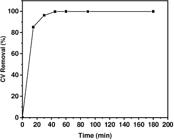
Since the PC material did not show significant removal rates, the effect of contact time on the HAH-PC was investigated. The results showed that more than 85% of the dye was removed within the first 15 min. This was followed by a slight increase in the adsorption rate until 99% removal was achieved after 45 min (Figure 5). This is attributed to the unoccupied adsorption sites on the surface of the HAH-PC. Many empty adsorption sites are available in the initial stages of adsorption. Due to the repulsive interactions between the CV molecules on the solid surface and the bulk phase, the remaining unoccupied surface sites may become difficult to fill after some time.15
Effect of CV pH solution
pH is a pivotal parameter in the removal of dyes from aqueous solutions. The pH of the medium directly influences the surface charge of both the adsorbent material and the dye molecules through processes of protonation or deprotonation. This alteration in charge determines whether the electrostatic interaction between the dye and the surface will be attractive or repulsive. To investigate the effect of pH on dye removal. The experiments involved treating a 100 ppm CV dye solution for a contact time of 30 min through three pH setpoints: 4, 7, and 10.
The result revealed that the optimal performance was achieved at pH 7, the removal efficiency reached its peak at 85%. Conversely, as the solution becomes basic, the effectiveness of the process is reduced significantly. At pH 10, the removal efficiency dropped sharply to 20%. The performance at pH 4 reduced slightly to 68%. At pH 7, the HAH-PC surface carries a strongly negative charge, which maximizes electrostatic attraction to the cationic CV species and explains the peak removal efficiency (85%) observed at this pH. As the solution becomes more basic (pH 10), the degree of CV dye ionization changes unfavorably,16,17 weakening this electrostatic attraction and accounting for the sharp drop in removal efficiency (20%). This correlation, together with the pH value, has been added to strengthen the mechanistic argument for the proposed adsorption mechanism.
This behavior can be explained by the surface chemistry involved. The superior removal rate in neutral conditions is attributed to the strong electrostatic attraction between the negatively charged surface and the CV dye, which exists in cationic form. In contrast, under basic conditions, the dye tends to convert to its non-ionized molecular form. This neutral state reduces the electrostatic attraction to the surface, thereby leading to a lower removal percentage, same behavior that has been reported previously.18,19
Effect of temperature
The effect of temperature on the adsorption of CV dye was studied. The adsorption of CV by HAH-PC is dependent on temperature (Figure 6). At 5 °C, the removal efficiency was low (38.7%); as the temperature increased to 10 and 20 °C, the removal efficiency increased sharply to 65 and 70%, respectively. The CV removal efficiency continues to rise, reaching its highest percentage of 87.8% at 60 °C. The slight increase in the adsorption capacity of CV onto HAH-PC as the solution temperature rises indicates that the process is endothermic.20 The increase in temperature improved the diffusion resistance of the adsorbate materials by accelerating the progression of CV from the solution to the vacant sites in HAH-PC. Table 4 summarizes HAH-PC compared to typical results found in adsorption studies for crystal violet.

Adsorption isotherm
Langmuir adsorption including the adsorbent reaction begins with the generation of a homogeneous monolayer of dye molecules on the adsorbent surface. Furthermore, adsorption occurs at specific active sites, with no interactions with adsorbent molecules or phase transitions.25
The adsorbent molecules are also unable to move across the surface or interact with neighboring molecules. This type of isotherm is denoted by the separation coefficient, the value of RL, which also indicates the nature of the adsorption. RL values between 0 and 1 indicate favorable adsorption conditions. Since RL (0.647) is positive, the adsorption of CV dye onto HAH-PC is a desirable process.26
The coefficient of determination of Langmuir isotherm is 0.99919 indicating that the sorption results fit the model well. The maximum monolayer coverage capacity (qmax) for the Langmuir adsorption equation model (Figure 7) was calculated to be 9.988 mg g-1.

The Freundlich model is frequently used when the surface of the adsorbent is heterogeneous. Figure 8 shows the Freundlich diagrams adsorption of the CV on HAH-PC. The R2 (coefficient of determination) is 0.80628 which means the adsorption system does not undergo Freundlich model.

The Temkin adsorption isotherm suggests that adsorption occurs on active and non-stoichiometric sites distributed across the adsorbent surface, with the most energetically active sites serving as the primary adsorption sites. Figure 9 shows the Temkin adsorption isotherm with R2 0.83049, which means there is some adsorbate-adsorbent interaction, but it is not the dominant mechanism.

The exceptionally high R2 value of the Langmuir model indicates an excellent agreement between the experimental data and the theoretical predictions, suggesting that the adsorption process follows a monolayer adsorption mechanism on a homogeneous surface with uniform energy sites.27 In contrast, the relatively lower correlation coefficients for the Freundlich and Temkin models suggest that surface heterogeneity and adsorbate-adsorbent interactions are not dominant factors in this system. Therefore, the Langmuir model provides the best representation of the adsorption behavior, confirming that the adsorption occurs through a uniform monolayer coverage rather than multilayer or heterogeneous surface interactions.28
The values obtained for the isotherm parameters for adsorption are shown in Table 1S (Supplementary Material). The maximum adsorption capacity (qmax) was estimated to be 9.99 mg g-1, representing the theoretical maximum surface coverage under the assumption of energetically homogeneous adsorption sites. The Langmuir affinity constant (b) was calculated as 0.647 L mg-1, indicating a moderate-to-strong interaction between HAH-PC and the dye and suggesting that the equilibrium is shifted toward a lower concentration of free dye in solution. The very low separation factor (RL) further designates that the adsorption process is favorable. In comparison, the Freundlich model provided a considerably weaker fit, with an R2 value of 0.806. Although the relatively high Freundlich exponent (n = 9.43) may suggest strong adsorption affinity, it is more likely revealing of the limited applicability of the multilayer adsorption model to the present system. Similarly, the Freundlich capacity coefficient (Kf = 6.41) has limited significance in this context. The Temkin model showed a moderate correlation (R2 = 0.830), with a Temkin heat of adsorption constant (bT) of 2760.9 J mol-1. The equilibrium binding constant (AT) was estimated to be 986.7 L mg-1, indicating relatively strong initial adsorbate-adsorbent interactions. The Temkin model further suggests that the adsorption energy decreases with increasing surface coverage, which may be attributed to interactions between adsorbed dye molecules.
Adsorption thermodynamics
Thermodynamic parameters provide key insight into the adsorption process, particularly where adsorbate molecules are taken up onto a porous solid surface with a constant void fraction that supports uniform distribution. In this study, the evaluated parameters included enthalpy change (∆H°), entropy change (∆S°), and Gibbs free energy change (∆G°).10 The values of ∆H° and ∆S° were determined from the slope and intercept of the linear plot of lnKd versus T-1 for a 100 ppm CV concentration (Figure 10), and the calculated thermodynamic values are summarized in Table 5. The positive ∆H° values indicate that the adsorption of CV onto HAH-PC is an endothermic process. Positive ∆S° values reflect strong affinity between the adsorbents and CV, as well as increased randomness at the adsorbent-solution interface during adsorption. The negative ∆G° values demonstrate that the adsorption process is spontaneous and thermodynamically feasible, with a favorable interaction between CV and both adsorbents.29

Recovery of CV dye from HAH-PC
To study dye removal from the HAH-PC, the material was treated after 100 ppm adsorption process. The adsorbent was centrifuged and the residual solution was discarded, then HAH-PC was washed with a suitable buffer solution (pH 10). Three solutions were used for dye recovery, buffer 10, isopropanol, and ethyl acetate. Figure 11 shows that isopropanol was the best solvent for dye recovery, with over 90% recovery within 15 min, followed by buffer 10 recovery, which recovered 64% of the dye. The HAH-PC adsorbent dissolved completely within 15 min of exposure to ethyl acetate, indicating that ethyl acetate is not a suitable solvent for the recovery of the CV dye.

Recovery of CV dye from HAH-PC by buffer 10, isopropanol and ethyl acetate solutions. *HAH-PC dissolved by the ethyl acetate solvent
CONCLUSIONS
A sorbent material was fabricated from polycarbonate recycled from compact discs (CDs) using a solvent-out method to develop a porous structure. The polycarbonate sorbent was treated with hydroxyl amine hydrochloride and the results demonstrate that the modified adsorbent has significant potential for the remediation of cationic dyes from industrial effluents, even at low concentrations and within short contact times. Notably, the treatment of polycarbonate with hydroxylamine hydrochloride enhanced the crystal violet (CV) removal efficiency by a factor of three. About 85% after 15 min and reach steady state after 45 min with 99% of CV removed by HAH-PC pH 7 and room temperature. Different physicochemical parameters were estimated and the removal data isotherm of Langmuir, Freundlich and Temkin were fitted. Langmuir model showed best fitting model with R2 of 0.99919. The maximum adsorption capacity of the surface was 9.988 mg g-1.
SUPPLEMENTARY MATERIAL
Supplementary material for this work is available at http://quimicanova.sbq.org.br/, as a PDF file, with free access.
DATA AVAILABILITY STATEMENT
All relevant data generated or analyzed during this study are fully included within the text, tables, and supplementary materials of this manuscript.
REFERENCES
-
1 Islam, T.; Repon, M. R.; Islam, T.; Sarwar, Z.; Rahman, M. M.; Environ. Sci. Pollut. Res. 2023, 30, 9207. [Crossref]
» Crossref -
2 Dobrosz-Gómez, I.; Quintero-Arias, J.-D.; Gómez-García, M.-Á.; Case Stud. Chem. Environ. Eng. 2024, 9, 100720. [Crossref]
» Crossref -
3 Zhou, A.; Almijbilee, M. M. A.; Zheng, J.; Wang, L.; Sep. Purif. Technol. 2021, 263, 118394. [Crossref]
» Crossref -
4 Ismail, G. A.; Sakai, H.; Chemosphere 2022, 291, 132906. [Crossref]
» Crossref -
5 El Messaoudi, N.; El Khomri, M.; El Mouden, A.; Bouich, A.; Jada, A.; Lacherai, A.; Iqbal, H. M. N.; Mulla, S. I.; Kumar, V.; Américo-Pinheiro, J. H. P.; Biomass Convers. Biorefin. 2024, 14, 11739. [Crossref]
» Crossref -
6 de Castro, C. S.; Viau, L. N.; Andrade, J. T.; Mendonça, T. A. P.; Gonçalves, M.; New J. Chem. 2018, 42, 14612. [Crossref]
» Crossref -
7 Somers, M. J.; Alfaro, J. F.; Lewis, G. M.; J. Cleaner Prod. 2021, 313, 127686. [Crossref]
» Crossref -
8 Din, S. F. M.; Khan, Z. I.; Othman, N.; Mousa, S.; Habib, U.; Mohamad, Z.; Ngadi, N.; Noor, M. H. M.; Mohsin, M. E. A.; Younes, M. Y.; Al Matar, R. A.; J. Thermoplast. Compos. Mater. 2025, 38, 4277. [Crossref]
» Crossref -
9 Zhang, W.; Song, H.; Zhu, L.; Wang, G.; Zeng, Z.; Li, X.; J. Environ. Chem. Eng. 2022, 10, 107202. [Crossref]
» Crossref -
10 Sen, N.; Shefa, N. R.; Reza, K.; Shawon, S. M. A. Z.; Rahman, M. W.; Sci. Rep. 2024, 14, 5349. [Crossref]
» Crossref -
11 Smith, B. C.; Spectroscopy 2022, 37, 16. [Crossref]
» Crossref -
12 Barjasteh-Askari, F.; Davoudi, M.; Dolatabadi, M.; Ahmadzadeh, S.; Heliyon 2021, 7, e07191. [Crossref]
» Crossref -
13 Lu, J.; Zhou, Y.; Zhou, Y.; Crit. Rev. Environ. Sci. Technol. 2023, 53, 1709. [Crossref]
» Crossref -
14 Zheng, H.; Guo, W.; Li, S.; Chen, Y.; Wu, Q.; Feng, X.; Yin, R.; Ho, S.-H.; Ren, N.; Chang, J.-S.; Bioresour. Technol. 2017, 244, 1456. [Crossref]
» Crossref -
15 Isik, B.; Avci, S.; Cakar, F.; Cankurtaran, O.; Environ. Sci. Pollut. Res. 2023, 30, 1333. [Crossref]
» Crossref -
16 Adams, E. Q.; Rosenstein, L.; J. Am. Chem. Soc. 1914, 36, 1452. [Crossref]
» Crossref -
17 Magde, D.; Windsor, M. W.; Chem. Phys. Lett. 1974, 24, 144. [Crossref]
» Crossref -
18 Sultana, S.; Islam, K.; Hasan, M. A.; Khan, H. M. J.; Khan, M. A. R.; Deb, A.; Al Raihan, M.; Rahman, M. W.; Environ. Nanotechnol., Monit. Manage. 2022, 17, 100651. [Crossref]
» Crossref -
19 Oloo, C. M.; Onyari, J. M.; Wanyonyi, W. C.; Wabomba, J. N.; Muinde, V. M.; Environ. Chem. Ecotoxicol. 2020, 2, 64. [Crossref]
» Crossref -
20 Kalaitzidou, K.; Zouboulis, A.; Mitrakas, M.; Water 2022, 14, 1163. [Crossref]
» Crossref -
21 Mall, I. D.; Srivastava, V. C.; Agarwal, N. K.; Dyes Pigm. 2006, 69, 210. [Crossref]
» Crossref -
22 Kumar, P. S.; Ramalingam, S.; Senthamarai, C.; Niranjanaa, M.; Vijayalakshmi, P.; Sivanesan, S.; Desalination 2010, 261, 52. [Crossref]
» Crossref -
23 Zhuang, X.; Wan, Y.; Feng, C.; Shen, Y.; Zhao, D.; Chem. Mater. 2009, 21, 706. [Crossref]
» Crossref -
24 Ahmad, R.; J. Hazard. Mater. 2009, 171, 767. [Crossref]
» Crossref -
25 Kalam, S.; Abu-Khamsin, S. A.; Kamal, M. S.; Patil, S.; ACS Omega 2021, 6, 32342. [Crossref]
» Crossref -
26 Kheradmand, A.; Negarestani, M.; Kazemi, S.; Shayesteh, H.; Javanshir, S.; Ghiasinejad, H.; Sci. Rep. 2022, 12, 14623. [Crossref]
» Crossref -
27 Islam, M. A.; Chowdhury, M. A.; Mozumder, M. S. I.; Uddin, M. T.; ACS Omega 2021, 6, 14481. [Crossref]
» Crossref -
28 Miskhan, S. F. A.; Takeshi, Y.; Hamzas, M. F. M. A.; Lokman, N. F.; IOP Conference Series: Earth and Environmental Science 2025, 1548, 012032. [Crossref]
» Crossref -
29 Tan, S. C.; Shi, P. H.; Su, R. J.; Zhu, M. C.; Adv. Mater. Res. 2012, 424-425, 1313. [Crossref]
» Crossref


