 NUTRITIONAL COMPOSITION OF CHLORELLA SUPPLEMENTS IN THE BRAZILIAN MARKET
Abstract
The microalgae Chlorella is known for its high photosynthetic capacity and rich nutritional profile. This study analyzed the fatty acid composition of twenty brands of Chlorella supplements available in the Brazilian market. The results revealed significant differences. Palmitic acid (16:0) exhibited the highest concentrations in samples 8 and 9. In contrast, samples 4, 13, 17 and 19 presented lower levels of palmitic acid. The concentration of linoleic acid (18:2n-6) peaked at 19.67 mg in sample 12, while sample 19 recorded the lowest level of 3.9 mg. Alpha-linolenic acid (18:3n-3) was the most abundant. Antioxidant capacity was evaluated using 2,2-diphenyl-1 picrylhydrazyl (DPPH) and 2,2’-azino-bis(3-ethylbenzothiazoline-6-sulfonic acid) (ABTS) assays. The results showed varying levels of free radical scavenging, with sample 4 exhibiting the highest values in ABTS (319.17 ± 16.57 µmol Trolox equivalents (TE) g-1) and DPPH (525.43 ± 24.04 µmol TE g-1) assays, followed by samples 19 and 12. Mineral analysis revealed significant variations in iron and zinc concentrations among samples. Iron content ranged from 49.8 to 770 mg 100 g-1, and zinc concentrations ranged from 2.38 to 12.2 mg 100 g-1. These findings highlight the nutritional value of Chlorella as a supplement, offering antioxidant protection and essential minerals that may aid in the prevention of chronic diseases.
Keywords:
fatty acids; phenolic compounds; iron; zinc; antioxidants.
INTRODUCTION
The growing global pursuit of quality of life and longevity has intensified the demand for natural solutions that promote health.1 In this context, microalgae emerge as innovative alternatives due to their wide range of beneficial compounds. They play a significant role in health promotion, aiding in weight loss, improving gut health, and consequently strengthening the immune system. In addition, they help reduce low density-lipoprotein (LDL) and total cholesterol levels and improve insulin resistance.2-4
Among them, the microalgae Chlorella, a green unicellular species, has gained prominence in the Asian market and has spread to many regions worldwide. Although its natural growth occurs in lakes and rivers, cultivation is optimized in large freshwater tanks.5 Chlorella cultivation has several applications in the cosmetic, food, biofuel, and pharmaceutical industries. Furthermore, recent studies6 have shown the potential of Chlorella to remove heavy metals from aquatic environments. This ability not only contributes to human health, but also promotes sustainability and benefits ecosystems as a whole.
There are more than 30 species of Chlorella, with C. vulgaris and C. pyrenoidosa being the most studied. The consumption of Chlorella is particularly valued due to its superior natural composition, which includes a higher protein content than soy. This microalga is also rich in fiber, polysaccharides with antioxidant properties, and α-glucan, which contribute to improved immunity.7
Recent studies8 have shown that the microalga Chlorella contains considerable amounts of iron and zinc, which can significantly contribute to human nutrition. Including this microalga in the diet can provide these minerals in a more sustainable and efficient way, especially in populations at high risk of deficiency.9 The bioavailability of these metals in Chlorella is influenced by the presence of antioxidants, which can enhance the absorption and utilization of these nutrients in the body. Thus, the consumption of Chlorella not only offers a rich source of iron and zinc but also enhances their benefits due to the positive interaction with antioxidant compounds present in the alga.10
The determination of fatty acids can be performed by gas chromatography, a highly recommended technique due to its high resolution, sensitivity, and speed.11 For the analysis of phenolic compounds and antioxidants, the ABTS (2,2’-azino-bis(3-ethylbenzothiazoline-6-sulfonic acid)) method offers a faster alternative compared to other approaches, with minimal interference, good versatility, and the ability to evaluate both hydrophobic and hydrophilic antioxidants. The determination of iron and zinc can be carried out using flame atomic absorption spectrometry (FAAS), a commonly used technique for elemental analysis.12
Considering the increasing consumption of Chlorella-based supplements and the limited availability of comparative data regarding their nutritional composition in the Brazilian market, this study aimed to systematically evaluate and compare the nutritional and functional quality of commercial Chlorella supplements. Specifically, the objective was to characterize the fatty acid profile, determine the antioxidant capacity and phenolic content, and quantify essential minerals (iron and zinc) in twenty different commercial brands. By integrating lipid composition, antioxidant activity, and mineral content, this study seeks to assess the variability among commercial products, verify whether these supplements effectively provide bioactive compounds associated with health benefits, and provide scientifically grounded information to support their use as functional dietary supplements. This comprehensive evaluation contributes to a better understanding of the nutritional potential of Chlorella supplements and supports quality assessment, consumer guidance, and future regulatory considerations.
EXPERIMENTAL
Reagents
Chloroform, methanol, n-heptane, and sulfuric acid were acquired from Millipore Sigma (Darmstadt, Germany). A standard mixture of methyl esters of fatty acids (FAMEs) (FAME standard mixture, C4 C24) and methyl tricosanoate (PI 23:0) were purchased from Millipore Sigma (Saint Louis, USA). For antioxidant analysis, ABTS, DPPH, and 6-hydroxy-2,5,7,8 tetramethylchroman-2-carboxylic acid (Trolox) were acquired from Sigma-Aldrich (Darmstadt, Germany). Methanol, ethanol, and potassium persulfate (analytical grade) were purchased from ACS Científica (São Paulo, Brazil). Nitric acid was acquired from FMaia (São Paulo, Brazil) and hydrogen peroxide was supplied by Merck (São Paulo, Brazil).
Samples
A total of 20 different brands of the microalgae Chlorella, from various species, were purchased from the local markets in the city of Maringá, Paraná, Brazil. All of them were homogenized, sealed in tubes and stored at -18 °C until analysis. Table 1 shows the information provided by manufacturers on the product labels.
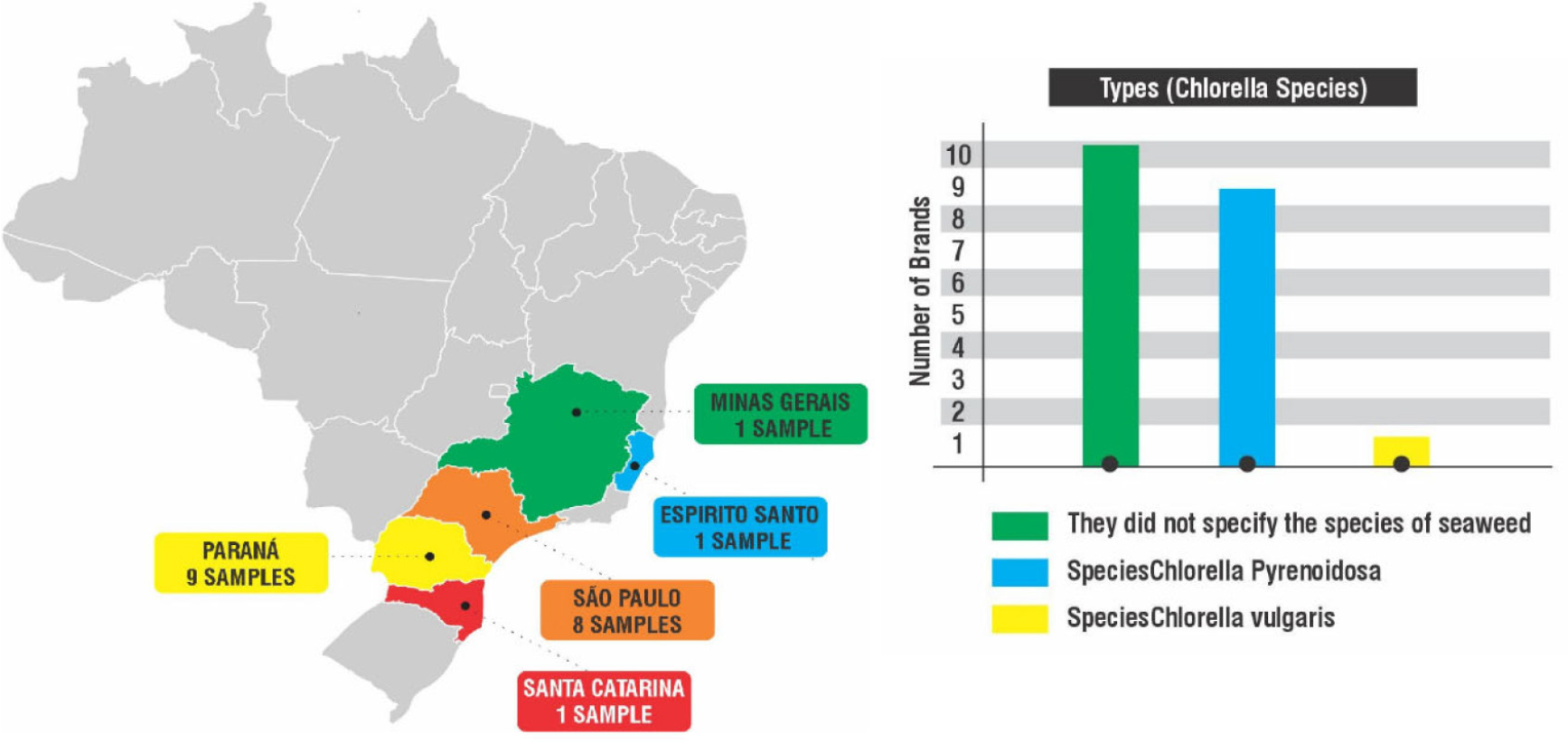
Ten samples did not specifiy the Chlorella species on their labels. Among those identified, nine corresponded to Chlorella pyrenoidosa and one to Chlorella vulgaris. In terms of geographic origin, the samples were distributed as follows: nine from Paraná, eight from São Paulo, and one each from Espírito Santo, Santa Catarina, and Minas Gerais, as shown in Figure 1.

Methylation
Lipid methylation was performed according to the ISO 550913 standard. Initially, 100 mg of RO were weighed into a test tube and mixed with 2.0 mL of n-heptane. The tube was shaken for 2 min. Subsequently 2.0 mL of a potassium hydroxide solution in methanol (2.0 mol L-1) was added, and the mixture was shaken for an additional 2 min. Then, 500 µL of the internal standard methyl tricosanoate (23:0) was added, and the tubes were shaken for 1 min. After complete phase separation, the organic phase was collected and subjected to chromatographic analysis. The same procedure was applied to SO and adulterated samples.
Fatty acid methyl esters (FAMEs) of RO and adulterated samples were analyzed using a TRACE™ Ultra gas chromatograph (Thermo Scientific™, USA) equipped with a flame ionization detector (FID). FAME identification was performed by comparing retention times with analytical standards, and the results were expressed as mg g-1 of samples (Equation 1), automatically processed using Chromquest™ 5.0 software (Thermo Fisher Scientific, USA).
where FA is the fatty acid concentration (mg FA g-1 samples); AX is the peak area of the FA; AP is the peak area of the internal standard (methyl tricosanoate, 23:0); MP is the mass of internal standard added to the sample; MX is the sample mass; FCT is the theoretical correction factor; and FCAE is the conversion factor required to express the results as mg of fatty acids.13
Chromatographic analysis
The fatty acid profiles of the samples were identified using a Shimadzu GC-2010 Plus gas chromatograph equipped with a flame ionization detector (FID). Injection mode were performed in split/splitless mode, using a CP-7420 capillary column (100 m × 0.25 mm, 0.25 µm cyanopropyl, Varian, USA). A 2.0 µL aliquot of each sample was injected in triplicate. Gas flow rates were set at 1.4 mL min-1 for the carrier gas (H2), 30 mL min-1 for the auxiliary gas (N2), and 30 and 300 mL min-1 for the flame gases (H2 and synthetic air, respectively). The gas chromatography (GC) oven was programmed to an initial temperature of 185 °C, held for 12 min at a heating rate of 16 °C min-1, followed by an increase to 235 °C at 20 °C min-1, held for 9 min. Retention times and peak areas of analytes and standards were used for the identification FAMEs. Results were expressed as mg of fatty acids per g of sample.
Antioxidant activity
For antioxidant activity analyses using DPPH and ABTS, extracts of Chlorella at 8 g L-1 in ethanol were prepared. All analyses were performed in triplicate.
The ABTS assay was conducted according to modifications of the method proposed by Rufino et al.14 It involved preparing 50 mL of an ABTS stock solution by dissolving 192 mg of ABTS in ethanol and filling up to volume in a volumetric flask. The ABTS+ radical was then generated by mixing 5 mL of the stock solution with 88 µL of 140 nM potassium persulfate solution. This mixture was kept at room temperature in the dark for 16 h. Subsequently, 1 mL of the mixture was diluted in ethanol until reaching an absorbance of 0.700 ± 0.05 at 734 nm, measured using an ultraviolet-visible (UV-Vis) spectrophotometer (Genesys 10-S, Thermo Scientific, Madison, USA).
For the assays, 3.0 mL of the ABTS radical solution was mixed with a 30 µL aliquot of the extracts or calibration curve samples (y = -0.0002x + 0.6773) in 15 × 100 mm test tubes. After 6 min, the absorbance was read at 734 nm on the spectrophotometer, initially calibrated with ethanol. Results were expressed as µmol Trolox equivalents per gram of sample (µmol TE g-1).
The DPPH assay was performed following the method described by Thaipong et al.15 with modifications. Stock solutions of DPPH (6.086 × 10⁻⁴ mol L-1) and Trolox (2000 µmol L-1) were prepared in methanol. The working DPPH solution was prepared by diluting 10 mL of the stock solution to approximately 80 mL with methanol, adjusting the absorbance to 0.700 ± 0.05, measured by UV-Vis spectrophotometry (Genesys 10-S, Thermo Scientific, Madison, USA). A calibration curve was prepared from the Trolox solution (y = -0.0003x + 0.6969), with concentrations ranging from 0 to 1800 µmol L-1.
For the assays, 25 µL of the samples (extracts or calibration curve points) were added to 15 × 100 mm glass test tubes containing 2 mL of the working DPPH solution. After 30 min of incubation in the dark, absorbance was read at 517 nm, and results were expressed as µmol Trolox equivalents per gram of sample (µmol TE g-1).
Iron and zinc determination
For iron and zinc determination, the samples were subjected to conventional acid digestion using concentrated nitric acid. Initially, 0.5 g of each sample was weighed into a 50 mL Erlenmeyer flask, and 10 mL of nitric acid was added. The temperature was increased on a hot plate to approximately 120 °C. Once the system was almost dry, an additional 10 mL of nitric acid was added together with 2 mL of hydrogen peroxide to ensure complete oxidation of organic compounds. When the system was almost dry again, the remaining content was transferred to a Falcon tube and diluted with ultrapure water to a final volume of 50 mL.
The determination of iron in the samples was performed using FAAS. A wavelength of 248.3 nm, slit width of 0.2 nm, and hollow cathode lamp current of 5.0 mA were employed. The gas mixture used was air/acetylene, with flow rates of 3.5 L min-1 for air and 1.5 L min-1 for acetylene, all parameters set according to the specifications of the manufacturer. Background correction was performed using a deuterium lamp to minimize spectral interferences. The figures of merit of the method showed a limit of detection (LOD) of 0.0252 mg L-1 and a limit of quantification (LOQ) of 0.485 mg L-1. The calibration curve was linear over the concentration range of 0.1 to 15 ppm, with the regression equation y = 0.0464x + 0.0095 and a determination coefficient (R2) of 0.9970. According to National Health Surveillance Agency (ANVISA) guidelines,16 an R2 value above 0.99 indicates excellent linearity, confirming the validity of the employed method.
Zinc determination was also performed using FAAS. The wavelength used was 213.9 nm, with a slit width of 1.0 nm and a hollow cathode lamp current of 5.0 mA. The gas mixture and flow rates were the same as those used for iron determination. Background correction was performed using a deuterium lamp to ensure accuracy by minimizing interferences.
The figures of merit of the method for zinc determination demonstrated a LOD of 0.000731 mg L-1 and a LOQ of 0.00688 mg L-1. The calibration curve was linear in the concentration range of 0.01 to 2 ppm, with the regression equation y = 0.9887x + 0.0194 and R2 of 0.9957, indicating excellent fit of the experimental data to the linear model. According to ANVISA, an R2 above 0.99 is considered adequate for validation of analytical methods, confirming the robustness of the procedure used.
Chemometrics analysis
The fatty acids identified by gas chromatography with flame ionization detection (GC-FID) in the samples were subjected to multivariate statistical analysis. Unsupervised techniques such as principal component analysis (PCA) and hierarchical cluster analysis (HCA) were employed to explore similarities among the samples based on their lipid composition. These analyses were performed using the R software, version 4.2.3 (R Core Team, Austria, 2023).
RESULTS AND DISCUSSION
Fatty acids
The microalgae Chlorella possesses a high photosynthetic capacity and is rich in micronutrients, including chlorophyll, proteins, vitamins, minerals, and various fatty acids such as palmitic acid, alpha-linolenic acid, and linoleic acid, among others. This microalga is considered safe for human consumption, being classified as GRAS (generally recognized as safe), and can be used as food or a supplement without causing health harm. Moreover, it may have beneficial therapeutic effects.8,17
Fatty acids (FAs) represent the major lipid fraction in microalgae. In some species, polyunsaturated fatty acids (PUFAs) may constitute between 25 and 60% of total lipids.15 Microalgae can adjust lipid production in response to changes in the chemical composition of the cultivation medium, allowing them to modulate their metabolism according to environmental conditions.
Linoleic acid (omega-6) is an essential polyunsaturated fatty acid that plays a key role in the synthesis of prostaglandins, which regulate various bodily functions such as immune response and inflammation.18
Alpha-linolenic acid (omega-3) is another essential polyunsaturated fatty acid, serving as a precursor to long-chain omega-3 fatty acids such as eicosapentaenoic acid (EPA) and docosahexaenoic acid (DHA). Omega-3 fatty acids are known for their cardiovascular, cognitive, and anti-inflammatory health benefits. These fatty acids also participate in the transfer of atmospheric oxygen to blood plasma, hemoglobin synthesis, and cell division, being termed essential because they cannot be synthesized by the body from de novo fatty acid synthesis.19
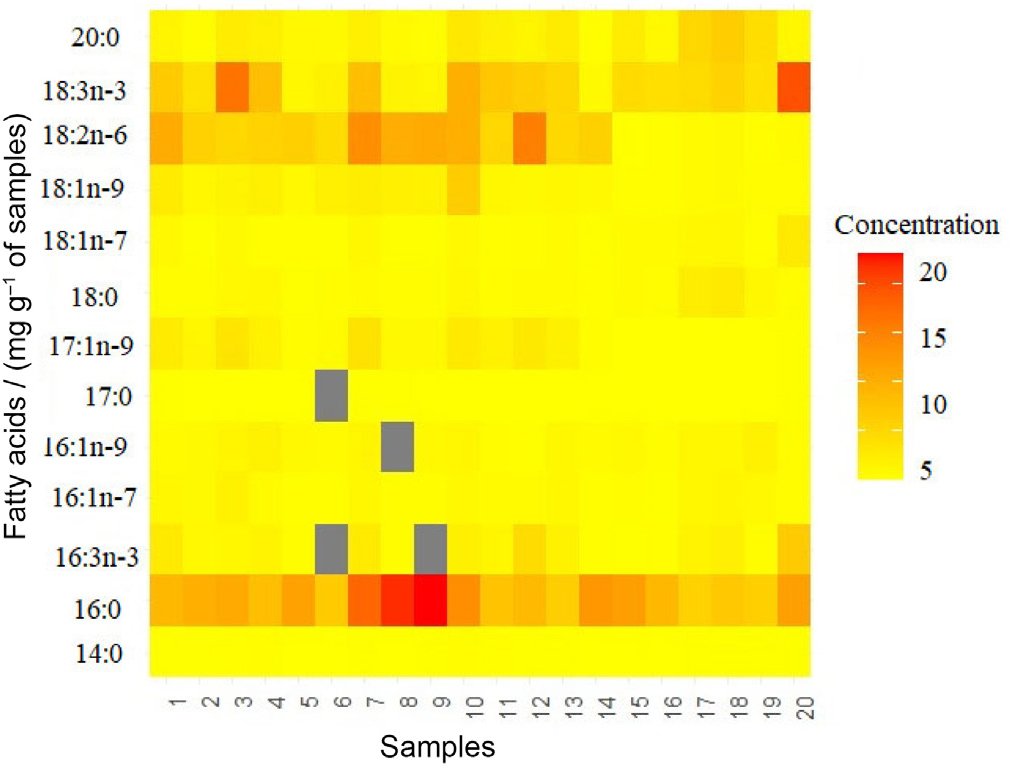
To verify the authenticity of Chlorella supplements sold on the Brazilian market, twenty brands were acquired, and fatty acid composition analysis was performed, as shown in Figure 2.
The fatty acid analysis allowed the quantification of thirteen fatty acids across all evaluated Chlorella brands. It was observed that palmitic acid (16:0) showed higher concentrations in samples 8 and 9 compared to the others. Palmitic acid is a significant energy source for the body, metabolized by cells to produce adenosine triphosphate (ATP), which is essential for proper physiological functioning. When consumed at adequate levels, it efficiently provides calories, particularly meeting the energy demands of tissues such as muscles and the brain. Conversely, samples 4, 13, 17, and 19 exhibited lower amounts of this fatty acid relative to the others.
According to Table 2, the concentration of linoleic acid (18:2n 6) was highest in sample 12, with 19.67 mg per sample, compared to sample 19, which showed the lowest concentration, with 3.92 mg per sample. Regarding alpha-linolenic acid (18:3n 3), samples 3 and 20 showed the highest concentrations, with a statistically significant difference compared to the others, followed by sample 10. On the other hand, samples 5, 8, 9, and 14 registered the lowest concentrations, which may compromise the quality of the supplementation, especially considering the importance of this essential fatty acid for human health. It should be noted that the label of sample 16 does not specify the species of Chlorella used in the product.
Alpha-linolenic acid provides numerous benefits, playing an essential role in physiological processes such as regulation of lipid metabolism, protection against inflammation, improvement of brain and cardiovascular functions, as well as contributing to skin health and the immune system.
The analysis of saturated, polyunsaturated, and monounsaturated fatty acids in Chlorella samples showed that ten samples had a higher concentration of polyunsaturated fatty acids, while nine were characterized by a predominance of saturated fatty acids. Notably, sample 12 was the only one among all evaluated to present the highest concentration of monounsaturated fatty acids.
Each type of fatty acid performs specific functions in the body. Monounsaturated fatty acids, often considered the most beneficial, help reduce LDL cholesterol and may improve cardiovascular health. Among the analyzed samples, sample 7 exhibited the highest concentration of polyunsaturated fatty acids. Sample 12 stood out by presenting the highest combined concentrations of saturated, polyunsaturated, and monounsaturated fatty acids. Regarding saturated fatty acids, sample 9 registered the highest concentration, with a value of 30.14 ± 3.11 μg.
In 100 g of Chlorella microalga, it is possible to find between 2 and 5 g of fatty acids, including 1 to 3 g of monounsaturated fatty acids and 3 to 7 g of polyunsaturated fatty acids. According to Radmann and Costa,8 palmitic acid (C16:0) ranged from 0.73 to 4.36% in the analyzed microalgae. This fatty acid is essential in infant nutrition, being present in concentrations between 20 and 30% in human breast milk. Arachidic acid (C20:0) was the most abundant among saturated fatty acids, with a concentration of 29.10% in Chlorella vulgaris. Other saturated fatty acids varied between 0.08 and 8.18%.
When comparing the two species evaluated among the twenty supplement brands, Chlorella pyrenoidosa was predominant in most samples. Although Chlorella vulgaris is more adaptable to cultivation and offers a good nutrient source, its nutritional profile is slightly inferior to that of C. pyrenoidosa. The latter exhibits higher concentrations of essential nutrients such as proteins, chlorophyll, and fatty acids, and is considered more effective for detoxification and immune system strengthening. However, C. pyrenoidosa is more expensive and requires more specific cultivation conditions.20
Antioxidant activity
The antioxidant activity results were evaluated against the DPPH and ABTS+ free radicals, and the findings are presented in Table 3.
According to Table 3, all twenty Chlorella samples analyzed exhibited the ability to scavenge DPPH and ABTS radicals at varying levels. The Chlorella sample with the highest concentration in the ABTS assay was sample 4, with 319.17 ± 16.57 µmol TE g-1, followed by samples 19 and 12, with 304.17 ± 4.77 and 182.50 ± 7.21 µmol TE g-1, respectively. In the DPPH assay, sample 4 again showed the highest concentration, with 525.43 ± 24.04 µmol TE g-1, followed by samples 8 and 19, with 22.64 ± 3.24 and 22.57 ± 1.97 µmol TE g-1, respectively.
Thus, all analyzed samples demonstrated antioxidant capacity; however, the highest concentrations were observed in sample 4 for both ABTS and DPPH radicals, which may be related to the presence of a high content of electron-donating compounds, such as phenolic compounds - including tannins, flavonoids, and terpenes.21
The consumption of foods with antioxidant potential is extremely important for maintaining human health. These compounds are found in higher amounts mainly in plants such as Chlorella and can act as a defense system for the human body, slowing the oxidation processes that naturally occur in the organism due to the production of free radicals (chemical molecules with at least one unpaired electron) generated in certain metabolic processes. The benefits of consuming foods with antioxidant properties are numerous, including the prevention of chronic degenerative diseases such as Alzheimer’s disease, Parkinson’s disease, rheumatoid arthritis, cardiovascular diseases, among other clinical conditions.22,23
Iron and zinc determination
Quantifying iron and zinc content in Chlorella supplements is important for nutritional, physiological, technological, and regulatory reasons, especially when considering the consumption of these products as alternative sources of micronutrients. The results of iron and zinc concentration are shown in Table 4.
The analysis of iron concentrations in the Chlorella samples revealed significant variation among them, with values ranging from 49.8 mg 100 g-1 (sample 15) to 770 mg 100 g-1 (sample 13). Most samples showed iron concentrations between 200 and 300 mg 100 g-1, except for atypical cases, such as sample 13, which stood out for its substantially high value. This variation may be associated with environmental and methodological factors, as well as the cultivation and processing conditions of Chlorella, which can influence mineral accumulation.
According to the guidelines of the Brazilian Health Regulatory Agency (ANVISA),16 the recommended daily intake of iron for adults is 14 mg. Considering the concentrations found in the Chlorella samples, this microalga stands out as an excellent dietary source of iron, especially beneficial for vegetarians, in whom iron bioavailability tends to be lower due to the absence of animal sources in the diet.24
Regarding zinc, the analyzed samples showed concentrations ranging from 2.38 to 12.2 mg 100 g-1. This range positions Chlorella as a good source of zinc, an essential mineral for immune function and protein synthesis. The daily recommendation for zinc is 7 mg for women and 9.5 mg for men, according to ANVISA. However, zinc bioavailability can be compromised in diets rich in phytates, such as those that include cereals and legumes. Therefore, the consumption of foods rich in bioavailable zinc, such as Chlorella, is important to ensure adequate intake of this mineral.
A greater homogeneity in zinc concentrations was also observed among the samples compared to iron, which may reflect a lower sensitivity of microalgae to environmental variation or a more consistent control during cultivation and processing.
CONCLUSIONS
The analysis of twenty Chlorella supplements revealed significant diversity in fatty acid composition, with palmitic acid standing out as the main source of energy, as well as linoleic and α-linolenic acids, which are essential for cardiovascular and brain health. All samples showed significant antioxidant activity, with sample 4 being the most prominent, a result associated with the presence of phenolic compounds capable of neutralizing free radicals and reducing oxidative stress. Furthermore, significant variation was observed in the levels of iron and zinc, minerals essential for protein synthesis, immune function, and the prevention of nutritional deficiencies. Thus, Chlorella supplementation shows promise for promoting health, offering nutritional and antioxidant support that can help prevent chronic diseases. However, the variability between products highlights the need for greater standardization in cultivation and processing processes to ensure the quality and efficacy of commercially available supplements.
DATA AVAILABILITY STATEMENT
All data generated or analyzed during this study are included in this published article.
REFERENCES
-
1 Fanzo, J.; Covic, N.; Dobermann, A.; Henson, S.; Herrero, M.; Pingali, P.; Staal, S.; Global Food Security 2020, 26, 100397. [Crossref]
» Crossref -
2 Jin, J. B.; Cha, J. W.; Shin, I.; Jeon, J. Y.; Cha, K. H.; Pan, C.; J. Sci. Food Agric. 2020, 100, 2938. [Crossref]
» Crossref -
3 Sherafati, N.; Bideshki, M. V.; Behzadi, M.; Mobarak, S.; Asadi, M.; Sadeghi, O.; Complementary Therapies in Medicine 2022, 66, 102822. [Crossref]
» Crossref -
4 Moradi, M.; Behrouj, H.; Alipoor, B.; Kheiripour, N.; Ghasemi, H.; J. Food Biochem. 2021, 45, e13914. [Crossref]
» Crossref -
5 Zhou, L.; Li, K.; Duan, X.; Hill, D.; Barrow, C.; Dunshea, F.; Martin, G.; Suleria, H.; Food Biosci. 2022, 49, 101932. [Crossref]
» Crossref -
6 Rossato, A.; Oliveira, P. S.; Sagrillo, M. R.; Disciplinarum Scientia 2021, 22, 25. [Crossref]
» Crossref -
7 Bito, T.; Okumura, E.; Fujishima, M.; Watanabe, F.; Nutrients 2020, 12, 2524. [Crossref]
» Crossref -
8 Radmann, E. M.; Costa, J. A. V.; Quim. Nova 2008, 31, 1609. [Crossref]
» Crossref -
9 Safi, C.; Zebib, B.; Merah, O.; Pontalier, P. Y.; Vaca-Garcia, C.; Renewable Sustainable Energy Rev. 2014, 35, 265. [Crossref]
» Crossref -
10 Chacón-Lee, T. L.; González-Mariño, G. E.; Compr. Rev. Food Sci. Food Saf. 2010, 9, 655. [Crossref]
» Crossref -
11 Milinsk, M. C.; Matsushita, M.; Visentainer, J. V.; de Oliveira, C. C.; de Souza, N. E.; J. Braz. Chem. Soc. 2008, 19, 1475. [Crossref]
» Crossref -
12 Aydinoglu, S.; Braz. J. Pharm. Sci. 2022, 58, e21094 [Crossref
» Crossref -
13 ISO 5509: Animal and Vegetable Fats And Oils-Preparation of Methyl Esters of Fatty Acids, International Standardization Organization, Geneva, 1978; Piccioli, A.; Santos, P.; da Silveira, R.; Bonafe, E.; Visentainer, J. V.; Santos, O. O.; J. Braz. Chem. Soc. 2019, 7, 1350. [Crossref]
» Crossref -
14 Rufino, M. S. M.; Albuquerque, I. G.; Brito, E. S.; Morais, S. M.; Anais do VI Encontro do Talento Estudantil da Embrapa Recursos Genéticos e Biotecnologia; Brasília, Brazil, 2001. [Link] accessed in March 2026
» Link -
15 Thaipong, K.; Boonprakob, U.; Crosby, K.; Cisneros-Zevallos, L.; Byrne, D. H.; J. Food Compos. Anal. 2006, 19, 669. [Crossref]
» Crossref -
16 Agência Nacional de Vigilância Sanitária (ANVISA); Resolução da Diretoria Colegiada (RDC) No. 166, de 24 de junho de 2017, Dispõe sobre a Validação de Métodos Analíticos e dá Outras Providências; Diário Oficial da União (DOU), Brasília, Brasil, 2017. [Link] accessed in March 2026
» Link -
17 Gulcin, I.; Arch. Toxicol. 2020, 94, 651. [Crossref]
» Crossref -
18 Costa, J. A. V.; de Morais, M. G.; Dalcanton, F.; Reichert, C. C.; Durante, A. J.; Z. Naturforsch., C 2006, 61, 105. [Crossref]
» Crossref -
19 Moraes, F. P.; Rev. Eletronica Farm. 2007, 3. [Crossref]
» Crossref -
20 Martin, C. A.; de Almeida, V. V.; Ruiz, M. R.; Visentainer, J. E. L.; Matsushita, M.; Souza, N. E.; Rev. Nutr. 2006, 19, 761. [Crossref]
» Crossref -
21 Panahi, Y.; Darvishi, B.; Jowzi, N.; Beiraghdar, F.; Curr. Pharm. Des. 2015, 22, 164. [Crossref]
» Crossref -
22 Pereira, J. C.; Martins, A. B.; Rocha, M. C. F.; Cavalcante Jr., S. M.; Feitosa, C. M.; Research, Society and Development 2021, 10, e10310716196. [Crossref]
» Crossref -
23 Wilson, D.; Nash, P.; Buttar, H.; Griffiths, K.; Singh, R.; de Meester, F.; Horiuchi, R.; Takahashi, T.; Antioxidants 2017, 6, 81. [Crossref]
» Crossref -
24 Gibson, R. S.; Bailey, K. B.; Gibbs, M.; Ferguson, E. L.; Food Nutr. Bull. 2010, 31, S134. [Crossref]
» Crossref