 CONSTRUCTION OF THE ChCl-Zn(Ac)2 CATALYTIC SYSTEM AND OPTIMIZATION OF THE PROCESS CONDITIONS FOR DIRECT SYNTHESIS OF PLASTICIZER DOTP FROM WASTE PET VIA CATALYTIC ALCOHOLYSIS
Abstract
Using waste polyethylene terephthalate (PET) as the feedstock, diisooctyl terephthalate (DOTP) was directly synthesized via alcoholysis with isooctanol (2-EH) over an environmentally friendly choline chloride-zinc acetate (the ChCl-Zn(Ac)2 catalyst)-deep eutectic solvent (DES). This approach overcame the limitations of traditional methods by offering simplicity, low cost, tunable composition, excellent environmental compatibility, and superior chemical stability. The study systematically investigated the effects of reaction temperature, catalyst dosage, molar ratio of 2-EH to PET, and reaction time on the synthesis process. Response surface methodology (RSM) was employed to optimize the process conditions, with the optimal parameters determined as follows: reaction temperature of 180 °C, catalyst dosage of 5.19%, molar ratio of 2-EH to PET of 4.89 mol mol-1, and reaction time of 87.30 min. Under these optimal conditions, PET was completely degraded, and the DOTP yield reached as high as 87.59%. The ChCl-Zn(Ac)2 catalyst exhibited stable performance, significantly enhanced both the PET degradation rate and the DOTP yield. This study provides a feasible technical solution for the efficient resource utilization of waste PET, offers a reference for developing green catalytic synthesis processes of DOTP, and expands the application potential of DES catalysts in polyester degradation.
Keywords:
waste PET; DES; ChCl-Zn(Ac)2; 2-EH; DOTP.
INTRODUCTION
Polyethylene terephthalate (PET), one of the world’s highest-volume synthetic polymers, is a high-performance thermoplastic polyester with excellent physical properties, chemical stability, and electrical insulation. Its low temperature sensitivity, non-toxicity, odorlessness, low cost, and safety make it indispensable in daily production and life, with widespread applications across industries. However, due to PET’s high stability and resistance to natural degradation, recycling technologies for its waste products have become a global priority. Converting waste PET into diisooctyl terephthalate (DOTP) not only mitigates environmental pollution but also enables high-value utilization of waste, fully aligning with the circular economy principles.
In catalytic systems for PET chemical recycling, deep eutectic solvents (DESs) exhibit unique properties, including low toxicity,1,2 renewability,3,4 environmental friendliness,5-7 excellent solubility,8-10 and excellent conductivity. Additionally, they offer advantages such as readily available raw materials,11 simple preparation processes,12,13 and low cost.14,15 These characteristics confer significant research value for the broad application of DESs across multiple fields.16,17 Currently, DESs are emerging as novel catalytic systems and represent a new research focus in chemistry. Formed through hydrogen bonding between two or more components, DESs exhibit melting points significantly lower than those of their individual components.18-21 Their catalytic performance can be optimized by controlling component types and ratios. Extensive studies have demonstrated the potential of DESs in PET depolymerization; for example, Wang et al.22 first reported PET glycolysis with ethylene glycol (EG) using urea/metal salt eutectic mixtures (e.g., urea/ZnCl2 4:1, urea/Zn(OAc)2·2H2O, urea/Mn(OAc)2·4H2O 12:1-6:1), achieving 80% bis(2-hydroxyethyl) terephthalate (BHET) yield from PET pellets at 170 °Cfor 30 min. Liu et al.23 obtained > 99% PET conversion and > 80% BHET yield (high-performance liquid chromatography (HPLC) analysis) via 1,3-dimethylurea (1,3 DMU)/Zn(OAc)2 DES. Additionally, Wang et al.24 synthesized a DES@ZIF-8 composite (where ZIF-8 is zeolitic imidazolate framework-8), and under optimal conditions, PET conversion reached 100% with 83.2% BHET yield. In summary, while existing studies have confirmed the advantages of DESs in PET depolymerization, their depolymerization products are primarily BHET intermediates. Research into the “technology chain” for the direct synthesis of high-value DOTP from waste PET, mediated by the ChCl-Zn(Ac)2 catalyst, remains notably inadequate. More importantly, there are no reports on optimizing process conditions for DOTP synthesis via PET depolymerization. To address these gaps, this study synthesized the green DES catalyst ChCl-Zn(Ac)2. Using this catalyst, the alcoholysis of waste PET into high-performance plasticizer DOTP was achieved. Through single-factor variable experiments, the effects of catalyst dosage, molar ratio of 2-ethylhexanol (2-EH) to PET, reaction temperature, and reaction time on the PET degradation rate and DOTP yield were systematically investigated. The structure of the target product DOTP was characterized and verified via Fourier transform infrared (FTIR) and nuclear magnetic resonance (1H NMR). Optimal process conditions were determined through response surface methodology (RSM) optimization, providing a theoretical basis and practical reference for the efficient, green, and high-value recycling of waste PET. This work also offers more reliable technical support for scaling up the process to an industrial scale.
EXPERIMENTAL
Materials and instruments
Materials
Waste Nongfu Spring PET beverage bottles were cut into 0.5 cm × 0.5 cm fragments; choline chloride (ChCl): 98%, Tianjin Ruijinte Chemical Co., Ltd.; 2-EH: > 99%, Shanghai Aladdin Reagent Co., Ltd.; zinc acetate (Zn(Ac)2): 99%, Shanghai McLean Chemical Reagent Co., Ltd.
Instruments
A TENSOR II FTIR spectrometer (Bruker Corporation, Germany) with a spectral collection range of 400-4000 cm-1; an AVANCE 1H NMR spectrometer (Bruker Corporation, Germany), for which 5 mg of sample was completely dissolved in deuterated chloroform (CDCl3) solvent and allowed to stand for defoaming prior to testing; and a SHZ-DIII vacuum pump (Gongyi Yuhua Instrument Co., Ltd., China) with a vacuum degree of 0.03-0.05 MPa were used.
Preparation of ChCl-Zn(Ac)2 catalyst
ChCl and Zn(Ac)2 were added to a three-necked flask at a molar ratio of 1:1 and stirred. Under an N2 atmosphere, the mixture was heated to 50 °C at a rate of 5 °C min-1 until it turned liquid. It was then slowly heated to 90 °C and held for 6 h to obtain a homogeneous, transparent DES catalyst ChCl-Zn(Ac)2. This catalyst had a melting point of 46-50 °C, significantly lower than that of pure ChCl or Zn(Ac)2. After preparation, the catalyst was immediately transferred to a vacuum drying oven, dried overnight at 80 °C, naturally cooled to room temperature, and sealed for storage.
Alcoholysis of PET for DOTP synthesis catalyzed by the ChCl-Zn(Ac)2 catalyst
Reaction equation of PET alcoholysis
With 2-EH as the alcoholysis agent, PET undergoes alcoholysis catalyzed by the ChCl-Zn(Ac)2 catalyst, producing DOTP and ethylene glycol (EG). The reaction equation is illustrated in Figure 1.

Experimental procedure for DOTP preparation via 2-EH depolymerization of PET
The experimental flowchart for the synthesis of DOTP via alcoholysis-depolymerization of PET is shown in Figure 2.

Accurately weighed 5.0 g PET fragments, 16.96 g 2-EH (n(2 EH):n(PET) = 5:1), and 0.25 g the ChCl-Zn(Ac)2 catalyst (5% of PET mass) were sequentially added to a 150 mL three-necked flask. The mixture was heated in a constant-temperature oil bath with magnetic stirring, and timing began when the preset temperature was reached. After reaction, heating was stopped, and the system was naturally cooled. When cooled to 90 °C, hot vacuum filtration was performed. The filter cake was dried at 80 °C for 8 h, weighed, and used to calculate the PET degradation rate. The filtrate was processed as follows: first, it was placed in a 65 °C water bath for 1 h and vacuum-filtered; then transferred to a 45 °C water bath for another hour and re-filtered (G4 sand core funnel used for both steps) to remove oligomers. The filtrate was then washed with a 3% Na2CO3 aqueous solution; Na2CO3 neutralizes residual acidic impurities in the system, reacts with dissolved Zn2+ to form precipitates for removing the catalyst, and adjusts the system to neutral or weakly alkaline conditions to prevent DOTP decomposition due to acidity during subsequent distillation. After washing, the system was allowed to settle and then separated into layers. The upper liquid fraction was subjected to vacuum distillation to remove excess 2-EH (which can be recovered and recycled). The distillation residue constituted the target product DOTP. The lower liquid fraction was then distilled to remove water, with EG recovered.
Among them, the calculation formulas for PET degradation rate (P) and DOTP yield (Q) were as follows:
where m1 is the initial mass of PET added (g), m2 is the mass of undegraded PET (g), m3 is the actual mass of DOTP produced (g), and m4 is the theoretical maximum mass of DOTP (g) that can be produced.
RESULTS AND DISCUSSION
Influencing factors of DOTP preparation via 2-EH depolymerization of PET
Effect of the ChCl-Zn(Ac)2 catalyst dosage
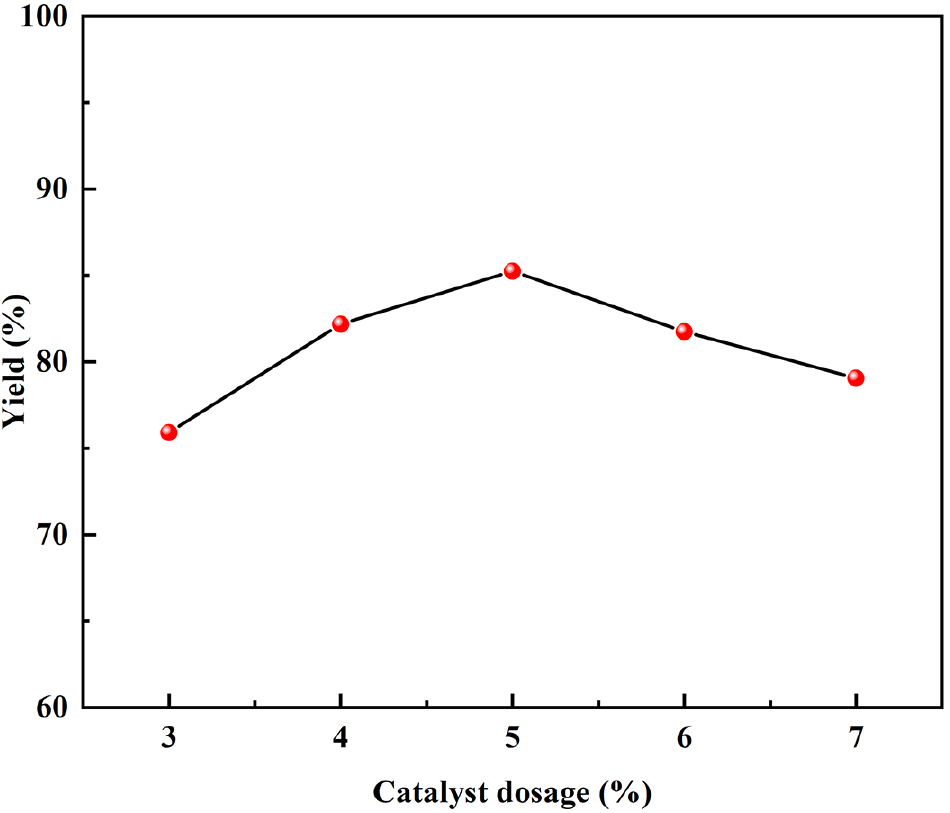
Figure 3 shows the effect of the ChCl-Zn(Ac)2 catalyst dosage (based on the mass of PET) on the yield of the target product DOTP, under the conditions of a 2-EH-to-PET molar ratio of 5:1, reaction temperature of 180 °C, and reaction time of 70 min.

As shown in Figure 3, the DOTP yield first increased and then decreased with the increase in catalyst dosage. When the catalyst dosage was low, the number of active sites was insufficient, resulting in a slow reaction rate. As the catalyst dosage increased, the catalytic efficiency was enhanced, promoting more thorough alcoholysis of PET and thereby increasing the DOTP yield. When the catalyst dosage was excessive, it triggered side reactions or increase impurity content. An excess of the ChCl-Zn(Ac)2 catalyst promoted dehydration condensation of 2-EH in the reaction system, yielding ether impurities such as di(2-ethylhexyl) ether via dehydration. Simultaneously, excess Zn2+ might react with intermediates like the terephthalic acid monoester generated from PET degradation, forming insoluble salt impurities such as zinc terephthalate. These impurities not only complicated subsequent product separation and purification but might also reduce DOTP purity. Therefore, a catalyst dosage of 5% by weight of PET was considered optimal for this experiment.
Effect of 2-EH-to-PET molar ratio
Under the conditions of a catalyst dosage of 5%, a reaction temperature of 180 °C, and a reaction time of 70 min, the effect of the 2-EH-to-PET molar ratio on the DOTP yield is presented in Figure 4.

As can be seen from Figure 4, the DOTP yield first increased and then decreased with increasing 2-EH-to-PET molar ratio. 2-EH acted as both a reactant and a solvent: when its dosage was low, the intermediate products generated from PET alcoholysis could not fully react with 2-EH to form the target product DOTP, resulting in a low yield. When the dosage of 2-EH was excessively high, it diluted the catalyst concentration and reduced reaction efficiency. Additionally, excessive 2-EH increased DOTP loss during the separation process, leading to a slight decrease in yield.
Influence of reaction temperature
Under the conditions of a 5% catalyst dosage, a 2-EH-to-PET molar ratio of 5:1, and a reaction time of 70 min, the effect of reaction temperature on DOTP yield is shown in Figure 5.

Reaction temperature was a key factor affecting the quality and yield of DOTP. At lower alcoholysis temperatures, the reaction rate slowed, PET underwent incomplete alcoholysis, more intermediate products remained, and the DOTP yield decreased. With a boiling point of 183-186 °C for 2-EH and a thermal stability temperature of the ChCl-Zn(Ac)2 catalyst typically ranging from 180-220 °C, excessively high alcoholysis temperatures reduced 2-EH content in the liquid phase. At 200 °C, ChCl might undergo decomposition reactions such as HCl elimination and carbonization. At 237 °C, Zn(Ac)2 might undergo thermal decomposition, leading to damage to the eutectic catalyst structure and loss of catalytic activity. This was detrimental to the PET alcoholysis reaction, not only reducing yield but also increasing energy consumption. As clearly observed in Figure 5, the optimal alcoholysis temperature using the ChCl-Zn(Ac)2 catalyst was 180 °C.
Effect of reaction time
With a catalyst dosage of 5%, a 2-EH-to-PET molar ratio of 5:1, and a reaction temperature of 180 °C, the effect of reaction time on DOTP yield was shown in Figure 6.

As can be seen from Figure 6, if the reaction time was too short, the alcoholysis reaction between PET and 2-EH was incomplete, leaving a large amount of residual oligomers and resulting in a low DOTP yield. Under the experimental conditions, when the reaction time exceeded 75 min, the yield of the alcoholysis product (DOTP) almost ceased to increase.
Response surface methodology experiments and optimization of process conditions
Box-Behnken experimental design
Based on the single-factor experimental results of the PET alcoholysis reaction, the main factors influencing the direct synthesis of DOTP via catalytic alcoholysis of waste PET - using the ChCl Zn(Ac)2 catalyst at a reaction temperature of 180 °C - were catalyst dosage, 2-EH-to-PET molar ratio, and reaction time.
The Box-Behnken design in response surface methodology was employed to design the experimental protocol and conduct experiments, aiming to determine the optimal process conditions for the direct synthesis of DOTP via PET alcoholysis. The specific coding design of the three influencing factors and their respective three levels in the response surface experiment is presented in Table 1.
The yield (Y) of DOTP directly synthesized via waste PET alcoholysis was used as the response value. Experiments were conducted following the Box-Behnken design protocol, and the results presented in Table 2.
Model simulation and analysis
Based on the experimental results in Table 2, the quadratic regression model was established between the response value (DOTP yield, Y) and the three key factors (in coded forms: catalyst dosage (A), 2-EH-to-PET molar ratio (B), reaction time (C)) as follows:
To verify the significance and reliability of the established model, analysis of variance (ANOVA) and significance test were performed, and the results presented in Table 3.
The ANOVA results in Table 3 showed that the model F-value was 122.72 with a p-value < 0.0001, demonstrating overall strong significance and confirming the reliable fit of the model to the experimental data. The molar ratio of 2-EH to PET (p = 0.0002 < 0.01) and reaction time (p < 0.0001) exerted particularly significant effects on DOTP yield. Based on the F-value, the order of significance for these three factors (catalyst dosage, molar ratio of 2-EH to PET, reaction time) in the model was: reaction time > molar ratio of 2-EH to PET > catalyst dosage. Among the quadratic and interaction terms, the interaction between catalyst dosage and reaction time exhibited excellent significance (p = 0.0006 < 0.01), indicating that their synergistic effect significantly influenced the model results. Furthermore, the p-value for the lack-of-fit term of the model was 0.7030 (> 0.05), further validating its stability and applicability.
Response surface analysis
The response surface of the interaction between catalyst dosage and reaction time is shown in Figure 7.

Under conditions where reaction temperature and reactant molar ratio were kept constant, Figure 7 illustrated the variation characteristics of DOTP yield with reaction time and catalyst dosage as independent variables. Analysis of the 3D surface plot showed that, at a fixed reaction time, the yield increased significantly first and then decreased with increasing catalyst dosage. Under the experimental conditions, as the reaction time was extended, the catalyst dosage needed to be increased accordingly to maintain a relatively high DOTP yield. As can be seen from the contour plots, the interaction between reaction time and catalyst dosage was extremely significant, and this conclusion was mutually corroborated by the results of the ANOVA analysis, which further verified the reliability of the experimental data.
Adequacy test of the response surface model
Based on the results of response surface analysis, the process conditions for the PET alcoholysis reaction catalyzed by the ChCl Zn(Ac)2 catalyst were optimized using Design Expert 13 software (Stat-Ease, USA, 2021). At a reaction temperature of 180 °C, the optimal process conditions were as follows: catalyst dosage of 5.19%, reaction time of 87.30 min, and a 2-EH-to-PET molar ratio of 4.89 mol mol-1. Under these conditions, the DOTP yield predicted by the model was 87.72%.
To verify the reliability of the model, three sets of parallel experiments were conducted under the aforementioned optimal conditions. The actual average yield of DOTP was measured to be 87.59%, which was very close to the predicted yield of the model. This result fully confirmed the accuracy and reliability of the response surface predictions of the model. A comparison between the model-predicted optimal conditions and those from the single-factor experiments revealed high consistency: the deviation in catalyst dosage was only 0.19%; that in the 2-EH/PET molar ratio was 0.11 mol mol-1; the optimal reaction time of 87.30 min fell within the stable range (centered at 75 min) determined by the single-factor experiment. This indicated that the single-factor experiments provided a reliable foundation for response surface optimization, thereby collectively confirming the validity of the optimal conditions.
Currently, multiple DES catalytic systems have been employed for PET depolymerization research: Liu et al.25 achieved glycolysis of PET with EG using betaine/Zn(OAc)2 as a catalyst at 190 °C for 60 min, with a BHET yield exceeding 80%; He et al.26 employed a FeCl3/lactic acid (LA) DES system for PET depolymerization; at 130 °C for 120 min, they achieved a 98.7% PET conversion rate with a terephthalic acid (TPA) yield of 94.3%; Li et al.27 employed the non-metallic deep eutectic solvent (DES) 1,5-diazabicyclo[4.3.0]pent-5 ene (DBN)/phenol as a catalyst for PET methanolysis; at 130 °C for 60 min, they achieved 100% PET degradation and a DMT (dimethyl terephthalate) yield of 95.3%. In contrast, this study employed the low-melting-point ChCl-Zn(Ac)2 catalyst to degrade PET using 2-EH. Under reaction conditions of 180 °C for 87.30 min, not only was 100% PET conversion achieved, but also an 87.59% yield of DOTP was obtained. The DOTP synthesized in this system was a high-performance, ready-to-use plasticizer that requires no further processing, making it more industrially valuable than systems yielding BHET, TPA, or DMT.
Characterization of the ChCl-Zn(Ac)2 catalyst
FTIR spectroscopic characterization of the ChCl-Zn(Ac)2 catalyst
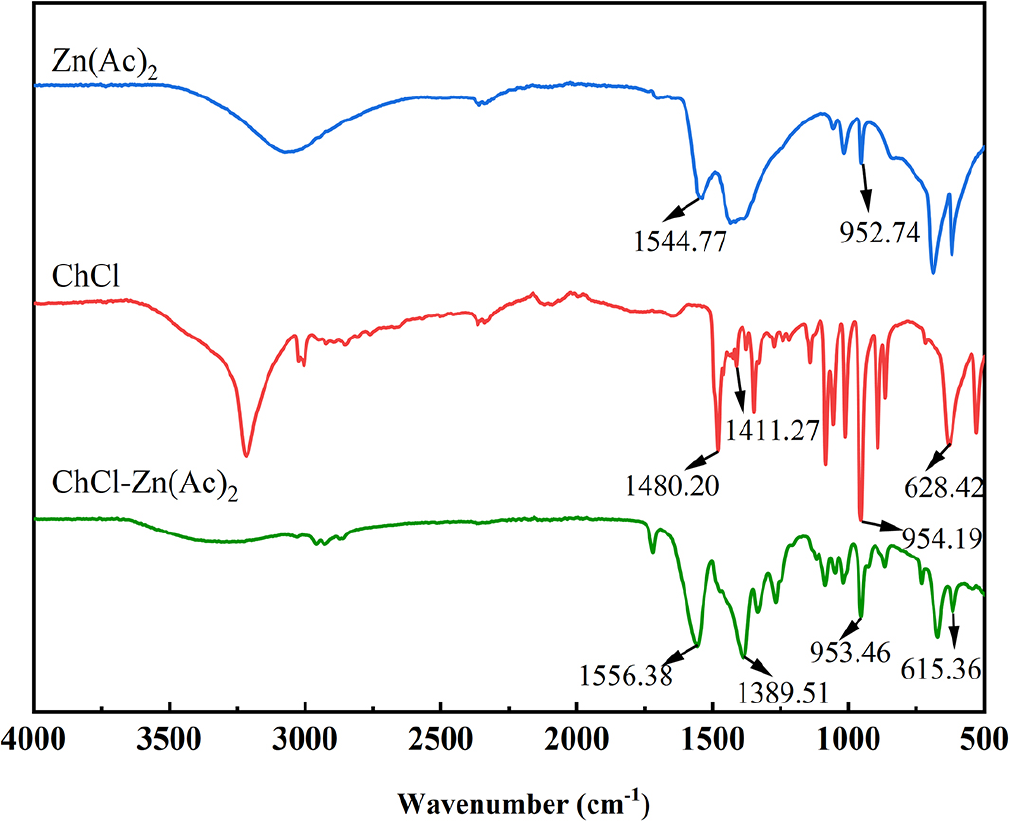
The deep eutectic ChCl-Zn(Ac)2 catalyst, prepared by fusing ChCl and Zn(Ac)2 at a molar ratio of 1:1 at 90 °C for 1 h, was characterized by FTIR spectroscopy. The results are presented in Figure 8.

It could be seen from the FTIR that the synthesized ChCl Zn(Ac)2 catalyst essentially covered the characteristic functional group peaks of both Zn(Ac)2 and ChCl. For example, the peaks at 952.74, 954.19, and 953.46 cm-1 were highly similar. This indicated that the basic functional groups in the raw material components still existed in the ChCl-Zn(Ac)2 catalyst system, demonstrating that the two components were combined through intermolecular interactions rather than undergoing destructive chemical reactions to form new substances, which was consistent with the characteristics of a eutectic system. Meanwhile, when the ChCl-Zn(Ac)2 catalyst was compared with its raw materials (ChCl and Zn(Ac)2), distinct differences were observed in the characteristic peaks of certain functional groups. For instance, ChCl exhibited a peak at 1480.20 cm-1, while Zn(Ac)2 showed a peak at 1544.77 cm-1; in the synthesized ChCl-Zn(Ac)2 catalyst, the peak shifted to 1556.38 cm-1. Such changes in peak position were typically associated with intermolecular interactions, particularly hydrogen bonding. The formation of hydrogen bonds altered the electron density and vibrational environment of functional groups, thereby causing shifts in infrared absorption frequencies. This finding strongly supported the hypothesis that new hydrogen bonds were formed between ChCl and Zn(Ac)2, and further explained the intermolecular interactions that underpinned the stability of their eutectic system. Additionally, the peak positions of the -CH3 bending vibration and C-Cl bond in ChCl shifted from 1411.27 and 628.42 cm-1 to 1389.51 and 615.36 cm-1, respectively, exhibiting a significant red shift. This indicated that the newly formed intermolecular interactions (e.g., hydrogen bonds) influenced the bond energies of the pre-existing -CH3 and C-Cl bonds. Specifically, the electronic effect of intermolecular interactions led to a decrease in the bond energies of these functional groups, thereby inducing the observed red shift phenomenon.
1H NMR spectroscopic characterization of the ChCl-Zn(Ac)2 catalyst
The 1H NMR characterization results of the deep eutectic ChCl-Zn(Ac)2 catalyst were presented in Figure 9.

Comparing the 1H NMR spectra of ChCl, Zn(Ac)2, and ChCl Zn(Ac)2 (DES), after excluding background peaks (d 2.50 ppm for water, d 3.30 ppm for dimethyl sulfoxide (DMSO)), the DES spectrum included all characteristic peaks of the two starting materials. The DES exhibited peaks at d 3.11, 3.41 and 3.84 ppm (assigned to methyl H, N-bonded methylene H, and hydroxyl-adjacent methylene H, respectively), which aligned with the analogous peaks of ChCl (d 3.34, 3.61, 3.97 ppm). The peak at d 1.77 ppm in the DES and the peak at d 1.79 ppm in Zn(Ac)2 both corresponded to the methyl H on the acetate ion; while these hydrogen atoms shared consistent chemical shift assignments, subtle deviations persisted. This phenomenon correlated with the red shift observed in FTIR analysis. The underlying cause resided in the DES synthesis process: noncovalent interactions (e.g., hydrogen bonds) between ChCl and Zn(Ac)2 altered the chemical environment of the hydrogen atoms. Furthermore, the characteristic peak at d 5.89 ppm in the ChCl spectrum, representing hydroxyl H, was absent in the DES spectrum. This finding indicated that during synthesis, the hydroxyl group of ChCl acted as a hydrogen bond donor, interacting with Zn(Ac)2 (as a hydrogen bond acceptor) to form stable hydrogen bonds, thereby confirming the successful synthesis of the ChCl-Zn(Ac)2 catalyst, the target choline-based DES catalyst.
Characterization of DOTP
FTIR characterization results
FTIR characterization was performed on DOTP, which was directly synthesized via PET alcoholysis catalyzed by the ChCl Zn(Ac)2 catalyst, with the results presented in Figure 10.

The comparison of infrared spectral characterization between the product DOTP obtained in this experiment and the DOTP standard sample revealed that the measured product exhibited a series of characteristic absorption peaks consistent with the structure of DOTP. The absorption peaks at 2956.64 and 2861.04 cm-1 corresponded to the -CH3 groups in the DOTP molecule; the peak at 1718.05 cm-1 was characteristic of the C=O group; the absorption peak at 1459.77 cm-1 was attributed to the benzene ring skeletal vibration absorption peak; the peaks at 1262.85 and 1100.18 cm-1 were characteristic absorptions of the C-O-C group; the peak at 727.74 cm-1 corresponded to the out-of-plane bending vibration absorption of the C-H bond in the benzene ring. All these characteristic peaks were fully consistent with the typical infrared absorption features of DOTP functional groups, confirming that the measured product was indeed DOTP.
1 H NMR characterization results
1 H NMR characterization was performed on DOTP synthesized directly via PET alcoholysis catalyzed by the ChCl-Zn(Ac)2 catalyst, with the results shown in Figure 11.

Figure 11 presents the characteristic chemical shifts of hydrogen atoms in different chemical environments within the target product molecule. 1H NMR (400 MHz, DMSO) d 8.09 (s, 4H), 4.24 (dd, J 5.6, 2.4 Hz, 4H), 1.70 (p, J 6.0 Hz, 2H), 1.43-1.27 (m, 16H), 0.93-0.85 (m, 12H). The integral area of each characteristic peak was proportional to the number of hydrogen atoms in the corresponding chemical environment. This property enables accurate determination of the distribution of hydrogen atoms in the molecule, providing a key basis for confirming the molecular structure of DOTP and thereby further verifying the successful direct synthesis of DOTP.
Reaction mechanism
The reaction mechanism of DOTP synthesis through PET alcoholysis catalyzed by the ChCl-Zn(Ac)2 catalyst is illustrated in Figure 12.
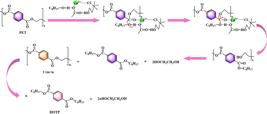
As shown in Figure 12, the ChCl-Zn(Ac)2 catalyst first formed hydrogen bonds with 2-EH, activating its hydroxyl group to participate in PET transesterification; subsequently, zinc ions attacked the PET carbonyl group to form a tetrahedral intermediate, generating EG through transesterification. As the reaction progressed, PET long chains broke down and degree of polymerization decreased, ultimately yielding DOTP. The acid-base synergistic catalysis of the ChCl-Zn(Ac)2 catalyst enables mild and efficient degradation of PET.
CONCLUSIONS
This study successfully synthesized the green DES catalyst ChCl-Zn(Ac)2 using ChCl and Zn(Ac)2 as raw materials, providing an integrated solution for PET waste treatment. Compared to traditional physical recycling with low product value and chemical recycling using strong acids/bases that may cause secondary pollution, this system achieved 100% depolymerization of waste PET under mild conditions (180 °C with 5.19% catalyst dosage), directly converting it into high-value plasticizer DOTP with a yield of 87.59%. This advancement propelled PET resources from “low-level recycling” toward “high-quality value enhancement”. It established a new technological bridge for recycling waste PET resources and producing green plasticizers, simultaneously addressing solid waste disposal challenges and meeting the demand for environmentally friendly chemical products. This innovation holds significant practical value and application prospects.
DATA AVAILABILITY STATEMENT
All data generated or analyzed during this study are included in the present manuscript.
ACKNOWLEDGMENTS
Thanks to all the authors for their efforts in completing this manuscript.
REFERENCES
-
1 Zhang, H.; Cui, X.; Wang, H.; Wang, Y.; Zhao, Y.; Ma, H.; Chai, L.; Wang, Y.; Hou, X.; Deng, T.; Polym. Degrad. Stab. 2020, 181, 109342. [Crossref]
» Crossref -
2 Pinho, M. R.; Lima, A. S.; Oliveira, G. A. R.; Liao, L. M.; Franceschi, E.; da Silva, R.; Cardozo-Filho, L.; J. Chem. Eng. Data 2024, 69, 3403. [Crossref]
» Crossref -
3 Landa-Castro, M.; Aldana-González, J.; de Oca-Yemha, M. M.; Romero Romo, M.; Arce-Estrada, E.; Palomar-Pardavé, M.; J. Alloys Compd. 2020, 830, 154650. [Crossref]
» Crossref -
4 Maxim, C.; Blaga, A. C.; Tataru-Farmus, R.-E.; Suteu, D.; Processes 2024, 12, 1686. [Crossref]
» Crossref -
5 Wang, H.; Ma, X.; Cheng, Q.; Xi, X.; Zhang, L.; J. Chem. 2018, 2018, 9579872. [Crossref]
» Crossref -
6 Jiang, W.; Jia, H.; Li, H.; Zhu, L.; Tao, R.; Zhu, W.; Li, H.; Dai, S.; Green Chem. 2019, 21, 3074. [Crossref]
» Crossref -
7 Li, D.; Frontiers in Plant Science 2022, 13, 1004332. [Crossref]
» Crossref -
8 Couling, D. J.; Bernot, R. J.; Docherty, K. M.; Dixon, J. K.; Maginn, E. J.; Green Chem. 2006, 8, 82. [Crossref]
» Crossref -
9 Hansen, B. B.; Spittle, S.; Chen, B.; Poe, D.; Zhang, Y.; Klein, J. M.; Horton, A.; Adhikari, L.; Zelovich, T.; Doherty, B. W.; Gurkan, B.; Maginn, E. J.; Ragauskas, A.; Dadmun, M.; Zawodzinski, T. A.; Baker, G. A.; Tuckerman, M. E.; Savinell, R. F.; Sangoro, J. R.; Chem. Rev. 2021, 121, 1232. [Crossref]
» Crossref -
10 Rahman, M. S.; Roy, R.; Jadhav, B.; Hossain, M. N.; Halim, M. A.; Raynie, D. E.; J. Mol. Liq. 2021, 321, 114745. [Crossref]
» Crossref -
11 Bušić, V.; Roca, S.; Vikić-Topić, D.; Vrandečić, K.; Ćosić, J.; Molnar, M.; Gašo-Sokač, D.; Environ. Chem. Lett. 2020, 18, 889. [Crossref]
» Crossref -
12 Li, L.; Wu, Z.; Xi, X.; Liu, B.; Cao, Y.; Xu, H.; Hu, Y.; J. Renewable Mater. 2021, 9, 219. [Crossref]
» Crossref -
13 Ayvaz, A.; Demirbaş, S. G.; Demirbaş, A.; Demirbaş, N.; Curr. Org. Chem. 2023, 27, 585. [Crossref]
» Crossref -
14 Xiong, X.; Zhang, H.; Lai, S. L.; Gao, J.; Gao, L.; React. Funct. Polym. 2020, 149, 104502. [Crossref]
» Crossref -
15 Zhang, M.; Song, H.; Zheng, C.; Liu, S.; Lin, Z.; Liu, Y.; Wu, W.; Gao, X.; J. Air Waste Manage. Assoc. 2021, 71, 1492. [Crossref]
» Crossref -
16 Zhang, Q.; Vigier, K. O.; Royer, S.; Jérôme, F.; Chem. Soc. Rev. 2012, 41, 7108. [Crossref]
» Crossref -
17 Qin, H.; Hu, X.; Wang, J.; Cheng, H.; Chen, L.; Qi, Z.; Green Energy Environ. 2020, 5, 8. [Crossref]
» Crossref -
18 Deepika; Juneja, S.; Pandey, S.; J. Chem. Eng. Data 2022, 67, 3400. [Crossref]
» Crossref -
19 Abbott, A. P.; Boothby, D.; Capper, G.; Davies, D. L.; Rasheed, R. K.; J. Am. Chem. Soc. 2004, 126, 9142. [Crossref]
» Crossref -
20 Jaglan, P.; Kumar, M.; Kaushik, D.; Kumar, A.; Argyropoulos, D.; Oz, F.; Proestos, C.; Results Chem. 2024, 7, 101445. [Crossref]
» Crossref -
21 Radmard, J.; Sani, A. M.; Arianfar, A.; Vaziri, B. M.; Sci. Rep. 2024, 14, 148. [Crossref]
» Crossref -
22 Wang, Q.; Yao, X.; Geng, Y.; Zhou, Q.; Lu, X.; Zhang, S.; Green Chem. 2015, 17, 2473. [Crossref]
» Crossref -
23 Liu, B.; Fu, W.; Lu, X.; Zhou, Q.; Zhang, S.; ACS Sustainable Chem. Eng. 2019, 7, 3292. [Crossref]
» Crossref -
24 Wang, R.; Wang, T.; Yu, G.; Chen, X.; Polym. Degrad. Stab. 2021, 183, 109463. [Crossref]
» Crossref -
25 Liu, L. F.; Yao, H.; Zhou, Q.; Yao, X.; Yan, D.; Xu, J.; Lu, X.; J. Environ. Chem. Eng. 2022, 10, 107512. [Crossref]
» Crossref -
26 He, Y.; Li, X.; Liu, Y.; J. Environ. Chem. Eng. 2025, 13, 118221. [Crossref]
» Crossref -
27 Li, J.; Yan, D.; Cheng, X.; Rong, C.; Feng, J.; Feng, X.; Xin, J.; Zhou, Q.; Li, Y.; Xu, J.; Lu, X.; Ind. Eng. Chem. Res. 2024, 63, 12373. [Crossref]
» Crossref
Edited by
-
Associate Editor handled this article:
Eduardo H. S. Sousa