 Epidemiology, economic losses, and management implications associated with pneumonia-related mortality in feedlots from Brazil
ABSTRACT:
Cattle death due to pneumonia-related mortalities (PRM) is a major problem in beef cattle feedlots worldwide. However, compared to other major beef-producing countries, Brazil lacks sufficient data on these losses, having no information to define the optimal feeding duration for cattle. This study investigated PRM at three beef cattle feedlots in the major cattle production states of Brazil over a 24-month period. PRM was the second cause of cattle mortality at these feedlots and accounted for 20.2% (142/703) of all mortalities. Nelore cattle had higher chances (OR = 1.79, p= 0.006) to develop PRM as compared with crossbreed animals, while cattle maintained in feedlots from Mato Grosso were at elevated risk (OR = 1.74, p = 0.031) to develop PRM relative to those maintained in the feedlots from Minas Gerais. Logistic regression revealed that PRM risk decreased with time on feed, confirming that PRM are more likely (p= 0.0005) to be elevated during the earlier days of cattle on-feed at these feedlots. The occurrence of PRM was not influenced by the sex (p= 0.653) of the animal affected nor seasonal variations (p = 0.653). The estimated annual cost of PRM at these feedlots was 105,027 USD, with a projected national cost of 4.040 M USD. A statistical model projected that it may be profitable to maintain cattle in these feedlots for approximately 120-130 days, after which financial investment declines. These results demonstrate the importance of PRM to the local beef cattle industry and emphasize the need to investigate other factors that may influence reduced productivity in beef cattle feedlots in Brazil.
INDEX TERMS:
Bovine respiratory disease; economic impacts; feedlot economics; lung pathology; statistical modeling
RESUMO:
A morte de bovinos devido as mortalidades relacionadas à pneumonia (MRP) é um problema enorme nos confinamentos de bovinos em todo o mundo. No entanto, comparado a outros grandes países produtores de carne bovina, o Brasil carece de dados suficientes sobre essas perdas, sem dados nacionais para definir a duração ideal de alimentação para o bovino de corte. Este estudo investigou as MRP em três confinamentos de bovinos durante um período de 24 meses nos principais estados produtores de bovino do Brasil. As MRP foram a segunda causa de mortalidade bovina nesses confinamentos e representaram 20,2% (142/703) de todas as mortalidades. Os animas da raça Nelore apresentando maior possibilidade (OR = 1.79, p= 0.006) à MRP em comparação com animais cruzados, enquanto bovinos mantido sem confinamentos do Mato Grosso apresentou risco elevado (OR = 1,74, p= 0,031) de desenvolver MRP em comparação com os bovinos nos confinamentos de Minas Gerais. A regressão logística revelou que o risco de MRP diminuiu com o período no cocho, confirmando que a MRP tem maior probabilidade (p= 0,0005) de ser elevada durante os primeiros dias de alimentação do gado nesses confinamentos. A ocorrência da MRP não foi influenciada pelo sexo (p= 0,653) do animal afetado nem pelas variações sazonais (p= 0,653). O custo anual estimado do MRP nesses lotes de ração foi de 105.027 USD, com um custo nacional projetado de 4,040 milhões de USD. Um modelo estatístico projetou que pode ser lucrativo manter os bovinos nesses confinamentos por aproximadamente 120-130 dias, após os quais há uma queda no investimento financeiro. Esses resultados demonstraram a importância do MRP para a indústria nacional de bovinocultura e enfatizam a necessidade de investigar outros fatores que podem influenciar a redução da produtividade nos confinamentos de bovinos no Brasil.
TERMOS DE INDEXAÇÃO:
Doença respiratória bovina; impactos econômicos; economia de confinamento; patologia pulmonar; modelagem estatística
Introduction
Bovine respiratory disease (BRD) is a multifactorial and multietiological disease complex that is caused by a wide range of disease pathogens, with bacterial and viral agents being responsible for most of the pulmonary diseases identified in feedlot cattle (Fulton et al. 2009, Caswell et al. 2012, Castro et al. 2021, O’Donoghue et al. 2025). Pulmonary diseases, particularly those due to BRD, are among the most significant contributors to morbidity and mortality in feedlot cattle worldwide (Snowder et al. 2006, Castro et al. 2021). Cattle mortality in feedlots frequently results from the manifestations of BRD (Loneragan et al. 2001, O’Donoghue et al. 2025). Identifying the frequency and causes of cattle mortality in feedlots is fundamental for establishing preventative measures. However, most of the scientific information relative to the occurrence of mortality in beef cattle feedlots available in Brazil is based on data obtained from North America (Cusack et al. 2007, Babcock et al. 2013a, 2013b, Yamada et al. 2025) and Australia (Hay et al. 2014, 2016, Sackett et al. 2006, Blakebrough-Hall et al. 2020). Alternatively, similar information based on investigations conducted in Brazil is lacking, studies are incipient, and with relatively few published data (Malafaia et al. 2016, Baptista et al. 2017, 2025).
As global demand for beef production increases (Greenwood 2021), Brazil has become the second-largest producer of beef, accounting for 19-20% of all beef consumed worldwide in 2024 (Greenwood 2021, ABIEC 2024, USDA-FAS 2024). Most of the beef produced in Brazil are from cattle reared within the states of Mato Grosso (MT), Minas Gerais (MG), Goiás (GO), Mato Grosso do Sul (MS), São Paulo (SP), and Paraná (PR) (ABIEC 2024, IBGE 2024), with MT being the main cattle producing state and responsible for 13.8-14% (32,853,368/238,180,757) of all cattle reared in Brazil between 2023 and 2024 (IBGE 2024).
A longitudinal study done in MG revealed that BRD was associated with 86.9% of all morbidity and 0.21% of total mortality from 188,862 steers on-feed (Baptista et al. 2017); similar results were obtained in a study that evaluated the cattle mortality at 10 feedlots from MG, SP, and GO (Baptista et al. 2025). Additionally, a study based on post mortem reports from a diagnostic laboratory indicated that pulmonary-related diseases were responsible for 0.09% (27/30.000) of feedlot mortality in Rio Grande do Sul (Estima-Silva et al. 2020). These findings align with worldwide data, where BRD remains the leading cause of feedlot mortality in North America (Edwards 2010) and Australia (Blakebrough-Hall et al. 2020, Cusack 2023).
Despite these results, epidemiological assessments of pneumonia-related mortality (PRM) in Brazilian feedlots remain scarce. Consequently, this study aims to a) present epidemiological aspects of PRM, b) evaluate the participation of pulmonary disease in the overall cattle mortality in three feedlots from the major cattle producing regions of Brazil by a retrospective observational analysis, and c) determine possible economic losses associated with PRM at these three feedlots.
Materials and Methods
Ethical approval. Approval was granted by the Animal Ethics Committees for Animal Usage (CEUA) of the “Universidade Norte do Paraná” (UNOPAR; protocol #008/20; 02/22).
Study location and feedlots. Data on cattle mortality at three large-scale beef cattle feedlots (A, B, and C) within the states of MT, SP, and MG were collected from January 2023 to December 2024. Feedlot A was from MT, had a carrying capacity of 21,000 heads of cattle, and received cattle reared within municipalities in this state. Feedlot B was within the state of SP, had a carrying capacity of 13.000 heads of cattle, and received animals predominantly reared within the state of SP as well as from the states of MG, GO, MT, and PR. Feedlot C had a carrying capacity of 10.000 heads of cattle, was located in the state of MG, and received cattle only from this state. The geographical locations of the three feedlots within the distinct biomes of Brazil are graphically represented in Figure 1. Feedlot A was located in the Cerrado biome, where the region maintained a humid tropical climate, with an average annual rainfall of 2,071 mm and an average temperature of 25.4 °C. Feedlot B was located within the Atlantic Forest biome, with an average annual precipitation of 1,238 mm and an average temperature of 24.7 °C. Additionally, Feedlot C was located in the Cerrado biome, with an average annual precipitation of 1,681 mm and an average annual temperature of 22.9 °C. All feedlots lacked sprinkler systems used during the winter to mitigate the possible effects of dust particles on the well-being of cattle on-feed (Urso et al. 2021, Cusack 2023).
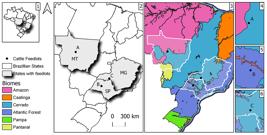
Graphical localizations of the three feedlots within the biomes of Brazil. An overview of the continental nation is provided (1), with the geographical locations (2) of the feedlots within the states of Mato Grosso (MT), São Paulo (SP), and Minas Gerais (MG). The six distinct biomes of Brazil are shown (3), with Feedlots A (4) and C (5) located within the Cerrado biome, and Feedlot B in the Atlantic Forest biome (6).
Cattle at these feedlots were routinely monitored with the “Sistema Brasileiro de Identificação Individual de Bovinos e Búfalos” (Brazilian System of Individual Traceability of Cattle and Buffaloes - SISBOV) as instituted by the “Ministério de Agricultura, Pecuária e Abastecimento” (Ministry of Agriculture, Livestock and Supply - MAPA) in 2006 (MAPA 2006); therefore, all cattle at these feedlots were ear-tagged to establish transparent traceability of all animal products. Furthermore, cattle at these feedlots were maintained in pens as previously described (Baptista et al. 2017).
Data collection. Each feedlot maintained a group of trained workers and veterinarians who routinely examined all pens to assess the well-being of animals on-feed. All cattle that died were evaluated by the onsite veterinarian to determine the main cause of death. Post mortem evaluations of all animals at these feedlots were done by the onsite veterinarian using criteria established to define the specific system and/or organ affected (Griffin 1998, Caswell et al. 2012). PRM was considered the principal cause of death when lesions in a determined animal were restricted to the respiratory system and affected more than 75% of the lungs.
The patterns of pneumonia were not evaluated during this study. All causes of cattle mortality were classified based on the main cause of death observed in each animal and then associated with the system involved (Glock 1998, Griffin 1998). Animals without a conclusive cause of death, that died of neoplastic diseases or transport-related activities, were grouped as unclassified, due to the difficulty of being associated with any specific system. Data on breed, sex, date of entry and death, and cause of cattle mortality at these feedlots were collected and tabulated in an Excel spreadsheet, then used as inputs for statistical analyses, as recommended (Smith 2015). The date of cattle mortality was used to determine the season in which a particular event occurred.
Economic estimates. The related economic cost due to PRM was estimated by comparing known mortality rates identified in feedlots from Brazil (Baptista et al. 2017, 2025). These indices were derived from previously published estimates and based on the economic impacts associated with routine immunization, therapy, operational costs due to mortality, and the average cost of the affected animal (Baptista et al. 2025).
Furthermore, the relationship between the days on-feed (DOF) and the occurrence of PRM was evaluated using a binomial logistic regression model. Pneumonia-related death was considered the dichotomous dependent variable, with DOF as the independent variable. All analyses were done with the Statistica software (version 12.0; StatSoft, USA).
We also wanted to evaluate the economic performance of beef cattle maintained at these feedlots. To do this, a probabilistic model was developed to estimate the expected profit per animal as a function of the number of DOF. The probability of death at these feedlots, P(t), was estimated using a logistic regression model, derived from the mortality data observed. The most adequate equation was:
Where:
t represents the number of days at these feedlots.
The probability of survival on day t was then calculated as S(t)= 1 -P(t).
This economic model considered an average selling price of 1,139.19 USD per animal at slaughter (CEPEA 2025), a daily feeding and management cost of 1.72 USD (Scot-Consultoria 2024), and an average economic loss of 777.78 USD due to the death of each animal (Baptista et al. 2025). Additionally, the following considerations were included in this model: (i) constant daily feeding cost, (ii) fixed market price at slaughter, and (iii) mortality risk based only on pneumonia-related deaths estimated via logistic regression.
For each day maintained at these feedlots (from 0 to 150 days), the expected profit was computed as:
Where:
R= selling price of a live animal (1,139.19 USD) (CEPEA 2025)
Cd= daily cost (1.72 USD) (Scot-Consultoria 2024)
L= loss per death (777.78 USD) (Baptista et al. 2025)
The summation term represents the expected cumulative feeding cost up to day t, considering the probability that the animal is still alive. The expected profit function was therefore conditioned on the probability of death estimated by the logistic regression model. This approach integrated biological risk (mortality) into economic decision-making, allowing the expected profit curve to reflect both the likelihood of survival and cumulative production costs throughout the period maintained at these feedlots. The expected profit values were computed for each period maintained at these feedlots (0-150 days) based on the logistic probability of death. The optimal duration at these feedlots (t*) was defined as the day that maximized the expected profit function.
Statistical analysis. Data was systematically entered into a Microsoft Excel spread sheet and subsequently analyzed using the R statistical software (version 4.4.2). Possible statistical associations between the occurrence of pneumonia-related cattle mortality at these feedlots and several specific variables were evaluated. These included: a) the geographic location of the feedlot; b) season of the year; and c) the sex and breed of the animal on-feed at these three feedlots within municipalities of the states of MT, SP, and MG. The relationship between explanatory variables and causes of mortality was initially evaluated using the Chi-square test. When the assumptions requisite for the Chi-square test was not fulfilled due to reduced expected cell counts, Fisher’s exact test was implemented.
Variables with a significant association with the outcome variable at a threshold of p< 0.25 in the preliminary association tests were earmarked for further investigation through univariable logistic regression. Following this, univariable logistic regression analysis was conducted to ascertain the individual impact of each explanatory variable on respiratory mortality. Variables demonstrating p-values lower than 0.25 in the univariable logistic regression analysis were chosen as candidate variables for the multivariable logistic regression model.
A multivariable logistic regression model was subsequently constructed to identify independent predictors of respiratory mortality. Adjusted odds ratios (OR) and 95% confidence intervals (CI) were used to quantify the strength of the association between explanatory variables and respiratory mortality. p≤ 0.05 was considered significant.
Results
Epidemiology of pneumonia-related mortalities at three feedlots within the states of Mato Grosso, Minas Gerais, and São Paulo
The geographical locations of the three feedlots during the 24-month period are shown in Table 1 and Figure 1. During this period, 141,178 heads-of-cattle were on-feed at these feedlots with an average mortality rate of 0.5% (703/141,178). Additionally, cattle mortality due to pneumonia occurred in 0.1% (135/141,178) of all cattle on-feed. Respiratory-related mortalities were the second most frequent causes of feedlot mortalities and contributed to 20.2% (142/703) of all categories of cattle mortality observed at these three feedlots during the period evaluated (Fig. 2). However, PRM were the most frequent causes of respiratory impairment occurring in 95.1% (135/142) of all cattle on-feed.
Comparative demonstration of pneumonia-related mortalities (PRM) relative to the total number of cattle on-feed from three beef cattle feedlots in Brazil during 2023-2024

Comparative frequency of the causes of cattle mortality based on the system affected in three feedlots from Brazil.
A significant statistical difference (p= 0.027) was identified when the frequency of PRM was compared with all other causes of mortality at each geographical location (Table 2), with PRM being more frequent in the state of MT (76/323, 23.5%), relative to PRM in the states of SP (35/221, 15.8%) and MG (24/159, 15.1%). When the breeds of cattle maintained on-feed at these three feedlots were compared (Table 2), PRM was significantly (p= 0.005) more frequent in Nelore cattle (102/455, 22.4%), relative to crossbreed animals (33/239, 13.8%). Alternatively, no statistical relationship was observed between the PRM frequency and the sex of the animals maintained on-feed (p = 0.653).
Although there were no statistical differences between the seasons (p= 0.215) during which PRM occurred at these feedlots, the environmental conditions at these feedlots were drastically different during the winter and summer. Summer at these feedlots were characterized by elevated daily temperature (27-30 °C), short but constant average daily thermic amplitude (8 °C), and severe rains (228-300 mm/day) resulting in muddy pens (Fig. 3). Alternatively, winters were dry and dusty (Fig. 4-6), since the average amount of rainfall was drastically reduced (2-50 mm/day), but with longer fluctuating daily thermic amplitudes (9-10 °C), and reduced temperatures (16-26 °C).

Comparative environmental conditions (3) during summer (4-6) with varying degrees of dusty environments during winter at the feedlot located within a municipality of the state of Mato Grosso.
The multivariable logistic regression analysis (Table 2) revealed that cattle breed and the geographical locations of the feedlots were independently related to PRM. Animals from the Nelore breed of cattle had 1.79x more chance (OR = 1.79, p= 0.006) of acquiring PRM in comparison with crossbred animals. Similarly, cattle from the feedlots in MT demonstrated a significantly greater chance (OR = 1.74, p= 0.031) to develop PRM relative to those maintained in feedlots from MG. However, no significant statistical disparity (p> 0.05) was identified between cattle maintained in feedlots located in SP and those in MG.
The binomial logistic regression revealed that the risk of PRM occurring in cattle at these feedlots decreased significantly during the later stages of the time on-feed. Additionally, the probability of PRM at these feedlots decreased by approximately 0.99% for each additional day-on-feed (Table 3). Although the daily impact of PRM observed was small (0.99%), the overall statistical model was significant (p= 0.0005), demonstrating that PRM tended to occur predominantly during the initial DOF, particularly within the first 100 days (Fig. 7).
Effects of the days-on-feed on the likelihood of pneumonia-related mortalities in beef cattle feedlots

Logistic regression of the probability of pneumonia-related mortalities relative to the number of days on-feed at three beef cattle feedlots in Brazil.
Economic impacts of pneumonia-related mortalities in feedlots from Brazil
The estimated economic impacts associated with PRM at these three beef cattle feedlots are provided in Table 4, demonstrating an estimated loss of 105,027 USD in 2024. Additionally, the projected economic impacts associated with BRD in Brazil were estimated at 4.040 M USD for 2024. Furthermore, the estimated cost of PRM contributed to 4.12% (4,040,738 USD/98,073,585 USD) of the economic loss associated with cattle production in Brazil in 2024 (Table 4).
The expected profit of beef cattle maintained at these feedlots as a function of days on-feed, incorporating the probability of PRM estimated by the logistic regression model, is illustrated in Figure 8. The profit curve (PC) showed that the expected profit increased proportionally with the period maintained at these feedlots for about 120 days, with maximum profit at 130 days, after which profitability begins to decline. This inflection point represented the optimal period on feed (t*), where the balance between feeding costs, mortality risk due to pneumonia, and potential revenue maximizes economic return. Beyond this period, the cumulative probability of PRM increases more rapidly than the expected gains from continued feeding, leading to a progressive reduction in profitability. In summary, this modelled PC can be divided into three distinct periods: a) early days, characterized by high risk of PRM, but rapid weight gain and lower cumulative costs; b) middle period, where there is lower mortality risk, efficient weight gain, and profit increases; and c) after optimal point (~130 days), where feeding costs and cumulative mortality risk increases faster than the value added by further weight gain, so profit declines. Therefore, the PC demonstrated that maintaining cattle on-feed for more than approximately 120-130 days at these feedlots would not be economically advantageous under these modeled health and management conditions.

Logistic model of the probabilistic mortality to demonstrate the expected profit of having beef cattle on-feed relative to the period maintained at three feedlots in Brazil.
Discussion
The results of the current study demonstrated that respiratory-related mortalities were the second most frequently occurring causes of death at these feedlots. At the same time, PRM contributed significantly to respiratory affections, demonstrating that PRM is one of the most significant causes of mortality in intensive cattle production systems in Brazil, with substantial economic losses for the local beef industry. These findings suggest that BRD continues to be one of the most common problems affecting feedlot cattle in Brazil (Malafaia et al. 2016, Baptista et al. 2017, Castro et al. 2021, Baptista et al. 2025) as well as in other major cattle-producing countries (Loneragan et al. 2001, Snowder et al. 2006, Fulton et al. 2009, Babcock et al. 2013a, Hay et al. 2014, O’Donoghue et al. 2025). Since this study was focused primarily on the establishment of epidemiological data on the occurrence of PRM in feedlot cattle in Brazil, thereby providing information pertinent to feedlot operations due to the paucity of local data, the occurrence of infectious agents associated with BRD, and the pattern of pulmonary lesions will not be discussed. Accordingly, the findings herein presented will be of valuable use to the local industry, considering that most feedlot data available in Brazil and used by sectors of the local beef cattle industry, are based on studies done in North America (Loneragan et al. 2001, Snowder et al. 2006, Babcock et al. 2013b, Vogel et al. 2015) and/or Australia (Cusack et al. 2007, Hay et al. 2014, Blakebrough-Hall et al. 2020, Cusack 2023), and these results may not necessarily reflect the situation in this continental nation.
The statistical model demonstrated that PRM decreased drastically during the late period of cattle on-feed at these feedlots, with elevated mortality occurring during the first 30 DOF. Similar findings were described in a study by our group that evaluated the occurrence of BRD-related mortality in 10 feedlots from similar geographical locations of Brazil (Baptista et al. 2025). Additionally, the data obtained in studies from Brazil are in accord with the results from investigations done in North America (Loneragan et al. 2001, Snowder et al. 2006) and Australia (Cusack 2023). Therefore, the pattern of PRM observed at these feedlots is consistent with those described in major cattle-producing nations, demonstrating that PRM is more frequent and more likely to occur during the early DOF, with a reduction as animals are maintained on-feed for longer periods.
Geographical location of the feedlots and the breed of cattle on feed may have an influence on pneumonia-related mortality
A statistically significant geographical variation in PRM was identified in feedlots from three major cattle-producing states of Brazil, with cattle from MT having an elevated risk (OR = 1.74, p = 0.031) for PRM relative to cattle from MG. This geographical disparity may suggest potential environmental, climatic, or management factors specific to MT that predispose cattle to respiratory disease with relation to cattle on-feed from MG. Environmental conditions have been related to the occurrence of BRD (Snowder et al. 2006), while metagenomics investigations that evaluated the microbial communities of the respiratory system of cattle from different geographical locations have demonstrated that the differences due to environmental conditions, feeding strategy, diet, altitude, and climatic conditions may affect the occurrence of BRD (Chai et al. 2022, Zhang et al. 2023). Although these variations were not evaluated during this investigation, their possible effects cannot be ignored, given that the cattle in this study originated from two distinct biomes in Brazil (Dick et al. 2021). Nevertheless, the differences in the levels of PRM observed in feedlots from MT (23.5%) as compared to those in SP (15.8%) and MG (15.1%) warrant further investigation into regional differences in feedlot management practices, vaccination protocols, and climatic conditions that may contribute to increased respiratory pathogen transmission, disease severity, and resulting PRM.
Statistical analysis revealed a significant breed-related difference in PRM frequency (OR = 1.79, p= 0.006) with Nelore cattle (Bos indicus) exhibiting markedly higher mortality rates as compared to crossbred cattle; these results are in accord with a study that demonstrated that crossbred cattle seemed to be less susceptible to developing BRD as compared with purebred animals (Cusack et al. 2007). Accordingly, these findings may suggest that zebu breeds, represented primarily by Nelore cattle, may possess anatomical or immunological characteristics that increase vulnerability to respiratory pathogens under intensive management conditions. Alternatively, this difference may be a direct representation of the population of cattle most frequently reared in feedlots throughout Brazil (Scot-Consultoria 2024). Nevertheless, breed susceptibility seems to influence the occurrence of BRD as was described in studies from Australia (Cusack et al. 2007, Cusack 2023) and North America (Muggli-Cockett et al. 1992, Snowder et al. 2005). However, no detailed studies have been done in Brazil to effectively evaluate the possible association between the breed differences of cattle and the occurrence of BRD.
Pneumonia-related mortalities at feedlots may result in economic impacts on beef cattle production in Brazil
In 2024, the Brazilian economy was considered the 10th-largest worldwide, with an estimated gross domestic product (GDP) of $2,179,413 M USD (WBG 2025). Additionally, Brazil was one of the leading beef cattle producers worldwide (Greenwood 2021, USDA-FAS 2023, ABIEC 2024, USDA-FAS 2024). The booming economy was reflected in this study, as it was estimated that cattle production contributed 98.1 M USD of the GDP of Brazil in 2024, with losses due to PRM being responsible for 4.12% of the loss to the cattle production industry and less than 1% of the GDP. When placed in perspective, the GDP generated from cattle production in Brazil was more than that of the combined GDP of Estonia (42.7 M USD), Georgia (23.7 M USD), and Benin (21.4 M USD) in 2024 (WBG 2025).
Additionally, the results have estimated that the cost associated with PRM was 4.040 M USD in 2024; similar results were previously described in studies that assessed the economic impacts at single (Baptista et al. 2017) and multiple feedlots (Baptista et al. 2025) from the largest beef-producing regions of Brazil. However, it must be highlighted that previous studies were conducted in the states of MG (Baptista et al. 2017, 2025), SP, and Goiás (Baptista et al. 2025), whereas the current study included feedlots from the states of MT, SP, and MG. The inclusion of feedlots from the MT, the largest beef-producing state of Brazil (ABIEC 2024, IBGE 2024), consolidates the results herein presented. Therefore, the estimated costs presented in these studies used data from cattle maintained in feedlots within most of the major cattle-producing states of Brazil (ABIEC 2024, IBGE 2024, Scot-Consultoria 2024). Therefore, these estimates may reflect the economic impact of BRD/PRM across this continental nation. Although these results cannot be easily compared with the economic impacts described in beef cattle feedlots from Australia (Sackett et al. 2006, Blakebrough-Hall et al. 2020) and North America (USDA 2011, Babcock et al. 2013b), due to the differences in the methodology of determining losses at beef cattle feedlots, they effectively demonstrate the economic effects of PRM in beef cattle feedlots from the major beef cattle producing regions of this country.
The statistical model demonstrated that profitability at these feedlots should increase proportionally with DOF until approximately 120-130 days, suggesting that feedlot producers in Brazil should not maintain cattle on-feed beyond this period. These results are in accord with the conclusions of a recent survey involving 36 nutritionists associated with beef cattle production in the major cattle-producing regions of Brazil, which reported that steers and bulls were maintained on-feed for approximately 91.5 and 106.5 days, respectively (Monsalve & Millen 2025). However, there is no mention of the variations in DOF practiced by the responding nutritionists, which would have provided a better idea of the amplitude detected at these feedlots in Brazil. Nevertheless, most feedlots in Brazil tend to maintain cattle on feed for an average of 105.4 days (Manzano 2024, Scot-Consultoria 2024), with a median period of 100 days (Scot-Consultoria 2024). Since there is no official benchmark to define feedlot profitability in Brazil, the findings herein described will be essential to develop national trends and standards for the local beef cattle industry, and can assist feedlot managers in making decisions based on profitability.
However, there seems to be distinct variations in the DOF practiced in the feedlots evaluated within these states. The shortest period of DOF was identified in feedlots from MG (70-120 days), followed by MT (90-140 days), with the longest period detected in feedlots from SP (90-150 days) (Scot-Consultoria 2024). Although differences in DOF practiced at feedlots within these states may represent the individual financial decision of feedlot managers, the modeled PC suggested that it was not economically advantageous to maintain cattle for more than about 120-130 days. Beyond this period, the risk of losses due to PRM and costs may increase faster than the potential revenue. Accordingly, this analysis will be of valuable use to help feedlot managers decide the best time to sell cattle with the objectives of maximizing profit and minimizing losses. Additionally, it must be highlighted that the average daily gain (ADG) at most beef cattle feedlots in Brazil is 1.59 kg/animal/day (Scot-Consultoria 2024), and a significant difference was identified between the ADG of cattle with and without BRD at feedlots (Baptista et al. 2025). Accordingly, the model suggests that these feedlots in Brazil that maintain cattle on-feed beyond the estimated 120-130 days will probably have additional productivity losses. Curiously, only 54% of 213 feedlot owners in Brazil have knowledge of the total cost of feedlot operations and carry out periodic analyses to identify opportunities and improvements (Scot-Consultoria 2024), thereby maximizing profitability. Therefore, it seems that massive investments must be made to provide adequate financial education to beef cattle feedlot owners in Brazil to ensure increasing revenue efficiency and optimize profits. This scenario is even more worrisome, as only 48.6% of feedlot producers in MT, the largest beef-producing state in Brazil, have effective financial control over their feedlot operations (Scot-Consultoria 2024). Accordingly, the economic impacts due to PRM in Brazil may be more elevated than herein projected.
Sexual and seasonal influences had no effect on the occurrence of pulmonary-related mortality
This seems to be the first study from Brazil that evaluated the possible relationship between the sex of the affected animals and seasonal predominance relative to the occurrence of BRD in beef cattle feedlots, since these relationships were not evaluated in the two major studies that previously investigated BRD-related mortalities at beef cattle feedlots in this continental nation (Baptista et al. 2017, 2025). Although no statistical difference (p= 0.653) was observed when the sex of the affected cattle was compared, male animals were overrepresented and contributed towards 95.6% (673/704) of all cattle that died during the 2-year period at these feedlots, as well as to the number of cattle on-feed. This disproportionally large number of male cattle at feedlots in Brazil represents the national trend, where male cattle, particularly intact steers (Manzano 2024, Pereira et al. 2024, Scot-Consultoria 2024), are routinely reared at beef cattle feedlots for meat production due to their faster growth rate and elevated carcass yield as compared to females (Pereira et al. 2024, Scot-Consultoria 2024). Therefore, male cattle will always be in considerably larger proportions than their female counterparts and, consequently, will be the predominant sex affected with most feedlot-related mortalities in Brazil. This feedlot management practice in Brazil differs from what is routinely done in the USA and Australia, where beef cattle feedlots consist of a mixture of male and female cattle (Sackett et al. 2006, Manzano 2024). Accordingly, it is not recommended to compare feedlot mortality based on the sex of the animal in Brazil, as occurred in studies from Australia (Cusack et al. 2007, Sackett et al. 2006, Cusack 2023) and the USA (Loneragan et al. 2001, Babcock et al. 2013a, Vogel et al. 2015).
Although PRM was more frequent during the summer months (21.4%) relative to winter (19%), no significant differences (p= 0.215) were identified when the seasonal occurrence of PRM was compared with the occurrence of other types of mortality at these three feedlots. These findings are contrary to studies conducted in North America (Yamada et al. 2025), Australia (Cusack et al. 2007), and Europe (Padalino et al. 2021), where seasonal variations were associated with the development of BRD. However, the results of this study must be interpreted with caution, as environmental conditions at these feedlots during the severely dusty, dry winter, compared with the muddy, wet summer, must be thoroughly evaluated to determine possible risk factors for the occurrence of BRD in Brazil. The elevated dust particle concentration, prevalent during winter at these feedlots, was responsible for the development of respiratory disease and severely affected animal health (Urso et al. 2021, Cusack 2023). Accordingly, a detailed investigation is being done to effectively determine the possible effects of seasonal and/or geographical differences on the occurrence of cattle mortality at feedlots in Brazil.
Study limitations
Using data from more feedlots in other beef-cattle-producing states of Brazil would have provided a better understanding of the contribution of PRM to cattle mortality in this continental nation. Nevertheless, most of the information in this study is consistent with that reported in previous investigations done in Brazil and other countries, suggesting that these data can serve as a basis for establishing local reference values for feedlots. Additionally, the incorrect interpretation of the extent of pulmonary lesions could have been difficult in a few cases and could have affected the categorization of the cause of death. Finally, the characterization of the type of pneumonia observed at these feedlots and the participation of infectious disease pathogens would have been important factors to understand their contribution towards the development of PRM. Notwithstanding these limitations, the results presented herein are important for understanding the role of PRM in beef cattle feedlots in Brazil.
Conclusion
This comprehensive epidemiological analysis of pneumonia-related mortality in feedlots across three distinct biomes of Brazil revealed that cattle from the Nelore breed and those maintained on-feed in feedlots in the state of Mato Grosso had a higher risk of pneumonia-related mortality. A statistical model based on historical feedlot performance data projected that it may be profitable to maintain cattle at these feedlots for approximately 120-130 days. Thereafter, there is a projected decline in financial investment due to increased feed costs and reduced weight gains at the feedlots evaluated.
Acknowledgments
Silva FHP and Fenta ME are recipients of graduate fellowships from the “Coordenação de Aperfeiçoamento de Pessoal de Nível Superior” (CAPES), Brazil. Headley SA is a recipient of the “Conselho Nacional de Desenvolvimento Científico e Tecnológico” (CNPq), Brazil, fellowship and grant.
References
-
ABIEC. Beef Report 2024: Brazilian beef profile. Associação Brasileira das Indústrias Exportadoras de Carnes, 2024. Accessed Sep 28, 2024. https://www.abiec.com.br/wp-content/uploads/beefreport_v2024-ENG.pdf
» https://www.abiec.com.br/wp-content/uploads/beefreport_v2024-ENG.pdf -
Babcock AH, Cernicchiaro N, White BJ, Dubnicka SR, Thomson DU, Ives SE, Scott HM, Milliken GA, Renter DG. A multivariable assessment quantifying effects of cohort-level factors associated with combined mortality and culling risk in cohorts of U.S. commercial feedlot cattle. Prev Vet Med 2013a; https://doi.org/10.1016/j.prevetmed.2012.07.008
» https://doi.org/10.1016/j.prevetmed.2012.07.008 -
Babcock AH, White BJ, Renter DG, Dubnicka SR, Scott HM. Predicting cumulative risk of bovine respiratory disease complex (BRDC) using feedlot arrival data and daily morbidity and mortality counts. Can J Vet Res 2013b; https://shre.ink/7B8N
» https://shre.ink/7B8N -
Baptista AL, Rezende AL, Fonseca PA, Massi RP, Nogueira GM, Magalhães LQ, Headley SA, Menezes GL, Alfieri AA, Saut JPE. Bovine respiratory disease complex associated mortality and morbidity rates in feedlot cattle from southeastern Brazil. J Infect Dev Ctries 2017; https://doi.org/10.3855/jidc.9296
» https://doi.org/10.3855/jidc.9296 -
Baptista AL, Xavier AAC, Reis MH, Madeira RB, Cerqueira HDB, Gama R, Headley SA, Saut JPE. The economic impacts of the bovine respiratory disease complex on beef cattle feedlots from Brazil. Semin Ciênc Agrár 2025; https://doi.org/10.5433/1679-0359.2025v46n5p1401
» https://doi.org/10.5433/1679-0359.2025v46n5p1401 -
Blakebrough-Hall C, McMeniman JP, González LA. An evaluation of the economic effects of bovine respiratory disease on animal performance, carcass traits, and economic outcomes in feedlot cattle defined using four BRD diagnosis methods. J Anim Sci 2020; https://doi.org/10.1093/jas/skaa005
» https://doi.org/10.1093/jas/skaa005 -
Castro MM, Oliveira TES, Headley SA. Bovine respiratory disease in Brasil: a short review. Semin Ciênc Agrár 2021; https://doi.org/10.5433/1679-0359.2021v42n3supl1p2081
» https://doi.org/10.5433/1679-0359.2021v42n3supl1p2081 -
Caswell JL, Hewson J, Slavić Ð, DeLay J, Bateman K. Laboratory and postmortem diagnosis of bovine respiratory disease. Vet Clin North Am Food Anim Pract 2012; https://doi.org/10.1016/j.cvfa.2012.07.004
» https://doi.org/10.1016/j.cvfa.2012.07.004 -
CEPEA. Indicador do Boi Gordo CEPEA/ESALQ: cotações e séries históricas. Centro de Estudos Avançados em Economia Aplicada, Universidade de São Paulo, 2025. Accessed Oct 15, 2025. https://cepea.org.br/br
» https://cepea.org.br/br -
Chai J, Liu X, Usdrowski H, Deng F, Li Y, Zhao J. Geography, niches, and transportation influence bovine respiratory microbiome and health. Front Cell Infect Microbiol 2022; https://doi.org/10.3389/fcimb.2022.961644
» https://doi.org/10.3389/fcimb.2022.961644 -
Cusack PMV, McMeniman NP, Lean IJ. Feedlot entry characteristics and climate: their relationship with cattle growth rate, bovine respiratory disease and mortality. Aust Vet J 2007; https://doi.org/10.1111/j.1751-0813.2007.00184.x
» https://doi.org/10.1111/j.1751-0813.2007.00184.x -
Cusack PMV. Evaluation of practices used to reduce the incidence of bovine respiratory disease in Australian feedlots (to November 2021). Aust Vet J 2023; https://doi.org/10.1111/avj.13239
» https://doi.org/10.1111/avj.13239 -
Dick M, Silva MA, Silva RRF, Ferreira OGL, Maia MS, Lima SF, Paiva Neto VB, Dewes H. Environmental impacts of Brazilian beef cattle production in the Amazon, Cerrado, Pampa, and Pantanal biomes. J Clean Prod 2021; https://doi.org/10.1016/j.jclepro.2021.127750
» https://doi.org/10.1016/j.jclepro.2021.127750 -
Edwards TA. Control methods for bovine respiratory disease for feedlot cattle. Vet Clin North Am Food Anim Pract 2010; https://doi.org/10.1016/j.cvfa.2010.03.005
» https://doi.org/10.1016/j.cvfa.2010.03.005 -
Estima-Silva P, Oliveira PA, Bruhn FRP, Scheid HV, Marques LS, Ribeiro LS, Schild AL. Causes of death of beef cattle raised in feedlots. Pesq Vet Bras. 2020; https://doi.org/10.1590/1678-5150-PVB-6539
» https://doi.org/10.1590/1678-5150-PVB-6539 -
Fulton RW, Blood KS, Panciera RJ, Payton ME, Ridpath JF, Confer AW, Saliki JT, Burge LT, Welsh RD, Johnson BJ, Reck A. Lung pathology and infectious agents in fatal feedlot pneumonias and relationship with mortality, disease onset, and treatments. J Vet Diagn Invest 2009; https://doi.org/10.1177/104063870902100407
» https://doi.org/10.1177/104063870902100407 -
Glock RD. Diagnostic and feedlot pathology. Vet Clin North Am Food Anim Pract 1998; https://doi.org/10.1016/S0749-0720(15)30256-5
» https://doi.org/10.1016/S0749-0720(15)30256-5 -
Greenwood PL. Review: an overview of beef production from pasture and feedlot globally, as demand for beef and the need for sustainable practices increase. Animal 2021; https://doi.org/10.1016/j.animal.2021.100295
» https://doi.org/10.1016/j.animal.2021.100295 -
Griffin D. Feedlot diseases. Vet Clin North Am Food Anim Pract 1998; https://doi.org/10.1016/S0749-0720(15)30251-6
» https://doi.org/10.1016/S0749-0720(15)30251-6 -
Hay KE, Barnes TS, Morton JM, Clements ACA, Mahony TJ. Risk factors for bovine respiratory disease in Australian feedlot cattle: use of a causal diagram-informed approach to estimate effects of animal mixing and movements before feedlot entry. Prev Vet Med 2014; https://doi.org/10.1016/j.prevetmed.2014.07.001
» https://doi.org/10.1016/j.prevetmed.2014.07.001 -
Hay KE, Morton JM, Clements ACA, Mahony TJ, Barnes TS. Associations between feedlot management practices and bovine respiratory disease in Australian feedlot cattle. Prev Vet Med 2016; https://doi.org/10.1016/j.prevetmed.2016.03.017
» https://doi.org/10.1016/j.prevetmed.2016.03.017 -
IBGE. Pesquisa da Pecuária Municipal. Instituto Brasileiro de Geografia e Estatística, 2024. Accessed Sep 28, 2025. https://www.ibge.gov.br/estatisticas/economicas/agricultura-e-pecuaria/9107-producao-da-pecuaria-municipal.html?=&t=resultados
» https://www.ibge.gov.br/estatisticas/economicas/agricultura-e-pecuaria/9107-producao-da-pecuaria-municipal.html?=&t=resultados -
Loneragan GH, Dargatz DA, Morley PS, Smith MA. Trends in mortality ratios among cattle in US feedlots. J Am Vet Med Assoc 2001; https://doi.org/10.2460/javma.2001.219.1122
» https://doi.org/10.2460/javma.2001.219.1122 -
Malafaia P, Granato TAL, Costa RM, Souza VC, Costa DFA, Tokarnia CH. Major health problems and their economic impact on beef cattle under two different feedlot systems in Brazil. Pesq Vet Bras 2016; https://doi.org/10.1590/S0100-736X2016000900008
» https://doi.org/10.1590/S0100-736X2016000900008 -
Manzano RP. Beef production in Brazil-A comparison with the U.S. beef industry, parts 1 and 2. Proceedings 96th Western Veterinary Conference (WVC), Las Vegas, NV, 2024. https://www.vin.com/members/cms/project/defaultadv1.aspx?pId=32037&meta=VIN&sterm=&schecked=DOC11757978&print=11757971
» https://www.vin.com/members/cms/project/defaultadv1.aspx?pId=32037&meta=VIN&sterm=&schecked=DOC11757978&print=11757971 -
MAPA. Instrução Normativa nº 17, de 13 de julho de 2006. Ministério da Agricultura, Pecuária e Abastecimento, Gabinete do Ministro, Diário Oficial da União, 2006. Accessed Oct 15, 2025. https://www.gov.br/agricultura/pt-br/assuntos/sanidade-animal-e-vegetal/saude-animal/rastreabilidade-animal/INMAPA17200616.07.06EstabeleceaNormaOperacionaldoSISBOV.pdf
» https://www.gov.br/agricultura/pt-br/assuntos/sanidade-animal-e-vegetal/saude-animal/rastreabilidade-animal/INMAPA17200616.07.06EstabeleceaNormaOperacionaldoSISBOV.pdf -
Monsalve JG, Millen DD. A snapshot of nutritional recommendations and management practices adopted by feedlot cattle nutritionists in Brazil in 2023. Front Vet Sci 2025; https://doi.org/10.3389/fvets.2025.1518571
» https://doi.org/10.3389/fvets.2025.1518571 -
Muggli-Cockett NE, Cundiff LV, Gregory KE. Genetic analysis of bovine respiratory disease in beef calves during the first year of life. J Anim Sci 1992; https://doi.org/10.2527/1992.7072013x
» https://doi.org/10.2527/1992.7072013x -
O’Donoghue S, Waters SM, Morris DW, Earley B. A comprehensive review: bovine respiratory disease, current insights into epidemiology, diagnostic challenges, and vaccination. Vet Sci 2025; https://doi.org/10.3390/vetsci12080778
» https://doi.org/10.3390/vetsci12080778 -
Padalino B, Cirone F, Zappaterra M, Tullio D, Ficco G, Giustino A, Ndiana LA, Pratelli A. Factors affecting the development of bovine respiratory disease: a cross-sectional study in beef steers shipped from France to Italy. Front Vet Sci 2021; https://doi.org/10.3389/fvets.2021.627894
» https://doi.org/10.3389/fvets.2021.627894 -
Pereira MA, Bungenstab DJ, Euclides VPB, Malafaia GC, Biscola PHN, Menezes GRO, Abreu UGP, Laura VA, Nogueira É, Mauro RA, Silva MP, Nicacio AC, Almeida RG, Gomes RC, Silva JCB, Souza VF. From traditionally extensive to sustainably intensive: a review on the path to a sustainable and inclusive beef farming in Brazil. Animals 2024; https://doi.org/10.3390/ani14162340
» https://doi.org/10.3390/ani14162340 -
Sackett D, Holmes P, Abbott K, Sturt C, Barber M. Assessing the economic cost of endemic disease on the profitability of Australian beef cattle and sheep producers. Meat & Livestock Australia, 2006. Final Report: Project AHW.087. Accessed Oct 15, 2025. https://www.mla.com.au/contentassets/6359e75d88214978af4273aad56064f0/ahw.087_final_report.pdf
» https://www.mla.com.au/contentassets/6359e75d88214978af4273aad56064f0/ahw.087_final_report.pdf -
Scot-Consultoria. Benchmarking confina Brasil 2024. Scot Consultoria, 2024. Accessed Oct 10, 2025. https://www.confinabrasil.com
» https://www.confinabrasil.com -
Smith DR. Investigating outbreaks of disease or impaired productivity in feedlot cattle. Vet Clin North Am Food Anim Pract 2015; https://doi.org/10.1016/j.cvfa.2015.05.003
» https://doi.org/10.1016/j.cvfa.2015.05.003 -
Snowder GD, Van Vleck LD, Cundiff LV, Bennett GL. Bovine respiratory disease in feedlot cattle: environmental, genetic, and economic factors. J Anim Sci 2006; https://doi.org/10.2527/jas.2006-046
» https://doi.org/10.2527/jas.2006-046 -
Snowder GD, Van Vleck LD, Cundiff LV, Bennett GL. Influence of breed, heterozygosity, and disease incidence on estimates of variance components of respiratory disease in preweaned beef calves. J Anim Sci 2005; https://doi.org/10.2527/2005.8361247x
» https://doi.org/10.2527/2005.8361247x -
Urso PM, Turgeon A, Ribeiro FRB, Smith ZK, Johnson BJ. Review: the effects of dust on feedlot health and production of beef cattle. J Appl Anim Res 2021; https://doi.org/10.1080/09712119.2021.1903476
» https://doi.org/10.1080/09712119.2021.1903476 -
USDA. Cattle and calves nonpredator death loss in the United States, 2010. United States Department of Agriculture, 2011. Accessed Oct 12, 2025. https://www.aphis.usda.gov/sites/default/files/cattle_calves_nonpred_2010.pdf
» https://www.aphis.usda.gov/sites/default/files/cattle_calves_nonpred_2010.pdf -
USDA-FAS. Beef production. United States Department of Agriculture, Foreign Agricultural Service, 2024. Accessed Sep 28, 2025. https://www.fas.usda.gov/data/production/commodity/0111000
» https://www.fas.usda.gov/data/production/commodity/0111000 -
USDA-FAS. Livestock and products anual: Brazil. United States Department of Agriculture, Foreign Agricultural Service, 2023. Accessed Oct 15, 2025. https://apps.fas.usda.gov/newgainapi/api/Report/DownloadReportByFileName?fileName=Livestock+and+Products+Annual_Brasilia_Brazil_BR2023-0017.pdf
» https://apps.fas.usda.gov/newgainapi/api/Report/DownloadReportByFileName?fileName=Livestock+and+Products+Annual_Brasilia_Brazil_BR2023-0017.pdf -
Vogel GJ, Bokenkroger CD, Rutten-Ramos SC, Bargen JL. A retrospective evaluation of animal mortality in US feedlots: rate, timing, and cause of death. Bovine Pract 2015; https://doi.org/10.21423/bovine-vol49no2p113-123
» https://doi.org/10.21423/bovine-vol49no2p113-123 -
WBG. Brazil. World Bank Group, 2025. Accessed Oct 25, 2025. https://data.worldbank.org/country/brazil
» https://data.worldbank.org/country/brazil -
Yamada M, Aly SS, Dubrovsky S, Karle B, Van Eenennaam A, Donlon JD, Pandit PS. Effects of short-term climatic conditions on the risk of bovine respiratory disease in preweaned calves on California dairies. Prev Vet Med 2025; https://doi.org/10.1016/j.prevetmed.2025.106658
» https://doi.org/10.1016/j.prevetmed.2025.106658 -
Zhang Z, Zhang C, Zhong Y, Yang S, Deng F, Li Y, Chai J. The spatial dissimilarities and connections of the microbiota in the upper and lower respiratory tract of beef cattle. Front Cell Infect Microbiol 2023; https://doi.org/10.3389/fcimb.2023.1269726
» https://doi.org/10.3389/fcimb.2023.1269726
-
Data availability statement
All the data used are available within the article
All the data used are available within the article


