 Antimicrobial multiresistance and biofilm formation in Salmonella enterica isolated from broiler production chain
ABSTRACT:
Poultry and poultry products are considered the predominant sources of Salmonella enterica contamination and are important reservoirs of bacteria with antimicrobial resistance. The objective of this study was to identify Salmonella with multidrug resistance (MDR) phenotype, with the ability to form biofilms and elucidate the presence of genes that encode antimicrobial resistance in isolates from the broiler production chain in the state of Maranhão, Brazil. A total of 121 strains of S. enterica of different serovars were evaluated for antimicrobial susceptibility, and of these, 26 strains were used to detect the ability to form biofilms and identify resistance genes using PCR. Antimicrobial resistance was observed in 95 (78.5%) Salmonella isolates, and 57 (47.1%) showed MDR phenotype. The isolates showed greater resistance to the sulfonamide principles (58.7%), trimethoprim (48.8%), tetracycline (45.4%), nalidixic acid (44.6%), amoxicillin and ampicillin (26.4%), and cefazolin (22.3%). Salmonella Schwarzengrund (n=21/61.7%), Albany (n=15/62.5%), and Enteritidis (n=4/44.5%) showed the highest indices of MDR phenotype. The ability to form biofilms at 37°C was found in 13 of the 26 strains evaluated, which were considered poor producers. The resistance genes blaCTX-M, blaCTX-M2, blaSHV, sul1, sul2, tetA, tetB, tetC, tetE, dfrA12, and dfrA1 were observed in the serovars Schwarzengrund, Albany, Enteritidis, Heidelberg, and Typhimurium. The results showed a high occurrence of S. enterica, with multiple resistance to conventional antimicrobials and the ability to form biofilms in the poultry production chain.
INDEX TERMS:
Salmonella spp.; antimicrobials; biofilms; resistance genes; poultry
RESUMO:
As aves e os produtos de origem aviária são fontes de contaminação predominantes de Salmonella enterica e importantes reservatórios de bactérias com resistência antimicrobiana. Objetivou-se identificar Salmonella com fenótipos de multirresistência a drogas (MDR), com a capacidade de formação de biofilmes e a presença de genes que codificam resistência antimicrobiana em isolados da cadeia de frangos de corte, do estado Maranhão, Brasil. Avaliaram-se 121 cepas de S. enterica de sorovares diferentes quanto ao teste de suscetibilidade aos antimicrobianos e destas, 26 cepas para detecção da capacidade de formar biofilmes e genes de resistência pela técnica de PCR. Foram encontradas resistência antimicrobiana em 95 (78,5%) dos isolados de Salmonella e 57 (47,1%) apresentaram fenótipos MDR. Os isolados apresentaram maior resistência aos princípios sulfonamida (58,7%), trimetoprim (48,8%), tetraciclina (45,4%), ácido nalidíxico (44,6%), amoxicilina e ampicilina (26,4%) e cefazolin (22,3%). Os sorovares Salmonella Schwarzengrund (n=21/61.7%), Albany (n=15/62.5%) e Enteritidis (n=4/44.5%) apresentaram os maiores índices de fenótipos MDR. A capacidade de formar biofilmes foi encontrada em 13 cepas avaliadas, consideradas fracamente produtoras. Nos sorovares S. Schwarzengrund, Albany, Enteritidis, Heidelberg e Typhimurium foram detectados os genes de resistência blaCTX-M, blaCTX-M2, blaSHV, sul1, sul2, tetA, tetB, tetC, tetE, dfrA12 e dfrA1. Os resultados evidenciaram a elevada ocorrência de fenótipos de S. enterica com resistência múltipla a antimicrobianos convencionais, com capacidade de formar biofilmes, na cadeia produtiva de aves destinadas ao consumo humano.
TERMOS DE INDEXAÇÃO:
Salmonella spp.; antimicrobianos; biofilmes; genes de resistência; frangos
Introduction
Salmonella infection is a leading cause of foodborne diarrheal illnesses in America and Europe (Ferrari et al. 2019, Jajere 2019, EFSA & ECDC 2023) The incidence of salmonellosis transmitted through the food production chain has increased significantly, with an estimated 94 million cases resulting in 155,000 deaths yearly (WHO 2014). The use of antimicrobials is a crucial measure for the treatment of patients with severe or systemic infections (WHO 2022). However, therapeutic effectiveness may be hampered by the increasing spread of Salmonella with multiple drug resistance (MDR), including clinically important antimicrobial agents (Cosby et al. 2015).
Infections caused by Salmonella MDR are generally transmitted through food, with farm animals serving as reservoirs and animal products as transmission routes for the resulting human diseases (Glenn et al. 2013). Birds, rearing environments, and poultry products are predominant sources of Salmonella enterica and are notable reservoirs of antimicrobial-resistant bacteria (Wang et al. 2015). The extensive use of antimicrobials in disease prophylaxis and as growth promoters in modern poultry farming has been identified as one of the reasons for the increased prevalence of MDR bacteria (Abreu et al. 2023). In several countries, MDR has resulted in outbreaks of human salmonellosis caused by the S. enterica serovars Enteritidis, Typhimurium, Heidelberg, and Schwarzengrund, which can be isolated from sources in the broiler production chain (Glenn et al. 2013, Mandelli et al. 2019, Ćwiek et al. 2020, EFSA & ECDC 2020, 2024).
The spread of different MDR serovars of Salmonella is rapid and mainly associated with the exchange and incorporation of numerous genes that encode antimicrobial resistance by conjugating mobile genetic elements (Abatcha et al. 2014, Cosby et al. 2015). In a shared habitat, these genes are easily mobilized between Salmonella and other bacteria of the Enterobacteriaceae family (Algarni et al. 2022, Baker et al. 2024). Salmonella spp. can act as receptors or donors of resistance genes, contributing to the dissemination of these elements in the human food chain (Baker et al. 2024, Orole et al. 2024).
The dissemination and persistence capacity of Salmonella spp. in chicken production chains is related to the pathogenicity mechanisms and virulence factors involved in host infection, as well as the process of adaptation to the environment outside the host (Iñiguez-Moreno et al. 2018). One of these strategies is the ability of Salmonella strains to form biofilms, which reduces the effectiveness of sanitation in poultry and slaughterhouses and, consequently, increases the risk of food contamination (Mackenzie et al. 2017, Borges et al. 2018). There is a correlation between the biofilm formation capacity of Salmonella spp. and its resistance to antimicrobials used in human treatments (Sereno et al. 2017, González et al. 2018, Mandelli et al. 2019). Therefore, from the perspective of infection, biofilm-producing Salmonella may have a greater degree of survival, adaptation, or dissemination (Mackenzie et al. 2017, Musa et al. 2024).
This study aimed to investigate the profile of Salmonella resistance to antimicrobial agents, the genetic determinants of resistance, and the capacity to form biofilms in isolates from different sources in the broiler production chain in Maranhão, in the Northeast region of Brazil.
Materials And Methods
Ethical approval. Ethical approval for this study was obtained from Ethics Committee on Animal Use (CEUA) at “Universidade Estadual de Londrina” (UEL) (CEUA no. 15093.2014.96)
Bacterial strains. A total of 121 strains of Salmonella enterica were isolated from the chicken production chain in the northern mesoregion of the state of Maranhão from 2013 and 2014, of which 26 were from environmental samples (trawl swab, propé, and cecal feces), seven from poultry samples (cloacal swab), and 88 from slaughterhouse samples (broiler carcasses). The strains were previously isolated, biochemically characterized and serotyped by the “Instituto Oswaldo Cruz” (Fiocruz), Rio de Janeiro, Brazil. For the analysis, the isolates were cultivated in tryptone soy broth (TSB) at 37°C for 24 h and then preserved in 20% glycerol at -20°C.
Antimicrobial susceptibility test. The antimicrobial susceptibility profiles of Salmonella isolates were determined by the disc diffusion method (Bauer et al. 1966), using the protocol recommended by the Clinical and Laboratory Standards Institute (CLSI 2008, 2013). Antimicrobial discs representative of the classes of penicillin (amoxicillin, 10µg; ampicillin, 10µg), cephalosporins (cefazolin, 30µg), carbapenems (imipenem, 10µg), and quinolones (nalidixic acid, 30µg; ciprofloxacin, 5µg; ciprofloxacin, 5µg) were used. Norfloxacin (10µg), phenicols (chloramphenicol, 30µg; fluorphenicol, 30µg), aminoglycosides (streptomycin, 300µg; gentamicin, 10µg), folate inhibitors (sulfonamide, 300µg; trimethoprim, 5µg), tetracyclines (tetracycline, 30µg) and nitrofurans (nitrofurantoin, 300µg) were used. The reference strains Escherichia coli ATCC 25922 and S. Enteritidis ATCC 13076 were used for test validation. MDR phenotype was considered as isolates with simultaneous resistance to three or more classes of antimicrobials as defined by the European Centre for Disease Prevention and Control (ECDC) and the Centers for Disease Control and Prevention (CDC) (Rodrigues et al. 2020a).
Molecular determinants of resistance. Twenty-six samples of S. enterica, belonging to the most prevalent serovars in the production cycle of broiler chickens, with the greatest relevance in public health and phenotypic resistance to two or more classes of antimicrobials, were selected in the present study. The evaluated serovars of S. enterica included Schwarzengrund (n=12), Albany (n=5), Enteritidis (n=5), Heidelberg (n=2), and Typhimurium (n=2).
The isolates were inoculated in xylose lysine deoxycholate (XLD) agar culture medium and incubated at 37°C for 24 h. After growth, a characteristic colony was transferred to Luria Bertani (LB) broth and incubated at 37°C for 18 h. The genomic DNA of the samples was extracted using a genomic DNA purification kit (Promega®), following the manufacturer’s instructions. The samples were quantified using the nanospectrum (KASVI®). The microtubes containing the genetic material were stored at -20°C until use.
PCR was performed, according to Paião et al. (2013), to confirm that the isolates belonged to Salmonella, using the primers for the inv A gene described by Fratamico (2003). This was followed by a search for genes that determine resistance to tetracyclines (tetA, tetB, tetC, tetD, tetE and tetG), beta-lactams (blaTEM, blaSHV, blaOXA, blaCTX-M, blaCTX-M1, blaCTX-M2, blaCTX-M15, blaCMY-2), sulfonamides (sul1, sul2, sul3), and trimethoprim (dfrA1, dfrA7, dfrA12, dfrA14), using previously described amplification primers and protocols (Ma et al. 2007, Ribeiro et al. 2011).
Biofilm formation test. The biofilm formation capacity of 26 strains of Salmonella spp. was evaluated using the microtiter method in a polystyrene plate at a growth temperature of 37°C, as described by Borges et al. (2018). Each well’s optical density (OD) was measured using a microplate reader at 450nm. The OD of each strain was obtained from the arithmetic mean absorbance value of eight wells, and this value was compared with the mean absorbance of the negative controls (ODn). Strains were classified according to Stepanović et al. (2004) as follows: No biofilm producer (OD≤ODn), weak biofilm producer (ODn<OD<2× ODn), moderate biofilm producer (2× ODn≤OD<4× ODn) and strong biofilm producer (OD≥4× Odn).
Results
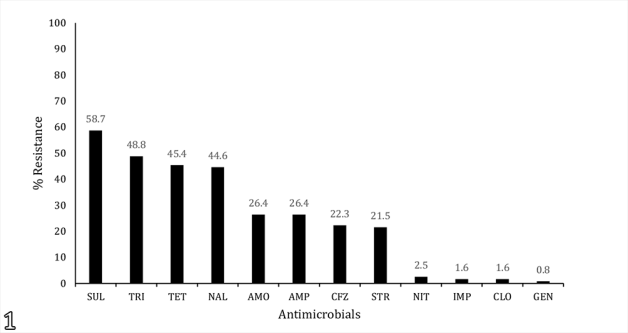
In the present study, 78.5% (95/121) of Salmonella enterica isolates originating from the chicken production chain were resistant to antimicrobials. Resistance was observed against sulfonamide (58.7%), trimethoprim (48.8%), tetracycline (45.4%) and nalidixic acid (44.6%) (Fig.1). All the isolates were sensitive to norfloxacin, ciprofloxacin, and fluorfenicol.

Frequency (%) of antimicrobial resistance in Salmonella enterica isolated in a poultry production chain in the state of Maranhão, Brazil. SUL = sulfonamide (300μg), TRI = trimethoprim (5μg), TET = tetracycline (30μg), NAL = nalidixic acid (30µg), AMO = amoxicillin (10μg), AMP = ampicillin (10µg), CFZ = cefazolin (30µg), STR = streptomycin (300µg), NIT = nitrofurantoin (300µg), IMP = imipenem (10µg), CLO = chloramphenicol (30µg), GEN = gentamicin (10μg).
Of the 121 samples of S. enterica, 57 (47.1%) were simultaneously resistant to three or more classes based on MDR phenotype (Table 1). The S. enterica serovars Schwarzengrund (n=21), Albany (n=15), Enteritidis (n=4), Heidelberg (n=2), Kentucky (n=3), Muenchen (n=3), Typhimurium (n=1), Hadar (n=1), Agona (n=1), Panama (n=1), Anatum (n=1), and Seftenberg (n=1) showed MDR phenotype. As for the isolation sources, Salmonella isolated from broiler chickens showed the highest frequency of MDR phenotypes (5/7 isolates), followed by the rearing environment (12/26 isolates) and carcasses (40/88 isolates).
Eleven of the 21 genes encoding resistance against sulfonamides, trimethoprim, beta-lactams, and tetracyclines were detected in the S. enterica serovars Schwarzengrund, Albany, Enteritidis, Heidelberg, and Typhimurium isolates (Table 2). In 11 isolates showing resistance phenotype against beta-lactams, amoxicillin, ampicillin, and cefazolin, the genes blaCTX-M, blaCTX-M2, and blaSHV were detected in eight (72.7%), four (36.3%), and three (27.2%) samples evaluated, respectively. The detection rate of resistance genes for sulfonamides was 15 (71.42%) of the 21 isolates with resistance phenotype, in which sul1 appeared in 11 (42.3%) and sul2 in three (14.28%) of the samples. The tet resistance genes were detected in all 22 isolates with tetracycline resistance phenotypes, with eight (36.3%) for tetA, 15 (68.1%) for tetB, 12 (54.5%) for tetC, and three (13.6%) for tetE. Regarding trimethoprim, nine (56.2%) of the 16 isolates showed phenotypes associated with the presence of genetic resistance determinants, of which eight (50%) had the dfrA12 gene and four (25%) the dfrA1 gene. The ability to form biofilms was detected in 13 (50%) isolates categorized as poor biofilm producers, with a resistance profile of one (n=1), two (n=3), three (n=4), four (n =4), and five (n=1) classes of antimicrobials (Table 2).
Phenotypic profile of antimicrobial resistance, resistance genes and biofilm production of Salmonella spp. strains
Discussion
The high infection rates of Salmonella spp. with multiple drug resistance from sources in the poultry production chain are similar to those in various parts of the world, including Brazil (85.7%) (Perin et al. 2020), Egypt (76.7%) (Elkenany et al. 2019), Cambodia, Thailand (45%) (Trongjit et al. 2017), India (100%) (Sharma et al. 2019), and China (60.5%) (Zhu et al. 2017). Salmonella isolated from broiler chickens and their products have higher antimicrobial resistance rates than those isolated from other domestic animal species (EFSA & ECDC 2020), which may reflect the high selection pressure suffered under the management practices of modern poultry. The antimicrobial resistance profiles according to the isolation sources of the study revealed that the isolates with MDR phenotype were present in the most varied points of the poultry production chain, with the poultry sources having the highest proportion of MDR phenotype (71.4%). These results reinforce the assertion that there is excessive use of antimicrobials in poultry farming, making these production animals an important reservoir of Salmonella with MDR, representing a risk for people who have direct contact as occupational workers or indirectly as consumers of food (Abreu et al. 2023). Furthermore, MDR Salmonella can spread through poultry waste from poultry farms and slaughterhouses, acting as a potential source of propagation of pathogens and antimicrobial resistance genes in the environment (Saraiva et al. 2022).
Sulfonamide was the antimicrobial principle that presented the highest resistance index in Salmonella isolated from different sources and has been extensively used in poultry farming for decades (Matiello et al. 2015). The wide dissemination and predominance of sul1 in the S. enterica isolated from birds and poultry products have been recorded in these serovars (Ribeiro et al. 2011, Brasil 2012, Glenn et al. 2013, Matiello et al. 2015). Its presence is generally associated with gene cassettes of class 1 integrons, which are responsible for the clonal or horizontal dissemination of multiple antimicrobial resistance genes in S. enterica (Fortes et al. 2012, Cosby et al. 2015).
The tetracycline group showed high resistance rates, particularly in Schwarzengrund (24/34) and Heidelberg (7/9) serovars. Countries like Brazil (64.6%) (Scur et al. 2014), United States (65.8%) (FDA 2012), and China (65.9%) (Wang et al. 2015) still record high levels of resistance against tetracyclines in Salmonella isolated from the poultry production chain. The spread of resistance is associated with numerous resistance genes (tet), and the presence of the tet gene coincided with the resistance phenotype in all isolates. In Salmonella spp., the main resistance mechanism associated with these genes is the activation of efflux pumps, which prevents the drug from accumulating inside the cell at a concentration necessary for bacterial death (Hur et al. 2012). Unlike other studies that detected a predominance of the tetA gene in isolates from different poultry sources (Ribeiro et al. 2011, Glenn et al. 2013, Adesiji et al. 2014, Matiello et al. 2015, Rodrigues et al. 2020b), tetB was predominant in the isolates we studied.
In the beta-lactam group, three different types of bla genes were detected (blaCTX-M, blaCTX-M2, and blaSHV) that encode extended-spectrum beta-lactamases (ESBL). Enzymes belonging to the CTX-M family are predominant in enterobacteria in South America (Silva & Lincopan 2012), with detection record of blaCTX-M2 in Salmonella isolated from poultry and poultry products in Brazil (Silva et al. 2013, Costa et al. 2024).
Notably, two isolates of Salmonella ser. Enteritidis and one isolate of Salmonella Schwarzengrund showed the presence of blaSHV, which confers multiple resistance against six or more antibiotics. The blaSHV genes are considered rare in Salmonella. However, they have been detected in food-producing animals and human clinical cases of salmonellosis and have a high capacity for horizontal transfer between bacteria of the Enterobacteriaceae family through conjugative plasmids (Pouget et al. 2013, Orole et al. 2024).
The blaCTX-M and blaCTX-M2 genes had a greater association with the sul1, tetB, and dfrA12 gene determinants, whereas all samples with the blaSHV gene were associated with the tetB, tetC, dfrA1, and dfr genes A12. Several genetic determinants of antimicrobial resistance in some Salmonella isolates suggest a potential co-selection of resistance genes to distinct classes of antimicrobials conventionally used in poultry. Moreover, the dissemination of these resistance genes between bacteria from animal production along multiple paths of the food production chain results in the preservation of the complex gene cassettes expressing MDR (Marshall & Levy 2011). In the context of One Health, the presence of Salmonella paratyphoid, a zoonotic pathogen with several antimicrobial resistance genes often carried on mobile elements, may be an important source of genomic transfer of resistance to commensal bacteria from different hosts or the environment (Saraiva et al. 2022, Baker et al. 2024).
Salmonella Enteritidis is the predominant serovar responsible for human salmonellosis outbreaks worldwide, caused by the consumption of contaminated poultry products (Ferrari et al. 2019, Liu et al. 2023). The results of this study showed that all isolates with antimicrobial resistance originated from environmental sources. Among these, four showed MDR phenotype, with the presence of various genetic determinants for resistance and the ability to form biofilms. Therefore, Salmonella ser. Enteritidis may represent a risk owing to its zoonotic potential, ability to exchange antimicrobial resistance genes, and persistence and dissemination along the production chain.
Salmonella Schwarzengrund showed the highest rates of multiresistant phenotypes (21/61.7%) in isolates from different sources. The most common resistance pattern observed in phenotypes with resistance to ≥7 antimicrobials (eight isolates) was Amo, Amp, Cfz, Est, Nal, South, Tri, and Tet (four isolates), which corroborated with the findings of Chen et al. (2010). These results resemble the phenotypic pattern of non-typhoidal Salmonella multidrug resistance (ACSSuT) in hospitalized patients in Brazil (Reis et al. 2018). This phenotypic profile of multiresistance found in serovars Schwarzengrund, Enteritidis and Typhimurium (Table 2) in this study requires surveillance, as they are one of the few serovars that cause invasive diseases in humans and require immediate antimicrobial therapy (Zhan et al. 2019, Abreu et al. 2023). High levels of resistance pose a significant threat to public health, particularly for individuals with affected immune systems who are at increased risk of serious complications and mortality (WHO 2024). Circulation of Salmonella strains with a high frequency of MDR phenotype and the presence of several antimicrobial resistance genes in the poultry production chain can be considered a concern for public health because it limits the number of antimicrobials for treatment in cases of severe infections (Akiyama & Khan 2012).
In this study, strains of different multidrug-resistant serovars could form biofilms at 37°C, with low production and resistance to sulfonamides, tetracyclines, and trimethoprim (Table 2). These results indicate the risk of bacterial persistence in different environments of the chicken production chain from the contamination of utensils and equipment, which may share genes that encode resistance among biofilm bacteria (Sereno et al. 2017, Musa et al. 2024).
Conclusions
The present study demonstrated the high occurrence of Salmonella enterica with multidrug resistance (MDR) phenotype in the broiler production chain. MDR isolates from different sources showed a high frequency of phenotypic and genotypic resistance to the antimicrobial groups sulfonamides, trimethoprim, tetracyclines, and beta-lactams, considered antimicrobials of importance in veterinary and human medicine.
The S. enterica serovars Schwarzengrund and Enteritidis had the highest frequency of MDR phenotype associated with resistance genes and the ability to form biofilms.
Isolates from the production chain of poultry destined for human consumption pose a risk to public health and animal health owing to the possible spread of Salmonella MDR and the implications for the treatment of severe clinical conditions.
Acknowledgments
This study was supported by “Fundação de Amparo a Pesquisa e ao Desenvolvimento Científico e Tecnológico do Maranhão” (FAPEMA), “Coordenação de Aperfeiçoamento de Pessoal de Nível Superior” (CAPES), and “Instituto Federal de Educação, Ciência e Tecnologia do Maranhão” (IFMA).
References
- Abatcha M.G., Zakaria Z., Kaur D.G. & Thong K.L. 2014. Review article: a trends of Salmonella and antibiotic resistance. Adv. Life Sci. Technol. 17:9-21.
-
Abreu R., Semedo-Lemsaddek T., Cunha E., Tavares L. & Oliveira M. 2023. Antimicrobial drug resistance in poultry production: current status and innovative strategies for bacterial control. Microorganisms 11(4):953. <https://dx.doi.org/10.3390/microorganisms11040953> <PMid:37110376>
» https://doi.org/https://dx.doi.org/10.3390/microorganisms11040953 -
Adesiji Y.O., Deekshit V.K. & Karunasagar I. 2014. Antimicrobial-resistant genes associated with Salmonella spp. isolated from human, poultry, and seafood sources. Food Sci Nutr. 2(4):436-442. <https://dx.doi.org/10.1002/fsn3.119> <PMid:25473501>
» https://doi.org/https://dx.doi.org/10.1002/fsn3.119 -
Akiyama T. & Khan A.A. 2012. Molecular characterization of strains of fluroquinolone-resistant Salmonella enterica serovar Schwarzengrund carrying multigrug resistance isolated from imported food. J. Antimicrob. Chemother. 18(1):101-110. <https://dx.doi.org/10.1093/jac/dkr414> <PMid:22010209>
» https://doi.org/https://dx.doi.org/10.1093/jac/dkr414 -
Algarni S., Ricke S.C., Foley S.L. & Han J. 2022. The dynamics of the antimicrobial resistance mobilome of Salmonella enterica and related enteric bacteria. Front. Microbiol. 13:859854. <https://dx.doi.org/10.3389/fmicb.2022.859854> <PMid:35432284>
» https://doi.org/https://dx.doi.org/10.3389/fmicb.2022.859854 -
Baker M., Zhang X., Maciel-Guerra A., Babaarslan K., Dong Y., Wang W., Hu Y., Renney D., Liu L., Li H., Hossain M., Heeb S., Tong Z., Pearcy N., Zhang M., Geng Y., Zhao L., Hao Z., Senin N., Chen J., Peng Z., Li F. & Dottorini T. 2024. Convergence of resistance and evolutionary responses in Escherichia coli and Salmonella enterica co-inhabiting chicken farms in China. Nat. Commun. 15:206. <https://dx.doi.org/10.1038/s41467-023-44272-1> <PMid:38182559>
» https://doi.org/https://dx.doi.org/10.1038/s41467-023-44272-1 - Bauer A.W., Kirb W.M., Sherris J.C. & Turck M. 1966. Antibiotics susceptibility testing by standardized single disk method. Am. J. Pathol. 45(4):493-496. <PMid:5325707>
-
Borges K.A., Furian, T.Q., Souza S.N., Menezes R., Tondo E.C., Salle C.T.P., Moraes H.L.S. & Nascimento V.P. 2018. Biofilm formation capacity of Salmonella serotypes at different temperature conditions. Pesq. Vet. Bras. 38(1):71-76. <https://dx.doi.org/10.1590/1678-5150-PVB-4928>
» https://doi.org/https://dx.doi.org/10.1590/1678-5150-PVB-4928 - Brasil 2012. Monitoramento da prevalência e do perfil de suscetibilidade aos antimicrobianos em Enterococos e Salmonelas isolados de carcaças de frango congeladas comercializadas no Brasil. Relatório de Pesquisa em Vigilância Sanitária de Alimentos, Programa Nacional de Monitoramento da Prevalência e da Resistência Bacteriana em Frango (PREBAF), Agência Nacional de Vigilância Sanitária (ANVISA), Ministério da Saúde, Brasília, DF. 171p.
-
Chen M.H., Wang S.W., Hwang W.Z., Tsai S.J., Hsih Y.C., Chiou C.S. & Tsen H.Y. 2010. Contamination of Salmonella Schwarzengrund cells in chicken meat from traditional marketplaces in Taiwan and comparison of their antibiograms with those of the human isolates. Poult. Sci. 89(2):359-365. <https://dx.doi.org/10.3382/ps.2009-00001> <PMid:20075291>
» https://doi.org/https://dx.doi.org/10.3382/ps.2009-00001 - CLSI 2008. Performance Standards for Antimicrobial Disk and Dilution Susceptibility Tests for Bacteria Isolated from Animals. Vol.28. 3rd ed. Clinical And Laboratory Standard Institute (CLSI), Wayne, PA. 100p. (Document M131-A3).
- CLSI 2013. Performance Standards for Antimicrobial Susceptibility Testing. 23rd. Clinical And Laboratory Standard Institute (CLSI), Wayne, PA. 12p. (Informational Supplement. Documents M100-S23).
-
Cosby D.E., Cox N.A., Harrison M.A., Wilson J.L., Buhr R.J. & Fedorka-Cray P.J. 2015. Salmonella and antimicrobial resistance in broilers: a review. J. Appl. Poult. 24(3)408-426. <https://dx.doi.org/10.3382/japr/pfv038>
» https://doi.org/https://dx.doi.org/10.3382/japr/pfv038 -
Costa G.A., Dias T.S., Fialho D.S., Silva L.A.M., Figueira A.A., Cunha N.C., Pereira V.L.A. & Abreu D.L.C. 2024. Resistance profile of Salmonella spp. to third generation cephalosporins and quinolones in chicken carcasses from Rio de Janeiro, Brazil. Braz. J. Poult. Sci. 26(2):001-006. <https://dx.doi.org/10.1590/1806-9061-2023-1888>
» https://doi.org/https://dx.doi.org/10.1590/1806-9061-2023-1888 -
Ćwiek K., Korzekwa K., Tabiś A., Bania J., Bugla-Płoskońska G. & Wieliczko A. 2020. Antimicrobial resistance and biofilm formation capacity of Salmonella enterica serovar Enteritidis strains isolated from poultry and humans in Poland. Pathogens 9(8):643. <https://dx.doi.org/10.3390/pathogens9080643> <PMid:32784631>
» https://doi.org/https://dx.doi.org/10.3390/pathogens9080643 -
EFSA & ECDC 2020. The European Union Summary Report on Antimicrobial Resistance in zoonotic and indicator bacteria from humans, animals and food in 2017/2018. EFSA J. 18(3):6007. <https://dx.doi.org/10.2903/j.efsa.2020.6007> <PMid:32874244>
» https://doi.org/https://dx.doi.org/10.2903/j.efsa.2020.6007 -
EFSA & ECDC 2023. The European Union one health 2022 zoonoses report. EFSA J. 21(12):e8442. <https://dx.doi.org/10.2903/j.efsa.2023.8442> <PMid:38089471>
» https://doi.org/https://dx.doi.org/10.2903/j.efsa.2023.8442 -
EFSA & ECDC 2024. The European Union Summary Report on Antimicrobial Resistance in zoonotic and indicator bacteria from humans, animals and food in 2021-2022. EFSA J. 22(2):e8583. <https://dx.doi.org/10.2903/j.efsa.2024.8583> <PMid:38419967>
» https://doi.org/https://dx.doi.org/10.2903/j.efsa.2024.8583 -
Elkenany R., Elsayed M.M., Zakaria A.I., El-Sayed S.A. & Rizk M.A. 2019. Antimicrobial resistance profiles and virulence genotyping of Salmonella enterica serovars recovered from broiler chickens and chicken carcasses in Egypt. BMC Vet Res. 15(1):124. <https://dx.doi.org/10.1186/s12917-019-1867-z> <PMid:31029108>
» https://doi.org/https://dx.doi.org/10.1186/s12917-019-1867-z -
FDA 2012. National Antimicrobial Resistance Monitoring System (NARMS): Retail meat report. Food and Drug Administration, Silver Spring, MD. 88p. Available at <Available at http://www.fda.gov/AnimalVeterinary/SafetyHealth/AntimicrobialResistance/NationalAntimi crobialResistanceMonitoringSystem/ucm059103.htm > Accessed on Aug. 1, 2015.
» http://www.fda.gov/AnimalVeterinary/SafetyHealth/AntimicrobialResistance/NationalAntimi crobialResistanceMonitoringSystem/ucm059103.htm -
Ferrari R.G., Rosario D.K.A., Cunha-Neto A., Mano S.B., Figueiredo E.E.S. & Conte-Junior C.A. 2019. Worldwide epidemiology of Salmonella Serovars in animal-based foods: a Meta-analysis. Appl. Environ. Microbiol. 85:e00591-19. <https://dx.doi.org/10.1128/AEM.00591-19> <PMid:31053586>
» https://doi.org/https://dx.doi.org/10.1128/AEM.00591-19 - Fortes T.P., Fagundes M.Q., Vasconcellos F.A., Timm C.D. & Silva É.F. 2012. Ilhas de patogenicidade de Salmonella enterica: uma revisão. Revta Inst. Adolfo Lutz. 71(2):219-227.
-
Fratamico P.M. 2003. Comparison of culture, polymerase chain reaction (PCR), TaqMan Salmonella, and Transia Card Salmonella assays for detection of Salmonella spp. in naturally-contaminated ground chicken, ground turkey, and ground beef. Mol. Cell. Probes 17(5):215-221. <https://dx.doi.org/10.1016/S0890-8508(03)00056-2> <PMid:14580395>
» https://doi.org/https://dx.doi.org/10.1016/S0890-8508(03)00056-2 -
Glenn L.M., Lindsey R.L., Folster J.P., Pecic G., Boerlin P., Gilmour M.W., Harbottle H., Zhao S., Mcdermott P.F., Fedorka-Cray P.J. & Frye J.G. 2013. Antimicrobial resistance genes in multi-drug resistant Salmonella enterica serovars isolated most frequently from animals, retail meat, and humans in the U.S. and Canada. Microbial Drug Resistance 19(3):175-184. <https://dx.doi.org/10.1089/mdr.2012.0177> <PMid:23350745>
» https://doi.org/https://dx.doi.org/10.1089/mdr.2012.0177 -
González J.F., Alberts H., Lee J., Doolitler L. & Gunn J.S. 2018. Biofilm formation protects Salmonella from the antibiotic ciprofloxacin in vitro and in vivo in the mouse model of chronic carriage. Sci. Rep. 8:222. <https://dx.doi.org/10.1038/s41598-017-18516-2> <PMid:29317704>
» https://doi.org/https://dx.doi.org/10.1038/s41598-017-18516-2 -
Hur J., Jawale C. & Lee J.H. 2012. Antimicrobial resistance of Salmonella isolated from food animals: a review. Food Res. Int. 45(2):819-830. <https://dx.doi.org/10.1016/j.foodres.2011.05.014>
» https://doi.org/https://dx.doi.org/10.1016/j.foodres.2011.05.014 -
Iñiguez-Moreno M., Gutiérrez-Lomelí M., Guerrero-Medina P.J. & Avila-Novoa M.G. 2018. Biofilm formation by Staphylococcus aureus and Salmonella spp. under mono and dual-species conditions and their sensitivity to cetrimonium bromide, peracetic acid and sodium hypochlorite. Braz. J. Microbiol. 49(2):310-319. <https://dx.doi.org/10.1016/j.bjm.2017.08.002> <PMid:29100930>
» https://doi.org/https://dx.doi.org/10.1016/j.bjm.2017.08.002 -
Jajere S.M. 2019. A review of Salmonella enterica with particular focus on the pathogenicity and virulence factors, host specificity and antimicrobial resistance including multidrug resistance. Vet. World 12(4):504-521. <https://dx.doi.org/10.14202/vetworld.2019.504-521> <PMid:31190705>
» https://doi.org/https://dx.doi.org/10.14202/vetworld.2019.504-521 -
Liu B., Zhang X., Ding X., Bin P. & Zhu G. 2023. The vertical transmission of Salmonella Enteritidis in a one-health context. One Health 16:100469. <https://dx.doi.org/10.1016/j.onehlt.2022.100469> <PMid:36507074>
» https://doi.org/https://dx.doi.org/10.1016/j.onehlt.2022.100469 -
Ma M., Wang H., Yu Y., Zhang D. & Liu S. 2007. Detection of antimicrobial resistance genes of pathogenic Salmonella from swine with DNA microarray. J. Vet. Diagn. Invest. 19(2):161-167. <https://dx.doi.org/10.1177/104063870701900204> <PMid:17402610>
» https://doi.org/https://dx.doi.org/10.1177/104063870701900204 -
Mackenzie K.D., Palmer M.B., Köster W.L. & White A.P. 2017. Examining the link between biofilm formation and the ability of pathogenic Salmonella strains to colonize multiple host species. Front. Vet. Sci. 4:138. <https://dx.doi.org/10.3389/fvets.2017.00138> <PMid:29159172>
» https://doi.org/https://dx.doi.org/10.3389/fvets.2017.00138 -
Mandelli J.Z.A., Ehrhardt A., Manto L., Borges K.A., Furian T.Q., Weber B., Rodrigues L.B. & Santos L.R. 2019. Extended spectrum beta-lactamase production and biofilm formation in Salmonella serovars resistant to antimicrobial agents. Braz. J. Poult. Sci. 21(2):001-004. <https://dx.doi.org/10.1590/1806-9061-2018-0913>
» https://doi.org/https://dx.doi.org/10.1590/1806-9061-2018-0913 -
Marshall B.M. & Levy S.B. 2011. Food animals and antimicrobials: Impacts on human health. Clin. Microbiol. Rev. 24(4):718-733. <https://dx.doi.org/10.1128/cmr.00002-11> <PMid:21976606>
» https://doi.org/https://dx.doi.org/10.1128/cmr.00002-11 -
Matiello S.P., Drescher G., Barth Jr. V.C., Ferreira C.A.S. & Oliveira S.D. 2015. Characterization of antimicrobial resistance in Salmonella enterica strains isolated from Brazilian poultry production. Antonie van Leeuwenhoek 108(5):1227-1238. <https://dx.doi.org/10.1007/s10482-015-0577-1> <PMid:26337044>
» https://doi.org/https://dx.doi.org/10.1007/s10482-015-0577-1 -
Musa L., Toppi V., Stefanetti V., Spata N., Rapi M.C., Grilli G., Addis M.F., Di Giacinto G., Franciosini M.P. & Proietti P.C. 2024. High biofilm-forming multidrug-resistant Salmonella Infantis strains from the poultry production chain. Antibiotics 13:595. <https://dx.doi.org/10.3390/antibiotics13070595> <PMid:39061277>
» https://doi.org/https://dx.doi.org/10.3390/antibiotics13070595 -
Orole O.O., Lamini J.N. & Chuku A. 2024. Phylogenetic characterization of resistant Salmonella strains in typhoid fever patients in Nigeria. Bioinform. Biol. Insights 9(18):11779322231220194. <https://dx.doi.org/10.1177/11779322231220194> <PMid:38213749>
» https://doi.org/https://dx.doi.org/10.1177/11779322231220194 -
Paião F.G., Arisitides L.G.A., Murate L.S., Vilas-Bôas G.T., Vilas-Boas L.A. & Shimokomaki M. 2013. Detection of Salmonella spp., Salmonella Enteritidis and Typhimurium in naturally infected broiler chickens by a multiplex PCR-based assay. Braz. J. Microbiol. 44(1):37-41. <https://dx.doi.org/10.1590/S1517-83822013005000002>
» https://doi.org/https://dx.doi.org/10.1590/S1517-83822013005000002 -
Perin A.P., Martins B.T.F., Barreiros M.A.B., Yamatogi R.S., Nero L.A. & Dos Santos Bersot L. 2020. Occurrence, quantification, pulse types, and antimicrobial susceptibility of Salmonella sp. isolated from chicken meat in the state of Paraná, Brazil. Braz. J. Microbiol. 51(1):335-345. <https://dx.doi.org/10.1007/s42770-019-00188-x> <PMid:31782062>
» https://doi.org/https://dx.doi.org/10.1007/s42770-019-00188-x -
Pouget J.G., Coutinho F.J., Reid-Smith R.J. & Boerlin P. 2013. Characterization of blaSHV genes on plasmids from Escherichia coli and Salmonella enterica isolates from Canadian food animals (2006-2007). Appl. Environ. Microbiol. 79(12):3864-3866. <https://dx.doi.org/10.1128/AEM.00355-13> <PMid:23563948>
» https://doi.org/https://dx.doi.org/10.1128/AEM.00355-13 -
Reis R.O., Souza M.N., Cecconi M.C.P., Timm L., Ikuta N., Simon D., Wolf J.M. & Lunge V.R. 2018. Increasing prevalence and dissemination of invasive nontyphoidal Salmonella serotype Typhimurium with multidrug resistance in hospitalized patients from southern Brazil. Braz. J. Infect. Dis. 22(5):424-432. <https://dx.doi.org/10.1016/j.bjid.2018.08.002> <PMid:30240572>
» https://doi.org/https://dx.doi.org/10.1016/j.bjid.2018.08.002 -
Ribeiro V.B., Lincopan N., Landgraf M., Franco B.D.G.M. & Destro M.T. 2011. Characterization of class 1 integrons and antibiotic resistance genes in multidrug-resistant Salmonella enterica isolates from foodstuff and related sources. Braz. J. Microbiol. 42:685-692. <https://dx.doi.org/10.1590/S1517-83822011000200033>
» https://doi.org/https://dx.doi.org/10.1590/S1517-83822011000200033 -
Rodrigues G.L., Panzenhagen P., Ferrari R.G., Dos Santos A., Paschoalin V.M.F. & Conte-Junior C.A. 2020a. Frequency of antimicrobial resistance genes in Salmonella from Brazil by in silico whole-genome sequencing analysis: An overview of the last four decades. Front. Microbiol. 11:1864. <https://dx.doi.org/10.3389/fmicb.2020.01864> <PMid:32849452>
» https://doi.org/https://dx.doi.org/10.3389/fmicb.2020.01864 -
Rodrigues I.B.B.E., Silva R.L., Menezes J., Machado S.C.A., Rodrigues D.P., Pomba C., Abreu D.L.C., Nascimento E.R., Aquino M.H.C. & Pereira V.L.A. 2020b. High prevalence of multidrug-resistant nontyphoidal Salmonella recovered from broiler chickens and chicken carcasses in Brazil. Braz. J. Poult. Sci. 22(1):001-006. <https://dx.doi.org/10.1590/1806-9061-2019-1206>
» https://doi.org/https://dx.doi.org/10.1590/1806-9061-2019-1206 -
Saraiva M.M.S., Lim K., Monte D.F.M., Givisiez P.E.N., Alves L.B.R., De Freitas Neto O.C., Kariuki S., Berchieri Júnior A., De Oliveira C.J.B. & Gebreyes W.A. 2022. Antimicrobial resistance in the globalized food chain: A One Health perspective applied to the poultry industry. Braz. J. Microbiol. 53:465-486. <https://dx.doi.org/10.1007/s42770-021-00635-8> <PMid:34775576>
» https://doi.org/https://dx.doi.org/10.1007/s42770-021-00635-8 -
Scur M.C., Pinto F.G.S., De Bona E.A.M., Weber L.D, Alves L.F.A. & Moura A.C. 2014. Occurrence and antimicrobial resistance of Salmonella serotypes isolates recovered from poultry of Western Paraná, Brazil. Afr. J. Agric. Res. 9(9):823-830. <https://dx.doi.org/10.5897/AJAR2013.8202>
» https://doi.org/https://dx.doi.org/10.5897/AJAR2013.8202 -
Sereno M.J., Ziech R.E., Druziani J.T., Pereira J.G. & Bersot L.S. 2017. Antimicrobial susceptibility and biofilm production by Salmonella sp. strains isolated from frozen poultry carcasses. Braz. J. Poult. Sci. 19(1):103-108. <https://dx.doi.org/10.1590/1806-9061-2016-0268>
» https://doi.org/https://dx.doi.org/10.1590/1806-9061-2016-0268 -
Sharma J., Kumar D., Hussain S., Hussain S., Pathak A., Shukla M., Kumar V. P., Anisha P.N., Rautela R., Upadhyay A.K. & Singh S.P. 2019. Prevalence, antimicrobial resistance and virulence genes characterization of nontyphoidal Salmonella isolated from retail chicken meat shops in Northern India. Food Control 102:104-111. <https://dx.doi.org/10.1016/j.foodcont.2019.01.021>
» https://doi.org/https://dx.doi.org/10.1016/j.foodcont.2019.01.021 -
Silva K.C. & Lincopan N. 2012. Epidemiologia das betalactamases de espectro estendido no Brasil: impacto clínico e implicações para o agronegócio. J. Bras. Patol. Med. Lab. 48(2):91-99. <https://dx.doi.org/10.1590/S1676-24442012000200004>
» https://doi.org/https://dx.doi.org/10.1590/S1676-24442012000200004 -
Silva K.C., Fontes L.C., Moreno A.M., Astolfi-Ferreira C.S., Ferreira A.J.P. & Lincopan N. 2013. Emergence of extended-spectrum-lactamase CTX-M2-producing Salmonella enterica serovars Schwarzengrund and Agona in poultry farms. Antimicrob. Agents Chemother. 57(7):3458-3459. <https://dx.doi.org/10.1128/aac.05992-11> <PMid:23629722>
» https://doi.org/https://dx.doi.org/10.1128/aac.05992-11 -
Stepanović S., Cirković I., Ranin L. & Svabić-Vlahović M. 2004. Biofilm formation by Salmonella spp. and Listeria monocytogenes on plastic surface. Lett. Appl. Microbiol. 38(5):428-432. <https://dx.doi.org/10.1111/j.1472-765X.2004.01513.x> <PMid:15059216>
» https://doi.org/https://dx.doi.org/10.1111/j.1472-765X.2004.01513.x -
Trongjit S., Angkititrakul S., Tuttle R.E., Poungseree J., Padungtod P. & Chuanchuen R. 2017. Prevalence and antimicrobial resistance in Salmonella enterica isolated from broiler chickens, pigs and meat products in Thailand-Cambodia border provinces. Microbiol. Immunol. 61(1):23-33. <https://dx.doi.org/10.1111/1348-0421.12462> <PMid:28042666>
» https://doi.org/https://dx.doi.org/10.1111/1348-0421.12462 -
Wang Y., Yang B., Zhang Z., Meng X., Xi M., Wang X., Xia X., Shi X., Wang D. & Meng J. 2015. Molecular characterization of Salmonella enterica serovar Enteritidis on retail raw poultry in six provinces and two National cities in China. Food Microbiol. 46:74-80. <https://dx.doi.org/10.1016/j.fm.2014.07.012> <PMid:25475269>
» https://doi.org/https://dx.doi.org/10.1016/j.fm.2014.07.012 -
WHO 2014. Antimicrobial Resistance: Global report on surveillance. WHO Library Cataloguing, World Health Organization, Switzerland. 256p. Available at <Available at http://www.who.int/drugresistance/documents/surveillancereport/en/ > Accessed on Apr. 20, 2016.
» http://www.who.int/drugresistance/documents/surveillancereport/en/ - WHO 2022. Global Antimicrobial Resistance and Use Surveillance System (GLASS) Report 2022. World Health Organization, Switzerland. 82p.
- WHO 2024. WHO List of Medically Important Antimicrobials: a risk management tool for mitigating antimicrobial resistance due to non-human use. World Health Organization, Switzerland. 41p.
-
Zhan Z., Xu X., Gu Z., Meng J., Wufuer X., Wang M., Huang M., Chen J., Jing C., Xiong Z., Zeng M., Liao M. & Zhang J. 2019. Molecular epidemiology and antimicrobial resistance of invasive non-typhoidal Salmonella in China, 2007-2016. Infect. Drug Resist. 2019(12):2885-2897. <https://dx.doi.org/10.2147/IDR.S210961> <PMid:31571942>
» https://doi.org/https://dx.doi.org/10.2147/IDR.S210961 -
Zhu Y., Lai H., Zou L., Yin S., Wang C., Han X., Xia X., Hu K., He L., Zhou K., Chen S., Ao X. & Liu S. 2017. Antimicrobial resistance and resistance genes in Salmonella strains isolated from broiler chickens along the slaughtering process in China. Int. J. Food Microbiol. 16(259):43-51. <https://dx.doi.org/10.1016/j.ijfoodmicro.2017.07.023> <PMid:28800411>
» https://doi.org/https://dx.doi.org/10.1016/j.ijfoodmicro.2017.07.023