 Ozonized oil with sugar in the topical treatment of a skin lesion in a crab-eating fox cub (Cerdocyon thous)
ABSTRACT:
The number of free-ranging wild animals seen in routine wildlife veterinary practice has increased in recent years. One factor underlying this observation is the greater proximity between forest areas and urban areas due to the advance of urbanization. Therefore, knowledge of these animals is essential for veterinarians. The crab-eating fox (Cerdocyon thous) is a small wild canid, a species that often requires veterinary care, mainly due to accidents related to territory disputes, predation, sport hunting, and being run over. Skin lesions occur frequently in this species and require either simple or complex treatment, depending on the degree and extent of the lesion, as well as the general condition of the patient when they are rescued. Wound management includes systemic therapies, with the use of antibiotics, and local therapies, with ointments, dressings, debridement procedures, tissue grafting, or a combination of the latter, depending on the type of injury. Complementary therapies have shown excellent results in wound healing, including ozone therapy, which exerts antimicrobial activity when used topically and stimulates tissue cell proliferation and remodeling. This study seems to be the first to report the treatment of a skin lesion in a crab-eating fox cub using a mixture of ozonized sunflower oil and granulated sugar for topical treatment associated with systemic therapy, which yielded beneficial outcomes. Our findings might contribute to the field of complementary therapies for wild animals.
INDEX TERMS:
Healing; complementary therapies; ozone therapy; canids
RESUMO:
A casuística de animais silvestres de vida livre na rotina do profissional da área de medicina de animais selvagens vem crescendo nos últimos anos, tendo como um dos motivos a maior proximidade entre zona de mata e zona urbana por conta do avanço da urbanização. Diante disso, conhecimentos acerca dessas espécies se fazem essenciais para esses profissionais. O cachorro-do-mato (Cerdocyon thous) é um canídeo selvagem de pequeno porte, sendo uma espécie que frequentemente necessita de cuidados veterinários, principalmente devido a acidentes relacionados à disputa de território, predação, caça esportiva, atropelamentos, entre outros motivos. As lesões cutâneas ocorrem com frequência nessa espécie, tendo tratamento simples ou complexo, a depender do grau e extensão da lesão, bem como do estado geral do paciente ao ser resgatado. O manejo da ferida pode incluir terapias sistêmicas, com uso de antibióticos, e terapias locais, com pomadas, curativos, procedimentos de desbridamento, enxerto de tecido, entre outras técnicas, dependendo do tipo de lesão, sendo possível realizar associação entre elas. As terapias complementares têm apresentado ótimos resultados em processos de cicatrização de feridas, como a ozonioterapia, com ação antimicrobiana quando usada topicamente, além da estimulação da proliferação e remodelação celular tecidual. O presente trabalho descreve o primeiro relato de tratamento de lesão cutânea em filhote de cachorro-do-mato, utilizando óleo de girassol ozonizado e açúcar cristal para tratamento tópico, associado à terapia sistêmica, apresentando resultado benéfico, a fim de acrescentar informações sobre terapias complementares em animais silvestres.
TERMOS DE INDEXAÇÃO:
Cicatrização; terapias complementares; ozonioterapia; canídeos
Introduction
The crab-eating fox (Cerdocyon thous) is a small wild canid that weighs between 5 kg and 8 kg. It is a yellowish-grey, nocturnal, and solitary animal that lives in forests, fields, and gallery forests in countries such as Colombia, Venezuela, Guyana, Suriname, eastern Peru, Bolivia, Paraguay, northern Argentina, and Brazil, with the exception of the Amazon lowland. They are omnivorous, feeding mainly on insects, crabs, and small vertebrates, as well as eggs, carrion, and fruit (Rodrigues & Auricchio 1994).
Over time, with advancing urbanization and the occupation of rural areas, there has been a significant reduction in forest areas that serve as habitat for various wild species (Felippe & Adania 2014). As a result, these animals end up suffering, directly or indirectly, from human actions and often present with injuries that require veterinary care (Jorge & Jorge 2014). Therefore, cases of free-ranging animals presenting with skin lesions have frequently occurred in clinical routine, and the professional’s knowledge regarding managing these lesions is essential for successful treatment (Zanoti 2024).
The use of complementary therapies in veterinary medicine is becoming increasingly common, with satisfactory results. One example is ozone therapy, i.e., the use of ozone gas, which exerts various biological activities and therapeutic properties (Garcia et al. 2008). It can be used in various ways, including ozonized sunflower oil, which is highly recommended for the topical treatment of lesions, whether contaminated or non-contaminated, because it exhibits anti-inflammatory, healing, antiseptic, antibacterial, antifungal, and analgesic effects and improves circulation (Buric et al. 2014). This method has proved effective in treating extensive wounds that are difficult to heal. In the case of wild species, the duration of treatment is a crucial factor in defining the prognosis, as the animal must be reintroduced into its habitat as quickly as possible (Santana et al. 2018).
The topical use of sugar is another indicated alternative to help the healing process of wounds by second intention, as it promotes the growth and maturation of granulation tissue in skin lesions (Biondo-Simões et al. 1991) and exerts anti-inflammatory activity (Tonks et al. 2003). The effects of sugar in the treatment of infected or non-infected wounds are attributed to its bactericidal and bacteriostatic properties, the supply of nutrients to injured cells, the reduction of local edema, the stimulation of macrophages, and the rapid formation of granulation tissue, in addition to properties such as absorption of exudates and dehydration of microorganisms present in the lesions. Thus, it is a useful tool for topical treatment of wounds (Biswas et al. 2010).
This study reports the treatment by second intention of an extensive, contaminated wound in a crab-eating fox cub. It emphasizes the efficacy of topical ozonated sunflower oil with granulated sugar in providing quick healing. Our findings might contribute to the field of veterinary medicine, with a focus on wildlife medicine.
Case Report
Ethical approval. This report was not submitted to the Ethics Committee for the Use of Animals (CEUA) because it consists of a description of a clinical case and, therefore, does not require ethical evaluation by any committee.
In May 2021, a female crab-eating fox (Cerdocyon thous), weighing 572 g, was admitted to the wildlife department of the veterinary hospital. The animal was rescued after being found on a property in the rural area of the city, with wounds to its head, and was transferred to us by the “Polícia Militar Ambiental” (Environmental Military Police - PMA).
Physical examination showed the loss of the left outer ear and an extensive lesion in this area with necrotic tissue and heavy production of purulent, foul-smelling exudate. In addition, the animal was dehydrated, its mucous membranes were hypochromic, and its body score was low (2/5).
Based on the patient’s condition, the initial treatment comprised analgesia for pain relief (Tramadol, 5 mg/kg, orally, every 12 h, for 5 days), anti-inflammatory drug (Meloxicam, 0.2 mg/kg, subcutaneously, every 24 h, for 3 days), antibiotic therapy (Doxycycline, 10 mg/kg, orally, every 12 h, for 14 days), fluid therapy (Ringer’s lactate, 50 mL/kg/day, subcutaneously, in boluses throughout the day until the animal was rehydrated), and feeding with fruit purée and meat-based wet food pouches.
For a complete assessment, cleaning, and definition of the prognosis, the animal was sedated using a combination of methadone (0.2 mg/kg intramuscularly) and propofol (2 mg/kg intravenously). During this procedure, a wide trichotomy was performed; all necrotic and contaminated tissues were removed, debridement was performed in the lesion area, and all the tissue was revitalized, especially at the edges of the wound, to encourage the healing process (Fig. 1-8). The patient’s ear canal was intact, so a decision was made to treat the lesion conservatively.

Evolution of the wound healing process. (1) Initial appearance of the lesion. (2) Extensive lesion after debridement. (3) Reduced lesion on the 2nd day of treatment. (4) Anchoring sutures of the external auditory canal on the 7th day of treatment. (5) 11th day of treatment. (6) Contraction of the wound edges on the 14th day of treatment. (7) 17th day of treatment. (8) Final appearance of wound healing, on the 20th day of treatment.
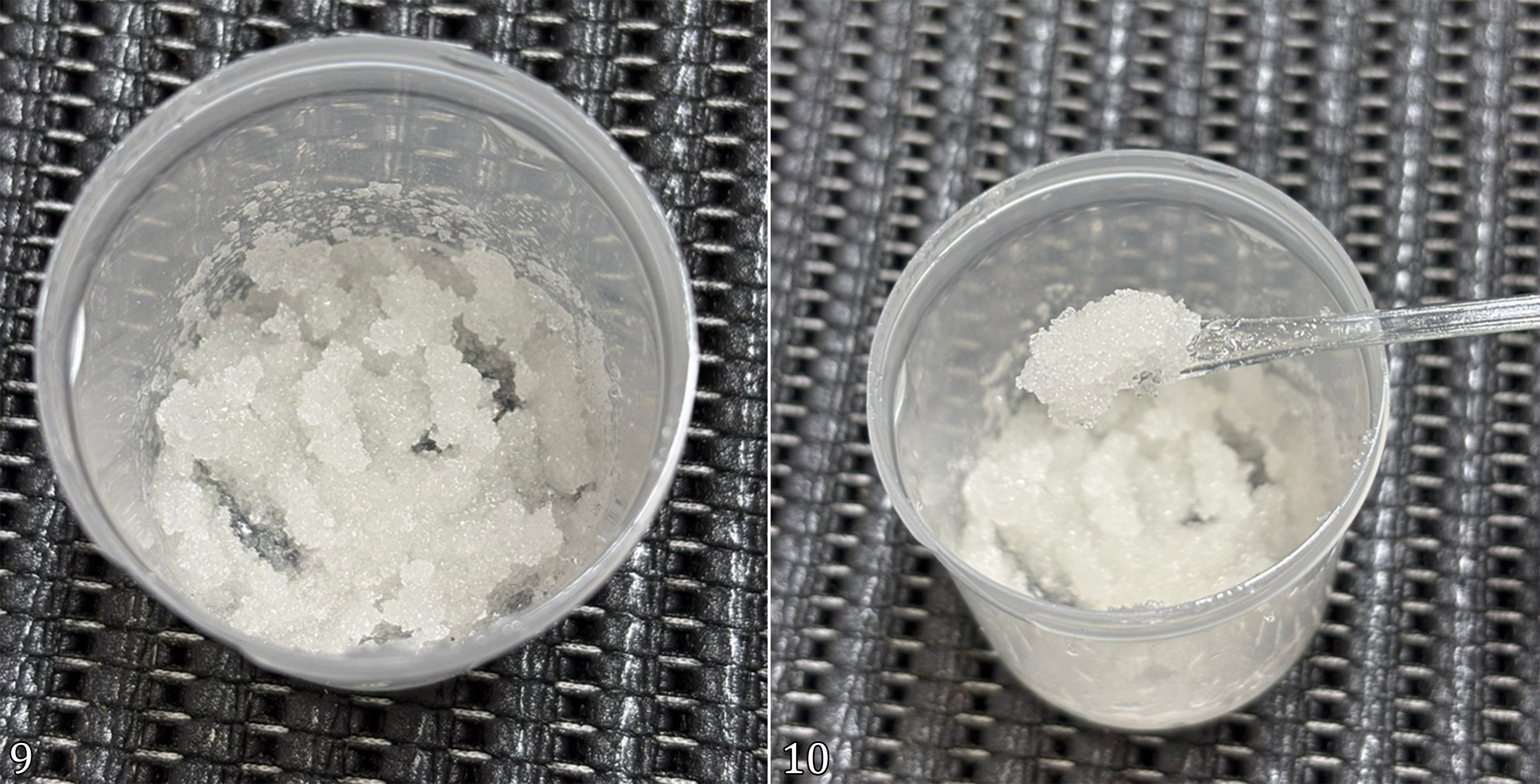
To further strengthen the healing process, a mixture containing one part ozonized sunflower oil and three parts granulated sugar with a paste-like consistency was prepared before each application and applied to the animal (Fig. 9-10). This mixture was applied daily to the wound, after cleansing with saline solution, and a dressing consisting of gauze and a bandage was subsequently applied to maintain contact between the oil/sugar mixture and the affected tissue and to prevent external contamination.

Consistency of the paste obtained after mixing one part ozonized sunflower oil with three parts granulated sugar.
On the 7th day, after the patient was finally stable, a blood sample was taken for a total blood count. Although the animal was in better clinical condition, it was still slightly anemic (hematocrit 34%).
During the course of the treatment, to preserve the integrity of the ear canal, the canal orifice was covered with cotton to prevent secretions and residues of the topical mixture from entering and to avoid potential damage. In addition, as healing progressed and the wound contracted, support sutures were placed to prevent contraction and total occlusion of the external auditory canal. This procedure was performed under sedation using methadone (0.2 mg/kg intramuscularly), propofol (2 mg/km intravenously), acepromazine (0.01 mg/kg intramuscularly), and lidocaine (4 mg/kg at the suture site). The topical treatment lasted 20 days, and at the end, the damaged tissue had fully recovered, with preserved anatomy and function of the ear canal.
Discussion
In the case reported herein, it was possible to identify an extensive skin lesion in the left auricular region, with loss of the external ear, tissue necrosis, and contamination with heavy production of purulent, foul-smelling exudate. Healing by second intention was selected, which consists of filling the tissue defect with granulation tissue over the injured epithelium and contraction of the wound edges, reducing and remodeling it (Ribeiro et al. 2019). This approach is indicated for wounds that show signs of infection or significant tissue loss that make it impossible to bring the edges together via suture (Turner & Mcilwraith 2016). Most wounds are managed this way due to the high degree of contamination and the extent of the injury (Carvalho & Borges 2011).
In cases where the ear is severely affected, especially when there is involvement of the ear canal, total or partial ablation of the ear canal can be performed surgically to improve treatment outcomes in routine clinical practice (Lanz & Wood 2004). However, in the present case, the conduit of the injured ear remained intact, allowing a conservative approach that prioritized anatomical and functional preservation. Furthermore, as this is a more invasive procedure and potentially associated with more postoperative complications, it was decided to avoid ablation and use healing by second intention through measures that keep the canal open, such as protecting the ostium with cotton and using support sutures to prevent stenosis or occlusion as the wound contracted (Lanz & Wood 2004).
Initially, it was impossible to perform venipuncture for hematological tests due to the degree of dehydration and consequent low blood volume. Therefore, it was decided first to stabilize the animal and collect blood later, which was done on the 7th day of hospitalization.
To begin topical treatment, debridement was essential to remove all necrotic tissue, clean the wound, and reduce contamination. The combination of ozonized sunflower oil and granulated sugar in this species has not been reported previously. Ozone therapy alone has been widely used, with satisfactory results (Zeng & Lu 2018). According to experimental and clinical studies, topical ozonated oil helps in the treatment of wounds as it contributes to the closure of acute and chronic wounds, increases neovascularization, and exhibits antioxidant, antimicrobial, and antifungal properties (Anzolin et al. 2020). Previously, ozone therapy has been used effectively to manage skin lesions in wild animals, including the hedgehog (Chagas et al. 2019), tupinambis (Pereira et al. 2021), rabbit (Santana et al. 2018), hamster (Almeida 2019), as well as domestic species such as dogs, cats, horses, and rats (Nakamura 2020).
Similarly, granulated sugar has been used for decades to treat wounds in animals of different species, with good outcomes (Bergman et al. 1983, Blomfield 1973). It is known to absorb exudates, dehydrate microorganisms present in the lesions, reduce edema by improving local circulation, nourish the superficial cells of the scar, and favor the growth of granulation tissue, thus improving the filling of wound gaps. These properties make it a useful tool for topical wound treatment. Therefore, sugar can be used as a second-intention wound-healing agent due to its healing and bactericidal properties, as well as its low cost, availability, and ease of handling (Ribeiro et al. 2019).
The treatment was performed quickly to reduce the time spent physically restraining the animal and, consequently, reduce stress during the applications. The results were satisfactory, with the lesion healing completely after 20 days of treatment. This result is advantageous in terms of treatment time when compared to other methods. Previously, Santana et al. (2018) reported a case of a rabbit with a skin lesion treated with topical ozone therapy, and complete healing was observed on the 38th day of treatment. In another report, Almeida (2019) discussed the treatment of a small lesion in a Syrian hamster with ozonized sunflower oil, which was completed after 23 days. Compared with sugar alone, the combination used in the present case was more effective than the agent used in previous studies. For instance, Ribeiro et al. (2019) reported the treatment of an extensive wound in an equine, wherein sugar was used for 48 days to form granulation tissue at the level of the dermis. With regard to conventional ointments, Sousa et al. (2009) reported the treatment of an extensive wound in a dog with a healing ointment based on collagenase and chloramphenicol. They showed the beginning of satisfactory granulation tissue formation from the 24th day onwards.
Another advantage of this combination was its method of application. In certain situations, the use of pure granulated sugar is limited by its inability to fill the affected area, especially in sites where granules do not adhere easily (Serafini et al. 2012). In contrast, a mixture of ozonized sunflower oil and sugar forms a paste that is easier to administer.
The progression of the wound’s appearance during treatment was also satisfactory, because the wound bed showed a clear reduction in purulent exudate production from the start of the applications, with a clean appearance throughout, an ideal level of moistness and absence of bleeding, crusts, tissue necrosis, adhesions or other elements that might interfere with the healing process. These elements can act as a physical barrier to the orderly formation of granulation tissue and collagen deposition, or they can intensify inflammation, thereby impairing the inflammatory response (Halloran & Slavin 2002).
Conclusion
This report describes what seems to be the first case of the use of a combination of ozonized sunflower oil and granulated sugar in the healing by second intention of an extensive and contaminated wound in a crab-eating fox. The use of this mixture helped the healing process by reducing inflammation, accelerating tissue growth, and controlling infection. The treatment was effective, cost-effective, and easy to apply, rendering it viable for use in wild animals. Future studies should further elucidate the efficacy of this combination in the treatment of skin lesions in wildlife medicine.
References
- Almeida GFO. Uso de óleo de girassol ozonizado como adjuvante na cicatrização de lesão cutânea em hamster Sírio (Mesocricetus auratus) - relato de caso. Trabalho de Conclusão de Curso de Graduação, Universidade Federal Rural do Semi-Árido, Mossoró. 2019. 29p.
-
Anzolin AP, Silveira-Kaross NL, Bertol CD. Ozonated oil in wound healing: what has already been proven? Med Gas Res 2020; https://doi.org/10.4103/2045-9912.279985
» https://doi.org/10.4103/2045-9912.279985 -
Bergman A, Yanai J, Weiss J, Bell D, David MP. Acceleration of wound healing by topical application of honey. Am J Surg 1983; https://doi.org/10.1016/0002-9610(83)90204-0
» https://doi.org/10.1016/0002-9610(83)90204-0 - Biondo-Simões MLP, BaretaJr VC, Ferreira LF, Collaço LM. Efeito do açúcar na cicatrização por segunda intenção: estudo experimental em ratos. Acta Cir Bras 1991;61:65.
-
Biswas A, Bharara M, Hurst C, Gruessner R, Armstrong D, Rilo H. Use of sugar on the healing of diabetic ulcers: a review. J Diabetes Sci Technol 2010; https://doi.org/10.1177/193229681000400512
» https://doi.org/10.1177/193229681000400512 -
Blomfield R. Honey for decubitus ulcers. JAMA 1973; https://doi.org/10.1001/jama.1973.03220200061034
» https://doi.org/10.1001/jama.1973.03220200061034 -
Buric J, Rigobello L, Hooper D. Five and ten year follow-up on intradiscal ozone injection for disc herniation. Int J Spine Surg 2014; https://doi.org/10.14444/1017
» https://doi.org/10.14444/1017 -
Carvalho DV, Borges EL. Tratamento ambulatorial de pacientes com ferida cirúrgica abdominal e pélvica. REME 2011; https://periodicos.ufmg.br/index.php/reme/article/view/50420
» https://periodicos.ufmg.br/index.php/reme/article/view/50420 -
Chagas NTC, Rocha CLR, Silva RBT, Santos KMM, Hirano LQL. Tratamento de ferida em Coendou prehensilis (Rodentia: Erethizontidae) com laserterapia e ozonioterapia: relato de caso. Arq Bras Med Vet Zootec 2019; https://doi.org/10.1590/1678-4162-10872
» https://doi.org/10.1590/1678-4162-10872 - Felippe PAN, Adania CH. Conservação e bem-estar animal, p.25-31. In: Cubas ZS, Silva JCR, Catão-Dias JL. Tratado de Animais Selvagens: medicina veterinária. 2nd. ed. São Paulo: Roca, 2014.
- Garcia CA, Stanziola L, Andrade ICV, Naves JHF, Neves SMN, Garcia LAD. Auto-hemoterapia maior ozonizada no tratamento de erliquiose canina - relato de caso. In: Anais 35º Congresso Brasileiro de Medicina Veterinária (CONBRAVET), Gramado, RS. 2008.
-
Halloran CM, Slavin JP. Pathophysiology of Wound Healing. Surgery Oxford 2002; https://shre.ink/7gZg
» https://shre.ink/7gZg - Jorge RSP, Jorge MLSP. Carnivora - Canidae (Cachorro-do-mato, Cachorro-vinagre, Lobo-guará e Raposa-do-campo), p.848-863. In: Cubas ZS, Silva JCR, Catão-Dias JL. Tratado de Animais Selvagens: medicina veterinária. 2nd. ed. São Paulo: Roca, 2014.
-
Lanz OI, Wood BC. Surgery of the ear and pinna. Vet Clin North Am Small Anim Pract. 2004; https://doi.org/10.1016/j.cvsm.2003.10.011
» https://doi.org/10.1016/j.cvsm.2003.10.011 - Nakamura AM. Efeito do óleo ozonizado na reparação de retalho cutâneo em ratos. Dissertação de Mestrado, Universidade Estadual Paulista “Júlio de Mesquita Filho”, Jaboticabal, 2020, 49p.
-
Pereira LMF, Prazeres Júnior FR, Gurgel JVO, Santana VS, Mayer LL, Pereira AWS, Medeiros NO, Moreira AC, Freitas CIA. Ozonized water used as complementary therapy for stomatitis in Salvator merianae - case report. Res Soc Develop 2021; https://doi.org/10.33448/rsd-v10i11.19550
» https://doi.org/10.33448/rsd-v10i11.19550 -
Ribeiro RM, Ribeiro DSF, Vasconcelos PHM, Pedroza HP. Utilização de sacarose na cicatrização por segunda intensão em ferida de 3° grau em equino: relato de caso. Rev Inter Interdis 2019; https://publicacoes.unifimes.edu.br/index.php/interacao/pt/article/view/476
» https://publicacoes.unifimes.edu.br/index.php/interacao/pt/article/view/476 - Rodrigues ASM, Auricchio P. Canídeos do Brasil. Série Zoologia - Zoo II, Mamíferos do Brasil, Coleção Terra Brasilis. Arujá: Terra Brasilis; 1994.
- Santana VS, Prazeres Júnior FR, Mayer L, Almeida G, Pereira LF, Rocha ELB, Jucá MAS. Uso de óleo de girassol ozonizado para cicatrização de ferida cirúrgica necrosada em (Oryctolagus cuniculus) - relato de caso. In: Anais Eletrônicos IX Encontro Nordestino de Grupos de Estudos de Animais Selvagens (ENGEAS), Maceió, AL. 2018.
-
Serafini GMC, Schossler JEW, Amaral AS, Dutra LH, Dibi AP, Drogemoller P, Athayde CL. Açúcar granulado ou em gel no tratamento de feridas em cães. Ciência Rural. 2012; https://doi.org/10.1590/S0103-84782012005000104
» https://doi.org/10.1590/S0103-84782012005000104 - Sousa DLS, Silva VCL, Souza M, Coelho MCOC, Rios TMM, Rodrigues UV. Atividade cicatrizante da colagenase e cloranfenicol em ferida cutânea em cão: relato de caso. In: Anais IX Jornada de Ensino, Pesquisa e Extensão (JEPEX), Recife, PE. 2009.
-
Tonks AJ, Cooper RA, Jones KP, Blair S, Parton J, Tonks A. Honey stimulates inflammatory cytokine production from monocytes. Cytokine 2003; https://doi.org/10.1016/S1043-4666(03)00092-9
» https://doi.org/10.1016/S1043-4666(03)00092-9 - Turner AS, McIlwraith CW. Princípio de tratamento de ferimentos e o uso de drenos, p.103-108. In: Turner AS, McIlwraith CW. Técnicas Cirúrgicas em Animais de Grande Porte. Rio de Janeiro: Roca; 2016.
-
Zanoti IC. Achados anatomopatológicos e determinação de causas de morte em canídeos selvagens do estado de São Paulo. Dissertação de Mestrado, 2024: https://doi.org/10.11606/D.10.2024.tde-13032024-115326
» https://doi.org/10.11606/D.10.2024.tde-13032024-115 -
Zeng J, Lu J. Mechanisms of action involved in ozone-therapy in skin diseases. Int Immunopharmacol 2018; https://doi.org/10.1016/j.intimp.2018.01.040
» https://doi.org/10.1016/j.intimp.2018.01.040
-
Data availability statement
The data used in this report are available upon reasonable request from the corresponding author.
The data used in this report are available upon reasonable request from the corresponding author.