 HPLC-DAD-MS/MS chemical characterization and evaluation of poisoning by Vernonia rubricaulis in sheep and mice
ABSTRACT:
Vernonia rubricaulis is a plant responsible for poisoning cattle living in areas subject to flooding in the Pantanal biome of Brazil. Because V. rubricaulis causes acute hepatic necrosis and clinical signs and lesions similar to other hepatotoxic plants, its action pathways are probably similar. However, the potentially toxic components of V. rubricaulis remain unknown. Our study aims to determine the chemical profiles of aqueous and ethanolic extracts of the leaves of V. rubricaulis in the budding stage, which is known to be toxic, and in the mature stage. Experimental trials using mice and sheep investigated the presence of toxic substances in the extracts. Three groups of mice received different doses of V. rubricaulis extract. Another four groups were carried out with sheep that received: (1) aqueous extract of immature leaves, (2) aqueous extract of mature leaves, (3) ethanolic extract of mature leaves, and (4) ethanolic extract of immature leaves. Intoxication was reproduced in sheep only with the aqueous extract of V. rubricaulis buds; ethanol was not a suitable solvent for extracting toxic compounds. This finding suggests that toxic components are not present in considerable amounts in the mature plant. Swiss mice proved not to be suitable experimental models for reproducing intoxication because none of the extracts was toxic to the animals, including the one that was toxic in sheep. The chemical profile of the extracts revealed the presence of sugars, flavonoids, sphingolipids, and chlorogenic acids. Chemical profiles determined by HPLC-DAD-MS of the aqueous and ethanolic extracts of the buds and mature leaves of V. rubricaulis did not reveal compounds with known toxic potential. We demonstrated that the aqueous extraction method of V. rubricaulis was efficient at extracting toxic components from the plant’s leaves in the budding stage.
INDEX TERMS:
Hepatotoxin; acute necrosis; toxic plants; cattle; sheep; mice; Asteraceae; HPLC-DAD-MS/MS
RESUMO:
Vernonia rubricaulis é uma planta responsável por causar surtos de intoxicação em bovinos que vivem em áreas sujeitas a alagamento no bioma Pantanal do Brasil. Por causar necrose hepática aguda e quadro anatomopatológico semelhante a outras plantas hepatotóxicas, como Xanthium spp., era suposto que seu princípio ativo fosse semelhante ao desta planta. No entanto, os potenciais componentes tóxicos permanecem desconhecidos. Este estudo buscou determinar o perfil químico dos extratos aquoso e etanólico das folhas de V. rubricaulis, na fase de brotação, sabidamente tóxica, e na fase adulta. Para investigar a presença das substâncias tóxicas nos extratos, estudos experimentais utilizando camundongos e ovinos foram realizados. Ensaios experimentais utilizando ratos e ovinos investigaram a presença de substâncias tóxicas nos extratos. Três grupos de camundongos receberam diferentes doses do extrato de V. rubricaulis. Outros quatro grupos foram formados com ovinos que receberam: (1) extrato aquoso de folhas imaturas, (2) extrato aquoso de folhas maduras, (3) extrato etanólico de folhas maduras, e (4) extrato etanólico de folhas imaturas. A intoxicação foi reproduzida em ovinos apenas com o extrato aquoso dos brotos de V. rubricaulis, revelando que o etanol não é um bom solvente extrator dos compostos tóxicos e corroborando com achados prévios que sugerem que estes componentes não estão presentes em quantidades tóxicas na planta adulta. Camundongos Swiss não foram classificados como modelos experimentais adequados para a reprodução da intoxicação, uma vez que nenhum dos extratos foi tóxico, nem mesmo aquele que foi tóxico para ovinos. O perfil químico dos extratos revelou a presença de compostos das classes dos açúcares, flavonoides, esfingolipídeos e ácidos clorogênicos. Assim, os perfis químicos determinados por HPLC-DAD-MS dos extratos aquoso e etanólico das folhas em fase de brotação e das folhas adultas, não revelaram compostos com potencial tóxico conhecido, indicando que outras estratégias de determinação do perfil químico ou outras técnicas de caracterização estrutural devem ser empregadas para tal finalidade. Entretanto, o estudo demonstrou que o método de extração aquosa de V. rubricaulis foi eficiente na extração dos componentes tóxicos das folhas em fase de brotação.
TERMOS DE INDEXAÇÃO:
Hepatotoxina; necrose aguda; plantas tóxicas; bovinos; ovinos; camundongos; Asteraceae; HPLC-DAD-MS/MS
Introduction
Vernonia rubricaulis is a subshrub belonging to the Asteraceae family found in flooded areas of the Pantanal biome in the state of Mato Grosso do Sul. It is known for causing acute hepatic necrosis in cattle that ingest it (Tokarnia & Döbereiner 1982, Brum et al. 2002). Economic losses caused by cattle poisoning outbreak by V. rubricaulis resulted in U$756,915.74 to farm producers on affected properties (Soares et al. 2018).
Its toxicity is higher in the budding stage, stimulated by mowing, burning, and rains that occur after long periods of drought when there is a greater need for forage (Brum et al. 2002). Clinicopathological findings result from acute liver failure characterized by centrilobular to massive hepatocellular necrosis associated with hemorrhagic areas (Godoy et al. 2018, Soares et al. 2018).
Spontaneous poisoning is described only in cattle (Tokarnia & Döbereiner 1982, Brum et al. 2002). Experimentally, it was reproduced in cattle (Tokarnia & Döbereiner 1982, Brum et al. 2002) and sheep (Godoy et al. 2018). Although the clinical, epidemiological and anatomopathological aspects are well described, the toxic compounds of V. rubricaulis are yet unknown (Godoy et al. 2018).
Knowledge about the toxic principle of plants relevant to livestock production is important for developing appropriate therapeutic procedures and prophylactic techniques. The main difficulty in determining the toxic principle of a plant is establishing between all isolated substances which one is responsible for toxicosis.
Our study was designed to address the pressing issue of V. rubricaulis poisoning in livestock. Specifically, we aimed to determine the chemical profile of V. rubricaulis leaves in both their budding and adult stages to identify potential toxic compounds. To validate our findings, we conducted experimental poisoning in sheep and mice, aiming to confirm the toxicity of these compounds and explore the potential of mice as experimental models for future studies on V. rubricaulis poisoning.
Materials and Methods
Ethical approval. The Ethics Committee on the Use of Animals of “Universidade Federal de Mato Grosso do Sul” (CEUA/UFMS) approved the experiment in sheep under protocol no. 1.201/2021. The experiments in mice were approved under number 1042/2019. The experimental protocols were conducted in accordance with the federal regulations of the National Council for the Control of Animal Experimentation (Brasil 2008) and the guidelines outlined by the Organization for Economic Cooperation and Development (OECD-420).
Obtaining extracts from Vernonia rubricaulis
We collected leaves of V. rubricaulis in the budding stage (i.e., plants with heights ranging from 5-7cm) and the leaves of mature plants (flowering stage) in the municipality of Campo Grande, Mato Grosso do Sul, Brazil (20°26’34” S/54°38’47” W).
Drying of plant material. We dried fresh leaves of V. rubricaulis in their budding (500g) and adult (200g) stages on a bench exposed to the air. Three 3g samples were precisely separated on glass plates and dried in the shade exposed to the air until their mass stabilized to calculate the average amount of water lost from the leaves. On average, the leaves lost 80% of their mass in the form of water.
Obtaining ethanolic extract of V. rubricaulis. The budding leaves (10.9g) and leaves from mature plants (20.3g) were dried, ground, and subjected to extraction with 0.5 and 1.0L of ethanol, respectively, for two days. This extraction process was performed three times. The extracts were separately filtered, and the solvent was removed by rotatory evaporation under reduced pressure at 37°C and lyophilization. Ethanolic extracts of the budding leaves and the mature plant were obtained with yields of 5.5% and 5.9%, respectively.
Obtaining aqueous extract of V. rubricaulis. The shoots (99.5g) and leaves of mature plants (20.0g) were dried, ground, and subjected to extraction with 4.0 and 0.8L of ultrapure water (Milli-Q®, Darmstadt, DE), respectively, in a water bath for 30 minutes in a covered flask at a temperature of 100°C. The extracts were filtered, and the water was removed by rotatory evaporation under reduced pressure at 37°C, followed by lyophilization. Aqueous extracts of the buds and the leaves of mature plants were obtained with yields of 28.6% and 26.9%, respectively.
Evaluation of toxicity in sheep
We conducted two experiments using seven young male and female sheep allocated to individual masonry pens. The animals were fed with corn silage, commercial feed for the species (250g/sheep), commercial mineral salt (30g/sheep), fresh forage of Brachiaria sp., and water ad libitum.
To ensure the animals’ health was optimal at the start of the experiment, we collected blood from the jugular veins of all sheep. The blood was then divided into two types of Vacutainer® tubes (Becton, Dickinson and Company, NJ, USA).
Part of the blood destined for blood counts was sampled in vacutainer tubes containing EDTA; the other part was destined for biochemical dosages of AST, GGT, urea, and creatinine enzymes. It was collected in a vacutainer tube with no additive. This meticulous blood collection process was a crucial step in our toxicity evaluation.
Aqueous and ethanolic extracts of V. rubricaulis. To verify the toxicity of buds from V. rubricaulis to sheep, an aliquot of 25.2g of ethanolic extracts from the budding leaves and another 5.4g of aqueous extracts were administered to two sheep (Sheep A and B) in a single oral dose. Considering the yield of the extracts and the percentage of water loss from the leaves, the doses were equivalent to 15g/kg/body weight (BW) of the fresh plant.
Aqueous extracts of buds and mature leaves of V. rubricaulis. Only aqueous extract from the bud was toxic to sheep. We then performed a new experiment using the aqueous extracts made from the mature plant leaves.
An aliquot of aqueous extracts from the mature plant leaves, equivalent to a dose of 15g/kg/BW of fresh V. rubricaulis, was administered orally to one sheep (Sheep C). Three sheep (Sheep D, E, and F) received an oral single dose or oral aliquots of aqueous extracts from the bud equivalent to doses of 15, 10 and 5g/kg/BW of the fresh plant. Sheep G was used as a control and did not receive any of the extract.
Clinical and anatomopathological evaluations. The sheep underwent a daily physical examination to assess their heart rate, respiratory rate, ruminal movements, and general behavior. Sheep that died were necropsied, and several organs were sampled and fixed in 10% neutral-buffered formalin, processed routinely for histology, and stained with hematoxylin and eosin (HE).
Assessment of extract toxicity in mice
Animals. Male (30±5g) and female (25±5g) Swiss albino mice (Mus musculus), aged approximately 8-12 weeks, from the Central Animal Facility (UFMS), were housed in cages and exposed to 12-hour light/dark cycles in a temperature of 23±2°C during two weeks for local adaptation. The animals received standard food and water ad libitum for two weeks and then were exposed to a four-hour food fast and one-hour water fast before the experiment began. The mice were stored in boxes with cages on the bottom during the entire fast to prevent coprophagy. Euthanasia was performed with an overdose by halothane inhalation (Cristália, São Paulo, Brazil). All mice were necropsied and the methodology used to collect the sample for histopathology was the same as that used in sheep.
Evaluation of extract toxicity in mice. All mice from the three treatment groups received a different dose of the V. rubricaulis extract (550mg/kg, 1,750mg/kg, and 5,000mg/kg); the Control group received water only. Each treatment group consisted of 10 mice (five nulliparous females and five males). Two different experiments were conducted, one with the aqueous extract made from V. rubricaulis buds and one with the aqueous extract made from the leaves of mature V. rubricaulis.
The animals were fasted for three hours after treatment, and then food and water were offered ad libitum. The mice were monitored individually for the first 30 minutes after treatment and then hourly for the next four hours. They were also observed periodically during the subsequent 24 hours and then daily for the next 14 days. Changes in the skin, hair, eyes, mucous membranes, and behavior of any mouse, in addition to other clinical signs, were monitored. Food consumption, water intake and animal weight were tabulated daily for 14 days. After 14 days of experiment, all animals were euthanized, and the weights of their livers and kidneys were compared.
The data from this crucial part of the study were expressed as mean ± standard deviation. Differences between groups were determined using the robust analysis of variance (ANOVA), followed by the rigorous Tukey’s test. A p-value less than 0.05 was presumed to indicate statistical significance, ensuring the reliability of our findings.
Analysis of the chemical profiles of the ethanolic and aqueous extracts of V. rubricaulis using HPLC-DAD-MS/MS
Chromatograms of the ethanolic and aqueous extracts of V. rubricaulis leaves in the budding and mature stages, as well as ultraviolet (UV) spectra and high-resolution mass spectra of its components, were obtained via HPLC-DAD-MS/MS. The ethanolic extracts were first solubilized in MeOH:H2O (1:1 v/v) and subjected to a clean-up by solid-stage extraction (SPE) (Sep-Pak Classic, C18, Waters™, MA, USA); the aqueous extracts were solubilized in Milli-Q® water. All samples were filtered through 0.22µm polyvinylidene fluoride (PVDF) membranes (Allcrom, São Paulo, BR) and injected at a final concentration of 1mg/mL. The solvents used were water type I (Milli-Q Synthesis, Millipore, Bedford, MA, USA) and acetonitrile (ACN) HPLC grade (Tedia, RJ, BR).
Five microliters of the extracts were separately injected into ultra-fast liquid chromatography (UFLC) LC-20AD system (Shimadzu™, Merck, Darmstadt, DE) coupled to a diode array detector (DAD) and a microTOF-QIII mass spectrometer (BrukerDaltonics, MA, USA) containing an electrospray ionization source and a quadrupole time-of-flight (qTOF) analyzer. The C18 column used (Kinetex, 2.6µm, 150.0x2.1mm, Phenomenex, Torrance, CA, USA) was protected with a pre-column packed with the same material.
For the mobile stage, water (solvent A) and acetonitrile (solvent B) were used, both with 1% acetic acid, and the elution gradient varied from 0-2 minutes for 3% B; 2-25 minutes for 3-25% B and 25-40 minutes for 25-80% B, followed by washing of the column and reconditioning for eight minutes. The flow was 0.3mL/min, and the analyses were performed by monitoring UV absorption between 240 and 800nm; mass spectrometry was also performed in positive and negative modes (m/z 120-1200).
The compounds present were determined by analysis of the UV spectra, high-resolution molecular masses and fragmentation patterns in the MS/MS spectra. Furthermore, comparisons were made with data available in the literature.
Results
Evaluation of the aqueous and ethanolic extracts of Vernonia rubricaulis buds in sheep
The sheep in the experiment had vital parameters, blood counts, and biochemical dosage results within normal limits; all animals were healthy.
We began our study by validating methods of extracting toxic components of V. rubricaulis. Two sheep received extracts at a dose equivalent to 15g/kg/BW of the fresh plant. Sheep A, which received the bud ethanolic extract, did not get sick. Sheep B, which received the bud aqueous extract, appeared healthy during the day and did not exhibit any adverse clinical signs. However, after 24 hours, the sheep was dead.
Grossly, the liver of Sheep B showed extensive dark red areas surrounded by pale to yellowish foci and multiple hemorrhagic areas extended from the capsular surface to the cut surface. Microscopic lesions were restricted to the liver and consisted of centrilobular to massive coagulative hepatocellular necrosis accompanied by multifocal hemorrhage in the centrilobular region.
Evaluation of the aqueous extracts of bud and mature leaves of V. rubricaulis
The outcome of the experiments using aqueous extract from the bud and aqueous extract from the mature plant leaves are in Table 1. Only sheep that received aqueous extract from the bud became ill. Sheep D, which had the most acute clinical course and received the highest dose of the extract, exhibited tachypnea, apathy, decreased appetite and died within 24 hours. Sheep E, on the other hand, which received a lower dose, presented hyporexia 24 hours after ingesting the extract and died after 48 hours.
Necropsy findings of Sheep D and E consisted of multiple petechiae in the epicardium and liver with an evident lobular pattern and multiple pale areas interspersed with dark red foci, similar to those observed in Sheep B (Fig.1 and 2). Histologically, the liver had moderate to severe coagulation hepatocellular necrosis affecting centrilobular and midzonal regions, associated with multiple extensive hemorrhagic foci (Fig.3 and 4). The other organs did not show microscopic abnormalities.
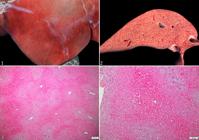
Anatomopathological findings of experimental poisoning by Vernonia rubricaulis in sheep. (1) Multiple dark red dots interspersed with pale foci on the capsular surface of the liver. (2) On the cut surface, there are red areas surrounded by pale foci distributed diffusely throughout the liver. (3) There is centrilobular to massive hepatocellular necrosis with hemorrhage occasionally bridging between the lobules. Liver. HE, obj.5x. (4) Approximately 90% of hepatocytes exhibit coagulation necrosis. Liver. HE, obj.10x.
Assessment of extract toxicity in mice
None of the mice exhibited clinical signs after being given aqueous extracts of the buds or mature leaves of V. rubricaulis. Furthermore, in all animals, none of the organs showed abnormalities. The weights of the livers and kidneys did not differ statistically between the Control group and the other three groups treated with different doses of the extracts.
Chemical profiles of the ethanolic and aqueous extracts of V. rubricaulis
A comprehensive analysis revealed the presence of a diverse array of thirty-two compounds in the ethanolic and aqueous extracts of V. rubricaulis, encompassing sugars, flavonoids, sphingolipids, and chlorogenic acids (Table 2). Notably, the majority of the metabolites identified through HPLC-DAD-MS were derivatives of chlorogenic acids and flavonoids in the ethanolic extracts (Fig.5 and 6), which were also found in the aqueous extracts. Intriguingly, the chemical profiles of both the aqueous and ethanolic extracts from the buds and mature leaves were remarkably similar to each other (Fig.7 and 8). Figure 9 represents a white column.

Base peak chromatogram (BPC) obtained by HPLC-DAD-MS/MS in positive ionization mode from extracts of Vernonia rubricaulis. (5) Ethanol extract of plant buds. (6) Ethanol extract of leaves from the mature plant. (7) Aqueous extract of plant buds. (8) Aqueous extract of leaves from the mature plant. (9) White column.
Discussion
Even though the aqueous and ethanolic extracts were both administered to sheep at a dose equivalent to 15g/kg/BW of fresh Vernonia rubricaulis - a dose considered to be fatal to sheep and cattle (Tokarnia & Döbereiner 1982, Brum et al. 2002, Godoy et al. 2018), only the sheep that received the aqueous extract became ill. We can accordingly conclude that ethanol was not a suitable liquid for extracting the toxic components of V. rubricaulis.
In an attempt to verify the toxic potential of both mature leaves and buds of V. rubricaulis in an aqueous extraction, the sheep that received the extract composed of mature leaves at a dose known to be toxic in the bud stage did not get sick. This finding corroborates the results of Godoy et al. (2018) that the mature stage of V. rubricaulis is not toxic. It is possible that, under natural conditions, this stage of development is not an important risk factor for poisoning in cattle. However, the aqueous extract with buds of V. rubricaulis retained only a portion of its toxic nature, as it poisoned Sheep D and E, which received the equivalent of 10 and 15g/kg/BW of the fresh bud. Sheep F did not get sick despite receiving a dose equivalent to 5g/kg/BW of fresh bud, even though that dose has been proven to be fatal in cattle (Brum et al. 2002). Despite being an efficient extractor solvent compared with ethanol, we conclude that the V. rubricaulis bud aqueous extraction method did not extract all the toxic principles.
All sheep that fell ill exhibited acute clinical signs, which is expected in cases of poisoning by V. rubricaulis, and macroscopic and microscopic lesions consistent with acute hepatic necrosis that were described in several instances of experimental poisoning in sheep and cattle (Brum et al. 2002, Godoy et al. 2018) and spontaneous poisoning in cattle (Brum et al. 2002, Soares et al. 2018).
None of the mice fell ill in our experiments, even those from groups receiving the aqueous extracts that proved to be fatal to Sheep D and E. The absence of clinical signs in mice has been commonly described in experiments using other species of Vernonia (Ojiako & Nwanjo 2006, Olufunmilayo et al. 2017). Therefore, we conclude that mice are not good experimental models for studies of poisoning by V. rubricaulis, as they do not appear to be susceptible to its toxicity. Rabbits were used as subjects in experimental trials with Vernonia molissima. However, although natural poisoning by V. molissima in cattle and sheep causes liver lesions similar to those caused by V. rubricaulis in these two livestock species, it primarily induces coagulative necrosis of the renal tubular epithelium in experimentally poisoned rabbits (Tokarnia et al. 1986).
Our HPLC-DAD-MS/MS data failed to reveal any toxic entities in any extract of V. rubricaulis. Atractylosides, metabolites that are considered to be responsible for the toxicity of plants from the Xanthium and Cestrum genera (Machado et al. 2021) and that cause lesions similar to those triggered by V. rubricaulis, were not detected in our study. Atractylosides were also not detected in previous studies (Godoy et al. 2018). Most metabolites we identified are derived from chlorogenic acid and flavonoids, substances commonly found in other Vernonia spp. (Toyang & Verpoorte 2013, Verma 2018). Flavonoids, in particular, are metabolites with a wide range of pharmacological properties; they can be anti-hyperglycemic, antimicrobials, and antioxidants (Alara et al. 2017, Verma 2018). Vernonia spp. include flavonoids, but it is unlikely that the metabolites noted in our study are associated with the toxic effects of V. rubricaulis observed in sheep and cattle. This fact indicates that new chemical profile analyses should be developed.
Although it has not yet been possible to identify the compound responsible for V. rubricaulis toxicity, our study has demonstrated promise in developing methodologies for extracting and identifying the unknown active compounds present in V. rubricaulis.
Conclusion
Aqueous extraction methods can extract the still-unknown active compounds of Vernonia rubricaulis. Mice are not good experimental models for studies evolving V. rubricaulis poisoning effects.
Acknowledgments
This study was made with the support of “Universidade Federal de Mato Grosso do Sul”, “Ministério da Educação” (UFMS/MEC), Brazil, and was partially funded by the “Coordenação de Aperfeiçoamento de Pessoal de Nível Superior” (CAPES), Brazil, finance code 001, and by “Fundação de Apoio ao Desenvolvimento do Ensino, Ciência e Tecnologia do Estado de Mato Grosso do Sul” (FUNDECT). Two of the authors (C.C.G. and R.A.A.L.) have research fellowships from the “Conselho Nacional de Desenvolvimento Científico e Tecnológico” (CNPq), Brazil.
References
-
Alara O.R., Abdurahman N.H., Mudalip S.K.A. & Olalere O.A. 2017. Phytochemical and pharmacological properties of Vernonia amygdalina: a review. J. Chem. Eng. Ind. Biotechnol. 2:80-96. <https://dx.doi.org/10.15282/jceib.v2i1.3871>
» https://doi.org/https://dx.doi.org/10.15282/jceib.v2i1.3871 -
Brasil 2008. Lei nº 11.794, de 8 de outubro de 2008. [Regulamenta o inciso VII do § 1o do art. 225 da Constituição Federal, estabelecendo procedimentos para o uso científico de animais; revoga a Lei no 6.638, de 8 de maio de 1979; e dá outras providências]. Presidência da República, Brasília, DF. Available at <Available at https://www.planalto.gov.br/ccivil_03/_ato2007-2010/2008/lei/l11794.htm >. Accessed on Oct. 1 2024.
» https://www.planalto.gov.br/ccivil_03/_ato2007-2010/2008/lei/l11794.htm -
Brum K.B., Purisco E., Lemos R.A.A. & Riet-Correa F. 2002. Intoxicação por Vernonia rubricaulis em bovinos no Mato Grosso do Sul. Pesq. Vet. Bras. 22(3):119-128. <https://dx.doi.org/10.1590/S0100-736X2002000300006>
» https://doi.org/https://dx.doi.org/10.1590/S0100-736X2002000300006 -
Godoy K.C.S., Leal P.V., Araújo M.A., Souza A.I., Pott A., Lee S.T., Barros C.S.L. & Lemos R.A.A. 2018. Experimental poisoning by Vernonia rubricaulis in sheep. Toxicon 141:9-14. <https://dx.doi.org/10.1016/j.toxicon.2017.11.002> <PMid:29128544>
» https://doi.org/https://dx.doi.org/10.1016/j.toxicon.2017.11.002 -
Machado M., Queiroz C.R.R., Wilson T.M., Sousa D.E.R., Castro M.B., Saravia A., Lee S.T., Armién A.G., Barros S.S. & Riet-Correa F. 2021. Endemic Xanthium strumarium poisoning in cattle in flooded areas of the Araguari River, Minas Gerais, Brazil. Toxicon 200:23-29. <https://dx.doi.org/10.1016/j.toxicon.2021.06.019> <PMid:34217747>
» https://doi.org/https://dx.doi.org/10.1016/j.toxicon.2021.06.019 - Ojiako O.A. & Nwanjo H.U. 2006. Is Vernonia amygdalina hepatotoxic or hepatoprotective? Response from biochemical and toxicity studies in rats. Afr. J. Biotechnol. 5(18):1648-1651.
- Olufunmilayo L.A., Oshiobugie M.J. & Iyobosa A.I. 2017. Acute toxicity and hypoglicemic properties of ethanolic root extract of Vernonia amygdalina (bitter leaf) in alloxan-induced diabetic rats. Int. J. Curr. Res. 9(5):50132-50138.
-
Soares M.C., Pupin R.C., Guizelini C.C., Gaspar A.O., Gomes D.C., Brumatti R.C. & Lemos R.A.A. 2018. Economic losses due to Vernonia rubricaulis poisoning in cattle. Pesq. Vet. Bras. 38(12):2217-2223. <https://dx.doi.org/10.1590/1678-5150-PVB-6075>
» https://doi.org/https://dx.doi.org/10.1590/1678-5150-PVB-6075 - Tokarnia C.H. & Döbereiner J. 1982. Intoxicação de bovinos por Vernonia rubricaulis (Compositae) em Mato Grosso. Pesq. Vet. Bras. 2(4):143-147.
- Tokarnia C.H., Döbereiner J., Amorim P.R., Gava A. & Consorte L.B. 1986. Intoxicação experimental por Vernonia mollissima (Compositae) em coelhos. Pesq. Vet. Bras. 6(1):5-10.
-
Toyang N.J. & Verpoorte R. 2013. A review of the medicinal potentials of plants of the genus Vernonia (Asteraceae). J. Ethnopharmacol. 146(3):681-723. <https://dx.doi.org/10.1016/j.jep.2013.01.040> <PMid:23395623>
» https://doi.org/https://dx.doi.org/10.1016/j.jep.2013.01.040 - Verma S. 2018. Phytochemical and pharmacological investigation of Vernonia cinerea: asteraceae. Pharma Innov. J. 7(6):519-521.


