
 A behavioral model to study decision-making involved in climate action
The United Nations’ 2030 Agenda emphasizes the need for actions that mitigate climate change effects and assist populations in adapting to the impact of extreme climate events. Emerging countries such as Brazil still require psychological studies on climate actions. This study aims to defend a research agenda that aids researchers, professionals, and policy decision-makers finding possibly relevant variables in the study of the relationship between climate change and behavior. Given the need of finding behavioral profiles susceptible to interventions or to the impact of extreme climate events, concepts from different psychological fields constitute potential psychological moderators of the relationship between climate change and behavior. The end of this study offers a differential susceptibility hypothesis as a method to find relevant moderators in the Brazilian study of climate actions.
Keywords:
behavioral sciences; environmental psychology; empirical methods
 Thumbnail
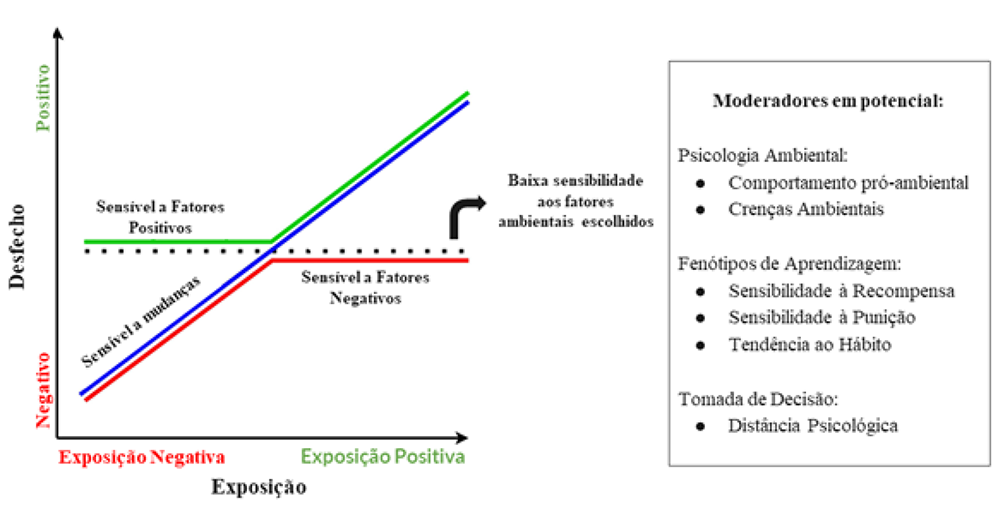 Nota. Modelo de análise de interação que pode ser utilizado no teste da hipótese da suscetibilidade diferencial.Fonte: Elaborado pelos autores, baseado em