 Cross-cultural adaptation and validity evidence of the engaging leadership scale in Brazil
Abstract
This study aimed to conduct a cross-cultural adaptation and examine validity evidence for the Engaging Leadership Scale in samples of Brazilian employees and leaders. The adaptation process comprised translation, back-translation, expert evaluation, and focus groups. Two cross-sectional studies were conducted: Study 1 included a general sample of 425 employees, whereas Study 2 comprised 131 leaders from the judiciary. In Study 1, confirmatory factor analysis indicated an excellent fit for the unidimensional model (χ2/df = 3.85; comparative fit index = 0.996; Tucker-Lewis index = 0.996; root mean square error of approximation [90% confidence interval] = 0.082 [0.070-0.094]) and high reliability (ω = 0.969). In Study 2, the unidimensional structure was supported, with satisfactory reliability (ω = 0.896) and convergent validity (r = 0.473; p < 0.001). Overall, the findings indicate that the Engaging Leadership Scale demonstrates adequate psychometric properties for Brazilian employees and provides encouraging preliminary evidence for its application among leaders.
Keywords:
Work engagement; Psychometrics; Psychological assessment
Resumo
O objetivo deste estudo foi realizar a adaptação transcultural e avaliar as evidências de validade da Engaging Leadership Scale (Escala de Liderança Engajadora) para trabalhadores e líderes brasileiros. O processo de adaptação incluiu tradução, retrotradução, avaliação por juízes e grupos focais. Dois estudos transversais foram realizados: o primeiro com 425 trabalhadores em geral e o segundo com 131 líderes do setor judiciário. No Estudo 1, a Análise Fatorial Confirmatória (AFC) apresentou excelente ajuste para o modelo unifatorial [χ2/gl = 3,85; CFI = 0,996; TLI = 0,996; RMSEA (IC90%) = 0,082 (0,070-0,094)] e alta confiabilidade (ω = 0,969). No Estudo 2, a estrutura unifatorial também foi sustentada (ω = 0,896), com correlação significativa para validade convergente (r = 0,473; p < 0,001). Concluímos que a Escala de Liderança Engajadora apresenta propriedades psicométricas adequadas para a população de trabalhadores brasileiros e resultados preliminares promissores para líderes.
Palavras-chave:
Engajamento no trabalho; Psicometria; Avaliação psicológica
Resumen
El objetivo de este estudio fue realizar la adaptación transcultural y evaluar las evidencias de validez de la Engaging Leadership Scale para trabajadores y líderes brasileños. El proceso de adaptación incluyó traducción, retrotraducción, evaluación por jueces y grupos focales. Se realizaron dos estudios transversales: el primero con 425 trabajadores en general y el segundo con 131 líderes del sector judicial. En el Estudio 1, el Análisis Factorial Confirmatorio (AFC) mostró un ajuste excelente para el modelo unifactorial [χ2/gl = 3,85; CFI = 0,996; TLI = 0,996; RMSEA (IC90%) = 0,082 (0,070-0,094)] y una alta confiabilidad (ω = 0,969). En el Estudio 2, la estructura unifactorial también fue sustentada (ω = 0,896), con una correlación significativa para la validez convergente (r = 0,473; p < 0,001). Concluimos que la Escala de Liderazgo Comprometido presenta propiedades psicométricas adecuadas para la población de trabajadores brasileños y resultados preliminares prometedores para líderes.
Palabras clave:
Compromiso laboral; Evaluación psicológica; Psicometría
Introduction
Leadership is a social phenomenon inherent to organizational contexts and expressed through influence, cultivating commitment, and coordinating individual and collective efforts toward shared goals (Yukl, 2012). When effectively exercised, leadership is strategic for organizational development and contributes positively to organizational outcomes and employee well-being (Calvosa et al., 2022; Melo & Santos, 2017; Nixon et al., 2012; Noval et al., 2022).
Schaufeli (2015a, 2015b, 2021) conceptualizes engaging leadership as a leader’s effort to inspire, strengthen, empower, and connect employees. Studies indicate that this leadership style is associated with lower stress (Selander et al., 2023), exhaustion (Salas-Vallina et al., 2021), and greater optimism, resilience, self-efficacy (Mazzetti & Schaufeli, 2022), and improved well-being and happiness at work (Salas-Vallina et al., 2021).
Engaging leadership is grounded in the principles of Self-Determination Theory, rather than being conceived merely as a job resource (Bakker et al., 2023; Deci & Ryan, 2000). This theory distinguishes three types of motivation: autonomous, controlled, and amotivation, each associated with personal development, work performance, and well-being (Deci & Ryan, 2008). Autonomous motivation arises from intrinsic interest and satisfaction, controlled motivation is driven by external rewards or pressures, and amotivation reflects a lack of intention or commitment to activities (Deci & Ryan, 2008).
Ethical, transactional, authentic, situational, and transformational leadership approaches differ from engaging leadership in that the latter is explicitly employee-centered (Piwowar-Sulej & Iqbal, 2023; Sarwar et al., 2022). This approach focuses on satisfying three basic psychological needs essential to employee health and well-being: autonomy (a sense of control), competence (a sense of effectiveness), and relatedness (a sense of being valued and cared for (Deci & Ryan, 2000; Schaufeli, 2015a, 2015b). When these needs are fulfilled, employees are more engaged at work, which in turn improves job performance (Deci & Ryan, 2012).
Work engagement is defined as the physical, cognitive, and emotional investment individuals bring to their work roles (Kahn, 1990). Schaufeli et al. (2002) described engagement as a persistent psychological state marked by positive and pleasurable attitudes toward work, characterized by vigor, dedication, and absorption. Research has shown that engaged employees are more creative (Demerouti et al., 2015), interested in learning, innovative (Rahmadani et al., 2020), and more assiduous at work (van Tuin et al., 2021), as engagement mediates the relationship between engaging leadership and work performance.
Workers’ perceptions of engaging leadership can be measured using the Engaging Leadership Scale, a self-report instrument containing 12 statements about the immediate leader, rated on a 5-point Likert scale ranging from 1 (strongly disagree) to 5 (strongly agree) (Schaufeli, 2021). The scale was originally developed in a pilot study with 195 Dutch workers and, subsequently, its factor structure was confirmed in a sample of 1,213 workers from the same country (Schaufeli, 2015a). The scale showed good fit for a model with four domains (inspiration, strengthening, connection, and empowerment) and high reliability (Cronbach’s alpha [α] between 0.88 and 0.93) (Schaufeli, 2015a). Its psychometric properties were later validated in samples of Indonesian (n = 607) and Russian (n = 384) public servants, demonstrating good reliability indices (α = 0.86 to 0.95) (Rahmadani et al., 2019). Nonetheless, a strong correlation among the four domains was observed in both samples (Indonesia: r = 0.41 to 0.66; Russia: r = 0.59 to 0.84) (Rahmadani et al., 2019), a result corroborated by subsequent research (Nikolova et al., 2021; Rahmadani et al., 2020).
The strong correlations among these domains have prompted a shift toward using a global engaging leadership score instead of a four-domain structure (Robijn, 2021; Schaufeli, 2021). Schaufeli (2021) posited that the domains are so closely interrelated that, in practice, engaging leadership is more appropriately considered a unidimensional construct.
The lack of validity evidence for the Engaging Leadership Scale in the Brazilian context limits both scientific research and its practical application in organizations. Addressing this gap is essential for encouraging leadership practices that enhance employee well-being, with positive implications for work engagement and performance. Although the scale’s original version assesses leadership behaviors from the subordinate’s perspective, an adaptation of pronouns may allow its use for self-assessment by leaders by converting third-person items (e.g., “My leader promotes…”) into first-person statements (e.g., “I promote…”).
Given these gaps, this study sought to conduct a cross-cultural adaptation of the Engaging Leadership Scale and to examine evidence of its validity in the Brazilian context. We hypothesized that the instrument would demonstrate a unidimensional structure and that the adapted version would show adequate evidence of validity and reliability for use with the Brazilian population, encompassing both leaders and followers.
Method
This study comprised two cross-sectional studies: Study 1 was conducted with general employees and Study 2 was conducted with leaders from a public institution in the judiciary. Given that the sections on translation and cultural adaptation, instrument description, and statistical analyses are common to both studies, they are reported only in Study 1. The study protocol was not preregistered, and the data are available from the corresponding author upon request.
Study 1
Participants
A total of 425 employees participated in Study 1, with a mean age of 36.7 years (standard deviation [SD] = 10.7). Most were female (53.6%), held an undergraduate degree (24.7%) or a graduate degree (32.0%), and worked in private organizations (61.6%). Participants had worked in their current organization for a mean of 8.8 years (SD = 9.3) and had 15.9 years of professional experience (SD = 10.2). A total of 34.1% held managerial positions. The sample was predominantly drawn from Brazilian states, particularly Goiás (81.2%), followed by Ceará (6.4%) and São Paulo (5.4%). Additional participant characteristics are presented in Supplementary Material 1.
Translation and cultural adaptation process
The translation and back-translation of the Engaging Leadership Scale for Study 1 were conducted in accordance with the Test Adaptation Reporting Standards (Iliescu et al., 2024), the American Educational Research Association guidelines (American Educational Research Association et al., 2014), and recommendations by Ozolins et al. (2020). The process comprised the following steps: (i) translation by three bilingual researchers; (ii) evaluating the translated items by three experts in psychological assessment to assess semantic, idiomatic, experiential, and conceptual equivalence; (iii) assessing item clarity, content, wording, and comprehensibility in three focus groups representing diverse characteristics (e.g., sex and level of education); (iv) preparing the final version of the instrument; (v) back-translation into English by two independent translators; and (vi) reviewing the English version by the original author, who provided formal authorization for its use and adaptation. No items were added or removed, and the original instructions and five-point Likert response scale were maintained. The final instrument is presented in Table 1.
Procedures
We collected data through an online questionnaire administered in Brazilian Portuguese via Google Forms, with an estimated completion time of approximately 20 minutes. Snowball sampling was utilized; eligible individuals completed the questionnaire and then shared the link within their social networks (Costa, 2018). With this approach, the questionnaire was disseminated across 14 Brazilian states, albeit the final sample was concentrated mainly in Goiás. This study was approved by the Research Ethics Committee of the Pontifical Catholic University of Goiás (PUC-GO) (opinion no. 5.886.028, CAAE: 65939022.9.0000.0037), in compliance with Brazilian National Health Council Resolution 510/2016 and related regulations.
Instruments
We employed four instruments: a personal and sociodemographic data form, the Engaging Leadership Scale, the Utrecht Work Engagement Scale-9 (UWES-9), and the Perception of Human Resource Management Policies Scale.
Personal and sociodemographic data questionnaire
This instrument was developed by the research team to collect information for characterizing the participants (e.g., gender, age, education, income, etc.).
Engaging Leadership Scale
The Engaging Leadership Scale (Schaufeli, 2015a, 2021) was translated into Brazilian Portuguese [Escala de Liderança Engajadora] and validated. It is a 12-item self-report instrument rated on a 5-point Likert scale (1 = strongly disagree; 5 = strongly agree) and assesses employees’ perceptions of their immediate leader’s behaviors. Previous validation with Dutch workers demonstrated excellent internal consistency (α = 0.88-0.93) (Schaufeli, 2015a).
Utrecht Work Engagement Scale-9
The UWES-9 was developed by Schaufeli et al. (2006) and adapted to the Brazilian context by Vazquez et al. (2015). It is a self-report nine-item instrument designed to assess levels of vigor, dedication, and absorption at work, with items rated on a five-point Likert scale (1 = strongly disagree; 5 = strongly agree). Its Brazilian version presents a unifactorial structure and demonstrated excellent internal consistency (α = 0.94) (Vazquez et al., 2015).
Perception of Personnel Management Policies Scale
Developed and validated in Brazil by Fiuza (2008), this scale assesses employees’ perceptions of organizational policies related to people management. It is a 19-item self-report instrument, with items rated on a 5-point Likert scale (1 = strongly disagree; 5 = strongly agree). Its factor structure comprises four dimensions, all showing good internal consistency: involvement (α = 0.88); training, development, and education (α = 0.72); working conditions (α = 0.77); and rewards (α = 0.78) (Fiuza, 2008).
Statistical analyses
We used descriptive statistics to characterize the study variables and conducted exploratory factor analyses (EFA) to examine the scale’s dimensional structure. A polychoric correlation matrix, appropriate for ordinal variables, was applied along with the minimum residual extraction method. The number of factors was determined based on a combination of Kaiser’s criterion (eigenvalues > 1) and visual inspection of the scree plot. Sphericity was assessed using Bartlett’s test, and overall sampling adequacy was evaluated using the Kaiser-Meyer-Olkin (KMO) measure.
Confirmatory factor analysis (CFA) was performed using the diagonal weighted least squares estimator. Model fit was evaluated using multiple indices: the chi-square to degrees of freedom ratio (χ2/df; desirable < 3), Tucker-Lewis Index (TLI), comparative fit index (CFI), and root mean square error of approximation (RMSEA). Here, TLI and CFI above 0.90 indicate good fit, while RMSEA values below 0.08 are considered acceptable.
The psychometric evaluation included analyses of measurement invariance, reliability, and discriminant validity. Measurement invariance across sex was tested using a sequence of structural equation models: configural (equivalence of factor structure), metric (equivalence of factor loadings), and scalar (equivalence of intercepts). Reliability was estimated with McDonald’s omega coefficient (ω). Convergent validity was examined through Pearson’s bivariate correlations between the Engaging Leadership Scale and the UWES-S-9 and Perception of Personnel Management Policies scales. Discriminant validity was assessed using the Fornell and Larcker (1981) criterion, which states that the square root of the average variance extracted for a given construct should exceed its correlations with other constructs. All analyses were conducted using JASP software (v. 0.19.3), with a significance level of 5% (p < 0.05).
Results of Study 1
Exploratory factor analysis
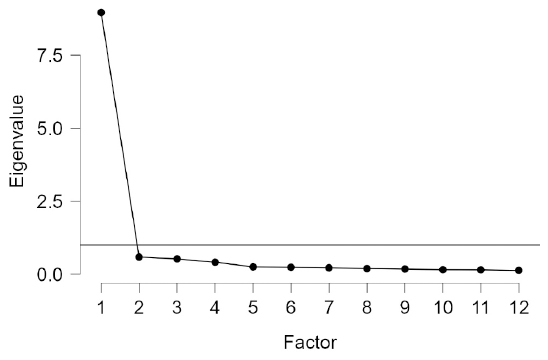
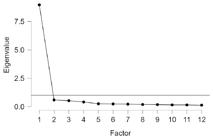
We performed exploratory factor analysis (EFA) to examine the scale’s dimensional structure (Table 2). Bartlett’s test of sphericity was statistically significant (χ2 = 7024.05; df = 66; p < 0.001), and the model demonstrated excellent sampling adequacy (KMO = 0.954). The scree plot (Figure 1) showed a clear inflection point after the first factor, suggesting a unidimensional solution. This finding was corroborated by Kaiser’s criterion (eigenvalue > 1), such that only one factor was retained. This factor explained 78% of the total variance, reflecting an excellent explanatory capacity. All items presented factor loadings above 0.80 and communalities above 0.64, evidencing a strong relationship with the latent construct (Table 2).
Confirmatory factor analysis
The CFA results supported the unidimensional model (Table 3). Although the chi-square test was statistically significant (χ2 = 208.2; df = 54; p < 0.001), the model demonstrated acceptable overall fit (χ2/df = 3.85), excellent incremental fit indices (TLI = 0.996; CFI = 0.996), acceptable approximation error (RMSEA = 0.082 [90% CI = 0.070-0.094]), and high internal consistency (ω = 0.969). These indices are consistent with the high standardized factor loadings (>0.90), emphasizing the meaningful contribution of each item to the construct.
The four-factor model was also tested (see Supplementary Material 2). Overall, this model showed a deterioration in fit (χ2/df = 5.95) and an unacceptable approximation error (RMSEA = 0.11 [90% CI = 0.096-0.120]). Despite these limitations, the instrument demonstrated excellent internal consistency for the inspiration (ω = 0.929), strengthening (ω = 0.898), connection (ω = 0.919), and empowerment (ω = 0.923) factors, with standardized factor loadings of >0.90.
Sex invariance
The configural model demonstrated adequate fit (χ2 = 246.34; df = 106; CFI = 0.998; TLI = 0.998; RMSEA = 0.079), showing that the questionnaire’s basic factor structure was equivalent for both men and women. The comparison between the metric and configural models was not statistically significant (Δχ2 [11] = 13.34; p = 0.271), and fit indices remained stable (CFI = 0.998; TLI = 0.998; RMSEA = 0.076), indicating invariance of factor loadings across sexes. Similarly, the imposition of scalar constraints did not result in a significant deterioration of model fit (Δχ2 [36] = 50.38; p = 0.056; CFI = 0.998; TLI = 0.998; RMSEA = 0.070), suggesting invariance of item intercepts. These results indicate that the Engaging Leadership Scale demonstrates invariance between genders, with factor loadings and item means equivalent for both men and women.
Convergent and discriminant validity
Convergent validity was supported by moderate to strong correlations between the Engaging Leadership Scale, the UWES-S-9, and the Perception of Personnel Management Policies Scale. Specifically, correlations were found with the UWES-S-9 (r = 0.584) and with the Perception of Personnel Management Policies Scale components (r = 0.431-0.594). These results indicate that engaging leadership shares substantial variance with theoretically related constructs, suggesting convergent validity. Discriminant validity was established according to Fornell and Larcker’s (1981) criterion, as the square root of the average variance extracted exceeded the correlations with other constructs. Complete results for convergent and discriminant validity are provided in Supplementary Material 3.
Study 2
Participants
This study included 131 leaders from the judiciary, with a mean age of 50.7 years (SD = 8). Most were male (54.2%), held a graduate degree (69.5%), were married or in a stable relationship (74%), and had no children (75.6%). Participants had 7.4 years (SD = 6.5) of experience in leadership positions and 21.9 years (SD = 8.7) of professional experience. Most were responsible for operational activities (67.2%). A detailed characterization of the sample is provided in Supplementary Material 1.
Translation and cultural adaptation process
Following the translation and cross-cultural adaptation procedures described in Study 1, all items were rewritten in the first person to enable leaders’ self-assessment, replacing third-person formulations (e.g., “My leader promotes…”) with first-person statements (e.g., “I promote…”). The complete version of this instrument is shown in Table 4.
Procedures
The Engaging Leadership Scale was administered to managers in the judicial sector in Campinas (São Paulo State). Participants held formally recognized leadership positions and supervised at least one subordinate. A convenience sample was used, as data collection occurred before a course on engaging leadership delivered by a member of the research team. All eligible participants signed an informed consent form prior to their participation and completing the questionnaires. The acceptance rate was 78%. Responses were collected via the SurveyMonkey platform, with an average completion time of approximately 10 minutes. This study was approved by the Research Ethics Committee of the Federal University of Health Sciences of Porto Alegre (UFCSPA) (opinion no. 6.011.643, CAAE: 78617617.8.0000.5345).
Instruments
We used three instruments: a personal and sociodemographic data form, the Engaging Leadership Scale, and the UWES-9. The complete description of these instruments is provided in Study 1.
Statistical analyses
For the EFA, we initially used the minimum residual extraction method with a polychoric correlation matrix, which did not converge. Subsequently, for reasons of parsimony, we used Pearson’s correlation matrix. The CFA and reliability analysis were conducted according to the procedures adopted in Study 1. Convergent validity was tested using bivariate correlations between the Engaging Leadership Scale and the UWES-9. The significance level was set at 5% (p < 0.05).
Results of Study 2
Exploratory factor analysis
The EFA results for Study 2 are listed in Table 5. Bartlett’s test of sphericity was statistically significant (χ2 = 705.02, df = 66; p < 0.001), and the model showed good overall adequacy (KMO = 0.885). The Engaging Leadership Scale again exhibited a single-factor structure, accounting for 42.4% of the total variance. Factor loadings ranged from 0.53 to 0.82.
Confirmatory factor analysis
The CFA results are presented in Table 6. In the unidimensional model, although the chi-square test was statistically significant (χ² = 189.9; df = 54; p < 0.001), the model showed acceptable overall fit (χ²/df = 3.51), with good indices of adequacy (TLI = 0.938; CFI = 0.949) and reliability (ω = 0.896). On the other hand, the RMSEA of 0.139 (90% CI [0.117, 0.161]) indicated a high approximation error, possibly due to the small sample size (n = 131). Attempts to analyze measurement invariance across sex were not feasible because the configural model (i.e., the baseline model) did not converge. The four-factor model also failed to converge using the diagonal weighted least squares estimator and weighted least squares mean and variance adjusted estimators, so the unidimensional structure was considered the most parsimonious option.
Convergent and discriminant validity
Convergent validity was assessed through the correlation between the total scores of the Engaging Leadership Scale and UWES-9. We observed a moderate positive correlation (r = 0.473), which was statistically significant (p < 0.001), supporting the convergent validity of the Engaging Leadership Scale.
Discussion
This study aimed to conduct a cross-cultural adaptation, examine evidence of validity for the Engaging Leadership Scale in the Brazilian context, and adapt a version of the scale that could be applied to both leaders and employees. For this, we performed two studies with different samples that included general employees and leaders in the Brazilian judiciary.
In Study 1, although the Engaging Leadership Scale was initially proposed with a four-factor structure, the analyses indicated that a unidimensional model provided better fit indices, explaining 78% of the total variance. These results suggest that, among employees, the construct can be adequately represented by a global engaging leadership score, corroborating Schaufeli’s (2021) recommendations. The unidimensional structure is consistent with previous studies showing strong correlations among the inspiration, empowerment, strengthening, and connection factors (Rahmadani & Schaufeli, 2022; Robijn et al., 2020; Schaufeli, 2021). In this model, factor loadings were high (> 0.90), and internal consistency was strong (ω = 0.969), in line with commonly observed values (α = 0.86-0.95) (Rahmadani et al., 2019; Rahmadani & Schaufeli, 2022), demonstrating the robustness of the results. Sex invariance, as well as convergent and discriminant validity, were also supported, further strengthening the study’s findings. Given the satisfactory psychometric properties, all items were retained, preserving the original version proposed by Schaufeli (2015a, 2021).
In Study 2, the EFA retained a single factor, explaining 42.4% of the total variance. Confirmatory factor analysis further supported this structure, revealing high factor loadings (λ > 0.60) and excellent internal consistency (ω = 0.896). Nevertheless, the model showed a high approximation error (RMSEA = 0.139), and convergence issues prevented the sex invariance analysis and four-factor model testing. Kyriazos (2018) emphasizes that sample size is a critical parameter in CFA, as a limited number of observations can affect several statistical indicators, such as residual estimates, confidence interval width, and overall model fit indices. The small sample size could compromise the discriminant validity assessment; consequently, it was not conducted in Study 2, as highlighted by Henseler et al. (2015). Although the unidimensional structure demonstrated adequate psychometric properties related to reliability and factor loadings, future studies with larger samples are necessary to address gaps associated with the version for leaders.
Limitations
In Study 1, the primary limitation was the employees’ geographic distribution. Although snowball sampling was intended to reach professionals across Brazil, this strategy proved only partially effective. Nonetheless, sample heterogeneity in education, income, training, institutional affiliation, and professional experience partially offsets this limitation and contributes to the generalizability of the findings.
The most substantial limitations were observed in Study 2. The sample comprised exclusively leaders from a single institution within the judiciary, resulting in homogeneous organizational and professional characteristics. The small sample size, coupled with the focus on leaders from the same sector, operating under identical regulations and within the same area of knowledge, limited the generalizability of the findings. These limitations may also have hindered more complex statistical analyses, as reflected in convergence issues and higher RMSEA values.
Final considerations
Robust evidence of validity was obtained for the Engaging Leadership Scale when applied to Brazilian employees. The unidimensional structure showed the best fit, indicating that the inspiration, empowerment, strengthening, and connection factors form a cohesive and highly correlated construct. Although the results for the leader self-assessment version are promising, sample limitations restricted a fuller psychometric evaluation. Future investigations with broader and more diverse samples of Brazilian leaders would strengthen these findings.
DATA AVAILABILITY STATEMENT:
The research data are not available.
Acknowledgments:
This study was carried out with support from the Coordination for the Improvement of Higher Education Personnel - CAPES (Finance Code 001; grant no. 88887.709191/2022-00) and with support from the São Paulo State Research Foundation - FAPESP (grant no. 2025/05925-0).
References
-
American Educational Research Association, American Psychological Association (APA), National Council on Measurement in Education, & Joint Committee on Standards for Educational and Psychological Testing. (2014). Standards for educational and psychological testing. American Psychological Association. https://www.testingstandards.net/open-access-files.html
» https://www.testingstandards.net/open-access-files.html -
Bakker, A. B., Demerouti, E., & Sanz-Vergel, A. (2023). Job Demands-Resources Theory: Ten years later. Annual Review of Organizational Psychology and Organizational Behavior, 10, 25-53. https://doi.org/10.1146/annurev-orgpsych-120920-053933
» https://doi.org/10.1146/annurev-orgpsych-120920-053933 - Calvosa, M. V. D., Anna, S., Lima, A. S., & Vinicius, M. (2022). O constructo liderança contemporânea a partir das mídias sociais virtuais. RAU Revista de Administração Unimep, 19(10), 83.
-
Conselho Nacional de Saúde [Brazilian National Health Council Resolution]. (2016). Resolução nº 510/2016. Recuperado em 27 de setembro de 2025, de Recuperado em 27 de setembro de 2025, de http://conselho.saude.gov.br/resolucoes/2016/Reso510.pdf
» http://conselho.saude.gov.br/resolucoes/2016/Reso510.pdf -
Costa, B. R. L. (2018). Bola de Neve Virtual: O Uso das Redes Sociais Virtuais no Processo de Coleta de Dados de uma Pesquisa Científica. Revista Interdisciplinar de Gestão Social, 7, 15-37. http://dx.doi.org/10.9771/23172428rigs.v7i1.24649
» http://dx.doi.org/10.9771/23172428rigs.v7i1.24649 -
Deci, E. L., & Ryan, R. M. (2000). The “what” and “why” of goal pursuits: Human needs and the self-determination of behavior. Psychological Inquiry, 11(4), 227-268. https://doi.org/10.1207/S15327965PLI1104_01
» https://doi.org/10.1207/S15327965PLI1104_01 -
Deci, E. L., & Ryan, R. M. (2008). Self-determination theory: A macrotheory of human motivation, development, and health. Canadian Psychology, 49(3), 182-185. https://doi.org/10.1037/a0012801
» https://doi.org/10.1037/a0012801 -
Deci, E. L., & Ryan, R. M. (2012). Self-determination theory. In P. A. M. Van Lange, A. W. Kruglanski, & E. T. Higgins (Eds.), Handbook of theories of social psychology. (pp. 416-433). SAGE Publications. https://doi.org/10.4135/9781446249215.n21
» https://doi.org/10.4135/9781446249215.n21 -
Demerouti, E., Bakker, A. B., & Gevers, J. M. P. (2015). Job crafting and extra-role behavior: The role of work engagement and flourishing. Journal of Vocational Behavior, 91, 87-96. https://doi.org/10.1016/j.jvb.2015.09.001
» https://doi.org/10.1016/j.jvb.2015.09.001 -
Fiuza, G. D. (2008). Desenvolvimento e validação da Escala de Percepção de Políticas de Gestão de Pessoas (EPPGP). RAM - Revista de Administração Mackenzie, 9(6), 77-101. https://doi.org/10.1590/S1678-69712008000600005
» https://doi.org/10.1590/S1678-69712008000600005 -
Fornell, C., & Larcker, D. F. (1981). Evaluating Structural Equation Models with Unobservable Variables and Measurement Error. Journal of Marketing Research, 18(1) 39-50. https://doi.org/10.1177/002224378101800104
» https://doi.org/10.1177/002224378101800104 -
Henseler, J., Ringle, C. M., & Sarstedt, M. (2015). A new criterion for assessing discriminant validity in variance-based structural equation modeling. Journal of the Academy of Marketing Science, 43(1), 115-135. https://doi.org/10.1007/s11747-014-0403-8
» https://doi.org/10.1007/s11747-014-0403-8 -
Iliescu, D., Bartram, D., Zeinoun, P., Ziegler, M., Elosua, P., Sireci, S., Geisinger, K. F., Odendaal, A., Oliveri, M. E., Twing, J., & Camara, W. (2024). The Test Adaptation Reporting Standards (TARES): reporting test adaptations. International Journal of Testing, 24(1), 80-102. https://doi.org/10.1080/15305058.2023.2294266
» https://doi.org/10.1080/15305058.2023.2294266 - Kahn, W. A. (1990). Psychological Conditions of Personal Engagement and Disengagement at Work. Academy of Management Journal, 33(4), 692-724.
-
Kyriazos, T. A. (2018). Applied Psychometrics: Sample Size and Sample Power Considerations in Factor Analysis (EFA, CFA) and SEM in General. Psychology, 9(8), 2207-2230. https://doi.org/10.4236/psych.2018.98126
» https://doi.org/10.4236/psych.2018.98126 -
Mazzetti, G., & Schaufeli, W. B. (2022). The impact of engaging leadership on employee engagement and team effectiveness: A longitudinal, multi-level study on the mediating role of personal- and team resources. PLoS ONE, 17(6), e0269433. https://doi.org/10.1371/journal.pone.0269433
» https://doi.org/10.1371/journal.pone.0269433 -
Melo, J. A. M., & Santos, L. H. V. dos. (2017). Estilos de liderança: um estudo de caso sobre a percepção de colaboradores de uma instituição de educação superior. Revista Negócios em Projeção, 2(8), 98-110. https://revista.faculdadeprojecao.edu.br/index.php/Projecao1/article/view/912
» https://revista.faculdadeprojecao.edu.br/index.php/Projecao1/article/view/912 -
Nikolova, I., Caniëls, M. C. J., Schaufeli, W. B., & Semeijn, J. H. (2021). Disengaging Leadership Scale (DLS): Evidence of initial validity. International Journal of Environmental Research and Public Health, 18(6), 2824. https://doi.org/10.3390/ijerph18062824
» https://doi.org/10.3390/ijerph18062824 -
Nixon, P., Harrington, M., & Parker, D. (2012). Leadership performance is significant to project success or failure: A critical analysis. International Journal of Productivity and Performance Management, 61(2), 204-216. https://doi.org/10.1108/17410401211194699
» https://doi.org/10.1108/17410401211194699 -
Noval, C. de M., Lizote, S. A., Teston, S. de F., & Zawadzki, P. (2022). Estilos de liderança dos gestores universitários e sua relação com o bem-estar no trabalho dos colaboradores. Revista Gestão Universitária na América Latina - GUAL, 15(1), 92-114. https://doi.org/10.5007/1983-4535.2022.e83510
» https://doi.org/10.5007/1983-4535.2022.e83510 -
Ozolins, U., Hale, S., Cheng, X., Hyatt, A., & Schofield, P. (2020). Translation and back-translation methodology in health research-a critique. Expert Review of Pharmacoeconomics and Outcomes Research, 20(1), 69-77. https://doi.org/10.1080/14737167.2020.1734453
» https://doi.org/10.1080/14737167.2020.1734453 -
Piwowar-Sulej, K., & Iqbal, Q. (2023). Leadership styles and sustainable performance: A systematic literature review. Journal of Cleaner Production, 382(1), 134600. https://doi.org/10.1016/j.jclepro.2022.134600
» https://doi.org/10.1016/j.jclepro.2022.134600 -
Rahmadani, V. G., Schaufeli, W. B., & Stouten, J. (2020). How engaging supervisors foster employees’ work engagement. Leadership & Organization Development Journal, 41(8), 1155-1169. https://doi.org/10.1108/LODJ-01-2020-0014
» https://doi.org/10.1108/LODJ-01-2020-0014 -
Rahmadani, V. G., & Schaufeli, W. B. (2022). Engaging leadership and work engagement as moderated by “diuwongke”: an Indonesian study. International Journal of Human Resource Management, 33(7), 1267-1295. https://doi.org/10.1080/09585192.2020.1799234
» https://doi.org/10.1080/09585192.2020.1799234 -
Rahmadani, V. G., Schaufeli, W. B., Ivanova, T. Y., & Osin, E. N. (2019). Basic psychological need satisfaction mediates the relationship between engaging leadership and work engagement: A cross-national study. Human Resource Development Quarterly, 30(4), 453-471. https://doi.org/10.1002/hrdq.21366
» https://doi.org/10.1002/hrdq.21366 -
Robijn, W., Euwema, M. C., Schaufeli, W. B., & Deprez, J. (2020). Supervisors, teams, and work engagement: a basic needs perspective. Career Development International, 25(4), 373-388. https://doi.org/10.1108/CDI-06-2019-0150
» https://doi.org/10.1108/CDI-06-2019-0150 -
Salas-Vallina, A., Alegre, J., & López-Cabrales, Á. (2021). The challenge of increasing employees’ well-being and performance: How human resource management practices and engaging leadership work together toward reaching this goal. Human Resource Management, 60(3), 333-347. https://doi.org/10.1002/hrm.22021
» https://doi.org/10.1002/hrm.22021 -
Sarwar, U., Zamir, S., Fazal, K., Hong, Y., & Yong, Q. Z. (2022). Impact of leadership styles on innovative performance of female supervisors in Pakistani Universities. PLoS ONE , 17(5), e0266956. https://doi.org/10.1371/journal.pone.0266956
» https://doi.org/10.1371/journal.pone.0266956 -
Schaufeli, W. B. (2021). Engaging leadership: How to promote work engagement? Frontiers in Psychology, 12, 754556. https://doi.org/10.3389/fpsyg.2021.754556
» https://doi.org/10.3389/fpsyg.2021.754556 -
Schaufeli, W. B. (2015a). Engaging leadership in the job demands-resources model. Career Development International , 20(5), 446-463. https://doi.org/10.1108/CDI-02-2015-0025
» https://doi.org/10.1108/CDI-02-2015-0025 - Schaufeli, W. B. (2015b). From burnout to work engagement: Work and well-being in the Netherlands. M&O - Organisatie & Management, 69(1), 15-31.
-
Schaufeli, W. B., Bakker, A. B., & Salanova, M. (2006). The measurement of work engagement with a short questionnaire: A cross-national study. Educational and Psychological Measurement, 66(4), 701-716. https://doi.org/10.1177/0013164405282471
» https://doi.org/10.1177/0013164405282471 - Schaufeli, W. B., Salanova, M., Salanova, V., & Bakker, A. B. (2002). The measurement of engagement and burnout: A two-sample confirmatory factor analytic approach. Journal of Happiness Studies, 3, 71-92.
-
Selander, K., Korkiakangas, E., Toivanen, M., Yli-Kaitala, K., Kangas, H., Nevanperä, N., & Laitinen, J. (2023). Engaging leadership and psychological safety as moderators of the relationship between strain and work recovery: A cross-sectional study of HSS employees. Healthcare, 11(7), 1045. https://doi.org/10.3390/healthcare11071045
» https://doi.org/10.3390/healthcare11071045 -
van Tuin, L., Schaufeli, W. B., & Van den Broeck, A. (2021). Engaging leadership: Enhancing work engagement through intrinsic values and need satisfaction. Human Resource Development Quarterly , 32(4), 483-505. https://doi.org/10.1002/hrdq.21430
» https://doi.org/10.1002/hrdq.21430 -
Vazquez, A. C. S., Magnan, E. dos S., Pacico, J. C., Hutz, C. S., & Schaufeli, W. B. (2015). Adaptation and Validation of the Brazilian Version of the Utrecht Work Engagement Scale. Psico-USF, 20(2), 207-217. https://doi.org/10.1590/1413-82712015200202
» https://doi.org/10.1590/1413-82712015200202 -
Yukl, G. (2012). Effective leadership behavior: What we know and what questions need more attention. Academy of Management Perspectives, 26(4), 66-85. https://doi.org/10.5465/amp.2012.0088
» https://doi.org/10.5465/amp.2012.0088
Appendix A
Brazilian Version of the Engaging Leadership Scale
Supplementary material 1
Supplementary material 2
Confirmatory factor analysis of the four-factor model
Supplementary material 3
Convergent and discriminant validity analysis