 Body Posi... Negativity? The Impacts of a Body Positivity Educational Video on Affects: The moderating Role of Body Satisfaction
Abstract
This study examined the immediate effects of an educational Body Positivity video on positive and negative affects, as well as the moderating role of self-esteem and body satisfaction. 240 Brazilians (mean age=31.81, SD=13.59) participated in the experiment, which was conducted online. MANOVA revealed significant effects on negative affects (F[1, 238]=10.568; p=0.001; η2=0.043), that were higher in the experimental group. Further analysis showed that body satisfaction was a significant moderator (b=-0.31, t=-3.15, p=0.01): negative affects were only experienced in participants with lower body satisfaction. Data can be explained by specifics of the content, that discussed Body Positivity by initially presenting negative opinions coming from the general population. Thus, results align with the General Learning Model, emphasizing that educational content regarding Body Positivity should focus less on highlighting discrimination.
Keywords:
Subjective Well-being; Body Image; Communications Media
Resumo
Este estudo examinou os efeitos imediatos de um vídeo educativo de Body Positivity no afeto positivo e negativo, bem como o papel moderador da autoestima e da satisfação corporal. Participaram do experimento online 240 brasileiros (média de idade=31,81, DP=13,59). A MANOVA revelou um efeito significativo no afeto negativo (F[1, 238]=10,568; p=0,001; η2=0,043), que foi maior no grupo experimental. Análises adicionais mostraram que a satisfação corporal foi um moderador significativo (b=-0,31, t=-3,15, p=0,01): o aumento no afeto negativo foi experienciado apenas por participantes com menor satisfação corporal. Os dados podem ser explicados pelas especificidades do conteúdo, que discutiu a Body Positivity apresentando inicialmente opiniões negativas provenientes da população em geral. Dessa forma, os resultados alinham-se ao Modelo Geral de Aprendizagem, enfatizando que conteúdos educativos sobre Body Positivity devem focar menos em destacar a discriminação.
Palavras-chave:
bem-estar subjetivo; imagem corporal; meios de comunicação
Resumen
Este estudio examinó los efectos inmediatos de un video educativo de Body Positivity en el afecto positivo y negativo, así como el rol moderador de la autoestima y la satisfacción corporal. En el experimento en línea participaron 240 brasileños (edad media=31.81, DE=13.59). Un MANOVA reveló efectos significativos sobre el afecto negativo (F[1, 238]=10.568; p=.001; η2=.043), que fue mayor en el grupo experimental. Análisis posteriores mostraron que la satisfacción corporal fue un moderador significativo (b=-0.31, t=-3.15, p=.01): los afectos negativos solo fueron experimentados participantes con menor satisfacción corporal. Los datos pueden explicarse por las particularidades del contenido, que abordó la Body Positivity presentando inicialmente opiniones negativas provenientes de la población general. Así, los resultados se alinean con el Modelo General de Aprendizaje, enfatizando que el contenido educativo sobre Body Positivity debería centrarse menos en resaltar la discriminación.
Palabras clave:
Bienestar Subjetivo; Imagen Corporal; Medios de Comunicación
Introduction
Poop emoji? - this was the joke used by comedian Aries Spears when referring to the body of American singer Lizzo in August 2022 (Stevanatto, 2022). However, this is not an isolated case of fat shaming in media: in the same year, actress Melanie Lynskey (Rose in Two and a Half Men) confessed that she had been pressured to lose weight in order to act in the film Coyote Ugly (Mattos, 2022). Such cases allow us to reflect on the extent to which the work of fat women can be subjugated by the weight of their bodies in current society.
Fat phobia refers to a pathological fear of fatness, often manifested as negative attitudes and stereotypes about fat people (Robinson et al., 1993). However, the problem is not restricted to the fat body: although thinness is socially represented as successful, aesthetic pressure conditions individuals to a single image model (Mattos, 2020). Therefore, aesthetic pressure is linked to the oppression that affects all people, especially women, while fat phobia exercises a logic of social exclusion and stigmatization (Jimenez-Jimenez, 2020).
But how to combat these forms of violence regarding different body types? The Body Positivity Movement presents itself as one of the fronts to face this prejudice. Currently, this strand of the feminist movement proposes the acceptance of any body, represented by the motto “my body, my rules” (Lima, 2019). Despite initially focusing on the agenda of fat phobia, as the intersectional feminist movement questions and subverts the beauty standards, body positivity encompasses any body that deviates from socially imposed norms. Thus, any individual who does not meet the current beauty standard has the right to be respected and accepted (Gibson, 2020).
Aiming to study the movement, Sastre (2014) discusses the presence of Body Positivity in social media, promoting body acceptance awareness. On Instagram, for example, the movement can be easily found using related hashtags, such as #bodypositivity or #loveyourself (Brathwaite & DeAndrea, 2022; Cohen et al., 2019).
In this way, we can observe not only the Body Positivity Movement’s social relevance, but its growing presence in media. This inclusion in the social media context can contribute positively to consumers, given that a previous study found that about 70% of participants would feel more positively about their appearance if they felt represented in consumed posts (Statista Research Department, 2022). Therefore, the following questions arise: what are the impacts of Body Positivity Media on those who consume it? And how to understand these effects? These questions guide the subsequent debate.
Investigating Body Positivity Media Effects
It is known, through previous studies, that the ideal of beauty has a negative impact on female mood and body image (Brown & Tiggemann, 2016; Halliwell, 2013). Specifically addressing the impacts of body positivity media, Cohen et al. (2019), for example, observed that exposure to theme-focused posts led to greater positive mood, body satisfaction, and body appreciation compared to posts centered on the “ideal body”. Investigating only textual content, Davies et al. (2020) show that negative humor is associated with fitness-inspired captions, while the body positivity theme was associated with self-acceptance and greater body esteem after exposure.
Furthermore, studies such as the one carried out by Danthinne et al. (2022) observed the positive effects of exposure to a video with this content on mood and body satisfaction. Maes and Vandenbosch (2022), analyzed messages focused on body image in television series: the results indicated that Body Positivity images (for example, a person says that their body is beautiful), when compared with negative body image (e.g., people reinforce obedience to dominant beauty standards), positively impact teenagers’ body image (Maes & Vandenbosch, 2022).
Corroborating these results, messages about the Body Positivity Movement are associated with higher satisfaction with body image and self-esteem, as analyzed by previous studies (Rubinsky et al., 2019; Nelson et al., 2022). In addition, body positivity media also had a protective effect against negative social aimed at internalizing beauty ideals on the Instagram (Nelson et al., 2022). But how to understand the impacts of the media on affective, cognitive and behavioral outcomes? The General Learning Model is one possibility.
General Learning Model and Body Positivity
To understand how Body Positivity Media can impact individuals, it is possible to use the General Learning Model (Buckley & Anderson, 2006, GLM) as a theoretical framework. The GLM points out that, in a learning situation, individual (characteristics such as personality, self-esteem or sociodemographic aspects) and situational variables (environmental conditions, media) impact the individual’s internal state (thoughts, affects, and arousal) individually or interactively (Buckley & Anderson, 2006). This variation of the internal state generates a change in the evaluative and decision-making processes and, consequently, in the way the person responds to that situation (Greitemyer, 2011).
Thus, the GLM can help in the understanding of how exposure to certain types of media, in interaction with personal variables, can impact people’s affective state in the short term. It is also noteworthy that with each exposure, the learning experience is repeated, reinforcing possible long-term impacts (Buckley & Anderson, 2006). Figure 1 summarizes the short cycle of the GLM and how the present study’s variables are included in it.

GLM Short-term cycle. Note. Variables highlighted in bold will be investigated in this study.
A recent study using GLM demonstrated its applicability to understanding Body Positivity Media: Coyne et al. (2021) focused on the effect of Body Positivity music videos on women’s body satisfaction. The results showed higher levels of body esteem for women in that watched a music video focused on self-love, when compared to those who watched both the neutral stimulus and body objectification music videos (e.g., women posing in a sexual manner directing attention to their bodies) (Coyne et al., 2021).
Considering these results, the present study seeks to understand GLM’s applicability to investigate the impact of an educational video about the Body Positivity Movement on positive and negative affects, the affective component of subjective well-being (Galinha & Pais-Ribeiro, 2005). In addition, the moderating role of two other relevant variables will be considered: body satisfaction, that is, how satisfied the individual feels with their physical appearance (Cohen et al., 2019), and self-esteem, the person’s general evaluative assessment of themselves (Rosenberg, 1965). The hypothesized moderations have empirical (e.g., Rubinsky et al., 2019; Nelson et al., 2022) and theoretical bases, considering that personal variables can impact routes (e.g. affections) directly or interacting with situational variables (Anderson et al., 2008).
The Present Study
Considering the previous discussion, it is observed that Body Positivity Media can impact consumers’ well-being, although this relationship is still little studied in the literature (especially in Latin America). It is also noteworthy that most previous studies are focused on commercial media and/or social networks, despite the effectiveness of media messages as an educational tool (Buckley & Anderson, 2006), and its relevance as an effective strategy for promoting development and social change (Khalid & Ahmed, 2014). Thus, this study aimed to observe the proximal effects of an educational video on Body Positivity on positive and negative affects, as well as the moderating role of self-esteem and body satisfaction.
Hypothesis: Exposure to an educational video on Body Positivity will increase positive affects and decrease negative affects among participants. Additionally, self-esteem and body satisfaction are expected to moderate this relationship, with higher levels of self-esteem and body satisfaction enhancing the positive effects of the video and buffering against negative affects.
Materials and Methods
Participants
The sample included 240 Brazilians from the general population, with a mean age of 31.81 years (SD=13.59; SE=0.87). These were mostly female (63.30%), cisgender (97.90%), heterosexual (77.50%), self-declared white (50.8%), without disabilities (97.1%) and normal weight according to the BMI (47.1%).
Regarding previous involvement with the research topic, most participants (39.2%) claimed to have no knowledge about the Body Positivity Movement, never consume media content (e.g., books, movies, posts on social media) on the topic (35%). Even so, the majority (52.5%) of the sample declared to be very favorable to the ideals of the movement. It is noteworthy to mention that we followed Kim et al. (2020) recommendations’ regarding the sample size, who suggest that experimental studies on media effects should have a minimum of 100 participants per group.
Materials and Instruments
Videos
The video used for the experimental group was produced by writer and editor Marie Southard Ospina for Bustle in 2015, entitled Your Guide To Body Positivity 101. The video (3 minutes and 56 seconds long) begins with several interviews with the general population about what would be a healthy body, plus-size clothes or a “normal body”. These were answered using popular knowledge, sometimes discriminatory and pejorative with the non-standard body. Subsequently, the author begins to discuss the body positivity movement and media’s influence on beauty standards. The original video was subtitled in Brazilian Portuguese.
As for the control group, another subtitled video, describing a tomato sauce recipe. The video had a similar length of the experimental video (3 minutes 36 seconds) and was produced for the YouTube channel of influencer Giulia Ardizzone.
Manipulation Check
After the videos, an item was presented that aimed to check whether the stimulus concerning the Body Positivity Movement was really perceived as such, on a scale from 0=Not at all Related to 5=Very Related.
Body Satisfaction Scale
Instrument developed for this study, to assess body satisfaction, composed of four items referring to satisfaction with general physical appearance, face, body, and weight. Responses are given on a 5-point Likert scale (1=not at all satisfied to 5=completely satisfied). As this measure was developed for this study, the adjustment indices for the single-factor model were verified, which was satisfactory (χ2/gl=54301.2; CFI=0,99; TLI=0,99; RMSEA=0,05 [0,00-0,01]; SRMR=0,05; α=0.85).
Rosenberg Self-esteem Scale
Instrument developed by Rosenberg (1989) and adapted to the Brazilian context by Hutz and Zanon (2011), composed of 10 statements that assess overall self-esteem (e.g., “On the whole, I am satisfied with myself”). Responses are given on a 4-point Likert scale (1=strongly disagree to 4=strongly agree) (α=0.83).
PANAS Scale
Instrument developed by Watson et al. (1988) and validated in Portuguese by Galinha and Pais-Ribeiro (2005), composed of 20 items that assess affect (e.g., irritated, excited). The scale is a two-factor model (positive and negative affects), and responses refer to a specified time period (in the present study, “the present moment”) (Positive Affects, α=0.80; Negative Affects, α=0.82).
Sociodemographic Questionnaire
Questions designed to characterize the sample in terms of age, sex, gender, socioeconomic status, marital status, working situation, and Body Mass Index (BMI). Also includes items regarding exposure frequency, favorability, and prior knowledge about the Body Positivity Movement.
Procedures
Initially, the project was submitted to the institution’s Research Ethics Committee, and after approval, activities began (Approval Number: 5.659.295; CAAE: 59022022.7.0000.5188). It is noteworthy to mention that the national ethical guidelines were followed regarding participants’ autonomy, and that involvement in the study was only initiated after the volunteer signed a Consent Form.
The experiment was carried out in the online context, using Google Forms to develop the questionnaires and the Allocate tool (Fergusson, 2016) to randomly divide the participants between the experimental and control groups. The research was shared on social media, under the premise that it was a study about online video effects.
After the introduction to the study, the trait variables (body satisfaction and self-esteem) were initially measured, aiming to not affect participants’ responses. After the designated video, the participant answered the manipulation check, the remaining instruments and went through debriefing (Figure 2).

Data Analysis
The SPSS was used for data analysis. Initially, descriptive analyzes (to characterize the sample) and the independent samples t-test (to access manipulation check) were conducted. Subsequently, the MANOVA (aiming to observe the differences between the groups), Pearson’s correlation (aiming to observe how the studied variables are related) and a moderation analysis (to analyze whether self-esteem and body satisfaction moderated the relationship between exposure to video and affects) were performed. For moderation, the PROCESS v4.1 macro (Hayes, 2022) was used.
Results
Manipulation Check
In both groups, participants were asked how much the video shown was related to Body Positivity (Not at all related=0 and Very related=5). The experimental group obtained an average of 4.46 (SD=0.88; SE=0.08) and in the control group 2.57 (SD=1.31; SE=0.12). The t-test for independent samples confirmed that this difference was statistically significant [t(207)=13.11, p=0.001].
MANOVA
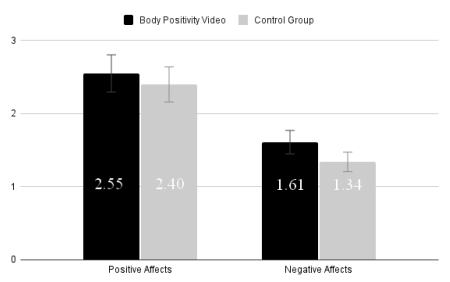
Using a MANOVA, a significant difference was observed between groups for positive and negative affect (Wilks Λ=0.952; F[2, 237]=6.028; p=0.003; η2=0.048). Subsequently, the individual impacts in each variable were observed, being evaluated at a significance level of 0.025 (Bonferroni correction). The results showed significant univariate effects only for negative affects (F[1, 238]=10.568; p=0.001; η2=0.043). Figure 3 demonstrates the differences between the groups, pointing out that the experimental group experienced more negative affects than the control group.
Correlation Analysis
After MANOVA, Pearson’s bivariate correlations were performed (Table 1). We observed statistically significant correlations between negative affect and video exposure of body positivity (r=.21, p<.01), body satisfaction (r=-.13, p<.05), and self-esteem (r=-.22, p<.01).
Moderation Analysis
Finally, a moderation analysis was carried out with Process to investigate the extent to which levels of self-esteem moderated the relationship between groups and negative affects. The interaction between these did not show a statistically significant effect, indicating no moderation (b=0.14, t=0.91, p=0.36).
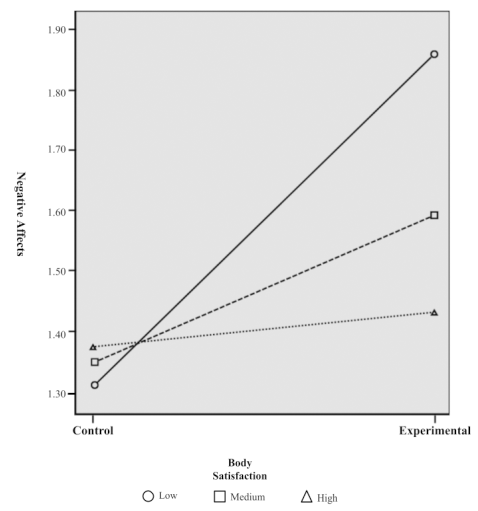
On the other hand, the moderation of body satisfaction showed statistically significant results (b=-0.31, t=-3.15, p=0.01, 95% CI: -0.49-0.11). These results can be seen in Table 2. In general, when levels of body satisfaction were low, the body positivity video’s impact on negative affects was significant (b=0.55, p<0.01). This relationship was smaller, but remained at intermediate levels (b=0.24, p<0.01), becoming non-significant in individuals with high body satisfaction (b=0.06, p>0.05). Figure 4 graphically presents the observed effects.

Discussion
The present study aimed to observe the impacts of an educational Body Positivity video on positive and negative affects, as well as the moderating role of self-esteem and body satisfaction. The results indicated an impact of Body Positivity Media on the increase of negative affects. This variation was moderated by body satisfaction: only when the individual had low and medium levels of this variable did the video generate negative affects.
Such results go against the initial hypotheses that consuming a video on Body Positivity increases positive affects and decreases negative ones, especially in individuals with high levels of self-esteem and body satisfaction. It is noteworthy that in similar studies, with only visual stimuli, divergent results were observed, such as an increase in participants’ positive mood (Cohen et al., 2019), and a higher state of body satisfaction (Davies et al., 2020). Along the same lines, a systematic review on the topic pointed out a positive effect on body image after exposure to Body Positivity content on social media (Vandenbosch, et al., 2021).
Despite this, in a study on the effect of an advertising campaign video based on Body Positivity in Japanese women, participants with high levels of beauty standards internalization lower body satisfaction, as well as more negative mood (Danthinne et al., 2022). Thus, to understand the results, it is important to understand that body satisfaction is closely linked to the acceptance of normative beauty ideals (Brown, & Tiggemann, 2016; Halliwell, 2013). Therefore, it is possible to understand the somewhat contradictory results of the present study based on three questions: society’s ideal of beauty, the low contact of the sample used with Body Positivity content, and how the video presented as a stimulus impacts both these questions.
In the video, although editor Marie Southard proposes to educate about the Body Positivity Movement, she introduces the theme based on popular opinion through interviews, sometimes with pejorative statements due to the internalization of societal beauty standards. Such a strategy may have been a “trigger” for spectators with lower levels of body satisfaction: as approached by De Lenne et al. (2021), the framing around Body Positivity initiatives can impact their outcomes: thus, an educational video that focus on prejudiced opinions can do more short-term harm than good, especially on those with low body satisfaction.
Thus, it is possible to analyze the results based on studies about message framing, the way in which a communication strategy is shaped to generate specific responses in the target audience (Santos et al., 2022; Wall et al., 2019). In their meta-analysis on the subject, Gallagher and Updegraff (2012) observed that positively framed messages (focused on benefits or positive aspects) are more effective in promoting desired attitudes and behaviors. Similar results were observed specifically using online videos (e.g., Jacobson et al., 2019).
The relevance of positively-framed messages can also be perceived in the study by Selensky and Carels (2021) on ads and body positivity: videos with happy non-standard women combined with audio messages about the importance of self-love were more effective in promoting a positive mood, compared to an interview about weight stigma and a video where women from the general population discussed beauty standards’ impact in the work industry. Other studies have reached similar conclusions regarding the fact that not all Body Positivity media is as positive as initially imagined (Legault & Sago, 2022), especially referring to experiences of “toxic body positivity” or objectification in some types of message.
Thus, such studies show the importance of rethinking the way in which the ideals of the Body Positivity Movement are being produced and disseminated by the media. In addition to bringing information about the movement, it is essential to understand the contents that should be used (or not) in order to promote positive effects, especially in audiences that are more vulnerable to the reproduction of negative statements, even if for informational purposes.
The effects observed in negative affects can also be explained using the GLM. As pointed out by Gentile et al. (2009), the specific content addressed by media generates a mobilization of the individual’s internal state, either by activating related cognitive structures, triggering emotions or modulating the arousal. In the present study, it is possible to hypothesize that due to the negative approach present in the initial interviews, the video mobilized the internal state negatively. This effect was enhanced by the personal variable Body Satisfaction, in accordance with another GLM theoretical assumption: the situational variable (Body Positivity media), impacted the internal state of the viewers (negative affects), through an interaction with a personal variable (body satisfaction) (Blankenship et al., 2019).
This interaction is corroborated by the results presented by Coyne et al. (2021), who also applied the GLM to understand impacts of Body Positivity Media: in this study, it was observed that participants with prior low body esteem showed lower implicit self-esteem after watching both an objectifying or body positive music video. Thus, the present study also points out the relevance of the General Learning Model for future research on the theme, considering the applicability of its assumptions to understand interactions between situational and personal variables in the short and long term.
Although the present study was designed as an experimental manipulation aimed at investigating the immediate effects of an educational video on Body Positivity, it is important to acknowledge that this type of exposure can, in practice, resemble a brief psychological intervention. The activation of affect through audiovisual content - especially when addressing sensitive topics such as body image and discrimination - is not emotionally neutral. In this case, although the video was intended to be positive and educational, it began by presenting negative public opinions and discriminatory experiences, which may have triggered adverse emotional responses in more vulnerable participants, such as those with low body satisfaction.
This dynamic reveals a conceptual and practical overlap between experimental manipulation and intervention. Even though the initial goal was to observe immediate reactions to a stimulus, the content had the potential to produce significant emotional changes, which are typically associated with interventions. In contexts like this, the line between manipulating an independent variable and intervening in participants’ psychological states can become increasingly blurred - particularly when the stimulus involves personal values, identity, and socially charged experiences (Gergen & Gergen, 2015; Fine, 2006; Bartholow & Anderson, 2002). Acknowledging this overlap is essential for interpreting the findings and refining the methodological approaches of future studies that involve sensitive content in experimental designs.
Beyond the analyses presented, it is important to consider the social impacts of disseminating educational videos related to body image. Such audiovisual materials hold transformative potential, especially by fostering public debates on fatphobia, aesthetic standards, and body acceptance (Kost & Jamie, 2022; Sing, 2021). However, as proposed by the General Learning Model (Buckley & Anderson, 2006), the effectiveness of these initiatives depends not only on the content conveyed but also on how it is structured and presented. When poorly designed or decontextualized, these videos may reinforce stigmas and trigger negative emotional reactions, particularly among vulnerable audiences. Therefore, it is essential to adopt responsible communication strategies that take into account the specific characteristics of the target audience and promote a sensitive, critical, and inclusive approach. In this sense, interventions in clinical and school settings should carefully consider the structure of these messages to foster empathy and tolerance without reinforcing stigmatization (Adusumilli et al., 2022; Guest et al., 2019).
Despite the theoretical and empirical contributions, this study is not free of limitations. Among these, the use of online collections should be highlighted: despite providing the research with a national reach, this strategy decreases the control of intervening variables and still limits participation to individuals with socioeconomic characteristics favorable to their presence in a digital context. Additionally, the homogeneity of the sample in question is noteworthy, since most respondents were cisgender, with a low BMI, and non-disabled, which reflects on the importance of studying the impact of this type of media on minorities.
Another relevant limitation of the present study concerns the content of the video used in the control condition. Although it showed significantly lower scores on Negative Affects in compared to the video with body positive content, the responses from the control group were still relatively high. This may suggest that the video, by presenting a recipe with natural ingredients and a generally positive tone, may have inadvertently activated associations related to health, or well-being. Such content, even if not explicitly linked to the Body Positivity Movement, could have elicited reflections on body image or associated emotions through mechanisms such as priming or activation of pre-existing cognitive schemas. The lack of specific measures to assess this kind of activation prevents us from drawing definitive conclusions about its impact on affective responses. Therefore, future studies are encouraged to use more neutral control materials regarding body- or health-related themes, in order to more precisely isolate the effects of the experimental content.
A pilot test was not conducted prior to the experimental procedure because the proposed intervention aimed to replicate realistic conditions of exposure to the educational material, aligning with procedures commonly employed in field research. Additionally, we chose to allocate available resources to large-scale data collection, prioritizing a robust sample size. However, we acknowledge that the absence of a pilot test may represent a limitation in terms of manipulation check. This aspect highlights the significance of future research considering this step for better methodological control.
A final limitation concerns the potential emotional impact of the video used in the experimental condition. Although designed to promote reflection on fatphobia and encourage positive attitudes, the video began by presenting discriminatory public opinions, aiming to contrast them with the principles of the Body Positivity Movement. This initial exposure may have unintentionally activated negative emotional states, such as anger or hostility, especially in participants with lower body satisfaction. These affects could stem from the activation of an emotional route (rather than a cognitive one), as described in process theories of information processing (Hoewe, 2020; Entman, 1989). We suggest that future research explore whether such emotional activation contributes to a deeper awareness of discrimination (motivating action) or instead reinforces psychological distress. Including specific measures for emotional responses and types of cognitive processing would allow a more nuanced understanding of how individuals engage with educational media on body image. This line of inquiry may help to refine the design of future content, ensuring it informs without inadvertently exacerbating negative affect.
Even so, we also highlight the study’s contributions, which show the complex relationship between Body Positivity Media and psychological aspects of potential consumers. Thus, the present study contributes to the understanding that, in addition to teaching and disseminating the ideas that the Body Positivity Movement defends, how these proposals will be reproduced matters: Is focusing on the negative view of a large portion of the population necessary? Is reproducing beauty standards the most effective way to help those who are oppressed by it?
Following these questions, future studies on the topic can investigate new psychological variables, such as the internalization of beauty standards or attitudes towards the Body Positivity Movement, especially if measured implicitly (aiming to reduce the bias of social desirability). These personal variables can be evaluated together with different framing strategies, in order to maximize positive effects. Finally, it is important to also investigate the long-term impacts of Body Positivity Media, such as, for example, in a context of psychoeducational intervention.
Therefore, this research presents a contribution to the field of psychology knowledge, especially media psychology (Rich et al., 2024; Pimentel et al., 2023). Furthermore, it helps in the development of interventions related to the theme of body positivity: the presented data helps on rethinking the way in which the movement ideals are disseminated through media, seeking to emphasize positive characteristics in the content to increase the dissemination of ideas of self-acceptance and the achievement of rights.
DATA AVAILABILITY STATEMENT
The research data are not available.
References
-
Adusumilli, D., Syed, S., & Pattnaik, S. (2022). Effect of an intervention on self-esteem, body image satisfaction, and eating disorders in adolescents. CHRISMED Journal of Health and Research, 9, 51-56. https://doi.org/10.4103/cjhr.cjhr_135_20
» https://doi.org/10.4103/cjhr.cjhr_135_20 -
Anderson, C. A., Buckley, K. E., & Carnagey, N. L. (2008). Creating Your Own Hostile Environment: A Laboratory Examination of Trait Aggressiveness and the Violence Escalation Cycle. Personality and Social Psychology Bulletin, 34(4), 462-473. https://doi.org/10.1177/0146167207311282
» https://doi.org/10.1177/0146167207311282 - Buckley, K. E., & Anderson, C. A. (2006). A theoretical model of the effects and consequences of playing video games. In P. Vorderer & J. Bryant (Eds.), Playing video games - Motives, responses, and consequences (pp. 363-378). Mahwah, NJ: LEA.
- Blankenship, K. L., Allen, J. J., Kane, K. A., & Anderson, C. A. (2019). The role of attitudes in violence and aggression. In D. Albarracin, & B. T. Johnson (Eds.) Handbook of Attitudes, 2nd Edition, Volume 2: Applications (pp. 299-336). New York: Routledge.
-
Brathwaite, K. N., & DeAndrea, D. C. (2022). BoPopriation: How self-promotion and corporate commodification can undermine the body positivity (BoPo) movement on Instagram. Communication Monographs, 89(1), 25-46. https://doi.org/10.1080/03637751.2021.1925939
» https://doi.org/10.1080/03637751.2021.1925939 -
Brown, Z., & Tiggemann, M. (2016). Attractive celebrity and peer images on Instagram: Effect on women’s mood and body image. Body image, 19, 37-43. https://doi.org/10.1016/j.bodyim.2016.08.007
» https://doi.org/10.1016/j.bodyim.2016.08.007 -
Cohen, R., Fardouly, J., Newton-John, T., & Slater, A. (2019). # BoPo on Instagram: An experimental investigation of the effects of viewing Body Positivity content on young women’s mood and body image. New Media & Society, 21(7), 1546-1564. https://doi.org/10.1177/1461444819826530
» https://doi.org/10.1177/1461444819826530 -
Coyne, S. M., Davis, E. J., Warburton, W., Stockdale, L., Abba, I., & Busby, D. M. (2021). Mirror, mirror on the wall: The effect of listening to body positive music on implicit and explicit body esteem. Psychology of Popular Media, 10(1), 2. https://psycnet.apa.org/doi/10.1037/ppm0000273
» https://psycnet.apa.org/doi/10.1037/ppm0000273 -
Danthinne, E. S., Giorgianni, F. E., Ando, K., & Rodgers, R. F. (2022). Real beauty: Effects of a body-positive video on body image and capacity to mitigate exposure to social media images. British Journal of Health Psychology, 27(2), 320-337. https://doi.org/10.1111/bjhp.12547
» https://doi.org/10.1111/bjhp.12547 -
Davies, B., Turner, M., & Udell, J. (2020). Add a comment... how fitspiration and Body Positivity captions attached to social media images influence the mood and body esteem of young female Instagram users. Body image, 33, 101-105. https://doi.org/10.1016/j.bodyim.2020.02.009
» https://doi.org/10.1016/j.bodyim.2020.02.009 -
De Lenne, O., Vandenbosch, L., Smits, T., & Eggermont, S. (2021). Framing real beauty: A framing approach to the effects of beauty advertisements on body image and advertising effectiveness. Body image, 37, 255-268. https://doi.org/10.1016/j.bodyim.2021.03.003
» https://doi.org/10.1016/j.bodyim.2021.03.003 -
Entman, R. M. (1989). How the Media Affect What People Think: An Information Processing Approach. The Journal of Politics, 51(2), 347-370. https://doi.org/10.2307/2131346
» https://doi.org/10.2307/2131346 -
Fergusson, A. (2016, June) Designing online experiments using Google forms + random redirect tool. Teaching Statistics Is Awesome. https://teaching.statistics-is-awesome.org/designing-online-experiments-using-google-forms-random-redirect-tool/
» https://teaching.statistics-is-awesome.org/designing-online-experiments-using-google-forms-random-redirect-tool/ -
Gallagher, K. M., & Updegraff, J. A. (2012). Health message framing effects on attitudes, intentions, and behavior: a meta-analytic review. Annals of behavioral medicine, 43(1), 101-116. https://doi.org/10.1007/s12160-011-9308-7
» https://doi.org/10.1007/s12160-011-9308-7 - Galinha, I. C., & Pais-Ribeiro, J. L. (2005). Contribuição para o estudo da versão portuguesa da Positive and Negative Affect Schedule (PANAS): II - Estudo psicométrico. Análise Psicológica, 2, 219-227.
-
Gentile, D. A., Anderson, C. A., Yukawa, S., Ihori, N., Saleem, M., Ming, L. K., ... & Sakamoto, A. (2009). The effects of prosocial video games on prosocial behaviors: International evidence from correlational, longitudinal, and experimental studies. Personality and Social Psychology Bulletin, 35(6), 752-763. https://doi.org/10.1177/0146167209333045
» https://doi.org/10.1177/0146167209333045 -
Gibson, G. L. (2020). Body Positive Babes: An Exploration of the Contemporary Body Positivity Movement and the’Acceptable’Fat Woman’s Body (Doctoral dissertation, University of York). https://dl.acm.org/doi/abs/10.5555/AAI28125043
» https://dl.acm.org/doi/abs/10.5555/AAI28125043 -
Guest, E., Costa, B., Williamson, H., Meyrick, J., Halliwell, E., & Harcourt, D. (2019). The effectiveness of interventions aiming to promote positive body image in adults: A systematic review. Body image, 30, 10-25. https://doi.org/10.1016/j.bodyim.2019.04.002
» https://doi.org/10.1016/j.bodyim.2019.04.002 -
Greitemeyer, T. (2011). Effects of prosocial media on social behavior: When and why does media exposure affect helping and aggression?. Current Directions in Psychological Science, 20(4), 251-255. https://doi.org/10.1177/0963721411415229
» https://doi.org/10.1177/0963721411415229 -
Halliwell, E. (2013). The impact of thin idealized media images on body satisfaction: Does body appreciation protect women from negative effects?. Body image, 10(4), 509-514. https://doi.org/10.1016/j.bodyim.2013.07.004
» https://doi.org/10.1016/j.bodyim.2013.07.004 - Hayes, A. (2022). Introduction to Mediation, Moderation, and Conditional Process Analysis: A Regression-Based Approach (3rd edition). New York: Gilford Press.
-
Hoewe, J. (2020). Toward a theory of media priming. Annals of the International Communication Association, 44, 312-321. https://doi.org/10.1080/23808985.2020.1815232
» https://doi.org/10.1080/23808985.2020.1815232 - Hutz, C. S., & Zanon, C. (2011). Revisão da adaptação, validação e normatização da escala de autoestima de Rosenberg: Revision of the adaptation, validation, and normatization of the Roserberg self-esteem scale. Avaliação Psicológica, 10(1), 41-49.
-
Jacobson, S. K., Morales, N. A., Chen, B., Soodeen, R., Moulton, M. P., & Jain, E. (2019). Love or Loss: Effective message framing to promote environmental conservation. Applied Environmental Education & Communication, 18(3), 252-265. https://doi.org/10.1080/1533015X.2018.1456380
» https://doi.org/10.1080/1533015X.2018.1456380 -
Jimenez-Jimenez, M. L. (2020). Lute como uma gorda: gordofobia, resistências e ativismos. 2020. [Tese de Doutorado, Universidade Federal de Mato Grosso]. Plataforma Sucupira. https://sucupira.capes.gov.br/sucupira/public/consultas/coleta/trabalhoConclusao/viewTrabalhoConclusao.jsf?popup=true&id_trabalho=9252612
» https://sucupira.capes.gov.br/sucupira/public/consultas/coleta/trabalhoConclusao/viewTrabalhoConclusao.jsf?popup=true&id_trabalho=9252612 - Khalid, M. Z., & Ahmed, A. (2014). Entertainment-education media strategies for social change: Opportunities and emerging trends. Review of journalism and mass communication, 2(1), 69-89.
-
Kost, C., & Jamie, K. (2022). “It has literally been a lifesaver”: the role of “knowing kinship” in supporting fat women to navigate medical fatphobia. Fat Studies, 12, 311-324. https://doi.org/10.1080/21604851.2022.2041295
» https://doi.org/10.1080/21604851.2022.2041295 -
Legault, L., & Sago, A. (2022). When body positivity falls flat: Divergent effects of body acceptance messages that support vs. undermine basic psychological needs. Body Image, 41, 225-238. https://doi.org/10.1016/j.bodyim.2022.02.013
» https://doi.org/10.1016/j.bodyim.2022.02.013 -
Lima, J. P. F. (2019). “Alexandrismos” e movimento Body Positivity: um estudo sobre a superação da gordofobia. [Trabalho de Conclusão de Curso, Universidade Federal de Alagoas] RIUFAL - Repositório Institucional da UFAL. https://www.repositorio.ufal.br/handle/riufal/6472
» https://www.repositorio.ufal.br/handle/riufal/6472 -
Maes, C., & Vandenbosch, L. (2022). “I love my body; I love it all”: Body Positivity Messages in Youth-Oriented Television Series. Mass Communication and Society, 1-25. https://doi.org/10.1080/15205436.2022.2030756
» https://doi.org/10.1080/15205436.2022.2030756 -
Mattos, M. (2022, 04 de agosto). Atriz de “Two and a Half Men” diz ter sofrido gordofobia em set de filme. UOL. https://www.uol.com.br/splash/noticias/2022/08/04/atriz-de-two-and-a-half-men-diz-ter-sofrido-gordofobia-em-set-de-filme.htm
» https://www.uol.com.br/splash/noticias/2022/08/04/atriz-de-two-and-a-half-men-diz-ter-sofrido-gordofobia-em-set-de-filme.htm - Mattos, R. (2020). Sobrevivendo ao estigma da gordura. Vetor Editora.
-
Nelson, S. L., Harriger, J. A., Miller-Perrin, C., & Rouse, S. V. (2022). The effectsof body-positive Instagram posts on body image in adult women. Body Image, 42, 338-346. https://doi.org/10.1016/j.bodyim.2022.07.013
» https://doi.org/10.1016/j.bodyim.2022.07.013 - Rich, G.J., Kumar, V.K., & Farley, F.H. (2024). Handbook of media psychology: The science and the practice. Springer Cham.
-
Robinson, B. B. E., Bacon, L. C., & O’reilly, J. (1993). Fat phobia: Measuring, understanding, and changing anti-fat attitudes. International Journal of Eating Disorders, 14(4), 467-480. https://doi.org/10.1002/1098-108X(199312)14:4%3C467::AID-EAT2260140410%3E3.0.CO;2-J
» https://doi.org/10.1002/1098-108X(199312)14:4%3C467::AID-EAT2260140410%3E3.0.CO;2-J -
Rosenberg, M. (1965). Rosenberg self-esteem scale (RSE). Acceptance and commitment therapy. Measures package, 61(52), 18. https://psycnet.apa.org/doi/10.1037/t01038-000
» https://psycnet.apa.org/doi/10.1037/t01038-000 -
Rubinsky, V., Hosek, A. M., & Hudak, N. (2019). “It’s better to be depressed skinny than happy fat:” College women’s memorable body messages and their impact on body image, self-esteem, and rape myth acceptance. Health communication, 34(13), 1555-1563. https://doi.org/10.1080/10410236.2018.1504659
» https://doi.org/10.1080/10410236.2018.1504659 -
Santos, I. L. S., Pimentel, C. E., & Alves, T. P. (2022). Aplicações da persuasão para otimização de campanhas na saúde: uma revisão. Psicologia em Estudo, 27. https://doi.org/10.4025/psicolestud.v27i0.48621
» https://doi.org/10.4025/psicolestud.v27i0.48621 -
Sastre, A. (2014). Towards a radical Body Positivity: Reading the online “Body Positivity movement”. Feminist Media Studies, 14(6), 929-943. https://doi.org/10.1080/14680777.2014.883420
» https://doi.org/10.1080/14680777.2014.883420 -
Selensky, J. C., & Carels, R. A. (2021). Weight stigma and media: An examination of the effect of advertising campaigns on weight bias, internalized weight bias, self-esteem, body image, and affect. Body Image, 36, 95-106. https://doi.org/10.1016/j.bodyim.2020.10.008
» https://doi.org/10.1016/j.bodyim.2020.10.008 -
Singh, S. (2021). Fatness, girlhood, and self-acceptance in Gippi and Fanney Khan. Fat Studies, 11, 83-97. https://doi.org/10.1080/21604851.2021.1879511
» https://doi.org/10.1080/21604851.2021.1879511 -
Statista Research Department. (2022). Brazil: girls’ perception of self-esteem on social media 2020. https://www.statista.com/statistics/1231874/self-esteem-social-media-girls-brazil/
» https://www.statista.com/statistics/1231874/self-esteem-social-media-girls-brazil/ -
Stevanatto, L. (2022, 08 de setembro). Lizzo é comparada a emoji de cocô e inspira reação contra gordofobia. UOL. https://www.uol.com.br/splash/noticias/2022/08/28/lizzo-e-comparada-a-emoji-de-coco-e-inspira-reacao-contra-gordofobia.htm
» https://www.uol.com.br/splash/noticias/2022/08/28/lizzo-e-comparada-a-emoji-de-coco-e-inspira-reacao-contra-gordofobia.htm - Pimentel, C.E., Mariano, T.E., & Santos, I.L.S. (2023). Psicologia da mídia: Fundamentos teóricos e tópicos atuais. Editora Dialética.
-
Vandenbosch, L., Fardouly, J., & Tiggemann, M. (2022). Social media and body image: Recent trends and future directions. Current Opinion in Psychology, 45, 101289. https://doi.org/10.1016/j.copsyc.2021.12.002
» https://doi.org/10.1016/j.copsyc.2021.12.002 -
Wall, H. J., Campbell, C. C., Kaye, L. K., Levy, A., & Bhullar, N. (2019). Personality profiles and persuasion: an exploratory study investigating the role of the Big-5, Type D personality and the Dark Triad on susceptibility to persuasion. Personality and Individual Differences, 139, 69-76. https://doi.org/10.1016/j.paid.2018.11.003
» https://doi.org/10.1016/j.paid.2018.11.003