 Adaptation of the abbreviated version of the Acceptance and Action Questionnaire - Social Anxiety for the Brazilian context
Abstract
This study aimed to adapt and obtain valid evidence of the Brief Social Anxiety Acceptance and Action Questionnaire (B-SA-AAQ) for the Brazilian context. A total of 301 subjects (69.4% women) from the five regions of Brazil, aged between 18 and 64 years (M = 26.7; SD = 8.7), participated in the study. Exploratory factor analyses (EFA) and confirmatory factor analyses (CFA) and the adequacy of the model were assessed using fit indices. The results indicated a satisfactory unidimensional structure (α = 0.92; ω = 0.91). Multigroup CFA demonstrated the invariance of the measurement between males and females. In addition, the scale scores showed significant correlations with external variables such as social phobia, psychological inflexibility, and emotional suppression. It was concluded that the results are favorable to the use of the B-SA-AAQ in Brazilian samples.
Keywords:
Emotional Regulation; Psychological Testing; Psychometrics
Resumo
Este estudo teve como objetivo adaptar e obter evidências de validade da versão abreviada do Brief Social Anxiety Acceptance and Action Questionnaire (B-SA-AAQ) para o contexto brasileiro. Participaram 301 sujeitos (69,4% mulheres) das cinco regiões do Brasil, com idades entre 18 e 64 anos (M = 26,7; DP = 8,7). Foram conduzidas análises fatoriais exploratórias (AFE) e confirmatórias (AFC), e a adequação do modelo foi avaliada por meio de índices de ajuste. Os resultados indicaram uma estrutura unidimensional satisfatória (α = 0,92; ω = 0,91). A AFC multigrupo demonstrou a invariância da medida entre os sexos masculino e feminino. Além disso, os escores da escala apresentaram correlações significativas com variáveis externas como fobia social, inflexibilidade psicológica e supressão emocional. Concluiu-se que os resultados são favoráveis ao uso do B-SA-AAQ em amostras brasileiras.
Palavras-chave:
Regulação Emocional; Testes Psicológicos; Psicometria
Resumen
Este estudio tuvo como objetivo adaptar y obtener evidencia de validez de la versión abreviada del Brief Social Anxiety Acceptance and Action Questionnaire (B-SA-AAQ) para el contexto brasileño. Participaron 301 sujetos (69,4% mujeres) de las cinco regiones de Brasil, con edades entre 18 y 64 años (M = 26,7; DE = 8,7). Se realizaron análisis factoriales exploratorios (AFE) y confirmatorios (AFC) y se evaluó la adecuación del modelo mediante índices de ajuste. Los resultados indicaron una estructura unidimensional satisfactoria (α = 0,92; ω = 0,91). El AFC multigrupo demostró invariancia de medición entre hombres y mujeres. Además, las puntuaciones de la escala mostraron correlaciones significativas con variables externas como la fobia social, la inflexibilidad psicológica y la supresión emocional. Se concluyó que los resultados son favorables al uso de B-SA-AAQ en muestras brasileñas.
Palabras clave:
Regulación Emocional; Tests Psicológicos; Psicometría
Introduction
Social Anxiety Disorder (SAD), widely known as social phobia, is a psychiatric condition characterized by intense apprehension in social situations, reinforced by a persistent and often overwhelming fear of criticism and negative evaluations (American Psychiatric Association; APA, 2023). Individuals affected by SAD often have deficits in social skills, exhibiting shy and withdrawn behaviors, as well as social and visual avoidance in anxiety-provoking situations (Barros & Galdino, 2020).
According to the Acceptance and Commitment Therapy (ACT) paradigm, avoidance behaviors, or, as they are also called, experiential avoidance, play a central role in the model of psychopathology or psychological inflexibility (Caletti et al., 2022; Saban, 2015). ACT is a behavioral approach that emphasizes complete contact with the present moment to facilitate changes and maintain behaviors that promote psychological flexibility. This approach is based on six processes: acceptance, diffusion, present moment, contextual self, values, and commitment actions (Almeida et al., 2022; Hayes et al., 2021).
According to Medeiros and Junior (2021) and Saban (2015), the aforementioned processes are defined as follows: “acceptance” consists of the ability to deal with suffering as it presents itself without trying to control or suppress internal events; “diffusion” involves distancing oneself from the contents of thoughts and feelings, to reduce suffering; the “present moment” refers to being fully aware of what is happening in the current moment and uniquely living experiences; the “contextual self ” is the ability to observe one’s own experiences as thoughts and feelings arise; “values” are related to what is truly important and meaningful, and what will guide actions; “commitment actions” consist of maintaining or changing behaviors, aligned with values, expanding the repertoire of flexible behaviors that connect to a specific value.
The ACT psychological flexibility promotion model has shown significant results in mediating the reduction of symptoms related to several disorders, such as depression, anxiety, obsessive-compulsive disorder, post-traumatic stress (Almeida et al., 2022; Laurito et al., 2022; Perry et al., 2019) and social anxiety disorder (Gadelha et al., 2021).
Among the measures developed to assess the foundations of ACT, the Acceptance and Action Questionnaire (AAQ; Hayes et al., 2004) stands out, which has a revised version with improved psychometric properties and validated for the Brazilian context (AAQ-II; Bond et al., 2011; AAQ-II Brazilian Version; Barbosa & Murta, 2015). Furthermore, variations of the AAQ have been developed for specific contexts, such as chronic pain (Chronic Pain Acceptance Questionnaire: CPAQ; McCracken et al., 2004; Acceptance and Action Questionnaire-II-Pain; Majeed et al., 2021), diabetes control (Acceptance and Action Diabetes Questionnaire: AADQ; Gregg et al., 2007), test taking (TA-AAQ; Pires et al., 2020), and social anxiety (Social Anxiety - Acceptance and Action Questionnaire: SAAAQ; MacKenzie & Kocovski, 2010).
The SA-AAQ scale was developed to assess acceptance and action regarding symptoms of social anxiety since low acceptance can lead to the adoption of experiential avoidance strategies (Gadelha et al., 2021). Action, in turn, helps individuals redirect their behaviors toward what is aligned with their values (Khoramnia et al., 2020). The instrument has 19 items and presents a two-factor structure (“Acceptance” and “Action”) that are strongly correlated (MacKenzie & Kocovski, 2010). Cronbach’s alpha (α) for the SA-AAQ was 0.94, indicating excellent internal consistency. Furthermore, it demonstrated sensitivity to change, allowing its use in clinical studies (Kocovski et al., 2013). The scale also showed good psychometric properties in contexts such as Portugal (Vieira et al., 2013), South Korea (Kim & Kwon, 2013), and Iran (Soltani et al., 2016).
Additionally, evidence of validity was found based on correlations with external variables. Soltani et al. (2016) showed that the SA-AAQ presented a negative correlation with a measure of social anxiety, a positive correlation with a measure of mindfulness, and a negative relationship with a measure of thought suppression. Suppression, an emotion regulation strategy widely studied in Cognitive Behavioral Therapy (CBT), aims to modify emotional impact by altering behavior and emotional expression (Fortes et al., 2022).
To provide a brief assessment in clinical and research settings, an abbreviated version of the SAAAQ, which has eight items, was developed, the Brief Version of the Social Anxiety - Acceptance and Action Questionnaire (B-SA-AAQ; MacKenzie et al., 2017). This model also consisted of two correlated factors (“Acceptance” and “Action”), both presenting satisfactory internal consistencies (B-SA-AAQ: α = 0.90; Acceptance subscale: α = 0.87; Action subscale: α = 0.82). The B-SA-AAQ has already been adapted for the Turkish context, also presenting good internal consistency (α = 0.89) and a bifactor structure (Alptekin et al., 2023).
In Brazil, studies using versions of the AAQ have been conducted in contexts such as chronic insomnia (El Rafihi-Ferreira et al., 2021), overweight/obesity (Finger et al., 2020), and among primary healthcare professionals (Berta-Otero et al., 2022). Until now, no national validation studies of specific measures to assess acceptance and action in the context of social anxiety have been developed. It highlights the importance of adapting and validating instruments to fill this gap, providing more detailed and accurate assessments of this construct.
Adaptation and validation of appropriate instruments are essential to provide valuable tools for both researchers and clinicians in the treatment of anxiety disorders. Based on this, the present study aimed to adapt and obtain valid evidence of the short version of the Social Anxiety Acceptance and Action Questionnaire (B-SA-AAQ) for the Brazilian context.
Adaptation and validation of appropriate instruments are essential to provide valuable tools for both researchers and clinicians in the treatment of anxiety disorders. Based on this, the present study aimed to adapt and obtain valid evidence of the Brief Social Anxiety Acceptance and Action Questionnaire (B-SAAAQ) for the Brazilian context.
Method
Participants
The survey included the participation of 301 Brazilians from all regions of the country, of which 197 (65.4%) were university students from public and private higher education institutions, coming from courses in the humanities, exact sciences, and health. The remaining participants (34.6%) fell into other categories: retirees, unemployed, and housewives. Most participants were female (n = 209; 69.4%). The age of the respondents ranged from 18 to 64 years (M = 26.7; SD = 8.7). Of the 301 participants, 231 obtained a score equal to or greater than 19 in the Social Phobia Inventory (SPIN), indicating symptoms of social anxiety, corresponding to 76.7% of the sample.
The sample size determination followed White’s (2022) recommendations for studies that use exploratory factor analysis (EFA) and confirmatory factor analysis (CFA). The author suggests that the similarity between studies justifies the adoption of equivalent sample sizes, an approach considered more transparent and direct than statistical formulas. As a reference, the B-SA-AAQ validation study (MacKenzie et al., 2017) was considered, and it included 148 undergraduate students in the instrument’s CFA. Given that the present study covers both EFA and CFA, this sample size was maintained for both stages, resulting in 301 participants.
Instruments
An online questionnaire, made available via an electronic address, consisted of sociodemographic questions (age, gender, education, occupation, place of residence). In addition, instruments were included to assess the acceptance and action of social anxiety symptoms, the symptoms of social anxiety themselves, psychological inflexibility, experiential avoidance, and emotional regulation strategies.
The Brief Acceptance and Action Questionnaire - Social Anxiety (B-SA-AAQ; MacKenzie et al., 2017; adapted for Brazil in this study). The original scale consists of eight items, assessed on a Likert scale from 1 (never) to 7 (always). The instrument was developed to assess the acceptance and action of social anxiety symptoms, and it is comprised of Acceptance and Action factors. Examples of items for each factor are, respectively, “I accept my feelings of social anxiety without fighting them” (items 2, 4, 6, 8) for the Acceptance factor and “I avoid doing things that make me anxious” (items 1, 3, 5, 7) for the Action factor. The score for each subscale is calculated by adding the scores of the corresponding items. Higher scores indicate greater acceptance and action of social anxiety. In the study by MacKenzie et al. (2017), the instrument presented a total Cronbach’s alpha coefficient of 0.81, with alpha coefficients of 0.84 for the Acceptance factor and 0.72 for the Action factor, demonstrating good internal consistency.
Social Phobia Inventory (SPIN; Connor et al., 2000, adapted for Brazil by Osório et al., 2009). The SPIN consists of 17 items evaluated on a Likert scale from 0 (not at all) to 4 (extremely). It aims to assess the symptomatic components of social anxiety disorder, differentiating individuals with and without the disorder, in addition to identifying the severity of symptoms. The items are organized into three primary subscales: Fear (6 items, such as “I am afraid of talking to strangers”), Avoidance (7 items, such as “I avoid going to parties for fear of embarrassment”), and Physiological Symptoms (4 items, such as “I sweat when I am anxious”). The total score ranges from 0 to 68, with higher scores indicating greater severity of social anxiety symptoms. Scores equal to or greater than 19 indicate a high risk of social anxiety. The Brazilian version of SPIN showed excellent internal consistency, with a total alpha coefficient of 0.90 and alpha coefficients that varied between 0.71 and 0.90 for the factors.
Acceptance and Action Questionnaire II (AAQII; Bond et al., 2011, adapted for Brazil by Barbosa & Murta, 2015). The AAQ-II consists of seven items, assessed on a Likert scale from 1 (never true) to 7 (always true), that measure psychological inflexibility and experiential avoidance. The items reflect the reluctance to experience unwanted emotions and thoughts and the difficulty in staying present and acting toward valued goals in the face of adverse psychological events. An example of an item is “I avoid situations that make me feel uncomfortable.” The total score can range from 7 to 49 points, with higher scores indicating higher levels of psychological inflexibility and a greater tendency toward experiential avoidance. The adaptation for Brazil presented a single-factor structure with an alpha coefficient of 0.87.
Emotion Regulation Questionnaire (ERQ; Gross & John, 2003), adapted by (Boian et al., 2009) for Brazil. The ERQ consists of 10 items, assessed on a Likert scale from 1 (never) to 7 (always), and measures two types of emotion regulation strategies: cognitive reappraisal (6 items, such as “When I want to feel more positive emotions (such as joy or contentment), I change what I am thinking”); and emotional suppression (4 items, such as “I keep my emotions to myself ”). For scoring, the items of each subscale are added, resulting in scores ranging from 6 to 42 for cognitive reappraisal and from 4 to 28 for emotional suppression. Higher scores indicate more significant use of the respective emotion regulation strategies. The Brazilian version presented a total Cronbach’s alpha of 0.83, the same for the cognitive reappraisal subscale and 0.73 for the emotional suppression subscale.
Procedures
Adapting the B-SA-AAQ to the Brazilian context followed the guidelines recommended by Borsa et al. (2012). Initially, the authors of the original scale were asked for their consent to carry out the adaptation. After authorization, two bilingual researchers (Portuguese English) independently translated the scale into Portuguese. Two other researchers then combined these translations into a single version. The scale was subsequently submitted for evaluation by five experts in the areas of “social anxiety” and “Acceptance and Commitment Therapy (ACT)”, all clinical psychologists. These experts assessed the suitability of the proposed terms and the instrument’s applicability to different populations. After discussions and suggestions for reformulating the items, the version for empirical testing was reached. The next phase involved a pilot study with 17 university students of both sexes and over 18 years of age. They were asked about the clarity of the items and possible difficulties in understanding. The application was conducted by a researcher who monitored the responses and identified possible interpretation problems. Ultimately, no additional adjustments or back-translations were necessary, resulting in the final version of the instrument.
The Research Ethics Committee (CEP) approved the study under opinion no. (information omitted). The instruments were made available electronically through Google Forms platform. The sample was selected by convenience, and participants were recruited through advertising on social networks, such as WhatsApp, Instagram, and Facebook. All participants were previously informed about the study’s objectives, including general details such as the estimated response time. After reading the Informed Consent Form (ICF), they voluntarily agreed to participate in the research.
Data Analysis
The total sample was equally and randomly divided into two parts (n1 = 150 and n2 = 151) for cross-validation. In the first half, an Exploratory Factor Analysis (EFA) was performed to investigate the dimensionality of the B-SA-AAQ. The EFA was conducted using the estimation method of Minimum Rank Factor Analysis (MRFA; Shapiro & Berge, 2002). The parallel analysis technique was applied to determine the number of factors to be retained, with 500 polychoric correlation matrices generated through random permutation of the observed values. This procedure is recommended to provide more accurate estimates when the observed sample and population distribution do not present normality (Timmerman & Lorenzo-Seva, 2011). The Kaiser-Meyer-Olkin (KMO) criterion and Bartlett’s Test of Sphericity (Hair et al., 2009) were used to observe whether the data matrix is amenable to factorization.
Subsequently, a Confirmatory Factor Analysis (CFA) was performed with the second half of the sample, using the Unweighted Least Squares Meanand-Variance-Adjusted (ULSMV) estimation method, which offers more accurate and less biased estimates for ordinal-level categorical indicators that do not meet the assumptions of normality (Li, 2016). The CFA aimed to evaluate the model derived from interpreting the EFA results. For this analysis, the following adjustment criteria and subsequent cut-off points were used: chi-square by degrees of freedom (χ²/df), must be less than or equal to 3; Comparative Fit Index (CFI) and Tucker-Lewis Index (TLI) must be equal to or above 0.95; Root-Mean-Square Error of Approximation (RMSEA) and Standardized Root Mean Square Residuals (SRMR) must be less than 0.08 (Brown, 2015).
Scale reliability indices were assessed using Cronbach’s alpha (α) and McDonald’s omega (ω) coefficients. Evidence of convergent validity was investigated through correlations of the B-SA-AAQ with the SPIN, AAQ-II, and the suppression factor of the ERQ in the total sample (n = 301).
Finally, a Multigroup Confirmatory Factor Analysis (MCFA) was calculated with the total sample to test the configural, metric, and scalar invariance of the scale’s measurement for gender. Configural invariance verifies whether the scale’s factor structure is equivalent between men and women. Metric invariance examines whether the factor loadings are equivalent between the two groups. Finally, scalar invariance assesses whether the intercepts, or means of the latent variable scores, are equal between the groups (Putnik & Bornstein, 2016). Thus, differences between chi-square values (Δχ2), respective degrees of freedom (Δdf), and CFI (ΔCFI) were considered. Values of p > 0.05 for Δχ2 and ΔCFI ≤ 0.01 were the criteria assumed to define factorial invariance (Cheung & Rensvold, 2002). The data were analyzed using R software (R Core Team, 2024), with the Latent Variable Analysis (Lavaan) (Rosseel, 2023) and psych (Revelle, 2018) packages.
Results
The results of Bartlett’s sphericity test (χ² (28) = 792.4; p < 0.001) and the KMO index (0.900) indicated that the correlation matrix of the items was interpretable, which justified the performance of the EFA. The parallel analysis with random permutation of the data showed that the B-SA-AAQ fits a unidimensional structure, in which a single factor is responsible for explaining 71.35% of the data variance.
The factor loadings of the items were mainly higher than 0.60, except the item “My social anxiety does not interfere with the way I want to live,” which had a factor loading of only 0.08. Therefore, it was decided to exclude this item, and all subsequent validity and reliability analyses were performed, considering the scale of seven items (see Table 1). Regarding the model’s reliability, both Cronbach’s α (0.92) and the McDonald’s ω index presented satisfactory values (0.91).
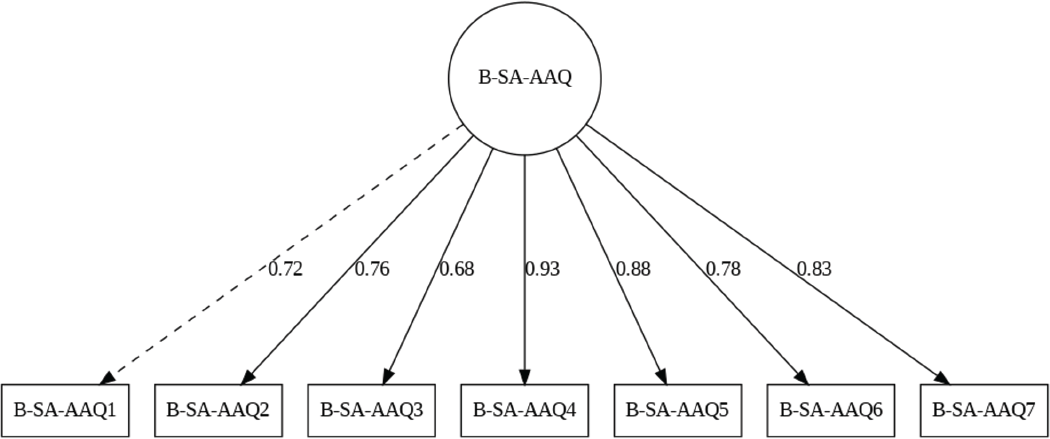
The CFA of the instrument’s one-dimensional theoretical model presented satisfactory adjustment indices (χ² = 26.942, gl = 14; χ²/gl= 1.92; RMSEA = 0.079; SRMR = 0.028; CFI = 0.99; TLI = 0.99). Figure 1 provides a graphical illustration of the factor model, confirming that the one-factor structure is robust with factor loadings greater than 0.60.
Table 2 provides the indicators of the factorial invariance test between men and women. The multigroup analysis conducted by sex indicated Δχ2 e ΔCFI values that suggest the existence of invariance between the groups in the factorial structure of the model considered.
Finally, evidence of validity was found based on correlations with external variables. Specifically, positive and moderate correlations were found between the B-SA-AAQ and the AAQ-II, and negative and moderate correlations between the B-SA-AAQ, the SPIN, and the ERQ suppression factor, demonstrating evidence of convergent validity. No significant correlation was observed between the B-SA-AAQ and the ERQ reappraisal factor. For more details, see Table 3.
Discussion
This study aimed to adapt and obtain evidence of the validity of the abbreviated version of the Social Anxiety Acceptance and Action Questionnaire (B-SAAAQ) for the Brazilian context. Satisfactory evidence of validity of the B-SA-AAQ was found based on its internal structure and relationship with other variables. The data indicated that the items adjusted to a single latent factor called “Acceptance and Action,” unlike the original validation study by MacKenzie et al. (2017), which identified two factors (“Acceptance” and “Action” separately). Furthermore, unlike the original version, the Brazilian version presented a better fit with seven items, with one item being excluded that compromised the adequacy of the data.
Despite the discrepancies between the factor structure observed in the present study and those found in the literature (which present the Acceptance and Action factors separately or a unidimensional model), a unifactorial model was expected due to the nature of the items in the abbreviated version used (MacKenzie et al., 2017). The B-SA-AAQ adapted in this study is composed mainly of positively formulated items, except for one reversed item that was excluded after the EFA. In previous validation studies of acceptance and action measures, the presence of positive and reversed items in balanced proportions allowed the factors to be determined by this configuration (Kim & Kwon, 2013; MacKenzie & Kocovski, 2010). Furthermore, the divergences in the factor structure may be related to how respondents understand the concepts measured or distinguish the concepts of acceptance and action. In ACT theory, these two concepts are closely linked to psychological flexibility, a higher-order construct (Bond et al., 2011), making it difficult to separate them.
The reliability indices, compared to those found in the original version of the B-SA-AAQ (MacKenzie et al., 2017) and in its Turkish adaptation (Alp In the validation study of the SA-AAQ (MacKenzie & Kocovski, 2010), the first factor grouped all items worded in the direction of lack of acceptance (reverse scoring), while the second factor grouped the positive items that reflected acceptance. Kim and Kwon (2013) also justified this two-factor structure as the result of a method effect rather than reflecting two distinct latent factors. The method effect occurs when the variance associated with the measurement method is incorporated into the evaluation process, influencing the results. This effect can arise from several sources, such as the respondents’ tendency to acquiescence, social desirability, or the presence of positively and negatively worded items in the same instrument, as in the case of the B-SA-AAQ. These methodological variances can impact the responses and the instrument’s structure, creating the impression of distinct factors, which may be, in fact, just a product of the data collection method (DiStefano et al., 2022).
(Tekin et al., 2023), can be considered satisfactory. Therefore, the abbreviated version of the B-SA-AAQ is considered helpful for future research and clinical settings to assess acceptance and action in social anxiety.
Regarding the relationships between acceptance and action of social anxiety and external variables, positive correlations were found with psychological inflexibility and experiential avoidance and negative correlations with symptoms of social phobia and emotional suppression. These findings are as expected, as they corroborate the findings of previous studies that reinforce acceptance as a crucial aspect of promoting psychological well-being (Bond et al., 2011; Saban, 2015). In this context, individuals with higher acceptance levels may present fewer symptoms of social phobia and/or suppress their emotions less (Caletti et al., 2022; Soltani et al., 2023). Sagalakova et al. (2023) highlights that people with social anxiety tend to use cognitive suppression more frequently. This regulatory process is related to one of the components of psychological inflexibility, according to ACT, called experiential avoidance, which opposes acceptance and seeks to alter the frequency or sensitivity to aversive private events (Caletti et al., 2022; Khoramnia et al., 2020).
Invariance analysis revealed that the instrument’s factor structure is equivalent between men and women, allowing reliable comparisons between these groups and reducing possible biases in statistical group comparison tests (Luong & Flake, 2023). It was the first study to perform such an analysis with the B-SA-AAQ, which is relevant since women have higher rates of social anxiety disorder compared to men in the general population (APA, 2023).
Some limitations in this study should be considered. First, caution is needed when generalizing the results due to the diversity of the Brazilian population since most participants were women and university students. Furthermore, using a convenience sample limits the representativeness of the results to the universe studied without allowing generalization to the general population. It is recommended that future studies investigate the invariance of the instrument in other groups, such as individuals of different age groups, levels of education, and clinical conditions in which the acceptance and action of social anxiety symptoms are relevant to their progress and psychological adjustment. Expanding the use of the instrument in different populations is necessary to provide additional validity evidence.
Nevertheless, this study demonstrated the satisfactory suitability of an instrument for the Brazilian context, introducing significant theoretical innovations. One of the main contributions of this study was the identification of a single-factor structure, which was considered more appropriate after reducing the effect of the method. This single-factor structure is aligned with the theoretical principles of Acceptance and Commitment Therapy (ACT), which reinforces its relevance in assessing the constructs of acceptance and action in contexts of social anxiety. The B-SAAAQ presents itself as a valuable tool for measuring the acceptance and action of social anxiety symptoms and their relationship with other constructs, providing a deeper understanding of the factors associated with this behavior. Furthermore, because it is brief to apply, the instrument proves helpful for research and clinical contexts.
References
-
Almeida, R. B. D., Demenech, L. M., Sousa-Filho, P. G. D., & Neiva-Silva, L. (2022). Group ACT for anxiety management among university students: a randomized clinical trial. Psychology: Science and Profession, 42(e235684), 1-17. https://doi.org/10.1590/1982-3703003235684
» https://doi.org/10.1590/1982-3703003235684 -
Alptekin, F. B., Burhan, H. S., & Kuru, T. (2023). Reliability and Validity Study of the Turkish Version of the Brief Social Anxiety-Acceptance and Action Questionnaire. Cam & Sakura Medical Journal, 3(1), 6-11. https://doi.org/10.4274/csmedj.galenos.2023.2022-12-2
» https://doi.org/10.4274/csmedj.galenos.2023.2022-12-2 - American Psychiatric Association. (2023). Diagnostic and Statistical Manual of Mental Disorders DSM-5-TR: Text Revision. Artmed Editora.
-
Barbosa, L. M., & Murta, S. G. (2015). Initial psychometric properties of the Brazilian version of the Acceptance and Action Questionnaire - II. Psico-USF, 20(1), 75-85. https://doi.org/10.1590/1413-82712015200107
» https://doi.org/10.1590/1413-82712015200107 -
Barros, A. B. D., & Galdino, M. K. C. (2020). Cognitive-behavioral therapy and mindfulness in the treatment of social anxiety disorder: a case study. Revista Brasileira de Terapias Cognitivas, 16(2), 122-129. https://doi.org/10.5935/1808-5687.20200018
» https://doi.org/10.5935/1808-5687.20200018 -
Berta-Otero, T., Barceló-Soler, A., Montero-Marin, J., Maloney, S., Pérez-Aranda, A., López-Montoyo, A., Salvo, V., Sussumu, M., García-Campayo, J., & Demarzo, M. (2022). Experiential Avoidance in Primary Care Providers: Psychometric Properties of the Brazilian “Acceptance and Action Questionnaire” (AAQ-II) and Its Criterion Validity on Mood Disorder-Related Psychological Distress. International Journal of Environmental Research and Public Health, 20(1), 225. https://doi.org/10.3390/ijerph20010225
» https://doi.org/10.3390/ijerph20010225 -
Boian, A. C., Soares, D. S. M., & Silva, J. (2009). Emotion Regulation Questionnaire adapted for the Brazilian population. Retrieved from http://spl.stanford.edu/pdfs/erq_portuguese_brazilian.pdf
» http://spl.stanford.edu/pdfs/erq_portuguese_brazilian.pdf -
Bond, F. W., Hayes, S. C., Baer, R. A., Carpenter, K. M., Guenole, N., Orcutt, H. K., … & Zettle, R. D. (2011). Preliminary psychometric properties of the Acceptance and Action Questionnaire-II: A revised measure of psychological inflexibility and experiential avoidance. Behavior Therapy, 42(4), 676-688. https://doi.org/10.1016/j.beth.2011.03.007
» https://doi.org/10.1016/j.beth.2011.03.007 -
Borsa, J. C., Damásio, B. F., & Bandeira, D. R. (2012). Adaptation and validation of psychological instruments across cultures: Some considerations. Paidéia, 22(53), 423-432. https://doi.org/10.1590/S0103-863X2012000300014
» https://doi.org/10.1590/S0103-863X2012000300014 - Brown, T. A. (2015). Confirmatory factor analysis for applied research (2nd ed.). The Guilford Press.
-
Caletti, E., Massimo, C., Magliocca, S., Moltrasio, C., Brambilla, P., Delvecchio, G. (2022). The role of acceptance and commitment therapy in the treatment of social anxiety: An updated scoping review. Journal of Affective Disorders, 310(1), 174-182. https://doi.org/10.1016/j.jad.2022.05.00
» https://doi.org/10.1016/j.jad.2022.05.00 -
Cheung, G. W., & Rensvold, R. B. (2002). Evaluating Goodness-of-Fit Indexes for Testing Measurement Invariance. Structural Equation Modeling: A Multidisciplinary Journal, 9(2), 233-255. https://doi.org/10.1207/S15328007SEM0902_5
» https://doi.org/10.1207/S15328007SEM0902_5 -
Connor, K. M., Davidson, J. R., Churchill, L. E., Sherwood, A., Weisler, R. H., & Foa, E. (2000). Psychometric properties of the Social Phobia Inventory (SPIN): New self-rating scale. The British Journal of Psychiatry, 176(4), 379-386. https://doi.org/10.1192/bjp.176.4.379
» https://doi.org/10.1192/bjp.176.4.379 -
Distefano, C., Schweizer, K., & Troche, S. (2022). Editorial: Controlling psychometric measures for method effects by means of factor analysis. Frontiers in Psychology, 13, 984050. https://doi.org/10.3389/fpsyg.2022.984050
» https://doi.org/10.3389/fpsyg.2022.984050 -
El Rafihi-Ferreira, R., Morin, C. M., Toscanini, A. C., Lotufo Neto, F., Brasil, I. S., Gallinaro, J. G., Borges, D. S., Conway, S. G., & Hasan, R. (2021). Acceptance and commitment therapy-based behavioral intervention for insomnia: a pilot randomized controlled trial. Revista Brasileira de Psiquiatria, 43(5), 504-509. https://doi.org/10.1590/1516-4446-2020-0947
» https://doi.org/10.1590/1516-4446-2020-0947 -
Finger, I. D. R., de Freitas, B. I., & Oliveira, M. D. S. (2020). Psychological inflexibility in overweight and obese people from the perspective of acceptance and commitment therapy (ACT). Eating and Weight Disorders: EWD, 25(1), 169-175. https://doi.org/10.1007/s40519-018-0541-y
» https://doi.org/10.1007/s40519-018-0541-y -
Fortes, A. B., Tractenberg, S., & Lisboa, C. S. de M. (2022). Emotional Regulation as a Moderator of the Relationship between Positive and Negative Affect and Psychological Well-Being. Estudos e Pesquisas em Psicologia, 22(1), 342-359. https://doi.org/10.12957/epp.2022.66488
» https://doi.org/10.12957/epp.2022.66488 -
Gadelha, M. J. N., Silva, L. R. M. D., Oliveira, A. P. D., Cavalcante, N. A., Araújo, V. S. D., Lopes, R. T., & Silva, N. G. D. (2021). Internet-based cognitive-behavioral therapy for social anxiety disorder: a systematic review. Revista Brasileira de Terapias Cognitivas , 17(2), 96-104. https://doi.org/10.5935/1808-5687.20210022
» https://doi.org/10.5935/1808-5687.20210022 -
Gregg, J. A., Callaghan, G. M., Hayes, S. C., & Glenn-Lawson, J. L. (2007). Improving diabetes self-management through acceptance, mindfulness, and values: a randomized controlled trial. Journal of Consulting and Clinical Psychology, 75(2), 336-43. https://doi.org/10.1037/t09553-000
» https://doi.org/10.1037/t09553-000 -
Gross, J. J., & John, O. P. (2003). Individual differences in two emotion regulation processes: Implications for affect, relationships, and well-being. Journal of Personality and Social Psychology, 85(2), 348-362. https://doi.org/10.1037/0022-3514.85.2.34
» https://doi.org/10.1037/0022-3514.85.2.34 - Hair, J. F., Anderson, R. E., Tatham, R. L., & Black, W. C. (2009). Análise Fatorial. In: Hair, J. F., Anderson, R. E., Tatham, R. L., & Black, W. C. (Eds.). Análise multivariada de dados (6ª ed., pp. 100-148). Bookman.
-
Hayes, S. C., Strosahl, K., Wilson, K. G., Bissett, R. T., Pistorello, J., Toarmino, D., … & McCurry, S. M. (2004). Measuring experiential avoidance: A preliminary test of a working model. The Psychological Record, 54(4), 553-578. https://doi.org/10.1007/ BF03395492
» https://doi.org/10.1007/ BF03395492 - Hayes, S. C., Strosahl, K. D., & Wilson, K. G. (2021). Acceptance and Commitment Therapy: The Process and Practice of Conscious Change. Artmed Editora.
-
Kim, K. W., & Kwon, S. M. (2013). Validation of the Korean version of the social anxiety-acceptance and action questionnaire. Cognitive Behavior Therapy in Korea, 13(3), 489-510. https://oa.mg/work/2789400792
» https://oa.mg/work/2789400792 -
Khoramnia, S., Bavafa, S., Jaberghaderi, N., Parvizifard, A., Foroughi, A., Ahmadi, M., & Amiri, S. (2020). The effectiveness of acceptance and commitment therapy for social anxiety disorder: a randomized clinical trial Trends in Psychiatry and Psychotherapy, 42(1), 30-38. https://doi.org/10.1590/2237-6089-2019-0003
» https://doi.org/10.1590/2237-6089-2019-0003 -
Kocovski, N. L., Fleming, J. E., Hawley, L. L., Huta, V., & Antony, M. M. (2013). Mindfulness and acceptance-based group therapy versus traditional cognitive behavioral group therapy for social anxiety disorder: A randomized controlled trial. Behaviour research and therapy, 51(12), 889-898. https://doi.org/10.1016/j.brat.2013.10.007
» https://doi.org/10.1016/j.brat.2013.10.007 -
Laurito, L. D., Loureiro, C. P., Dias, R. V., Faro, L., Torres, B., Moreira-de-Oliveira, M. E., ... & Twohig, M. P. (2022). Acceptance and Commitment Therapy for obsessive compulsive disorder in a Brazilian context: Treatment of three cases. Journal of Contextual Behavioral Science, 24, 134-140. https://doi. org/10.1016/j.jcbs.2022.04.002
» https://doi. org/10.1016/j.jcbs.2022.04.002 -
Li, C. H. (2016). The performance of ML, DWLS, and ULS estimation with robust corrections in structural equation models with ordinal variables. Psychological tan Methods, 21(3), 369-387. https://doi.org/10.1037/met0000093
» https://doi.org/10.1037/met0000093 -
Luong, R., & Flake, J. K. (2023). Measurement invariance testing using confirmatory factor analysis and alignment optimization: A tutorial for transparent analysis planning and reporting. Psychological methods, 28(4), 905-924. https://doi.org/10.1037/met0000441
» https://doi.org/10.1037/met0000441 -
MacKenzie, M. B., & Kocovski, N. L. (2010). Self-reported acceptance of social anxiety symptoms: Development and validation of the social anxiety acceptance and action questionnaire. International Journal of Behavioral Consultation and Therapy, 6(3), 214-232. https://doi.org/10.1037/h0100909
» https://doi.org/10.1037/h0100909 -
MacKenzie, M. B., Kocovski, N. L., Blackie, R. A., Carrique, L. C., Fleming, J. E., & Antony, M. M. (2017). Development of a brief version of the social anxiety - acceptance and action questionnaire. Journal of Psychopathology and Behavioral Assessment, 39(2), 342-354. https://doi.org/10.1007/s10862-016-9585-3
» https://doi.org/10.1007/s10862-016-9585-3 -
Majeed, R., Faust, I., Hüppe, M., & Hermann, C. (2021). Measurement of pain-related experiential avoidance: analysis of the Acceptance and Action Questionnaire-II-Pain in patients with chronic pain. Der Schmerz, 35(6), 1-11. https://doi.org/10.1007/s00482-021-00537-6
» https://doi.org/10.1007/s00482-021-00537-6 -
McCracken, L. M., Vowles, K. E., & Eccleston, C. (2004). Acceptance of chronic pain: component analysis and a revised assessment method. Pain, 107(1), 159-166. https://doi.org/10.1016/j.pain.2003.10.012
» https://doi.org/10.1016/j.pain.2003.10.012 -
Medeiros, A., & Júnior, J. H. (2021). Protocol based on acceptance and commitment therapy for geriatric depression. Psychology, Health & Diseases, 22(2), 688702. http://dx.doi.org/10.15309/21psd220230
» http://dx.doi.org/10.15309/21psd220230 -
Osório, F. L., Crippa, J. A. S., & Loureiro, S. R. (2009). Cross-cultural validation of the brazilian portuguese version of the social phobia inventory (spin): Study of the items and internal consistency. Brazilian Journal of Psychiatry, 31(1), 25-29. https://doi.org/10.1590/S1516-44462008005000018
» https://doi.org/10.1590/S1516-44462008005000018 -
Perry, A., Gardener, C., Oliver, J. E., Taş, Ç., & Ozenç, C. (2019). Exploring the cultural flexibility of the ACT model as an effective therapeutic group intervention for Turkish speaking communities in East London. The Cognitive Behaviour Therapist, 12(2), 1-25. https://doi.org/10.1017/S1754470X18000041
» https://doi.org/10.1017/S1754470X18000041 -
Pires, C.P., Putwain, D.W., Hofmann, S.G., Martins, D.S., MacKenzie, M.B., Kocovski, N.L. & do Céu Salvador, M. (2020) Assessing psychological flexibility in test situations: The test anxiety acceptance and action questionnaire for adolescents. Revista de Psicopatologia y Psicologia Clinica, 25(3), 147-169. https://dx.doi.org/10.5944/rppc.29014
» https://dx.doi.org/10.5944/rppc.29014 -
Putnik, D. L., & Bornstein, M. H. (2016). Measurement invariance conventions and reporting: The state of the art and future directions for psychological research. Developmental Review, 41, 71-90. https://doi.org/10.1016/j.dr.2016.06.004
» https://doi.org/10.1016/j.dr.2016.06.004 -
R Core Team. (2024). R: A language and environment for statistical computing. (4.4.1). R Foundation for Statistical Computing. http://www.r-project.org
» http://www.r-project.org - Revelle, W. R. (2018). psych: Procedures for Personality and Psychological Research. Software
-
Rosseel, Y. (2023). lavaan: An R Package for Structural Equation Modeling. Journal of Statistical Software, 48(2), 1-36. https://doi.org/10.18637/jss.v048.i02
» https://doi.org/10.18637/jss.v048.i02 - Saban, M. T. (2015). Introdução à terapia de aceitação e compromisso (2ª ed.). Artesa.
-
Sagalakova, O., Truevtsev, D., Zhirnova, O., & Tinekov, A. (2023). The Effects of Social Anxiety and Shame in Voice Development: Metacognitive Processing of Adverse Relationship Experiences and Vigilance Toward Social Threats. Clinical Psychology and Special Education, 12(2), 25-53. https://doi.org/10.17759/cpse.2023120202
» https://doi.org/10.17759/cpse.2023120202 -
Shapiro, A., & Berge, J. M. F. (2002). Statistical inference of minimum rank factor analysis. Psychometrika, 67, 79-94. https://doi.org/10.1007/BF02294710
» https://doi.org/10.1007/BF02294710 -
Soltani, E., Bahrainian, S. A., Arani, A. M., Farhoudian, A., & Gachkar, L. (2016). Psychometric properties of the Persian version of the Social Anxiety-Acceptance and Action Questionnaire. Iranian Journal of Psychiatry and Behavioral Sciences, 10(2), e3753. https://doi.org/10.17795/ijpbs.3753
» https://doi.org/10.17795/ijpbs.3753 -
Soltani, E., Bahrainian, S. A., Farhoudian, A., Masjedi Arani, A., & Gachkar, L. (2023). Effectiveness of Acceptance Commitment Therapy in Social Anxiety Disorder: Application of a Longitudinal Method to Evaluate the Mediating Role of Acceptance, Cognitive Fusion, and Values. Basic and clinical neuroscience, 14(4), 479-490. https://doi.org/10.32598/bcn.2021.2785.1
» https://doi.org/10.32598/bcn.2021.2785.1 -
Timmerman, M. E., & Lorenzo-Seva, U. (2011). Dimensionality assessment of ordered polytomous items with parallel analysis. Psychological Methods, 16(2), 209. https://doi.org/10.1037/a0023353
» https://doi.org/10.1037/a0023353 -
Vieira, S., Salvador, M. C., Matos, A. P., Garcia-Lopez, L. J., & Beidel, D. C. (2013). Social Phobia and Anxiety Inventory (Brief Version): psychometric properties in a sample of Portuguese adolescents. Behavioral Psychology Behavioral Psychology, 21(1), 25-38. https://psycnet.apa.org/record/2013-17396-002
» https://psycnet.apa.org/record/2013-17396-002 -
White, M. (2021) Sample size in quantitative instrument validation studies: A systematic review of articles published in Scopus. Heliyon, 8(12), e12223. https://doi.org/10.1016/j.heliyon.2022.e12223
» https://doi.org/10.1016/j.heliyon.2022.e12223