
 Psychometric evidence of the Cognitive Emotions Regulation Scale-Short Version in a sample of Brazilian military personnel
Abstract
The aim of this study was to psychometrically validate the Cognitive Emotion Regulation Questionnaire - Short Form (CERQ-SF) in a sample of Brazilian military personnel. A total of 337 service members completed the instrument in a virtual environment. Construct validity was examined through Confirmatory Factor Analysis using the Weighted Least Squares Mean and Variance Adjusted (WLSMV) estimator. First- and second-order models were tested. The second-order model showed borderline fit, whereas the first-order model demonstrated satisfactory fit (RMSEA = .055; 90% CI = .044-.066; CFI = .97; TLI = .95; SRMR = .04; χ²/df = 1.99; p < .001) and was therefore retained as the final model. Internal reliability was adequate for most factors (ω² = .76-.89), except for putting into perspective (ω² = .64). Convergent and discriminant validity were supported for all factors, with partial limitations for putting into perspective (AVE = .47). These findings support the use of the CERQ-SF in Brazilian military samples. samples.
Keywords:
Attitudes measure; Factor analysis; Brazil; Emotion
Resumo
O objetivo deste estudo foi validar psicometricamente o Cognitive Emotion Regulation Questionnaire - Short Form (CERQ-SF) em uma amostra de militares brasileiros. Participaram 337 militares que responderam ao instrumento em ambiente virtual. A validade de construto foi avaliada por Análise Fatorial Confirmatória, utilizando o estimador Weighted Least Squares Mean and Variance Adjusted. Foram testados modelos de primeira e segunda ordem. O modelo de segunda ordem apresentou ajuste limítrofe, enquanto o modelo de primeira ordem demonstrou ajuste satisfatório (RMSEA = 0,055; IC90% = 0,044-0,066; CFI = 0,97; TLI = 0,95; SRMR = 0,04; χ²/gl = 1,99; p < 0,001), sendo adotado como modelo final. A confiabilidade interna foi adequada para quase todos os fatores (ω² = 0,76-0,89), exceto colocar em perspectiva (ω² = 0,64). As validades convergente e discriminante foram confirmadas para todos os fatores, com exceção parcial de colocar em perspectiva (AVE = 0,47). Os resultados apoiam o uso do CERQ-SF em amostras militares no Brasil.
Palavras-chave:
Medidas de atitude; Análise fatorial; Brasil; Emoção
Resumen
El objetivo de este estudio fue validar psicométricamente el Cognitive Emotion Regulation Questionnaire - Short Form (CERQ-SF) en una muestra de militares brasileños. Participaron 337 militares que completaron el instrumento en un entorno virtual. La validez de constructo se evaluó mediante Análisis Factorial Confirmatorio, utilizando el estimador de Mínimos Cuadrados Ponderados Ajustados por Media y Varianza (WLSMV). Se probaron modelos de primer y segundo orden. El modelo de segundo orden presentó un ajuste limítrofe, mientras que el modelo de primer orden mostró un ajuste satisfactorio (RMSEA = 0,055; IC 90% = 0,044-0,066; CFI = 0,97; TLI = 0,95; SRMR = 0,04; χ²/gl = 1,99; p < 0,001), por lo que fue adoptado como modelo final. La confiabilidad interna fue adecuada para la mayoría de los factores (ω² = 0,76-0,89), con excepción de poner en perspectiva (ω² = 0,64). Las validades convergente y discriminante se confirmaron para todos los factores, con limitaciones parciales en poner en perspectiva (AVE = 0,47). Los resultados respaldan el uso del CERQ-SF en muestras militares brasileñas.
Palabras clave:
Medidas de actitud; Análisis factorial; Brasil; Emoción
Emotion is a complex human reaction involving interrelated experiential, behavioral, and physiological components (Koole et al., 2011). From a neurobiological perspective, Kandel et al. (2014) distinguish two complementary aspects of emotion: physiological responses and feelings. Physiological responses refer to automatic bodily reactions to stimuli-such as increased heart rate in threatening situations-that may occur without conscious awareness. Feelings, in contrast, involve the conscious experience and labeling of these physiological responses, such as identifying fear in response to a perceived threat. Thus, emotions are primarily automatic and often unconscious processes, whereas feelings involve the voluntary recognition and interpretation of emotional responses (Kandel et al., 2014).
Emotion regulation mediates individuals’ responses to emotion-eliciting events (Aldao, 2013). Gross (1998) defines emotion regulation as the set of processes through which individuals influence when, how, and whether emotions are experienced and expressed. These processes may operate consciously or unconsciously and affect multiple stages of the emotional response. Emotion regulation involves the modulation of physiological and behavioral reactions during emotional experiences, such as managing heightened arousal without overt behavioral expression (Gross, 1998). In essence, it consists of monitoring, evaluating, and modifying emotional reactions through both conscious and automatic mechanisms (Schäfer et al., 2018).
Effective emotion regulation requires the selection of appropriate strategies and their flexible application across contexts, a capacity that is central to psychological adaptation (Campbell-Sills, 2007). Deficits in emotion regulation have been consistently associated with psychopathological symptoms (Victor & Klonsky, 2016). According to Gratz and Roemer (2004), emotion regulation encompasses four core dimensions: awareness and understanding of emotions, acceptance of emotional experiences, the ability to control impulsive behaviors in the presence of negative emotions, and the use of flexible strategies to modulate emotional responses in accordance with situational demands. The relative absence of one or more of these capacities characterizes difficulties in emotion regulation, commonly referred to as emotional dysregulation (Gratz & Roemer, 2004). Emotional dysregulation plays a critical role in mental health and shapes how individuals interact with the multiple environments they inhabit (Tibubos et al., 2018).
In military contexts, emotions significantly influence performance (Stanley & Larsen, 2021). Military personnel are frequently exposed to high-stress and high-pressure situations that elicit intense negative emotions, often under life-threatening conditions. Effective emotion regulation supports the management of impulsivity, enhances social and task cohesion, strengthens leadership capacities, preserves empathy, and improves situational awareness (Endsley & Garland, 2000; John & Gross, 2004; Abrahams, 2007). Conversely, emotional dysregulation-characterized by marked difficulties in understanding, accepting, and modulating emotional responses-can impair decision-making, degrade performance, and compromise mission outcomes, with serious consequences for the mental health of military personnel (Stanley & Larsen, 2019).
Given the demanding nature of military work, personnel are required to regulate negative emotions consistently and effectively. Failure to do so may result in chronic stress, reduced performance, and increased suicide risk (Stanley & Larsen, 2021). Emotion regulation is therefore a critical competency for soldiers operating in high-stakes environments, shaping how emotions are controlled and expressed under pressure (Basham, 2015). Empirical evidence across military contexts underscores this relevance. Research in a U.S. Army unit showed that strategies such as expressive suppression and cognitive reappraisal moderated the relationship between mental health symptoms and compulsive behaviors (Russell et al., 2023). In the Russian Army, cognitive reappraisal was associated with reduced aggressive responses, mediated by emotions such as disgust, anger, and shame (Cricenti et al., 2022). Studies with the Chinese Navy highlighted the role of optimistic intelligence and emotion regulation in reducing stress and enhancing combat readiness (Cui et al., 2022). Emotional dysregulation has also been linked to posttraumatic stress disorder and depression, particularly among individuals exposed to military sexual trauma (Lopez et al., 2022; Menefee et al., 2022). Additionally, greater vagally mediated heart rate variability-an index of self-regulatory capacity-appears to buffer the adverse effects of maladaptive emotion regulation strategies, such as expressive suppression, on depressive symptoms and perceived stress (Brown et al., 2022). Collectively, these findings underscore the central role of emotion regulation in military settings, with direct implications for behavior, operational effectiveness, and overall well-being.
While Brazilian military personnel face depressive symptoms, suicidal ideation, and psychological trauma (Tonon et al., 2019; Brandão, 2021; Cotian & Neves, 2020), they also report pride and satisfaction in their work (Celestino et al., 2019), as well as a patterned emotional repertoire that includes pity, indifference, disgust, and hatred (Vasconcelos & Santos, 2022). The role of emotions in this professional group warrants closer examination, given that military personnel are directly responsible for national defense and also perform public security functions (Brazil, 1988). However, a review of the literature on emotional regulation in this population revealed a lack of empirical data on the topic, as well as an absence of psychometric instruments validated for this specific sample-limitations that hinder quantitative research and hypothesis testing. Therefore, valid and reliable psychometric tools are needed to assess emotional regulation among Brazilian military personnel (Neves & Silva, 2022), enabling the scientific community to systematically investigate emotional regulation processes within this population.
As previously noted, several instruments are available in Brazil, although none has been specifically validated for military populations. Notably, the Difficulties in Emotion Regulation Scale (DERS; Gratz & Roemer, 2004) consists of 36 items distributed across six dimensions: Impulse, Nonacceptance, Awareness, Goals, Strategies, and Clarity. All dimensions assess difficulties in emotion regulation, and the scale was validated in Brazil in a reference sample of adults aged 18 to 71 years, primarily from the southern region (Machado et al., 2020). In that study, the original factor structure was confirmed (RMSEA = .07; CFI = .98; TLI = .98; χ²/df = 3.45), with item factor loadings ranging from .41 to .91 and McDonald’s omega coefficients between .84 and .91.
The Emotion Regulation Profile-Revised (ERP-R; Nelis et al., 2011) assesses adaptive and maladaptive emotion regulation strategies through scenario-based responses. The Brazilian version (Gondim et al., 2015) focused on 12 scenarios involving positive emotions-joy, admiration, excitement, contentment, and pride-and negative emotions-sadness, jealousy, guilt, anger (two scenarios), and fear. The psychometric study was conducted with a sample of 686 Brazilian adults aged 18 to 51 years, of whom 53.6% were students. Factorial analyses supported a well-fitting bifactorial model (RMSEA = .04; CFI = .96; TLI = .97; χ²/df = 1.91). Item factor loadings ranged from .28 to .66 for the negative emotion regulation factor and from .50 to .67 for the positive emotion regulation factor.
The Cognitive Emotion Regulation Questionnaire (CERQ; Garnefski & Kraaij, 2007) evaluates cognitive strategies used to regulate emotions following stressful events. It comprises 36 items distributed across nine dimensions, including five adaptive strategies-acceptance, positive refocusing, refocus on planning, positive reappraisal, and putting into perspective-and four maladaptive strategies-rumination, catastrophizing, self-blame, and blaming others. The Brazilian validation study included a sample of 445 university students, predominantly undergraduates (92.1%) from southern Brazil (Schäfer et al., 2018). Two structural models were tested: a nine-factor first-order model and a hierarchical model with two second-order factors (adaptive and maladaptive strategies). The first-order model demonstrated superior fit (RMSEA = .06; CFI = .90; χ²/df = 2.58). Across the nine factors, item loadings ranged from .41 to .88, and Cronbach’s alpha coefficients exceeded .70 for all dimensions (α = .71-.88).
A short version of the instrument, the Cognitive Emotion Regulation Questionnaire-Short Form (CERQ-SF; Garnefski & Kraaij, 2006), consists of 18 items distributed across the same nine dimensions as the full version. In Brazil, the CERQ-SF was validated in a sample of 254 adults aged 18 to 59 years, 76% of whom were female and primarily from the northern region (Araujo et al., 2020). Results supported the original nine-factor structure (RMSEA = .05; 90% CI = .05-.15; CFI = .95; TLI = .93; χ²/df = 1.62), with all factor loadings exceeding .50. Regarding internal consistency, McDonald’s omega coefficients were above .60 for eight of the nine factors, with putting into perspective presenting the lowest value (ω² = .57).
Psychometric qualities-validity and reliability-are not inherent to an instrument itself but rather depend on its performance within specific reference populations (Marôco, 2021). Accordingly, instruments must be empirically calibrated for the population of interest. Although the CERQ-SF has been validated for Brazilian civilian samples, no instrument has been specifically validated to assess and monitor emotion regulation among Brazilian military personnel, despite the critical relevance of this construct for this group. Given the unique emotional demands faced throughout military careers-which may contribute to elevated stress, impaired performance, and suicide risk-this gap is particularly concerning. Moreover, short-form instruments, although sometimes less sensitive, often yield results comparable to full versions while offering practical advantages, such as reduced administration time and improved respondent engagement (Kessler et al., 2003; Kemper et al., 2019). Considering (a) the absence of validated measures of emotion regulation for Brazilian military personnel, (b) the need to better understand this construct in this population, and (c) the advantages of shorter instruments for data collection, the present study selected the CERQ-SF for psychometric evaluation.
Accordingly, this study aims to investigate the psychometric properties of the CERQ-SF in a sample of Brazilian military personnel. Specifically, we seek to examine the factor structure of the instrument through Confirmatory Factor Analysis, with the expectation of confirming the original nine-factor first-order model; to generate evidence of convergent and discriminant validity following the criteria proposed by Fornell and Larcker (1981); and to assess internal consistency using construct reliability coefficient.
Methods
To achieve the study’s objective, a methodological study was conducted, focusing on evaluating a measurement instrument through theory. The study began after approval by an Ethics Committee in June 2024 and followed the resolutions of the National Council of Research Ethics with Human Beings, numbers 466/12 and 510/16.
Participants
The target population included young men and women aged 18 to 39. A non-probabilistic sampling strategy was employed, using a snowball sampling technique. Inclusion criteria required participants to be active members of the Brazilian Armed Forces, either enlisted personnel or commissioned officers. Exclusion criteria consisted of self-reported current diagnosis of emotional disorders, including depressive disorders, anxiety disorders, and trauma- and stressor-related disorders. Screening for these conditions was conducted through the demographic questionnaire administered prior to the psychometric measures.
The CERQ-Short instrument has 18 items, 18 associated errors, and 9 paths (from first-order to second-order factors). The sample size calculation considered these parameters multiplied by a constant K (ranging from 6 to 10) (Hair et al., 2019). Thus, the minimum required sample size was 270 participants
<mml:math><mml:mfenced open="[" close="]"><mml:mrow><mml:mfenced><mml:mrow><mml:mn>18</mml:mn><mml:mo> </mml:mo><mml:mi>v</mml:mi><mml:mi>a</mml:mi><mml:mi>r</mml:mi><mml:mi>i</mml:mi><mml:mi>a</mml:mi><mml:mi>b</mml:mi><mml:mi>l</mml:mi><mml:mi>e</mml:mi><mml:mi>s</mml:mi><mml:mo>+</mml:mo><mml:mn>18</mml:mn><mml:mo> </mml:mo><mml:mi>e</mml:mi><mml:mi>r</mml:mi><mml:mi>r</mml:mi><mml:mi>o</mml:mi><mml:mi>r</mml:mi><mml:mi>s</mml:mi><mml:mo>+</mml:mo><mml:mn>9</mml:mn><mml:mo> </mml:mo><mml:mi>p</mml:mi><mml:mi>a</mml:mi><mml:mi>t</mml:mi><mml:mi>h</mml:mi><mml:mi>s</mml:mi></mml:mrow></mml:mfenced><mml:mo>×</mml:mo><mml:mn>6</mml:mn><mml:mo>=</mml:mo><mml:mn>270</mml:mn></mml:mrow></mml:mfenced> <mml:mo>.</mml:mo></mml:math>
A total of 351 individuals responded to the instrument. None was previously diagnosed with emotional disorders and were current in treatment. Eleven were excluded due to age, one for being from auxiliary forces, and two for being civilians, leaving 337 participants. The mean age was 30 ± 3.87 years, with 84.8% being biologically male. Regarding rank, 53.6% were 1st Lieutenants, 11.3% were 2nd Lieutenants, 22.3% were Captains, and the remaining 12.8% included Aspirants, Sergeants, and Majors. Participants resided in 22 Brazilian states, including the Federal District, with the highest representation from Rio de Janeiro (28.5%), São Paulo (17.2%), Rio Grande do Sul (10.4%), the Federal District (8%), and Mato Grosso do Sul (5.6%). No participants were from Acre, Amapá, Ceará, Paraíba, or Tocantins.
Instruments
-
Cognitive Emotion Regulation Scale - Short Form (CERQ-SF) Garnefski & Kraaij, 2006): Assesses cognitive strategies used to understand emotions after stressful or negative events. The instrument consists of 18 items distributed across nine first-order factors: acceptance (Items 1 and 5), positive refocusing (Items 3 and 8), refocus on planning (Items 12 and 15), positive reappraisal (Items 7 and 11), putting into perspective (Items 13 and 16), self-blame (Items 4 and 14), rumination (Items 2 and 6), catastrophizing (Items 9 and 17), and blaming others (Items 10 and 18). These dimensions can also be organized into two second-order factors representing adaptive and maladaptive cognitive emotion regulation strategies. Responses are recorded on a 5-point Likert scale ranging from 1 (almost never) to 5 (almost always), and factor scores are calculated as the mean of the corresponding item responses. The Brazilian version of the CERQ-SF was validated in a sample of young adults (M = 25.51, SD = 8.14), with evidence favoring a more parsimonious first-order factor structure (Araujo et al., 2020). In the present study, both first- and second-order factor structures were tested.
-
Demographic Questionnaire: developed specifically for this study to characterize the sample and to screen for exclusion criteria. It included items assessing age, biological sex, military rank, and place of birth. Additionally, participants were asked whether they had ever received a medical diagnosis of an emotional disorder, including depressive disorders (e.g., major depressive disorder, dysthymia, premenstrual dysphoric disorder), anxiety disorders (e.g., generalized anxiety disorder, panic disorder, social anxiety disorder, specific phobias), or trauma- and stressor-related disorders (e.g., posttraumatic stress disorder, acute stress disorder, adjustment disorder). Responses were recorded using a dichotomous format (yes/no). Participants who endorsed a previous diagnosis were subsequently asked whether they were currently recovered (yes/no). These items were used to operationalize the exclusion criteria for the study.
Procedures
Data collection was conducted online using an electronic survey platform. Invitations to participate were initially distributed to the researchers’ professional contacts, beginning with military personnel affiliated with the Army Physical Training Center, via email and WhatsApp. Participants were encouraged to forward the invitation to other eligible military personnel in order to expand sample reach, consistent with the snowball sampling strategy.
Upon accessing the survey link, participants were first directed to the Informed Consent Form (ICF), where they were required to indicate agreement or refusal to participate. Only participants who provided electronic consent were allowed to proceed to the study instruments. Those who declined participation were automatically redirected to a thank-you message and exited from the survey. After consent, participants completed the demographic questionnaire, which was used to characterize the sample and to screen for exclusion criteria, followed by the Cognitive Emotion Regulation Questionnaire-Short Form (CERQ-SF). The total completion time for the survey was approximately 10-15 minutes. Data collection was hosted on Google Forms. To prevent duplicate responses, Internet Protocol (IP) addresses were monitored. In cases where more than one response originated from the same IP address, duplicate entries were identified and excluded from the dataset.
Statistical analysis
To determine the validity of the scales, multivariate factor analysis was employed. Confirmatory Factor Analysis (CFA) was chosen over exploratory methods due to its robustness and consistency (Brown, 2006; Marcoulides & Hershberger, 2005). Descriptive statistics, including median, skewness, kurtosis, and response frequencies, were calculated for the observable variables of the instrument. 14
The investigation of validity was made under the model of analysis proposed by Anastasi and Urbina (2000), Marôco (2021), and Hair et al. (2019). Here, construct validity is understood as having three subcomponents: factorial validity; convergent validity, and discriminant validity. According to these references, factorial validity is investigated by means of the verification of the scale model itself, evaluating the adjust of the model through the indexes of adjustment, earlier mentioned (Marôco, 2021).
The CFA was performed using the Weighted Least Squares Mean and Variance Adjusted (WLSMV) estimator, which is recommended for ordinal data (Marôco, 2021). The fit indices used to evaluate the quality of the factor structures included the Comparative Fit Index (CFI), Tucker-Lewis Index (TLI), Standardized Root Mean Square Residual (SRMR) and Root Mean Square Error of Approximation (RMSEA) with a 90% confidence interval. According to established guidelines (Hu & Bentler, 1999; Marôco, 2021), good model fit was indicated by CFI and TLI values ≥ .95, SRMR and RMSEA ≤ 0.08. Factor loadings (λ) were also assessed, with values > .40 considered adequate and retained in the model (Marôco, 2021). Modification indices, calculated from Lagrange multipliers, were inspected for values above 11, and correlations between item errors were examined to refine the model if necessary (Marôco, 2021).
Convergent validity was evaluated based on the Average Variance Extracted (AVE) values, following the recommendations of Fornell and Larcker (1981). Adequate convergent validity for each factor was confirmed when AVE values were ≥ .50 (Hair et al., 2019; Marôco, 2021). Discriminant validity was assessed by comparing the squared correlation coefficient (r²) between two correlated factors with their respective AVE values. Discriminant validity was established when the AVE of each factor was greater than or equal to the r² between them (Fornell & Larcker, 1981).
Internal reliability was evaluated using construct reliability coefficient, calculated for each factor of the instrument. Reliability was considered adequate when these coefficients were ≥ .70 (Hair et al., 2019; Marôco, 2021). All analyses were conducted using MPLUS version 8.3, with a 95% significance level.
Results
Table 1 presents the descriptive statistics for each item of the Brazilian version of the CERQ-Short. All response options on the Likert scale were utilized, with responses concentrated at the extremes for items 1, 2, 3, 8, 12, 15, 17, and 18. Items related to adaptive strategies (1, 3, 5, 7, 8, 11, 12, 13, 15, and 16) showed higher concentrations of responses at the “most frequent” end of the scale, while items related to maladaptive strategies (2, 4, 6, 9, 10, 14, 17, and 18) were mostly concentrated at the “least frequent” end. This pattern suggests logical consistency in the participants’ responses.
Given the absence of discrepancies in response distributions, we proceeded to analyze the structural model. We began with the second-order model, where the latent variable “maladaptive strategies” was reflected by the first-order latent variables of rumination, catastrophizing, self-blame, and blaming others. Similarly, the latent variable “adaptive strategies” was reflected by the first-order latent variables of acceptance, positive reappraisal, positive refocusing, refocus on planning, and perspective adjustment. The results indicated a borderline fit of the data to the proposed theoretical model (RMSEA = .077, 90% CI = .068-.086; CFI = .92, TLI = .89; SRMR = .07; χ²/df = 2.94; p < .001; Figure 1A). Factor loadings ranged from 1.03 to .56 among the items of the five factors of the adaptative second order factor, and from .86 to.72 among the items of the four factors of the non-adaptative second order factor. No further refinements to the model were indicated.
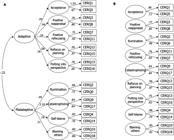
Second and first order structural models of the CERQ-SF with a Brazilian military personnel sample
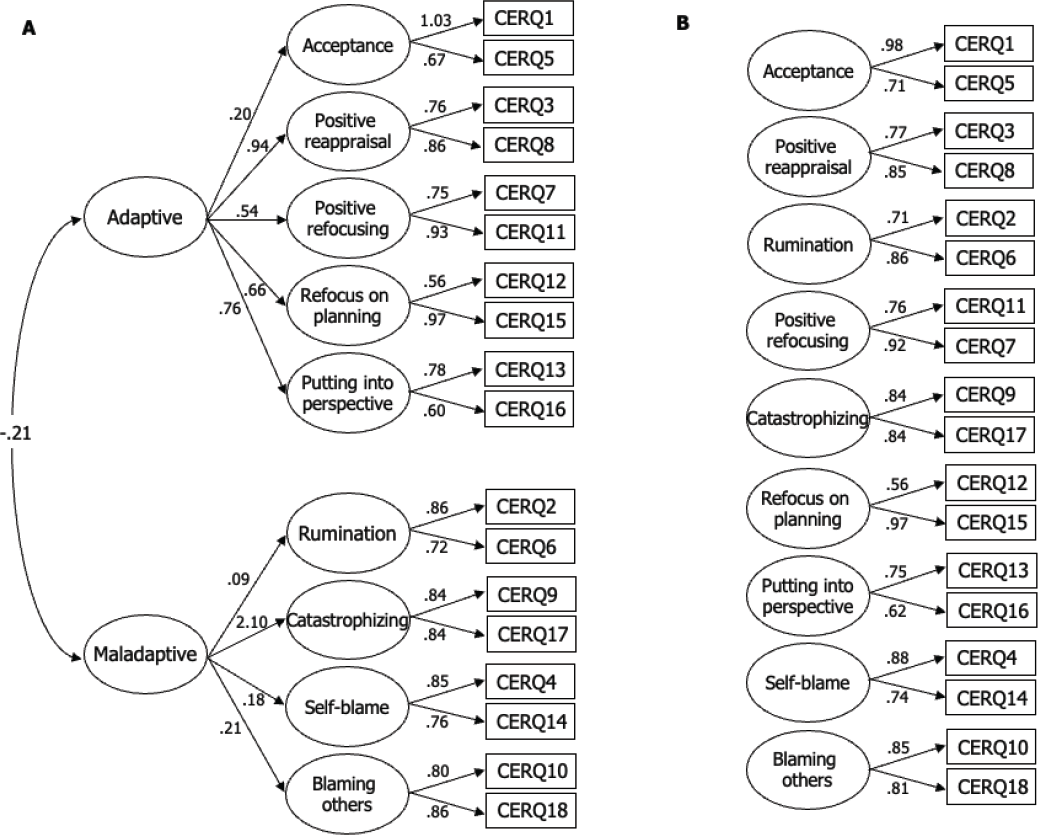
Next, we analyzed the first-order model, which included the nine first-order latent variables (rumination, catastrophizing, self-blame, blaming others, acceptance, positive reappraisal, positive refocusing, refocus on planning, and putting into perspective). The model demonstrated satisfactory fit (RMSEA = .055, 90% CI = .044-.066; CFI = .97, TLI = .95; SRMR = .04; χ²/df = 1.99; p < .001) and was therefore adopted as the final model. Table 2 and Figure 1B presents the factor loadings for each item - which ranged from .56 to .98 - within their respective factors.
Although both first- and second-order models were tested, the second-order bifactorial structure demonstrated inferior global fit and substantive estimation problems. Compared with the first-order model, the second-order model showed higher RMSEA and SRMR values and lower CFI and TLI indices, indicating poorer overall fit. More importantly, the second-order solution produced improper parameter estimates, including standardized factor loadings exceeding 1.0 (e.g., λ = 1.03 and λ = 2.10), which are indicative of Heywood cases and suggest model over-constraint and lack of discriminant variance at the first-order level. Such estimation anomalies violate fundamental assumptions of confirmatory factor analysis and undermine the interpretability of the higher-order construct (Jöreskog, 1999; Kline, 2016). Consistent with theory-driven measurement principles, and given the superior fit and well-behaved parameter estimates of the nine-factor first-order model, the latter was retained as the most psychometrically and conceptually adequate representation of the CERQ-SF for this reference sample.
Regarding internal reliability, almost all factors demonstrated adequate construct reliability coefficient (CR), with values ranging from .76 to .89. The exception was the perspective adjustment factor, which had a CR of .64 (Table 3), a value still considered tolerable.
For convergent validity, nearly all factors had adequate Average Variance Extracted (AVE) values (AVE > .50), meeting the criteria for item coherence within each latent variable. Only the perspective adjustment factor had a borderline but still acceptable AVE value (AVE = .47). Discriminant validity was also adequate for all factors (AVE > 0.50 and greater than the squared correlation coefficient [r²]), with leniency applied to the perspective adjustment factor (Table 3).
Discussion
This study aimed to investigate the psychometric properties of the CERQ-SF in a sample of Brazilian military personnel, aged 18 to 39. We examined the the factor structure of the instrument through Confirmatory Factor Analysis, generated evidence of convergent and discriminant validity (Fornell & Larcker, 1981); and internal consistency, using construct reliability coefficient.
The research was motivated by the scarcity of studies focusing on emotional regulation within the national context, particularly among military populations. CERQ-SF has already been validated for the general Brazilian population, from 18 to 59 years old, primarily female, and from the northwest of Brazil, achieving an adjusted nine first order factor with satisfactory evidence of internal consistency. The present study adds distinct psychometric evidence for the measure, from a reference sample of military (enlisted and commissioned officer), from 18 to 39 years old, primarily males and from 22 different states of Brazil. Therefore, given the fact that the evaluation of the psychometric properties of an instrument is essential to stablish its robustness and generalizability (American Educational Research Association et al., 2014; Furr & Bacharach, 2013), the present study gives a contribution to the field.
The literature presents two structural models applicable to the CERQ (Garnefski et al., 2001). The first is a second-order model, where latent variables are categorized into adaptive - with 5 first order factors - and maladaptive strategies - with the remaining four first order factors. The second model considers only the nine first-order latent variables. In the development of the CERQ-SF, only the latter model was analyzed (Garnefski & Kraaij, 2006), but the former is also theoretically viable and was therefore evaluated.
In this study, as in previous research conducted in Brazil (Araújo et al., 2020), the first-order model demonstrated a better fit for the CERQ-SF. This structural model appears to align well with theory, as it has been confirmed across diverse cultural samples, including Argentine adults (Dominguez-Lara et al., 2023), Iranian adults (Hasani et al., 2023), Portuguese adolescents (Santos et al., 2023), Italian adolescents and adults (Cerolini et al., 2022), Norwegian children (Sætren et al., 2024), Spanish children (Orgilés et al., 2018), Turkish university students (Cakmak & Cevik, 2010), South African adults (Propheta & VanZyl, 2019), Peruvian adults (Dominguez-Lara & Merino-Soto, 2015), and clinical samples of Australian adults (Ireland et al., 2017). However, a Persian version of the instrument, validated with a sample of Iranian staff from a military university, showed adequate fit for a bifactorial model, distinct from all previous ones, labeled adaptive coping (items 3, 4, 7-14) and maladaptive coping (items 1, 2, 5, 6, 15-18) (Mohsenabadi & Fathi-Ashtiani, 2021). It suggests an important theoretical variation in cognitive emotion regulation within this sample, but it is worth to mention that the original first order factor and the second order factor models were not presented by Mohsenabadi and Fathi-Ashtiani (2021). The risk is to creat “caricatures of models” based only on math, ignoring the theory behind the measure This concern is well established in the psychometric literature. Confirmatory factor analysis was originally conceived as a theory-driven approach in which models are specified a priori based on substantive considerations (Jöreskog, 1969; Jöreskog & Sörbom, 1993). Accordingly, acceptable model fit does not, by itself, constitute evidence of construct validity (McDonald, 1999; Borsboom, 2005). Several authors have cautioned against the uncritical prioritization of parsimony and fit indices, emphasizing that statistically efficient models may oversimplify complex psychological constructs when theoretical distinctions are ignored (Marsh et al., 2004; Reise et al., 2013). From this perspective, collapsing multidimensional constructs into broad latent categories without systematically testing theoretically grounded alternatives risks producing models that are mathematically adequate but conceptually impoverished. Hence, the Persian study (Mohsenabadi & Fathi-Ashtiani, 2021), potentially interesting because of the sample, seems not comparable with the present one.
Adequate values for convergent validity, discriminant validity, and construct reliability were found, with the exception of the “putting into perspective” factor, which showed borderline results. The lower internal reliability of this factor has been noted in previous studies (Dominguez-Lara & Merino-Soto, 2015; Propheta & VanZyl, 2019; Santos et al., 2023), including for the same factor at the previous study in Brazil (Araujo et al., 2020). Statisticaly ,we can point that the factor loadings for “putting into perspective” factor in the present version were satisfactory (λ > 0.50), but response central tendency and factor loading heterogeneity may explain the lower reliability (Valentini & Damásio, 2016). Nevertheless, the value obtained is still acceptable (Jordan & Spiess, 2019), and the use of this factor in analyses for this population is still recommended. The average variance extracted (AVE) was close to the threshold, and considering potential cross-loadings with the positive reappraisal factor-due to content similarity and covariance between the two factors-the value can be tolerated (Valentini & Damásio, 2016).
Culturally, we can address the low reliability of this factor in both Brazilian studies, the present one and the conducted by Araujo et al., (2020), remembering the popular saying in Brazil: brazilians never gave up. Hence, when they read the observable variables “I think it wasn’t so bad...” and “I tell myself there are worse things...” in the putting into perspective” factor, it may capture only part of the process of moving forward in adversity, since the feeling that it was just a step back is culturally deeply rooted. Specifically for the military, they also have an attitudinal value developed on the formation schools called “ruggedness”-the ability to endure adverse environments, overcome difficulties quickly, and adapt to various situations - being a defining characteristic of military personnel. They also have a particular saying for adverse, but common situations: the war is worse, people die out there. Again, the observable variables are sufficiently well reflected by the factor, but there should be more to observe regarding put something into perspective among Brazilians to move on. A qualitative research, about this topic, might be useful to address these and other transcultural particularities of emotional regulation among Brazilians.
While this study provides evidence of satisfactory fit for the nine-factor model of the Brazilian CERQ-SF in a military sample, some limitations should be noted. First, the sampling was non-probabilistic and included relatively young participants, with a mean age of around 30, which may limit the generalizability of the results to other age groups. Additionally, there was a significant predominance of male respondents (84.8% of the sample), which may limit the representativeness of female experiences and perceptions within the military context. Another relevant aspect is that most responses came from junior officers (64.9% of participants), potentially biasing the conclusions toward this group and away from other ranks. Finally, the study focused exclusively on career military personnel, excluding enlisted personnel, who constitute the majority of the armed forces, thus limiting the applicability of the findings to this significant segment.
Future research directions include several important avenues to enhance the understanding of emotional regulation in military contexts. First, it would be valuable to develop a tailored instrument based on the CERQ and CERQ-SF, incorporating the cultural specificities of military careers regarding emotional adjustments. This instrument should address the profession’s demand for blocking or suppressing emotions to fulfill certain missions, as in situations like environmental disasters or armed conflicts, where there is no time for emotional processing due to mission urgency. In such cases, emotional regulation is crucial to ensure that emotions do not interfere with essential task performance.
Another relevant line of research is to deepen the understanding of factors influencing emotional regulation that are critical to military careers. Investigating these factors is important, as emotional dysregulation not only compromises task execution but can also endanger the lives of military personnel. Understanding these elements could contribute to the development of more effective training and emotional support strategies, ensuring that military personnel are better prepared to face the emotional challenges of their missions.
Data Availability Statement
Raw data were generated at Escola de Educação Física do Exército. The data that support the findings of this study are openly available in Science DB repository at https://doi.org/10.57760/sciencedb.21280
References
- Abrahams, D. S. (2007). 2d Place: Emotional intelligence and Army leadership: Give it to me straight! Military Review, 87(2), 86.
-
Aldao, A. (2013). The future of emotion regulation research: Capturing context. Perspectives on Psychological Science, 8(2), 155-172. https://doi.org/10.1177/1745691612459518
» https://doi.org/10.1177/1745691612459518 - American Educational Research Association, American Psychological Association, & National Council on Measurement in Education. (2014). Standards for educational and psychological testing. Washington, DC: American Educational Research Association.
- Anastasi, A. & Urbina, S. (2000). Testagem psicológica [Psychological testing]. Porto Alegre: Artes Médicas.
-
Araujo, A. P. de C., Gadelha, M. J. N., & Melo, R. L. P. de. (2020). Evidence of validity, reliability and psychometric parameters of the items of the Cognitive Emotion Regulation Questionnaire-Short (CERQ-Short). Psico-USF, 25(3), 547-559. https://doi.org/10.1590/1413-82712020250312
» https://doi.org/10.1590/1413-82712020250312 -
Basham, V. M. (2015). Waiting for war: Soldiering, temporality, and the gendered politics of boredom and joy in military spaces. In L. Åhäll & T. Gregory (Eds.), Emotions, politics and war (pp. 128-140). Routledge. https://doi.org/10.4324/9781315728259
» https://doi.org/10.4324/9781315728259 - Borsboom, D. (2005). Measuring the mind: Conceptual issues in contemporary psychometrics. Cambridge University Press.
- Brandão, C. B. (2021). Comportamento suicida em militares do exército: Estudo de métodos mistos [Master’s thesis]. Universidade Estadual do Ceará.
-
Brasil. (1988). Constituição da República Federativa do Brasil. http://www.planalto.gov.br/ccivil_03/Constituicao/Constituicao_Compilado.htm
» http://www.planalto.gov.br/ccivil_03/Constituicao/Constituicao_Compilado.htm -
Brown, R. L., et al. (2022). Emotion regulation, parasympathetic function, and psychological well-being. Frontiers in Psychology, 13, 879166. https://doi.org/10.3389/fpsyg.2022.879166
» https://doi.org/10.3389/fpsyg.2022.879166 - Brown, T. A. (2006). Confirmatory factor analysis for applied research. Guilford Press.
- Cakmak, A. F., & Çevik, E. I. (2010). Cognitive emotion regulation questionnaire: Development of Turkish version of 18-item short form. African Journal of Business Management, 4(10), 2097-2102.
- Celestino, S., et al. (2019). Análise das ações voltadas aos militares empregados em missões de paz no Exército Brasileiro - Relatório Final. CEP/FDC.
-
Cerolini, S., et al. (2022). Cognitive Emotion Regulation Questionnaire-Short: Reliability, validity, and measurement invariance of the Italian version. Behavioral Sciences, 12(12), 474. https://doi.org/10.3390/bs12120474
» https://doi.org/10.3390/bs12120474 - Cotian, M., & Neves, A. (2020). Trauma psicológico e resiliência nas operações de paz. In S. Celestino & A. Neves (Eds.), Missões de paz: Teoria e dimensão humana (pp. 127-148). Appris.
-
Cricenti, C., et al. (2022). Can emotion regulation affect aggressive responses? A study on the Ukrainian-Russian conflict in a non-directly exposed sample. International Journal of Environmental Research and Public Health, 19(10), 6189. https://doi.org/10.3390/ijerph19106189
» https://doi.org/10.3390/ijerph19106189 -
Cui, Y., et al. (2022). A correlation study of military psychological stress, optimistic intelligence quotient, and emotion regulation of Chinese naval soldiers. Social Behavior and Personality: An International Journal, 50(5), e11378. https://doi.org/10.2224/sbp.11378
» https://doi.org/10.2224/sbp.11378 - Dominguez-Lara, S., & Merino-Soto, C. (2015). Una versión breve del Cognitive Emotion Regulation Questionnaire: Análisis estructural del CERQ-18 en estudiantes universitarios limeños. Revista Peruana de Psicología y Trabajo Social, 4(1), 25-36.
-
Dominguez-Lara, S., et al. (2023). Psychometric analysis of two brief versions of the CERQ in the Argentinean population: CERQ-18 and CERQ-27. Psychology in Russia: State of the Art, 16(1), 26-43. https://doi.org/10.11621/pir.2023.0103
» https://doi.org/10.11621/pir.2023.0103 - Endsley, M. R., & Garland, D. J. (2000). Situation awareness analysis and measurement. CRC Press.
-
Fornell, C., & Larcker, D. F. (1981). Evaluating structural equation models with unobservable variables and measurement error. Journal of Marketing Research, 18(1), 39-50. https://doi.org/10.1177/002224378101800104
» https://doi.org/10.1177/002224378101800104 - Furr, R. M., & Bacharach, V. R. (2013). Psychometrics: An introduction (2nd ed.). Sage Publication.
-
Garnefski, N., & Kraaij, V. (2006). Cognitive Emotion Regulation Questionnaire-Development of a short 18-item version (CERQ-short). Personality and Individual Differences, 41(6), 1045-1053. https://doi.org/10.1016/j.paid.2006.04.010
» https://doi.org/10.1016/j.paid.2006.04.010 -
Garnefski, N., & Kraaij, V. (2007). The Cognitive Emotion Regulation Questionnaire. European Journal of Psychological Assessment, 23(3), 141-149. https://doi.org/10.1027/1015-5759.23.3.141
» https://doi.org/10.1027/1015-5759.23.3.141 -
Garnefski, N., Kraaij, V., & Spinhoven, P. (2001). Negative life events, cognitive emotion regulation and emotional problems. Personality and Individual Differences , 30(8), 1311-1327. https://doi.org/10.1016/S0191-8869(00)00113-6
» https://doi.org/10.1016/S0191-8869(00)00113-6 -
Gondim, S. M. G., et al. (2015). Evidências de validação de uma medida de características pessoais de regulação das emoções. Psicologia: Reflexão e Crítica, 28(4), 659-667. https://doi.org/ 10.1590/1678-7153.201528403
» https://doi.org/ 10.1590/1678-7153.201528403 -
Gratz, K. L., & Roemer, L. (2004). Multidimensional assessment of emotion regulation and dysregulation: Development, factor structure, and initial validation of the Difficulties in Emotion Regulation Scale. Journal of Psychopathology and Behavioral Assessment, 26(1), 41-54. https://doi.org/10.1023/B:JOBA.0000007455.08539.94
» https://doi.org/10.1023/B:JOBA.0000007455.08539.94 -
Gross, J. J. (1998). The emerging field of emotion regulation: An integrative review. Review of General Psychology, 2(3), 271-299. https://doi.org/10.1037/1089-2680.2.3.271
» https://doi.org/10.1037/1089-2680.2.3.271 - Hair, J. F., Black, W. C., Babin, B. J., & Anderson, R. E. (2019). Multivariate data analysis (8th ed.). Cengage.
-
Hasani, J., et al. (2024). Psychometric properties of the Persian version of the Cognitive Emotion Regulation Questionnaire-Short (CERQ-P-Short): Reliability, validity, factor structure, treatment sensitivity, and measurement invariance. Journal of Psychiatric Research, 170, 1-10. https://doi.org/10.1016/j.jpsychires.2023.12.007
» https://doi.org/10.1016/j.jpsychires.2023.12.007 -
Hu, L.-T., & Bentler, P. M. (1999). Cutoff criteria for fit indexes in covariance structure analysis: Conventional criteria versus new alternatives. Structural Equation Modeling: A Multidisciplinary Journal, 6(1), 1-55. https://doi.org/10.1080/10705519909540118
» https://doi.org/10.1080/10705519909540118 -
Ireland, M. J., Clough, B. A., & Day, J. J. (2017). The Cognitive Emotion Regulation Questionnaire: Factorial, convergent, and criterion validity analyses of the full and short versions. Personality and Individual Differences , 110, 90-95. https://doi.org/10.1016/j.paid.2017.01.035
» https://doi.org/10.1016/j.paid.2017.01.035 -
John, O. P., & Gross, J. J. (2004). Healthy and unhealthy emotion regulation: Personality processes, individual differences, and life span development. Journal of Personality, 72(6), 1301-1334. https://doi.org/10.1111/j.1467-6494.2004.00298.x
» https://doi.org/10.1111/j.1467-6494.2004.00298.x -
Jordan, P., & Spiess, M. (2019). Rethinking the interpretation of item discrimination and factor loadings. Educational and Psychological Measurement, 79(6), 1103-1132. https://doi.org/10.1177/0013164419832060
» https://doi.org/10.1177/0013164419832060 -
Jöreskog, K. G. (1969). A general approach to confirmatory maximum likelihood factor analysis. Psychometrika, 34(2), 183-202. https://doi.org/10.1007/BF02289343
» https://doi.org/10.1007/BF02289343 -
Jöreskog, K. G. (1999). How large can a standardized coefficient be? Unpublished manuscript. https://www.statmodel.com/download/Joreskog.pdf
» https://www.statmodel.com/download/Joreskog.pdf - Jöreskog, K. G., & Sörbom, D. (1993). LISREL 8: Structural equation modeling with the SIMPLIS command language. Scientific Software International.
- Kandel, E. R., et al. (2014). Princípios de neurociências (5th ed.). AMGH.
-
Kemper, C. J., et al. (2019). Short versus long scales in clinical assessment: Exploring the trade-off between resources saved and psychometric quality lost using two measures of obsessive-compulsive symptoms. Assessment, 26(5), 767-782. https://doi.org/10.1177/1073191118810057
» https://doi.org/10.1177/1073191118810057 -
Kessler, R. C., et al. (2003). Screening for serious mental illness in the general population. Archives of General Psychiatry, 60(2), 184-189. https://doi.org/10.1001/archpsyc.60.2.184
» https://doi.org/10.1001/archpsyc.60.2.184 - Kline, R. B. (2016). Principles and practice of structural equation modeling (4th ed.). Guilford Press.
- Koole, S. L., Van Dillen, L. F., & Sheppes, G. (2011). The self-regulation of emotion. In K. D. Vohs & R. F. Baumeister (Eds.), Handbook of self-regulation: Research, theory, and applications (2nd ed., pp. 22-40). Guilford Press.
-
Lopez, C. M., et al. (2022). Effects of emotion dysregulation on post-treatment post-traumatic stress disorder and depressive symptoms among women veterans with military sexual trauma. Journal of Interpersonal Violence, 37(15-16), NP13143-NP13161. https://doi.org/10.1177/08862605211005123
» https://doi.org/10.1177/08862605211005123 -
Machado, B. M., et al. (2020). Evidences of validity of the Difficulties in Emotion Regulation Scale-DERS. Paidéia, 30, e3017. https://doi.org/10.1590/1982-4327e3017
» https://doi.org/10.1590/1982-4327e3017 - Marcoulides, G. A., & Hershberger, S. L. (2005). Multivariate statistical methods: A first course. Lawrence Erlbaum Associates.
- Marôco, J. (2021). Análise de equações estruturais: Fundamentos teóricos, software & aplicações. Report Number.
-
Marsh, H. W., Hau, K.-T., & Wen, Z. (2004). In search of golden rules: Comment on hypothesis-testing approaches to setting cutoff values for fit indexes and dangers in overgeneralizing Hu and Bentler’s (1999) findings. Structural Equation Modeling, 11(3), 320-341. https://doi.org/10.1207/s15328007sem1103_2
» https://doi.org/10.1207/s15328007sem1103_2 - McDonald, R. P. (1999). Test theory: A unified treatment. Lawrence Erlbaum Associates.
-
Menefee, D. S., Ledoux, T., & Johnston, C. A. (2022). The importance of emotional regulation in mental health. American Journal of Lifestyle Medicine, 16(1), 28-31. https://doi.org/10.1177/15598276211049701
» https://doi.org/10.1177/15598276211049701 - Mohsenabadi, H., & Fathi-Ashtiani, A. (2021). Evaluation of psychometric properties of the Persian version of the short form of Cognitive Emotion Regulation Questionnaire (CERQ-18). Payesh (Health Monitor), 20(2), 167-178.
-
Nelis, D., et al. (2011). Measuring individual differences in emotion regulation: The Emotion Regulation Profile-Revised (ERP-R). Psychologica Belgica, 51(1), 49-91. https://doi.org/10.5334/pb-51-1-49
» https://doi.org/10.5334/pb-51-1-49 - Neves, A. N., & Silva, W. R. (2022). Instrumentos psicométricos: Definição, tipos, propriedades métricas e critérios para escolha na psicologia do esporte e do exercício. In A. Neves et al. (Eds.). Pesquisa aplicada ao exercício físico e ao esporte (pp. 281-307). Appris.
-
Orgilés, M., et al. (2018). Validation of the short version of the Cognitive Emotion Regulation Questionnaire for Spanish children. Journal of Child Health Care, 23(1), 87-101. https://doi.org/10.1177/1367493518777291
» https://doi.org/10.1177/1367493518777291 -
Perry, J. L., et al. (2020). Different version, similar result? A critical analysis of the multiplicity of shortened versions of the Zimbardo Time Perspective Inventory. Sage Open, 10(2), 2158244020923351. https://doi.org/10.1177/2158244020923351
» https://doi.org/10.1177/2158244020923351 -
Propheta, I., & Van Zyl, C. J. J. (2019). Measuring cognitive emotion regulation in South Africa using the Cognitive Emotion Regulation Questionnaire-Short Form. African Journal of Psychological Assessment, 1(1), 1-6. https://doi.org/10.4102/ajopa.v1i1.9
» https://doi.org/10.4102/ajopa.v1i1.9 -
Reise, S. P., Bonifay, W. E., & Haviland, M. G. (2013). Scoring and modeling psychological measures in the presence of multidimensionality. Journal of Personality Assessment, 95(2), 129-140. https://doi.org/10.1080/00223891.2012.725437
» https://doi.org/10.1080/00223891.2012.725437 -
Russell, C. A., Russell, D. W., & Harris, C. (2023). Post-traumatic consumption: Does emotion regulation moderate the relationship between military life stressors, mental health outcomes, and compulsive buying? Journal of Consumer Affairs, 57(3), 1183-1212. https://doi.org/10.1111/joca.12544
» https://doi.org/10.1111/joca.12544 -
Sætren, S. S., et al. (2024). Validation of the short version of Cognitive Emotion Regulation Questionnaire for adolescents in Norway. Scandinavian Journal of Public Health, 52(1), 14034948231225616. https://doi.org/10.1177/14034948231225616
» https://doi.org/10.1177/14034948231225616 -
Santos, A. C., et al. (2023). Portuguese validation of the Cognitive Emotion Regulation Questionnaire short version in youth: Validity, reliability and invariance across gender and age. European Journal of Developmental Psychology, 20(2), 384-399. https://doi.org/10.1080/17405629.2022.2051040
» https://doi.org/10.1080/17405629.2022.2051040 -
Schäfer, J. L., et al. (2018). Psychometric properties of the Brazilian version of the Cognitive Emotion Regulation Questionnaire. Trends in Psychiatry and Psychotherapy, 40(2), 160-169. https://doi.org/ 10.1590/2237-6089-2017-0074
» https://doi.org/ 10.1590/2237-6089-2017-0074 -
Stanley, E. A., & Larsen, K. L. (2019). Emotion dysregulation and military suicidality since 2001: A review of the literature. Political Psychology, 40(1), 147-163. https://doi.org/10.1111/pops.12534
» https://doi.org/10.1111/pops.12534 -
Stanley, E. A., & Larsen, K. L. (2021). Difficulties with emotion regulation in the contemporary US armed forces: Structural contributors and potential solutions. Armed Forces & Society, 47(1), 77-105. https://doi.org/10.1177/0095327X19891977
» https://doi.org/10.1177/0095327X19891977 -
Tibubos, A. N., et al. (2018). Emotion regulation strategies moderate the relationship of fatigue with depersonalization and derealization symptoms. Journal of Affective Disorders, 227, 571-579. https://doi.org/10.1016/j.jad.2017.11.079
» https://doi.org/10.1016/j.jad.2017.11.079 -
Tonon, A. C., et al. (2019). How do stress, sleep quality, and chronotype associate with clinically significant depressive symptoms? A study of young male military recruits in compulsory service. Brazilian Journal of Psychiatry, 42(1), 54-62. https://doi.org/10.1590/1516-4446-2018-0286
» https://doi.org/10.1590/1516-4446-2018-0286 -
Valentini, F., & Damásio, B. F. (2016). Variância média extraída e confiabilidade composta: Indicadores de precisão. Psicologia: Teoria e Pesquisa, 32(2), e322225. https://doi.org/10.1590/0102-3772e322225
» https://doi.org/10.1590/0102-3772e322225 -
Vasconcelos, I. D. S., & Santos, S. M. D. A. (2022). Sobre afetos e fardas: gestão militar e emocionalidade em abrigos para venezuelanos em Roraima, Brasil. REMHU: Revista Interdisciplinar da Mobilidade Humana, 30(66), 243-264. https://doi.org/10.1590/1980-85852503880006614
» https://doi.org/10.1590/1980-85852503880006614 -
Victor, S. E., & Klonsky, E. D. (2016). Validation of a brief version of the Difficulties in Emotion Regulation Scale (DERS-18) in five samples. Journal of Psychopathology and Behavioral Assessment , 38(4), 582-589. https://doi.org/10.1007/s10862-016-9547-9
» https://doi.org/10.1007/s10862-016-9547-9

 Note. CERQ = Cognitive emotion regulation questionnaire