
 FAKE NEWS´ COGNITIVE EFFECTS IN COMPLEX DECISION-MAKING AND POLITICAL POLARIZATION: INSIGHTS FROM ARGENTINA
Abstract
Political polarization has key relevance for today’s democracies. Previous research in political science, social psychology and cognitive neuroscience tends to examine its effects in core countries (such as the United States or European countries). Given the limited literature on these processes in peripheral countries, this review aims to examine the role of fake news in complex decision-making and other cognitive processes involved in political polarization, and to provide insights into its impact in Argentina. To this end, we discuss the cognitive effects of fake news on decisionmaking and political polarization, and highlight the facilitating effects of rebuttal texts as a tool that can promote the review of misinformation resulting from exposure to fake news. We also discusspublic policies applications.
Keywords:
Polarization; Fake News; Rebuttal Texts; Decision-making; Argentina.
Resumo
A polarização política tem relevância fundamental para as democracias atuais. Pesquisas anteriores em ciência política, psicologia social e neurociência cognitiva tendem a examinar seus efeitos em países centrais (como os EUA ou países europeus). Considerando que há pouca literatura sobre esses processos em países periféricos, o objetivo desta revisão é examinar o papel das notícias falsas na tomada de decisões complexas e outros processos cognitivos envolvidos na polarização política, e apresentar insights sobre seu impacto na Argentina. Com esse objetivo, discutimos os efeitos cognitivos das notícias falsas na tomada de decisões e na polarização política, e destacamos os efeitos facilitadores dos textos de refutação, como uma ferramenta que pode promover a revisão de desinformação resultante da exposição a notícias falsas. Também discutimos aplicações em políticas públicas.
Palavras-chave:
Polarização; Notícias Falsas; Textos de Refutação; Tomada de Decisão; Argentina.
Resumen
La polarización política es fundamental para las democracias actuales. Investigaciones previas en ciencias políticas, psicología social y neurociencia cognitiva tienden a examinar sus efectos en países centrales (como Estados Unidos o países europeos). Dada la escasa literatura sobre estos procesos en países periféricos, esta revisión busca examinar el rol de las noticias falsas en la toma de decisiones complejas y otros procesos cognitivos involucrados en la polarización política, y presentar perspectivas sobre su impacto en Argentina. Para ello, analizamos los efectos cognitivos de las noticias falsas en la toma de decisiones y la polarización política, y destacamos el efecto facilitador de los textos de refutación como herramienta que puede promover la revisión de la desinformación derivada de la exposición a noticias falsas. También analizamos sus aplicaciones en políticas públicas.
Palabras clave:
Polarización; Noticias falsas; Textos de refutación; Toma de decisiones; Argentina.
Introduction
The phenomenon of political polarization has taken on key relevance for today’s democracies. Although recent studies have been conducted in political science, social psychology and cognitive neuroscience, most of the literature has tended to examine its effects on central countries (e.g., the US or European countries). Few studies have examined the role of political polarization, decision-making, fake news, and refutation text , and even fewer of these focus on peripheral countries: Table 1 illustrates this by presenting results of bibliometric keywords queries (“Political Polarization”, “Decision-making”, “Fake News”, “Refutation text” and their possible associations) in GoogleScholar and Scopus databases (Mongeon & Paul-Hus, 2016), in relation to Argentina. Taking into account this gap, in this paper we examine the role of fake news in complex decision-making and other cognitive processes in political polarisation, incorporating a perspective from Argentina. We discuss the cognitive processes involved in political polarisation in relation to fake news and decision-making, and highlight the role of rebuttal texts as tools that can promote the revision of misinformation. We also propose applications to public policy.
Papers published on (Political) Polarization, Decision-Making, Fake News and Refutation Texts, or associations of these queries, in total or related to Argentina. Data were obtained from GoogeScholar and Scopus databases as of September 2023.
To achieve this objective, the following sections will be presented: (a) description of how fake news are seeds of polarisation; (b) the cognitive and emotional effects of fake news; (c) background on complex decisions; (d) the dual process framework; (e) the role of fake news in complex decisions; (f) the potential use of refutation text to limit the effect of fake news; (g) the perspective from Argentina; and (h) conclusions and final perspectives.
Fakes News: Seeds For Polarization
Mass political polarization occurs when individuals radicalise their political beliefs, or develop strong and intense group attachments (Sieber & Ziegler, 2019). The issue has been addressed by experimental social psychology. These investigations examine the observed tendency of members of a social group to become radicalised in their initial political views. (Sieber & Ziegler, 2019). There are three operational dimensions of political polarization: cognitive, motivational and affective (Jost et al., 2022). Ideological or cognitive polarization is characterized by a radicalization of political and/or ideological beliefs. It is often operationalised as a bimodal distribution of beliefs, opinions and values, and usually involves groups (such as progressive & conservatives or left-wing & right-wing) that move in opposite directions. Polarization can also occur in relation to political parties. These are often based on shared social and/or cultural beliefs, and express gaps based on social class, region or religion. Finally, affective polarization occurs when members of different social groups (or political parties) have very positive (or negative) feelings towards their own (or other) groups. These three dimensions of polarization can lead citizens to understand politics and society in terms of “us versus/against them”, with potentially harmful consequences for intergroup relations and Democracy (Jost et al., 2022).
In economics and political science, disagreements that underlie polarization are usually considered to have two main sources: (a) differences inreferences, values or beliefs; and (b) differences in the information they process. In relation to differences in preferences, people may disagree about the application of a given policy, because they would benefit from it or not. Differences in the information that processed may lead individuals to support a given policy (or choose a political candidate), given that they have been exposed to biased sources of information, but their beliefs may change if they have to make decisions (Azzimonti & Fernandes, 2023). These sources of polarization may not be independent from each other. For example, conservative social media users have been observed to consume misinformation to a greater extent than liberal users in the US (Mosleh & Rand, 2022).
Although the spread of false information has been used as a weapon in the past, it was not until the emergence of new technologies that fake news became massive (Valero & Oliveira, 2018). These deceptive news stories are closely related to extreme views, propaganda, populism and political manipulation (Tumber & Waisbord, 2021b). Their main purpose is to deceive users, disseminate, and manipulate public discourse to benefit specific economic or political interests. Their spread is facilitated by algorithms, online and social media and advertising companies, where generating quality and verified content is costly, while creating fake news is more attractive, easier and cheaper, or is aimed at genuine manipulation of public discourse for political interests.The impact that fake news has on political decisions has been assessed by several authors (Bago et al., 2020; Kucharski, 2016; Lazer et al., 2018; Pennycook & Rand, 2020), although others consider them to not have an effect on these decisions (Altay et al., 2020; Mercier, 2020a, 2020b) or not being as relevant as cognitive biases (Dunaway, 2021). The sources of fake news can be elites (people and organizations with power (Mosleh & Rand, 2022); although they are also associated with populism (Tumber & Waisbord, 2021b)), state or governmental institutions, media and social networks. In relation to this, fake news was proposed to have played a key role during the Brexit process in the UK (Greene et al., 2021; Höller, 2021; Rose, 2017), the 2016 election campaigns in the US (Bovet & Makse, 2019; Darraj et al., 2017; Dowling, 2022; Fischer & Klazar, 2020; Garrett, 2019; Lazer et al., 2018; Oddleifson, 2020; Rose, 2017), and in election campaigns in peripheral regions such as Trinidad and Tobago, Brazil, Argentina or Latin America and Caribe (Arencibia et al., 2023; Dowling, 2022; Fischer & Klazar, 2020; Oddleifson, 2020; Osuna & Soforza, 2019; Pimenta et al., 2024; Sousa et al., 2023 ). Fake news has been also used massively in campaigns against vaccination (Chiou & Tucker, 2018; Iacobucci, 2019), public policies of prevention during the Covid-19 outbreak (Apuke & Omar, 2021; Rabinovich & Geffner, 2021; Rocha et al., 2021), climate change (Drummond et al., 2020; Lutzke et al., 2019; Pennycook, 2023), social and gender rights (Castellano et al., 2022; Murphy et al., 2019; Osuna & Soforza, 2019; Stabile et al., 2019), among other cases. However, both election campaigns and anti-campaigns are often ideologically or politically related.
Citizens have their own political representations, which may be stronger or weaker depending on their personal, familial or social experience. These representations will be associated, on the one hand, with personal beliefs, values, and social, economic and political expectations. On the other hand, they will serve as a political map to classify candidates or political parties within a left-wing/right-wing or progressive/conservative spectrum (Brussino et al., 2017).
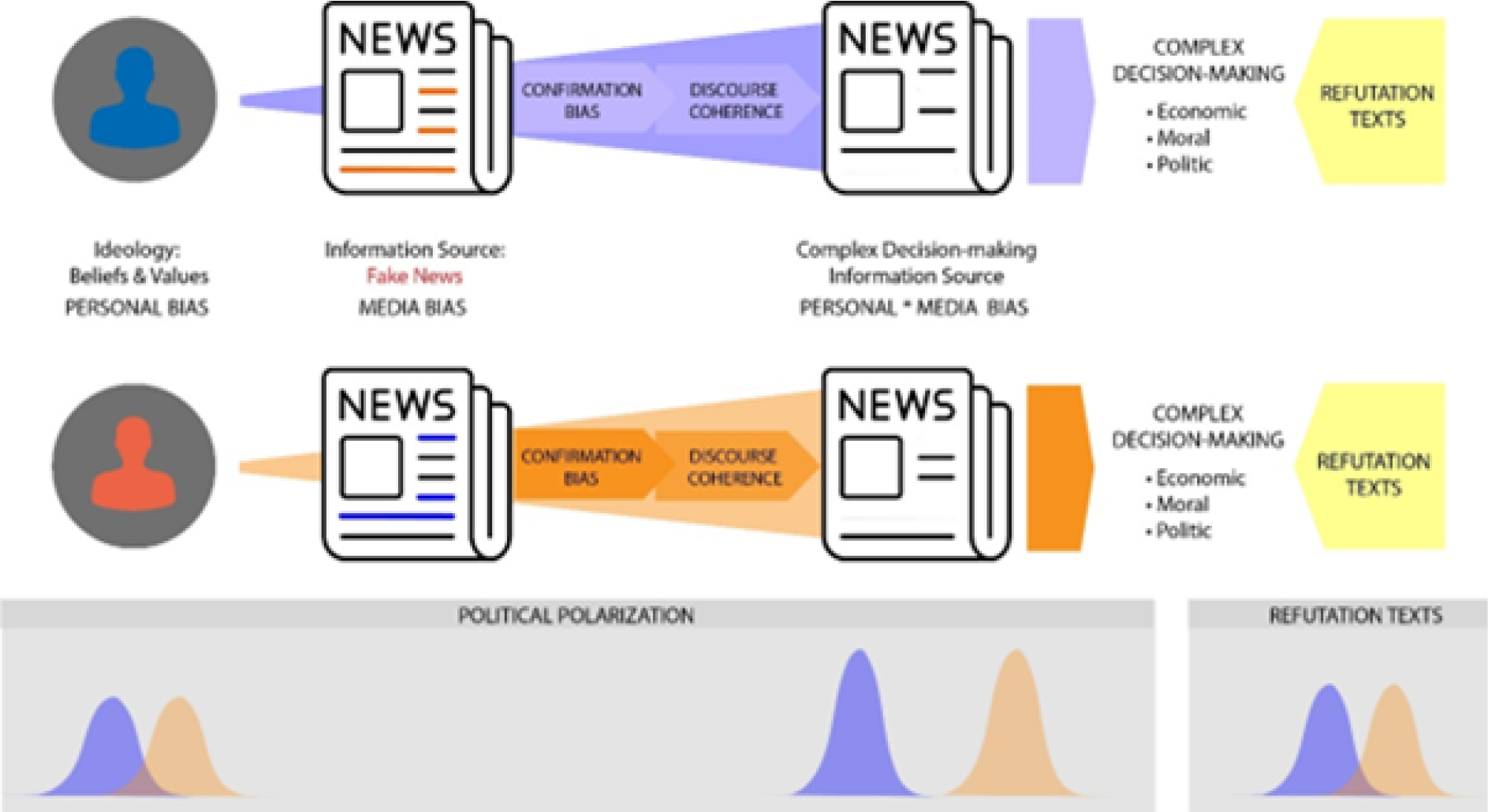
Even though we can discuss the construction of these representations in general, each region or country may have its own specific characteristics (i.e., peronism/anti-peronism in Argentina), which should be analysed in each case in order to understand the cognitive and social determinants of political decisions. These representations may include beliefs, values, common impressions or pieces of information that serve as “anchors” on which people rely to make judgments (De Wilde et al., 2018; Epley & Gilovich, 2010; Tversky & Kahneman, 1974) (see Figure 1). These anchors could play a key role in confirmation bias during sampling information, like published in media or social networks. Media news involves, on the one hand, a biased selection of information (disinformation)(García et al., 2020), and on the other hand, inaccurate or misinformation, priming people’s opinions to induce a trust or familiarity perception to any target, like a candidate (Bernal et al., 2022; Pérez et al., 2023). While misleading and partisan content may not be entirely false or fabricated, it may be widespread on social media (Faris et al., 2017). Moreover, although fake news may not be as prevalent as originally thought, fake content can have an impact on individual belief (Guess et al., 2020). The formation of echo chambers, polarization and segregation occur as users select and share content according to a specific narrative, disregarding the rest of the information. Confirmation bias and the lack of high-quality information contribute to the proliferation of biased narratives, fuelling distrust and paranoia (Del Vicario et al., 2015).

Possible cognitive and social mechanisms by which Fake News might contribute to political polarisation and Refutation Texts to the opposite effect
In order to make a complex decision, the information available to the person during the assessment process, biased by the source and the subject, must be consistent with the subject’s own beliefs, either from a rational/logical (Hammond, 2000) or emotional perspective (Barnes & Thagard, 2019; Thagard, 2001). Refutation texts and accuracy prompts may interfere with this internal coherence by updating the information and minimizing the effect of fake news on the representations generated by the subject; and thus, reversing its effect on polarization.
Cognitive and emotional effects of Fake News
Modern societies are heavily influenced by social media and internet search engines, which utilize machine learning algorithms designed to present users with information that aligns with their interests. In consequence, they benefit not only the sponsors of these websites through the bias imposed by artificial intelligence (Gharibshah et al., 2020; Stehr, 2001), but also the owners of the large technology companies that include such AIs (Mark Zuckerberg, Jeff Bezos, Elon Musk, among others). One downside of the internet revolution and globalization is the increased speed at which fake news spreads, due to its strong emotional content and novelty (Flintham et al., 2018; Shu et al., 2017). In the last decade, the role of emotions in the consumption and belief of fake news, as well as in political decision-making, has been widely studied. Emotions have been proposed to bias people to perceive and process misinformation and diminish their ability to make choices and assess different options properly (Martel et al., 2020). Moreover, higher emotional intelligence is associated with greater capacity to identify fake news (Preston et al., 2021).
Repeated exposure to a piece of information over time could affect a person’s value judgment, regardless of its veracity. This phenomenon is known as the “Illusory Truth Effect” and it was first described by Hasher et al (Hasher et al., 1977), who found that subjects rated statements presented repeatedly as more truthful than the ones presented for the first time.
This effect occurs without the direct intervention of explicit memory (Pennycook et al., 2018). In relation to this, Fazio et al (Fazio et al., 2015) found that prior knowledge about a topic does not prevent the illusory truth effect, as individuals do not rely on correct knowledge they previously possessed, when judging the truthfulness of statements related to the analysed topic.
It is clear how this effect could bias citizens in a context of political campaigns and elections, where news spread dynamically and with a high degree of emotional impact, often lacking proper verification (Rini, 2017). There are several cognitive and metacognitive factors that are related to the illusory truth effect, such as processing fluency and mere exposure effect. When we receive information, the fluency of its processing plays a fundamental role in establishing a value judgment about its veracity. The mere repetition of statements leads to them being processed with greater fluency, and since fluency is used to determine validity, people could be misled when judging its truthfulness (Dechêne et al., 2010; Unkelbach, 2007). The mere-exposure effect, also known as the principle of familiarity, is closely related to the illusory truth effect (Dechêne et al., 2009), as people’s preferences and affective reactions to new information presented can result from and be modified as a result of the repeated presentation of the same one. Unkelbach and Rom (2017) proposed that truth is also judged based on the coherence between new information and prior knowledge.
Complex decision-making
Decision-making involves processes of selecting an option from a set of alternatives, considering its likelihood of leading to the best possible outcome. Unlike other more automatic, faster and less cognitively intensive processes (Ratcliff et al., 2016), complex decision-making (CDM) may involve a higher cognitive processing and longer reflection, though it can also be susceptible to priming (Bernal et al., 2022). The relevance of these decisions has aroused interest in different fields, from experimental psychology to economics, which provides an amalgam of very heterogeneous studies, with diverse approaches included into the framework of Game Theory (Kahneman, 2011; Morgenstern & Von Neumann, 1953; Sanfey, 2007; Tversky & Kahneman, 1981) and moral dilemmas (Christensen & Gomila, 2012; Greene, 2015), among others. Some of these paradigms assume that decision-makers are rational and selfish. Kahneman incorporates the idea of relative preference, which might be affected by social norms, expectations, or level of aspiration (Kahneman, 2011; Tversky & Kahneman, 1981), partially disarming the rationality assumption. In turn, the work of Fehr and Schmidt (1999) was pioneering in dismantling the assumption of selfishness, given that they suggest that decisions may be motivated by aversion to inequality (Fehr & Schmidt, 1999) , although other possibly relevant variables include sensitivity to fairness, deservedness and need (Starmans et al., 2017) or social hierarchies (Haidt, 2007; Xie et al., 2017). These aspects are evidence of moral components associated with these decisions. Our conceptualisation of CDM allows us to re-think political decisions, by incorporating the economic and moral dimensions, often analysed separately.
These perspectives enable us to conceptualize individuals as biased political subjects, who are susceptible to being influenced by priming, propaganda or fake news, which can even lead them to radicalize their opinions and beliefs. It is even relevant to point out that these concepts (“rationality”, “selfishness”, “inequality”, “deservedness”, “need”, “social hierarchies” or “authority”) could be constitutive elements of the subjects’ own beliefs (including researchers), which can divide the water in the polarization process.
Dual process theories
Dual Process Theories (DPT) provide a theoretical framework for analysing the cognitive dimension of polarisation (Rathbun, 2020; Yi, 2019). Radicalization towards extremes appears to involve automatic processes, associated with cognitive biases, exacerbated within like-minded communities (Sunstein, 2009).
These theories propose two different types of processes involved in reasoning and decision-making, either dichotomous (Evans, 2009; Kahneman, 2011; Osman, 2004; Pennycook, 2017) or hybrid/continuous (Newell et al., 2015; Osman, 2004; Thompson, 2013). Processes conceptualized as “System 1” are characterized as fast and automatic, susceptible to implicit processing, not necessarily involving awareness; whereas “System 2” processes involve explicit, deliberative, flexible, slow processing and always involve awareness (Evans, 2018; Evans & Frankish, 2009; Osman, 2004). While some DPT consider these processes as dichotomous (although there may be some interaction), alternative hybrid models propose that there is a continuum between both. Even some distinguish between processes based on implicit learning and automatic ones, which would be defined by the individual’s ability to consciously access behaviour, but not the ability to control it (Osman, 2004).
Complex decision-making could acquire a pattern similar to System 1, either through cognitive shortcuts, such as stereotypes or political/ideological representations (Carlin & Love, 2013; Lane & Sulikowski, 2017; Rathbun, 2020), or through induction by emotional or implicit processes (Newell & Shanks, 2014). The interplay between decision-making and emotions is multidimensional and complex. Somatic marker theory (Damasio et al., 1991; but see Dunn et al., 2006) proposes that autonomic responses learned by association in past experiences (known as somatic markers) bias decision-making, by reducing the likelihood of choosing options associated with negative markers.
The emotional state and/or mood can be induced by the constituent stimulus of the choice or decision (as in priming), or by a stimulus that precedes (and extends during) the decision process. In relation to this, repetition and emotional priming have been reported to induce complex decision-making, favouring familiarity and trust. Yet these processes could be interfered by top-down mechanisms, which can take on characteristics of more deliberative processes (Bernal et al., 2022). For example, the appearance of faces or their emotional expression can be used implicitly to make inferences of competence, which suggests that rapid and unreflective trait inferences may contribute to vote choice (Todorov et al., 2005) or increase prosocial behavior (Weiß et al., 2021). In turn, individuals in a happy mood tend to overestimate the probability of positive, and underestimate the likelihood of negative outcomes, while the opposite holds true for individuals in a sad mood (Johnson & Tversky, 1983; Nygren et al., 1996). In an electoral scenario, this aspect could be expressed as emotional climate (Páez et al., 1997), which affects political opinion, decision and polarization. In relation to this, Gault and Sabini (2000) explored the relationship between emotional states and support for different policies. Results indicated an association between anger with greater preference for punishments, and empathy with reparative policies (Gault & Sabini, 2000).
The effects of Fake News on complex decision-making
As was suggested, the role of information in complex decision-making processes is key. In this sense, fake news can be central for radicalizing opinions and, thus, leading to polarization. Motivated reasoning was implicated in the consumption of disinformation, such that «people believe fake news, because it is consistent with their political ideology» (Kahan, 2017). Motivated reasoning posits that our motivations influence how we perceive information, adapting it to our beliefs, opinions, or preferences. Either the preservation of one’s own identity or one’s position in an affinity group that shares fundamental values can generate motivated cognition in relation to politically-relevant facts (Kahan, 2013). While there is no consensus on how motivated reasoning and dual processes’ accounts interact, and hence, the mechanisms involved in misinformation belief (Kahan, 2013, 2017), some authors consider that fake news have an effect, not because they are the result of motivated thinking, but rather because of automatic processes and lack of deliberation (Pennycook & Rand, 2019). Furthermore, the involvement of emotions in what looks like rational reasoning and decision-making, leads to individuals being less meticulous when examining evidence consistent with their beliefs, and more prone to seeking errors in contrary information and opinions (Pennycook & Rand, 2018). Individuals may be more vulnerable to fake news that are congruent with their political ideology. Yet, analytical thinking (System 2) allows discerning between fake and real news, regardless of whether it is consistent or inconsistent with their political ideology (Pennycook & Rand, 2019).
A third relevant framework linked ideological or cultural values to cognitive reasoning styles. Updating Adorno´s “Authoritarian Personality” theory (Adorno, 2019), a substantial body of empirical work hypotheses that right-wing ideology is a manifestation of intellectual traits (such as dogmatism, aversion to complexity, and a craving for certainty or “closure” in argumentation). On this account, it is proposed that the cognitive style of these dispositions implies a reflexive closed-mindedness towards empirical evidence hostile to ideologically conservative beliefs, values or political preferences (Feygina et al., 2010; Jost et al., 2018). Dual-process motivational (DPM) model of ideological attitudes proposes two cognitive dimensions (right-wing authoritarianism and social dominance orientation) to analyse right-wing/conservative thinking and behavior (Duckitt & Sibley, 2010; Sibley & Duckitt, 2008). On the other hand, some of the DPT literature suggests that progressive and conservatives differ in the dominance or reliance on which system, 1 or 2, to make a decision (Lane & Sulikowski, 2017).
In the classical view of DTP, the goal of System 2 is the correction of false intuitions (System 1´s outcomes) (Evans & Frankish, 2009), and in this sense, its activation might contribute to preventing the effect of fake news (e.g., through refutation texts). Indeed, social media can lead to inattention and evoke social motivations (e.g. maximize getting “likes”) that could distract from common accuracy motivations and deliberation (Ross et al., 2021). While misinformation may involve misleading content, with a strong partisan bias, or strictly fake or fabricated news, mass dissemination through social networks by agents who believe in them (rather than by bots (Azzimonti & Fernandes, 2023), may favour the radicalisation of ideological moderates, who tend to be more susceptible to “bullshit” (Frankfurt , 2025) than ideological extremists (Sterling et al., 2016). While fact-checking approaches tend to focus on absolute falsehood (of which fake news is an example), hyper-partisan content tends to be certainly more common; though it is not always possible to discriminate which information is biased and which is not (Ross et al., 2021). In the case of populisms, they used to pose a dispute at the level of the media to reinforce the dominant public positions of their leaders, amplify messages and gain visibility, embracing disinformation in several cases (Tumber & Waisbord, 2021a). Most importantly, political polarisation around issues such as misinformation occurs not only despite the lack of logical connection between opposing beliefs and the opposing values of those who espouse them, but may persist despite apparent scientific consensus on the answers to many of these controversial questions (Kahan et al., 2011; Lewandowsky et al., 2013).
In conclusion, integrating cognitive, social and political complexity and understanding their dynamics in the digital age is crucial to effectively address the problem of fake news through interventions that promote information verification, critical thinking and media literacy. In the next session we will analyse the role of refutation texts in promoting the establishment of logical causal connections that allow, through reflection (System 2), to disarm beliefs intuitively installed by fake news, and anchored in personal political/ideological backgrounds.
Promoting conceptual change to overcome the effect of fake news through the presentation of refutation texts
Given that fake news promotes that people acquire inaccurate knowledge (or directly false), it is important to examine how we can promote that this misinformation is revised. Prior research suggests that one of the ways in which this can happen, is by promoting conceptual change (Chi, 2008). As was suggested, incorrect ideas that result from exposure to fake news, differ from scientifically accepted concepts, and may be difficult to change (Garcés, 2018). Prior studies have highlighted the effectiveness of the presentation of refutation texts in promoting the revision of these ideas. These texts are designed by modifying original texts, in order to make explicit the prior incorrect ideas that participants have about a topic, refuting them, and presenting correct information. The co-activation of the incorrect and correct ideas is expected to promote the identification of the contradiction between them, given that the cognitive conflict between them should induce deep engagement and critical thinking (Kendeou & Van Den Broek, 2007; Muis et al., 2018). Refutation texts have been widely used to promote that learners overcome misconceptions related to different topics. Among these studies, Diakidoy et al. (2003)(Diakidoy et al., 2003) and Mason et al. (2008)(Mason et al., 2008) observed that they promoted that participants monitored their comprehension, generated inferences and reviewed their prior incorrect knowledge (Kendeou & Van Den Broek, 2007; Lassonde et al., 2016; McCrudden, 2012; Sinatra & Broughton, 2011). In turn, Aguilar et al. (2019) observed that refutation texts reduced participants’ misconceptions and significantly increased their correct ideas about educational policies. The refutation text used in this study consisted of 240 words, and was organized into four paragraphs:
1. The majority of charter schools are managed by for-profit organizations. (False) This is false [in California it is approximately 3% of charter schools (Zinshteyn, 2017)], but in our 2014 poll we found that only 26% of participants correctly identified it as such (45% said it was true).
2. State policies allow charter schools to charge tuition. (False) This is false, which 39% of participants correctly identified in 2014 (31% said it was true).
3. State law forbids charter schools from picking and choosing which students to enroll. (true)
This is true, which 31% of participants correctly identified in 2014 (25% said charter schools could select which students they prefer when over-enrolled).
4. Charter schools are held to the same testing and accountability laws as traditional public schools. (True)
We did not ask this question on our poll, but we believed it might be a common misconception; we added it to our study for length.
Kessler et al. (2019) also found that refutation texts can correct misconceptions about vaccines. However, they suggest that the revision of knowledge depends on individual differences. People with cognitive needs were more receptive to the refutation texts, and reading them led to them acquiring accurate ideas about the usefulness of vaccines. Yet, people with more flexible thinking showed less acceptance of accurate information and the rebuttal texts had the counterproductive effect of increasing their misconceptions about vaccines. Schmid and Betsch (2022) found that debunking texts can reduce the credibility of misinformation about mRNA vaccines. Also, participants with higher levels of spirituality (experimental and control group) tend to believe more in misinformation, have less confidence and intention to vaccinate. Trevors and Ladhani (2022) examined the role of the presentation of refutation texts in a public health education campaign, which involved a digital gamified environment. Participants who used gamified refutation texts retained correct information about Covid-19, and experienced a higher number of positive emotional reactions (happiness) and a lower number of negative emotional reactions (anger, scepticism), in comparison to participants who read traditional refutation texts.
In relation to what makes refutations texts effective, Ecker et al. (2020) indicate that the repetition of the incorrect information facilitates knowledge revision, given that it highlights the incongruence between the incorrect and correct information. This is expected to promote that the correct information is integrated into the mental representation that the participant constructs. The emotions of the comprehender triggered by refutation texts have also been proposed to facilitate the revision of prior incorrect knowledge. In relation to this, Jacobson et al. (2022) found that emotions such as hope and surprise may mediate the process of knowledge revision, and facilitate the acceptance of refutations. Also, when people experience curiosity, they seem to be more open to new knowledge, and to update their prior incorrect knowledge. In addition, experiencing hope appears to generate a sense of optimism about the ability to revise their knowledge, which increases their willingness to revise their knowledge.
To sum up, given the cognitive effects of fake news on beliefs that would lead people to radicalize their positions and make decisions, it is important to correctly apply refutation texts, supported by an effective emotional context, to trigger deliberative processes that would disarm misinformation.
Argentina: A Peripheral Regional Case
While the phenomenon of political polarization shakes many countries around the world, most of the literature analyses the phenomenon and its causes in the central countries and from a local perspective. While it is true that cognitive causes can be generalisable, the triggers and beliefs in question may vary according to the historical/political trajectory of each country and the tensions with regional or central countries. In this sense, for example, fake news about the war in Ukraine, could have a greater effect in Europe or US than in Latin America; but depending on the country, and the internal tensions between groups with interests aligned with the US or Russia, such fake news could have a different local impact.
In particular, Latin America has had an alternating trajectory between democratic, populism or self-imposed military governments. In fact, Argentina celebrated 40 years of uninterrupted democracy in 2023. Most of the left-wing experiences in Latin America responded to the representations of the “old bipolar world”, prior to the collapse of the USSR (Brussino et al., 2017). Right-wing experiences have been influenced by the central countries, or the emergence of neoliberalism worldwide in the 1980s. In a way, all these experiences ended up concentrating on bipartisan forms (centre-left and centre-right), with the flexibility to move across the ideological spectrum according to international tensions (e.g. requirements from international organisms such as the International Monetary Fund).
In 20th century Argentina, this bipartisanship took the form of the Radical Civic Union (UCR, acronym in Spanish) and Peronism. Juan Domingo Peron was a military leader who came to power first through military dictatorship and then democratically; he had a populist policy in favour of workers’ and women’s rights, but under an authoritarian doctrine, a cult of the leader and associated with some religious values. For this reason, Peronism represents a broad, heterogeneous, populist political movement (which has been able to capture different popular social sectors); although it originally claimed to be a third world position (neither with the US nor with the USSR), it has had an anti-left policy since its origins (Kabat, 2017). Without this historical background, it would be very difficult to understand how the current Argentine bipartisanship, expressed as “Peronism/anti-Peronism”, has played a role, as dominant political representations, in the affective polarization in Argentina (Ideological identity, issue-based ideology and bipolar affective polarization in multiparty systems: the cases of Argentina, Chile, Italy, Portugal and Spain). The representations of progressivism or conservatism/neoliberalism, which have mostly replaced left-right representations, constitute different dimensions to those local representations, and are therefore insufficient to explain the phenomenon of polarization (Brussino et al., 2017). Another key aspect in understanding ideological polarization is the prevalence of populations that strongly adhere to religious values. Although populist experiences in Latin America are largely anchored in religion (Siles et al., 2021), it is valuable to recognise that in the case of Argentina, it allows us to understand both right-wing and centre-left populism. For example, one of its transversal concepts of Peronism (“social justice”) is taken from Catholic social doctrine. On the other hand, the strong adherence to Catholic values in some regions or the increasing growth, especially in low-income sectors, of evangelical religions is associated with the conservative side of the ideological spectrum, constituting part of the anti-rights groups that then form the social basis of the right-wing populism.
After the economic and political crisis of 2001 (generated by the neoliberal peronist Carlos Menem governments, 1989 to 1999, which exploded during a coalition government with the UCR), Nestor Kirchner won presidential elections in 2003, constituting the Kirchnerism, a more recent centre-left populist version of Peronism. In 2015, Mauricio Macri, the artificial of a national coalition against it (“Cambiemos”; later, “Juntos por el Cambio”), including the UCR among other parties, with a centre-right perspective, won presidential elections, reviving the old dichotomy, now in the form of Macrism/Kirchenism. This opposition (locally known as the “gap”) grew in intensity, blaming each other for Argentina’s main political, social and economic problems, until it took on a polarized form of “one against the other” (Bonvillani, 2020).
In addition to the role of bipartisanship, political polarization has been exacerbated by a number of factors, including the country’s history of economic instability, the recent Covid-19 pandemic (Lisińska, 2023; Resico, 2020; Torrente et al., 2022), economic inequality, social media, and the media (Di Tella et al., 2021), between others. Economic inequality was proposed as a major driver of political polarization in Argentina, and because of its long history of economic instability, with periods of hyperinflation and high levels of poverty, the country has a great income gap that has led to an increase in polarization (Olivieri & Horenstein, 2004). Other variables of social inequality, such as gender inequality and health care, contributed to the strong political polarization. Once rights or laws that minimized these social asymmetries were achieved, anti-rights groups organized around opposing those laws or rights, increasing polarization.
Social networks have played a role in political polarization in Argentina, creating echo chambers where people are only exposed to information that confirms their pre-existing beliefs (Di Tella et al., 2021), especially around issues related to the pandemic, social security and the role of the State. Thus, network users tend to be more polarized, not finding easy to tolerate alternative political views (Mitchelstein et al., 2021), or even becoming more extremist (Sunstein, 2009). In this sense, it cannot be ruled out that the covid pandemic has not only contributed to the conglomeration of anti-science, anti-vaccine or anti-health policy groups, but also that forced isolation has favoured hermeticism and the formation of digital communities, one of the recognised causes of polarization (Qureshi et al., 2020). These conditions may have amplified the role of information in agenda-setting (Hyun & Moon, 2016), through widely biased news (García et al., 2020) or even fake news. Indeed, previously, the marketing strategy that succeeded in imposing M. Macri in the 2015 presidential elections involved the use of social media extensively, trolls and fake news (De Maio, 2019). A recent survey published by the Economic and Social Council of Argentina (CES) and UNTREF University (2023) (CES, 2023) found that approximately one third of the population interviewed indicated that they receive fake news daily (17.9% several times a day and 12.5% at least once a day), and more than half of the sample acknowledged receiving it frequently (once a week or more). The study also found out that more than 50% of the people surveyed suffered virtual assaults at least once, and misinformation and hate speech were among the most mentioned in the survey.
All those factors have contributed to an increase in the distance between the political positions of opposing groups, as well as an increase in the intensity of political disagreements. But, more importantly, they have implied an increase in the population that associates with increasingly right-wing political options. In fact, both sides of the bipartisanship (Macrism/Kirchnerism) have had an increasingly right-wing shift in their policies, candidate options and discourse, with strong proposals in favour of increasing security, against social mobilizations and in favour of the adjustment of the state (Svampa, 2020). In this context, where neither of the two parties has been able to solve the basic social and economic problems of the Argentine people, a third option associated with an anti-rights, anti-science, libertarian right-wing position has grown. In the recent presidential elections (2023), the candidate Javier Milei, representing this position, won the ballotage with 55.65%. This result reveals a trend towards right-wing radicalization, while approximately a (historical) increasing part of the population abstained from voting (30% in P.A.S.O.; 23% in General election and ballotage). Scepticism, cynicism, and apathy towards democratic institutions (Pinkleton et al., 2002) may be evidence of an erosion of traditional forms of politics and the two-party system, contributing to polarization. On the other hand, information has been key to manipulating the masses in favour of certain electoral results or economic interests, amplifying the phenomenon. Argentina, far from being an exception, is a paradigmatic case of political polarization. Polarisation and radicalisation towards the right is an international trend: examples include Brazil (during the last right-wing government), the USA (first and second Trump governments), Poland, Hungary, and the rise of the extreme or alt-right in Europe, among others.
Conclusions & Future Directions
Given the research we have reviewed, political polarisation is one of the main problems facing democracies today, and we propose that it should be analysed as a deepening of strongly two-party political systems. The rise of radicalised anti-rights, anti-vaccine and anti-science groups, deepening economic crises (with a considerable increase in global poverty) and political institutions, the increasing marketisation of politics, the climate crisis, endless wars and the emergence of pandemics (such as Covid-19) associated with our socio-economic practices, have all contributed to the substratum of such polarisation. The role of the media in seeding inaccurate, hyper-partisan or false information (fake news), and of social networks as echo chambers to amplify it in isolated digital communities, needs to be addressed. While this has been part of the academic agenda since the era of mass communication began, we insist on the need for further research to demonstrate how disinformation influences the cognitive level, in a social context of clear information saturation, which inevitably leads to the inability to discriminate quality information (the era of “post-truth”). Regarding how to reduce the cognitive impact of misinformation, it will be essential to examine how we can facilitate the comprehension of refutation texts and to consider presenting them as part of social impact campaigns that focus on key issues (such as the promotion of gender and economic equality, human rights, between others).It will also be essential to discuss as a society how to regulate new technologies, in order to set boundaries on the creation and propagation of fake news, and to design tools, including AI algorithms, to identify such misinformation. Finally, we see the importance of pointing out that all these mechanisms that favour polarization and the dissemination of fake news are only effective to the extent that accurate and reliable knowledge and information is not a resource that is easily, publicly and freely accessible. Therefore, these conditions of knowledge production must be on the agenda in order to discuss how to deal with political polarization.
-
Financing There was no financing
-
Image use consent Does not apply
-
Approval, ethics and consent Does not apply
AVAILABILITY OF DATA AND MATERIALS
The datasets used or analyzed during the current study are available from the corresponding author upon reasonable request.
References
- Adorno, T. (2019). The authoritarian personality Verso Books.
-
Aguilar, S. J., Polikoff, M. S., & Sinatra, G. M. (2019). Refutation texts: A new approach to changing public misconceptions about education policy. Educational Researcher, 48(5), 263272. https://doi.org/10.3102/0013189X19849416
» https://doi.org/10.3102/0013189X19849416 -
Altay, S., Hacquin, A.-S., & Mercier, H. (2020). Why do so few people share fake news? It hurts their reputation. New Media & Society, 1303-1324. https://doi.org/10.1177/1461444820969893
» https://doi.org/10.1177/1461444820969893 -
Apuke, O. D. & Omar, B. (2021). Fake news and Covid-19: Modelling the predictors of fake news sharing among social media users. Telematics and Informatics, 56, 101475. https://doi.org/10.1016/j.tele.2020.101475
» https://doi.org/10.1016/j.tele.2020.101475 - Arencibia, M. G., Corozo, E. H. V., & Cardero, D. M. (2023). Fake News: An Analysis from Political Economy. Economics, 12(2), 72-82.
-
Azzimonti, M. & Fernandes, M. (2023). Social media networks, fake news, and polarization. European Journal of Political Economy, 76, 102256. https://doi.org/10.1016/j.ejpoleco.2022.102256
» https://doi.org/10.1016/j.ejpoleco.2022.102256 -
Bago, B., Rand, D. G., & Pennycook, G. (2020). Fake news, fast and slow: Deliberation reduces belief in false (but not true) news headlines. Journal of experimental psychology: general. 149(8), 1608-1613. https://doi.org/10.1037/xge0000729
» https://doi.org/10.1037/xge0000729 - Barnes, A. & Thagard, P. (2019). Emotional decisions. In Proceedings of the 18th Annual Conference of the Cognitive Science Society (pp. 426-429). Erlbaum.
-
Bernal, F. A., Alves Salgueiro, T., Brzostowski, A., Recart Zapata, E., Carames, A., Pérez, J. M., Furman, D., Graziano, M., & Fernández Larrosa, P. N. (2022). Top-down modulation impairs priming susceptibility in complex decision-making with social implications. Scientific Reports, 12(1), Article 1. https://doi.org/10.1038/s41598-022-22707-x
» https://doi.org/10.1038/s41598-022-22707-x - Bonvillani, A. (2020). La “revolución de la alegría”. La pasión despolitizante del macrismo en las elecciones presidenciales de 2015 en Argentina, Postdata, 25(2), 349-373
-
Bovet, A. & Makse, H. A. (2019). Influence of fake news in Twitter during the 2016 US presidential election. Nature Communications, 10, 7. https://doi.org/10.1038/s41467-018-07761-2
» https://doi.org/10.1038/s41467-018-07761-2 -
Brussino, S. (Coord.), Acuña, M. I., Alonso, D., Dreizik, M., Etchezahar, E., Imhoff, D., Paz García, A. P., Rabbia, H. H., Sorribas, P. M., & Ungaretti, J. (2017). Políticamente. Contribuciones desde la Psicología Política en Argentina Consejo Nacional de Investigaciones Científicas y Técnicas (CONICET). https://rdu.unc.edu.ar/handle/11086/4910
» https://rdu.unc.edu.ar/handle/11086/4910 -
Carlin, R. E. & Love, G. J. (2013). The politics of interpersonal trust and reciprocity: An experimental approach. Political Behavior, 35, 43-63. https://doi.org/10.1007/s11109-011-9181-x
» https://doi.org/10.1007/s11109-011-9181-x - Castellano, M., Rios, D., & Ferreirinho, G. (2022). “Boys Wear Blue, Girls Wear Pink”: Drag Queens, Fake News and Gender Controversies in a Conservative Brazil. In Drag in the Global Digital Public Sphere (pp. 36-50). Routledge.
- Chi, M. T. (2008). Three types of conceptual change: Belief revision, mental model transformation, and categorical shift. In S. Vosniadou (Ed.), International Handbook of Research on Conceptual Change (pp. 61-82). Routledge.
-
Chiou, L. & Tucker, C. (2018). Fake News and Advertising on Social Media: A Study of the Anti-Vaccination Movement Working Paper 25223 (National Bureau of Economic Research). http://www.nber.org/papers/w25223.pdf
» http://www.nber.org/papers/w25223.pdf -
Christensen, J. F. & Gomila, A. (2012). Moral dilemmas in cognitive neuroscience of moral decision-making: A principled review. Neuroscience & Biobehavioral Reviews, 36(4), Article 4. https://doi.org/10.1016/j.neubiorev.2012.02.008
» https://doi.org/10.1016/j.neubiorev.2012.02.008 - Damasio, A. R., Tranel, D., & Damasio, H. C. (1991). Somatic markers and the guidance of behavior: Theory and preliminary testing. In H. S. Levin, H. M. Eisenberg, & A. L. Benton (Eds.), Frontal lobe function and dysfunction (pp. 217-229). Oxford University Press.
- Darraj, Emily, Sample, C., & Cowley, J. (2017). Information Operations: The use of information weapons in the 2016 US presidential election. In Proceedings of the 16th European Conference on Cyber Warfare and Security (pp. 92-101), Dublin.
-
De Maio, M. (2019, April 26). Argentine Media Regulation, Fake News, and the Election of Mauricio Macri. In Oxford Research Encyclopedia of Latin American History https://oxfordre.com/latinamericanhistory/view/10.1093/acrefore/9780199366439.001.0001/acrefore-9780199366439-e-709
» https://oxfordre.com/latinamericanhistory/view/10.1093/acrefore/9780199366439.001.0001/acrefore-9780199366439-e-709 -
De Wilde, T. R. W., Ten Velden, F. S., & De Dreu, C. K. W. (2018). The anchoring-bias in groups. Journal of Experimental Social Psychology, 76, 116-126. https://doi.org/10.1016/j.jesp.2018.02.001
» https://doi.org/10.1016/j.jesp.2018.02.001 -
Dechêne, A., Stahl, C., Hansen, J., & Wänke, M. (2009). Mix me a list: Context moderates the truth effect and the mere-exposure effect. Journal of Experimental Social Psychology, 45(5), 1117-1122. https://doi.org/10.1016/j.jesp.2009.06.019
» https://doi.org/10.1016/j.jesp.2009.06.019 -
Dechêne, A., Stahl, C., Hansen, J., & Wänke, M. (2010). The truth about the truth: A meta-analytic review of the truth effect. Personality and Social Psychology Review, 14(2), 238-257. https://doi.org/10.1177/1088868309352251
» https://doi.org/10.1177/1088868309352251 - Del Vicario, M., Bessi, A., Zollo, F., Petroni, F., Scala, A., Caldarelli, G., Stanley, H. E., & Quattrociocchi, W. (2015). Echo chambers in the age of misinformation. arXiv preprint arXiv:1509.00189
- Di Tella, R., Gálvez, R. H., & Schargrodsky, E. (2021). Does Social Media cause ´ Polarization? Evidence from access to Twitter Echo Chambers during the 2019 Argentine Presidential Debate. Working Paper 29458, National Bureau of Economic Research. Series: Working Paper Series.
-
Diakidoy, I.-A. N., Kendeou, P., & Ioannides, C. (2003). Reading about energy: The effects of text structure in science learning and conceptual change. Contemporary Educational Psychology, 28(3), 335-356. https://doi.org/10.1016/S0361-476X(02)00039-5
» https://doi.org/10.1016/S0361-476X(02)00039-5 -
Dowling, M.-E. (2022). Cyber information operations: Cambridge Analytica’s challenge to democratic legitimacy. Journal of Cyber Policy, 7(2), 230-248. https://doi.org/10.1080/23738871.2022.2081089
» https://doi.org/10.1080/23738871.2022.2081089 -
Drummond, C., Siegrist, M., & Árvai, J. (2020). Limited effects of exposure to fake news about climate change. Environmental Research Communications, 2(8), Article 081003. https://doi.org/10.1088/2515-7620/abae77
» https://doi.org/10.1088/2515-7620/abae77 -
Duckitt, J. & Sibley, C. G. (2010). Personality, ideology, prejudice, and politics: A dual-process motivational model. Journal of Personality, 78(6), 1861-1894. https://doi.org/10.1111/j.1467-6494.2010.00672.x
» https://doi.org/10.1111/j.1467-6494.2010.00672.x -
Dunaway, J. (2021). Polarisation and misinformation. In The Routledge Companion to Media Disinformation and Populism Routledge. https://doi.org/10.4324/9781003004431
» https://doi.org/10.4324/9781003004431 -
Dunn, B. D., Dalgleish, T., & Lawrence, A. D. (2006). The somatic marker hypothesis: A critical evaluation. Neuroscience & Biobehavioral Reviews, 30(2), 239-271. https://doi.org/10.1016/j.neubiorev.2005.07.001
» https://doi.org/10.1016/j.neubiorev.2005.07.001 -
Ecker, U. K., O’Reilly, Z., Reid, J. S., & Chang, E. P. (2020). The effectiveness of short-format refutational fact-checks. British Journal of Psychology, 111(1), 36-54. https://doi.org/10.1177/20563051221098347
» https://doi.org/10.1177/20563051221098347 -
Epley, N. & Gilovich, T. (2010). Anchoring unbound. Journal of Consumer Psychology, 20(1), 20-24. https://doi.org/10.1016/j.jcps.2009.12.005
» https://doi.org/10.1016/j.jcps.2009.12.005 -
Evans, J. S. B. (2009). How many dual-process theories do we need? One, two, or many? In J. S. B. T. Evans & K. Frankish (Eds.), In two minds: Dual processes and beyond (pp. 33-54). Oxford University Press. https://doi.org/10.1093/acprof:oso/9780199230167.003.0002
» https://doi.org/10.1093/acprof:oso/9780199230167.003.0002 - Evans, J. S. B. (2018). Dual process theory: Perspectives and problems. In W. De Neys (Ed.), Dual process theory 2.0 (pp. 137-155). Routledge/Taylor & Francis Group.
-
Evans, J. S. B. & Frankish, K. E. (2009). In two minds: Dual processes and beyond. Oxford University Press. https://doi.org/10.1093/acprof:oso/9780199230167.001.0001
» https://doi.org/10.1093/acprof:oso/9780199230167.001.0001 - Faris, R., Roberts, H., Etling, B., Bourassa, N., Zuckerman, E., & Benkler, Y. (2017). Partisanship, propaganda, and disinformation: Online media and the 2016 US presidential election. Berkman Klein Center Research Publication, 6
-
Fazio, L. K., Brashier, N. M., Payne, B. K., & Marsh, E. J. (2015). Knowledge does not protect against illusory truth. Journal of Experimental Psychology: General, 144(5), 993. https://doi.org/10.1037/xge0000098
» https://doi.org/10.1037/xge0000098 -
Fehr, E. & Schmidt, K. M. (1999). A theory of fairness, competition, and cooperation. The Quarterly Journal of Economics, 114(3), 817-868. https://doi.org/10.1162/003355399556151
» https://doi.org/10.1162/003355399556151 -
Feygina, I., Jost, J. T., & Goldsmith, R. E. (2010). System justification, the denial of global warming, and the possibility of “system-sanctioned change”. Personality and Social Psychology Bulletin, 36(3), 326-338. https://doi.org/10.1177/0146167209351435
» https://doi.org/10.1177/0146167209351435 -
Fischer, R. & Klazar, E. (2020). Facts, truth, and post-truth: Access to cognitively and socially just information. The International Journal of Information, Diversity, & Inclusion, 4(3/4), 5-19. https://www.jstor.org/stable/48645282
» https://www.jstor.org/stable/48645282 -
Flintham, M., Karner, C., Bachour, K., Creswick, H., Gupta, N., & Moran, S. (2018). Falling for fake news: Investigating the consumption of news via social media. In Proceedings of the 2018 CHI Conference on Human Factors in Computing Systems, 1-10. https://doi.org/10.1145/3173574.317395
» https://doi.org/10.1145/3173574.317395 - Frankfurt, H. G. (2025). On Bullshit: Anniversary Edition Princeton University Press.
-
Garcés, S. B. (2018). Ideas previas y cambio conceptual. Educación Química, 15(3), 210-217. https://doi.org/10.22201/fq.18708404e.2004.3.66178
» https://doi.org/10.22201/fq.18708404e.2004.3.66178 -
García, A. P. P., Brussino, S., & Alonso, D. (2020). Efectos del tratamiento periodístico sesgado ideológicamente en el procesamiento cognitivo de información política. Un abordaje experimental. Opinião Pública, 26(2), Article 2. http://dx.doi.org/10.1590/1807-01912020262351
» http://dx.doi.org/10.1590/1807-01912020262351 - Garrett, R. K. (2019). Social media’s contribution to political misperceptions in US Presidential elections. PloS one, 14(3), Article 3.
-
Gault, B. A. & Sabini, J. (2000). The roles of empathy, anger, and gender in predicting attitudes toward punitive, reparative, and preventative public policies. Cognition & Emotion, 14(4), 495520. https://doi.org/10.1080/026999300402772
» https://doi.org/10.1080/026999300402772 -
Gharibshah, Z., Zhu, X., Hainline, A., & Conway, M. (2020). Deep learning for user interest and response prediction in online display advertising. Data Science and Engineering, 5(1), 12-26. https://doi.org/10.1007/s41019-019-00115-y
» https://doi.org/10.1007/s41019-019-00115-y -
Greene, C. M., Nash, R. A., & Murphy, G. (2021). Misremembering Brexit: Partisan bias and individual predictors of false memories for fake news stories among Brexit voters. Memory, 29(5), 587-604. https://doi.org/10.1080/09658211.2021.1923754
» https://doi.org/10.1080/09658211.2021.1923754 -
Greene, J. D. (2015). The rise of moral cognition. Cognition, 135, 39-42. https://doi.org/10.1016/j.cognition.2014.11.018
» https://doi.org/10.1016/j.cognition.2014.11.018 -
Guess, A. M., Lockett, D., Lyons, B., Montgomery, J. M., Nyhan, B., & Reifler, J. (2020). “Fake news” may have limited effects beyond increasing beliefs in false claims Harvard Kennedy School Misinformation Review, 1(1) https://doi.org/10.37016/mr-2020-004
» https://doi.org/10.37016/mr-2020-004 -
Haidt, J. (2007). The new synthesis in moral psychology. Science, 316(5827), 998-1002. https://doi.org/10.1126/science.1137651
» https://doi.org/10.1126/science.1137651 - Hammond, K. R. (2000). Coherence and correspondence theories in judgment and decision making. In Judgment and decision making: An interdisciplinary reader, 2nd ed (pp. 53-65). Cambridge University Press.
-
Hasher, L., Goldstein, D., & Toppino, T. (1977). Frequency and the conference of referential validity. Journal of Verbal Learning and Verbal Behavior, 16(1), 107-112. https://doi.org/10.1016/S0022-5371(77)80012-1
» https://doi.org/10.1016/S0022-5371(77)80012-1 -
Höller, M. (2021). The human component in social media and fake news: The performance of UK opinion leaders on Twitter during the Brexit campaign. European Journal of English Studies, 25(1), 80-95. https://doi.org/10.1080/13825577.2021.1918842
» https://doi.org/10.1080/13825577.2021.1918842 - Hyun, K. D. & Moon, S. J. (2016). Agenda setting in the partisan TV news context: Attribute agenda setting and polarized evaluation of presidential candidates among viewers of NBC, CNN, and Fox News. Journalism & Mass Communication Quarterly, 93(3), 509-529.
-
Iacobucci, G. (2019). Vaccination:“fake news” on social media may be harming UK uptake, report warns. BMJ: British Medical Journal (Online), 364 https://doi.org/10.1136/bmj.l365
» https://doi.org/10.1136/bmj.l365 -
Jacobson, N. G., Thacker, I., & Sinatra, G. M. (2022). Here’s hoping it’s not just text structure: The role of emotions in knowledge revision and the backfire effect. Discourse Processes, 59(1-2), 13-35. https://doi.org/10.1080/0163853X.2021.1925059
» https://doi.org/10.1080/0163853X.2021.1925059 -
Johnson, E. J. & Tversky, A. (1983). Affect, generalization, and the perception of risk. Journal of Personality and Social Psychology, 45(1), 20-31. https://doi.org/10.1037/0022-3514.45.1.20
» https://doi.org/10.1037/0022-3514.45.1.20 -
Jost, J. T., Baldassarri, D. S., & Druckman, J. N. (2022). Cognitive-motivational mechanisms of political polarization in social-communicative contexts. Nature Reviews Psychology, 1(10), 560-576. https://doi.org/10.1038/s44159-022-00093-5
» https://doi.org/10.1038/s44159-022-00093-5 - Jost, J. T., Glaser, J., Sulloway, F. J., & Kruglanski, A. W. (2018). Political conservatism as motivated social cognition. The Motivated Mind, 129-204.
- Kabat, M. (2017). Perónleaks. Una relectura del peronismo en base a sus documentos secretos, 1943-1955 Razón y Revolución.
-
Kahan, D. M. (2013). Ideology, motivated reasoning, and cognitive reflection. Judgment and Decision Making, 8(4), 407-424. https://doi.org/10.1017/S1930297500005271
» https://doi.org/10.1017/S1930297500005271 -
Kahan, D. M. (2017). Misconceptions, Misinformation, and the Logic of Identity-Protective Cognition. SSRN Electronic Journal https://doi.org/10.2139/ssrn.2973067
» https://doi.org/10.2139/ssrn.2973067 -
Kahan, D. M., Jenkins-Smith, H., & Braman, D. (2011). Cultural cognition of scientific consensus.Journal of Risk Research, 14(2), 147-174 https://doi.org/10.1080/13669877.2010.511246
» https://doi.org/10.1080/13669877.2010.511246 - Kahneman, D. (2011).Thinking, fast and slow. Macmillan
-
Kendeou, P. & Van Den Broek, P. (2007). The effects of prior knowledge and text structure on comprehension processes during reading of scientific texts.Memory & cognition, 35(7), 1567-1577 https://doi.org/10.3758/bf03193491
» https://doi.org/10.3758/bf03193491 -
Kessler, E. D., Braasch, J. L. G., & Kardash, C. M. (2019). Individual differences in revising (and maintaining) accurate and inaccurate beliefs about childhood vaccinations.Discourse Processes, 56(5-6), 415-428 https://doi.org/10.1080/0163853X.2019.1596709
» https://doi.org/10.1080/0163853X.2019.1596709 - Kucharski, A. (2016). Study epidemiology of fake news.Nature, 540(7634), Article 7634
-
Lane, D. & Sulikowski, D. (2017). Bleeding-heart conservatives and hard-headed liberals: The dual processes of moral judgements.Personality and Individual Differences, 115, 30-34 https://doi.org/10.1016/j.paid.2016.09.045
» https://doi.org/10.1016/j.paid.2016.09.045 -
Lassonde, K. A., Kendeou, P., & O’Brien, E. J. (2016). Refutation texts: Overcoming psychology misconceptions that are resistant to change.Scholarship of Teaching and Learning in Psychology, 2(1), 62-74 https://doi.org/10.1037/stl0000054
» https://doi.org/10.1037/stl0000054 -
Lazer, D. M., Baum, M. A., Benkler, Y., Berinsky, A. J., Greenhill, K. M., Menczer, F., Metzger, M. J., Nyhan, B., Pennycook, G., & Rothschild, D. (2018). The science of fake news.Science, 359(6380), Article 6380 https://doi.org/10.1126/science.aao2998
» https://doi.org/10.1126/science.aao2998 -
Lewandowsky, S., Gignac, G. E., & Vaughan, S. (2013). The pivotal role of perceived scientific consensus in acceptance of science.Nature climate change, 3(4), 399-404 https://doi.org/10.1038/NCLIMATE1720
» https://doi.org/10.1038/NCLIMATE1720 - Lisińska, M. (2023). Political Polarization in Times of Crisis: La grieta and Its Impact on Argentine Democracy during the Covid-19 Pandemic.Politeja-Pismo Wydzia\lu Studiów Międzynarodowych i Politycznych Uniwersytetu Jagiellońskiego, 19(81), 123-138
- Lutzke, L., Drummond, C., Slovic, P., & Árvai, J. (2019). Priming critical thinking: Simple interventions limit the influence of fake news about climate change on Facebook.Global Environmental Change, 58, 101964
- Martel, C., Pennycook, G., & Rand, D. G. (2020). Reliance on emotion promotes belief in fake news.Cognitive research: Principles and Implications, 5, 1-20
-
Mason, L., Gava, M., & Boldrin, A. (2008). On warm conceptual change: The interplay of text, epistemological beliefs, and topic interest.Journal of Educational Psychology, 100(2), 291 https://doi.org/10.1037/0022-0663.100.2.291
» https://doi.org/10.1037/0022-0663.100.2.291 -
McCrudden, M. T. (2012). Readers’ use of online discrepancy resolution strategies.Discourse Processes, 49(2), 107-136 https://doi.org/10.1080/0163853X.2011.647618
» https://doi.org/10.1080/0163853X.2011.647618 - Mercier, H. (2020a). Futile Fale News. InNot Born Yesterday(pp. 199-216). Princeton University Press
- Mercier, H. (2020b).Not born yesterday: The science of who we trust and what we believe. Oxford University Press
-
Mitchelstein, E., Boczkowski, P., & Giuliano, C. (2021). Platform matters: Political opinion expression on social media.Weizenbaum Journal of the Digital Society, 1(1), 1-1 https://doi.org/10.34669/wi.wjds/1.1.5
» https://doi.org/10.34669/wi.wjds/1.1.5 -
Mongeon, P. & Paul-Hus, A. (2016). The journal coverage of Web of Science and Scopus: A comparative analysis.Scientometrics, 106, 213-228 https://doi.org/10.1007/s11192-0151765-5
» https://doi.org/10.1007/s11192-0151765-5 - Morgenstern, O. & Von Neumann, J. (1953).Theory of games and economic behavior. Princeton University Press
- Mosleh, M. & Rand, D. G. (2022). Measuring exposure to misinformation from political elites on Twitter. Nature Communications, 13(1), 7144.
-
Muis, K. R., Chevrier, M., & Singh, C. A. (2018). The role of epistemic emotions in personal epistemology and self-regulated learning. Educational Psychologist, 53(3), 165-184. https://doi.org/10.1080/00461520.2017.1421465
» https://doi.org/10.1080/00461520.2017.1421465 -
Murphy, G., Loftus, E. F., Grady, R. H., Levine, L. J., & Greene, C. M. (2019). False memories for fake news during Ireland’s abortion referendum. Psychological Science, 30(10), 14491459. https://doi.org/10.1177/0956797619864887
» https://doi.org/10.1177/0956797619864887 - Newell, B. R., Lagnado, D. A., & Shanks, D. R. (2015). Straight choices: The psychology of decision making Psychology Press.
- Newell, B. R. & Shanks, D. R. (2014). Unconscious influences on decision making: A critical review. Behavioral and Brain Sciences, 37(1), Article 1.
- Nygren, T. E., Isen, A. M., Taylor, P. J., & Dulin, J. (1996). The influence of positive affect on the decision rule in risk situations: Focus on outcome (and especially avoidance of loss) rather than probability. Organizational behavior and human decision processes, 66(1), 59-72.
- Oddleifson, E. (2020). The effects of modern data analytics in electoral politics: Cambridge Analytica’s Suppression of Voter Agency and the implications for global politics. Political Science Undergraduate Review, 5(1), 46-52.
- Olivieri, S. & Horenstein, M. (2004). Income polarization in Argentina: Pure income polarization, theory and applications. Económica, 50, 39-66.
-
Osman, M. (2004). An evaluation of dual-process theories of reasoning. Psychonomic Bulletin & Review, 11(6), 988-1010. https://doi.org/10.3758/BF03196730
» https://doi.org/10.3758/BF03196730 - Osuna, C. A. & Soforza, S. C. (2019). ¿Microfascismos? Sexualidades, fake news y nuevas derechas (Trump-Bolsonaro). Revista Sociedad, 39, Article 39.
- Páez, D., Ruiz, J. I., Gailly, O., Kornblit, A. L., Wiesenfeld, E., & Vidal, C. M. (1997). Clima emocional: Su concepto y medición mediante una investigación transcultural. Revista de Psicología Social, 12(1), 79-98.
- Pennycook, G. (2017). A perspective on the theoretical foundation of dual process models. In Dual process theory 2.0 (pp. 5-27). Routledge.
- Pennycook, G. (2023). A framework for understanding reasoning errors: From fake news to climate change and beyond. Advances in Experimental Social Psychology, 67(1), 1-85.
- Pennycook, G., Cannon, T. D., & Rand, D. G. (2018). Prior exposure increases perceived accuracy of fake news. Journal of Experimental Psychology: General, 147(12), 1865.
- Pennycook, G. & Rand, D. G. (2019). Lazy, not biased: Susceptibility to partisan fake news is better explained by lack of reasoning than by motivated reasoning. Cognition, 188, 39-50.
- Pennycook, G. & Rand, D. G. (2020). Who falls for fake news? The roles of bullshit receptivity, overclaiming, familiarity, and analytic thinking. Journal of Personality, 88(2), Article 2.
- Pérez, J. M., Zapata Recart, E., Alves Salgueiro, T., Furman, D., & Fernández Larrosa, P. N. (2023). A Spanish dataset for Targeted Sentiment Analysis of political headlines. Electronic Journal of SADIO (EJS), 22(1), 53-66.
-
Pimenta, R. M., Regly, T., Silva, A. K. S., & Belfort, H. (2024). A mecânica da desinformação eleitoral: fake news e o paralelo com as “trend topics” das redes sociais em 2022 Encontros Bibli, 29, e100310. https://doi.org/10.5007/1518-2924.2024.e100310
» https://doi.org/10.5007/1518-2924.2024.e100310 - Pinkleton, B. E., Um, N.-H., & Austin, E. W. (2002). An exploration of the effects of negative political advertising on political decision making. Journal of Advertising, 31(1), 13-25.
- Preston, S., Anderson, A., Robertson, D. J., Shephard, M. P., & Huhe, N. (2021). Detecting fake news on Facebook: The role of emotional intelligence. Plos one, 16(3), e0246757.
- Qureshi, I., Bhatt, B., Gupta, S., & Tiwari, A. A. (2020). Causes, symptoms and consequences of social media induced polarization (SMIP). Information Systems Journal, 11
- Rabinovich, G. A. & Geffner, J. (2021). Facing up to the Covid-19 pandemic in Argentina. Nature Immunology, 22(3), 264-265.
- Ratcliff, R., Smith, P. L., Brown, S. D., & McKoon, G. (2016). Diffusion decision model: Current issues and history. Trends in cognitive sciences, 20(4), Article 4.
- Rathbun, B. (2020). Towards a dual process model of foreign policy ideology. Current Opinion in Behavioral Sciences, 34, 211-216.
-
Resico, M. F. (2020). Argentina frente a la crisis Covid-19: Entre el diálogo político y la polarización In J. Esther (Ed.), ¿Quo Vadis América Latina? Pronósticos políticos y socio-económicos en tiempos de Covid-19 (pp. 7-16). Fundación Hans Seidl. https://repositorio.uca.edu.ar/handle/123456789/15293
» https://repositorio.uca.edu.ar/handle/123456789/15293 - Rini, R. (2017). Fake news and partisan epistemology. Kennedy Institute of Ethics Journal, 27(2), E-43.
-
Rocha, Y. M., de Moura, G. A., Desidério, G. A., de Oliveira, C. H., Lourenço, F. D., & de Figueiredo Nicolete, L. D. (2021). The impact of fake news on social media and its influence on health during the Covid-19 pandemic: A systematic review. Journal of Public Health, 1-10. Advance online publication. https://doi.org/10.1007/s10389-021-01658-z
» https://doi.org/10.1007/s10389-021-01658-z -
Rose, J. (2017). Brexit, Trump, and Post-Truth Politics. Public Integrity, 19(6), 555-558. https://doi.org/10.1080/10999922.2017.1285540
» https://doi.org/10.1080/10999922.2017.1285540 - Ross, R. M., Rand, D. G., & Pennycook, G. (2021). Beyond “fake news”: Analytic thinking and the detection of false and hyperpartisan news headlines. Judgment and Decision Making, 16(2), 484-504.
- Sanfey, A. G. (2007). Social decision-making: Insights from game theory and neuroscience. Science, 318(5850), Article 5850.
- Schmid, P. & Betsch, C. (2022). Benefits and pitfalls of debunking interventions to counter mRNA vaccination misinformation during the Covid-19 pandemic. Science Communication, 44(5), 531-558.
- Shu, K., Sliva, A., Wang, S., Tang, J., & Liu, H. (2017). Fake news detection on social media: A data mining perspective. ACM SIGKDD Explorations Newsletter, 19(1), 22-36.
- Sibley, C. G. & Duckitt, J. (2008). Personality and prejudice: A meta-analysis and theoretical review. Personality and Social Psychology Review, 12(3), 248-279.
- Sieber, J. & Ziegler, R. (2019). Group polarization revisited: A processing effort account. Personality and Social Psychology Bulletin, 45(10), 1482-1498.
- Siles, I., Tristán, L., & Carazo, C. (2021). Populism, media, and misinformation in Latin America. In The Routledge Companion to Media Disinformation and Populism Routledge.
- Sinatra, G. M. & Broughton, S. H. (2011). Bridging reading comprehension and conceptual change in science education: The promise of refutation text. Reading Research Quarterly, 46(4), 374-393.
-
Sousa, J. H., Petroll, M. de L. M., & Rocha, R. A. (2023). Fake News e o comportamento online dos eleitores nas redes sociais durante a Campanha Presidencial Brasileira de 2018. Revista de Ciências da Administração, 25(65), Article 65. https://doi.org/10.5007/2175-8077.2023.e65768
» https://doi.org/10.5007/2175-8077.2023.e65768 - Stabile, B., Grant, A., Purohit, H., & Harris, K. (2019). Sex, lies, and stereotypes: Gendered implications of fake news for women in politics. Public Integrity, 21(5), 491-502.
- Starmans, C., Sheskin, M., & Bloom, P. (2017). Why people prefer unequal societies. Nature Human Behaviour, 1(4), 1-7.
-
Stehr, N. (2001). The fragility of modern societies: Knowledge and risk in the information age Sage. https://doi.org/10.4135/9781446217399
» https://doi.org/10.4135/9781446217399 - Sterling, J., Jost, J. T., & Pennycook, G. (2016). Are neoliberals more susceptible to bullshit? Judgment and Decision Making, 11(4), 352-360.
-
Sunstein, C. R. (2009). Going to extremes: How like minds unite and divide Oxford University Press. https://books.google.com/books?hl=es&lr=&id=jEWplxVkEEEC&oi=fnd&pg=PP9&dq=Cass+R.+Sunstein,+Going+to+Extremes:+How+like+Minds+Unite+and+Divide+(Oxford+%3B+New+York,+2009).+p.+2.&ots=GRbJXtdBaE&sig=lRrvRJAA9Js3ztaiScvz0DkCz9A
» https://books.google.com/books?hl=es&lr=&id=jEWplxVkEEEC&oi=fnd&pg=PP9&dq=Cass+R.+Sunstein,+Going+to+Extremes:+How+like+Minds+Unite+and+Divide+(Oxford+%3B+New+York,+2009).+p.+2.&ots=GRbJXtdBaE&sig=lRrvRJAA9Js3ztaiScvz0DkCz9A - Svampa, M. (2020). Lo que las derechas traen a la región latinoamericana. Entre lo político y lo social: nuevos campos de disputa. Nuevas derechas autoritarias. Conversaciones sobre el ciclo político actual en América Latina. Rosa Luxemburg Stiftung/Ed. Abya Yala.
- Thagard, P. (2001). How to make decisions: Coherence, emotion, and practical inference. Varieties of Practical Inference In Varieties of Practical Reasoning, edited by E. Millgram, Cambridge. MIT Press, 355-371.355-371.
- Thompson, V. A. (2013). Why it matters: The implications of autonomous processes for dual process theories-Commentary on Evans & Stanovich (2013). Perspectives on Psychological Science, 8(3), 253-256.
- Todorov, A., Mandisodza, A. N., Goren, A., & Hall, C. C. (2005). Inferences of competence from faces predict election outcomes. Science, 308(5728), 1623-1626.
-
Torrente, F., Low, D., & Yoris, A. (2022). Risk perception, but also political orientation, modulate behavioral response to Covid-19: A randomized survey experiment. Frontiers in Psychology, 13 https://www.frontiersin.org/articles/10.3389/fpsyg.2022.900684
» https://www.frontiersin.org/articles/10.3389/fpsyg.2022.900684 - Trevors, G. & Ladhani, F. (2022). It’s Contagious! Examining Gamified Refutation Texts, Emotions, and Knowledge Retention in a Real-World Public Health Education Campaign. Discourse Processes, 59(5-6), 401-416.
- Tumber, H. & Waisbord, S. (2021a). Media, disinformation, and populism: Problems and responses. In The Routledge Companion to Media Disinformation and Populism Routledge.
-
Tumber, H. & Waisbord, S. (Eds.). (2021b). The Routledge Companion to Media Disinformation and Populism Routledge. https://doi.org/10.4324/9781003004431
» https://doi.org/10.4324/9781003004431 - Tversky, A. & Kahneman, D. (1974). Judgment under uncertainty: Heuristics and biases. science, 185(4157), Article 4157.
- Tversky, A. & Kahneman, D. (1981). The framing of decisions and the psychology of choice. science, 211(4481), Article 4481.
- Unkelbach, C. (2007). Reversing the truth effect: Learning the interpretation of processing fluency in judgments of truth. Journal of Experimental Psychology: Learning, Memory & Cognition, 33(1), 219.
- Unkelbach, C. & Rom, S. C. (2017). A referential theory of the repetition-induced truth effect. Cognition, 160, 110-126.
-
Valero, P. P. & Oliveira, L. (2018). Fake news: A systematic review of the literature. Observatorio (* OBS), 54-78. https://doi.org/10.15847/obsOBS12520181374
» https://doi.org/10.15847/obsOBS12520181374 - Weiß, M., Paelecke, M., & Hewig, J. (2021). In Your Face (t)-Personality Traits Interact With Prototypical Personality Faces in Economic Decision Making. Frontiers in Psychology, 12, 652506.
- Xie, W., Ho, B., Meier, S., & Zhou, X. (2017). Rank reversal aversion inhibits redistribution across societies. Nature Human Behaviour, 1(8), 1-5.
- Yi, I.-H. (2019). Media environment, dual process and polarization: A computational approach. arXiv preprint arXiv:1906.06531
- Zinshteyn, M. (2017). Understanding California charter schools: A quick guide. EdSource
-
Cientific editor
Dr. Ana Cecília Marotta Mendez

 Fonte: Author