 EMPIRICAL STUDY ON ONE-DIMENSIONAL CUTTING STOCK PROBLEM SOLUTIONS USING ONLY CUTTING PATTERNS WITH A LIMITED NUMBER OF DISTINCT ITEM TYPES
ABSTRACT
In this study we focus on the approximate solution of the one-dimensional Cutting Stock Problem (CSP) by leveraging insights from studies on the Cutting Stock Problem with a Limited Number of Open Stacks (CS-LOSP). The CS-LOSP, a variant of the classical CSP, imposes a limit on the number of open stacks during production, reflecting constraints observed in many industrial environments. Em-pirical findings from CS-LOSP studies have shown that high-quality CSP solutions can be achieved with low values of C (the permitted number of open stacks). Inspired by these observations, we investigate a matheuristic pattern screening strategy that discards all cutting patterns generating more than C distinct item types to solve the CSP. The work is empirical in nature, supported by extensive computational tests designed to verify whether the promising results observed in CS-LOSP can be replicated in the classical one-dimensional CSP. Our experiments identify the conditions under which the matheuristic produces optimal or near-optimal solutions, particularly under medium to high demand levels, while its effectiveness tends to decrease in low-demand scenarios. Beyond demonstrating significant reductions in the size of the feasible pattern set to be considered when solving the CSP, our results underline the practical relevance of our approach. This is especially pertinent for sequential optimization systems in industrial applications.
Keywords:
cutting & packing; cutting stock problem; open stacks; pattern sequencing; integer linear programming
1 INTRODUCTION
The cutting stock problem (CSP) is an optimization problem that aims to determine the most efficient way to cut stock materials (e.g., paper rolls (Kim et al., 2014; Kallrath et al., 2014), wooden planks (Morabito & Arenales, 2000)) into smaller, demand-specific items. Objectives in the CSP vary depending on operational priorities, such as minimizing the number of raw materials used or optimizing cost-related factors like waste reduction and cutting process expenses. Central to the CSP are cutting patterns, which define how objects are partitioned to fulfill demand while adhering to constraints.
In many industrial settings, items produced via cutting patterns are organized into homogeneous stacks, where each stack corresponds to a single item type (e.g., defined by length in one-dimensional cases). A stack transitions from open to closed based on production activity: it opens when the first cutting pattern generating its item type is executed and closes once the final pattern for that item type is completed. Due to finite storage capacity, a critical operational priority is to minimize the maximum number of simultaneously open stacks during production, thereby ensuring efficient spatial resource utilization and an uninterrupted workflow.
The minimization of open stacks problem (MOSP) adopts a sequential approach to address this objective. First, the CSP is solved to determine a set of cutting patterns and their respective frequencies. Subsequently, the MOSP seeks to identify the optimal execution order of these patterns to minimize the maximum number of open stacks during production.
A variant of the cutting stock problem is known as the Cutting Stock with a Limited Number of Open Stacks Problem (CS-LOSP), which imposes an upper limit on the number of open stacks allowed during production. Several studies on CS-LOSP indicate that high-quality solutions for the CS-LOSP can be obtained by using low values for C (the permitted number of open stacks) Arbib et al. (2016); Guimarães & Poldi (2023); Martin et al. (2022b); Yanasse & Lamosa (2007); Guimarães et al. (2025). Inspired by these encouraging findings, our work focuses on the approximate solution of the one-dimensional CSP through a matheuristic screening criterion that discards cutting patterns generating more than C item types.
The extensive computational experiments carried out in this study successfully reproduced the results reported in previous CS-LOSP research. Moreover, the conditions and scenarios that led to both favorable and less favorable outcomes were systematically identified. The proposed approach significantly reduces the size of the feasible pattern set needed to solve the one-dimensional Cutting Stock Problem (CSP), thereby improving computational efficiency and solution performance.
In addition to computational gains, the screening criterion offers significant operational advantages in practical, sequential production environments. Specifically, by discarding complex cutting patterns that generate a large number of distinct item types, an approach empirically adopted in many industrial settings, the method also indirectly reduces the number of stacks open simultaneously during production. This is particularly beneficial in environments with limited floor space or handling constraints, as managing fewer open stacks contributes to smoother operations.
1.1 Main Contributions and Organization of the Paper
This paper makes the following main contributions:
-
We propose a novel matheuristic pattern screening strategy for the one-dimensional Cutting Stock Problem (CSP), based on restricting cutting patterns to those generating at most C distinct item types. The criterion is motivated by structural insights derived from studies on the Cutting Stock with a Limited Number of Open Stacks Problem (CS-LOSP), establishing a new connection between sequencing-constrained variants and the classical CSP.
-
We conduct an extensive computational study to evaluate the effectiveness of the proposed screening criterion under different demand levels and instance characteristics. The experiments identify conditions under which the approach yields optimal or near-optimal solutions, as well as scenarios in which performance deteriorates, providing practical guidance for its application.
-
We demonstrate that the proposed screening strategy has a meaningful impact when embedded in a sequential optimization framework in which the CSP is solved first and the Minimization of Open Stacks Problem (MOSP) is subsequently addressed. The results show that, for most instances, the restricted screening criterion has only a minor impact on the number of objects used, while considerably reducing the maximum number of open stacks, thus yielding a favorable trade-off.
The remainder of the paper is organized as follows. In Section 2 we review the relevant literature. In Section 3 we present a detailed description of the problems addressed in this study. In Section 4 we introduce the proposed screening criterion, which constitutes the core of our approximate solution approach for the one-dimensional Cutting Stock Problem. In section 5, we detail the methodology employed in the baseline model and in the proposed heuristic strategy. In Section 6 we report the computational experiments and discusses the corresponding results. Finally, in Section 7 some final remaks and paths for future research are presented.
2 LITERATURE REVIEW
The one-dimensional Cutting Stock Problem (CSP) stands as one of the most intensively studied combinatorial optimization challenges in operational research. Over decades, researchers have explored a wide array of methodologies, ranging from sophisticated mathematical programming techniques, such as integer linear programming (ILP) formulations (Kantorovich, 1960; Gilmore & Gomory, 1961, 1963, 1965; Valério de Carvalho, 1999; Côté & Iori, 2018; Delorme & Iori, 2020), and constraint programming models (Shaw, 2004; Cambazard & O’Sullivan, 2010; Schaus et al., 2012) to exact algorithms employing branch-and-bound or branch-and-price frame-works (Vance, 1998; Degraeve & Schrage, 1999; de Carvalho, 1998). Notably, Delorme et al. (2016) offer a comprehensive review of exact methods, providing valuable insights into their strengths and limitations.
To the best of our knowledge, the current state-of-the-art exact approach for the Cutting Stock Problem (CSP) is the Network Flow Framework (NFF) proposed in de Lima et al. (2023). In this approach, a highly asymmetric branching scheme is employed, where a sequence of small-sized arc-flow models is solved by a general-purpose MILP solver, allowing the efficient exploitation of strong relaxations derived from network-flow representations.
Complementing these approaches, heuristic strategies (Roodman, 1986; Vahrenkamp, 1996; Poldi & Arenales, 2009; Cerqueira et al., 2021) and meta-heuristics (Golfeto et al., 2009; Jahromi et al., 2012) have also been developed, broadening the toolkit for tackling the CSP’s complexity. This methodological diversity highlights not only the problem’s inherent computational difficulty but also its widespread industrial relevance.
Alongside algorithmic advancements, theoretical research has investigated key structural properties of the Cutting Stock Problem (CSP), particularly the Integer Round-Up Property (IRUP) and the Modified Integer Round-Up Property (MIRUP). These properties characterize the gap between the optimal value of the linear programming relaxation and the optimal integer solution. A problem instance has the IRUP if its integer optimum equals the ceiling of its linear relaxation value, and it satisfies the MIRUP if this gap is strictly less than 2. A long-standing and influential observation is that, despite the problem’s general NP-hard complexity, all known benchmark instances have been found to satisfy the MIRUP, and no counterexample has been discovered to date. This robust empirical finding indicates that, for practical purposes, the lower bound provided by the linear relaxation is exceptionally strong. Consequently, it serves as a highly reliable foundation for many exact and heuristic algorithms, typically lying within one unit of the optimal integer solution (Scheithauer & Terno, 1997; Delorme & Vanderbeck, 2007; Rietz & Dempe, 2008).
Selective pattern screening criteria are commonly employed in the cutting stock problem and its variants. For instance, in contexts where overproduction of item types is allowed, cutting patterns that produce waste exceeding the length of the shortest demanded object can be disregarded (Aliano Filho et al., 2018). Furthermore, it is often required that the number of units of any item type produced in a cutting pattern does not exceed its total demand (Côté & Iori, 2018; Delorme & Iori, 2020). In the (CS-LOSP), one may enforce that a cutting pattern produces no more than the allowed number of distinct item types (Guimarães & Poldi, 2023). Moreover, the aforementioned waste-based screening criterion can also be adapted for the CS-LOSP.
The Minimization of Open Stacks Problem (MOSP) is a combinatorial challenge with significant applications in fields such as cutting, VLSI design, and graph theory (Linhares & Yanasse (2002)). In the literature, several mathematical formulations have been proposed to address this problem (Yanasse, 1997; Baptiste, 2005; Lopes & Valerio de Carvalho, 2010; Martin et al., 2022a). Furthermore, the literature presents a variety of solution methods, ranging from heuristic approaches (Yuen, 1991, 1995; Ashikaga & Soma, 2009; Frinhani et al., 2018) to metaheuristic techniques, such as simulated annealing (Fink & Voß, 1999) and genetic algorithms (Gonçalves et al., 2016; de Giovanni et al., 2013).
In addition to solution approaches, the literature also explores several interesting theoretical properties of the MOSP. For instance, (Linhares & Yanasse, 2002) proved that MOSP is an NP-hard problem. Furthermore, Yanasse & Limeira (2004) identified special structures within the problem and leveraged them to develop polynomial-time algorithms. More recently, Yanasse & Senne (2010) proposed preprocessing strategies aimed at improving the efficiency of MOSP-solving techniques.
3 FORMAL PROBLEM DESCRIPTIONS
The one-dimensional Cutting Stock Problem (CSP) considered in this work involves an unlimited supply of identical large objects of length L and a set of item types I. Each item type i∈I has a length ℓi and a demand d i . The specific ways of cutting the large objects, referred to as cutting patterns, are represented using |I|-dimensional vectors. Let us denote P as the set of all feasible cutting patterns. For each cutting pattern j∈P, the entry denotes the number of items of type i∈I produced when applying pattern j to a single large object. Thus, a cutting pattern j∈P is defined by the vector .
A cutting pattern j is feasible in the one-dimensional case if the total length of all items it produces does not exceed L. Formally, for every j∈P, the following constraint must hold:
The objective of the Cutting Stock Problem (CSP) is to minimize the total number of large objects used, allowing overproduction of items. The solution to the Cutting Stock Problem (CSP) comprises a subset of cutting patterns K⊆P and their associated execution frequencies. For each cutting pattern k∈K, the non-negative integer variable ζk specifies how many large objects are cut using that pattern. This quantity ζk is termed the execution frequency of pattern k, where K contains exactly those patterns with ζk >0. An optimal solution must ensure that:
guaranteeing all item demands are met, while simultaneously minimizing:
the total count of large objects processed. Here, ζk ∈ℤ≥0 explicitly links each pattern’s frequency to its practical implementation count.
It is worth noting that, given an optimal solution to the CSP with overproduction, one can obtain an optimal solution with the same objective value for the CSP without overproduction (i.e., , ∀i∈I) by appropriately modifying cutting patterns, eliminating items whose demand is exceeded in the original solution.
The MOSP arises after establishing the set of cutting patterns K⊆P. Given K, the MOSP aims to determine an optimal processing order of these cutting patterns so as to minimize the maximum number of stacks that are simultaneously open during production.
More formally, a feasible solution to the MOSP is a bijection σ:K→{1, 2, ..., |K|}, which determines the execution order of the cutting patterns. Since σ is a bijection, for each position r∈{1, 2, ..., |K|} there exists a unique cutting pattern k r ∈K such that
Hence, the sequence (k 1, k 2, ..., k |K| ) represents the cutting patterns in their order of execution.
At an arbitrary execution position r, an item of type i∈I is in production (that is, its stack is open) if it has already been produced in at least one of the cutting patterns k 1, ..., k r , and it will still be produced in at least one of the cutting patterns k r , ..., k |K| . Formally, this occurs if and only if
Thus, the objective of the MOSP is to determine a bijection σ (equivalently, a sequence k 1, ..., k |K| ) that minimizes the maximum number of open stacks over all execution positions:
In Figure 1 we illustrate a set of cutting patterns obtained from an arbitrary CSP solution. In this figure, we display the order in which the patterns are executed (from top to bottom) and, on the right, we present the open stacks, identified by their corresponding item indices, during the execution of each pattern. The stacks highlighted in blue indicate those that are scheduled to close immediately after the corresponding pattern is executed.

Illustrative example of stacks opened and closed during the execution of cutting patterns in a CSP solution.
In Figure 2, we present one of the optimal sequences corresponding to the same cutting patterns, derived from the MOSP solution. This alternative sequence minimizes the maximum number of simultaneously open stacks. By reordering the same cutting patterns shown in Figure 1, the maximum number of simultaneously open stacks is reduced from 8 to 7

Illustrative example of stacks opened and closed during the execution of cutting patterns in a CSP solution, considering an optimal sequencing.
4 AN APPROXIMATE SOLUTION APPROACH FOR THE ONE-DIMENSIONAL CUTTING STOCK PROBLEM USING A SCREENING CUTTING PATTERN STRATEGY
Computational studies on the CS-LOSP reveal that for small values of C (e.g., C=2 or C=3), optimal or near-optimal solutions can be obtained for the associated CSP for several bench-mark instances Arbib et al. (2016); Guimarães & Poldi (2023); Martin et al. (2022b); Yanasse & Lamosa (2007). This empirical observation provides the foundation for our proposed criterion. In the CS-LOSP, each cutting pattern must produce at most C distinct item types, as exceeding this limit would violate the open stack constraint. This restriction implies a relationship between the restricted CSP (where patterns are limited to C item types but lack sequencing constraints) and the CS-LOSP. Formally, the minimum number of objects required for the restricted CSP, denoted F CSP(C), will always satisfy F CSP(C)≤F CS-LOSP(C), where F CS-LOSP(C) represents the CS-LOSP counterpart. The inequality arises because sequencing constraints in the CS-LOSP may force less efficient pattern usage, increasing material consumption compared to the sequencing-free restricted CSP.
Given the empirical near-optimality of CS-LOSP solutions for small C, we propose a matheuristic to solve the one-dimensional CSP. Our approach is based on the classical Gilmore-Gomory model Gilmore & Gomory (1961) and incorporates a cutting pattern screening procedure to reduce the number of patterns considered. Specifically, rather than using the full set of feasible cutting patterns P, we eliminate any pattern that produces more than C distinct item types. This screening step dramatically reduces the cardinality of P, thereby simplifying the optimization process while still yielding high-quality, near-optimal solutions. Note that the overall solution is heuristic in nature since it leverages a restricted pattern set.
For clarity, we define:
P set of all feasible cutting patterns;
number of items of type i∈I obtained by executing the k th cutting pattern in P;
pk number of times the k th cutting pattern is executed.
The Gilmore-Gomory formulation of the CSP used in our matheuristic is as follows:
In our matheuristic, the set P is restricted by discarding any cutting pattern that generates more than C distinct item types. This modification enables efficient computation even for instances with an enormous number of potential patterns.
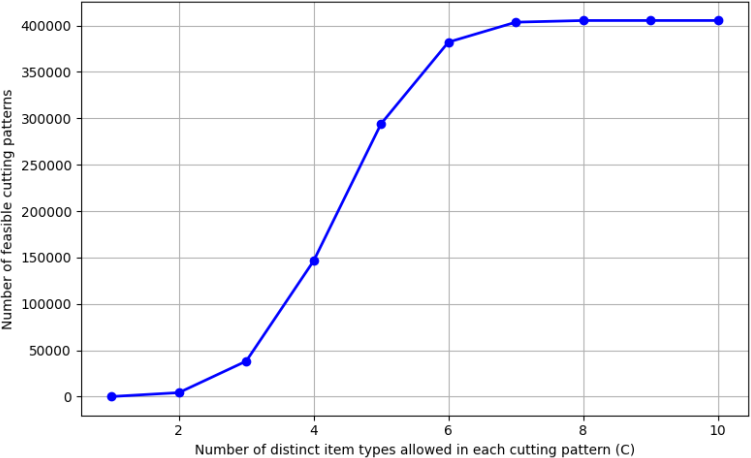
The reduction in the number of cutting patterns is essential, as complete enumeration becomes intractable for instances with many item types or when item sizes are small relative to the object size. For example, the first instance of Class 1, generated using the CUTGEN1 generator Gau & Wäscher (1995), contains 405,384 feasible patterns, a number that quickly becomes prohibitive. Instances in Classes 5 and 6, generated using the CUTGEN1 generator, are even more challenging, as they feature four times as many item types.
Our proposed pattern screening criterion thus drastically reduces the number of feasible patterns for small C. In Figure 3 we illustrate the reduction for the first instance of Class 1, (which has 10 distinct item types) generated using the CUTGEN1 generator, displaying the number of patterns obtained for different values of C.

5 METHODOLOGICAL SETUP FOR BASELINE AND MATHEURISTIC COMPARISONS
In this section, we present the methodological framework adopted for both the baseline model and the proposed matheuristic approach. We describe the mathematical formulations used in the computational experiments, discuss the modeling choices, and detail the procedures for generating cutting patterns and arcs (used in the baseline arc-flow model).
To solve the CSP, we adopt the formulation proposed by Gilmore & Gomory (1961) (Equations (1a)-(1c)). This formulation is particularly suitable for our matheuristic approach, as it relies on a priori generation of cutting patterns and allows the incorporation of the filtering criterion directly reducing the number of variables of the model.
For the baseline CSP, i.e., the complete model without filtering, we employ the arc-flow formulation proposed by Valério de Carvalho (1999). The MOSP is solved using the ILP-I model from Martin et al. (2022a) in all experiments. All computational experiments are conducted under a time limit of 60 seconds for each solver run. If the time limit is reached, the best solution found is reported.
Although a time limit of 60 seconds is imposed in all experiments, the solutions obtained by the baseline CSP model were systematically compared against the benchmark results reported in Araujo et al. (2014) and in Cui et al. (2015) order to verify their optimality. This comparison shows that the baseline model consistently attains proven optimal solutions for essentially all benchmark instances.
More precisely, among the 1800 CUTGEN1 instances, only a single instance from Class 6 was not solved to proven optimality within the prescribed limit. Even in this case, the obtained average value was 424.69, whereas the best-known optimal average reported in Araujo et al. (2014) and in Cui et al. (2015) is 424.68, corresponding to a negligible deviation of only 0.01 objects.
Therefore, the baseline solutions can be regarded as effectively optimal throughout the benchmark set, ensuring that the proposed matheuristic methods are compared against highly reliable reference solutions. Consequently, the reported results provide a meaningful assessment of the proximity of the heuristic solutions to optimality.
Moreover, for the randomly generated instances, the time limit was never reached during the solution of the CSP. Hence, all baseline solutions obtained for these instances are proven optimal.
During the comparison with the benchmark values reported in Araujo et al. (2014), a small number of discrepancies were identified in the published benchmark tables. Among the 1800 instances considered, three values were affected, corresponding to the reported mean values of classes 9, 17, and 18. The originally reported values (93.81, 222.76, and 2221.56) were later confirmed to contain typographical inaccuracies and should be corrected to 93.65, 224.85, and 2242.59, respectively. These corrections were kindly confirmed by the original authors through personal communication and have been adopted consistently throughout this study.
In the proposed matheuristic, we consider the screening parameter values C∈{2, 3}. These values were selected based on preliminary experiments indicating that increasing C leads to a rapid growth in the number of feasible cutting patterns, which significantly increases the computational effort.
At the same time, larger values of C tend to reduce the effectiveness of the screening criterion in decreasing the number of simultaneously open stacks. In this sense, values of C greater than 3 provide limited additional benefits while incurring higher computational costs. On the other hand, C=2 and C=3 were found to offer the most relevant trade-offs, with C=2 yielding stronger reductions in the number of open stacks and C=3 providing more stable solutions with a limited impact on material usage.
The remainder of this section is organized as follows. In Section 5.1, we discuss the reduction criteria applied to arcs and cutting patterns. In Section 5.2 we present the cutting pattern generation procedure. Finally, in Section 5.3 we describe the arc generation process used in the baseline model.
5.1 Reduction criteria
In this work, we employ two reduction criteria to improve the computational performance of the proposed models. The goal is to reduce the size of the solution space, either by limiting the number of arcs in the arc-flow formulation or by eliminating dominated cutting patterns in the matheuristic approach.
The first criterion is demand-based. It requires that any feasible cutting pattern satisfy
where d i denotes the demand of item type i.
The second criterion is length-based. It requires that the total length of the items included in a pattern satisfy
where η=mini∈I ℓi . The rationale is that any pattern leaving a waste larger than the shortest item length can be improved by adding units of that item.
These two criteria are commonly used in the CSP literature. The demand-based criterion is adopted, for instance, in Valério de Carvalho (1999) and Delorme & Iori (2020), while the length-based criterion is used in the definition of feasible cutting patterns in Aliano Filho et al. (2018).
As shown in Guimarães & Poldi (2026), these two criteria cannot be applied simultaneously in their original form. The criterion proposed in Guimarães & Poldi (2026) reconciles them by allowing overproduction of the item type with the smallest length. Let
denote such an item. Then, the criterion permits to exceed d s , while still enforcing for all i∈I\{s}. Therefore, if a pattern violates the length condition, one can increase until
holds, without violating the remaining demand constraints.
However, this argument does not extend directly when each cutting pattern is restricted to contain at most C distinct item types, that is,
Under this additional constraint, adding units of the shortest item may require introducing a new item type, which may violate the cardinality bound.
To account for this restriction, Guimarães & Poldi (2023) propose the following dominance rule. Consider two patterns
that produce the same set of item types. If for all i∈I, then pattern can be removed without affecting optimality.
This dominance rule is equivalent to requiring that any non-dominated pattern has waste strictly smaller than the length of the smallest item produced in the pattern. Otherwise, the pattern can be substituted by another cutting pattern, increasing the multiplicity of an existing item without introducing new item types, thereby yielding a dominating pattern.
In the baseline model, we apply the demand-based and length-based criteria, incorporating the adaptations proposed in Guimarães & Poldi (2026). In the matheuristic approach, we addition-ally enforce a restriction on the maximum number of distinct item types per pattern. Thus, the matheuristic combines the demand-based and length-based criteria with a cardinality constraint, taking into account the necessary adaptations for their joint implementation. The reduction criteria implementation within the cutting pattern generation and arc-flow construction is presented in Sections 5.2 and 5.3, respectively.
5.2 Cutting pattern generation
We generate the set of cutting patterns used in the computational experiments via a recursive enumeration procedure, adapted to incorporate the reduction criteria described in Section 5.1.
The generation process is applied over all subsets of item types of cardinality exactly C, obtained by considering all combinations of C items from the set of M item types. For each subset, cutting patterns are constructed recursively by attempting to add items one at a time, ensuring that the accumulated length does not exceed L. During this process, a temporary vector is maintained to track the multiplicity of each item in the current partial pattern.
Whenever no additional item from the current subset can be inserted without violating the capacity constraint, the current partial pattern becomes a candidate to be included in the pool of feasible cutting patterns.
A candidate pattern is included in the pool of feasible cutting patterns only if the reduction criteria described in Section 5.1 are met. That is, the number of items of each type i does not exceed the corresponding demand d i , except for the item type with smallest length within the subset under consideration. More precisely, for each subset, we define
where S denotes the current subset of item types. For this item type, overproduction is allowed, while for all other item types the demand constraints must be respected.
Furthermore, a cutting pattern is accepted only if its total utilized length satisfies
where ℓmin denotes the smallest item length within the subset being considered.
Moreover, the cutting patterns are stored in a set structure to avoid duplication. The complete pattern-generation procedure is implemented in the experimental framework and is available in the Supplementary Material at: https://github.com/ggazzinelli/empirical-study-on-one-dimensional-cutting-stock-problem.
5.3 Arcs generation
The arc-flow graph used in the baseline model is generated following the procedure proposed in Delorme & Iori (2020), with the adaptations required by the reduction criteria described in Section 5.1. The graph is built by iteratively exploring the reachability of nodes representing used object length. For each item type, we identify the reachable nodes from which an additional copy of that item can be placed without exceeding the object length L. Whenever such a placement is possible, we create an item arc linking the corresponding tail and head nodes.
To incorporate the demand-based criterion, we limit the production of each item type to a maximum of units during the graph construction. Specifically, we define
where s=argmini∈I ℓi denotes the item type with the smallest length.
Thus, for each item type i, the arc-generation procedure allows at most units of the item of type i to be produced along any path in the graph. This construction ensures that the demand constraints are respected for all item types except the smallest one, for which overproduction is allowed, in accordance with the adapted criterion of Guimarães & Poldi (2026).
Loss arcs are then added between consecutive reachable nodes. In order to enforce the length-based criterion, we generate loss arcs only from nodes v such that
where ℓmin=mini∈I ℓi . This restriction ensures that loss arcs are created only when the remaining unused length is smaller than the shortest item length, which is consistent with the criterion that patterns with larger waste should not be retained.
The complete arc-generation procedure is implemented in the baseline version of the graph construction and is available in the Supplementary Material at: https://github.com/ggazzinelli/empirical-study-on-one-dimensional-cutting-stock-problem.
6 COMPUTATIONAL EXPERIMENTS
This section presents the computational evaluation of the proposed cutting pattern screening criterion within a sequential approach that first minimizes the number of objects used and subsequently minimizes the maximum number of simultaneously open stacks. The methodology follows a two-phase process. In the first phase, the CSP is solved to determine the set of cutting patterns K and their multiplicities ζk for k∈K. In the second phase, the MOSP is solved to determine the optimal execution sequence σ of these patterns.
All experiments were performed on a Dell Precision 3591 workstation featuring an Intel Core Ultra 9 185H processor (2.3 GHz) and 64 GB of RAM, operating under Microsoft Windows 11 Pro (64-bit). The algorithms were developed in Julia 1.11.5, using the JuMP modeling framework, and the corresponding optimization models were solved with Gurobi Optimizer version 12.0.3 under default parameter settings. A fixed random seed (982451653) was used to generate the random instances.
This section is organized as follows. In Section 6.2, we introduce the notation and performance metrics. The results for the CUTGEN1 dataset are presented in Section 6.3. Section 6.4 reports the results for the randomly generated instances, while Section 6.5 focuses on instances with very low demand. Finally, Section 6.6 provides a discussion of the results.
6.1 Detailed presentation of the benchmark instances
For the computational experiments, we consider three sets of instances. All classes across all instance sets assume a fixed object length of L=1000. The first set is composed of 1,800 benchmark instances generated by the CSP instance generator described in Gau & Wäscher (1995). These instances are organized into 18 classes, each characterized by three parameters: (i) the interval for item lengths , (ii) the average demand per item type , and (iii) the number of distinct item types . With parameter variations structured as follows:
The second set of instances was randomly generated to address a broader range of parameters, where we consider four intervals to generate the item types length and three demand levels.
Item Length Intervals (Category A)
Demand Levels (Category B)
Generated instances were then obtained by combining the size intervals (Category A) with the demand levels (Category B) in various configurations, as described next.
1. Single length interval and single demand value
Classes 1-12 consist of single-class instances. Each class is uniquely defined by the configuration pair (A i -B j ), with size category index i∈{1, ..., 4} and demand regime index j∈{1, 2, 3}. All instances in these classes contain 10 distinct item types, where each item type is generated within the length interval A i , and its corresponding demand follows regime B j . The complete combinatorial set of these classes is systematically enumerated in Table 3.
2. Two length intervals and demand values
Classes 13-66 represent double-class instances combining pairs of distinct size categories (A i1, A i2 ) with independent demand regimes (B j1, B j2 ), where i 1, i 2∈{1, ..., 4} (i 1≠i 2) and j 1, j 2∈{1, 2, 3} (j 1≠j 2). Each instance contains 10 item types equally divided between the two size classes: 5 types generated from A i1 with demands following B j1, and 5 types from A i2 with demands following B j2 . In Table 4, all 36 configurations generated are enumerated.
3. Three length intervals and demand values
Classes 67-174 encompass all triple-category combinations, systematically pairing distinct size triplets (A i1 , A i2 , A i3 ) with independent demand regimes (B j1 , B j2 , B j3 ), where i 1, i 2, i 3∈{1, ..., 4} are distinct size indices and j 1, j 2, j 3∈{1, 2, 3} represent unique demand levels. In each instance of these classes 12 item types (4 per size category) with demands following their respective regime were considered. The combinatorial variants are detailed in Table 5.
The last set of instances addresses cases of very low demand. It consists of 30 classes, each containing 10 instances. All instances have 10 distinct item types. The classes are organized into three groups according to their item length intervals: Classes 1-10, 11-20, and 21-30. Within each group, the item lengths are drawn from a fixed interval, while the demand values are randomly generated from the integer interval [1, K], where K varies from 1 to 10 across the classes. For each class c, the demand interval and item length interval are defined as follows:
-
Class 1-10 (c=1, ..., 10):
-
- Let K=c. Demand for each item type is sampled uniformly from the integer interval [1, K].
-
- Item lengths are sampled uniformly from the real interval [0.1 L, 0.25 L].
-
Class 11-20 (c=11, ..., 20):
-
- Let K=c-10. Demand for each item type is sampled uniformly from [1, K].
-
- Item lengths are sampled uniformly from [0.15 L, 0.30 L].
-
Class 21-30 (c=21, ..., 30):
-
- Let K=c-20. Demand for each item type is sampled uniformly from [1, K].
-
- Item lengths are sampled uniformly from [0.20 L, 0.35 L].
6.2 Notation and performance metrics
The computational experiments assess the impact of the screening criterion on both material usage and the maximum number of open stacks, on comparison to the baseline approach, in which no restriction is imposed. For the heuristic approach we consider the screening parameter equal to C=2 and C=3.
All reported performance metrics are computed as averages over the set of instances within each class. Accordingly, let F M , S M , and T M denote, respectively, the average number of objects, the average number of open stacks, and the average computational time (in seconds) obtained by the baseline approach over all instances in a given class. Similarly, let F C , S C , and T C denote the corresponding average values when the screening criterion is applied with parameter C∈{2, 3}.
The relative discrepancy in the number of objects for the CSP is measured as
For the MOSP, the percentage reduction in the number of open stacks is computed as
In addition, we report absolute differences with respect to the baseline approach. The deviations regarding the number of objects used and the maximum number of open stacks are given by:
For each class of instances, we report summary statistics of these deviations, including the mean value , the maximum value , and the standard deviation .
6.3 Computational experiments for the CUTGEN1 instances
The computational results for the CUTGEN1 benchmark instances are summarized in three complementary tables, each designed to highlight a different aspect of the performance of the proposed screening criterion. In Table 6 we report the overall solution quality, the number of open stacks, and the computational time for the baseline method and for the matheuristic approaches with C=2 and C=3. To better assess the practical impact of the matheuristic, in Table 7 we present the corresponding percentage trade-offs in the number of objects and the maximum number of simultaneously open stacks. Finally, in Table 8 we report descriptive statistics of the absolute gaps in both objects and stacks, including the mean, maximum, and standard deviation for each class.
Results of the cutting pattern screening criterion for C=2 and C=3 on the instances generated via the CUTGEN1 generator, across the 18 classes.
Relative variations (in percentage) of the CSP and MOSP performance measures with respect to the baseline approach for each instance class. The columns report the relative change in the number of objects (∆F C ) and in the number of open stacks (∆S C ) obtained with the screening criterion for C=2 and C=3.
Summary of the performance for each class, reporting descriptive statistics of the absolute deviations from the baseline approach (see Section 6.2).
Table 6 is organized as follows. The first column indicates the class, where each of the 18 classes generated by the CUTGEN1 generator is denoted by CUTGEN1-i, with i representing the class index.
The remaining columns report the performance measures defined in Section 6.2. Columns 2-4 present the average number of objects (F M ), the average number of open stacks (S M ), and the average computational time in seconds (T M ) obtained by the baseline approach.
Columns 5-7 report the corresponding metrics for the matheuristic approach with C=2, namely F 2, S 2, and T 2. Similarly, Columns 8-10 present the results for C=3, denoted by F 3, S 3, and T 3.
The optimal objective function values for the CUTGEN1 instance classes reported in Araujo et al. (2014), together with the lower bounds presented in Cui et al. (2015), were used to validate our computational experiments. Based on these reference results, we can affirm that the baseline method consistently attains optimal or near-optimal solutions under the imposed time limit.
In particular, optimal solutions are obtained for all instances except those in Class 6. For this class, the average number of objects used is 424.69, whereas the reported optimal value is 424.68, yielding only a small optimality gap.
Regarding computational performance, the matheuristic approach have a lower average run time, particularly for C=2. For C=2, the matheuristic is outperformed by the baseline only for Class 6.
For C=3, the computational times increase, as expected, due to the larger number of feasible cutting patterns that must be considered. Consequently, the average runtime becomes higher than that of the baseline. Nevertheless, the matheuristic remains computationally more efficient for the majority of instances, with exceptions restricted to Classes 5, 6, and 17.
Additionally, Table 6 highlights a substantial reduction in the maximum number of simultaneously open stacks achieved by the proposed screening criterion. This effect is particularly pronounced for C=2, where the number of open stacks is drastically reduced across nearly all classes, often by more than half when compared to the baseline. For C=3, although the reduction is less pronounced, it remains significant.
In Table 7, we report the relative variations, in percentage terms, of both performance measures, providing a clearer view of the trade-offs induced by the proposed screening criterion across all instance classes. The columns correspond to the relative variations in the number of objects and open stacks, namely ∆F 2, ∆S 2, ∆F 3, and ∆S 3, as defined in Section 6.2.
The results presented in Table 7 clearly indicate that the proposed approach achieves a favorable trade-off between the number of objects used and the maximum number of simultaneously open stacks.
For C=2, the increase in the number of objects remains consistently small across all classes, ranging from 0.01% to 1.31%. In contrast, the reduction in the number of open stacks is substantial, varying from 4.78% up to 82.83%. In particular, the most significant improvements are observed in Classes 1-6, where stack reductions frequently exceed 60%, reaching over 80% in Class 5. Even in the least favorable cases (Classes 13 and 14), the method still achieves non-negligible reductions in stack usage.
For C=3, the trade-off becomes even more favorable in terms of solution quality, with a very small increase in the number of objects (at most 0.09%, and equal to zero in most classes). At the same time, the number of open stacks is reduced in the vast majority of cases, with reductions reaching up to 55.73%. Although the improvements are generally less pronounced than for C=2, they remain significant for several classes, particularly those with smaller item sizes.
It is worth noting that, for C=3, a slight increase in the number of open stacks is observed in a small number of classes (namely Classes 16 and 18), with maximum increases of 0.73% and 2.15%, respectively.
Lastly, in Table 8 we present a detailed summary of the performance for each class by reporting descriptive statistics of the absolute deviations with respect to the baseline approach, as defined in Section 6.2.
For each class of instances and for each value of C∈{2, 3}, the table reports three statistics for both performance measures. Specifically, , , and denote, respectively, the mean, the maximum, and the standard deviation of the deviations in the number of objects, where . Similarly, , , and denote the corresponding statistics for the deviations in the number of open stacks, where .
All statistics are computed over the set of instances within each class, allowing a detailed assessment of the average impact, variability, and worst-case behavior of the proposed screening criterion.
The results reported in Table 8 provide additional insights into the behavior and variability of the proposed methods. Overall, the average reduction in the maximum number of simultaneously open stacks is consistently higher than the corresponding increase in the number of objects. However, the variability in object usage, as measured by the standard deviation, is generally higher than that observed for stacks. This indicates that, although the average impact on the number of objects is small, there exist specific instances where the increase can be more pronounced. This effect is particularly evident for C=2. While the mean gaps in the number of objects remain relatively small across all classes, the maximum values and standard deviations reveal the presence of outliers. For example, in Class 12, an instance requires up to 42 additional objects compared to the baseline.
In contrast, for C=3, the method exhibits a much more stable behavior. The increase in the number of objects is small, never exceeding one unit across all instances and classes. At the same time, meaningful reductions in the number of stacks are still achieved, with improvements of up to 19 stacks. This demonstrates that C=3 provides a more conservative alternative, delivering consistent reductions in the maximum number of simultaneously open stacks with smaller impact on object usage.
6.4 Computational experiments for the broader parameter variations on random instances
To further assess the performance of the cutting pattern screening criterion, we conducted extensive experiments with broader parameter variations using the 174 instance classes described in Section 6.1. The computational results for the random instances are summarized in a set of tables following the same rationale adopted for the CUTGEN1 benchmark. However, due to the larger number of instance classes (174), the results are presented in a more aggregated form.
We present the results in two tables. Table 9 is analogous to Table 6, reporting the overall solution quality, the number of open stacks, and the computational time for the baseline method and for the matheuristic approaches with C=2 and C=3.
Results of the cutting pattern screening criterion for C=2 and C=3 on the randomly generated instances, across the 174 classes.
Table 10 provides a consolidated view of the trade-offs induced by the screening criterion. In particular, it reports both the relative variations, in percentage terms, and the descriptive statistics of the absolute deviations with respect to the baseline approach, as defined in Section 6.2.
Consolidated view of the trade-offs induced by the screening criterion. For each value of C∈{2, 3}, the table reports the relative variations ∆F C and ∆S C (in percentage terms), representing the changes in the number of objects and open stacks, respectively, as well as descriptive statistics of the absolute deviations from the baseline approach (see Section 6.2). In particular, the mean , maximum , and standard deviation are presented for each aggregated group of instances.
More precisely, for each value of C∈{2, 3}, the table includes the relative variations ∆F C and ∆S C , capturing the percentage changes in the number of objects and open stacks, respectively, similarly to Table 7.
In addition, it reports summary statistics of the absolute deviations, namely the mean , the maximum , and the standard deviation , computed over all instances within each aggregated group, similarly to Table 8. Finally, in both tables, the symbol ≈ is used to indicate values smaller than 0.01.
Tables 9 and 10 are presented as follows.
In terms of computational performance, the matheuristic approach remains more efficient than the baseline, exhibiting lower average runtimes for both C=2 and C=3. This indicates that, even under broader parameter variations, the screening criterion performance remains adequate.
Regarding solution quality, the increase in the number of objects remains very limited. On average, the baseline approach yields 1359.38 objects, compared to 1365.96 for C=2 and 1359.57 for C=3, confirming that the impact of the screening criterion on material usage is small.
On the other hand, the reduction in the number of open stacks remains significant. The average number of stacks decreases from 4.02 in the baseline to 2.60 for C=2 and 3.61 for C=3, demonstrating that the proposed criterion is effective in improving MOSP performance while preserving object usage efficiency.
These results reinforce the conclusions drawn from the CUTGEN1 instances, highlighting the favorable trade-off between material consumption and the maximum number of simultaneously open stacks achieved by the screening criterion implementation.
The results presented in Table 10 are consistent with those obtained for the CUTGEN1 instances. In particular, the reduction in the number of open stacks (∆S 2 and ∆S 3), in percentage terms, is again more pronounced than the corresponding increase in the number of objects (∆F 2 and ∆F 3), for both C=2 and C=3.
However, a more detailed analysis reveals important differences between the two instance sets. For C=2, the variability in the number of objects is considerably higher, as indicated by the standard deviation . In particular, while the average increase is relatively moderate (6.58 objects), some instances exhibit a substantial deterioration, with increases of up to 105 objects. Once again, indicating that the use of C=2 may lead to significant losses in solution quality for certain instances.
In contrast, the results for C=3 are considerably more stable. The maximum increase in the number of objects is limited to 14, with an average increase of only 0.36, indicating a much more controlled impact on material usage.
Regarding the MOSP performance, the matheuristic achieve meaningful reductions in the maximum number of open stacks for both C=2 and C=3. For C=2, the average reduction reaches -29.97%, corresponding to a decrease of 1.36 stacks, whereas for C=3 the reduction is -8.30%, corresponding to 0.40 stacks on average.
Overall, these results suggest that C=2 should be used with caution, as it may lead to significant increases in the number of objects in certain cases. Its use is therefore recommended primarily in applications where a substantial reduction in the maximum number of simultaneously open stacks is required. On the other hand, C=3 provides a more balanced trade-off between material consumption and reduction in the maximum number of simultaneously open stacks.
6.5 Computational experiments for the random instances with very low demand
A theoretical upper bound on the material usage can be constructed in the following manner. Since the material waste per object must be equal to or lower than max{ℓ1, ..., ℓI }, as greater waste would permit additional item production through improved cutting patterns (Pitombeira-Neto & de Athayde Prata, 2020), an upper bound for optimal CSP solutions is given by
Defining M as the number of distinct item types and considering our screening criterion, where the minimum object count becomes ⌈M/C⌉, we derive a lower bound on the difference in the number of objects used when applying versus not applying the cutting pattern screening criterion, which is particularly useful for low-demand instances.
This bound suggests that lower values of C, lower demand levels, and smaller item lengths are associated with larger differences in the number of objects used with and without the cutting pattern screening criterion.
To address this, we conducted experiments on the 30 very low demand instance classes described in Section 6.1, with demands sampled from the interval [1, Q] for Q=1, 2, ..., 10.
In Figure 4 we report the average material discrepancy, measured by ∆F C as previously defined, as a function of the maximum demand parameter Q, considering the application of the screening criterion with C=2.

Average material usage discrepancy as a function of the demand interval parameter Q, where instance demands are sampled randomly from [1, Q], considering the proposed screening criterion with C=2.
In Figure 4 we illustrate the performance of the criterion with C=2 across different item length categories. For small items, the average material discrepancy is 52.20% when Q≤5, declining sharply to 2.64% for Q>5. In the case of medium items, the average discrepancy is 32.74% for Q≤3, declining to 3.80% for Q>3. For large items, the average discrepancy is 36.08% when Q≤2, declining to 2.38% for Q>2. In Figure 5 the discrepancy as a function of the maximum demand value over the interval [1, Q] is displayed when the criterion is applied with C=3.

Average material usage discrepancy as a function of the demand interval parameter Q, where instance demands are sampled randomly from [1, Q], considering the proposed screening criterion with C=3.
For C=3, enhanced performance across various item types is observed in Figure 5. For small items, the material discrepancy is 100.00% when Q=1, decreases to 29.03% at Q=2, and further reduces to 4.76% and 4.00% for Q=3 and Q=4, respectively; optimal solutions (0% discrepancy) are achieved for Q≥5. For medium items, a discrepancy of 33.33% is observed at Q=1, with optimal solutions obtained for Q=2, while small residual discrepancies may occur for larger values of Q. In the case of large items, a discrepancy of 29.03% is observed at Q=1, with optimal solutions consistently achieved for Q≥2.
These findings reveal two significant trends. First, increasing C substantially reduces material discrepancy, particularly for smaller items. Second, longer item lengths naturally mitigate the restrictive impact of the criterion, even when demand levels are low.
The reliability of the criterion follows a sliding scale, where acceptable demand thresholds are inversely correlated with item size, expressed as ℓ/L, and the parameter C. This suggests that demand requirements scale proportionally, with smaller items necessitating higher thresholds.
Although no universal Q threshold exists, practical insights emerge. Specifically, considering the intervals used to generate item lengths, when C=2, selecting Q>5 ensures a discrepancy below 3%, while increasing C to 3 eliminates discrepancies entirely for small and large items, and leads to only minor fluctuations for medium-sized items, which never exceed 2% for the tested values of Q. Consequently, operational safety becomes adaptive, governed by relative item sizes and algorithm parameters, rather than dictated by rigid rules, emphasizing the importance of context-dependent calibration over fixed thresholds.
6.6 Discussion of Results and Practical Implications
Our computational experiments indicate that the proposed cutting pattern screening criterion achieves balance between material efficiency and operational complexity. The impact on material usage is small and tends to vanish when item lengths are sufficiently large relative to the object length, as geometric constraints naturally limit the proliferation of cutting patterns.
Considering the CUTGEN1 instances, the average discrepancies in material usage are very small, amounting to only 0.28% and 0.01% for C=2 and C=3, respectively.
The effectiveness of the screening criterion is further validated by the results obtained for the randomly generated instances, where the maximum observed average discrepancies remain limited to 0.64% for C=2 and 0.02% for C=3. A key observation is the clear performance difference between the two parameter settings, with C=3 consistently yielding significantly smaller average discrepancies.
On the other hand, the reduction in the maximum number of simultaneously open stacks is substantially more pronounced. For the CUTGEN1 instances, the reductions reach -39.23% and -18.37% for C=2 and C=3, respectively, while for the random instances the reductions are -29.97% and -8.30%, respectively.
Regarding the limitations of the screening criterion, although it performs robustly across most parameter combinations, rare edge cases still persist, even under moderate demand, with increases of up to 105 objects. This indicates potential avenues for further algorithmic refinement. Moreover, for instances with very small demand (i.e., less than or equal to five items per type), the results suggest that the criterion may lead to a significant increase in the number of objects used.
Our results demonstrate that the cutting pattern screening criterion achieves a significant reduction in the maximum number of simultaneously open stacks (MOSP) while incurring only negligible increases in material usage for most instances. This trade-off is particularly pronounced in instances with shorter item lengths, where the criterion achieves the highest reductions in operational complexity.
These findings highlight the practical value of integrating the screening criterion into sequential approaches that combine the Cutting Stock Problem (CSP) and MOSP. By effectively decoupling the optimization of material usage from operational constraints, the criterion enables substantial improvements in MOSP solutions without compromising the quality of CSP results. This dual-benefit approach is especially promising for industrial applications where both material efficiency and production-floor complexity are critical considerations.
Interestingly, the proposed matheuristic also provides a theoretical lower bound for the Cutting Stock Problem with a Limited Number of Open Stacks (CS-LOSP). As discussed in Section 4, the minimum number of objects required for the restricted CSP, denoted F CSP(C), satisfies F CSP(C)≤F CS-LOSP(C), where F CS-LOSP(C) represents the CS-LOSP solution value considering that at most C stacks are opened during the execution of the cutting patterns. This inequality ensures that solutions derived from our matheuristic serve as valid lower bounds for CS-LOSP instances, enhancing their utility in benchmarking and exact solution methodologies.
These results are also aligned with industrial practice, since companies dealing with one-dimensional cutting problems often prefer to use simple cutting patterns containing only a few distinct item types. The results obtained in this work provide additional support for this strategy, indicating that restricting the number of distinct item types on the cutting patterns can simplify operational complexity while causing only small losses in material efficiency.
Importantly, this operational improvement is achieved without significantly impacting material efficiency. Our matheuristic maintains near-optimal CSP solutions while dramatically reducing the maximum number of simultaneously open stacks. This substantial reduction in open stacks is crucial in industrial settings, where available space is limited and production logistics must be streamlined. The dual benefit of preserving solution quality while easing operational constraints makes the proposed method an attractive strategy for industries focused on lean operations and optimized resource utilization.
7 FINAL REMARKS AND PATHS FOR FUTURE RESEARCH
In this research, we develop a matheuristic for the one-dimensional Cutting Stock Problem (CSP) that discards cutting patterns generating more than C distinct item types, integrated with the model proposed in Gilmore & Gomory (1961). Our findings demonstrate that this approach effectively preserves near-optimal material usage while drastically reducing both the cardinality of the feasible pattern set and the maximum number of simultaneously open stacks (MOSP).
Future research may extend this methodology to other variants of the Cutting Stock Problem (CSP), exploring its adaptability and performance in more complex or constrained settings. Another promising direction lies in a systematic investigation of the matheuristic’s role as a lower bound for CS-LOSP. In particular, empirical studies could quantify the tightness and reliability of this bound across a wide range of instance classes. Additionally, a critical complementary research effort would involve establishing theoretical guarantees for the parameter C that ensure the optimality of the CSP solution. This is especially relevant in edge cases characterized by high demand variability or heterogeneous item-size distributions, where the matheuristic’s effectiveness may be more difficult to predict.
Acknowledgements
The authors are grateful to the two anonymous reviewers for their valuable comments and suggestions of revisions.
Data Availability
The data that support the findings of this study will be made available upon reasonable request.
References
- ARAUJO SA, POLDI KC & SMITH J. 2014. A genetic algorithm for the one-dimensional cutting stock problem with setups. Pesquisa Operacional, 34(2): 165-87.
- ALIANO FILHO A, MORETTI AC & PATO MV. 2018. A comparative study of exact methods for the bi-objective integer one-dimensional cutting stock problem. Journal of the Operational Research Society, 69(1): 91-107.
- ARBIB C, MARINELLI F & VENTURA P. 2016. One-dimensional cutting stock with a limited number of open stacks: bounds and solutions from a new integer linear programming model. International Transactions in Operational Research, 23: 47-63.
- ASHIKAGA FM & SOMA NY. 2009. A heuristic for the minimization of open stacks problem. Pesquisa Operacional, 29: 439-450.
-
BAPTISTE P. 2005. Simple MIP formulations to minimize the maximum number of open stacks. In: SMITH BM & GENT IP (Eds.), Constraint Modelling Challenge 2005, IJCAI 2005. pp. 9-13. Available at: https://ipg.host.cs.st-andrews.ac.uk/challenge/
» https://ipg.host.cs.st-andrews.ac.uk/challenge/ - CAMBAZARD H & O’SULLIVAN B. 2010. Propagating the Bin Packing Constraint Using Linear Programming. In: Principles and Practice of Constraint Programming - CP 2010. pp. 129-136. Berlin, Heidelberg: Springer Berlin Heidelberg.
- CERQUEIRA GR, AGUIAR SS & MARQUES M. 2021. Modified Greedy Heuristic for the one-dimensional cutting stock problem. Journal of Combinatorial Optimization, 42(3): 657-674.
- CUI Y, ZHONG C & YAO Y. 2015. Pattern-set generation algorithm for the one-dimensional cutting stock problem with setup cost. European Journal of Operational Research, 243: 540-546.
- CÔTÉ JF & IORI M. 2018. The Meet-in-the-Middle Principle for Cutting and Packing Problems. INFORMS Journal on Computing, 30: 646-661.
- DE CARVALHO J. 1998. Exact solution of cutting stock problems using column generation and branch-and-Bound. Paper presented at the 14th Triennial Conference of Operational Research Societies, Vancouver. International Transactions in Operational Research, 5(1): 35-44.
- DE GIOVANNI L, MASSI G & PEZZELLA F. 2013. An adaptive genetic algorithm for large-size open stack problems. International Journal of Production Research, 51(3): 682-697.
- DE LIMA VL, IORI M & MIYAZAWA FK. 2023. Exact solution of network flow models with strong relaxations. Mathematical Programming, 197: 813-846.
- DEGRAEVE Z & SCHRAGE L. 1999. Optimal integer solutions to industrial cutting stock problems. INFORMS Journal on Computing, 11(4): 406-419.
- DELORME M & IORI M. 2020. Enhanced Pseudo-polynomial Formulations for Bin Packing and Cutting Stock Problems. INFORMS Journal on Computing, 32: 101-119.
- DELORME M, IORI M & MARTELLO S. 2016. Bin packing and cutting stock problems: Mathematical models and exact algorithms. European Journal of Operational Research, 255(1): 1-20.
-
DELORME M & VANDERBECK F. 2007. Revisiting the integer round-up property for the one-dimensional cutting stock problem. Operations Research Letters, 35(1): 29-35. Available at: https://doi.org/10.1016/j.orl.2006.06.001
» https://doi.org/10.1016/j.orl.2006.06.001 - FINK A & VOSS S. 1999. Applications of modern heuristic search methods to pattern sequencing problems. Computers & Operations Research, 26: 17-34.
- FRINHANI RDMD, CARVALHO MAMD & SOMA NY. 2018. A PageRank-based heuristic for the minimization of open stacks problem. Plos one, 13(8): e0203076.
- GAU T & WÄSCHER G. 1995. CUTGEN1: A problem generator for the standard one-dimensional cutting stock problem. European Journal of Operational Research, 84: 572-579.
- GILMORE PC & GOMORY RE. 1961. A linear programming approach to the cutting-stock problem. Operations Research, 9: 849-859.
- GILMORE PC & GOMORY RE. 1963. A linear programming approach to the cutting-stock problem-Part II. Operations Research, 11: 863-888.
- GILMORE PC & GOMORY RE. 1965. Multi-stage cutting stock problems of two and more dimensions. Operations Research, 13: 94-120.
- GOLFETO RR, MORETTI AC & SALLES NETO LL. 2009. A genetic symbiotic algorithm applied to the one-dimensional cutting stock problem. Pesquisa Operacional, 29(2): 365-382.
- GONÇALVES JF, RESENDE MG & COSTA MD. 2016. A biased random-key genetic algorithm for the minimization of open stacks problem. International Transactions in Operational Research, 23(1-2): 25-46.
- GUIMARÃES GG & POLDI KC. 2023. Mathematical models for the cutting stock with limited open stacks problem. RAIRO-Operations Research, 57(4): 2067-2085.
- GUIMARÃES GG & POLDI KC. 2026. Exact approaches for the pattern minimization problem. Computers & Industrial Engineering, 217: 112012.
- GUIMARÃES GG, POLDI KC & MARTIN M. 2025. Mathematical models for the one-dimensional cutting stock problem with setups and open stacks. Journal of Combinatorial Optimization, 49: 43.
-
JAHROMI MH, TAVAKKOLI-MOGHADDAM R, MAKUI A et al. 2012. Solving a one-dimensional cutting stock problem by simulated annealing and tabu search. Journal of Industrial Engineering International, 8: 24. Available at: https://doi.org/10.1186/2251-712X-8-24
» https://doi.org/10.1186/2251-712X-8-24 - KALLRATH J, REBENNACK S, KALLRATH J & KUSCHE R. 2014. Solving real-world cutting stock-problems in the paper industry: Mathematical approaches, experience and challenges. European Journal of Operational Research, 238(1): 374-389.
- KANTOROVICH LV. 1960. Mathematical Methods of Organizing and Planning Production. Management Science, 6: 366-422.
- KIM K, KIM BI & CHO H. 2014. Multiple-choice knapsack-based heuristic algorithm for the two-stage two-dimensional cutting stock problem in the paper industry. International Journal of Production Research, 52(19): 5675-5689.
- LINHARES A & YANASSE HH. 2002. Connections between cutting-pattern sequencing, VLSI design, and flexible machines. Computers & Operations Research, 29(12): 1759-1772.
- LOPES IC & VALERIO DE CARVALHO J. 2010. Minimization of Open Orders Using Interval Graphs. IAENG International Journal of Applied Mathematics, 40.
- MARTIN M, YANASSE HH & PINTO MJ. 2022a. Mathematical models for the minimization of open stacks problem. International Transactions in Operational Research, 29(5): 2944-2967.
- MARTIN M, YANASSE HH, SANTOS MO & MORABITO R. 2022b. Models for two- and three-stage two-dimensional cutting stock problems with a limited number of open stacks. International Journal of Production Research.
- MORABITO R & ARENALES MN. 2000. Optimizing the cutting of stock plates in a furniture company. International Journal of Production Research.
- PITOMBEIRA-NETO AR & DE ATHAYDE PRATA B. 2020. A matheuristic algorithm for the one-dimensional cutting stock and scheduling problem with heterogeneous orders. TOP, 28(1): 178-192.
- POLDI KC & ARENALES MN. 2009. Heuristics for the one-dimensional cutting stock problem with limited multiple stock lengths. Computers & Operations Research, 36(6): 2074-2081.
-
RIETZ J & DEMPE S. 2008. Large gaps in one-dimensional cutting stock problems. Discrete Applied Mathematics, 156(10): 1929-1935. Available at: https://doi.org/10.1016/j.dam.2007.11.028
» https://doi.org/10.1016/j.dam.2007.11.028 - ROODMAN GM. 1986. Near-optimal solutions to one-dimensional cutting stock problems. Computers & Operations Research, 13(6): 713-719.
- SCHAUS P, RÉGIN JC, VAN SCHAEREN R, DULLAERT W & RAA B. 2012. Cardinality Reasoning for Bin-Packing Constraint: Application to a Tank Allocation Problem. In: Principles and Practice of Constraint Programming. pp. 815-822. Berlin, Heidelberg: Springer Berlin Heidelberg.
-
SCHEITHAUER G & TERNO J. 1997. The integer round-up property for one-dimensional cutting stock problems. Operations Research Letters, 20(2): 57-63. Available at: https://doi.org/10.1016/S0167-6377(96)00029-1
» https://doi.org/10.1016/S0167-6377(96)00029-1 - SHAW P. 2004. A Constraint for Bin Packing. In: Principles and Practice of Constraint Programming - CP 2004. pp. 648-662. Berlin, Heidelberg: Springer Berlin Heidelberg.
- VAHRENKAMP R. 1996. Random search in the one-dimensional cutting stock problem. European Journal of Operational Research, 95(1): 191-200.
- VALÉRIO DE CARVALHO JMV. 1999. Exact solution of bin-packing problems using column generation and branch-and-bound. Annals of Operations Research, pp. 629-659.
- VANCE PH. 1998. Branch-and-price algorithms for the one-dimensional cutting stock problem. Computational optimization and applications, 9: 211-228.
- YANASSE HH. 1997. On a pattern sequencing problem to minimize the maximum number of open stacks. European Journal of Operational Research, 100: 454-463.
- YANASSE HH & LAMOSA MJP. 2007. An integrated cutting stock and sequencing problem. European Journal of Operational Research, 183: 1353-1370.
- YANASSE HH & LIMEIRA MS. 2004. Refinements on an enumeration scheme for solving a pattern sequencing problem. International Transactions in Operational Research, 11(3): 277-292.
- YANASSE HH & SENNE ELF. 2010. The minimization of open stacks problem: A review of some properties and their use in pre-processing operations. European Journal of Operational Research, 203(3): 559-567.
- YUEN BJ. 1991. Heuristics for sequencing cutting patterns. European Journal of Operational Research, 55: 183-190.
- YUEN BJ. 1995. Improved heuristics for sequencing cutting patterns. European Journal of Operational Research, 87: 57-64.
-
Declaration on the Use of Artificial Intelligence
The authors declare that generative Artificial Intelligence (AI) tools were used during the preparation of this manuscript in accordance with the journal guidelines. ChatGPT and DeepSeek were employed exclusively to improve the quality of the writing, including grammar correction, sentence restructuring, and enhancement of clarity and readability. These tools assisted in editing and refining portions of the text to improve linguistic quality. No scientific content, results, models, or conclusions were generated by AI. All technical content, analyses, and interpretations were fully developed and verified by the authors. The authors take full responsibility for the content of the manuscript.
-
Funding
This study was financed in part by the São Paulo Research Foundation (FAPESP-Brazil) under grant numbers 2022/05803-3 and 2025/03514-2, and by the National Council for Scientific and Technological Development (CNPq-Brazil) under grant numbers 304144/2019-3, 405702/2021-3, and 302124/2025-0.