 Polypropylene reinforced with hollow glass microspheres: effect of thermal aging and reprocessing
Abstract
The hollow glass microspheres (HGM), exhibit low density, reduced dielectric constant, and good thermal conductivity. This study assessed the mechanical performance of polypropylene (PP) reinforced with HGM under artificial thermal aging conditions. The compositions underwent two rounds of reprocessing in a single-screw extruder, and samples were prepared for both tensile and impact testing. Tensile specimens were subjected to thermal aging at 100 ºC for seven and 21 days. Mechanical tests were carried out on samples before and after aging, while exposed samples underwent visual inspection, optical microscopy, and Fourier transform infrared spectroscopy analysis. Visual inspection and microscopy revealed improved PP-HGM interaction due to the additives, with no deformation or damage from reprocessing. Infrared spectroscopy showed minor degradation in the PP structure post-exposure. In summary, the presence and content of HGM, reprocessing, and aging time significantly affect the mechanical properties (elastic modulus, breaking stress, elongation at break, and impact resistance).
Keywords:
impac test; HGM; mechanical behavior
1. Introduction
Polypropylene (PP), a semi-crystalline thermoplastic polymer similar to polyethylene (PE), is widely used in the plastics industry due to its versatility and processing capacity at temperatures close to 165 ºC. Its advantages include low cost, ease of molding, chemical resistance to solvents, good mechanical and thermal properties, and an excellent electrical insulators[1,2].
PP is essential in the production of plastics and is mainly used in extrusion and injection processes. However, extrusion can cause material degradation after reprocessing cycles[3]. To prevent this degeneration, multiple additives are added to the polymer matrix, improving processing and inhibiting degradation[4].
On the other hand, composites are considered an alternative to the high costs of processes for obtaining polymeric mixtures[5]. It is worth mentioning that the type of filler will directly depend on the desired properties[6]. Therefore, the application of hollow glass microspheres (HGM), which are particles 15 to 65 μm in diameter with thin walls of 0.5 to 1.5 μm containing an inert gas[7], results in unique properties such as low density (0.12 to 0.60 g/cm3), low thermal conductivity, and a reduced dielectric constant. Its presence has minimal impact on composite processing due to the low content applied[8]. HGM have wide applications, from the manufacture of explosives to increase their performance to cement mortars to improve thermal insulation[7].
Bharath et al.[9] evaluated the effect of HGM in HDPE-based composites and verified that the mechanical properties were considerably impacted by HGM, becoming less ductile and more rigid. In a similar vein, Niazi et al.[10] discovered that the mechanical characteristics of HGM/PP composites were influenced by the content as well as the density of HGM fillers. However, Ferreira et al.[7] discovered that the incorporation and content of HGM in hybrid composites with glass fiber based on polyamide 6 (PA6), with mass fraction maintained at 70%, significantly affected the behavior of mechanical properties and impact resistance from 5 wt% HGM.
Understanding the interaction between the polymer matrix and the filler, the degradation mechanisms in the face of environmental and accelerated aging processes are essential for the development of durable materials of satisfactory quality[11]. Accelerated aging tests, which simulate weathering, processing, or service use, are an alternative to avoid high costs. These results allow a better understanding of the material’s stability[12].
Polymeric materials containing HGM could experience a reduction in mechanical properties and lose recyclability due to accelerated aging or repeated reprocessing. Therefore, this study aims to evaluate the mechanical behavior of PP composites reinforced with HGM. The composites were reprocessed in a single-screw extrusion and artificial thermal aging for up to 21 days. The presence and content of HGM, the reprocessing, and exposure time were evaluated using mechanical tensile and impact tests, visual inspection, optical microscopy, and Fourier transform infrared spectroscopy.
2. Materials and Methods
2.1 Materials
Polypropylene (PP) homopolymer H301, produced by Braskem (Camacari, BA, Brazil), was used as a polymer matrix. It has a melt flow index of 10 g/10 min (230°C/2.16kg - ASTM D 1238) and a density of 0.905g/ cm3.
Hollow glass microspheres (HGM) iM16K, produced by 3M Company (Maplewood, MI, USA), were used as aninorganic filler. These have a density of 0.46 g/cm3, an average diameter of 20 µm, and a crush strength of 110 MPa.
Orevac CA 100, manufactured by SK Geo Centric (Seoul, South Korea), is a PP copolymer grafted with maleic anhydride (5-10 wt%) (PP-g-MA), was used as a compatibilizing agent. It has a melting point close to 167 °C, a density is 0.905 g/cm3, melt index is 10 g/10 min (190°C, 0.325 kg, ISO 1133), and a breaking strength (BS) of 22 MPa.
Irganox 1010, produced by Basf (Ludwigshafen am Rhein, Germany), is a phenolic antioxidant, and was used to protect the polymer against thermo-oxidative degradation. This antioxidant has good compatibility, high extraction resistance, and low volatility. Its density is 1.116 g/cm3, and its melting point varies between 113 and 126 °C.
2.2 Preparation of composites
The systems were processed in a single-screw extruder AX Plásticos AX-16 (L/D = 26) with a temperature profile of the three zones (180, 190, and 200ºC) and a screw rotation speed of 50 rpm. The PP matrix and HGM-containing systems were mixed in two cycles in parts per hundred resin (phr) of the systems as listed in Table 1.
2.3 Preparation of the specimen
The systems specimens were injection molded with recommended dimensions for testing (type I ASTM D638[13]) using a Eurostec BL52 (Caxias do Sul, RS, Brazil) injection molding machine. The temperature profile used was 185, 190, 200, and 205 ºC. The mold temperature was set at 25°C and the cooling time was 35 seconds.
2.4. Accelerated aging
The accelerated aging test followed the guidelines of ASTM D3045[14]. Test specimens were hung from the top of a Solab SL-100 (Piracicaba, SP, Brazil) oven and spaced 10 mm apart. The aging duration was divided into two withdrawal cycles of seven and 21 days, respectively, and the exposure temperature was maintained at 100 ºC (± 1 ºC). After each removal from the oven, the samples were placed in desiccators.
2.5 Characterizations of the systems
2.5.1 Fourier transform infrared spectroscopy (FTIR)
FTIR was used to evaluate the chemical reactions occurring in the systems studied before and after accelerated aging, seeking to identify the functional groups present in the systems. The analyses were carried out on a Perkin-Elmer Spectrum 400 IR (Waltham, MA, USA) spectrophotometer, between 4000 and 400 cm-1 and a resolution of 4 cm-1.
2.5.2 Mechanical behavior
The tensile test was carried out on an Instron Emic DL 30000 (Caxias do Sul, RS, Brazil) universal testing machine in accordance with ASTM D638[13] with a load cell of 5KN at room temperature and a crosshead speed of 50 mm/min. At least six specimens were evaluated for each system.
Izod impact tests were performed in accordance with ASTM D256[15] using Instron Ceast Resil 5.5 (Norwood, MA, USA) equipment, operating with a 2.75J hammer at room temperature. The specimens were notched (notch depth = 2.5 mm) before impact. All results reported are a mean of six specimens.
All measurements of mechanical properties were reported as mean ± standard deviation. Analysis of Variance (Anova) was applied considering a significance level of 5% and the means were compared using the Tukey test (p < 0.05) using OriginPro 2024 software (OriginLab, Northampton, MA, USA).
2.5.3 Visual aspect and optical microscopy
Visual inspection was conducted before and after aging to identify surface defects on specimens, including cracks, lack of additive homogeneity, roughness, opacity, and color changes. Images were captured using a digital camera with a maximum resolution of 13 megapixels. In addition, the morphology of the specimens was evaluated using a Leica Microsystems MD500 (Wetzlar, Germany) optical microscope in reflection mode with an ICC50E capture camera and 40x magnification (200µm scale). The fracture region after tensile testing was also assessed.
3. Results and Discussions
3.1 Spectroscopy FTIR
The spectrograms of the PP filled with HGM and reprocessed before and after 21 days of aging are shown in Figure 1. The region between 4000 and 1300 cm-1 corresponds to the functional groups[16]. Generally, few absorption bands appear in this region, which refers to the bond stretching of the main functional groups, such as –OH and C=O[17]. In the region between 1400 and 1600 cm-1, there are the C=O bonds[18]. A slight attenuation of the band is observed, which suggests a slight increase in this binding through aging cycles[19].

FTIR spectrograms of of PP systems filled with HGM and reprocessed: (a) and (b) before, (c) and (d) after 21 days of aging. Legend: “1x” and “2x” correspond to the number of processing.
Syakti et al.[20] noted that PP can be distinguished by peaks at 2951, 2911, and 2844 cm-1. Nevertheless, the FTIR analysis of the surface area of PP did not reveal spectra near 1740 cm-1, typically associated with carbonyl groups. The peak at 1167 cm-1 is identified as the phenolic C=O stretch, while the peak at 1376 cm-1 was assigned to the C–H bending vibration in methylene group's (CH3)[21].
The interface between the polymeric matrix and the HGM is made through the hydroxyl group (–OH), which is on the surface of the microsphere. The bands between 2957 and 2871 cm-1 correspond to the asymmetric and symmetric axial deformation of the hydrogen of the methyl group. The bands at 1800 and 1650 cm-1 refer to the carbonyl group, which could indicate the degradation of PP. A slight inflections could suggest the degradation of the PP[22].
The bands observed between 2970 and 2840 cm-1 correspond to the symmetric and asymmetric stretching vibrations of the aliphatic –CH2 and –CH3 groups, indicative of the organic component of PP. Conversely, the bands identified between 1300 and 880 cm-1 pertain to the inorganic phase of HGM[23,24].
Similarly, the reprocessed samples showed no significant variations, consistent with findings by Hahladakis et al.,[23] who examined the effect of additives on PP processability. FTIR spectrograms confirmed that the chemical structure of PP was preserved, showing no indications of deterioration.
No bands were detected at 1637 and 1720 cm-1, which are attributed to the carbonyl group, in addition to the absence of peaks in the ranges of 1850–1630 (carbonyl), 1680–1620 (alkene) and 908 cm−1 (C=CH, vinyl), indicating the non-occurrence of degradation processes in polypropylene under the conditions analyzed[21].
The PP/HGM systems, aged up to 21 days, present FTIR spectra very similar to the other samples, with no notification of the presence of new peaks. Senatova et al.[25] observed that PP exposed to ultraviolet radiation exhibited signs of degradation only after 1,200 hours (50 days), with the formation of a surface oxide layer that directly impacted its properties.
3.2 Morphological analysis
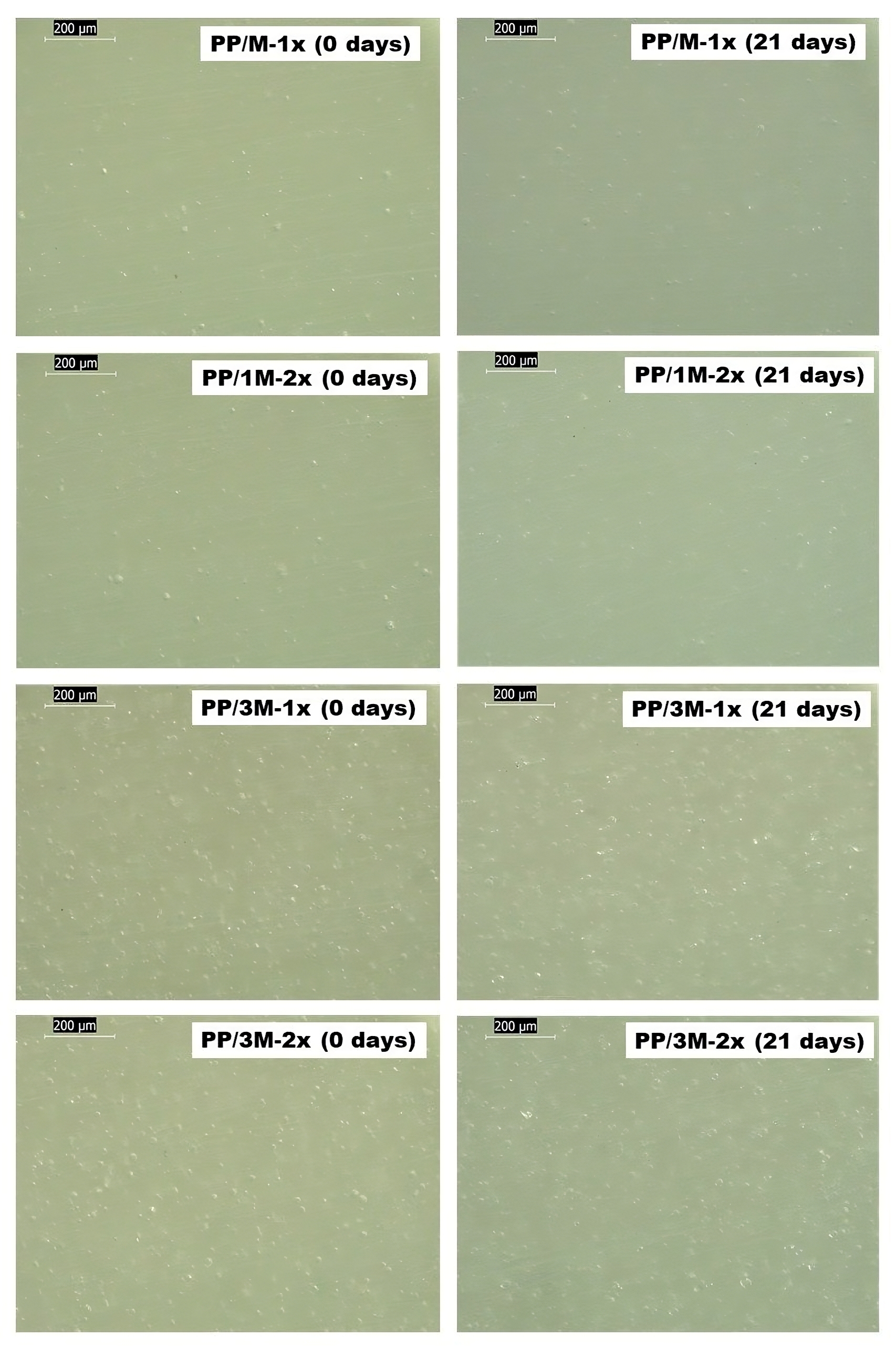
The optical micrographs of the composites recorded at the end of each reprocessing cycle are shown in Figure 2 damage caused to the filler for future correlations with the properties of the systems.

Microscopy of PP systems filled with HGM and reprocessed before and after aging for 21 days. Magnification of 40x (200µm scale). Legend: “1x” and “2x” correspond to the number of processing.
In all systems, the filler was distributed homogeneously in the matrix. No damage or crushing was observed in the HGM due to reprocessing in an extruder, resulting in a satisfactory index of HGM integrity. Cunha et al.[26] attributed the filler's lack of severe damage to its uniform distribution within the polymer matrix, which reflects the material's resilience to shear. While Zhang et al.[27] suggested that the substantial polarity difference between polyester resin and HGM may reduce adhesion, adversely affecting the composite's mechanical properties. Adding silane agents can strengthen the composite's mechanical performance and improve HGM dispersion.
After 21 days of exposure, a homogeneous distribution of the components suggested that the integrity of the microspheres was maintained, thus artificial aging was not sufficient to cause significant damage or any type of unwanted reaction in the HGM. These results align with He et al.[28] who studied accelerated aging in PP and observed increasing surface roughness over time. Notable surface degradation, with significant roughness and corrosion occurring after nine days of artificial aging and ninety days of natural aging.
On the other hand, Weingart et al.[29] reported that PP exposed to accelerated aging for 96 days at 90 ºC showed no cracks, suggesting that this aging period was insufficient to induce degradation or damage. Thus, longer thermal degradation intervals would likely be necessary to observe significant reactions. The study also confirmed PP’s high morphological stability, with crystallinity levels fluctuating—decreasing at lower temperatures and increasing with prolonged exposure to higher temperatures.
He et al.[30] evaluated the compressive strength of hollow glass microspheres as a function of hydrostatic pressure applied to epoxy-based composites. They reported that composites with a higher HGM content (50 vol%) showed mechanical stability up to a hydrostatic pressure of 40 MPa. Above this value, the microspheres fractured, drastically increasing water absorption and thermal conductivity.
These results indicate that HGM could be used in mechanical recycling conditions and that, with adequate treatment, its addition to polymer composites can greatly improve its thermal and mechanical properties. Also, these results show that HGM has good resistance even after the reprocessing and aging conditions.
3.3 Mechanical behavior under tensile test
Mechanical properties behavior of the different PP systems filled with HGM and reprocessed before and after thermal aging is listed in Table 2.
Mechanical properties of PP systems filled with HGM and reprocessed before and after thermal aging.
The composition-reprocessing-time interaction did not significantly (p > 0.05) affect any of the mechanical properties evaluated (elastic modulus, breaking stress, and elongation at break). The composition-aging and number of process interactions significantly affected (p < 0.05) only the breaking stress (BS). The composition-reprocessing interaction significantly affected (p < 0.05) only the elastic modulus (EM). Finally, significant effects (p < 0.05) individually were observed: (i) compositional variations affect all mechanical properties, (ii) reprocessing only changed the EM, and (iii) aging time affected BS and EB.
Cunha et al.[26] reported that increasing the HGM content in composites increased the storage modulus and viscosity, in addition to significantly reducing the density of the material, a desirable characteristic for industrial applications. However, Afolabi et al.[31] pointed out that the interfacial adhesion between HGM and the matrix can be enhanced by using modifiers in the polymer matrix or on the reinforcing surface, leading to better tensile properties.
At first glance, the PP matrix's reprocessing and aging did not yield statistically significant effects (p > 0.05) on the assessed mechanical properties. However, the presence and HGM content did demonstrate a significant impact (p < 0.05). It was conversely, reprocessing led to notable variations (p > 0.05) in systems filled with HGM.
The most substantial decrease (16.6%) in ME values relative to PP (zero days) was observed in the PP/3M system (no reprocessing and aging for up to seven days). Notably, in the BS assessments, significant variations were only evident in the non-reprocessed PP/3M formulation. A notable increase (p < 0.05) of up to 62.9% in average BS value was noted for the PP/3M system aged for up to 21 days, in comparison to non-reprocessed PP (zero days).
The reduction in the EM due to the increase in HGM content was intensified. Carvalho, Canevaloro, and Sousa[32] reported similar mechanical behavior in PP hybrid composites reinforced with glass fibers and HGM, attributed to the reduction in the aspect ratio of HGM relative to glass fibers. On the other hand, Abbas et al.[33] explored the potential of HGM and glass fibers in hybrid composites with a polyester resin matrix. They found that the addition of HGM to the resin plays a crucial role in improving the interfacial bonding between the fiber and matrix. This enhancement leads to a progressive increase in tensile strength and modulus as the HGM percentage in the resin rises. Niazi et al.[10] reported different outcomes in polyester composites reinforced with fumed silica and HGM. When specimens were reinforced with up to 20 wt% of HGM and 10 wt% of fumed silica, the authors noticed an increase in modulus, which was followed by a decrease. The potential for filler agglomeration at higher loadings, which weakened interfacial bonding and decreased reinforcement wettability, was blamed for the modulus decrease.
Sai and Tambe[34] observed that adding HGM to an acrylonitrile butadiene styrene (ABS) matrix resulted in a slight decrease in tensile strength compared to the matrix. Highlighting more pronounced decreases for higher HGM contents. This behavior suggested the formation of clusters of microspheres due to the absence of a compatibilizing agent, which reduced the reinforcement effectiveness.
The low ability of microspheres to increase matrix stiffness is related to the microstructure of PP/HGM composites, as in hollow particles, the effective EM depends on the wall thickness of the particles and, more specifically, on the ratio of wall thickness to the size of the reinforcing particle. Similar results were found by Afolabi et al.[31] when analyzing the composites reinforced with hollow particles.
Regarding EB behavior, both the presence and variations in HGM content, as well as aging time, had a significant effect (p < 0.05) on this property. The most notable variations of 30.4% and 24.3% were recorded for the PP and PP/1M systems, not reprocessed and aged for up to seven days, respectively, concerning non-reprocessed PP (zero days). No significant variations (p > 0.05) were observed between the other systems.
According to Jang[35], HGM behave akin to flaws within the matrix, altering the material's behavior from ductile to brittle. This decrease in tensile strength aligns with the notion that solely the matrix opposes mechanical tensile stress, indirectly suggesting limited phase interaction and weak load transmission between the matrix and filler.
In addition, the residual thermal stresses at the interface between the matrix and reinforcement resulting from the aging test are sufficient to guarantee stress transfer[7,32]. Therefore, replacing a certain volumetric fraction of the polymer matrix with the component with the highest EM influences the final EM of the composite.
Wang and Petru[36] observed, when evaluating the accelerated aging of PP and fiberglass samples, no significant change in mechanical properties up to 60 days of aging. On the other hand, La Mantia et al.[37] found, when analyzing the mechanical properties of samples of virgin, recycled PP and their blends exposed to accelerated aging, that the ultimate properties decrease significantly with extended photo-oxidation time while the elastic modulus increases. Interestingly, the PP turns ductile after 144 hours, and the sample's higher crystallinity – brought on by macromolecular cleavage accelerating the crystallization rate – was attributed to its higher elastic modulus.
3.4 Visual aspect
The macroscopic appearance of samples of PP systems filled with HGM and reprocessed before and after thermal aging after tensile testing are in Figure 3.

Macrophotographs of PP systems specimens filled with HGM and reprocessed: (a) before and (b) after 21 days of aging. From left to right: (A.1) PP-1x, (A.2) PP-2x, (B.1) PP/1M-1x, (B.2) PP/1M-2x, (C.1) PP/3M-1x, and (C.2) PP/3M-1x.
The largest deformations recorded occurred in the PP/1M systems in both reprocessing cycles (1x and 2x). As signaled by Pei et al.[38] the low deformation in the PP/3HGM-1x system is due to the higher HGM content in the polymer matrices, which prevents the chains from sliding. Even with a suitable matrix/filler interaction, the rigid structure of the microspheres did not allow them to undergo pronounced elongations, such as those presented by the matrix, further restricting their deformation.
The EB is more pronounced in the PP/3M-2x system, as observed by Ferreira et al.[7] the addition of HGM to polyamide-6 (PA6) reduced the modulus of elasticity, tensile strength, and elongation at break. Similarly, Bharath et al.[9] found behavior in extruded HDPE/HGM composites in the presence of compatibilizer and with a good interaction interface; however the increase in the amount of microspheres did not significantly change the tensile strength values of the composite.
The EB behavior was similar to that occurring in unexposed samples. The PP/2M-1x system again showed a lower EB value. The short exposure time to thermal degradation was the preponderant factor for this behavior.
3.5 Impact behavior
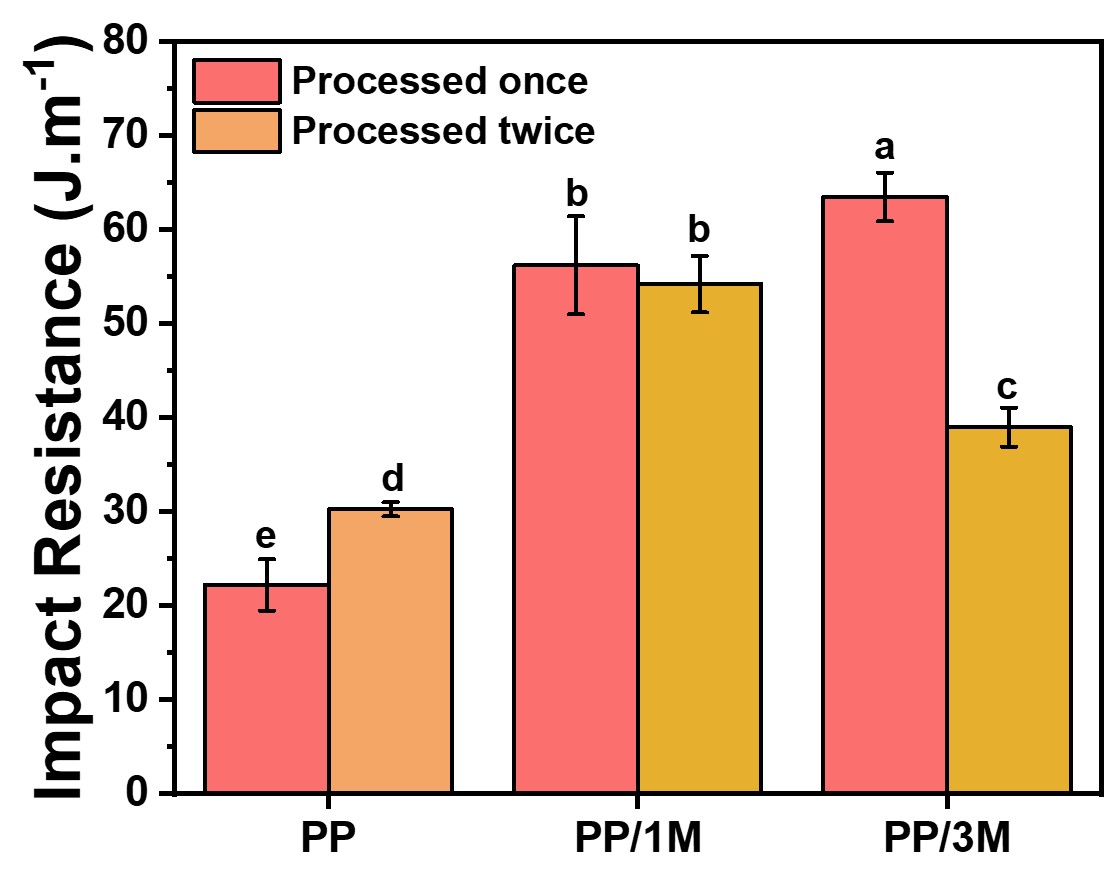
The behavior of the impact resistance (IR) of PP systems filled with HGM and reprocessed are shown in Figure 4. The analysis of variance (Anova) indicated that the interaction composition x reprocessing has a significant effect (p < 0.05) on the impact resistance values. Furthermore, it is also observed that variations in compositions and the amount of reprocessing act significantly (p < 0.05) on the IR.
Impact resistence of PP systems filled with HGM and processed (once and twice). Means labeled with the same letter do not exhibit statistically significant differences, according to the Tukey test (p < 0.05).
Thus, it was observed that all systems presented significantly (p < 0.05) different values compared to unprocessed PP, providing significant (p < 0.05) effects due to each processing and each applied HGM content. No significant difference (p > 0.05) was found in the PP/1M system due to reprocessing. It was noted that reprocessing significantly (p < 0.05) increased the PP system by 36.1% and reduced the PP/3M systems by 38.5%.
Poulakis and Papaspyrides[39] reported that the degree of crystallinity of polypropylene increased after double recycling. Therefore, recycling itself may act as a form of annealing process. Nonetheless, the prior processing of the assessed samples had no appreciable impact on the mechanical properties of the assessed recycled PP. Ha and Kim[40] on the other hand, discovered that a material with a lower yield stress can more readily start the fibrillated damage zone at the notch front. The reprocessed PP (PP-2x) may have a higher impact resistance (p < 0.05) due to this behavior, as the linking molecules act as local stress transmitters between the lamellae and only break when more energy is needed for the deformation or fracture.
Cosse et al.[41] reported similar results when evaluating the effects of microspheres in HDPE foams on impact resistance when differentiating processing routes: single-screw and twin-screw extruders. These authors observed that the presence of HGM significantly increases the RI values, but the subsequent increase in the content reduces this property. However, higher values were observed than in the pure HDPE matrix. On the other hand, Ozkutlu et al.[42] obtained opposite results in poly(methyl methacrylate) (PMMA) composites filled with HGM of different densities and sizes. They reported that in all systems, the presence of HGM reduced the IR values, and increasing the HGM content further reduced this property.
4. Conclusions
The primary question of this study aimed to answer was whether polymeric materials containing hollow glass microspheres (HGM) might experience a decline in mechanical properties and a reduction in recyclability due to accelerated aging or repeated reprocessing. To address this, the present study focused on the production of polypropylene (PP) composites incorporating HGM followed by reprocessing in a single-screw extruder and artificial aging in an oven at 100°C for up to 21 days. Mechanical tests, structural analyses, and morphological analyses were carried out before and after aging. Mechanical properties were significantly influenced (p < 0.05) by the presence of HGM, reprocessing, and exposure time. Uniform distribution of HGM was observed within the PP matrix, with no signs of damage or deformation in the microspheres, indicating excellent shear resistance during extrusion. Composites containing HGM showed a slight decline in their mechanical properties. However, they shown recyclable even after accelerated aging, and surface treatment on the HGM could further improve the affinity between this filler and the PP matrix. In summary, achieving the desired mechanical properties, crucial for various applications, depends on optimizing the compatibility system and processing parameters. These composites have potential for applications where weight reduction is essential, such as replacing synthetic foams in construction.
6. Acknowledgements
The authors want to acknowledge the Universidade Federal do Piauí (UFPI), National Council for Scientific and Technological Development (CNPq), and Piauí State Research Support Foundation (FAPEPI).
-
How to cite:
Koseki, H. C. M., Bergozza, M., Braz, C. J. F., Alves, T. S., & Barbosa, R. (2025). Polypropylene reinforced with hollow glass microspheres: effect of thermal aging and reprocessing. Polímeros: Ciência e Tecnologia, 35(1), e20250012, https://doi.org/10.1590/0104-1428.20240047
7. References
-
1 Gahleitner, M., & Paulik, C. (2017). Polypropylene and other polyolefins. In M. Gilbert (Ed.), Brydson’s plastics materials (pp. 279-309). Oxford: Elsevier. http://doi.org/10.1016/B978-0-323-35824-8.00011-6
» http://doi.org/10.1016/B978-0-323-35824-8.00011-6 - 2 Vasile, C., & Pascu, M. (2005). Practical guide to polyethylene Shrewsbury: Rapra Technology.
-
3 Alsabri, A., Tahir, F., & Al-Ghamdi, S. G. (2022). Environmental impacts of polypropylene (PP) production and prospects of its recycling in the GCC region. Materials Today: Proceedings, 56(Pt 4), 2245-2251. http://doi.org/10.1016/j.matpr.2021.11.574
» http://doi.org/10.1016/j.matpr.2021.11.574 - 4 Wypych, G. (2020). UV stabilizers and other components of formulations. In G. Wypych (Ed.), Handbook of UV degradation and stabilization (pp. 433-438). Toronto: ChemTec Publishing. http://doi.org/10.1016/B978-1-927885-57-4.50013-9.
-
5 Biswal, T., BadJena, S. K., & Pradhan, D. (2020). Synthesis of polymer composite materials and their biomedical applications. Materials Today: Proceedings, 30(Pt 2), 305-315. http://doi.org/10.1016/j.matpr.2020.01.567
» http://doi.org/10.1016/j.matpr.2020.01.567 - 6 DeArmitt, C., & Rothon, R. (2016). Particulate fillers, selection, and use in polymer composites. In S. Palsule (Ed.), Polymers and polymeric composites: a reference series (pp. 1-26). Berlin: Springer. http://doi.org/10.1007/978-3-642-37179-0_1-2.
-
7 Ferreira, T. R. M., Lechtman, M. A., Dias, F. L., & Silva, A. B. (2022). Effect of hollow glass microspheres addition on density reduction and mechanical properties of PA6/glass fibers composites. Polímeros: Ciência e Tecnologia, 32(1), e2022001. http://doi.org/10.1590/0104-1428.210060
» http://doi.org/10.1590/0104-1428.210060 -
8 Imran, M., Rahaman, A., & Pal, S. (2019). Effect of low concentration hollow glass microspheres on mechanical and thermomechanical properties of epoxy composites. Polymer Composites, 40(9), 3493-3499. http://doi.org/10.1002/pc.25211
» http://doi.org/10.1002/pc.25211 -
9 Bharath, H. S., Bonthu, D., Prabhakar, P., & Doddamani, M. (2020). Three-dimensional printed lightweight composite foams. ACS Omega, 5(35), 22536-22550. http://doi.org/10.1021/acsomega.0c03174 PMid:32923813.
» http://doi.org/10.1021/acsomega.0c03174 -
10 Niazi, P., Karevan, M., & Javanbakht, M. (2023). Mechanical and thermal insulation performance of hollow glass microsphere (HGMS)/fumed silica/polyester microcomposite coating. Progress in Organic Coatings, 176, 107387. http://doi.org/10.1016/j.porgcoat.2022.107387
» http://doi.org/10.1016/j.porgcoat.2022.107387 -
11 Maraveas, C., Kyrtopoulos, I. V., Arvanitis, K. G., & Bartzanas, T. (2024). The aging of polymers under electromagnetic radiation. Polymers, 16(5), 689. http://doi.org/10.3390/polym16050689 PMid:38475374.
» http://doi.org/10.3390/polym16050689 -
12 Qin, J., Jiang, J., Tao, Y., Zhao, S., Zeng, W., Shi, Y., Lu, T., Guo, L., Wang, S., Zhang, X., Jie, G., Wang, J., & Xiao, M. (2021). Sunlight tracking and concentrating accelerated weathering test applied in weatherability evaluation and service life prediction of polymeric materials: a review. Polymer Testing, 93, 106940. http://doi.org/10.1016/j.polymertesting.2020.106940
» http://doi.org/10.1016/j.polymertesting.2020.106940 - 13 American Society for Testing and Materials – ASTM. (2022). ASTM D638-22: standard test method for tensile properties of plastics West Conshohocken: ASTM.
- 14 American Society for Testing and Materials – ASTM. (2018). ASTM D3045-18: standard practice for heat aging of plastics without load. West Conshohocken: ASTM.
- 15 American Society for Testing and Materials – ASTM. (2023). ASTM D256-23e1: standard test methods for determining the Izod pendulum impact resistance of plastics. West Conshohocken: ASTM.
-
16 Hay, M. B., & Myneni, S. C. B. (2007). Structural environments of carboxyl groups in natural organic molecules from terrestrial systems. Part 1: infrared spectroscopy. Geochimica et Cosmochimica Acta, 71(14), 3518-3532. http://doi.org/10.1016/j.gca.2007.03.038
» http://doi.org/10.1016/j.gca.2007.03.038 - 17 Larkin, P. J. (2017). Infrared and Raman spectroscopy: principles and spectral interpretation Amsterdam: Elsevier. http://doi.org/10.1016/C2015-0-00806-1.
-
18 Fuente, E., Menéndez, J. A., Díez, M. A., Suárez, D., & Montes-Morán, M. A. (2003). Infrared spectroscopy of carbon materials: A quantum chemical study of model compounds. The Journal of Physical Chemistry B, 107(26), 6350-6359. http://doi.org/10.1021/jp027482g
» http://doi.org/10.1021/jp027482g -
19 Li, J., Wang, L., Xu, Z., Zhang, J., Li, J., Lu, X., Yan, R., & Tang, Y. (2023). A new point to correlate the multi-dimensional assessment for the aging process of microfibers. Water Research, 235, 119933. http://doi.org/10.1016/j.watres.2023.119933 PMid:37023644.
» http://doi.org/10.1016/j.watres.2023.119933 -
20 Syakti, A. D., Hidayati, N. V., Jaya, Y. V., Siregar, S. H., Yude, R., Suhendy, L., Asia, L., Wong-Wah-Chung, P., & Doumenq, P. (2018). Simultaneous grading of microplastic size sampling in the Small Islands of Bintan water, Indonesia. Marine Pollution Bulletin, 137, 593-600. http://doi.org/10.1016/j.marpolbul.2018.11.005 PMid:30503472.
» http://doi.org/10.1016/j.marpolbul.2018.11.005 -
21 Khoironi, A., Hadiyanto, H., Anggoro, S., & Sudarno, S. (2020). Evaluation of polypropylene plastic degradation and microplastic identification in sediments at Tambak Lorok coastal area, Semarang, Indonesia. Marine Pollution Bulletin, 151, 110868. http://doi.org/10.1016/j.marpolbul.2019.110868 PMid:32056648.
» http://doi.org/10.1016/j.marpolbul.2019.110868 -
22 Baptista, C. A., & Canevarolo, S. V. (2019). Grafting polypropylene over hollow glass microspheres by reactive extrusion. Polímeros: Ciência e Tecnologia, 29(3), e2019037. http://doi.org/10.1590/0104-1428.06118
» http://doi.org/10.1590/0104-1428.06118 -
23 Hahladakis, J. N., Velis, C. A., Weber, R., Iacovidou, E., & Purnell, P. (2018). An overview of chemical additives present in plastics: migration, release, fate and environmental impact during their use, disposal and recycling. Journal of Hazardous Materials, 344, 179-199. http://doi.org/10.1016/j.jhazmat.2017.10.014 PMid:29035713.
» http://doi.org/10.1016/j.jhazmat.2017.10.014 -
24 Varghese, A. M., Rangaraj, V. M., Luckachan, G., & Mittal, V. (2020). UV aging behavior of functionalized mullite nanofiber-reinforced polypropylene. ACS Omega, 5(42), 27083-27093. http://doi.org/10.1021/acsomega.0c02437 PMid:33134668.
» http://doi.org/10.1021/acsomega.0c02437 -
25 Senatova, S. I., Senatov, F. S., Kuznetsov, D. V., Stepashkin, A. A., & Issi, J. P. (2017). Effect of UV-radiation on structure and properties of PP nanocomposites. Journal of Alloys and Compounds, 707, 304-309. http://doi.org/10.1016/j.jallcom.2016.11.170
» http://doi.org/10.1016/j.jallcom.2016.11.170 -
26 Cunha, M. P., Grisa, A. M. C., Klein, J., Poletto, M., & Brandalise, R. N. (2018). Preparation and characterization of hollow glass microspheres- reinforced poly (acrylonitrile-co-butadiene-co-styrene) composites. Materials Research, 21(6), e20180201. http://doi.org/10.1590/1980-5373-mr-2018-0201
» http://doi.org/10.1590/1980-5373-mr-2018-0201 -
27 Zhang, X., Liu, M., Chen, Y., He, J., Wang, X., Xie, J., Li, Z., Chen, Z., Fu, Y., Xiong, C., & Wang, S. (2022). Epoxy resin/hollow glass microspheres composite materials with low dielectric constant and excellent mechanical performance. Journal of Applied Polymer Science, 139(33), e52787. http://doi.org/10.1002/app.52787
» http://doi.org/10.1002/app.52787 -
28 He, M., Sawut, A., Guan, L., Li, Y., & Yimit, M. (2021). Study on the weathering performance of polypropylene by artificial accelerated aging and natural aging. Journal of Polymer Materials, 38(3-4), 191-203. http://doi.org/10.32381/JPM.2021.38.3-4.2
» http://doi.org/10.32381/JPM.2021.38.3-4.2 -
29 Weingart, N., Raps, D., Lamka, M., Demleitner, M., Altstädt, V., & Ruckdäschel, H. (2023). Influence of thermo-oxidative aging on the mechanical properties of the bead foams made of polycarbonate and polypropylene. Journal of Polymer Science, 61(21), 2742-2757. http://doi.org/10.1002/pol.20230267
» http://doi.org/10.1002/pol.20230267 -
30 He, Z.-Q., Yang, Y., Yu, B., Yang, J.-P., Jiang, X.-B., Tian, B., Wang, M., Li, X.-Y., Sun, S.-Q., & Sun, H. (2022). Research on properties of hollow glass microspheres/epoxy resin composites applied in deep rock in-situ temperature-preserved coring. Petroleum Science, 19(2), 720-730. http://doi.org/10.1016/j.petsci.2021.10.028
» http://doi.org/10.1016/j.petsci.2021.10.028 -
31 Afolabi, O. A., Kanny, K., & Mohan, T. P. (2022). Analysis of particle variation effect on flexural properties of hollow glass microsphere filled epoxy matrix syntactic foam composites. Polymers, 14(22), 4848. http://doi.org/10.3390/polym14224848 PMid:36432973.
» http://doi.org/10.3390/polym14224848 -
32 Carvalho, G. B., Canevarolo, S. V., Jr., & Sousa, J. A. (2020). Influence of interfacial interactions on the mechanical behavior of hybrid composites of polypropylene / short glass fibers / hollow glass beads. Polymer Testing, 85, 106418. http://doi.org/10.1016/j.polymertesting.2020.106418
» http://doi.org/10.1016/j.polymertesting.2020.106418 -
33 Abbas, Z., Shahid, S., Nawab, Y., Shaker, K., & Umair, M. (2020). Effect of glass microspheres and fabric weave structure on mechanical performance of hemp/green epoxy composites. Polymer Composites, 41(11), 4771-4787. http://doi.org/10.1002/pc.25751
» http://doi.org/10.1002/pc.25751 -
34 Sai, B. L. N. K., & Tambe, P. (2022). Surface modified hollow glass microsphere reinforced 70/30 (wt/wt) PC/ABS blends: influence on rheological, mechanical, and thermo-mechanical properties. Composite Interfaces, 29(6), 617-641. http://doi.org/10.1080/09276440.2021.1986974
» http://doi.org/10.1080/09276440.2021.1986974 -
35 Jang, K.-S. (2020). Low-density polycarbonate composites with robust hollow glass microspheres by tailorable processing variables. Polymer Testing, 84, 106408. http://doi.org/10.1016/j.polymertesting.2020.106408
» http://doi.org/10.1016/j.polymertesting.2020.106408 -
36 Wang, X., & Petru, M. (2020). Degradation of bending properties of flax fiber reinforced polymer after natural aging and accelerated aging. Construction & Building Materials, 240, 117909. http://doi.org/10.1016/j.conbuildmat.2019.117909
» http://doi.org/10.1016/j.conbuildmat.2019.117909 -
37 La Mantia, F. P., Mistretta, M. C., & Titone, V. (2021). Rheological, mechanical and morphological characterization of monopolymer blends made by virgin and photo-oxidized polypropylene. Recycling, 6(3), 51. http://doi.org/10.3390/recycling6030051
» http://doi.org/10.3390/recycling6030051 -
38 Pei, L., Ya, B., Ding, Z., Fan, Z., & Zhang, X. (2023). Effect of curing agents and hollow glass microspheres on the compression properties of syntactic foams. Journal of Materials Research and Technology, 27, 5321-5331. http://doi.org/10.1016/j.jmrt.2023.11.002
» http://doi.org/10.1016/j.jmrt.2023.11.002 -
39 Poulakis, J. G., & Papaspyrides, C. D. (1997). Recycling of polypropylene by the dissolution/reprecipitation technique: I. A model study. Resources, Conservation and Recycling, 20(1), 31-41. http://doi.org/10.1016/S0921-3449(97)01196-8
» http://doi.org/10.1016/S0921-3449(97)01196-8 -
40 Ha, K. H., & Kim, M. S. (2012). Application to refrigerator plastics by mechanical recycling from polypropylene in waste-appliances. Materials & Design, 34, 252-257. http://doi.org/10.1016/j.matdes.2011.08.014
» http://doi.org/10.1016/j.matdes.2011.08.014 -
41 Cosse, R. L., Morais, A. C. L., Silva, L. R. C., Carvalho, L. H., Reis Sobrinho, J. F., Barbosa, R., & Alves, T. S. (2019). Preparation of syntactic foams made from green polyethylene and glass microspheres: morphological and mechanical characterization. Materials Research, 22(Suppl 1), e20190035. http://doi.org/10.1590/1980-5373-mr-2019-0035
» http://doi.org/10.1590/1980-5373-mr-2019-0035 -
42 Ozkutlu, M., Dilek, C., & Bayram, G. (2018). Effects of hollow glass microsphere density and surface modification on the mechanical and thermal properties of poly(methyl methacrylate) syntactic foams. Composite Structures, 202, 545-550. http://doi.org/10.1016/j.compstruct.2018.02.088
» http://doi.org/10.1016/j.compstruct.2018.02.088