 AUTISM AND SCHOOL INCLUSION: WHAT DOES RESEARCH IN THE HEALTH AREA INDICATE?
ABSTRACT
The presence of students with Autism Spectrum Disorder (ASD) in Basic Education is a reality; however, there is little research about the subject in Education journals. Therefore, the objective of this article was to analyze the scientific literature about ASD and school inclusion in Brazilian medical and psychological journals between 2012 and 2021, in order to identify what has been researched about the topic in these fields. The research uses a qualitative approach, using a literature review. Among the main results, we found that of the 17 articles included in the research corpus, 14 mention the use of strategies to teach students with ASD, and five reveal that participating teachers have negative perceptions of these students. Education.
Keywords:
school inclusion; medicine; psychology; ASD
RESUMO
A presença de estudantes com Transtorno do Espectro Autista (TEA) na Educação Básica é uma realidade, todavia, são poucas as pesquisas sobre o assunto nos periódicos da área da Educação. Assim, o objetivo deste artigo foi analisar a produção científica sobre o TEA e inclusão escolar nos periódicos brasileiros das áreas médica e psicológica, entre os anos de 2012 a 2021, a fim de identificar o que vem sendo pesquisado sobre o tema nessas áreas. A pesquisa tem abordagem qualitativa, do tipo revisão bibliográfica. Entre os principais resultados, constatamos que dos 17 artigos que fizeram parte do corpus da pesquisa, 14 mencionam o uso de estratégias para ensinar o estudante com TEA e cinco revelam que os professores participantes têm percepções negativas sobre esses estudantes.
Palavras-chave:
inclusão escolar; medicina; psicologia; TEA
RESUMEN
La presencia de estudiantes con Trastorno del Espectro Autista (TEA) en la educación básica es una realidad, sin embargo, son pocas las investigaciones sobre el tema en los periódicos de las áreas de educación. El objetivo de este artículo fue analizar la producción científica sobre el TEA e inclusión escolar en los periódicos brasileños de las áreas médica el psicológica, entre los años de 2012 y 2021, con la finalidad de identificar lo que se ha investigado sobre el tema en esas áreas. La investigación tiene abordaje cualitativo, del tipo revisión bibliográfica. Entre los principales resultados, constatamos que de los 17 artículos que formaron parte del corpus de la investigación, 14 mencionaron el uso de estrategias para enseñar el estudiante con TEA y cinco apuntan que los profesores participantes presentan percepciones negativas sobre esos estudiantes.
Palabras clave:
inclusión escolar; medicina; psicología; TEA
INTRODUCTION
According to the Política Nacional de Educação Especial na Perspectiva da Educação Inclusiva (PNEEPEI), or National Policy for Special Education in the Perspective of Inclusive Education, Autism Spectrum Disorder (ASD) is described as a global development disorder whose characteristics are “[...] qualitative alterations in reciprocal social interactions and in communication, in addition to a restricted repertoire of interests and activities, as well as stereotyped and repetitive behaviors” (Ministry of Education, 2008, p. 15). The rights of people with ASD are guaranteed by Law no. 12.764/2012 (Brasil, 2012), which institutes the National Policy for The Protection of The Rights of People with Autism Spectrum Disorder.
According to Cunha (2019), ASD manifests itself at birth or early childhood, yet there is no ultimate explanation for its existence, although the most widely accepted is based on genetic studies. The disorder is so complex that there is no standardized pattern of manifestation because the signs can vary significantly, which makes it difficult to get an early diagnosis. According to the aforementioned author, individuals commonly present a triple combination of difficulties: in communication, in social interaction, and in stereotyped behaviors.
In addition, the Manual Diagnóstico e Estatístico de Transtornos Mentais - DSM-5-TR (APA, 2022), or Diagnostic and Statistical Manual for Mental Disorders classifies Autism Spectrum Disorder (ASD) into three levels, depending on the need for support: light, moderate, and acute. In the light level, individuals require little support, and present minimal difficulties in aspects such as social communication, social interaction, and behaviors. In the moderate level, people need considerable support due to more evident deficits in these areas. Finally, in the acute level, individuals need significant support because there are severe impairments in social communication, social interaction, and behavior with little or no response to attempts at verbal and non-verbal communication.
In general, these people have the right to access, to permanence, to participation and to learning at all levels and modes of education, in addition to the availability of accessibility strategies in its diverse dimensions (Brasil, 2012). However, there is a distance between what the law prescribes and what in fact takes place in regular classrooms. Lima and Laplane (2016) emphasize that the schooling process for students with ASD is, in general, left unfinished and few individuals go as far as High School. This piece of information, therefore, implies that in reality access is guaranteed, by permanence is not.
In this sense, reflecting on permanence and thinking of inclusive practices are of great importance. Thus, it is fundamental that we take into consideration the role played by educational administration, as well as curricular adaptations, as well as the availability of pedagogical material, in addition to other tools so that inclusion can happen.
To Schmidt et.al. (2016), although there is a legal advancement in the inclusion of students with ASD, there are still too many difficulties for educators in the work with these students. In this sense, many research works expose the precariousness that exists in the formation of teachers and the relation of formation with the inclusion of students with disabilities at regular schools (Crochík, Kohatsu, Dias, Freller, & Casco, 2013; Dias, 2018; Silva, 2015).
In this sense, it is legitimate to highlight the fact that some students with ASD need different pedagogical strategies in order to learn because, most of the time, they present multiple restrictions that affect the learning process (Cunha, 2019). Furthermore, it is important to emphasize that not all students with ASD need different pedagogical strategies, but rather strategies to use in the classroom.
In this perspective, Orrú (2012) highlights the need for teachers to respect the individuality of these students, understand their limits and propose strategies for the overcoming of current barriers, especially because the presence of students with ASD in common education is a trend in Brazilian schools.
According to Santos and Elias (2018), there is a significant increase in the number of students with ASD in regular education. According to the aforementioned authors, there was a growth in the number of enrolled ASD students, especially in the Southeastern, Northeastern, and Southern regions, with a highlight on the percentual increase in the regions other than the Southeast between 2009 and 2012. The information presented by these authors is corroborated by the numbers presented by the Censo Escolar da Educação Básica, or Educational Census of Basic Education. According to this document, the enrollment of students with disabilities, global development disorders and/or high skills/giftedness aged from 4 to 7 years (included in regular classrooms) gradually increased, surpassing 90.8%, in 2017, and reaching 93.5%, in 2021 (Inep, 2022).
Despite the rise in the number of enrollments of students with ASD at schools, there are still few studies in the area of education (Camargo, Silva, Crespo, Oliveira, & Magalhães, 2020; Wuo, 2019). Wuo (2019), in a literature review, aimed at analyzing how much is known about education for people with ASD in theses and dissertations produced in the Brazilian Southern and Southeastern regions between the years of 2008 and 2016. The author indicated that ASD is defined by distinct approaches, and most are based on the explanations provided by medicine with a connection with the notion of deficit and psychological and social loss. Furthermore, Wuo (2019) highlights that knowledge on ASD belongs to the medical domain. Out of the 136 works that were part of the corpus of the research, 92 were in the healthcare area, 25 were from areas such as biosciences, technology, and human sciences, and 19 belonged to the education area. In this sense, the aforementioned author points at the emergence of research works on ASD in the field of school inclusion, with the intention to promote the construction of new forms of thinking the schooling process.
Due to the scarcity of studies in the area of Education, as we have highlighted above, we decided to go for articles that referred to ASD and school inclusion in periodicals of the medical and psychological area. This choice justifies itself because ASD is a disorder that is widely studied in the mentioned areas. In addition, the relation between them is supported by the medical perspective on the disabilities and disorders.
Considering what has been exposed, this article aimed at mapping and analyzing the scientific production on ASD and school inclusion in Brazilian periodicals in the medical and psychological areas from 2012 to 2021.
METHOD
In order to understand what has been published on the ASD theme and the matters related to the education of these people, there was a survey on the articles (in the mentioned areas) published in national periodicals from 2012 to 2021, classified in the quality levels between A1 and A4, in the Qualis-Capes 2019. We chose to search for works published after 2012 due to law no. 12.764 (Brasil, 2012). It was after this policy that people with ASD had safeguarded rights, at least from the legal point of view.
For the selection of periodicals, we chose only the ones that were related to the base area of the research (healthcare, medicine, and psychology) and that were indicated by the periodicals. This selection method eliminated the possibility for foreign periodicals or periodicals of other areas to be included in the systematization of data.
Using the previously established criteria, we were able to identify 46 periodicals. Regarding the classification, three periodicals were identified as A1, five as A2 and two as A3. However, in only nine periodicals we found articles related to the research criteria.
The inclusion criteria for the choice of articles were: i) articles that had been published in periodicals in the health area (medical and psychological) and that were present in the Qualis-Capes system (“Qualis vazado” - 2019), with continuous publications; ii) articles that approached learning/teaching of students with ASD; iii) articles in Portuguese that had been published from 2012 to 2021. Researchers excluded works that were not connected to education/teaching and ASD.
Considering the adopted inclusion criteria, we realized the first search phase using the following descriptors: autism (autism), autista (autistic), Transtorno do Espectro Autista (Autism Spectrum Disorder) and TEA (ASD), resulting in the total sum of 281 articles. The second stage consisted of selecting from the obtained works the ones that contained the terms escolarização (schoolong), Ensino (teaching), escola (school), educação inclusive (inclusive education), inclusão (inclusion) and educação especial (special education) in the titles, in the abstracts, or in the keywords because many works that were obtained in the searches were not related to the study field. We excluded the works that referred to cognition, to physical and motor development, to family and to health. Thus, we obtained the corpus of the research, which is made up of 17 productions, according to the information on Table 1. It is important o enphasize that this number refers to research works that focus solely on people with ASD and schooling.
Thus, it becomes possible to observe that research works on the inclusion of students with ASD are still incipient in the assessed periodicals, because in a universe of 279 works, only 17 met the research criteria. The selected articles are distributed throughout 2012-2021 according to Table 2: After a complete and attentive reading of the articles, data were organized into three theme axes: 1) Teaching Stages of Education; 2) Teaching students with ASD; 3) Teachers’ perception of students with ASD and the students’ perspectives regarding their teachers.
RESULTS AND DISCUSSION
In this section, we present the organized data in the three theme axes. It is important to emphasize that some articles can be classified into more than one axis, because some studies approach more than one theme. For example, we highlight A8, which mentions strategy and the teachers’ perception.
Stages of teaching in education
This axis indicates the stages of education that are mentioned in the articles. The works classified in this axis can be visualized in Illustration 01:
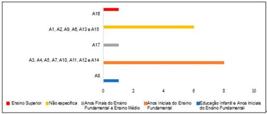
We observed that there is a predominance of research works on the initial years of basic education, but few works are concerned with High School. Our data are corroborated by the research by Lima and Laplane (2016), which investigated the inclusion of autistic students in the municipal network of Maceió, and identified that the students with ASD who were enrolled in the researched network attended, mostly, childhood education and basic education. The authors demonstrate that few students reached high school because there was a high rate of school evasion. Furthermore, they also argue that despite the guarantees that are established by laws, documents and guidelines, the participation of students with ASD at school is contradictory and falls rather short of inclusive goals (Lima & Laplane, 2016).
The research by Lima and Laplane (2016) also mentions that when an education network does not offer specialized pedagogical support might lead to students with ASD quitting school. The presented data indicate that school practices are inefficient because they do not consider the students’ specific needs regarding the teaching of more complex contents, and there is also the absence of specific assessing instruments for them. The fact that this group did not advance in the stages of Education might indicate that the students are not the “problem”. The problem is rather the existing policies that contribute very little to permanence and learning at school, because there is a lack of qualified professionals, resources, curricular accessibility, pedagogical support and other factors. In this sense, Dias (2018, p. 90) emphasize that “failure is often attributed to the inclusion or mere presence of students with disabilities at regular schools, and it provides further evidence of the general problems of school, which were always there, but that depend on confrontation for resolution”.
It is relevant to highlight that, despite the legal guaranteed for the inclusion of students with ASD, research points at a predominance in the enrollment of these students in the initial years of Basic Education, with a significant fall in High School, which is evidence of a high rate of school evasion. There is a lack of specialized pedagogical support and of practices that are suitable to the needs of these students. That contributes to academic failure and discontinuance, and shows that the inclusion policies, although they exist, are still not enough. The problem is not in the students. It lies in the structural limitations of schools and in the lack of resources and qualified professionals. It is necessary to confront structural issues so that inclusion and learning is effective.
The teaching of students with ASD
Regarding practice, we analyzed which productions deal with pedagogical strategies for teaching students with ASD. Data can be visualized in illustration 02.
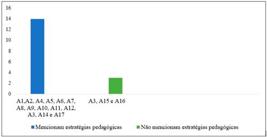
Out of the 17 analyzed articles, 14 mention strategies to teach students with ASD. These data reveal that there are pedagogical resources for practice with these students, and software and games are the ones that are mentioned most often. Another relevant piece of information refers to the number of research works that are related to reading strategies for children with ASD. The study by Camargo et. al. (2020) demonstrates that it is necessary to have practices that benefit the potentialities of children with ASD and that are based on the needs of students and teachers.
In article A1, Lemos, Salomão, Aquino and Agripino-Ramos (2016) aimed at analyzing the parents’ and teachers’ regarding autistic children and their inclusion process. The study revealed that some teachers used music, images, games, and realia as strategies to benefit the teaching and learning process for these children. However, even when they are reporting practices that focus on the learning of school content, teachers, in their discourses, associated interventions that benefitted the socialization and integration of autistic children with the other students.
The research by Camargo et al. (2020) demonstrated that there are strategies that are commonly used and based on common sense or on what teachers believe to be adequate rather than on the difficulty presented by ASD students. This data points at the need for better service regarding inclusion and providing special education for children with autism or other conditions. Mantoan (2015) highlights that in order to have a pedagogical practice that is truly inclusive, it is not only necessary, it is fundamental to understand that the resources must be suitable to the learning necessities of these students and that the contents of the activity be learned by everyone.
In articles A2, A4, A5, A6, A7, A11, A12, A13, A14 and A17 specific pedagogical strategies are used in order to teach ASD students. Some of the strategies are Constructed Response Matching to Sample (CRMTS), social histories and videomodeling. In A2, Paixão and Assis (2018) aimed at verifying the effects of training via CRMTS in the development of text reading for the comprehension and construction of sentences for children with ASD. According to the authors, the CRMTS consists of the “integration of repertoires of reading and writing. It has been used for the teaching of the construction of sentences, and which is usually realized with the selection of letters for the construction of words” (Paixão & Assis, 2018, p. 78).
This procedure has been used in order to teach reading to students ASD, considering that many of them present reading difficulties. In the research by Paixão and Assis - A2 (2018), the use of CRMTS led participants to learn to read and build words and sentences. According to Cunha (2019) and Orrú (2012), When pedagogical strategies are focused on the specificities of students with ASD, they learn.
A4 aimed at verifying the effects of the presentation of social histories in the learning of behaviors that are adequate and in the reduction of unsuitable behaviors in the classroom by children with ASD. Silva, Arantes and Elias (2020, p. 4), authors of A4, emphasize that “the objective of social histories is to describe situations in which one individual might have difficulty in identifying relevant social signs or expected behaviors and to understand the consequences of behaving in certain ways”. Concerning autistic students, the histories are great help because they are people who have difficulty in interpretation and in behavior. In this sense, Del Prette and Del Prette (2005) highlight the relevance of academic social skills for the following of rules or oral instructions and participate in discussions for the probable relation between social competence and academic performance. Thus, when students have social difficulties, he will probably have poor academic performance.
In A13, Bialer (2015) approached school insertion in the field of autism by means of diverse experiences that are related to autobiographies that had been written by autistic people. The author highlighted the speech by Temple Grandin, who was autistic and wrote a book in 2011 in which he provides guidelines on school inclusion in the field of autism. According to Grandin, educators of students with ASD must be people who believe in the potential of these students and that have a consistently friendly mood in addition to the wisdom to prevent learning from stagnation due to an overload of information. Furthermore, it is important for teachers to propose something different, in order to stimulate development and the flexibilization of thought.
Teachers must be attentive when they teach autistic students because many of these students have impaired sensorial systems. Many students with the disorder emphasize the sensorial hypersensitiveness issue and how relevant it is for schools to respect this alternative way of processing sensorial information, which might also demand environmental adaptations at school such as the reduction of light in the classroom as well as the use of ear protection.
In this perspective, the most efficient strategy to teach students with ASD is to get to know their characteristics. The lack of deeper knowledge (especially practical knowledge on the disorder) makes teachers face difficulties when it comes to teaching and handling behavioral issues with ASD students. These are some of the basic difficulties that were found in the daily work with these children and that had been reported by the teachers (Camargo et al., 2020).
In articles A8, A9, A10, although the interviewed teachers did recognize the relevance of pedagogical strategies to teach ASD students, they failed to specify which ones were used. In A9, teachers argued on the difficulty to include ASD students due to the absence of suitable materials and guidelines for the work (Rodrigues, Moreira, & Lerner, 2012). In A10, Weizenmann, Pezzi and Zanon (2020) investigated the experience of teachers regarding the inclusion of students with ASD, while contemplating teachers’ feelings and practices. The authors pointed out that the assessed teachers proved favorable to the use of pedagogical strategies, because their use might stimulate participation and interaction among the students while respecting individuality, thought they do not mention any of these strategies.
The pedagogical strategies are fundamental in order to teach students with ASD. However, it is important to highlight that it is necessary for teachers to know not only the characteristics of the disorder, but also the individualities of the students.
Teachers’ perception of students with ASD
This axis includes articles that discuss the teachers’ perceptions of students with ASD. The teachers’ ´perceptions can be visualized in Illustration 03:

Articles A3, A8, A9 A12 and A17 reveal that the participating teachers in the research works have negative perceptions regarding the students with ASD. This perception can be verified in the use of derogative terms such as “autistic slow” or “problem student”, referring to the ones who have difficulty to socialize and to learn, in addition to stereotyping. Some teachers mention their own alleged insecurity to work with these students due to scarcity of knowledge and of resources in order to face the social and behavioral learning obstacles that they are challenged with.
In A3, Santos and Santos (2012) reveal that most of the teachers who participated in the research have a mistake perception of ASD and its origin, considering that some consider it an organic disorder or the result of precocious relational complications. This is an approach that is similar to the one that was approached in A8. Schmidt et al. (2016) demonstrate that autism is a condition that is still unknown by teachers and that they feel unprepared to educate these students.
In A9, Rodrigues, Moreira and Lerner (2012) identified in the reports by the assessed teachers the oppositions that characterize the recurrent conception of “Problem-Students”. Also, according to the authors, the teachers sometimes have an individualized perception for these students, sometimes they tend to compare these students with the ones without ASD. The “Problem-Students” reveal a situation of “no-knowledge” among the teachers regarding these students.
In A17, Silva et al. (2020, p. 80) highlight the teachers’ perception of students with ASD: “to me, autistic students are the ones with difficulty to interact with their classmates, who live isolated in a world of their own”. This negative perception might contribute to non-inclusive practices. Because these students tend to isolate themselves, it is fundamental that teachers use strategies that promote interaction among students.
An interesting piece of information that was identified in A1 and in A10: the teachers’ perceptions changed after contact with the autistic students. In A1, Lemos et al. (2016) observed that most of the teachers refreshed their perceptions after the experiences of connection with the ASD kids in the everyday routines of schools. In A10, Weizenmann etal. (2020) point out that the first feelings that emerged in the teachers were fear and insecurity. After the adaptation period, these feelings turned into confidence in their competence. Only experience makes us able to eradicate stereotyping and prejudice. In this sense, Crochík et al. (2013) emphasize that it is necessary to promote an education that leads to experience. According to Dias, even though experience does not guarantee the elimination of prejudice, might benefit reflection on its causes. The author emphasizes that
[...] in addition to recognition, experience with diversity is essential. This is one of the reasons why we reaffirm the defense of inclusion of people with disabilities at regular schools, despite all challenges to be overcome. (Dias, 2018, p. 215).
We agree with Crochík et al. (2013) on the relevance and need for inclusive education, because they propose the coexistence of minorities so that humanity can thrive in difference. Several research works have highlighted the role of experience and interaction with difference as a possible route for appreciation and respect for diversity among students (Crochík et al., 2013; Dias, 2018; Mantoan, 2015).
In A3, the teachers’ perception is negative regarding autistic students. To Santos and Santos (2012), because they did not know about autistic students, the teachers resort to practical knowledge in contrast with scientific knowledge.
When they report their experience with the autistic students, the teachers emphasize that, for their practice, the most important thing was to observe the students and learn from the more experienced teachers, that is, the most seasoned teachers at the institution, while academic knowledge is of little or no importance (Santos & Santos, 2012, p. 369).
In this sense, even though the teachers recognize that they do not use organized scientific knowledge, which supports the pedagogical work with these students, they consider academic knowledge more valuable than practical knowledge (Santos & Santos, 2012). According to Orrú (2012), literature indicates that the educational practices, developed until then, contribute very little to the insertion of people with disability into society. Camargo et. al. (2020) highlight the importance of continued formation with the objective to better prepare teachers for practice in inclusive classrooms.
In A5, the teachers’ perception regarding ASD students is positive. Carvalho (2019) highlights that it is indispensable to disconnect from labels and from naming for identifying individuals with ASD. That would be the way
Because it would be a way to overcome the challenges of inclusive education. In consonance with Carvalho (2019), Orrú (2012, p. 50) emphasizes that
The concept of deficiency looms over people who have intellectual deficit with a performance that is below average, in addition to behavior and social adaptation problems, labeling them as uncapable of learning or of keeping up with the contents of regular education, and to problematizing their social-historical context, condemning them thus to processes of exclusion in the social spaces of their communities.
According to Crochík e tal. (2013), stereotype is characterized by the generalization of supposed characteristics of a certain group for all individuals who belong to it. In this case, people with disabilities or global development disorders are many times characterized by their deficits rather than by what they really are, and stereotyping is the thing that excludes them. Therefore, it is important to eliminate labels. However, regarding individuals with ASD, it is necessary to get to know the characteristics of the disorder so that teachers can create inclusive pedagogical strategies. These students, in their majority, might have problems in their sensorial systems, which is responsible for the learning process. According to Bialer (2015, p. 490),
A considerable number of autistic people emphasize the issue of sensorial hyper-sensibility and the importance of schools respecting this different way of processing sensorial information, which might demand inclusive environmental adaptations such as the reduction of light in the classroom as well as ear protection.
To Grandin (2011), changes in routine and ambiance, as well as problems of sensorial processing, are frequent causes of aggressiveness or crisis in people with ASD. Furthermore, Cunha (2019) argues that people with ASD who have impairments in the sensorial processing, might present hyper-sensibility. Among autistic people who have hearing hyper-sensibility, common background noises cause discomfort and might be interpreted as pain. In this case, a noisy classroom can be a place of unhappiness.
In A12, the teachers’ perceptions regarding students with ASD is negative. Martins and Monteiro (2017) emphasize that autistic children are generally stigmatized as having a series of limitations that are determined by their peculiarities and their behavior, and very little was said about possibilities of practicing with these individuals and promoting interactions with them.
The educational proposals focus on specific methods that tendo to appreciate the execution of tasks, and the inhibition of actions that are considered undesirable or incomprehensible, generally not appreciating social interaction and abstraction (Martins & Monteiro, 2017).
Thus, we highlight the relevance of quality formation and that contemplates the educational needs of the students who are being enrolled at school, including the ones with ASD. Furthermore, it is important to emphasize that constant interaction with these students leads to the experience of reformulating negative perceptions, towards the end of stereotypes and prejudice.
It is fundamental that university courses promote discussions on inclusive education and the diversity that is present in the school environment so that schools can have inclusive practices.
FINAL CONSIDERATIONS
In this research, we aimed at mapping and assessing scientific production on ASD and school inclusion in Brazilian periodical in the medical and psychological areas from 2012 to 2021. Nine periodicals were found and analyzed. 17 were found.
Regarding the stages of teaching in Education, we have identified that out of the 17 articles, nine refer to the initial years of Basic education. Furthermore, the obtained data provide evidence that there is a scarcity of works on the ASD and school inclusion. Out of the obtained articles, 17 were related to schooling in the universe of 281 articles.
14 articles mention pedagogical aspects in order to teach students with ASD. These results reveal that there are diverse pedagogical forms for practice with students, which contributes to their learning process. The research revealed that the teachers who participated in the researches have a negative perception among students with ASD. That is why the importance of knowledge on ASD ad the capacitation of teachers to work with these students. According to Crochík et al. (2013), only experience is capable of diminishing and/or eliminating prejudice and, for this reason, it is important for these students to be in regular education.
Regarding the obtained results, we emphasize the importance of the role played by the teacher in the inclusion process, because without knowledge on the disorder, the teachers will hardly be able to include this student. In this sense, it is relevant that university courses provide curricula disciplines and activities in addition to developing activities that lead to comprehensive discussion on the diversity among students. We consider it to be relevant in the debate on school inclusion to include pedagogical strategies that guarantee the permanence of students with disabilities and/or development disorder at school so that they have total access at all levels of modes of education to process of participation and learning.
We recognize that the data and reflections promoted by this study are limited to the context of the periodicals and the adopted time scope. However, we expect results to contribute with the themes of inclusion of the student with ASD, in addition to fomenting discussions on schooling, while recognizing the relevance of inclusive education in the promotion of more humanized school practices.
Acknowledgements
We wish to express our gratitude to the Coordination for the Improvement of Higher Education Personnel, or Coordenação de Aperfeiçoamento de Pessoal de Nível Superior (CAPES), for the financial support and the promotion of research.
References
- American Psychiatric Association. (2022). Diagnostic and statistical manual of mental disorders (5th ed., text rev.). American Psychiatric Association.
-
Benitez, P., & Domeniconi, C. (2016). Consultoria colaborativa: estratégias para o ensino de leitura e escrita. Psicologia: teoria e prática,18(3), 141-155. https://doi.org/10.5935/1980-6906/psicologia.v18n3p141-155.
» https://doi.org/10.5935/1980-6906/psicologia.v18n3p141-155 -
Benitez, P., & Domeniconi, C. (2018). Atuação do psicólogo na inclusão escolar de estudantes com autismo e deficiência intelectual. Psicologia Escolar e Educacional, 22(1), 163-172. https://doi.org/10.1590/2175-35392018013926
» https://doi.org/10.1590/2175-35392018013926 -
Bialer, M. (2015). A inclusão escolar nas autobiografias de autistas. Psicologia Escolar e Educacional, 19(3), 485-492. https://doi.org/10.1590/2175-3539/2015/0193876
» https://doi.org/10.1590/2175-3539/2015/0193876 -
Brasil(2012). Lei 12.764, de 27 de dezembro de 2012 Institui a Política Nacional de Proteção dos Direitos da Pessoa com Transtorno do Espectro Autista; e altera o § 3º do art. 98 da Lei nº 8.112, de 11 de dezembro de 1990. Brasília, DF. http://www.planalto.gov.br/ccivil_03/_ato2011-2014/2012/lei/l12764.htm
» http://www.planalto.gov.br/ccivil_03/_ato2011-2014/2012/lei/l12764.htm -
Brasilense, I. C. S., Flores, E. P., Barros, R. S., & Souza, C. B. A. S. (2018). Aprendizagem Observacional em Crianças com Autismo: Efeitos do Ensino de Respostas de Monitoramento via Videomodelação. Psicologia: Teoria e Pesquisa, 34, 2-11. https://doi.org/10.1590/0102.3772e3424
» https://doi.org/10.1590/0102.3772e3424 -
Camargo, S. P. H., Silva, G. L., Crespo, R. O., Oliveira, C. R., & Magalhães, S. L. (2020). Desafios no processo de escolarização de crianças com autismo no contexto inclusivo: diretrizes para formação continuada na perspectiva dos professores. Educação em Revista, 36, 1- 22, jul. https://doi.org/10.1590/0102-4698214220
» https://doi.org/10.1590/0102-4698214220 -
Carvalho, P. F. (2019). O que podemos aprender com os autistas: a experiência clínica de uma professora do ensino fundamental e um aluno autista. Psicologia em Revista, 25(3), 1316-1330. http://dx.doi.org/10.5752/P.1677-1168.2019v25n3p1316-1330
» https://doi.org/10.5752/P.1677-1168.2019v25n3p1316-1330 - Crochík, J. L., Kohatsu, L. N., Dias, M. Á. L., Freller, C. C., & Casco, R. (2013). Inclusão e discriminação na educação escolar Editora Alínea.
- Cunha, E. (2019). Autismo e inclusão: psicopedagogia práticas educativas na escola e na família Wak Ed.
- Del Prette, Z. A. P., & Del Prette, A. (2005). Psicologia das habilidades sociais na infância: Teoria e práticas Vozes.
- Dias, V. B. (2018). Formação de professores e educação inclusiva: uma análise à luz da Teoria Crítica da Sociedade [Tese de doutorado, Programa de Pós-graduação em Educação e Contemporaneidade, Universidade do Estado da Bahia, Salvador- BA].
- Grandin, T. (2011). A história de uma vida: como eu penso (M. F. S. Souza, Trad.). Editora BestSeller. (Trabalho original publicado 2011).
- Inep- Instituto Nacional de Estudos e Pesquisas Educacionais Anísio Teixeira. (2022). Censo da educação básica 2021: resumo técnico Inep.
-
Lemos, E. L. M. D., Salomão, N. M. R., Aquino, F. S. B., & Agripino-Ramos, C. S. (2016). Concepções de pais e professores sobre a inclusão de crianças autistas. Fractal: Revista de Psicologia, 28(3), 351-361. https://doi.org/10.1590/1984-0292/1229
» https://doi.org/10.1590/1984-0292/1229 - Lima, S., & Laplane, A. L. F. E. (2016). Escolarização de alunos com autismo. Revista Brasileira de Educação Especial, 22(2), 269-284.
- Mantoan, M. T. E. (2015). Inclusão: O que é? Por quê? Como Fazer? Sumus.
-
Martins, A. D. F., & Monteiro, M. I. B. (2017). Alunos autistas: análise das possibilidades de interação social no contexto pedagógico. Psicologia Escolar e Educacional, 21(2), 215-224. https://doi.org/10.1590/2175-3539201702121108
» https://doi.org/10.1590/2175-3539201702121108 -
Menotti, A. R. S., Domeniconi, C., & Benitez, P. (2019). Atividades aplicadas pelos pais para ensinar leitura para filhos com autismo. Psicologia Escolar e Educacional, 23, e185073. https://doi.org/10.1590/2175-35392019015073
» https://doi.org/10.1590/2175-35392019015073 -
Ministério da Educação. (2008). Política Nacional de Educação Especial na Perspectiva da Educação Inclusiva Mec. http://portal.mec.gov.br/arquivos/pdf/politicaeducespecial.pdf
» http://portal.mec.gov.br/arquivos/pdf/politicaeducespecial.pdf - Orrú, S. E. (2012). Autismo, linguagem e educação: interação social no cotidiano escolar (3a ed). Wak Ed.
-
Paixão, G. M., & Assis, G. J. A. A. (2018). Efeitos do ensino via CRMTS sobre leitura e construção de sentenças para crianças com autismo. Interação em Psicologia, 22(1), 77-88. http://dx.doi.org/10.5380/psi.v22i1.51327
» https://doi.org/10.5380/psi.v22i1.51327 -
Rodrigues, I. B., & Angelucci, C. B. (2018). Estado da arte da produção sobre escolarização de crianças diagnosticadas com TEA. Psicologia Escolar e Educacional, 22(3), 545-555. http://dx.doi.org/10.1590/2175-35392018033904
» https://doi.org/10.1590/2175-35392018033904 -
Rodrigues, I. B., Moreira, L. E. V., & Lerner, R. (2012). Análise institucional do discurso de professores de alunos diagnosticados como autistas em inclusão escolar. Psicologia: teoria e prática, 14(1), 70-83. https://pepsic.bvsalud.org/scielo.php?script=sci_arttext&pid=S1516-36872012000100006
» https://pepsic.bvsalud.org/scielo.php?script=sci_arttext&pid=S1516-36872012000100006 -
Santos, M. A., & Santos, M. F. S. (2012). Representações sociais de professores sobre o autismo infantil. Psicologia & Sociedade, 24(2), 364-372. https://doi.org/10.1590/S0102-71822012000200014
» https://doi.org/10.1590/S0102-71822012000200014 -
Santos, V., & Elias, N. C. (2018). Caracterização das matrículas dos alunos com transtorno do espectro do autismo por regiões brasileiras. Revista Brasileira de Educação Especial, 24(4), 465-482. https://doi.org/10.1590/S1413-65382418000500001
» https://doi.org/10.1590/S1413-65382418000500001 -
Schmidt, C., Nunes, D. R. P., Pereira, D. M., Oliveira., V. F., Nuernberg., A. H., & Kubaski, C. (2016). Inclusão escolar e autismo: uma análise da percepção docente e práticas pedagógicas. Psicologia: teoria e prática, 18(1), 222-235. http://dx.doi.org/10.15348/1980-6906/psicologia.v18n1p222-235
» https://doi.org/10.15348/1980-6906/psicologia.v18n1p222-235 -
Silva, M. C., Arantes, A., & Elias, N. C. (2020). Uso de histórias sociais em sala de aula para crianças com autismo. Psicologia em estudo, 25, e43094. https://doi.org/10.4025/psicolestud.v25i0.43094
» https://doi.org/10.4025/psicolestud.v25i0.43094 -
Silva, L. M. (2015). O trato ético com a inclusão escolar em Sociedades administradas. Olh@res, 3(1), 58-75. https://doi.org/10.34024/olhares.2015.v3.316
» https://doi.org/10.34024/olhares.2015.v3.316 -
Silva, S. C., Schneider, D. R., Kaszubowski, E., & Nuernberg, A. H. (2020). Estudantes com Transtorno do Espectro Autista no ensino superior: analisando dados do INEP. Psicologia Escolar e Educacional, 24, 73-95. http://dx.doi.org/10.1590/2175-35392020217618
» https://doi.org/10.1590/2175-35392020217618 -
Souza, A. S., Morales, P. C. M., Almeida, M. L., Silva, R. M. M., Silva Sobrinho, R. A., & Zilly, A. (2019). Discurso dos professores do apoio educacional especializado sobre inclusão de alunos com transtorno do espectro autista.Revista Sustinere, 7(1), 73-95. https://doi.org/10.12957/sustinere.2019.37683
» https://doi.org/10.12957/sustinere.2019.37683 -
Weizenmann, L. S., Pezzi, F. A. S., & Zanon, R. B. (2020). Inclusão escolar e autismo: sentimentos e práticas docentes. Psicologia Escolar e Educacional, 24, 1-8. https://doi.org/10.1590/2175-35392020217841
» https://doi.org/10.1590/2175-35392020217841 -
Wuo, A. S. (2019). Educação de pessoas com transtorno do espectro do autismo: estado do conhecimento em teses e dissertações nas regiões Sul e Sudeste do Brasil (2008-2016). Saúde soc, 28(3), 210-223. https://doi.org/10.1590/S0104-12902019170783
» https://doi.org/10.1590/S0104-12902019170783
the contents that are related to the research text are available in the manuscript.

 Anos finais do ensino fundamental e ensino médio (final Years of basic education and high school)Anos iniciais do ensino fundamental (initial years of basic education)Educação infantil e anos iniciais do ensino fundamental (childhood education and initial years of basic education)Source: Research data (2022).
 Mencionam estratégias pedagógicas; pedagogical strategies are mentionedNão mencionam estratégias pedagógicas; pedagogical strategies are not mentionedSource: Research Data (2022).
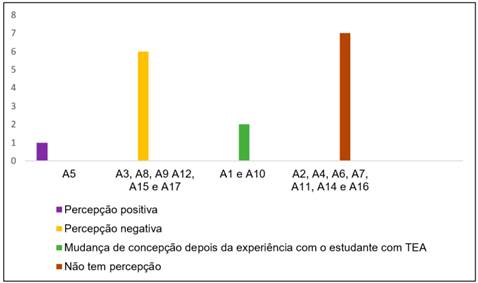 Percepção positiva: positive perceptionPercepção negativa: negative perceptionMudança de concepção depois da experiencia com alunos com TEA: change of conception after the experience with ASD studentsNão tem percepção: No perceptionSource: Research Data (2022).