 IMPACT OF COVID-19 ON THE EDUCATION OF STUDENTS WITH AUTISM SPECTRUM DISORDER
ABSTRACT
In order to understand the conditions of school inclusion in Brazil for children with disabilities in light of the impact of the COVID-19 pandemic in 2020, a survey was carried out with 1044 caregivers of children enrolled in Basic Education in special or regular schools, private or private, from Elementary to High School, in Brazil. Of these, 568 responses were from caregivers of children with Autism Spectrum Disorder (ASD), a sample that will be analyzed in this work. To this end, an online questionnaire containing 24 questions was created and disseminated through social networks. Data analysis indicates that the majority of individuals with ASD experienced significant and continuous interruptions in terms of access to supports and education itself, as well as worsening ASD symptoms. More efficient strategies for including children and adolescents with ASD in the context of remote education are necessary and urgent.
Keywords:
autism; accessibility; pandemic
RESUMO
Para compreender quais foram as condições de inclusão escolar no Brasil para crianças com deficiência frente ao impacto da pandemia de COVID-19 em 2020, foi realizada uma pesquisa com 1044 cuidadores de crianças matriculadas na Educação Básica em escolas especiais ou comuns, particulares ou privadas, do Ensino Fundamental ao Ensino Médio, do Brasil. Dessas, 568 respostas foram de cuidadores de crianças com Transtorno do Espectro Autista (TEA), recorte que será analisado nesse trabalho. Para tanto, foi construído e divulgado por meio de redes sociais, um questionário online contendo 24 questões. Análise de dados indica que a maioria dos indivíduos com TEA experimentou interrupções significativas e contínuas em termos de acesso aos suportes e à educação propriamente dita, bem como piora dos sintomas de TEA. Estratégias mais eficientes para inclusão das crianças e adolescentes com TEA no contexto do ensino remoto são necessárias e urgentes.
Palavras-chave:
autismo; acessibilidade; pandemia
RESUMEN
Para comprender cuales fueron las condiciones de inclusión escolar en Brasil para niños con deficiencia frente al impacto de la pandemia de COVID-19 en 2020, se realizó una investigación con 1044 cuidadores de niños matriculadas en la educación básica en escuelas especiales o comunes, particulares o privadas, de la enseñanza básica a la enseñanza secundaria, de Brasil. De esas, 568 respuestas fueron de cuidadores de niños con Trastorno del espectro del autismo (TEA), recorte que será analizado en ese estudio. Para tanto, se construyó y divulgó por intermedio de redes sociales, un cuestionario online conteniendo 24 cuestiones. Análisis de datos indica que la mayoría de los individuos con TEA experimentó interrupciones significativas y continuas en términos de acceso a los suportes y a la educación propiamente dicha, así como un empeoramiento de los síntomas del TEA. Estrategias más eficientes para inclusión de los niños y adolescentes con TEA en el contexto de la enseñanza remota son necesarias y urgentes.
Palabras clave:
autismo; accesibilidad; pandemia
INTRODUCTION
In 2020, schools around the world had their activities suspended due to the Covid-19 pandemic. Due to the lack of safe protective measures and the high transmissibility of the virus, the World Health Organization recommended the adoption of non-pharmacological measures, especially social restrictions including, among other spaces, the closure of schools at all levels (Garcia & Duarte, 2020). Pedagogical teams had to readjust and many began offering Emergency Remote Education (ERE). However, the most vulnerable students were those who suffered the most from the impact of school closures (UNESCO, 2020). Among these students are those with Autism Spectrum Disorder (ASD).
The latest data from the Brazilian Institute of Geography and Statistics (IBGE, 2018) indicate that 24% of the Brazilian population self-report having some type of disability. The IBGE technical note (2018) reviewed the data and indicates that 6.7% of the population has some type of disability (approximately 12.7 million). These, according to data from the 2017 Basic Education Census and the 2016 Higher Education Census, approximately 800,000 students with disabilities are enrolled in Basic Education and 35,000 are in Higher Education.
The ASD is a developmental disorder with increasing prevalence (Paula, Ribeiro, Fombonne, & Mercadante, 2011). Although there are no robust statistics about autism in Brazil, a pilot survey was conducted in 2011 in the municipality of Atibaia (state of São Paulo) indicating a rate of 1 in every 370 children (Paula et. al., 2011). In the educational context, data from the Instituto Nacional de Pesquisas Educacionais Anísio Teixeira (INEP, 2012-2018) indicate an increase in the enrollment of children with ASD in the regular education system, representing around 9% of the total number of students enrolled in the Special Education Target Audience (PAEE), which is made up of students with disabilities, global developmental disorders and high abilities/giftedness.
In general, Brazilian literature indicates that we still face a situation of lack of knowledge and teacher’s unpreparedness regarding ASD, due to the absence or precariousness in teacher training, leading to a lack of use of specific teaching methodologies for ASD, even though they exist. As a result, few autistic children make it to high school and even fewer to higher education. Furthermore, it is still possible to see children enrolled in certain grades, but who do not attend the classes in which they are registered, since the use of methodologies appropriate for ASD is not a reality in our country (Schmidt et. Al., 2016).
After a year of social isolation, several educational practices were put into practice on an emergency basis, in the public or private sphere, for different age groups. There are several studies discussing the impacts of the COVID-19 pandemic on children and young people in several countries. However, research dedicated to PAEE is rarer, disregarding the specificities of this group. Some studies indicate that the COVID-19 pandemic has had an even greater impact on families of people with ASD, in terms of stress and emotional health, with important consequences about the behavior of children and adults with ASD, in countries such as the United States (White et. Al., 2021) and France (Berard et. Al., 2021). The study by May, Dale & Judge (2021), in England, focused on the issue of schooling and identified a negative impact on the academic progress of school-aged children with ASD, with negative consequences for the mental health of caregivers.
Due to the characteristics of the ASD condition, which implies greater attachment to routines and consequent difficulties in transitions, the situation of restriction experienced by the children was even more worrying. Studies such as those carried out by White et al. (2021), Berard et al. (2021), among others, indicate the worsening of challenging behaviors and loss of skills in the context of social isolation. The study by White et al. (2021) sought to evaluate the adaptation of therapies for people with ASD to remote mode, based on 3,502 American participants. The authors emphasize the losses resulting from the interruption of stimulation and intervention sessions in childhood, due to difficulties in adaptation or the lack of telecare services. The research indicates that most were not receiving services and, for those who did, the benefits were reported as small. This situation led to losses, stagnation of skills or worsening of symptoms, which in turn increased levels of parental stress and feelings of anguish, especially for parents of school-age children.
The study by Rueda, Pérez and Sarrionandia (2021) evaluated, in Spain, the impact of the teaching-learning process for autistic children, from Elementary School to Higher Education, in the context of confinement caused by the COVID-19 pandemic. The study used qualitative methodology, interviewing and forming four groups focal points with 19 families. As a result, the researchers concluded that when support was made available by schools, this support contributed to the teaching-learning process; however, in general, the pandemic updated exclusion processes, being more cruel to more vulnerable groups, such as those who were already experiencing digital exclusion processes or, more specifically, the study audience: autistic students.
I this sense, before to the pandemic, the Rede Real research (Paula et. al., 2020) sought to investigate parental needs in Latin America, based on a questionnaire answered by parents or caregivers from the following countries: Brazil, Argentina, Chile, Uruguay, Venezuela, and the Dominican Republic. Right after concerns regarding ASD symptoms (communication difficulties, social interaction, and deficits), participants indicated access to adequate education as their main concern.
In the face of the pandemic, which has affected everyone worldwide, autistic people and their families have had to adapt to a new way of living, with schools closing, emergency remote teaching using virtual learning environments, or even the complete absence of school, making it necessary to understand this process. In this sense, this study aimed to understand how family members of students with disabilities experienced the process of homeschooling during the pandemic so that schools and family members can be guided and equipped. Without school, some students had Emergency Remote Learning, others not even that, as will be demonstrated below.
METHOD
In order to carry out the study on how family members of students with disabilities experienced the process of homeschooling during the pandemic, a quantitative survey was conducted using the Survey research method. This method aims to identify the opinions of participants based on questionnaires or interviews and is considered for large-scale research, the purpose of which is to examine a sample of the population, constituting exploratory research.
Participants
The sample for this study was non-probabilistic due to accessibility or convenience, and was composed of family members of students with ASD enrolled in Basic Education, in any region of the country, assuming that the sample can represent the universe based on the elements to which they have access. It is worth noting that this study is part of a larger survey that interviewed family members of students with disabilities. From the total of 1,043 respondents, 568 responses were from guardians of students with autism, the target audience discussed in this study.
Instruments or Materials
A self-administered questionnaire was created using the Google Forms platform. The survey was organized into two axes: the vertical axis, which covered the types of school, whether regular or special, and the horizontal axis, related to whether or not students with disabilities performed school activities, including the difficulties presented by both groups. In this sense, the questionnaire consisted of 24 closed questions, divided into 5 parts: 1. Basic information/Respondent/family profile; 2. Student and school activities; 3. Students who are carrying out school activities (with live participation from the teacher and/or recorded classes and/or Home activities); 4. Student’s ability and agitation at home; 5. Students who are not carrying out remote school activities.
Procedures
The preliminary questionnaire was prepared by the research team and submitted to a pre-test with five family members of students with ASD. The pre-test aimed to identify semantic issues that could make it difficult for respondents to understand the questions, allowing the questionnaire to be refined to meet the proposed objectives. After the pre-test, the final questionnaire was prepared and data collection began. The link to complete the questionnaire was made available through various social networks, such as science dissemination profiles on Instagram, personal profiles and groups of parents of children with autism on WhatsApp, sent via email by the research group responsible for the research. Data collection occurred after the work was approved by the Research Ethics Committee (COEP). The Free and Informed Consent Form (FICF) was included in the introduction to the instrument, and the questionnaire was only answered after the participants’ consent. The questionnaire was made available between May 22 and June 10, 2020. A descriptive analytical analysis of the responses was performed using the Statistical Package for Social Sciences (SPSS). The responses analysis was performed descriptively, using frequency.
RESULTS AND DISCUSSION
Basic information/Respondent/family profile
The data presented here refer to students with Autism Spectrum Disorder. In regard to the broad survey that had 1,043 responses, ASD represented 54.4% of the sample, that is, 568 students. Analyzing specifically the group of students with autism, which is the focus at this time, the following comorbidities are present: intellectual disability, physical disability, hearing disability, visual impairment, and deafness. Of the 568 autistic students, only 133 (23.4%) had some comorbidity, with intellectual disability being the most frequent, present in 124 (21.8%) students.
No responses were obtained from the states of Acre, Amazonas, Amapá, Roraima, Rondônia and Tocantins. The remaining Brazilian states were included. Most respondents were from the Southeast region (almost 80%), followed by the Northeast (14%). The South and Central-West were represented by 2% and 1%, respectively. There were no responses for the North region of the country. Regarding average family income, a tendency was observed for the frequency of responses to decrease as the amount of income increased, with more than half of the responses being for incomes ranging from 1 to 3 minimum wages. Regarding the emergency aid provided by the federal government to low-income citizens, 37% of respondents sought emergency aid. According to the Pesquisa Nacional por Amostra de Domicílio (PNAD-COVID, 2020), 49.5% of the Brazilian population benefited from emergency aid.
It is interesting that the average number of people seeking emergency aid was not far from the average for the Brazilian population, even though the education level was at least higher education for more than half of the respondents and only 11% did not complete high school, most families indicated an income of 1 to 3 minimum wages.
The minimum age of the respondents found was 19 years old, while the maximum age was 74 years old. The majority are between 35 and 50 years old, representing about 71% of the respondents. Also, about 71% of the respondents live in a household with three or four people. Less than 5% live in households with one or six or more people.
Regarding communication devices, almost 80% of respondents own at least one computer, while this number increases significantly to 97% for cell phones and tablets. Only 2.3% of respondents said they do not own any of these devices. The most part of respondents, 94%, said they have internet access at home. It is important to clarify that the survey was conducted using an instrument made available online, so it is expected that most respondents have access to the internet. The type of internet service that families have access to was not asked.
The most part of the mothers are the primary caregivers for people with ASD (Misquiatti, Brito, Ferreira, & Junior, 2015) and most of the questionnaires were answered by them, a percentage of 80%. Almost half of the respondents were not working at the time of data collection, which indicates a possible greater impact of the Covid-19 pandemic on these women, mothers of children with autism. Among those who were working, the majority were doing so from home. This information helps to understand the data on the interviewees’ education. The education level of family members at the time of the pandemic was not a differential in terms of income preservation. This is probably because, despite having higher education, these family members had to dedicate themselves to their autistic children during the period of social isolation.
Student and school activities
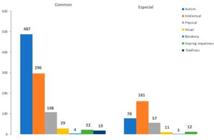
In Brazil, the National Policy for Special Education from an Inclusive Perspective (PNEEPI, 2008) is currently in force. In addition, numerous laws, decrees and regulations guide states and municipalities towards the organization of educational systems from an inclusive perspective, that is, students with disabilities are guaranteed enrollment in regular schools. Special schools continue to enroll students despite the understanding that Special Education is a type of education and, in this sense, it should permeate all levels. Regarding the type of enrollment, looking at the research as a whole for comparative purposes, most students with autism (487) were enrolled in regular schools, while there were 78 students in special schools (Graph 1). This data is interesting to visualize the profile of students who continue to attend special schools, that is, mainly students with intellectual disabilities.
Regarding the age of students with ASD, the average was 9 years old, with the youngest age being between 0 and 3 years old and the oldest age being 18 years old. More than half of the responses were from students in the 1st to 3rd year of elementary school, while the smallest number of responses were from high school students.
Regarding the type of education received during the period, the questionnaire directed respondents to two different streams of questions: a) whether they are carrying out school activities at home; b) whether they are not carrying out the activities.
In this way, with the closure of schools imposed by restrictive measures of contact and the need for social isolation, Ordinance 343 of the Ministry of Education was published in Brazil on March 17, 2020. The ordinance authorized classes that would use information and communication means and technologies on an exceptional basis. According to Grossi (2021), it is necessary to clarify that:
The education that has been offered during the COVID-19 pandemic, on an emergency, temporary basis and mediated by technology, is remote education. This is not considered distance learning (which is a well-structured and organized education modality for a more adult audience) and is also not homeschooling (which is a proposal for home education without the participation of an educational institution). Therefore, the remote teaching that has been practiced during the suspension of classes is a pedagogical strategy that resembles hybrid teaching and it is not considered a form of education. Furthermore, it is important to highlight that the government has no intention of making it a new educational system. (Grossi, 2021, p. 9).
For Arruda (2020), Emergency Remote Teaching (ERE) involves synchronous (live) classes, asynchronous (recorded) classes, and other activities. The content can be transmitted via television, radio, or the internet. The challenge of this teaching method, implemented in a hurry in school systems, it is the requirement for adequate equipment and physical spaces, in addition to the teacher’s minimum knowledge to deal with digital platforms. Some schools chose to send printed activities to students’ homes (CTE-IRB, 2020). In the case of students with disabilities, it is important to emphasize that there was no assessment of the students, before to the ERE implementation process, that could calculate the real difficulties of this group in following the classes.
Thus, the 568 questionnaires answered by family members of autistic children, 2 did not answer this question and 334, the majority, were taking classes and school activities at home. It is worth noting, however, that 268 students were not taking school activities, having their fundamental right to education denied during the pandemic.
For family members of students who received school activities, they were asked about the resources required by the family members, that is, support and accommodations that students should have to be able to follow classes. For Moores-Abdool (2010), providing access to the general curriculum for students with autism is very challenging. On the one hand, students with autism have different needs, on the other, teachers do not have adequate support. If this was already a challenge before the pandemic, during the pandemic, without support from the school systems, the situation became even more complicated and the challenge becomes even greater. In a recent study about teaching during the pandemic (Gestrado, 2020), it was shown that most teachers did not receive any specific training to learn about digital resources for Remote Teaching. This data is more worrying when it comes to students with disabilities, as specific resources are needed in the classroom, which will not always be the same at home, in addition to the lack of guidance for families. Neither teachers nor families were consulted about the students’ needs in the home environment (Monteiro, 2020). “In addition, a person living with a disability has their own perspective about their needs and necessary accommodations, which need to be taken into account when planning and interacting with them” (Orsati & Ashby, 2020, p. 189).
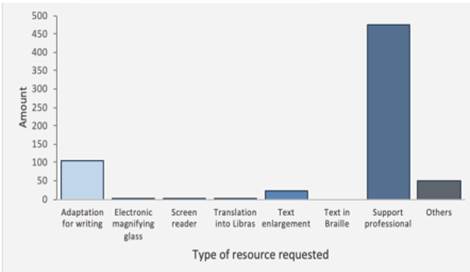
Among the supports needed to carry out school activities, the resource most requested by family members was the mediator/inclusion support assistant. For 91.8% of families, this was considered the most necessary resource. The second support indicated by respondents was adaptation for writing, with 25% of family members of autistic children requesting this resource, remembering that more than one option could be chosen for this question, as shown in graph 2.
According to the Brazilian Inclusion Law (BRAZIL, 2015), a support professional is defined as a person who performs feeding, hygiene, and mobility activities for students with disabilities. However, this professional often acts as a mediator, helping the student with tasks. In the case of ASD, the specific legislation is Law 12,764 of 2012, known as the Berenice Piana Law, which stipulates a specialized companion in the regular classroom, in cases where the student with autism has proven need. In this way, those students with autism who were able to participate in the ERE, 52.9% did not receive any type of individualized support, and those who received some type of individualized support, the most frequent was the virtual meeting with the mediator (17.6%). If, as described above, the mediator is the most necessary support, but is only available to 17.6% of the group, it is clear that there was negligence when teaching was transferred to the ERE. Qualitative data would be necessary to understand how the mediator has been performing in the context of remote teaching, especially because this is a role that is still riddled with controversy regarding its role, the profile of the professional, training, and regulations for exercising it.

Regarding the provision of ERE by schools, the questions focused on the types of activities and the time students spent on them. Almost 90% of the students who were doing school activities they received them to do at home at the time of the survey. When doing the activities sent by the school, without supervision from the teacher or mediator, only 4.1% of the students remained attentive the entire time, that is, most of them were unable to do the activities without help, regardless of the student’s age. In addition, only 9.2% of the students were able to do these activities autonomously or independently.
Approximately 40% of the students participate in distance learning classes using computer resources with the participation of the teacher live, and the duration of each distance learning class, in this model, it is on average 55 minutes. However, classes lasting 30 or 60 minutes are more common. In terms of tolerance time, less than 50% of students remain engaged in online classes and activities for more than half of the time in the teacher’s presence.
Without the presence of the teacher in person, the proportion of students who take classes remotely using computer resources increases by around 10%, reaching almost 50% of students. The average daily duration of these activities is a little less than 50 minutes. Activities lasting 15 or 30 minutes are more frequent. During the period of permanence in the activities, most students alternate between moments of attention and disinterest. Only 55% of students remain attentive the entire time, as shown in graph 3.

When we look at graph 3, we can see why families are asking for a mediator. More than 80% of students are unable to follow classes or do activities independently. This means that a large part of families, in this context of pandemic and remote work, have had to go out of their way to help their children with the activities. In this context, women tend to be the most affected. A survey conducted only with women in Brazil showed that 47% of them were responsible for caring for someone during this period (Sempreviva Organização Feminista and Organização Feminista Gênero e Número, 2020). As a result, women, who are the main caregivers for their children, have been exposed to double or triple work shifts.
When asked about how they carry out activities, 84% indicated that students do not carry out activities independently. The lack of students’ autonomy is directly related to the lack of planned activities. Without adequate planning, students receive material that was not prepared to meet their specific needs. As a result, the students are unable to carry out activities alone.
Before social isolation, a little over 50% of students had activities planned specifically for them. However, during social isolation, almost 60% of students did not have activities planned specifically for them, which indicates that some of the students who required adaptation of activities were not being served (at least 10%). In order for students with ASD to benefit from education in an emergency remote context, the adaptations are necessary, which implies planning, which must take into account the specificities of each student, both in terms of teaching objectives, considering difficulties and deficits, but also taking into account strengths and motivating interests.
In Chapter V of article 28 of the Brazilian Inclusion Law (2015) specifies that it is the responsibility of the public authorities to ensure maximum academic and social development, and in addition, to create, develop, implement, encourage, monitor and evaluate the adoption of individualized and collective measures for students with disabilities, in order to favor access, permanence, participation and learning in educational institutions. The same article of the Law, in Chapter III, clarifies that schools are obliged to promote “a pedagogical project that institutionalizes specialized educational services, as well as other reasonable services and adaptations, to meet the characteristics of students with disabilities” (BRASIL, 2015).
The fact is that, even before the pandemic, students were deprived of the right to adaptations. During the pandemic, the percentage increased by 10%, drawing attention to the importance of ensuring the right to curricular accessibility, which depends on planned adaptations and activities.
The activities planned specifically for students with ASD, when they were carried out, it had been planned most of the time by the main teachers (82%), followed by the mediators (51%) and then by the teachers of the Multifunctional Resource Rooms, who carry out the Specialized Educational Services (48%), and it is possible to indicate more than one professional as the one who carries out adaptations. It is important that the main teacher assumes this role, as he or she is responsible for the class and knows the curriculum. The mediator, in most cases, does not even have a high school education, and he/she is not the best person for this role. The resource room teacher and specialist in Special Education, as well as the regent, play an important role, as they can help the teacher in developing a set of activities, accessibility and pedagogical resources that help to promote curricular accessibility. In addition to these, health team professionals - psychologists, speech therapists, occupational therapists - were also mentioned as being responsible for educational planning.
The family members of 268 students with ASD who were not participating in school activities at the time of the survey were asked why the students were not taking classes or doing school activities. It is noteworthy that the majority, 231 students, corresponding to 86%, have not been doing any pedagogical activities.
From the caregivers’ point of view, at least half of the students miss the school. It is notable and worrying that 55% of the respondents said that the school did not even try to offer the activities. These, 17.4% responded that the school did not offer the activities even when requested by the family. It was possible to mark more than one answer, so 58% of respondents stated that the school tried, but the student was unable to attend classes via computer (Graph 4).

The survey also asked family members about the student’s agitation, as well as whether there was a loss, maintenance or gain of skills during the pandemic, as noted by respondents. In both cases, the situation was worrying: 68% of students became more agitated and 46% even lost skills during the period of social isolation and without continuing school activities.
DISCUSSION
The Covid-19 pandemic was an unexpected event, in terms of scale and consequences. Schools around the world were closed and millions of children were affected, but in countries where inequalities are striking, such as Brazil, the results tend to be worse. The UNICEF report points out that:
The Pesquisa Nacional por Amostra de Domicílios (Pnad) has been gathering data about the educational situation during the pandemic. In October 2020, the percentage of students aged 6 to 17 who were not attending school (in-person and/or remote learning) was 3.8% (1,380,891) - higher than the national average for 2019, which was 2%, according to the Continuous Pnad Survey. In addition to these students who were not attending, there were another 4,125,429 who said they were attending school but did not have access to school activities and they were not on vacation (11.2%). Thus, it is estimated that more than 5.5 million children and adolescents were denied their right to education in 2020. (UNICEF, 2021, p. 47).
The data discussed about the education of students with autism during the pandemic from the perspective of family members showed that many students did not have access to school activities, but even among those who did have access to activities, the right was denied. The main aspect to be highlighted is the lack of planning of activities accessible to students, which they could develop with the maximum possible autonomy.
In this sense, it is possible to state that the majority of students with ASD experienced significant and continuous interruptions in terms of access to support and education itself. The analysis of the responses also indicated that there was a worsening of ASD symptoms, with greater agitation and even loss of skills. Children with ASD who received support, such as assistance from an inclusion support professional (mediator) or adaptations of activities, were left uncovered during the pandemic, without the availability of this support to carry out pedagogical activities during this period. More efficient strategies for the inclusion of children and adolescents with ASD in the context of remote learning are necessary and urgent. The findings are similar to research conducted in other countries, such as the United States, Spain and England. On the other hand, it is essential to consider the possible losses that are accumulating for these students, living in a context of such long-lasting restrictions, as in Brazil, which means that measures will have to be taken to mitigate these losses for this population that already faces unique challenges on a daily basis. Furthermore, there is a dimension of updating of exclusion processes, since many typical children, less socially vulnerable, were able to adapt to the remote model and continue learning (Burgess & Sievertsen, 2020). While, once again, in an unequal manner, since there was no adequate planning to favor access to teaching-learning processes for poor children or children with disabilities, many autistic children found themselves without any support and without access to the fundamental right to education. In this sense, it is urgent and necessary for education systems to organize themselves for the return to in-person classes for students with ASD, based on the recognition that the students who will return to schools are not the same ones who were away. The period of isolation affected everyone, without distinction, but some were more affected than others.
References
-
Arruda, E. M. (2020). Educação remota emergencial: elementos para políticas públicas na educação brasileira em tempos de Covid-19.EmRede-Revista de Educação a Distância, 7(1), p. 257-275. https://www.aunirede.org.br/revista/index.php/emrede/article/view/621
» https://www.aunirede.org.br/revista/index.php/emrede/article/view/621 -
Berard, M., Rattaz, C., Peries, M., Loubersac, J., Munir, K., & Baghdadli, A. (2021). Impact of containment and mitigation measures on children and youth with ASD during the COVID-19 pandemic: Report from the ELENA cohort. Journal of Psychiatric Research, 137, 73-80. https://doi.org/10.1016/j.jpsychires.2021.02.041
» https://doi.org/10.1016/j.jpsychires.2021.02.041 -
Burgess, S., & Sievertsen, H. H. (2020). Schools, skills, and learning: The impact of COVID-19 on education. VoxEu org 1.2https://voxeu.org/article/impact-covid-19-education
» https://voxeu.org/article/impact-covid-19-education -
Comitê Técnico da Educação do Instituto Rui Barbosa (CTE-IRB), Interdisciplinaridade e Evidências no Debate Educacional (Iede) e Tribunais de Contas dos Estados Brasileiros (2020). Projeto A educação não pode esperar: ações para minimizar os impactos negativos à educação em razão das razões de enfrentamento ao novo coronavírus Recuperado em 14 de junho, 2021, de Recuperado em 14 de junho, 2021, de https://irbcontas.org.br/wp-content/uploads/2020/06/Estudo-A-Educa%C3%A7%C3%A3o-n%C3%A3o-Pode-Esperar_diagramado.pdf
» https://irbcontas.org.br/wp-content/uploads/2020/06/Estudo-A-Educa%C3%A7%C3%A3o-n%C3%A3o-Pode-Esperar_diagramado.pdf -
Garcia, L. P., & Duarte, E. (2020). Intervenções não farmacológicas para o enfrentamento à epidemia da COVID-19 no Brasil. Epidemiologia e Serviços de Saúde, 29(2), e2020222. https://doi.org/10.5123/s1679;49742020000200009
» https://doi.org/10.5123/s1679;49742020000200009 -
Gestrado - Grupo de Estudos sobre Política Educacional e Trabalho Docente. (2020). Trabalho Docente em Tempos de Pandemia - Relatório Técnico. Retratos da Escola, 14(30), 701-717. Recuperado em13 de junho, 2021, de Recuperado em13 de junho, 2021, de http://retratosdaescola.emnuvens.com.br/rde/article/view/1256
» http://retratosdaescola.emnuvens.com.br/rde/article/view/1256 -
Grossi, M. G. R. (2021). Usar tecnologias digitais nas aulas remotas durante a pandemia da COVID-19? Sim, mas quais e como usar? Olhar de professor 24, 1-12, e-15879.059. https://doi.org/10.5212/OlharProfr.v.24.15879.059
» https://doi.org/10.5212/OlharProfr.v.24.15879.059 -
Instituto Brasileiro de Geografia e Estatística. (2018). Nota técnica IBGE nº 1/2018, Releitura dos dados de pessoas com deficiência no Censo Demográfico 2010 à luz de recomendações do Grupo de Washington, p. 1-8. https://ftp.ibge.gov.br/Censos/Censo_Demografico_2010/metodologia/notas_tecnicas/nota_tecnica_2018_01_censo2010.pdf
» https://ftp.ibge.gov.br/Censos/Censo_Demografico_2010/metodologia/notas_tecnicas/nota_tecnica_2018_01_censo2010.pdf -
Instituto Brasileiro de Geografia e Estatística (2020). Pesquisa Nacional por Amostra de Domicílio (PNAD) https://covid19.ibge.gov.br/pnad-covid/
» https://covid19.ibge.gov.br/pnad-covid/ -
Instituto Nacional de Estudos e Pesquisas Educacionais Anísio Teixeira. INEP. (2012-2018). Censo da Educação Básica http://portal.inep.gov.br/web/guest/dados
» http://portal.inep.gov.br/web/guest/dados -
Lei nº 12.764 de 27 de Dezembro de 2012, Legislativo(2012). Institui a política nacional de proteção dos direitos da pessoa com transtorno do espectro autista; e altera o § 3º do art. 98 da Lei nº 8.112, de 11 de dezembro de 1990. Diário Oficial da União (28-12-2012) P. 2.: https://www.planalto.gov.br/ccivil_03/_ato2011-2014/2012/lei/l12764.htm
» https://www.planalto.gov.br/ccivil_03/_ato2011-2014/2012/lei/l12764.htm -
Lei n.º 13.146 de 6 de julho de 2015, Legislativo(2015). Institui a Lei Brasileira de Inclusão da Pessoa com Deficiência (Estatuto da Pessoa com deficiência). Diário Oficial da União (07-07-2015), p. 2. Brasília. Recuperado em 13 de fevereiro de 2019, de Recuperado em 13 de fevereiro de 2019, de http://www.planalto.gov.br/CCIVIL_03/_Ato2015-2018/2015/Lei/L13146.htm
» http://www.planalto.gov.br/CCIVIL_03/_Ato2015-2018/2015/Lei/L13146.htm -
May, D., Dale, I., & Judge, H. (2021). (National Autistic Society). Understanding the Impact of the Covid-19 Pandemic on the Education of Autistic School Age Children and Their Families. International Society for Autism Research - Virtual Annual Meeting. https://www.internetsociety.org/impact-report/2020/?gclid=EAIaIQobChMIuez9rIDm8gIVhYiRCh29sQucEAAYASAAEgIxT_D_BwE#education-in-pandemic
» https://www.internetsociety.org/impact-report/2020/?gclid=EAIaIQobChMIuez9rIDm8gIVhYiRCh29sQucEAAYASAAEgIxT_D_BwE#education-in-pandemic -
Ministério da Educação, Grupo de Trabalho da Política Nacional de Educação Especial. (2008). Política Nacional de Educação especial na perspectiva da educação inclusiva http://portal.mec.gov.br/arquivos/pdf/politicaeducespecial.pdf
» http://portal.mec.gov.br/arquivos/pdf/politicaeducespecial.pdf -
Misquiatti, A. R. N., Brito, M. C., Ferreira, F. T. S., & F Junior, F. B. A. (2015). Family burden and children with autism spectrum disorders: Perspective of caregivers. Revista CEFAC, 17, 192-200. https://doi.org/10.1590/1982-0216201520413
» https://doi.org/10.1590/1982-0216201520413 -
Monteiro, S. S. (2020). (Re)inventar educação escolar no brasil em tempos da Covid-19. Revista Augustus, 25(51), 237-254. Recuperado em 06 de junho, 2021, de https://doi.org/10.15202/1981896.2020v25n51p237
» https://doi.org/10.15202/1981896.2020v25n51p237 -
Moores-Abdool, W. (2010). Included Students with Autism and Access to General Curriculum: What Is Being Provided?.Issues in Teacher Education, 19(2), 153-169. https://files.eric.ed.gov/fulltext/EJ902680.pdf
» https://files.eric.ed.gov/fulltext/EJ902680.pdf - Orsati, F. T., & Ashby, C. (2020). O que não é negociável na educação inclusiva. In: Orsati et al (Eds.), Transdisciplinaridade e Interdisciplinaridade na Educação(pp. 183-204). São Paulo: Edicon.
-
Paula, C. S., Ribeiro, S. H., Fombonne, E., & Mercadante, M. T. (2011). Brief report: prevalence of pervasive developmental disorder in Brazil: a pilot study.Journal of autism and developmental disorders,41(12), 1738-1742. doi: https://doi.org/10.1007/s10803-011-1200-6
» https://doi.org/10.1007/s10803-011-1200-6 -
Rueda, C. S., Pérez, M. C., & Sarrionandia, G. E. (2021). El proceso de confinamiento por la Covid-19 del alumnado con trastornos del espectro autista escolarizado en centros ordinarios: un análisis cualitativo del impacto sobre ellos, sus necesidades futuras y las de sus familias.Siglo Cero Revista Española sobre Discapacidad Intelectual, (1), 141-161. https://doi.org/10.14201/scero202152e141161
» https://doi.org/10.14201/scero202152e141161 -
Schmidt, C., Nunes, D. R. P., Pereira, D. M., Oliveira, V. F., Nuernberg, A. H., & Kubaski, C. (2016). Inclusão escolar e autismo: uma análise da percepção docente e práticas pedagógicas.Psicologia: teoria e prática, 18(1), 222-235. https://doi.org/10.15348/1980-6906/psicologia.v18n1p222-235
» https://doi.org/10.15348/1980-6906/psicologia.v18n1p222-235 -
Sempreviva Organização Feminista & Organização Feminista Gênero e Número (2020). Sem Parar: O trabalho e a vida das mulheres na pandemia (Relatório de Pesquisa/2020). Recuperado em 18 setembro, 2020, de http://mulheresnapandemia.sof.org.br/wp-content/uploads/2020/08/Relatorio_Pesquisa_SemParar.pdf
» http://mulheresnapandemia.sof.org.br/wp-content/uploads/2020/08/Relatorio_Pesquisa_SemParar.pdf -
UNESCO. (2020). Relatório de Monitoramento Global da Educação 2020: Inclusão e Educação para Todos Paris. https://gem-report-2020.unesco.org/
» https://gem-report-2020.unesco.org/ -
UNICEF Brasil, Instituto Claro e Cenpec. (2021). Enfrentamento da cultura do fracasso escolar: Reprovação, abandono e distorção idade-série. https://www.unicef.org/brazil/relatorios/enfrentamento-da-cultura-do-fracasso-escolar
» https://www.unicef.org/brazil/relatorios/enfrentamento-da-cultura-do-fracasso-escolar - White, L. C., Law, J. K., Daniels, A. M., Vernoia, B., Xiao, S., SPARK Consortium, Feliciano, P., & Chung, W. K. (2021). Brief Report: Impact of COVID-19 on Individuals with ASD and Their Caregivers: A Perspective from the SPARK Cohort. Journal of autism and developmental disorders, 1-8. https://doi.org/10.1007/s10803-020-04816-6
Acknowledgement:
-
This study was carried out within the scope of the Instituto Nacional de Ciência e Tecnologia Política Educacional e Trabalho Docente, which is funded by the Conselho Nacional de Desenvolvimento Científico e Tecnológico (CNPq) - Process 406861/2022-6; the Coordination for the Improvement of Higher Education Personnel (CAPES) - Financing Code 001 and the Fundação de Amparo à Pesquisa do Estado de Minas Gerais(FAPEMIG) - 098/2024- Call INCT - MCTI/CNPq/CAPES/FAPs No. 58/2022 and Universal Demand01/2021, process APQ-00432-21.

 Source: Research data
 Source: Research data
 Source: Research data
 Source: Research data