 Effect of Toothbrushing with Vegan Dentifrices on the Roughness and Mass of a Nanoparticle Composite Resin
ABSTRACT
Objective: To evaluate the effect of dentifrices labeled as vegan on the mass and surface roughness of a nanoparticulate composite resin subjected to simulated toothbrushing, and to analyze the labeling of these products.
Material and Methods: Sixty composite resin specimens were divided into six groups (n=10): one control group using a conventional dentifrice (CG) and five test groups using dentifrices labeled as vegan (TG1, TG2, TG3, TG4, and TG5). Mass and surface roughness were measured before and after simulated brushing equivalent to six months (25,000 cycles) and twelve months (50,000 cycles) of use. The labeling analysis assessed the composition of the dentifrices and their compliance with Brazilian Health Regulatory Agency regulations.
Results: Mass analysis showed no significant differences between groups at either time point. Regarding surface roughness, the control group showed no significant change (p>0.05) after 6 and 12 months of brushing. However, the test groups exhibited variable responses. After twelve months, TG4 exhibited significantly greater roughness compared to CG, TG1, and TG2 (p<0.05), while TG5 showed greater roughness than CG and TG1 (p<0.05). Visual indicators of veganism were present on the packaging of the test dentifrices, although no certification seals were found.
Conclusion: The labeling analysis revealed that vegan dentifrices are not currently regulated by national or international agencies, raising concerns about their reliability and safety, as well as the absence of agents with proven anticaries efficacy. Additionally, while brushing with vegan-labeled dentifrices did not significantly increase the roughness or reduce the mass of the composite resin, their effects after twelve months of simulated brushing were comparable to those of conventional dentifrices.
Keywords:
Composite Resins; Dentistry; Dentifrices; Vegans.
Introduction
The growing demand for natural cosmetics free of chemical or synthetic ingredients has driven sales of natural, organic, and vegan products [1]. A pursuit of a healthier lifestyle primarily drives this trend, reflected in changes in dietary patterns, behaviors, and consumer choices [2].
A natural cosmetic product contains no chemical or synthetic additives. Its formulation may include raw materials of animal, plant, or mineral origin, but excludes substances such as petrolatum, silicones, synthetic preservatives, dyes, and fragrances. Organic cosmetics, in contrast, are derived from sustainable raw materials intended to minimize environmental, animal, and human impact. These products prohibit the use of synthetic pesticides and fertilizers. Vegan cosmetics, meanwhile, exclude any ingredients of animal origin and adopt a cruelty-free philosophy, which forbids animal testing for both safety and efficacy [3,4].
According to the Brazilian Health Regulatory Agency (ANVISA), which is responsible for protecting public health in Brazil through the sanitary regulation of products and services, personal hygiene cosmetics are defined by Collegiate Board Resolution (RDC) Nº. 752, dated September 19, 2022, as preparations made from natural or synthetic substances intended for external use on various parts of the human body, including the skin, teeth, and oral mucosa [5]. Dentifrices, which are cosmetic formulations, are typically available as creams, gels, or powders [6]. They are intended to clean and polish dental surfaces without damaging enamel or restorative materials [7].
Given the increasing availability of vegan dentifrices, which must be free of animal-derived ingredients and not tested on animals during manufacturing, and the absence of internationally accepted regulations for registering such products, nongovernmental organizations (NGOs) and independent private companies have assumed the role of certifiers [3,4]. These entities establish their own guidelines and labeling criteria to identify products that comply with vegan principles, ensuring the exclusion of animal-based components and animal testing [3,4].
There are various types of dentifrices available on the market, each formulated with specific components to fulfill distinct functions. Dentifrices contain active agents with therapeutic properties that enhance oral hygiene and help prevent and control dental caries, biofilm accumulation, and periodontal disease. Based on the type of therapeutic agent included, dentifrices can be classified as anticaries, antiplaque, anticalculus, anti-halitosis, desensitizing, or whitening [8]. In vegan-labeled dentifrices, medicinal plants are often incorporated as oils and extracts [9]. These formulations also include inactive ingredients, such as abrasives, humectants, binders, water, surfactants, flavorings, preservatives, sweeteners, and colorants, which help maintain the product's physicochemical stability and usability [6,8].
Recent literature on vegan dentifrices highlights the need for studies assessing their effects on hard dental tissues and esthetic restorative materials, given the potential for increased surface roughness and mass loss, which may compromise their physical properties and longevity. Therefore, this study aimed to evaluate, in vitro, the effect of vegan-labeled dentifrices on the mass and surface roughness of a nanoparticulate composite resin subjected to simulated brushing, and to analyze the labeling of these products.
Material and Methods
Sixty specimens of a nanoparticulate composite resin (CP) were prepared using Filtek Z350 XT (3M ESPE, Dental Products, St. Paul, Minnesota, USA), shade A2B, a universal restorative material. This resin was chosen for its favorable physical and mechanical properties, including optimal optical properties, gloss retention, color stability, and surface smoothness [9,10]. The specimens were randomly assigned to six groups (n=10) and subjected to simulated brushing cycles equivalent to six months (25,000 cycles) and twelve months (50,000 cycles) using a brushing machine (ElQuip MSEI, São Carlos, SP, Brazil) to assess the effects on mass and surface roughness. The selection of dentifrices was based on their composition, intended function, and brand (Figure 1).

Composition of dentifrices and manufacturer information by experimental group, as indicated on primary and secondary packaging.
Sample Preparation
A two-part metal matrix (Odeme Dental Research, Luzerna, SC, Brazil) with a 5 mm diameter and a 3 mm thickness was used to prepare the CPs. The resin was inserted in incremental layers, and each increment was polymerized using a DB light-curing unit with an intensity >500 mW/cm2 (Dabi Atlante SA Indústrias Médico Odontológica, Ribeirão Preto, SP, Brazil). Following preparation, CPs were stored in distilled water at 37 °C in a microbiological incubator (Q316M Quimis Ltda., Diadema, SP, Brazil). Complete mass stabilization (g) was confirmed by daily weighing over one month. Once stabilized, the CPs were embedded in orthophthalic resin (Center Glass, Salvador, BA, Brazil), ensuring that only the surface designated for analysis remained exposed. Each specimen was polished using a metallographic polisher (PL VO60, Biopdi Equipamentos para Ensaio de Materiais, São Carlos, SP, Brazil) with progressively finer abrasive papers [11], followed by finishing with Sof-Lex sanding discs (Pop ON, 3M do Brasil, São Paulo, SP, Brazil) for 15 seconds each [12].
Simulated Brushing
For the abrasion test, 50,000 cycles, equivalent to twelve months of brushing, were performed using a simulated brushing machine (ElQuip MSEI, São Carlos, SP, Brazil). Soft-bristled toothbrush heads (Classic Clean, Colgate-Palmolive Ind. e Com. Ltda., São Paulo, SP, Brazil) were attached to the machine's arms, which moved back and forth at 4.5 cycles per second. For each specimen, a dedicated toothbrush and a 20 mL syringe were used to dispense 0.4 mL of slurry every two minutes. Each dentifrice was weighed on a precision balance (model AY 220, Shimadzu do Brasil Ltda., São Paulo, SP, Brazil), diluted in distilled water at a 1:2 ratio [13], and placed into 20 mL syringes. After brushing, the specimens were removed from the machine, rinsed in an ultrasonic cleaner (L-200, Schuster Comercio de Equipamentos Odontologicos Ltda., Santa Maria, RS, Brazil) with distilled water for 10 minutes to eliminate residual dentifrice, and then dried for 2 minutes using a 25VR-100 three-way syringe (AirZap Anest Iwata, Limeira, SP, Brazil).
Mass Evaluation
The mass (g) of each CP was measured in triplicate using a precision balance before brushing and after simulated brushing at the 6-month (25,000 cycles) and 12-month (50,000 cycles) intervals.
Roughness Evaluation
Surface roughness of each composite resin specimen (CP) was measured using a roughness meter (Model SJ 301 Mitutoyo, Kawasaki, Japan). Measurements were taken in four different directions on each specimen, and the final roughness value was calculated as the average of these readings. A cutoff value of 0.8 mm and an “N” value (number of reading segments) of 5 were used, allowing the sensor tip to traverse the entire length of each specimen in a straight line for each measurement. Surface roughness was assessed both before brushing and after each simulated brushing interval.
Label Analysis
Label analysis was performed by reviewing the information provided on both the primary and secondary packaging of the dentifrices.
Statistical Analysis
Descriptive and exploratory analyses were conducted initially on the mass and surface roughness data. Because the data did not meet the assumptions for analysis of variance (ANOVA), nonparametric tests were used. The Kruskal-Wallis and Dunn tests were used for comparisons between groups, while the Friedman and Nemenyi tests were used for comparisons across time points. All analyses were conducted at 5% significance level using the R software.
Results
Mass
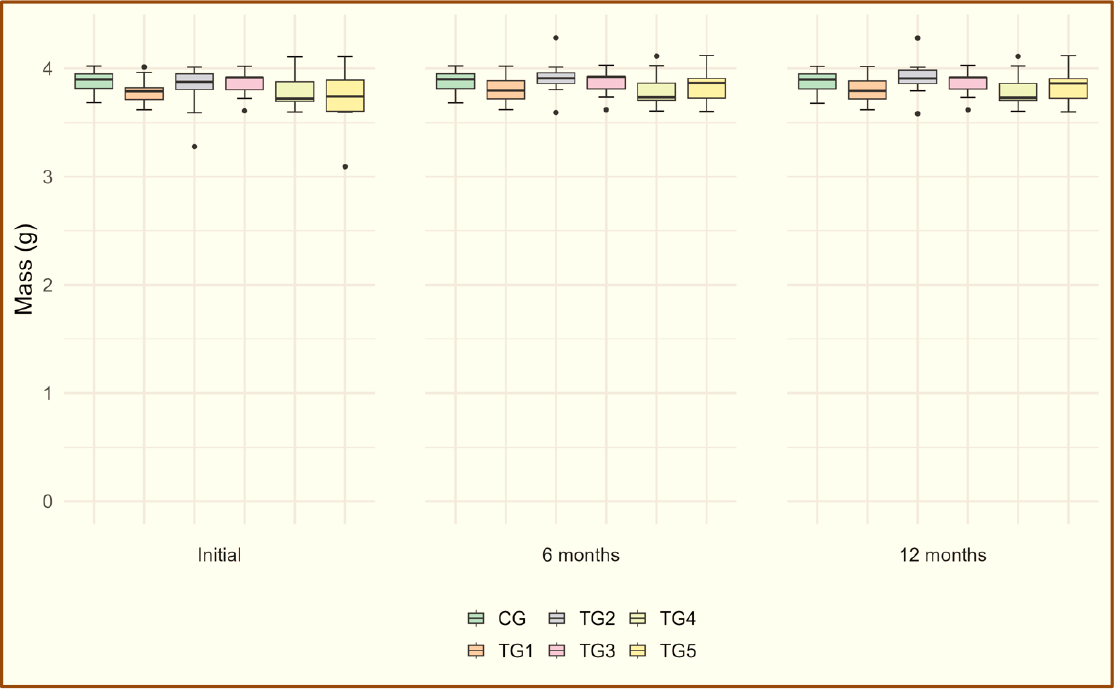
No statistically significant differences in mass (g) were observed between groups at baseline, after 6 months, or after 12 months of simulated brushing. However, a substantial increase in mass was detected in all test groups after 6 months of brushing compared to baseline (p < 0.05), except for the control group (CG), which remained stable. No significant differences were observed in any group when comparing baseline to 12 months (p > 0.05) (Figure 1).
Roughness
At baseline, there were no statistically significant differences in surface roughness between the control and test groups. Over time, the control group (CG) showed no substantial change in roughness after 6 or 12 months of simulated brushing (p>0.05). In contrast, TG1 and TG2 exhibited a significant increase in roughness after 6 months (p<0.05), while TG3, TG4, and TG5 did not show significant changes at this time point (p>0.05). After 12 months, TG3, TG4, and TG5 presented a significant increase in roughness compared to baseline (p<0.05). TG1 showed a considerable increase relative to the 6-month mark but not in relation to baseline (p>0.05), and TG2 exhibited no significant differences across all time points (p>0.05).
When comparing between groups, after 6 months of brushing, TG2 and TG5 demonstrated significantly higher roughness than CG and TG4 (p < 0.05). At the 12-month mark, TG3 showed no significant difference from either the control or the other test groups (p > 0.05). TG4 exhibited significantly greater roughness than CG, TG1, and TG2 (p < 0.05), while TG5 showed significantly greater roughness than CG and TG1 (p < 0.05) (Figure 2).

Label Analysis
The label analysis revealed that all dentifrices included in the study were labeled as vegan products on their packaging. However, only the dentifrices in groups TG4 and TG5 displayed a certification seal from the Instituto Biodinâmico de Desenvolvimento Rural (IBD). The remaining dentifrices did not feature any seals from recognized certification bodies.
The secondary packaging of all tested dentifrices featured visual elements appealing to vegans, though with varying presentations. These included manufacturer-specific seals and illustrations indicating that the product was vegan, natural, nontoxic, cruelty-free, and free of animal-derived ingredients. Additional claims included eco-friendliness, sustainability, recyclable packaging, and the absence of artificial colors, flavors, sweeteners, preservatives, fluoride, and gluten.
The composition analysis revealed the presence of medicinal plant extracts in the dentifrices of groups TG1, TG4, and TG5, while the dentifrices in groups TG2 and TG3 contained both plant extracts and essential oils.
Abrasive agents, either alone or in combination, were identified in all dentifrices, both in the control and test groups, with silica present in every formulation. Silica was the sole abrasive component in the dentifrices of groups CG and TG1. In contrast, it was combined with calcium carbonate in TG2, TG4, and TG5, and with both calcium carbonate and sodium bicarbonate in TG3.
Sodium fluoride (NaF) was present in the dentifrices of groups CG and TG1 at concentrations of 1450 ppm F⁻ and 1100 ppm F⁻, respectively. No fluoride was detected in the remaining dentifrices.
The compositional analysis also revealed the presence of sweeteners. Xylitol was detected in all tested dentifrices, always in combination with other sweeteners. In the dentifrices of groups TG1, TG4, and TG5, xylitol was combined with stevia, whereas in TG2 and TG3 it was combined with sucralose. In the control group (CG), sodium saccharin and sucralose were identified as sweeteners.
The conventional dentifrice (CG) and three of the test dentifrices (TG1, TG2, and TG3) included instructions on both the primary and secondary packaging, recommending brushing three times per day or as directed by a dentist. Dentifrices from groups TG4 and TG5 provided usage instructions only on the primary packaging.
Regarding brushing time, CG, TG1, and TG3 did not specify a minimum duration. In contrast, the dentifrice in group TG2 recommended a minimum brushing time of one minute using a 2 cm strip of product. Dentifrices in groups TG4 and TG5 were recommended to have a minimum brushing time of 120 seconds, as indicated on the primary packaging.
All dentifrice labels included precautionary statements regarding ingestion and advised keeping the product out of reach of children. The dentifrices in groups CG, TG1, and TG2 additionally specified that the product was intended for use by children over 6 years of age. They recommended a pea-sized amount for younger children, to be used under adult supervision.
Discussion
In recent years, there has been a notable increase in the availability of over-the-counter oral hygiene products formulated with natural ingredients and often marketed as safer and more effective alternatives. Vegan-labeled cosmetics, in particular, have emerged as a popular choice among consumers seeking a healthier lifestyle aligned with animal rights values [4,14].
The vegan consumer demographic typically includes individuals committed to a natural lifestyle, environmental sustainability, and ethical purchasing practices that support animal protection and welfare. The Brazilian market reflects this trend, offering a wide variety of cosmetic products, including vegan, natural, cruelty-free, and synthetic options. However, not all vegan products are necessarily natural, as some may contain synthetic components. According to existing definitions, natural products must contain at least 95% raw materials of natural origin and be free from petroleum derivatives and parabens [14].
In Brazil, there is currently no legislation regulating the use of the term “vegan” on cosmetic products or requiring manufacturers to obtain specific certification seals [4]. However, under ANVISA Resolution RDC Nº. 752, dated September 19, 2022, the Brazilian Ministry of Health mandates that cosmetic labeling must be legible and provide clear, truthful, and sufficient information to prevent misuse or misinterpretation of the product's intended purpose, including for personal hygiene products such as dentifrices. Packaging must not include statements that could mislead, confuse, or create a false impression about product characteristics, such as claims of complete elimination or death of microorganisms [5].
Dentifrices are formulated to clean and polish teeth as well as restorative materials; however, abrasive wear may occur due to the abrasiveness of the formulation and/or the brushing force applied [15]. Increased surface roughness of enamel and restorative materials can promote greater biofilm accumulation, reduce stain resistance, and compromise the natural gloss and longevity of restorations [16,17].
In the vegan-labeled dentifrices analyzed, various informational claims emphasized the absence of specific components, such as fluoride, in their formulations. Additionally, phrases and symbols were used to highlight the product's classification as natural and nontoxic. One label claimed the product was gluten-free, a substance not typically found in dentifrice formulations. Another tested dentifrice claimed it could eliminate 99.9% of the bacteria responsible for oral problems. Similarly, another label asserted that the dentifrice could eliminate fungi and harmful bacteria with extreme efficiency. However, in both cases, no information was provided about the specific agents responsible for these effects, underscoring the lack of relevant information available to consumers. Current regulations do not require manufacturers to provide detailed information on product packaging.
Among the test dentifrices evaluated in this study, all were labeled as vegan and featured illustrations or symbols resembling certification seals created by the manufacturers themselves. However, none displayed the official seal of the Brazilian Vegetarian Society (SVB), and only two (TG4 and TG5) carried the IBD certification seal. The remaining dentifrices lacked certification from any recognized national or international regulatory organizations.
The dentifrices in groups TG4 and TG5 displayed only the IBD seal for natural products, but not the IBD vegan seal. IBD is a Brazilian nongovernmental organization with international recognition that certifies organic products. One of the key requirements for the IBD vegan certification is the prohibition of animal testing - both for the ingredients used in manufacturing and for the final consumer product. Additionally, vegan certification excludes any ingredients of animal origin, including milk, eggs, honey, and all forms of animal protein, including hydrolyzed proteins [18,19].
Beyond the composition of dentifrices, other factors that influence wear on dental tissues and restorative materials include the force applied during brushing, the type of bristles used, and the brushing technique [20]. Abrasives are insoluble particles commonly found in dentifrices, functioning as mechanical whitening agents by removing extrinsic stains. The abrasiveness of these particles is influenced by their size, shape, hardness, and concentration [21]. Although qualitative information about abrasives was provided on the packaging of the dentifrices analyzed, the concentration of these ingredients was not disclosed. This is because, under current ANVISA regulations, manufacturers are not legally required to report the quantitative composition of ingredients, only their qualitative presence [5].
The results of this study showed no significant differences in CP mass between groups at the evaluated time points, suggesting similar effects among both the control and test dentifrices, regardless of their composition or brand. Despite methodological differences related to the types of dentifrices analyzed, these findings are consistent with previous studies that reported either no mass loss or only minimal, clinically insignificant loss following dentifrice brushing [22,23].
A comparison between baseline and the final evaluation (12 months) in the test groups revealed no significant changes in mass over time. However, a temporary increase in mass was observed in the test groups after 6 months of brushing. This may be attributed to the transient retention of dentifrice components on the resin surface, despite ultrasonic cleaning, as the increase was not observed at the 12-month mark.
Among the test dentifrices, only those in groups TG1 and TG3 showed statistically significant differences in mass at the 6- and 12-month time points. The dentifrice used in TG3 contained three different abrasives: calcium carbonate, sodium bicarbonate, and silica, which may have contributed to the variations in mass across brushing durations [20]. In contrast, the TG1 dentifrice contained only silica as its abrasive component.
Regarding surface roughness, no differences were observed between groups at baseline, as polishing conditions were standardized across all specimens. However, differences emerged after 6 and 12 months of simulated brushing. At the final evaluation point, dentifrices from groups TG4 and TG5, which contained a combination of hydrated silica and calcium carbonate, showed significantly greater surface roughness compared to the conventional dentifrice, which contained only silica. Interestingly, the dentifrice from group TG3, which also included these abrasive agents, did not differ significantly from the control. This suggests that dentifrices with similar qualitative compositions may vary in their effects due to differences in the quantitative concentrations of their components.
The compositional analysis further revealed that only the dentifrices from groups CG and TG1 contained fluoride and used silica as the sole abrasive, indicating chemical compatibility between these two agents. The remaining dentifrices were fluoride-free and included combinations of silica with calcium carbonate or sodium bicarbonate. The absence of fluoride compromises the anticaries efficacy of these formulations, as the fluoride's remineralizing effect is absent and cannot be replaced by other components. Fluoride plays a critical role in caries prevention by inhibiting demineralization and promoting enamel remineralization [24,25].
In Brazil, ANVISA establishes a maximum fluoride concentration of 1,500 ppm (F⁻) in dentifrice formulations but does not define a minimum threshold [26]. In contrast, the U.S. Food and Drug Administration (FDA) does not authorize the sale of dentifrices with low fluoride concentrations because there is insufficient evidence supporting their therapeutic efficacy [27]. ANVISA RDC Nº. 530, in effect since August 04, 2021, focuses solely on the safety of dentifrice use, without accounting for the well-documented anticaries benefits of fluoride [28].
Dentifrices may provide anticaries and/or antiplaque benefits by controlling the proliferation of oral bacteria and reducing tooth demineralization [29]. However, the labeling of the dentifrices analyzed in this study, combined with the general lack of consumer knowledge regarding oral health, may lead both vegan and non-vegan consumers to make misinformed choices, particularly in the absence of fluoride, which remains the most effective agent for preventing dental caries.
In addition to claims regarding natural and vegan classification, the dentifrice from group TG2 recommended a 2 cm strip for adults, which may be excessive. Although all dentifrices included warnings to keep the product out of reach of children, the age recommendations varied across products.
The dentifrices from groups CG, TG1, and TG2 recommended a pea-sized amount for children up to six years of age, with adult supervision during brushing. This guidance aligns with ANVISA RDC Nº. 639, which stipulates the same recommendation for children. However, RDC Nº. 639 is not consistent with the guidelines of international [28] and national [30] dental associations, which recommend using a rice-sized amount of fluoride dentifrice from the eruption of the first tooth and a pea-sized amount thereafter [31].
The label of the dentifrice in group TG3 advised against use by children under six years of age, despite claiming to be a “truly natural product, free of triclosan, parabens, fluoride, or harmful chemicals," and stating that it contained xylitol and was "scientifically proven to help fight tooth decay." This restriction is noteworthy, as the manufacturer did not provide a rationale for contraindicating its use in young children, typically done in the presence of potentially allergenic ingredients. In contrast, the dentifrices from groups TG4 and TG5 did not include any pediatric-use information.
Additionally, the TG3 dentifrice prominently featured a claim that xylitol has scientifically proven anticaries properties. However, the label did not specify the mechanism behind this effect. The current scientific literature does not support the notion that xylitol exerts an anticariogenic effect or promotes enamel remineralization equivalent to that of fluoride [32]. The control dentifrice contained 1,450 ppm fluoride, and the test dentifrice from TG1 contained 1,000 ppm; both concentrations were recognized as effective for caries prevention. These anticaries benefits were absent in the fluoride-free vegan-labeled dentifrices tested in this study.
An in vitro study comparing the effects of xylitol, sorbitol, maltitol, and mannitol on the remineralization of enamel surface lesions found that none of these polyols promoted remineralization of superficial enamel lesions [33]. Therefore, any anticaries effect attributed to xylitol, commonly present in vegan-labeled dentifrices but not scientifically proven, likely results from its antimicrobial activity, replacing fermentable sugars in the dentifrice formulation rather than from a direct remineralizing effect.
The inclusion of medicinal plants, in the form of extracts and essential oils, in dentifrice and mouthwash formulations is a well-established and expanding practice, as these compounds can serve both therapeutic and flavoring purposes. In the vegan dentifrices evaluated in this study, natural compounds were incorporated to leverage their documented antimicrobial activity in health care applications [34]. However, the use of medicinal plants in dentifrice formulations should be approached with caution to ensure efficacy, safety, and product reliability. Frequently, their presence is emphasized on packaging as a marketing strategy, reinforcing the product's natural, organic, or vegan identity often without adequate scientific support or regulatory oversight. Due to the absence of ANVISA regulations defining clear criteria for classifying vegan cosmetics and the lack of control over marketing claims on product labels, dental professionals should be particularly vigilant. Clinicians should understand the potential effects of these products on the oral cavity, dental tissues, and restorative materials so that they can provide informed guidance to patients, especially regarding the limited anticaries action of most vegan-labeled dentifrices.
Conclusion
The labeling analysis revealed a lack of certification seals and regulatory oversight by national and international agencies for vegan dentifrices, raising concerns about the reliability and safety of these products. Additionally, the absence of agents with proven anticaries efficacy, such as fluoride, further limits their therapeutic value. Although brushing with vegan-labeled dentifrices did not result in mass loss of nanoparticulate composite resin, a significant increase in surface roughness was observed in two test groups after 12 months of simulated brushing, when compared to the conventional dentifrice.
-
Financial Support
This study was funded in part by the Coordenação de Aperfeiçoamento de Pessoal de Nível Superior (CAPES), Brazil - Finance Code 001.
Data Availability
The data used to support the findings of this study can be made available upon request to the corresponding author.
ν References
-
[1] Rubin CB, Brod B. Natural does not mean safe - The dirt on clean beauty products JAMA Dermatology 2019; 155(12)L1344-1345. https://doi.org/10.1001/jamadermatol.2019.2724
» https://doi.org/10.1001/jamadermatol.2019.2724 -
[2] Saraiva A, Carrascosa C, Ramos F, Raheem D, Raposo A. Agave syrup: Chemical analysis and nutritional profile, applications in the food industry and health impacts. Int J Environ Res Public Health 2022; 19(12):7022. https://doi.org/10.3390/ijerph19127022
» https://doi.org/10.3390/ijerph19127022 -
[3] Kalil CLP, Vargas AS, Grazziotin FPR, Campos VB, Chaves CRP. Clean beauty: Artigo de revisão sobre a nova tendência em cosméticos. SBCD 2022; 14:E20220137. https://doi.org/10.5935/scd1984-8773.2022140137 [In Portuguese].
» https://doi.org/10.5935/scd1984-8773.2022140137 - [4] Flor J, Mazin MR, Ferreira LA. Cosméticos naturais, orgânicos e veganos. C&T 2019; 31:30-36. [In Portuguese].
- [5] Brasil. Ministério da Saúde. Agência Nacional de Vigilância Sanitária. Resolução RDC No 752, de 19 de setembro de 2022. Dispõe sobre os requisitos técnicos para regularização de produtos de higiene pessoal, cosméticos e perfumes. Diário Oficial da União. 2022 set 21; 160 (seção 1):177. [In Portuguese].
- [6] Subramanian S, Appukuttan D, Tadepalli A, Gnana PPS, Victor DJ. The role of abrasives in dentifrices. J Pham Sci Res 2017; 9(2);221-224.
-
[7] Pertiwi UI, Eriwati YK, Irawan B. Surface changes of enamel after brushing with charcoal dentifrice. J Phys 2017; 884:012002. https://doi.org/10.1088/1742-6596/884/1/012002
» https://doi.org/10.1088/1742-6596/884/1/012002 -
[8] Lippert F. An introduction to dentifrice - Its purpose, history and ingredients. Monogr Oral Sci 2013; 23:1-14. https://doi.org/10.1159/000350456
» https://doi.org/10.1159/000350456 -
[9] Lima TO, Silva MF, Geraldo-Martins VR. Evaluation of the surface microhardness of nanoparticulate resins submitted to erosive challenge. Braz J Health Rev 2021; 4(6):25248-25261. https://doi.org/10.34119/bjhrv4n6-133
» https://doi.org/10.34119/bjhrv4n6-133 -
[10] Almeida L, Santin DC, Maran BM, Naufel FS, Schimitt VL. Assessment of surface staining and roughness of direct restorative materials after different polishing systems: In vitro study. Rev Odontol UNESP 2019; 48:e20180096. https://doi.org/10.1590/1807-2577.09618
» https://doi.org/10.1590/1807-2577.09618 -
[11] Silveira RR, Silva MES, Souza EL, Giovannini JFBG, Francisconi PAS. Evaluation of microtensile bond strength of composite resin repair using different surface treatments. Arq Odontol 2012; 48(4):234-241. https://doi.org/10.7308/aodontol/2012.48.4.05
» https://doi.org/10.7308/aodontol/2012.48.4.05 -
[12] Souza KMRde, Silva RVdeM, Dias MF, Lins-Filho PC, Silva CHVda, Guimarães RP. Evaluation of different composite resin finishing and polishing protocols by confocal laser scan microscopy. Braz J Oral Sci 2022; 21(00):e225334. https://doi.org/10.20396/bjos.v21i00.8665334
» https://doi.org/10.20396/bjos.v21i00.8665334 -
[13] Tao D, Smith RN, Zhang Q, Sun JN, Philpotts CJ, Ricketts SR, et al. Tooth whitening evaluation of blue covarine containing dentifrices. J Dent 2017; 67S:S20-24. https://doi.org/10.1016/j.jdent.2017.10.014
» https://doi.org/10.1016/j.jdent.2017.10.014 - [14] Amaral F, Oliveira CJR. Cosméticos veganos - Artigo de opinião. BJNS 2023; 5(1):e1672023. [In Portuguese].
- [15] Rana M, Upadhya M, Jaiswal A, Tyagi K. Evaluation of surface roughness of nanofilled composite restorations after simulated tooth brushing using various dentifrices. Kathmandu Univ Med J 2018; 63(3):231-236.
-
[16] Rath SK, Sharma V, Pratap CB, Chaturvedi TP. Abrasivity of dentrifices: An update. SRM J Res Dent Sci 2016; 7(2):96-100. https://doi.org/10.4103/0976-433X.182662
» https://doi.org/10.4103/0976-433X.182662 -
[17] Chimello DT, Dibb RGP, Corona SAM, Lara EHG. Assessing wear and surface roughness of diferrent composite resins after toothbrushing. J Mater Res 2001; 4(4):285-289. https://doi.org/https://doi.org/10.1590/S1516-14392001000400011
» https://doi.org/https://doi.org/10.1590/S1516-14392001000400011 - [18] Instituto Biodinâmico. IBD Certificações. Diretrizes ingredientes naturais vegano. 2020. [In Portuguese].
- [19] Instituto Biodinâmico. IBD Certificações. Diretrizes para a certificação de produtos de saúde e beleza orgânicos e naturais e para ingredientes orgânicos e naturais. 5th. ed. 2014. [In Portuguese].
-
[20] Lippert F, Arrageg MA, Eckert GJ, Hara AT. Interaction between dentifrice abrasivity and toothbrush filament stiffness on the development of erosive/abrasive lesions in vitro. Int Dent J 2017; 67(6):344-350. https://doi.org/10.1111/idj.12305
» https://doi.org/10.1111/idj.12305 -
[21] Andrade Júnior ACC, Andrade MRTC, Machado WAS, Fischer RG. Estudo in vitro da abrasividade de dentifrícios. Rev Odontol Univ 1998; 12(3):231-236. https://doi.org/10.1590/S0103-06631998000300006 [In Portuguese].
» https://doi.org/10.1590/S0103-06631998000300006 -
[22] Oliveira RS, Simões HB, Odilon NN, Lima MJP, Campos EJ. Effect of whitening dentifrices containing optical agent on the variation of color, roughness and mass of a nanoparticulate composite resin. Rev Odontol Unesp 2020; 49:e20200073. https://doi.org/10.1590/1807-2577.07320
» https://doi.org/10.1590/1807-2577.07320 -
[23] Al Khuraif AA. An in vitro evaluation of wear and surface roughness of particulate filler composite resin after tooth brushing. Acta Odontol Scand 2014; 72(8):977-983. https://doi.org/10.3109/00016357.2014.933251
» https://doi.org/10.3109/00016357.2014.933251 -
[24] Cury JA, Caldarelli PG, Tenuta LMA. Necessity to review the Brazilian regulation about fluoride dentifrices. Rev Saude Publica 2015; 49:74. https://doi.org/10.1590/S0034-8910.2015049005768
» https://doi.org/10.1590/S0034-8910.2015049005768 - [25] Baldasso CN, Weber JBB, Coelho EMRB, Alves NM, Kramer PF. Sugar and oral health: A critical review of the literature. Stomatos 2020; 26(50):46-45.
- [26] Brasil. Ministério da Saúde. Agência Nacional de Vigilância Sanitária. Resolução RDC Nº 530, de 4 de agosto de 2021. Dispõe sobre a lista de substâncias que os produtos de higiene pessoal, cosméticos e perfumes não devem conter exceto nas condições, e com as restrições estabelecidas, a lista de componentes de fragrâncias e aromas que devem ser indicados na rotulagem desses produtos em condições específicas e internaliza a Resolução GMC MERCOSUL nº 24/11, alterada pela Resolução GMC MERCOSUL nº 37/20. [In Portuguese].
- [27] Venturin F, Valdivia-Tapia AC, Cury JA. Fluorosis from voluntary ingestion of fluoride paste after 5 years of age: case report and discussion of the importance of health education in early childhood. Rev Cient CRO-RJ 2021; 6(3):92-99.
-
[28] Clark MB, Slayton RL. Section on oral health. Fluoride use in caries prevention in the primary care setting. Pediatrics 2014; 134(3):626-633. https://doi.org/10.1542/peds.2014-1699
» https://doi.org/10.1542/peds.2014-1699 -
[29] Carvalho IO, Purgato GA, Piccolo MS, Pizziolo VR, Coelho RR, Diaz-Muñoz, et al. In vitro anticariogenic and antibiofilm activities of dentifrices formulated with essential oils. Arch Oral Biol 2020; 117:104834. https://doi.org/10.1016/j.archoralbio.2020.104834
» https://doi.org/10.1016/j.archoralbio.2020.104834 -
[30] Associação Brasileira de Odontopediatria. Orientação aos pais sobre cuidados com a saúde bucal do bebê e das crianças. 2023. Available from: https://saudeoral.com.br/wp-content/uploads/2024/06/ABOPED-Orientacoes-pais-cuidados-saude-bucal-bebe-criancas [Accessed on September 16, 2024]. [In Portuguese].
» https://saudeoral.com.br/wp-content/uploads/2024/06/ABOPED-Orientacoes-pais-cuidados-saude-bucal-bebe-criancas -
[31] Walsh T, Worthington HV, Glenny AM, Marinho VC, Jeroncic A. Fluoride dentifrices of different concentrations for preventing dental caries. Cochrane Database Syst Ver 2019; 43(3):CD007868. https://doi.org/10.1002/14651858.CD007868.pub3
» https://doi.org/10.1002/14651858.CD007868.pub3 -
[32] Janket SJ, Benwait J, Isaac P, Ackerson LK, Meurman JH. Oral and systemic effects of xylitol consuption. Caries Res 2019; 53(5):491-501. https://doi.org/10.1159/000499194
» https://doi.org/10.1159/000499194 -
[33] Shen P, Walker GD, Yuan Y, Reynolds C, Reynolds EC. Polyols and remineralisation of enamel subsurface lesions. J Dent 2017; 66:71-75. https://doi.org/10.1016/j.jdent.2017.08.008
» https://doi.org/10.1016/j.jdent.2017.08.008 -
[34] Monteiro MHDA, Fraga SAPM. Phytotherapy in dentistry survey of main plant products for oral health. Fitos 2021; 15(1):58-77. https://doi.org/10.32712/2446-4775.2021.1102
» https://doi.org/10.32712/2446-4775.2021.1102
Edited by
-
Academic Editor:
Alessandro Leite Cvalcanti