 Enhanced Effect of Zinc Oxide Cement Formulated with Eugenol and Oregano Essential Oil Against Streptococcus mutans - A Pilot Study
ABSTRACT
Objective: To evaluate the in vitro antimicrobial activity of zinc oxide cement formulated with eugenol and oregano essential oil (OEO) against Streptococcus mutans. OEO was chosen for its established activity against oral bacteria, although its incorporation into dental materials has not been previously reported.
Materials and Methods: Eugenol and an eugenol-OEO mixture were introduced into perforated wells on agar plates inoculated with S. mutans. Disk-shaped zinc oxide cement specimens formulated with either eugenol alone or the eugenol-OEO mixture were placed on the agar surface, and stick-shaped specimens were inserted into the agar. After incubation, the inhibition zones were measured. Statistical analysis included one-way ANOVA followed by Tukey's post hoc test for comparing inhibition zones from the oils. An unpaired t-test was used to compare the inhibition zones from the cement specimens. Statistical significance was set at p<0.05.
Results: OEO exhibited significantly greater antibacterial activity than other agents (p<0.001), including the positive control (0.12% chlorhexidine digluconate). Cement specimens (diskand stick-shaped) containing the eugenol-OEO mixture produced larger inhibition zones compared to those formulated with eugenol alone (p<0.05).
Conclusion: Zinc oxide cement formulated with eugenol and OEO demonstrated superior antimicrobial activity against S. mutans compared to the conventional formulation.
Keywords:
Dental Cements; Antibacterial Agents; Origanum; Clove Oil; Syzygium.
Introduction
Dental caries is recognized as a multifactorial disease that significantly impacts quality of life [1,2]. Streptococcus mutans plays a central role in its pathogenesis, primarily through its contribution to the formation of a dysbiotic biofilm [3,4]. The management of dental caries involves both preventive health strategies and clinical therapeutic procedures, including the removal of carious tissue followed by restorative treatment [5]. Temporary restorative materials are commonly used to protect the tooth and maintain function while definitive treatment is planned or performed [6,7].
Among these materials, zinc oxide cement formulated with eugenol, derived from clove oil (Syzygium aromaticum L.), is widely used in clinical practice due to its effective marginal sealing, analgesic properties, and antimicrobial effects [8-10]. However, studies on other essential oils [11,12], particularly from oregano (Origanum vulgare L.) [13,14], have demonstrated more potent antimicrobial activity, including against oral bacteria. This highlights its potential for enhancing the antimicrobial properties of dental materials.
Given these findings, the development of new formulations of zinc oxide cement incorporating essential oils with superior antimicrobial effects is of significant interest. Therefore, this pilot study aims to evaluate the antimicrobial effect of zinc oxide cement formulated with eugenol and oregano essential oil against S. mutans.
Material and Methods
Essential Oils and Cement Specimens
To assess the antimicrobial activity of the essential oils, eugenol from the Intermediate Restorative Material Kit (IRM, Dentsply Corp., Charlotte, NC, USA), containing 99.5% eugenol and 0.5% acetic acid, was used. Oregano essential oil (OEO) (Lazlo Aromas e Sabores Com. de Alimentos LTDA, MG, Brazil), with a carvacrol content of 50-60% (according to the manufacturer), and a mixture of eugenol (75% by weight) and OEO (25% by weight) were also tested.
For the preparation of cement specimens for antimicrobial testing, the Intermediate Restorative Material Kit (IRM - Dentsply Sirona Corp., Charlotte, NC, USA) was used, consisting of the following components: powder (zinc oxide, methyl methacrylate, and zinc acetate) and liquid (eugenol). The zinc oxide cement was prepared following the manufacturer’s recommended powder-to-liquid ratio of 6:1 by weight. Additionally, specimens were prepared using zinc oxide cement formulated with a mixture of eugenol (75% by weight) and OEO (25% by weight), maintaining the same powder-to-liquid ratio. The cement was spatulated and aseptically placed into silicone molds with cavities measuring 6 mm in diameter and 3 mm in depth to create disk-shaped specimens. Stick-shaped specimens were manually fabricated, measuring 3 mm in diameter and 7 mm in length, with their dimensions verified using a digital caliper.
Antimicrobial Test
Isolated colonies of Streptococcus mutans (ATCC 25175) were suspended in sterile saline solution (NaCl 0.9% w/v) to achieve a turbidity equivalent to 0.5 on the McFarland scale (1-2 × 10⁸ CFU/mL) to form microbial inoculum. This suspension was spread on Petri dishes containing tryptic soy agar (TSA) using a sterile swab. To evaluate the antimicrobial effects of the oils, 6 mm wells were created in the inoculated TSA using a sterile punch, and 40 µL of each oil (eugenol, OEO, and their mixture) was added to the wells. A 0.12% chlorhexidine digluconate solution was used as a positive control with the same volume.
To evaluate the antimicrobial activity of the cement specimens, disk-shaped specimens were placed directly onto the surface of the inoculated agar. In contrast, stick-shaped specimens were inserted perpendicularly into the agar to ensure deeper contact. The traditional cement served as the control group, whereas the cement formulated with eugenol and OEO represented the test group. In both experiments, all plates were incubated for 48 hours at 37°C under microaerophilic conditions. After incubation, the diameters of inhibition zones were measured using a digital caliper. All experiments were performed in quadruplicate (n = 4).
Statistical Analysis
Statistical analyses were performed using GraphPad Prism® software (Version 8.0.1). A one-way analysis of variance (ANOVA), followed by Tukey’s post hoc test, was used to compare the diameters of inhibition zones produced by the oils. The diameters of inhibition zones from the cement specimens in the control and test groups were compared using an unpaired t-test. Differences were considered statistically significant at p < 0.05.
Results
In the inhibition zone formation test, oregano essential oil (OEO) exhibited superior antibacterial activity against S. mutans compared to the other agents, including the positive control (0.12% chlorhexidine) (Figure 1A). The inhibition zones formed by OEO were approximately twice the size of those produced by the other agents, confirming its potent antibacterial effect. However, the combination of eugenol and OEO did not enhance the antimicrobial activity (Figure 1A).
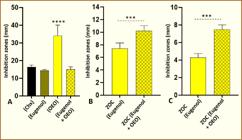
(A) Inhibition zones produced by the tested oils, alone or in combination; (B) and (C) Inhibition zones formed by the disk-shaped and stick-shaped cement specimens, respectively. Chx - 0.12% chlorhexidine digluconate; OEO - oregano essential oil; ZOC - zinc oxide cement; ***p<0.05; ****p<0.001.
Both types of cement specimens (disk and stick) from the control and test groups showed slight inhibition zones when placed on agar inoculated with S. mutans. However, the inhibition zones from specimens made with eugenol mixed with OEO were significantly larger than those from the traditional cement (Figure 1B and 1C).
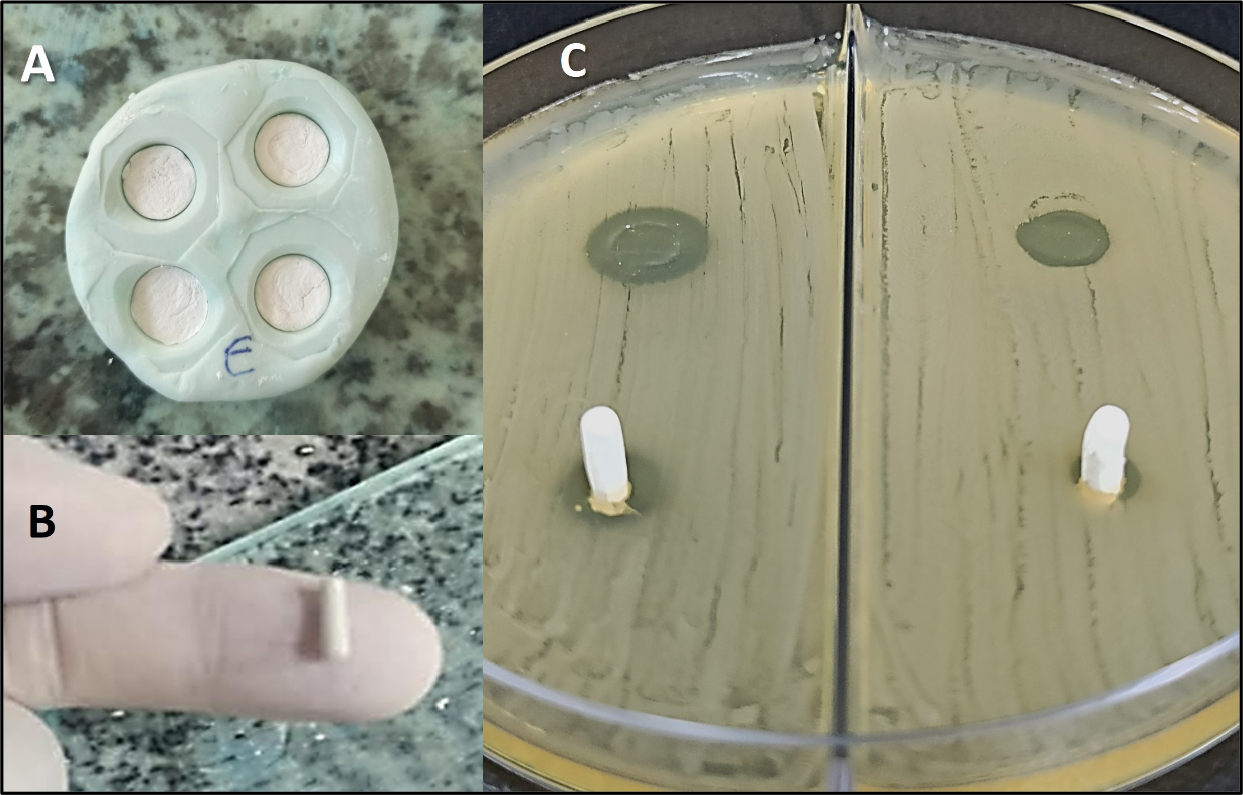
Figure 2A and 2B show pictures of the specimen-making process. In Figure 2C, on the left side of the Petri dish, the larger inhibition zones made by the cement with the mixed oils are observed compared to the traditional cement (right side).

(A) and (B) Fabrication of disk-shaped and stick-shaped specimens, respectively; (C) Representative Petri dish showing inhibition zones produced by specimens made with zinc oxide and eugenol + OEO (left side) and zinc oxide with eugenol only (right side).
Discussion
When selecting a provisional restorative material, several characteristics should be considered, including ease of handling, insertion, and removal; aesthetics; resistance to abrasion and compression; biocompatibility; insolubility; and good marginal sealing [7,8,15]. Additionally, since S. mutans is a key microbial etiological factor in the development of dental caries, dental materials should also exhibit antimicrobial properties [8,15]. The potent antimicrobial activity of oregano essential oil (OEO) has been demonstrated against various oral pathogens, including S. mutans, in accordance with the findings of the present study [14,16].
This effect is likely attributed to the direct action of OEO on bacterial cell walls, resulting in cell lysis and exerting both bacteriostatic and bactericidal effects [17]. OEO is rich in bioactive compounds with established antibacterial properties, including thymol, carvacrol, p-cymene, and γ-terpinene. Among these, the volatile compounds thymol and, particularly, carvacrol are recognized as the primary contributors to its pharmacological activity [18,19]. On the other hand, eugenol, a hydroxyphenyl propene volatile compound, demonstrated a weaker antibacterial effect compared to OEO in this study. Its antimicrobial activity is also linked to the disruption of the cytoplasmic membrane [20].
The results did not demonstrate an enhanced antimicrobial effect when combining eugenol (75% by weight) with OEO (25% by weight), likely because this OEO proportion was insufficient to produce a synergistic effect with eugenol. However, an improved effect was observed in the zinc oxide cement formulation containing eugenol combined with OEO. The smaller inhibition zones observed with the traditional cement, despite eugenol’s recognized antimicrobial properties [21], may be attributed to the limited release of eugenol from the cement after complete setting. This could be due to the reaction between eugenol and zinc oxide, resulting in the formation of zinc eugenolate [22]. Nevertheless, this reaction may not hinder the release of OEO from the cement, which, associated with its potent antimicrobial activity, could explain the larger inhibition zones produced by the test group.
Considering the limitations of an in vitro pilot study, this is, to the best of our knowledge, based on the consulted literature, the first study to evaluate the antimicrobial effects of zinc oxide cement formulated with eugenol associated with OEO. The antimicrobial activity was assessed using two types of specimens: disk-shaped and stick-shaped. Notably, the use of stick-shaped specimens, which is less common, provides an alternative approach for testing this type of material, as their lateral contact surface inside the agar may offer additional insights into antimicrobial diffusion. Further studies are necessary to evaluate potential changes in the cement’s physical and mechanical properties.
Conclusion
The zinc oxide cement formulated with eugenol and oregano essential oil demonstrated superior antimicrobial activity against S. mutans compared to the traditional formulation.
-
Financial Support
The authors are grateful for the financial support from UNIFSA/NIP (EDITAL nº 10/2021).
Data Availability
The data used to support the findings of this study can be made available upon request to the corresponding author.
References
-
[1] Bukhari OM. Dental caries experience and oral health related quality of life in working adults. Saudi Dent J 2020; 32(8):382-389. https://doi.org/10.1016/j.sdentj.2019.11.003
» https://doi.org/10.1016/j.sdentj.2019.11.003 -
[2] Pakkhesal M, Riyahi E, Alhosseini AN, Amdjadi P, Behnampour N. Impact of dental caries on oral health related quality of life among preschool children: Perceptions of parents. BMC Oral Health 2021; 21(1):68. https://doi.org/10.1186/s12903-021-01396-4
» https://doi.org/10.1186/s12903-021-01396-4 -
[3] Costalonga M, Herzberg MC. The oral microbiome and the immunobiology of periodontal disease and caries. Immunol Lett 2014; 162(2PtA):22-38. https://doi.org/10.1016/j.imlet.2014.08.017
» https://doi.org/10.1016/j.imlet.2014.08.017 -
[4] Zhu J, Chu W, Luo J, Yang J, He L, Li J. Dental materials for oral microbiota dysbiosis: An update. Front Cell Infect Microbiol 2022; (12):900918. https://doi.org/10.3389/fcimb.2022.900918
» https://doi.org/10.3389/fcimb.2022.900918 -
[5] Warreth A. Dental caries and its management. Int J Dent 2023; (2023):9365845. https://doi.org/10.1155/2023/9365845
» https://doi.org/10.1155/2023/9365845 -
[6] Slutzky H, Slutzky-Goldberg I, Weiss EI, Matalon S. Antibacterial properties of temporary filling materials. J Endod 2006; 32(3):214-217. https://doi.org/10.1016/j.joen.2005.10.034
» https://doi.org/10.1016/j.joen.2005.10.034 -
[7] Chiluka L, Shastry YM, Gupta N, Reddy KM, Prashanth NB, Sravanthi K. An in vitro study to evaluate the effect of eugenol-free and eugenol-containing temporary cements on the bond strength of resin cement and considering time as a factor. J Int Soc Prev Community Dent 2017; 7(4):202-207. https://doi.org/10.4103/jispcd.JISPCD_138_17
» https://doi.org/10.4103/jispcd.JISPCD_138_17 - [8] Gazlo RFL, Britto MLB, Machado MEL, Nabeshima, CK. Evaluation of the antibacterial activity of different temporary restorative materials. Rev Assoc Paul Cir Dent 2014; 68(4):250-253.
-
[9] Dragland IS, Wellendorf H, Kopperud H, Stenhagen I, Valen H. Investigation on the antimicrobial activity of chitosan-modified zinc oxide-eugenol cement. Biomater Investig Dent 2019; 6(1):99-106. https://doi.org/10.1080/26415275.2019.1697621
» https://doi.org/10.1080/26415275.2019.1697621 -
[10] De Grado Gabriel F, Clément B, Florence F, Anne-Marie M, Damien O. Efficacy of articaine or eugenol for pain relief after emergency coronal pulpotomy in teeth with irreversible pulpitis: A randomized clinical trial. Dent J 2023; 11(7):167. https://doi.org/10.3390/dj11070167
» https://doi.org/10.3390/dj11070167 -
[11] Mohammed HA, Abdel-Aziz MM, Hegazy MM. Anti-oral pathogens of Tecoma stans (L.) and Cassia javanica (L.) flower volatile oils in comparison with chlorhexidine in accordance with their folk medicinal uses. Medicina 2019; 55(6):301. https://doi.org/10.3390/medicina55060301
» https://doi.org/10.3390/medicina55060301 -
[12] Mohammed HA, Sulaiman GM, Khan RA, Al-Saffar AZ, Mohsin MH, Albukhaty S, et al. Essential oils pharmacological activity: Chemical markers, biogenesis, plant sources, and commercial products. Process Biochem 2024; 144:112-132. https://doi.org/10.1016/j.procbio.2024.05.021
» https://doi.org/10.1016/j.procbio.2024.05.021 -
[13] Hejazinia F, Fozouni L, Azami NS, Mousavi S. The anti-biofilm activity of oregano essential oil against dental plaque-forming Streptococcus mutans in vitro and in vivo. J Kermanshah Univ Med Sci 2020; 24(3):e107680. https://doi.org/10.5812/jkums.107680
» https://doi.org/10.5812/jkums.107680 -
[14] Silva ECAD, Leuthier LL, Almeida Júnior A, Nunes JMFF, Correia Sampaio F, Farias IAP. Physicochemical characteristics and antimicrobial activity of Origanum vulgare L. essential oil and carvacrol on cariogenic bacteria: An in vitro and in silico study. Nat Prod Res 2022; 36(24):6410-6413. https://doi.org/10.1080/14786419.2022.2034809
» https://doi.org/10.1080/14786419.2022.2034809 -
[15] Slutzky H, Slutzky-Goldberg I, Weiss EI, Matalon S. Antibacterial properties of temporary filling materials. J Endod 2006; 32(3):214-217. https://doi.org/10.1016/j.joen.2005.10.034
» https://doi.org/10.1016/j.joen.2005.10.034 -
[16] Yuan Y, Sun J, Song Y, Raka RN, Xiang J, Wu H, et al. Antibacterial activity of oregano essential oils against Streptococcus mutans in vitro and analysis of active components. BMC Complement Med Ther 2023; 23(1):61. https://doi.org/10.1186/s12906-023-03890-4
» https://doi.org/10.1186/s12906-023-03890-4 -
[17] Lambert RJ, Skandamis PN, Coote PJ, Nychas GJ. A study of the minimum inhibitory concentration and mode of action of oregano essential oil, thymol and carvacrol. J Appl Microbiol 2001; 91(3):453-462. https://doi.org/10.1046/j.1365-2672.2001.01428.x
» https://doi.org/10.1046/j.1365-2672.2001.01428.x -
[18] Bairamis A, Sotiropoulou N-SD, Tsadila C, Tarantilis P, Mossialos, D. Chemical composition and antimicrobial activity of essential oils and hydrosols from oregano, sage and pennyroyal against oral pathogens. Appl Sci 2024; 14(8):3238. https://doi.org/10.3390/app14083238
» https://doi.org/10.3390/app14083238 -
[19] Khoshbakht T, Karami A, Tahmasebi A, Maggi F. The variability of thymol and carvacrol contents reveals the level of antibacterial activity of the essential oils from different accessions of oliveria decumbens. Antibiotics 2020; 9(7):409. https://doi.org/10.3390/antibiotics9070409
» https://doi.org/10.3390/antibiotics9070409 -
[20] Marchese A, Barbieri R, Coppo E, Orhan IE, Daglia M, Nabavi SF, et al. Antimicrobial activity of eugenol and essential oils containing eugenol: A mechanistic viewpoint. Crit Rev Microbiol 2017; 43(6):668-689. https://doi.org/10.1080/1040841X.2017.1295225
» https://doi.org/10.1080/1040841X.2017.1295225 -
[21] Fatene N, Mounaji K, Soukri A. Effect of eugenol on Streptococcus mutans adhesion on NiTi orthodontic wires: In vitro and in vivo conditions. Eur J Gen Dent 2021; 10(03):151-157. https://doi.org/10.1055/s-0041-1736372
» https://doi.org/10.1055/s-0041-1736372 -
[22] Wilson AD, Clinton DJ, Miller RP. Zinc oxide-eugenol cements. IV. Microstructure and hydrolysis. J Dent Res 1973; 52(2):253-260. https://doi.org/10.1177/00220345730520021201
» https://doi.org/10.1177/00220345730520021201
Edited by
-
Academic Editor:
Alidianne Fábia Cabral Cavalcanti