 Impact of Visual Criteria for Caries Detection Around Restorations on Reproducibility and Treatment Decision
ABSTRACT
Objective: To assess the reproducibility of two clinical approaches based on visual criteria for evaluation of carious lesions around the restorations in primary teeth and the impact on treatment decisions.
Material and Methods: Twenty-five photographs of resin composite restorations on primary teeth, including all scores of the two criteria, were selected. Restorations’ evaluations were performed by five specialists in Pediatric Dentistry. All examiners underwent training to use both criteria. First, the evaluations were performed based on FDI criteria, and 1 month later, with CARS criteria. The consensus of two benchmark examiners was considered to be the reference standard. Kappa statistics were used to determine inter-examiner reliability, considering the scores of both criteria. The Wilcoxon test was used to compare the treatment decision with two criteria. The chi-square test was used to compare the frequencies of true positives, true negatives, false positives, and false negatives across two criteria. The significance level was set at 5%.
Results: Inter-examiner reliability ranged from 0.53 to 0.63 and 0.54 to 0.71 when using FDI and CARS systems, respectively. A higher frequency of false negative results was observed when using the FDI criteria, while the CARS system leads to more true positive results.
Conclusion: The CARS and FDI criteria present moderate to good inter-examiner reproducibility in the photographic evaluation of resin composite restorations in primary teeth. However, the use of the CARS system results in more assertive decision-making.
Keywords:
Clinical Decision-Making; Dental Restoration Failure; Tooth; Deciduous.
Introduction
Caries lesions around the restoration, also called secondary or recurrent caries [1], are considered one of the major reasons for restoration failure [2,3]. Secondary caries is a complex process, combining well-known causes of "conventional" caries with the specificities of the restorations and restorative materials [4]. From these particularities, the buffering capability of dental materials, as well as the presence of marginal defects in the restorations, are known to play a role in the process [4]. But in the end, the process results in (and should be diagnosed as) demineralization detectable at the margin of an existing restoration, and the treatment decision should be based solely on the clinical signs observed [5].
The visual inspection is the most commonly used method to detect secondary caries. Nevertheless, an accurate diagnosis of caries lesions around restorations is often challenging for dentists due to confounding factors such as gaps between the restoration and tooth surface and marginal staining [6]. Detailed visual systems have been proposed to improve the accuracy and reliability of visual inspection for caries around restorations. Among the available criteria, the International Caries Classification and Management System (ICCMS) and CariesCare 4D include a list of well-described criteria for Caries Associated with Restorations and Sealants (CARS) [7,8]. On the other hand, the criteria proposed by the World Dental Federation (FDI) [9] are based on the evaluation of functional, esthetic and biological parameters, being one of those the “recurrence caries at restoration margin”.
Reinterventions in restored teeth invariably remove healthy dental tissue and weaken the remaining structure, accelerating the restorative death spiral [10]. A recent study [11] evaluated the influence of using FDI and CARS criteria to assess carious lesions around restorations on the decision to replace restorations in primary molars. FDI criteria suggested more invasive treatments compared to the CARS system [11]. It is important to highlight that other parameters of the FDI criteria such as marginal staining and defects on marginal adaptation, that are important confounders for clinicians during the clinical assessment of caries lesions around restorations, were considered, leading to a potential overdiagnosis, and, consequently, overtreatment.
Recently, it has been shown that CARS system is more accurate in detecting caries around restorations in primary teeth than the FDI criteria, when caries at the restoration margin, marginal staining, and marginal adaptation were analyzed together for the latter. However, FDI caries recurrence presented similar performance to the CARS system for dentin threshold [12].
Although the use of these criteria by an experienced examiner has been analyzed, to the best of our knowledge, no previous study evaluated the inter-examiner reproducibility when clinicians use the two criteria for detecting caries around restorations. In addition, the comparison of both criteria, considering only caries at the restoration margin of the FDI system, has not yet been investigated. Thus, this study aimed to assess the reproducibility of two clinical approaches based on visual criteria for evaluation of carious lesions around the restorations in primary teeth and the impact on treatment decisions.
Material and Methods
Setting and Study Design
The present study was conducted at the Faculty of Dentistry of the Federal University of Rio Grande do Sul. The local committee for ethics in research approved the protocol (CAEE number: 71774323.2.0000.5347). This study was reported following the Guidelines for Reporting Reliability and Agreement Studies [13]. Five specialists in Pediatric Dentistry who had 2 or 3 years of clinical experience were involved as examiners.
The two diagnostic criteria were evaluated: FDI [9] and CARS [7,8] systems. The FDI criteria are based on three different categories: esthetic, functional and biological. Each category is divided into subcategories totalizing 16 evaluated aspects. Each subcategory is scored according to a five-step grading of the restoration, cross-linked with possible management strategies: reviewing/monitoring (scores 1-2), refurbishment/reseal (score 3), repair (score 4), and replacement (score 5) [9]. For the study, only the subcategory “caries at restoration margin” was considered (Table 1).
The CARS criteria was derived from the International Caries Detection and Assessment System (ICDAS), and it has been the criteria proposed in the ICCMS and the updated CariesCare 4D [7,8]. The restorations are evaluated with a score ranging from 0 (’sound tooth surface with restoration’) to 6 (’extensive distinct cavity with visible dentin’). The treatment options are based on the recommendations described in [7,8] to treat coronal primary caries lesions, including: no treatment, professional topical fluoride application, refurbishment, repair, and replacement [5,11] (Table 2).
Lesion’s characteristics and treatment indication, respectively, of each CARS code based on CariesCare International 4D.
Examiners’ Training
Training sessions were conducted by a benchmark examiner (T.L.L.). The training consisted of a lecture about the criteria and the evaluation of a series of photographs with restorations in primary teeth. The examiners and expert discussed the evaluation and treatment of each restoration according to the FDI and CARS criteria. Different sessions for each system were established. A draw was made to define the order of training and subsequent restoration’s evaluation according with each system. First, the examiners were trained to use FDI criteria, and after 1 month to use the CARS system.
Restorations’ Evaluation
A convenience sample of 25 resin composite restorations on primary teeth was selected, including all scores of the two criteria. A clinical database between 2022 and 2024 from the Children and Youth Dental Clinic, School of Dentistry, Federal University of Rio Grande do Sul, was searched for clinical photographs of resin composite restorations on primary teeth. All photographs were made with a digital camera (D3200; Nikon Corp., Tokyo, Japan) with a macro lens (AF-S DX Micro NIKKOR 85mm f/3.5G; Nikon Corp., Tokyo, Japan). One photograph per restoration was used for the evaluation. After selection, each photograph was cropped into a square shape to leave the tooth and restoration centered in the image, using the following specifications: 1500×1500 pixels at a resolution of 150 pixels per inch.
Firstly, the five examiners, blinded to each other’s observations, independently evaluated the 25 restorations in the same order according to FDI criteria. The photographs were projected on a 50" HD television in a dark room. Considering the clinical situation, the evaluation was performed quickly, not exceeding 60 seconds per image. After 1 month, the examiners reevaluated the same set of 25 photographs in random order under the same conditions according to CARS system. The randomization was made using a software (Excel 2010; Microsoft Corp., Redmond, WA, USA), by populating a random number for each restoration and sorting the list based on the random number. The examiners were oriented to evaluate the photographs exclusively regarding caries around the restorations, even if other aspects, such as any loss of restoration material or anatomic form alteration, were evident.
Standard Reference
After the examinations, two examiners who had experience in using the visual criteria for evaluation of carious around the restorations (T.L.L. and C.P.C.) also evaluated the photographs and the restorations were classified by consensus. Examiners’ evaluation results were compared to the reference standard, and the non-coincident results were considered as false results.
Statistical Analyses
The descriptive analysis provides the distribution summary of restorations according to the evaluation using FDI and CARS systems, and results based on the reference standard. Kappa values and respective 95% confidence intervals were calculated and used to determine inter-examiner reliability, considering the scores of both criteria. The treatment for restorations assessed by both criteria was classified into: no invasive treatment (restorations requiring monitoring, refurbishment/reseal or those with an indication of topical fluoride application), repair, or replacement [5]. The strength of agreement for the Kappa value can be interpreted as follows: < 0.20: Poor; 0.21-0.40: Fair; 0.41-0.60: Moderate; 0.61-0.80: Good; 0.81-1.00: Excellent [14]. The Wilcoxon test was used to compare the treatment decision with two criteria. Chi-square test was used to compare the frequency of true positive, true negative, false positive, and false negative results when using two criteria. The significance level was set at p<0.05. Statistical analyses were performed using the IBM SPSS Statistics for Windows, Version 30.0 (IBM Corp.; Armonk, NY, USA).
Results
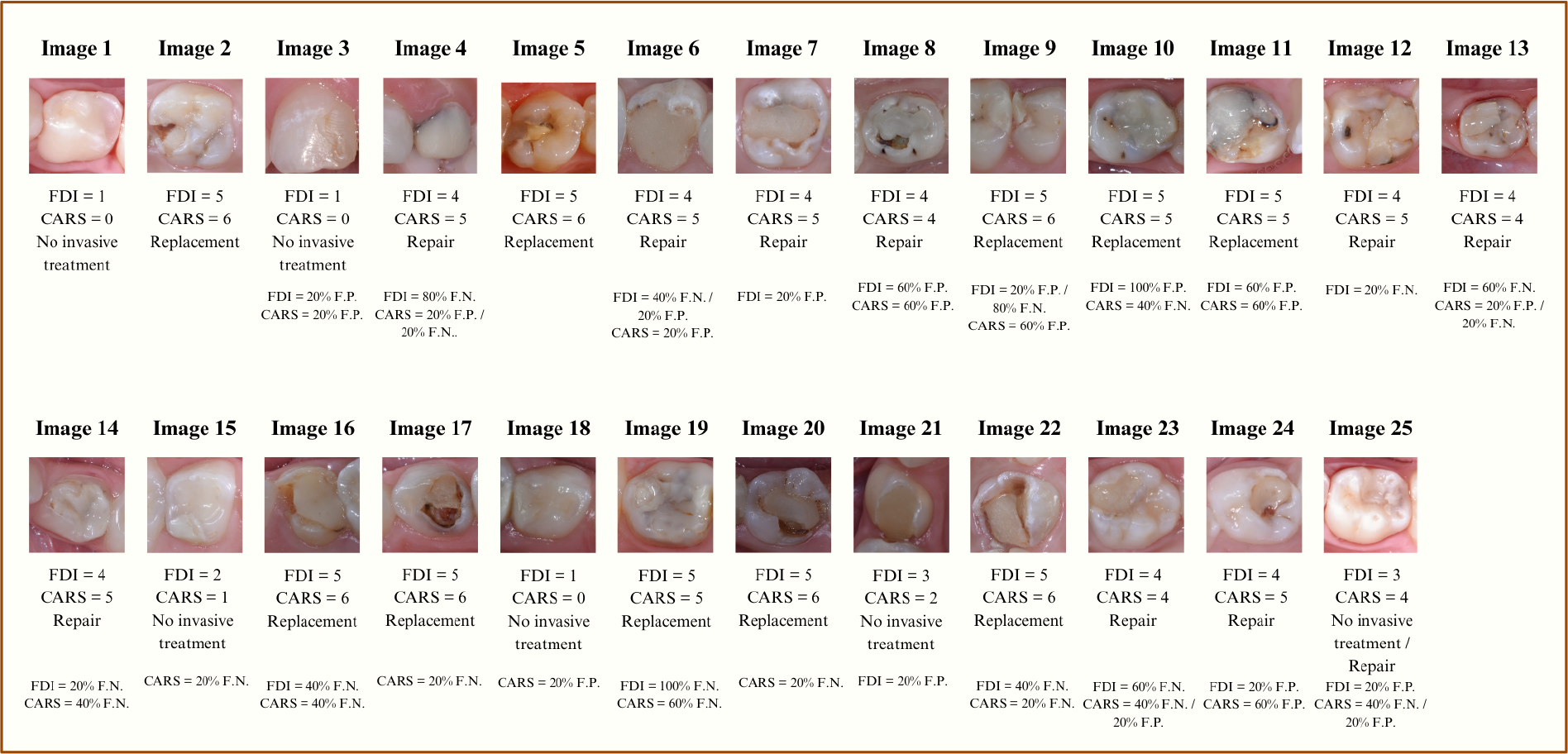
Of the 25 restorations evaluated, 3 were classified as score 1, 1 as score 2, 2 as score 3, 9 as score, 4 and 10 as score 5 by the FDI criteria according to the reference standard. Of these, 10 were indicated for replacement and 9 for repair, and 6 demanded no invasive treatment. According to the CARS criteria, 3 restorations were classified as score 0, 1 as score 1, 1 as score 2, 3 as score 4, 10 as score 5, and 7 as score 6. Of these, 5 did not require invasive intervention, 10 needed replacement, and 10 needed repair.
Table 3 presents the Kappa coefficient and 95% confidence interval for inter-examiner reproducibility with FDI and CARS scores. Overall, lower Kappa values were obtained with FDI criteria. However, inter-examiner agreement ranged from moderate to good for both systems.
Kappa coefficient and 95% confidence interval for inter-examiner reproducibility with FDI and CARS scores.
Table 4 summarizes the examiners' evaluation of treatment decisions based on FDI and CARS criteria. CARS system suggested more invasive treatments when compared with the FDI method (p<0.001). A higher frequency of false negative results was observed when the examiners used the FDI criteria, while the use of the CARS system leads to more true positive results. These findings show that the use of the CARS system results in more assertive decision-making (Table 5). Figure 1 summarizes the restorations’ assessment according to the reference standard and the frequency of false results.

Restorations’ assessment according to reference standard and the frequency of false results.
Discussion
This study provides valuable information regarding the reproducibility and clinical decision-making of two criteria commonly used to evaluate caries around restorations. Several statistical methods can be used in reliability studies, but no single approach has been regarded as a standard [13]. According to the Quality Appraisal of Reliability Studies, categorical data should be analyzed with the kappa statistic, whereas continuous data would be better analyzed with the intraclass correlation coefficient [15]. Based on Kappa statistics, inter-examiner reliability was scored as moderate and good, ranging from 0.53 to 0.63 and 0.54 to 0.71, when using FDI and CARS systems, respectively.
It is essential to emphasize that a sample of examiners was selected (invited) to participate in this study. This probably influenced this agreement, since the examiners’ interest is proportional to the dedication on assessments. The reference method may also be contributing to this finding. Most published studies on decision-making related to restorations did not use a clinically relevant reference method [16]. Using the expert’s consensus as a reference may result in less impact on the implementation of the criteria, since similar domains may be used. On the other side, it may approximate the results from those is really important to be seen in a clinical situation and considered in the decision-making.
Overall, higher kappa values were found when the restorations were evaluated with CARS criteria. Although the CARS system comprises seven scores and the FDI criteria consist of five codes, the CARS system provides more detailed information about each stage of the caries process than the FDI caries at the restoration margin. There is no corresponding evaluation score in the FDI criteria for caries adjacent to restoration with an underlying dark shadow from dentin (corresponding to CARS score 4). When the examiners performed assessments with CARS criteria, they had already carried out the examinations previously with the FDI system. Therefore, they were more highly trained than the first time. They could have maintained a residual effect from the first method, particularly because both methods for caries around restoration assessment consider similar clinical characteristics. Also, the use of ICDAS [8] to evaluate the carious lesions is part of the clinical practice of the examiners of this study, which may have simplified the use of CARS system, improving the inter-examiner agreement.
Regarding the treatment decision, CARS system suggested more invasive treatments when compared with the FDI method. The use of CARS criteria suggested more invasive treatments in comparison with FDI. According to the reference standard, a higher number of true positives was observed when using the CARS method. On the other hand, the use of FDI criteria resulted in more false negative results, i.e., the examiners did not invasively intervene when necessary or indicated the repair when replacement was required. These findings show the examiners had a more assertive decision-making when the CARS system was used.
Previous studies showed that the use of the FDI method by experienced and trained examiners led to indicate more invasive treatments than using CARS system to evaluate posterior restorations in primary [11] and permanent [5] teeth. Nevertheless, the marginal staining, marginal integrity, and gap width were evaluated together with caries at the restoration margin when the FDI system was used, leading to overtreatment. In the present study, no significant difference regarding the number of false positive results was found between the two criteria. It may be explained because only the caries at the restoration margin of the FDI criteria was considered.
Finally, the study limitations must be addressed. A small number of restorations were assessed. In addition, the evaluation of caries at restoration margins from photographs of restorations may be difficult without clinical examination. All examiners have the same clinical level of experience. In fact, one goal of using visual scoring systems is the minimization of the inherent subjectivity of clinical examinations. Nevertheless, although the use of CARS and FDI systems seems to be logical, clinicians (mainly more experienced ones) think differently from each other in clinical settings. They are accustomed to drawing on past clinical experience to make a diagnosis, and therefore, they can be more resistant to learning about prescriptive methods of clinical examination. Further studies addressing the performance of examiners more experienced in the restorations’ evaluation based on both criteria, or even including a wider variety of students, are necessary.
Conclusion
The CARS and FDI criteria present moderate to good inter-examiner reproducibility in the photographic evaluation of resin composite restorations in primary teeth. However, the use of the CARS system results in more assertive decision-making.
-
Financial Support
This study was financed in part by the Coordenação de Aperfeiçoamento de Pessoal de Nível Superior - Brazil (CAPES) - Finance Code 001.
Data Availability
The data used to support the findings of this study can be made available upon request to the corresponding author.
References
-
[1] Nedeljkovic I, De Munck J, Vanloy A, Declerck D, Lambrechts P, Peumans M, et al. Secondary caries: Prevalence, characteristics, and approach. Clin Oral Investig 2020; 24(2):683-691. https://doi.org/10.1007/s00784-019-02894-0
» https://doi.org/10.1007/s00784-019-02894-0 -
[2] Mjör IA, Moorhead JE, Dahl JE. Reasons for replacement of restorations in permanent teeth in general dental practice. Int Dent J 2000; 50(6):361-366. https://doi.org/10.1111/j.1875-595x.2000.tb00569.x
» https://doi.org/10.1111/j.1875-595x.2000.tb00569.x -
[3] Chisini LA, Collares K, Cademartori MG, de Oliveira LJC, Conde MCM, Demarco FF, et al. Restorations in primary teeth: A systematic review on survival and reasons for failures. Int J Paediatr Dent 2018; 28(2):123-139. https://doi.org/10.1111/ipd.12346
» https://doi.org/10.1111/ipd.12346 -
[4] Askar H, Krois J, Göstemeyer G, Bottenberg P, Zero D, Banerjee A, et al. Secondary caries: What is it, and how it can be controlled, detected, and managed? Clin Oral Investig 2020; 24(5):1869-1876. https://doi.org/10.1007/s00784-020-03268-7
» https://doi.org/10.1007/s00784-020-03268-7 -
[5] Signori C, CaCIA collaborative group, Uehara JLS, Romero VHD, Moro BLP, Braga MM, et al. Comparison of two clinical approaches based on visual criteria for secondary caries assessments and treatment decisions in permanent posterior teeth. BMC Oral Health 2022; 22(1):77. https://doi.org/10.1186/s12903-022-02112-6
» https://doi.org/10.1186/s12903-022-02112-6 -
[6] Mjör IA. Clinical diagnosis of recurrent caries. J Am Dent Assoc 2005; 136(10):1426-1433. https://doi.org/10.14219/jada.archive.2005.0057
» https://doi.org/10.14219/jada.archive.2005.0057 -
[7] Martignon S, Pitts NB, Goffin G, Mazevet M, Douglas GVA, Newton JT, et al. CariesCare practice guide: Consensus on evidence into practice. Br Dent J 2019; 227(5):353-362. https://doi.org/10.1038/s41415-019-0678-8
» https://doi.org/10.1038/s41415-019-0678-8 -
[8] Ismail AI, Pitts NB, Tellez M; Authors of International Caries Classification and Management System (ICCMS); Banerjee A, Deery C. The International Caries Classification and Management System (ICCMS™) an example of a caries management pathway. BMC Oral Health 2015; 15(Suppl 1):S9. https://doi.org/10.1186/1472-6831-15-S1-S9
» https://doi.org/10.1186/1472-6831-15-S1-S9 -
[9] Hickel R, Mesinger S, Opdam N, Loomans B, Frankenberger R, Cadenaro M. Revised FDI criteria for evaluating direct and indirect dental restorations-recommendations for its clinical use, interpretation, and reporting. Clin Oral Investig 2023; 27(6):2573-2592. https://doi.org/10.1007/s00784-022-04814-1
» https://doi.org/10.1007/s00784-022-04814-1 -
[10] Elderton RJ. Clinical studies concerning re-restoration of teeth. Adv Dent Res 1990; 4:4-9. https://doi.org/10.1177/08959374900040010701
» https://doi.org/10.1177/08959374900040010701 -
[11] Moro BLP, Freitas RD, Pontes LRA, Pássaro AL, Lenzi TL, Tedesco TK, et al. Influence of different clinical criteria on the decision to replace restorations in primary teeth. J Dent 2020; 101:103421. https://doi.org/10.1016/j.jdent.2020.103421
» https://doi.org/10.1016/j.jdent.2020.103421 -
[12] Moro BLP, Pontes LRA, Maia HC, Freitas RD, Tedesco TK, Raggio DP, et al. Clinical accuracy of two different criteria for the detection of caries lesions around restorations in primary teeth. Caries Res 2022; 56(2):98-108. https://doi.org/10.1159/000523951
» https://doi.org/10.1159/000523951 -
[13] Kottner J, Audigé L, Brorson S, Donner A, Gajewski BJ, Hróbjartsson A, et al. Guidelines for Reporting Reliability and Agreement Studies (GRRAS) were proposed. J Clin Epidemiol 2011; 64(1):96-106. https://doi.org/10.1016/j.jclinepi.2010.03.002
» https://doi.org/10.1016/j.jclinepi.2010.03.002 -
[14] Cavalheiro CP, de Souza PS, Rocha RO, Mendes FM, Braga MM, Raggio DP, et al. Choosing the criteria for clinical evaluation of composite restorations: An analysis of impact on reliabilty and treatment decision. Pesqui Bras Odontopediatria Clín Integr 2020; 20:e5088. https://doi.org/10.1590/pboci.2020.055
» https://doi.org/10.1590/pboci.2020.055 -
[15] Lucas NP, Macaskill P, Irwig L, Bogduk N. The development of a quality appraisal tool for studies of diagnostic reliability (QAREL). J Clin Epidemiol 2010; 63(8):854-861. https://doi.org/10.1016/j.jclinepi.2009.10.002
» https://doi.org/10.1016/j.jclinepi.2009.10.002 -
[16] Signori C, Gimenez T, Mendes FM, Huysmans MDNJM, Opdam NJM, Cenci MS. Clinical relevance of studies on the visual and radiographic methods for detecting secondary caries lesions - A systematic review. J Dent 2018; 75:22-33. https://doi.org/10.1016/j.jdent.2018.05.018
» https://doi.org/10.1016/j.jdent.2018.05.018
Edited by
-
Academic Editor:
Alessandro Leite Cavalcanti