 Antifungal Activity of Tea Tree Oil, Chlorhexidine, and Nystatin against Candida albicans: A Comparative Study
ABSTRACT
Objective: To evaluate the antifungal effect of 25% Tea tree oil and compare it to 2% Chlorhexidine and Nystatin against Candida albicans at both the 4th day and 7th day of inoculation to explore potential alternative treatment options for fungal infections in endodontic therapy.
Material and Methods: 82 single-canal human mandibular premolar teeth were cleaned, prepared, and inoculated with a C. albicans suspension. After incubating for 4 and 7 days, the teeth were randomly assigned to receive one of four treatments: Nystatin, Chlorhexidine (CHX), Tea tree oil (TTO), or Dimethyl Sulfoxide (DMSO). After treatment, samples were rinsed and dried. Dentine shavings were collected and incubated to observe the growth of C. albicans. The antifungal activity was measured by the number of Candida colony-forming units. Two-way ANOVA followed by post-hoc Tukey's test was applied to compare the CFU growth.
Results: TTO exhibited comparable antifungal activity to CHX (p=0.976) and superior antifungal activity compared to Nystatin (p<0.001).
Conclusion: 25% Tea tree oil shows antifungal efficacy against C. albicans, comparable to 2% Chlorhexidine, suggesting it could be a viable alternative for endodontic treatments. However, Nystatin demonstrated only limited antifungal effectiveness.
Keywords:
Antifungal Agents; Fungi; Biguanides; Endodontics
Introduction
The primary objectives of root canal therapy involve eradicating microorganisms from the root canal system and preventing future reinfection of the periradicular tissue. Lately, increasing apprehension surrounds persistent apical periodontitis, a situation where microorganisms resist standard treatment, causing the infection to endure despite therapeutic efforts [1]. In such cases, the need for intracanal medicaments and irrigants to combat these microorganisms is imperative, especially when the infection demonstrates resistance to conventional therapy, making the effectiveness of endodontic treatment uncertain.
The existing research indicates that yeasts, specifically Candida albicans (C. albicans), are commonly found in infected dental pulp and root canals [2,3]. Numerous microbiological studies on persistent apical periodontitis have revealed that C. albicans is the most commonly identified fungus, responsible for 7-18% of such infections [4,5]. The prevalence of yeast in infected root canals is high, ranging from 5% to 20%, occurring in either pure cultures or in combination with bacteria, with C. albicans being the predominant species [6].
Various agents have been studied for their antifungal properties against C. albicans [4,5,7]. While endodontic professionals have utilized numerous irrigating solutions to combat yeasts, Candida biofilms exhibit a distinct capacity to withstand endodontic irrigants selectively [8]. After being treated with 3% sodium hypochlorite (NaOCl), these biofilms can endure and redevelop to levels similar to those of untreated biofilms, indicating the inadequacy of this treatment approach [9]. Although ethylene di-amine tetra-acetic acid (EDTA) can considerably hinder the growth of persistent NaOCl-treated biofilms, it does not achieve complete effectiveness, raising concerns about the possibility of secondary endodontic infections. A potentially superior option involves irrigating root canals with increased concentrations of NaOCl and Chlorhexidine (CHX), which have demonstrated enhanced antifungal effects on C. albicans compared to antibiotic-based root canal irrigation solutions [10]. CHX exhibits a broad range of antimicrobial properties at low concentrations and is particularly potent against C. albicans. It adheres to nearby tissues and can be gradually discharged over a prolonged duration, a phenomenon referred to as substantivity [11]. Historically, antibiotics were used locally and systemically to sterilize infected root canals. The antibiotic pastes included antifungal substances, such as Nystatin and sodium caprylate, suggesting a shift toward antifungal treatment for infected root canals [12]. However, no distinct antifungal agent is utilized as an intracanal medication or for irrigation in affected root canals [7]. This underscores the need to explore alternative treatment options for fungal infections in endodontic therapy, which was the focus of the present study. Nystatin is a frequently employed antifungal agent for managing oral candidiasis. It is recognized for its minor side effects and reduced hepatotoxicity risk compared to Fluconazole, which has been associated with rare systemic exposure-related hepatotoxicity [13].
Herbal products, also known as phytotherapeutic agents, have been used for medicinal purposes since ancient times. Their potential to combat multi-resistant microorganisms has led to increasing interest in their use for developing new drugs effective in treating severe infections [14]. Tea tree oil (TTO), an essential oil extracted from the Australian plant Melaleuca alternifolia through steam distillation, is one such herbal medication with antibacterial, antiseptic, and antifungal properties that make it highly versatile [15,16]. However, its antifungal activity in endodontics has been minimally explored. Therefore, the present study aimed to evaluate the antifungal effect of 25% TTO and compare it to 2% CHX and Nystatin against C. albicans at both the 4th day and 7th day of inoculation to explore potential alternative treatment options for fungal infections in endodontic therapy.
Material and Methods
Specimen Preparation
Eighty-two (human) extracted, permanent, mandibular premolar teeth (single-rooted) with a single canal were selected. Dental radiographs were captured in both straight and mesial angulations to verify the existence of a single canal. To eliminate organic tissue, the teeth were submerged in 2.5% sodium hypochlorite for 15 minutes and subsequently scaled and cleaned to remove calculus and stains. The teeth were stored in distilled water containing 0.2% sodium azide until required. Crowns were removed from the teeth at or closest to the cementoenamel junction using diamond disks (S S White Burs Inc., Lakewood, NJ, USA) – FLEX Mounted Diamond Discs, standardizing the length to 15 mm, and any remaining pulp tissue was extracted. Subsequently, a size 10 K-File (Dentsply Sirona, Ballaigues, Switzerland) was employed up to the working length. When the file was visible at the apical foramen, one millimeter was deducted from this length to establish the working length. Gates Glidden drills (Dentsply Sirona, Ballaigues, Switzerland) size 1 to 3 were used in this study for coronal flaring, and a size 40 K-File was used last for apical preparation. Two milliliters of 5% NaOCl (Prime Dental Products Pvt Ltd., Maharashtra, India) were used as an irrigant between the files. After instrumentation, 1 mL of 17% EDTA (META BioMED, Chungcheongbuk-do, Republic of Korea) was used for one minute to remove the smear layer (final rinse), followed by 2 mL of 5% NaOCl (Prime Dental Products Pvt Ltd., Maharashtra, India). Finally, the canals were flushed with 5 mL of distilled water to remove any precipitate that may have formed. The apical foramen was sealed with Fuji II glass ionomer cement (GC Corp., Tokyo, Japan). Subsequently, the roots were sterilized with ethylene trioxide gas.
Specimen Inoculation with C. albicans
A C. albicans suspension (ATCC 24433) was adjusted to 0.5 turbidity (McFarland scale) (1x10⁶ CFU/mL). The canals of all teeth specimens were inoculated cautiously with 0.3 mL of the freshly prepared suspension. They were stored in a plastic vial and incubated at 37 0C and 91% humidity at four- and seven-day intervals. Every 24 hours, a freshly prepared suspension of C. albicans was replenished, and the growth of C. albicans was verified. The teeth were removed from the plastic vials, and any excess fluid within the canal was eliminated using sterile paper points. Specimens were divided into four groups, consisting of ten in each group, inoculated for 4 days and 7 days, and one specimen as a positive control (inoculated) and one as a negative control (uninoculated).
Specimen Allocation to Experimental Groups
In this experiment, a total of 80 teeth were randomly distributed into four separate groups, with each group containing 20 teeth. These groups were then further divided into two subgroups of 10 teeth each, where one subgroup was incubated for 4 days and the other for 7 days. The four groups were irrigated as follows.
-
■ Group 1: 5 mL of 100,000 units of Nystatin aqueous solution;
-
■ Group 2: 5 mL of 2% CHX (Kasturba Hospital, Karnataka, India);
-
■ Group 3: 5 mL of 25% TTO (Aromex Industry, Mumbai, India);
-
■ Group 4: 5 mL of DMSO.
One tooth was left sterile (un-inoculated), and one tooth was inoculated and irrigated with distilled water as a negative and positive control, respectively.
Preparation of Solutions
-
■ Nystatin (Nystatin USP) was prepared in accordance with the manufacturer's instructions. Twenty milligrams of Nystatin powder were dissolved in 20 mL of propylene glycol and 80 mL of distilled water to form an aqueous solution of 100 mL containing 100,000 units of Nystatin (n = 20).
-
■ TTO (Aromex Industry, Mumbai, India) was freshly prepared individually for 10 samples each. According to the manufacturer's instructions, 25 mL of TTO was prepared by mixing 4.8 mL of TTO with 20.2 mL of DMSO, resulting in a 25 mL solution of 25% TTO. Similarly, the procedure was repeated three times for a fresh solution (n = 20).
-
■ 2% CHX (Manipal College of Pharmaceutical Sciences, India) was used (n = 20).
-
■ 1% DMSO (FWI, Tulsa, OK, USA) was prepared using 100 mL of distilled water and adding 1 mL DMSO (n = 20).
The specimens in each group were rinsed with 5 mL of each solution using a 27-gauge side vented needle, and each irrigant was kept in contact with the dentine for 2 minutes. The samples were then rinsed with 10 mL of distilled water to prevent any carryover of irrigant in the canals and dried with sterile absorbent paper points.
Dentine Shavings Collection and Antimicrobial Assessment
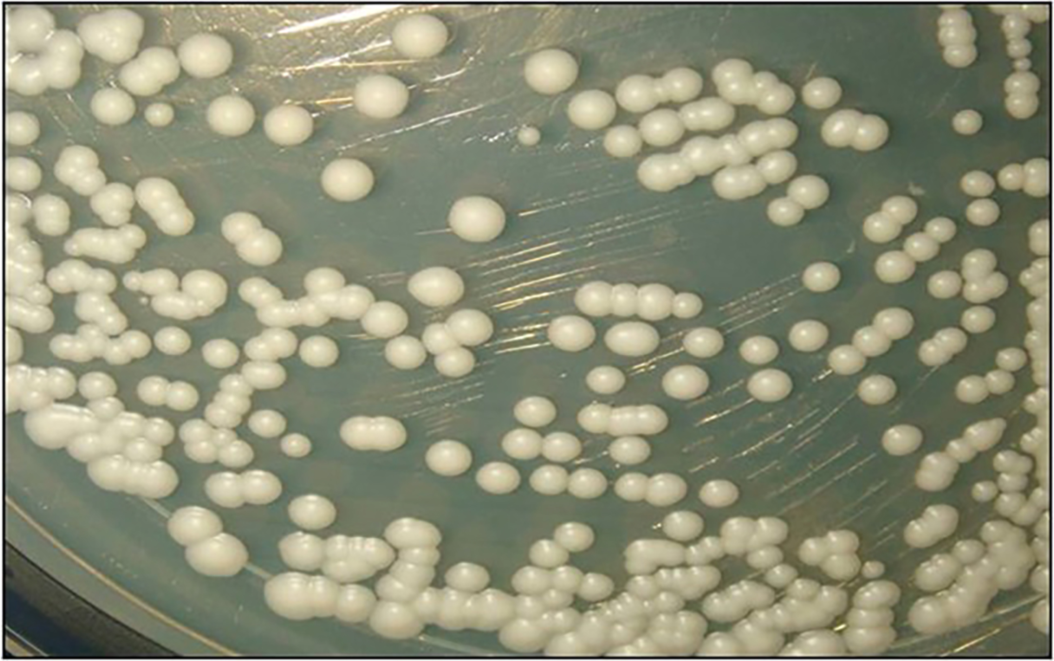
Dentine shavings were obtained with Gates Glidden drills (Dentsply Sirona, Ballaigues, Switzerland), two inserted at 14 mm, three inserted at 12 mm, four inserted at 10 mm, and five inserted at 8 mm for each sample, and placed on 4% Sabouraud's dextrose agar (SDA) (HiMedia Laboratories Private Limited, Maharashtra, India). The agar plates were incubated at 36 0C and 91% humidity for 24 hours. The growth of C. albicans was assessed using light microscopy at 400X magnification (Figure 1). A standard 4 μm loop was used to carry 0.01 mL of the Candida suspension, resulting in a 1000-fold dilution factor, which was then multiplied by the colony-forming unit (CFU) count to obtain CFUs per mL. The number of CFUs of Candida served as a measure of the antifungal activity of the test irrigants (1x10⁶ CFU/mL).

3-4mm raised, convex, entire, pearly white colonies of C. albicans grown on Sabouraud Dextrose Agar media following 24hrs of incubation at 36 0C (400X).
Statistical Analysis
Data was analyzed using IBM SPSS, V26.0 (IBM Corp., Armonk, NY, USA). Two-way ANOVA followed by post-hoc Tukey's test was applied to compare the CFU growth.
Results
The distribution of C. albicans CFU growth following exposure to experimental irrigants at two distinct inoculation time intervals is shown in Table 1.
Distribution of CFU growth (1x10⁶ CFU/mL) of Candida albicans after exposure to the test irrigants.
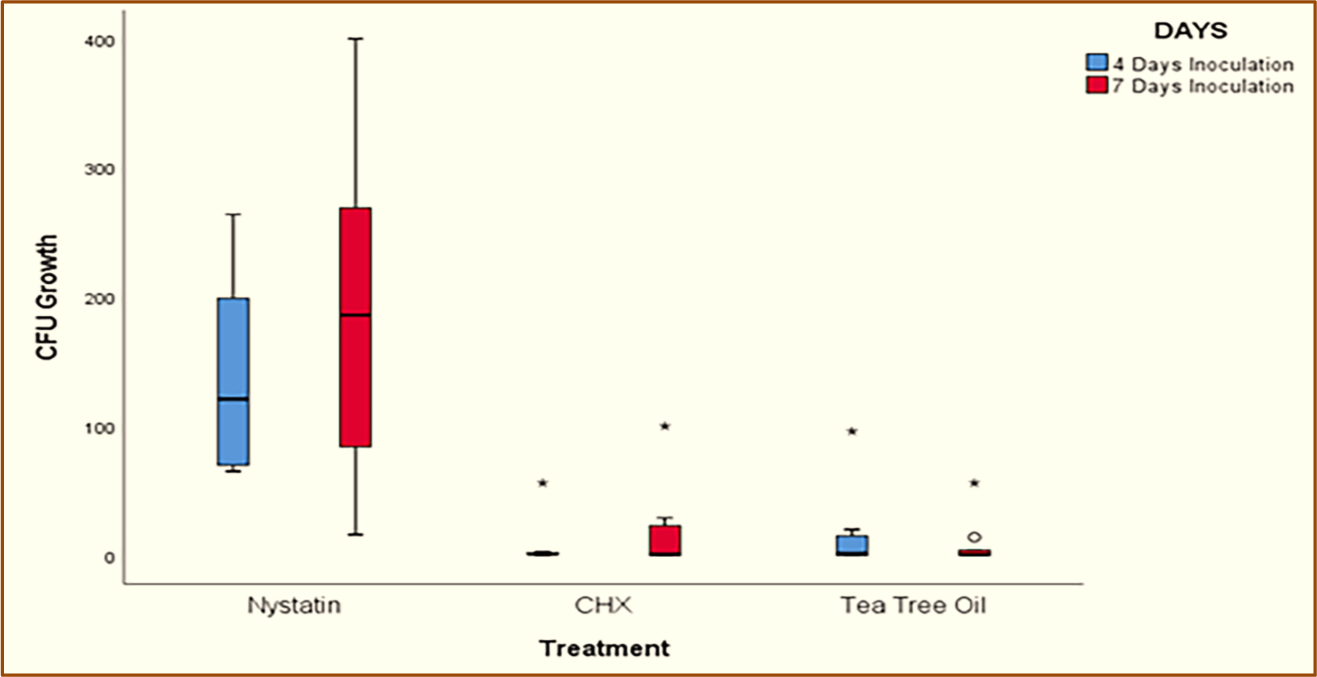
CFU growth data did not follow a normal distribution (Figure 2). Ranking is one of the procedures used to transform data that does not meet the assumptions of normality. In addition, the procedure is resistant to outliers.[17] We performed two-way ANOVA on the rank-transformed data to compare the CFU growth between days and between the three treatments.

Box-plot showing distribution of CFU growth (1x10⁶ CFU/mL) of candida albicans after exposure to the test irrigants at two different time intervals of inoculation
The interaction effect between days and treatments was not significant (p=0.680). The median CFU growth between days was insignificant (p>0.999). The CFU growth between treatments was significant (p<0.001). Post-hoc Tukey's test indicated that median CFU growth was significantly higher in the Nystatin group compared to the CHX group (p<0.001), as well as TTO growth (p<0.001). There was no significant difference in CFU growth between CHX and TTO groups (p=0.976). The DMSO group showed maximum growth of colonies. The difference in CFU growth between the DMSO group and other treatment groups is apparent in Table 1. No growth of colonies was observed in the control sterile saline group.
Discussion
Several studies revealing the presence of fungi in endodontic infections have reignited interest in the contribution of these microorganisms to the etiology of peri-radicular diseases and previously treated dentin [5-7,18].
Turk et al. [19] investigated the colonization patterns of C. albicans on both treated and untreated radicular dentin and observed a thick layer of yeast cells forming biofilms in the untreated group, while pseudohyphae were present in the treated radicular dentin. To specifically target C. albicans during root canal cleaning and shaping procedures, it is recommended to include an antifungal agent, particularly in cases of unsuccessful endodontic treatments and for immunocompromised patients [20,21].
No studies have compared the antifungal efficacy of TTO, CHX, and Nystatin when used as root canal irrigants. According to the results obtained in the present study, 25% TTO is equally effective against C. albicans as compared to 2% CHX and more effective than 100,000 units of Nystatin solution at both the 4th and 7th day of inoculation.
Sen et al. [22] noted that C. albicans is a "dentinophilic" microorganism capable of surviving in the challenging ecological environment of the root canal and adapting to a wide range of pH levels. It exhibits pleomorphism and dimorphism; germ tubes, blastospores, pseudohyphae, true hyphae, and chlamydospores. Except chlamydospores, all growth patterns can undergo interconversion to each other based on the prevailing environmental conditions, including pH, temperature, and nutritional source. Minor changes in predisposing circumstances can cause C. albicans to transform from a benign symbiont into a disease-causing entity. Such changes in conditions could manifest various virulence factors, including adherence, thigmotropism, phenotypic switching, and secretion of a degenerative enzyme called "aspartyl protease," which degrades dentinal collagen [23].
Sen et al.'s study [22] highlighted the propensity of C. albicans to colonize root canals, particularly in the absence of a smear layer. They observed a predominance of yeast blastospores and hyphal structures, indicating a significant fungal presence that adapts to the root canal environment over time. This finding underscores the importance of effective canal sterilization, as demonstrated in our study, where the absence of a smear layer allowed for deeper penetration and effectiveness of the tested irrigants [22].
Lahijani et al. [24] studied the efficacy of German chamomile extract and TTO in removing the smear layer and observed that it was superior to NaOCl alone but less than the combination of NaOCl and EDTA and concluded that TTO, when used in its emulsion form, would yield promising results. Thus, TTO, known for its antimicrobial properties, was evaluated in its emulsion form as an endodontic irrigant against C. albicans in the present study.
The principal contributor to the antimicrobial effectiveness of TTO is terpinene-4-ol [25]. TTO has been shown to inhibit the formation of germ tubes or mycelial conversion in C. albicans. Still, this effect is reversible, suggesting it targets morphogenesis rather than inhibiting overall growth [26]. Nonetheless, TTO causes a delay in germ tube formation, indicating a post-antifungal effect. Carson et al. reported that concentrations up to 28% did not cause local irritant reactions [16].
Cox et al. [27] found that TTO reduced cell viability in C. albicans by 84%, increased membrane fluidity by 54%, and inhibited respiration by 69.6%. The ability of TTO to impede respiration and enhance membrane permeability in microbial cells suggests that its destructive actions mainly result from the inhibition of membrane-associated metabolic events, such as monoterpene-induced cell membrane damage and a loss of chemiosmotic control.
The in vitro model utilized in this study was modified from the procedure originally developed by Orstavik and Haapasalo [28]. This model was modified to accommodate human-extracted teeth, providing a more accurate reflection of the clinical situation than bovine teeth. Using a No. 40 K-file for apical preparation facilitated better penetration of irrigants, while biomechanical preparation standardized the internal diameter of the root canals.
Teeth were sterilized using ethylene trioxide gas to prevent damage to their structure. White et al. [29] found that ethylene trioxide, dry heat, and autoclave sterilization methods caused changes in the dentin surface and optical properties; however, ethylene trioxide was the least destructive. Shavings from one sterile tooth were cultured on SDA media to ensure sterility.
In this study, 1% DMSO was used as a solvent to dilute TTO to the required concentration. Previous research indicates that DMSO at this concentration does not significantly inhibit fungal pathogens, ensuring that the observed antifungal effects can be attributed to the TTO [30].
The effectiveness of CHX on C. albicans is well documented in the literature [7,11]. A recent study observed that silver nanoparticles (AgNPs) showed the highest antifungal effect, and 5.25% NaOCl showed the lowest. While the 2% CHX solution had a statistically lower antifungal effect than AgNPs, it was found to have a higher impact than NaOCl [31].
Barkvoll et al. [32] combined CHX and Nystatin and observed that their combination forms a low-solubility CHX-Nystatin salt, which is less effective than CHX alone. However, it seems that CHX can effectively hinder the initial attachment and potentially the subsequent buildup and formation of fungal and other microbial biofilms. A clinical investigation demonstrated that canals that received a concluding rinse with a 2% CHX solution were significantly more likely to be free of cultivable microorganisms compared to controls irrigated solely with NaOCl [33].
Nystatin, a potent antifungal agent, is synthesized by Streptomyces noursei and demonstrates effective fungicidal activity against a broad range of pathogenic fungi. By virtue of its unique amphipathic structure, Nystatin effectively inhibits fungal growth by interacting with ergosterol, thereby compromising the membrane's selective permeability. This drug acts by incorporating itself into the membrane and binding to ergosterol molecules, creating channels that permit the transfer of cytoplasmic components, primarily potassium ions, resulting in an imbalance of the intra-/extracellular proton gradient and ultimately leading to the demise of the fungal cell [34]. However, compared to CHX and TTO, the efficacy of Nystatin in reducing the number of CFUs of C. albicans was significantly lower, as indicated by the results of the present study. CHX has been shown to disrupt the cell membrane of microorganisms by interacting with the phospholipid bilayer and altering its permeability, which leads to leakage of cellular components and, ultimately, cell death [35]. TTO has been reported to have a similar mode of action, with the ability to disrupt the cell membrane and cause damage to the cytoplasmic contents of microorganisms [27]. Therefore, the broader spectrum of antimicrobial activity of CHX and TTO compared to Nystatin may be the reason for their higher efficacy against C. albicans.
Another factor to consider is the mean dentine tubule diameter in radicular dentine, which measures 2.55-2.56 μm [36]. The particle size of Nystatin in solution is approximately 8 μm, which may explain the reduced efficiency of Nystatin observed in this study. Further research is needed to confirm this hypothesis.
The increasing incidence of yeast in endodontics makes the use of antifungal irrigants essential in specific cases. TTO has been previously tested for smear layer removal and as a solvent [24,37]. Further research on TTO should be conducted to evaluate other essential properties of endodontic irrigants, such as antibacterial activity, toxicity to periradicular tissue, and more. Once these properties have been assessed, TTO could be used successfully in endodontics.
Conclusion
This in vitro study revealed that 25% Tea tree oil exhibited antifungal effectiveness against C. albicans, comparable to 2% Chlorhexidine on both the 4th and 7th days. Meanwhile, Nystatin demonstrated only minimal antifungal efficacy in this context. These findings suggest that Tea tree oil could be an alternative to Chlorhexidine for targeting C. albicans in endodontic treatments.
Financial Support
Funding
Data Availability
The data used to support the findings of this study can be made available upon request to the corresponding author.
References
-
[1] Waltimo TM, Sirén EK, Torkko HL, Olsen I, Haapasalo MP. Fungi in therapy-resistant apical periodontitis. Int Endod J 1997; 30(2):96-101. https://doi.org/10.1046/j.1365-2591.1997.00058.x
» https://doi.org/10.1046/j.1365-2591.1997.00058.x -
[2] Akpata ES. Total viable count of microorganisms in the infected dental pulp. J Dent Res 1974; 53(6):1330-1333. https://doi.org/10.1177/00220345740530060501
» https://doi.org/10.1177/00220345740530060501 -
[3] Baumgartner JC, Watts CM, Xia T. Occurrence of Candida albicans in infections of endodontic origin. J Endod. 2000; 26(12):695-698. https://doi.org/10.1097/00004770-200012000-00003
» https://doi.org/10.1097/00004770-200012000-00003 -
[4] Chua EG, Parolia A, Ahlawat P, Pau A, Amalraj FD. Antifungal effectiveness of various intracanal medicaments against Candida albicans: An ex-vivo study. BMC Oral Health 2014; 14:53. https://doi.org/10.1186/1472-6831-14-53
» https://doi.org/10.1186/1472-6831-14-53 -
[5] Awawdeh L, Jamleh A, Al Beitawi M. The antifungal effect of propolis endodontic irrigant with three other irrigation solutions in presence and absence of smear layer: An in vitro study. Iran Endod J 2018; 13(2):234-239. https://doi.org/10.22037/iej.v13i2.19227
» https://doi.org/10.22037/iej.v13i2.19227 -
[6] Waltimo TM, Sen BH, Meurman JH, Ørstavik D, Haapasalo MP. Yeasts in apical periodontitis. Crit Rev Oral Biol Med 2003; 14(2):128-137. https://doi.org/10.1177/154411130301400206
» https://doi.org/10.1177/154411130301400206 -
[7] Chandra SS, Miglani R, Srinivasan MR, Indira R. Antifungal efficacy of 5.25% sodium hypochlorite, 2% chlorhexidine gluconate, and 17% EDTA with and without an antifungal agent. J Endod 2010; 36(4):675-678. https://doi.org/10.1016/j.joen.2010.01.015
» https://doi.org/10.1016/j.joen.2010.01.015 -
[8] Abraham SB, Al Marzooq F, Himratul-Aznita WH, Ahmed HMA, Samaranayake LP. Prevalence, virulence and antifungal activity of C. albicans isolated from infected root canals. BMC Oral Health 2020; 20(1):347. https://doi.org/10.1186/s12903-020-01347-5
» https://doi.org/10.1186/s12903-020-01347-5 -
[9] Alshanta OA, Shaban S, Nile CJ, McLean W, Ramage G. Candida albicans biofilm heterogeneity and tolerance of clinical isolates: implications for secondary endodontic infections. Antibiotics 2019; 8(4). https://doi.org/10.3390/antibiotics8040204
» https://doi.org/10.3390/antibiotics8040204 - [10] Mohammadi Z, Asgary S. A comparative study of antifungal activity of endodontic irrigants. Iran Endod J 2015; 10(2):144-147.
-
[11] Mohammadi Z, Abbott PV. The properties and applications of chlorhexidine in endodontics. Int Endod J 2009; 42(4):288-302. https://doi.org/10.1111/j.1365-2591.2008.01540.x
» https://doi.org/10.1111/j.1365-2591.2008.01540.x -
[12] Sen BH, Safavi KE, Spångberg LS. Antifungal effects of sodium hypochlorite and chlorhexidine in root canals. J Endod 1999; 25(4):235-238. https://doi.org/10.1016/S0099-2399(99)80149-6
» https://doi.org/10.1016/S0099-2399(99)80149-6 -
[13] Garcia-Cuesta C, Sarrion-Pérez MG, Bagán JV. Current treatment of oral candidiasis: A literature review. J Clin Exp Dent 2014; 6(5):e576-e582. https://doi.org/10.4317/jced.51798
» https://doi.org/10.4317/jced.51798 -
[14] Vaou N, Stavropoulou E, Voidarou C, Tsigalou C, Bezirtzoglou E. Towards advances in medicinal plant antimicrobial activity: A review study on challenges and future perspectives. Microorganisms 2021; 9(10):2041. https://doi.org/10.3390/microorganisms9102041
» https://doi.org/10.3390/microorganisms9102041 -
[15] Cowan MM. Plant products as antimicrobial agents. Clin Microbiol Rev 1999; 12(4):564-582. https://doi.org/10.1128/CMR.12.4.564
» https://doi.org/10.1128/CMR.12.4.564 -
[16] Carson CF, Hammer KA, Riley TV. Melaleuca alternifolia (Tea Tree) oil: a review of antimicrobial and other medicinal properties. Clin Microbiol Rev 2006; 19(1):50-62. https://doi.org/10.1128/CMR.19.1.50-62.2006
» https://doi.org/10.1128/CMR.19.1.50-62.2006 - [17] Conover WJ, Iman RL. Rank Transformations as a bridge between parametric and nonparametric statistics. The American Statistician 1981; 35(3):124-129.
-
[18] Mergoni G, Percudani D, Lodi G, Bertani P, Manfredi M. Prevalence of Candida species in endodontic infections: Systematic review and meta-analysis. J Endod 2018; 44(11):1616-1625.e9. https://doi.org/10.1016/j.joen.2018.07.016
» https://doi.org/10.1016/j.joen.2018.07.016 -
[19] Turk BT, Ates M, Sen BH. The effect of treatment of radicular dentin on colonization patterns of C. albicans. Oral Surg Oral Med Oral Pathol Oral Radiol Endod 2008; 106(3):457-462. https://doi.org/10.1016/j.tripleo.2008.05.012
» https://doi.org/10.1016/j.tripleo.2008.05.012 - [20] Kumar J, Sharma R, Sharma M, Prabhavathi V, Paul J, Chowdary CD. Presence of Candida albicans in root canals of teeth with apical periodontitis and evaluation of their possible role in failure of endodontic treatment. J Int Oral Health 2015; 7(2):42-45.
-
[21] Yoo YJ, Kim AR, Perinpanayagam H, Han SH, Kum KY. Candida albicans virulence factors and pathogenicity for endodontic infections. Microorganisms 2020; 8(9):1300. https://doi.org/10.3390/microorganisms8091300
» https://doi.org/10.3390/microorganisms8091300 -
[22] Sen BH, Safavi KE, Spångberg LS. Growth patterns of Candida albicans in relation to radicular dentin. Oral Surg Oral Med Oral Pathol Oral Radiol Endod 1997; 84(1):68-73. https://doi.org/10.1016/s1079-2104(97)90298-5
» https://doi.org/10.1016/s1079-2104(97)90298-5 -
[23] Talapko J, Juzbašić M, Matijević T, Pustijanac E, Bekić S, Kotris I, et al. Candida albicans - The virulence factors and clinical manifestations of infection. J Fungi 2021; 7(2):79. https://doi.org/10.3390/jof7020079
» https://doi.org/10.3390/jof7020079 -
[24] Sadr Lahijani MS, Raoof Kateb HR, Heady R, Yazdani D. The effect of German chamomile (Marticaria recutita L.) extract and tea tree (Melaleuca alternifolia L.) oil used as irrigants on removal of smear layer: A scanning electron microscopy study. Int Endod J 2006; 39(3):190-195. https://doi.org/10.1111/j.1365-2591.2006.01073.x
» https://doi.org/10.1111/j.1365-2591.2006.01073.x -
[25] Johansen B, Duval RE, Sergere JC. Antimicrobial spectrum of Titroleane™: A new potent anti-infective agent. Antibiotics 2020; 9(7):391. https://doi.org/10.3390/antibiotics9070391
» https://doi.org/10.3390/antibiotics9070391 - [26] Hammer KA, Carson CF, Riley TV. Melaleuca alternifolia (tea tree) oil inhibits germ tube formation by Candida albicans. Med Mycol 2000; 38(5):355-362.
-
[27] Cox SD, Mann CM, Markham JL, Gustafson JE, Warmington JR, Wyllie SG. Determining the antimicrobial actions of Tea tree oil. Molecules 2001; 6(2):87-91. https://doi.org/10.3390/60100087
» https://doi.org/10.3390/60100087 -
[28] Haapasalo M, Orstavik D. In vitro infection and disinfection of dentinal tubules. J Dent Res 1987; 66(8):1375-1379. https://doi.org/10.1177/00220345870660081801
» https://doi.org/10.1177/00220345870660081801 -
[29] White JM, Goodis HE, Marshall SJ, Marshall GW. Sterilization of teeth by gamma radiation. J Dent Res 1994; 73(9):1560-1567. https://doi.org/10.1177/00220345940730091201
» https://doi.org/10.1177/00220345940730091201 -
[30] Rodríguez-Tudela JL, Cuenca-Estrella M, Díaz-Guerra TM, Mellado E. Standardization of antifungal susceptibility variables for a semiautomated methodology. J Clin Microbiol 2001; 39(7):2513-2517. https://doi.org/10.1128/JCM.39.7.2513-2517.2001
» https://doi.org/10.1128/JCM.39.7.2513-2517.2001 -
[31] Oncu A, Celikten B, Aydın B, Amasya G, Açık L, Sevimay FS. Comparative evaluation of the antifungal efficacy of sodium hypochlorite, chlorhexidine, and silver nanoparticles against Candida albicans. Microsc Res Tech 2022; 85(12):3755-3760. https://doi.org/10.1002/jemt.24249
» https://doi.org/10.1002/jemt.24249 -
[32] Barkvoll P, Attramadal A. Effect of nystatin and chlorhexidine digluconate on Candida albicans. Oral Surg Oral Med Oral Pathol 1989; 67(3):279-281. https://doi.org/10.1016/0030-4220(89)90354-x
» https://doi.org/10.1016/0030-4220(89)90354-x - [33] Mohammadi Z. Chlorhexidine gluconate, its properties and applications in endodontics. Iran Endod J 2008; 2(4):113-125.
-
[34] Scheibler E, Garcia MCR, Medina da Silva R, Figueiredo MA, Salum FG, Cherubini K. Use of nystatin and chlorhexidine in oral medicine: Properties, indications and pitfalls with focus on geriatric patients. Gerodontology 2017; 34(3):291-298. https://doi.org/10.1111/ger.12278
» https://doi.org/10.1111/ger.12278 -
[35] Poppolo Deus F, Ouanounou A. Chlorhexidine in dentistry: Pharmacology, uses, and adverse effects. Int Dent J 2022; 72(3):269-277. https://doi.org/10.1016/j.identj.2022.01.005
» https://doi.org/10.1016/j.identj.2022.01.005 -
[36] Schilke R, Lisson JA, Bauss O, Geurtsen W. Comparison of the number and diameter of dentinal tubules in human and bovine dentine by scanning electron microscopic investigation. Arch Oral Biol 2000; 45(5):355-361. https://doi.org/10.1016/s0003-9969(00)00006-6
» https://doi.org/10.1016/s0003-9969(00)00006-6 -
[37] Katunarić A, Dijanić P, Jurić Kaćunić D, Matijević J, Galić N. Efficiency evaluation of various solvents in retreatment of endodontic filling in extracted teeth. Acta Stomatol Croat 2022; 56(1):2-11. https://doi.org/10.15644/asc56/1/1
» https://doi.org/10.15644/asc56/1/1