 Microbiological Analysis of Oral Biofilm and Tracheal Aspirate in Child Patients under Mechanical Ventilation
ABSTRACT
Objective: To analyze the oral biofilm and tracheal aspirate of children on invasive mechanical ventilation to observe similarities in the microbiota.
Material and Methods: This study consisted of a retrospective descriptive analysis carried out in 35 children admitted to the Pediatric Intensive Care Unit of the University Hospital of the Federal University of Maranhão from March to December 2019. The lingual biofilm and tracheal aspirate were collected, and both samples were sent for culture examination.
Results: In 34.3% of participants, the same bacteria were present in both the lingual biofilm and the tracheal aspirate, with Stenotrophomonas maltophilia and Acinetobacter baumannii being the most frequent. The frequency of detection of the same species at both sites was higher among patients who died compared to those discharged from the hospital (54.6% versus 25%, p = 0.087). There was a statistically higher frequency of deaths in patients aged up to 24 months (52.9% versus 11.1%, p = 0.01).
Conclusion: There was a high similarity in the microorganisms found at the two sites studied in patients up to 24 months of age. Thus, it is noted that the oral cavity of hospitalized children on invasive mechanical ventilation serves as a reservoir for respiratory pathogens.
Keywords:
Intensive Care Units, Pediatric; Respiration, Artificial; Microbiological Analysis; Oral Health
Introduction
The oral biofilm is composed of a structurally organized microbial community [1]. In healthy patients, it is composed of commensal bacterial species that maintain homeostasis [2], but changes in the balance of these bacteria contribute to local and systemic diseases [3].
Hospitalized patients in intensive care units (ICUs) present an increased amount of oral biofilm that is susceptible to colonization by multiresistant microorganisms due to the use of multiple antibiotics, drying of the mucous membranes, decreased salivary flow, and accumulation of secretions resulting from the presence of an orotracheal tube [4]. Recent studies indicate that microbial alterations may occur in the oral biofilm of patients under mechanical ventilation [5,6]. These changes predict the colonization of the biofilm by ventilator-associated pneumonia (VAP) associated respiratory pathogens that are not typically found in the oral cavity of healthy individuals [5].
In recent years, research in Adult ICUs has found a high prevalence of respiratory pathogens in saliva and oral biofilm of adult patients under mechanical ventilation [5,7-9]. Recent investigations have been carried out only in adult hospitalized patients under mechanical ventilation [10-16]. Therefore, research in pediatric ICUs is necessary to understand the dynamics of microorganisms in the oral biofilm and how this microbiota relates to the microbiota of tracheal aspirate in children. Thus, this study aimed to investigate the similarity of the microbiota in the tracheal aspirate and oral biofilm of children undergoing mechanical ventilation in a pediatric ICU and to understand the influence of one biofilm on the composition of the other.
Material and Methods
Ethical Clearance and Study Design
This research was approved by the Research Ethics Committee of the Presidente Dutra University Hospital – HUUFMA (n ° 251.610). It consists of a cross-sectional study carried out at the Pediatric Intensive Care Unit of the University Hospital of the Federal University of Maranhão - Maternal and Child Unit (HUUFMA-UMI) from March to December 2019.
Sample
The sample included 35 children hospitalized (with ages ranging between 1 month and 13 years) on mechanical ventilation via an orotracheal tube. Patients with a previous episode of aspiration of gastric contents, undergoing thoracic surgery, with chronic obstructive pulmonary disease, carriers of the acquired immunodeficiency syndrome virus, with community pneumonia, and those undergoing organ transplants were excluded [9].
Data Collection
A single researcher performed data collection from the medical records of the 35 participants. The data collection included the following variables: gender, age, reason for hospitalization, length of stay, duration of mechanical ventilation, and systemic diseases. A clinical examination was also performed to categorize oral hygiene into satisfactory and unsatisfactory according to the presence of visible lingual biofilm (VLB), adapted from the criteria of the Greene and Vermilion plaque index [17], and for assessment of the oral condition in presence or absence of alterations: teeth (presence caries lesion), gingiva (spontaneous gingival bleeding) and buccal mucosa (erosions, ulcerations, candidiasis).
A single dentist collected the buccal biofilm from the dorsum of the tongue of each participant with a sterile swab and sent it for culture examination with an antibiotic sensitivity test (AST). The collection was performed 48 hours after the patient's admission to the pediatric ICU, always in the morning, before oral hygiene [9]. The collection of tracheal aspirate was performed after collecting the buccal biofilm, following the routine of the pediatric ICU nursing team. After the collections, patients continued to be monitored during their stay in the ICU, with each patient's progress closely followed, until discharge or death.
The lingual biofilm and tracheal aspirate samples were sent to the laboratory, and the culture media used were blood agar, MacConkey agar, Sabouraud agar, and BHI broth. After microbial growth, the inocula were prepared and placed in the Vitek® 2 System (Biomérieux Brasil S.A., Rio de Janeiro, RJ, Brazil) for the identification and performance of the antibiotic sensitivity test (AST) of bacteria and yeasts following the protocols recommended by the manufacturer [18].
Data Analysis
The results were tabulated and analyzed using BioEstat version 5.3 (Optical Digital Technology, Belém, PA, Brazil), employing Fisher's Exact Test to verify the association between the presence of the same microorganism at the two different sites. The significance level adopted was 5% (p < 0.05).
Results
The study population consisted of 54.28% boys and 45.72% girls, with ages ranging from 1 month to 13 years. The mean age was 51.2 ± 46.8 months, and they were hospitalized in the Pediatric ICU for a minimum of 5 days and a maximum of 69 days, under mechanical ventilation (MV) from 2 to 48 days. The oral condition revealed the presence of gingival bleeding (5.7%), untreated dental caries (20%), soft tissue lesions (17.1%), and unsatisfactory oral hygiene (8.6%). 31.4% of patients died during hospitalization (Table 1).
Distribution of demographic and clinical characteristics of the patients admitted to the pediatric intensive care unit.
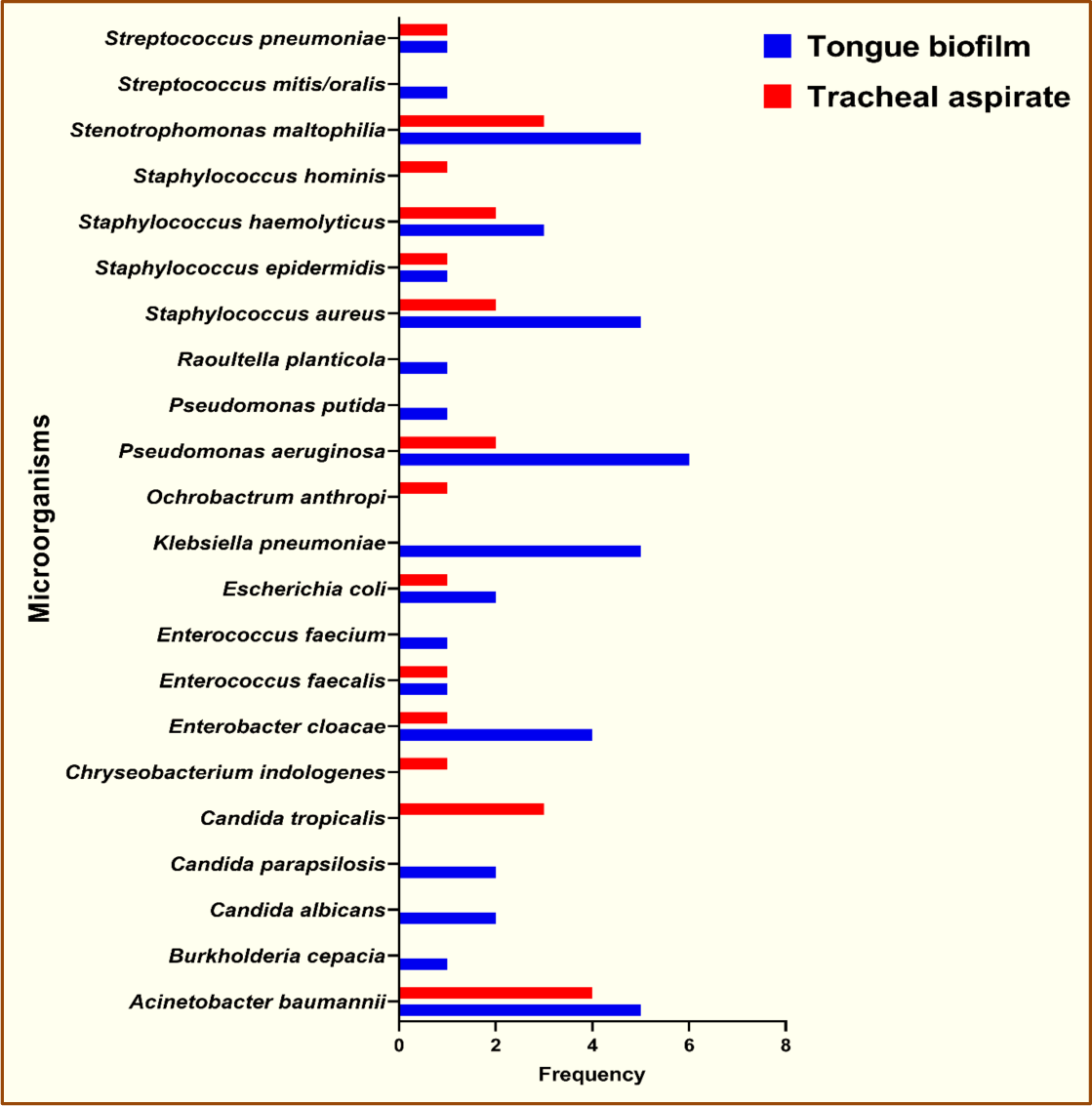
Eighteen different species were identified in the lingual biofilm and 14 different species in the tracheal aspirate (Figure 1). The most frequent species in the lingual biofilm were Pseudomonas aeruginosa, Acinetobacter baumannii, Klebsiella pneumoniae, Staphylococcus aureus, and Stenotrophomonas maltophilia. In tracheal aspirate, the most frequent species were Acinetobacter baumannii and Stenotrophomonas maltophilia. The same species of microorganism was identified in 12 patients (34.3%). The highest frequencies of the same species isolated in both regions were Acinetobacter baumannii (3 patients, 8.6%), Stenotrophomonas maltophilia (3 patients, 8.6%), and Pseudomonas aeruginosa (2 patients, 5.7%).

Absolute frequency of microorganism species isolated from lingual biofilm and tracheal aspirate.
The frequency of the same species at both sites in patients aged up to 24 months was statistically higher compared to the older group (58.8% versus 11.1%, p = 0.004); other variables did not show statistically significant differences (Table 2). However, the frequency of the same species in both sites was higher among patients who died compared to those discharged from the hospital (54.6% versus 25%, p = 0.087).
Demographic and clinical factors associated with the detection of the same microorganism in the tongue biofilm and tracheal samples.
Demographic and clinical factors associated with hospital death were investigated (Table 3). There was a statistically higher frequency of deaths among patients aged up to 24 months (52.9% versus 11.1%, p = 0.01). In addition, there was a higher frequency of death among patients with MV time ? 10 days, but without significant differences (50% versus 15.8%, p = 0.065).
Discussion
This study revealed that the same bacteria were present in the lingual biofilm and in the tracheal aspirate, and were identified in 34.3% of patients undergoing invasive mechanical ventilation in a pediatric intensive care unit. A similar result was demonstrated by Souza et al. [9], who reported the same species of pathogens in tracheal aspirate and buccal biofilm in 59.37% of adult patients on mechanical ventilation. However, there was a lower frequency of the same bacterial species in the lingual biofilm and in the tracheal aspirate of patients hospitalized in the Pediatric ICU compared to those in the Adult ICU.
In the present study, 18 different species of microorganisms were identified in the lingual biofilm, and 14 other species were identified in the tracheal aspirate. In another study, only eight different species were detected in the lingual biofilm, and four in the tracheal aspirate. This difference can be attributed to the sample size, as the present study evaluated 35 children on mechanical ventilation, whereas the other study included only eight children [6].
Acinetobacter baumannii and Stenotrophomonas maltophilia were the most frequent bacterial species, simultaneously, in both sites. Acinetobacter baumannii is a Gram-negative coccobacillus associated with persistent nosocomial infections [19], which cause morbidity and mortality, especially in intensive care units [20]. Although A. baumannii has been frequently reported as the primary pathogen in adults, it is also a critical concern in the pediatric intensive care unit, particularly in cases of prolonged hospitalization among pediatric patients [21].
In our study, three patients had A. baumanni in the two investigated sites, and 2 of them died while 1 developed a bloodstream infection. Another survey found that mortality (16.7%) and positive blood cultures for A. baumannii infection (27.5%) were associated with this pathogen in a Pediatric ICU [22].
Stenotrophomonas maltophilia is a gram-negative, aerobic, and non-fermentative bacterium [19]. Due to its low virulence, it rarely causes disease in healthy individuals; however, in immunosuppressed individuals, it can lead to infections such as pneumonia, skin and soft tissue infections, urinary tract infections, and meningitis [23,24]. In pediatric patients with an average hospital stay of 20 days, infection caused by the bacteria S. maltophilia was identified in 79.5% of children [25]. In the present study, this bacterium was more present in the lingual biofilm than in the aspirate, in 5 and 3 participants, respectively. These data were not published in scientific studies, as the respiratory tract was defined as the primary site of infection by S. maltophilia.
Mortality related to S. maltophilia is significantly high, both in adults (37.5%) and in children, with rates ranging from 10% to 60% [24,26-28]. In the present study, two children who simultaneously exhibited S. maltophilia in the lingual biofilm and tracheal aspirate died, and one of these children developed ventilator-associated pneumonia.
The rate of VAP in the sample was minimal, with only one patient diagnosed in this study. This can be attributed to the presence of a dentist in the Pediatric ICU, integrated into the patient care routine through a service that has been in place for 5 years, and to the strict hygiene protocol instituted, which utilizes a 0.12% chlorhexidine solution twice a day to reduce the microbial load in the oral cavity. The use of oral hygiene protocols, including mouthwashes or chlorhexidine gel, was associated with a 40% reduction in the incidence of ventilator-associated pneumonia [29]. However, some studies mention that the use of chlorhexidine does not decrease the incidence of VAP in children on mechanical ventilation [30,31].
Only one patient in the Pediatric ICU (2.85%), among the 35 participants, did not present pathogens in the lingual biofilm, and another respiratory bacterium frequently related to VAP, Pseudomonas aeruginosa, was identified in oral biofilm samples, corroborating with other studies [5,8,9], which leads us to conclude that the mouth is a reservoir of respiratory pathogens.
There was a higher frequency of deaths among patients aged up to 24 months (52.9% versus 11.1%, p = 0.01). The newborn's immune system presents a limited response against invasive pathogens and greater susceptibility to infections [32]. Additionally, the production of secretory IgA is absent in the first days of life, causing increased vulnerability to pathogenic microorganism invasions [33]. Furthermore, the antibody response to polysaccharides present in the cell membrane of bacteria occurs in the marginal zone of the spleen. Histological studies of the infant spleen have shown that this zone is not fully developed until 2 years of age, which may, in part, explain the delayed response of antibodies to encapsulated bacteria, such as Acinetobacter baumannii and Pseudomonas aeruginosa [34].
The number of participants in this study can be considered small; however, it is justified by the low patient turnover and the exclusion of children with severe conditions from the research. However, in the present research, biological material was collected from two different sites of the same patient in a pediatric ICU for comparison - a method not employed in other studies, where only one site was investigated. In addition, the present study employed the same technique to identify microorganisms from two sites: lingual biofilm and aspirate, thus minimizing possible reading errors and making it a pioneering study in the investigation of pathogens in lingual biofilm of patients in the Pediatric ICU.
Conclusion
There was a high similarity in the microorganisms present in the lingual biofilm and tracheal aspirate of patients up to 24 months of age, and this similarity was greater among patients who died. Thus, it is noted that the oral cavity of children hospitalized on invasive mechanical ventilation serves as a reservoir of respiratory pathogens, reiterating the need for Dental Care in all Intensive Care Units.
-
Financial Support
None.
Data Availability
The data used to support the findings of this study can be made available upon request to the corresponding author.
References
-
[1] Sanz M, Beighton D, Curtis MA, Cury JA, Dige I, Dommisch H, et al. Role of microbial biofilms in the maintenance of oral health and in the development of dental caries and periodontal diseases. Consensus report of group 1 of the Joint EFP/ORCA workshop on the boundaries between caries and periodontal disease. J Clin Periodontol 2017; 44(Suppl 18):S5-S11. https://doi.org/10.1111/jcpe.12682
» https://doi.org/10.1111/jcpe.12682 -
[2] Marsh PD. Dental plaque as a biofilm and a microbial community - Implications for health and disease. BMC Oral Health 2006; 6(Suppl 1):S14. https://doi.org/10.1186/1472-6831-6-S1-S14
» https://doi.org/10.1186/1472-6831-6-S1-S14 -
[3] Peterson SN, Snesrud E, Liu J, Ong AC, Kilian M, Schork NJ, et al. The dental plaque microbiome in health and disease. PLos One 2013; 8(3):e58487. https://doi.org/10.1371/journal.pone.0058487
» https://doi.org/10.1371/journal.pone.0058487 -
[4] Zuanazzi D, Souto R, Mattos MB, Zuanazzi MR, Tura BR, Sansone C, et al. Prevalence of potential bacterial respiratory pathogens in the oral cavity of hospitalised individuals. Arch Oral Biol 2010; 55(1):21-28. https://doi.org/10.1016/j.archoralbio.2009.10.005
» https://doi.org/10.1016/j.archoralbio.2009.10.005 -
[5] Sands KM, Twigg JA, Lewis MAO, Wise MP, Marchesi JR, Smith A, et al. Microbial profiling of dental plaque from mechanically ventilated patients. J Med Microbiol 2016; 65(2):147-159. https://doi.org/10.1099/jmm.0.000212
» https://doi.org/10.1099/jmm.0.000212 -
[6] Pinheiro CLS, Lima FP, Machado FC, Santos SS, Malheiro ARX, Ataíde LA, et al. Oral and tracheal microbiota of pediatric and adolescent patients in an intensive care unit. Spec Care Dentist 2021; 41(5):599-606. https://doi.org/10.1111/scd.12602
» https://doi.org/10.1111/scd.12602 -
[7] Marino PJ, Wise MP, Smith A, Marchesi JR, Riggio MP, Lewis MAO, et al. Community analysis of dental plaque and endotracheal tube biofilms from mechanically ventilated patients. J Crit Care 2017; 39:149-155. https://doi.org/10.1016/j.jcrc.2017.02.020
» https://doi.org/10.1016/j.jcrc.2017.02.020 -
[8] Sands KM, Wilson MJ, Lewis MAO, Wise MP, Palmer N, Hayes AJ, et al. Respiratory pathogen colonization of dental plaque, the lower airways, and endotracheal tube biofilms during mechanical ventilation. J Crit Care 2017; 37:30-37. https://doi.org/10.1016/j.jcrc.2016.07.019
» https://doi.org/10.1016/j.jcrc.2016.07.019 -
[9] Souza LCD, Mota VBR, Carvalho AVSZ, Corrêa RGCF, Libério SA, Lopes FF. Association between pathogens from tracheal aspirate and oral biofilm of patients on mechanical ventilation. Braz Oral Res 2017; 31:e38. https://doi.org/10.1590/1807-3107BOR-2017.vol31.0038
» https://doi.org/10.1590/1807-3107BOR-2017.vol31.0038 -
[10] Cifuentes EA, Sierra MA, Yepes AF, Baldión AM, Rojas JA, Álvarez-Moreno CA, et al. Endotracheal tube microbiome in hospitalized patients defined largely by hospital environment. Respir Res 2022; 23(1):168. https://doi.org/10.1186/s12931-022-02086-7
» https://doi.org/10.1186/s12931-022-02086-7 -
[11] Gregorczyk-Maga I, Fiema M, Kania M, Kędzierska J, Jachowicz E, Romaniszyn D, et al. Cultivable oral bacteriota dysbiosis in mechanically ventilated COVID-19 patients. Front Microbiol 2022; 13:1013559. https://doi.org/10.3389/fmicb.2022.1013559
» https://doi.org/10.3389/fmicb.2022.1013559 -
[12] Iwona GM, Anna P, Mateusz F, Michal K, Anna K, Paweł M, et al. Impact of tooth brushing on oral bacteriota and health care-associated infections among ventilated COVID-19 patients: An intervention study. Antimicrob Resist Infect Control 2023; 12(1):17. https://doi.org/10.1186/s13756-023-01218-y
» https://doi.org/10.1186/s13756-023-01218-y -
[13] Sabrah NYA, Pellegrino JL, Mansour HE, Mostafa MF, Kandeel NA. Care bundle approach for oral health maintenance and reduction of ventilator-associated pneumonia. Crit Care Nurs Q 2024; 47(4):335-345. https://doi.org/10.1097/CNQ.0000000000000522
» https://doi.org/10.1097/CNQ.0000000000000522 -
[14] Zambrano TBS, Vivas XSG, Santos CB, Mestre VF, Maddela NR, Santana LEG, et al. Evaluation of brushing efficiency in reducing oral microbiota in mechanically ventilated patients admitted to an intensive care unit. Infect Prev Pract 2024; 6(1):100346. https://doi.org/10.1016/j.infpip.2024.100346
» https://doi.org/10.1016/j.infpip.2024.100346 -
[15] Khalil KA, Alsultan M, Daher NA. Microbial profile and antimicrobial resistance patterns in ventilator-associated pneumonia (VAP): A cross-sectional study from Syria. J Postgrad Med 2025; 71(1):7-14. https://doi.org/10.4103/jpgm.jpgm_565_24
» https://doi.org/10.4103/jpgm.jpgm_565_24 -
[16] Sheng H, Wang L, Fei Y, Zhu Z, Wang P. Application of double-sleeve endotracheal tube in infection control for icu patients: A randomized controlled trial. Head Face Med 2025; 21(1):12. https://doi.org/10.1186/s13005-025-00488-8
» https://doi.org/10.1186/s13005-025-00488-8 -
[17] Greene JC, Vermillion JR. The oral hygiene index: A method for classifying oral hygiene status. J Am Dent Assoc 1960; 61(2):172-179. https://doi.org/10.14219/jada.archive.1960.0177
» https://doi.org/10.14219/jada.archive.1960.0177 -
[18] Winstanley T, Courvalin P. Expert systems in clinical microbiology. Clin Microbiol Rev 2011; 24(3):515-556. https://doi.org/10.1128/CMR.00061-10
» https://doi.org/10.1128/CMR.00061-10 -
[19] Kempf M, Rolain JM. Emergence of resistance to carbapenems in Acinetobacter baumannii in Europe: Clinical impact and therapeutic options. Int J Antimicrob Agents 2012; 39(2):105-114. https://doi.org/10.1016/j.ijantimicag.2011.10.004
» https://doi.org/10.1016/j.ijantimicag.2011.10.004 -
[20] Manchanda V, Sanchaita S, Singh N. Multidrug resistant acinetobacter. J Glob Infect Dis 2010; 2(3):291-304. https://doi.org/10.4103/0974-777X.68538
» https://doi.org/10.4103/0974-777X.68538 -
[21] Cai XF, Sun JM, Bao LS, Li WB. Risk factors and antibiotic resistance of pneumonia caused by multidrug resistant Acinetobacter baumannii in pediatric intensive care unit. World J Emerg Med 2012; 3(3):202-207. https://doi.org/10.5847/wjem.j.issn.1920-8642.2012.03.008
» https://doi.org/10.5847/wjem.j.issn.1920-8642.2012.03.008 -
[22] Shi J, Sun T, Cui Y, Wang C, Wang F, Zhou Y, et al. Multidrug resistant and extensively drug resistant Acinetobacter baumannii hospital infection associated with high mortality: A retrospective study in the pediatric intensive care unit. BMC Infectious Diseases 2020; 20(1):597-606. https://doi.org/10.1186/s12879-020-05321-y
» https://doi.org/10.1186/s12879-020-05321-y -
[23] Brooke JS. Stenotrophomonas maltophilia: An emerging global opportunistic pathogen. Clin Microbiol Rev 2012; 25(1):2-41. https://doi.org/10.1128/CMR.00019-11
» https://doi.org/10.1128/CMR.00019-11 -
[24] Ebara H, Hagiya H, Haruki Y, Kondo E, Otsuka F. Clinical characteristics of Stenotrophomonas maltophilia bacteremia: a regional report and a review of a Japanese case series. Intern Med 2017; 56(2):137-142. https://doi.org/10.2169/internalmedicine.56.6141
» https://doi.org/10.2169/internalmedicine.56.6141 -
[25] Wang L, Zhou W, Cao Y, Yang C, Liu H, Chen T, et al. Characteristics of Stenotrophomonas maltophilia infection in children in Sichuan, China, from 2010 to 2017. Medicine 2020; 99(8):1-6. https://doi.org/10.1097/MD.0000000000019250
» https://doi.org/10.1097/MD.0000000000019250 - [26] Wu PS, Lu CY, Chang LY, Hsueh P, Lee P, Chen J, et al. Stenotrophomonas maltophilia bacteremia in pediatric patients – a 10-year analysis. J Microbiol Immunol Infect 2006; 39(2):144-149.
-
[27] Falagas ME, Kastoris AC, Vouloumanou EK, Rafailidis P, Kapaskelis AM, Dimopoulos G. Attributable mortality of Stenotrophomonas maltophilia infections: A systematic review of the literature. Future Microbiol 2009; 4(9):1103-1109. https://doi.org/10.2217/fmb.09.84
» https://doi.org/10.2217/fmb.09.84 -
[28] Arthur C, Tang X, Romero JR, Gossett J, Harik N, Prodhan P. Stenotrophomonas maltophilia in- fection among young children in a cardiac intensive care unit: A single institution experience. Pediatr Cardiol 2015; 36(3):509-515. https://doi.org/10.1007/s00246-014-1041-0
» https://doi.org/10.1007/s00246-014-1041-0 -
[29] Shi Z, Xie H, Wang P, Zhang Q, Wu Y, Chen E, et al. Oral hygiene care for critically ill patients to prevent ventilator-associated pneumonia. Cochrane Database Syst Rev 2013; (8):CD008367. https://doi.org/10.1002/14651858.CD008367.pub2
» https://doi.org/10.1002/14651858.CD008367.pub2 -
[30] Kusahara DM, Peterlini MA, Pedreira ML. Oral care with 0.12% chlorhexidine for the prevention of ventilator-associated pneumonia in critically ill children: Randomised, controlled and double blind trial. Int J Nurs Stud 2012; 49(11):1354-1363. https://doi.org/10.1016/j.ijnurstu.2012.06.005
» https://doi.org/10.1016/j.ijnurstu.2012.06.005 -
[31] Sebastian MR, Lodha R, Kapil A, Kabra SK. Oral mucosal decontamination with chlorhexidine for the prevention of ventilator-associated pneumonia in children - A randomized, controlled trial. Pediatr Crit Care Med 2012; 13(5):e305-310. https://doi.org/10.1097/PCC.0b013e31824ea119
» https://doi.org/10.1097/PCC.0b013e31824ea119 -
[32] Holt PG, Jones CA. The development of the immune system during pregnancy and early life. Allergy 2000; 55(8):588-697. https://doi.org/10.1034/j.1398-9995.2000.00118.x
» https://doi.org/10.1034/j.1398-9995.2000.00118.x -
[33] Clapp DW. Developmental regulation of the immune system. Semin Perinatol 2006; 30(2):69-72. https://doi.org/10.1053/j.semperi.2006.02.004
» https://doi.org/10.1053/j.semperi.2006.02.004 -
[34] Zandvoort A, Tiemens W. The dual function of the splenic marginal zone; essential for the initiation of anti-TI-2 responses but also vital in the general first-line defense against blood bourna antigens. Clin Exp Immunol 2002; 130(1):4-11. https://doi.org/10.1046/j.1365-2249.2002.01953.x
» https://doi.org/10.1046/j.1365-2249.2002.01953.x
Edited by
-
Academic Editor:
Alessandro Leite Cavalcanti