 Use of Mouthguards to Prevent Dental Trauma in Children: Case Series
ABSTRACT
Objective: To assess the outcomes of mouth protector use in preventing further tooth injuries.
Material and Methods: Participants were selected from those referred for care at the School of Dentistry, Federal University of Juiz de Fora, Brazil. The children were evaluated by dentists who provided necessary treatment after dental trauma incidents, including clinical examinations, radiographs, treatment of affected teeth, and impressions, fitting, and periodic adjustments of the mouth protector. To fabricate, patients first underwent an intraoral scan, which created a three-dimensional image of the dental arches. Based on this scan, the mouthguards were made from silicone with a thickness of 5 mm and delivered to the patients within one week. After adjustments were made using Maxicut and Minicut burs to ensure optimal fit.
Results: Four children with varying histories of tooth injuries were followed. In three cases, no new trauma was reported after the introduction of a mouth protector. In the fourth case, a new trauma occurred when the mouth protector was not being used at the time of the incident. Despite initial adaptation challenges, most patients reported good acceptance and consistent use during sports activities.
Conclusion: These cases reinforce the importance of mouth protectors as a preventive tool for children at high risk of tooth injuries and highlight the need for ongoing awareness to ensure regular use.
Keywords:
Mouth Protectors; Tooth Injuries; Child.
Introduction
In recent years, pediatric dentistry has adopted an increasingly preventive approach. In addition to regular checkups and family guidance, it is essential to include sports and recreational activities in the dental care plan due to the risk of tooth injuries, which can affect individual teeth and facial structures [1]. Dental trauma compromises masticatory, phonetic, and aesthetic functions [2]. It also impacts the socioeconomic and psychological well-being of children and their families [1,3,4]. Therefore, personalized diagnosis and treatment are fundamental, and understanding a child’s daily routine and habits should be a priority for effective professional action focused on prevention and trauma recovery [2,5].
According to the International Association of Dental Traumatology (IADT), one in two children will suffer dental trauma, and 17% of bodily injuries in preschool-aged children are oral in nature [5]. Its prevalence is particularly high among children aged 8 to 12, mainly affecting the upper central and lateral incisors, and it occurs more frequently in boys due to their higher participation in contact sports and adventure activities [2,5-10]. In preschool-aged children, tooth injuries mostly occur in school or home settings, underscoring the importance of prevention [5,8]. The main etiological factors include falls, collisions, domestic or sexual violence, malocclusion, bruxism, open bite, and lack of lip sealing [2,5-7].
Understanding a child's routine is essential for the dentist to adopt an appropriate preventive approach, which may range from education and basic oral care guidance (passive prevention) to the use of mouth protectors (active prevention) [2,3-6,9]. Full engagement with the child and their family, including analysis of medical history, complaints, physical exams, and assessment of habits and lifestyle, is fundamental for promoting oral health. This allows dental follow-up to be tailored to the child's sports and recreational activities [2].
Mouth Protectors, developed in the 19th century by Woolf Krause to protect boxers, remain the best option for preventing dental trauma and reducing severe injuries, even with technological and practical advancements over the years [9]. They are important allies in protecting teeth and soft tissues, preventing luxation, bruising, avulsion, crown and root fractures, as well as bone fractures, joint injuries, and brain injuries [8,9,11]. Thus, the present study aims to report a series of cases in which children used mouth protectors to prevent dental trauma, highlighting their benefits, challenges, and observed outcomes.
Material and Methods
Study Design and Participants
The study participants were selected among those referred for care/follow-up at the School of Dentistry, Federal University of Juiz de Fora, Brazil. The children were evaluated by dentists who provided necessary treatment after dental trauma incidents, including clinical examinations, radiographs when necessary, treatment of affected teeth, and impressions, fitting, and periodic adjustments of the mouth protector.
To fabricate the mouth protector, patients first underwent an intraoral scan, which generated a three-dimensional image of the dental arches. Based on this scan, the mouth protectors were made from silicone with a thickness of 5 mm and delivered to the patients within one week. After fabrication, adjustments were made using Maxicut and Minicut burs to ensure optimal fit.
The patients were regularly monitored by professionals who tracked the progress of the traumatized teeth and the proper use of the mouth protector. In addition, parents or guardians received detailed instructions on hygiene procedures and necessary care for maintaining the mouthguards.
Results
Case 1
Patient G.R.L. is an 11-year-old white male from Santos Dumont, Brazil, who plays soccer. He suffered dental trauma on August 6, 2024, during a physical education class at school. First aid was provided by the teachers, who collected the fractured tooth fragment and applied ice to the oral region. There was no bleeding or injury to other tissues or areas of the body. The trauma exclusively affected tooth 21, with a crown fracture (Figure 1A).

(A) Patient with a fracture; (B) Outcome after reattachment of the tooth fragment; (C) Mouth Protector; and (D) Patient wearing the mouth protector.
Following his grandmother's advice, the patient's mother stored the tooth fragment in a saline solution. At home, the patient was medicated with 500 mg/mL oral dipyrone. The next day, they traveled to Juiz de Fora, where he received dental care. Treatment included reattachment of the tooth fragment (Figure 1B) and fabrication of a mouth protector (Figures 1C and 1D). The initial radiograph showed no abnormalities. However, after two months of follow-up, endodontic treatment was needed for the affected tooth.
Initially, the mother reported that her son experienced discomfort when using the mouthguard, including gum irritation and nausea. However, after a few days of adaptation, the patient began using it without problems during sports activities. Since then, no new falls or dental trauma have been reported.
Case 2
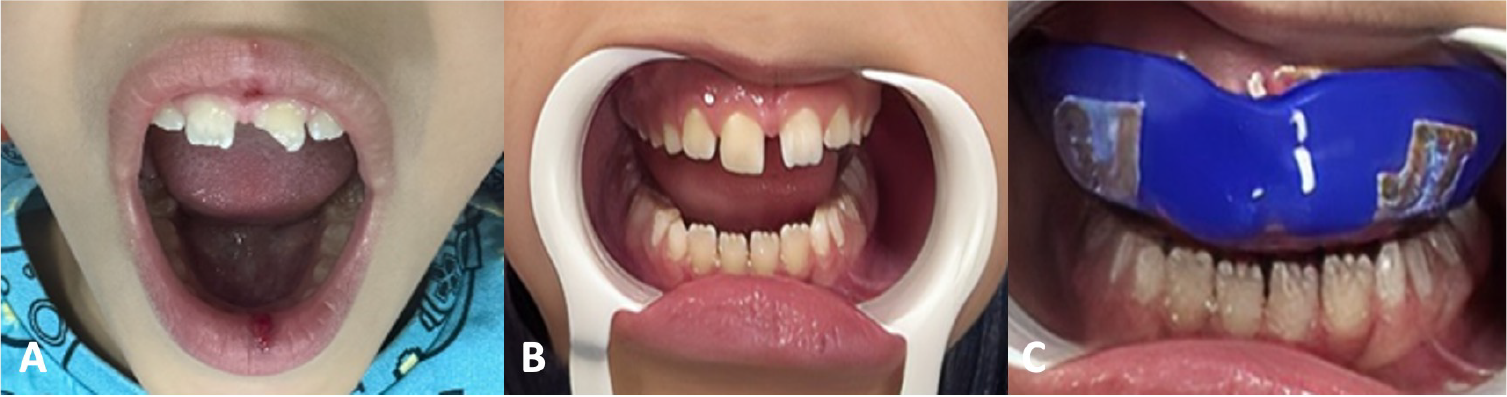
Patient J.V.M.P. is an 8-year-old white male from Juiz de For a, Brazil, who practices soccer and volleyball. He suffered dental trauma and injuries to the upper and lower lips on September 2, 2024. The accident occurred during a school activity when the patient hung from a mobile fence that swung back and hit his face.
School staff provided first aid, cleaning the affected area with water and applying cotton to the lip to stop the bleeding. No injuries were observed on other parts of the body. The trauma resulted in an enamel-dentin fracture of tooth 11 and a laceration on the lip (Figure 2A). Dental care was provided about three hours after the incident. The radiographic exam showed no abnormalities. The lip lacerations did not require suturing. Treatment included reattachment of the fractured tooth fragment (Figure 2B), which had been stored in saline, and fabrication of a mouth protector (Figure 2C). At home, the mother applied Omcilon Orabase to the injured area. The mother reported that the patient adapted quickly and used the mouthguard during physical activities without complications. No new trauma occurred after the event.

(A) Patient with a fractured tooth 11; (B) Outcome after reattachment of the fragment; and (C) Patient wearing the mouth protector.
Case 3
Patient G.M.A. is a 7-year-old white male from Juiz de Fora, Brazil, who plays soccer, swims, and plays tennis. He experienced a sequence of dental trauma events between 2021 and 2023. His first incident occurred in February 2021, at age 4, during a physical education class at school, resulting in a lower lip injury and subluxation of tooth 82 (Figure 3A). A few months later, he fell down the stairs at home, resulting in an upper lip contusion and subluxation of teeth 51 and 61 (Figure 3B).

(A) Lip injury and subluxation of tooth 82; (B) Lip contusion and subluxation of teeth 51 and 61; (C) Traumatic ulcer; (D) Subluxation of teeth 21 and 22; (E) Patient with a fractured tooth 11; and (F) Outcome after reattachment of the fragment.
In January 2022, at age 5, he collided with another child during a soccer match, leading to a traumatic ulcer at the labial commissure (Figure 3C). Later, in November 2023, at age 6, he experienced another fall while running at a water park, resulting in subluxation of teeth 21 and 22 (Figure 3D). A mouth protector was fabricated following this episode.
However, in December 2023, the patient suffered another trauma after colliding with a glass door while playing, causing an enamel-dentin fracture of tooth 11 and upper lip swelling (Figure 3E). Treatment included restoring the affected tooth with composite resin (Figure 3F). Although the patient already had a mouth protector, he was not wearing it at the time of the incident. No radiographic changes were observed in any of the cases. After this last incident, the mother reported that the patient began consistently wearing the mouthguard during school sports and other recreational activities. Although reminders were sometimes needed, the patient showed good adaptation and tolerance.
Case 4
Patient H.P.C.S. is a 10-year-old mixed-race male from Juiz de Fora, Brazil, who plays soccer. He experienced two traumatic events in 2023. The first event occurred in June 2023, at age 9, in a park in Miguel Pereira, Rio de Janeiro, Brazil. The patient fell and sustained heavy bleeding in the buccal mucosa and subluxation of tooth 11 (Figure 4A). On-site medical staff cleaned the affected area with moist gauze and noted slight mobility in tooth 11 and injuries to both the upper and lower lips. Ice was applied, and the patient was taken to a local hospital for general evaluation.
(A) Lip injury and gingival bleeding; (B) Splint on teeth 11 and 12; and (C) Patient wearing the mouth protector.
After contacting the pediatric dentist, the mother was advised to seek a radiographic evaluation in the city. The exam revealed no fractures, but did show two cracks. Immediate treatment included splinting of teeth 11 and 12 with orthodontic wire (Figure 4B). Two days later, the patient visited his pediatric dentist in Juiz de Fora, who adjusted the splint to extend from canine to canine.
The second trauma occurred the following month, in July 2023, at school, involving subluxation of tooth 21. Radiographic and tomographic exams showed no root fracture. The patient was referred for endodontic evaluation and currently undergoes semiannual follow-up, expected to continue for five years. After the second trauma, a mouth protector was recommended (Figure 4C). Initially, the patient was very resistant, reporting discomfort and pain even after adjustments. Due to stress, the mouthguard was discontinued. A year later, the pediatric dentist revisited the topic with the family, and the patient began using the mouth protector during soccer training. He is still in the adaptation phase. Since the second trauma, no new injuries have been reported.
Discussion
Tooth injuries are frequent among children, particularly boys, reflecting findings in the literature that indicate a higher prevalence in males, with a 2.5:1 ratio [12,13]. Moreover, increased overjet and overbite, dental protrusion, lack of lip sealing, and anterior open bite raise the incidence of trauma, most frequently affecting the maxillary central incisors due to their anterior position in the oral cavity [7,12,14-18].
The reported cases confirm this pattern, with all patients being male and engaged in sports activities, in which the risk of dental injury is elevated. This correlation underscores the importance of implementing personalized preventive measures, particularly in high-impact activities like soccer and other recreational sports. This study assessed the effectiveness of mouth protectors in four patients with histories of dental trauma across various conditions and activities, highlighting the device's role in preventing further injuries. The analysis reinforces that the mouthguard's efficacy depends on consistent use. The case of G.M.A., where a new trauma occurred when the mouth protector was not worn, illustrates the importance of adherence, especially during high-risk activities. Conversely, the experiences of G.R.L. and H.P.C.S. demonstrate that despite initial discomfort and adaptation difficulties, patients can become accustomed to the device over time. This highlights that, even in the face of resistance, mouth protector use can be encouraged through educational reinforcement and personalized adjustments to enhance comfort and functionality. Similarly, J.V.M.P.'s case showed that mouthguard adaptation can be quick, contributing to protection during sports without further complications after implementation.
An analysis of activities and behaviors that predispose children to tooth injuries reveals common risk factors, particularly contact sports and leisure activities such as soccer, martial arts, cycling, and skateboarding [13,19]. The severity of dental trauma is related to the impact intensity, potentially resulting in crown fractures (complicated or not), root fractures, and periodontal support injuries such as concussion, subluxation, luxation, and avulsion [7,19,20]. Recent studies also identify falls at school and during sports as significant etiological factors, consistent with the cases presented [5,8].
Tooth injuries affect both oral health and the overall quality of life of children and their families, with esthetic, functional (speech and mastication), psychological, and economic implications [21-23]. Therefore, preventive measures such as counseling and the use of mouth protectors are recommended, especially in sports and recreational activities with high injury risk [17,24-26]. According to a systematic review, athletes who wear mouth protectors are 82% to 93% less likely to suffer dental trauma, demonstrating the effectiveness of this resource [26]. A proper adaptation process, with dental follow-up focused on comfort and functionality, is essential to ensure retention and consistent use, as supported by the literature [27,28].
Mouth Protector can be stock (pre-fabricated), molded by “boil-and-bite,” or custom-made [9,29]. They can be manufactured from alginate impressions or intraoral scans, including immediately after trauma, ensuring a good fit to the child’s dentition. These are usually made from silicone or EVA and should extend to the distal surface of the last erupted tooth, with a minimum thickness of 3 mm labially and occlusally, and 2 mm palatally [27]. The presented cases confirm that custom-made mouthguards offer clear advantages in terms of fit and effectiveness, as they allow for individualized adjustments, improving comfort and stability during use [28,29].
Prevention is fundamental in reducing dental trauma rates, making mouth protectors an indispensable piece of safety equipment [26]. Dentists should encourage their use among professional and amateur athletes, as well as individuals engaged in risky activities [28]. Adaptation is a gradual process that depends on clear information for patients and families about the importance of the device and on adjustments that ensure comfort and stability, avoiding interference with occlusion, speech, or breathing, which facilitates acceptance [24,28]. Prevention, therefore, goes beyond mouth protector use - it includes raising awareness among parents and children about the risks of tooth injuries and the importance of supervision and additional care.
Accurate diagnosis is essential to determine appropriate management, as treatment depends on the extent and severity of the injury [28,30]. The Dental Trauma Guide [31] is a useful tool that provides information to assist in diagnosing and predicting dental trauma outcomes, as well as recommending the most appropriate treatment for each type of injury. Moreover, regular clinical and radiographic follow-up, as performed in the reported cases, is crucial for preserving function, vitality, and development of the dental structure [20]. Ongoing dental care promotes effective recovery. It should include clinical management and emotional support for the patient and their family [30].
Therefore, this case series reinforces that, while mouthguards have demonstrated significant effectiveness in preventing new trauma and reducing injury severity, their acceptance and use depend on educational strategies and ongoing follow-up to ensure proper adaptation and adherence. Personalizing treatment and actively engaging with caregivers are essential for the successful implementation of preventive and long-term management measures, ultimately benefiting the patient's oral health and well-being.
Conclusion
Dental trauma is a common event among children, particularly those engaged in sports activities. The use of mouth protectors has proven to be a relevant preventive measure, with the potential to minimize trauma-related damage. Although the reported cases did not allow for a quantitative evaluation of the device's preventive effectiveness - due to the absence of new trauma in most patients or to the device not being worn during the event - adherence to mouth protector use proved essential to achieving the expected benefits.
Additionally, initial adaptation challenges highlight the importance of clear guidance and continuous reinforcement for patients and caregivers. It is concluded that the mouth protector should be integrated into the dental prevention plan, especially for children frequently exposed to trauma risks, to promote effective protection and reduce orofacial consequences.
-
Financial Support
None.
Data Availability
The data used to support the findings of this study can be made available upon request to the corresponding author.
References
- [1] Jetro V, Morais HHA, Dias TGS, Barbalho JCM, Lucena EES. Traumatismo dentoalveolar: Nível de conhecimento e conduta de urgência dos bombeiros do município de Caicó-RN. Rev Cir Traumatol Buco-Maxilo-Fac 2013; 13(2):101-108. [In Portuguese].
- [2] Scarparo A. Odontopediatria: Bases teóricas para uma prática clínica de excelência. 1st. ed. Barueri: Editora Manole; 2020. 544p. [In Portuguese].
- [3] Slayton RL, Palmer EA. Introduction: Epidemiology of traumatic dental injuries. Traumatic Dental Injuries in Children. 1st. ed. Switzerland: Springer 2019; 1-15.
-
[4] Sulistyarsi P, Fauziah E, Budiardjo SB. Effect of electronic book "Traumatic dental injury to children's permanent teeth" on primary school teacher's knowledge. J Clin Pediatr Dent 2024; 48(3):101-106. https://doi.org/10.22514/jocpd.2024.027
» https://doi.org/10.22514/jocpd.2024.027 -
[5] Ak TA, Ozdas DO, Zorlu S, Kataban PK. Dental traumatology in pediatric dentistry. Trauma in Dentistry. 1st. ed. London: IntechOpen 2019; 55-82. https://doi.org/10.5772/intechopen.84150
» https://doi.org/10.5772/intechopen.84150 -
[6] Abbott PV, Tewari N, Mills SC, Stasiuk H, Roettger M, O'Connell AC, et al. The International Association of Dental Traumatology (IADT) and the Academy for Sports Dentistry (ASD) guidelines for prevention of traumatic dental injuries: Part 7: Orthodontics for the prevention of dental and oral trauma. Dent Traumatol 2024; 40:(Suppl 1):16-17. https://doi.org/10.1111/edt.12927
» https://doi.org/10.1111/edt.12927 -
[7] Bourguignon C, Cohenca N, Lauridsen E, Flores MT, O'Connell AC, Day PF, et al. International Association of Dental Traumatology guidelines for the management of traumatic dental injuries: 1. Fractures and luxations. Dent Traumatol 2020; 36(4):314-330. https://doi.org/10.1111/edt.12578
» https://doi.org/10.1111/edt.12578 -
[8] Loiola TR, Daltro RM, De Almeida TF. Traumatismo dento-alveolar na infância: Uma revisão sistemática. Rev Ciênc Méd Biol 2019; 18(2):254-259. https://doi.org/10.9771/cmbio.v18i2.24307 [In Portuguese].
» https://doi.org/10.9771/cmbio.v18i2.24307 -
[9] Mordini L, Lee P, Lazaro R, Biagi R, Giannetti L. Sport and dental traumatology: Surgical solutions and prevention. Dent J 2021; 9(3):33. https://doi.org/10.3390/dj9030033
» https://doi.org/10.3390/dj9030033 -
[10] Tewari N, Bansal K, Mathur VP. Dental trauma in children: A quick overview on management. Indian J Pediatr 2019; 86(11):1043-1047. https://doi.org/10.1007/s12098-019-02984-7
» https://doi.org/10.1007/s12098-019-02984-7 -
[11] Tuna EB, Ozel E. Factors affecting sports-related orofacial injuries and the importance of mouthguards. Sports Med 2014; 44:777-783. https://doi.org/10.1007/s40279-014-0167-9
» https://doi.org/10.1007/s40279-014-0167-9 -
[12] Corrêa-Faria P, Martins CC, Bonecker M, Paiva SM, Ramos-Jorge ML, Por Deus IA. Clinical factors and socio-demographic characteristics associated with dental trauma in children: A systematic review and meta-analysis. Dent Traumatol 2016; 32(5):367-378. https://doi.org/10.1111/edt.12268
» https://doi.org/10.1111/edt.12268 -
[13] Levin L, O'Connell AC, Tewari N, Mills SC, Stasiuk H, Roettger M, et al. The International Association of Dental Traumatology (IADT) and the Academy for Sports Dentistry (ASD) guidelines for prevention of traumatic dental injuries: Part 1: General introduction. Dent Traumatol 2024; 40(Suppl 1):1-3. https://doi.org/10.1111/edt.12923
» https://doi.org/10.1111/edt.12923 -
[14] Aguroupoulos A, Pavlou N, Kotsanti M, GourtsoGianni S, Tzanetakis G, Gizani S. A 5-year data report of traumatic dental injuries in children and adolescents from a major dental trauma center in Greece. Dent Traumatol 2021; 37(4):631-638. https://doi.org/10.1111/edt.12678
» https://doi.org/10.1111/edt.12678 -
[15] Batista KB, Thiruvenkatachari B, Harrison JE, O'Brien KD. Orthodontic treatment for prominent upper front teeth (Class II malocclusion) in children and adolescents. Cochrane Database Syst Rev 2018; 3(3):CD003452 https://doi.org/10.1002/14651858.cd003452.pub4
» https://doi.org/10.1002/14651858.cd003452.pub4 -
[16] Gümüş H, Öztürk G, Kürem B. Profiles of traumatic dental injuries among children aged 0-15 years in Cappadocia, Turkey: A retrospective cohort study. Dent Traumatol 2021; 37(3):419-429. https://doi.org/10.1111/edt.12648
» https://doi.org/10.1111/edt.12648 -
[17] Petti S. Over two hundred million injuries to anterior teeth attributable to large overjet: A meta-analysis. Dent Traumatol 2015; 31(1):1-8. https://doi.org/10.1111/edt.12126
» https://doi.org/10.1111/edt.12126 -
[18] Vieira WA, Pecorari VGA, Figueiredo-de-Almeida R, Junior NC, Vargas-Neto J, Santos ECA, et al. Prevalence of dental trauma in Brazilian children and adolescents: A systematic review and meta-analysis. Cad. Saúde Pública 2021; 37(12):e00015920. https://doi.org/10.1590/0102-311x00015920
» https://doi.org/10.1590/0102-311x00015920 - [19] Andreasen JO, Andreasen FM, Andersson L, editors. Textbook and color atlas of traumatic injuries to the teeth. 5th. ed. Wiley-Blackwell; 2018. 1072p.
-
[20] Levin L, Day PF, Hicks L, O’Connell A, Fouad AF, Bourguignon C, et al. International Association of Dental Traumatology guidelines for the management of traumatic dental injuries: General introduction. Dent Traumatol 2020; 36(4):309-313. https://doi.org/10.1111/edt.12574
» https://doi.org/10.1111/edt.12574 -
[21] Benkirane L, Targhaline N, Hamza M, El Arabi S. Prevalence and predisposing factors associated with facial and dentoalveolar trauma among children and adolescents aged between 06 months and 15 years having consulted Casablanca dental emergency department. J Pediatr Dent 2021; 7(1):00-00. https://doi.org/10.14744/JPD.2021.01_24
» https://doi.org/10.14744/JPD.2021.01_24 -
[22] El-Kalla IH, Shalan HM, Bakr RA. Impact of dental trauma on quality of life among 11-14 years schoolchildren. Contemp Clin Dent 2017; 8(4):538-544. https://doi.org/10.4103/ccd.ccd_428_17
» https://doi.org/10.4103/ccd.ccd_428_17 -
[23] Trabelsi K, Shepard RJ, Zlitni S, Boukhris O, Ammar A, Khacharem A, et al. Dental trauma first-aid knowledge and attitudes of physical education teachers: A systematic review and meta-analysis of the literature with meta-regressions. Educ Sci 2019; 9(4):251. https://doi.org/10.3390/educsci9040251
» https://doi.org/10.3390/educsci9040251 -
[24] Avgerinos S, Stamos A, Nanussi A, Engels-Deutsch M, Cantamessa S, Dartevelle JL, et al. Position statement and recommendations for custom-made sport mouthguards. Dent Traumatol 2024; 41(3):246-251. https://doi.org/10.1111/edt.13019
» https://doi.org/10.1111/edt.13019 -
[25] Cobourne MT, DiBiase AT, Seehra J, Papageorgiou S. Should we recommend early overjet reduction to prevent dental trauma?. Br Dent J 2022; 233(5):387-390. https://doi.org/10.1038/s41415-022-4916-0
» https://doi.org/10.1038/s41415-022-4916-0 -
[26] Fernandes LM, Neto JCL, Lima TRF, Magno MB, Santiago BM, Cavalcanti YW, et al. The use of mouthguards and prevalence of dento-alveolar trauma among athletes: A systematic review and meta-analysis. Dent Traumatol 2019; 35(1):54-72. https://doi.org/10.1111/edt.12441
» https://doi.org/10.1111/edt.12441 -
[27] Lloyd JD, Nakamura WS, Maeda Y, Takeda T, Leesungbok R, Lazarchik D, et al. Mouthguards and their use in sports: Report of the 1st International Sports Dentistry Workshop, 2016. Dent Traumatol 2017; 33(6):421-426. https://doi.org/10.1111/edt.12375
» https://doi.org/10.1111/edt.12375 -
[28] Spinas E, Mameli A, Giannetti L. Traumatic dental injuries resulting from sports activities; immediate treatment and five years follow-up: An observational study. Open Dent J 2018; 12:1-10. https://doi.org/10.2174/1874210601812010001
» https://doi.org/10.2174/1874210601812010001 -
[29] Abbott PV, Tewari N, O'Connell AC, Mills SC, Stasiuk H, Roettger M, et al. The International Association of Dental Traumatology (IADT) and the Academy for Sports Dentistry (ASD) guidelines for prevention of traumatic dental injuries: Part 3: Mouthguards for the prevention of dental and oral trauma. Dent Traumatol 2024; 40(1):7-9. https://doi.org/10.1111/edt.12925
» https://doi.org/10.1111/edt.12925 -
[30] Német SM, Kenny KP, Day PF. Special considerations in paediatric dental trauma. Prim Dent J 2023; 12(4):64-71. https://doi.org/10.1177/20501684231211413
» https://doi.org/10.1177/20501684231211413 -
[31] Dental Trauma Guide. Available from: https://dentaltraumaguide.org/ [Accessed on November 20, 2024].
» https://dentaltraumaguide.org/
Edited by
-
Academic Editor:
Alessandro Leite Cavalcanti