 Decision-Making for Occlusal Caries Lesions in Permanent Molars Reported by Dentists from a Brazilian Community
ABSTRACT
Objective: To examine dentists' thresholds for restorative treatment for occlusal caries lesions in permanent molars, as a function of the patient's caries risk (PCR), and determine whether an "evidence-practice gap" (EPG) exists.
Material and Methods: A convenience sample of dentists from a Brazilian community (n = 215) completed a questionnaire about their practice/patient characteristics, as well as a translated version of the "Assessment of Caries Diagnosis and Caries Treatment" Questionnaire. Dentists were presented with three clinical cases: Case 1, characterized by white discoloration in the outer enamel; Case 2, featuring brown discoloration in the inner enamel; and Case 3, presenting brown discoloration without cavitation in the outer third of the dentin. Two clinical scenarios were considered: low caries risk (LR) or increased caries risk.
Results: An EPG was evident, as 57% of dentists would intervene operatively in the LR scenario, even when the lesion was still in the enamel. Dentists in private practice, those with a higher percentage of patients uninterested in individualized caries prevention, or those who graduated from a private dental school were more likely to perform operative treatment (p < 0.05). Conversely, dentists with an advanced degree or those who were female had a lower probability of performing operative treatment (p < 0.05).
Conclusion: A substantial EPG was evident, the threshold for restorative treatment for occlusal caries progression was associated with dentists' professional context and educational background.
Keywords:
Decision Making; Dental Caries; Practice Patterns, Dentists’
Introduction
Dental caries may be defined as a biofilm-mediated, diet (sugar) modulated, multifactorial, non-communicable, dynamic disease resulting in net mineral loss of dental hard tissues. It is caused by biological, behavioral, psychosocial, and environmental factors [1]. Caries is a disease that affects more than half of the child population [2,3] and more than 90% of adults [4].
Caries lesions have an uneven distribution among the several types of tooth surfaces, with occlusal surfaces most affected [5,6]. Such surfaces, especially on permanent molars, are those most likely to have caries early at tooth eruption [7] due to limited occlusal function during this period [8] and due to the typical morphology that creates a retentive area for biofilm formation and food retention [9]. Historically, managing caries lesions was associated with the complete removal of carious tissue [10].
Within the modern approach of Minimal Intervention Dentistry (MID), several strategies are recommended to maintain functional dental health throughout life, including early caries detection, assessment, and reduction of potential caries risk factors, remineralization of incipient lesions, and conservative caries removal [11]. Thus, in a MID scenario, occlusal surfaces with underlying dentin shadow or localized enamel breakdown may be managed and controlled with micro-invasive procedures, such as sealing procedures [12]. In most cases, micro-cavitated lesions radiographically extending into middle or inner dentine should be managed surgically [13].
Studies conducted with dentists participating in dental practice-based research networks have shown that more than two-thirds of dentists from the United States, Denmark, Norway, and Sweden [14] and more than one-third of dentists in a Japanese network [15] choose to surgically restore lesions located on inner enamel surfaces, indicating a discordance between what the evidence says that dentists should be doing and what they actually do, called an "evidence-practice gap" (EPG).
In Brazil, the first survey using the same questionnaire as the studies of Gordan et al. [14] and Kakudate et al. [15] was conducted in Araraquara, SP. The primary objectives of this study were to examine the threshold for restorative treatment for occlusal caries in permanent molars as a function of the patient's caries risk and determine whether an EPG exists. We also tested whether dentists' characteristics are associated with this EPG.
Material and Methods
Study Design
This survey-based study was the first conducted with dentists from a Brazilian community, using the translated version of the "Assessment of Caries Diagnosis and Caries Treatment" Questionnaire from the National Dental Practice-Based Research Network, as well as another questionnaire that assessed sociodemographic and practice characteristics.
Ethical Aspects
The study was conducted with the subject's understanding and written consent, and in accordance with the principles of the World Medical Association Declaration of Helsinki. Ethical approval was granted by the Research Ethics Committee of the School of Dentistry, Araraquara, UNESP (Protocol number #78/11).
Questionnaire Translation and Validation
The questionnaire "Assessment of Caries Diagnosis and Caries Treatment" was translated and cross-culturally adapted by the following steps: initial translation, back-translation, and committee review. The questionnaire underwent a pre-test, and after one week, it was filled out again to assess its reliability and comprehension. Almost all the dentists who participated in the pre-test (95%) reported no difficulty completing it. Regarding reliability, 42% of the questions showed a satisfactory correlation, and 58% showed an excellent correlation [16]. The complete questionnaire is available at https://periodicos.ufmg.br/index.php/arquivosemodontologia/article/view/3743/2496.
Questionnaire on Sociodemographic and Practice Characteristics
A questionnaire collecting demographic data and information about clinical training and individual practices was also completed by the dentists. Information on age, sex, type of practice, years since dental school graduation, type of dental school graduation, specialization, post-graduate degree, percent of patients by age cohort, percent of patients for which a dental explorer is used to diagnose an occlusal caries lesion, caries risk assessment, percent of patients interested in a caries prevention regimen, percent of patients who receive a caries risk prevention regimen was collected.
Participants
A total of 801 dentists were invited to participate in the study, along with the informed consent form and two paper questionnaires. The contact information of 722 dentists was obtained at the Regional Council of Dentistry of São Paulo State – Araraquara region, in 2011. As data were collected in 2014-2015, internet sources were consulted to update the list, and 79 dentists were added to the original list, bringing the total to 801 dentists. A total of 217 dentists (27% return rate) returned completed questionnaires, and data from a convenience sample of 215 dentists who met the following inclusion criteria were analyzed for this study: treat dental caries, practice in Araraquara (São Paulo State, Brazil), and not retired. The exclusion criteria were not completing at least one of the two clinical case scenarios that involved the treatment threshold for occlusal caries of a permanent molar.
To encourage a higher response rate, dentists were mailed the questionnaires to their work address with a pre-paid return envelope. Non-respondents were contacted by telephone and received a second copy of the questionnaire. Data collection took place from October 2014 to December 2015.
Clinical Case Scenarios
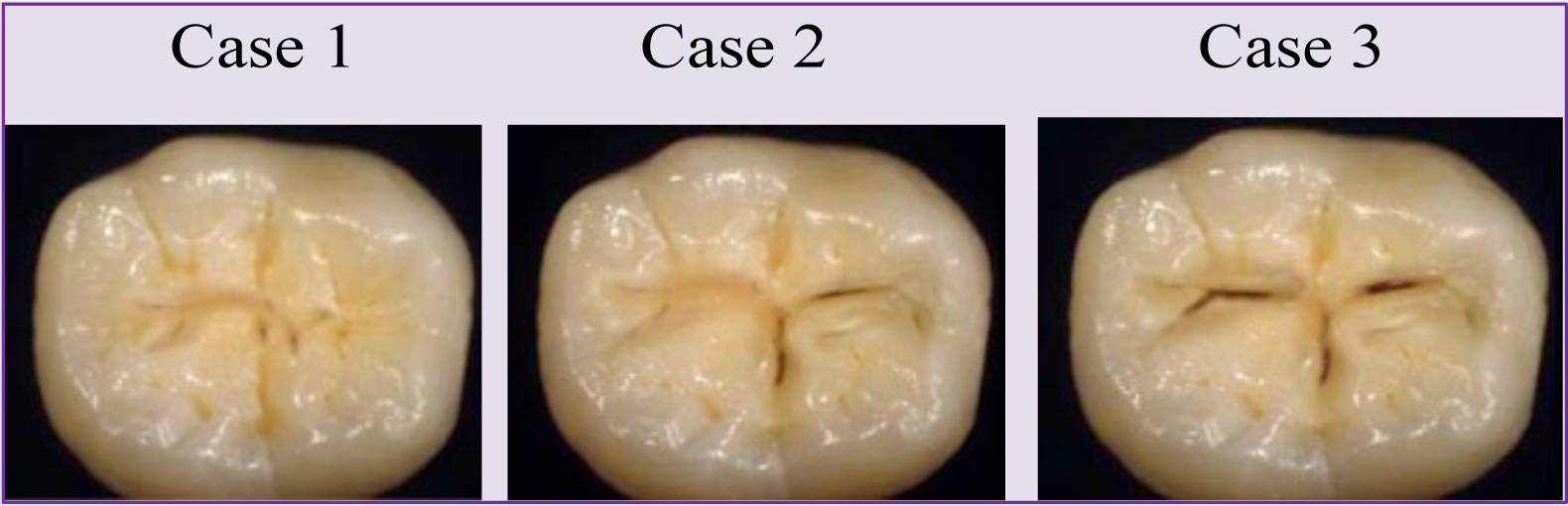
Dentists were presented with two clinical case scenarios that included three high-resolution photographs involving the occlusal surface of a mandibular first molar. The pictures showed occlusal surfaces with increasing caries severity. Case 1 had a white or discolored enamel surface. Case 2 had brown discoloration in about half of the occlusal surface. Case 3 exhibited brown discoloration in most of the occlusal surface fissures, with no cavitation. Cases 1 and 2 were considered lesions located in the outer and inner enamel, respectively. Case 3 was considered a lesion located in the outer third of the dentin (see Figure 1). The first clinical case scenario involved a 30-year-old female patient with a low caries risk.

Occlusal surfaces with increasing caries severity.
Reprinted from Espelid et al. (Espelid I, Tveit AB, Mejáre I, Nyvad B. Caries - New knowledge or old truths? The Norwegian Dental Journal. 1997; 107:66-74) with permission.
Case 1: White or discolored enamel surface (lesion located in the outer enamel).
Case 2: Brown discoloration in about half of the occlusal surface (lesion located in the inner enamel).
Case 3: Brown discoloration in most of the fissures in the occlusal surface, and had no cavitation (lesion located in the outer 1/3 of the dentin).
Treatment options provided for restoring Cases 1 through 3:
Treatment codes for the treatment codes dentists would recommend for each of the case scenarios: a) No treatment today, follow the patient regularly; b) In-office fluoride; c) Recommend non-prescription fluoride; d) Prescription for fluoride; e) Use sealant or unfilled resin over the tooth; f) Chlorhexidine treatment; g) Minimal drilling and sealant; h) Minimal drilling and preventive resin restoration; i) Air abrasion and a sealant; j) Air abrasion and preventive resin restoration; k) Amalgam restoration; l) Composite restoration; m) Indirect restoration; n) Other treatment. Responses for each clinical case scenario were grouped as follows: No treatment category (option a), prevention (options b-f), minimally invasive treatment (options g-j), and restoration (options k-m) for each of the three cases for both low-risk and high-risk scenarios.
Clinical case scenario 1: A 30-year-old woman with a low caries risk, presenting with no relevant medical history. She has no complaints and is in her office today for a routine check-up. She has been visiting her office once every two years regularly for the past six years, has no other fillings or decay lesions, and has not had any teeth extracted.
Clinical case scenario 2: The Patient with multiple factors associated with increased caries risk (a 30-year-old woman with 12 teeth restored, extensive plaque and calculus, multiple Class V white spot lesions, and five extracted teeth).
In contrast, the second scenario involved the same patient but exhibited multiple factors associated with increased caries risk. Dentists were given a list of treatment options and asked to select between no treatment, multiple preventive aids, and operative treatments that involved minimally invasive interventions through restoration with different materials. The response codes for the treatment options are also shown in Figure 1.
Statistical Analysis
First, descriptive statistics were calculated for all study variables. Responses for each clinical case scenario were grouped as follows: No treatment category (option a), prevention (options b-f), minimally invasive treatment (options g-j), and restoration (options k-m) for each of the three caries progression scenarios, including both low-risk and high-risk scenarios. Minimally invasive and restoration categories were combined to represent the higher-order category of "operative treatment".
An EPG was considered present when a dentist chose to intervene operatively in a low-risk patient scenario, even if the lesion was still in the enamel (either the outer half or the inner half).
The chi-square test was used to examine whether the dentist's choice of no treatment, preventive, or operative treatment differed across the clinical cases representing different levels of caries progression for each risk scenario. Associations between dentist and practice variables and the selection of operative treatment code = 1, with no treatment/prevention coded = 0, were tested using chi-square tests. Risk indices were calculated for each of the three cases to assess whether dentists' treatment options changed according to the caries risk scenarios. This was calculated and coded as a change in "no treatment", "preventive ", and "operative treatment" progression = 1, and no change in the clinical recommendation from low risk to high risk = 0. Differences in treatment selection for caries progression with varying caries risk factors were examined using chi-square tests to determine whether dentists' treatment choices varied across risk levels. Associations between dentist and practice variables were tested using chi-square tests (p < .05). To examine the multivariate relationship between dentist and practice variables as predictors of operative treatment for each risk scenario, a logistic regression model was employed. Odds ratio (OR) and respective p-values were estimated. Variables that were significant at p< .05 were entered into the model using a backward elimination method, which considers all variables initially and accounts for suppressor effects [17].
Results
Dentist, Practice, and Patient Characteristics
Characteristics of the 215 dentists who participated in the study are presented in Table 1. Participants were primarily middle-aged adults (mean age 42.2 years), most of whom were female (60%), had graduated from a public dental school (76%), and had some level of specialization (62%). The majority of their patients fell within an age range of 19-64 years. Fifty-five percent of the dentists worked exclusively in private practice.
Sensitivity to Caries Depth
The distribution of treatments chosen across Cases 1-3 using both the low-risk and high-risk scenarios is displayed in Table 2. For both the low-risk and high-risk scenarios, dentists were more likely to surgically intervene when the lesion was deeper (low-risk scenario: 13% for Case 1, 44% for Case 2, and 85% for Case 3; high-risk scenario: 22% for Case 1, 59% for Case 2, and 93% for Case 3). They were also more likely to surgically intervene in the high-risk scenario as compared to the low-risk scenario, regardless of lesion depth.
Distribution of treatment options chosen by dentists for Cases 1-3 using patient scenarios representing low and high caries risk.
Low-Risk Scenario
The results of chi-square tests indicated that the dentist's treatment choices for the low-risk scenario differed between Cases 1-2 (x2 (4) = 76.701, p < 0.001) and Cases 2-3 (x2 (4) = 80.832, p < 0.001), indicating a significant sensitivity to caries penetration.
High-Risk
Dentist's treatment choices for the high-risk scenario differed between Cases 1-2 (χ2(4) = 92.529, p < 0.001) and Cases 2-3 (χ2(4) = 47.104, p < 0.001), indicating a significant sensitivity to caries penetration.
Dentist and Practice Factors between Levels of Caries Penetration
Low Caries Risk Scenario
Tests of significance for predictors of dentists' treatment choice for operative treatment compared to no treatment/prevention for the low-risk scenario are reported in Table 3. For Case 1 representing caries in the outer enamel, dentists without a Doctorate or Master's degree (p=0.048), dentists who practice exclusively in a private practice model compared to public health or a hybrid private/public model (p=0.003), who do not assess caries risk (p=0.044), and have a smaller percentage of patients interested in individualized caries prevention (p=0.029) were more likely to have chosen operative treatment compared to no treatment or prevention. For Case 2, representing caries in the inner enamel, male dentists (p=0.042), dentists without a Doctorate or Master's degree (p=0.005), and those who practice exclusively in a private practice model (p=0.005) were more likely to have chosen operative treatment compared to no treatment or prevention. For Case 3, representing caries in the dentin lesion, none of the dentist or practice factors were associated with the likelihood of choosing operative treatment.
Dentist and practice characteristics as predictors of a recommendation for operative treatment for Cases 1-3 using the low caries risk scenario.
For Case 1, the results of logistic regression indicated that dentists using a private practice model (OR = 3.61, p = 0.014) and a higher percentage of patients not interested in individualized caries prevention (OR = 1.51, p = 0.037) predicted an increased probability of operative dental treatment in the low-risk model. For Case 2, dentists using the private practice model (OR = 1.94, p = 0.03) predicted an increased probability of operative dental treatment, whereas having an advanced degree (OR = 0.49, p = 0.045) and female sex (OR = .58, p = 0.049) were associated with a decreased probability of operative dental treatment.
High Caries Risk Scenario
Tests of significance for predictors of a dentist's treatment choice for operative treatment compared to no treatment/prevention in a high caries risk scenario are reported in Table 4. For Case 1, representing caries in the outer enamel, dentists with a greater number of years since dental school graduation (p=0.029), who attended a private dental school (p=.002), who practice exclusively in a private practice model (p<0.001), and had the fewest percent of patients interested in individual caries prevention (p=0.001) were more likely to have chosen operative treatment compared to no treatment or prevention. For Case 2, representing caries in the inner enamel, dentists who held a Doctorate or Master's degree (p = 0.015) and dentists who practiced exclusively in a private practice model (p = 0.026) were more likely to have chosen operative treatment over no treatment or prevention. For Case 3, representing caries in dentin, none of the dentist or practice factors were associated with the likelihood of choosing operative treatment.
Dentist and practice characteristics as predictors of a recommendation for operative treatment for Cases 1-3 using the high caries risk scenario.
For Case 1, the results of logistic regression indicated that dentist using a private practice model (OR = 3.54, p=0.002), having attended a private dental school (OR = 2.33, p=0.028) and a higher percentage of patients not interested in individualized caries prevention (OR = 1.61 p<0.001) predicted an increased probability of operative dental treatment in the low-risk model. For Case 2, dentists with an advanced degree (OR = 0.53, p = 0.041) were associated with a decreased probability of choosing operative dental treatment.
Sensitivity to Risk Factors
Dentists' treatment choices, comparing low caries risk with high caries risk scenarios at each level of caries progression, are presented in Table 5. The results of chi-square tests indicated that there was a significant change in the dentist's treatment choices between caries risk case scenarios for Case 1 representing caries in the outer enamel (x2 (4) = 91.594, p<0.001), with 51% (n=109) of dentists selecting a different treatment compared to 49% (n=106) who made the same treatment choice. There was also a significant change in dentists' treatment choices between caries risk scenarios for Case 2, representing caries in the inner enamel (χ2 (4) = 111.588, p<0.001), with 32% (n=68) of dentists selecting a different treatment compared to 68% (n=147) who made the same treatment choice. Seven dentists would choose operative treatment for patients with a low caries risk and preventive treatment for patients with a high caries risk. There was also a significant change in dentists' treatment choices between caries risk scenarios for Case 3, representing caries in the dentin (χ2 (4) = 22.019, p<0.001), with 15% (n=33) of dentists selecting a different treatment compared to 85% (n=182) who made the same treatment choice. Two dentists would choose operative treatment for patients with a low caries risk and preventive treatment for patients with a high caries risk.
Dentists’ treatment choices comparing the caries risk case scenarios at each level of caries progression.
Dentist and Practice Factors between Caries Risk Scenarios
Tests of significance for predictors of a change in dentists' treatment choices between the caries risk scenarios for various cases of caries progression are reported in Table 6. For Case 1, representing caries in the outer enamel, female dentists were significantly more likely to change their treatment choices between the caries risk case scenarios (p = 0.049). For Case 2, representing caries in the outer enamel, female dentists (p = .046), dentists who practice in public health (p = 0.043), and dentists who assess caries risk (p = 0.001) were significantly more likely to change their treatment choices for patients with varying caries risk. For Case 3, representing caries in dentin lesions, dentists with more years since graduation from dental school (p = 0.048) were significantly more likely to change their treatment choices for patients with varying caries risk.
Dentist and practice characteristics by whether they recommended operative treatment for Cases 1-3 based on the scenario for a low caries risk individual.
Discussion
This was the first study to assess decision-making thresholds for occlusal caries treatment among dentists in South America. Our results indicate a more invasive approach to treating caries compared to dentists worldwide, with many dentists reporting that they would surgically treat caries lesions in enamel, particularly for patients with high caries risk.
The more invasive approach suggested by the participant dentists is discordant with recommendations from current clinical practice guidelines, although other countries and health systems have also shown this trend [18-20]. Most dentists from the United States, Denmark, Norway, and Sweden participating in the National Dental Practice-Based Research Network opt to restore lesions in inner enamel surfaces surgically [14]. More than one-third of dentists in the Japanese network chose to restore enamel lesions [15]. A systematic review and meta-analysis demonstrated that 21% of dentists or dental therapists would restore enamel lesions [10].
An expert consensus on operative treatment of carious lesions has postulated that occlusal lesions extending only into enamel with micro-cavitation should be treated using micro-invasive interventions, such as sealing and infiltration. In most cases, only micro-cavitated occlusal lesions radiographically extending into middle or inner dentine should be managed with restorations that require surgical removal of carious tissue [13].
Considering this expert consensus, dentists from Araraquara (Brazil) and other countries have shown a critical EPG on treatment decision thresholds for treating caries in occlusal surfaces. Therefore, there is a need to understand better the dentists' decisions to intervene surgically and implement interventions that translate research evidence into everyday clinical practice.
Participant dentists were less conservative for treatment decision thresholds in a high-risk scenario. This result aligns with that of Gordan et al. [14]. This finding is also consistent with the results of Innes & Schwendicke, who, in a systematic review and meta-analysis, observed that the probability of restoring enamel lesions nearly doubles when patients are at high caries risk [10]. This finding is similar to our previous study, which showed that 13% and 22% of dentists chose operative treatment for lesions located on the outer enamel in low- and high-caries-risk scenarios, respectively.
Despite the scarcity of data on the reasons for choosing distinct treatment thresholds based on a patient's caries risk, clinicians' perspectives may influence treatment decision-making [10]. Dentists' beliefs about caries progression, their ability to accurately diagnose the presence and extent of caries, and the importance they attribute to the cost of diagnostic errors can all influence clinical decision-making [21].
Decision-making should be based on an accurate diagnosis, which should include detection of caries, assessment of caries severity (lesion depth, presence of cavities), and caries activity (active or inactive) [22]. Assessing caries activity can directly aid in caries management and follow-up monitoring, especially for severe, progressing cavities, as well as influence the need for interventions [23]. In this paper, caries activity was not included in the clinical case scenarios; we suggest that future studies address this issue.
A conceptual framework for dentists' clinical decision-making proposed by Ghoneim et al. [24] included environmental, practice, provider, and patient domains. The environmental domain encompasses factors such as the healthcare system, geographic location, community water fluoridation, policies and regulations, dentist density, and competition. Provider characteristics included age, sex, ethnicity, years of practice, number of dependents, practice ownership, number of hours worked, income, perception of competition, busyness, ethics, professionalism, moral community, and perceived professional role (business, healthcare, and professional). The practice domain includes the practice setting (solo, minor, or extensive practice), the number of dentists, the number of hygienists, the number of hours worked, the practice philosophy, the type of practice (general/specialty practice), the age of the practice, and the busyness of the practice. Finally, patient domains included age, sex, ethnicity, socioeconomic status, insurance status, general and oral health, patient preferences, number of dependents, previous dental experience, and accessibility (physical and financial).
Some predictors of dentists' clinical decision-making, as outlined by this conceptual framework, were demonstrated in the present study. Variables associated with the outcomes included sex, years of practice, post-graduation status, type of practice, and the percentage of patients interested in caries prevention. Other variables not included in the framework, such as the type of school and caries risk assessment, were also found to be associated with treatment decisions. The most frequent predictor of the outcomes was the type of practice, with dentists working in private exclusive practices choosing fewer conservative decisions that preserved tooth structure. Dentists from Araraquara who worked exclusively in a private practice model were also less likely to perform caries risk assessments [25].
In contrast, dentists practicing in a large group setting (or public health clinics) were more likely to perform caries risk assessments [26]. It is important to investigate why dentists in exclusively private practice may not implement minimally invasive interventions for primary caries lesions. Laske et al. [27] investigated whether contemporary minimally invasive treatment concepts have led to a trend towards more conservative choices made by dentists regarding treatment thresholds and restorative techniques. Despite variations among countries, they found a general worldwide trend towards operatively intervening at an overly early stage of caries progression.
In this context, the full implementation of Minimal Intervention Dentistry (MID) in primary dental care services, combined with adequate training of new dentists, will contribute to MID being an effective strategy for addressing the global burden of untreated cavitated caries lesions, offering significant long-term economic benefits [28]. This is not an easy task, as a study revealed a gap in the use of MID across different continents of the world due to a lack of knowledge or confidence in adapting professional approaches. According to the authors, expanding awareness, providing in-depth education, and disseminating information are crucial steps in narrowing gaps and promoting the acceptance and broader use of MID in dental settings worldwide [29].
We also found that dentists with a higher percentage of patients uninterested in individualized caries prevention, or those who graduated from a private dental school, were more likely to perform operative treatment. On the other hand, dentists with an advanced degree or those who were female had a lower probability of performing operative treatment. These findings may be attributed to a higher demand for invasive procedures resulting from patients' disinterest in preventive care, greater exposure to interventionist practices during dental education, and gender-related differences in clinical decision-making. Future studies should address this issue.
In summary, the gap between scientific evidence and clinical practice should be addressed through strategies that improve clinical decision-making and enhance dentists' participation in practice-based studies.
As limitations, photographs were used to estimate decision thresholds for the treatment indication of occlusal caries lesions. While a photograph cannot replace the entire clinical scenario, even when supplemented with additional data about the patient's background and caries risk, this method has been successfully used before [14] and has been deemed replicable. Further limitations of the study include its cross-sectional design, the self-selection of participating dentists, and the assumption that these dentists accurately reported their actual practices [30]. Other constraints include the use of a paper questionnaire sent by mail and the absence of data on caries lesion activity. Furthermore, the time elapsed since data collection may impact the relevance of the findings, especially since concepts related to MID have become more prominent in contemporary clinical practice. Moreover, a convenience sample may result in limited generalizability and external validity of the findings, as well as potential selection bias.
Additionally, the sample may not fully represent dentists in Araraquara. In our study, 62% of the participating dentists had a specialization. However, with a 27% response rate and no official data on the specialization of all dentists in Araraquara in 2015, we cannot determine whether our sample accurately reflects the city's entire dentist population in terms of specialization. Data from the São Paulo Regional Dental Council in 2025 indicate that 40% of dentists in Araraquara hold a specialization in dentistry. Without official data from 2015, it remains unclear whether this difference is due to sampling variability or represents an actual change over time. On the other hand, there was no significant difference in sex distribution between participants and nonparticipants [30], suggesting that sex-related biases did not influence the study's findings. Moreover, the questionnaire proved to be a viable tool for assessing and comparing dental practices globally [31].
Conclusion
A substantial evidence-practice gap was identified, and the threshold for restorative treatment for occlusal caries progression was found to be associated with dentists' professional context and educational background.
-
Financial Support
The Foundation for the Development of the São Paulo State University (FUNDUNESP; Grant 0170/004/13-PROPe/CDC) and by the São Paulo Research Foundation (FAPESP; Grant 2012/10397-2). Specific components of this work were supported by National Institutes of Health grants U01-DE-16746, U01-DE-16747, U19-DE-22516, and U19-DE-28717.
Data Availability
The data used to support the findings of this study can be made available upon request to the corresponding author.
Acknowledgements
The authors thank Maximiliano Sérgio Cenci, Claudia Huck, Fabiano Jeremias, Juliana Alvares Duarte Bonini Campos, Mariana de Matos, Luana Moreira Loures Ridolfi, Wilson Chediek, Elina Mara da Silva Marcomini, Rita De Cassia Prando, Márcia Santana, Luis Alberto da Silva, Ivanete Correa Macieira, Célia Regina de Freitas Rocha, Olavo Bergamaschi Barros, and Karina Antunes for their assistance, as well as all the dentists who participated in this study.
References
-
[1] MacHiulskiene V, Campus G, Carvalho JC, Dige I, Ekstrand KR, Jablonski-Momeni A, et al. Terminology of dental caries and dental caries management: Consensus report of a workshop organized by ORCA and cariology research group of IADR. Caries Res 2020; 54(1):7-14. https://doi.org/10.1159/000503309
» https://doi.org/10.1159/000503309 -
[2] Lagerweij MD, van Loveren C. Declining caries trends: Are we satisfied? Curr Oral Heal Reports 2015; 2(4):212-217. https://doi.org/10.1007/s40496-015-0064-9
» https://doi.org/10.1007/s40496-015-0064-9 -
[3] Gimenez T, Bispo BA, Souza DP, Viganó ME, Wanderley MT, Mendes FM, et al. Does the decline in caries prevalence of Latin American and Caribbean children continue in the new century? Evidence from systematic review with meta-analysis. PLoS One 2016; 11(10):e0164903. https://doi.org/10.1371/journal.pone.0164903
» https://doi.org/10.1371/journal.pone.0164903 -
[4] Carvalho JC, Schiffner U. Dental caries in European adults and senior citizens 1996-2016: ORCA saturday afternoon symposium in Greifswald, Germany - Part II. Caries Res 2019; 53(3):242-252. https://doi.org/10.1159/000492676
» https://doi.org/10.1159/000492676 -
[5] Basha S, Swamy HS. Dental caries experience, tooth surface distribution and associated factors in 6- and 13- year- old school children from Davangere, India. J Clin Exp Dent 2012; 4(4):e210-216. https://doi.org/10.4317/jced.50779
» https://doi.org/10.4317/jced.50779 -
[6] Nørrisgaard PE, Qvist V, Ekstrand K. Prevalence, risk surfaces and inter-municipality variations in caries experience in Danish children and adolescents in 2012. Acta Odontol Scand 2016; 74(4):291-297. https://doi.org/10.3109/00016357.2015.1119306
» https://doi.org/10.3109/00016357.2015.1119306 -
[7] Carvalho JC, Dige I, Machiulskiene V, Qvist V, Bakhshandeh A, Fatturi-Parolo C, et al. Occlusal caries: Biological approach for its diagnosis and management. Caries Res 2016; 50(6):527-542. https://doi.org/10.1159/000448662
» https://doi.org/10.1159/000448662 -
[8] Carvalho JC. Caries process on occlusal surfaces: Evolving evidence and understanding. Caries Res 2014; 48(4):339-346. https://doi.org/10.1159/000356307
» https://doi.org/10.1159/000356307 -
[9] Pitts NBZD. Word Dental Federation-Colgate caries prevention partnership: White paper on dental caries prevention and management 2016. Available from: https://www.fdiworlddental.org/sites/default/files/media/documents/2016-fdi_cppwhite_%0Apaper.pdf [Accessed on November 15, 2022].
» https://www.fdiworlddental.org/sites/default/files/media/documents/2016-fdi_cppwhite_%0Apaper.pdf -
[10] Innes NPT, Schwendicke F. Restorative thresholds for carious lesions: Systematic review and meta-analysis. J Dent Res 2017; 96(5):501-508. https://doi.org/10.1177/0022034517693605
» https://doi.org/10.1177/0022034517693605 -
[11] Walsh LJ, Brostek AM. Minimum intervention dentistry principles and objectives. Aust Dent J 2013; 58(Suppl 1):3-16. https://doi.org/10.1111/adj.12045
» https://doi.org/10.1111/adj.12045 -
[12] Ahovuo-Saloranta A, Forss H, Walsh T, Nordblad A, Mäkelä M, Worthington H V. Pit and fissure sealants for preventing dental decay in permanent teeth. Cochrane Database Syst Rev 2017; 7(7):CD001830. https://doi.org/10.1002/14651858.CD001830.pub5
» https://doi.org/10.1002/14651858.CD001830.pub5 -
[13] Schwendicke F, Splieth C, Breschi L, Banerjee A, Fontana M, Paris S, et al. When to intervene in the caries process? An expert Delphi consensus statement. Clin Oral Investig 2019; 23(10):3691-703. https://doi.org/10.1007/s00784-019-03058-w
» https://doi.org/10.1007/s00784-019-03058-w -
[14] Gordan VV, Bader JD, Garvan CW, Richman JS, Qvist V, Fellows JL, et al. Restorative treatment thresholds for occlusal primary caries among dentists in The Dental Practice-Based Research Network. J Am Dent Assoc 2010; 141(2):171-184. https://doi.org/10.14219/jada.archive.2010.0136
» https://doi.org/10.14219/jada.archive.2010.0136 -
[15] Kakudate N, Sumida F, Matsumoto Y, Yokoyama Y, Gilbert GH, Gordan VV. Patient age and dentists’ decisions about occlusal caries treatment thresholds. Oper Dent 2014; 39(5):473-480. https://doi.org/10.2341/13-141-C
» https://doi.org/10.2341/13-141-C -
[16] Tagliaferro EPS, Ridolfi LML, Matos M, Rosell FL, Valsecki Junior A, Silva SRC, et al. Tradução e adaptação brasileira do questionário “Assessment of caries diagnosis and caries treatment. Arq Odontol 2017; 53:e13. https://doi.org/10.7308/aodontol/2017.53.e13 [In Portuguese].
» https://doi.org/10.7308/aodontol/2017.53.e13 -
[17] Bursac Z, Gauss CH, Williams DK, Hosmer DW. Purposeful selection of variables in logistic regression. Source Code Biol Med 2008; 3:17. https://doi.org/10.1186/1751-0473-3-17
» https://doi.org/10.1186/1751-0473-3-17 -
[18] Drachev SN, Galieva AS, Yushmanova TN, Polivanaya EA, Stangvaltaite-Mouhat L, Al-Mahdi R, et al. Restorative treatment decisions for carious lesions: Do Russian dentists and dental students apply minimal intervention dentistry? BMC Oral Health 2021; 21(1):638. https://doi.org/10.1186/s12903-021-01978-2
» https://doi.org/10.1186/s12903-021-01978-2 -
[19] Rechmann P, Doméjean S, Rechmann BMT, Kinsel R, Featherstone JDB. Approximal and occlusal carious lesions. J Am Dent Assoc 2016; 147(5):328-338. https://doi.org/10.1016/j.adaj.2015.10.006
» https://doi.org/10.1016/j.adaj.2015.10.006 -
[20] Chana P, Orlans MC, O’Toole S, Domejean S, Movahedi S, Banerjee A. Restorative intervention thresholds and treatment decisions of general dental practitioners in London. Br Dent J 2019; 227(8):727-732. https://doi.org/10.1038/s41415-019-0849-7
» https://doi.org/10.1038/s41415-019-0849-7 -
[21] Jobim Jardim J, Henz S, Barbachan E Silva B. Restorative treatment decisions in posterior teeth: A systematic review. Oral Health Prev Dent 2017; 15(2):107-115. https://doi.org/10.3290/j.ohpd.a37922
» https://doi.org/10.3290/j.ohpd.a37922 -
[22] Cheng L, Zhou XD. Clinical assessment of caries prevention and management. Zhonghua Kou Qiang Yi Xue Za Zhi 2021; 56(1):39-44. https://doi.org/10.3760/cma.j.cn112144-20201104-00551 [In Chinese].
» https://doi.org/10.3760/cma.j.cn112144-20201104-00551 -
[23] Cheng L, Zhang L, Yue L, Ling J, Fan M, Yang D, et al. Expert consensus on dental caries management. Int J Oral Sci 2022; 14(1):17. https://doi.org/10.1038/s41368-022-00167-3
» https://doi.org/10.1038/s41368-022-00167-3 -
[24] Ghoneim A, Yu B, Lawrence H, Glogauer M, Shankardass K, Quiñonez C. What influences the clinical decision-making of dentists? A cross-sectional study. PLoS One 2020; 15(6):e0233652. https://doi.org/10.1371/journal.pone.0233652
» https://doi.org/10.1371/journal.pone.0233652 -
[25] Tagliaferro EP da S, Silva SRC da, Rosell FL, Valsecki Junior A, Riley Iii JL, Gilbert GH, et al. Caries risk assessment in dental practices by dentists from a Brazilian community. Braz Oral Res 2021; 35:e017. https://doi.org/10.1590/1807-3107bor-2021.vol35.0017
» https://doi.org/10.1590/1807-3107bor-2021.vol35.0017 -
[26] Riley JL, Gordan VV, Ajmo CT, Bockman H, Jackson MB, Gilbert GH, et al. Dentists’ use of caries risk assessment and individualized caries prevention for their adult patients: findings from The Dental Practice-Based Research Network. Community Dent Oral Epidemiol 2011; 39(6):564-573. https://doi.org/10.1111/j.1600-0528.2011.00626.x
» https://doi.org/10.1111/j.1600-0528.2011.00626.x -
[27] Laske M, Opdam NJM, Bronkhorst EM, Braspenning JCC, van der Sanden WJM, Huysmans MCDNJM, et al. Minimally invasive intervention for primary caries lesions: Are dentists implementing this concept? Caries Res 2019; 53(2):204-216. https://doi.org/10.1159/000490626
» https://doi.org/10.1159/000490626 -
[28] Bernabé E, Marcenes W. Can minimal intervention dentistry help in tackling the global burden of untreated dental caries? Br Dent J 2020; 229(7):487-491. https://doi.org/10.1038/s41415-020-2155-9
» https://doi.org/10.1038/s41415-020-2155-9 -
[29] Perrone BR, Bottesini VC, Duarte DA. Minimal intervention dentistry: What is its clinical application and effectiveness in different continents? – A scoping review. J Conserv Dent Endod 2024; 27(2):134-139. https://doi.org/10.4103/JCDE.JCDE_274_23
» https://doi.org/10.4103/JCDE.JCDE_274_23 -
[30] Riley JL, Gordan VV, Rouisse KM, McClelland J, Gilbert GH. Differences in male and female dentists’ practice patterns regarding diagnosis and treatment of dental caries. J Am Dent Assoc 2011; 142(4):429-440. https://doi.org/10.14219/jada.archive.2011.0199
» https://doi.org/10.14219/jada.archive.2011.0199 -
[31] Tagliaferro E, Junior AV, Rosell F, Silva S, Riley J, Gilbert G, et al. Caries diagnosis in dental practices: Results from dentists in a Brazilian community. Oper Dent 2019; 44(1):E23-31. https://doi.org/10.2341/18-034-C
» https://doi.org/10.2341/18-034-C
Edited by
-
Academic Editor:
Wilton Wilney Nascimento Padilha