Catalog of type specimens of recent mammals in the Museu de Zoologia da Universidade de São Paulo (MZUSP)
Abstract
The Museu de Zoologia da Universidade de São Paulo (MZUSP) houses one of Latin America’s largest, most complete, and representative collections of Neotropical mammals. Its origins can be dated back to the 1890s when it was initially established as part of the Museu Paulista. The collection’s growth is primarily attributed to the efforts of its first directors and curators. Initially, the collection expanded through the acquisition of complete specimens from various regions of Brazil, obtained via scientific expeditions led by traveling naturalists and purchases from professional collectors. The collection continues to grow predominantly through specimens gathered during environmental impact studies, fieldwork conducted by MZUSP researchers, and donations. Over the years, the collection at MZUSP has constituted an essential source of information for taxonomic and biogeographic studies of mammals. It contains approximately 66,000 specimens from 882 species, including type material of several taxa. In this article, we present a comprehensive list of the type material of extant mammals housed at MZUSP, along with comments on taxonomy and other noteworthy information regarding the specimens. A comprehensive survey was conducted on all valid and synonymous taxa-type specimens housed at the mammal collection of MZUSP. Additionally, photos of the name-bearing types are provided. A total of 257 type specimens were listed, comprising 53 name-bearing types (holotypes, syntypes, neotypes, and lectotypes) and 204 secondary types (paratypes and paralectotypes). Out of these, 37 are considered valid names. The specimens were obtained from the orders Didelphimorphia, Pilosa, Primates, Rodentia, Chiroptera, Carnivora, and Artiodactyla. This catalog provides the first comprehensive, annotated account of the mammalian type specimens at the MZUSP, highlighting the collection’s historical and scientific significance, and enhancing the accessibility and preservation of specimen data to support Neotropical mammalogy and systematic research.
Keywords
Holotype; Mammalia; MZUSP; Paratype; Taxonomy
INTRODUCTION
The mammal collection of the Museu de Zoologia da Universidade de São Paulo (MZUSP) is one of the largest and most representative collections of Neotropical mammals in Latin America (de Vivo et al., 2011; Bezerra, 2012; Chiquito et al., 2021). The collection started in the late 19th century, increasing considerably after the arrival of the German naturalist Hermann von Ihering, the first director of the Museu Paulista (which at that time included the current Museu de Zoologia da Universidade de São Paulo) (Rodrigues et al., 2000; Silva, 2006; Landim, 2011). In addition to the exhibition collection, Ihering was committed to establishing an exclusive collection for scientific studies, following the model of European institutions (Pinto, 1945; Rodrigues et al., 2000). At that time, the collection consisted mainly of small mammals, including bats, rodents, and opossums (Ihering, 1894). To increase the number and diversity of specimens, Ihering encouraged the general population to contribute with new specimens, dedicating some pages of his catalog of mammals of São Paulo (Ihering, 1894) to instruct readers on some methods for collecting and preserving specimens. In addition, several specimens were purchased and acquired through scientific expeditions led by traveling naturalists, including Beniamino Bicego, João Zech, Christiano Enslen, and Ernst Garbe (Pinto, 1945; Grola, 2014; Rodrigues et al., 2000).
The mammal and other zoological collections were part of the Zoology Section of the Museu Paulista until 1939 (Rodrigues et al., 2000; Silva, 2006). That year, the entire section was reorganized as the newly created Department of Zoology, under the State of São Paulo’s Department of Agriculture, Industry, and Commerce (Rodrigues et al., 2000; Silva, 2006). Construction of a building specifically designed to house the zoological collections began with the laying of its cornerstone in July 1940. By July 1942, the collections had been fully transferred, significantly increasing the space available for housing specimens (Silva, 2006).
In the early 1940s, Carlos Octaviano da Cunha Vieira was appointed as the first official curator of the mammal collection (de Vivo, 1998). During his tenure, the collection expanded considerably through field expeditions and acquisitions from professional collectors, notably Alfonso M. Olalla (Vieira, 1942; de Vivo, 1998; Taddei et al., 1999). In 1969, the Department of Zoology was incorporated into the Universidade de São Paulo and received its current designation, Museu de Zoologia da Universidade de São Paulo (Rodrigues et al., 2000; Silva, 2006), remaining to this day in the same building constructed in the 1940s.
Since the beginning of the MZUSP mammal collection, Ihering was concerned about obtaining complete voucher specimens (skin and skull) from different regions of Brazil (Ihering, 1894). Over the decades, these specimens have been an essential source of information for taxonomic and biogeographic studies of mammals, including taxonomic revisions and the description of new taxa (e.g.,Gualda-Barros et al., 2012; Nascimento, 2014; Nascimento & Feijó, 2017; Serrano-Villavicencio et al., 2019; Nascimento et al., 2021; Brandão et al., 2022). Moreover, the historical records preserved in the collection offer valuable insights into temporal and spatial dynamics of mammalian fauna, including local extinctions, such as the giant otter (Pteronura brasiliensis) in the Atlantic Forest and the Pampas (Garbino et al., 2022).
Currently, the collection holds approximately 66,000 specimens from 882 species, including type material of several taxa (de Vivo et al., 2011; Bezerra, 2012; Chiquito et al., 2021). The specimens originate primarily from the Neotropical region, with additional holdings from Africa, Asia, Europe, and North America. They are preserved as dry specimens (skins, skulls, and postcranial skeletons) and in fluid (parts or whole specimens in alcohol). Over the past three decades, the collection has expanded primarily through specimens obtained during environmental impact studies (Nascimento & Vendramel, 2020), fieldwork conducted by MZUSP researchers, and significant donations, such as V.A. Taddei’s bat collection of approximately 16,000 specimens, generously transferred in 2021 from the Instituto de Biociências, Letras e Ciências Exatas (IBILCE), Universidade Estadual Paulista (UNESP), São José do Rio Preto, state of São Paulo, Brazil.
Early contributions to documenting mammal specimens housed in the MZUSP collection include species lists based solely on its holdings, such as those by Lima (1926) and Vieira (1942), both focused on bats, and Pinto (1931), focused on sciurids. More recently, Nascimento & Vendramel (2020) also compiled a list of specimens from the state of Pará. However, no catalog specifically dedicated to type material had been produced. Here, we present a comprehensive catalog of the type material of extant mammals housed at MZUSP, including taxonomic notes and collection information about the specimens. This work follows the recommendations of the International Code of Zoological Nomenclature (ICZN, 1999) to publish type material lists and disseminate information regarding the institutions housing name-bearing specimens (Recommendation 72F; ICZN, 1999).
MATERIAL AND METHODS
We conducted a comprehensive survey of all valid and non-valid species-level type specimens housed at the mammal collection of MZUSP. This assessment involved direct examination of specimens in the collection’s type-material cabinets, consultation of the museum’s specimen catalog, verification of specimen label data, and an extensive review of taxonomic literature. For each type specimen, we transcribed all available information from specimen labels, the museum’s specimen catalog, and the original descriptions. Furthermore, we provided photographs of the name-bearing types - holotypes, neotypes, lectotypes, and syntypes (in the latter case, only one syntype was selected per taxon) - including skin (dorsal and ventral views) and skull (dorsal, ventral, and lateral views), when available. Taxonomy followed the most recent list of mammal species published by Abreu Jr. et al. (2024) and the Mammal Diversity Database (2025), supplemented by more recent taxon-specific studies when applicable. As subspecies were not addressed in those sources, we referred to the latest available literature in such cases.
Catalog organization
The catalog’s taxonomic sequence of higher-level taxa (order and suborder) follows Wilson & Reeder (2005), reflecting a traditional arrangement based on the phylogenetic relationships of mammals, as adopted in various lists, catalogs, databases, and other mammalian taxonomic references (e.g.,Gardner, 2007; Paglia et al., 2012; Fisher & Ludwig, 2014, 2015, 2016; Kelt & Patton, 2020; Quintela et al., 2020; Mammal Diversity Database, 2025). For the family group and classifications at genus and species levels, nominal taxa are listed alphabetically. Following other published catalogs of mammal types (Koopman, 1976; Lawrence, 1993; Fisher & Ludwig, 2014, 2015, 2016), each type material is characterized by:
-
1) The species name given by the original author;
-
2) Citation of the original description;
-
3) Valid name of the species if the original name was synonymized;
-
4) Common names in English and Portuguese, following original descriptions and relevant literature (Gardner, 2007; Patton et al., 2015; Abreu Jr. et al., 2024; Sobral et al., 2024; Mammal Diversity Database, 2025);
-
5) Type specimen identification: the catalog number, age, sex, type of preparation (skin, skull, postcranial skeleton, parts or whole specimens fluid-preserved, tissue), collector’s name, collection date, field number, and collection locality with the geographical coordinates (when present on the specimens labels or in the original description of the taxa). We provide the type localities as informed in the original descriptions, with updated names or translations in brackets. Some whole specimens or parts of them were not found in the collection, probably lost, and are indicated with asterisks (*) along the catalog;
-
6) Body measurements: usually taken by field collectors and obtained from the specimens labels or original description of the taxa, including total length (TL), head-body length (HB), tail length (T), hindfoot length (HF - with claw/without claw), forefoot length (FF), forearm length (FA), tibia length (for bats) (TI), ear length (E), tragus length (TR), testicles (test.) and weight (W), when available;
-
7) Comments: additional information about the specimens (such as their current condition), along with annotations related to the original publication, collection locality, or relevant notes on the taxonomic assignment of the name. Specimens that comprise the type series of the taxa listed in the catalog but are not housed in MZUSP are also referenced in the Comments section.
List of acronyms
The collections and museum acronyms referred in this catalog are: MZUSP = Museu de Zoologia da Universidade de São Paulo, São Paulo, Brazil; AMNH = American Museum of Natural History, New York, USA; BMNH = Natural History Museum (formerly British Museum of Natural History), London, UK; DZUP = Universidade Federal do Paraná, Curitiba, Brazil; FMNH = Field Museum of Natural History, Chicago, USA; IEPA = Instituto de Pesquisas Científicas e Tecnológicas do Estado do Amapá, Macapá, Brazil; INPA = Instituto Nacional de Pesquisas da Amazônia, Manaus, Brazil; LMUSP = Laboratório de Mamíferos, Escola Superior de Agricultura Luiz de Queiroz da Universidade de São Paulo, Piracicaba, Brazil; MCNU = Museu de Ciências Naturais, Universidade Luterana do Brasil, Canoas, Brazil; MDBio = Museu de Diversidade Biológica (formerly Museu de Zoologia da Unicamp), Universidade de Campinas, Campinas, Brazil; MHNG = Musée d’Histoire Naturelle, Genève, Switzerland; MNHN = Museo Nacional de Historia Natural, Montevideo, Uruguay; MNRJ = Museu Nacional, Universidade Federal do Rio de Janeiro, Rio de Janeiro, Brazil; MVZ = Museum of Vertebrate Zoology, University of California, Berkeley, USA; NMNH = National Museum of Natural History, Smithsonian Institution, Washington, USA; ROM = Royal Ontario Museum, Toronto, Canada; UFMG = Universidade Federal de Minas Gerais, Belo Horizonte, Brazil; UFMT = Universidade Federal de Mato Grosso, Cuiabá, Brazil; UFPB = Universidade Federal da Paraíba, João Pessoa, Brazil; UFRS = Universidade Federal do Rio Grande do Sul, Porto Alegre, Brazil; UFSC = Universidade Federal de Santa Catarina, Florianópolis, Brazil. The specimens added from Taddei’s collection are denoted in this catalog by their original collection acronym, DZSJRP.
RESULTS AND DISCUSSION
The MZUSP mammal collection includes 257 type specimens, consisting of 53 name-bearing types (38 holotypes, 11 syntypes, one neotype, three lectotypes) and 204 secondary types (194 paratypes and 10 paralectotypes) from the orders Didelphimorphia, Pilosa, Primates, Rodentia, Chiroptera, Carnivora, and Artiodactyla. Among these, 37 are currently valid names.
Taxonomic accounts of type specimens
Order Didelphimorphia Gill, 1872 Family Didelphidae Gray, 1821 Subfamily Didelphinae Gray, 1821 Tribe Marmosini Hershkovitz, 1992 Genus Monodelphis Burnett, 1830 Subgenus Monodelphiops Matschie, 1916
Monodelphis tricolor paulensis Vieira, 1950
Arquivos de Zoologia do Estado de São Paulo, 7(4): 359, 1950.
= Monodelphis (Monodelphiops) dimidiata (Wagner, 1847)
Common names: Yellow-sided opossum (Eng.); catita, guaiquica-anã (Port.).
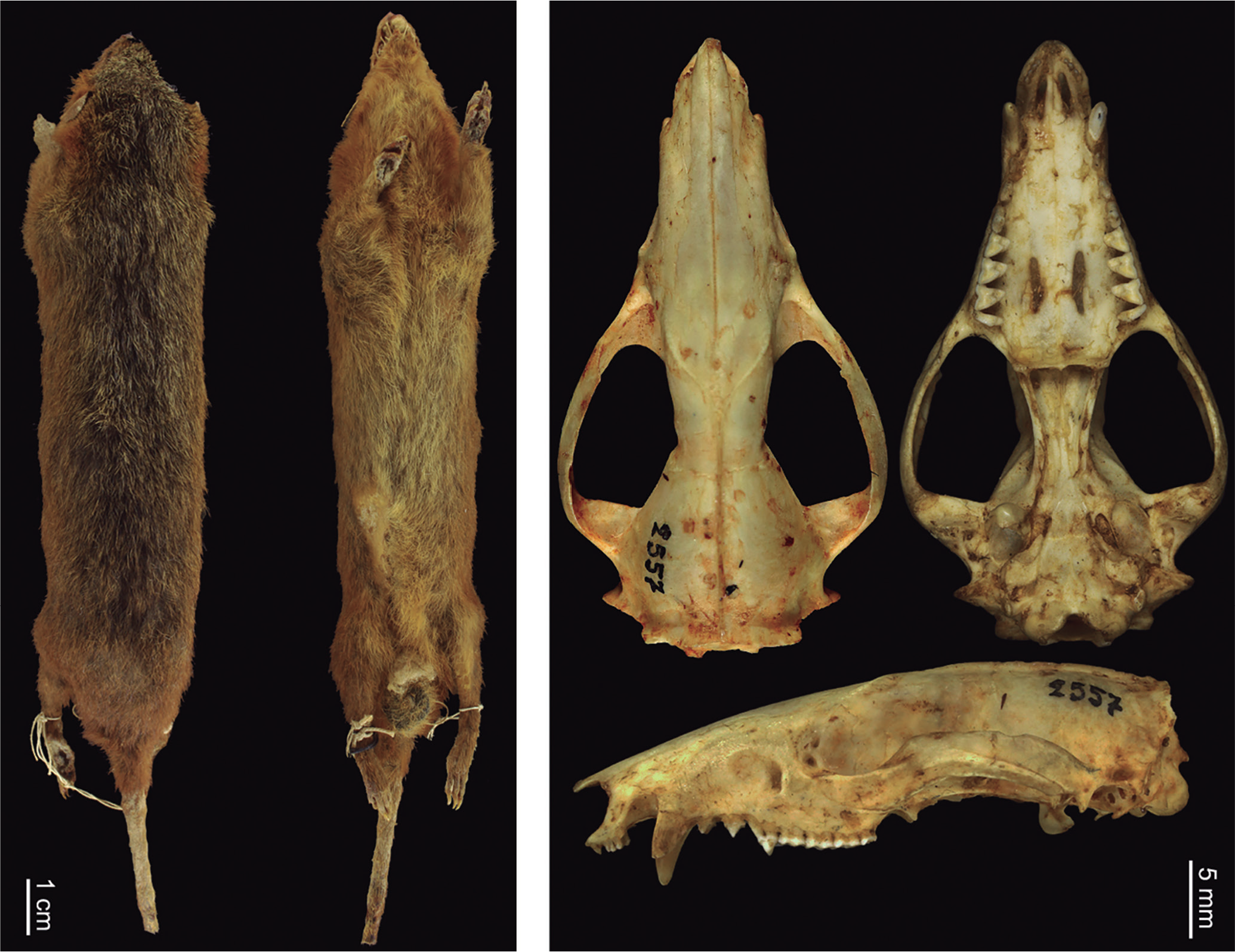
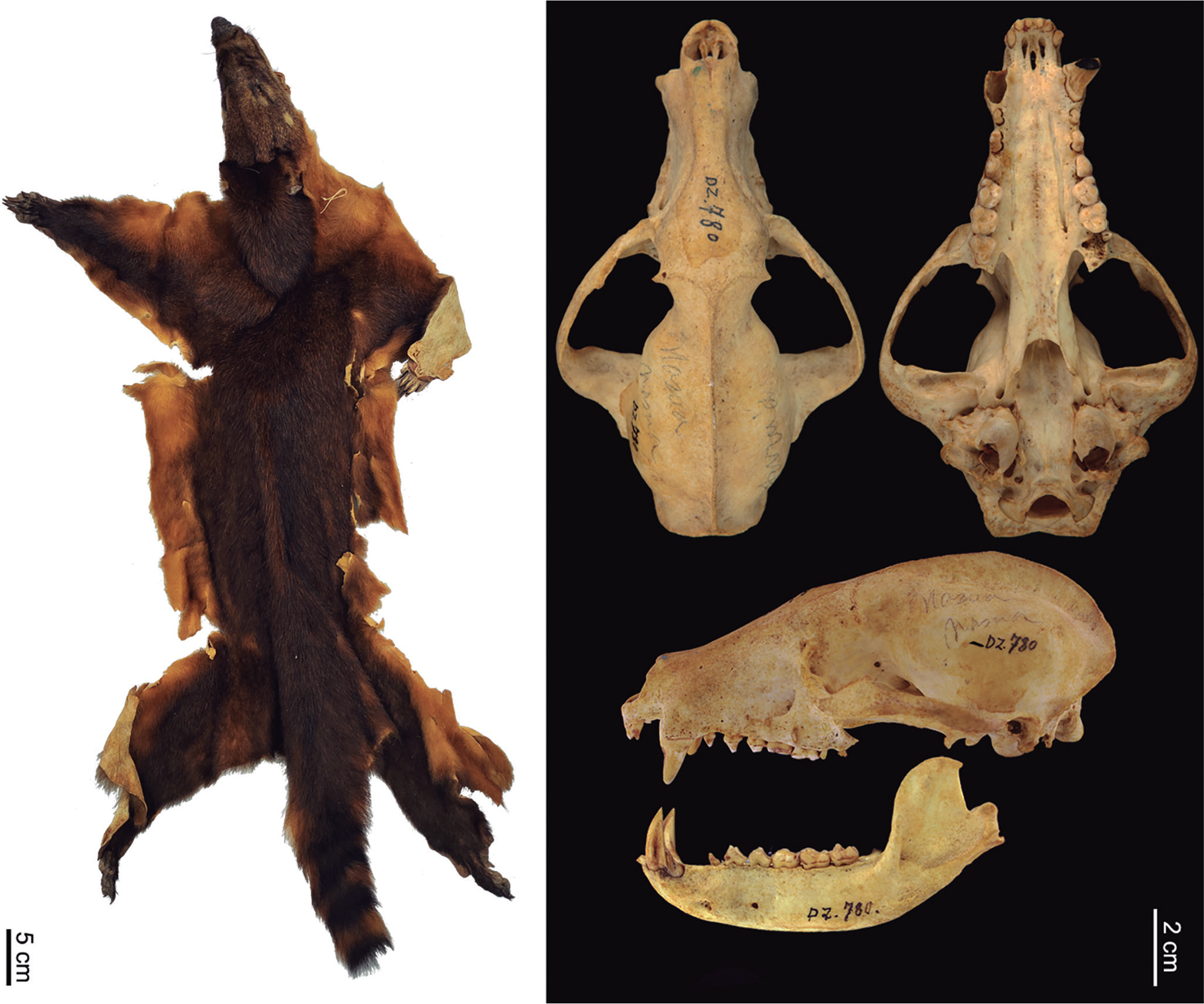
Holotype (Fig. 1): MZUSP 2557, adult male, skin and skull (without mandible), collected by L.P. Barreto on 13 January 1908, at “Pirituba, subúrbio da cidade de São Paulo” [= Pirituba, municipality of São Paulo], state of São Paulo, Brazil.

Skin and skull (with missing mandible) of the holotype (MZUSP 2557) of Monodelphis tricolor paulensisVieira, 1950, currently Monodelphis (Monodelphiops) dimidiata (Wagner, 1847).
Paratypes: MZUSP 25 and MZUSP 128*, both adult females, skin and skull (partially damaged in MZUSP 25), collected by J. Zech at Piquete, state of São Paulo, Brazil, the former in November 1896 and the latter in 1897. MZUSP 4146, adult male, skin, collected by J.L. Lima on 23 February 1933, at Mogi das Cruzes, state of São Paulo, Brazil. MZUSP 6611, adult female, skin* and skull, collected on 13 November 1945, and MZUSP 6612, adult male, skin and skull*, collected on 28 December 1945, both by J.L. Lima, at Ibiti, state of São Paulo, Brazil.
Body measurements: MZUSP 2557 - TL = 136 mm; T = 70 mm. MZUSP 6611 - TL = 180 mm; T = 80 mm; HF = 15 mm. MZUSP 6612 - TL = 225 mm; T = 90 mm; HF = 20 mm. MZUSP 25, 128, and 4146 - not available.
Comments:Monodelphis tricolor paulensis was described by Vieira (1950) mainly based on color pattern. However, this species was synonymized with Monodelphis sorex, later considered a junior synonym of M. dimidiata by morphological and molecular analyses (Vilela et al., 2010; Pavan et al., 2014). The holotype is incomplete, missing its mandible, which is presumed lost. Although the specimen catalog of the MZUSP collection notes that MZUSP 6611 and 6612 have skins and skulls, we could not locate the former’s skin and the latter’s skull. Additionally, MZUSP 128 was not found and is likely lost. The skull of MZUSP 25 is damaged, with missing bones in the posterior portion of the neurocranium.
Subgenus Mygalodelphys S. Pavan & Voss, 2016 Monodelphis pinocchio S. Pavan, 2015
American Museum Novitates, 3832: 3, 2015.
= Monodelphis (Mygalodelphys) pinocchio S. Pavan, 2015
Common names: Pinocchio opossum, long-nosed short-tailed opossum (Eng.); catita, catita-de-cauda-curta, catita-nariguda (Port.).
Paratypes: MZUSP 2793, adult male, skin and skull, collected by E. Garbe in November 1909, at Serra de Macaé, state of Rio de Janeiro, Brazil (22.32°S, 42.33°W). MZUSP 30740, adult male, skin, skull, postcranial skeleton, and tissue, field number ITM 135, collected by R. Rossi and J.W.A. Santos on 23 October 2001, at Riacho Grande, São Bernardo do Campo, state of São Paulo, Brazil (23.80°S, 46.58°W). MZUSP 36103, adult female, fluid-preserved with skull extracted, field number MRT 15815, collected by M.T. Rodrigues on 5 November 2008, at PARNA Caparaó, córrego do Calçado, Ibitirama, state of Espírito Santo, Brazil (20°28′03″S, 41°44′01″W).
Body measurements: MZUSP 30740 - TL = 93 mm; T = 54 mm; HF = 13 mm; E = 10 mm. MZUSP 2793 and 36103 - not available.
Comments: The holotype, an adult male, is held at the MNRJ (MN 78680) (Pavan, 2015). The paratype series consists of five specimens, three of which are held at the MZUSP. The other two specimens are deposited at the AMNH (AMNH 61547) and the MNRJ (MN 78651) (Pavan, 2015). The paratype MZUSP 36103, cited as an “uncatalogued MZUSP specimen” by Pavan (2015), had its collection locality coordinates updated, as the original description differed from both the collector’s records and the information on the specimen label.
Order Pilosa Flower, 1883 Suborder Vermilingua Illiger, 1811 Family Cyclopedidae Pocock, 1924 Genus Cyclopes Gray, 1821 Cyclopes thomasi Miranda, Casali, Perini, Machado & Santos, 2018
Zoological Journal of the Linnean Society, 183(3): 687, 2018.
Common names: Thomas’ silky anteater (Eng.); tamanduaí-de-thomas (Port.).
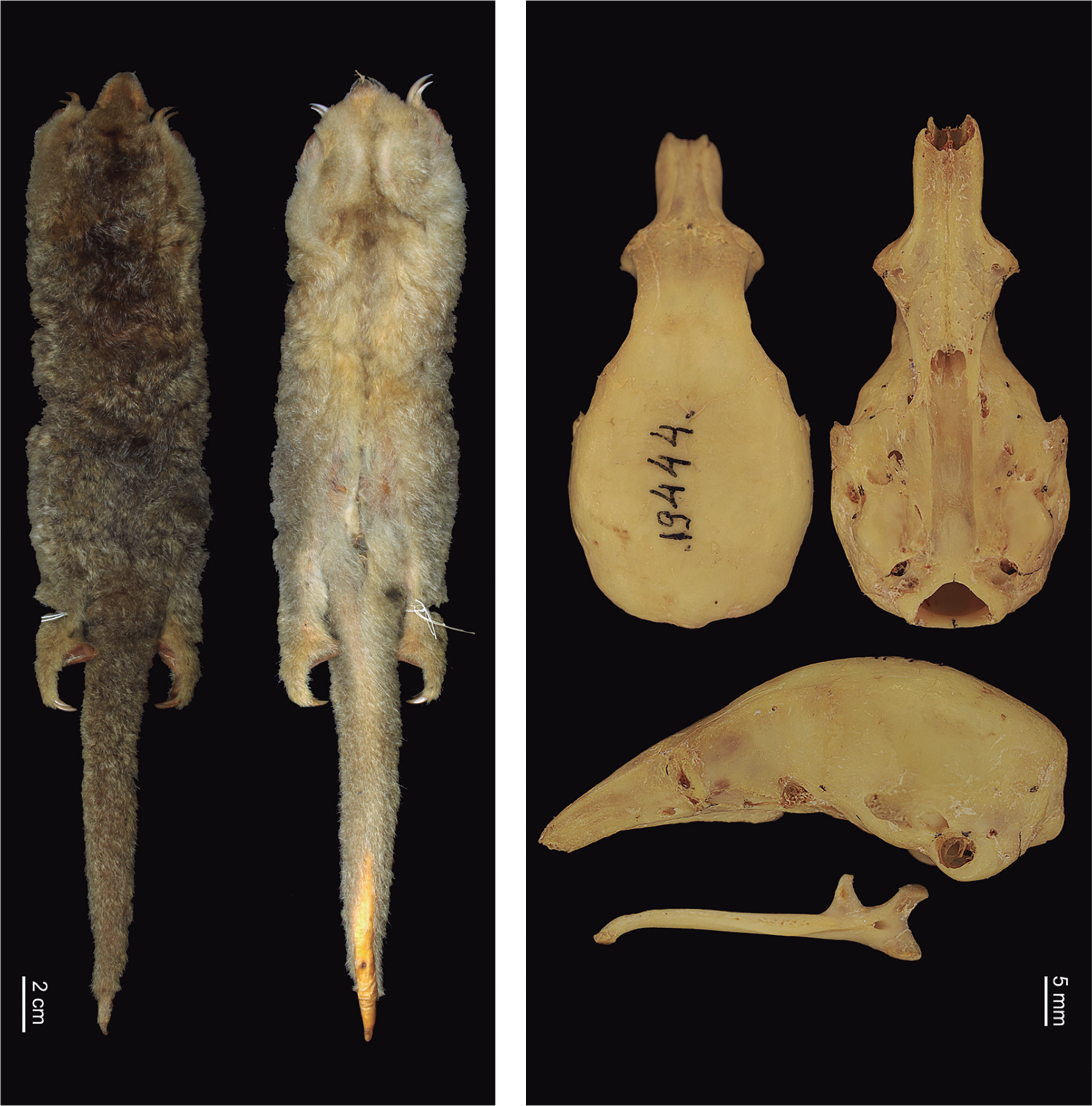
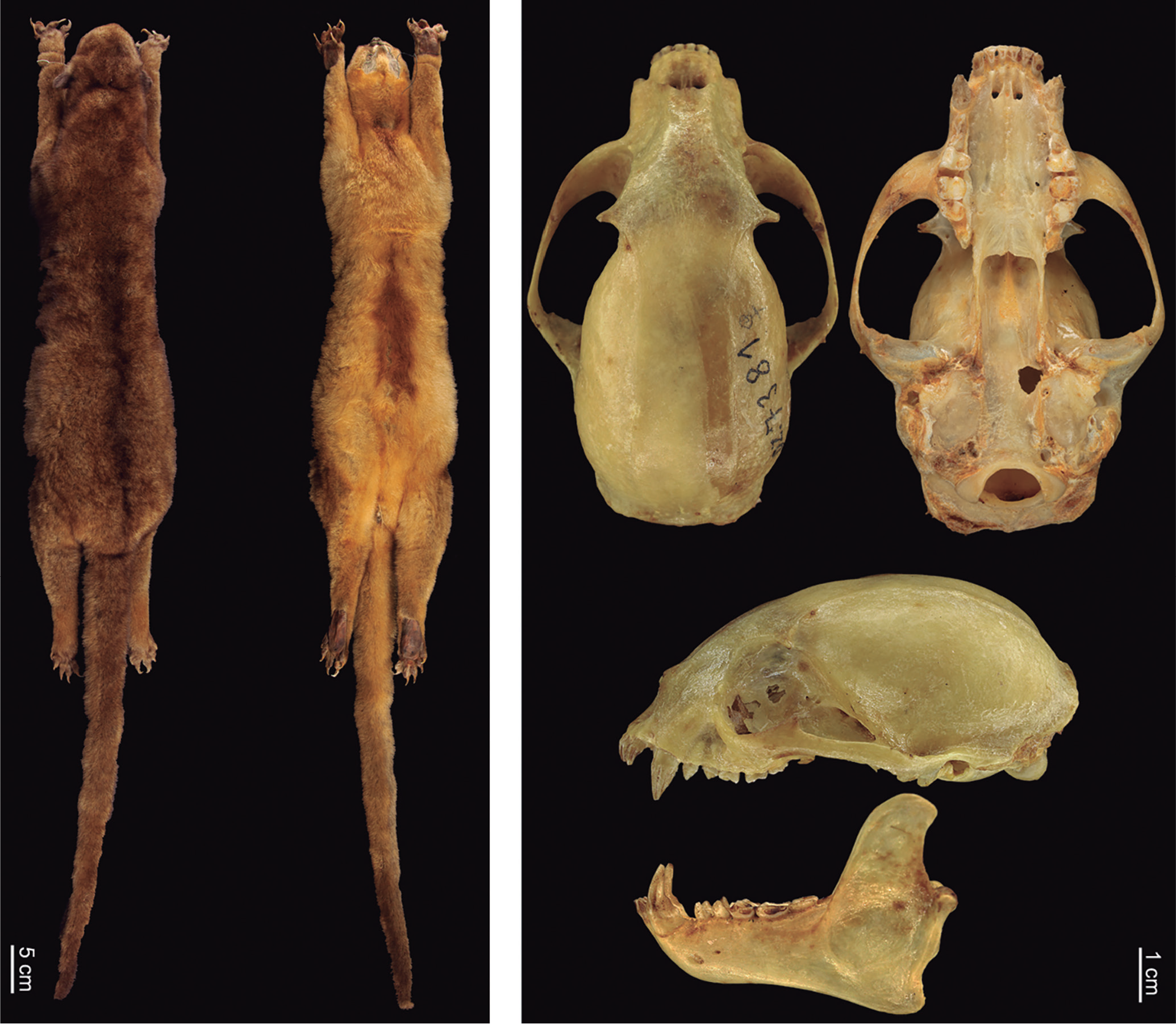
Holotype (Fig. 2): MZUSP 19944, female, skin and skull, field number 78.3399, collected by P.E. Vanzolini on 9 January 1979, at “Porto Walter, Acre, Brazil”.

Body measurements: HB = 172 mm; T = 160 mm; HF = 35 mm; W = 275 g.
Comments: In the original description, Miranda et al. (2018) mentioned 1985 as the year of collection. However, this is the date when P.E. Vanzolini identified and cataloged this specimen in the MZUSP collection. We correct the collection date to 1979, according to the information on the specimen label.
Order Primates Linnaeus, 1758 Suborder Haplorhini Pocock, 1918 Infraorder Simiiformes Haeckel, 1866 Family Atelidae Gray, 1825 Subfamily Alouattinae Trouessart, 1897 Genus Alouatta Lacépède, 1799 Alouatta guariba clamitansCabrera, 1940
Revista hispano-americana de Ciencias puras y aplicadas, 9: 404, 1940.
= Alouatta guariba (Humboldt, 1812)
Common names: Brown Howler Monkey (Eng.); guariba, bugio-ruivo (Port.).
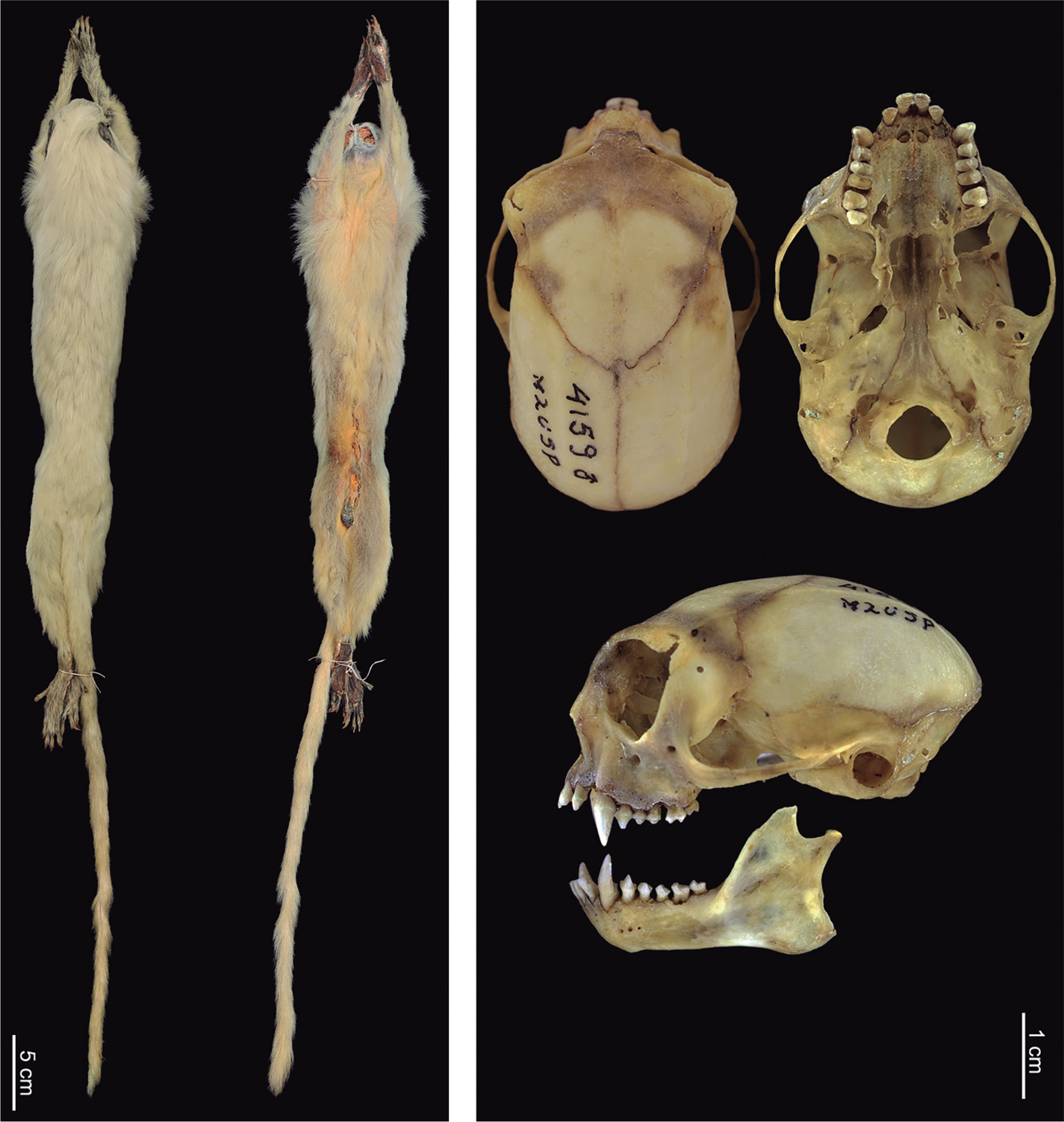
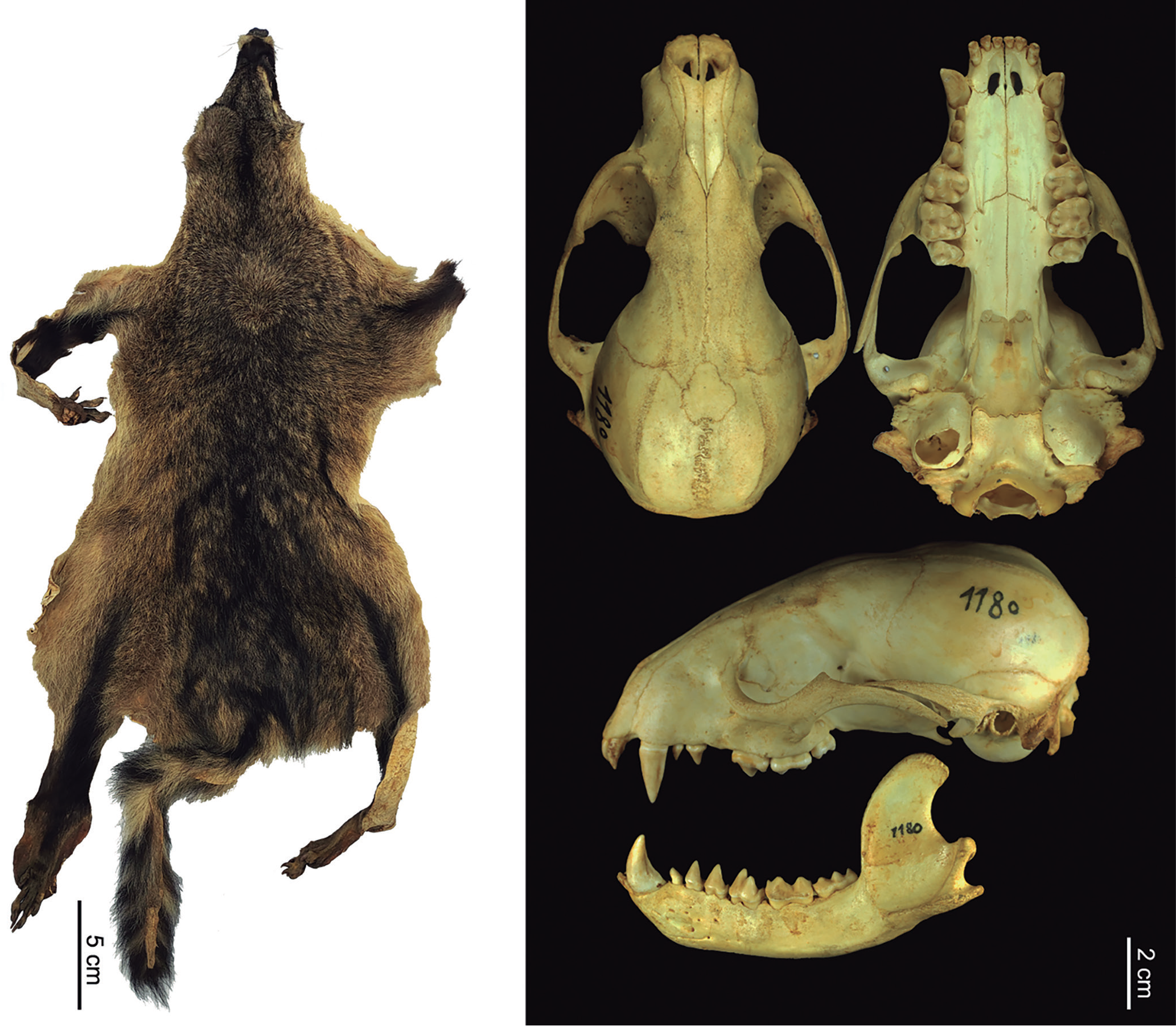
Lectotype (Fig. 3): MZUSP 97, adult female, skin and skull, collected by B. Bicego in September 1896, at “São Sebastião, Estado de [= State of] São Paulo, Brasil (23°50′S, 42°20′W)”.

Skin and skull of the lectotype (MZUSP 97) of Alouatta guariba clamitansCabrera, 1940, currently Alouatta guariba (Humboldt, 1812).
Paralectotypes: MZUSP 407, adult male, skin, skull, and hyoid bone, collected in 1900; MZUSP 409, young male, skin, field number 1327, collected on 24 August 1900; both collected at “Alto da Serra” [= Paranapiacaba], state of São Paulo, Brazil (23°46′S, 46°17′W), by an unknown collector. MZUSP 1671, adult male, skin* and skull, collected by C. Grossmann at Joinville, state of Santa Catarina, Brazil (26°18′S, 48°50′W).
Body measurements: Not available.
Comments:Gregorin (2006) formally designated specimen MZUSP 97 as the lectotype and MZUSP 407, 409, and 1671 as paralectotypes of Alouatta guariba clamitansCabrera, 1940, elevating A. clamitans to full species status and distinguishing it from A. guariba. This type designation relied on Cabrera’s (1940) reference to type material from the “Museu Paulista”, originally listed by Ihering (1914), although Cabrera did not formally assign types. Alouatta g. clamitans is currently treated as a synonym of A. guariba (Mammal Diversity Database, 2025). Among the paralectotypes, MZUSP 407 lacks upper incisors and has loose lower incisors; the skin of MZUSP 1671 is missing and is presumed to be lost.
Family Cebidae Bonaparte, 1821 Subfamily Callitrichinae Gray, 1821 Genus Saguinus Hoffmannsegg, 1807 Subgenus Leontocebus Wagner, 1839 Leontocebus hololeucusPinto, 1937
Boletim Biológico, 3: 3, 1937.
= Saguinus (Leontocebus) weddelli melanoleucus (Miranda-Ribeiro, 1912)
Common names: White-mantled tamarin, white saddle-back tamarin (Eng.); sagui-branco, sauim-branco, sagui-de-manto-branco (Port.).
Holotype (Fig. 4): MZUSP 4159, adult male, skin and skull, field number 1324, collected by A.M. Olalla on 14 October 1936, at “Santo Antonio, Rio Eirú (afluente da margem direita do Rio Juruá, pouco acima de S. Felipe) [= a tributary on the right bank of the Juruá River, just above S. Felipe], no Estado do [= in the State of] Amazonas”, Brazil.

Skin and skull of the holotype (MZUSP 4159) of Leontocebus hololeucusPinto, 1937, currently Saguinus (Leontocebus) weddelli melanoleucus (Miranda-Ribeiro, 1912).
Paratypes: MZUSP 4156, adult female, skin and skull, field number 1325, collected on 12 October 1936; MZUSP 4157, adult male, skin and skull, field number 1327, collected on 13 October 1936; MZUSP 4158, adult female, skin and skull, field number 1326, on 14 October 1936; all collected by A.M. Olalla at the same locality as the holotype.
Body measurements: MZUSP 4159 - TL = 565 mm; T = 330 mm; HF = 70 mm. MZUSP 4156 - TL = 550 mm; T = 345 mm; HF = 70 mm. MZUSP 4157 - TL = 530 mm; T = 325 mm; HF = 70 mm. MZUSP 4158 - TL = 545 mm; T = 330 mm; HF = 70 mm.
Comments:Pinto (1937) designated the individual MZUSP 4159 as the “Typo” of Leontocebus hololeucus, and the individuals MZUSP 4156, 4157, and 4158 as cotypes. According to the ICZN (1999), the term “cotype” was formerly used to designate either syntypes or paratypes, but it is now recommended to be avoided (see Recommendation 73E of the ICZN, 1999). Since Pinto (1937) expressly designated and described the holotype of L. hololeucus, his cotypes are considered paratypes of L. hololeucus.
Subgenus Tamarinus Trouessart, 1904 Midas pileatus juruanusIhering, 1904
Revista do Museu Paulista, 6: 416, 1904.
= Saguinus (Tamarinus) pileatus (I. Geoffroy & Deville, 1848)
Common names: Red-capped/Red-cap mustached tamarin (Eng.); sagui-de-bigode, sagui-de-boca-branca (Port.).
Syntypes: MZUSP 733 (Fig. 5), adult male, mounted skin and skull (partially damaged), MZUSP 1182, adult male, skin and skull, collected by E. Garbe in 1902 at “rio Juruá”, state of Amazonas, Brazil.

Skin and skull of MZUSP 733, syntype of Midas pileatus juruanusIhering, 1904, currently Saguinus (Tamarinus) pileatus (I. Geoffroy & Deville, 1848).
Body measurements: MZUSP 1182 - HB = 240 mm; T = 370 mm. MZUSP 733 - not available.
Comments:Midas pileatus juruanus is currently considered a junior synonym of Saguinus pileatus (Groves, 2001, 2005; Mammal Diversity Database, 2025). Ihering (1904: 416) reported the existence of a third syntype transferred to the BMNH, which is now found under the catalog number BMNH 1903.9.1.10. The syntype MZUSP 733 exhibits damage to the skull, including partial loss of the occipital bone.
Subfamily Cebinae Bonaparte, 1831 Genus Saimiri Voigt, 1831 Saimiri vanzoliniiAyres, 1985
Papéis Avulsos de Zoologia, 36(14): 148, 1985.
Common names: Vanzolini’s squirrel monkey, black squirrel monkey (Eng.); macaco-de-cheiro-de-cabeça-preta (Port.).
Holotype (Fig. 6): MZUSP 15474, adult male, skin, skull, and postcranial skeleton, field number 83.0081, collected by P.E. Vanzolini and J.M. Ayres on 26 July 1983, at “left (north) bank of Lake Mamirauá, at the mouth of the Rio Japurá, state of Amazonas, Brazil (02°59′S, 64°55′W)”.

Paratypes: MZUSP 15471, field number 83.0058, and MZUSP 15473, field number 83.0060, both males; MZUSP 15472*, field number 83.0059, and MZUSP 15476, field number 83.0083, both females; all with skin and skull, collected by P.E. Vanzolini and J.M. Ayres on 25-26 July 1983, at Lago Mamirauá, mouth of the Japurá River, state of Amazonas, Brazil (02°59′S, 64°55′W). MZUSP 19016*, field number 83.0253, MZUSP 19017, field number 83.0254, both males, with skin and skull collected by J.M. Ayres on 8 December 1984, at the same locality. MZUSP 17557, male, field number 84.0016, MZUSP 17558, female, field number 84.0018, both with skin and skull, collected by J.M. Ayres and P.E. Vanzolini on 19 February 1984, at Furo do Buá-buá, Paraná do Jarauá, state of Amazonas, Brazil (02°51′S, 64°59′W). MZUSP 18898, field number 83.0310, and MZUSP 18899, field number 83.0311, both males, with skin and skull, collected by J.M. Ayres on 6 July 1984, at “Ilha do Tarará” [= Pananim], Solimões River, state of Amazonas, Brazil (03°17′S, 64°36′W).
Body measurements: MZUSP 15474 - HB = 282 mm; T = 366 mm; HF = 84 mm; E = 28 mm; W = 980 g. MZUSP 15471 - HB = 270 mm; T = 360 mm; HF = 79 mm; E = 28 mm; W = 1030 g. MZUSP 15472 - HB = 257 mm; T = 410 mm; HF = 83 mm; E = 25 mm; W = 680 g. MZUSP 15473 - HB = 284 mm; T = 398 mm; HF = 81 mm; E = 29 mm; W = 1100 g. MZUSP 15476 - HB = 258 mm; T = 410 mm; HF = 79 mm; E = 25 mm; W = 750 g. MZUSP 17557 - HB = 276 mm; T = 375 mm; HF = 81 mm; E = 27 mm; W = 620 g. MZUSP 17558 - HB = 258 mm; T = 369 mm; HF = 80 mm; E = 24 mm; W = 540 g. MZUSP 18898 - HB = 262 mm; T = 384 mm; HF = 84 mm; E = 30 mm; W = 890 g. MZUSP 18899 - HB = 262 mm; T = 384 mm; HF = 75 mm; E = 30 mm; W = 880 g. MZUSP 19016 - HB = 243 mm; T = 375 mm; HF = 80 mm; E = 25 mm; W = 550 g. MZUSP 19017 - HB = 259 mm; T = 390 mm; HF = 80 mm; E = 27 mm.
Comments: Although formerly treated as a subspecies (Hershkovitz, 1987a) or as a synonym of other Saimiri taxa (Costello et al., 1993), the validity of Saimiri vanzolinii is now supported by morphological and genetic data (Lynch-Alfaro et al., 2015; Mercês, 2018). Two paratypes (MZUSP 15472 and 19016) were not found in the MZUSP collection and are probably lost. One additional specimen (MZUSP 15475) is labeled as a paratype; nonetheless, Ayres (1985) did not explicitly designate this specimen as part of the type series in the original description.
Family Pitheciidae Mivart, 1865 Subfamily Callicebinae Pocock, 1925 Genus Plecturocebus Byrne, Rylands, Carneiro, Lynch Alfaro, Bertuol, M.N. Silva, Messias, Groves, Mittermeier, Farias, Hrbek, Schneider, Sampaio & Boubli, 2016 Callicebus cupreus acreanusVieira, 1952
Papéis Avulsos do Departamento de Zoologia, 11(2): 23, 1952.
= Plecturocebus cupreus (Spix, 1823)
Common names: Red titi monkey, coppery titi monkey, coppery ringtail (Eng.); zogue-zogue, guigó-acobreado (Port.).
Holotype (Fig. 7): MZUSP 7332, female, skin and skull, field number Exp. DZ 207, collected by P.E. Vanzolini during the Expedição do Departamento de Zoologia on 6 September 1951, at “Iquiri, Acre”, Brazil.

Skin and skull of the holotype (MZUSP 7332) of Callicebus cupreus acreanusVieira, 1952, currently Plecturocebus cupreus (Spix, 1823).
Body measurements: TL = 730 mm; T = 420 mm; HF = 90 mm; FF = 60 mm; E = 20 mm.
Comments: Although Vieira (1952) stated that Callicebus cupreus acreanus differs from C. c. cupreus in pelage coloration, this taxon has consistently been considered a junior synonym of either C. cupreus (Hershkovitz, 1990; Groves, 2001) or C. toppini (Cabrera, 1958; Vermeer & Tello-Alvarado, 2015). Following the genus reclassification proposed by Byrne et al. (2016), which split the former genus Callicebus (sensuThomas, 1903; Hershkovitz, 1963, 1988, 1990; Kobayashi, 1995; Groves, 2001; van Roosmalen et al., 2002) into three distinct genera, C. c. acreanus is currently regarded as a junior synonym of Plecturocebus cupreus.
Callicebus vieirai Gualda Barros, Nascimento & Amaral, 2012
Papéis Avulsos de Zoologia, 52(23): 263, 2012.
= Plecturocebus vieirai (Gualda Barros, Nascimento & Amaral, 2012)
Common names: Vieira’s titi (Eng.); guigó-de-vieira, sauá-de-vieira, zogue-zogue-de-vieira (Port.).
Holotype (Fig. 8): MZUSP 34663, adult male, skin and skull (partially damaged), field number PEV 747-748, collected by M. Kerr on 7 April 1997, at “Rio Renato, a tributary of Rio Teles Pires (right bank), nearby the city of Cláudia, state of Mato Grosso, Brazil (11°33′00.15″S, 55°10′59.98″W; about 370 m above sea level)”.
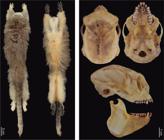
Skin and skull (with damaged left side) of the holotype (MZUSP 34663) of Callicebus vieiraiGualda-Barros et al., 2012, currently Plecturocebus vieiraiGualda-Barros et al., 2012.
Paratypes: MZUSP 25441, adult female, skin, skull (partially damaged), and postcranial skeleton, field number JLSilvaFº 105; MZUSP 25442 and MZUSP 25443, both adult males, skin, skull (partially damaged), and postcranial skeleton, field numbers JLSilvaFº 106 and 107, respectively; all collected by J.L. Silva-Filho on 22 November 1988, at Largo do Souza, Iriri River, state of Pará, Brazil (04°00′S, 53°00′W).
Body measurements: MZUSP 34663 - HB = 348 mm; T = 510 mm; HF = 98 mm; FF = 65 mm; E = 35 mm; W = 955 g. MZUSP 25441 - HB = 305 mm; T = 460 mm; HF = 90 mm; E = 30 mm. MZUSP 25442 - HB = 300 mm; T = 450 mm; HF = 88 mm; E = 30 mm. MZUSP 25443 - HB = 300 mm; T = 410 mm; HF = 86 mm; E = 30 mm.
Comments: According to Byrne et al. (2016), Callicebus vieirai belongs to the genus Plecturocebus, although these authors did not assess this species directly. In the holotype, the left coronoid process and the condyle of the mandible are damaged, and the tail was shortened during the taxidermy process. All paratypes show varying degrees of cranial damage, particularly affecting the basicranial and frontal regions.
Subfamily Pitheciinae Mivart, 1865 Genus Pithecia Desmarest, 1804 Pithecia mittermeieriMarsh, 2014
Neotropical Primates, 21(1): 105, 2014.
= Pithecia irrorata Gray, 1843
Common names: Gray’s bald-faced saki (Eng.); parauacu, macaco-cabeludo, macaco-velho (Port.).
Paratype: MZUSP 5549, male, skin and skull, field number 504, collected by A.M. Olalla on 8 May 1936, at Aruã, Arapiuns River, state of Pará, Brazil (02°39′S, 55°38′W).
Body measurements: HB = 450 mm; T = 450; HF = 135 mm.
Comments:Serrano-Villavicencio et al. (2019) demonstrated the ambiguity of the morphological characters used by Marsh (2014) to distinguish Pithecia mittermeieri from Pithecia irrorata and questioned the unsupported reassignment of the P. irrorata type locality from Brazil to an unspecified location in Peru. They also noted the absence of population segregation by the Madeira and Purus rivers (seeSerrano-Villavicencio et al., 2019). As a result, they treated P. mittermeieri as a junior synonym of P. irrorata. Additional paratypes are housed at INPA (INPA 5707), MNRJ (MN 3315), and BMNH (BMNH 20.7.14.6), which also holds the holotype (BMNH 27.8.5.9.1) (Marsh, 2014).
Pithecia irrorata vanzolinii Hershkovitz, 1987
American Journal of Primatology, 12: 426, 1987.
= Pithecia vanzolinii Hershkovitz, 1987
Common names: Vanzolini’s bald face saki (Eng.); parauacu-de-vanzolini, macaco-cabeludo, macaco-velho (Port.).
Holotype (Fig. 9): MZUSP 5491, adult male, skin and skull, field number 1803, collected by A.M. Olalla on 29 October 1936, at “Santa Cruz, Rio Eirú, a right bank (southern) tributary of the Rio Juruá, Amazonas, Brazil” (07°23′S, 70°47′W).

Skin and skull of the holotype (MZUSP 5491) of Pithecia irrorata vanzolinii Hershkovitz, 1987, currently Pithecia vanzolinii Hershkovitz, 1987.
Body measurements: TL = 935 mm; T = 420 mm; HF = 120 mm.
Comments:Hershkovitz (1987b), based mainly on material held at the MZUSP (21 specimens), described this taxon as a subspecies of Pithecia irrorata, P. i. vanzolinii. All specimens of this taxon collected by A.M. Olalla and housed at the MZUSP are labeled as paratypes, which may have led Marsh (2014: 101) to report the existence of 22 paratypes of P. vanzolinii in her revision. Nonetheless, as Serrano-Villavicencio et al. (2019) pointed out, Hershkovitz (1987b) never explicitly designated paratypes for this taxon as he did for the holotype MZUSP 5491. According to Article 72.4.7 of the ICZN (1999), a specimen labeled as “Type” is not necessarily evidence that a specimen is a type. For this reason, we agree with Serrano-Villavicencio et al. (2019) in considering the specimen MZUSP 5491 as the sole type material of P. vanzolinii.
Order Rodentia Bowdich, 1821 Suborder Hystricomorpha Brandt, 1855 Infraorder Hystricognathi Brandt, 1855 Family Caviidae Fischer, 1817 Subfamily Caviinae G. Fischer, 1817 Genus Cavia Pallas, 1766 Cavia magnaXiménez, 1980
Revista Nordestina de Biologia, 3 (especial): 148, 1980.
Common names: Greater guinea pig (Eng.); preá (Port.).
Holotype (Fig. 10): MZUSP 12843, male, skin and skull, field number 8570, collected by A.R. Cordeiro on 21 April 1975, at “en las orillas del arroyo Imbé, municipio de Tramandaí, Estado de Rio Grande del Sur, Brasil” [= on the banks of the Imbé stream, municipality of Tramandaí, State of Rio Grande do Sul, Brazil].

Paratype: MZUSP 11781, male, skin and skull, field number 8577, collected by A.R. Cordeiro on 21 April 1975, at the same locality as the holotype.
Body measurements: MZUSP 12843 - TL = 310 mm; HF = 54/49 mm; E = 30 mm; test. = 30 × 20 mm; W = 760 g. MZUSP 11781 - TL = 310 mm; HF = 62/57 mm; E = 27 mm; W = 570 g.
Comments: The paratype series includes four other specimens housed in various institutions: AMNH (AMNH 235998), UFRS (AX 8574), BMNH (BM 78.2803), and MNHN (MNHN 2858) (Ximénez, 1980).
Family Echimyidae Gray, 1825 Subfamily Echimyinae Gray, 1825 Tribe Echimyini Gray, 1825 Genus Echimys G. Cuvier, 1809 Echimys vieirai Iack Ximenes, de Vivo & Percequillo, 2005
Papéis Avulsos de Zoologia, 45(5): 52, 2005.
Common names: Vieira’s tree rat, Vieira’s spiny tree-rat (Eng.); rato-da-árvore (Port.).
Holotype (Fig. 11): MZUSP 26650, young male, skin and skull, field number EPA 70.1327, collected by P.E. Vanzolini on 24 November 1970, at “Barreirinha, right bank of the Tapajós River, near São Luis do Tapajós, Pará state, Brazil; geographic coordinates 04°25′S, 56°13′W”.
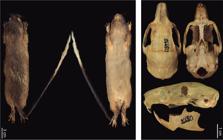
Body measurements: HB = 245 mm; T = 340 mm; HF = 50 mm; E = 15 mm.
Comments: This species is known from only two individuals: the holotype housed at the MZUSP and a paratype (MN 67549) deposited at the MNRJ, which is also a young individual collected by A. Parko in Virgem Guajará, state of Amazonas, Brazil (Iack-Ximenes et al., 2005).
Genus Phyllomys Lund, 1839 Phyllomys pattoni Emmons, Leite, Kock & Costa, 2002
American Museum Novitates, 3380: 30, 2002.
Common names: Patton’s Atlantic tree-rat, rusty-sided Atlantic tree-rat (Eng.); rato-da-árvore (Port.).
Paratypes: MZUSP 31953 and MZUSP 31954, both males, skin, skull, carcass, and tissue (liver), field numbers YL 198 and YL 199, respectively; MZUSP 31955 and MZUSP 31956, both females, field numbers YL 201 and YL 200, respectively; all collected by Y. Leite on 15-16 April 1998, at Fazenda Monte Castelo, Ilha da Cassumba, 7 km southwest of Caravelas, state of Bahia, Brazil (17°48′06″S, 39°15′49″W).
Body measurements: MZUSP 31953 - TL = 464 mm; T = 223 mm; HF = 42 mm; E = 17 mm; W = 395 g. MZUSP 31954 - TL = 230 mm (tail was naturally broken); HF = 42 mm; E = 18 mm; W = 295 g. MZUSP 31955 - TL = 240 mm (tail was naturally broken); HF = 42 mm; E = 17 mm; W = 380 g. MZUSP 31956 - TL = 430 mm; T = 227 mm; HF = 40 mm; E = 17 mm; W = 235 g.
Comments: The holotype of Phyllomys pattoni (MN 62391), an adult female collected at Mangue do Caritoti, Caravelas, state of Bahia, Brazil, is housed at the Museu Nacional, Universidade Federal do Rio de Janeiro, and two additional paratypes are held at the MVZ (MVZ 197621) and the NMNH (USNM 583932) (Emmons et al., 2002).
Phyllomys sulinus Leite, Christoff & Fagundes, 2008
Journal of Mammalogy, 89(4): 846, 2008.
Common names: Southern Atlantic tree-rat (Eng.); rato-da-árvore (Port.).
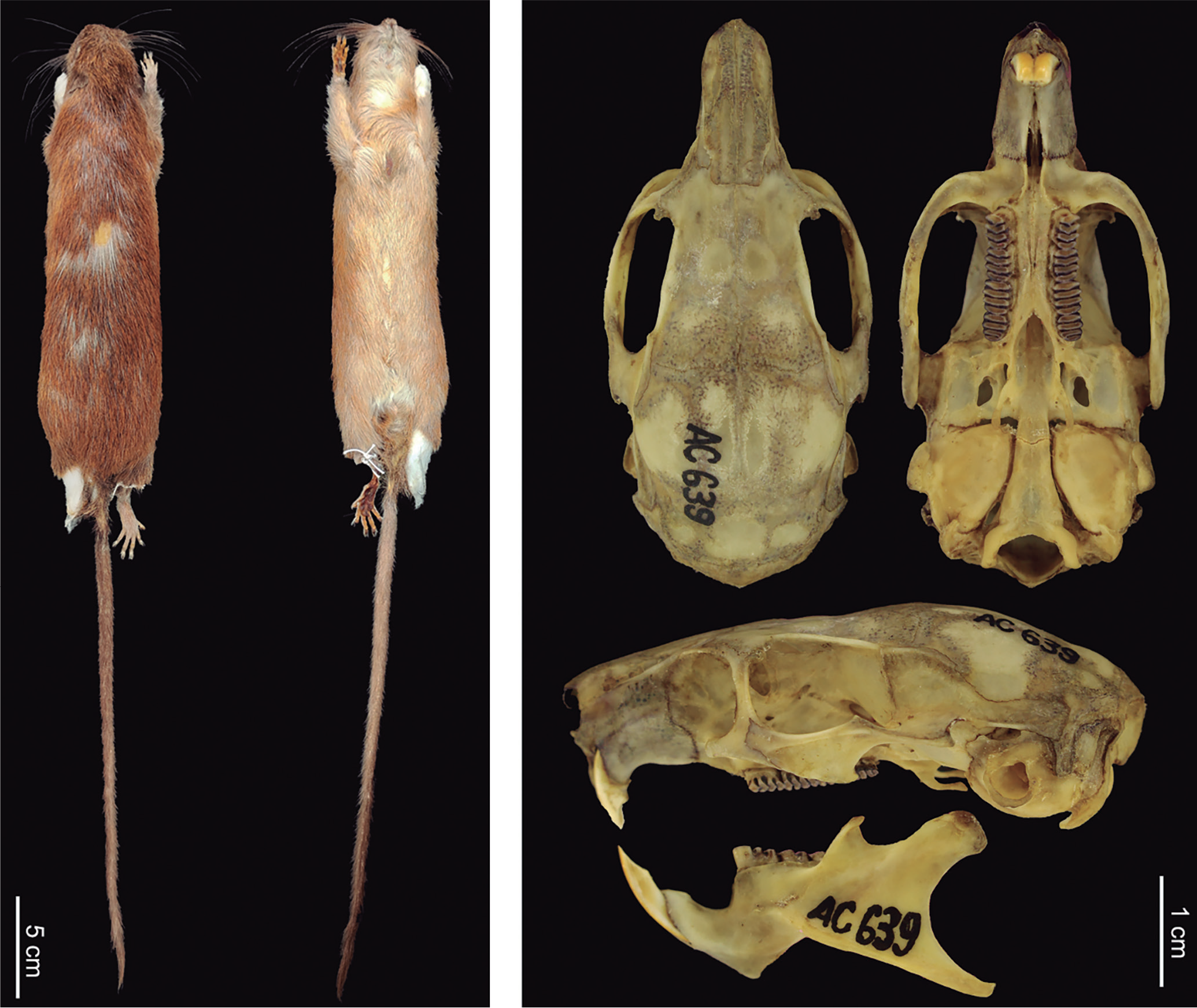
Holotype (Fig. 12): MZUSP 33474, adult male, skin, skull, partial postcranial skeleton, and tissue (liver), field numbers AC 639 and ITA 4842, collected by A.U. Christoff on 20 March 2000, at “South bank of the Uruguay River, municipality of Aratiba, Rio Grande do Sul, Brazil, 27°23′39″S, 52°18′01″W, 420 m elevation”.

Paratype: MZUSP 33475, female, skin, skull, and tissue (liver), field numbers AC 640 and ITA 4874, collected by A.U. Christoff at the type locality in 2000.
Body measurements: MZUSP 33474 - TL = 417 mm; T = 227 mm; HF = 40 mm; E = 16 mm. MZUSP 33475 - TL = 421 mm; T = 223 mm; HF = 36 mm; E = 16 mm.
Comments: Ten other specimens (MCNU 826, 827, 831, 833, 834, 835, 836, 837, 838, 840) collected by A.U. Christoff at the same locality as the holotype were also included in the paratype series (Leite et al., 2008).
Mesomys thomasi Ihering, 1897
Revista do Museu Paulista, 2: 171, 1897.
= Phyllomys thomasi (Ihering, 1897)
Common names: Giant Atlantic tree-rat, Thomas’s Atlantic tree rat (Eng.); rato-da-árvore, curuá (Port.).
Lectotype (Fig. 13): MZUSP 47, male, skin and skull, collected by B. Bicego in 1896, at “Ilha de São Sebastião” [= Ilhabela], state of São Paulo, Brazil [23°46′S, 45°21′W, amended by Emmons et al. (2002)].
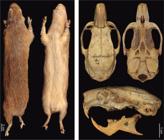
Skin and skull of the lectotype (MZUSP 47) of Mesomys thomasiIhering, 1897, currently Phyllomys thomasi (Ihering, 1897).
Paralectotypes: MZUSP 45 and MZUSP 532, both males, skin; MZUSP 51, unknown sex, skull; MZUSP 526 and MZUSP 527, both males, fluid-preserved with skulls extracted (partially damaged in MZUSP 527); all collected by B. Bicego in 1896 at “São Sebastião” [= Ilhabela], state of São Paulo, Brazil. MZUSP 223, male, skull (partially damaged), collected by B. Bicego on the same date at “Ilha de São Sebastião” [= Ilhabela], state of São Paulo, Brazil.
Body measurements: MZUSP 47 - HB = 287 mm; HF = 38 mm. MZUSP 45, 532, 51, 526, 527, 223 - unavailable.
Comments:Ihering (1897) described this species based on the first specimen of “cururuá sem rabo” he received, consisting of a skin (without skull) collected on “Ilha de São Sebastião”. In his description, the author characterized the specimen based on the pelage coloration and body measurements. However, Ihering (1897) did not provide any record number. In the MZUSP collection, the oldest series of this species is composed of seven specimens collected by B. Bicego in 1896, from which Emmons et al. (2002) designated MZUSP 47 as lectotype, as it most closely matches the description provided by Ihering (1897), and the other six as paralectotypes. The series of paralectotypes also includes three other specimens collected by B. Bicego in the same year, one housed at the FMNH (FMNH 41360) and the others at the BMNH (BMNH 99.8.12.1 and 2.8.25.2) (Emmons et al., 2002). The paralectotypes from “São Sebastião”, as indicated on the specimens’ labels, were probably collected on Ilha de São Sebastião (municipality of Ilhabela), not in the municipality of the same name on the mainland, as it is an endemic species of the island (Emmons et al., 2002). Two paralectotypes (MZUSP 223 and 527) exhibit damaged skulls, each lacking portions of the orbital region and zygomatic arch on one side.
Subfamily Euryzygomatomyinae Fabre, Upham, Emmons, Justy, Leite, Loss, Orlando, Tilak, Patterson & Douzer, 2017 Genus TrinomysThomas, 1921Proechimys albispinus sertoniusThomas, 1921
The Annals and Magazine of Natural History, 8: 142, 1921.
= Trinomys albispinus albispinus (I. Geoffroy, 1838)
Common names: White-spined spiny rat (Eng.); rato-de-espinho (Port.).
Paratype: MZUSP 2003, male, skin and skull, field number 1562, collected by A. Robert on 3 July 1903, at Lamarão, state of Bahia, Brazil.
Body measurements: HB = 160 mm; T = 145 mm; HF = 35 mm; E = 23 mm.
Comments: Based on morphological analyses, Pessôa & Strauss (1999) synonymized Proechimys albispinus sertonious with P. a. albispinus. This taxon is now recognized under the genus Trinomys, supported by biogeographic, molecular, and morphological evidence (Lara et al., 1996; Lara & Patton, 2000; Pessôa et al., 2015). The holotype (BM 3.9.5.86), collected at the same locality as MZUSP 2003, is housed at the BMNH (Thomas, 1921).
Proechimys albispinus minor Reis & Pessôa, 1995
Zeitschrift für Säugetierkunde, 60: 239, 1995.
= Trinomys albispinus minor (Reis & Pessôa, 1995)
Common names: White-spined spiny rat (Eng.); rato-de-espinho (Port.).
Paratypes: MZUSP 28885, female, skull, field number PEU 880001 and BIO 651; MZUSP 28886, male, skin, skull, and postcranial skeleton, field number PEU 880002 and BIO 652; MZUSP 28887, female, skull, field number PEU 880003; MZUSP 28888, male, skull, field number PEU 880004 and BIO 649; all collected on 21 August 1988, at Morro do Chapéu, state of Bahia, Brazil (11°33′S, 41°09′W, 800 m of elevation), by P. Rocha.
Body measurements: MZUSP 28886 - W = 100 g. MZUSP 28885, 28887, 28888 - not available.
Comments:Reis & Pessôa (1995) described Proechimys albispinus minor based only on specimens from the type locality (“Morro do Chapéu, 800 m above sea level, state of Bahia, Brazil”). The holotype (MN 34491) is housed at the MNRJ, and a fifth paratype (UFPB 772) is deposited at the UFPB.
Proechimys yonenagae Rocha, 1995
Mammalia, 59(4): 541, 1995.
= Trinomys yonenagae (Rocha, 1995)
Common names: Torch-tail spiny rat, Yonenaga’s spiny rat, Yonenaga’s Atlantic spiny rat (Eng.); rato-de-espinho (Port.).
Holotype (Fig. 14): MZUSP 28922, male, skin, skull, and postcranial skeleton, field number PEU 880064, collected by P. Rocha on 2 October 1988, at “Ibiraba, Bahia, Brazil (10°48′S, 42°50′W)”.

Skin and skull of the holotype (MZUSP 28922) of Proechimys yonenagaeRocha, 1995, currently Trinomys yonenagae (Rocha, 1995).
Paratypes: MZUSP 28898, 28902, 28907, 28909, 28918, 28919, 28921, all males, with skin, skull, and postcranial skeleton, field numbers PEU 880020, PEU 880036, PEU 880041, PEU 880043, PEU 880056, PEU 880057, PEU 880063, collected on 30 August 1988, 7 September 1988, 15 September 1988, 15 September 1988, 19 September 1988, 21 September 1988, 1 October 1988, respectively. MZUSP 28883, 28912, 28914, 28915, 28917, 28920, all females, with skin, skull, and postcranial skeleton, field numbers PEU 870019, PEU 880047, PEU 880050, PEU 880051, PEU 880053, PEU 880062, collected on 4 October 1987, 17 September 1988, 18 September 1988, 18 September 1988, 21 September 1988, 1 October 1988, respectively. MZUSP 28884, 28905, 28923, 28933, 28934, 28935, all males, with skin and skull, field numbers PEU 870020, PEU 880039, PEU 880065, PEU 89018, PEU 89019, PEU 89022, collected on 4 October 1987, 9 September 1988, 2 October 1988, 18 March 1989, 18 March 1989, 19 March 1989, respectively. MZUSP 28896, 28897, 28903, 28906, 28908, 28910, 28911, 28913, 28930, 28931, 28936, all females, with skin and skull, field numbers PEU 880018, PEU 880019, PEU 880037, PEU 880040, PEU 880042, PEU 880044, PEU 880046, PEU 880048, PEU 89006, PEU 89007, PEU 89028, collected on 30 August 1988, 7 September 1988, 9 September 1988, 15 September 1988, 15 September 1988, 17 September 1988, 17 September 1988, 12 March 1989, 13 March 1989, 19 March 1989, respectively. MZUSP 28899, 28904, 28925, 28926, 28927, 28929, all males, with skull, field numbers PEU 880029, PEU 880038, PEU 880071, PEU 880074, PEU 880075, PEU 880077, collected on 2 September 1988, 7 September 1988, 11 October 1988, 12 October 1988, 12 October 1988, 13 October 1988, respectively. MZUSP 28900, 28901, 28916, 28928, all females, with skull, field numbers PEU 880033, PEU 880035, PEU 880052, PEU 880076, collected on 5 September 1988, 5 September 1988, 19 September 1988, 13 October 1988, respectively. MZUSP 28938, unknown sex, skull, field number PEU 89048, collected on 24 March 1989. All 41 paratypes were collected by P. Rocha at the same locality as the holotype.
Body measurements: MZUSP 28922 - HB = 171 mm; T = 184 mm; HF = 46 mm; E = 25 mm; W = 155 g. MZUSP 28883 - HB = 145 mm; T = 173 mm; HF = 46 mm; E = 23 mm. MZUSP 28884 - HB = 162 mm; T = 164 mm; HF = 43 mm; E = 23 mm. MZUSP 28896 - HB = 123 mm; T = 143 mm; HF = 40 mm; E = 20 mm; W = 54 g. MZUSP 28897 - HB = 169 mm; T = 184 mm; HF = 44 mm; E = 25 mm; W = 120 g. MZUSP 28898 - HB = 166 mm; T = 194 mm; HF = 44 mm; E = 25 mm; W = 130 g. MZUSP 28902 - HB = 146 mm; T = 196 mm; HF = 41 mm; E = 22 mm; W = 100 g. MZUSP 28903 - HB = 141 mm; T = 187 mm; HF = 43 mm; E = 22 mm; W = 105 g. MZUSP 28905 - HB = 137 mm; T = 176 mm; HF = 44 mm; E = 21 mm; W = 80 g. MZUSP 28906 - HB = 134 mm; T = 152 mm; HF = 39 mm; E = 21 mm; W = 90 g. MZUSP 28907 - HB = 131 mm; T = 140 mm; HF = 36 mm; E = 22 mm; W = 63 g. MZUSP 28908 - HB = 119 mm; T = 152 mm; HF = 37 mm; E = 21 mm; W = 59 g. MZUSP 28909 - HB = 151 mm; T = 196 mm; HF = 43 mm; E = 23 mm; W = 140 g. MZUSP 28910 - HB = 133 mm; T = 153 mm; HF = 40 mm; E = 22 mm; W = 60 g. MZUSP 28911 - HB = 170 mm; T = 200 mm; HF = 44 mm; E = 25 mm; W = 130 g. MZUSP 28912 - HB = 176 mm; T = 202 mm; HF = 43 mm; E = 24 mm; W = 130 g. MZUSP 28913 - HB = 164 mm; T = 210 mm; HF = 45 mm; E = 26 mm; W = 140 g. MZUSP 28914 - HB = 90 mm; T = 97 mm; HF = 32 mm; E = 18 mm; W = 31 g. MZUSP 28915 - HB = 156 mm; HF = 44 mm; E = 24 mm; W = 120 g. MZUSP 28917 - HB = 161 mm; T = 193 mm; HF = 43 mm; E = 24 mm; W = 160 g. MZUSP 28918 - HB = 148 mm; T = 182 mm; HF = 42 mm; E = 25 mm; W = 125 g. MZUSP 28919 - HB = 161 mm; T = 199 mm; HF = 46 mm; E = 26 mm; W = 145 g. MZUSP 28920 - HB = 168 mm; T = 185 mm; HF = 44 mm; E = 25 mm; W = 150 g. MZUSP 28923 - HB = 161 mm; T = 181 mm; HF = 41 mm; E = 24 mm; W = 130 g. MZUSP 28930 - HB = 173 mm; T = 187 mm; HF = 44 mm; E = 26 mm; W = 175 g. MZUSP 28931 - HB = 154 mm; T = 192 mm; HF = 45 mm; E = 24 mm; W = 130 g. MZUSP 28933 - HB = 186 mm; T = 197 mm; HF = 43 mm; E = 27 mm; W = 140 g. MZUSP 28934 - HB = 154 mm; T = 194 mm; HF = 42 mm; E = 24 mm; W = 115 g. MZUSP 28935 - HB = 120 mm; HF = 38 mm; E = 22 mm; W = 65 g. MZUSP 28936 - HB = 150 mm; T = 200 mm; HF = 42 mm; E = 23 mm; W = 125 g. MZUSP 28899, 28900, 28901, 28904, 28916, 28921, 28925, 28926, 28927, 28928, 28929, 28938 - not available.
Comments:Rocha (1995) described Proechimys yonenagae based on specimens collected in a sandy dune habitat on the left bank of the middle São Francisco River, a region to which the species is restricted. According to the author, P. yonenagae is the most divergent species of the genus, being readily distinguished from its forest-dwelling congeners by several traits associated with adaptation to semiarid conditions (including smaller overall size, relatively longer tail/body and hind foot/body ratios, more inflated tympanic bullae, and a well-developed brush of hairs on the tip of the tail, burrow-dwelling habits, and asymmetrical gait pattern during locomotion) (Rocha, 1995; Rocha et al., 2007).
Suborder Sciuromorpha Brandt, 1855 Family Sciuridae G. Fischer, 1817 Subfamily Sciurinae G. Fischer, 1817 Tribe Sciurini G. Fischer, 1817 Genus Guerlinguetus Gray, 1821 Guerlinguetus aestuans garbeiPinto, 1931
Revista do Museu Paulista, 17(1): 294, 1931.
= Guerlinguetus brasiliensis (Gmelin, 1788)
Common names: Brazilian squirrel (Eng.); cuatipurú, caxinguelê (Port.).
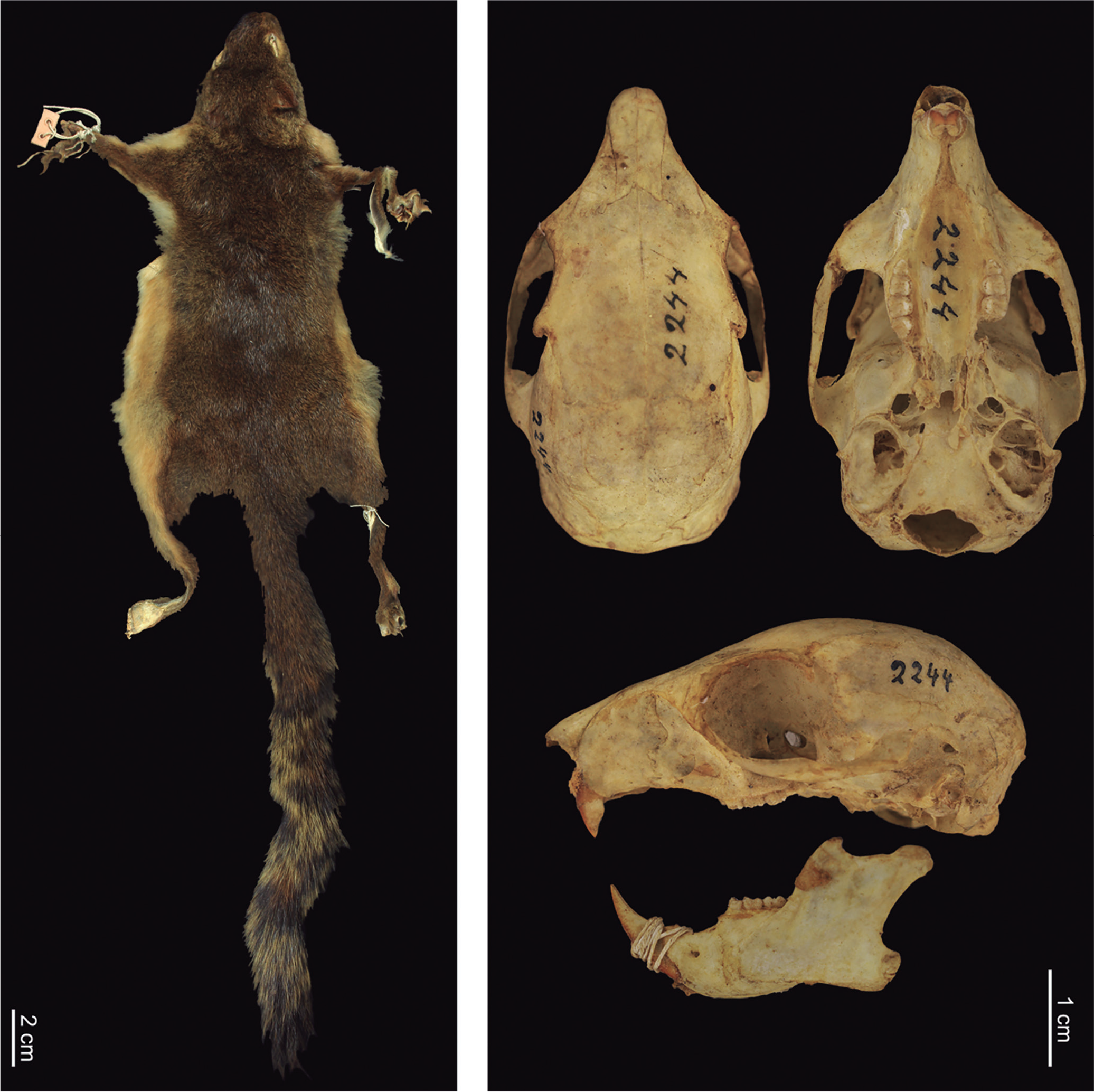
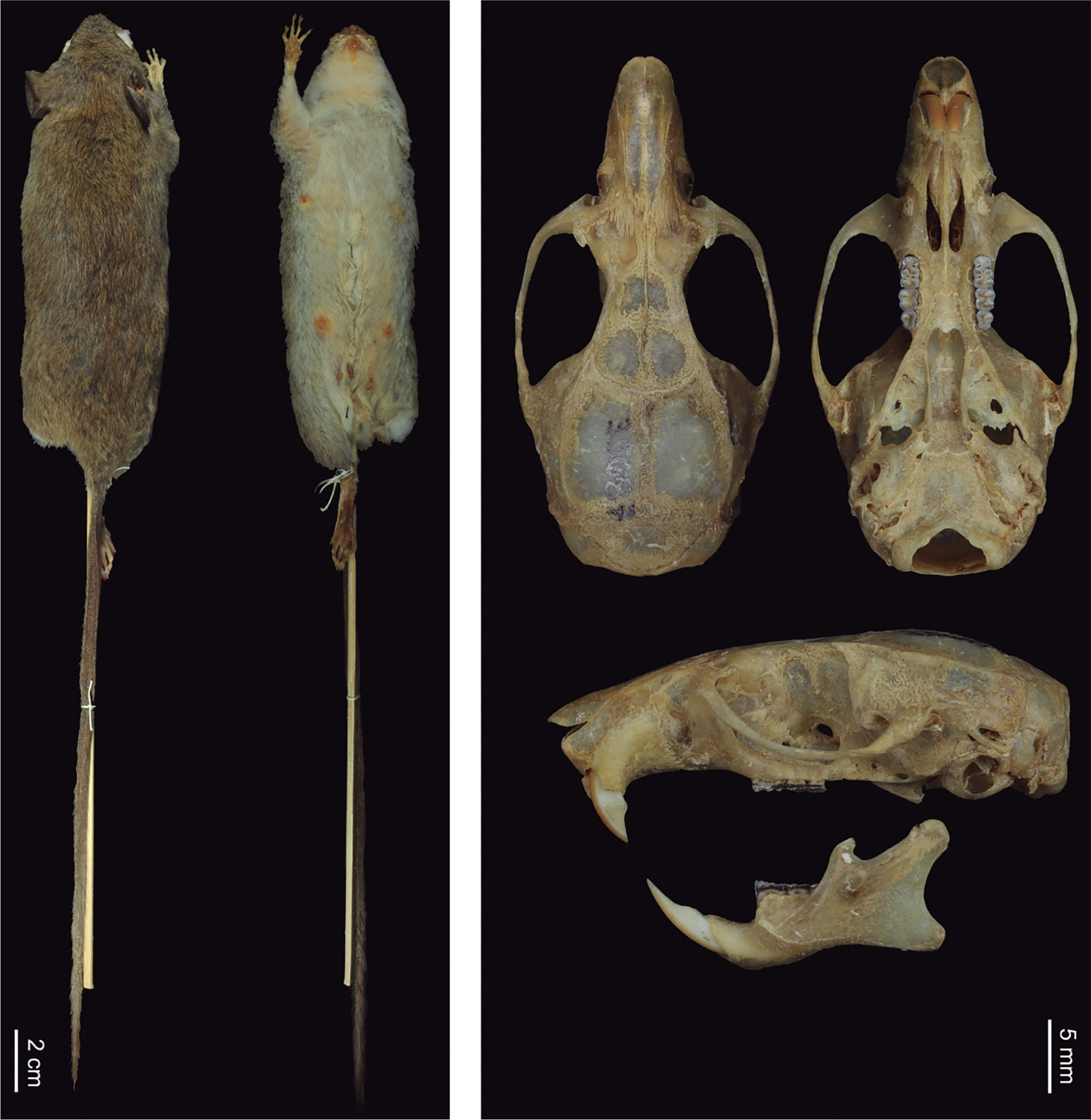
Holotype (Fig. 15): MZUSP 2244, female, skin and skull, collected by E. Garbe in May 1906, at “Villa Collatino [= Colatina] (Espírito Santo)”, Brazil.

Skin and skull of the holotype (MZUSP 2244) of Guerlinguetus aestuans garbeiPinto, 1931, currently Guerlinguetus brasiliensis (Gmelin, 1788).
Body measurements: TL = 329 mm; HB = 165 mm; T = 164 mm.
Comments:de Vivo & Carmignotto (2015) listed Guerlinguetus aestuans garbei as a synonym of Guerlinguetus brasiliensis ingrami.Abreu Jr. et al. (2020) analyzed the mitochondrial genome of historical and modern samples of Guerlinguetus specimens, considering no subspecies for G. brasiliensis. We follow this latter proposal here.
Genus Hadrosciurus Allen, 1915 Urosciurus nigratusPinto, 1931
Revista do Museu Paulista, 17(1): 309, 1931.
= Hadrosciurus pyrrhinus fulminatus (Thomas, 1926)
Common names: Northern Amazon red squirrel (Eng.); quatipuru-açú (Port.).
Holotype (Fig. 16): MZUSP 715, female, skin and skull (partially damaged), collected by E. Garbe in February 1902, at “Rio Juruá (Amazonas)”, Brazil.
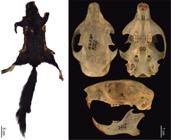
Skin and skull of the holotype (MZUSP 715) of Urosciurus nigratusPinto, 1931, currently Hadrosciurus pyrrhinus fulminatus (Thomas, 1926).
Body measurements: TL = 517 mm; HB = 285 mm; T = 232 mm.
Comments:Urosciurus nigratus was described by Pinto (1931) based solely on the holotype. It is now considered a junior synonym of Hadrosciurus pyrrhinus fulminatus (seede Vivo & Carmignotto, 2015). The holotype exhibits damage to the right zygomatic arch and lacks both upper third molars (M3).
Suborder Supramyomorpha D’Elía, Fabre & Lessa, 2019 Infraorder Myomorphi Brandt, 1855 Family Cricetidae Fischer, 1817 Subfamily Sigmodontinae Wagner, 1843 Tribe Akodontini Cockerell & Printz in Cockerell et al., 1914 Genus Akodon Meyen, 1833 Akodon diauarum Brandão, Carmignotto, Percequillo, Christoff, Mendes-Oliveira & Geise, 2022
Zootaxa, 5205(5): 416, 2022.
Common names: Diauarum grass mouse (Eng.); rato-do-mato-de-diauarum (Port.).
Holotype (Fig. 17): MZUSP 29672, adult male, skin, skull, postcranial skeleton, and tissue, field number M000058, collected by A.P. Carmignotto on 4 May 1997, at “30 km to the north of the Gaúcha do Norte municipality, between the Coluene and Curisevo river basins, in northeastern Mato Grosso state, Brazil (13°00′53″S, 53°10′39″W)”.

Paratypes: MZUSP 29674, 29677, and 29678, all males, with skin, skull, postcranial skeleton, field numbers M000069, M000078, M000082, respectively; MZUSP 29664, 29676, and 29683, all females, with skin, skull, postcranial skeleton, field numbers M000024, M000076, M000136, respectively; all from Gaúcha do Norte, state of Mato Grosso, Brazil, collected by A.P. Carmignotto on 2-5 May 1997.
Body measurements: MZUSP 29672 - HB = 102 mm; T = 87 mm; HF = 26 mm; W = 38.5 g. MZUSP 29664 - HB = 107 mm; T = 81 mm; HF = 25/23 mm; W = 35 g. MZUSP 29674 - HB = 110 mm; T = 81 mm; HF = 26/24 mm; W = 44 g. MZUSP 29676 - HB = 106 mm; T = 80 mm; HF = 24/22 mm; W = 39.5 g. MZUSP 29677 - HB = 103 mm; T = 92 mm; HF = 27/25 mm; W = 30 g. MZUSP 29678 - HB = 107 mm; T = 87 mm; HF = 26/24 mm; W = 35 g. MZUSP 29683 - HB = 108 mm; T = 95 mm; HF = 26/24 mm; W = 35.5 g.
Comments: The paratype series of this species includes three other specimens (MN 11691, 73906, 73970) housed at the MNRJ (Brandão et al., 2022).
Akodon kadiweu Brandão, Percequillo, D’Elía, Paresque & Carmignotto, 2021
Journal of Mammalogy, 102(1): 108, 2021.
Common names: Kadiwéu grass mouse (Eng.); rato-do-mato-kadiwéu (Port.).
Holotype (Fig. 18): MZUSP 35766, adult male, skin, skull, postcranial skeleton, and tissue, field number APC 985, collected by A.P. Carmignotto and colleagues on 19 April 2002, at “Brazil: Mato Grosso do Sul state; Bodoquena municipality, Serra da Bodoquena, Fazenda Califórnia, (20°42′S; 56°51′W; 520 m a.s.l.)”.

Paratypes: MZUSP 35765, male, skin, skull, postcranial skeleton, field number APC 975; MZUSP 35767, male, skin, skull, postcranial skeleton, field number APC 996; MZUSP 35994, female, fluid-preserved, tissue, field number APC 997; all collected on 17-21 April 2002, by the same collector and at the same locality as the holotype.
Body measurements: MZUSP 35766 - TL = 164 mm; T = 80 mm; HF = 22/21 mm; E = 15 mm; W = 20 g. MZUSP 35765 - TL = 182 mm; T = 85 mm; HF = 22/21 mm; E = 15 mm; W = 30 g. MZUSP 35767 - TL = 166 mm; T = 82 mm; HF = 22/20 mm; E = 16 mm; W = 29 g. MZUSP 35994 - TL = 170 mm; T = 81 mm; HF = 23/21 mm; E = 16 mm; W = 23 g.
Comments:Akodon kadiweu, whose distribution is known only from the type locality, was described based on molecular cytochrome b evidence, karyological data, and morphological evidence (Brandão et al., 2021).
Akodon paranaensis Christoff, Fagundes, Sbalqueiro, Mattevi & Yonenaga Yassuda, 2000
Journal of Mammalogy, 81(3): 844, 2000.
Common names: Paraná akodont, Paraná grass mouse (Eng.); rato-do-chão (Port.).
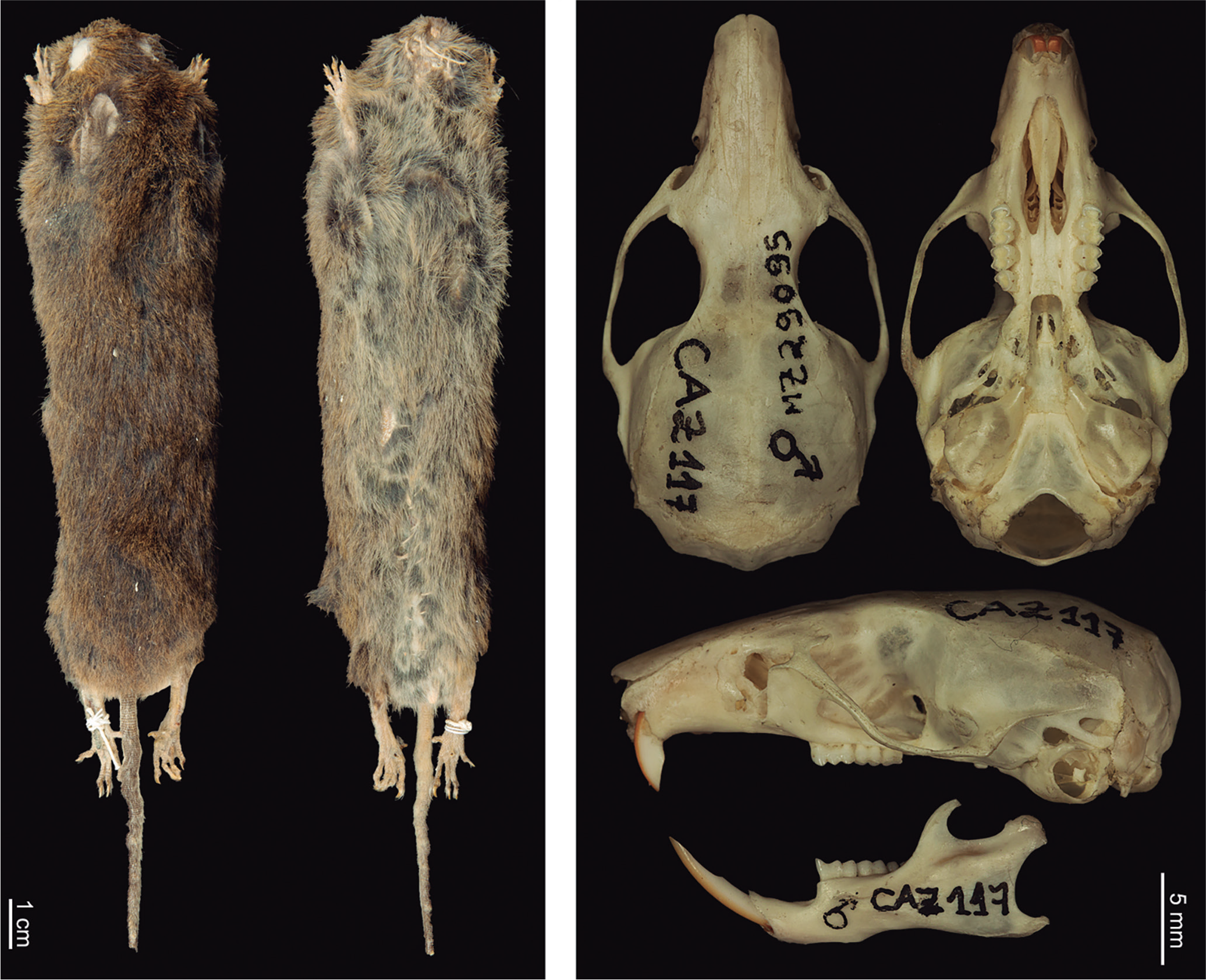
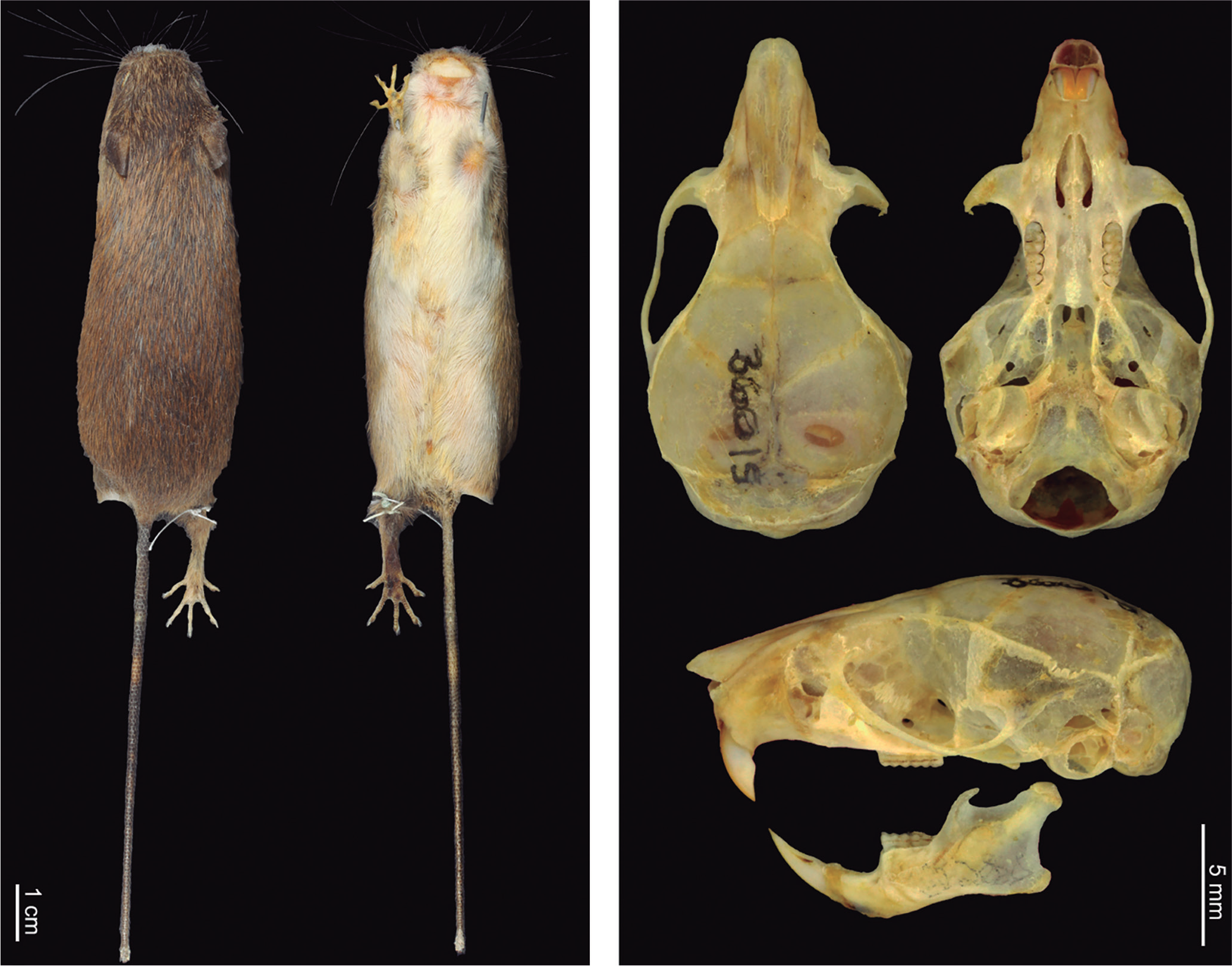
Holotype (Fig. 19): MZUSP 29095, adult male, skin and skull, field number CAZ 117, collected by C. Zotz on 23 November 1963, at “Piraquara (Estação Ecológica Canquiri), Paraná, Brazil” (25°31′S, 49°03′W).

Paratypes: MZUSP 29088-29094, 29096, 29097, 29107-29110, 29113, 29114, 29116-29118, all males, with skin and skull, field numbers CAZ 54, CAZ 59, CAZ 64, CAZ 67, CAZ 72, CAZ 79, CAZ 82, CAZ 134, CAZ 169, CAZ 10, CAZ 73, CAZ 89, CAZ 90, CAZ 109, CAZ 113, CAZ 136, CAZ 137, CAZ 155; MZUSP 29098-29105, 29111, 29115, female, skin and skull, field numbers CAZ 57, CAZ 51, CAZ 83, CAZ 96, CAZ 105, CAZ 111, CAZ 174, CAZ 119, CAZ 93, CAZ 135; MZUSP 29106, male, skull; MZUSP 29112, unknown sex, skull; all collected at Estação Ecológica Canguiri, Piraquara, state of Paraná, Brazil (25°31′S; 49°03′W), by C. Zotz between 22 March 1983 to 27 April 1984. MZUSP 29119-29122, 29125, 29126, all males, with skin and skull, field numbers AUC 2, AUC 4 AUC 5, AUC 6, AUC 16, AUC 21; MZUSP 29124, female, skin and skull, field number AUC 11; all collected by A.U. Christoff, on 2-6 April 1987, at Três Barras, 3 meters from the bank of Uruguai River, Aratiba, state of Rio Grande do Sul, Brazil (27°24′S; 52°19′W).
Body measurements: MZUSP 29095 - HB = 125.3 mm; T = 88.4 mm; HF = 26.1/23.7 mm; E = 16.9 mm; W = 44.82 g. MZUSP 29088 - HB = 108.9 mm; T = 79.3 mm; HF = 26.8/24.1 mm; E = 17.1 mm; W = 27.89 g. MZUSP 29089 - HB = 106.6 mm; T = 69.1 mm; HF = 25.5/23.2 mm; E = 14.7 mm; W = 26.05 g. MZUSP 29090 - HB = 102.7 mm; T = 71.5 mm; HF = 25/23.4 mm; E = 12.7 mm; W = 28.13 g. MZUSP 29091 - HB = 106.4 mm; T = 70 mm; HF = 26.2/23.6 mm; E = 17.5 mm; W = 24.61 g. MZUSP 29092 - HB = 107.2 mm; T = 81.8 mm; HF = 24.1/21.8 mm; E = 17.3 mm; W = 28.68 g. MZUSP 29093 - HB = 105.1 mm; T = 87.3 mm; HF = 24.5/22.1 mm; E = 16.4 mm; W = 27.65 g. MZUSP 29094 - HB = 105 mm; T = 86.1 mm; HF = 25.9/23.2 mm; E = 16.9 mm; W = 28.38 g. MZUSP 29096 - HB = 123.6 mm; T = 87.8 mm; HF = 26.4/23.8 mm; E = 16.5 mm; W = 49.51 g. MZUSP 29097 - HB = 101.7 mm; T = 85.9 mm; HF = 23.3/21.4 mm; E = 16.4 mm; W = 27.35 g. MZUSP 29098 - HB = 101.3 mm; T = 69.1 mm; HF = 25/22.4 mm; E = 16.3 mm; W = 26.28 g. MZUSP 29099 - HB = 95.4 mm; T = 60.3 mm; HF = 25.2/21.7 mm; E = 15.9 mm; W = 21.41 g. MZUSP 290100 - HB = 90.7 mm; T = 70.9 mm; HF = 24.3/22.3 mm; E = 15.6 mm; W = 20.71 g. MZUSP 29101 - HB = 108.5 mm; T = 71.8 mm; HF = 24.3/21.9 mm; E = 17.5 mm; W = 26.37 g. MZUSP 29102 - HB = 116.4 mm; T = 76.4 mm; HF = 25.6/22.3 mm; E = 15.5 mm; W = 25.34 g. MZUSP 29103 - HB = 109.5 mm; T = 73.4 mm; HF = 24.5/21.9 mm; E = 18.2 mm; W = 29.83 g. MZUSP 29104 - HB = 115.1 mm; T = 89.3 mm; HF = 24.1/21.6 mm; E = 17.3 mm; W = 33.34 g. MZUSP 29105 - HB = 101.9 mm; T = 79.2 mm; HF = 25.2/22.8 mm; E = 16.9 mm; W = 29.75 g. MZUSP 29107 - HB = 109.8 mm; T = 65.5 mm (broken tip); HF = 25.3/23.8 mm; E = 12.8 mm; W = 45.44 g. MZUSP 29108 - HB = 107.7 mm; T = 78.8 mm; HF = 26.5/24.4 mm; E = 17.3 mm; W = 26.86 g. MZUSP 29109 - HB = 95.1 mm; T = 78.9 mm; HF = 23.8/21.9 mm; E = 16.2 mm; W = 30 g. MZUSP 29110 - HB = 97.1 mm; T = 85.9 mm; HF = 25.2/23.8 mm; E = 19.7 mm; W = 41.09 g. MZUSP 29111 - HB = 92.9 mm; T = 74.5 mm; HF = 23.8/22.7 mm; E = 16.2 mm; W = 29.45 g. MZUSP 29113 - HB = 96.4 mm; T = 88.6 mm; HF = 25.5/23.4 mm; E = 17.5 mm; W = 25.5 g. MZUSP 29114 - HB = 116.4 mm; T = 83.8 mm; HF = 25.4/23.1 mm; E = 17.6 mm; W = 33.3 g. MZUSP 29115 - HB = 112.4 mm; T = 82.9 mm; HF = 24.8/23.4 mm; E = 18.4 mm; W = 45.05 g. MZUSP 29116 - HB = 116.2 mm; T = 84.6 mm; HF = 25.4/23.8 mm; E = 18.1 mm; W = 37.94 g. MZUSP 29117 - HB = 114.3 mm; T = 89.2 mm; HF = 24.2/21.7 mm; E = 18.1 mm; W = 36.64 g. MZUSP 29118 - HB = 103.5 mm; T = 84.7 mm; HF = 25.6/22 mm; E = 17.1 mm; W = 43.76 g. MZUSP 29119 - HB = 93 mm; T = 80 mm; HF = 24/22 mm; E = 18 mm; test. = 2.5 × 5 mm; W = 26 g. MZUSP 29120 - HB = 118 mm; T = 80 mm; HF = 26/23 mm; E = 18 mm; test. = 1 × 0.6 mm (right), 1 × 0.5 mm (left); W = 50 g. MZUSP 29121 - HB = 106 mm; T = 86 mm; HF = 25/22 mm; E = 17 mm; test. = 0.3 × 0.6 mm; W = 33 g. MZUSP 29122 - HB = 107 mm; T = 82 mm; HF = 24/22 mm; E = 18 mm; test. = 1 × 5 mm; W = 34.5 g. MZUSP 29124 - HB = 88 mm; T = 68 mm; HF = 23/21 mm; E = 17 mm; W = 21.5 g. MZUSP 29125 - HB = 102 mm; T = 92 mm; HF = 26/24 mm; E = 17 mm; test. = 03 × 0.6 mm; W = 31.5 g. MZUSP 29126 - HB = 88 mm; T = 73 mm; HF = 24/22 mm; E = 16 mm; test. = 0.2 × 0.3 mm; W = 21 g. MZUSP 29106 and 29112 - not available.
Comments: Studies by Christoff et al. (2000), Gonçalves et al. (2007), and D’Elía et al. (2008) confirmed Akodon paranaensis as a distinct species based on its karyotype, morphometrics, pelage coloration, and skull morphology. Skulls of two paratypes (MZUSP 29124 and 29125) were coated for scanning electron microscopy.
Genus Brucepattersonius Hershkovitz, 1998 Brucepattersonius nebulosus Abreu Jr., Vilela, Christoff, Valiati & Percequillo, 2019
Arquivos de Zoologia, 50(1): 37, 2019.
Common names: Nebulous brucie (Eng.); rato-do-chão (Port.).
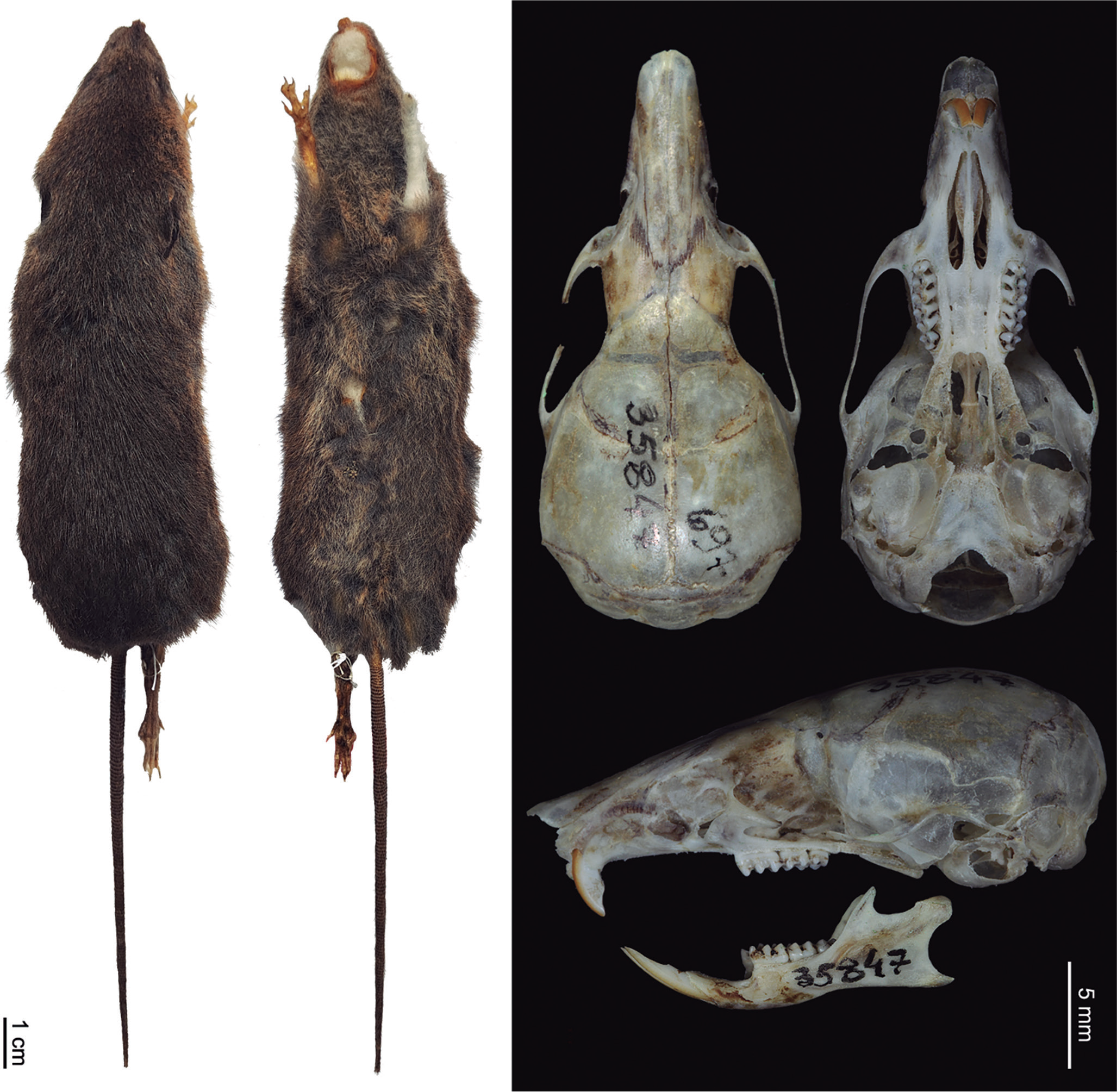
Holotype (Fig. 20): MZUSP 35847, young adult male, skin, skull (partially damaged), carcass, and tissue, field number EEB 697, collected by A.R. Percequillo and collaborators on 14 December 2003, at “Brazil, São Paulo State, Bananal municipality, Estação Ecológica de Bananal, Trilha da Pedra Vermelha (22°47′53″S, 44°21′35″W) around 1,200 m above sea level”.
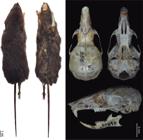
Skin and skull of the holotype (MZUSP 35847) of Brucepattersonius nebulosus Abreu Jr. et al., 2019.
Paratypes: MZUSP 33714, female, skin (partially damaged), skull, carcass, and tissue, field numbers EEB 664, collected by A.R. Percequillo and collaborators on 11 December 2003, at Estação Ecológica de Bananal, Trilha das 7 Quedas, acima da 5ª Queda, Bananal, state of São Paulo, Brazil (22°48′22″S, 44°22′08″W). MZUSP 35846, male, fluid-preserved with skull extracted, field number EBM 023, collected by A.R. Percequillo and collaborators on 14 April 2004, at Estação Ecológica de Bananal, Trilha do Rio das Cobras, Bananal, state of São Paulo, Brazil (22°48′05″S, 44°22′12″W). MZUSP 35848, female, skin, skull, carcass, and tissue, field numbers EEB 698, same data as the holotype.
Body measurements: MZUSP 35847 - HB = 94 mm; T = 96 mm; HF = 26/24 mm; E = 18 mm; W = 20 g. MZUSP 33714 - HB = 94 mm; T = 87 mm; HF = 24.5/23 mm; E = 15 mm; W = 22 g. MZUSP 35846 - HB = 109 mm; T = 107 mm; HF = 27.1/24.4 mm; E = 18.5 mm. MZUSP 35848 - HB = 98 mm; T = 89 mm; HF = 26.5/24.6 mm; E = 19 mm; W = 20 g.
Comments:Abreu Jr. & Percequillo (2019) described this species following seven field expeditions coordinated by MZUSP in the region of the Bananal Ecological Station. According to the authors, these specimens exhibited a unique combination of pelage coloration and skull traits, supported by genetic and morphometric evidence, justifying their recognition as a distinct Brucepattersonius species. The holotype exhibits partial damage to the left zygomatic arch, and one paratype (MZUSP 33714) has a damaged tail.
Brucepattersonius igniventris Hershkovitz, 1998
Bonner zoologische Beiträge, 47: 232, 1998.
= Brucepattersonius soricinus Hershkovitz, 1998
Common names: Red-bellied akodont, red-bellied brucie (Eng.); rato-do-chão (Port.).
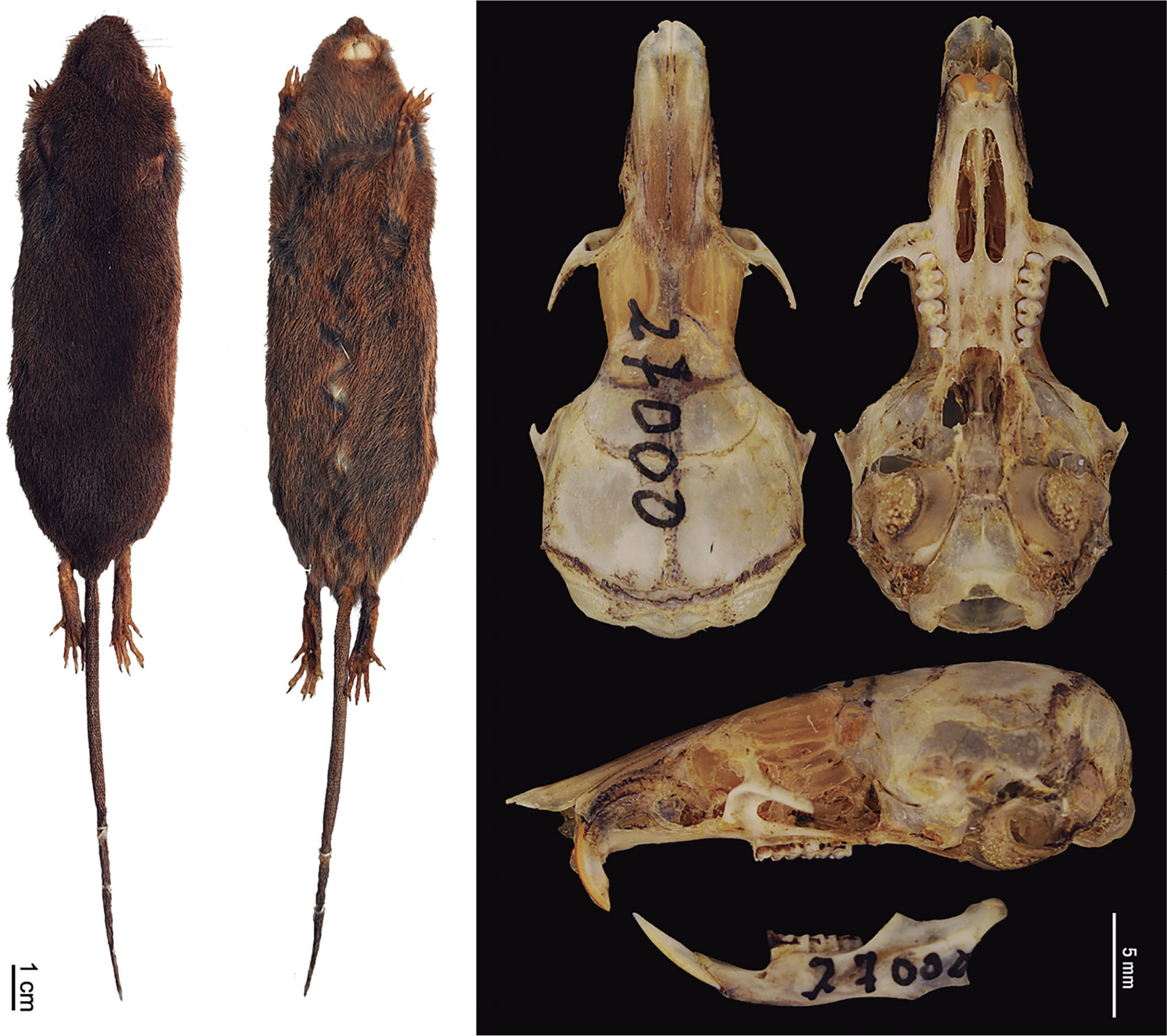
Holotype (Fig. 21): MZUSP 27000, adult male, skin and skull (partially damaged), field number 9871, collected by P. Hershkovitz, S. Lindbergh, and B.E. Brown on 1 December 1989, at “Iporanga (Petar) State Park [= Parque Estadual Turístico do Alto Ribeira], southwestern São Paulo, Brazil” (24°35′S, 48°35′W).
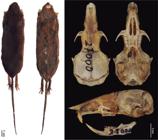
Skin and skull of the holotype (MZUSP 27000) of Brucepattersonius igniventris Hershkovitz, 1998, currently Brucepattersonius soricinus Hershkovitz, 1998.
Body measurements: TL = 213 mm; T = 99 mm; HF = 25 mm; E = 16 mm; W = 31 g.
Comments: Based on an analysis of morphology, morphometrics, and molecular data using phylogenetic inference, Abreu et al. (2021) determined that Brucepattersonius igniventris is a junior synonym of B. soricinus. This observation is consistent with the suggestion made by Dias (2016). The holotype shows partial damage to the zygomatic arch on both sides of the skull.
Tribe Ichthyomyini Cockerell & Printz in Cockerell et al., 1914 Genus Daptomys Anthony, 1929 Neusticomys ferreirai Percequillo, Carmignotto & M.J.J. Silva, 2005
Journal of Mammalogy, 86(5): 874, 2005.
= Daptomys ferreirai (Percequillo, Carmignotto & M.J.J. Silva, 2005)
Common names: Ferreira’s fish-eating rat, Ferreira’s ichthyomyine (Eng.); rato-d’água (Port.).
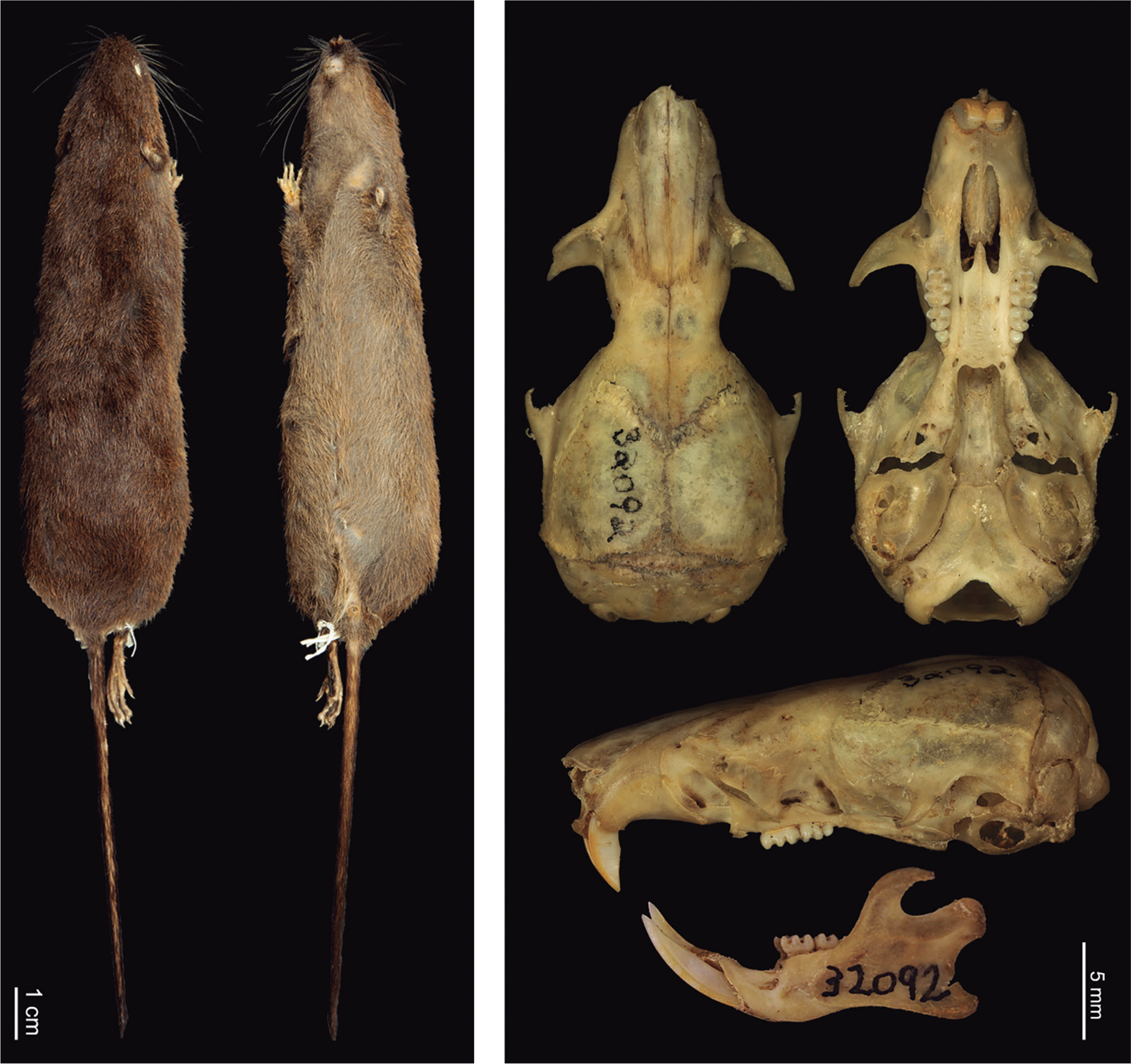
Holotype (Fig. 22): MZUSP 32092, adult female, skin, skull (partially damaged), postcranial skeleton, and tissue (liver and muscle), field number APC 173, collected by A.P. Carmignotto on 15 June 1997, at “20 km W of the left bank of the Rio Juruena, in the municipality of Juruena”, state of Mato Grosso, Brazil (10°14′S, 58°29′W).

Skin and skull of the holotype (MZUSP 32092) of Neusticomys ferreirai Percequillo et al., 2005, currently Daptomys ferreirai (Percequillo et al., 2005).
Paratype: MZUSP 32093, young adult male, skin, skull, postcranial skeleton, stomach, and tissue (liver and muscle), field number APC 150, collected by A.P. Carmignotto on 10 June 1997, at the same locality as the holotype.
Body measurements: MZUSP 32092 - HB = 106 mm; T = 85 mm; HF = 22.5/21 mm; E = 11 mm; W = 34 g. MZUSP 32093 - HB = 105 mm; T = 79 mm; HF = 24/22 mm; E = 11.5 mm; W = 25 g.
Comments:Salazar-Bravo et al. (2023) proposed a two-genus classification for the taxa previously grouped under Neusticomys. For those occurring at low to mid elevations, they recognized Daptomys as a valid genus, which includes D. ferreirai. The holotype shows partial damage to both zygomatic arches, as well as to the anterior tip of the nasal bone.
Tribe Oryzomyini Vorontsov, 1959 Genus DrymoreomysPercequillo, Weksler & Costa, 2011Drymoreomys albimaculatusPercequillo, Weksler & Costa, 2011
Zoological Journal of the Linnean Society, 161: 360, 2011.
Common names: Montane forest rat (Eng.); rato-do-mato (Port.)
Holotype (Fig. 23): MZUSP 34716, adult female, skin, skull, partial postcranial skeleton, and tissue, field number MAM 8 (previous collection number MVZ 18208), collected by M.A. Mustrangi on 21 July 1992 at “Brazil, Estado de [= State of] São Paulo, Município de [= Municipality of] Ribeirão Grande, Parque Estadual Intervales, base do Carmo, 700 m; 24°20′S, 48°25′W”.

Skin and skull of the holotype (MZUSP 34716) of Drymoreomys albimaculatusPercequillo et al., 2011.
Paratypes: MZUSP 33782, female, skin, skull, and carcass, field number EEB 674, collected by A.R. Percequillo at Estação Ecológica de Bananal, Bananal, state of São Paulo, Brazil (22°48′22″S, 44°22′08″W, 1,200 m of elevation), on 13 December 2003. MZUSP 36655, 36656 and 36658, males, field numbers BO 41, 42 and 44, MZUSP 36654 and 36657, females, field numbers BO 24 and 43, all of them fluid-preserved with skulls extracted, collected by M.T.U. Rodrigues, at Estação Biológica de Boracéia, Salesópolis, state of São Paulo, Brazil (23°38′S, 45°52′W, 900 m of elevation), on 19-24 February 2004. MZUSP 36664, adult male, fluid-preserved with skulls extracted, field number AB 397, collected on 12 May 2005; MZUSP 36665 and 36668, adult and young males, skin, skull, and skeleton, field numbers AB 398 and 698, collected 12 February 2005 and 12 August 2006, respectively; all collected by Adriana Bueno, at Sítio Mulheres, Ribeirão Grande, state of São Paulo, Brazil (24°13′40.1″S, 48°23′17.2″W). MZUSP 36666, adult female, skin, skull, and skeleton, field number AB 422, collected by Adriana Bueno, on 12 July 2005, at Sítio Cogumelo, Ribeirão Grande, state of São Paulo, Brazil (24°13′47.7″S, 48°22′37.2″W). MZUSP 36667, adult female, skin, skull, and skeleton, field number AB 423, collected by Adriana Bueno, on 12 August 2005, at Sítio Paraguai, Ribeirão Grande, state of São Paulo, Brazil (24°13′45.1″S, 48°23′23.5″W). MZUSP 36669, female, skin and skull, field number BS 1441, collected by Renata Pardini and collaborators, on 22 January 2003, at Reserva Florestal Morro Grande, Cotia, state of São Paulo, Brazil (23°41′S, 46°58′W).
Body measurements: MZUSP 34716 - HB = 149 mm; T = 176 mm; HF = 28 mm; E = 20 mm; W = 57 g. MZUSP 33782 - HB = 105 mm; T = 145 mm; HF = 25 mm; E = 16 mm; W = 32 g. MZUSP 36664 - HB = 109 mm; T = 150 mm; HF = 27.5/26 mm; E = 18.5 mm; W = 52 g. MZUSP 36665 - HB = 112 mm; T = 144 mm; HF = 27/26 mm; E = 16 mm; W = 34 g. MZUSP 36666 - HB = 106 mm; T = 134 mm; HF = 22.5/21.5 mm; E = 17.5 mm. MZUSP 36667 - HB = 143 mm; T = 162 mm; HF = 29/27.5 mm; E = 19 mm; W = 102 g. MZUSP 36668 - HB = 90 mm; T = 116 mm; HF = 23/22 mm; E = 10 mm; W = 26 g. MZUSP 36654-36658, and 36669 - not available.
Comments:Percequillo et al. (2011) described this species and established the new genus Drymoreomys, based on molecular data and distinctive morphological traits - including pelage texture and coloration, as well as cranio-dental features - that differentiate it from all other cricetids of the Atlantic Forest. The paratype series includes all the specimens examined by Percequillo et al. (2011), including the ones housed at the MZUSP collection, two at the MVZ (MVZ 182089 and 239830), two at the LMUSP (RG 47 and RG 48), and 20 at the UFSC (UFSC 860, FURB 6267, 9621, 9664, 9666, 9743, 9756, 9787, 9792, 9794, 9831, 9833, 9838, 9862, 9869, 9871, 9902-03, 9962, 12044). Five of these paratypes (MZUSP 36664-36668) were originally described as collected at Reserva do Morro Grande, Cotia, state of São Paulo, Brazil, and reported as fluid-preserved females with extracted skulls (Percequillo et al., 2011). However, according to the collector’s field notes archived at MZUSP, these specimens were collected in Ribeirão Grande, state of São Paulo, Brazil, with most preserved as dry specimens (except MZUSP 36664) and identified as males (except MZUSP 36666 and 36667).
Genus EuryoryzomysWeksler, Percequillo & Voss, 2006Oryzomys emmonsae Musser, Carleton, Brothers & Gardner, 1998
Bulletin of the American Museum of Natural History, 236: 233, 1998.
= Euryoryzomys emmonsae (Musser, Carleton, Brothers & Gardner, 1998)
Common names: Emmons’s rice rat (Eng.); rato-do-mato (Port.).
Holotype (Fig. 24): MZUSP 27150, old adult male, skin and skull, field number 559, collected by L.H. Emmons on 3 September 1986, at “east bank of Rio Xingu, 52 km SSW Altamira (03°39′S, 52°22′W), below 100 m in Estado de [= State of] Pará, Brazil”.

Skin and skull of the holotype (MZUSP 27150) of Oryzomys emmonsae Musser et al., 1998, currently Euryoryzomys emmonsae (Musser et al., 1998).
Body measurements: TL = 302 mm; T = 160 mm; HF = 34 mm; E = 24 mm; W = 78 g.
Comments: The species was transferred to the genus Euryoryzomys by Weksler et al. (2006) as part of a taxonomic revision of the polyphyletic genus Oryzomys. The holotype skull was coated for scanning electron microscopy analysis. The collection locality is indicated as “Cachoeira do Espelho, Rio Xingu, Pará” on the specimen label and in the specimen catalog of the MZUSP collection.
Genus Neacomys Thomas, 1900 Neacomys elieceri Semedo, M.N.F. Silva, Carmignotto & Rossi, 2021
Systematics and Biodiversity, 19(8): 1123, 2021.
Common names: Eliecer’s spiny mouse (Eng.); rato-espinhoso (Port.).
Holotype (Fig. 25): MZUSP 36015, adult male, skin, skull, partial postcranial skeleton, and tissue, field number APC 2286, collected by A.P. Carmignotto and collaborators on 16 June 2013, at Platô Capiranga, Juruti, Pará (02°31′15″S, 56°10′39″W). See the “Comments” section for information about the type locality.
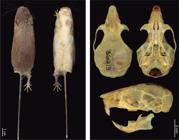
Paratypes: MZUSP 36016, adult male, skin, skull, and partial postcranial skeleton, field number APC 2291; MZUSP 36017, adult male, skin, skull, partial postcranial skeleton, and tissue, field number APC 2296; MZUSP 36018, adult female, skin, skull, and partial postcranial skeleton, field number APC 2293; MZUSP 36019, adult male, fluid-preserved with skull extracted, and tissue, field number APC 2309; all collected by A.P. Carmignotto on 16-20 June 2013, at Platô Capiranga, Juruti, state of Pará (02°31′15″S, 56°10′39″W).
Body measurements: MZUSP 36015 - HB = 77 mm; T = 80 mm; HF = 20/19 mm; E = 13 mm; W = 16.5 g. MZUSP 36016 - HB = 76 mm; T = 79 mm; HF = 21/20 mm; E = 13 mm; W = 15 g. MZUSP 36017 - W = 16 g. MZUSP 36018 - HB = 74 mm; T = 74 mm; HF = 20/19 mm; E = 13 mm. MZUSP 36019 - HB = 73 mm; T = 77 mm; HF = 21/19.5 mm; E = 13.5 mm; W = 18 g.
Comments: The paratype series consists of five specimens, four of which are at the MZUSP. The fifth specimen (UFMT 4896), an adult female collected at the same locality, is held at the UFMT (Semedo et al., 2021). The type locality in the original description (“Juruti, left bank of Rio Tapajós, state of Pará, Brazil (02°09′S, 56°05′W)”; Semedo et al., 2021: 1123) differs from the holotype label and the collection catalog. Here, we restrict the type locality to “Platô Capiranga, Juruti, Pará (02°31′15″S, 56°10′39″W)” following the information from the collector. In the holotype, the right zygomatic arch is damaged.
Tribe Thomasomyini Steadman & Ray, 1982 Genus Rhipidomys Tschudi, 1845 Rhipidomys caracolensis Campos, Percequillo, Miranda & Langguth, 2022
Hystrix, the Italian Journal of Mammalogy, 33(1): 147, 2022.
Common names: Caracol climbing tree rat (Eng.); rato-da-árvore (Port.).
Holotype (Fig. 26): MZUSP 35687, adult female, skin, skull, partial postcranial skeleton, and tissue, field number ARP 152, collected by A.R. Percequillo and collaborators on 22 January 2002, at “Caracol, Parque Nacional Serra das Confusões, 09°13′S, 43°27′W”, state of Piauí, Brazil.

Skin and skull of the holotype (MZUSP 35687) of Rhipidomys caracolensisCampos et al., 2022.
Paratypes: MZUSP 35683 and 35685, both females, skin, skull, and postcranial skeleton, field numbers PNSC 82, PNSC 85, collected on 10 October 2000; MZUSP 35686, male, and MZUSP 35688, 35689, 35690, 35691, 35692, all females, with skin, skull, postcranial skeleton, field numbers ARP 151, ARP 156, ARP 157, ARP 160, DAM 110, DAM 111, collected on 21-25 January 2002; MZUSP 35682 and 35684, both males, skin, skull, postcranial skeleton, field numbers PNSC 26 and PNSC 83, collected on 10 October 2000; all collected by the same collectors and in the same locality as the holotype.
Body measurements: MZUSP 35687 - HB = 139 mm; T = 198 mm; HF = 30 mm; E = 26 mm; W = 70 g. MZUSP 35683 - HB = 142 mm; T = 197 mm; HF = 27 mm; E = 20 mm; W = 71 g. MZUSP 35684 - HB = 128 mm; T = 195 mm; HF = 30 mm; E = 19 mm; W = 78 g. MZUSP 35685 - HB = 132 mm; T = 191 mm; HF = 20 mm; E = 21 mm; W = 80 g. MZUSP 35686 - HB = 128 mm; T = 171 mm; HF = 30 mm; E = 23 mm; W = 60 g. MZUSP 35688 - HB = 132 mm; T = 197 mm; HF = 29.5 mm; E = 23.5 mm; W = 67 g. MZUSP 35689 - HB = 117 mm; T = 118 mm; HF = 30 mm; E = 25 mm; W = 56 g. MZUSP 35690 - HB = 119 mm; T = 169 mm; HF = 26.5 mm; E = 25 mm; W = 54 g. MZUSP 35691 - HB = 141 mm; T = 175 mm; HF = 29/27 mm; E = 24 mm; W = 54 g. MZUSP 35692 - HB = 134 mm; T = 181 mm; HF = 27/28.5 mm; E = 24 mm; W = 72 g. MZUSP 35682 - not available.
Comments: Previous studies demonstrated a putative new species of Rhipidomys occurring in the Brazilian states of Goiás, Piauí, Minas Gerais, Tocantins, and Bahia, based on molecular and karyotype analyses (Costa et al., 2011; Rocha et al., 2011). However, Rhipidomys caracolensis was formally named and described only recently through morphological and molecular analysis (Campos et al., 2022).
Tribe Wiedomyini Reig, 1980 Genus Juliomys González, 2000 Juliomys ossitenuis L. Costa, S. Pavan, Leite & Fagundes, 2007
Zootaxa, 1463: 23, 2007.
Common names: Slender Juliomys, delicate red-nosed tree mouse (Eng.); rato-do-mato (Port.)
Paratypes: MZUSP 33170, adult female, MZUSP 33171, adult male, both with skin, skull, and partial postcranial skeleton, field numbers MAM139 and MAM 141, respectively, collected on 20-21 August 1993 by M.A. Mustrangi and collaborators at Sítio Até que Enfim, Caucaia do Alto, state of São Paulo, Brazil (23°41′S, 47°02′W).
Body measurements: MZUSP 33170 - HB = 177 mm; T = 103 mm; HF = 19 mm; E = 10 mm; W = 14 g. MZUSP 33171 - HB = 195 mm; T = 113 mm; HF = 20 mm; E = 15 mm; W = 21 g.
Comments:Costa et al. (2007) described this species based on morphological, molecular, and karyological evidence. The holotype (MN 69752) and one of the paratypes (MN 69753) are housed at the MNRJ, and two other paratypes are at UFMG (UFMG 3173, 3174) (Costa et al., 2007).
Order Chiroptera Blumenbach, 1779 Suborder Vespertilioniformes Hutcheon & Kirsch, 2006 Family Mormoopidae Saussure, 1860 Genus Pteronotus Gray, 1838 Subgenus Phyllodia Gray, 1843 Pteronotus (Phyllodia) alitonus A. Pavan, Bobrowiec & Percequillo, 2018
Journal of Mammalogy, 99(3): 630, 2018.
Common names: Amazonian common mustached bat (Eng.); morcego (Port.).
Paratypes: MZUSP 35505, adult female, fluid-preserved with skull extracted, field number ACP 173, collected by A.C. Pavan and collaborators, at Área de Proteção Ambiental Tapajós, Jamanxim river basin, Itaituba, state of Pará, Brazil (06°03′01″S, 56°18′05″W) on 23 October 2010. MZUSP 35523, female, fluid-preserved with skull extracted, field number GA0637, collected by JGP Consultoria at Amaila Falls, Potaro-Siparuni, Guyana (05°31′12″N, 59°15′36″W).
Body measurements: MZUSP 35505 - FA = 59.2 mm; TI = 21.69 mm; E = 23.64 mm; W = 34 g. MZUSP 35523 - FA = 61 mm; W = 24 g.
Comments: The holotype is specimen INPA 6942. Nine additional paratypes are housed in different collections: IEPA 417, 1847; INPA 6947; ROM 98128, 106659, 117545; MHNG 1978.077, 1978.082; AMNH 267851 (Pavan et al., 2018).
Family Phyllostomidae Gray, 1825 Subfamily Lonchophyllinae Griffiths, 1982 Tribe Lonchophyllini Griffiths, 1982 Genus LonchophyllaThomas, 1903Lonchophylla bokermanniSazima, Vizotto & Taddei, 1978
Revista Brasileira de Biologia, 38(1): 82, 1978.
Common names: Bokermann’s nectar bat (Eng.); morcego-beija-flor (Port.).
Holotype (Fig. 27): MZUSP 36672, previously housed at Museu de Zoologia da Universidade de Campinas (Unicamp) under the number ZUEC 221, adult female, fluid-preserved with skull extracted, original number DZSJRP 10347, collected by I. Sazima and M. Sazima, between 9-15 December 1974, at “Serra do Cipó, município de Jaboticatubas, Estado de Minas Gerais, Brasil (aprox. 19°16′S, 43°36′W, a 900 m de altitude)” [= Serra do Cipó, municipality of Jaboticatubas, State of Minas Gerais, Brazil (ca. 19°16′S, 43°36′W, 900 m of elevation)].

Skin and skull of the holotype (MZUSP 36672) of Lonchophylla bokermanniSazima et al., 1978.
Paratypes: MZUSP 36673, female, fluid-preserved, original number DZSJRP 10342, collected between 26-28 October 1974 by I. Sazima and O.C. de Oliveira; MZUSP 36674, male, fluid-preserved, original number DZSJRP 10408, collected by O.C. de Oliveira and J. Semir between 29-30 April 1975; MZUSP 36675, female, skin and skull, original number DZSJRP 11410, and MZUSP 36676, female, fluid-preserved, original number DZSJRP 11411, collected between 5-6 September 1976 by W. Uieda and A. Storti Filho; all collected at the same locality as the holotype.
Body measurements: MZUSP 36672 - HB = 62.5 mm; HF = 9 mm; FA = 40.7 mm; TI = 14.5 mm. MZUSP 36673 - HB = 63.5 mm; HF = 9 mm; FA = 40 mm; TI = 14.5 mm. MZUSP 36674 - HB = 61 mm; HF = 9 mm; FA = 40 mm; TI = 14 mm. MZUSP 36675 - HF = 8 mm; FA = 40 mm; TI = 14 mm. MZUSP 36676 - HB = 60 mm; HF = 9 mm; FA = 41.3 mm; TI = 14.5 mm.
Comments: Four additional paratypes (ZUEC 160, 161, 585, 586) were designated by Sazima et al. (1978) and are housed in the MDBio collection.
Lonchophylla dekeyseri Taddei, Vizotto & Sazima, 1983
Ciência e Cultura, 35(5): 626, 1983.
Common names: Dekeyser’s nectar bat (Eng.); morceguinho-do-cerrado (Port.).
Holotype (Fig. 28): MZUSP 36677, adult male, fluid-preserved with skull extracted, original number DZSJRP 10099, collected on 8 August 1970, unknown collector, at “Parque Nacional de Brasília, Distrito Federal, Brasil, cerca de 8 km ao Norte do centro da cidade (aprox. 15°48′S, 47°47′W, ca. 1,100 m de alt.)” [= approximately 8 km north of the center of the city (ca. 15°48′S, 47°47′W, ca. 1,100 m of elevation)].
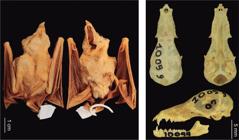
Skin and skull of the holotype (MZUSP 36677) of Lonchophylla dekeyseriTaddei et al., 1983.
Paratype: MZUSP 36678, adult female, fluid-preserved with skull extracted, original number DZSJRP 11459, collected at Sete Cidades, Piracuruca, state of Piauí, Brazil (03°56′S, 41°44′W), on 17 January 1977 by W. Uieda.
Body measurements: MZUSP 36677 - HB = 48.5 mm; FA = 37.4 mm; TI = 15 mm. MZUSP 36678 - HB = 48.7 mm; FA = 34.7 mm; TI = 14.8 mm.
Comments: Two additional paratypes, DZSJRP 10100 and ZUEC 897, were also designated (Taddei et al., 1983). However, the first was not found, and the latter is believed to be housed in the MDBio collection.
Lonchophylla peracchii Dias, Esbérard & Moratelli, 2013
Zootaxa, 3722(3): 355, 2013.
Common names: Peracchi’s nectar bat (Eng.); morcego-beija-flor (Port.).
Holotype (Fig. 29): MZUSP 36679, adult female, fluid-preserved with skull extracted, original number DZSJRP 15162, field number DZUFRJ 62, collected “near Vila do Abraão (ca. 23°07′S, 44°10′W), Ilha Grande, Angra dos Reis, Rio de Janeiro State, Brazil”, by S.A. de Souza and J.L. Manuzzi on 9 December 1984.

Paratypes: MZUSP 36680, original number DZSJRP 15159, and MZUSP 36681, original number DZSJRP 15163, both adult females, fluid-preserved with skulls extracted, collected on 2 August 1980 by S.A. de Souza and J.L. Manuzzi at the same locality as the holotype.
Body measurements: MZUSP 36679 - FA = 35.8 mm. MZUSP 36680 - FA = 36 mm. MZUSP 36681 - FA = 36.5 mm.
Comments:Dias et al. (2013) found morphological and morphometric distinctions between Atlantic Forest and Cerrado populations, previously classified as Lonchophylla bokermanni. Therefore, the authors designated Atlantic Forest populations as L. peracchii.
Genus Xeronycteris Gregorin & Ditchfield, 2005 Xeronycteris vieirai Gregorin & Ditchfield, 2005
Journal of Mammalogy, 86(2): 405, 2005.
Common names: Vieira’s long-tongued bat, Vieira’s flower bat (Eng.); morcego-beija-flor (Port.).
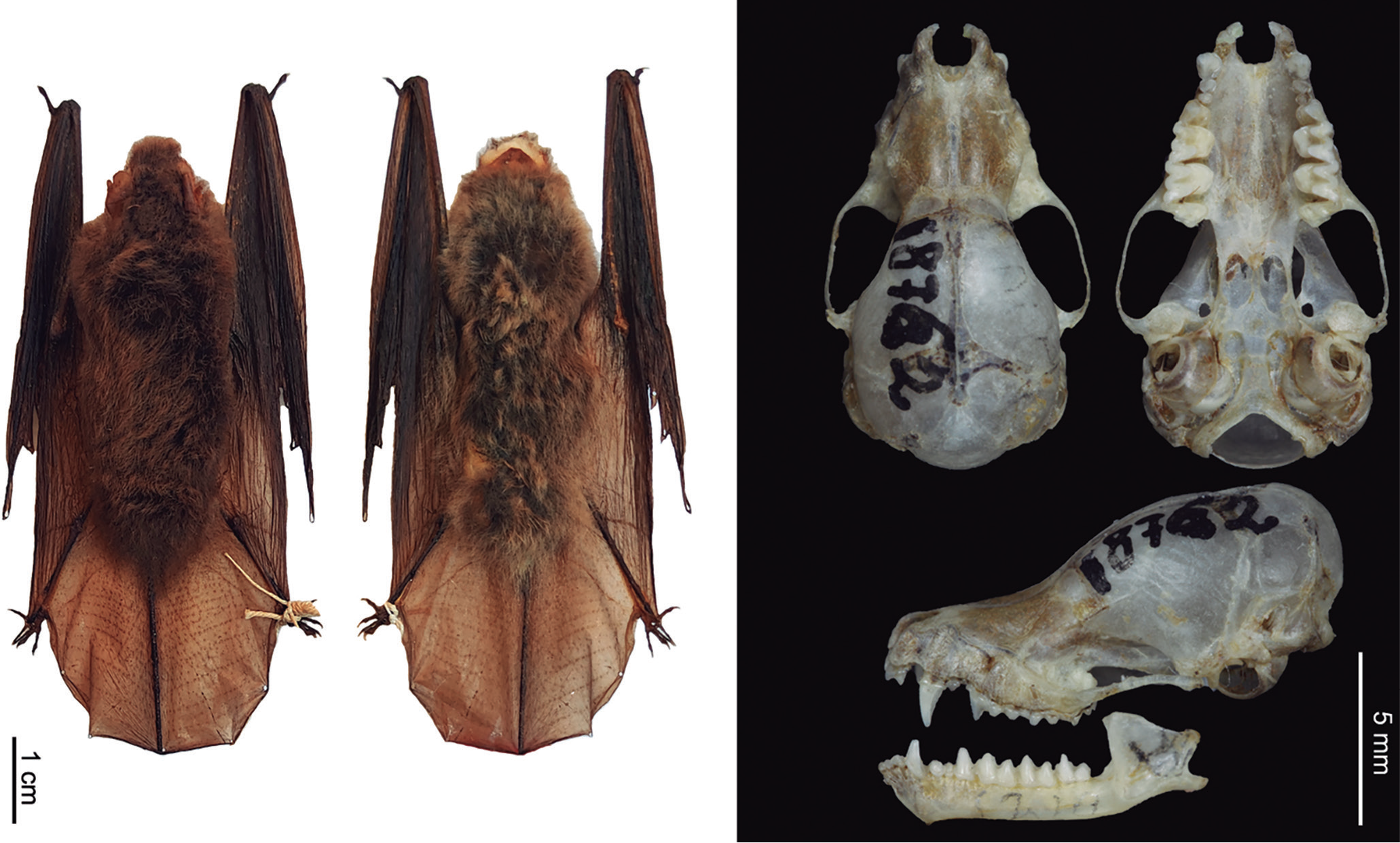
Holotype (Fig. 30): MZUSP 29777, adult female, fluid-preserved with skull extracted, and tissue, field number AD15, collected by A.D. Ditchfield on 11 July 1993, at “Fazenda Espírito Santo, Município de [= municipality of] Soledade, state of Paraíba, Brazil (07°05′S, 36°21′W)”.

Skin and skull of the holotype (MZUSP 29777) of Xeronycteris vieirai Gregorin & Ditchfield, 2005.
Paratypes: MZUSP 14170, adult female, fluid-preserved with skull extracted, field number ABC MZUSP 73.0594, collected by ABC MZUSP expedition on 1-4 May 1973, at Cocorobó, state of Bahia, Brazil (09°53′S, 39°02′W). MZUSP 14173, subadult male, fluid-preserved, same data. MZUSP 14804, adult female, fluid-preserved with skull extracted, field number ABC FINEP 3685, collected by ABC FINEP on 12 January 1978, at Serra da Gritadeira, 18 km southwest of the municipality of Exu, state of Pernambuco, Brazil (07°40′S, 39°47′W).
Body measurements: MZUSP 29777 - TL = 77.6 mm; T = 8.3 mm; HF = 13 mm; FA = 44 mm; E = 9.7 mm; TR = 4 mm; W = 10 g. MZUSP 14170, 14173 and 14804 - not available.
Comments: The holotype was originally described as male, but the presence of a vulva undoubtedly indicates that it is female, as noted by Nogueira et al. (2014).
Subfamily Stenodermatinae Gervais, 1856 Tribe Stenodermatini Gervais, 1856 Genus Chiroderma Peters, 1860 Chiroderma vizottoi Taddei & Lim, 2010
Brazilian Journal of Biology, 70(2): 384, 2010.
= Chiroderma doriae vizottoi Taddei & Lim, 2010
Common names: Brazilian big-eyed bat (Eng.); morcego (Port.).
Holotype (Fig. 31): MZUSP 36670, adult male, fluid-preserved with skull extracted, original number DZSJRP 18054, field number PI0482, collected at “Teresina (ca. 05°02′S, 42°45′W), in the State of Piauí, Brazil”, by L.D. Vizotto, A.J. Dumbra, and V. Rodrigues.

Skin and skull of the holotype (MZUSP 36670) of Chiroderma vizottoi Taddei & Lim, 2010, currently Chiroderma doriae vizottoi Taddei & Lim, 2010.
Paratypes: MZUSP 36671, subadult male, fluid-preserved with skull extracted, original number DZSJRP 11460, collected by W. Uieda in Piracuruca, Parque Nacional de Sete Cidades, state of Piauí, Brazil (ca. 04°05′S, 41°45′W) on 16 January 1976. MZUSP 33553*, adult female, fluid-preserved with skull extracted, field number PNSC 55, collected by A.R. Percequillo and A.P. Carmignotto on 7 October 2000, at Guaribas, Serra das Confusões, Parque Nacional das Confusões, state of Piauí, Brazil (ca. 09°13′S, 43°49′W).
Body measurements: MZUSP 36670 - FA = 46.7 mm. MZUSP 36671 - FA = 49.9 mm. MZUSP 33553 - not available.
Comments: This taxon has been proposed as a subspecies of Chiroderma doriae by Garbino et al. (2020). The paratype specimen MZUSP 33553 could not be located in the collection and is presumed lost.
Family Thyropteridae Miller, 1907 Genus Thyroptera Spix, 1823 Thyroptera devivoi Gregorin, Gonçalves, Lim & Engstrom, 2006
Journal of Mammalogy, 87(2): 239, 2006.
Common names: de Vivo’s disk-winged bat (Eng.); morcego-de-ventosa (Port.).
Holotype (Fig. 32): MZUSP 30073, adult male, fluid-preserved with skull extracted, field number UUPI 383, collected during an expedition led by H. Zaher on 23 July 2000, at “Estação Ecológica de Uruçuí-Una, municipality of Bom Jesus, state of Piauí, Brazil (08°52′S, 44°57′W)”.

Paratype: MZUSP 32345, adult male, fluid-preserved with skull extracted, tissue (liver), field number EG 295, collected by R. Gregorin and E. Gonçalves on 31 March 2003, at Rio Novo, near Estação Ecológica Serra Geral do Tocantins, a region known as “Jalapão”, state of Tocantins, Brazil (10°33′S, 46°45′W).
Body measurements: MZUSP 30073 - CT = 42.4 mm; FA = 35.7 mm; W = 4.1 g. MZUSP 32345 - FA = 36 mm.
Comments: Two additional paratypes (ROM 35588 and ROM 35589) are deposited in the ROM (Gregorin et al., 2006). In the holotype, the zygomatic arch exhibits partial damage on the right side of the skull.
Thyroptera albiventer juquiaensis Vieira, 1942
Arquivos de Zoologia do Estado de São Paulo, 3(8): 391, 1942.
= Thyroptera tricolor juquiaensis Vieira, 1942
Common names: Spix’s disk-winged bat (Eng.); morcego (Port.).
Holotype (Fig. 33): MZUSP 5702, adult male, fluid-preserved with skull extracted, collected by L. Travassos Filho on 8 April 1940, at “Fazenda Poço Grande, rio Juquiá, município de [= municipality of] Iguape, Estado de [= State of] São Paulo”, Brazil.

Skin and skull of the holotype (MZUSP 5702) of Thyroptera albiventer juquiaensisVieira, 1942, currently Thyroptera tricolor juquiaensisVieira, 1942.
Body measurements: HB = 40 mm; T = 26 mm; HF = 5 mm; FA = 36 mm; TI = 18 mm; E = 12 mm; TR = 4 mm.
Comments:Vieira (1942) described this species based on a specimen caught inside a house. Thyroptera t. juquiaensis has been treated as valid and refers to the populations of T. tricolor from southeastern Brazil (Gregorin et al., 2006; Esbérard et al., 2007; Garbino, 2016; Simmons & Cirranello, 2023). The holotype presents partial damage to both zygomatic arches.
Family Vespertilionidae Gray, 1821 Subfamily Myotinae Tate, 1942 Myotis lavali Moratelli, Peracchi, Dias & Oliveira, 2011
Mammalian Biology, 76: 602, 2011.
Common names: LaVal’s myotis (Eng.); morcego (Port.).
Holotype (Fig. 34): MZUSP 18762, adult male, skin and skull, field number ABC Finep 1210, collected by M.R. Willig on 3 April 1977, Escola Agrícola de Exu, at 7 km south of Exu, state of Pernambuco, Brazil (07°30′S, 39°43′W, 523 m of elevation).
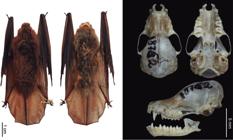
Paratypes: MZUSP 18753, 18755, 18783, 18784, 18785, 18792, 18793, 18807, 18813, 18814, 18823, 18849, females; MZUSP 18759, 18815, 18819, 18820, 18821, 18846, 18847*, 18848, males; all with skin and skull, and collected by M.R. Willig at the same locality as the holotype.
Body measurements: MZUSP 18762 - TL = 83 mm; T = 30; HF = 6 mm; FA = 38 mm; E = 13 mm; TR = 7 mm; W = 4.5 g. MZUSP 18753 - TL = 82 mm; T = 34 mm; HF = 6 mm; FA = 33 mm; E = 13 mm; TR = 8 mm; W = 4.5 g. MZUSP 18755 - TL = 89 mm; T = 35 mm; HF = 6 mm; FA = 34 mm; E = 11 mm; TR = 8 mm; W = 5.5 g. MZUSP 18759 - TL = 82 mm; T = 33 mm; HF = 6 mm; FA = 33 mm; E = 12 mm; TR = 8 mm; W = 4.5 g. MZUSP 18762 - TL = 83 mm; T = 30 mm; HF = 6 mm; FA = 38 mm; E = 13 mm; TR = 7 mm; W = 4.5 g. MZUSP 18783 - TL = 82 mm; T = 32 mm; HF = 6 mm; FA = 39 mm; E = 12 mm; TR = 7 mm; W = 4.0 g. MZUSP 18784 - TL = 87 mm; FA = 37 mm; HF = 6 mm; E = 13 mm; TR = 8 mm; T = 33 mm; W = 5.0 g. MZUSP 18785 - TL = 80 mm; T = 34 mm; HF = 6 mm; FA = 34 mm; E = 14 mm; TR = 9 mm; W = 4.5 g. MZUSP 18792 - TL = 79 mm; T = 32 mm; HF = 6 mm; FA = 31 mm; E = 12 mm; TR = 7 mm; W = 5.0 g. MZUSP 18793 - TL = 85 mm; T = 34 mm; HF = 6 mm; FA = 37 mm; E = 14 mm; TR = 8 mm; W = 4.5 g. MZUSP 18807 - TL = 72 mm; T = 30 mm; HF = 5 mm; FA = 32 mm; E = 11 mm; TR = 7 mm; W = 3.0 g. MZUSP 18813 - TL = 81 mm; T = 34 mm; HF = 6 mm; FA = 36 mm; E = 12 mm; TR = 7 mm; W = 4.5 g. MZUSP 18814 - TL = 84 mm; T = 34 mm; HF = 6 mm; FA = 36 mm; E = 12 mm; TR = 8 mm; W = 5.0 g. MZUSP 18815 - TL = 79 mm; T = 35 mm; HF = 6 mm; FA = 36 mm; E = 12 mm; TR = 8 mm; W = 4.5 g. MZUSP 18819 - TL = 80 mm; T = 32 mm; HF = 6 mm; FA = 39 mm; E = 11 mm; TR = 8 mm; W = 4.0 g. MZUSP 18820 - TL = 79 mm; T = 34 mm; HF = 6 mm; FA = 34 mm; E = 12 mm; TR = 8 mm; W = 4.0 g. MZUSP 18821 - TL = 85 mm; T = 33 mm; HF = 6 mm; FA = 34 mm; E = 12 mm; TR = 8 mm; W = 5.0 g. MZUSP 18823 - TL = 84 mm; T = 36 mm; HF = 6 mm; FA = 36 mm; E = 13 mm; TR = 7 mm; W = 4.5 g. MZUSP 18846 - TL = 87 mm; T = 35 mm; HF = 6 mm; FA = 38 mm; E = 13 mm; TR = 8 mm; W = 5.0 g. MZUSP 18847 - TL = 86 mm; T = 37 mm; HF = 6 mm; FA = 36 mm; E = 13 mm; TR = 8 mm; W = 5.0 g. MZUSP 18848 - TL = 80 mm; T = 34 mm; HF = 6 mm; FA = 37 mm; E = 12 mm; TR = 8 mm; W = 4.5 g. MZUSP 18849 - TL = 87 mm; T = 35 mm; HF = 6 mm; FA = 42 mm; E = 11 mm; TR = 8 mm; W = 5.5 g.
Comments: The type locality in the original description differs slightly from the specimen label. Moratelli et al. (2011) reported it as “6 km S Exu”, while the label indicates “7 km S Exu”. The authors also mentioned the existence of 15 female and 14 male paratypes, but some specimen numbers are duplicated in their description (seeMoratelli et al., 2011: 602). The skull of specimen MZUSP 18847 was not found in the collection and is probably lost.
Subfamily Vespertilioninae Gray, 1821 Tribe Eptesicini Vollett & Heller, 1994 Genus Neoeptesicus Cláudio, Novaes, Gardner, Nogueira, Wilson, Maldonado, Oliveira & Moratelli, 2023 Eptesicus taddeiiMiranda, Bernardi & Passos, 2006
Zootaxa, 1383: 58, 2006.
= Neoeptesicus taddeii (Miranda, Bernardi & Passos, 2006)
Common names: Taddei’s serotine (Eng.); morcego (Port.).
Paratype: MZUSP 26455, female, fluid-preserved with skull extracted, field number CR 17992, collected in Barra do Ribeira, Iguape, state of São Paulo, Brazil, by the Instituto Adolpho Lutz, on 5 November 1987.
Body measurements: E = 14 mm; FA = 45.10 mm.
Comments: We follow Cláudio et al. (2023) in assigning the Brazilian species formerly classified in Eptesicus to the genus Neoeptesicus. This paratype was originally housed at the Instituto Adolpho Lutz, state of São Paulo, Brazil. The holotype (DZUP 246) and 22 additional paratypes (DZUP 098, 229, 247-266) are deposited in the DZUP (Miranda et al., 2006).
Tribe Lasiurini Tate, 1942 Genus Lasiurus Gray, 1831 Subgenus Lasiurus Gray, 1831 Lasiurus enslenii J.L. Lima, 1926
Revista do Museu Paulista, 14: 113, 1926.
= Lasiurus (Lasiurus) blossevillii salinae Thomas, 1902
Common names: Red bat, southern red bat (Eng.); morcego (Port.).
Holotype (Fig. 35): MZUSP 1991, female, skin and skull, collected by C. Enslen in 1905, at “Estado do Rio Grande do Sul [= State of Rio Grande do Sul], São Lourenço”, Brazil.

Skin and skull of the holotype (MZUSP 1991) of Lasiurus ensleniiLima, 1926, currently Lasiurus (Lasiurus) blossevillii salinae Thomas, 1902.
Body measurements: HB = 48 mm; HF = 7 mm; FA = 39 mm; TI = 20 mm; E = 8.5 mm; TR = 4 mm.
Comments:Lasiurus enslenii was described based on the slightly darker pelage of the holotype (Lima, 1926). Later, the species was considered a junior synonym of Lasiurus blossevillii (Koopman, 1993). However, a molecular-based systematic revision of lasiurine bats recognizes L. salinae as a subspecies of blossevillii, with enslenii as a junior synonym (Baird et al., 2015). We follow Novaes et al. (2018) in classifying Lasiurus species into three subgenera.
Lasiurus ebenus Fazzolari Corrêa, 1994
Mammalia, 58(1): 119, 1994.
= Lasiurus (Lasiurus) ebenus Fazzolari Corrêa, 1994
Common names: Black hairy-tailed bat, hairy-tailed bat (Eng.); morcego (Port.).
Holotype (Fig. 36): MZUSP 28125, adult male, skin, skull, and postcranial skeleton, field number 91.0405, collected by S. Fazzolari-Corrêa on 11 June 1991, at “Brasil: São Paulo: Parque Estadual da Ilha do Cardoso (25°05′S, 47°59′W)”.

Skin and skull of the holotype (MZUSP 28125) of Lasiurus ebenusFazzolari-Corrêa, 1994, currently Lasiurus (Lasiurus) ebenusFazzolari-Corrêa, 1994.
Body measurements: HB = 57 mm; T = 58 mm; HF = 8 mm; FA = 45.7 mm; TI = 21.2 mm; E = 12 mm; TR = 6 mm; W = 14 g.
Comments: This species was previously known only from the holotype until a second specimen was captured in the Parque Estadual Carlos Botelho, state of São Paulo, Brazil (Fazzolari-Corrêa, 1994; Cláudio et al., 2018). The holotype presents partial damage to the zygomatic arch on the left side of the skull.
Order Carnivora Bowdich, 1821 Suborder Caniformia Kretzoi, 1943 Infraorder Arctoidea Flower, 1869 Family Mephitidae Fischer, 1817 Genus Conepatus Gray, 1837 Conepatus chilensis bahiensisIhering, 1911
Revista do Museu Paulista, 8: 257, 1911.
= Conepatus semistriatus amazonicus (Lichtenstein, 1838)
Common names: Striped hog-nosed skunk (Eng.); jaritataca, cangambá (Port.).
Holotype (Fig. 37): MZUSP 2649, male, skin and skull, collected by E. Garbe in 1908, at “Villa Nova [= Senhor do Bonfim], Bahia”, Brazil.

Skin and skull of the holotype (MZUSP 2649) of Conepatus chilensis bahiensisIhering, 1911, currently Conepatus semistriatus amazonicus (Lichtenstein, 1838).
Body measurements: HB = 450 mm; T = 300 mm.
Comments: The taxon was first mentioned by Ihering (1910) while studying specimens from the “Museu Paulista” (currently MZUSP), but without a formal description or indication of the catalog number of the specimen analyzed. In that study, Ihering (1910) stated that he had already referred to this subspecies in a description published in volume VIII of the Revista do Museu Paulista - however, this volume was only released a year later, on 8 May 1911. This suggests that both manuscripts were prepared concurrently and that Ihering anticipated an earlier release of the 1911 publication, which may explain the premature citation. Therefore, as with the majority of carnivorans cited by Ihering (1910), this subspecies only received a formal description and the indication of the specimen “2649” as the basis for it in the following year (Ihering, 1911). The specimen’s tail has been lost; however, Ihering (1910, 1911) reported it as being very long at the time of description.
Family Procyonidae Gray, 1825 Genus Nasua Storr, 1780 Nasua nasua aricanaVieira, 1945
Arquivos de Zoologia, 4(10): 404, 1945.
Common names: South American coati, ring-tailed coati (Eng.); quati, quati-sul-americano, quati-de-cauda-anelada, quati-de-nariz-marrom (Port.).
Holotype (Fig. 38): MZUSP 6309, adult male, skin and skull, field number 776, collected by A.M. Olalla on 2 July 1944, at “Fazenda Aricá, Rio Aricá, Município de [= Municipality of] Cuiabá, Estado de [= State of] Mato Grosso”, Brazil.

Paratypes: MZUSP 6310, adult male, skin and skull, field number 639, collected on 23 June 1944; MZUSP 6311, adult male, skin and skull, field number 692, collected on 28 June 1944; MZUSP 6313, juvenile male, skin and skull, field number 592, collected on 23 June 1944; all collected by A.M. Olalla at the same locality as the holotype.
Body measurements: MZUSP 6309 - TL = 1,055 mm; T = 500 mm; HF = 100 mm. MZUSP 6310 - HB = 610 mm; T = 460 mm. MZUSP 6311 - HB = 600 mm; T = 442 mm. MZUSP 6313 - not available.
Comments:Vieira (1945) designated the specimen MZUSP 6312 (adult female, skin and skull, field number 692, collected by A.M. Olalla on 2 July 1944, at Fazenda Aricá, Aricá River, Cuiabá, state of Mato Grosso, Brazil) as the “allotype” of N. n. aricana. However, according to the 4th edition of the ICZN Code (Recommendation 72A; ICZN, 1999), the term “allotype”, despite being used to indicate a specimen of the opposite sex to the holotype, has no name-bearing function.
Nasua narica juruana Ihering, 1911
Revista do Museu Paulista, 8: 239, 1911.
= Nasua nasua dorsalis Gray, 1866
Common names: South American coati, ring-tailed coati (Eng.); quati, quati-sul-americano, quati-de-cauda-anelada, quati-de-nariz-marrom (Port.).
Holotype (Fig. 39): MZUSP 780, adult male, skin (partially damaged) and skull, collected by E. Garbe in January 1902, at “Rio Juruá”, state of Amazonas, Brazil.

Skin and skull of the holotype (MZUSP 780) of Nasua narica juruanaIhering, 1911, currently Nasua nasua dorsalis Gray, 1866.
Body measurements: Not available.
Comments:Ihering (1910), studying specimens from the “Museu Paulista” (currently MZUSP), recognized two species of coatis in Brazil: Nasua nasua, restricted to the lower Amazon region and represented by individuals from the states of Pará and Maranhão; and Nasua narica, occurring throughout the rest of the country. Within the latter, he identified a distinctive form from the Juruá River, which he named Nasua narica juruana (“Eine eigenartige Unterart, die ich Nasua narica juruana subsp. n. nennen will, ist die Form des Rio Juruá. Die Felle sowohl, wie die Schädel gehören unzweifelhaft zu Nasua narica, indessen sind die Felle sehr dunkel und mit rötlich überlaufen erscheint”. [= A peculiar subspecies, which I want to call Nasua narica juruana subsp. n., is the form of the Juruá River. The skins, as well as the skulls, undoubtedly belong to Nasua narica, but the skins are very dark and appear to be overflowing with red.]; Ihering, 1910: 167). However, he did not provide a formal description or mention the catalog numbers of the specimens examined, stating only that the skull measurements of these specimens were presented in volume VIII of the Revista do Museu Paulista; however, this volume was released only a year later. In the following article, Ihering (1911) described the subspecies in more detail but did not explicitly indicate which specimen was the type. Among the Nasua narica specimens examined and listed in the table of skull measurements, the only individual from the Juruá River was an adult male with the identification number “780”. Therefore, we can infer that MZUSP 780 is the type specimen of the subspecies proposed by Ihering.
Genus Potos É. Geoffroy & F.G. Cuvier, 1795 Potos flavus brasiliensisIhering, 1911
Revista do Museu Paulista, 8: 228, 1911.
= Potos flavus chapadensis Allen, 1904
Common names: Kinkajou (Eng.); jupará, jurupará, macaco-da-noite (Port.).
Holotype (Fig. 40): MZUSP 1802, unknown sex, skin, collected by H. Silva in 1905, at “Matto Grosso de Goyaz”, state of Goiás, Brazil.
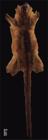
Skin of the holotype (MZUSP 1802) of Potos flavus brasiliensisIhering, 1911, currently Potos flavus chapadensis Allen, 1904.
Body measurements: Not available.
Comments:Ihering (1911) reported that this form of Potos flavus inhabited central Brazil, more specifically in “Goyaz” (encompassing the states of Goiás and Tocantins) and “Matto Grosso” (currently encompassing the Brazilian states of Mato Grosso, Mato Grosso do Sul, and Rondônia). Based on one dry skin from Mato Grosso de Goiás, Ihering (1911) described this form as a distinct taxon of Wied’s Nasua nocturna (= Potos flavus nocturnus) and named it Potos flavus brasiliensis. However, Ihering (1911) did not explicitly indicate the specimen number in his publication. Still, the only individual from the MZUSP mammal collection with the matching information (location, collector, date of collection, morphological characters) described by this author is MZUSP 1802. For this reason, we recognize this specimen as the holotype by monotypy following Article 73.1.2 of the ICZN Code (ICZN, 1999). Regarding the type locality, Mato Grosso de Goiás is an enclave of seasonal deciduous forest in the Cerrado, along the western and southern portions of the state of Goiás (Dutra e Silva et al., 2017).
Nasua nocturna Wied, 1826
Beiträge zur Naturgeschichte von Brasilien, 2: 298, 1826.
= Potos flavus nocturnus (Wied, 1826)
Common names: Kinkajou (Eng.); jupará, jurupará, macaco-da-noite (Port.).
Neotype (Fig. 41): MZUSP 7381, adult female, skin and skull, field number 86, collected by Expedição do Departamento de Zoologia on 2 October 1951, at “matas da região de São Miguel dos Campos, na faixa litorânea do sul do Estado de Alagoas” [= forests in the region of São Miguel dos Campos, on the coastal strip of the south of the State of Alagoas], Brazil. Designated by Vieira (1952).

Skin and skull of the neotype (MZUSP 7381) of Nasua nocturnaWied, 1826, currently Potos flavus nocturnus (Wied, 1826).
Body measurements: HB = 430 mm; T = 460 mm; E = 30; FF = 140 mm; FA = 100 mm.
Comments:Wied (1826) described this species based on a damaged skin he saw during his travels in the southern region of the state of Bahia, Brazil. Although Wied (1826) described this animal as a new species of coati (genus Nasua), he noted that locals knew it as “Jupará”. Due to the lack of type material and the uncertainty regarding Wied’s Nasua nocturna provenance, Vieira (1952) designated a neotype for N. nocturna, currently classified as Potos flavus nocturnus, using material collected by O. Pinto in the state of Alagoas. Vieira (1952) also stated that this subspecies was typical of the coastal forests of northeastern Brazil.
Genus Procyon Storr, 1780 Procyon cancrivorus brasiliensisIhering, 1911
Revista do Museu Paulista, 8: 228, 1911.
= Procyon cancrivorus nigripes Mivart, 1886
Common names: Crab-eating raccoon, South American raccoon (Eng.); mão-pelada, guaxinim, jaguacinim (Port.).
Syntypes: MZUSP 1180 (Fig. 42), male, skin and skull, collected by J.L. Lima on 30 September 1903, at Ipiranga, São Paulo, state of São Paulo, Brazil; MZUSP 1437, male, skull, collected by C. Enslen on June 1904, at São Lourenço do Sul, state of Rio Grande do Sul, Brazil; MZUSP 1673, male, skin and skull, collected by C. Grossmann on 1904, at Joinville, state of Santa Catarina, Brazil; MZUSP 2418, skin and skull, collected by E. Garbe on August 1906, at Rio Doce [= ”surroundings of Linhares and Lagoa Juparana” (Pinto, 1945)], state of Espírito Santo, Brazil; MZUSP 2651, skin and skull, by E. Garbe on 1908, at “Villa Nova” [= Senhor do Bonfim], state of Bahia, Brazil.
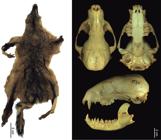
Skin and skull of MZUSP 1180, syntype of Procyon cancrivorus brasiliensisIhering, 1911, currently Procyon cancrivorus nigripes Mivart, 1886.
Body measurements: Not available.
Comments:Ihering (1910) named a new subspecies of crab-eating raccoon as Procyon cancrivorus brasiliensis, but he did not indicate any type specimen or a formal description, only briefly indicating that this proposed subspecies differed from the typical species by having black feet instead of red feet (“Die typische Form stammt von Guiana und Kolumbien und hat nach Sclater rote Füße. Es muß daher die brasilianische Varietät mit schwarzen Füßen einen besonderen Namen erhalten, und nenne ich dieselbe Procyon cancrivorus brasiliensis subsp. n.”. [= The typical form comes from Guiana and Colombia and, according to Sclater, has red feet. The Brazilian variety with black feet must therefore be given a special name, and I call it Procyon cancrivorus brasiliensis subsp. n.]; Ihering, 1910: 167). Ihering (1911) again did not explicitly designate any type specimen(s) for this taxon. Nonetheless, throughout his text and in the comparative table of skull measurements, he pointed out and described some specimens from the collection from various localities (listed above). In this way, we can interpret these specimens as syntypes of P. c. brasiliensis.Ihering (1911) did not provide a precise type locality, mentioning only “Brazil”.
Infraorder Canoidea Simpson, 1931 Family Canidae Fischer, 1817 Genus Cerdocyon C.E.H. Smith, 1839 Canis thous riograndensisIhering, 1910
Archiv für Naturgeschichtre, 76(1): 144, 1910.
= Cerdocyon thous entrerianus (Burmeister, 1861)
Common names: Crab-eating fox (Eng.); cachorro-do-mato, lobinho, lobete, graxaim-do-mato (Port.).
Syntypes: MZUSP 514 (Fig. 43), adult male, skin and skull, collected by C. Enslen in 1901, at “Kolonie São Lourenço im Süden des Staates Rio Grande do Sul” [= Colony of São Lourenço in the south of the state of Rio Grande do Sul] (nowadays São Lourenço do Sul, state of Rio Grande do Sul), Brazil. MZUSP 518, adult male, skull, collected by C. Enslen in 1897 at the same locality.
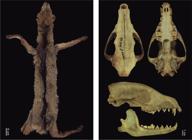
Skin and skull (mandible with missing teeth on the left side) of MZUSP 514, syntype of Canis thous riograndensisIhering, 1910, currently Cerdocyon thous entrerianus (Burmeister, 1861).
Body measurements: Not available.
Comments: Throughout the description of the subspecies, Ihering (1910) provided skull measurements for a specimen he indicated as number “415”. However, this was probably a typographical error, as the correct number of this specimen is 514. This is supported by the table of cranial measurements included in the same article, as well as by Ihering’s subsequent publication (1911), in which he explicitly indicated specimens 514 and 518 as types of C. t. riograndensis. The mandible of MZUSP 514 is currently missing several teeth, including all lower incisors, the left canine, and two left molars.
Genus Speothos Lund, 1839 Speothos wingeiIhering, 1911
Revista do Museu Paulista, 8: 222, 1911.
= Speothos venaticus wingei Ihering, 1911
Common names: Bush dog, vinegar dog, savannah dog (Eng.); cachorro-vinagre, cachorro-do-mato-vinagre (Port.).
Syntypes: MZUSP 2684 (Fig. 44), old female, skin and skull, collected by Ehrhardt, at “Colonia Hansa” [= Corupá], state of Santa Catarina, Brazil, collection date unknown. MZUSP 2685, unknown sex, skull, collected by Ehrhardt, at the same locality, collection date unknown.

Skin and skull of MZUSP 2684, syntype of Speothos wingeiIhering, 1911, currently Speothos venaticus wingeiIhering, 1911.
Body measurements: MZUSP 2684 - HB = 740 mm; T = 110 mm; E = 40 mm. MZUSP 2685 - not available.
Comments:Ihering (1910) named a new species of bush dog, Speothos wingei, briefly noting the overall pelage coloration and measurements of the upper canines and upper first premolar, but without indicating any specimen number. In his following publication, Ihering (1911) provided a detailed description of the species, yet again did not explicitly indicate the type specimens. However, two specimens’ catalog numbers (“2684” and “2685”) were included in the accompanying skull measurement table, allowing us to infer that MZUSP 2684 and MZUSP 2685 were the basis for the description. Accordingly, we consider both as syntypes of S. wingei. The type locality was originally indicated by Ihering (1911) as “Estado of Santa Catharina” (original spelling), subsequently restricted by Vieira (1946) to “Colônia Hansa” [= Corupá]. Currently, this species is regarded as one of the three subspecies recognized for Speothos venaticus (S. v. venaticus, S. v. panamaensis, and S. v. wingei) (Cabrera, 1958; Wozencraft, 2005; Beisiegel & Zuercher, 2005).
Order Artiodactyla Owen, 1848 Suborder Ruminantia Scopoli, 1777 Infraorder Pecora Flower, 1883 Family Cervidae Goldfuss, 1820 Subfamily Capreolinae Brookes, 1828 Tribe Odocoileini Pocock, 1923 Genus Mazama Rafinesque, 1817 Mazama bororoDuarte, 1996
Guia de Identificação de Cervídeos Brasileiros, 7, 1996.
= Mazama jucunda Thomas, 1913
Common names: Small red brocket, bororo, São Paulo bororó (Eng.); veado-mateiro-pequeno, veado-bororó-de-são-paulo (Port.)
Lectotype (Fig. 45): MZUSP 33471, skull and partial postcranial skeleton, adult male, tese 204, collected by Projeto Cervídeos Brasileiros, UNESP Jaboticabal, on 21 August 2000 at Parque Estadual de Intervales, Iporanga, state of São Paulo, Brazil (24°18′29.7″S, 48°24′26.2″W).

Skull of the lectotype (MZUSP 33471) of Mazama bororoDuarte, 1996, currently Mazama jucunda Thomas, 1913.
Paralectotype: MZUSP 33470, skin, metacarpal and metatarsal bones, adult male, Mb 02, collected by Projeto Cervídeos Brasileiros, UNESP Jaboticabal, on 18 February 1997 at Barra do Turvo, state of São Paulo, Brazil.
Body measurements: Not available.
Comments:Duarte (1992) proposed in his Master’s thesis the existence of a new species, Mazama bororo, based on a captive specimen from Capão Bonito, São Paulo, which presented karyotypic differences compared to the other Mazama specimens studied. According to the ICZN Code (ICZN, 1999), this designation qualifies as an unpublished work, invalidating this name. Later, M. bororo received a description based on karyotypic and morphological characters, leading some authors to consider it as an “intermediate form” between M. nana and M. americana (Duarte, 1996; Duarte & Merino, 1997; Duarte & Jorge, 2003). However, none of these works formally designated a type specimen (holotype or syntype) (Duarte, 1996; Duarte & Merino, 1997). Based on morphological and karyotypical evidence, Duarte & Jorge (2003) described M. bororo using three specimens: T071 and T072, both from Barra do Turvo, state of São Paulo; and T064, of unknown origin, possibly from the surroundings of Curitiba, state of Paraná - without indicating their institutional depository. Furthermore, these authors presented photos of the anesthetized T071 specimen and its karyotype in the article. Consequently, these three specimens could be considered as the syntypes of M. bororo. Later, Vogliotti & Duarte (2009), disregarding the material previously used by Duarte & Jorge (2003), designated allegedly new type material consisting of a lectotype (MZUSP 33471) and a paralectotype (MZUSP 33470) for M. bororo. Recently, Mantellato et al. (2022) extracted and sequenced mitochondrial DNA from the holotype of Mazama americana jucunda Thomas, 1913, and found that this taxon and M. bororo represent the same biological entity, and thus, the former name has priority over the latter. Consequently, the new name combination became Mazama jucunda Thomas, 1913. The skull of Vogliotti & Duarte’s (2009) lectotype of M. bororo (MZUSP 33471) is partially damaged, with the zygomatic arches, premaxillae, most of the nasals, and part of the left maxilla missing. A revision regarding the validity of M. bororo and its correct authorship is needed.
Suborder Whippomorpha Waddell, Okada & Hasegawa, 1999 Infraorder Cetacea Brisson, 1762 Parvorder Odontoceti Flower, 1867 Family Pontoporiidae Gray, 1870 Genus Pontoporia Gray, 1846 Pontoporia blainvillei pukusiNara, Secchi & Cunha, 2024
Journal of Mammalian Evolution, 31: 2024.
Common names: Franciscana dolphin (Eng.); franciscana, toninha (Port.).
Holotype (Fig. 46): MZUSP 25651, male, skull and postcranial skeleton, field number FBCN GMA B 55, collected by L. Lodi & L. Capistrano on 8 April 1988, at “Barra do Furado, Quissamã, in northern Rio de Janeiro, Brazil”.

Body measurements: HB = 1,210 mm; Condylobasal length = 346 mm; Snout to the angle of gape length = 242 mm.
Comments: Based on genetic, morphological, and ecological data, Nara et al. (2024) classified Pontoporia blainvillei into two subspecies, describing P. b. pukusi for populations from the northern region of the species’ range (from the state of Espírito Santo to northern Rio de Janeiro).
Additional comments
Order Didelphimorphia Gill, 1872 Family Didelphidae Gray, 1821 Subfamily Didelphinae Gray, 1821 Tribe Thylamyini Hershkovitz, 1992 Genus Marmosops Matschie, 1916 Subgenus Marmosops Matschie, 1916 Marmosa thomasi Ihering = Marmosops (Marmosops) incanus (Lund, 1840)
Comments: The specimen MZUSP 253 (adult male, mounted skin and skull, collected at São Sebastião, state of São Paulo, Brazil, unknown collector and date) was added to the collection in 1897, probably by Ihering, as listed in the specimen catalog of the MZUSP collection. The original specimen label, also possibly made by Ihering, indicates that this is the type of Marmosa thomasi. However, we have found no publication on this name. According to Pinto (1945), Ihering was in Ilha de São Sebastião between September and October 1896, accompanied by Beniamino Bicego and Hellmuth Pinder, to collect specimens. Later, Ihering (1897) listed the species recorded during this expedition in his publication “A Ilha de São Sebastião”, but did not mention Marmosa thomasi.Gardner & Creighton (2007) considered Marmosa thomasi as a nomen nudum.
Order Chiroptera Blumenbach, 1779 Suborder Vespertilioniformes Hutcheon & Kirsch, 2006 Family Molossidae Gervais, 1856 Subfamily Molossinae Gervais, 1856 Genus Neoplatymops Peterson, 1965 Molossops mattogrossensisVieira, 1942
Arquivos de Zoologia do Estado de São Paulo, 3: 430, 1942.
= Neoplatymops mattogrossensis (Vieira, 1942)
Comments: In the original description, Vieira (1942) designated the specimen MZUSP 17588 (adult female, skin and skull, originally MN 3596, collected by F. Hoehne, Comissão Rondon, on 10 February 1918, at S. Simão, Juruena River, northern of the state of Mato Grosso, Brazil) as the “allotype” of N. mattogrossensis. By the ICZN Code (ICZN, 1999), the term “allotype” is not subject to the regulations established by the Code. As outlined in Recommendation 72A and the Glossary section, an allotype is defined as a specimen of the opposite sex to the holotype that does not possess a name-bearing name function (ICZN, 1999). Furthermore, Vieira (1942) explicitly indicated one specimen as the holotype (MN 3597) and five others as the paratypes (MN 3595, 3644-3647) currently housed at MNRJ.
CONCLUSION
This catalog represents the first comprehensive annotated list of the type specimens housed in the mammal collection of the Museu de Zoologia da Universidade de São Paulo (MZUSP), one of the most representative and historically significant repositories of Neotropical mammals. It compiles and updates essential taxonomic data and specimen information, providing an invaluable reference for current and future research.
The catalog demonstrates the historical significance of the collection, which includes type specimens dating back to 1896, such as the paratype of Monodelphis tricolor paulensis, the lectotype of Alouatta guariba clamitans, and the lectotype and paralectotypes of Mesomys thomasi. These specimens illustrate Hermann von Ihering’s pivotal role in establishing the collection, largely through his efforts to promote fieldwork and commission collectors who secured much of its earliest material. To this day, Ihering remains the author responsible for the highest number of mammal species described based on MZUSP material, with six taxa assigned to Carnivora, one to Rodentia, and one to Primates. He is followed by Carlos Octaviano da Cunha Vieira, who described one taxa from the order Didelphimorphia, one from Carnivora, one from Primates, and one Chiroptera.
Recent studies based on MZUSP specimens have further reaffirm the enduring scientific value of the collection. Notable examples include the description of species more than a century after the collection of their type specimens, such as Monodelphis pinocchio S. Pavan, 2015 (paratype collected in 1909), and the description of new taxa, such as Pontoporia blainvillei pukusiNara et al., 2024 and Rhipidomys caracolensisCampos et al., 2022. These findings highlight the critical importance of maintaining specimen records updated and accessible.
The MZUSP collection remains a cornerstone of Neotropical mammalogy, with type material from 21 Brazilian states and one locality in Guyana. It encompasses major mammalian groups, with a notable predominance of Rodentia (153 type specimens, accounting for 59.5% of the collection’s type material) and Chiroptera (46 type specimens, 18% of the total). Scientific collections like this are of paramount importance, serving not only as repositories of specimens but also as the most reliable and enduring record of biodiversity. By providing access to specimens across time and space, they serve as powerful tools for addressing scientific questions over centuries, and enable robust diagnoses and reliable taxonomic revisions.
However, maintaining specimens in optimal conditions presents significant challenges. Scientific collections are subject to constant deterioration, institutional vulnerabilities, and major disasters, all of which can result in the loss of material and associated records (Tyler et al., 2023). The risk is especially critical for type specimens, as they are unique and irreplaceable. As the foundational reference points for species descriptions, type specimens represent the core heritage of mammalian systematics and are indispensable for taxonomic accuracy and continuity.
Despite these challenges, initiatives like this catalog play a crucial role in ensuring that type specimens remain accessible and scientifically relevant. By consolidating and documenting critical information, the present work safeguards the taxonomic record of the MZUSP mammal collection, mitigates the risks of information loss, and strengthens its long-term value for scientific research. Ultimately, it reinforces the collection’s enduring contribution to advancing our understanding of mammalian diversity for future generations.
-
FUNDING INFORMATION:
RLV received support from Coordenação de Aperfeiçoamento de Pessoal de Nível Superior (CAPES). JES V and JRP received financial support from the Fundação de Amparo à Pesquisa do Estado de São Paulo (FAPESP), processes 2023/09464-1 and 2022/12632-0.
ACKNOWLEDGMENTS:
We dedicate this work to the former curators who worked on the MZUSP mammal collection: Dr. Hermann von Ihering, Carlos Octaviano da Cunha Vieira, Dr. Cory Teixeira de Carvalho (all in memoriam), and Dr. Mario de Vivo. We also extend our thanks to Dione Seripierri for her invaluable assistance with the bibliographic references that were essential for this catalog, to Dr. Ana Carolina Pavan for providing information about the specimens, and to Dr. Marcus Vinicius Brandão for the photos of one of the holotypes.
REFERENCES
-
Abreu Jr., E.F. & Percequillo, A.R. 2019. Small mammals of the Estação Ecológica de Bananal, southeastern Atlantic Forest, Brazil, with description of a new species of Brucepattersonius (Rodentia, Sigmodontinae). Arquivos de Zoologia, 50(1): 1-116. https://doi.org/10.11606/2176-7793/2019.50.01
» https://doi.org/10.11606/2176-7793/2019.50.01 -
Abreu Jr., E.F.; Casali, D.; Costa-Araújo, R.; Garbino, G.S.T.; Libardi, G.S.; Loretto, D.; Loss, A.C.; Marmontel, M.; Moras, L.M.; Nascimento, M.C.; Oliveira, M.L.; Pavan, S.E. & Tirelli, F.P. 2024. Lista de Mamíferos do Brasil. 2024-1. Sociedade Brasileira de Mastozoologia. [dataset]. Available: https://doi.org/10.5281/zenodo.14536925 Access: 01/03/2025.
» https://doi.org/10.5281/zenodo.14536925 -
Abreu Jr., E.F.; Jung, D.M.H.; Christoff, A.U.; Valiati, V.H.; Jansa, S.A. & Percequillo, A.R. 2021. Systematics of Brucepattersonius Hershkovitz, 1998 (Rodentia, Sigmodontinae): molecular species delimitation and morphological analyses suggest an overestimation in species diversity. Systematics and Biodiversity, 19(6): 544-570. https://doi.org/10.1080/14772000.2021.1890270
» https://doi.org/10.1080/14772000.2021.1890270 -
Abreu Jr., E.F.; Pavan, S.E.; Tsuchiya, M.T.N.; Wilson, D.E.; Percequillo, A.R. & Maldonado, J.E. 2020. Museomics of tree squirrels: a dense taxon sampling of mitogenomes reveals hidden diversity, phenotypic convergence, and the need of a taxonomic overhaul. BMC Evolutionary Biology, 20(77): 1-25. https://doi.org/10.1186/s12862-020-01639-y
» https://doi.org/10.1186/s12862-020-01639-y -
Ayres, J.M. 1985. On a new species of squirrel monkey, genus Saimiri, from Brazilian Amazonia (Primates, Cebidae). Papéis Avulsos de Zoologia, 36(14): 147-164. https://doi.org/10.11606/0031-1049.1983.36.p147-164
» https://doi.org/10.11606/0031-1049.1983.36.p147-164 -
Baird, A.B.; Braun, J.K.; Mares, M.A.; Morales, J.C.; Patton, J.C.; Tran, C.Q. & Bickham, J.W. 2015. Molecular systematic revision of tree bats (Lasiurini): doubling the native mammals of the Hawaiian Islands. Journal of Mammalogy, 96(6): 1255-1274. https://doi.org/10.1093/jmammal/gyv135
» https://doi.org/10.1093/jmammal/gyv135 -
Beisiegel, B.M. & Zuercher, G.L. 2005. Speothos venaticus. Mammalian Species, 783: 1-6. https://doi.org/10.1644/783.1
» https://doi.org/10.1644/783.1 - Bezerra, A. 2012. Coleções Científicas de Mamíferos. I - Brasil. Boletim da Sociedade Brasileira de Mastozoologia, 65: 19-25.
-
Brandão, M.V.; Carmignotto, A.P.; Percequillo, A.R.; Christoff, A.U.; Mendes-Oliveira, A.C. & Geise, L. 2022. A new species of Akodon Meyen, 1833 (Rodentia: Cricetidae) from dry forests of the Amazonia-Cerrado transition. Zootaxa, 5205(5): 401-435. https://doi.org/10.11646/zootaxa.5205.5.1
» https://doi.org/10.11646/zootaxa.5205.5.1 -
Brandão, M.V.; Percequillo, A.R.; D’Elía, G.; Paresque, R. & Carmignotto, A.P. 2021. A new species of Akodon Meyen, 1833 (Rodentia: Cricetidae: Sigmodontinae) endemic from the Brazilian Cerrado. Journal of Mammalogy, 102(1): 101-122. https://doi.org/10.1093/jmammal/gyaa126
» https://doi.org/10.1093/jmammal/gyaa126 -
Byrne, H.; Rylands, A.B.; Carneiro, J.C.; Lynch-Alfaro, J.W.; Bertuol, F.; Da Silva, M.N.F.; Messias, M.; Groves, C.P.; Mittermeier, R.A.; Farias, I.; Hrbek, T.; Schneider, F.; Sampaio, I. & Boubli, J.P. 2016. Phylogenetic relationships of the New World titi monkeys (Callicebus): first appraisal of taxonomy based on molecular evidence. Frontiers in Zoology, 13(10): 1-25. https://doi.org/10.1186/s12983-016-0142-4
» https://doi.org/10.1186/s12983-016-0142-4 - Cabrera, A. 1940. Los nombres cientificos de algunos monos americanos. Revista Hispano-Americana de Ciencias Puras y Aplicadas, 1(9): 402-2405.
- Cabrera, A. 1958. Catalogo de los mamiferos de America del Sur. Revista del Museo Argentino de Ciencias Naturales “Bernardino RIvadavia”, 4(1): 1-307.
-
Campos, B.A.T.P.; Percequillo, A.R.; Miranda, G. & Langguth, A. 2022. Two new species of Rhipidomys (Rodentia: Sigmodontinae) from Eastern Brazil, with comments on the taxonomy of the genus. Hystrix-Italian Journal of Mammalogy, 33(2): 138-156. https://doi.org/10.4404/hystrix-00443-2021
» https://doi.org/10.4404/hystrix-00443-2021 -
Chiquito, E.; Caccavo, A.; Santos, C.; Semedo, T.; Costa-Pinto, A.L.; Astúa, D.; Bezerra, A.M.; Silva, C.R.; Guerra, E.; Gonçalves, P.; Althoff, S.L.; Trigo, T. & Percequillo, A. 2021. Coleções de mamíferos no Brasil: visão geral e banco de dados. Brazilian Journal of Mammalogy, 90(especial): e90202105. https://doi.org/10.32673/bjm.vie90.5
» https://doi.org/10.32673/bjm.vie90.5 -
Christoff, A.U.; Fagundes, V.; Sbalqueiro, I.J.; Mattevi, M.S. & Yonenaga-Yassuda, Y. 2000. Description of a new species of Akodon (Rodentia: Sigmodontinae) from southern Brazil. Journal of Mammalogy, 81(3): 838-851. https://doi.org/10.1644/1545-1542(2000)081<0838:DOANSO>2.3.CO;2
» https://doi.org/10.1644/1545-1542(2000)081<0838:DOANSO>2.3.CO;2 -
Cláudio, V.C.; Barbosa, G.P.; Novaes, R.L.M.; Rassy, F.B.; Rocha, V.J. & Moratelli, R. 2018. Second record of Lasiurus ebenus (Chiroptera, Vespertilionidae), with comments on its taxonomic status. Zootaxa, 4403(3): 513-522. https://doi.org/10.11646/zootaxa.4403.3.5
» https://doi.org/10.11646/zootaxa.4403.3.5 -
Cláudio, V.C.; Novaes, R.L.M.; Gardner, A.L.; Nogueira, M.R.; Wilson, D.E.; Maldonado, J.E.; Oliveira, J.A. & Moratelli, R. 2023. Taxonomic re-evaluation of New World Eptesicus and Histiotus (Chiroptera: Vespertilionidae), with the description of a new genus. Zoologia, Curitiba, 40: 1-24, e22029. https://doi.org/10.1590/S1984-4689.v40.e22029
» https://doi.org/10.1590/S1984-4689.v40.e22029 -
Costa, B.M.A.; Geise, L.; Pereira, L.G. & Costa, L.P. 2011. Phylogeography of Rhipidomys (Rodentita: Cricetidae: Sigmodontinae) and description of two new species from southeastern Brazil. Journal of Mammalogy, 92(5): 945-962. https://doi.org/10.1644/10-MAMM-A-249.1
» https://doi.org/10.1644/10-MAMM-A-249.1 -
Costa, L.P.; Pavan, S.E.; Leite, Y.L.R. & Fagundes, V. 2007. A new species of Juliomys (Mammalia: Rodentia: Cricetidae) from the Atlantic Forest of southeastern Brazil. Zootaxa, 1463: 21-37. https://doi.org/10.11646/zootaxa.1463.1.3
» https://doi.org/10.11646/zootaxa.1463.1.3 -
Costello, R.K.; Dickinson, C.; Rosenberger, A.L.; Boinski, S. & Szalay, F.S. 1993. Squirrel monkey (genus Saimiri) taxonomy: a multidisciplinary study of the biology of the species. New York, Plenum Press. https://doi.org/10.1007/978-1-4899-3745-2_8
» https://doi.org/10.1007/978-1-4899-3745-2_8 -
D’Elía, G.; Mora, I.; Myers, P. & Owen, R.D. 2008. New and noteworthy records of Rodentia (Erethizontidae, Sciuridae, and Cricetidae) from Paraguay. Zootaxa, 1784: 39-57. https://doi.org/10.11646/zootaxa.1784.1.3
» https://doi.org/10.11646/zootaxa.1784.1.3 - Dias, D. 2016. Sistemática molecular, biogeografia e diversificação de Brucepattersonius (Rodentia: Sigmodontinae). (Master’s Thesis). Universidade Federal do Espírito Santo, Vitória.
-
Dias, D.; Esbérard, C.E.L. & Moratelli, R. 2013. A new species of Lonchophylla (Chiroptera, Phyllostomidae) from the Atlantic Forest of southeastern Brazil, with comments on L. bokermanni. Zootaxa, 3722(3): 347-360. https://doi.org/10.11646/zootaxa.3722.3.4
» https://doi.org/10.11646/zootaxa.3722.3.4 - Duarte, J.M.B. 1992. Aspectos taxonômicos e citogenéticos de algumas espécies de cervídeos brasileiros. (Master’s Thesis). Universidade Estadual Paulista “Júlio de Mesquita Filho”, Jaboticabal.
- Duarte, J.M.B. 1996. Guia de Identificação de Cervídeos Brasileiros. Jaboticabal, Fundação de Apoio a Pesquisa, Ensino e Extensão (FUNEP).
-
Duarte, J.M.B. & Jorge, W. 2003. Morphologic and cytogenetic description of the small red brocket (Mazama bororo Duarte, 1996) in Brazil. Mammalia, 67(3): 403-410. https://doi.org/10.1515/mamm.2003.67.3.403
» https://doi.org/10.1515/mamm.2003.67.3.403 - Duarte, J.M.B. & Merino, M.L. 1997. Taxonomia e evolução. In: Duarte, J.M.B. (Ed.). Biologia e conservação de cervídeos sul-americanos: Blastocerus, Ozotoceros e Mazama. Jaboticabal, Fundação de Apoio à Pesquisa, Ensino e Extensão (FUNEP). 21p.
-
Dutra e Silva, S.; Franco, J.L.A. & Drummond, J.A. 2017. Colonização e desflorestamento: a expansão da fronteira agrícola em Goiás nas décadas de 1930 e 1940. In: Gerhardt, M.; Nodari, E.S. & Moretto, S.P. (Eds.). História ambiental e migrações: diálogos. São Leopoldo, OIKOS, Editora UFFS, p. 11-29. https://doi.org/10.7476/9788564905689.0002
» https://doi.org/10.7476/9788564905689.0002 -
Emmons, L.H.; Leite, Y.L.R.; Kock, D. & Costa, L.P. 2002. A review of the named forms of Phyllomys (Rodentia: Echimyidae) with the description of a new species from coastal Brazil. American Museum Novitates, 3380: 1-40. https://doi.org/10.1206/0003-0082(2002)380<0001:AROTNF>2.0.CO;2
» https://doi.org/10.1206/0003-0082(2002)380<0001:AROTNF>2.0.CO;2 -
Esbérard, C.E.L.; Santos, B.S. & Faria, D. 2007. New Thyroptera tricolor Spix records in the Atlantic Forest, Brazil (Chiroptera; Thyropteridae). Brazilian Journal of Biology, 67(2): 379-380. https://doi.org/10.1590/S1519-69842007000200028
» https://doi.org/10.1590/S1519-69842007000200028 -
Fazzolari-Corrêa, S. 1994. Lasiurus ebenus, a new vespertilionid bat from Southeastern Brazil. Mammalia, 58(1): 119-123. https://doi.org/10.1515/mamm.1994.58.1.119
» https://doi.org/10.1515/mamm.1994.58.1.119 -
Fisher, R.D. & Ludwig, C.A. 2014. Catalog of type specimens of recent Mammals: Rodentia (Myomorpha, Anomaluromorpha, and Hystricomorpha) in the National Museum of Natural History, Smithsonian Institution. Washington, D.C., Smithsonian Institution Scholarly Press. https://doi.org/10.5479/si.19436696.642
» https://doi.org/10.5479/si.19436696.642 -
Fisher, R.D. & Ludwig, C.A. 2015. Catalog of Type Specimens of Recent Mammals: Orders Didelphimorphia through Chiroptera (excluding Rodentia) in the National Museum of Natural History, Smithsonian Institution. Washington, D.C., Smithsonian Institution Scholarly Press. https://doi.org/10.5479/si.19436696.644
» https://doi.org/10.5479/si.19436696.644 -
Fisher, R.D. & Ludwig, C.A. 2016. Catalog of Type Specimens of Recent Mammals: Orders Carnivora, Perissodactyla, Artiodactyla, and Cetacea in the National Museum of Natural History, Smithsonian Institution. Smithsonian Institution Scholarly Press, Washington, D.C. https://doi.org/10.5479/si.19436696.646
» https://doi.org/10.5479/si.19436696.646 -
Garbino, G.S.T. 2016. Research on bats (Chiroptera) from the state of São Paulo, southeastern Brazil: annotated species list and bibliographic review. Arquivos de Zoologia, 47(3): 43-128. https://doi.org/10.11606/issn.2176-7793.v47i3p43-128
» https://doi.org/10.11606/issn.2176-7793.v47i3p43-128 -
Garbino, G.S.T.; Lim, B.K. & Tavares, V.D.C. 2020. Systematics of big-eyed bats, genus Chiroderma Peters, 1860 (Chiroptera: Phyllostomidae). Zootaxa, 4846(1): 1-93. https://doi.org/10.11646/zootaxa.4846.1.1
» https://doi.org/10.11646/zootaxa.4846.1.1 -
Garbino, G.S.T.; Siciliano, S.; Nascimento, F.O.; Melo, F.R.; Feio, R.N.; Lessa, G.; Emin-Lima, R.; Costa, A.F. & Silva, L.G. 2022. Reconstructing the historical distribution and local extinction of the giant otter Pteronura brasiliensis in the Atlantic Forest of South America. Aquatic Conservation: Marine and Freshwater Ecosystems, 32(7): 1184-1194. https://doi.org/10.1002/aqc.3835
» https://doi.org/10.1002/aqc.3835 -
Gardner, A.L. 2007. Mammals of South America. Volume 1, Marsupials, Xenarthrans, Shrews, and Bats. Chicago, The University of Chicago Press. https://doi.org/10.7208/chicago/9780226282428.001.0001
» https://doi.org/10.7208/chicago/9780226282428.001.0001 -
Gardner, A.L. & Creighton, G.K. 2007. Genus Marmosops Matschie, 1916. In: Gardner, A.L. (Ed.). Mammals of South America. Volume 1, Marsupials, Xenarthrans, Shrews, and Bats. Chicago, The University of Chicago Press. p. 61-73. https://doi.org/10.7208/chicago/9780226282428.001.0001
» https://doi.org/10.7208/chicago/9780226282428.001.0001 - Gonçalves, P.R.; Myers, P.; Vilela, J.F. & Oliveira, J.A. 2007. Systematics of species of the genus Akodon (Rodentia: Sigmodontinae) in southeastern Brazil and implications for the biogeography of the campos de altitude. Miscellaneous Publications Museum of Zoology, University of Michigan, 197: 1-24.
-
Gregorin, R. 2006. Taxonomia e variação geográfica das espécies do gênero Alouatta Lacépède (Primates, Atelidae) no Brasil. Revista Brasileira de Zoologia, 23(1): 64-144. https://doi.org/10.1590/S0101-81752006000100005
» https://doi.org/10.1590/S0101-81752006000100005 -
Gregorin, R.; Gonçalves, E.; Lim, B.K. & Engstrom, M.D. 2006. New species of disk-winged bat Thyroptera and range extension for T. discifera. Journal of Mammalogy, 87(2): 238-246. https://doi.org/10.1644/05-MAMM-A-125R1R1.1
» https://doi.org/10.1644/05-MAMM-A-125R1R1.1 - Grola, D.A. 2014. Coleções de História Natural no Museu Paulista, 1894-1916. (Master’s Thesis). São Paulo, Faculdade de Arquitetura e Urbanismo da Universidade de São Paulo.
-
Groves, C.P. 2001. Primate taxonomy. Washington, D.C., Smithsonian Institution Press. https://doi.org/10.1002/9781118584538.ieba0405
» https://doi.org/10.1002/9781118584538.ieba0405 - Groves, C.P. 2005. Order Primates. In: Wilson, D.E. & Reeder, D.M. (Eds.). Mammal Species of the World. A Taxonomic and Geographic Reference. 3. ed. Baltimore, Johns Hopkins University Press. p. 111-184.
-
Gualda-Barros, J.; Nascimento, F.O. & Amaral, M.K. 2012. A new species of Callicebus Thomas, 1903 (Primates, Pitheciidae) from the states of Mato Grosso and Pará, Brazil. Papéis Avulsos de Zoologia, 52(23): 261-279. https://doi.org/10.1590/S0031-10492012002300001
» https://doi.org/10.1590/S0031-10492012002300001 -
Hershkovitz, P. 1963. A systematic and zoogeographic account of the monkeys of the genus Callicebus of the Amazonas and Orinoco river basins. Mammalia, 27(1): 1-79. https://doi.org/10.1515/mamm.1963.27.1.1
» https://doi.org/10.1515/mamm.1963.27.1.1 -
Hershkovitz, P. 1987a. Uacaries, New World monkeys of the genus Cacajao (Cebidae, Platyrrhini): A preliminary taxonomic review with the description of a new subspecies. American Journal of Primatology, 12: 1-53. https://doi.org/10.1002/ajp.1350120102
» https://doi.org/10.1002/ajp.1350120102 -
Hershkovitz, P. 1987b. The taxonomy of South American sakis, genus Pithecia (Cebidae, Platyrrhini): a preliminary report and critical review with the description of a new species and a new subspecies. American Journal of Primatology, 12(4): 387-468. https://doi.org/10.1002/ajp.1350120402
» https://doi.org/10.1002/ajp.1350120402 - Hershkovitz, P. 1988. Origin, speciation, and distribution of South American Titi Monkeys, Genus Callicebus (Family Cebidae, Platyrrhini). Proceedings of the Academy of Natural Sciences of Philadelphia, 140(1): 240-272.
-
Hershkovitz, P. 1990. Titis, new world monkeys of the genus Callicebus (Cebidae, Platyrrhini): A preliminary taxonomic review. Fieldiana Zoology, 55: 1-109. https://doi.org/10.5962/bhl.title.2843
» https://doi.org/10.5962/bhl.title.2843 -
Iack-Ximenes, G.E.; de Vivo, M. & Percequillo, A.R. 2005. A new species of Echimys Cuvier, 1809 (Rodentia, Echimydae) from Brazil. Papéis Avulsos de Zoologia, 45(5): 51-60. https://doi.org/10.1590/S0031-10492005000500001
» https://doi.org/10.1590/S0031-10492005000500001 - Ihering, H. 1894. Os mammiferos de S. Paulo. São Paulo, Typ. Diario Official.
- Ihering, H. 1897. A Ilha de S. Sebastião. Revista do Museu Paulista, 2: 129-171.
- Ihering, H. 1904. O rio Juruá. Revista do Museu Paulista, 6: 385-460.
- Ihering, H. 1910. Systematik, Verbreitung und Geschichte der südamerikanischen Raubtiere. Archiv für Naturgeschichte, 76(1): 113-179.
- Ihering, H. 1911. Mammiferos do Brazil Meridional. I. Contribuição: Carnivora. Revista do Museu Paulista, 8: 147-272.
- Ihering, H.V. 1914. Os bugios do gênero Alouatta. Revista do Museu Paulista, 9: 231-280.
- International Commission on Zoological Nomenclature (ICZN). 1999. International Code of Zoological Nomenclature. Fourth Edition. The International Trust for Zoological Nomenclature, London.
- Kelt, D.A. & Patton, J.L. 2020. A Manual of the Mammalia. An homage to Lawlor’s Handbook to the Orders and Families of Living Mammals. Chicago, The Chicago University Press.
-
Kobayashi, S. 1995. A phylogenetic study of titi monkeys, genus Callicebus, based on cranial measurements: I. Phyletic groups of Callicebus. Primates, 36(1): 101-120. https://doi.org/10.1007/BF02381918
» https://doi.org/10.1007/BF02381918 - Koopman, K.F. 1976. Catalog of type specimens of recent mammals in the Academy of Natural Sciences at Philadelphia. Proceedings of the Academy of Natural Sciences of Philadelphia, 128: 1-24.
- Koopman, K.F. 1993. Order Chiroptera. In: Wilson, D.E. & Reeder, D.M. (Eds.). Mammal species of the world. 2. ed. Washington, Smithsonian Institution Press. p. 137-241.
-
Landim, M.I. 2011. Museu de Zoologia da Universidade de São Paulo: adaptação aos novos tempos. Estudos Avançados, 25(73): 205-216. https://doi.org/10.1590/S0103-40142011000300023
» https://doi.org/10.1590/S0103-40142011000300023 -
Lara, M.C. & Patton, J.L. 2000. Evolutionary diversification of spiny rats (genus Trinomys, Rodentia: Echimyidae) in the Atlantic Forest of Brazil. Zoological Journal of the Linnean Society, 130(4): 661-686. https://doi.org/10.1006/zjls.2000.0240
» https://doi.org/10.1006/zjls.2000.0240 -
Lara, M.C.; Patton, J.L. & Da Silva, M.N.F. 1996. The simultaneous diversification of South American echimyid rodents (Hystricognathi) based on complete cytochrome b sequences. Molecular Phylogenetics and Evolution, 5(2): 403-413. https://doi.org/10.1006/mpev.1996.0035
» https://doi.org/10.1006/mpev.1996.0035 - Lawrence, M.A. 1993. Catalog of Recent Mammal Types in the American Museum of Natural History. Bulletin of the American Museum of Natural History, 217: 1-200.
-
Leite, Y.L.R.; Christoff, A.U. & Fagundes, V.A. 2008. A new species of Atlantic Forest tree rat, genus Phyllomys (Rodentia, Echimyidae) from southern Brazil. Journal of Mammalogy, 89(4): 845-851. https://doi.org/10.1644/07-MAMM-A-343.1
» https://doi.org/10.1644/07-MAMM-A-343.1 - Lima, J.L. 1926. Os Morcegos da Coleção do Museu Paulista. Revista do Museu Paulista, 14: 43-128.
-
Lynch-Alfaro, J.; Boubli, J.P.; Paim, F.P.; Ribas, C.C.; Silva, M.N.; Messias, M.R.; Röhe, F.; Mercês, M.P.; Silva Jr., J.S.; Silva, C.R.; Pinho, G.M.; Koshkarian, G.; Nguyen, M.T.T.; Harada, M.L.; Rabelo, R.M.; Queiroz, H.L.; Alfaro, M.E. & Farias, I.P. 2015. Biogeography of squirrel monkeys (genus Saimiri): south-central Amazon origin and rapid pan-Amazonian diversification of a lowland primate. Molecular Phylogenetics Evolution, 82(part B): 436-454. https://doi.org/10.1016/j.ympev.2014.09.004
» https://doi.org/10.1016/j.ympev.2014.09.004 -
Mammal Diversity Database. 2025. Mammal Diversity Database. Version 2.0. [dataset]. Available: https://doi.org/10.5281/zenodo.15007505 Access: 01/03/2025.
» https://doi.org/10.5281/zenodo.15007505 -
Mantellato, A.M.B.; González, S. & Duarte, J.M.B. 2022. Cytochrome b sequence of the Mazama americana jucunda Thomas, 1913 holotype reveals Mazama bororo Duarte, 1996 as its junior synonym. Genetics and Molecular Biology, 45(1): e20210093. https://doi.org/10.1590/1678-4685-GMB-2021-0093
» https://doi.org/10.1590/1678-4685-GMB-2021-0093 -
Marsh, L.M. 2014. A taxonomic revision of the saki monkeys, Pithecia Desmarest, 1804. Neotropical Primates, 21(1): 1-163. https://doi.org/10.1896/044.021.0101
» https://doi.org/10.1896/044.021.0101 - Mercês, M.P. 2018. Revisão taxonômica e filogenômica de Saimiri Voigt, 1831 (Primates, Cebidae). (Doctoral Dissertation). Belém, Universidade Federal do Pará, Museu Paraense Emílio Goeldi.
-
Miranda, F.R.; Casali, D.M.; Perini, F.A.; Machado, F.A. & Santos, F.R. 2018. Taxonomic review of the genus Cyclopes Gray, 1821 (Xenarthra: Pilosa), with the revalidation and description of new species. Zoological Journal of the Linnean Society, 183(3): 687-721. https://doi.org/10.1093/zoolinnean/zlx079
» https://doi.org/10.1093/zoolinnean/zlx079 -
Miranda, J.M.D.; Bernardi, I.P. & Passos, F.C. 2006. A new species of Eptesicus (Mammalia: Chiroptera: Vespertilionidae) from the Atlantic Forest, Brazil. Zootaxa, 1383(1): 57-68. https://doi.org/10.11646/zootaxa.1383.1.4
» https://doi.org/10.11646/zootaxa.1383.1.4 -
Moratelli, R.; Peracchi, A.L.; Dias, D. & Oliveira, J.A. 2011. Geographic variation in South American populations of Myotis nigricans (Schinz, 1821) (Chiroptera, Vespertilionidae), with the description of two new species. Mammalian Biology, 76(5): 592-607. https://doi.org/10.1016/j.mambio.2011.01.003
» https://doi.org/10.1016/j.mambio.2011.01.003 -
Nara, L.; Secchi, E.R. & Cunha, H.A. 2024. Divergence, diagnosability, and description of a new subspecies of franciscana dolphin Pontoporia blainvillei (Gervais & d’Orbigny, 1844). Journal of Mammalian Evolution, 31(32): 1-16. https://doi.org/10.1007/s10914-024-09718-3
» https://doi.org/10.1007/s10914-024-09718-3 -
Nascimento, F.O. 2014. On the morphological variation and taxonomy of the Geoffroy’s cat Leopardus geoffroyi (d’Orbigny & Gervais, 1844) (Carnivora, Felidae). Papéis Avulsos de Zoologia, 54(11): 129-160. https://doi.org/10.1590/0031-1049.2014.54.11
» https://doi.org/10.1590/0031-1049.2014.54.11 -
Nascimento, F.O. & Feijó, A. 2017. Taxonomic revision of the tigrina Leopardus tigrinus (Schreber, 1775) species group (Carnivora, Felidae). Papéis Avulsos de Zoologia, 57(19): 231-264. https://doi.org/10.11606/0031-1049.2017.57.19
» https://doi.org/10.11606/0031-1049.2017.57.19 -
Nascimento, F.O. & Vendramel, R.L. 2020. Catalog of medium and large-sized mammals from the state of Pará, Brazil, housed in the Museu de Zoologia da Universidade de São Paulo (MZUSP). Boletim Museu Paraense Emílio Goeldi. Ciências Naturais, 15(3): 863-903. https://doi.org/10.46357/bcnaturais.v15i3.240
» https://doi.org/10.46357/bcnaturais.v15i3.240 -
Nascimento, F.O.; Cheng, J. & Feijó, A. 2021. Taxonomic revision of the pampas cat Leopardus colocola complex (Carnivora: Felidae): an integrative approach. Zoological Journal of the Linnean Society, 191(2): 575-611. https://doi.org/10.1093/zoolinnean/zlaa043
» https://doi.org/10.1093/zoolinnean/zlaa043 -
Nogueira, M.R.; Gregorin, R. & Peracchi, A.L. 2014. Emended diagnosis of Xeronycteris vieirai (Mammalia: Chiroptera), with the first record of polyodontia. Zoologia, 31(2): 175-180. https://doi.org/10.1590/S1984-46702014000200009
» https://doi.org/10.1590/S1984-46702014000200009 -
Novaes, R.L.M.; Garbino, G.S.; Cláudio, V.C. & Moratelli, R. 2018. Separation of monophyletic groups into distinct genera should consider phenotypic discontinuities: the case of Lasiurini (Chiroptera: Vespertilionidae). Zootaxa, 4379(3): 439-440. https://doi.org/10.11646/zootaxa.4379.3.8
» https://doi.org/10.11646/zootaxa.4379.3.8 - Paglia, A.P.; Fonseca, G.A.B.; Rylands, A.B.; Herrmann, G.; Aguiar, L.M.S.; Chiarello, A.G.; Leite, Y.L.R.; Costa, L.P.; Siciliano, S.; Kierulff, M.C.M.; Mendes, S.L.; Tavares, V.C.; Mittermeier, R.A. & Patton, J.L. 2012. Lista Anotada dos Mamíferos do Brasil/Annotated checklist of Brazilian mammals. Occasional Papers in Conservation Biology, 6: 1-68.
- Patton, J.L.; Pardiñas, U.F.J. & D’Elía, G. 2015. Mammals of South America, Volume 2: Rodents. Chicago, University of Chicago Press.
-
Pavan, A.C.; Bobrowiec, P.E.D. & Percequillo, A.R. 2018. Geographic variation in a South American clade of mormoopid bats, Pteronotus (Phyllodia), with description of a new species. Journal of Mammalogy, 99(1): 624-645. https://doi.org/10.1093/jmammal/gyy048
» https://doi.org/10.1093/jmammal/gyy048 -
Pavan, S.E. 2015. A new species of Monodelphis (Didelphimorphia: Didelphidae) from the Brazilian Atlantic Forest. American Museum Novitates, (3832): 1-15. https://doi.org/10.1206/3832.1
» https://doi.org/10.1206/3832.1 -
Pavan, S.E.; Jansa, S.A. & Voss, R.S. 2014. Molecular phylogeny of short-tailed opossums (Didelphidae: Monodelphis): taxonomic implications and tests of evolutionary hypotheses. Molecular Phylogenetics and Evolution, 79: 199-214. https://doi.org/10.1016/j.ympev.2014.05.029
» https://doi.org/10.1016/j.ympev.2014.05.029 -
Percequillo, A.R.; Weksler, M. & Costa, L.P. 2011. A new genus and species of rodent from the Brazilian Atlantic Forest (Rodentia: Cricetidae: Sigmodontinae: Oryzomyini), with comments on oryzomyine biogeography. Zoological Journal of the Linnean Society, 161(2): 357-390. https://doi.org/10.1111/j.1096-3642.2010.00643.x
» https://doi.org/10.1111/j.1096-3642.2010.00643.x - Pessôa, L.M. & Strauss, R.E. 1999. Cranial size and shape variation, pelage and bacular morphology, and subspecific differentiation in spiny rats, Proechimys albispinus (Is. Geoffroy, 1838), from northeastern Brazil. Bonner Zoologische Beiträge, 48(3-4): 231-243.
- Pessôa, L.M.; Tavares, W.C.; de Oliveira, J.A. & Patton, J.L. 2015. Genus Trinomys Thomas, 1921. In: Patton, J.L.; Pardiñas, U.F.J. & D’Elía, G. (Eds.). Mammals of South America, Volume 2: Rodents. Chicago, The University of Chicago Press. p. 999-1017.
- Pinto, O. 1931. Ensaio sobre a fauna de sciurideos do Brasil consoante sua representação nas collecções do Museu Paulista. Revista do Museu Paulista, 17: 263-320.
- Pinto, O. 1937. Um novo mamífero (Hapalidae) do rio Juruá (Amazonas). Boletim Biológico, 3: 3-4.
-
Pinto, O. 1945. Cinqüenta anos de investigação ornitológica: história das origens e do desenvolvimento da Coleção Ornitológica do Museu Paulista e de seu subsequente progresso no Departamento de Zoologia da Secretaria de Agricultura. Arquivos de Zoologia do Estado de São Paulo, 4(8): 1-340. https://doi.org/10.11606/issn.2176-7793.19464261-340
» https://doi.org/10.11606/issn.2176-7793.19464261-340 -
Quintela, F.M.; Rosa, C.A. & Feijó, A. 2020. Updated and annotated checklist of recent mammals from Brazil. Anais da Academia Brasileira de Ciencias, 92 (Suppl. 2): 1-57, e20191004. https://doi.org/10.1590/0001-3765202020191004
» https://doi.org/10.1590/0001-3765202020191004 - Reis, S.F. & Pessôa, L.M. 1995. Proechimys albispinus minor, a new subspecies from the state of Bahia, northeastern Brazil (Rodentia: Echimyidae). Zeitschrift für Säugetierkunde, 60(4): 237-242.
-
Rocha, P.L.B. 1995. Proechimys yonenagae, a new species of spiny rat (Rodentia: Echimyidae) from fossil sand dunes in the Brazilian Caatinga. Mammalia, 59(4): 537-550. https://doi.org/10.1515/mamm.1995.59.4.537
» https://doi.org/10.1515/mamm.1995.59.4.537 -
Rocha, P.L.B.; Renous, S.; Abourachid, A. & Höfling, E. 2007. Evolution toward asymmetrical gaits in Neotropical spiny rats (Rodentia: Echimyidae): evidences favoring adaptation. Canadian Journal of Zoology, 85(6): 709-717. https://doi.org/10.1139/Z07-049
» https://doi.org/10.1139/Z07-049 -
Rocha, R.G.; Ferreira, E.; Costa, B.M.A.; Martins, I.C.M.; Leite, Y.L.R.; Costa, L.P. & Fonseca, C. 2011. Small mammals of the mid-Araguaia River in central Brazil, with the description of a new species of climbing rat. Zootaxa, 2789: 1-34. https://doi.org/10.11646/zootaxa.2789.1.1
» https://doi.org/10.11646/zootaxa.2789.1.1 - Rodrigues, M.T.; Marques, M.D.; Brandão, C.R.F. & Figueiredo, J.L. 2000. Museu de Zoologia - Preservação da História da Fauna Brasileira. In: Abreu, A.A. (Ed.). Quantos Anos Faz o Brasil? São Paulo, Editora da Universidade de São Paulo. p. 71-77.
-
van Roosmalen, M.G.M.; Roosmalen, T. & Mittermeier, R.A. 2002. A taxonomic review of the titi monkeys, genus Callicebus Thomas, 1903, with the description of two new species, Callicebus bernhardi and Callicebus stephennashi, from Brazilian Amazonia. Neotropical Primates, 10 (Suppl.): 1-52. https://doi.org/10.62015/np.2002.v10.503
» https://doi.org/10.62015/np.2002.v10.503 -
Salazar-Bravo, J.; Tinoco, N.; Zeballos, H.; Brito, J.; Arenas-Viveros, D.; Marín C., D.; Ramírez-Fernández, J.D.; Percequillo, A.R.; Lee Jr., T.E.; Solari, S.; Colmenares-Pinzon, J.; Nivelo, C.; Herrera, B.R.; Merino, W.; Medina, C.E.; Murillo-García, O. & Pardiñas, U.F. 2023. Systematics and diversification of the Ichthyomyini (Cricetidae, Sigmodontinae) revisited: evidence from molecular, morphological, and combined approaches. PeerJ, 11: 1-71, e14319. https://doi.org/10.7717/peerj.14319
» https://doi.org/10.7717/peerj.14319 - Sazima, I.; Vizotto, L.D. & Taddei, V.A. 1978. Uma nova espécie de Lonchophylla da Serra do Cipó, Minas Gerais, Brasil (Mammalia, Chiroptera, Phyllostomidae). Revista Brasileira de Biologia, 38(1): 81-89.
-
Semedo, T.B.F.; Silva, M.N.F.; Carmignotto, A.P. & Rossi, R.V. 2021. Three new species of spiny mice, genus Neacomys Thomas, 1900 (Rodentia: Cricetidae), from Brazilian Amazonia. Systematics and Biodiversity, 19(8): 1113-1134. https://doi.org/10.1080/14772000.2021.1980449
» https://doi.org/10.1080/14772000.2021.1980449 -
Serrano-Villavicencio, J.E.; Hurtado, C.M.; Vendramel, R.L. & Nascimento, F.O. 2019. Reconsidering the taxonomy of the Pithecia irrorata species group (Primates: Pitheciidae). Journal of Mammalogy, 100(1): 130-141. https://doi.org/10.1093/jmammal/gyy167
» https://doi.org/10.1093/jmammal/gyy167 - Silva, M.C. 2006. Cristiano Stockler das Neves e o Museu de Zoologia da Universidade de São Paulo. (Master’s Thesis). São Paulo, Faculdade de Arquitetura e Urbanismo da Universidade de São Paulo.
-
Simmons, N.B. & Cirranello, A.L. 2023. Bat species of the world: a taxonomic and geographic database. Version 1.4. American Museum of Natural History. Available: https://batnames.org Access: 08/25/2023.
» https://batnames.org -
Sobral, G.; Ferreira, H.; Ferracioli, P.; Souza-Gudinho, F.; Menezes, F.H.; Ferrando, C.P.R.; Albuquerque, J.G.; Luchesi, L.C. 2024. List of popular names for Brazilian rodents (Mammalia: Rodentia). Zoologia, Curitiba, 41: e23070. https://doi.org/10.1590/S1984-4689.v41.e23070
» https://doi.org/10.1590/S1984-4689.v41.e23070 - Taddei, V.A.; Martins, U.R.; de Vivo, M. & Percequillo, A.R. 1999. O acervo das coleções zoológicas do Estado de São Paulo. In: Brito, M.C.W. & Joly, C.A. (Eds.). Biodiversidade do Estado de São Paulo, Brasil, Vol. VII, Infra-estrutura para a conservação da biodiversidade. São Paulo, FAPESP. p. 53-67.
- Taddei, V.A.; Vizotto, L.D. & Sazima, I. 1983. Uma nova espécie de Lonchophylla do Brasil e chave para identificação das espécies do gênero (Chiroptera, Phyllostomidae). Ciência e Cultura, 35(5): 6253-629.
-
Thomas, O. 1903. Notes on South-American monkeys, bats, carnivores, and rodents, with descriptions of new species. The Annals and Magazine of Natural History, Series 7, 12: 455-457. https://doi.org/10.1080/00222930308678880
» https://doi.org/10.1080/00222930308678880 -
Thomas, O. 1921. On spiny rats of the Proechimys group from South-eastern Brazil. The Annals and Magazine of Natural History, Series 9, 8: 140-143. https://doi.org/10.1080/00222932108632569
» https://doi.org/10.1080/00222932108632569 -
Tyler, M.J.; Fucsko, L.A. & Roberts, J.D. 2023. Calamities causing loss of museum collections: a historical and global perspective on museum disasters. Zootaxa, 5230(2): 153-178. https://doi.org/10.11646/zootaxa.5230.2.2
» https://doi.org/10.11646/zootaxa.5230.2.2 -
Vermeer, J. & Tello-Alvarado, J.C. 2015. The distribution and taxonomy of titi monkeys (Callicebus) in central and southern Peru, with the description of a new species. Primate Conservation, 29: 9-29. https://doi.org/10.1896/052.029.0102
» https://doi.org/10.1896/052.029.0102 -
Vieira, C.C. 1942. Ensaio monográfico sobre os quirópteros do Brasil. Arquivos de Zoologia do Estado de São Paulo, 3: 219-471. https://doi.org/10.11606/issn.2176-7793.19423219-472
» https://doi.org/10.11606/issn.2176-7793.19423219-472 -
Vieira, C.C. 1945. Sôbre uma coleção de mamíferos de Mato Grosso. Arquivos de Zoologia do Estado de São Paulo, 4(10): 397-429. https://doi.org/10.11606/issn.2176-7793.19464395-430
» https://doi.org/10.11606/issn.2176-7793.19464395-430 -
Vieira, C.C. 1946. Carnívoros do Estado de São Paulo. Arquivos de Zoologia do Estado de São Paulo, 5: 135-176. https://doi.org/10.11606/issn.2176-7793.19485135-176
» https://doi.org/10.11606/issn.2176-7793.19485135-176 -
Vieira, C.C. 1950. Xenartros e marsupiais do Estado de São Paulo. Arquivos de Zoologia do Estado de São Paulo, 7: 325-362. https://doi.org/10.11606/issn.2176-7793.19517325-362
» https://doi.org/10.11606/issn.2176-7793.19517325-362 -
Vieira, C.C. 1952. Sobre o “Jupará” do nordeste do Brasil (Potos flavus nocturnus (Wied)). Papéis Avulsos do Departamento de Zoologia, 6(3): 33-36. https://doi.org/10.11606/0031-1049.1952.11p33-36
» https://doi.org/10.11606/0031-1049.1952.11p33-36 -
Vilela, J.F.; Russo, C.A.M. & Oliveira, J.A. 2010. An assessment of morphometric and molecular variation in Monodelphis dimidiata (Wagner, 1847) (Didelphimorphia: Didelphidae). Zootaxa, 2646: 26-42. https://doi.org/10.11646/zootaxa.2646.1.2
» https://doi.org/10.11646/zootaxa.2646.1.2 - de Vivo, M. 1998. Diversidade de Mamíferos do Estado de São Paulo. In: Castro, R.M.C. (Ed.). Biodiversidade do Estado de São Paulo, Brasil. Volume 6, Vertebrados. FAPESP, São Paulo, 53-66.
- de Vivo, M. & Carmignotto, A.P. 2015. Family Sciuridae G. Fischer, 1817. In: Patton, J.L.; Pardiñas, U.F. & D’Elía, G. (Eds.). Mammals of South America, Volume 2: Rodents. Chicago, University of Chicago Press. p. 1-47.
-
de Vivo, M.; Carmignotto, A.P.; Gregorin, R.; Hingst-Zaher, E.; Iack-Ximenes, G.E.; Miretzki, M.; Percequillo, A.R.; Rollo Jr., M.M.; Rossi, R.V.; Taddei, V.A. 2011. Checklist dos mamíferos do Estado de São Paulo, Brasil. Biota Neotropica, 11(1a): 111-131. https://doi.org/10.1590/S1676-06032011000500007
» https://doi.org/10.1590/S1676-06032011000500007 - Vogliotti, A. & Duarte, J.M.B. 2009. Discovery of the first wild population of the small red brocket deer Mazama bororo (Artiodactyla: Cervidae). Mastozoología Neotropical, 16(2): 499-503.
-
Weksler, M.; Percequillo, A.R. & Voss, R.S. 2006. Ten new genera of oryzomyine rodents (Cricetidae: Sigmodontinae). American Museum Novitates, 3537: 1-29. https://doi.org/10.1206/0003-0082(2006)3537[1:TNGOOR]2.0.CO;2
» https://doi.org/10.1206/0003-0082(2006)3537[1:TNGOOR]2.0.CO;2 -
Wied, M.P. 1826. Beiträge zur Naturgeschichte von Brasilien, von Maximilian, Prinzen zu Wied. II Band. Weimar, Landes-Industrie-Comptoirs. https://doi.org/10.5962/bhl.title.3088
» https://doi.org/10.5962/bhl.title.3088 - Wilson, D.E. & Reeder, D.M. (Eds.). 2005. Mammal species of the world, a taxonomic and geographic reference. 3. ed. Baltimore, Johns Hopkins University Press.
- Wozencraft, W.C. 2005. Order Carnivora. In: Wilson, D.E. & Reeder, D.M. (Eds.). Mammal Species of the World. 3. ed. Baltimore, Johns Hopkins University Press. p. 532-628.
- Ximénez, A. 1980. Notas sobre el genero Cavia pallas con la descripcion de Cavia magna sp. n. (Mammalia-Caviidae). Revista Nordestina de Biologia, 3 (especial): 145-179.
Edited by
-
Edited by: Carlos José Einicker Lamas