Expansion of the Invasive Green Mussel (Perna viridis) in Brazilian Mollusk Farming: A New Southern Frontier
Abstract
The green mussel Perna viridis, native to the Indo-Pacific, has demonstrated significant invasive potential in various coastal regions worldwide, posing threats to both aquaculture and native ecosystems. In Brazil, mollusk farming is primarily concentrated in Santa Catarina, with an annual production exceeding 13,000 tons. This study aimed to confirm the occurrence of P. viridis in the region, specifically within the mollusk farming park of Itapocoroy Bay. A total of 210 individuals were collected, and molecular analyses confirmed the species’ presence through COI gene amplification, with sequences showing 99.85% similarity to those from China and India. The phylogenetic analysis supported this identification, placing the sample within a highly supported P. viridis clade. Biometric analysis revealed shell lengths ranging from 5.94 mm to 24.72 mm, with 38% of individuals’ sex indeterminate due to the absence of external sexual dimorphism. This represents an 800 km southward range expansion of P. viridis along the Brazilian coast over a six-year period. In Brazil, Perna viridis is likely introduced via ballast water and hull fouling, with secondary dispersal facilitated by coastal vessel movement. Mariculture systems are especially vulnerable due to abundant substrate and resources. The study underscores the importance of early detection to prevent further spread, given P. viridis’ ability to compete with native or commercial species, such as Perna perna, for space and food resources.
Keywords:
Mollusk Farming; Alien Species; Molecular analysis; Biological invasion
INTRODUCTION
Aquatic animals represent a significant global source of protein, primarily derived from capture fisheries and aquaculture (Boyd et al., 2022). The farming of molluscan shellfish in nearshore ecosystems accounts for a substantial portion of this industry (Harrison et al., 2022). In Brazil, mollusk farming is the second most important aquaculture activity, producing approximately 8,969 tons annually, behind only fish farming (IBGE, 2021; MPA, 2025). The sector is primarily concentrated in aquaculture farms located in the state of Santa Catarina, which accounts for more than 95% of national production (MPA, 2023).
Mollusk farming is susceptible to invasion by other bivalves because cultivation systems presumably provide optimal conditions for the growth of both the target and invasive species (Urbano et al., 2005). There are two broad categories of exotic species introductions associated with aquaculture. First, the establishment and spread of exotic species can be intentional, introduced for aquaculture purposes, such as the oyster Crassostrea rhizophorae (Guilding, 1828) in Colombia (FAO, 1977) and the mussel Mytilus galloprovincialis (Lamarck, 1819) in South Africa (Branch & Steffani, 2004). Second, introductions can be accidental, occurring when exotic species are associated with the introduced target species, such as the zebra mussel Dreissena sp., which caused significant problems in the Great Lakes region and subsequently spread throughout North America (Stickney & McVey, 2002).
A pertinent example of exotic species introduction is the bivalve mollusk Perna viridis (Linnaeus, 1758), native to the Indo-Pacific region, which has been documented in the Northwest and Northeast Pacific, Oceania, South Africa, the Gulf of Mexico, the Caribbean, and the Northwest Atlantic (Santos et al., 2023). The first report of P. viridis in Brazil was made by Messano et al. (2019), who recorded the species in May 2018, attached to experimental plates installed to test anti-fouling systems in Guanabara Bay, Rio de Janeiro, on the southeastern coast. Subsequently, Santos et al. (2023) detected P. viridis in lantern nets within the Marine Extractive Reserve at Arraial do Cabo, also in Rio de Janeiro. In the same state, the presence of P. viridis was genetically confirmed by Weber et al. (2025).
Still within the Southeastern Region of Brazil, but farther south, Barbieri et al. (2025) and Stefanelli-Silva et al. (2025) recorded colonies of P. viridis in the state of São Paulo. Further south, Beltrão et al. (2024) confirmed the occurrence of the exotic mussel in the state of Paraná through molecular analysis, representing the first documented record of the species in a southern Brazilian state. The introduction of the species in Brazil occurred incidentally through international shipping, either via adult mussels attached to ship hulls or larvae transported in ballast water tanks (Santos et al., 2023. Its subsequent spread along the coast has likely been facilitated by recreational vessels (Weber et al., 2025).
The mussel P. viridis inhabits the littoral and shallow sublittoral zones of marine and estuarine ecosystems (depths < 10 m) (Rajagopal et al., 2006; Kripa et al., 2009). The species is found in salinities ranging from 16 to 33, with optimal conditions between 27 and 33, and in temperatures ranging from 10 to 35℃, with an optimal range of 26 to 32℃ (Power et al., 2004). It can also tolerate high concentrations (1,200 mg L⁻¹) of suspended solids without mortality during a 96 h test period (Shin et al., 2002).
Due to its biological attributes, such as forming dense colonies attached by a well-developed byssal apparatus (Rajagopal et al., 2006), high resistance to environmental stress (Lenz et al., 2011), phenotypic plasticity, rapid dispersal, high growth rate (6-10 mm month⁻¹) (Gobin et al., 2013), and dispersed spawning behavior (Siriwardena, 2022), this mussel thrives on various substrates, including rocky surfaces and submerged structures, in environments ranging from polluted anthropogenic areas (Rajagopal et al., 1997, 2006; Micklem et al., 2016) to pristine and protected systems (Gracia & Rangel-Buitrago, 2020; Santos et al., 2023).
Therefore, given P. viridis’ exceptional invasive capabilities and the significant role of mollusk farming in Santa Catarina, Brazil, this study aimed to genetically confirm the occurrence of the exotic species Perna viridis in a mollusk farming park located in Santa Catarina.
MATERIAL AND METHODS
Study Area and Sample Collection
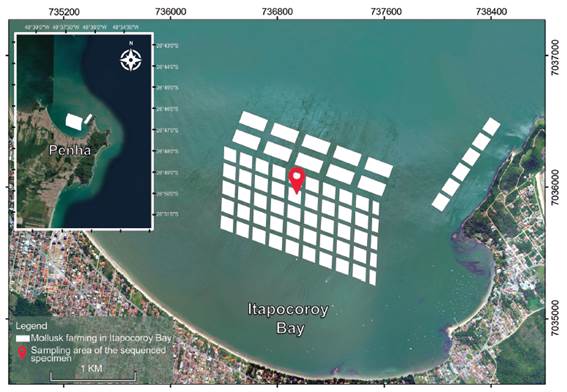
The samples were collected throughout a mussel farming park located in Itapocoroy Bay, Penha, Santa Catarina, Brazil (26°58′S, 48°38′W) (Fig. 1). The region features a semicircular embayment that covering an area of 6.7 km², with an average depth of 8 m and a maximum depth of 15 m. It is primarily influenced by coastal water masses, which exhibit salinity levels below 34 and temperatures ranging from 19 to 28℃. Additionally, it is affected by the freshwater input from the Itajaí-Açu River, which discharges 20 km to the south (Schettini et al., 2010). Due to its east-west coastal orientation, the area is considered as a sheltered location, protected from the direct wave incidence from the southern quadrant. These conditions favor the development of mollusk farming activities that began in 1994 (Schettini et al., 2010). Currently, approximately 40 mariculturists operate in Penha, occupying a total area of 41.04 hectares, with a production capacity of 2,309.6 tons per year. In the region, the mussel Perna perna (Linnaeus, 1758) represents the main cultivated mollusk species (MPA, 2023).
Map of the sampling area for Perna viridis within a mollusk farming park in Itapocoroy Bay, Penha, Santa Catarina, Brazil. In red, the location of the se quenced specimen.
To confirm the occurrence of the species, 210 individuals possibly belonging to the species P. viridis were manually collected in May 2024 within areas of mollusk farming in Itapocoroy Bay. The organisms were sparsely distributed and attached to farming structures (long-lines and ropes) in different locations throughout the area. For species evaluation, entire specimens, including shells and tissues, were carefully detached from the farming structures using a metal spatula, placed in plastic containers, and transported on ice to the laboratory, where they were stored in a freezer.
The samples were identified through a two-step process. The first step involved the manual separation of P. viridis specimens from potential P. perna individuals, using the external green color of the shell as the sole criterion for differentiation. During this stage, biometric analyses were also conducted, using shell length (the longest anteroposterior distance) as the standard measure (Lopes & Fonseca, 2008), along with the recording of biometric features and the sex of all individuals. These measurements were not intended to differentiate of P. viridis from other species but served as a preliminary step for monitoring the individual and population-level growth of the species in the region. For sex determination, we followed the approach proposed by Rajagopal (1997), in which males are distinguished by their milky white gonads and females by bright orange to brick-red colored gonads. The second step involved molecular identification. For this, one individual was randomly selected, and the remaining specimens were deposited in the malacological collection of the UNIVALI Oceanographic Museum (catalog number: MOVI 69047-69051).
DNA Extraction and COI Gene Amplification and Sequencing
A random sample was selected from the initial 210 individuals for molecular identification. DNA extraction was performed from the mussel’s adductor muscle tissue using the DNeasy Blood & Tissue Kit (Qiagen, Germany), following the manufacturer’s protocol. The concentration and purity of the extracted genomic DNA were assessed using a NanoQuant Plate with a Tecan Infinite® 200 Pro microplate reader (Tecan, Switzerland). Absorbance readings at 260 nm and 280 nm were taken using 2 µl of the sample. Only DNA with a 260/280 absorbance ratio between 1.8 and 2.0 was considered suitable for subsequent steps.
The DNA sample was then subjected to polymerase chain reaction (PCR) to amplify the cytochrome c oxidase I (COI) gene, a mitochondrial marker commonly used for species identification. The PCR followed the protocol described by Meyer (2003), utilizing the primer pair dgLCO-1490 (5′-TAAACTTCAGGGTGACCAAARAAYCA-3′) and dgHCO-2198 (5′-GGTCAACAAATCATAAAGAYATYGG-3′), which are degenerate primers designed to enhance amplification across a broad range of taxa. The primers included an additional 5-base barcode at the 5′ end of each, allowing for sample differentiation during simultaneous sequencing on the MinION platform. The PCR reaction mixture (20 µl total volume) consisted of 50 ng of genomic DNA, 1X Platinum SuperFi II DNA Polymerase High-Fidelity buffer (Thermo Fisher, USA), 0.2 mM of each dNTP (Promega, USA), 0.5 µM of each primer, 0.5 U of Platinum SuperFi II DNA Polymerase (Thermo Fisher, USA), and ultrapure water to reach the final reaction volume.
PCR amplification was conducted using a gradient thermal cycler, model K33-XTG (KASVI, Brazil), with the following cycling conditions: an initial denaturation at 94℃ for 2 minutes, followed by 35 cycles of 94℃ for 20 seconds, 54℃ for 35 seconds, and 72℃ for 1 minute, with a final extension at 72℃ for 5 minutes. The success of the PCR amplification was confirmed by 1% agarose gel electrophoresis. The PCR product was mixed with loading buffer and stained with Diamond Nucleic Acid Dye (Promega, USA), and the amplified DNA fragment, approximately 700 base pairs in size, was visualized using a UV transilluminator. The molecular weight of the fragment was determined using a λ Hind III marker. Electrophoresis was performed at 50 V and 120 mA for 90 minutes, and the gels were documented using EOS Utility software (Canon, Japan).
Once the target gene was amplified, the PCR product was purified using the Wizard® SV Gel and PCR Clean-Up System (Promega, USA). The purified product was then prepared for sequencing by constructing a DNA library. The process began with end-repairing the DNA fragments using specific enzymes provided in the Companion Module for Oxford Nanopore Technologies® Ligation Sequencing (New England Biolabs, USA). After end-repair, adaptors were ligated to the DNA fragments using the Ligation Sequencing Kit SQK-LSK112 (Oxford Nanopore Technologies, UK), following the manufacturer’s protocol. The prepared library was loaded onto a Flongle Flow Cell (FLO-FLG114, Oxford Nanopore Technologies, UK) and sequenced using the MinION device (Oxford Nanopore Technologies, UK) at the Molecular Genetics Laboratory of UNIVALI. The sequencing process was managed using the MinKnow software (v 24.06.8, Oxford Nanopore Technologies, UK).
Sequence processing, identification, and phylogenetic analysis
After sequencing on the MinION platform, the raw data underwent basecalling using the MinKNOW software (v 24.06.8, Oxford Nanopore Technologies, UK). This process converted the electrical signals produced by the sequencer into DNA sequences, employing the Super Accurate Basecalling option to enhance accuracy. Only sequences with a minimum quality score of 8 were retained for further analysis. The resulting sequences were initially generated in FASTQ format and subsequently converted to FASTA format for downstream processing. A custom Python script facilitated the next steps in sequence processing. Initially, the script performed in silico PCR to demultiplex the sequences, utilizing primer and barcode information to assign each sequence to the corresponding sample. Following demultiplexing, the sequences for each sample were clustered based on similarity, enabling the grouping of highly similar amplicons. From these clusters, a consensus sequence was generated by selecting the most frequent nucleotide at each position, which effectively represented the dominant sequence for each sample.
For species identification, the consensus sequences were annotated using a dual approach involving both the NCBI non-redundant (NR) database and the Barcode of Life Data System (BOLD). Initially, the sequences were compared against the Nucleotide Collection (nr/nt) database using the BLAST (Basic Local Alignment Search Tool) algorithm (Zhang et al., 2000) to determine their taxonomic affiliations. Local BLAST searches enabled rapid identification by comparing each sequence against a comprehensive set of reference sequences, facilitating the initial taxonomic classification by identifying homologous sequences with significant alignment scores. Following the BLAST analysis, the consensus sequences were uploaded to the Barcode of Life Data System (v4, BOLD) (Ratnasingham & Hebert, 2007). These sequences were then matched against the Species Level Barcode Records database within BOLD, which currently includes over 5 million COI sequences (5,040,349 sequences) representing approximately 246,329 species and 120,909 interim species. This extensive database allows for species identification based on the highest similarity scores with known entries. Additionally, BOLD’s curated records provided an extra layer of verification, enabling species-level resolution and confirming the taxonomic identifications obtained through BLAST.
DNA sequences from species within the genus Perna, were retrieved from the non-redundant NCBI databank. The species included Perna viridis, Perna perna, Perna canaliculus and Perna indica. Additionally, Mytilus edulis was included as an outgroup to provide a point of reference for rooting the phylogenetic tree. Between 6 and 16 sequences per Perna species were selected, ensuring that each matched the COI region of the study sequence. These sequences were aligned using the ClustalW algorithm in MEGA 11 (Molecular Evolutionary Genetics Analysis, v. 11) to maintain uniform sequence length and coverage. The phylogenetic analysis employed the Maximum Likelihood (ML) method using the Tamura-Nei model (TN93) with rates among sites modeled as Gamma Distributed with Invariant Sites (G+I) to account for variation in substitution rates and the presence of invariant sites. Five discrete gamma categories were used to enhance the model’s sensitivity to evolutionary rate differences. The initial tree was automatically generated using the Neighbor-Joining (NJ) method to provide a starting point for the ML optimization. To evaluate the robustness of the phylogenetic relationships, 1,000 bootstrap replicates were conducted, resulting in a refined phylogenetic tree that elucidated the evolutionary relationships among the Perna species analyzed.
RESULTS
Biometric analysis
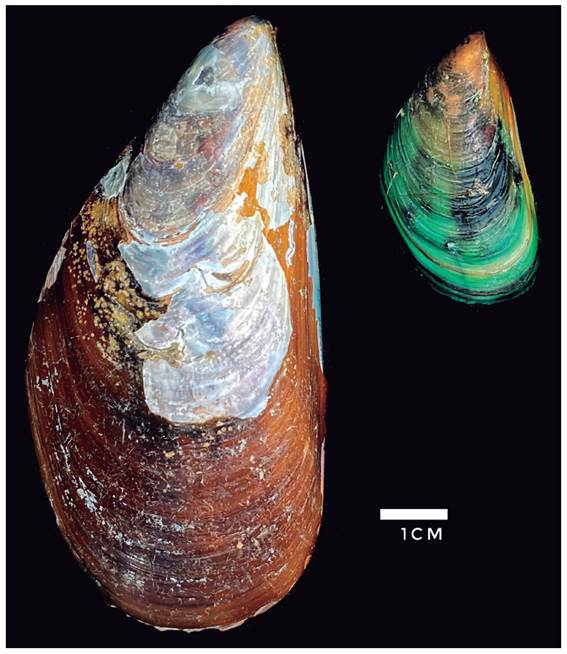
Individuals possibly belonging to the species P. viridis were collected in association with the structures used for P. perna cultivation. The greenish color of the sampled shells contrasted with the dark brown color of the cultivated species (Fig. 2). However, according to Micklem et al. (2016), P. viridis displays a wide range of shell colors, and shell coloration is not a reliable characteristic. For 38% of the collected specimens, which had body length close to 10-13 mm, sex could not be determined. Among the individuals whose sex was identified, 34% were male and 28% were female. In terms of length, values ranged, variations ranged from 5.94 mm to 24.72 mm, with the 11-20.99 mm size class being the most frequent (Fig. 3).
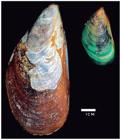
Specimens of Perna perna (cultivated species, left) and Perna viridis (right), both collected in a mussel farming park located in Itapocoroy Bay, Penha, Brazil.
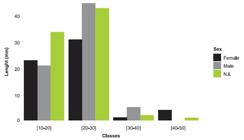
Frequency distribution of biometric measurements (length) of 210 individuals of Perna viridis collected from a mollusk farming park in Itapocoroy Bay, Brazil.
Molecular Identification and Phylogenetic Analysis
Through the comparison of the mitochondrial COI gene sequence obtained from the mussel collected in Itapocoroy Bay (Perna viridis, GenBank: PQ208532.1) with reference sequences from the NCBI nucleotide database and the Barcode of Life Data System (BOLD), it was confirmed that the collected specimen corresponds to the exotic green mussel Perna viridis (Linnaeus, 1758). The BLAST analysis in the NCBI database revealed high similarity with sequences from P. viridis, further corroborated by matches in the BOLD database, confirming the species-level identification. To provide additional validation, we selected the top five most similar sequences from both databases for comparison. These sequences are summarized in Table 1, highlighting the degree of similarity with the collected specimen and supporting the molecular identification.
Top five most similar sequences identified using BLAST searches against the NCBI Nucleotide Collection (nr/nt) database and the Barcode of Life Data System (BOLD, Species Level Barcode Records v4). Analysis was performed for the mitochondrial COI gene sequence obtained in this study (Perna viridis, GenBank accession: PQ208532.1).
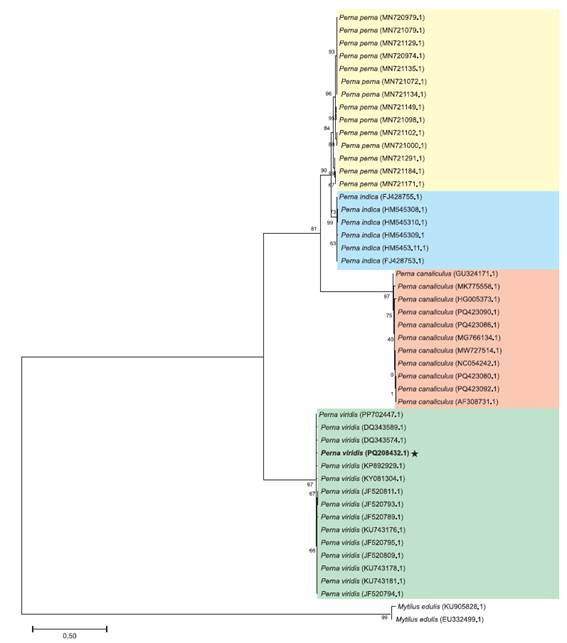
The phylogenetic relationships among species within the genus Perna were inferred using the Maximum Likelihood (ML) method based on the Tamura-Nei model (TN93), incorporating a gamma distribution with invariant sites (G+I) to account for site-specific rate variation. The analysis was conducted in MEGA 11 software, with 1,000 bootstrap replicates used to evaluate the robustness of the tree. The sequences obtained in this study (Perna viridis, GenBank: PQ208532.1) were aligned with reference sequences from the NCBI nucleotide database, covering all known species within the Perna genus. Additionally, Mytilus edulis was used as an outgroup to root the phylogenetic tree.
The resulting tree (Fig. 4) shows a well-supported separation of the species within the genus Perna. The sample collected from Itapocoroy Bay clusters within a highly supported clade of Perna viridis, with bootstrap values above 97%, confirming the species identification. This clade is distinct from the clades representing other species, such as Perna perna, Perna canaliculus, and Perna indica, which are clearly separated. The P. viridis clade includes sequences from various geographical regions, highlighting the genetic consistency of the species across different locations. Notably, the sample from this study is closely related to sequences from China and India, indicating potential genetic similarities despite geographical separation.
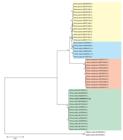
Phylogenetic tree of the Perna genus inferred using the Maximum Likelihood (ML) method based on the Tamura-Nei model (TN93), incorporating a gam ma distribution with invariant sites (G+I) to account for rate variation among sites. The analysis was performed using MEGA 11 software, with 1,000 bootstrap repli cates to assess branch robustness. The sequence obtained in this study (Perna viridis, GenBank: PQ208532.1, marked with a star) was aligned with reference sequenc es from the NCBI database, covering all known species within the Perna genus. Mytilus edulis was used as an outgroup to root the tree.
The clades representing Perna canaliculus and Perna indica also show strong bootstrap support, exceeding 90%, demonstrating clear genetic divergence between these species. The outgroup, Mytilus edulis, is distinctly separated from the genus Perna, providing a reliable rooting point for the tree. Overall, the phylogenetic analysis supports the molecular identification obtained through both the NCBI and BOLD databases, confirming the collected specimen as P. viridis. The tree provides a clear visualization of the evolutionary relationships among the Perna species included in the analysis, with high bootstrap values supporting the genetic differentiation among species.
DISCUSSION
The molecular identification and phylogenetic analysis conducted in this study provided robust evidence confirming the presence of P. viridis in Santa Catarina. The high similarity between the COI sequence of the collected sample and reference sequences from the NCBI and BOLD databases, combined with its clustering within a well-supported P. viridis clade, underscores the accuracy of the species identification. This molecular approach not only validates the occurrence of P. viridis, but its genetic proximity to sequences from China and India also supports the hypothesis that its initial introduction into the Atlantic was driven by anthropogenic vectors, such as ship ballast water and hull fouling. These findings highlight the utility of molecular tools for early identification and monitoring of invasive species, offering critical insights for managing the spread of P. viridis. The integration of molecular data with ecological observations could enhance current biosecurity measures, helping to mitigate impacts on native species and aquaculture industries along the Brazilian coast.
As noted by Siddall (1980), the external shell coloration of juveniles ranges from green to blue-green. In the mollusk farming park of Itapocoroy Bay, the largest individual collected measured 24.72 mm in length, while the most frequently observed size class was 11-20.99 mm. For 38% of the sampled specimens, particularly those measuring up to 13 mm, sex could not be determined, as males and females of P. viridis are not distinguishable based solely on external morphology. Sexual maturity is typically reached at a shell length of 15-30 mm, corresponding to an age of approximately 2-3 months (Siddall, 1980; Soon & Ransangan, 2014).
This finding marks an 800 km southward range expansion of P. viridis along the Brazilian coast over a six-year period, having been first documented in the state of Rio de Janeiro (Messano et al., 2019; Santos et al., 2023; Weber et al., 2025), and subsequently expanding its distribution to the states of São Paulo (Barbieri et al., 2025; Stefanelli-Silva et al., 2025), Paraná (Beltrão et al., 2024), and now Santa Catarina. This pattern suggests that the mussel is actively spreading southward along the Brazilian coast, and indicates that the country’s coastline offers optimal environmental conditions for its establishment and growth.
According to Siriwardena (2022), the species is likely to continue spreading in Atlantic habitats until it encounters its thermal tolerance limits. Siddall (1980) noted that P. viridis has the capacity to extend beyond its native range via stepwise larval dispersal or “island hopping.” However, due to the lack of rafting capabilities, members of the Mytilidae family require external vectors for long-distance dispersal (Gracia & Rangel-Buitrago, 2020). As a result of these limitations, ship ballast water and hull fouling have been identified as the primary means of introduction for this species (Bumbeer & Rocha, 2016; Siriwardena, 2022; Castro et al., 2023; Santos et al., 2023).
Maritime trade is strongly associated with the increased introduction of non-native species, facilitating the transport of organisms across biogeographical boundaries and expanding the global distribution of numerous species (Ignacio et al., 2010). Unlike other regions in Brazil where the mussel has already been recorded, Itapocoroy Bay lacks active port facilities. This observation supports the hypothesis that the initial introduction of P. viridis into Brazil likely occurred through ship ballast water and/or hull fouling in areas with port activity (Messano et al., 2019). In regions without such activity, however, potential dispersal vectors may include the movement of smaller vessels, such as fishing and tourism boats, as suggested by Weber et al. (2025). Additionally, mariculture systems appear to be more susceptible to invasion by bivalves, creating favorable conditions for the establishment and development of P. viridis, as observed in the present study. This is consistent with the findings of Santos et al. (2023).
Following direct anthropogenic modifications, the issue of invasive species is globally recognized as the second greatest threat to biodiversity (Latini & Resende, 2016). Once established in new areas, the negative impacts associated with invasive species are typically irreversible, with mollusks among the most impactful non-native taxa (Micklem et al., 2016; Santos et al., 2023). This is largely due to the high environmental tolerance displayed by these organisms compared to related native species. Such tolerance enables them to establish dense populations, allowing them to compete effectively for space and resources, including with commercially cultivated species (Lenz et al., 2011).
A historical example of competition between cultivated and exotic species is the decline of the native oyster Ostrea edulis Linnaeus, 1758, along the French coast following the introduction of Crassostrea angulata (Lamarck, 1819) (Buestel et al., 2009). Viallanes (1892) demonstrated that the exclusion of the native species occurred due to differences in filtration mechanisms between the two species. The exotic oyster C. angulata filtered water 5.5 times faster than O. edulis, making it a superior competitor for seston resources. Similarly, Belz et al. (2020) reported the occurrence of the exotic Mediterranean mussel Mytilus galloprovincialis (Lamarck, 1819) in a P. perna farming park in southern Brazil, where the exotic species outcompeted P. perna spat for space on mussel ropes, leading to economic losses.
Similarly to other non-native species, once introduced to a new area, P. viridis is capable of causing significant negative impacts, including competition for space, displacement of native species, and changes in community structure (Gracia et al., 2011; Baker et al., 2012). Additionally, there is a risk of transmitting diseases and parasites to local species, as well as disrupting aquaculture operations by clogging traps and cultivation bags (Gracia et al., 2011).
In addition to ecological consequences, economic impacts have also been reported. According to Weber et al. (2025), P. viridis may interfere with P. perna farming activities and consequently lead to economic losses. The author further notes that, in Guanabara Bay, P. viridis populations have expanded and occupied structures originally intended for P. perna cultivation. A similar pattern was reported in the state of Santa Catarina following the introduction of the Mediterranean mussel Mytilus galloprovincialis (Belz et al., 2020). However, although P. viridis is not yet officially commercialized in the state of Santa Catarina, local shellfish farmers report that its organoleptic characteristics are more similar to those of P. perna, differing from M. galloprovincialis, which may favor greater acceptance of the species in the local market (personal communication).
Considering both ecological and economic concerns, the presence of this invasive species in Brazil raises broader implications for coastal management. The introduction of exotic species is particularly concerning, and P. viridis has demonstrated strong potential for invasion and range expansion along the Brazilian coast. This finding supports the predictions of Siriwardena (2022) and Santos et al. (2023), who anticipated the species’ expansion into Atlantic habitats.
CONCLUSION
The molecular evidence presented in this study confirms the ongoing expansion of Perna viridis along the Brazilian coast, including the first recorded occurrence in the state of Santa Catarina. In Brazil, the most likely vectors for the introduction of Perna viridis are ballast water discharge and hull fouling from international maritime traffic. Additionally, the movement of smaller vessels along the coast may contribute to secondary dispersal. Among the potential habitats, mariculture systems appear particularly susceptible to invasion by bivalve species due to the high availability of substrate and resources. This finding highlights the significant ecological and economic risks posed by this invasive species, particularly in mollusk farming areas, where competition for space and resources may lead to the displacement of native species. In this context, continuous monitoring and early detection of P. viridis are essential for managing its spread and mitigating its impacts on native biodiversity and aquaculture industries.
DATA AVAILABILITY:
The contents underlying the research text are included in the manuscript.
Acknowledgments:
We thank the Instituto do Meio Ambiente of the State of Santa Catarina (IMA) for issuing Research Authorization No. 2/2025/IMA/GEANP to G.C.M., which enabled the study of Perna viridis in Santa Catarina.
REFERENCES
-
Baker, P.; Fajans, J.S. & Baker, S.M. 2012. Habitat dominance of a nonindigenous tropical bivalve, Perna viridis (Linnaeus, 1758), in a subtropical estuary in the Gulf of Mexico. Journal of Molluscan Studies, 78(1): 28-33. https://doi.org/10.1093/mollus/eyr026.
» https://doi.org/10.1093/mollus/eyr026 -
Barbieri, E.; Castro, Í.B.; Cavallari, D.C.; Marques, R.C. & Olivera, E.B. 2025. Green mussel Perna viridis (L.) on the Brazilian coast: a fast-spreading invasive species reaching protected areas. Marine Biology, 172(4): 1-9. https://doi.org/10.1007/s00227-025-04606-7.
» https://doi.org/10.1007/s00227-025-04606-7 -
Beltrão, M.C.; Cunha, N.J.R.; Laaf, Y.O.; Diehl, F.L. & Santos, T.D. 2024. Molecular methods confirm the first report of the non-indigenous Perna viridis Linnaeus, 1758 (Mytilida, Mytilidae) in southern Brazil. Check List, 20(4): 859-867. https://doi.org/10.15560/20.4.859.
» https://doi.org/10.15560/20.4.859 -
Belz, C.E.; Simone, L.R.L.; Silveira Jr., N.; Baggio, R.A.; Gernet, M.V. & Birckolz, C.J. 2020. First record of the Mediterranean mussel Mytilus galloprovincialis (Bivalvia, Mytilidae) in Brazil. Papéis Avulsos de Zoologia, 60(7): 1-5, e20206007. https://doi.org/10.11606/1807-0205/2020.60.07.
» https://doi.org/10.11606/1807-0205/2020.60.07 -
Boyd, C.E.; McNevin, A.A. & Davis, R.P. 2022. The contribution of fisheries and aquaculture to the global protein supply. Food Security, 14(3): 805-827. https://doi.org/10.1007/s12571-021-01246-9.
» https://doi.org/10.1007/s12571-021-01246-9 -
Branch, G.M. & Steffani, C.N. 2004. Can we predict the effects of alien species? A case-history of the invasion of South Africa by Mytilus galloprovincialis (Lamarck). Journal of Experimental Marine Biology and Ecology, 300: 189-215. https://doi.org/10.1016/j.jembe.2003.12.007.
» https://doi.org/10.1016/j.jembe.2003.12.007 -
Buestel, D.; Ropert, M.; Prou, J. & Goulletquer, P. 2009. History, status, and future of oyster culture in France. Journal of Shellfish Research, 28(4): 813-820. https://doi.org/10.2983/035.028.0410.
» https://doi.org/10.2983/035.028.0410 -
Bumbeer, J.A. & Rocha, R.M. 2016. Invading the natural substrate: a case study in South Brazil. Zoologia, 33(3): 1-7. https://doi.org/10.1590/S1984-4689zool-20150211.
» https://doi.org/10.1590/S1984-4689zool-20150211 -
Castro, M.C.T.; Scapolatempore, M.P. & Rangel-Pereira, F.S. 2023. Biofouling in-water cleaning and scrubbers wash waters, potential sources of marine pollution: the Brazilian case. Environmental Monitoring and Assessment, 195(1151): 1-10. https://doi.org/10.1007/s10661-023-12123-7.
» https://doi.org/10.1007/s10661-023-12123-7 -
Food and Agriculture Organization of the United Nations (FAO). 1977. Informe sobre la situación de la acuicultura en Colombia Available: https://www.fao.org/4/ac868s/ac868s06.htm Access: 20/11/2024.
» https://www.fao.org/4/ac868s/ac868s06.htm -
Gobin, J.; Agard, J.; Madera, J. & Mohammed, A. 2013. The Asian green mussel Perna viridis (Linnaeus 1758): 20 years after its introduction in Trinidad and Tobago. Open Journal of Marine Science, 3(2): 62-65. https://doi.org/10.4236/ojms.2013.32007.
» https://doi.org/10.4236/ojms.2013.32007 -
Gracia, A. & Rangel-Buitrago, N. 2020. The invasive species Perna viridis (Linnaeus, 1758 - Bivalvia: Mytilidae) on artificial substrates: a baseline assessment for the Colombian Caribbean Sea. Marine Pollution Bulletin, 152: 1-6. https://doi.org/10.1016/j.marpolbul.2020.110926.
» https://doi.org/10.1016/j.marpolbul.2020.110926 - Gracia, A.; Medellín-Mora, J.; Gil-Agudelo, D.L. & Puentes, V. 2011. Perna viridis. In: Guía de las especies introducidas marinas y costeras de Colombia Colombia, INVEMAR, Ministerio de Ambiente y Desarrollo Sostenible. p. 64-66.
-
Harrison, J.; Nelson, K.; Morcrette, H.; Morcrette, C.; Preston, J.; Helmer, L.; Tritball, R.W.; Butler, C.S. & Wagley, S. 2022. The increased prevalence of Vibrio species and the first reporting of Vibrio jasicida and Vibrio rotiferianus at UK shellfish sites. Water Research, 211: 1-12. https://doi.org/10.1016/j.watres.2021.117942.
» https://doi.org/10.1016/j.watres.2021.117942 -
Ignacio, B.L.; Julio, L.M.; Junqueira, A.O.R. & Ferreira-Silva, M.A.G. 2010. Bioinvasion in a Brazilian bay: Filling gaps in the knowledge of Southwestern Atlantic Biota. PLOS One, 5: 1-9. https://doi.org/10.1371/journal.pone.0013065.
» https://doi.org/10.1371/journal.pone.0013065 -
Instituto Brasileiro de Geografia e Estatística (IBGE). 2021. SIDRA: Banco de tabelas e Estatística Available: https://sidra.ibge.gov.br Access: 12/10/2024.
» https://sidra.ibge.gov.br - Kripa, V.; Mohamed, K.S.; Velayudhan, T.S.; Joseph, M.; Alloycious, P.S. & Jenni, B. 2009. Comparison of growth and gonad development of farmed green mussel Perna viridis in three habitats. Journal of the Marine Biological Association of India, 51(2): 199-204.
- Latini, A.O. & Resende, D.C. 2016. Capítulo 1 - introdução. In: Latini, A.O.; Resende, D.C.; Pombo, V.B. & Coradin, L. (Eds.). Série biodiversidade, espécies exóticas invasoras de águas continentais no Brasil Brasília, Ministério do Meio Ambiente. p. 11-20.
-
Lenz, M.; Gama, B.A.P.; Gerner, N.V.; Gobin, J.; Gröner, F.; Harry, A.; Jenkins, S.R.; Kraufvelin, P.; Mummelthei, C.; Sareyka, J.; Xavier, E.A. & Wahl, M. 2011. Non-native marine invertebrates are more tolerant towards environmental stress than taxonomically related native species: results from a globally replicated study. Environmental Research, 111(7): 943-952. https://doi.org/10.1016/j.envres.2011.05.001.
» https://doi.org/10.1016/j.envres.2011.05.001 - Lopes, S.G.B.C. & Fonseca, M.L. 2008. O mexilhão Perna perna (Linnaeus, 1758): taxonomia, morfologia e anatomia funcional. Rio de Janeiro. Interciência.
-
Messano, L.V.R.; Gonçalves, J.E.A.; Messano, H.F.; Campos, S.H.C. & Coutinho, R. 2019. First report of the Asian green mussel Perna viridis (Linnaeus, 1758) in Rio de Janeiro, Brazil: a new record for the southern Atlantic Ocean. BioInvasions Records, 8(3): 653-660. https://doi.org/10.3391/bir.2019.8.3.22.
» https://doi.org/10.3391/bir.2019.8.3.22 -
Meyer, C.P. 2003. Molecular systematics of cowries (Gastropoda: Cypraeidae) and diversification patterns in the tropics. Biological Journal of the Linnean Society, 79(3): 401-45. https://doi.org/10.1046/j.1095-8312.2003.00197.x.
» https://doi.org/10.1046/j.1095-8312.2003.00197.x -
Micklem, J.M.; Griffiths, C.L.; Ntuli, N. & Mwale, M. 2016. The invasive Asian green mussel Perna viridis in South Africa: all that is green is not viridis. African Journal of Marine Science, 38(2): 207-215. https://doi.org/10.2989/1814232X.2016.1180323.
» https://doi.org/10.2989/1814232X.2016.1180323 -
Ministério da Pesca e Aquicultura (MPA). 2023. Boletim da aquicultura em águas da união - 2022 Relatório Anual de Produção Available: https://www.gov.br/mpa/pt-br/assuntos/aquicultura/boletim-da-aquicultura-em-aguas-da-uniao-2013-2022-site_compressed.pdf Access: 20/11/2024.
» https://www.gov.br/mpa/pt-br/assuntos/aquicultura/boletim-da-aquicultura-em-aguas-da-uniao-2013-2022-site_compressed.pdf -
Ministério da Pesca e Aquicultura (MPA). 2025. Boletim Da Aquicultura Em Águas Da União - 2024. Relatório Anual de Produção Available: https://www.gov.br/mpa/pt-br/assuntos/aquicultura/aquicultura-em-aguas-da-uniao/boletim-da-aquicultura_digitalv2-compactado.pdf Access: 27/10/2025.
» https://www.gov.br/mpa/pt-br/assuntos/aquicultura/aquicultura-em-aguas-da-uniao/boletim-da-aquicultura_digitalv2-compactado.pdf - Power, A.J.; Walker, R.L.; Payne, K. & Hurley, D. 2004. First occurrence of the nonindigenous green mussel, Perna viridis in Coastal Georgia, United States. Journal of Shellfish Research, 23(3): 741-744.
-
Rajagopal, S.; Nair, K.V.K.; Van der Velde, G. & Jenner, H.A. 1997. Seasonal settlement and succession of fouling communities in Kalpakkam, east coast of India. Netherland Journal of Aquatic Ecology, 30(4): 309-325. https://doi.org/10.1007/bf02085874.
» https://doi.org/10.1007/bf02085874 -
Rajagopal, S.; Venugopalan, V.P.; Van der Velde, G. & Jenner, H.A. 2006. Greening of the coasts: a review of the Perna viridis success story. Aquatic Ecology, 40: 273-297. https://doi.org/10.1007/s10452-006-9032-8.
» https://doi.org/10.1007/s10452-006-9032-8 -
Ratnasingham, S. & Hebert, P.D.N. 2007. BOLD: The Barcode of Life Data System (http://www.barcodinglife.org). Molecular Ecology Notes, 7(3): 355-364. https://doi.org/10.1111/j.1471-8286.2007.01678.x.
» https://doi.org/10.1111/j.1471-8286.2007.01678.x -
Santos, H.S.; Bertollo, J.C. & Creed, J.C. 2023. Range extension of the Asian green mussel Perna viridis (Linnaeus, 1758) into a marine extractive reserve in Brazil. BioInvasions Records, 12(1): 208-222. https://doi.org/10.3391/bir.2023.12.1.17.
» https://doi.org/10.3391/bir.2023.12.1.17 -
Schettini, C.; Carvalho, J.L. & Truccolo, E.C. 2010. Aspectos hidrodinâmicos da Enseada da Armação de Itapocoroy, SC. Brazilian Journal of Aquatic Science and Technology, 3(1): 99-109. https://doi.org/10.14210/bjast.v3n1.p99-109.
» https://doi.org/10.14210/bjast.v3n1.p99-109 -
Shin, P.K.S.; Yau, F.N.; Chow, S.H.; Tai, K.K. & Cheung, S.G. 2002. Responses of the green-lipped mussel Perna viridis (L.) to suspended solids. Marine Pollution Bulletin, 45: 157-162. https://doi.org/10.1016/S0025-326X(01)00298-3.
» https://doi.org/10.1016/S0025-326X(01)00298-3 - Siddall, S.E. 1980. A clarification of the genus Perna (Mytilidae). Bulletin of Marine Science, 30(4): 858-870.
-
Siriwardena, S. 2022. CABI compendium: Perna viridis (Asian Green Mussel). Available: https://www.cabidigitallibrary.org/doi/10.1079/cabicompendium.70090 Access: 06/03/2023.
» https://www.cabidigitallibrary.org/doi/10.1079/cabicompendium.70090 - Soon, T.K. & Ransangan, J. 2014. A review of feeding behavior, growth, reproduction and aquaculture site selection for green-lipped mussel, Perna viridis Advances in Bioscience and Biotechnology, 5: 462-469.
-
Stefanelli-Silva, G.; Ramalho, D.C.; Molina, J.; Pontes, K.; Campos, M.C.; Cardoso, S.M. & Guedes de Azevedo, V. 2025. Range expansion of the Asian green mussel Perna viridis (Linnaeus, 1758) to São Paulo, Brazil. BioInvasions Record, 14(1): 223-231. https://doi.org/10.3391/bir.2025.14.1.17.
» https://doi.org/10.3391/bir.2025.14.1.17 -
Stickney, R.R. & McVey, J.P. 2002. Responsible marine aquaculture World Aquaculture Society. 391p. Available: https://www.cabidigitallibrary.org/doi/full/10.5555/20023099965 Access: 10/09/2024.
» https://www.cabidigitallibrary.org/doi/full/10.5555/20023099965 -
Urbano, T.; Lodeiros, C.; De Donato, M.; Acosta, V.; Arrieche, D.; Núñez, M. & Himmelman, J. 2005. Growth and survival of the mussels Perna perna, Perna viridis and an undefined morphotype in suspended culture. Ciencias Marinas, 31(3): 517-528. https://doi.org/10.7773/cm.v31i3.50.
» https://doi.org/10.7773/cm.v31i3.50 - Viallanes, H. 1892. Recherches sur la filtration de l’eau par les Mollusques et applications a l’Ostreiculture et a l’Oceanographie Comptes rendus hebdomadaires des séances de l’Académie des sciences, 114: 1386-1388.
-
Weber, L.I.; Búrigo Z.G.; Tardelli R.M.; Thomasi S.A.; Vianna T.P.; Oliveira, M.M. & Moreira N.L. 2025. New records of Perna viridis in Brazil represent main COI haplotypes of Indo-West Pacific. Bulletin of Marine Science, 101(4): 1-14. https://doi.org/10.5343/bms.2024.0110.
» https://doi.org/10.5343/bms.2024.0110 -
Zhang, Z.; Schwartz, S.; Wagner, L. & Miller, W. 2000. A greedy algorithm for aligning DNA sequences. Journal of Computational Biology, 7(1-2): 203-214. https://doi.org/10.1089/10665270050081478.
» https://doi.org/10.1089/10665270050081478
-
AI USE:
During the preparation of this manuscript, the authors used ChatGPT - October to November 2024 for manuscript translation. After using this tool/service, the authors have reviewed and edited the content appropriately and take full responsibility for the content of the publication.
-
FUNDING:
The species identification was supported by funding from a project financed by the Santa Catarina Research and Innovation Support Foundation (FAPESC), under Public Call Notice No. 09/2024, MULHERES+PESQUISA, 1st edition (TR No. 2024TR001605).