Effects of altitude and climatic variables on alpha and beta diversity of wood degrading beetles (Coleoptera: Passalidae) in the Eastern Andes of Colombia
Abstract
Wood-degrading beetles are subsocial insects, with a primarily pantropical distribution. For most species, the entire life cycle occurs within a decaying log, where individuals feed and contribute to wood decomposition and nutrient recycling. Species tend to be restricted to particular altitudinal ranges, possibly due to variables involved in wood decomposition, including humidity and temperature. The objectives of this work were to evaluate the alpha and beta diversity of Passalidae across an altitudinal gradient in the Colombian Andes, to identify the environmental variables driving changes in alpha diversity, and to determine the processes structuring beta diversity. Beetles were sampled at four altitudes (2,500, 2,700, 3,000, and 3,300 m.a.s.l.) in the Municipal Natural Park Robledales de Tipacoque, Boyacá, Colombia, and temperature and humidity were recorded at each site. Overall, five passalid species were collected, with the highest abundance at 2,700 m.a.s.l., where Passalus curtus dominated; P. irregularis was most abundant at 2,500, P. curtus at 3,000, and P. quyefutynsuca at 3,300 m.a.s.l. There was a progressive decrease in diversity towards higher altitudes. Altitude, temperature, and humidity influenced alpha diversity, while beta diversity was structured by both the abundance gradient and the balanced variation in abundance components. In conclusion, altitude has an effect on the taxonomic diversity of wood-degrading beetles in the study area, and species distribution is influenced by the climatic variables, such as temperature and humidity, involved in the wood decomposition process.
Keywords:
Species distribution; Humidity; Temperature; Bess beetles; Oak forest
INTRODUCTION
Understanding spatial heterogeneity in species distributions is one of the main objectives of ecology (Gaston, 2000), with altitude determining the species abundance and community composition (Huston, 1994). Indeed, altitudinal ranges permit comparisons of biodiversity along a gradient of abiotic variables that could have either a positive (i.e., precipitation and solar radiation) or negative (i.e., temperature and air pressure) relation with altitude (McCain & Grytnes, 2010). Altitudinal variables could impose physiological and ecological limits on species distributions, and have been used to recognize possible extinction risks (Şekercioğlu et al., 2007; García-López et al., 2011). In insects, altitudinal species turnover and abundance changes could be associated with environmental variables, habitat configuration, or interactions with other organisms (Hodkinson, 2005). Among the insects, along an altitudinal gradient, beetles might be impacted by biotic variables, like vegetation structure and habitat heterogeneity, and abiotic variables, like soil physicochemical properties and humidity, and temperature (Becquet et al., 2023; Zhao et al., 2023).
Wood-degrading beetles (Coleoptera: Passalidae) are subsocial insects with a mainly pantropical distribution (Reyes-Castillo, 1970; Mouzinho & Fonseca, 1998). Most species feed and live within decaying logs, where their entire life cycle occurs (Reyes-Castillo & Halffter, 1984). As a result of this close relationship with a specific habitat, passalids play an important role in wood degradation processes by degrading natural polysaccharides and promoting nutrient cycling (Castillo & Morón, 1992; Castillo & Reyes-Castillo, 2003; Schwarz et al., 2023). However, wood is not equally accessible to all passalid species, given that this food resource does not decompose uniformly. Firstly, the underbark wood is available and then the sapwood-heartwood, so species could be classified depending on the layer where they feed [e.g., underbark, sapwood-heartwood or generalist when inhabits both layers Reyes-Castillo & Halffter (1984)].
From a geographic perspective, altitudinal variation in the richness of Passalidae has been mainly documented in New World countries, including Colombia (Reyes-Castillo & Amat-García, 1991; Lozano, 1997; Amat-García & Reyes-Castillo, 2002; Jiménez-Ferbans et al., 2010; Taboada-Verona & Murillo-Ramos, 2020), Guatemala (McVean & Schuster, 1981; Cano, 1993; Beza-Beza et al., 2023) and Mexico (Morón et al., 1985; Morón, 1994; Castillo & Reyes-Castillo, 2003; Chamé-Vázquez et al., 2018). In general, a greater number of species has been observed in humid mountain ecosystems in contrast to less humid ones (Castillo & Reyes-Castillo, 2003). At the same time, a predominance of the passalid tribe Proculini over Passalini is reported in high ranges (Lobo & Castillo, 1997). At an adaptive level, in high mountain ecosystems an increase in body size stands out, along with wing modifications, that result in a reduction of flight capacity (brachypterism) (McVean & Schuster, 1981; Boucher, 2005; Ariza-Marín & Amat-García, 2023). However, these adaptations are not generalized. While 40% of Proculini species have brachypterous or hemibrachypterous wings, this occurs in less than 1% of Passalini species (Jiménez-Ferbans et al., 2022; Ariza-Marín et al., 2024).
Ecological studies of wood-degrading beetles have analyzed emergent properties of the community such as abundance, composition and species richness (Lozano, 1997; Castillo & Lobo, 2004; Mouzinho et al., 2010; Kattan et al., 2010). These approximate to the ecological functions that wood-degrading beetles provide to ecosystems. This study aims to evaluate changes in the diversity of wood-degrading beetles along an altitudinal gradient of oak forests (Quercus humboldtii) in the Colombian Andes. In addition, we evaluated how environmental variables influence alpha diversity, and which components structure beta diversity along the altitudinal gradient. We hypothesize that the alpha diversity of passalid beetles along an altitudinal gradient in the Colombian Andes is influenced by factors such as wood availability, climatic conditions, and environmental heterogeneity associated with altitudinal variation. We expect that alpha diversity will decrease with increasing altitude due to reduced resource availability and exposure to extreme climatic conditions. In contrast, beta diversity is likely to be more strongly influenced by variations in species abundance, driven by differences in environmental conditions and habitat characteristics across altitudes (McVean & Schuster, 1981; Beza-Beza et al., 2023).
MATERIAL AND METHODS
Study site
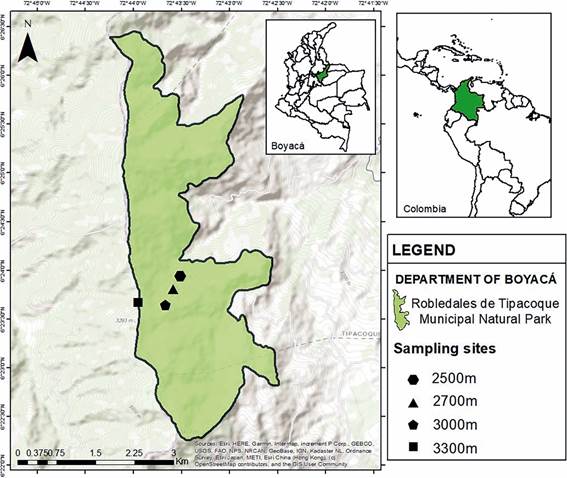
The study was carried out in the Colombian oak forest (Quercus humboldtii Bonpl.) of the Robledales de Tipacoque Municipal Natural Park reserve (RTMNP) (06°23′54.9″N, 72°42′58.8″W), located on the eastern slope of the eastern mountain range of Boyacá, Colombia (Fig. 1). This area is part of the Guantiva-La Rusia-Iguaque ecological corridor, which includes high-mountain ecosystems of the departments of Boyacá and Santander, such as Andean forests and moors. Within the RTMNP, areas of primary forest are recognized, also areas with processes of ecological restoration and natural plant succession along with areas with constant anthropogenic disturbances. The reserve is located between 2,400 and 3,400 m.a.s.l., with an average annual temperature of 13℃ and a relative humidity of 78% (Moreno-Fonseca & Amat-García, 2016).
Sampling methods
Sampling was carried out between April 2012 and August 2013. Four sampling points were located within an oak forest patch (at 2,500, 2,700, 3,000, and 3,300 m.a.s.l.), being the highest point an ecotone to “subpáramo”. The latter is a transitional ecosystem between the lower limit of the true páramo and the upper limit of the high Andean Forest, characterized by open shrub vegetation and rosette plants (Rangel, 2000) (Fig. 1). At each point, 20 effective independent trunks (with the presence of beetle galleries) were sampled through horizontal transects of ≈ 1 km. In addition, humidity and ambient temperature data were recorded with the help of a digital thermo hygrometer (Contro Company Traceable®). To define the trophic guild of species, each trunk layer (bark, underbark, sapwood-heartwood and trunk-soil interface) was completely sampled, and the passalids associated with each microzone were collected. Species found in more than one microzone were categorized as generalists.
Taxonomic identification
Captured adults were preserved in ethanol (70%), and posteriorly identified taxonomically at the genus level using the Schuster & Cano (2005) key. Furthermore, for species determination, comparisons were made with Passalidae specimens determined by expert taxonomists in the family from the entomological collection of the Institute of Natural Sciences of the National University of Colombia (ICN-UNAL), where the collected material was finally deposited.
Data analysis
All analyses were performed using RStudio v4.2.0 (R Core Team, 2020). A rarefaction and extrapolation-interpolation curve were created to estimate the expected number of species. This method uses the sample and a completeness curve with twice the sample size, in addition to a 95% confidence interval, and a resampling of 100 bootstrap pseudoreplications (Chao et al., 2014). These analyzes were performed with the R package iNEXT (Hsieh et al., 2016).
To evaluate diversity, true diversity indices (“Hill” numbers) were used that represent the effective number of species (q0, q1, q2) (Jost, 2006). These indices were calculated using the online software iNEXT (Chao et al., 2016), and the alpha profile was plotted with the ggplot2 package (Wickham et al., 2016). Jost (2006) proposes it to evaluate diversity at several levels, including species richness (q0), diversity based on the relative abundance of species (q1, Shannon diversity), and diversity that takes into account the abundance of the most common species (q2, Simpson diversity) (Chao et al., 2014).
Generalized linear models (GLMs) were used to evaluate the effects of altitude, temperature, and humidity on species abundance and diversity indices (Hill numbers), considering each trunk as an independent sampling unit (Data availability). Abundance was modeled using a negative binomial distribution due to overdispersion; q0 was modeled with a quasi-Poisson distribution to account for underdispersion; and q1 and q2 were modeled using a Gamma distribution, appropriate for continuous, positively skewed data (Zuur et al., 2009; Hilbe, 2011). To determine the best combination of independent variables per dependent variable, we performed different combination using the independent variables as additive. Model selection was based on the Akaike Information Criterion (AIC) (Akaike, 1974). All analyses were performed using the “glm” function in R, and model comparison was conducted with support from the glmnet and base R packages (Friedman et al., 2010). Finally, the best-fitting models were subjected to ANOVA to assess the significance of each explanatory variable.
Regarding to beta diversity, a total dissimilarity matrix based on Bray-Curtis distances was used for cluster analysis to illustrate the similarity among communities from different altitudes. Additionally, the “beta.multi.abund” function from the betapart package (Baselga & Orme, 2012) was applied to partition beta diversity into balanced variation and abundance gradient components (Baselga, 2013, 2017).
RESULTS
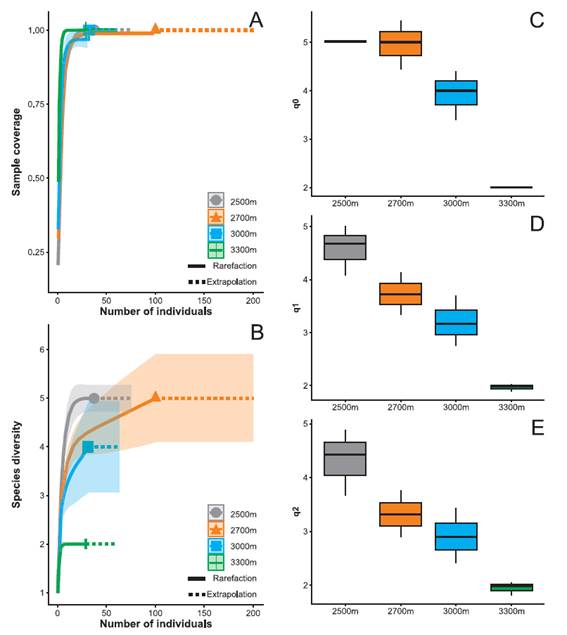
A total of 199 individuals of passalids belonging to five species were collected in 80 logs yielded. A hundred individuals were collected at 2,700 m.a.s.l. (50.25%), followed by 2,500 m.a.s.l. (n = 38, 19.10%), 3,000 m.a.s.l. (n = 32, 16.08%), and 3,300 m.a.s.l. (n = 29, 14.57%). The most abundant species were: Passalus (Passalus) curtus (n = 79, 39.69%); Passalus (Pertinax) irregularis (n = 63, 31.65%) and Passalus (Pertinax) quyefutynsuca (n = 29, 14.57%) (Table 1). Analysis by the sample coverage method revealed 100% completeness for each altitude, suggesting that sampling was representative (Fig. 2a). When extrapolating the number of individuals, the number of effective species was significantly lower at 3,300 m.a.s.l., whereas the remaining altitudes were similar (2,500, 2,700, and 3,000 m.a.s.l.) (Fig. 2b).
Species and abundance of wood-degrading Passalidae beetles at different altitudes. (UB) Underbark; (SHW) Sapwood-heartwood; (GEN) Generalist feeders.
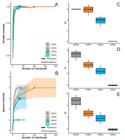
Rarefaction and interpolation-extrapolation curves, based on the wood-degrading beetles (Passalidae) at different altitudes, (A) Sampling completeness; (B) Richness estimation; (C) Species richness (D) Shannon diversity; (E) Simpson diversity. Solid lines represent the estimation using interpolation, dashed lines the extrapolation, and shaded areas the 95% confidence intervals.
The altitudes with the highest number of effective species (q0) were 2,500 (5 spp.) and 2,700 (5 spp.), followed by 3,000 (4 spp.) and 3,300 m.a.s.l. (2 spp.) (Fig. 2c). The same pattern was observed for the effective numbers of common (q1, Shannon Diversity) and dominant (q2, Simpson Diversity) species (Figs. 2d, 2e). In general terms, the alpha diversity profile shows a trend in the decrease of the three orders of diversity as the altitudinal gradient increases. The generalized linear models revealed that temperature and altitude had a statistically significant effect on species abundance, explaining a substantial portion of the deviance, whereas humidity was not significant. Regarding the diversity orders, both temperature and humidity significantly influenced q0 and q1, while q2 was significantly affected by altitude and humidity (Table 2).
ANOVA test of the generalized linear model on abundance and diversity orders (Hill numbers). Df: degrees of freedom.
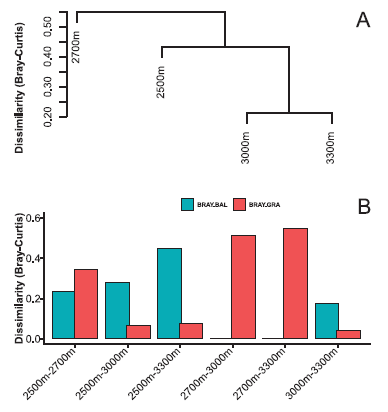
Regarding beta diversity, the cluster analysis based on Bray-Curtis dissimilarity revealed that the communities at 3,000 and 3,300 m.a.s.l. were the most similar, with a dissimilarity of approximately 22%. These two sites clustered together first, followed by the 2,500 m.a.s.l. site, which showed a dissimilarity of around 45% relative to the previous group. Finally, the 2,700 m.a.s.l. site exhibited the highest dissimilarity, exceeding 50%, and was clearly separated from the rest in the dendrogram (Fig. 3a). The total dissimilarity among the four altitudes was 61.8% (BRAY = 0.618), of which 28.6% explained by balanced variation in abundance (BRAY.BAL = 0.285) and 33.2% by abundance gradients (BRAY.GRA = 0.332). When comparing site pairs, the balanced variation component (BRAY.BAL) shows its highest values between sites located at the extremes of the altitudinal gradient. For example, the BAL value between 2,500 and 3,300 m.a.s.l. is 0.45, while between 2,500 and 3,000 m.a.s.l. it is 0.28. In contrast, the abundance gradient component (BRAY.GRA) reaches its highest values between intermediate altitude sites, such as between 2,700 and 3,300 m.a.s.l. (0.55) or between 2,700 and 3,000 m.a.s.l. (0.51) (Fig. 3b).
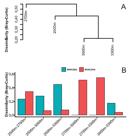
Cluster analysis based on Bray-Curtis distance. (A) Variation of beta diversity in Passalidae community. (B) Percentage of balanced variation and abundance gradient, according to Bray-Curtis dissimilarity index.
DISCUSSION
In this study, we evaluated how the alpha and beta diversity of passalid beetles change along an altitudinal gradient in Colombia. Our results highlighted three findings: i) There was a progressive decrease in alpha diversity towards higher altitudes; ii) Beta diversity was explained by abundance gradient and balanced variation in abundance, and iii) Temperature and altitude significantly influenced beetle abundance, with temperature being the strongest predictor. Alpha diversity (q0, q1, q2) was significantly affected by both temperature and humidity, while altitude only influenced q2. These findings provide evidence that altitudinal effects are important to the taxonomic diversity of wood-degrading beetles, and species distribution is influenced by climatic variables, such as temperature and humidity.
Passalid fauna in different altitudes
The five species found in this work correspond to 3.68% of the passalid species recorded for Colombia (136 spp: Jiménez-Ferbans et al., 2018a, 2023), and all of them have macropterous wings allowing them to disperse by flight. Four species belong to the tribe Passalini particularly to the genus Passalus Fabricius 1792, which is the genus with the highest richness in the country (50%) and more widely-distributed both elevationally and geographically (Amat-García et al., 2004, Jiménez-Ferbans et al., 2018a). Regarding the tribe Proculini, only one species belonging to the genus Popilius Kaup 1871 was collected. This genus is currently delimited with four species groups; the “marginatus” group is the most diverse in South America, and the Popilius gibbosus complex includes the highland species of the group from 1,350 to 3,000 m.a.s.l. (Gillogly, 2005). This work increases the both the upper and lower limits of the altitudinal ranges reported for P. curtus and P. quyefutynsuca, which are endemic from the eastern range of Colombian Andes: for the latter the new lower limit is 2,500 m.a.s.l., whereas the upper limit was 3,300 and 3,000 m.a.s.l. respectively. In addition, the upper limit increases for P. irregularis, the known distributional ranges now cover from 2,700 to 3,300 m.a.s.l., the lower limit taken from Amat-García et al., (2004). It is important to clarify that the lower limit of P. irregularis could be higher or change among mountain ranges, Jiménez-Ferbans et al., (2018b) reported 1,200 m.a.s.l. in the Eastern Colombian Andes.
Effects of altitudinal gradient on passalid diversity
The diversity 2,500 and 3,300 m.a.s.l. shows an inverse relationship with elevation, and similar diversity between the two lowest zones 2,500 and 2,700. Thus, our results agree with previous studies in the western (Lozano, 1997), and central ranges of the Colombian Andes (Reyes-Castillo & Amat-García, 1991; Amat-García & Reyes-Castillo, 2002), and Sierra de las Minas in Guatemala (Cano, 1993), that found species richness and abundance decrease as altitude increases in high montane ecosystems, after a richness peak in middle altitudes. The decline of diversity patterns in passalids in high altitudes in mountains could be explained by the joint effects of biotic and abiotic variables, like vegetation, climate, and geographic location (windward versus leeward). In the case of the vegetation, in our study the highest zone was located near the moor region, and particularly to “subpáramo” ecosystem characterized by having mainly shrubs (Rangel-Ch. et al., 1997). The richness and abundance of passalids are related to trunk size and volume (Chamé-Vázquez et al., 2018; Alencar et al., 2020; Villalba-Fuentes et al., 2022) and wood availability (Castillo & Reyes-Castillo, 2003), therefore the reduced abundance in the highest zone could be explained by smaller trunks (≤ 1 m wide), resulting in less wood availability in the “subpáramo”. Likewise, diversity is more similar between 2,500 and 2,700 because those sampling sites correspond to the same ecosystem, and probably have similar wood availability.
The temperature and humidity explain the abundance and diversity orders, both variables are involved in the wood decomposition process (van Geffen et al., 2010; Rawlik et al., 2021; Piaszczyk et al., 2022), and decomposition rates (Pietsch et al., 2018). In addition, previous studies in passalids showed that together with evapotranspiration these variables could explain changes in altitudinal stratification (Beza-Beza et al., 2023). Altitudinal changes correspond with modifications in temperature and humidity (Frahm & Gradstein, 1991; Lieberman et al., 1996), that generate natural barriers to passalid dispersal and colonization. These create environmental heterogeneity, and interact with ecological, biogeographical, and evolutionary processes on a geographic and temporal scale (Asner et al., 2017; Murga-Orrillo et al., 2021). Finally, the geographic location of mountain ranges affects air currents which in turn influence temperature and humidity. When moist air flows over mountains, its temperature decreases and generates orographic precipitation on one side (windward), while on the other side air temperature increases and environmental humidity decreases (leeward), phenomena known as Föhn effect (Barry & Chorley, 2003).
Regarding trophic guilds, generalist feeders were collected at all localities, whereas more specialized feeders (underbark or sapwood-heartwood) were not collected at the highest locality. This pattern could be explained by the joint effect of food availability and body size restrictions; only species with medium body size (0.5-0.8 cm of body width, 1.5-2.0 cm of body length) were collected in all localities (see the species body size in Moreno-Fonseca & Amat-García, 2016). Smaller trunk sizes in the “subpáramo” decrease the amount of sapwood-heartwood available, impeding the colonization and establishment of passalids specialized to these microhabitats like P. gibbosus. On the other hand, Passalus (Pertinax) aff. beneshi might be absent from higher altitudes due to its smaller body size. Insect body size tends to be greater as temperature decreases with increasing elevation, as proposed in Bergmann’s rule (Horne et al., 2017; Alcantara et al., 2024).
Beta diversity in the RTMNP was explained by both the abundance gradient and the balanced variation in abundance. According to Baselga (2013), the abundance gradient is analogous to nestedness. In some taxonomic groups, patterns based on “subsets” contribute most to beta diversity when comparing geographically close localities with homogeneous vegetation (Córdoba-Ariza et al., 2020; Bolaño-Manjarres et al., 2023; Morales-Alba et al., 2023). The balanced variation in abundance may be related to a similar flight capacity among species (well-developed wings, macropterous), and to the fact that climate and vegetation among sampling localities were not distinct enough to alter the species composition of passalid guilds, suggesting the absence of environmental, historical, or spatial barriers within the study area (Baselga, 2010).
CONCLUSION
The altitudinal gradient sampled in this study provided enough environmental heterogeneity to drive changes in taxonomic diversity of wood-degrading beetles in an oak forest of the Colombian Andes. There was an inverse relationship between diversity and altitude, probably due to a reduction in wood availability and extreme environmental conditions. Altitude, temperature, and humidity were key factors influencing alpha diversity, while beta diversity was structured by both the abundance gradient and the balanced variation in abundance components. The similarity in community composition at lower altitudes indicates a more homogeneous environment that favors substrate specialist species (i.e., underbark, and sapwood-heartwood), while variations in species abundance reflect changes in resource availability. These findings offer insights into the ecological dynamics of passalid communities in mountain ecosystems, and provide a baseline for future research on the impact of environmental change (natural or anthropogenic) on passalid biodiversity, highlighting the importance of considering environmental heterogeneity and ecological constraints for studying the limits of altitudinal distributions of species and species communities along gradients.
DATA AVAILABILITY:
The data supporting this study are available at the following link: https://doi.org/10.5281/zenodo.15779280.
Acknowledgments:
The first author would like to express his gratitude to Karen Salazar and Nini Johana Beltran for their essential help in the field. In addition, all authors would like to thank Amy Berkov and Cesar Correa for their invaluable help in revising the manuscript. The second author would like to thank Secretaría de Ciencia, Humanidades, Tecnología e Innovación (SECIHTII) for the postodoctoral fellow (CVU 771603).
REFERENCES
-
Akaike, H. 1974. A new look at the statistical model identification. IEEE Transactions on Automatic Control, 19(6): 716-723. https://doi.org/10.1109/TAC.1974.1100705.
» https://doi.org/10.1109/TAC.1974.1100705 -
Alcantara, M.J.M.; Fontanilla, A.M.; Ashton, L.A.; Burwell, C.J.; Cao, M.; Han, H.; Huang, H.; Kitching, R.L.; Reshchikov, A.; Shen, X.; Tang, Y.; Wan, Y.; Xu, Z. & Nakamura, A. 2024. Bugs and Bergmann’s rule: a cross-taxon large-scale study reveals idiosyncratic altitudinal and latitudinal body size patterns for different insect taxa. Entomologia Generalis, 44(3): 715-725. https://doi.org/10.1127/entomologia/2024/2246.
» https://doi.org/10.1127/entomologia/2024/2246 -
Alencar, J.B.R.; da Fonseca, C.R.V.; Baccaro, F.B.; Bento, M.M.F. & Ribeiro, J.M. 2020. Effect of structural variation of dead trunks on Passalid (Coleoptera: Passalidae) assemblages in Central Amazonian Campinaranas. Neotropical Entomology, 49: 337-346. https://doi.org/10.1007/s13744-019-00759-5.
» https://doi.org/10.1007/s13744-019-00759-5 - Amat-García, G. & Reyes-Castillo, P. 2002. Los Coleoptera Passalidae de Colombia. In: Costa, C.; Vanin, S. & Lobo, J. (Eds.). Proyecto de Red Iberoamericana de Biogeografía y Entomología Sistemática PRIBES Zaragoza, Sociedad Entomologica Aragoneza. p. 139-151. (Monografías Tercer Milenio, 3)
- Amat-García, G.; Blanco-Vargas, E. & Reyes-Castillo, P. 2004. Lista de especies de los escarabajos pasálidos (Coleoptera: Passalidae) de Colombia. Biota Colombiana, 5(2): 173-182.
-
Ariza-Marín, E.R. & Amat-García, G. 2023. Morphometric changes in wing of bess beetles (Coleoptera: Passalidae) related to elevation: a case study in the Colombian Andes. Studies of Neotropical Fauna and Environment, 58(2): 250-260. https://doi.org/10.1080/01650521.2021.1936882.
» https://doi.org/10.1080/01650521.2021.1936882 -
Ariza-Marín, E.R.; Jiménez-Ferbans, L. & Reyes-Castillo, P. 2024. Wing condition and distribution of a mesoamerican montane genus of wooddegrading beetles, Oileus Kaup (Coleoptera: Passalidae), with the description of a new species. Zoological Studies, 62: 1-19, e10. https://doi.org/10.6620/ZS.2024.63-10.
» https://doi.org/10.6620/ZS.2024.63-10 -
Asner, G.P.; Martin, R.E.; Anderson, C.B.; Kryston, K.; Vaughn, N.; Knapp, D.E.; Bentley, L.P.; Shenkin, A.; Salinas, N.; Sinca, F.; Typayachi, R.; Huaypar, K.Q.; Pillco, M.M.; Álvarez, F.D.C.; Díaz, S.; Enquist, B.J. & Malhi, Y. 2017. Scale dependence of canopy trait distributions along a tropical forest elevation gradient. New Phytologist, 214(3): 973-988. https://doi.org/10.1111/nph.14068.
» https://doi.org/10.1111/nph.14068 -
Barry, R.G. & Chorley, R.J. 2003. Atmosphere, weather and climate London, Routledge. https://doi.org/10.4324/9780203016206.
» https://doi.org/10.4324/9780203016206 -
Baselga, A. 2010. Partitioning the turnover and nestedness components of beta diversity. Global Ecology and Biogeography, 19(1): 134-143. https://doi.org/10.1111/j.1466-8238.2009.00490.x.
» https://doi.org/10.1111/j.1466-8238.2009.00490.x -
Baselga, A. 2013. Separating the two components of abundance‐based dissimilarity: balanced changes in abundance vs. abundance gradients. Methods in Ecology and Evolution, 4(6): 552-557. https://doi.org/10.1111/2041-210X.12029.
» https://doi.org/10.1111/2041-210X.12029 -
Baselga, A. 2017. Partitioning abundance‐based multiple‐site dissimilarity into components: Balanced variation in abundance and abundance gradients. Methods in Ecology and Evolution, 8(7): 799-808. https://doi.org/10.1111/2041-210X.12693.
» https://doi.org/10.1111/2041-210X.12693 -
Baselga, A. & Orme, C.D.L. 2012. betapart: An R package for the study of beta diversity. Methods in Ecology and Evolution, 3(5): 808-812. https://doi.org/10.1111/j.2041-210X.2012.00224.x.
» https://doi.org/10.1111/j.2041-210X.2012.00224.x -
Becquet, J.; Lamouroux, N.; Forcellini, F. & Cauvy‐Fraunié, S. 2023. Modelling macroinvertebrate hydraulic preferences in alpine streams. Hydrological Processes, 37(2): 1-15, e14806. https://doi.org/10.1002/hyp.14806.
» https://doi.org/10.1002/hyp.14806 -
Beza-Beza, C.F.; Rivera, C.; Pons, D.; McKenna, D. & Schuster, J.C. 2023. Replicate studies separated by 40 years reveal changes in the altitudinal stratification of montane passalid beetle species (Passalidae) in Mesoamerica. Diversity, 15(3): 1-13, 315. https://doi.org/10.3390/d15030315.
» https://doi.org/10.3390/d15030315 - Bolaño-Manjarres, E.D.; Turizo, C.E.T. & Rivas, L.B. 2023. Diversidad de tarántulas (Araneae: Theraphosidae) en un gradiente altitudinal de la vertiente noroccidental de la Sierra Nevada de Santa Marta (Colombia). Revista ibérica de Aracnología, 42: 189-196.
-
Boucher, S. 2005. Évolution et phylogénie des Coléoptères Passalidae (Scarabaeoidea). Les taxon du groupe famille La tribunéotropicale des Proculini et son complexe Veturius. Annales de La Societé Entomologique de France, 41(3-4): 239-604. https://doi.org/10.1080/00379271.2005.10697444.
» https://doi.org/10.1080/00379271.2005.10697444 - Cano, E. 1993. Pasálidos. In: Villar L. (Ed.). Evaluación ecológica rápida de la reserva de la biosfera Reserva de las Minas Guatemala, CECON, CEC, Facultad de Ciencias Químicas y Farmacia, Universidad de San Carlos de Guatemala. p. 57.
-
Castillo, M.L. & Lobo, J.M. 2004. A comparison of Passalidae (Coleoptera: Lamellicornia) diversity and community structure between primary and secondary tropical forest in Los Tuxtlas, Veracruz, Mexico. Biodiversity and Conservation, 13: 1257-1269. https://doi.org/10.1023/B:BIOC.0000019400.73064.c7.
» https://doi.org/10.1023/B:BIOC.0000019400.73064.c7 - Castillo, M.L. & Morón, M.A. 1992. Observaciones sobre la degradación de madera por algunas especies de passálidos (Coleoptera: Lamellicornia). Folia Entomológica Mexicana, 84: 35-44.
- Castillo, M.L. & Reyes-Castillo, P. 2003. Los Passalidae: coleópteros degradadores de troncos de árboles muertos. In: Álvarez-Sánchez, J. & Naranjo García, E. (Eds.). Ecología del Suelo en la selva tropical húmeda de México Xalapa, Instituto de Ecología, A.C., Instituto de Biología y Facultad de Ciencias, UNAM. p. 237-262.
-
Chamé-Vázquez, E.R.; Reyes-Castillo, P.; Gómez, B. & Ibarra-Núñez, G. 2018. Distribución de la familia Passalidae (Coleoptera: Scarabaeoidea) en un gradiente altitudinal en el Soconusco, Chiapas, México. Dugesiana, 25(2): 115-124. https://doi.org/10.32870/dugesiana.v25i2.7035.
» https://doi.org/10.32870/dugesiana.v25i2.7035 -
Chao, A.; Gotelli, N.; Hsieh, T.; Sander, E.; Ma, K.; Colwell, R. & Ellison, A. 2014. Rarefaction and extrapolation with Hill numbers: a framework for sampling and estimation in species diversity studies. Ecological monographs, 84(1): 45-67. https://doi.org/10.1890/13-0133.1.
» https://doi.org/10.1890/13-0133.1 -
Chao, A.; Ma, K.H. & Hsieh T.C. 2016. User’s guide for iNEXT online: Software for interpolation and Extrapolation of species diversity Institute of Statictics Available: https://chao.shinyapps.io/iNEXTOnline Access: 05/04/2024.
» https://chao.shinyapps.io/iNEXTOnline -
Córdoba-Ariza, G.; Rincón-Palau, K. & González-Trujillo, J.D. 2020. Variación espacio-temporal de macroinvertebrados acuáticos en la Lindosa, Guayana colombiana. Revista de Biología Tropical, 68(2): 452-465. https://doi.org/10.15517/rbt.v68i2.39331.
» https://doi.org/10.15517/rbt.v68i2.39331 -
Frahm, J.P. & Gradstein, S.R. 1991. An altitudinal zonation of tropical rain forests using byrophytes. Journal of biogeography, 18(6): 669-678. https://doi.org/10.2307/2845548.
» https://doi.org/10.2307/2845548 -
Friedman, J.; Hastie, T. & Tibshirani, R. 2010. Regularization Paths for Generalized Linear Models via Coordinate Descent. Journal of Statistical Software, 33(1): 1-22. https://doi.org/10.18637/jss.v033.i01.
» https://doi.org/10.18637/jss.v033.i01 -
García-López, A.; Micó, E. & Galante, E. 2011. From lowlands to highlands: searching for elevational patterns for species richness and distribution of scarab beetles in Costa Rica. Diversity and Distributions, 18(6): 543-553. https://doi.org/10.1111/j.1472-4642.2011.00846.x.
» https://doi.org/10.1111/j.1472-4642.2011.00846.x -
Gaston, K.J. 2000. Global patterns in biodiversity. Nature, 405(6783): 220-227. https://doi.org/10.1038/35012228.
» https://doi.org/10.1038/35012228 -
Gillogly, A. 2005. Review of the genus Popilius and preliminary phylogeny of Passalidae (Coleoptera) (PhD Thesis), Texas A&M University. 2005. Available: https://oaktrust.library.tamu.edu/items/0627cf74-6933-4c2c-a3c7-364123266940 Access: 10/04/2024.
» https://oaktrust.library.tamu.edu/items/0627cf74-6933-4c2c-a3c7-364123266940 -
Hilbe, J.M. 2011. Negative Binomial Regression Cambridge, Cambridge University Press. https://doi.org/10.1017/CBO9780511973420.
» https://doi.org/10.1017/CBO9780511973420 -
Hodkinson, I.D. 2005. Terrestrial insects along elevational gradients: species and community responses to altitude. Biological Reviews, 80(3): 489-513. https://doi.org/10.1017/S1464793105006767.
» https://doi.org/10.1017/S1464793105006767 -
Horne, C.R.; Hirst, A.G. & Atkinson, D. 2017. Insect temperature-body size trends common to laboratory, latitudinal and seasonal gradients are not found across altitudes. Functional Ecology, 32(4): 948-957. https://doi.org/10.1111/1365-2435.13031.
» https://doi.org/10.1111/1365-2435.13031 -
Hsieh, T.; Ma, K. & Chao, A. 2016. iNEXT: an R package for rarefaction and extrapolation of species diversity (Hill numbers). Methods in Ecology and Evolution, 7(12): 1451-1456. https://doi.org/10.1111/2041-210X.12613.
» https://doi.org/10.1111/2041-210X.12613 - Huston, M.A. 1994. Biology diversity: The coexistence of species on changing landscapes Cambridge, Cambridge University Press.
- Jiménez-Ferbans, J.; Amat-García, G. & Reyes-Castillo, P. 2018a. Estudios de los pasálidos (Coleoptera: Passalidae) de Colombia. In: Deloya, C. & Gasca, H. (Eds.). Escarabajos del Neotrópico (Insecta: Coleoptera) Ciudad de México, SyG editores. p. 81-94.
-
Jiménez-Ferbans, L.; Reyes-Castillo, P. & Schuster, J.C. 2018b. Passalidae (Coleoptera: Scarabaeoidea) of the biogeographical province of Chocó and the west Andean region of Colombia, with the description of two new species. Neotropical Entomology, 47(5): 642-667. https://doi.org/10.1007/s13744-017-0584-1.
» https://doi.org/10.1007/s13744-017-0584-1 - Jiménez-Ferbans, L.; Amat-García, G.D. & Reyes-Castillo, P. 2010. Diversity and distribution patterns of Passalidae (Coleoptera: Scarabaeoidea) in the Caribbean region of Colombia. Tropical Zoology, 23(2): 147-164.
-
Jiménez-Ferbans, L.; Maestre-Guerra, A.; Villalba-Fuentes, E.; Barros-Barrios, M.M. & Muñoz-Montero, J. 2023. Passalidae (Coleoptera, Scarabaeoidea) from the Caribbean coast of Colombia: synopsis, key, and new species description. ZooKeys, 1179: 243-297. https://doi.org/10.3897/zookeys.1179.104037.
» https://doi.org/10.3897/zookeys.1179.104037 -
Jiménez-Ferbans, L.; Reyes-Castillo, P. & Bevilaqua, M. 2022. The Brachypterous species of Passalus (Pertinax) (Coleoptera: Passalidae), with the description of a new species from Sierra Nevada de Santa Marta, Colombia. Neotropical Entomology, 51(5): 722-741. https://doi.org/10.1007/s13744-022-00988-1.
» https://doi.org/10.1007/s13744-022-00988-1 -
Jost, L. 2006. Entropy and Diversity. Okios, 113(2): 363-375. https://doi.org/10.1111/j.2006.0030-1299.14714.x.
» https://doi.org/10.1111/j.2006.0030-1299.14714.x -
Kattan, G.H.; Murcia, C. & Galindo-Cardona, A. 2010. An evaluation of bess beetles (Passalidae) and their resource base in a restored Andean forest. Tropical Conservation Science, 3(3): 334-343. https://doi.org/10.1177/194008291000300307.
» https://doi.org/10.1177/194008291000300307 -
Lieberman, D.; Lieberman, M.; Peralta, R. & Hartshorn, G.S. 1996. Tropical forest structure and composition on a large-scale altitudinal gradient in Costa Rica. Journal of Ecology, 84(2): 137-152. https://doi.org/10.2307/2261350.
» https://doi.org/10.2307/2261350 - Lobo, J.M. & Castillo, M.L. 1997. The relationship between ecological capacity and morphometry in a neotropical community of Passalidae (Coleoptera). The Coleopterist Bulletin, 51(2): 147-153.
- Lozano, F. 1997. Pasálidos: Distribución y efecto de la deforestación en el transecto altitudinal Tumaco-Chiles (Nariño). Boletín Museo Entomológico Universidad del Valle, 5(1): 13-24.
-
McCain, C.M. & Grytnes, J.A. 2010. Elevational gradients in species richness. In: Encyclopedia of Life Sciences (ELS) Chichester, John Wiley & Sons. p. 1-10. https://doi.org/10.1002/9780470015902.a0022548.
» https://doi.org/10.1002/9780470015902.a0022548 -
McVean, C.H. & Schuster, J.H. 1981. Altitudinal distribution of passalid beetles (Coleoptera: Passalidae) and Pleistocene dispersal on the volcanic chain of Northern Central America. Biotropica, 13(1): 29-38. https://doi.org/10.2307/2387868.
» https://doi.org/10.2307/2387868 -
Morales-Alba, A.F.; Carvajal-Cogollo, J.E. & Morales, I. 2023. Diversidad de escarabajos coprófagos en dos periodos de precipitación anual en un fragmento de bosque andino, Santander, Colombia. Intropica, 18(1): 50-64. https://doi.org/10.21676/23897864.4625.
» https://doi.org/10.21676/23897864.4625 -
Moreno-Fonseca, C. & Amat-García, G. 2016. Morfoecología de gremios en escarabajos (Coleoptera: Passalidae) en un gradiente altitudinal en robledales de la Cordillera Oriental, Colombia. Revista de Biología Tropical, 64(1): 289-303. https://doi.org/10.15517/rbt.v64i1.18561.
» https://doi.org/10.15517/rbt.v64i1.18561 -
Morón, M.A. 1994. Fauna de Coleoptera Lamellicornia en las montañas del noreste de Hidalgo, Mexico. Acta Zoológica Mexicana (n.s.), 63: 7-59. https://doi.org/10.21829/azm.1994.63631945.
» https://doi.org/10.21829/azm.1994.63631945 - Morón, M.A.; Villalobos, F.J. & Deloya, C. 1985. Fauna de coleópteros lamelicornios de Boca del Chajul, Chiapas, México. Folia Entomológica Mexicana, 66: 57-118.
-
Mouzinho, J.R.C. & Fonseca, C.R.V. 1998. Contribuiqáo ao estudo da Passalidofauna (Coleoptera, Scarabaeoidea, Passalidae) em uma área de terra firme da Amazonia Central. Acta Zoológica Mexicana (n.s.), 73: 19-44. https://doi.org/10.21829/azm.1998.73731725.
» https://doi.org/10.21829/azm.1998.73731725 -
Mouzinho, J.R.C.; Fonseca, C.R.V. & Barbosa M.L.L. 2010. The influence of flood pulses on the reproductive strategy of two species of passalid beetle in the fluvial archipelago of Anavilhanas, Amazon, Brasil. Journal of Natural History, 44(9): 589-600. https://doi.org/10.1080/00222930903384758.
» https://doi.org/10.1080/00222930903384758 -
Murga-Orrillo, H.; Coronado Jorge, M.F.; Abanto-Rodríguez, C. & Almeida Lobo, F.D. 2021. Gradiente altitudinal y su influencia en las características edafoclimáticas de los bosques tropicales. Madera y Bosques, 27(3): e2732271. https://doi.org/10.21829/myb.2021.2732271.
» https://doi.org/10.21829/myb.2021.2732271 -
Piaszczyk, W.; Lasota, J.; Błońska, E. & Foremnik, K. 2022. How habitat moisture condition affects the decomposition of fine woody debris from different species. CATENA, 208: 1-7, 105765. https://doi.org/10.1016/j.catena.2021.105765.
» https://doi.org/10.1016/j.catena.2021.105765 -
Pietsch, K.A.; Eichenberg, D.; Nadrowski, K.; Bauhus, J.; Buscot, F.; Purahong, W.; Wipfler, B.; Wubet, T.; Yu, M. & Wirth, C. 2018. Wood decomposition is more strongly controlled by temperature than by tree species and decomposer diversity in highly species rich subtropical forests. Oikos, 128(5): 701-715. https://doi.org/10.1111/oik.04879.
» https://doi.org/10.1111/oik.04879 -
R Core Team. 2020. R: A Language and Environment for Statistical Computing R Foundation for Statistical Computing, Vienna, Austria. Available: https://www.r-project.org
» https://www.r-project.org - Rangel, J. 2000. Colombia diversidad biótica III: La región de vida paramuna Colombia, Santafé de Bogotá, Universidad Nacional de Colombia.
- Rangel-Ch., J.O.; Lowy, P.D. & Aguilar, M. 1997. Colombia Diversidad Biótica II: Tipos de vegetación en Colombia Santafé de Bogotá, Universidad Nacional de Colombia; Editorial Guadalupe.
-
Rawlik, K.; Nowiński, M. & Jagodziński, A.M. 2021. Short life-fast death: decomposition rates of woody plants leaf- and herb-litter. Annals of Forest Science, 78: 1-30, 6. https://doi.org/10.1007/s13595-020-01019-y.
» https://doi.org/10.1007/s13595-020-01019-y - Reyes-Castillo, P. 1970. Coleoptera Passalidae: morfología y división en grandes grupos; géneros americanos. Folia Entomológica Mexicana, 20-22: 1-240.
- Reyes-Castillo, P. & Amat-García, G. 1991. Notas sobre taxonomía y distribución de una nueva especie. Caldasia, 16(79): 501-508.
- Reyes-Castillo, P. & Halffter, G. 1984. La estructura social de los Passalidae (Coleoptera: Lamellicornia). Folia Entomológica Mexicana, 61: 49-72.
-
Schuster, J. & Cano, E. 2005. Clave para los géneros de los Passalidae americanos Available: https://unsm-ento.unl.edu/Guide/Scarabaeoidea/Passalidae/Passalidae-Key/Passalidaeclave.pdf Access: 06/09/2013.
» https://unsm-ento.unl.edu/Guide/Scarabaeoidea/Passalidae/Passalidae-Key/Passalidaeclave.pdf -
Schwarz, M.; Beza-Beza C.F. & Mikaelyan, A. 2023. Wood fibers are a crucial microhabitat for cellulose- and xylan- degrading bacteria in the hindgut of the wood-feeding beetle Odontotaenius disjunctus Frontiers in Microbiology, 14: 1-15, 1173696. https://doi.org/10.3389/fmicb.2023.1173696.
» https://doi.org/10.3389/fmicb.2023.1173696 -
Şekercioğlu, C.H.; Schneider, S.H.; Fay, J.P. & Loarie, S.L. 2007. Climate change, elevational range shifts and bird extinctions. Conservation Biology, 22(1): 140-150. https://doi.org/10.1111/j.1523-1739.2007.00852.x.
» https://doi.org/10.1111/j.1523-1739.2007.00852.x -
Taboada-Verona, C. & Murillo-Ramos, L. 2020. The bess beetles (Coleoptera, Passalidae) of three subregions of the department of Sucre, Caribbean region of Colombia. Check List, 16(6): 1581-1590. https://doi.org/10.15560/16.6.1581.
» https://doi.org/10.15560/16.6.1581 -
van Geffen, K.G.; Poorter, L.; Sass-Klaassen, U.; Van Logtestijn, R.S. & Cornelissen, J.H. 2010. The trait contribution to wood decomposition rates of 15 Neotropical tree species. Ecology, 91(12): 3686-3697. https://doi.org/10.1890/09-2224.1.
» https://doi.org/10.1890/09-2224.1 -
Villalba-Fuentes, E.; Fuentes-Castro, M.; Cultid-Medina, C. & Jiménez-Ferbans, L. 2022. Los escarabajos de la madera (Coleoptera: Passalidae) y su relación con los sitios de conservación. Conservación Colombiana, 27: 60-66. https://doi.org/10.54588/cc2021v27n01a04.
» https://doi.org/10.54588/cc2021v27n01a04 -
Wickham, H.; Chang, W. & Wickham, M.H. 2016. Package ‘ggplot2’. Create elegant data visualisations using the grammar of graphics. Version, 2(1): 1-189. Available: https://github.com/tidyverse/ggplot2 Access: 06/04/2024.
» https://github.com/tidyverse/ggplot2 -
Zhao, L.; Gao, R.; Liu, J.; Liu, L.; Li, R.; Men, L. & Zhang, Z. 2023. Effects of environmental factors on the spatial distribution pattern and diversity of insect communities along altitude gradients in Guandi Mountain, China. Insects, 14(3): 1-15, 224. https://doi.org/10.3390/insects14030224.
» https://doi.org/10.3390/insects14030224 -
Zuur, A.F.; Ieno, E.N.; Walker, N.J.; Saveliev, A.A. & Smith, G.M. 2009. Mixed effects models and extensions in ecology with R New York, Springer. https://doi.org/10.1007/978-0-387-87458-6.
» https://doi.org/10.1007/978-0-387-87458-6