Neotropical leaf-footed bugs (Hemiptera, Coreidae): new taxa, synonym and distributional notes
Abstract
During the review of biological collections and explorations to catalog the diversity of Coreidae (Hemiptera: Heteroptera) from Colombia, specimens were found that could not be associated with previously described taxa. Here they are illustrated and described. The species El grajo gen. et sp. nov. is placed on the tribe Hypselonotini (Coreinae), while Anorcophthia dysdercoides gen. et sp. nov. and Leptoglossus pseudoalatus sp. nov. are placed within the tribe Anisoscelini (Coreinae). Leptoscelis obscura Dallas, 1852 is synonymized with Phthiacnemia picta (Drury, 1773); and the type locality of Acidomeria dentipes (Blöte, 1935) is clarified.
Keywords:
Heteroptera; True bugs; Colombia; New species
INTRODUCTION
Coreidae is the fourth most diverse family of Heteroptera with more than 2,500 valid species, of which, at least 800 are present in the neotropics (Brailovsky & Perez-Gelabert, 2019; CoreoideaSF Team, 2023; Packauskas, 2010). Knowledge of the neotropical Coreidae has recently been enhanced through whole regional cataloging, improved accessibility and systematization of data and type specimens photos, and the publication of fauna lists for some countries (Brailovsky & Perez-Gelabert, 2019; Cazorla, 2021; CoreoideaSF Team, 2023; Garcete Barrett, 2016; Packauskas, 2010; Serna-Muñoz & Wolff, 2024). Specifically in Colombia, 305 species have now been recorded (Olivera et al., 2024; Serna-Muñoz & Wolff, 2024), although large areas of the country remain underexplored.
During recent explorations in the Colombian Amazon and the review of biological collections, specimens were found that did not coincide with previously known genera and/or species. All specimens belong to the subfamily Coreinae, which is characterized by all the tibia sulcate and the metatibia unarmed at apex (Packauskas, 1994). One of these specimens is diagnosed as a member of the tribe Hypselonotini - in some works treated as Coreini -, the most diverse of the family with 37 genera and 364 species (CoreoideaSF Team, 2023; Packauskas, 2010; Serna-Muñoz & Wolff, 2024). This tribe is widely distributed throughout the Americas, covering almost its entire extent, from Canada to Chile and Argentina, including the Antilles (Brailovsky & Barrera, 2020, 2022; CoreoideaSF Team, 2023; Packauskas, 2010). It is characterized by the tylus vaguely projected beyond juga, both not extended forward; antennal segments III and IV not flattened; metatibia not expanded; metafemora not incrassated in males; metathoracic peritreme with two completely separated auricles; distance between metacoxae much narrower than distance from coxae to lateral margin; and spiracles equidistant from anterior and posterior borders of middle abdominal segments (Brailovsky & Barrera, 2022; Packauskas, 1994; Panizzi & Grazia, 2015).
The remaining taxa are included in the tribe Anisoscelini, a cosmopolitan tribe that comprises 169 species in 29 genera (Brailovsky & Barrera, 2023, 2025; CoreoideaSF Team, 2023; Leavengood et al., 2024; Packauskas, 2010). This tribe is characterized by the tylus vaguely projected beyond juga; juga and tylus extended forward beyond antenniferous tubercles; head porrect; and usually all femora spinose below - with the exception of SephinioidesBrailovsky, 1996 - (Leavengood et al., 2024; Osuna, 1984; Packauskas, 1994; Panizzi & Grazia, 2015).
Thus, in this contribution, two new genera and three new species are described and illustrated as part of ongoing studies related to the Coreidae of Colombia. And, in addition as a miscellany, the type locality of one species of Hypselonotini is clarified and a new synonym within the tribe Anisoscelini is proposed.
MATERIAL AND METHODS
The material examined consists of dry-mounted specimens. The following abbreviations are used for the institutions mentioned here: (BMNH) British Museum of Natural History, London, England; (CEUA) Colección Entomológica Universidad de Antioquia, Medellín, Colombia; (CTNI) Colección Taxonómica Nacional de Insectos “Luis María Murillo”, Agrosavia, Mosquera, Colombia; (MEFLG) Museo Entomológico “Francisco Luis Gallego”, Universidad Nacional de Colombia, Medellín, Colombia; (MPUJ_ENT) Colección Entomológica, Museo de Historia Natural de la Pontificia Universidad Javeriana, Bogotá, Colombia; (ZMUC) Zoologisk Museum, University of Copenhagen, Copenhagen, Denmark.
The photographs were taken with a Nikon D5300 digital camera and edited in Photoshop. All measurements are provided in millimeters.
RESULTS
Family Coreidae Leach, 1830 Subfamily Coreinae Leach, 1830 Tribe Hypselonotini Bergroth, 1913El Serna-Muñoz, gen. nov. https://zoobank.org/47B9BEE5-DEE6-456E-810B-8AC67F95949C
Type species: El grajo Serna-Muñoz, by present designation.
Differential diagnosis: El is related to the genera SundarusAmyot & Serville, 1843, StenoprasiaHorvath, 1913, ParyphesBurmeister, 1835 and SphictyrtusStål, 1860 for having metallic iridescence on the body. This new genus can be separated from Sundarus and Stenoprasia by having the antennal segment II longer than the III, as well as by the dull legs and scutellum with metallic iridescence; in Sundarus and Stenoprasia these three characters are opposites. El differs from Paryphes by having the tibia and tarsus without metallic iridescence, by its abdominal margins tapering inward posteriorly, and for the three conspicuous areas on the pronotum with scarce iridescence; while it differs from Sphictyrtus by having iridescence on the antennae and the pronotal calli, and by lacking posterior triangular processes on the pronotum.
Description: Structure: Medium sized body: Head: Broader than long, shape sub pentagonal, shorter than half the length of pronotum; tylus declivent and short; juga shorter than tylus, in lateral view at the same height as tylus, also declivent; antennae long and slender; antennal segment I the shortest, robust, slightly curved forward, and thickened toward the apex; segment II the longest, cylindrical, and less robust than I; segment III slightly longer than I, cylindrical, and less robust than I; segment IV longer than III, fusiform, and about as robust as I; antennal tubercles unarmed, prominent, widely separated and with inner lobe more developed; ocellar tubercles slightly raised; ocelli closer to the eyes than to each other; eyes hemispherical and protuberant; postocular tubercle slightly projecting; buccula short, high, with semicircular anterior border and not projecting anterior to the antennal tubercles, without spines or processes; rostrum reaching posterior border of metasternum; rostral segment I robust, reaching anterior border of prosternum; segment II is the longest; segment III the shortest; segment IV subequal to I. Thorax: Pronotum. Trapezoidal; wider than long across humeral angles; steeply declivent, 40° to plane of the hemelytra; anterodorsally convex; collar of the maximum width of the head; anterior border slightly concave; anterolateral angles not produced in a spine; anterolateral margins almost smooth; lateral margin straight to the base of the humeral angles; humeral angles projected in a short, exposed, blunt tooth; posterolateral margin smooth, sinuously shaped; posterior margin straight, without triangular processes at the base of the scutellum; posterior transverse carina not evident; calli slightly elevated, sparsely rugose and, with two lobes on each side of the midline connecting at the collar. Scutellum. Longer than wide; triangular with sides straight; disc flat; apex blunt. Hemelytra. Macropterous, extending to the apex of the last abdominal segment; costal margin slightly emarginate, straight, continuous to more than half the length of the membrane; wider than abdomen, covering it completely. Thoracic pleura. Metathoracic peritreme with two completely separated auricles. Pro-, meso-, and metasternum not sulcate. Legs: Unarmed, long and slender; femora not dilated; tibia not expanded. Abdomen: Elongated, margins straight, tapering inwards towards the posterior end; sternites not sulcate; abdominal spiracles located slightly closer to the posterior edge of each segment; posterior angles of segments III-VII unarmed; connexivum raised above tergum.
Integument: Head: Without metallic iridescence except on the antennae and rostral segments I and IV. Thorax: With metallic iridescence, less evident around midline of pronotum; disc with dense, deep punctuation and transverse striation; covered with widely spaced, short, erect, and silver setae; pleura with metallic iridescence except for the metathoracic senescent gland opening and the evaporative area, these two dull; sternites without iridescence, dull. Legs: Entirely dull, without metallic iridescence. Scutellum. Covered with metallic iridescence; with punctuation shallowly excavated. Hemelytra. Clavus and corium covered with metallic iridescence; with spaced punctuation shallower than on pronotum and without striation; covered with widely spaced, short, decumbent, erect and silver setae. Membrane not iridescent. Abdomen: Pleura with metallic iridescence; pleura covered with short, decumbent, erect and silver setae, longer than on hemelytra; sternites without iridescence, dull; without punctuation; sternites covered with short, decumbent, erect and silver setae, longer than on hemelytra.
Etymology: Name in apposition, derives from the masculine definite article in Spanish el (“the”), used here as a noun. Masculine.
Discussion: This genus keys to Paryphes in the couplet 5 of the Serna-Muñoz & Wolff (2024) key to the Colombian genera of Hypselonotini. Its differences with this genus were discussed in the diagnosis.
El grajo Serna-Muñoz, sp. nov. https://zoobank.org/0A48FD8C-6B63-47A2-8098-816686D1E8EE Figs. 1-3
Type specimens: Holotype, female, Amazonas, Leticia, On the way to Yahuarcaca lakes, 75 m.a.s.l., -4.20264, -69.94903, 07-13 Nov 2023, col. S. Serna-Muñoz, CEUA 154553.
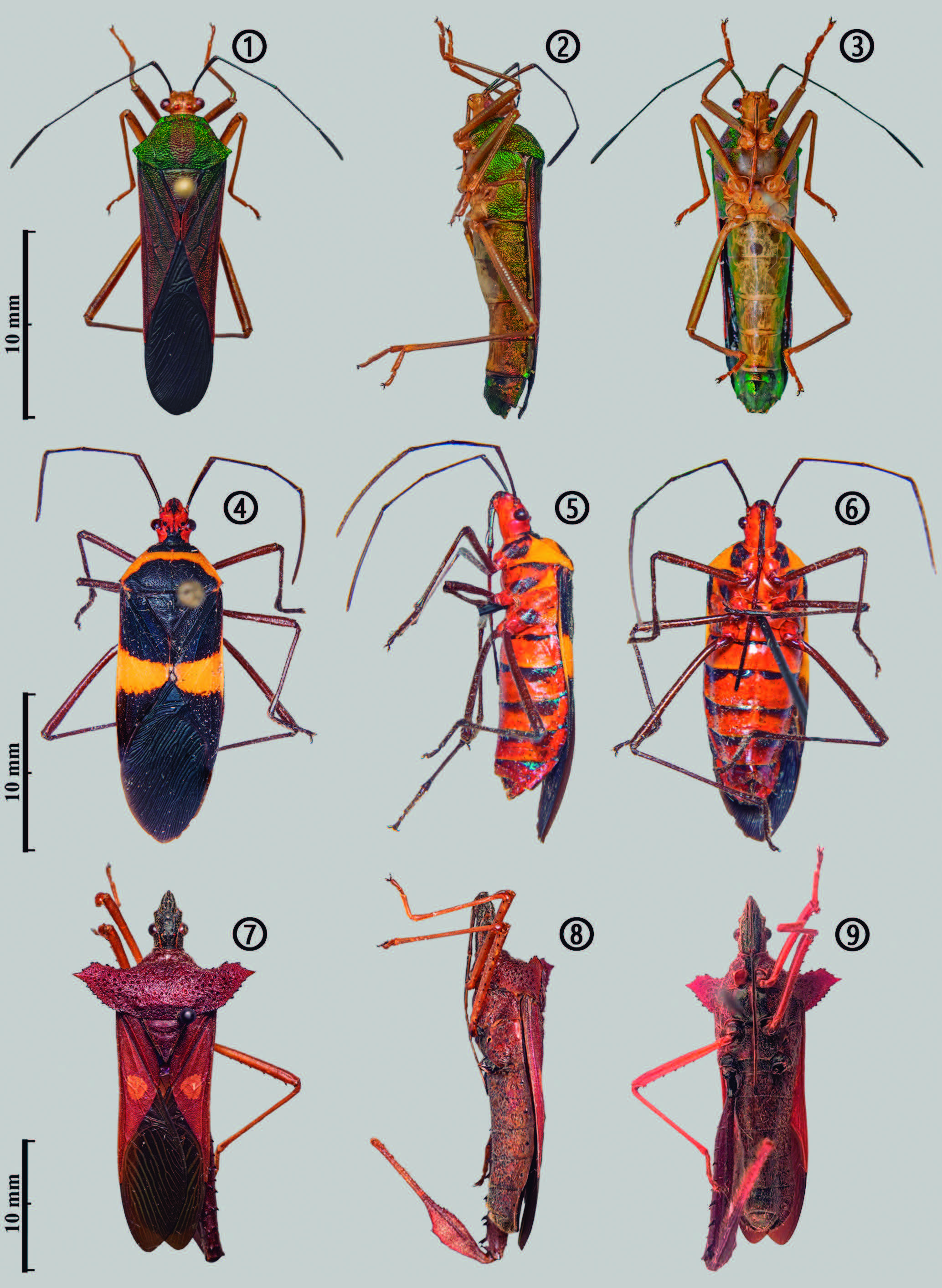
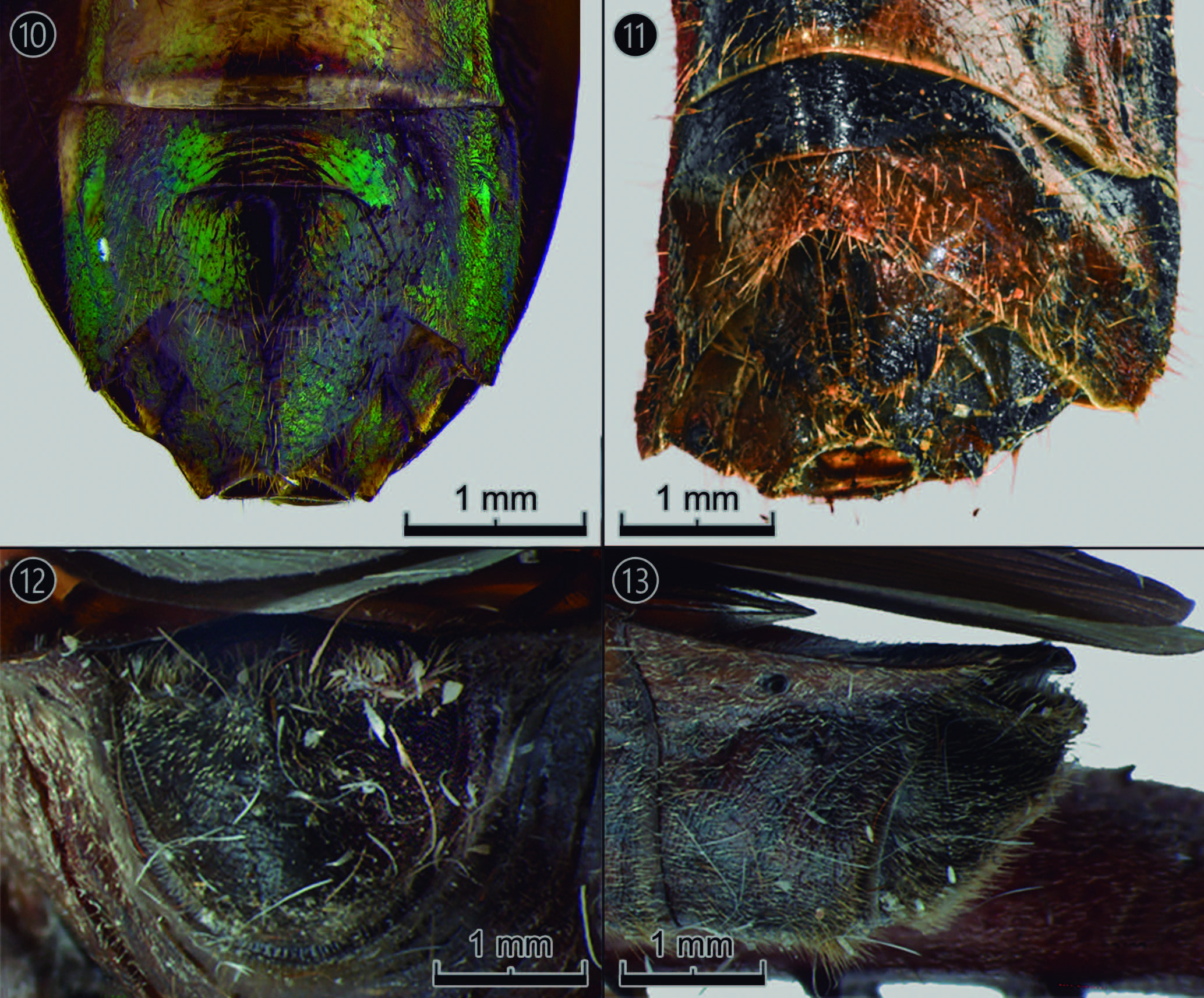
Description: Holotype female: Dorsal coloration (Fig. 1): Head: Bright orange; antennal segments I-IV black and covered by greenish and golden metallic iridescence, basal joint of segment I bright orange. Thorax: Pronotal disc brown and completely covered with greenish and golden metallic iridescence, less evident in a broad central oval area and a smaller one on each side. Scutellum brown with greenish and golden iridescence, more evident on the basal margin and apex. Hemelytra. Clavus brown with greenish and golden iridescence, less evident on the claval commissure; corium bicolor, brown with veins and basal margin more opaque, almost black, and covered with mostly golden iridescence, less evident on the costal margin; hemelytral membrane black with some interveinal spaces with greenish iridescence. Ventral coloration (Figs. 2-3): Head: Bright orange; rostral segment I bright orange covered with greenish iridescence; rostral segments II-III bright orange; rostral segment IV bright orange with apical tip black. Thorax: Pro- and meso pleura brown covered by greenish and golden iridescence; meta pleura brown with green and golden iridescence except evaporative area and metathoracic senescent gland opening which are cream colored and without iridescence. Legs entirely bright orange. Abdomen: Sternites alternating cream areas with darker areas, and with longitudinal striations; pleura entirely brown with greenish and golden iridescence; genital plates black, mainly with greenish iridescence. Female genitalia: Genital plates: Fissure very elongate, almost as long as gonocoxa I; plica slightly convex; gonocoxa I reaches posterior edge of paratergite IX, subtriangular; paratergites VIII and IX quadrangular, VIII longer than IX (Fig. 10).
Male: Unknown.
Measurements: Female: Holotype: Body length 17.0. Head: Length 1.2; width 2.4; interocular distance 1.4; interocellar distance 0.4; length of antennal segments: I, 2.7; II, 3.3; III, 2.8; IV, 2.9; length of rostral segments: I, 1.5; II, 1.6; III, 0.7; IV, 1.5. Pronotum: Length 2.7; width across humeral angles 5.3. Scutellar length 2.3; width 2.0. Legs: Profemur 4.1; protibia 4.3; mesofemur 4.0; mesotibia 4.2; metafemur 6.2; metatibia 7.1.
Etymology: Name in apposition, given by the common name used in some regions of Colombia for members of the suborder Heteroptera due to their ability to release odors, sometimes unpleasant, as a method of defense.
Distribution: Known from the department of Amazonas, Colombia. The type locality is located in the Colombian Amazon.
Discussion: The type locality for this species is located less than 5 km from the triple border between Colombia, Brazil and Peru, so it is likely that this species could also be found in these two last countries.
Acidomeria dentipes ( Blöte, 1935 )
Remarks: The type locality of this species is “Hoch-Peru” (as “Upper Peru” on the original description), since then, this species has been cited as coming from present-day Peru. The name “Upper Peru” was used during the colony to refer to the administrative entity of the “Audiencia de Charcas” which, since its independence in 1825 changed its name to “Republica de Bolivar” and later, in the same year, to “Republica de Bolivia” (present-day Bolivia) (Aillón Soria, 2008). Therefore, the specimens recorded from Peru by Cruces & Vergara (2015) represents the first record of this species for this country. Additionally, Serna-Muñoz & Wolff (2024) cited this species from Colombia, although after reexamining the specimens reported as such, it is concluded that they actually correspond to Acidomeria osunaiBrailovsky, 1983 (specimens codes: MPUJ_ENT 9309, 67976-67979, 67985, 87683 and CTNI 87684).
Tribe Anisoscelini Laporte, 1832Anorcophthia Serna-Muñoz, gen. nov. https://zoobank.org/7DC8782F-CB53-4DDA-B41E-6B594E869065
Type species: Anorcophthia dysdercoides Serna-Muñoz, by present designation.
Differential diagnosis: Anorcophthia belongs to the “Leptoscelini group” (Leavengood et al., 2024) characterized by having the tibia simple, never expanded. Moreover, this genus is grouped within the “Phthia complex” in which it is related to the genus PhthiaStål, 1862 with whom it shares the bilobed metathoracic peritreme, the body surface with scattered metallic iridescence, the metafemora dorsally smooth, the calli without two conspicuous projections, the humeral angles projecting in a laterally directed spine, the anterolateral
Habitus of the new species. (1-3) El grajo (CEUA 154553, holotype, female) gen. et sp. nov. (1) Dorsal habitus. (2) Lateral habitus. (3) Ventral habitus. (4-6) Anorcophthia dysdercoides (MEFLG NC-58118, holotype, female) gen. et sp. nov. (4) Dorsal habitus. (5) Lateral habitus. (6) Ventral habitus. (7-9) Leptoglossus pseudoalatus (CTNI 9308, holotype, male) sp. nov. (7) Dorsal habitus. (8) Lateral habitus. (9) Ventral habitus. Scale bar: 10 mm.
margins of the pronotum smooth, and the head dorsally not completely covered by metallic iridescence; no other genus of this complex has this combination of characters (Brailovsky, 2009; Brailovsky & Barrera, 2025; Leavengood et al., 2024).
Anorcophthia differs from Phthia by the pro- and mesofemora each with one subapical spine, the scattered metallic iridescence on the clavus and corium, the transverse fascia of the pronotum covering the humeral angles and, by the lack of yellowish to reddish maculae on the thoracic and abdominal pleurae; in Phthia all femora are armed with two subapical spines, the clavus and corium are nearly dull, the yellow transverse fascia of the pronotum does not cover the humeral angles and, the pleura has yellowish to reddish maculae (Brailovsky, 2009).
Another related genus is PhthiarellaBrailovsky, 2009 with which it shares the presence of metallic iridescence on the clavus and corium, the metafemora dorsally smooth, the calli without two conspicuous projections, the humeral angles projecting in a laterally directed spine, and thoracic and abdominal pleura without strongly contrasting yellowish to reddish-orange maculae (Brailovsky, 2009; Brailovsky & Barrera, 2025; Leavengood et al., 2024). But this new genus differs by the dorsal surface of the head almost entirely red with disperse iridescence restricted to the ocellar tubercles and behind these, the anterolateral margins of the pronotum smooth, the mesofemora with one subapical spine, and the thoracic pleura with the iridescence restricted to black markings above the acetabulum; in Phthiarella, the dorsal surface of the head is entirely covered with a green to bluish iridescence, the anterolateral margins of the pronotum are finely dentated, the mesofemora with two subapical spines, and the thoracic pleura almost completely covered by iridescence except for the inferior margin of the acetabulum (Brailovsky, 2009; Brailovsky & Barrera, 2025; Leavengood et al., 2024).
Description: Structure: Head: Longer than broad, subequal to the pronotum in length; tylus and juga extended beyond the antenniferous tubercles; tylus and juga in lateral view at the same height; posttylar depression forming a simple sulcus; antennae long, almost as long as the body; antennal segment I longer than III, slightly wider than the others, slightly curved and broadening towards the apex; segment II longer than I, slender, cylindrical and not furrowed; segment III is the shortest, slender, cylindrical and not furrowed; segment IV is the longest, fusiform; antennal tubercles unarmed; ocellar tubercles barely evident; interocellar distance greater than distance ocelli to eye; eyes hemispherical, protuberant; postocular tubercle not evident; buccula short, with the anterior border semicircular; rostrum reaches the middle of abdominal sternite III; rostral segment I reaches the anterior border of the prosternum; segment II longer than III; segment III is the shortest; segment IV is the longest. Thorax: Pronotum. Trapezoidal; wider than long across the humeral angles; steeply declivent, 40° to the plane of the hemelytra; protruding to the region of the callus; collar of the maximum width of the head; calli smooth, barely evident; anterior border almost straight; anterior angles rounded; anterolateral margins smooth; lateral outline concave, margin slightly emarginated posteriorly; humeral angles projecting in a short, outward-pointing and subacute spine; posterolateral margins smooth and angulated; posterior margin slightly convex, with triangular processes not very distinct at the base of the scutellum; posterior transverse carina slightly raised. Scutellum. Broader than long; with a slight longitudinal elevation on the midline; apex blunt. Hemelytra. Macropterous, extending beyond the apex of the abdomen; costal margin slightly emarginate, slightly concave; laterally completely covering the abdomen. Thoracic pleura. Metathoracic peritreme bilobed. Pro-, meso- and metasternum sulcate. Legs: Long and slender; pro- and mesofemora armed with one small subapical spine; metafemora dorsally smooth, ventrally armed with one long subapical spine and one shorter at its apical third; tibia furrowed and not expanded; space between procoxae very narrow, less than the diameter of one coxa; space between meso- and metacoxae at least the diameter of one coxa; distance between pro- and mesocoxae twice that between meso- and metacoxae. Abdomen: Elongate, margins parallel; sternites sulcate; spiracles located in the middle of each segment; connexivum unarmed.
Integument: Head: With metallic iridescence restricted to the antenniferous tubercles, the tylus and behind the ocellar tubercles; antennae with iridescence through its whole length. Thorax: Pronotum shallowly punctate, without striations; with scattered metallic iridescence, especially on the punctuation, but excepting areas covered by its yellow transverse fascia; covered with short, erect, silver setae interspersed with longer, erect, black setae, both longest on anterior disc; pleura shallowly punctate, with striations in areas above the acetabula; mostly not iridescent, excepting black areas above the acetabula and the anterior border of the pro- and mesopleura; sternites with short, erect, silver setae, longer than on pronotum; sternites without iridescence. Legs: Not iridescent, dull; femora, tibia and tarsus densely covered with long, erect, silver setae. Scutellum. With punctuation shallowly excavated; covered by iridescence more evident on punctuation; with long, erect, black setae, longer and darker than on the rest of the body. Hemelytra. Clavus. With evident but shallowly excavated punctation; with metallic iridescence on the punctation; covered with scattered short, erect, silver setae. Corium. With shallowly excavated punctation, less evident than in the clavus; with metallic iridescence on the punctuation, except on a transverse fascia running posteriorly to the claval commissure; with scattered short, erect, silver setae, more conspicuous around the costal margin. Abdomen: Pleura and sternites mostly non-iridescent, iridescence restricted to black areas on anterior border of each segment; upper edge of pleura with longitudinal striations; sternites densely covered with long, erect, silver setae.
Etymology: Named for its similarity to the genus PhthiaStål, 1862. According to the Iliad, Phthia was the homeland of the Myrmidons, warriors who fought at Troy under the command of Achilles due to the commitments acquired on the oath of Tyndareus. The name Anorcophthia is derived from the Greek prefix an- (ἀν, “without”), -orcos- (ὅρκος, “oath”), and -phthia (Φθία). The name may be interpreted as “one derived from Phthia without oath” and references the lesser developed of the femoral spines in this genus (compared to other members of the Phthia complex). Feminine.
Discussion: This genus keys to the couplet 25 of the Leavengood et al. (2024) key to the genera of Anisoscelini. In this couplet, Anorcophthia gen. nov. does not match the characteristics described for neither option, Phthia or Phthiarella; its differences from both genera were addressed in the diagnosis.
Anorcophthia dysdercoides Serna-Muñoz, sp. nov. https://zoobank.org/158430B2-F96A-4CF2-893C-109797DF079B Figs. 4-6
Type specimens: Holotype, female, Colombia, Antioquia, Cocorná, Aug 1956, col. F.L. Gallego, MEFLG NC-58118. Paratype, female, Colombia, Antioquia, Mutatá, Vereda San José del Léon, Finca la Soledad, 7.501867, -76.513117, 402 m.a.s.l., 07 Sep 2025, col. Grupo Entomología Tulenapa, manual capture, CEUA 164405.
Description: Holotype female: Dorsal coloration (Fig. 4): Head reddish-orange with tylus, apex of jugum, anterior border of the antennal tubercles, two spots in front of the ocellar tubercles, the ocellar tubercles and a pentagonal area behind these black and with scattered greenish iridescence; antennal segments garnet, I with iridescence at its base. Thorax: Pronotal disc black and covered with scattered greenish iridescence except for a yellow transverse fascia crossing the frontal disc and running laterally to the humeral angles. Scutellum black with scattered greenish iridescence. Hemelytra. Clavus black with scattered greenish iridescence and apex yellow; corium bicolor, black with greenish iridescence except for a yellow transverse fascia originating at the end of the claval commissure and extending along the costal margin; hemelytral membrane black with greenish iridescence. Ventral coloration (Figs. 5-6): Head: Reddish-orange; rostral segments I-III garnet colored, IV darker. Thorax: Upper and posterior edges of pro- and mesopleura yellow, with iridescent black spot on the acetabulum and the anterior border, the remaining areas reddish-orange; meta pleura reddish-orange with the posterior border yellow and the acetabulum black with metallic iridescence; metathoracic senescent gland black; evaporative area red; sternites reddish-orange with the intersegmental joint black and covered with metallic iridescence. Legs: Coxa reddish-orange; trochanters, femora, tibia and tarsus garnet. Abdomen: Pleura and sternites reddish-orange with the anterior border of each segment black and covered with metallic iridescence. Genitalia of the female. Genital plates. Fissure covering half the length of sternite VII; plica concave; gonocoxa I reach the medium of paratergite IX, subtriangular; paratergites VIII and IX quadrangular, subequal in length; genital plates reddish-brown with the anterior borders darker (Fig. 11).
Variation: Paratype with yellow transverse fascia of the pronotum wider posteriorly, covering the entire posterolateral edge. Setae more evident all over the body.
Male: Unknown.
Measurements: Female: Holotype: Body length 21.4. Head: Length 2.6; width 2.7; interocular distance 1.5; interocellar distance 0.7; length of antennal segments: I, 3.6; II, 4.1; III, 3.3; IV, 6.4; length of rostral segments: I, 2.8; II, 3.3; III, 1.5; IV, 3.7. Pronotum: Length 3.1; width across humeral angles 6.4. Scutellar length 2.5; width 3.0. Legs: Profemur 5.4; protibia 5.3; mesofemur 6.0; mesotibia 6.3; metafemur 8.7; metatibia 8.9. Paratype: Body length 18.03. Head: Length 2.6; width 2.6; interocular distance 1.3; interocellar distance 0.6; length of antennal segments: I, 3.4; II, 4.4; III, 3.4; IV, 6.5; length of rostral segments: I, 2.7; II, 2.9; III, 1.0; IV, 3.3. Pronotum: Length 2.7; width across humeral angles 6.1. Scutellar length 2.9; width 3.2. Legs: Profemur 4.8; protibia 5.1; mesofemur 4.7; mesotibia 4.6; metafemur 8.5; metatibia 8.6.
Etymology: Named for its coloration similarities to some species of the cotton bug genus DysdercusGuerin-Méneville, 1831 (Hemiptera: Pyrrhocoridae). The dorsal coloration of Anorcophthia dysdercoides sp. nov. consisting of head almost entirely reddish-orange, hemelytra black, and yellow transversal fasciae on prothorax and hemelytra is similar to that of the aposematic Dysdercus imitatorBlöte, 1931 and Dysdercus bloetei Doesburg, 1968.
Distribution: Known from the department of Antioquia, Colombia. The type localities are located on the eastern and western slopes of the Colombian Central Cordillera.
Discussion: In almost 70 years since the collection of the female holotype only one additional specimen has been collected; however, recently one observation consistent with this species was uploaded to the participative science platform iNaturalist: Colombia, Antioquia, Briceño, 7.12673, -75.51678, 19 Oct 2024, D.A. Nohava, https://www.inaturalist.org/observations/248360370 (Access: 07/09/2025).
The coloration similarities between this species and some species of cotton bugs (Dysdercus) might suggest mimicry, as the latter are probably aposematic and unpalatable to predators, while also forms putative mimicry rings including several species of lygaeid bugs, mirids and even other coreids like HypselonotusHahn, 1833 (van Doesburg, 1968; Zrzavý & Nedvěd, 1999).
Leptoglossus pseudoalatus Serna-Muñoz, sp. nov. https://zoobank.org/EBB2C9D5-4B49-44F5-BA27-73B836AFF99D Figs. 7-9
Type specimens: Holotype, male, Colombia, Valle del Cauca, Anchicayá river, Sep 1946, col. B. Losada S., CTNI 9308.
Differential diagnosis: Leptoglossus pseudoalatus belongs to the “dilaticollis species group” of the genus Leptoglossus, characterized by a thoracic pleura without strongly contrasting yellow markings and a yellow longitudinal marking on the abdominal dorsal segments (Brailovsky, 2014). This specie is related to L. rubrescens (Walker, 1871) being both related by the shape of the pronotum, L. pseudoalatus can be differentiated from this one by having the humeral area more developed and projected forward, by the shorter external expansion of the tibia being only slightly longer than the internal expansion, by having an orange subcircular marking on the corium, and by the posteroventral edge of the genital capsule sinuous with very narrow and deep median notch. In L. rubrescens the external expansion of the tibia is almost twice as long as the internal expansion, the corium lacks contrasting markings, and the posteroventral edge of the genital capsule has a wide and rounded median notch (Allen, 1969; Brailovsky, 2014).
Another related specie is L. dilaticollis (Guérin-Méneville, 1831) with which it shares the large size, the highly developed humeral area, and the genital capsule with low dorsal prongs; this new species can be distinguished by the orange subcircular marking on the corium, the humeral areas projecting laterally in a long process, the genital capsule with a deeper median notch, and the shorter labium reaching the posterior border of abdominal sternite IV; in L. dilaticollis the corium has a straight transverse fascia, the humeral angles are produced into a rounded process, the genital capsule has a shallow median notch, and the labium reaches at least the middle of the abdominal sternite VI (Allen, 1969; Brailovsky, 2014).
This species also resembles to L. egeriBrailovsky, 2014 and L. humeralisAllen, 1969; however, in these two species the external tibial expansion is phylliform in contrast to the lanceolate one of L. pseudoalatus; while they also lack a subcircular marking on the corium (Brailovsky, 2014).
Description: Holotype male: Structure: Head: Longer than broad, half as long as the pronotum; tylus longer than the jugum, both projecting well in front of the antenniferous tubercles; labium reaching the anterior edge of abdominal sternite IV; rostral segments I and II subequal, III the shortest, IV the longest. Pronotum. Wider than long; antero- and posterolateral margins serrate; humeral areas projected upward, laterally and a little forward; humeral angles ending in a sharp spine; calli poorly developed, separated by midline into two slightly elevated regions; antero- and posterolateral margins strongly dentated. Legs: Pro- and mesofemora with a ventral row of small spines; metafemora with six rows of spines, two dorsal, one internal, one external and one ventral larger than the others; meta tibia lanceolate; external expansion with two conspicuous spines on its edge, internal expansion with a series of short spines on its apical half; external expansion 50% of maximum tibial length; internal expansion shorter than external, 40% of tibial length; internal edge of meta tibia with small spines starting in the middle of the expansion and reaching the distal end of the tibia. Genital capsule. Posteroventral edge sinuous with very narrow and deep median notch; dorsal prongs low (Figs. 12-13).
Dorsal coloration (Fig. 7): Head: Black with two dark orange lines running laterally to the midline, from the eyes to the pronotum and between the antenniferous tubercles and jugum. Pronotum. Entirely dark reddish brown, garnet. Scutellum. Dark reddish brown with lateral margins slightly lighter. Hemelytra. Clavus dark reddish brown with lighter claval vein; corium reddish brown with lighter costal margin, orange; corium with an orange subcircular marking; hemelytral membrane dark brown with violaceous details. Abdomen: Abdominal dorsal segments with a yellow longitudinal marking running down the middle, the remaining black. Ventral coloration (Figs. 8-9): Head: Black with orange markings between the base of the eye and buccula; rostral segment I dark reddish brown, II bicolor orange and black, III orange, IV orange with the apical third black. Thorax: Pleura reddish brown with numerous small black discoidal dots; anterior lobe of metathoracic peritreme orange, posterior with lower half black and upper half orange; sternites with midline dark reddish brown and sides black. Legs: Coxa black; pro- and mesotrochanters orange, metatrochanters black; pro- and mesofemora, tibia, and tarsus orange; femur spines black; metafemora dark reddish brown; metatibia with basal half dark reddish brown and distal half orange, spines black; tibial expansions dark reddish brown except for an irregular spot on middle third of inner expansion. Abdomen: Sternites and pleura reddish brown with numerous small black discoidal spots; abdominal spiracles black. Genital capsule. Dark reddish brown (Figs. 12-13).
Integument: Body surface dull; head, frontal lobe of pronotum, thoracic and abdominal pleura and sternites, genital capsule, tibia and tarsus densely covered with long, decumbent, golden setae; posterior lobe of pronotum, scutellum and femora less densely covered; clavus, corium and hemelytral membrane glabrous; hemelytra and scutellum with dense, shallow punctuation; pronotum with punctuation as above interspersed with a much larger and profound one, giving it a rugose appearance.
Female: Unknown.
Measurements: Male: Holotype: Body length 28.0. Head: Length 4.7; width 3.1; interocular distance 1.6; interocellar distance 0.7; length of rostral segments: I, 4.2; II, 4.0; III, 2.4; IV, 4.2. Pronotum: Length 5.5; width across humeral angles 14.2. Scutellar length 3.3; width 3.4. Legs: Profemur 6.4; protibia 7.5; mesofemur 7.8; mesotibia 7.5; metafemur 12.5; metatibia 13.0.
Etymology: Name given for having a sub circular spot on the endo-corium, like some species of the same genus belonging to the “alatus” group.
Distribution: Known from the department of Valle del Cauca, Colombia. The type locality is located on the Western Colombian Cordillera.
Discussion: This species keys to the couplet 20 of the Brailovsky (2014) key to the species of Leptoglossus. Differences of Leptoglossus pseudoalatus sp. nov. from closely related species with widely expanded humeral angles were discussed in the diagnosis. On the iNaturalist platform, three observations have recorded specimens that can be diagnosed as this species: Colombia, Antioquia, Medellín, 6.21264, -75.54234, 25 Sep 2017, obs. A. Posada, https://www.inaturalist.org/observations/8090884 (Access: 07/09/2025); Colombia, Antioquia, Medellín, 6.20335, -75.5619, 05 Sep 2024, obs. D. Hincapie, https://colombia.inaturalist.org/observations/241259965 (Access: 07/09/2025); and, Colombia, Risaralda, Pueblo Rico, 5.23485, -76.08967, 06 Ago 2025, obs. C. Sexton, https://colombia.inaturalist.org/observations/241259965 (Access: 07/09/2025). These observations suggest a wide range of these species within the Cauca River valley.
Phthiacnemia picta ( Drury, 1773 )
=Cimex ciliatusFabricius, 1775
=Cimex leprosusFabricius, 1775
=Cimex candelabrumGoeze, 1777
=Cimex crenulatusFabricius, 1781
=Lygaeus disparFabricius, 1803
=Anisoscelis divisusHerrich-Schäffer, 1842
=Anisoscelis pulverulentusHerrich-Schäffer, 1842
=Anisoscelis (Leptoscelis) annulipesGuérin-Méneville, 1857
=Leptoscelis obscuraDallas, 1852, new synonymy
External genitally of the new species. (10) El grajo (CEUA 154553, holotype, female) gen. et sp. nov. genital plates. (11) Anorcophthia dysdercoides (CEUA 164405, paratype, female) gen. et sp. nov. genital plates (photo by Wilmar Zapata-González). (12-13) Leptoglossus pseudoalatus (CTNI 9308, holotype, male) sp. nov. genital capsule (photos by Erika Valentina Vergara-Navarro). (12) Frontal view. (13) Lateral view. Scale bar: 1 mm.
Remarks: After comparing the type specimens of Phthiacnemia picta (ZMUC 102312-102314) and Leptoscelis obscura (BMNH 651903) (by photo), they are here considered conspecific. Leptoscelis obscura is only known by two specimens from Colombia and French Guiana (CoreoideaSF Team, 2023; Dallas, 1852); while P. picta is a widespread and variable species, with 8 synonyms (Brailovsky, 2009; CoreoideaSF Team, 2023; Packauskas, 2010). The synonymy presented here was previously proposed by Stål (1870) but discarded by Distant (1901), in both cases without discussing the reasons for such decisions. The syntype of L. obscura is very deteriorated and lacks antennae; however, Dallas (1852) describes the latter as completely black, which, together with the anterolateral pronotal spines, excludes it from the generic limits of LeptoscelisLaporte, 1832. These characteristics as well as the simple metatibia, anterior pronotal calli without two conspicuous spine-like projections, abdomen elongated, the pronotal disk with reddish lateral margins, humeral angles obtuse, and posterolateral angles of the pronotum smooth are diagnostic of P. picta and differentiates it from the rest of the Anisoscelini (Brailovsky & Barrera, 2011, 2012; Leavengood et al., 2024; Osuna, 1984). Images of type specimens of both L. obscura and P. picta can be accessed through the Coreoidea Species File (CoreoideaSF Team, 2023).
ACKNOWLEDGMENTS:
This work was possible thanks to all the people who have preserved the specimens in the visited collections, and to whom allowed me to access the specimens cited here, I would like to thank Marta Wolff (CEUA), Erika Valentina Vergara-Navarro (CTNI), John Alveiro Quiroz-Gamboa (MEFLG) and Giovanny Fagua (MPUJ_ENT) for their work in the conservation, understanding, and dissemination of Colombian biodiversity from their roles as curators. Special thanks to Julián Alzate-Cano for his valuable comments during the development of this work, and to Wilmar Zapata-González and Erika Valentina Vergara-Navarro for their help obtaining photographs of the external genitally of the specimens CEUA 164405 and CTNI 9308, respectively.
Data Availability:
All datasets generated during and/or analyzed during the current study are contained within the article and its supplementary materials.
REFERENCES
-
Aillón Soria, E. 2008. De Charcas/Alto Perú a la República de Bolívar/Bolivia. Trayectorias de la identidad boliviana. In: Chiaramonte, J.C.; Marichal, C. & Granados, A. (Compiladores). Crear la Nación. Los nombres de los países de América Latina p. 106-126. https://shial.colmex.mx/wp-content/uploads/2023/02/CREAR-LA-NACION-LOS-NOMBRES-DE-LOS-PAISES-DE-AMERICA-LATINA.pdf
» https://shial.colmex.mx/wp-content/uploads/2023/02/CREAR-LA-NACION-LOS-NOMBRES-DE-LOS-PAISES-DE-AMERICA-LATINA.pdf - Allen, R.C. 1969. A revision of the genus Leptoglossus Hemiptera Heteroptera Coreidae. Entomologica Americana, 45: 35-140.
-
Amyot, C.J.B. & Serville, A. 1843. Histoire naturelle des insectes: Hémiptères Paris, Librairie Encyclopédique de Roret. V.1. https://www.biodiversitylibrary.org/item/35025#page/9/mode/1up
» https://www.biodiversitylibrary.org/item/35025#page/9/mode/1up - Bergroth, E. 1913. Supplementum Catalogi Heteropterorum Bruxellensis. II. Coreidae, Pyrrhocoridae, Colobathristidae, Neididae. Mémoires de la Société Entomologique de Belgique, 22: 125-183.
- Blöte, H.C. 1931. Catalogue of the Pyrrhocoridae in ‘s Rijks Museum van Natuurlijke Historie. Zoologische Mededelingen, 14(8): 97-136.
- Blöte, H.C. 1935. Catalogue of the Coreidae in the Rijksmuseum van Natuurlijke Historie: Part II. Coreinae, first part. Zoologische Mededelingen, 18(8): 181-227.
- Brailovsky, H. 1983. The genus Acidomeria Stal with description of a new species (Hemiptera, Heteroptera, Coreidae, Coreini). Folia Entomologica Mexicana, 56: 3-20.
- Brailovsky, H. 1996. A new genus and a new species of leptoscelidini (Heteroptera: Coreidae) from Costa Rica. Proceedings of the Entomological Society of Washington, 98: 215-220.
- Brailovsky, H. 2009. Revision of the Phthia generic complex with a description of four new genera (Hemiptera: Heteroptera: Coreidae: Coreinae: Leptoscelini). Acta Entomologica Musei Nationalis Pragae, 49(1): 59-74.
-
Brailovsky, H. 2014. Illustrated key for identification of the species included in the genus Leptoglossus (Hemiptera: Heteroptera: Coreidae: Coreinae: Anisoscelini), and descriptions of five new species and new synonyms. Zootaxa, 3794(1): 143-178. https://doi.org/10.11646/zootaxa.3794.1.7.
» https://doi.org/10.11646/zootaxa.3794.1.7 - Brailovsky, H. & Barrera, E. 2011. Two new species of Leptoscelis from South America (Hemiptera: Heteroptera: Coreidae: Leptoscelini). Heteropterus Revista de Entomologia, 2(11): 195-199.
-
Brailovsky, H. & Barrera, E. 2012. Taxonomía y distribución del género Leptoscelis en Costa Rica (Hemiptera: Heteroptera: Coreidae: Leptoscelini). Revista Mexicana de Biodiversidad, 83(1): 57-62. https://doi.org/10.22201/ib.20078706e.2012.1.1153.
» https://doi.org/10.22201/ib.20078706e.2012.1.1153 -
Brailovsky, H. & Barrera, E. 2020. New taxa of neotropical Coreini (Hemiptera: Heteroptera: Coreidae). Proceedings Entomological Society of Washashington, 122(2): 273-283. https://doi.org/10.4289/0013-8797.122.2.273.
» https://doi.org/10.4289/0013-8797.122.2.273 -
Brailovsky, H. & Barrera, E. 2022. Redescription of four little-known genera and one new genus of Coreidae (Hemiptera: Heteroptera) from South America. Proceedings Entomological Society of Washashington, 123(4): 703-720. https://doi.org/10.4289/0013-8797.123.4.703.
» https://doi.org/10.4289/0013-8797.123.4.703 -
Brailovsky, H. & Barrera, E. 2023. Two New Species of Leptoglossus Guérin-Méneville (Heteroptera: Coreidae: Coreinae: Anisoscelini) from South America. Proceedings of the Entomological Society of Washington, 125(3): 305-312. https://doi.org/10.4289/0013-8797.125.3.305.
» https://doi.org/10.4289/0013-8797.125.3.305 -
Brailovsky, H. & Barrera, E. 2025. Revision of the genus Phthiarella Brailovsky, description of 21 new species, new distributional records, and a key to the known species (Hemiptera: Heteroptera: Coreidae: Coreinae: Anisoscelini). Zootaxa, 5693(4): 451-481. https://doi.org/10.11646/zootaxa.5693.4.1.
» https://doi.org/10.11646/zootaxa.5693.4.1 -
Brailovsky, H. & Perez-Gelabert, D.E. 2019. A review of the Coreidae of Hispaniola (Hemiptera: Heteroptera), with description of one new species, new distributional records, and a key to the subfamilies, tribes, genera and species. Zootaxa, 4568(2): 201-241. https://doi.org/10.11646/zootaxa.4568.2.1.
» https://doi.org/10.11646/zootaxa.4568.2.1 -
Burmeister, H. 1835. Handbuch der Entomologie: 1: Schnabelkerfe. Rhynchota Berlin, Theod. Chr. Friedr. Enslin. https://www.biodiversitylibrary.org/item/80477#page/5/mode/1up
» https://www.biodiversitylibrary.org/item/80477#page/5/mode/1up -
Cazorla, D. 2021. Coreidae (Hemiptera: Heteroptera) de Venezuela. Revista Nicaraguense de Entomologia, 246: 1-91. https://doi.org/10.5281/ZENODO.5453653.
» https://doi.org/10.5281/ZENODO.5453653 -
CoreoideaSF Team. 2023. Coreoidea Species File Online . Version 5.0/5.0 http://coreoidea.speciesfile.org
» http://coreoidea.speciesfile.org -
Cruces, L. & Vergara, C. 2015. Distribución de las especies de ocho géneros de la tribu Coreini (Heteroptera: Coreidae) en Perú. Ecología Aplicada, 14(1): 41-54. https://doi.org/10.21704/rea.v14i1-2.80.
» https://doi.org/10.21704/rea.v14i1-2.80 -
Dallas, W.S. 1852. List of the specimens of hemipterous insects in the collection of the British Museum II, London Printed by order of the Trustees. 638p. https://doi.org/10.5962/bhl.title.20373.
» https://doi.org/10.5962/bhl.title.20373 -
Distant, W.L. 1901. Rhynchotal notes. VIII. Heteroptera: Fam. Coreidae. Annals and Magazine of Natural History, Serie 7, (7): 6-22. https://doi.org/10.1080/00222930108678432.
» https://doi.org/10.1080/00222930108678432 -
Drury, D. 1773. Illustrations of natural history. Wherein are exhibited upwards of two hundred and forty figures of exotic insects, according to their different genera… With a particular description of each insect: Interspersed with remarks and reflections on the nature and properties of many of them London, Printed for the author and sold by B. White. https://doi.org/10.5962/bhl.title.61910.
» https://doi.org/10.5962/bhl.title.61910 -
Fabricius, J.C. 1775. Systema entomologiae: Sistens insectorvm classes, ordines, genera, species, adiectis synonymis, locis, descriptionibvs, observationibvs Lipsiae, In Officina Libraria Kortii. https://doi.org/10.5962/bhl.title.36510.
» https://doi.org/10.5962/bhl.title.36510 - Fabricius, J.C. 1781. Species insectorum: Exhibentes eorum differentias specificas, synonyma auctorum, loca natalia, metamorphosin: adiectis observationibus, descriptionibus Hamburgi, Impensis Carol. Ernest. Bohnii. https://doi.org/10.5962/bhl.title.11658.
- Fabricius, J.C. 1803. Systema Rhyngotorum: Secundum ordines, genera, species: adiectis synonymis, locis, observationibus, descriptionibus Brunsvigae, C. Reichard. https://doi.org/10.5962/bhl.title.11644.
- Garcete Barrett, B.R. 2016. Catálogo ilustrado de la colección de chinches de la familia Coreidae (Insecta: Hemiptera: Heteroptera) del Museo Nacional de Historia Natural del Paraguay. Boletín del Museo Nacional de Historia Natural del Paraguay, 20: 109-147.
-
Goeze, J.A.E. 1777. Entomologische beyträge zu des ritter Linné. 12 Ausgabe des natursystems Leipzig, Weidmanns Erben und Reich. V.1. https://doi.org/10.5962/bhl.title.45974.
» https://doi.org/10.5962/bhl.title.45974 -
Guérin-Méneville, F.E. 1831. Crustacés, arachnides et insects. In: Duperrey, L.I Voyage autour du monde, excute par ordre du Roi, sur la corvette de Sa Majeste, La Coquille, pendant les annes 1822, 1823, 1924 et 1825, 1, Paris, Arthus Bertrand Libreire-Editeur. Tomo 2, pt. 2, 319p. https://www.biodiversitylibrary.org/item/119038#page/9/mode/1up
» https://www.biodiversitylibrary.org/item/119038#page/9/mode/1up - Guérin-Méneville, F.E. 1857. Animaux articulés à pieds articulés, Insectes. In: Ramon de la Fraga, M., Histoire physique, politique et naturelle de l’ile de Cuba Arthus Bertrand. V.9, 868p. https://doi.org/10.5962/bhl.title.51128.
- Hahn, C.W. 1833. Die wanzenartigen Insecten: Getreu nach der Natur abgebildet und beschrieben Nurmberg, In der C.H. Zeh’schen Buchhandlung. V.1. https://doi.org/10.5962/bhl.title.11547.
-
Herrich-Schäffer, G.A.W. 1842. Die wanzenartigen Insecten: Getreu nach der Natur abgebildet und beschrieben In der C.H. Zeh’schen Buchhandlung. V.6. https://doi.org/10.5962/bhl.title.11547.
» https://doi.org/10.5962/bhl.title.11547 -
Horvath, G. 1913. Revisio critica generis Paryphes Burm. Et affinium. Annales Musei Nationalis Hungarici, 11(1): 344-373. http://publication.nhmus.hu/annales/cikkreszletes.php?idhoz=264
» http://publication.nhmus.hu/annales/cikkreszletes.php?idhoz=264 - Laporte, F. de. 1832. Essai d’une classification systématique de l’ordre des Hémiptères (Hémiptères-Hetéroptères, Latr.). Magasin de Zoologie, 2(1): 17-88.
-
Leach, W.E. 1830. Entomolgy. In: Brewster, D. (Ed.). Edinburgh Encyclopaedia V.9, p. 57-172. https://archive.org/details/edinburghencyclo09edinuoft
» https://archive.org/details/edinburghencyclo09edinuoft -
Leavengood, J.M.; Brailovksy, H. & Barrera, E. 2024. Studies in the New World tribe Anisoscelini Laporte, 1832 (Heteroptera: Coreidae: Coreinae): updated distributions, nomenclatural changes, and keys to the genera of the tribe and the species of Anisoscelis Latreille, 1829 and Bitta Osuna, 1984. Zootaxa, 5415(2): Article 2. https://doi.org/10.11646/zootaxa.5415.2.2.
» https://doi.org/10.11646/zootaxa.5415.2.2 -
Olivera, L.; Dellapé, P.M. & Melo, M.C. 2024. Description of eight new species of the genus Acanthocephala Laporte, 1833 from South America (Hemiptera, Coreidae, Acanthocephalinae). Zoosystema, 46(12): 285-318. https://doi.org/10.5252/zoosystema2024v46a12.
» https://doi.org/10.5252/zoosystema2024v46a12 - Osuna, E. 1984. Monografía de la tribu Anisoscelidini (Hemiptera, Heteroptera Coreidae). I. Revisión genérica. Boletín de Entomologia Venezolana, 3: 77-145.
- Packauskas, R.J. 1994. Key to the subfamilies and tribes of the new world Coreidae (Hemiptera), with a checklist of published keys to genera and species. Proceedings Entomological Society of Washington, 93(1): 44-53.
-
Packauskas, R.J. 2010. Catalog of the Coreidae, or leaf-footed bugs, of the new world Kansas, Fort Hays State University. https://scholars.fhsu.edu/cgi/viewcontent.cgi?article=1070&context=fort_hays_studies_series
» https://scholars.fhsu.edu/cgi/viewcontent.cgi?article=1070&context=fort_hays_studies_series -
Panizzi, A.R. & Grazia, J. (Eds.). 2015. True Bugs (Heteroptera) of the Neotropics Netherlands, Springer. V.2. https://doi.org/10.1007/978-94-017-9861-7.
» https://doi.org/10.1007/978-94-017-9861-7 -
Serna-Muñoz, S. & Wolff, M. 2024. Leaf-footed Bugs (Hemiptera: Heteroptera: Coreidae) of Colombia: Annotated checklist, distribution, and description of a new species. Zootaxa, 5459(1): 1-95, Article 1. https://doi.org/10.11646/zootaxa.5459.1.
» https://doi.org/10.11646/zootaxa.5459.1 -
Stål, C. 1860. Till kännedomen om Coreida. Öfversigt af Kongl. Vetenskaps-akademiens forhandlingar, 449-477. https://www.biodiversitylibrary.org/bibliography/15534
» https://www.biodiversitylibrary.org/bibliography/15534 - Stål, C. 1862. Hemiptera Mexicana. Entomologische Zeitung, 23: 273-295. https://doi.org/10.1002/mmnd.47918620121.
- Stål, C. 1870. Enumeratio hemipterorum: bidrag till en förteckning öfver alla hittills kända hemiptera, jemte systematiska meddelanden. P.A. Norstedt, Stockholm. https://doi.org/10.5962/bhl.title.12549.
- van Doesburg, P.H. 1968. A revision of the New World species of Dysdercus Guérin Méneville (Heteroptera, Pyrrhocoridae). Zoologische Verhandelingen, 97(1): 1-213.
- Walker, F. 1871. Catalogue of the specimens of heteropterous-Hemiptera in the collection of the British museum, London. Printed for the Trustees of the British Museum. V.1. https://doi.org/10.5962/bhl.title.9254.
- Zrzavý, J. & Nedvěd, O. 1999. Evolution of mimicry in the New World Dysdercus (Hemiptera: Pyrrhocoridae). Journal of Evolutionary Biology, 12(5): 956-969. https://doi.org/10.1046/j.1420-9101.1999.00102.x.
-
Ethical Statement:
All type specimens of the species described in this study are deposited in public biological collections and registered with the “Registro Único Nacional de Colecciones Biológicas (RNC)” of Colombia.
-
Funding:
This study was supported by the “Vicerrectoría de Investigación Universidad de Antioquia”, under the grant 2022 56911 (through the program “Jóvenes Investigadores Universidad de Antioquia CODI”), and by the “Secretaría de Ciencia, Humanidades, Tecnología e Innovación (SECIHTI)”, scholarship 4031297.
-
Published with the financial support of the “Programa de Apoio às Publicações Científicas Periódicas da Universidade de São Paulo”.
- 6
Edited by
-
Edited by:
Talita Roell