A rare new species of Lento Evans, 1955 (Lepidoptera: Hesperiidae) from the western Amazon Basin
Abstract
A rare new species of skipper butterfly from the western Amazon Basin (Cuzco and Madre de Dios, Peru and Acre, Brazil) belonging to the subtribe Moncina (Lepidoptera: Hesperiidae) is herein described: Lento yaguar Medeiros & O. Mielke sp. nov. The new species can be easily recognized by the conspicuous yellow and black hind wing ventral pattern, that resembles the peculiar color of a jaguar’s skin. This interesting pattern is unique among Hesperiidae, and a similar pattern occurs only in a few species of Riodinidae. The presence of an unusual, modified scale patch on the male abdominal tergites III, IV, and V of L. yaguar sp. nov., is herein hypothesized as an androconial organ and represents the first record of this kind of structure on the abdominal tergum of a skipper species.
Keywords
Lento yaguar
; Morphology; New taxa; Skippers; Taxonomy
INTRODUCTION
The hesperiid genus Lento Evans, 1955 (type species: Pamphila lento Mabille, 1878) was initially established to encompass 15 species and six subspecies (Evans, 1955). Evans characterized Lento as a genus comprising small, yellow-banded species, distinguished by the antenna slightly longer than half the length of the costa, an obtuse antennal club with nudum of 10 to 12 segments, a long and acicular third segment of the labial palpus, mid tibiae smooth or with few spines, the male forewing with CuA2 arising near the wing base, and the presence of glandular stigmas on either side of the CuA2 origin. Zhang et al. (2022) supplemented the genus definition, noting that its species tend to have the forewing discal band extending into the discal cell, the discal cell spot separate from the band, or a predominantly orange dorsal hindwing.
The taxonomy of Lento remained stable for a long period until Steinhauser (1991) introduced a new species (Lento grosso Steinhauser, 1991), proposed a new combination (Lento lotus (Bell, 1947), previously in Mnestheus Godman, 1901), and elevated the four subspecies of Lento krexoides (Hay-ward, 1940) sensu Evans (1955) to species status. Through the examination of holotype genitalia, Mielke & Casagrande (2002) synonymized Lento muska Evans, 1955 with Corticea mendica schwarzi (Bell, 1941), now recognized as a distinct species from Corticea mendica (Mabille, 1898) (Zhang et al., 2022). The latest taxonomic changes in the genus involved the new combinations of Lento hermione hermione (Schaus, 1913) and Lento hermione vina Evans, 1955 under species status under Hermio Grishin, 2022, and Lento vicinus (Plötz, 1884) under Corticea Evans, 1955 (Zhang et al., 2022), bringing the current number of species in Lento to 17 (Mielke, 2024).
After analyzing four specimens (three males and one female) of an unknown species, from the Olaf Mielke Collection, deposited at the Padre Jesus Santiago Moure Entomological Collection, Universidade Federal do Paraná, Curitiba, Paraná, Brazil, and from the Museo de Historia Natural, Universidad Nacional Mayor de San Marcos, Lima, Peru, we concluded that they represent a new species of Lento. This species, whose rarity is evidenced by its low representation in collections (corroborated by the second author’s extensive visits to museums worldwide), exhibits a highly distinctive color pattern that sets it apart from other Lento species and all known species of Hesperiidae. Accordingly, based on these four specimens collected in the western Amazon Basin, a new species of Lento is herein described.
MATERIAL AND METHODS
The morphological study of the specimens was conducted using a stereomicroscope. For the genitalia dissection, the abdomen was removed and boiled in a 10% potassium hydroxide (KOH) solution until the structures were softened. All images, except for the female, were captured with a digital camera (Leica DFC 500), utilizing the focus stacking system of the Leica LAS 3D view and LAS montage version 4.7 software. The terminology used for veins, wing cells, and genitalia follows Carneiro et al. (2013). The following abbreviations were used in the text: DZUP-OM - Olaf Mielke Collection, deposited at the Padre Jesus Santiago Moure Entomological Collection, Universidade Federal do Paraná, Curitiba, Paraná, Brazil; MUSM - Museo de Historia Natural, Universidad Nacional Mayor de San Marcos, Lima, Peru. We analyzed the two specimens from the MUSM based on photographs, for this reason, the female was not dissected and illustrated.
RESULTS
Taxonomy
LentoEvans, 1955Lento yaguar Medeiros & O. Mielke sp. nov. Figs. 1,2,3,4,5,6,7,8,9,10,11,12,13,14

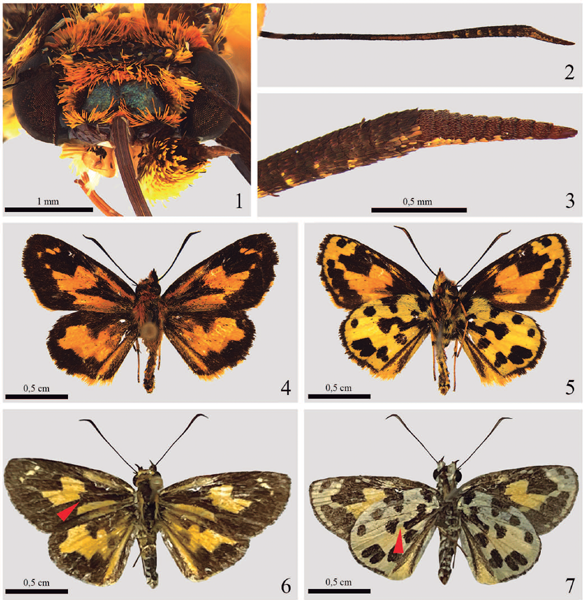
Lento yaguarsp. nov. (1-5) Holotype male. (1) Head in dorsal view, highlighting the blue frons. (2) antenna in ventral view. (3) Nudo. (4-5) dorsal, and ventral views. (6-7) Allotype Female, dorsal, and ventral views. The red arrows point to the main differences between males and females.
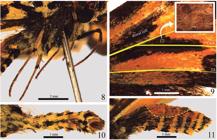
Lento yaguarsp. nov. (8) Legs, male holotype. (9) Stigma, emphasizing the scales, male paratype from Bujari, Acre, Brazil (OM 66.991). (10) Abdomen in ventral view, male holotype (11) Abdomen in lateral view, highlighting the presumably scent organ, male holotype.

Lento yaguarsp. nov., male genitalia in dorsal, lateral and ventral views, paratype from Bujari, Acre, Brazil (OM 66.991).
Type material: Holotype male deposited at the DZ-UP-OM with the following labels (each separated by a slash): / HOLOTYPUS / 20-23-VII-2004 50 km NO de Bu-jari, Bujari, Acre [Brazil], 200 m, O[laf].-C[arlos]. Mielke leg. / OM 65.666 / Lento yaguar Medeiros & O. Mielke det. 2024 /.
Allotype female deposited at the MUSM with the following labels (each separated by a slash): / ALLOTYPUS / Peru, CU[zco], Quebrada Quitacalzón, 1,100 m 1301/7130 [= 13°01’S, 71°30’W] 24-ix-2014 M. Mclnnis [leg.] / Lento yaguar Medeiros & O. Mielke det. 2024 /.
Paratypes (2 males): PERU - Madre de Dios: Puerto Maldonado (Tambopata National Reserve), 12°50’S 69°17’W, 300 m, 1 male, 29.X.1991, R. Robbins (MUSM). BRAZIL - Acre: Bujari (75 km NW), 1 male, 01.VIII.2005, C. Mielke, leg. OM 66.991 [DZUP-OM].
Description: MALE (Figs. 1,2,3,4,5, 8,9,10,11,12,13,14): Forewing length 10 mm (n = 2). Head: Dorsally dark brown, with conspicuous yellow, setiform scales around the frons and chaetosema; frons with imbricated grayish scales, forming a shiny surface that reflects a more or less bluish iridescence when positioned at an angle to the light source (Fig. 1); gena light yellow. Antenna longer than half of costa, dark brown, ventrally yellow at the base of the club segments, and under apiculus (Fig. 2); nudum with 10 segments (Fig. 3). Labial palpus first and second segments ventrally yellow, dorsally black; third segment black. Thorax: Dorsally densely covered with dark yellow setiform scales; ventrally light yellow. Legs with black femur; tibiae yellow with black spots at the extremities (Fig. 8). Dorsal forewing (Fig. 4): Ground color black. Costal area posteriorly bordered by a narrow yellow band that extends over the basal two-thirds of Sc-R, and partially invades costal and discal cells. Subapical area with four spots from R3 to M2, the first reduced to some scales, and the last displaced to the outer margin. Discal band dark yellow, irregular, from M2 to inner margin. Discal cell with a yellow, large, rectangular spot, continuous with the discal band between M3 and CuA2. Stigma grayish, consisting of two similar elongated parts: one at the base of CuA1-CuA2, another below CuA2, both consisting of a mix of broad and hair-like scales (Fig. 9). Marginal line black. Fringes uniformly black from apex to M3, the remainder yellow, except for the black endings of the veins CuA, and CuA2. Dorsal hind wing (Fig. 4): Ground color black, with a dark yellow, broad, and irregular central path, from Rs to 2A. Anal area with a more or less diffuse yellow rod-shaped patch in 2A-3A. Marginal line and fringe as on dorsal forewing. Ventral forewing (Fig. 5): Ground color black. The dorsal forewing dark yellow spots are also found on the ventral forewing side but are broader and somewhat lighter. Primary differences in ventral fore-wing compared to the dorsal forewing are as follows: yellow band in Sc-R, medially interrupted; discal band not reaching the inner margin and continuous with sub-apical spots; presence of a narrow submarginal band from apex to tornus, and extending along the costal margin, where it is represented by four small, detached spots. Marginal line and fringe as on dorsal forewing. Ventral hind wing (Fig. 5): Broadly yellow with black spots in nearly all cells, except between M, and M3. Most spots are somewhat more or less rounded, except when connected to others in adjacent cells, as observed in M3-CuA, and CuA1-CuA2. A long, sinuous spot along the discal cell, extending from base to apex, where it becomes dilated. Additionally, there are two elongated black strips along 2A and 3A. Marginal line and fringe as on ventral forewing. Abdomen: With alternating dark brown and dark yellow bands, except on the ventral side, which is yellow with a longitudinal median brown stripe (Figs. 10-11). Tergites III, IV, and V with a conspicuous patch of modified dark yellow and light brown scales (presumably a scent organ) (Fig. 11). Genitalia (Figs. 12,13,14): Tegumen trapezoidal, long and narrow in lateral view; saccus ventrally tapered, with dilated proximal end. Uncus bifid, rectangular, shorter than tegumen, and H-shaped when viewed dorsally (Fig. 12). Gnathos broad and bifid. Valva distally narrowed; costa dorsally protruding; ampulla longer than wide, distally blunt; harpe broad, with a pointed distal apex, and a prominent finger-like projection near its ventral margin (Fig. 14). Aedeagus slightly sinuous, as long as valva+-saccus; coecum rounded, barely curved upwards. Fultura inferior sclerotized, U-shaped. FEMALE (Figs. 6-7): Similar to the male, except in the following features: lighter color, dorsal forewing with discal band discontinuous in CuA2-2A (Fig. 6), and the sinuous spot along the discal cell disjointed near the apex (Fig. 7).
Distribution:Lento yaguarsp. nov. is known only from a few specimens collected at altitudes spanning from 200 to 1,100 meters in the western Amazon Basin, specifically in Brazil (Acre) and Peru (Cuzco and Madre de Dios). According to the material examined, the species occurs from July to October.
Etymology: The name “yaguar” originates from the Tupi-Guarani, a family of indigenous languages spoken primarily in South America. Speakers of Tupi-Guarani use the term specifically to refer to the jaguar (Panthera onca (Linnaeus, 1758)), the largest felid in the Americas. We use the name for the coloration similarity between the ventral surface of the wings of Lento yaguar sp. nov. and the jaguar’s skin. The term is a masculine noun in apposition.
Diagnosis and remarks:L. yaguarsp. nov. can be easily recognized by the conspicuous yellow and black hind wing ventral pattern, that resembles the peculiar coloration of a jaguar’s skin (Figs. 4,5,6,7). This interesting pattern is unique among Hesperiidae, and a somewhat similar pattern occurs only in a few species of Riodinidae, such as Symmachia leopardinum C. Felder & R. Felder, 1865, and some species of Argyrogrammana Strand, 1932 (Dolibaina et al., 2015). Among the Lento species, a similar pattern also occurs in Lento apta Evans, 1955, from which
L. yaguarsp. nov. can be easily distinguished by the characters mentioned in the following paragraphs.
Male stigma morphology is highly variable in Lento species, generally consisting of two scar-like parts in
CuA1CuA2 and CuA2-2A, but it may also appear as three parts in Lento pyra Evans, 1955, a single part in Lento imerius (Plötz, 1884), or may even be absent, as in Lento xanthina (Mabille, 1891) and Lento lotus (E. Bell, 1947). The scales on the stigmas are also variable and are broad in some species or hair-like in others. In L. yaguar sp. nov., the stigma consists of two parts and is composed of a mix of broad and hair-like scales, representing another unique character of the species (Fig. 9).
Another interesting feature of L. yaguar sp. nov. is the modified scales patch on the male abdominal tergites III, IV, and V. This feature, absent in all other species of the genus, is herein hypothesized as an androconial organ and represents the first record of this kind of structure on the abdominal tergum of a skipper species. However, a biochemical and ultrastructural investigation is required to confirm the actual nature of this interesting attribute.
In addition to the aspects mentioned previously, three other important characters are diagnostic for L. yaguar sp. nov.: (1) frons with imbricated grayish scales, forming a shiny surface that reflects a more or less bluish iridescence when positioned at an angle to the light source (Fig. 1); (2) legs with black femora (Fig. 8); and (3) uncus H-shaped when viewed dorsally (Fig. 12).
ACKNOWLEDGMENTS:
We thank Dr. Gerardo Lamas for sending the photographs of the specimens deposited at MUSM and for his valuable contributions as a reviewer of the manuscript. We also thank the Coordenação de Aperfeiçoamento de Pessoal de Nível Superior (CAPES) for the research fellowships granted to the first author.
-
FUNDING INFORMATION:
ADM: Coordenação de Aperfeiçoamento de Pessoal de Nível Superior (CAPES), research fellowship (88887.941144/2024-00).
REFERENCES
- Carneiro, E.; Mielke, O.H.H. & Casagrande, M.M. 2013. Thorax and abdomen morphology of some Neotropical Hesperiidae (Lepidoptera). Insecta Mundi, 0327: 1-47.
-
Dolibaina, D.R.; Dias, F.M.S; Mielke, O.H.H. & Casagrande, M.M. 2015. Argyrogrammana Strand (Lepidoptera: Riodinidae) from Parque Nacional da Serra do Divisor, Acre, Brazil, with the description of four new species. Zootaxa, 4028(2): 227-245. https://doi.org/10.11646/zootaxa.4028.2.4
» https://doi.org/10.11646/zootaxa.4028.2.4 - Evans, W.H. 1955. A Catalogue of the American Hesperiidae indicating the Classification and Nomenclature adopted in the British Museum (Natural History). Part IV. Hesperiinae and Megathyminae. British Museum, London.
-
Mielke, O.H.H. 2024. Catalogue and Checklist of the American Hesperiidae. Available: https://sites.google.com/site/lablepneo/publica%C3%A7%C3%B5es/livros Access: 24/10/2024. https://doi.org/10.1109/MCAS.2024.3392990
» https://doi.org/10.1109/MCAS.2024.3392990» https://sites.google.com/site/lablepneo/publica%C3%A7%C3%B5es/livros -
Mielke, O.H.H. & Casagrande, M.M. 2002. Notas taxonômicas em Hes-periidae neotropicais, com descrições de novos taxa (Lepidoptera). Revista brasileira de Zoologia, 19(Suplemento 1): 27-76. https://doi.org/10.1590/S0101-81752002000500002
» https://doi.org/10.1590/S0101-81752002000500002 - Steinhauser, S.R. 1991. Taxonomic notes and descriptions of new taxa in the Neotropical Hesperiidae. Part II. Heteropterinae and Hesperiinae, Vinius group. Bulletin of the Allyn Museum, 132: 1-79.
- Zhang, J.; Cong, Q.; Shen, J. & Grishin, N.V. 2022. Taxonomic changes suggested by the genomic analysis of Hesperiidae (Lepidoptera). Insecta Mundi, 0921: 1-135.
Edited by
-
Edited by:
Carlos José Einicker Lamas