Taxonomy and color variation in Brazilian Agapostemon bees (Apidae, Caenohalictini)
Abstract
The identification of females in the sister species Agapostemon chapadensis Cockerell, 1900 and Agapostemon semimelleus Cockerell, 1900 has historically been challenging, with metasomal coloration serving as the primary distinguishing feature. However, extensive intraspecific variation observed in this trait has highlighted its unreliability as a diagnostic character. This study analyzed 727 specimens of both species, integrating morphological traits and geographic distribution to delimit species boundaries and investigate color variation. New diagnostic characters, subtle pubescence patterns - such as setae length and distribution in both sexes - are proposed to reliably differentiate the species. Agapostemon chapadensis is largely restricted to Cerrado regions, with individuals typically exhibiting amber-colored metasoma, while A. semimelleus is more widespread, predominantly displaying black metasoma. The observed variation in metasomal coloration may reflect environmental adaptations, as responses to climate or predation pressures. Further research is recommended to elucidate the ecological and evolutionary drivers of these color variations.
Keywords:
Bees; Coloration; Cryptic species; Delimitation; Systematics
INTRODUCTION
Bees play a crucial role in maintaining terrestrial ecosystems as they are large-scale pollinators of angiosperms, being essential for the reproduction of these plants (Roubik, 1989; Silva et al., 2022). There are approximately 20,500 bee species worldwide, of which over 1,965 are native to Brazil (Orr et al., 2021; Moure et al., 2022). They arose on Gondwana during the Cretaceous and became ubiquitous in many terrestrial ecosystems (Almeida et al., 2023). Around 77% of these species exhibit solitary habits, characterized by the independent construction of nests by a single female, without the assistance of other individuals (Danforth et al., 2019).
Agapostemon Guérin-Méneville, 1844 comprises 40 species (Ascher & Pickering, 2022; Moure & Melo, 2022) classified in two subgenera, Agapostemon s. str. and Notagapostemon (Janjic & Packer, 2003). The genus occurs in the New World, from Canada through Chile (Janjic & Packer, 2003). Most species with known nesting biology are communal, with females sharing the same nest, but two species were classified as strictly solitary (see references provided by Janjic & Packer, 2003). Despite the generic revision carried by Roberts (1972), the phylogeny provided by Janjic & Packer (2003), and several taxonomic studies on North American species (see Portman et al., 2024 for a complete list), the taxonomy of some species complexes remains elusive.
The species Agapostemon (Notagapostemon) chapadensis and Agapostemon (Notagapostemon) semimelleus were described by Cockerell (1900), who emphasized the distinction between females based on metasomal coloration. According to him, females of A. chapadensis have a black metasoma and a bright green coloration on the head and mesosoma, with yellow markings on the clypeus and mandibles, while A. semimelleus has an amber metasoma with yellow bands and a bright yellow-green coloration on the head and mesosoma. Later, in his generic revision, Roberts (1972) indicated that color distinctions of these species were inconsistent, as females of A. chapadensis exhibit a brown or amber metasoma, while females of A. semimelleus have a predominantly black coloration. Roberts was unable to provide a key to separate the females of both species although the female paralectotypes were distinguished by him (Roberts, 1972, page 470 and 526). Females of both species run to couplet 5′ of the key to South American species (Roberts, 1972, page 458). Regarding the color differences, Roberts believed that the intraspecific variation he observed was so extensive that it obscured the distinctions between species (page 526), revealing that color was inaccurate for delimitation of both species. The distinction between males is simpler, with species separated by hind femur color and shape of gonostylus (Cockerell, 1900; Roberts, 1972).
These species are in a sister-group relationship according to Janjic & Packer (2003). They are common in Brazil and are currently the only known representatives of the genus in the country (Moure & Melo, 2022). Currently, females can be identified indirectly using the known distribution of males (Roberts, 1972), but overlapping distribution and high abundances can be problematic (Gonçalves & Melo, 2006; Portman et al., 2024). Here we provide a reanalysis of the species delimitation, indicating new characters to separate the females of both species and present an identification key. Additionally, we investigate whether color variation correlates with the geographical distribution of the species.
MATERIAL AND METHODS
Material from the Entomological Collection Pe. Jesus Santiago Moure at the Universidade Federal do Paraná (DZUP) was examined. The studied Agapostemon consists of 692 sorted specimens of A. semimelleus and A. chapadensis. The main metasomal color of specimens was tabulated, and a search for additional characters was conducted to complement the morphological analysis. The examined material and color tabulation are available in Gonçalves & Sousa (2025). Morphological terminology follows Eickwort (1969) and Michener (2007). We use the abbreviations F for flagellomeres and T for tergum. Distribution maps of the species were created using QGIS Desktop 3.38.3, based on original label data. Additionally, photographs of the species were taken with a Nikon D700 camera equipped with a 4× objective lens, using the Helicon Remote software to control image capture.
RESULTS
Key to Brazilian species of Agapostemon
Females
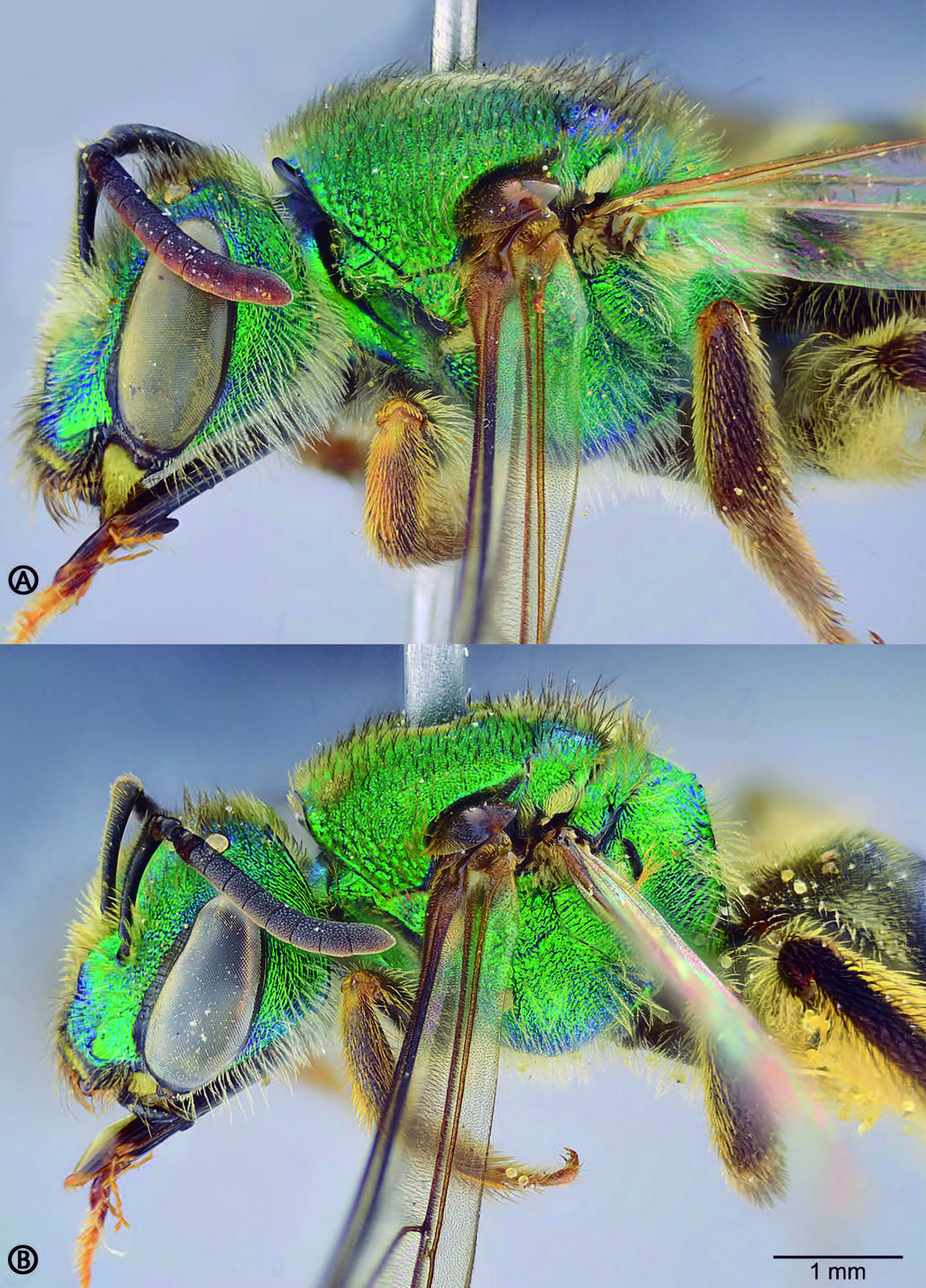
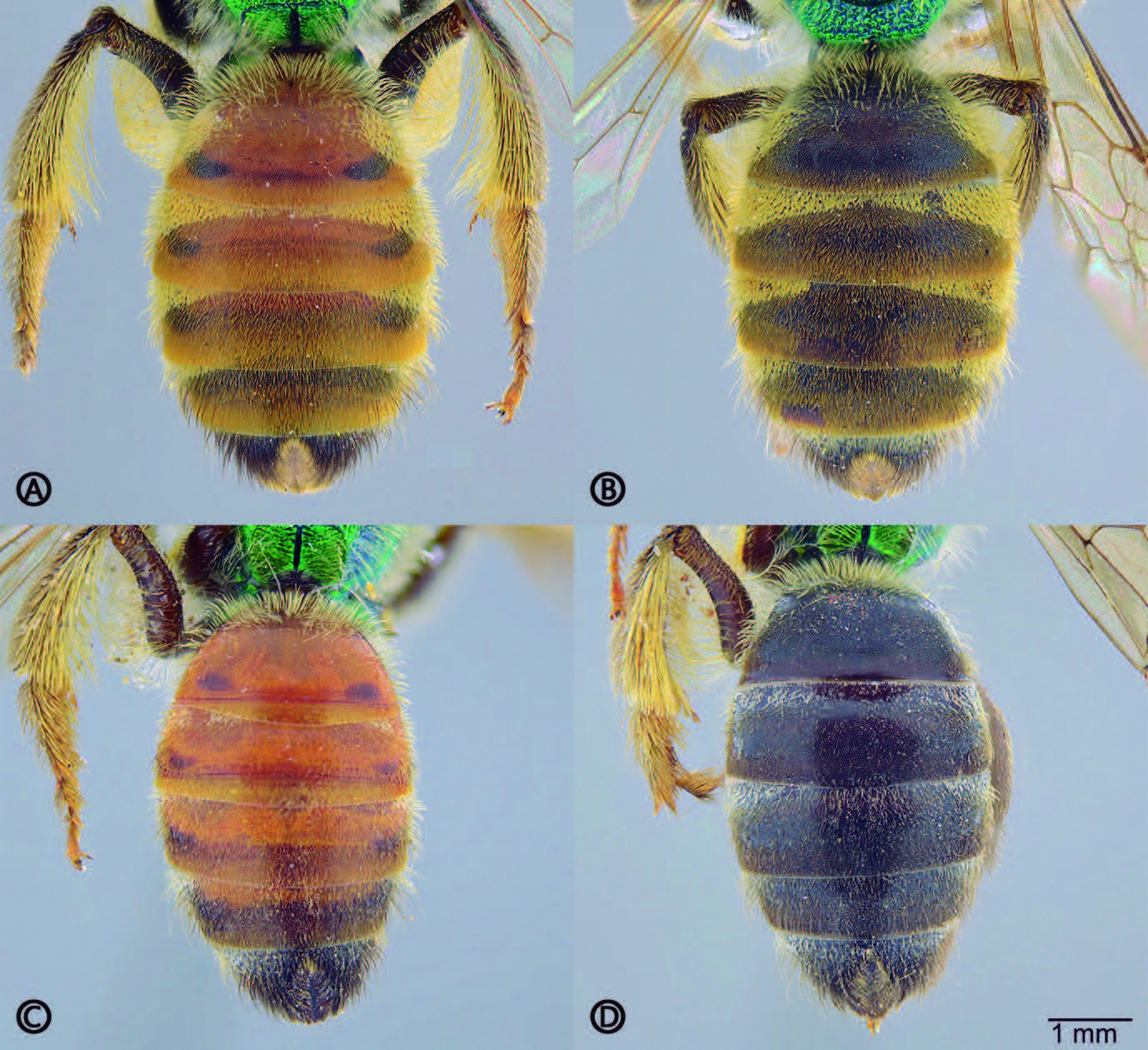
- Lower paraocular area, lateral surface of mesoscutum and ventral surface of mesepisternum with setae longer than F1+F2 length (Fig. 1A); mesoscutum setae mostly yellow, rarely darkened; anterior surface of T2-4 with broad stripe of tomentose setae, as large as marginal areas (Figs. 2A-B)Agapostemon chapadensisCockerell, 1900
-′ Lower paraocular area, lateral surface of mesoscutum and ventral surface of mesepisternum with setae shorter than F1+F2 length (Fig. 1B); mesoscutum setae with yellow and black intermixed; basal surface of T2-4 with narrow stripe of tomentose setae, shorter than marginal areas (Figs. 2C-D)Agapostemon semimelleusCockerell, 1900
Males
- Inner surface of hind femur black from base to apex; lower paraocular, lateral mesoscutum and ventral surface of mesepisternum with setae as long as F2 lengthAgapostemon chapadensisCockerell, 1900
-′ Inner surface of hind femur black only on base and on apex; lower paraocular, lateral mesoscutum and ventral surface of mesepisternum with setae shorter than F2 lengthAgapostemon semimelleusCockerell, 1900
Color variation and distribution
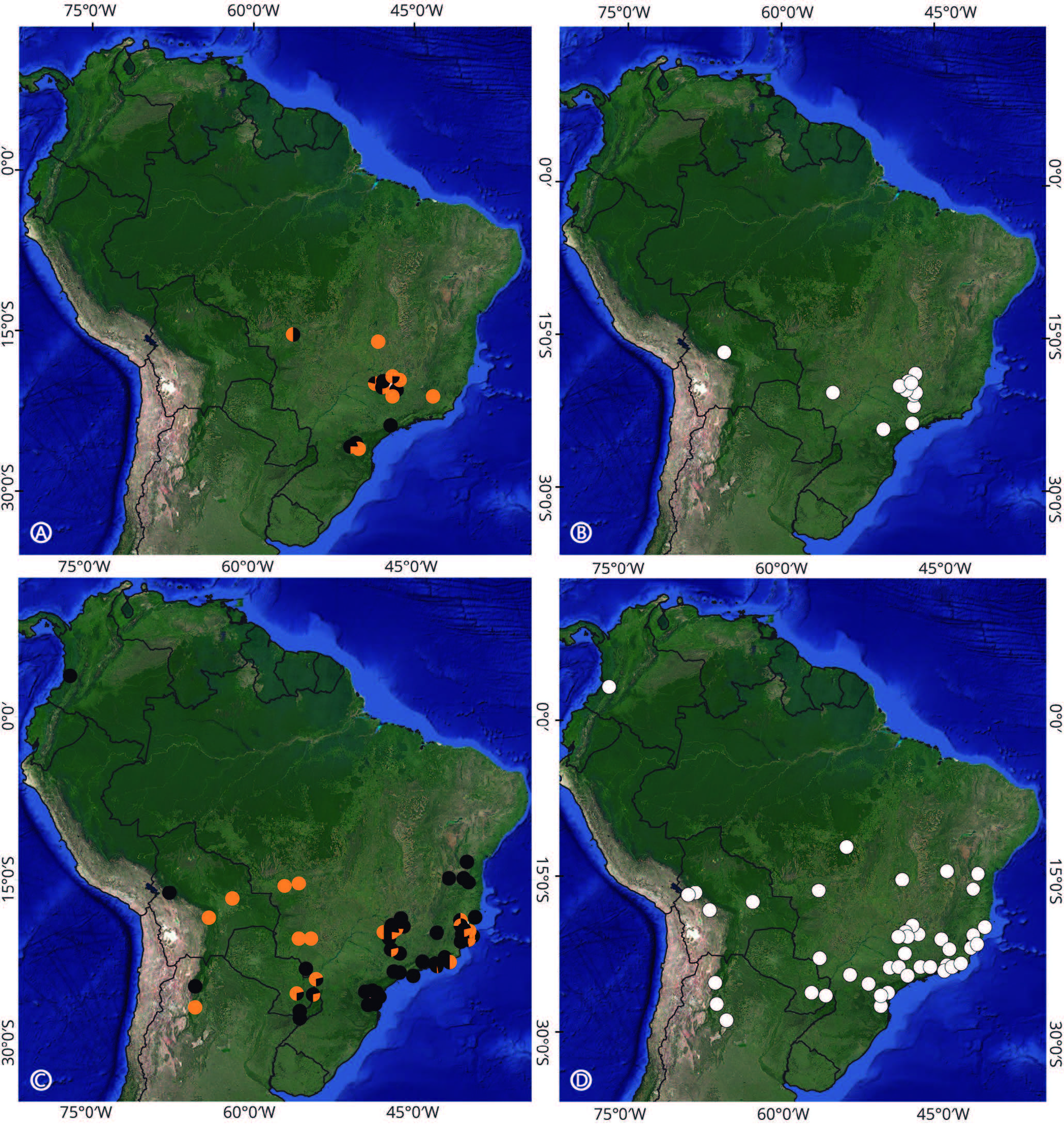
The geographic distribution maps reveal distinct ranges and coloration patterns between Agapostemon chapadensis and A. semimelleus (Fig. 3A, C). For A. chapadensis, the distribution is restricted to 14 locations mainly in the Southeast and Midwest regions of Brazil, with a higher concentration in Cerrado areas (Fig. 3A-B). Additionally, there is an overall predominance of females with amber coloration (63%), also in number of localities (64%). Localities with several sampled females (more than 15 specimens) also showed a prevalence of amber coloration (Araxá and Uberaba, 73% and 80% respectively). Amber coloration in this species derives from integument, that varies from reddish to amber in T1-3, and also by dark yellow setae. Dark females usually have brown tergal marginal area. The males of A. chapadensis exhibited a distribution pattern similar to that of the females, concentrated in the same regions.
On the other hand, A. semimelleus displayed a broader geographic distribution, encompassing 55 locations across various regions of Brazil, including the Southeast, Midwest, North, and Northeast (Fig. 3C-D). Females with black coloration (Fig. 2D, 3C) were more predominant in absolute number (73%) and also in locations (73%). Localities with several females also showed a prevalence of the brown coloration (Colatina, Foz do Iguaçu and Rio de Janeiro, 71%, 67% and 94% respectively). Orange coloration in this species derives from integument, mostly orange T1-3, while setae are whitish. Dark females are usually black, sometimes with the tergal marginal zone dark brown. Only two locations exhibited both colorations in equal proportions. The geographic distribution of A. semimelleus males was consistent with that of the females, and this wider distribution indicates a higher ecological adaptability for the species.
DISCUSSION
Our interpretation is that the head and mesosoma pubescence pattern is consistent between females and males, making it a reliable diagnostic feature for species identification. The females of A. chapadensis, which have longer setae, typically exhibit amber-colored metasoma and broad tomentose basal bands - a characteristic originally attributed to A. semimelleus by Cockerell (1900). In contrast, females of A. semimelleus, which possess shorter setae, generally have brown metasoma. This discrepancy
Head and mesosoma of Agapostemon females in lateral view. (A) A. chapadensis from Ponta Grossa, Paraná (PEVV0389), (B) A. semimelleus from Ponta Grossa, Paraná (DZUP614061). Both images at same scale.
suggests that Cockerell may have misassociated females and males in the original descriptions. As Roberts (1972) designated males as lectotypes, the females should be considered misassigned in the original descriptions - a notable irony since Cockerell’s name ‘semimelleus’ (partially resembling honey) aligns more closely with A. chapadensis metasoma color under the current interpretation. According to our interpretation, color variation occurs in both species and was inherited from a common ancestor.
Recently, Portman et al. (2024) addressed another Agapostemon species complex. Females of Agapostemon angelicus Cockerell, 1924, and A. texanus Cresson, 1872, were considered morphologically indistinguishable by Roberts (1972) even with Sandhouse (1936) previously differentiating these females. Roberts (1972) also introduced noise in this complex by synonymizing a third species, A. subtilior Cockerell, 1898, with A. texanus. Portman et al. (2024) proposed a revised key and diagnoses for the three species after reevaluating morphological traits such as sculpturing and shape. They emphasized the broader issue of misidentifications and cryptic species in historic collections and stressed the importance of properly vouchering specimens for further study, a viewpoint we endorse.
The observed color variation between A. semimelleus and A. chapadensis raises the question about which factors may influence this trait, as similar patterns of color variation are seen in other bee groups. In Augochlorini, color variation is well-documented with two patterns: entire body and metasoma-only polychromatism (Celis & Melo, 2024). As recent reported cases, Lepeco & Gonçalves (2018) documented body polychromatism in Augochlora dapnhis Smith, 1853, observing green, blue and black color morphs within the same localities. Celis & Melo (2024) reported body polychromatism in
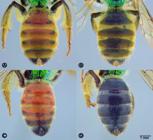
Metasoma color variation of Agapostemon females in dorsal view. A. chapadensis: (A) amber from Ponta Grossa, Paraná (DZUP171731), (B) brown from Ponta Grossa, Paraná (PEVV0389). A. semimelleus: (C) amber from Ponta Grossa, Paraná (DZUP614048), (D) brown from Ponta Grossa, Paraná (DZUP614061). All images at same scale.
Augochloropsis bertonii Schrottky, 1909, but in this case the color variations were correlated with distribution, being the violet specimens more frequently found in high areas from Atlantic Forest, while green specimens prevail along the coast.
In Agapostemon, color variation is restricted to the metasoma, resembling patterns found in augochlorine species such as Paroxystoglossa mourella (Gonçalves, 2017), and Corynura ampliata (Alfken, 1913) (indicated by Celis & Melo, 2024). However, in Agapostemon species, this variation primarily involves differences in pigmentation rather than metallic reflections. A comparable condition exists in other Caenohalictini. For instance, females of Habralictus callichroma (Cockerell, 1901) display either dark or orange metasoma (Liz & Gonçalves, 2025). In the Halictini, the species Lasioglossum apristum (Vachal, 1903) and L. politum (Schenck, 1853) are known to have similar metasomal color variation (Miyanaga et al., 1999; Murao & Tadauchi, 2011). To mention another bee lineage, in stingless bees the color of the metasoma can also be variable, with some species having dark brown to reddish brown morphs due to pigmentation (Pereboom & Biesmeijer, 2003; Melo, 2015).
The coloration can be determined by a complex interaction of biological pigments, cuticle properties and environmental factors (Cuthill et al., 2017). The pigments
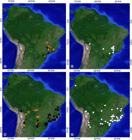
Distribution records of Agapostemon from Brazil (DZUP collection). (A) A. chapadensis females, (B) A. chapadensis male, (C) A. semimelleus females, (D) A. semimelleus males. Proportion of metasoma color, black: females with predominantly brown metasoma, orange: females with predominantly amber metasoma.
responsible for coloration can be divided into eight groups with complex biochemistry routes (Shamim et al., 2014). The pigmentation process is unidirectional from head to thorax to abdomen, which explains why species that have a light head and mesosoma but dark metasoma is extremely rare (Pereboom & Biesmeijer, 2003). On the other hand, the black head and mesosoma and reddish metasoma is very common in bees, indicating a possible role of the contrast of metasoma in communication due to mimetism, even in sweat bees (Smith-Pardo, 2005). Studies indicate that color variation in bees could relate to Müllerian mimicry and mutations in Hox genes Abd-A and Abd-B, which govern abdominal segment development. For example, in Bombus melanopygus Nylander, 1848, mutations in these genes drive metasoma color changes, shifting segments from red to black (Tian et al., 2019).
Color also matters for thermoregulation. Color morphs of Melipona costaricensis Cockerell, 1920 and Cephalotrigona capitata (Smith, 1854) that differ only in metasoma color differed significantly in their warm-up rates, with dark morphs heating up more rapidly and attaining higher temperature than morphs with a light-colored abdomen (Pereboom & Biesmeijer, 2003). Recently Ostwald et al. (2025) investigated how climate shapes color variation in bees at global scale and found that lightness increases in function of temperature and decreases with annual precipitation. Dry regions are linked to bee adaptation that may reduce overheating (Ostwald et al., 2025). In the case of the Agapostemon species studied here, the same phenomenon could be extrapolateded, as A. semimelleus is predominantly darker and is widespread in more wetter Atlantic forest environments when compared to A. chapadensis (Fig. 3A, C).
Color morph dynamics can shift over time. For instance, Suni & Dela Cruz (2021) documented an 11-year trend in Euglossa championi Cheesman, 1929, with increases in a red-orange morph and decreases in blue-green and green-orange morphs. Geographic factors also can play a role. Ferrari & Melo (2014) demonstrated that in orchid bee species, intraspecific color variation often correlates with geographic factors such as climate and vegetation types, suggesting that coloration may be an adaptive environmental response. Murao & Tadauchi (2011) also found a geographic structuring in color morphs of Lasioglossum politum, in this case manifested in black, reddish brown and intermediate. On L. apristum (Miyanaga et al., 1999) the color variation is related to size.
Molecular evidence further underscores the limitations of using color as a primary criterion for species delimitation. Color traits can vary within a single species due to environmental factors such as flower types visited or climatic conditions (Ferrari & Melo, 2014). Here we highlighted the challenges of relying on integumentary color for distinguishing A. chapadensis and A. semimelleus, and suggest that this trait is an unreliable basis for bee taxonomy. A careful examination revealed that subtle pubescence differences can be used to properly separate the females.
ACKNOWLEDGMENTS:
We express our appreciation to the entire team at the Laboratório de Abelhas (LAbe) of the Universidade Federal do Paraná, particularly Julia Alberti de Liz, for her technical assistance in map creation and for the insightful discussions that enriched this work.
Data Availability:
The datasets generated during and/or analyzed during the current study are available in the SciElo Data at: https://doi.org/10.48331/scielodata.mt0vy5.
REFERENCES
-
Almeida, E.A.; Bossert, S.; Danforth, B.N.; Porto, D.S.; Freitas, F.V.; Davis, C.C.; Murray, E.A.; Blaimer, B.B.; Spasojevic, T.; Stroher, P.R.; Orr, M.C.; Packer, L.; Brady, S.G.; Kuhlmann, M.; Branstetter, M.G. & Pie, M.R. 2023. The evolutionary history of bees in time and space. Current Biology, 33(16): 3409-3422. https://doi.org/10.1016/j.cub.2023.07.005.
» https://doi.org/10.1016/j.cub.2023.07.005 -
Ascher, J. & Pickering, J. 2022. Discover Life bee species guide and world checklist Available: Available: https://www.discoverlife.org Access: 19/11/2024.
» https://www.discoverlife.org -
Celis, C.J. & Melo, G.A. 2024. Taxonomic revision of the South American subgenus Augochloropsis (Glyptobasia) (Hymenoptera: Apidae: Halictinae). Zootaxa, 5514(5): 431-450. https://doi.org/10.11646/zootaxa.5514.5.2.
» https://doi.org/10.11646/zootaxa.5514.5.2 -
Cockerell, T.D.A. 1900. Descriptions of New Bees Collected by Mr. H.H. Smith in Brazil: I. Proceedings of the Academy of Natural Sciences of Philadelphia, 52, 356-377. https://www.jstor.org/stable/4062631
» https://www.jstor.org/stable/4062631 -
Cuthill, I.C.; Allen, W.L.; Arbuckle, K.; Caspers, B.; Chaplin, G.; Hauber, M.E.; Hill, G.E.; Jablonski, N.G.; Jiggins, C.D.; Kelber, A.; Mappes, J.; Marshall, J.; Merrill, R.; Osorio, D.; Prum, R.; Roberts, N.W.; Roulin, A.; Rowland, H.M.; Sherratt, T.N.; Skelhorn, J.; Speed, M.P.; Stevens, M.; Stoddard, M.C.; Stuart-Fox, D.; Talas, L.; Tibbetts, E. & Caro, T. 2017. The biology of color. Science, 357(6350): 1-7, eaan0221. https://doi.org/10.1126/science.aan0221.
» https://doi.org/10.1126/science.aan0221 -
Danforth, B.N.; Minckley, R.L. & Neff, J.L. 2019. The solitary bees: biology, evolution, conservation Princeton, Princeton University Press. https://doi.org/10.2307/j.ctvd1c929.
» https://doi.org/10.2307/j.ctvd1c929 - Eickwort, G.C. 1969. A comparative morphological study and generic revision of the augochlorine bees (Hymenoptera: Halictidae). The University of Kansas Science Bulletin, 48: 325-524. https://doi.org/10.5962/bhl.part.11227.
-
Ferrari, B.R. & Melo, G.A.R. 2014. Deceiving colors: recognition of color morphs as separate species in orchid bees is not supported by molecular evidence. Apidologie, 45(5): 641-652. https://doi.org/10.1007/s13592-014-0280-7.
» https://doi.org/10.1007/s13592-014-0280-7 -
Gonçalves, R.B. 2017. Phylogeny and new species of the Neotropical bee genus Paroxystoglossa Moure (Hymenoptera, Apoidea). Revista Brasileira de Entomologia, 61(2): 178-191. https://doi.org/10.1016/j.rbe.2017.03.001.
» https://doi.org/10.1016/j.rbe.2017.03.001 -
Gonçalves, R.B. & Melo, G.A. 2006. Revision of the bee genus Thectochlora Moure (Hymenoptera, Apidae, Halictinae). Zootaxa, 1331(1): 1-30. https://doi.org/10.11646/zootaxa.1331.1.1.
» https://doi.org/10.11646/zootaxa.1331.1.1 -
Gonçalves, R.B. & Sousa, G.R. 2025. Data from: Taxonomy and color variation in Brazilian Agapostemon bees (Apidae, Caenohalictini). https://doi.org/10.48331/scielodata.mt0vy5, SciELO Data.
» https://doi.org/10.48331/scielodata.mt0vy5 -
Janjic, J. & Packer, L. 2003. Phylogeny of the bee genus Agapostemon (Hymenoptera: Halictidae). Systematic Entomology, 28(1): 101-123. https://doi.org/10.1046/j.1365-3113.2003.00204.x.
» https://doi.org/10.1046/j.1365-3113.2003.00204.x -
Lepeco, A. & Gonçalves, R.B. 2018. The Colour and the Shape: Morphological Variation on a Facultatively Eusocial Bee Augochlora (Augochlora) amphitrite (Schrottky). Sociobiology, 65(4): 662-670. https://doi.org/10.13102/sociobiology.v65i4.3388.
» https://doi.org/10.13102/sociobiology.v65i4.3388 -
Liz, J.A. & Gonçalves, R.B. 2025. A taxonomic review of Habralictus Moure, 1941 from Brazil, with description of four new species (Hymenoptera: Apidae). European Journal of Taxonomy, 991: 1-53. https://doi.org/10.5852/ejt.2025.991.2907.
» https://doi.org/10.5852/ejt.2025.991.2907 -
Melo, G.A.R. 2015. New species of the stingless bee genus Schwarziana (Hymenoptera, Apidae). Revista Brasileira de Entomologia, 59(4): 290-293. https://doi.org/10.1016/j.rbe.2015.08.001.
» https://doi.org/10.1016/j.rbe.2015.08.001 - Michener, C.D. 2007. The Bees of the World 2. ed. Baltimore, Johns Hopkins University Press. 953p.
-
Miyanaga, R.; Maeta, Y. & Sakagami, S.F. 1999. Geographical variation of sociality and size-linked color patterns in Lasioglossum (Evylaeus) apristum (Vachal) in Japan (Hymenoptera, Halictidae). Insectes Sociaux, 46: 224-232. https://doi.org/10.1007/s000400050138.
» https://doi.org/10.1007/s000400050138 -
Moure, J.S. & Melo, G.A.R. 2022. Halictini Thomson, 1869. In: Catalogue of Bees (Hymenoptera, Apoidea) in the Neotropical Region - online version Available: Available: https://www.moure.cria.org.br/catalogue Access: 27/10/2025.
» https://www.moure.cria.org.br/catalogue -
Moure, J.S.; Urban, D. & Melo, G.A.R. 2022. Catalogue of bees (Hymenoptera, Apoidea) in the Neotropical region - online version Available: Available: https://www.moure.cria.org.br/catalogue Access: 27/10/2025.
» https://www.moure.cria.org.br/catalogue - Murao, R. & Tadauchi, O. 2011. Notes on color variation of Lasioglossum (Evylaeus) politum pekingense (Hymenoptera, Halictidae). Japanese Journal of Systematic Entomology, 17: 55-58.
-
Orr, M.C.; Hughes, A.C.; Chesters, D.; Pickering, J.; Zhu, C.D. & Ascher, J.S. 2021. Global patterns and drivers of bee distribution. Current Biology, 31: 451-458. https://doi.org/10.1016/j.cub.2020.10.053.
» https://doi.org/10.1016/j.cub.2020.10.053 -
Ostwald, M.M.; Chen, K.; Alexander, N.; Ding, L.; Gonzalez, V.H. & Seltmann, K.C. 2025. Climate explains global functional trait variation in bees. Functional Ecology, 39(7): 1748-1760. https://doi.org/10.1111/1365-2435.70051.
» https://doi.org/10.1111/1365-2435.70051 -
Pereboom, J.J.M. & Biesmeijer, J.C. 2003. Thermal constraints for stingless bee foragers: the importance of body size and coloration. Oecologia, 137: 42-50. https://doi.org/10.1007/s00442-003-1324-2.
» https://doi.org/10.1007/s00442-003-1324-2 -
Portman, Z.M.; Arduser, M.; Powley, M.E. & Cariveau, D.P. 2024. Taxonomy of Agapostemon angelicus and the A. texanus species complex (Hymenoptera, Halictidae) in the United States. European Journal of Taxonomy, 958(1): 203-241. Https://doi.org/10.5852/ejt.2024.958.2671.
» https://doi.org/10.5852/ejt.2024.958.2671 - Roberts, R.B. 1972. Revision of the bee genus Agapostemon (Hymenoptera: Halictidae). The University of Kansas Science Bulletin, 49(9): 437-590.
-
Roubik, D.W. 1989. Ecology and natural history of tropical bees New York, Cambridge University Press. https://doi.org/10.1017/CBO9780511574641.
» https://doi.org/10.1017/CBO9780511574641 -
Sandhouse, G. A. (1936). The bees of the genus Agapostemon (Hymenoptera: Apoidea) occurring in the United States. Journal of the Washington Academy of Sciences, 26(2): 70-83. https://www.biodiversitylibrary.org/part/101403
» https://www.biodiversitylibrary.org/part/101403 -
Shamim, G.; Ranjan, S.K.; Pandey, D.M. & Ramani, R. 2014. Biochemistry and biosynthesis of insect pigments. European Journal of Entomology, 111: 149-164. https://doi.org/10.14411/eje.2014.021.
» https://doi.org/10.14411/eje.2014.021 - Silva, A.A.; Ronqui, L.; Carmassi, A.L.; Soares, A.P.Q.S.; Mota, I.O. & Santi, T. 2022. A vida das abelhas em manual São Carlos, UFSCar/CPOI.
-
Smith-Pardo, A.H. 2005. Systematics and mimicry of the genus Neocorynura: an example of two species from Central America (Hymenoptera: Halictidae). Acta Zoologica Cracoviensia, Serie B, Invertebrata, 48(3-4): 11-21. https://doi.org/10.3409/173491505783995572.
» https://doi.org/10.3409/173491505783995572 -
Suni, S.S. & Dela Cruz, K. 2021. Climate-associated shifts in color and body size for a tropical bee pollinator. Apidologie, 52: 933-945. https://doi.org/10.1007/s13592-021-00875-5.
» https://doi.org/10.1007/s13592-021-00875-5 -
Tian, L.; Rahman, S.R.; Ezray, B.D.; Franzini, L.; Strange, J.P.; Lhomme, P. & Hines, H.M. 2019. A homeotic shift late in development drives mimetic color variation in a bumble bee. Proceedings of the National Academy of Sciences of the United States of America, 116(24): 11857-11865. https://doi.org/10.1073/pnas.1900365116.
» https://doi.org/10.1073/pnas.1900365116
-
Ethical Statement:
All laws, regulations and permits necessary for the research were followed and obtained.
-
Use of AI:
During the preparation of this manuscript, the authors used ChatGPT for language review. After using this tool/service, the authors have reviewed and edited the content appropriately and take full responsibility for the content of the publication
-
Funding:
Fundação Araucária (undergraduate scholarship to GRS) and CNPq (process 307671/2021 6 to RBG) organizations that funded the fellowship for the authors.
Edited by
-
Edited by:
Kelli dos Santos Ramos