First description of the male of Morellia (Trichomorellia) callidimera (Bigot) (Diptera, Muscidae), with examination of type material
Abstract
Morellia (Trichomorellia) Stein, 1918 is a Neotropical subgenus with eight known species occurring from Mexico to Argentina. Morellia (T.) callidimera (Bigot) was described in 1887 based on a female specimen from Mexico. The male of M. (T.) callidimera is described here for the first time, 139 years after the original description, including images of the habitus and drawings of the male and female terminalia. The female holotype of M. (T.) callidimera and its junior synonym M. (T.) fulvipes were examined and redescribed. Morellia (T.) callidimera is recorded from Veracruz (Mexico) for the first time.
Keywords:
Mexico; Neotropical region; Redescription; Taxonomy; Type examination.
INTRODUCTION
In the Neotropical region, Morellia Robineau-Desvoidy comprises 33 species in four subgenera (de Carvalho et al., 2005; Nihei & de Carvalho, 2011; Löwenberg-Neto & de Carvalho, 2013). Among them, Morellia (Trichomorellia) Stein, 1918 is exclusively Neotropical and includes eight species recorded from Mexico, Guatemala, Venezuela, Colombia, Ecuador, Peru, Bolivia, Brazil, and Argentina (Pont, 2000; de Carvalho & Couri, 2002; Pont et al., 2005; Löwenberg-Neto & de Carvalho, 2013). There are no characters to support the monophyly of the subgenus (Pamplona, 1983).
Morellia (Trichomorellia) callidimera (Bigot) and M. (T.) fulvipes (Bigot) were described in the same paper based on females from Mexico (without more detailed locality information), differing only in leg coloration (Bigot, 1887). Wulp (1896) subsequently reported M. (T.) callidimera from Guerrero (Mexico). Pont (2000) examined the types and synonymized M. (T.) fulvipes with M. (T.) callidimera.Snyder (1949) described Dasymorellia fulvitibia based on female specimens from Guatemala and Mexico, later recognized as a junior synonym of M. (T.) callidimera (de Carvalho et al., 2005).
Here, the male of M. (T.) callidimera is described for the first time, including images and drawings of the male and female terminalia. The holotypes of M. (T.) callidimera and M. (T.) fulvipes were examined, and morphological variation and synonymy are briefly discussed. The distribution is updated with the first record from Veracruz (Mexico).
MATERIAL AND METHODS
The material used in this study is based on specimens from the British Museum of Natural History (BMNH), London, United Kingdom; and the Entomological Collection at the Instituto de Ecología, Xalapa (IEXA), Veracruz, Mexico.
The distal half of the abdomen was removed for examination of the terminalia. Dissected structures were cleared and softened in cold potassium hydroxide (KOH) 10% for 24 h, transferred to acetic acid, dehydrated in 70% alcohol and then placed in glycerin.
Observations and photographs were made using a Leica S8 APO stereomicroscope equipped with an MC170 HD camera. Terminalia were examined with a Zeiss Primo Star compound microscope with an AmScope M120-2 L-PB10 (5mpx) camera. Images were edited in Adobe Photoshop, and drawings were made in Adobe Illustrator. Morphological terminology follows Cumming & Wood (2017). The following abbreviations are used: a= anterior; ad= anterodorsal; av= anteroventral; d= dorsal; p= posterior; pd= posterodorsal; pv= posteroventral.
RESULTS
Taxonomy
Order Diptera Linnaeus, 1758 Family Muscidae Latreille, 1802 Subfamily Muscinae Latreille, 1802 Genus Morellia Robineau-Desvoidy, 1830 Subgenus Trichomorellia Stein, 1918
Diagnosis: Male holoptic. Eyes setulose. Arista plumose. Humerals 4. Prealar strong. Dorsocentrals 2+4. Acrostichals 2+2-3. Katepisternals 1+2. Wings with cilia at node on both surfaces (except M. (T.) benoisti Pamplona). Apical portion of vein M bent forward. Lower calypter glossiform, about twice longer than the upper calypter. Fore tibia on dorsal surface with 2 preapical setae. Hind tibia with a strong posterodorsal seta (calcar) (adapted from de Carvalho & Couri, 2002).
Morellia (Trichomorellia) callidimera (Bigot, 1887)
callidimeraBigot, 1887: clxxiv [also 1888: 615] (Curtonevra). Holotype female, BMNH [Ref. Pont, 2000: 8]. Type-locality: “Mexique”. Distribution: Mexico, Guatemala.
callimera, error [Bigot (1888: 615)].
calimera, error.
Morellia callimera;Wulp (1896: 302) (Mexico); Stein (1919: 108) (cat.); Séguy (1935: 110) (cat.); Séguy (1937: 393) (cat.); Albuquerque (1956: 37) (cat.); Pont (1972: 8) (cat.).
Cyrtoneura callimera;Giglio-Tos (1896: 12) (Mexico, as calimera).
Dasymorellia callimera;Albuquerque & Lopes (1979: 330) (cat.); de Carvalho et al. (1993: 9) (cat.); Pont (2000: 8) (notes on type); de Carvalho & Couri (2002: 42) (Neotropical Region, key).
Morellia (Trichomorellia) callidimera;de Carvalho et al. (2005: 34) (cat., new combination); Löwenberg-Neto & de Carvalho (2013: 15) (distribution).
fulvipesBigot, 1887: clxxiv [also 1888: 613] (Curtonevra). Holotype female, BMNH [Ref. Pont (2000: 14)]. Type-locality: “Mexique”.
Mydaea? fulvipes;Stein (1919: 119) (cat.); Séguy (1937: 285) (cat.).
Unplaced species of Cyrtoneurininae; Pont (1972: 58) (cat.).
Dasymorellia fulvipes;de Carvalho et al. (1993: 9) (cat., new combination); Pont (2000: 14) (notes on type and nomenclature, junior synonymy of callidimera); de Carvalho & Couri (2002: 41) (listed).
Morellia (Trichomorellia) fulvipes;de Carvalho et al. (2005: 34) (cat., new combination).
fulvitibiaSnyder, 1949: 22 (Dasymorellia). Holotype female, AMNH (American Museum of Natural History, New York, New York, USA), paratypes, AMNH. Type-locality: Guatemala, Guatemala City.
Dasymorellia fulvitibia;Albuquerque (1951: 8) (cat.); Pont (1972: 10) (cat.).
Diagnosis: Eyes short-setulose, almost bare. Parafacial, facial, and gena with gray pruinosity. Antennae and palpi dark brown. Gena with weak and sparse setulae. Acrostichals 2+2. Hind femur with a row of ad setae and one median pv seta. This species differs from M. (T.) benoisti, M. (T.) seguyi (Pamplona), and M. (T.) trichops (Malloch) by the short-setulose eyes, and from M. (T.) flavipalpis (Pamplona) by the dark brown antennae. Males can be also distinguished from other species of the subgenus by the mid femur bearing 2 thick, truncate apical d setae and by the hind tibia with a row of approximately 20 long and thin pv setae.
Male: Body length: 7.5 mm. Wing length: 7.0 mm.
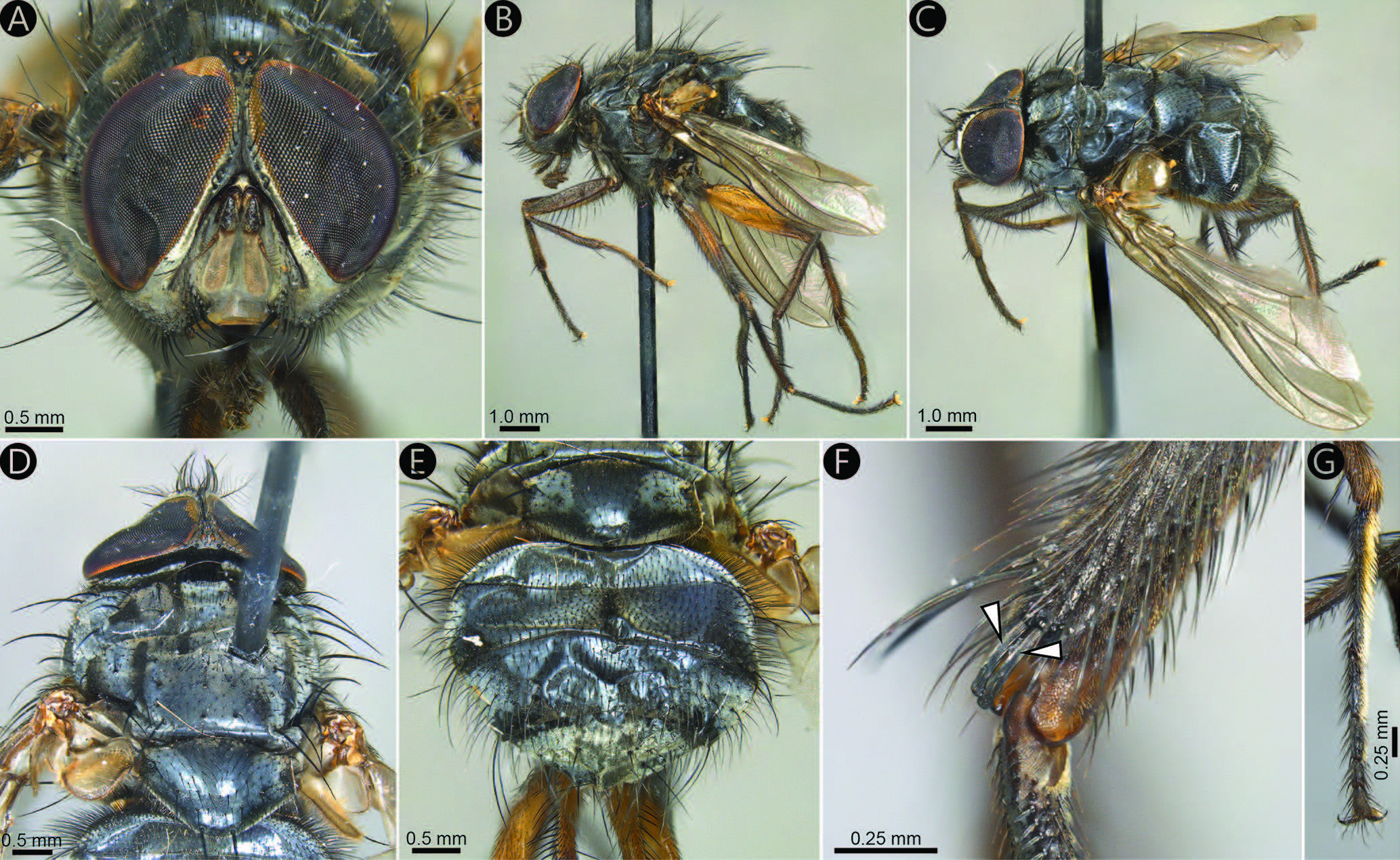
Coloration: Head: Antennae and palpi dark brown, basal half of arista light brown. Frontal vitta dark brown; fronto-orbital plate, gena, lunule, and parafacial dark brown with gray pruinosity (Fig. 1A). Thorax: Dark brown, with a central gray pruinose stripe reaching the middle of the pronotum, becoming inconspicuous until the transversal suture of the mesonotum (Fig. 1D). Gray pruinosity on the postpronotal lobe and notopleuron (Fig. 1C). Scutum with an inconspicuous pattern formed by three gray pruinose stripes reaching the base of scutellum, contrasting with four black stripes (Fig. 1D). Scutellum dark brown with inconspicuous lateral gray pruinosity (Fig. 1E). Legs: Fore leg dark brown. Mid leg dark brown, with the basal two-thirds of the femur yellow. Hind leg dark brown with the femur yellow with the apical fourth dark brown (Fig. 1B). Claws dark brown, lighter basally. Pulvilli white. Abdomen: Dark brown, with gray pruinosity forming irregular dorsal and lateral stripes and spots on tergites 1+2 to 4. Tergite 5 entirely pruinose (Fig. 1E).
Head: Holoptic. Distance between eyes similar to anterior ocellus width (Fig. 1A). Postpedicel 2.5 times longer than pedicel. Arista long plumose, with the longest hairs about ¼ the length of the arista. Ocellar setae long, about half-length of the frontal setae. 13-14 pairs of frontal setae: 6-7 convergent, 6 proclinate, and 1 reclinate (Fig. 1B); extending from the antennae insertion to almost the anterior ocellus. Inner vertical setae convergent, 2.5 times longer than outer vertical setae. Outer vertical setae divergent. Postocellars short, half-length of the ocellar setae. Gena twice as high as pedicel length.
Thorax: Acrostichal setae 2+2. 7 irregular rows of acrostichal presutural setulae. Dorsocentrals 2+4, the first postsutural half-length of the others. Intra-alars 2. Prealar seta long, with the same length to the posterior notopleural. Notopleuron with 2 setae and with covered setulae, the first one slightly longer than the posterior one. A row of about 10 anepisternal setae, the upper 4 longer. Prosternum bare. Katepisternals 1+2, with the anterior and upper posterior seta twice as long as the lower posterior one. Proepisternum and katepimeron bare. Anepimeron setulose. Meron bare, with setulae above hind coxa. Scutellum with a long pair of apical and basal setae, the basal pair slightly longer; a pair of prebasal setae about ¼ the length of the basal pair; a pair of subapical scutellar setae half-length of the apical pair; and a discal scutellar pair with about ⅔ the length of the apical setae.
Morellia (Trichomorellia) callidimera (Bigot). Male: head, frontal view (A); habitus, lateral view (B); habitus, dorsal view (C); thorax, dorsal view (D); abdo men, dorsal view (E); mid femur, anterodorsal view (F); hind tarsi, lateral view (G).
Wing: Hyaline. Vein M strongly curved (Fig. 1C). Vein R₄₊₅ with setulae on both dorsal and ventral surfaces, extending from Rs to nearly the apex of R₄₊₅. Calypters yellow, with light brown margins (Fig. 1C).
Legs: Fore femur with a long row of setae on pd and pv, and several shorter setae on the posterior surface. Fore tibia with a long apical seta on d and pv. Mid femur with a row of short a setae, twice longer than the covered setulae, reaching half of the femur, the last one longer, twice longer than the others; a row of posterior setae on the apical half; 3-4 p to pd preapical setae; 2 thick, truncate apical d setae (Fig. 1F); and 2-3 long pv setae, the median one longer than the femur width. Mid tibia with 3 median pd and 3 median p (twice longer than the pd setae); a long apical seta on av and v, both with half-length of the basitarsus; short apical seta on a, av, pv, and pd. Hind femur with a row of ad setae; a long median pv (as long as the femur width); 5-6 av setae on apical – (setae longer than femur width); a row of 2-3 preapical d; and one short preapical seta on pd, p, and av. Hind tibia with 5-7 ad; a row of approximately 20 long and thin pv; 6 av (twice longer than tibia width); two pd: 1 supramedian and 1 submedian (calcar), calcar twice longer than tibia width; preapical seta on d and ad; apical seta on a, ad, av, and v, the av twice longer than the others; apical ¼ of hind tibia and tarsi 1-3 covered by white-yellowish covered setulae on posterior surface (Fig. 1G).
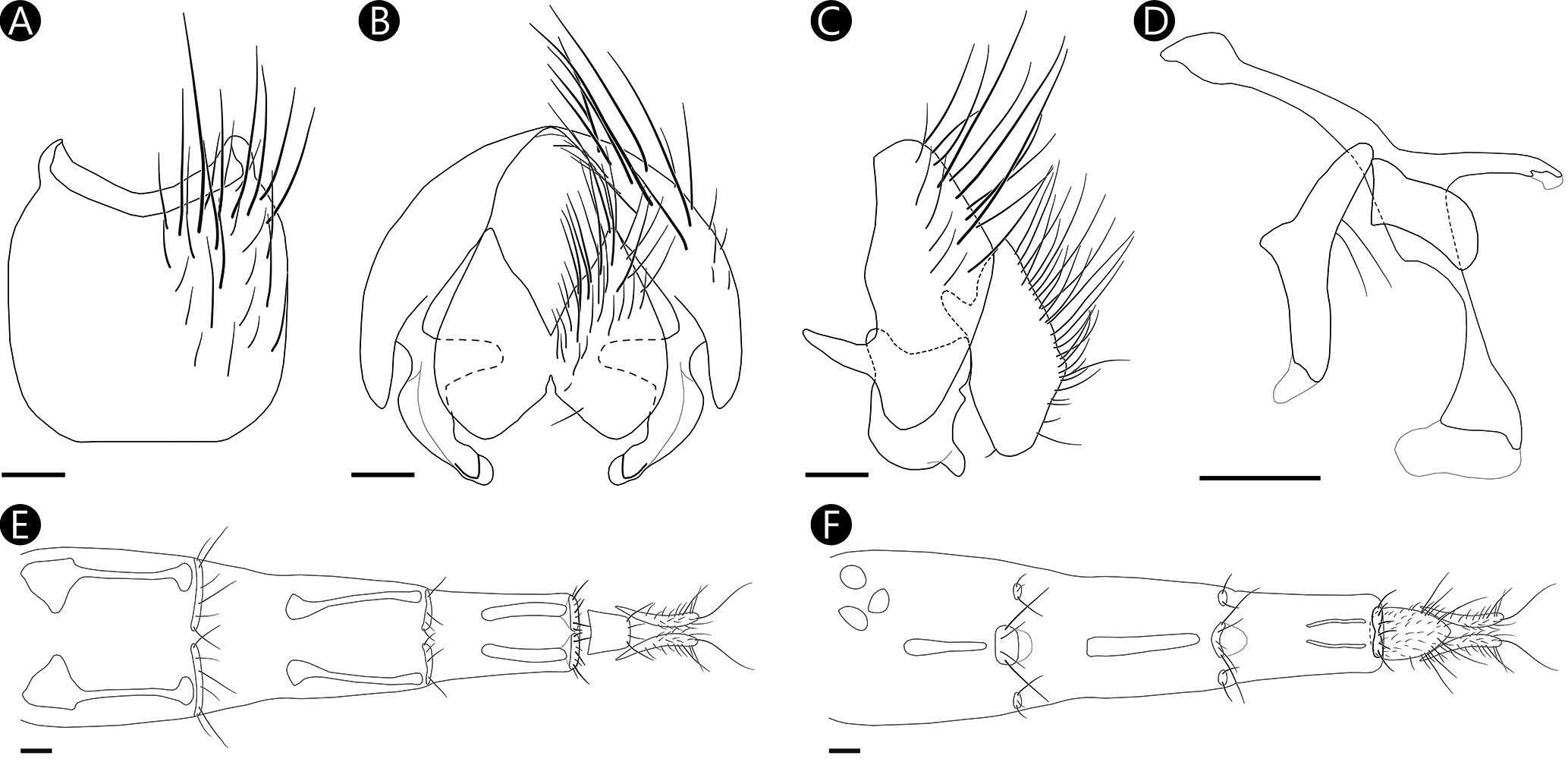
Abdomen: Tergites 4 and 5 with long marginal setae (Fig. 1E). Sternite 1 ciliated. Sternite 5 quadrangular, slightly longer than wide, covered by longer setae on its posterior region (Fig. 2A).
Terminalia: Cerci medially connected in dorsal view, with a rounded ventral extremity; surstyli curved inwards (Fig. 2B). In lateral view, the epandrium, cerci, and surstyli have similar widths; the surstyli bears a rounded posteroapical projection (Fig. 2C). Pregonite twice longer than postgonite, bearing 2 long submedian setae (Fig. 2D). Phallapodeme apically enlarged (Fig. 2D). Epiphallus as long as the postgonite (Fig. 2D). Distiphallus apically enlarged, with a triangular shape (Fig. 2D).
Morphological variation: Body length: 5.0-8.0 mm. Wing length: 5.0-7.5 mm. In some specimens, the anterior presutural acrostichal are short and difficult to distinguish from the covered setulae. The lower calypter margin is yellow in some specimens. Setulae on vein R₄₊₅ extend from the base of Rs to near the apex of R₄₊₅ on both dorsal and ventral surfaces, they are more conspicuous beyond Rs, whereas the most apical setulae are inconspicuous, sparse, or absent in some specimens. Legs coloration is variable (see Discussion).
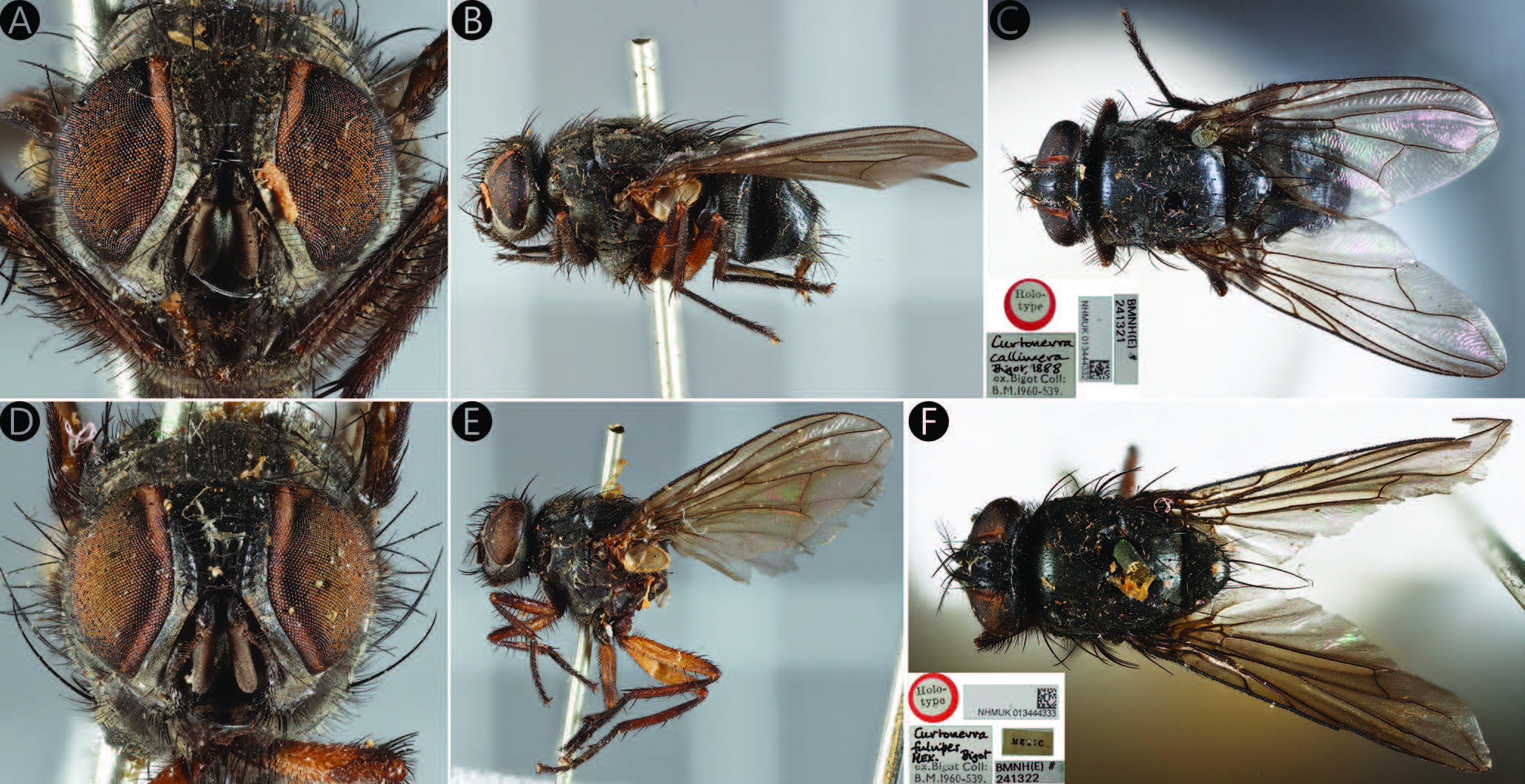
Female: As in male, except as follows. Head: Dichoptic (Fig. 3A, D). Ocellar setae long, slightly longer or similar in length to the frontal setae. 11-12 pairs of convergent frontal setae, 2 pairs of proclinate orbital setae (the anterior one twice longer), and 2 pairs of reclinate orbital setae (the posterior one slightly longer). Inner vertical setae convergent, twice longer than the outer vertical setae. Postocellars slightly shorter than frontal setae.
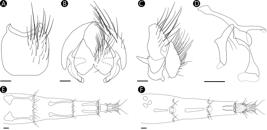
Morellia (Trichomorellia) callidimera (Bigot). Male: sternite 5, ventral view (A); epandrium, cerci, and surstyli, posterior view (B); epandrium, cerci, and surstyli, lateral view (C); aedeagus and associated structures, lateral view (D). Female: ovipositor, dorsal view (E); ovipositor, ventral view and spermathecae (F). Scale bar: 0.1 mm.
Thorax: Dorsocentral presutural setae of similar length. A row of 8-9 anepisternal setae. Scutellum with a long pair of apical and basal setae, the basal pair slightly longer; a pair of prebasal with ⅕ the length of the basal pair; a pair of subapical scutellar setae ¼ the length of the apical pair; and a discal scutellar pair approximately ⅔ the length of the apical setae. Wing: Calypter yellow, with margin ranging from light brown to yellowish (Fig. 3B, E). Legs: Mid femur with 3 p to pd preapical setae; without thick, truncate apical d setae; the 2-3 pv setae shorter than in males. Mid tibia with 3 median p; the pd are shorter than in male, almost indistinguishable from the cover setulae. Hind femur with a median pv seta with about half as long as femur width; 5-6 av setae on the apical – of the femur, as long as femur width. Hind tibia with 4 ad; without a row of long and thin pv; 4 av as long as tibia width. Terminalia: Tergites 6 conspicuously enlarged basally and apically; tergites 7 slightly enlarged basally; tergite 8 narrow; epiproct quadrangular, with 2 pairs of apical setae (Fig. 2E). Sternite 6-8 narrow, with a rounded apical plate; hypoproct triangular, covered by setulae, with 3 pairs of setae on the apical margin; cerci long and narrow, as long as the hypoproct, with a long apical seta slightly shorter than the cerci length (Fig. 2F). Three rounded spermathecae (Fig. 2F).
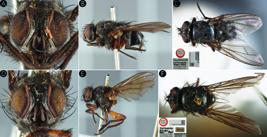
Morellia (Trichomorellia) callidimera (Bigot), holotype female: head, frontal view (A); habitus, lateral view (B); habitus, dorsal view (C). M. (T.) fulvipes (Bigot), holotype female [ junior synonym of M. (T.) callidimera (Bigot) ]: head, frontal view (D); habitus, lateral view (E); habitus, dorsal view (F).
Type Material examined: Holotype female. “Holotype” (NHM holotype label); “Curtonevra \ callimera \ Bigot, 1888 \ ex. Bigot Coll: \ B.M. 1960-539.” (white handwrite/printed label); “NHMUK 013444332” (white printed label); “C. callimera ♀ \ Mexique J. Bigot” (white handwrite label, not in the specimen).
Material examined: Mexico. Guerrero. Amula, 6,000 ft., Sept., H.H. Smith, 1 male (BMNH); Amula, 6,000 ft., August., H.H. Smith, 2 males and 2 females (BMNH); Omilteme, 8,000 ft. July, H.H. Smith, 1 male and 1 female (BMNH); Sierra de las Aguas Escondidas, 7,000 ft., July, H.H. Smith, 4 males [a male dissected in 1978] and 2 females (BMNH); Xucumanatlan, 7,000 ft., July, H.H. Smith, 1 male and 2 females (BMNH). Veracruz. Huatusco de Chicuellar, Las Cañadas, 02.ix.2004, Malaise 1, S. Ibañez, F.A. Pech, J.F. Dzul col. DIP-010863, 1 male (IEXA) [photo and description]; Huatusco, Las Cañadas, 1,340 m, 20.iv.2004, red, V. Hernández, C. Deloya, F.A. Pech, DIP-010213, 2 males (IEXA); Huatusco, Las Cañadas, 1,340 m, 21.iv.2004, Malaise, V. Hernández, C. Deloya, F.A. Pech, DIP-010235, 1 female (IEXA).
Distribution: Guatemala (Ciudad de Guatemala) and Mexico (Guerrero, Morelos, and Veracruz) (Snyder, 1949; Löwenberg-Neto & de Carvalho, 2013).
Remarks: The holotype is in good condition, with a dorsal perforation in the thorax.
Morellia (Trichomorellia) fulvipes (Bigot, 1887) [junior synonym of M. (T.) callidimera (Bigot, 1887); Synonymy by Pont (2000: 14)] (Fig. 3D-F).
Material examined: Holotype female. “Holotype” (NHM holotype label); “Curtonevra \ fulvipes \ MEX. Bigot \ ex. Bigot Coll: \ B.M. 1960-539.” (white handwrite/printed label); “C. fulvipes♀ \ Mexique J. Bigot” (white handwrite label).
Remarks: Holotype in good condition, abdomen and left mid leg missing.
DISCUSSION
No significant morphological differences were observed between the holotype of M. (T.) callidimera and M. (T.) fulvipes, except for leg coloration. In M. (T.) callidimera, the fore femur is light brown and the mid and hind femora are yellow with light brown apex (Fig. 3B). In contrast, in M. (T.) fulvipes, the fore femur is light brown with a yellow base, and mid and hind femora are completely yellow (Fig. 3E).
The material from Guerrero (Mexico) examined by Wulp (1896) and identified as M. (T.) callidimera present variation in leg coloration. Fore femur ranges from entirely yellow to yellow basally with a light brown apex, or entirely light brown. The mid femur may bear an apical dark brown area with less than one-fifth of femoral length or extending to approximately one-third. One male specimen with completely yellow legs was previously dissected, and its terminalia is identical to those of the Veracruz specimen described here, indicating that leg coloration is variable within this species.
Given the observed variation in leg, the identical male genitalia among specimens with different leg patterns, and the fact that leg coloration is the only difference between the holotypes of M. (T.) callidimera and M. (T.) fulvipes, the synonym proposed by Pont (2000) is supported.
The terminalia of the subgenus Trichomorellia remain poorly documented. Pamplona (1983) described and illustrated the terminalia of four species. Male terminalia are known for three species: M. (T.) trichops, M. (T.) seguyi, and M. (T.) benoisti. Whereas female terminalia have been described for four species: M. (T.) trichops, M. (T.) seguyi, M. (T.) benoisti, and M. (T.) flavipalpis. However, in females only the cerci, epiproct, and hypoproct were illustrated.
The female terminalia of M. (T.) callidimera most closely resemble to M. (T.) flavipalpis, particularly in lacking spines on the ovipositor (the male of M. (T.) flavipalpis is unknown). In contrast, the male terminalia is more similar to M. (T.) benoisti and M. (T.) trichops, especially in the morphology of the cerci, epandrium, and surstyli. In these three species, the surstyli bear a rounded posteroapical projection in lateral view, although it is narrower in M. (T.) callidimera.
Among the species treated by Pamplona (1983), males of M. (T.) benoisti, M. (T.) trichops, and M. (T.) seguyi possess a dorsal protuberance with setae on the mid femur. However, none exhibit modifications comparable to the two thick, truncate dorsal apical setae present in M. (T.) callidimera.
In the present study, the female sternites and tergites of Trichomorellia are described for the first time. Comprehensive redescriptions of the remaining species are needed to clarify interspecific morphological variation, particularly the male and female terminalia.
ACKNOWLEDGMENTS:
I am grateful to Dr. Vicente Hernández (INECOL) for the loan of part of the material examined; Dr. Duncan Sivell, Dr. Erica McAlister, and Dr. Zoe Adams for hosting my visit to BMNH and providing support during my research. My visit to the BMNH was funded by the Ernst Mayr Travel Grant (Museum of Comparative Zoology, Harvard University).
Data Availability:
All data generated in this study are included within the article.
REFERENCES
- Albuquerque, D. de O. 1951. Quinta nota sôbre tipos de Macquart (Diptera-Muscidae), existentes no Museu Nacional de História Natural de Paris e descrição de uma espécie nova, proveniente do Chile. Boletim do Museu Nacional. Nova série, Zoologia, 105: 1-17.
- Albuquerque, D. de O. 1956. Fauna do Distrito Federal. XII. Sôbre o gênero Morellia R.-D. (Diptera-Muscidae). Boletim do Museu Nacional. Nova série, Zoologia, 131: 1-45.
- Albuquerque, D. de O. & Lopes, S.M.R. 1979. Uma nova espécie de Parapyrellia Townsend, 1915 com notas sobre Muscinae neotrópicos (Diptera, Muscidae). Revista Brasileira de Biologia, 39(2): 327-330.
- Bigot, J.-M.-F. 1887. [Note, in Séance of 9 November 1887]. Bulletin bimensuel de la Société Entomologique de France, 1887(21): clxxii-clxxiv.
-
Bigot, J.-M.-F. 1888. Diptères nouveaux ou peu connus. Muscidi (J.B.). Bulletin de la Société Zoologique de France, 12[1887]: 581-617. https://doi.org/10.5962/bhl.title.9278.
» https://doi.org/10.5962/bhl.title.9278 - Cumming, J.W. & Wood, D.M. 2017. 3. Adult morphology and Terminology. In: Kirk-Spriggs, A.H. & Sinclair, B.J. (Eds.). Manual of Afrotropical Diptera, vol. 1, Introductory chapters and key to Diptera families Suricata 4. Pretoria, South African National Biodiversity Institute. p. 89-133.
- de Carvalho, C.J.B. & Couri, M.S. 2002. Part I. Basal groups. In: de Carvalho, C.J.B. (Ed.). Muscidae (Diptera) of the Neotropical Region: taxonomy Curitiba, Editora Universidade Federal do Paraná, p. 17-132.
- de Carvalho, C.J.B.; Couri, M.S.; Pont, A.C.; Pamplona, D. & Lopes, S.M. 1993. Part II. Muscidae. In: de Carvalho, C.J.B. (Ed.). A catalogue of the Fanniidae and Muscidae (Diptera) of the Neotropical region São Paulo, Sociedade Brasileira de Entomologia. 201p.
-
de Carvalho, C.J.B.; Couri, M.S.; Pont, A.C.; Pamplona, D. & Lopes, S.M. 2005. A catalogue of the Muscidae (Diptera) of the Neotropical Region. Zootaxa, 860: 1-282. https://doi.org/10.11646/zootaxa.860.1.1.
» https://doi.org/10.11646/zootaxa.860.1.1 - Giglio-Tos, H. 1896. Ditteri del Messico. Parte Quarta. Muscidae calypteratae: Muscinae, Anthomyinae. Muscidae acalypteratae: Scatophaginae, Helomyzinae, Tetanocerinae, Ortalinae, Ulidinae, Sapromyzinae, Trypetinae, Sepsinae, Tanypezinae, Psilinae, Chloropinae, Ephydrinae, Drosophilinae. Memorie della (Reale) Accademia delle Scienze di Torino, 45(2): 1-74.
-
Löwenberg-Neto, P. & de Carvalho, C.J.B. 2013. Muscidae (Insecta: Diptera) of Latin America and the Caribbean: geographic distribution and check-list by country. Zootaxa, 3650: 1-147. https://doi.org/10.11646/zootaxa.3650.1.1.
» https://doi.org/10.11646/zootaxa.3650.1.1 -
Nihei, S.S. & de Carvalho, C.J.B. 2011. Taxonomy and cladistic analysis of the subgenus Xenomorellia Malloch (Diptera: Muscidae: Morellia Robineau-Desvoidy) with description of two new species. Journal of Natural History, 45(41-42): 2627-2644. https://doi.org/10.1080/00222933.2011.597883.
» https://doi.org/10.1080/00222933.2011.597883 - Pamplona, D.M. 1983. Sobre as espécies de Dasymorellia Malloch, 1923 (Diptera, Muscidae - Muscinae). Boletim do Museu Nacional. Nova série, Zoologia, 305: 1-10.
- Pont, A.C. 1972. 97. Family Muscidae. In: A Catalogue of the Diptera of the Americas South of the United States, São Paulo, Secretaria da Agricultura. Museu de Zoologia, Universidade de São Paulo. 111p.
- Pont, A.C. 2000. The Muscoidea (Insecta, Diptera) described by J.-M.-F. Bigot. Occasional Papers on Systematic Entomology, 12: 1-40.
-
Pont, A.C.; Nihei, S.S. & de Carvalho, C.J.B. 2005. On the Genera Trichomorellia Stein and Cyacyrtoneura Townsend (Diptera: Muscidae). Neotropical Entomology, 34(1): 63-66. https://doi.org/10.1590/S1519-566X2005000100009.
» https://doi.org/10.1590/S1519-566X2005000100009 - Séguy, E. 1935. Études sur les anthomyiides. 9e, 10e et 11e notes. 9. Trois Phaoniines nouveaux de Madagascar. 10. Étude sur le genre Morellia R.-D. 11. Un nouveau Trichomorellia de l’Equateur (Muscides). Encyclopédie Entomologique, B II, Diptéres, 8: 97-116.
- Séguy, E. 1937. Diptera Fam. Muscidae. In: Wytsman, P. (Ed.). Genera Insectorum, n. 205 Brussels, Desmet-Verteneuil. 604p.
- Snyder, F.M. 1949. Notes and descriptions of some Phaoniinae (Diptera, Muscidae). American Museum Novitates, 1402: 1-25.
- Stein, P. 1919. Die Anthomyidengattungen der Welt, analytisch bearbeitet, nebst einem kritisch-systematischen Verzeichnis aller aussereuropäischen Arten. Archiv für Naturgeschichte, 83A1[1917]: 85-178.
- Wulp, F.M. van der. 1896. Group Muscinae (Part.) In: Godman, F.D. & Salvin, O. (Eds.). Biologia Centrali-Americana. Zoologia-Insecta-Diptera, part 129 London, Taylor & Francis. p. 291-304.
-
Ethics Statement:
No applicable.
-
AI Use:
No artificial intelligence tools were used in the preparation of this manuscript.
-
Funding:
Ernst Mayr Travel Grant (Museum of Comparative Zoology, Harvard University).
-
Published with the financial support of the “Programa de Apoio às Publicações Científicas Periódicas da Universidade de São Paulo”.
Edited by
-
Edited by:
Carlos José Einicker Lamas