New land microsnails of the genus Gastrocopta (Eupulmonata: Gastrocoptidae) in the semiarid region of Brazil
Abstract
In Brazil, Gastrocoptidae Pilsbry, 1918 includes only land microsnails of the genus Gastrocopta Wollaston, 1878. Here, two new species of Gastrocopta are described from the phytogeographic domain of the Caatinga (semiarid scrubland): Gastrocoptajoaoherminioi sp.nov. and Gastrocopta caatinga sp.nov. The shell morphology of G. joaoherminioi sp.nov. differs substantially from native and invasive congeners of Brazil, mainly in the greatly convex whorls as well as in the number and configuration of apertural barriers, which totals 11 very strongly developed teeth (except suprapalatal tooth) that greatly obstruct the region. The shell morphology of G. caatinga sp.nov. has a typical ovoid shape and apertural barriers totaling four teeth that do not obstruct the region (except for the projection of parieto-angular tooth). The new land snails, found in a dense layer of leaf litter on sandy soil at a semi-open dry tropical forest habitat, are compared with congeners from the neotropical region.
Keywords
South America; Tropical dry forest; Caatinga; Gastropoda; Gastrocoptinae
INTRODUCTION
Brazil’s phytogeographic domains are great storehouses of terrestrial invertebrates still unknown to Science (Almeida-Azevedo et al., 2023; Becker, 2023; Bedoya-Roqueme et al., 2023a, b; Campos-Filho et al., 2023; James et al., 2023; Bouzan et al., 2024; López-Orozco et al., 2024; Maia, 2024; Paredes-Munguía et al., 2024; Pecly et al., 2024; Tavares et al., 2024). Land microsnails (smaller than 5 mm) represent an important component of the invertebrate biota in these domains (Simone, 2006) and are mainly associated with vegetable organic matter deposited on the soil (Maestrati et al., 2015). Among the main families of microsnails found in Brazil are Charopidae Hutton, 1884, Diplommatinidae Pfeiffer, 1857, Euconulidae Baker, 1928, Gastrocoptidae Pilsbry, 1918, Gastrodontidae Tryon, 1866, Strobilopsidae Wenz, 1915, Valloniidae Morse, 1864, Vertiginidae Fitzinger, 1833 and Zonitidae Mörch, 1864 (Simone, 2006; Maestrati et al., 2015; Salvador et al., 2017, 2018).
Gastrocopta Wollaston, 1878 is a genus of the family Gastrocoptidae with the most expressive species richness and the most widely distributed through the planet’s terrestrial ecosystems (MolluscaBase, 2024). Such gastrocoptids live in association with moss, shrubs, fallen trunks, leaf litter as well as clay, granite, schist, sandy soils, flood debris and cliffs (Solem, 1991; Pokryszko et al., 2009; Nekola & Coles, 2010; Stanisic et al., 2010, 2018; Miquel & Brito, 2019; Brito & Miquel, 2022; Herbert & Willows-Munro, 2022), as well as calciphilic environments (Solem, 1991; Vermeulen & Whitten, 1998; Hotopp et al., 2013).
In Brazil, members of the family Gastrocoptidae include only representatives of the genus Gastrocopta, which are mainly found in the phytogeographic domains of the Atlantic Forest, Caatinga [e.g., G. oblonga (L. Pfeiffer, 1854)], Cerrado [e.g., G. sharae Salvador, Cavallari & Simone, 2017] and Pampa [e.g., G. iheringi (Suter, 1900)] (Simone, 2006; Salvador et al., 2017, 2018; Cozer et al., 2021). Other congeners were reported on Brazilian islands [e.g., G. solitaria (Smith, 1890) and G. barbadensis (Pfeiffer, 1853)] (Simone, 2006; Cunha et al., 2015) and recognized as invasive taxa [e.g., G. barbadensis and G. pelucida hordeacella (Pilsbry, 1890)] (Kotzian & Amaral, 2013; Cunha et al., 2015; Batistão et al, 2021; Miranda et al, 2023; Abreu et al, 2024).
Gastrocopta is by far one of the least studied land microsnails in Brazil (Simone, 2006) with sparse periods of descriptions of new species throughout the centuries (Pfeiffer, 1852; Suter, 1900; Salvador et al., 2017). This and other genera of microsnails have a species richness that is recognized as underestimated on account of the Brazilian megadiversity still being associated with many unexplored regions as well as the difficulty in sampling and, especially, screening of minute-small individuals from the different types of ecological environments (Salvador, 2019).
To the best of our knowledge regarding the richness of Gastrocopta, this paper describes two new species in the semiarid region of Brazil.
MATERIAL AND METHODS
Study area
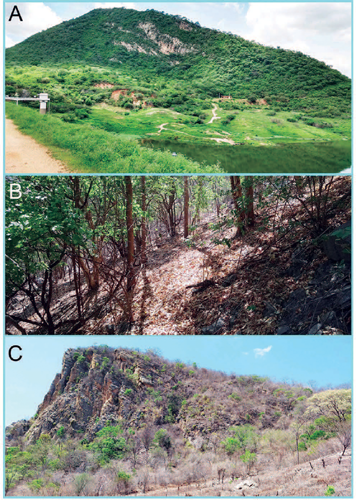
Engenheiro Ávidos Ecological Park – EAEP (06°59′39.73″S, 38°27′14.47″W) is inserted in the municipalities of Cajazeiras and São José de Piranhas, state of Paraíba, northeastern Brazil. EAEP is situated between a mountainous chain with shrub-herbaceous and arboreal vegetation, hyperxerophilic phytophysiognomy (Araújo & Pereira, 2016; Souto et al., 2019a) and aquatic ecosystems (Fig. 1), e.g., Piranha reservoir, streams and marginal lagoons (Freitas, 2012; Souto et al., 2019a, b). The temperature ranges from 23° to 33°C and average rainfall is 800 mm with rains concentrated between February and April (Feitosa, 2000). EAEP has shallow sandy-clay soil at the base of the mountain and is stony on the plateau (Bandeira, 2016).
Photos showing study area where microsnails were collected in EAEP: (A) General view of the collection area in the rainy season; (B) General view of stretch where the microsnails were collected in the rainy season; (C) General view of stretch of the collection area in the dry season.
EAEP is a priority area for biodiversity conservation due to the unique biota, which has been studied very little over the years and is extremely susceptible to anthropogenic disturbances (Araújo & Pereira, 2016; Feitosa et al., 2002; Souto et al., 2019a, b).
Collection and identification
Collections of litter (leaf and soil) were carried out for one year (2017 to 2018) in a less impacted area of EAEP. Collection areas included habitats bordering and entering the native vegetation. Substrates (10 to 15 kg of litter) from different points of the study area were collected for the screening of microsnails under a stereomicroscope. The litter was left to dry in the sun and micromollusks were then screened under a stereomicroscope. The material was processed at the Zoology Lab of the Professor Education Center of the Federal University of Campina Grande. Sampling was carried out with the authorization of Sistema de Autorização e Informação em Biodiversidade (SISBIO 60982-1) [Authorization and Information System in Biodiversity], Instituto Chico Mendes de Conservação da Biodiversidade [Chico Mendes Biodiversity Conservation Institute], Ministério do Meio Ambiente [Ministry of the Environment].
Identification of the microsnails was performed under a stereomicroscope. Shells were also studied based on photographs taken with a stereoscopic microscope. The description of apertural barriers (clockwise in aperture) is based on Whisson & Köhler (2012: 17, fig. 1).
Microsnails are deposited in the following scientific collections: UFPB.MOL – Coleção de Invertebrados Paulo Young, Departamento de Sistemática e Ecologia, Universidade Federal da Paraíba (UFPB), João Pessoa, Paraíba, Brazil; CMPHRM-B – Coleção Malacológica Prof. Henry Ramos Matthews (Série B), Departamento de Biologia, Universidade Federal do Ceará, Fortaleza, Ceará, Brazil.
RESULTS
Gastrocopta joaoherminioi sp. nov. (Fig. 2)
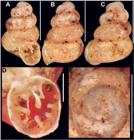
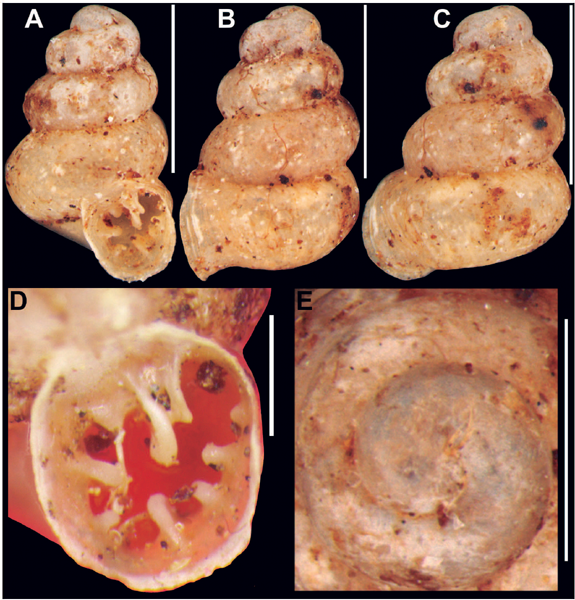
Gastrocopta joaoherminioisp. nov. collected from the EAEP: (A) Ventral view, (B) Right view, (C) Dorsal view, (D) Detail of aperture, (E) Apical view. Scale bars: A-C = 1 mm (holotype), D = 0.2 mm (paratype - UFPB.MOL-44074), and E = 0.5 mm (holotype).
Type material: Holotype – UFPB.MOL-44073 (Figs. 2A,B,C, E);
Paratypes – UFPB.MOL-44074 (9 shells) (Fig. 2D), CM-PHRM7521B (4 shells), all from type locality; CMPHRM7520B (5 shells), Brazil, Paraíba, municipality of Cajazeiras, EAEP, sampling area 9, 06°59′07″S, 38°27′34″W (410 m), litter (leaf and soil), 25.XI.2017, Evandro C.T. Abreu collector.
Type locality: Brazil, Paraíba, municipality of Cajazeiras, EAEP, sampling area 8, 06°59′06″S, 38°27′32″W (401 m), litter (leaf and soil), 25.XI.2017, Evandro C.T. Abreu collector.
Etymology: The species is named to honor Prof. Dr. João Hermínio da Silva (1961-2023). Prof. João Hermínio, as he was called among his colleagues and students, obtained a degree in Mathematics from the Universidade Estadual do Ceará (UECE: 1984-1989), a master’s degree in Energy and Nuclear Technologies from the Universidade Federal de Pernambuco (UFPE: 1997-1999), a PhD in Physics from the Universidade Federal do Ceará (UFC: 2002-2007) and a Post-Doctorate from the Universidade Federal do Piauí (UFPI: 2015-2016). He was a professor at the Universidade Estadual do Tocantins (Unitins: 1995-1996), Universidade Federal Rural de Pernambuco (UFRPE: 1997-1999), UFC (2002-2006), Instituto Centro de Ensino Tecnológico (Centec: 2006-2007), Centro Universitário Farias Brito (FB UNI: 2007-2007), UFC (2010-2015) and finally Universidade Federal do Cariri (UFCA: 2016-2023). He was a research productivity fellow at the Conselho Nacional de Desenvolvimento Científico e Tecnológico (CNPq) due to his important scientific, technological and innovation production involving raman and infrared spectroscopy, materials subjected to high temperatures and high pressures, vibrational properties of amino acid crystals, growth and characterization of amino acid crystals, application of radioisotopes, Physics and Microbiology, Physics Applied to Paleontology and Archeology and Teaching Physics. He dedicated part of his life to the study of fossils from the Araripe Basin (located between the south of the state of Ceará, the west of the state of Pernambuco and the east of Piauí) contributing to paleontological research, mainly in the Cariri of the state of Ceará, as well as the training of researchers and teachers in the areas of Physical, Geological, Paleontological and Biological Sciences. Prof. João Hermínio passed away at the age of 62.
Diagnosis: Apertural barriers with 11 very strongly developed teeth (except suprapalatal tooth) greatly obstructing aperture, not extending to lip margin. Parietal to angular region with five teeth – infraparietal tooth apparently semicircular, completely anastomosed with parieto-angular tooth 1; parieto-angular tooth 2 longest of all teeth, slightly or strongly anastomosed to adjacent teeth, recurved to left, bulbous in distal region, tapered in proximal region; parieto-angular tooth 3 semicircular, partially anastomosed to adjacent teeth, forming minute apical space between them or completely anastomosed to adjacent teeth not forming space between them; angular tooth moderately long, with similar thickness along its length, slightly recurved to right, connected in distal region or completely anastomosed to parieto-angular tooth 2. Palatal region with four well-spaced, rounded teeth – suprapalatal tooth minute, tubercular (inconspicuous in some shells); upper palatal tooth and inter-palatal tooth semicircular, with similar size; lower palatal tooth semicircular, larger and more robust among palatal teeth. Basal tooth low, semicircular. Columellar tooth semicircular, strong, thick, moderately long, oblique (diagonal) or perpendicular to columellar axis, located at about midpoint of columellar wall. Columellar tooth and lower palatal tooth similar in size and outline.
Description: Shell dextral, whitish to light cream, thin, minute (length about 1.2 mm), pupilloid-conical (Figs. 2A,B,C), surface worn (mostly devoid of periostracum) marked by growth striations (Fig. 2E). Apex obtuse, blunt, strongly domed. Protoconch smooth, bulbous, blunt, with about 1.5 whorl; proto-teleoconch transition marked by faint edge (Fig. 2E). Spire weakly convex (about 45% of total length), blunt-obtuse (Figs. 2A,B,C). Teleoconch with 3.5 to 4.0 inflated, globose, greatly convex whorls, rather increasing conspicuously in size; sculptured by closely spaced, rather regular, faint, fine, prosocline axial riblets visible on an unworn surface (Figs. 2A,B,C, E). Body whorl with about 55% of total length, expanded, oval, width with about 60% of total length of shell (Fig. 2A), contour strongly projected to left in ventral view (Fig. 2A), lateral view with depression (Fig. 2B). Umbilicus large and rounded. Suture deeply impressed, oblique (diagonal) to columellar axis (Figs. 2A,B,C, E). Peristome subcircular (not virtually complete) very slightly reflexed on columellar and parietal areas (parietal callus slightly distinct, thin). Lip thin, narrow. Aperture subcircular, about 35% of total length. Apertural barriers with 11 very strongly developed teeth (except suprapalatal tooth) greatly obstructing aperture, not extending to lip margin. Parietal to angular region with five teeth – infraparietal tooth apparently semicircular, completely anastomosed with parieto-angular tooth 1; parieto-angular tooth 2 longest of all teeth, slightly or strongly anastomosed to adjacent teeth, recurved to left, bulbous in distal region, tapered in proximal region; parieto-angular tooth 3 semicircular, partially anastomosed to adjacent teeth, forming minute apical space between them (Fig. 2D) or completely anastomosed to adjacent teeth not forming space between them; angular tooth moderately long, with similar thickness along its length, slightly recurved to right, connected in distal region (Fig. 2D) or completely anastomosed to parieto-angular tooth 2. Palatal region with four well-spaced, rounded teeth – suprapalatal tooth minute, tubercular (inconspicuous in some shells); upper palatal tooth and interpalatal tooth semicircular, with similar size; lower palatal tooth semicircular, larger and more robust among palatal teeth. Basal tooth low, semicircular. Columellar tooth semicircular, strong, thick, moderately long, oblique (diagonal) (Fig. 2D) or perpendicular (Fig. 2A) to columellar axis, located at about midpoint of columellar wall. Columellar tooth and lower palatal tooth similar in size and outline (Figs. 2A, D).
Distribution: Known only from the municipality of Cajazeiras, Paraíba, Brazil.
Remarks: The shell morphology of Gastrocopta joaoherminioi sp. nov. differs substantially from the native and invasive congeners of Brazil, mainly in the greatly convex whorls (Figs. 2A,B,C) as well as in the number and configuration of apertural barriers (Fig. 2D). The shell morphology of G. joaoherminioi sp. nov. and G. sharae correspond in their pupilloid-conical shape, markedly convex whorls associated with a deep suture and strongly developed apertural dentition. These species also have a columellar tooth and lower palatal tooth with similar outline and inclination. Gastrocopta joaoherminioi sp. nov. differs markedly from G. sharae due to the presence of 11 apertural barriers that greatly obstruct the region (Fig. 2D). In contrast, this cave gastrocoptid discovered in the state of Goiás (Central-West of Brazil) only have four apertural barriers (upper palatal tooth, lower palatal tooth, columellar lamella and anguloparietal lamella) (Salvador et al., 2017: 136-139, figs. 2-6). The new species has infraparietal tooth, three parieto-angular teeth, suprapalatal tooth, interpalatal tooth and basal tooth (Fig. 2D), which are non-existent in G. sharae (Salvador et al., 2017: 136-139, figs. 2-6).
Gastrocopta joaoherminioisp. nov. and G. aliciae Miquel & Brito, 2019 [from the Galapagos Islands (Ecuador)] have strongly developed teeth greatly obstructing aperture. Both species also share similar arrangement and strength of the columellar tooth, parietoangular tooth and angular tooth. The new species differs sub-stantially from G. aliciae in having greatly convex teleoconch whorls, a greater number of teeth in the parietal region and absence of supracolumellar and subcolumellar teeth.
Gastrocopta joaoherminioisp. nov. has 11 strongly developed teeth greatly obstructing aperture (Figs. 2A, D) while G. crucifera Hylton Scott, 1948 and G. pulvinata Hylton Scott, 1948 [both from Argentina] have six to seven apertural barriers that do not obstruct the aperture. The new species has a columellar tooth located at about midpoint of columellar wall (Figs. 2A, D), while G. crucifera and G. pulvinata have columellar tooth located near the infraparietal region (Hylton Scott, 1948: 245, fig. 1; 246, fig. 2, respectively). Gastrocopta joaoherminioi sp. nov. has a well-developed basal tooth (Figs. 2A, D), while it is absent in G. crucifera (Hylton Scott, 1948: 245, fig. 1). The aperture of G. joaoherminioi sp. nov. has three well-developed parieto-angular teeth and four palatal teeth (Fig. 2A, D), while aperture of G. pulvinata presents only one parieto-angular tooth and two palatal teeth (Hylton Scott, 1948: 246, fig. 2).
Gastrocopta caatinga sp. nov. (Fig. 3)
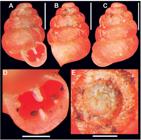
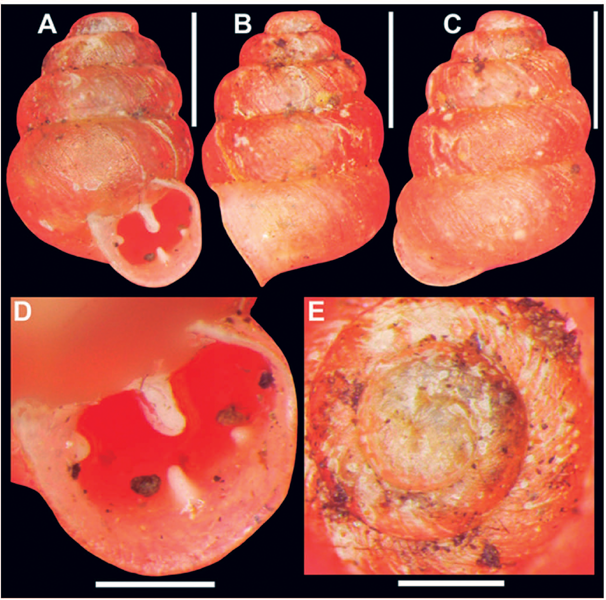
Gastrocopta caatingasp. nov. (holotype) collected from the EAEP: (A) Ventral view, (B) Right view, (C) Dorsal view, (D) Detail of aperture, (E) View of protoconch. Scale bars: A-C = 0.5 mm, D-E = 0.2 mm.
Type material: Holotype – UFPB.MOL-44075 (Fig. 3); paratypes - UFPB.MOL-44076 (1 shell) and CM-PHRM7522B (1 shell), all from type locality.
Type locality: Brazil, Paraíba, municipality of São José de Piranhas, EAEP, sampling area 17, 06°59′23″S, 38°27′28″W (404 m), litter (leaf and soil), 10.II.2018, Evandro C.T. Abreu collector.
Etymology: The specific name honors the phytogeographic domain of the Caatinga – from the Tupi-Guarani, meaning “white forest” referring to the landscape consisting of leafless vegetation and whitish trunks typical of the dry season, or a large geographic area covering the greater part of northeastern Brazil characterized by the variety of vegetation cover, which is usually deciduous and hyperxerophilic.
Diagnosis: Apertural barriers with four teeth that do not obstruct the region (except for projection of parieto-angular tooth). Parieto-angular tooth longest of all teeth, slightly bifid, recurved to right, located at midpoint of parietal region. Upper palatal tooth minute. Lower palatal tooth rounded, second biggest tooth. Columellar tooth low, semicircular, slightly oblique (diagonal) to columellar axis, located at midpoint of columellar wall.
Description: Shell dextral, whitish to light cream, thin, minute (length about 1.2 mm), ovoid (Figs. 3A,B,C). Apex cap shape, apically subflattened. Protoconch worn, apparently smooth, with about 1.5 whorl; proto-teleoconch transition marked by faint edge and appearance of numerous, faint growth striations (Fig. 3E). Spire moderately convex (about 60% of total length). Teleoconch with about 4 inflated, globose, moderately convex whorls, increasing moderately in size, sculptured by closely spaced, rather regular, faint, fine, prosocline axial riblets visible on unworn surface (Figs. 3A,B,C). Body whorl with about 40% of total length, expanded, strongly oval, width about 68 to 69% of total length of shell (Figs. 3A,B,C). Umbilicus large and rounded. Suture well impressed, moderately deep, slightly oblique (diagonal) to columellar axis (Figs. 3A,B,C). Peristome slightly reflexed (little more prominent on columellar area), rounded in columellar to lower palatal area, flattened in upper palatal area; suprapalatal region with distinct angulation. Lip moderately thickened, narrow. Aperture subsquare, about 37 to 38% of total length. Apertural barriers with four teeth that do not obstruct region (except for projection of parieto-angular tooth), not extending to lip margin. Parieto-angular tooth longest of all teeth slightly bifid, recurved to right located at midpoint of parietal region. Upper palatal tooth minute. Lower palatal tooth rounded, second larger tooth. Columellar tooth low, semicircular, slightly oblique (diagonal) to columellar axis, located at midpoint of columellar wall (Figs. 3A, C-D).
Geographical distribution: Known only from the municipality of São José de Piranhas, Paraíba, Brazil.
Remarks:Gastrocopta caatingasp. nov. differs substantially from native and invasive Brazilian congeners in having basically an ovoid shape (Figs. 3A,B,C) and apertural barriers with distinctive size, outline and/or inclination of the dentition (Figs. 3A, D). In Brazilian phytogeographical domains, there is no species of Gastrocopta with shell morphology similar to G. caatinga sp. nov.
The new species superficially resembles G. barbadensis [Cunha et al., 2015: fig. 2D], G. iheringi [Simone, 2006: fig. 346], G. oblonga [Simone, 2006: fig. 347] and G. solitaria [Simone, 2006: fig. 349] in the outline of the teleoconch whorls; G. barbadensis in the distinct angulation of the suprapalatal region; G. oblonga in its subsquare aperture; and G. sharae [Salvador et al., 2017: figs. 2-6] in the arrangement of teeth on the columellar and palatal areas.
DISCUSSION
The new species were found in a dense layer of leaf litter (Fig. 1B) on sandy soil at a semi-open dry tropical forest habitat composed of shrubs (e.g., Croton jacobinensi and Jatropha mollissima – Euphorbiaceae) and mainly trees (e.g., Anadenanthera colubrina, Mimosa arenosa, M. tenuiflora, Piptadenia moniliformis, P. retusa and Senegalia polyphylla – Fabaceae; Cochlospermum vitifolium – Cochlospermaceae; Astronium urundeuva – Anacardiaceae) (Figs. 1A, C), which partially shaded the site (Fig. 1B).
The shells of Gastrocopta joaoherminioi sp. nov. and G. caatinga sp. nov. presented a remnant of periostracum and axial riblets visible only on an unworn surface (Figs. 2-3), probably due to wear caused by the biodegradation of dead organic matter in the soil and some bearing on the studied region. It is worth highlighting that the topography of the collection site does not allow the transport of the examined shells to a remote area with distinct environmental features and the collection environment is not composed of soils rich in calcium carbonates.
The new species were found in one of the least anthropic sites of an ecological park. EAEP suffers anthropogenic impacts due to agricultural practices and the planting of invasive exotic vegetation. Shrub and tree seedlings are widely transported by humans between regions of the phytogeographical domains of northeastern Brazil (including within the boundaries of the EAEP). This provides immense potential for the accidental spread of exotic and invasive land snails in Brazil (Abreu et al., 2024). The new species of Gastrocopta have very distinctive conchological characteristics (Figs. 2-3) when comparing native/invasive congeners of Brazil (Simone, 2006: figs. 346-350; Veitenheimer-Mendes & Oliveira, 2012: figs. 1-4; Kotzian & Amaral, 2013: figs. 6g-i; Cunha et al., 2015: fig. 2D; Salvador et al., 2017: figs. 2-11; Batistão et al., 2021: fig. 2; Miranda et al., 2023: fig. 2) and other geographic ecoregions (Nekola & Coles, 2010: figs. 1-2; Brito & Miquel, 2022: figs. 2-3, 5, 7-8, 10, 12-13, 15).
-
FUNDING INFORMATION:
Evandro Abreu - Scientific Initiation Scholarships (I.C. – Process: Nº 870361/1997-0) from Conselho Nacional de Desenvolvimento Científico e Tecnológico [National Council for Scientific and Technological Development].
ACKNOWLEDGEMENT:
The authors are grateful to the Departamento de Sistemática e Ecologia [Department of Systematics and Ecology – DSE] of Universidade Federal da Paraíba [Federal University of Paraíba – UFPB], city of João Pessoa, state of Paraíba and Dr. Jéssica Prata (DSE/UFPB) for the photographs; Fundação Coordenação de Aperfeiçoamento de Pessoal de Nível Superior [Foundation Coordination for the Improvement of Higher Education Personnel] for the Master’s scholarship (2022-2024) granted to Evandro C.T. Abreu; M. Sc. Emanuel Evaristo de Sousa (Universidade Federal de Pernambuco, Departamento de Botânica [Federal University of Pernambuco, Department of Botany]) for helping with the identification of the main plant species at the collection site; Dr. Ulisses Caramaschi (Museu Nacional, Universidade Federal do Rio de Janeiro [National Museum, Federal University of Rio de Janeiro]) and Dr. Alessandre Pereira Colavite (DSE/UFPB) by suggesting of the specific epithet of the first new species; Mrs. Dione Seripierri (Universidade de São Paulo, Museu de Zoologia [University of Sao Paulo, Museum of Zoology]) for the help in obtaining literature; and the anonymous reviewers for their contributions to revising the manuscript.
-
Published with the financial support of the Programa de Apoio às Publicações Científicas Periódicas da Universidade de São Paulo
REFERENCES
-
Abreu, E.C.T.; Lima, S.F.B. & Alves-Júnior, F.A. 2024. Gastrocopta pellucida hordeacella (Eupulmonata: Gastrocoptidae) in the semiarid region of Brazil. Folia Malacologica, 32(2): 1-9. https://doi.org/10.12657/folmal.032.011
» https://doi.org/10.12657/folmal.032.011 -
Almeida-Azevedo, R.; Acioli, A.N.S.; Morais, J.W. & Azevedo, R.A. 2023. Caputitermes, a new genus of soldierless termite (Blattaria: Isoptera: Termitidae) with dimorphic workers from the Amazon rainforest. Acta Amazonica, 53(3): 201-207. https://doi.org/10.1590/1809-4392202202511
» https://doi.org/10.1590/1809-4392202202511 - Araújo, W.P. & Pereira, M.S. 2016. Diversity of Rubiaceae Juss. at Engenheiro Ávidos Ecological Park, Paraíba, Brazil. Vitória, SBB.
- Bandeira, A.N.T. 2016. Convolvulaceae Juss. in a conservation unit in the semiarid of Paraiba, Northeastern of Brazil. Paulo Afonso, Universidade do Estado da Bahia. (Masters Dissertation)
-
Batistão, A.R.; Passos, F.D.; Graciano, D.S. & Miranda, M.S. 2021. My home is a trap: first record of a land snail living in a carnivorous pitcher plant. Journal of Natural History, 55(37-38): 2439-2444. https://doi.org/10.1080/00222933.2021.1996649
» https://doi.org/10.1080/00222933.2021.1996649 -
Becker, V.O. 2023. Three new species of the Neotropical genus Hapigia Guenée from Brazil (Lepidoptera, Notodontidae, Heterocampinae). Papéis Avulsos de Zoologia, 63(29): 1-7, e202363029. https://doi.org/10.11606/1807-0205/2023.63.029
» https://doi.org/10.11606/1807-0205/2023.63.029 -
Bedoya-Roqueme, E.; Tizo-Pedroso, E.; Barbier, E. & Lira, A.F.A. 2023a. A new cave-dwelling Maxchernes Feio, 1960 (Pseudoscorpiones: Chernetidae) from Brazil. Studies on Neotropical Fauna and Environment, 58(1): 155-165. https://doi.org/10.1080/01650521.2021.1948312
» https://doi.org/10.1080/01650521.2021.1948312 -
Bedoya-Roqueme, E.; Tizo-Pedroso, E.; Barbier, E. & Lira, A.F.A. 2023b. Two new cave-dwelling pseudoscorpion species (Arachnida: Pseudoscorpiones) from Northeastern Brazil. Zootaxa, 5293(2): 317-332. https://doi.org/10.11646/zootaxa.5293.2.6
» https://doi.org/10.11646/zootaxa.5293.2.6 -
Bouzan, R.S.; Means, J.C.; Ivanov, K.; Brescovit, A. & Iniesta, L.F.M. 2024. Tupadesmus (Polydesmida, Chelodesmidae) and T. muyrakyta, a New Millipede Genus and Species from the Amazon Rainforest of Brazil, with a Checklist of the Chelodesmidae of Pará State. Annales Zoologici Fennici, 61(1): 1-14. https://doi.org/10.5735/086.061.0101
» https://doi.org/10.5735/086.061.0101 - Brito, F.F. & Miquel, S.E. 2022. New species of Gastrocopta from Argentina (Mollusca: Eupulmonata: Gastrocoptidae). Revista del Museo Argentino de Ciencias Naturales, 24(2): 171-178.
-
Campos-Filho, I.S.; Chagas-Jr, A.; Sfenthourakis, S. & Bichuette, M.E. 2023. A new species of Metaprosekia Leistikow, 2000 (Oniscidea, Philosciidae) from caves of the State of Mato Grosso, Brazil. Studies on Neotropical Fauna and Environment, 58(3): 679-688. https://doi.org/10.1080/01650521.2023.2188009
» https://doi.org/10.1080/01650521.2023.2188009 -
Cozer, R.R.; Deringer, L.K. & Martello, A.R. 2021. Composição da malacofauna terrestre urbana de União da Vitória, extremo sul do Paraná, Brasil. Brazilian Journal of Animal and Environmental Research, 4(4): 5679-5689. https://doi.org/10.34188/bjaerv4n4-065
» https://doi.org/10.34188/bjaerv4n4-065 - Cunha, C.M.; Salvador, R.B. & Simone, L.R.L. 2015. The terrestrial microgas-tropods of Trindade Island, Brazil (Gastropoda, Pulmonata). Spixiana, 38: 139-143.
- Feitosa, A.A.F.M.A. 2000. Study of the perception of different groups linked to the Engenheiro Ávidos Ecological Park, in the Municipality of Cajazeiras – PB. UFPB, João Pessoa. Dissertation.
- Feitosa, A.A.F.M.A.; Watanabe, T. & Menezes, M.A. 2002. Conservation units in the semi-arid northeast: the case of the Engenheiro Ávidos Ecological Park – PB. Raízes, Revista de Ciencias Sociais e Economicas, 21: 101-113.
- Freitas, M.I.A. 2012. Alto Piranhas sub-basin, Sertão Paraibano: Environmental perception and perspectives in water resources management. UFPB, João Pessoa. (Dissertation)
-
Herbert, D.G. & Willows-Munro, S. 2022. The wandering snaggletooth snail, Gastrocopta servilis (Gould, 1843) – a new record of an alien non-marine mollusc in South Africa (Gastropoda: Eupulmonata: Gastrocoptidae). BioInvasions Records, 11(4): 855-863. https://doi.org/10.3391/bir.2022.11.4.04
» https://doi.org/10.3391/bir.2022.11.4.04 -
Hotopp, K.P.; Pearce, T.A.; Nekola, J.C.; Slapcinsky, J.; Dourson, D.C.; Winslow, M.; Kimber, G. & Watson, B. 2013. Land snails and slugs of the Mid-Atlantic and Northeastern United States. Available: https://www.carnegiemnh.org/science/mollusks Access: 04/01/2024.
» https://www.carnegiemnh.org/science/mollusks - Hylton Scott, M.I. 1948. Moluscos del noroeste Argentino. Acta Zoológica Lilloana, 6: 241-274.
-
James, S.W.; Bartz, M.L.C. & Brown, G.G. 2023. New Ocnerodrilidae genera, species and records from Brazil (Annelida: Crassiclitellata). Zootaxa, 5255(1): 235-269. https://doi.org/10.11646/zootaxa.5255.1.22
» https://doi.org/10.11646/zootaxa.5255.1.22 -
Kotzian, C.B. & Amaral, A.M.B. 2013. Diversity and distribution of mollusks along the Contas River in a tropical semiarid region (Caatinga), Northeastern Brazil. Biota Neotropica, 13(4): 299-314. https://doi.org/10.1590/S1676-06032013000400027
» https://doi.org/10.1590/S1676-06032013000400027 -
López-Orozco, C.M.; Campos-Filho, I.S.; Gallo, J.S.; Gallao, J.E.; Carpio-Diaz, Y.M.; Borja-Arrieta, R. & Bichuette, M.E. 2024. Iron-isopods: new records and new species of terrestrial isopods (Isopoda, Oniscidea) from Brazilian Amazon iron ore caves. European Journal of Taxonomy, 921: 116-135. https://doi.org/10.5852/ejt.2024.921.2421
» https://doi.org/10.5852/ejt.2024.921.2421 - Maestrati, P.; Simone, L.R. & Bouchet, P. 2015. Moluscos (Mollusca) da Reserva Biológica de Pedra Talhada. In: Studer, A.; Nusbaumer, L. & Spichiger, R. (Eds.). Biodiversidade da Reserva Biológica de Pedra Talhada (Alagoas, Pernambuco - Brasil). Boissiera, 68: 163-172.
-
Maia, V.C. 2024. Five new species of Asphondylia (Diptera, Cecidomyiidae, Asphondyliini) from Brazilian restinga (Atlantic Forest). Papéis Avulsos de Zoologia, 64(8):1-30, e202464008. https://doi.org/10.11606/1807-0205/2024.64.008
» https://doi.org/10.11606/1807-0205/2024.64.008 -
Miquel, S.E. & Brito, F.F. 2019. Taxonomy and distribution of species of Gastrocopta Wollaston 1878 (Mollusca: Gastropoda: Gastrocoptidae) from the Galápagos Islands (Ecuador). Molluscan Research, 39(3): 265-279. https://doi.org/10.1080/13235818.2019.1566842
» https://doi.org/10.1080/13235818.2019.1566842 - Miranda, M.S.; Passos, F.D. & Batistão, A.R. 2023. A new record of the Snaggle-tooth snail, Gastrocopta pelucida hordeacella (Pilsbry, 1890) from Rio de Janeiro State, Brazil (Gastropoda, Eupulmonata, Gastrocoptidae). The Nautilus, 137(3-4): 112-114.
-
MolluscaBase. 2024. Mollusca Base. Gastrocoptidae Pilsbry, 1918. Available: https://www.marinespecies.org/aphia.php?p=taxdetails&id=842722 Access: 10/05/2024.
» https://www.marinespecies.org/aphia.php?p=taxdetails&id=842722 -
Nekola, J.C. & Coles, B.F. 2010. Pupillid land snails of eastern North America. American Malacological Bulletin, 28(2): 29-57. https://doi.org/10.4003/006.028.0221
» https://doi.org/10.4003/006.028.0221 -
Paredes-Munguía, W.; Brescovit, A.D. & Teixeira, R.A. 2024. Revision of Neotropical wolf spider genus Arctosa C.L. Koch, 1847 (Araneae: Lycosidae), with description of seven new species. Zootaxa, 5414(1): 1-83. https://doi.org/10.11646/zootaxa.5414.1.1
» https://doi.org/10.11646/zootaxa.5414.1.1 -
Pecly, N.H.; Quintas,V.; Domahovski, A.C.; Cavichioli, R.R. & Mejdalani, G. 2024. A new genus and species of Cicadellini (Insecta: Hemiptera: Cicadellidae: Cicadellinae) from the Brazilian Atlantic Forest. European Journal of Taxonomy, 921(1): 64-75. https://doi.org/10.5852/ejt.2024.921.2415
» https://doi.org/10.5852/ejt.2024.921.2415 - Pfeiffer, L. 1852. Descriptions of sixty-six new land shells, from the collection of H. Cuming, Esq. Proceedings of the Zoological Society of London, 20: 56-70.
-
Pokryszko, B.M.; Auffenberg, K.; Hlaváč, J.Č. & Naggs, F. 2009. Pupilloidea of Pakistan (Gastropoda: Pulmonata): Truncatellininae, Vertigininae, Gastrocoptinae, Pupillinae (In Part). Annales Zoologici, 59(4): 423-458. http://www.bioone.org/doi/full/10.3161/000345409X484847
» http://www.bioone.org/doi/full/10.3161/000345409X484847 - Salvador, R.B. 2019. Land snail diversity in Brazil. Strombus, 25(1-2): 10-20.
-
Salvador, R.B.; Cavallari, D.C. & Simone, L.R.L. 2017. Taxonomical study on a sample of land and freshwater snails from caves in central Brazil, with description of a new species. Zoosystematics and Evolution, 93: 135-141. https://doi.org/10.3897/zse.93.10995
» https://doi.org/10.3897/zse.93.10995 -
Salvador, R.B.; Charles, L.; Simone, L.R.L. & Maestrati, P. 2018. Terrestrial gastropods from Pedra Talhada Biological Reserve, Alagoas state, Brazil, with the description of a new species of Radiodiscus (Gastropoda: Charopidae). Archiv für Molluskenkunde, 147(1): 101-128. https://doi.org/10.1127/arch.moll/147/101-128
» https://doi.org/10.1127/arch.moll/147/101-128 - Simone, L.R.L. 2006. Land and Freshwater Molluscs from Brazil. São Paulo, EGB/Fapesp.
- Solem, A. 1991. Distribution and diversity patterns of Australian pupilloid land snails (Mollusca: Pulmonata: Pupillidae, s.l.). The Veliger, 34(3): 233-252.
-
Souto, F.S.; Quaresma, A.A.; Queiroz, R.T. & Pereira, M.S. 2019a. Estudo tax-onômico da Tribo Cassieae (Leguminosae – Caesalpinioideae) no Parque Ecológico Engenheiro Ávidos, Cajazeiras – PB. Pesquisa e Ensino em Ciências Exatas e da Natureza, 3: 18-39. https://doi.org/10.29215/pecen.v3i1.1146
» https://doi.org/10.29215/pecen.v3i1.1146 -
Souto, F.S.; Quaresma, A.A.; Araruna, A.B. & Queiroz, R.T. & Pereira, M.S. 2019b. Estudo Taxonômico das subfamílias Cercidoideae e Detarioideae (Leguminosae) no Parque Ecológico Engenheiro Ávidos, Sertão Paraibano. Pesquisa e Ensino em Ciências Exatas e da Natureza, 3: 68-75. https://doi.org/10.29215/pecen.v3i1.1149
» https://doi.org/10.29215/pecen.v3i1.1149 - Stanisic, J.; Shea, M.; Potter, D. & Griffiths, O. 2010. Australian land snails: a field guide to the eastern Australian species. Mauritius, Bioculture Press. v. 1.
- Stanisic, J.; Shea, M.; Potter, D. & Griffiths, O. 2018. Australian land snails: a field guide to southern, central and western species. Mauritius, Bioculture Press. v. 2.
- Suter, H. 1900. Observações sobre alguns caracóis terrestres do Brasil. Revista do Museu Paulista, 4: 329-337.
-
Tavares, G.C.; Oya, B.H.K.; Cadena-Castañeda, O.J.; Oliveira, M.P.A. & Castro-Souza, R.A. 2024. New species and records of Zebragryllus Desutter-Grandcolas & Cadena-Castañeda, 2014 (Orthoptera: Gryllidae: Gryllinae) from the Brazilian Amazon rainforest. European Journal of Taxonomy, 932(1): 82-111. https://doi.org/10.5852/ejt.2024.932.2511
» https://doi.org/10.5852/ejt.2024.932.2511 - Veitenheimer-Mendes, I.L. & Oliveira, C.R.P. 2012. Gastrocopta iheringi (Suter, 1900) (Gastropoda, Vertiginidae): redescrição do material-tipo. Biotemas, 25(1): 181-185.
- Vermeulen, J.J. & Whitten, A.J. 1998. Fauna Malesiana. Guide to the land snails of Bali. Leiden, Backhuys.
-
Whisson, C.S. & Köhler, F. 2012. Gastrocopta (Mollusca, Gastropoda, Pupillidae) in the Pilbara region of Western Australia. ZooKeys, 261: 15-39. https://doi.org/10.3897/zookeys.261.4269
» https://doi.org/10.3897/zookeys.261.4269
Edited by
-
Edited by: Marcelo Veronesi Fukuda