 Chemical composition and antifungal activity of mandarin essential oils on the in vitro control of Colletotrichum abscissum1
ABSTRACT
Citrus farming in Brazil faces phytosanitary problems, especially postbloom fruit drop, caused by the Colletotrichum abscissum fungus. This study investigated the action of mandarin essential oils on the in vitro development of C. abscissum. Essential oils of IAC 2019Maria mandarin, Murcott IAC 221 tangor, and Late IAC 585 willowleaf mandarin were analyzed, extracted from immature and ripe fruits at different dosages (0, 2, 4, 8, 16, and 32 ¼L mL-1), as well as the main chemical components found on them, and the in vitro inhibition of mycelial growth, sporulation, and spore germination of the fungus. Limonene was the main compound found for all mandarin varieties at both ripening stages. The essential oil from immature fruits of Late IAC 585 showed a greater mycelial growth inhibition (66.89 %), whereas that from ripe IAC 2019Maria mandarin fruits stood out with greater inhibition (67.24 %). Both essential oils from immature fruits controlled sporulation; but, for ripe fruits, only the dosages influenced the conidia reduction. The dosages of 16 and 32 μL mL-1 of the essential oils extracted from immature and ripe fruits of the three mandarin varieties inhibited spore germination, indicating a potential alternative strategy for disease management.
KEYWORDS:
Citrus farming; postbloom fruit drop; limonene
RESUMO
A citricultura no Brasil enfrenta problemas fitossanitários, destacando-se a podridão floral dos citros, causada pelo fungo Colletotrichum abscissum. Este estudo investigou a ação de óleos essenciais de tangerina no desenvolvimento in vitro de C. abscisssum. Foram analisados os óleos essenciais de tangerina IAC 2019Maria, tangor Murcott IAC 221 e mexerica Late IAC 585, extraídos de frutos imaturos e maduros em diferentes dosagens (0; 2; 4; 8; 16; e 32 ¼L mL-1), bem como os principais componentes químicos neles encontrados, e a inibição in vitro do crescimento micelial, esporulação e germinação de esporos do fungo. O limoneno foi o principal composto encontrado para todas as variedades de tangerina nos dois estágios de maturação. O óleo essencial de frutos imaturos da mexerica Late IAC 585 apresentou maior inibição do crescimento micelial (66,89 %), enquanto, para frutos maduros, o da tangerina IAC 2019Maria se destacou com maior inibição (67,24 %). Ambos os óleos essenciais de frutos imaturos controlaram a esporulação, mas, para frutos maduros, apenas as dosagens influenciaram na redução de conídios. As dosagens de 16 e 32 μL mL-1 dos óleos essenciais das três variedades extraídos de frutos imaturos e maduros inibiram a germinação de esporos, indicando potencial estratégico alternativo para manejo de doenças.
PALAVRAS-CHAVE:
Citricultura; podridão floral dos citros; limoneno
INTRODUCTION
In Brazil, citrus farming stands out for its contribution to socioeconomic growth and the national trade balance. In 2024, Brazil was the world’s second largest citrus producer, with around 20 million tons; however, considering only orange production, the country holds the world leadership (FAO 2025), with 70 % of it destined for juice production, and along with this process, essential oils (EOs) are also extracted from the peel of these fruits (Simas et al. 2015). In addition to oranges, the activity includes limes, lemons, acid limes, pomelos, and mandarins (Girardi et al. 2021). In the national production, limes and lemons stand out as the second largest group, in terms of produced volume, followed by mandarins, the latter being destined for local consumption (IBGE 2024).
Producers seek the best practices to ensure a maximum production; for this, disease control is essential. Among fungal diseases, postbloom fruit drop can reduce production by more than 80 % (Goes et al. 2008). It is caused by species of the Colletotrichum acutatum and C. gloesporioides complex; but, in the São Paulo state, it is estimated that C. abscissum, belonging to the C. acutatum complex, is responsible for more than 80 % of the disease incidence (Gonçalves et al. 2021). Flowers infected by the fungus show orange lesions, which can occur as early as the bud stage, whereas newly formed fruits turn yellow and fall prematurely, leaving calyxes retained, popularly called “retained calix” (Timmer & Zitko 1995). Under conditions of high humidity and prolonged periods of rain, the development and dissemination of the pathogen are accelerated (Goes et al. 2008). The use of chemical fungicides is the main form of control, but their indiscriminate use contributes to resistance of fungal strains, in addition to environmental impact (Bebber & Gurr 2015).
The use of EOs for disease control has been investigated because they do not present toxicity and do not cause damage to the biotic environment (Souza et al. 2019). The secondary metabolism of plants produces volatile compounds that, due to their chemical composition, have antifungal activity (Costa et al. 2019). Tang et al. (2020) reported that EOs, upon contact with the fungus, cause leakage of the cell’s contents, due to the presence of certain terpenes, which make the plasma membrane permeable.
Experiments have shown that citrus EOs contain compounds that inhibit the mycelial growth of phytopathogenic fungi, capable of controlling symptoms in vivo (Moura et al. 2024). In other studies, it was found that lemon [Citrus × limon (L.) Burm] and tangerine (C. reticulata Blanco) EOs significantly reduced the severity of Alternaria alternata (Devite et al. 2023, 2025). In both cases, the main constituent of the studied EOs was limonene. Thus, it becomes interesting to test the antifungal activity of these EOs, in addition to comparing this activity between EOs from immature and ripe fruits from thinning carried out in species with alternating production, such as mandarins. Therefore, this study aimed to evaluate the effect of the chemical composition of EOs extracted from immature and ripe mandarin fruits on the in vitro control of C. abscissum.
MATERIAL AND METHODS
The study was carried out at the Universidade Federal de São Carlos, in Araras, São Paulo state, Brazil (22°21’25”S; 47°23’02”W), in the years 2023/2024.
Colletotrichum abscissum was obtained by indirect isolation from petals of Tahiti lime flowers (Citrus × latifolia Tanaka), and thus cultivated in potato-dextrose-agar (PDA) culture medium, conditioned in a BOD incubator at 25 °C, with a 12-hour photoperiod. From the edges of the colonies that grew from the petals, 0.6-cm mycelial discs were transferred to new Petri dishes containing PDA medium and incubated under the same conditions. For morphological evaluation, a monosporic culture of mycelial growth was obtained. From a suspension of the pure culture, conidia were observed under a microscope to verify the size and shape of 100 conidia, in addition to observing the morphological and growth characteristics of the isolated colony. Conidia were measured indirectly using a video camera system coupled to a microscope, with the image transmitted to a computer and analyzed using the BELCapture software calibrated with a micrometer slide.
Immature and ripe fruits of the mandarin varieties IAC 2019Maria {[C. reticulata × Citrus × sinensis (L.) Osbeck] × Citrus × sinensis}, tangor Murcott IAC 221 (C. reticulata × Citrus × sinensis) and mandarin Late IAC 585 (Citrus × deliciosa Tenore) grafted onto Rangpur lime (Citrus × limonia Osbeck) were harvested from different positions on plants in a five-year-old orchard. The collection coincided with the months of March and April 2023 for immature fruits and May and July 2023 for ripe fruits, according to the ripening time of each variety. For the essential oils (EOs) extraction, a portion of 400 g of peels cut to an approximate size of 1 cm2 were placed in a Clevenger-type distiller with 800 mL of distilled water, and then submitted to the hydro-distillation method by steam distillation, within a period of 4 hours. After extraction, the EOs were stored in amber glass bottles, kept in a freezer at -18 °C, and, subsequently, sent for chemical characterization.
Quantitative analyses and individual identification of the chemical profile of the EOs from the tested varieties were performed. For the quantitative analysis, a Shimadzu GC-14B gas chromatograph (Tokyo, Japan) equipped for flame ionization and data processing software (EZ-Chrom, Shimadzu Corp.), and a GC-MS QP 5050A (Shimadzu Europe) were used. The quantification of each compound was performed according to Frizzo et al. (2004), using tetradecane (Sigma Aldrich, USA) as internal standard. Individual substance identification was based on comparing mass spectra with commercial libraries and calculating linear retention indices in two capillary columns of different polarity: slightly polar (SE-52, Mega, Legnano, Italy) and polar (CW-20M, Mega, Legnano, Italy).
To evaluate the effect of the EOs from the mandarin varieties on the fungus, concentrations of 0, 2, 4, 8, 16, and 32 ¼L mL-1 were tested, added to the positive control containing the commercial fungicide trifloxystrobin (100 g L-1) + tebuconazole (200 g L-1). The treatments were incorporated into PDA culture medium with the hydrophilic surfactant Tween® 80 (0.5 %), in Petri dishes containing 20 mL of the medium, where mycelial discs of 0.6 cm in diameter, taken from a 7-day culture of the pathogen, were placed at the center of the plate, and then sealed and stored in a BOD incubator at 27 °C, with a 12-hour photoperiod. The experiment was conducted in a completely randomized design, in duplicate, with five replicates in a 3 x 6 + 1 factorial scheme (3 EOs, 6 concentrations, and 1 additional control). Experiments were carried out with EOs from immature and ripe fruits that followed the same methodology and conditions, but installed at different times. The analyzed variables were: mycelial growth and sporulation.
Mycelial growth was daily measured using a digital caliper, corresponding to the average of two perpendicular measurements of the colony diameter, performed until the control plate was completely covered by fungal mycelium. After that, the mycelial growth inhibition percentage, in relation to the 0 ¼L mL-1 dose, and the mycelial growth speed index (MGSI) were determined using the following equations: Inhibition (%) = [(control growth - treatment growth)/control growth] × 100 and MGSI = ∑[(current average diameter - previous average diameter)/number of days after inoculation].
At the end of the mycelial diameter measurements, fungal sporulation was evaluated by adding 10 mL of sterile distilled water to each Petri dish, obtaining a spore suspension after scraping with a Drigalski loop, which was filtered through double gauze, and a 10-μL aliquot was taken for counting conidia in a Neubauer chamber under an optical microscope, thus calculating the average number of spores mL-1.
To evaluate the germination of C. abscissum spores, conventional agar-water culture media were prepared, containing the same concentrations of mandarin essential oils and fungicide previously mentioned, incorporated with Tween® 80 (0.5 %) and pentabiotic. In Petri dishes containing 10 mL of the already solidified culture medium, and using a 2-cm-diameter metal punch, the locations where 10-μL aliquots of the fungal spore suspension were deposited were marked. This suspension was prepared by scraping a fungal colony of approximately 14 days old, diluted and calibrated to 10⁶ spores mL-1 of the fungus. The Petri dishes were incubated in a BOD incubator with alternating photoperiods, in a scheme of 2 hours of light, followed by 12 hours of darkness, with another hour of light, at 25 °C, totaling 15 hours. After the incubation period, one drop of lactophenol cotton blue dye was placed on each marked site, in order to simultaneously paralyze the spore germination in all treatments. The evaluation was performed by visualizing the reproductive structures of the fungus under an optical microscope. One hundred spores per marked site were counted, and those that showed 2/3 of germ tube development were considered germinated, with results being expressed as percentage. The experiment was conducted in a completely randomized design, in duplicate, with 4 replicates, in the same 3 x 6 + 1 factorial scheme. Each Petri dish represented one treatment, and contained the four replicates represented by the perforated sites.
The values obtained for the analyzed variables were submitted to analysis of variance, the treatment means were compared using the Scott-Knott test at 5 % of probability, and the dosages were submitted to regression, with models being selected based on the determination coefficient (R2 > 0.8), both using the R software. For the sporulation variable, data were transformed into square root. The mandarin varieties at the two maturation stages were used in the principal component analysis (PCA) to distinguish the varieties, regarding the chemical components of the essential oils and their action on C. abscissum, using the R software.
RESULTS AND DISCUSSION
The colonies from the isolate presented entire margins, with salmon to peach coloration on the surface due to sporulation, with sectors partially covered by white flocculated aerial mycelium, becoming gray to black in the center. Hyaline conidia were observed, with smooth walls, aseptate, straight, cylindrical, with rounded base, acute apex, sometimes narrowed in the center, with a length of 7.5-12.5 ¼m and a width of 2.9-4.5 ¼m (Figure 1). Both the asexual structures and the culture characteristics are in accordance with the description of Pinho et al. (2015) and Bragança et al. (2016).

Colletotrichum abscissum mycelial growth after 15 days of cultivation in potato-dextrose-agar medium. Petri dish front (A) and back (B) sides. C and D) conidia. Scale bar = 20¼m.
GC-FID and GC-MS chromatographic analysis identified a total of 44 compounds (Table 1), from which it was observed that the essential oils are mainly composed of monoterpenes (40.75 %), with the terpene class being the most predominant, and its compounds can act in isolation or in synergy, capable of enhancing their biological activity, which guarantees them a greater effectiveness (Nikkhah & Hashemi 2020). Among them, limonene stands out as a major component for all the mandarin varieties, showing higher levels when extracted from ripe fruits. For the Late IAC 585 mandarin, the second component with the highest percentage was γ-terpinene, with 19.71 % for immature and 18.89 % for ripe fruits, levels similar to those found by Bourgou et al. (2012), who concluded that the peels of immature tangerines predominantly contained monoterpenes such as limonene (65.37 %) and γ-terpinene (12.44 %), a molecule characterized as anti-inflammatory and microbicidal (Ramalho et al. 2016). Other compounds, such as α-terpineol, β-myrcene, linalool, octanal, decanal, nonanal, and hexadecanoic acid, were identified as supplementary constituents present in all the EO samples extracted from C. reticulata (Krishnakumar et al. 2025).
Chemical composition and relative percentage of essential oils from the peels of immature (I) and ripe (R) mandarin fruits grafted onto Rangpur lime rootstock.
All treatments showed significant differences, in relation to the fungicide, which had an inhibition rate of 91.6 %. When analyzing the EOs obtained from immature fruits, it was found that the Late IAC 585 mandarin provided the highest inhibition rate from the dose of 8 ¼L mL-1, being equal to the IAC 2019Maria mandarin at the dose of 16 ¼L mL-1 (Figure 2a). At the dose of 32 ¼L mL-1, all varieties differed from each other, with the Late IAC 585 mandarin showing inhibition of 66.89 %, followed by IAC 2019Maria mandarin (57.72 %) and Murcott IAC 221 tangor, with the lowest performance (42.46 %). The Late IAC 585 mandarin presented higher γ-terpinene levels (Table 1), a chemical component capable of causing protein and lipid leakage in fungi (Tahvilian et al. 2016). Considering only the tested dosages (Figure 2b), it was observed that the higher the EOs concentration, the greater the fungal growth inhibition.

In vitro inhibition of Colletotrichum abscissum mycelial growth (%) in PDA culture medium at different concentrations (0, 2, 4, 8, 16, and 32 ¼L mL-1) of essential oil (EO) from the peel of three mandarin varieties extracted from immature (A and B) and ripe (C and D) fruits, together with the commercial fungicide (Fung) (trifloxystrobin + tebuconazole). Columns followed by a lowercase letter differentiate varieties within the same concentration and an uppercase letter differentiates concentrations within the same variety by the Scott-Knott test at 5 % of probability. +: differed significantly from the others.
When using EOs extracted from ripe fruits, it was also possible to observe a decrease in mycelial growth as dosages increased (Figures 2d and 3). However, there is a different behavior among the varieties, with the essential oil from the IAC 2019Maria mandarin standing out with a higher inhibition rate (67.24 %) at dosages of 16 and 32 ¼L mL-1 (Figure 2c). Moura et al. (2024) analyzed the action of EOs from Late IAC 585 mandarin and Pera IAC orange and observed that, at dosages of 32 ¼L mL-1, the inhibition rates of the Geotrichum citri-aurantii mycelial growth were 44 and 25 %, respectively. When testing C. reticulata essential oil against other pathogens, such as Fusarium oxysporum f. sp. cubense, the dose of 1 ¼L mL-1 was able to inhibit the mycelial growth by 100 % (Krishnakumar et al. 2025).

In vitro Colletotrichum abscissum mycelial growth in PDA culture medium under different concentrations (0, 2, 4, 8, 16, and 32 ¼L mL-1) of essential oils extracted from immature and ripe mandarin fruits, when compared to the commercial fungicide (trifloxystrobin + tebuconazole).
This antifungal activity may be related to the ability to alter the composition, permeability, and integrity of cell membranes present in the fungi, causing inhibition of intracellular ion transport processes, oxidative stress, and rupture of cell membranes (Nazzaro et al. 2017). Although limonene is the main component of the EOs, Mitropoulou et al. (2017) concluded that the antimicrobial activity of the C. medica L. essential oil is not due exclusively to limonene, but rather to the synergistic effect of limonene with other minor components.
Conversely, the mycelial growth rate index decreased as the EOs concentrations increased (Figure 4). For EOs extracted from immature fruits, when using dosages of 4 and 16 ¼L mL-1, both the EOs from the IAC 2019Maria and the Late IAC 585 mandarins had the lowest mycelial growth speed index, not differing statistically from each other, which was not observed when using dosages of 8 and 32 ¼L mL-1, where the treatment with EO from Late IAC 585 mandarin maintained the best control of the pathogen (Figure 4a). All treatments differed from the positive control. For all varieties, the highest EO concentration achieved the best mycelial growth control, differing from the other dosages.
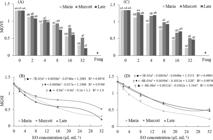
In vitro Colletotrichum abscissum mycelial growth speed index (MGSI) in PDA culture medium under different concentrations (0, 2, 4, 8, 16, and 32 ¼L mL-1) of essential oils from three mandarin varieties extracted from immature (A and B) and ripe (C and D) fruits, together with the commercial fungicide (Fung) (trifloxystrobin + tebuconazole). Columns followed by a lowercase letter differentiate varieties within the same concentration, and uppercase letters differentiate concentrations within the same variety using the Scott-Knott test at 5 % of probability. +: differed significantly from the others.
For the EOs from ripe fruits, the behavior changes, when compared to immature fruits, maintaining results similar to those found in the mycelial growth inhibition, in which the IAC 2019Maria mandarin provided a lower mycelial growth rate, a treatment that statistically differed from the other varieties at all dosages used, with the best control being at the dose of 32 ¼L mL-1 (Figure 4c). This effect may be related to the presence of monoterpenes such as limonene, linalool, and myrcene, compounds frequently reported as constituents of essential oils with antifungal activity against Colletotrichum spp. (Scariot et al. 2020), and that were found at high concentrations in the IAC 2019Maria mandarin (Table 1). The hydroxyl group, present in linalool, favors its penetration through the cytoplasmic membrane, thus representing a relatively good antifungal activity, when compared to the monoterpenes p-cymene and γ-terpinene (Qi et al. 2023).
This effect of EOs has been investigated over the years. Moura et al. (2024), in their experiment with G. citri-aurantii, found a 57 % reduction in mycelial growth rate, when compared to the control treatment. When investigating the effect of EOs on the fungi structure, Oliveira et al. (2019) reported changes on the surface of C. acutatum, when submitted to Lippia sidoides oil, such as superficial wrinkles in the fungal hyphae, as well as desquamation, distortion, and destruction, making them unviable. Devite et al. (2023) presented promising results at the dose of 16 μL mL-1 of the EO from IAC2019Maria mandarin for the in vitro control of A. alternata. There is still a lack of studies on the action of EOs, especially from mandarin varieties. It is known that this activity depends directly on the presence of certain components and their amount (Antunes & Cavaco 2010). For this, studies at different concentrations for various fungi are necessary, in order to obtain a significant effect.
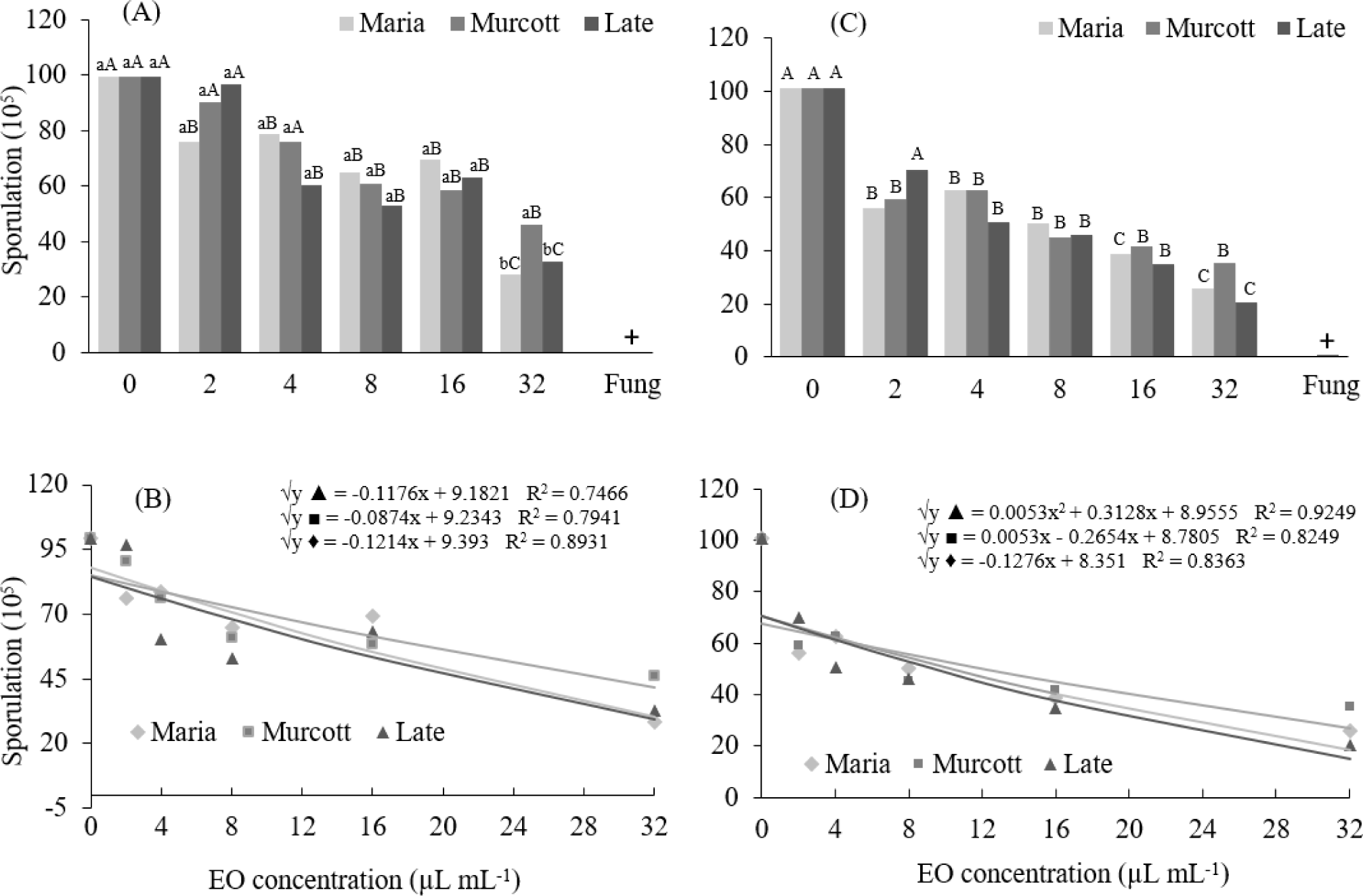
When applying the highest dose (32 ¼L mL-1) of EO from IAC 2019Maria mandarin, there was a reduction of approximately 46.3 % in spore production, when compared to the dose of 0 ¼L mL-1, statistically equaling the Late IAC 585 mandarin, a variety that differs from the others at the dose of 4 ¼L mL-1, with a lower number of spores (Figure 5a). A similar result was not observed for Murcott IAC 221 tangor, even at the highest dose, which still presented a high spore rate. All treatments differed from the positive control (fungicide). For the EOs from ripe fruits, a significant difference was found only between dosages within each variety. There was also a decrease in spore rate with increasing concentration, mainly with the EO from Late IAC 585 mandarin, where the dose of 32 ¼L mL-1 had a 55.3 % reduction, when compared to the dose of 0 ¼L mL-1 (Figures 5c and 5d).

In vitro spore count (10⁵) per mL of Colletotrichum abscissum suspension under different doses (0, 2, 4, 8, 16, and 32 ¼L mL-1) of essential oils from three mandarin varieties extracted from immature (A and B) and ripe (C and D) fruits, together with the commercial fungicide (Fung) (trifloxystrobin + tebuconazole). The trend line was adjusted using the values transformed by √Y to meet the model assumptions, and subsequently reconverted to the original scale. Columns followed by a lowercase letter differentiate varieties within the same concentration, and an uppercase letter differentiates concentrations within the same variety using the Scott-Knott test at 5 % of probability. +: differed significantly from the others.
When testing the effect of the EOs from immature and ripe fruits on conidia germination, it was clear that, with increasing dosages, the number of germinated spores gradually decreased (Figure 6). In both cases, the EO from IAC 2019Maria mandarin stands out for starting its control at lower dosages, differing from the other varieties. For the EOs from immature fruits, at the dose of 8 ¼L mL-1, IAC 2019Maria mandarin reduced it by approximately 98 %, when compared to the dose of 0 ¼L mL-1, leaving only 2.1 % of germinated spores, obtaining the same inhibition as the fungicide (Figure 6a). The reduction percentage is close to that found in the study carried out by Hoyos et al. (2025), in which, using a dose of 4.8 ¼L mL-1 of EO from Citrus × sinensis reduced the germination of Colletotrichum lindemuthianum spores by 95 %.
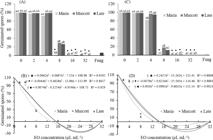
In vitro percentage of germinated Colletotrichum abscissum spores under different doses (0, 2, 4, 8, 16, and 32 ¼L mL-1) of essential oils from three mandarin varieties extracted from immature (A and B) and ripe (C and D) fruits, together with the commercial fungicide (Fung) (trifloxystrobin + tebuconazole). Columns followed by a lowercase letter differentiate varieties within the same concentration, and uppercase letters differentiate concentrations within the same variety using the Scott-Knott test at 5 % of probability. ●: statistically equal to the fungicide.
The early inhibition of the EO from IAC 2019Maria mandarin may be related to the fact that it is the only variety to present high linalool levels (Table 1), as previously mentioned. In addition to its activity in inhibiting mycelial growth, studies have shown that linalool has an effect on spore germination, and, even at a low dose (2 ¼L mL-1), it was able to completely inhibit the germination of A. flavus spores (Li et al. 2022). For EOs from ripe fruits, the same behavior was observed; however, the IAC 2019Maria mandarin begins to show differences at the dose of 4 ¼L mL-1, with a marked reduction at the dose of 8 ¼L mL-1, becoming significantly equal to the action of the fungicide and the higher dosages. When using the dose of 32 ¼L mL-1, for all varieties, there was no spore germination, statistically equaling the dose of 16 ¼L mL-1, both for the EOs from immature and ripe fruits (Figure 6c). A similar result was found by Moura et al. (2017), where, when using concentrations of 1 and 2 %, EOs from sweet orange (Citrus × sinensis) and Sicilian lemon (Citrus × limon) completely inhibited the germination of C. musae and C. gloeosporioides spores. At low concentrations, the EO from Citrus × limon was effective on the C. gloeosporioides germination.
Devite et al. (2025) found that, when lemon EO was preventively used, there was inhibition of spore germination of A. alternata isolates due to its ability to form a protective barrier on the leaf surface. This result may be related not only to the action of the major EO component, limonene, but also to other compounds such as linalool and β-pinene, which are able to disrupt the fungal cell membranes, inhibiting spore germination (Rodrigues et al. 2021, Devite et al. 2025). This action of essential oils in preventing spore germination is related to lipophilic bioactive compounds, which easily penetrate the lipid bilayer of the fungal cell membrane and, consequently, cause a rupture (Sharma et al. 2017).
The mandarin varieties at the two maturation stages were used in the principal component analysis (PCA) to distinguish them according to the components found in the essential oils extracted from their fruits, along with their activity in the in vitro control of C. abscissum mycelial growth, sporulation, and conidial germination. The analysis of the two principal components explained 80.05 % of the total data variance, with the principal component 1 (PC1 = 57.06 %) comprising the largest share, followed by the principal component 2 (PC2 = 22.99 %) (Figure 7).

Principal component analysis (PCA) showing the distribution of essential oils from immature (I) and ripe (R) fruits of three mandarin varieties: Murcott IAC 221 tangor (Mu), Late IAC 585 mandarin (L), and IAC 2019Maria mandarin (Ma), associated with their chemical components, in vitro Colletotrichum abscissum mycelial growth (mg), sporulation (spor), and conidia germination (germ).
PC1 showed a strong correlation with the amounts of compounds such as citronellal (R = -0.95), decanal (R = -0.90), isoterpinolene (R = 0.98), α-pinene (R = 0.96), β-pinene (R = 0.98), γ-terpinene (R = 0.98), limonene (R = -0.89), and α-terpineol (R = 0.83). Mycelial growth (R = 0.94) was the variable that most contributed to PC2 (Figure 7). Based on the results, it is understood that the essential oil extracted from ripe IAC 2019Maria mandarin showed higher citronellal and decanal levels, when compared to other compounds such as isoterpinolene, α-pinene, β-pinene, γ-terpinene, and α-terpineol, which were found in smaller amounts. This result contrasts with the essential oil from the Late 585 IAC mandarin, which showed higher levels of these compounds. It was also observed that the essential oil from IAC 2019Maria mandarin showed the greatest inhibition, whereas Murcott IAC 221 tangor showed the worst performance in controlling mycelial growth (Figure 7). Although the results are promising, in vitro assays may not reflect field conditions, where environmental factors and plant-pathogen interactions are more complex.
CONCLUSIONS
-
Limonene was the main compound found in the essential oils extracted from immature and ripe fruits of the mandarin varieties IAC 2019Maria, Late IAC 585, and Murcott IAC 221.
-
The essential oil from immature Late IAC 585 mandarins used at the highest dose (32 μL mL-1) showed the best performance in the in vitro control of Colletotrichum abscissum;
-
The essential oil from the IAC 2019Maria mandarin stands out in the in vitro control of C. abscissum when extracted from ripe fruits;
-
All essential oils inhibited the germination of C. abscissum spores.
Data Availability Statement:
Research data are only made available by authors upon request.
ACKNOWLEDGMENTS
This study was carried out with the support of the Coordenação de Aperfeiçoamento de Pessoal de Nível Superior (Capes; Funding Code 001). The authors would like to thank the Sylvio Moreira Citrus Center - Instituto Agronômico de Campinas (IAC), for the intellectual and financial support.
REFERENCES
- ANTUNES, M. D. C.; CAVACO, A. M. The use of essential oils for postharvest decay control: a review. Flavour and Fragrance Journal, v. 25, n. 5, p. 351-366, 2010.
- BEBBER, D. P.; GURR, S. J. Crop-destroying fungal and oomycete pathogens challenge food security. Fungal Genetics and Biology, v. 74, n. 1, p. 62-64, 2015.
- BOURGOU, S.; RAHALI, F. Z.; OURGHEMMI, I.; SAÏDANI TOUNSI, M. Changes of peel essential oil composition of four Tunisian citrus during fruit maturation. The Scientific World Journal, v. 2012, e528593, 2012.
- BRAGANÇA, C. A.; DAMM, U.; BARONCELLI, R.; MASSOLA JÚNIOR, N. S.; CROUS, P. W. Species of the Colletotrichum acutatum complex associated with anthracnose diseases of fruit in Brazil. Fungal Biology, v. 120, n. 4, p. 547-561, 2016.
- COSTA, A. P.; MOURA, G. S.; GEBAUER, J. T.; FRANZENER, G. Extrato aquoso e óleo essencial de gengibre induzem mecanismos bioquímicos de defesa em feijoeiro. Revista de Agricultura Neotropical, v. 6, n. 2, p. 79-86, 2019.
- DEVITE, F. T.; AZEVEDO, F. A. D.; BASTIANEL, M.; CONCEIÇÃO, P. M. D.; PETRÔNIO, L. C. D. F.; SARAIVA, B. M.; SOUZA, A. J. B. D. Lemon essential oil for controlling Alternaria alternata (Fr: Fr.) Keissler f. sp. Citri. Fruit Crops Science Journal, v. 1, e307, 2025.
- DEVITE, F. T.; AZEVEDO, F. A. D.; BASTIANEL, M.; SCHINOR, E. H.; CONCEIÇÃO, P. M. D. Mandarin essential oils as an alternative method of controlling the fungus Alternaria alternata (Fr.: Fr.) Keissler. Horticulturae, v. 9, n. 6, e613, 2023.
-
FOOD AND AGRICULTURE ORGANIZATION OF THE UNITED NATIONS (FAO). Crops and livestock products 2025. Available at: https://www.fao.org/faostat/en/#data/QCL Access on: Nov. 10, 2025.
» https://www.fao.org/faostat/en/#data/QCL - FRIZZO, C. D.; LORENZO, D.; DELLACASSA, E. Composition and seasonal variation of the essential oils from two mandarin cultivars of southern Brazil. Journal of Agricultural and Food Chemistry, v. 52, n. 10, p. 3036-3041, 2004.
- GIRARDI, E. A.; POMPEU JUNIOR, J.; TEÓFILO SOBRINHO, J.; SOARES FILHO, W. dos S.; PASSOS, O. S.; CRISTOFANI-YALY, M.; SEMPIONATO, O. R.; STUCHI, E. S.; DONADIO, L. C.; MATTOS JUNIOR, D. de; BASSANEZI, R. B.; GARCIA, L. A. P.; AYRES, A. J. Guia de reconhecimento dos citros em campo: um guia prático para o reconhecimento em campo de variedades de laranjeira-doce e outras espécies de citros cultivadas no estado de São Paulo e Triângulo Mineiro. Araraquara: Fundecitrus, 2021.
- GOES, A. de; GARRIDO, R. B. O.; REIS, R. F.; BALDASSARI, R. B.; SOARES, M. A. Evaluation of fungicide applications to sweet orange at different flowering stages for control of postbloom fruit drop caused by Colletotrichum acutatum. Crop Protection, v. 27, n. 1, p. 71-76, 2008.
- GONÇALVES, F. P.; NOGUEIRA JÚNIOR, A. F.; SILVA-JUNIOR, G. J.; CIAMPI-GUILLARDI, M.; AMORIM, L. Environmental requirements for infection of Colletotrichum acutatum and C. gloeosporioides sensu lato in citrus flowers and prevalence of these pathogens in Brazil. European Journal of Plant Pathology, v. 160, n. 1, p. 27-37, 2021.
- HOYOS, J. M. A.; DORIGAN, A. F.; SILVEIRA, P. R. da; LABORY, C. R. G.; RIBEIRO JUNIOR, P. M.; FERNANDES, R.; ALVES, E. Antifungal activity of essential oils in Colletotrichum lindemuthianum and alternative control of bean anthracnose. European Journal of Plant Pathology, v. 172, n. 2, p. 373-389, 2025.
-
INSTITUTO BRASILEIRO DE GEOGRAFIA E ESTATÍSTICA (IBGE). Municipal agricultural production: temporary and permanent crops. 2024. Available at: https://www.ibge.gov.br/estatisticas/economicas/agricultura-e-pecuaria/9117-producao-agricola-municipal-culturas-temporarias-e-permanentes.html Access on: Nov. 25, 2024.
» https://www.ibge.gov.br/estatisticas/economicas/agricultura-e-pecuaria/9117-producao-agricola-municipal-culturas-temporarias-e-permanentes.html - KRISHNAKUMAR, S. V.; SYED, A. R. M.; VETHAMONI, I.; PERUMAL, R.; SAMPATHRAJAN, V. K.; NALLUSAMY, S.; THIRUVENKATASAMY, S.; NATESAN, S.; MURUGESAN, A. M.; SHANMUGAM, N.; KUMAR, A.; VICHANGAL PRIDIULDI, S. Exploring the antifungal potential of citrus essential oils from northeast India: a comparative gas chromatography-mass spectrometry, in vitro, and in silico analysis. ACS Agricultural Science & Technology, v. 5, n. 5, p. 763-776, 2025.
- LI, Y. N.; ZHANG, S. B.; LV, Y. Y.; ZHAI, H. C.; CAI, J. P.; HU, Y. S. Mechanisms underlying the inhibitory effects of linalool on Aspergillus flavus spore germination. Applied Microbiology and Biotechnology, v. 106, n. 19, p. 6625-6640, 2022.
- MITROPOULOU, G.; FITSIOU, E.; SPYRIDOPOULOU, K.; TIPTIRI-KOURPETI, A.; BARDOUKI, H.; VAMVAKIAS, M.; PANAS, P.; CHLICHLIA, K.; PAPPA, A.; KOURKOUTAS, Y. Citrus medica essential oil exhibits significant antimicrobial and antiproliferative activity. LWT - Food Science and Technology, v. 84, n. 1, p. 344-352, 2017.
- MOURA, G. S.; SCHEFFER, D. C.; FRANZENER, G.; JASKI, J. M. Efeito de óleos essenciais de Citrus spp. no controle pós-colheita da antracnose em banana e pimentão. Revista Cultivando o Saber, v. 10, n. 3, p. 73-87, 2017.
- MOURA, V. S.; OLANDIN, L. D.; MARIANO, B. S.; RODRIGUES, J.; DEVITE, F. T.; ARANTES, A. C. C.; QUEIROGA, C. L.; SARTORATTO, A.; AZEVEDO, F. A. de; BASTIANEL, M. Antifungal activity of citrus essential oil in controlling sour rot in Tahiti acid lime fruits. Plants, v. 13, n. 21, e3075, 2024.
- NAZZARO, F.; FRATIANNI, F.; COPPOLA, R.; DE FEO, V. Essential oils and antifungal activity. Pharmaceuticals, v. 10, n. 4, e86, 2017.
- NIKKHAH, M.; HASHEMI, M. Boosting antifungal effect of essential oils using combination approach as an efficient strategy to control postharvest spoilage and preserving the jujube fruit quality. Postharvest Biology and Technology, v. 164, e111159, 2020.
- OLIVEIRA, J.; GLORIA, E. M.; PARISI, M. C. M.; BAGGIO, J. S.; SILVA, P. P. M.; AMBROSIO, C. M. S.; SPOTO, M. H. F. Antifungal activity of essential oils associated with carboxymethylcellulose against Colletotrichum acutatum in strawberries. Scientia Horticulturae, v. 243, n. 1, p. 261-267, 2019.
- PINHO, D. B.; PEREIRA, O. L.; CAMARA, M. P. S.; SILVA, A. M. R.; FREIRE JUNIOR, F. C. O.; VIANA JUNIOR, M. G.; MAIA, L. C.; HYDE, K. D.; CAI, L. Colletotrichum abscissum: molecular re-identification of Colletotrichum acutatum sensu lato causing citrus postbloom fruit drop in Brazil. Persoonia: Molecular Phylogeny and Evolution of Fungi, v. 34, n. 1, p. 236-237, 2015.
- QI, X.; ZHONG, S.; SCHWARZ, P.; CHEN, B.; RAO, J. Mechanisms of antifungal and mycotoxin inhibitory properties of Thymus vulgaris L. essential oil and their major chemical constituents in emulsion-based delivery system. Industrial Crops and Products, v. 197, e116575, 2023.
- RAMALHO, T. R.; FILGUEIRAS, L. R.; OLIVEIRA, M. T. P. de; LIMA, A. L. A.; BEZERRA-SANTOS, C. R.; JANCAR, S.; PIUVEZAM, M. R. Gamma-terpinene modulation of LPS-stimulated macrophages is dependent on the PGE2/IL-10 axis. Planta Medica, v. 82, n. 15, p. 1341-1345, 2016.
- RODRIGUES, D. W.; BOSSI, M. A. da S.; DRANKA, B. A.; GONÇALVES, L. F. S.; TOSETTO, M. L. da S.; TOMELIN, D.; SILVA, A. M. da. Aplicação de óleos essenciais no controle alternativo da antracnose no Brasil. Metodologias e Aprendizado, v. 4, n. 1, p. 33-40, 2021.
- SCARIOT, F. J.; FORESTI, L.; DELAMARE, A. P. L.; ECHEVERRIGARAY, A. P. L. S. Activity of monoterpenoids on the in vitro growth of two Colletotrichum species and the mode of action on C. acutatum Pesticide Biochemistry and Physiology, v. 170, e104698, 2020.
- SHARMA, A.; RAJENDRAN, S.; SRIVASTAVA, A.; SHARMA, S.; KUNDU, B. Antifungal activities of selected essential oils against Fusarium oxysporum f. sp. lycopersici 1322, with emphasis on Syzygium aromaticum essential oil. Journal of Bioscience and Bioengineering, v. 123, n. 3, p. 308-313, 2017.
- SIMAS, D. L. R.; AMORIM, S. H. B. M. de; OLIVEIRA, J. M. de; ALVIANO, D. S.; SILVA, A. J. R. da. Caracterização dos óleos essenciais de frutas cítricas. Citrus Research & Technology, v. 36, n. 1, p. 15-26, 2015.
- SOUZA, R. L.; MESQUITA, F. R.; ALVES, W. F. Avaliação da atividade antifúngica dos óleos essenciais de andiroba e copaíba e suas diferentes combinações no controle do fungo Sclerotium rolfsii Scientia Naturalis, v. 1, n. 1, p. 17-25, 2019.
- TAHVILIAN, R.; MORADI, R.; ZHALE, H.; ZANGENEH, M. M.; ZANGENEH, A.; YAZDANI, H.; HAJIALIANI, M. Ethnomedicinal plants: study on antifungal activity of essential oil of Pistacia khinjuk (combined with the dominance γ-Terpinene) against Candida albicans International Journal of Pharmaceutical and Clinical Research, v. 8, n. 10, p. 1369-1373, 2016.
- TANG, C.; CHEN, J.; ZHANG, L.; ZHANG, R.; ZHANG, S.; YE, S.; ZHAO, Z.; YANG, D. Exploring the antibacterial mechanism of essential oils by membrane permeability, apoptosis and biofilm formation combination with proteomics analysis against methicillin-resistant Staphylococcus aureus International Journal of Medical Microbiology, v. 310, n. 5, e151435, 2020.
- TIMMER, L. W.; ZITKO, S. E. Early season indicators of postbloom fruit drop of citrus and the relationship of disease and fruit production. Plant Disease, v. 79, n. 10, p. 1017-1020, 1995.
-
Editor:
Luis Carlos Cunha Junior