 Strategies to mitigate water deficit in naturally colored cotton: interactions between salicylic acid and irrigation levels1
ABSTRACT
Naturally colored cotton stands out socioeconomically in northeastern Brazil; however, the low water availability and high evapotranspiration rates limit its growth and yield. This study aimed to evaluate the effects of irrigation levels and salicylic acid concentrations on the growth and yield of naturally colored cotton cultivars. The experiment was conducted in a randomized block design, with 64 experimental units, in a 2 × 4 × 2 factorial scheme, with four replications and one plant per plot, with plants grown in pots adapted to drainage lysimeters. The treatments included two irrigation levels (100 and 50 % of the water requirement), four salicylic acid concentrations (0, 1.5, 3.0, and 4.5 mM), and two cultivars (BRS Rubi and BRS Safira). The reduced irrigation level (50 %) negatively affected the growth, accumulation, and yield of the naturally colored cotton cultivars, with the productive variables being the most impacted. The average application of 2.9 mM of salicylic acid promoted greater growth and yield, in addition to mitigating the effects of water deficit on the number of bolls. BRS Safira stood out in growth, biomass, and productive components, outperforming BRS Rubi under different water conditions.
KEYWORDS:
Gossypium hirsutum L.; water deficit; phytohormone.
RESUMO
O algodão de fibra naturalmente colorida apresenta destaque socioeconômico no Nordeste do Brasil; entretanto, a baixa disponibilidade hídrica e as elevadas taxas de evapotranspiração limitam seu crescimento e produtividade. Objetivou-se avaliar os efeitos de níveis de irrigação e concentrações de ácido salicílico no crescimento e produção de cultivares de algodão de fibra naturalmente colorida. O experimento foi conduzido em delineamento de blocos casualizados, com 64 unidades experimentais, em esquema fatorial 2 × 4 × 2, com quatro repetições e uma planta por parcela, sendo as plantas cultivadas em vasos adaptados a lisímetros de drenagem. Os tratamentos consistiram de dois níveis de irrigação (100 e 50 % da necessidade hídrica), quatro concentrações de ácido salicílico (0; 1,5; 3,0; e 4,5 mM) e duas cultivares (BRS Rubi e BRS Safira). O nível reduzido de irrigação (50 %) afetou negativamente o crescimento, a biomassa e a produção das cultivares de algodão colorido, sendo as variáveis produtivas as mais impactadas. A aplicação média de 2,9 mM de ácido salicílico promoveu maior crescimento e produção, além de mitigar os efeitos do estresse hídrico sobre o número de capulhos. BRS Safira destacou-se quanto ao crescimento, biomassa e componentes produtivos, superando a BRS Rubi sob diferentes condições hídricas.
PALAVRAS-CHAVE:
Gossypium hirsutum L.; estresse hídrico; fitormônio.
INTRODUCTION
Cotton is one of the most widely produced fibers worldwide, and is recognized as one of the main sources of wealth in the global agricultural sector (USDA 2024). In Brazil, the cultivation of naturally colored cotton also occupies a prominent position, especially due to its higher value, when compared to white cotton (Conab 2024).
With the advancement of globalization, concerns about sustainability and environmental preservation have increased, which has driven industries to adopt environmentally friendly products. In this context, colored cotton presents significant advantages, as it eliminates the need for artificial dyes, which are responsible for the pollution of natural resources. Furthermore, it contributes to reducing fiber production costs, representing an important economic advantage (Nascimento et al. 2019).
Water deficit, characterized by water demand exceeding soil availability, reduces the absorption of water and nutrients by plants, leading to significant losses (Campos et al. 2021). This water deficit stress limits the growth of cultivated plants, considering that water is the primary component in plant metabolic processes (Scalon et al. 2020). However, water deficit can result from reducing the amount of water used in irrigation during less sensitive phenological stages, without harming plant development and yield, thus improving the water-use efficiency in a more sustainable manner (Cotrim et al. 2017).
Nevertheless, tolerance to water deficit varies among plant species, and even among varieties of the same species, as demonstrated by Soares et al. (2023), who evaluated, among other aspects, the growth and production of colored fiber cotton genotypes (BRS Rubi, BRS Jade, and BRS Safira) under water deficit at different phenological stages. They observed that BRS Jade is the most suitable for cultivation under water deficit conditions, with 40 % of the actual evapotranspiration.
However, to enable the cultivation of species more sensitive to water deficit, it is essential to seek strategies to mitigate the adverse effects of water deficit, such as the use of salicylic acid. This compound has attracted considerable interest due to its ability to protect plants against biotic and abiotic stresses (Kim et al. 2018). Although the effects of salicylic acid on cotton and its correlation with leaf pigments remain scarce in the literature, studies on other crops have revealed its potential to enhance chlorophyll synthesis and photosynthetic activity (Silva et al. 2023).
The application of salicylic acid in small concentrations promotes plant tolerance to stress by increasing cell turgor (Nobre et al. 2025). However, at high concentrations, it does not play a beneficial role in plant growth and production, due to low translocation of salicylic acid to shoots, which may disrupt enzymatic activity, damage the photosystem, and compromise growth (Souri & Tohidloo 2019, Sofy et al. 2020).
The beneficial effect of salicylic acid application depends on the plant species, developmental stage, cultivation type, applied concentration, and application method (Nobre et al. 2025). Therefore, the appropriate use of this compound may represent a promising strategy for increasing crop resilience.
In fact, the exogenous application of salicylic acid has demonstrated significant potential in mitigating the negative effects of abiotic stresses in cotton, contributing to improvements in vegetative development, yield, and fiber quality (El-Beltagi et al. 2017, Mahdi et al. 2020). However, the efficiency of this practice is directly related to the proper adjustment of the applied concentration and the plant phenological stage, essential factors for maximizing its beneficial effects (Kiliç & Karademir 2024).
In this context, this research aimed to evaluate the effects of irrigation levels, in combination with salicylic acid concentrations, on the growth and production components of naturally colored fiber cotton cultivars.
MATERIAL AND METHODS
The experiment was conducted from August to December 2023, under field conditions, with plants grown in pots adapted to a drainage lysimeter, installed at the experimental area of the Universidade Federal Rural do Semiárido, in Caraúbas, Rio Grande do Norte state, Brazil (05º46’23”S, 37º34’24”W, and altitude of 144 m). The climate of the region is classified as BSh, hot semi-arid, according to Köppen.
The research was conducted using a randomized block design, in a 2 × 4 × 2 factorial scheme, corresponding to irrigation depth of 50 % (L1) and 100 % (L2) of the pot water-holding capacity, four salicylic acid concentrations (0, 1.5, 3.0, and 4.5 mM), and two cotton cultivars (BRS Rubi and BRS Safira), with four replications and one plant per plot, totaling 64 plants. The plants were cultivated in drainage lysimeters spaced in the field at 0.6 × 1.0 m.
Regarding the cultivars used, BRS Rubi has an average height of 110 cm and a development cycle of 140-150 days, flowering approximately at 55 days. Its cultivation can be carried out both under rainfed conditions, with average yield of 1,894 kg ha-1, in the Brazilian semi-arid region, and under irrigated conditions, where it achieves an average yield of over 3.5 t ha-1 (Ramos et al. 2020). Meanwhile, BRS Safira is highly productive under rainfed conditions in the Northeast region, due to the low incidence of foliar and soil diseases in the area. This evidence was confirmed in trials conducted in 2003 and 2004, when the obtained average yields were 1,915 and 1,221 kg ha-1, respectively (Ramos et al. 2020).
The drainage lysimeters consisted of 20-L polyethylene pots (35 cm in height × 31 cm in upper diameter × 20 cm in lower diameter), supported by ceramic bricks, raising them 15 cm above the ground. At the base of each lysimeter, a drainage system was installed, consisting of a transparent hose (1.27 cm in diameter and 15 cm in length) connected to a 2-L PET bottle to collect drainage water and estimate the plants’ water consumption. The end of the drain inside the lysimeter was wrapped with a geotextile fabric to prevent clogging caused by soil material. The lysimeters were filled with a 2-kg layer of gravel at the base, followed by 2 kg of washed sand, 10 kg of silty soil, and, in the upper layer, a mixture of 2 kg of substrate composed of cured bovine manure, charcoal powder, and crushed carnauba straw in a 1:1:1 ratio and 4 kg of silty soil from the agricultural area of the municipality of Caraúbas. The chemical and physical-hydraulic characteristics were determined according to Teixeira et al. (2017).
The soil:substrate mixture was characterized as light-textured, with the following contents: 16 % of sand, 79.3 % of silt, and 4.7 % of clay. The electrical conductivity of the saturation extract was 0.41 dS m-1, whereas the pH in H₂O was 6.38. The organic matter content was 33.08 g kg-1. For the chemical attributes, the soil had the following values: 313 mg dm-3 of phosphorus (P), 66 cmolc dm-3 of potassium (K⁺), 50 cmolc dm-3 of sodium (Na⁺), 8 cmolc dm-3 of calcium (Ca2⁺), and 4 cmolc dm-3 of magnesium (Mg2⁺). Aluminum saturation (Al3⁺) was non-existent and the potential acidity (H + Al) was 2.08 cmolc dm-3. The sum of bases and cation exchange capacity (CEC at pH 7.0) were the same, both at 12.54 cmolc dm-3, whereas the effective CEC (T) was 14.62 cmolc dm-3. The base saturation (V%) reached 86 %, with aluminum saturation (m%) of 0 %. The exchangeable sodium percentage was 1 %.
The irrigation depth was determined based on the pot water-holding capacity of the substrate. Throughout the experimental period, the total volume of water applied per plant was 21.795 L. To achieve this, water was applied to the substrate until saturation by capillarity was reached, followed by free drainage (Casaroli & van Lier 2008).
Sowing was carried out with five seeds per lysimeter, distributed equidistantly at a depth of 1.5 cm. At 20 days after sowing (DAS), thinning was performed, leaving only the most developed plant per lysimeter. At 23 DAS, the exogenous application of salicylic acid began, with concentrations defined according to Abbaszadeh et al. (2020). The application was performed by foliar spraying, covering both the adaxial and abaxial surfaces of the leaves. To prevent product drift, a support was used during the process, which was always conducted at 5:00 p.m., using a 350-mL manual sprayer, along with physical barriers to avoid interference between treatments. Applications were performed at 12-day intervals, totaling seven throughout the experiment. During the first three sprayings, 3 mL per plant were applied, and, from the fourth application onwards, the volume was increased to 8 mL per plant.
Regarding nutritional requirements, fertilization with nitrogen (N), phosphorus (P), and potassium (K) was carried out following the recommendations of Novais et al. (1991), at dosages of 100, 300, and 150 mg kg-1 of N, P₂O₅, and K₂O, respectively, using urea, monoammonium phosphate, and potassium chloride. These nutrients were applied at 36 and 96 DAS, diluted in 3.2 L of water, with 50 mL placed in each lysimeter. Phosphorus and potassium fertilization continued throughout the experiment at 10-day intervals.
During the experiment, crop practices (area cleaning, weeding between lysimeter rows, and surface scarification of the soil in the pots) and phytosanitary treatments (insecticide applications) recommended for the crop were carried out. Pest emergence was monitored, and control measures were adopted when necessary.
At 82 DAS, the effect of the treatments on the cotton cultivars was measured by determining the variables: number of leaves, obtained by taking into account the leaves that were longer than 3 cm and had a fully open leaf limb; plant height, by measuring the distance between the root collar and the insertion point of the youngest leaf; stem diameter, determined at 2 cm from the root collar, using a digital caliper; and leaf area, measured according to Grimes & Carter (1969).
In the period between 46 and 82 DAS, the absolute growth rate for the number of leaves, stem diameter, plant height and leaf area of the cotton cultivars were evaluated (Benincasa 2003).
At the end of the experiment (112 DAS), the plants were collected and separated into leaves, stems and roots, placed in paper bags and dried in an air circulation oven at 65 ºC until constant weight. The material was then weighed to obtain the leaf dry mass, stem dry mass, shoot dry mass, root dry mass, total dry mass and root/shoot ratio. The production components were also determined, with the bolls harvested per plant as they reached the harvest point, and the number of bolls, number of seeds, seed mass, fiber mass and seed cotton mass being quantified per plant.
The means of the variables were submitted to analysis of variance, with the F test (1 and 5 % of probability) and regression studies for salicylic acid concentrations. The means of the qualitative factors (irrigation rates and cotton cultivars) were compared using the Tukey test (1 and 5 % of probability), with the Sisvar statistical software (Ferreira 2019).
RESULTS AND DISCUSSION
According to the analysis of variance, there was a significant effect for irrigation depth × cotton cultivars interaction on the number of leaves and leaf area. Additionally, there was a significant isolated effect of the water deficit factor on plant height and stem diameter, as well as of salicylic acid concentrations on number of leaves, leaf area, plant height, and stem diameter. The cotton cultivars also differed in terms of stem diameter.
The increase in salicylic acid concentrations significantly influenced the number of leaves and leaf area (Figures 1A and 1B). The highest values were observed at salicylic acid concentrations of 2.4 and 3.6 mM, with maximum of 45.06 leaves and 41.76 cm2, respectively. Plants that did not receive salicylic acid exhibited the lowest number of leaves and leaf area values. This highlights the potential of salicylic acid in promoting physiological adjustments that favor leaf development, likely due to its role in processes such as photosynthesis and nitrogen metabolism - an essential nutrient for leaf area growth (Khan et al. 2015).

Number of leaves (NL; A) and leaf area (LA; B) as a function of salicylic acid (SA) concentrations; and NL (C) and LA (D) as a function of the interaction between factors (irrigation depth × cotton cultivars), at 82 days after sowing. Means followed by uppercase letters indicate comparisons between cultivars tested under different irrigation levels, whereas means followed by lowercase letters indicate comparisons between irrigation levels for the same cultivar. Means with the same letters do not differ from each other according to the Tukey test (p ≤ 0.01).
For plants irrigated with 100 % of the pot water-holding capacity, the highest leaf area was obtained for the BRS Rubi cultivar, surpassing BRS Safira by 23.24 %. However, under 50 % of the irrigation depth, no statistical differences were observed between the cultivars. Additionally, BRS Rubi plants irrigated with 100 % of the irrigation depth exhibited a leaf area 18.15 % higher, when compared to those irrigated with 50 % of the irrigation depth. On the other hand, BRS Safira did not show significant differences in leaf area between the two irrigation levels, although it reduced the number of leaves under stress conditions (Figure 1C) while maintaining the same leaf area (Figure 1D).
This suggests that BRS Safira adopts a physiological strategy as a satisfactory maintenance of photosynthesis to conserve leaf area, allowing the continuation of essential metabolic processes for growth. Under water deficit conditions, cotton reduces cell division, limiting leaf emission and consequently decreasing the transpiring surface of the plant (Soares et al. 2021). However, plants with larger leaf area tend to show a higher yield, as they have more efficient photosynthetic rates, enabling a greater light assimilation, photosynthesis, and dry matter accumulation (Albano et al. 2017).
A significant effect of irrigation depth on plant height and stem diameter was observed. According to the test of means, the highest values for both variables occurred under an irrigation depth of 100 %, which exceeded the plants under the irrigation depth of 50 % by 13.34 % (8.86 cm) for plant height (Figure 2A) and 12.75 % (1.33 mm) in terms of stem diameter (Figure 2B), indicating that lower soil water availability reduces turgor and cell division. Additionally, under this condition, stomatal closure frequently occurs, leading to reduced nutrient absorption and, consequently, limiting plant growth (Carvalho et al. 2017). This effect demonstrates the sensitivity of secondary stem growth to water deficit, supporting the findings of Carvalho et al. (2020), who observed that water limitation significantly reduced plant structural development.

Plant height (PH; A) and stem diameter (SD; B) as a function of irrigation depth, PH (C) and SD (D) as a function of salicylic acid (SA) concentrations, and SD (E) as a function of cotton cultivars, at 82 days after sowing. Means with the same letter do not differ from each other by the Tukey test (p ≤ 0.01).
The application of salicylic acid significantly affected the plant height and stem diameter. According to the regression equations (Figures 2C and 2D), a quadratic response was observed, with the highest plant height (64.51 cm) and stem diameter (9.96 mm) values obtained in plants treated with concentrations of 2.8 and 1.9 mM, respectively. The lowest plant height values were found in plants that did not receive salicylic acid, indicating that the application of low concentrations may increase levels of photosynthetic pigments and the photosynthetic rate (Lisboa et al. 2017), contributing to cotton growth, as observed in the variables number of leaves and leaf area (Figures 1A and 1B) and plant height and stem diameter (Figures 2A and 2D).
When examining the stem diameter of the cotton cultivars (Figure 2E), it was found that they significantly differed, in terms of stem diameter, with the largest stem diameter (10.01 mm) obtained in BRS Safira plants, which exceeded the BRS Rubi by only 5 % (0.5 mm), suggesting that this difference may be due to genetic factors of the distinct cultivars.
A significant effect of the irrigation depth x cotton cultivars interaction on the absolute growth rate for number of leaves, leaf area, and stem diameter was observed. There were also isolated effects of the salicylic acid concentrations on absolute growth rate for number of leaves, of the irrigation depth factor on absolute growth rate for plant height, and of cotton cultivars on absolute growth rate for plant height.
The irrigation depth x cotton cultivars interaction significantly affected the absolute growth rate for the number of leaves, and, according to the mean comparison test (Figure 3A), when the plants were irrigated with an irrigation depth of 100 %, there was no statistical difference between the cultivars. However, under the irrigation depth of 50 %, a significant difference was observed, with BRS Rubi outperforming BRS Safira by 38.3 %. When analyzing the cultivars under different irrigation blades, it was found that, for BRS Rubi, plants under irrigation depth of 50 % outperformed those irrigated with 100 % by 26.67 %; whereas, for BRS Safira, no statistical difference was observed between the blades. This suggests that, under water deficit, plants activate adaptive mechanisms to reduce the transpiring area and energy expenditure, thus maintaining growth (Scalon et al. 2020).

Absolute growth rate for number of leaves (AGRNL; A) and leaf area (AGRLA; B) of cotton as a function of the irrigation depth x cotton cultivars interaction. Means followed by uppercase letters indicate comparisons between cultivars tested under different irrigation levels, whereas means followed by lowercase letters indicate comparisons between irrigation levels for the same cultivar. Means with the same letter do not differ from each other by the Tukey test (p ≤ 0.01).
The absolute growth rate for leaf area was affected by the interaction between irrigation depth and cotton cultivars, and, according to the mean comparison test (Figure 3B), under irrigation depth of 100 %, BRS Rubi outperformed BRS Safira by 46.3 %, in terms of absolute growth rate for leaf area. However, when plants of different cultivars were under the irrigation depth of 50 %, no significant difference was observed between them. Moreover, the absolute growth rate for leaf area of BRS Safira did not differ statistically between irrigation depths. In contrast, for BRS Rubi, plants irrigated with depth of 100 % showed a higher absolute growth rate of 29.63 % for leaf area than those irrigated with depth of 50 %, indicating that BRS Safira is more tolerant to water deficit, as also observed for absolute growth rate for the number of leaves (Figure 3A).
It was observed that, under the application of irrigation depths of 100 and 50 %, BRS Safira showed absolute growth rates for stem diameter 56.8 and 42.5 % higher than for BRS Rubi, respectively. Furthermore, it was noted that the absolute growth rate for stem diameter of BRS Rubi did not differ statistically under the different irrigation depths applied; whereas, for BRS Safira, the absolute growth rate for stem diameter of plants under irrigation depth of 100 % was 27.27 % higher, when compared to those under lower water availability.
The irrigation depth had a significant effect on absolute growth rate for plant height, and, according to the mean comparison test (Figure 4B), it was observed that plants irrigated with irrigation depth of 100 % outperformed those under irrigation depth of 50 % by 22.5 %. This infers that water restriction, when applied throughout the entire growing cycle, can affect the plant’s physiology, altering growth and reducing cell division, which impedes leaf emergence, thereby reducing the transpiring surface of cotton plants to ensure survival under these conditions (Soares et al. 2021).

Absolute growth rate for stem diameter (AGRSD) as a function of the irrigation depth x cotton cultivars interaction (A); absolute growth rate for plant height (AGRPH) under irrigation depth (B); and absolute growth rate for number of leaves (AGRNL) under salicylic acid (SA; C) concentrations. Means followed by uppercase letters indicate comparisons between cultivars tested under different irrigation levels, whereas means followed by lowercase letters indicate comparisons between irrigation levels for the same cultivar. Means with the same letter do not differ from each other by the Tukey test (p ≤ 0.01).
A significant response of the salicylic acid concentrations on absolute growth rate for number of leaves was observed, and, according to the regression equation (Figure 4C), the data showed a better fit to the quadratic model, with the highest absolute growth rate for number of leaves (0.55 leaves per day) being obtained in plants under 2.2 mM of salicylic acid. This behavior is attributed to the salicylic acid’s role in the photosynthetic process (Khan et al. 2015) and cell division, contributing to plant growth when provided in adequate amounts (Feitosa et al. 2016).
There was a significant effect of the irrigation depth x cotton cultivars interaction on shoot dry mass and total dry mass per plant. There were also isolated effects for irrigation depth, cotton cultivars, and salicylic acid concentrations on root dry mass.
The different irrigation depths affected the root dry mass, and, according to the mean comparison test (Figure 5A), it was observed that plants irrigated with 100 % of the field capacity throughout the cycle outperformed those under 50 % by 25.12 % (2.68 g). This indicates that, when plants are under water deficit conditions, reductions occur in transpiration, transport of photosynthetic assimilates, cell division, and cell expansion, resulting in a decrease in the growth and production components of the plants (Ferrari et al. 2015).

Root dry mass (RDM) as a function of irrigation depth (A), cotton cultivars (B), and salicylic acid concentrations (C); shoot dry mass (SDM; D) and total dry mass per plant (TDM; E) as a function of the interaction between factors (irrigation depth x cotton cultivars); and cotton fiber mass as a function of cotton cultivars (F). Means followed by uppercase letters indicate comparisons between cultivars tested under different irrigation levels, whereas means followed by lowercase letters indicate comparisons between irrigation levels for the same cultivar. Means with the same letter do not differ from each other by the Tukey test (p ≤ 0.01).
The root dry mass was also significantly affected by the cotton cultivars, and, according to the mean comparison test (Figure 5B), it was observed that the root dry mass of the BRS Safira cultivar surpassed that of the BRS Rubi by 14.7 %, indicating the superiority of this cultivar once again, showing that genetic factors play a determining role in the observed results.
The application of salicylic acid significantly influenced the root dry mass, and, according to the regression equation (Figure 5C), the data showed a quadratic response, with the highest root dry mass value (10.08 g) obtained in plants exposed to the concentration of 1.6 mM, whereas the lowest value was found in plants under 4.5 mM. This indicates that salicylic acid benefits cotton plants at low doses, but, at higher concentrations, it may fail to promote the reorganization of cellular membranes and, instead, exert a deleterious effect on plant cells (Gastl Filho et al. 2017), affecting plant growth.
The total dry mass per plant as a function of the cotton cultivars (Figure 5F) showed that the highest value (20.45 g) was produced by the BRS Safira cultivar, which represents an increase of 18.73 % (3.83 g), if compared to BRS Rubi. Thus, it is evident that BRS Safira surpassed the BRS Rubi, which may be related to its genetic characteristics, as highlighted by Ferrão et al. (2016), who indicated that drought-tolerant genotypes tend to have greater stability in production, although with lower production potential.
A significant irrigation depth x cotton cultivars interaction was observed for shoot dry mass and total dry mass per plant. According to Figure 5D (shoot dry mass) and 5E (total dry mass), the highest values were observed in both cultivars under 100 % of the pot water-holding capacity treatment. Under these conditions, BRS Rubi plants showed increases of 23.8 % (shoot dry mass) and 24.33 % (total dry mass), whereas BRS Safira plants showed increases of 9.19 % (shoot dry mass) and 11.40 % (total dry mass), when compared to plants under 50 %. The different irrigation depths affected the root dry mass, and, according to the mean comparison test (Figure 5A), plants irrigated with 100 % of the field capacity blade throughout the cycle outperformed those under 50 % by 25.12 % (2.68 g), indicating that BRS Safira is more tolerant to water deficit, in terms of biomass production. Additionally, under 50 %, the different irrigation depths affected the root dry mass, and, according to the mean comparison test (Figure 5A), plants irrigated with 100 % of the field capacity blade throughout the cycle outperformed those under 50 % by 25.12 % (2.68 g). BRS Safira outperformed BRS Rubi by 15.34 % (shoot dry mass) and 15.68 % (total dry mass); whereas, under 100 % of the pot water-holding capacity, no significant differences were found between the cultivars for these variables. These results suggest that, under low water availability in the soil, cotton plants respond with various adaptations, including changes in gas exchange, such as net CO2 assimilation rate, which affects photosynthesis and, consequently, biomass production (Campelo et al. 2015).
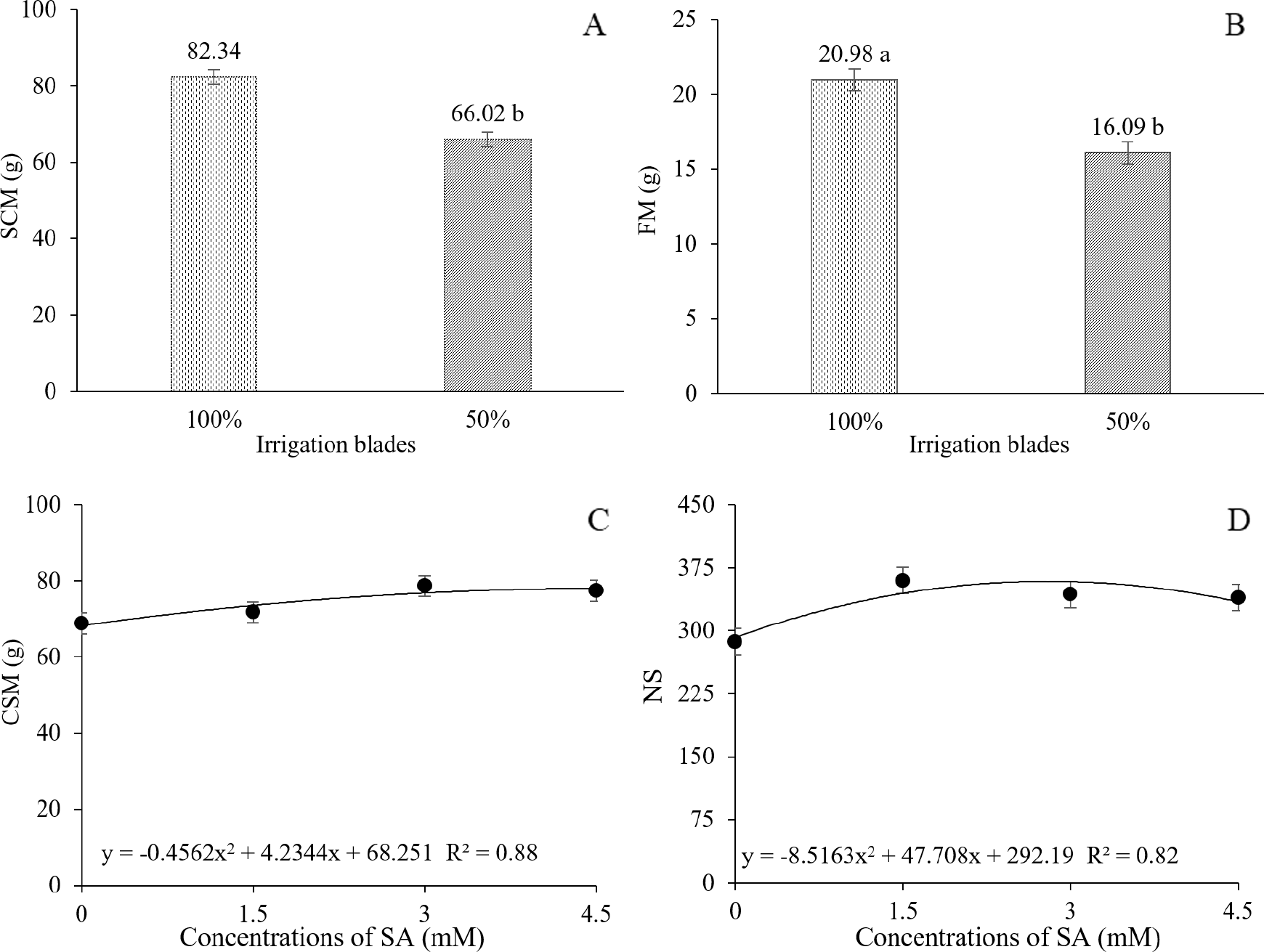
A significant irrigation depth x cotton cultivars interaction was observed for the variables number of seeds and seed mass. Additionally, the irrigation depth x salicylic acid concentrations interaction significantly affected the number of bolls. There were also isolated effects of irrigation depth on fiber mass and seed cotton mass, as well as effects of cotton cultivars on fiber mass, and of salicylic acid concentrations on number of seeds and seed cotton mass.
The interaction between the studied factors (irrigation depth x salicylic acid) significantly influenced the number of bolls per plant. According to the regression equations (Figure 6), the data fit a quadratic model, showing that the highest number of bolls (17.38) was achieved in plants under 100 % of the pot water-holding capacity with the application of 2.0 mM of salicylic acid. Meanwhile, plants under water deficit (50 % of the pot water-holding capacity) showed the highest number of bolls (15.51) with the concentration of 4.5 mM of salicylic acid. It was observed that, despite a 10.76 % reduction in the number of bolls per plant, when compared to those under 100 % of the pot water-holding capacity, providing adequate concentrations of salicylic acid favored the increase in boll production per plant under different irrigation levels. This suggests that the exogenous application of salicylic acid acts in various ways within the plant, including influencing the germination process, regulating growth, functioning as a non-enzymatic antioxidant, and activating stress defense mechanisms (Lisboa et al. 2017), thereby promoting plant yield when applied at adequate concentrations.

Number of cotton bolls per plant (NB) as a function of the irrigation depth x salicylic acid concentrations interaction. Means with the same letter do not differ from each other by the Tukey test (p ≤ 0.01).
The production components cotton seed mass and fiber mass were significantly affected by the irrigation depth, with the treatment of 50 % of the pot water-holding capacity promoting reductions of 19.82 % (16.32 g) in seed cotton mass (Figure 7A) and 23.31 % (4.89 g) in fiber mass (Figure 7B), when compared to plants subjected to 100 %, which showed the highest values for seed cotton mass (82.34 g) and fiber mass (20.98 g). This indicates that, although cotton is a relatively drought-tolerant plant, soil moisture deficiency at certain stages of the growing cycle causes severe damage, affecting reproductive structures and, consequently, reducing yield (Alves et al. 2019), likely due to floral bud or boll abortion (Lima et al. 2018).

Seed cotton mass (SCM; A) and fiber mass (FM; B) as a function of irrigation depth; and SCM (C) and number of seeds (NS; D) as a function of salicylic acid (SA) concentrations, at 112 days after sowing. Means with the same letter do not differ from each other by the Tukey test (p ≤ 0.01).
Increasing doses of salicylic acid promoted, according to regression equations, a quadratic adjustment of the data for cotton seed mass (Figure 7C) and number of seeds (Figure 7D), with the highest values for seed cotton mass (78.07 g) and number of seeds (359 seeds) obtained, respectively, in plants under 4.5 and 2.8 mM of salicylic acid. This suggests that providing adequate concentrations of this phenolic compound enhances the photosynthetic process and signals genes that promote the accumulation of reactive-oxygen species in the apoplast, favoring water absorption, growth, and, consequently, plant yield (Mazaro et al. 2015).
A significant interaction was observed for number of seeds and seed mass per plant, in relation to cotton cultivars. As shown in Figure 8A (number of seeds) and Figure 8B (seed mass), a significant difference was found only for BRS Rubi, where the highest number of seeds (364.67) and seed mass (35.54 g) were obtained in plants irrigated with 100 % of the pot water-holding capacity, surpassing the plants irrigated with 50 % of the pot water-holding capacity by 27.03 and 25.29 %, respectively. The number of seeds and seed mass per plant for BRS Safira did not differ statistically under different irrigation levels, with average values of 350 for number of seeds and 33.53 g for seed mass. Furthermore, the number of seeds and seed mass of the BRS Safira cultivar did not differ statistically from those of BRS Rubi when plants were irrigated with the highest irrigation level. However, when plants were irrigated with 50 % of the pot water-holding capacity, BRS Safira was superior by 19.46 % (number of seeds) and 19.98 % (seed mass), indicating a higher tolerance to water deficit for this genetic material.

Number of seeds (NS; A) and seed mass (SM; B) as a function of the irrigation depth x cotton cultivars interaction, at 112 days after sowing. Means followed by uppercase letters indicate comparisons between cultivars tested under different irrigation levels, whereas means followed by lowercase letters indicate comparisons between irrigation levels for the same cultivar. Means with the same letter do not differ from each other by the Tukey test (p ≤ 0.01).
CONCLUSIONS
-
1. The reduction in irrigation depth to 50 % of the pot water-holding capacity throughout the entire growing cycle affects growth components, biomass production, and yield of naturally colored cotton fiber, with production variables being the most affected by water scarcity;
-
2. An optimal concentration around 2.8-3.0 mM of salicylic acid promotes a greater growth and production of naturally colored cotton cultivars and mitigates the negative effects of water deficit on the number of cotton bolls;
-
3. The BRS Safira cotton cultivar outperformed the BRS Rubi, in terms of growth, biomass production, and production components, under different irrigation depths (100 and 50 % of the water requirement).
Data Availability Statement:
Research data are only made available by authors upon request.
REFERENCES
- ABBASZADEH, B.; LAYEGHHAGHIGHI, M.; AZIMI, R.; HADI, N. Improving water use efficiency through drought stress and using salicylic acid for proper production of Rosmarinus officinalis L. Industrial Crops and Products, v. 144, e111893, 2020.
- ALBANO, F. G.; CAVALCANTE, Í. H. L.; MACHADO, J. S.; LACERDA, C. F. de; SILVA, E. R. da; SOUSA, H. G. de. New substrate containing agroindustrial carnauba residue for production of papaya under foliar fertilization. Revista Brasileira de Engenharia Agrícola e Ambiental, v. 21, n. 2, p. 128-133, 2017.
- ALVES, F.; CAVALCANTE, F.; OLIVEIRA, I.; FERRAZ, I.; SIQUEIRA, S. Competição de variedades de algodão herbáceo para cultivo no agreste pernambucano. Pesquisa Agropecuária Pernambucana, v. 24, n. 1, e1971242019, 2019.
- BENINCASA, M. M. P. Análise de crescimento de plantas: noções básicas. Jaboticabal: Funep, 2003.
- CAMPELO, D. de H.; LACERDA, C. F.; SOUSA, J. A.; CORREIA, D.; BEZERRA, A. M. E.; ARAÚJO, J. D. M.; NEVES, A. L. R. Trocas gasosas e eficiência do fotossistema II em plantas adultas de seis espécies florestais em função do suprimento de água no solo. Revista Árvore, v. 39, n. 5, p. 973-983, 2015.
- CAMPOS, A. J. D. M.; SANTOS, S. M.; NACARATH, I. R. F. F. Estresse hídrico em plantas: uma revisão. Research, Society and Development, v. 10, n. 15, e311101523155, 2021.
- CARVALHO, J. S. B. de; SILVA, J. P. R. da; BATISTA, R. de C. M. Uso do ácido salicílico como atenuador aos efeitos do déficit hídrico em plantas de manjericão. Diversitas Journal, v. 5, n. 3, p. 1561-1574, 2020.
- CARVALHO, M.; LINO-NETO, T.; ROSA, E.; CARNIDE, V. Cowpea: a legume crop for a challenging environment. Journal of the Science of Food and Agriculture, v. 97, n. 13, p. 4273-4284, 2017.
- CASAROLI, D.; VAN LIER, Q. de J. Critérios para determinação da capacidade de vaso. Revista Brasileira de Ciência do Solo, v. 32, n. 1, p. 59-66, 2008.
- COMPANHIA NACIONAL DE ABASTECIMENTO (Conab). Safra brasileira de grãos Brasília, DF: Conab, 2024.
- COTRIM, C.; COELHO, E.; SILVA, J.; SANTOS, M. Irrigação com déficit controlado e produtividade de mangueira ‘Tommy Atkins’ sob gotejamento. Revista Brasileira de Agricultura Irrigada, v. 11, n. 8, p. 2229-2238, 2017.
- EL-BELTAGI, H. S.; AHMED, S. H.; NAMICH, A. A. M.; ABDEL-SATTAR, R. R.; ABDEL-SATTAR, R. R. Effect of salicylic acid and potassium citrate on cotton plant under salt stress. Fresenius Environmental Bulletin, v. 26, n. 1A, p. 1091-1100, 2017.
- FEITOSA, S. dos S.; ALBUQUERQUE, M. B. de; OLIVEIRA, A. P. de; PEREIRA, W. E.; BRITO NETO, J. F. de. Fisiologia do Sesamum indicum L. sob estresse hídrico e aplicação de ácido salicílico. Irriga, v. 21, n. 4, p. 711-723, 2016.
- FERRÃO, R. G.; MOREIRA, S. O.; FERRÃO, M. A. G.; RIVA, E. M.; ARANTES, L. O.; COSTA, A. F. S.; CARVALHO, P. L. P. T.; GALVÊAS, P. A. O. Genética e melhoramento: desenvolvimento e recomendação de cultivares com tolerância à seca para o Espírito Santo. Incaper em Revista, v. 6, n. 7, p. 51-71, 2016.
- FERRARI, E.; PAZ, A.; SILVA, A. C. Déficit hídrico no metabolismo da soja em semeaduras antecipadas no Mato Grosso. Nativa, v. 3, n. 1, p. 67-77, 2015.
- FERREIRA, D. Sisvar: a computer analysis system to fixed effects split plot type designs. Revista Brasileira de Biometria, v. 37, n. 4, e529, 2019.
- GASTL FILHO, J.; BONETTI, L. L. S.; ARAUJO, R. S.; SANTI, S. L.; NASCIMENTO, V. A.; VILARINHO, M. S. Ácido salicílico e potencial germinativo na germinação de sementes de pepino. Revista Inova Ciência & Tecnologia, v. 3, n. 2, p. 7-12, 2017.
- GRIMES, D. W.; CARTER, L. M. A linear rule for direct nondestructive leaf area measurements. Agronomy Journal, v. 61, n. 3, p. 477-479, 1969.
- KHAN, M. I. R.; FATMA, M.; PER, T. S.; ANJUM, N. A.; KHAN, N. A. Salicylic acid-induced abiotic stress tolerance and underlying mechanisms in plants. Frontiers in Plant Science, v. 6, e462, 2015.
- KILIÇ, R.; KARADEMIR, Ç. Effect of salicylic acid application on cotton yield and fibre quality. Journal of Applied Life Sciences and Environment, v. 56, n. 4, p. 579-599, 2024.
- KIM, Y.; MUN, B.-G.; KHAN, A. L.; WAQAS, M.; KIM, H.-H.; SHAHZAD, R.; IMRAN, M.; YUN, B.-W.; LEE, I.-J. Regulation of reactive oxygen and nitrogen species by salicylic acid in rice plants under salinity stress conditions. PLoS One, v. 13, n. 3, e0192650, 2018.
- LIMA, R. F.; ARAÚJO, W. P.; PEREIRA, J. R.; CORDÃO, M. A.; FERREIRA, F. N.; ZONTA, J. H. Fibras de algodoeiro herbáceo sob déficit hídrico. Revista Verde de Agroecologia e Desenvolvimento Sustentável, v. 13, n. 4, e427, 2018.
- LISBOA, L. A. M.; LAPAZ, A. M.; VIANA, R. S.; LEONEZI, R. S.; FIGUEIREDO, P. A. M. Influência do ácido salicílico no processo germinativo de sementes de cultivares de sorgo sacarino. Acta Iguazu, v. 6, n. 2, p. 37-49, 2017.
- MAHDI, A. H. A.; TAHA, R. S.; EMAM, S. M. Foliar applied salicylic acid improves water deficit-tolerance in Egyptian cotton. Journal of Plant Production, v. 11, n. 5, p. 383-389, 2020.
- MAZARO, S. M.; BORSATTI, F. C.; DALACOSTA, N. L.; LEWANDOWSKI, A.; DANNER, M. A.; BUSSO, C.; WAGNER JUNIOR, A. Qualidade pós-colheita de acerolas tratadas com ácido salicílico. Revista Brasileira de Ciências Agrárias, v. 10, n. 4, p. 512-517, 2015.
- NASCIMENTO, P. S.; ALVES, L. S.; PAZ, V. P. S. Performance of colored cotton under irrigation water salinity and organic matter dosages. Revista Ambiente & Água, v. 14, n. 5, e2369, 2019.
- NOBRE, R. G.; CARVALHO, K. M. P.; SALES, G. S.; SOUZA, M. S. M.; SOUTO, A. G. L.; ANTUNES, L. F. S. Salicylic acid reduces salinity stress in Barbados cherry irrigated with oilfield water in semiarid Brazil. ACS Omega, v. 10, n. 40, p. 47570-47581, 2025.
- NOVAIS, R. F.; FRANCHINI, J. C.; PAVAN, M. A. Ensaio em ambiente controlado. In: OLIVEIRA, A. J.; GARRIDO, W. E.; ARAUJO, J. D.; LOURENÇO, S. (org.). Métodos de pesquisa em fertilidade do solo Brasília, DF: Embrapa, 1991. p. 189-254.
- RAMOS, G. A.; BARROS, M. A. L.; SILVA, J. S. Relatório de avaliação dos impactos de tecnologias geradas pela Embrapa Campina Grande: Embrapa Algodão, 2020.
- SCALON, S. P. Q.; KODAMA, F. M.; DRESCH, D. M.; PEREIRA, Z. V.; MUSSURY, R. M.; SCALON, L. Q. Gas exchange in Caryocar brasiliense seedlings in water deficit conditions. Floresta e Ambiente, v. 27, n. 2, e20170520, 2020.
- SILVA, A. A. R.; LIMA, G. S.; AZEVEDO, C. A. V.; ARRUDA, T. F. L.; GHEYI, H. R.; SOARES, L. A. A. Salicylic acid attenuates the harmful effects of salt stress on the morphophysiology of early dwarf cashew. Ciência e Agrotecnologia, v. 47, n. 5, e015622, 2023.
- SOARES, L. A. A.; FELIX, C. M.; LIMA, G. S.; GHEYI, H. R.; SILVA, L. A.; FERNANDES, P. D. Gas exchange, growth, and production of cotton genotypes under water deficit. Revista Caatinga, v. 36, n. 1, p. 145-157, 2023.
- SOARES, L. A. A.; FELIX, C. M.; LIMA, G. S.; GHEYI, H. R.; SILVA, L. A.; FERNANDES, P. D. Phytomass and production components of colored cotton under salt stress. Revista Brasileira de Engenharia Agrícola e Ambiental, v. 25, n. 2, p. 132-138, 2021.
- SOFY, M. R.; SELEIMAN, M. F.; ALHAMMAD, B. A.; ALHARBI, B. M.; MOHAMED, H. I. Minimizing adverse effects of Pb on maize plants. Agronomy, v. 10, n. 5, e699, 2020.
- SOURI, M. K.; TOHIDLOO, G. Effectiveness of different methods of salicylic acid application. Chemical and Biological Technologies in Agriculture, v. 6, e26, 2019.
- TEIXEIRA, P. C.; DONAGEMA, G. K.; FONTANA, A.; TEIXEIRA, W. G. Manual de métodos de análise de solo 3. ed. Brasília, DF: Embrapa, 2017.
- UNITED STATES DEPARTMENT OF AGRICULTURE (USDA). Cotton: world markets and trade: Brazil passes the United States as top 39 cotton exporter in 2023/24. Washington, DC: USDA, 2024.
-
Editor:
Luis Carlos Cunha Junior