 Polyamine-mediated growth and physiological changes in Borago officinalis1
ABSTRACT
Polyamines play an important role in regulating plant growth, as well as in physiological and metabolic processes related to crop performance. This study aimed to evaluate the effects of polyamine use on early growth, yield, and quality traits of Borago officinalis L. A factorial layout was performed using a randomized complete block design, considering two factors: seed priming and foliar spraying. Seed priming included one control (dry seeds) and priming with distilled water, putrescine, spermine, and spermidine. Foliar spraying included one control (no spraying) and spraying at the four-leaf stage, at 50 % of the flower bud formation and 50 % of flowering. Seed priming with spermidine and spermine, combined with foliar spraying at 50 % of the flower bud stage, increased chlorophyll contents. The highest carotenoid contents were observed in plants grown from spermidine-primed seeds and sprayed with putrescine at 50 % of the flower bud stage. The highest mucilage percentages and yield performance were obtained for the spermidine and spermine priming, followed by putrescine spraying at 50 % of the flower bud and flowering stages. The saponin content was high in plants from spermidine-primed seeds sprayed at 50 % of the flower bud stage. The use of polyamines increased the essential oil content and yield, in addition to change the relative proportions of palmitic, oleic, and gamma-linolenic fatty acids, in comparison to the control.
KEYWORDS:
European borage; photosynthetic pigments; essential oil.
RESUMO
As poliaminas desempenham papel importante na regulação do crescimento vegetal, bem como em processos fisiológicos e metabólicos relacionados ao desempenho da cultura. Objetivou-se avaliar os efeitos do uso de poliaminas no crescimento inicial, produtividade e características de qualidade de Borago officinalis L. Utilizou-se delineamento fatorial em blocos casualizados completos, considerando-se dois fatores: condicionamento de sementes e pulverização foliar. O condicionamento de sementes incluiu um controle (sementes secas) e condicionamento com água destilada, putrescina, espermina e espermidina. A pulverização foliar consistiu de um controle (sem pulverização) e pulverização no estádio de quatro folhas, com 50 % de formação de botões florais e 50 % de floração. O condicionamento de sementes com espermidina e espermina, combinado com a pulverização foliar no estádio de 50 % de formação de botões florais, aumentou os teores de clorofila. Os maiores teores de carotenoides foram observados em plantas cultivadas a partir de sementes condicionadas com espermidina e pulverizadas com putrescina no estádio de 50 % de formação de botões florais. Os maiores percentuais de mucilagem e rendimentos foram obtidos com o tratamento prévio com espermidina e espermina, seguido da pulverização com putrescina nos estádios de 50 % de botão floral e floração. O teor de saponina foi elevado em plantas provenientes de sementes tratadas com espermidina e pulverizadas no estádio de 50 % de botão floral. O uso de poliaminas aumentou o teor e o rendimento de óleo essencial, além de alterar as proporções relativas dos ácidos graxos palmítico, oleico e gama-linolênico, em comparação com o controle.
PALAVRAS-CHAVE:
Borragem europeia; pigmentos fotossintéticos; óleo essencial.
INTRODUCTION
European borage (Borago officinalis L.), from the Boraginaceae family, is an annual herb native to the Mediterranean region (Borowy & Kapłan 2020). In herbal medicine, its leaves and flowers are used as sedatives, diuretics, expectorants, and laxatives (Feghhenabi et al. 2021), and contain some bioactive compounds like mucilage, saponins, tannins, and alkaloids, as well as fatty acids such as gamma-linolenic acid (Tewari et al. 2019). Its seed oil has been used to help to reduce blood pressure and regulate cholesterol levels (Avila et al. 2020), being also associated with anti-inflammatory effects, skin health improvement, lipid metabolism regulation, and increased bone strength (Tasset-Cuevas et al. 2013).
One of the main challenges in the production of most medicinal plants is their low germination and establishment capacity, which can limit yield (Shekari et al. 2011), with chemical treatments being suggested to overcome that (Khan et al. 2012). Priming with water or chemicals is an effective way to increase germination, promote uniform and rapid emergence, and improve seedling growth under non-stress and stressful conditions (Farooq et al. 2008).
In recent decades, the use of polyamines has been advised either as priming to increase pre-germination (Sheteiwy et al. 2017), or as foliar sprays to stimulate growth and increasing secondary metabolite production (Liu et al. 2016). Polyamines are low-molecular-weight compounds containing amine groups that are involved in some biological processes like growth under non-stress and stressful conditions (Amirkhiz et al. 2021). They are considered as biostimulants and growth promoters (Chen et al. 2019), and, among these compounds, putrescine, spermine, and spermidine play key roles in germination, cell division, flower development, maturation, stress responses, and plant survival (Kusano et al. 2008, Tavladoraki et al. 2012, Reis et al. 2016).
The production of secondary metabolites is an adaptive mechanism, especially in medicinal species, where these compounds contribute to defense and therapeutic value (van Dam & van der Meijden 2011). They include some bioactive substances like essential oils and other specialized compounds (Verpoorte et al. 2002). In many medicinal plants, saponins represent a major group of these metabolites (Isah 2019), being influenced by environmental conditions and developmental stage (Moses et al. 2014).
Borago officinalis is recognized for its medicinal and nutritional values, mainly due to its bioactive constituents, including saponins and flavonoids (Sufwan et al. 2025). Understanding the factors that influence their synthesis is needed for optimizing cultivation and improving medicinal quality. Polyamines may contribute to this process by increasing the accumulation of structural polysaccharides like mucilage, as well as improving plant water status and growth processes (Luo et al. 2015).
Understanding the physiological responses of B. officinalis to polyamine is important for developing effective strategies to improve growth and production. However, limited information is available regarding the effects of polyamines on secondary metabolite production, oil quantity and quality, and yield performance. Therefore, the present research aimed to assess the effects of seed priming and foliar application of polyamines on physiological responses of B. officinalis, as well as on their quantitative and qualitative traits.
MATERIAL AND METHODS
This research was conducted at the University of Maragheh, in Maragheh, Iran (46º16′E, 37º23′N, and 1,485 m of altitude), during the 2022 growing season.
The area has a cold semi-arid climate, based on the Köppen classification system. To determine the soil characteristics, soil samples were collected from a depth of 0-30 cm (Tandon 1995). The samples were air-dried to measure the pH, electrical conductivity, and saturation percentage (Table 1). The soil organic carbon was measured using the Walkley & Black procedure. The total nitrogen was determined via the Kjeldahl procedure, and the available phosphorus according to Olsen. The available potassium was recorded with ammonium acetate. Calcium carbonate (CaCO3) was measured via volumetric acid-base titration or infrared spectroscopy. Micronutrients (Zn, Mn, and Fe) were extracted using the DTPA method and quantified by atomic absorption spectroscopy (Table 1).
To evaluate the influence of polyamines on the growth and internal compounds of Borago officinalis (European borage), a factorial layout was performed via a randomized complete block design, with three replicates. The polyamines were purchased from Merck, with a reported purity of ≥ 80 %. The first factor was seed priming at five levels: control (dry seeds), priming with distilled water, priming with 3 mM of putrescine, priming with 3 mM of spermine, and priming with 5 mM of spermidine. The seeds were primed for 4 hours, and then washed with tap water and dried at room temperature (25 ºC) for 4 hours. Two preliminary optimization trials were done, and the selection of treatments was based on germination percentage. The 4-hour priming duration combined with the selected polyamine concentrations showed the best performance, and was used in the main trial.
The second factor was foliar application of putrescine at four levels: no spraying, and spraying with 3 mM at the four-leaf stage, at 50 % of the flower bud formation, and at 50 % of flowering. Putrescine was selected for foliar application due to its favorable performance reported in previous investigations. The field was prepared based on local recommendations, and basal fertilizers (75:40:20 - NPK) were applied based on soil test results to ensure a sufficient nutrient availability. The seeds were planted in plots measuring 2.5 × 3 m, arranged in four rows per plot, with 50 cm between rows and 10 cm between plants, and irrigation was applied. Standard practices were done across all field plots. The Terflan herbicide was applied before sowing, to control early weed emergence, and manual weeding was carried out during the growing season.
Seedling emergence was recorded daily for 20 days after the appearance of the first seedlings. When no further increase in emerged seedlings was observed, the mean emergence time was computed via the modified procedure of Ellis & Roberts (1981): MET = [∑n * d]/N, where MET is the mean emergence time, ∑n the daily emerged number of seeds, d the number of days from the starting of the trail, and N the total number of seeds germinated by the end of the experiment. After full seedling establishment in the experimental plots, the total number of emerged seedlings in each plot was counted. The percentage of seedling emergence per square meter was then calculated using the following equation: FEP = (Ni/S) × 100, where FEP is the final emergence percentage, Ni the seeds emerged by the desired day, and S the whole seeds sown (ISTA 2015). The ground cover percentage in each experimental unit was measured starting at 25 days after sowing, and continued once a week for five stages, using a square frame with 50-cm sides. The position of the frame was kept constant within each plot during all measurement stages. The contents of chlorophylls a and b and carotenoids were determined according to Arnon (1949), with 80 % acetone as the extraction solvent. The membrane stability index was determined based on Sairam et al. (2002), by assessing the electrical conductivity of leaf leachates in double-distilled water after incubation at 40 ºC, followed by 100 ºC.
The saponin content was determined using the spectrophotometric procedure described by Brunner (1984), whereas 1 g of dried plant was extracted with 80 % methanol. The extraction was performed in a water bath at 60 ºC, for 2 hours, continuously shaking. The extract was filtered and reacted with the chromogenic reagent, whereas absorbance measuring was done at 544 nm, using a UV-visible spectrophotometer. Quantification was performed by comparison with a standard calibration curve. Mucilage was measured via the hot extraction procedure explained by Cakmak et al. (2023), so 1 g of dried and powdered sample was mixed and heated with distilled water at 80-90 ºC, for 1 hour, to dissolve mucilage polysaccharides. The extract was filtered, and the mucilage was precipitated by adding 95 % ethanol, followed by drying and weighing the recovered residue. At maturity, the number of seeds per plant and 1,000-seed weight were determined using 10 randomly selected plants from each plot. For total yield, seeds were harvested every 5 days from a 1-m2 area in the center plot, and yield was calculated.
Data were measured using a 5 × 4 factorial analysis of variance in a randomized complete block design, with three replicates. The statistical model consisted on the main effects of seed priming (5 levels), foliar spraying (4 levels), their interaction, and block effects. Before analysis, the normality of residuals was assessed using the Shapiro-Wilk test, and all datasets satisfied the normality; therefore, data transformation was not required. Mean comparisons were performed using the SAS software (version 9.1), with the Student-Newman-Keuls procedure at 5 % of probability.
RESULTS AND DISCUSSION
The obtained findings indicated that polyamine-seed priming improved early seedling growth by affecting the duration, as well as the percentage of field emergence. The treatment with spermidine priming resulted in the fastest emergence and the highest emergence percentage, whereas the control (dry seeds) treatment recorded the slowest and lowest emergence performance (Figures 1A and B). Seed priming is recognized as an effective approach to increased germination, uniform seedling emergence, and early seedling establishment, which can support better plant growth and yield (Khan et al. 2012). Priming with polyamines was effective in improving early seedling growth by influencing both the emergence duration and percentage. Also, the spermidine priming resulted in the fastest emergence and the highest emergence rate, whereas the control showed the slowest emergence and the lowest emergence performance. These findings are consistent with previous reports indicating the positive response of B. officinalis seeds to priming treatments (Feghhenabi et al. 2021, Sheikhzadeh et al. 2021).

Effect of seed priming with polyamine hormones on mean emergence time (A) and final emergence percentage (B) of Borago officinalis seedlings.
Shekari et al. (2011) found that B. officinalis seeds have a potential to respond to seed priming applications. Similarly, Asadidanalo et al. (2018) suggested that polyamine priming improves seedling characteristics, vigor index, and emergence uniformity in B. officinalis. Also, Afzal et al. (2008) attributed the rapid and uniform emergence and reduced seedling mortality observed in seeds primed with spermine and spermidine to the enhanced use of metabolic reserves during germination. In the current research, the percentage of ground cover was higher in plants derived from spermineand spermidine-primed seeds across all growth stages, with the greatest differences seen in early growth (Figure 2). The rapid and uniform germination of polyamine-primed seeds, particularly spermineand spermidine-treated seeds, contributed to better seedling establishment and increased ground cover. Since leaves are the main photosynthetic organs of plants, maximizing the interception of solar radiation by green tissues can improve plant growth efficiency (Henry et al. 2020). Also, an increased leaf area can reduce the soil surface water evaporation and increase assimilate synthesis and translocation to various plant organs, whereas supporting the persistence and expansion of ground cover (Li et al. 2022).

Changes in ground cover percentage in Borago officinalis under seed priming with polyamine hormones.
Polyamines may increase plant growth by modulating hormonal pathways, like influencing the synthesis or activity of growth-related hormones including auxins and cytokinins, which may contribute to increased leaf greenness and photosynthetic surface area (Divte et al. 2021). This mechanism was not directly assessed in the current research and needs further investigation (Yousefi et al. 2021). Also, polyamines are nitrogen-containing organic compounds that may influence nitrogen metabolism and stimulate plant growth (Badawy et al. 2015).
The structure and concentration of chlorophyll as the most important photosynthetic pigment are influenced not only by genetic factors, but also by environmental conditions and plant growth status (Huang et al. 2022, Hashem & Al-Issawi 2023). The results of the current research showed that spermidine priming (Figures 3a and 3b) and foliar spraying at 50 % of the flower bud stage (Figures 3c and 3d) produced the highest chlorophyll a and b contents. In contrast, the lowest chlorophyll a and b levels were observed in dry seeds and the non-sprayed control.

Effect of seed priming with polyamine hormones on chlorophyll a (A) and b (B), and spraying with putrescine in different growth stages on chlorophyll a (C) and b (D).
The carotenoid content was affected by the interaction between seed priming and foliar spraying stage. Under spraying conditions, polyamine priming increased the carotenoid concentration, when compared with non-primed and hydro-primed seeds, with spermidine priming consistently showing the greatest effect. The highest carotenoid content was obtained when spermidine priming was combined with foliar spraying at 50 % of the flower bud formation, whereas non-primed seeds exhibited the lowest carotenoid levels across all spraying treatments (Figure 4). Shaddad et al. (2011) reported an increment in pigment content after polyamine spraying, which was attributed to improved stability in thylakoids. Since nitrogen is an essential element for photosynthetic pigment biosynthesis, the enhancement of pigment accumulation after polyamine application may be related to the ability of polyamines to interact with nucleic acids and help to maintain the stability of nitrogen and its availability in plant tissues, whereas supporting chlorophyll synthesis (Ghorbani et al. 2023).

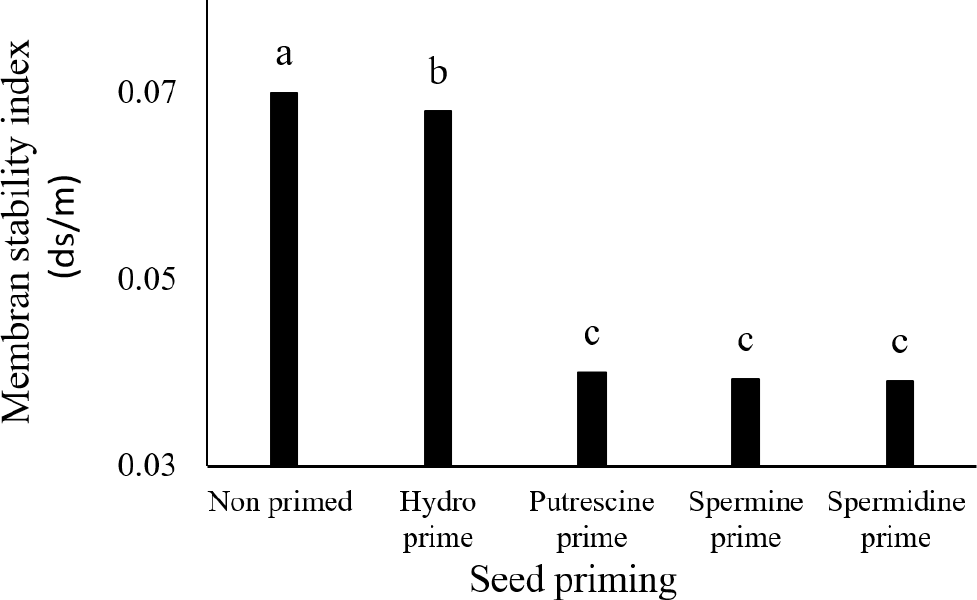
Cell membrane integrity had an important influence on maintaining normal growth and improving resistance to various stresses (Munnik et al. 2021). In the current study, the highest membrane stability and the lowest electrolyte leakage were found in spermidineand spermine-primed seeds, with no significant difference between them (Figure 5). The improvement in membrane structure due to polyamine may explain the physiological responses in B. officinalis, as increased cellular stability can support a better growth performance under the experimental conditions. This effect may be related to the interaction of polyamines with membrane phospholipids, which can modify solute diffusion across cellular membranes (Galston & Sawhney 1990, Kubis et al. 2014).

Effect of seed priming with polyamine hormones on Borago officinalis membrane stability index.
Although the antioxidant enzyme activity was not assessed in this research, the reduction in electrolyte leakage under polyamine may be related with improved antioxidant defense mechanisms, which could contribute to membrane protection (Mostafaei et al. 2018).
Among the priming treatments, the highest seed yield was obtained with spermidine priming, whereas the lowest yield was recorded in the control treatment (Figure 6a). Also, among the foliar spraying treatments, the highest seed yield was observed when putrescine was applied at 50 % of the flower bud formation (F3) and 50 % of flowering (F4) (Figure 6b). Poor germination is one of the major factors limiting plant yield (Albarenque et al. 2023). The higher seed yield observed in spermidineand spermine-primed plants may be associated with improved emergence, as demonstrated in the current research. Similar relationships have been reported in other species (Tomosugi et al. 2006).

Effect of seed spraying and priming with polyamine hormones on Borago officinalis seed yield.
It has been suggested that polyamine priming may increase germination by increasing endogenous levels of growth-related hormones like indole-3-acetic acid and gibberellins, which may increase starch degradation, as well as soluble sugar availability, whereas supporting energy supply during germination (Yang et al. 2016). Huang et al. (2017) reported that spermidine priming significantly increased shoot and root dry biomass, as well as plant height, in sweet corn. Similarly, Farooq et al. (2009) observed that putrescine spraying increased the chlorophyll concentration, which may increase photosynthetic efficiency and yield. Also, Chen et al. (2019) reported that putrescine application affected plant biomass, possibly via its role in stimulating cell division.
However, polyamine application may contribute to regulating flower bud differentiation, flowering, and seed maturation in B. officinalis. In particular, polyamines may influence hormonal balance and metabolic pathways involved in reproductive development, which is consistent with reports in other species where polyamine treatments enhanced reproductive growth and improved seed yield (Bueno & Cordovilla 2019).
The mucilage content was influenced by both the seed priming and foliar spraying treatments. Among the priming treatments, the highest mucilage percentage was obtained with spermidine and spermine priming, with no significant difference between them, whereas the highest mucilage yield was recorded in spermidine-primed plants (Figures 7a and 7b). Regarding foliar application, the highest mucilage percentage was observed when putrescine was sprayed at 50 % of the flower bud and 50 % of the flowering (F4) stage, with no significant difference between them (Figure 7c).

Effect of priming with polyamine on mucilage percentage (A) and yield (B), and of spraying with putrescine on mucilage percentage (C) and yield (D).
The positive effects of polyamines may be associated with improved photosynthetic efficiency, enhanced translocation of photo-assimilates from source tissues to developing seeds, and improved nutrient supply, which can contribute to stronger cell wall formation and increased mucilage biosynthesis during seed development (Akter et al. 2018). Similar trends were observed for mucilage yield (Figure 7d). Since mucilage yield is determined by both seed yield and mucilage percentage, it is positively correlated with these two traits.
The highest saponin concentration was obtained when seeds were primed with spermidine and sprayed with putrescine at 50 % of the flower bud stage. The lowest saponin content was found in the control treatment without foliar spraying (F1) (Figure 8). Saponins are important secondary metabolites that may contribute to improved plant physiological performance by supporting metabolic activity and assimilate distribution during seed development (El Aziz et al. 2019). Similarly, Peynevandi et al. (2018) noticed that polyamine increased photosynthetic pigment levels and glycosidic compound synthesis, which may explain the observed increase in saponin accumulation. However, some researches have reported reductions in glycosidic compounds after the use of growth regulators, indicating that metabolite responses may vary depending on species and treatment conditions (Javed et al. 2017, Ahmad et al. 2020).

The percentage and yield of essential oil in B. officinalis were influenced by seed priming. The highest essential oil percentage was observed with spermidine priming (Figure 9a). Similarly, the highest essential oil yield was obtained in plants primed with spermidine and spermine, with no significant difference between them (Figure 9b). Essential oils consist of complex mixtures of low-molecular-weight terpenoids derived from isoprene units (Dash et al. 2022).

Effect of seed priming with polyamine hormones on Borago officinalis essential oil percentage (A) and yield (B).
Polyamine-seed priming may moderately improve nutrient availability and physiological activity, which can promote the early development of glandular and secretory tissues responsible for essential oil biosynthesis (Maes et al. 2011). Also, glucose availability in plant cells, which is generated through photosynthesis, plays a key role in enhancing terpene synthesis and essential oil accumulation in medicinal and aromatic plants (Calsamiglia et al. 2007). Consistent with these findings, Karaman et al. (2008) reported that the use of spermine and spermidine increased the essential oil profile of basil (Ocimum basilicum). Such increase in essential oil yield after polyamine priming may be related to the combined impacts of higher essential oil concentration and improved seed yield in polyamine-treated plants.
The highest oil percentage and oil yield were obtained in the treatment combining spermidine-seed priming and putrescine spraying at 50 % of the flowering stage (Figures 10a and 10b). Polyamine pre-treatment may improve the germination rate, emergence uniformity, and seedling establishment, which can enhance photosynthetic efficiency and stimulate metabolic pathways involved in oil biosynthesis (Rolletschek et al. 2005). The increase in oil yield observed in polyamine-treated plants is consistent with the higher seed yield recorded under these treatments. Similarly, Deotale et al. (2016) reported that the foliar application of putrescine significantly increased the oil content in soybean.

Effect of spraying and priming with polyamine hormones on Borago officinalis seed oil percentage (A) and yield (B).
The results indicated that the highest oleic acid content was obtained under spermidine priming (Figure 11a), whereas the highest palmitic acid content was observed in the control treatment (Figure 11b). The maximum gamma-linolenic acid content (31.24 %) was achieved when spermidine priming was combined with putrescine spraying at 50 % of the flower bud stage (F3). In addition, spermine and spermidine priming increased the gamma-linolenic acid levels, when compared with the control treatment (Figure 12).

Effect of seed priming with polyamine hormones on Borago officinalis oleic (A) and palmitic (B) acid.

Effect of spraying and priming with polyamine hormones on Borago officinalis seed gamma-linolenic acid.
The increase in oil concentration and seed yield in polyamine-treated plants may be associated with enhanced enzyme activities which are involved in lipid metabolism (Tomosugi et al. 2006). Similarly, reductions in palmitic acid content following polyamine application have been reported in Stevia rebaudiana treated with polyamines (Peynevandi et al. 2018). These findings support the role of polyamines in modulating lipid metabolism and fatty acid composition by potentially influencing the enzymes activities involving fatty acid biosynthesis.
Talaat & El-Din (2005) reported that several enzyme activities which are involved in fatty acid synthesis in rapeseed increased following polyamine application. Similarly, Blazquez (2024) suggested that polyamines may delay leaf senescence and prolong the green leaf period, thereby extending the seed filling stage and improving oil quality. In addition, polyamines may influence the composition of seed fatty acids by modulating the enzymes activities involving fatty acid biosynthesis (Li et al. 2025).
CONCLUSIONS
-
1. Seed priming and foliar spraying with polyamines increase the seed yield of Borago officinalis;
-
2. Polyamine improves the yield of essential oil, mucilage, and saponin, as well as lipid-related constituents such as oil and fatty acid composition, in B. officinalis seeds.
Data Availability Statement:
Research data are only made available by authors upon request.
REFERENCES
- AFZAL, I.; BASRA, S. M. A.; SHAHID, M.; FAROOQ, M.; SALEEM, M. Priming enhances germination of spring maize (Zea mays L.) under cool conditions. Seed Science and Technology, v. 36, n. 2, p. 497-503, 2008.
- AHMAD, A.; ALI, H.; KHAN, H.; BEGAM, A.; KHAN, S.; ALI, S. S.; ABBASI, B. H. Effect of gibberellic acid on production of biomass, polyphenolics and steviol glycosides in adventitious root cultures of Stevia rebaudiana (Bert.). Plants, v. 9, n. 4, e420, 2020.
- AKTER, S.; RASUL, M. G.; ZAKARIA, M.; SARKER, M. M.; NILA, I. S.; DUTTA, S.; ROHMAN, M. M. Effect of polyamine on pigmentation, reactive oxidative species and antioxidant under drought in maize (Zea mays L.). Turkish Journal of Agriculture - Food Science and Technology, v. 6, n. 7, p. 799-811, 2018.
- ALBARENQUE, S.; BASSO, B.; DAVIDSON, O.; MAESTRINI, B.; MELCHIORI, R. Plant emergence and maize (Zea mays L.) yield across multiple farmers’ fields. Field Crops Research, v. 302, e109090, 2023.
- AMIRKHIZ, K. F.; DEHAGHI, M. A.; SANAVY, S. A. M. M.; REZAZADEH, A. Evaluation of changes in fatty acid profile, grain, and oil yield of Carthamus tinctorius L. in response to foliar application of polyamine compounds under deficit irrigation conditions. Industrial Crops and Products, v. 161, e113231, 2021.
- ARNON, D. I. Copper enzymes in isolated chloroplasts: polyphenoloxidase in Beta vulgaris. Plant Physiology, v. 24, n. 1, p. 1-15, 1949.
- ASADIDANALO, A.; SHEKARI, F.; SABAGHNIA, N.; NASIRI, Y. Effect of polyamines application on germination and physiological characteristics of European borage (Borago officinalis L.). Agriculture & Forestry, v. 64, n. 3, p. 127-140, 2018.
- AVILA, C.; BREAKSPEAR, I.; HAWRELAK, J.; SALMOND, S.; EVANS, S. A systematic review and quality assessment of case reports of adverse events for European borage (Borago officinalis), coltsfoot (Tussilago farfara) and comfrey (Symphytum officinale). Fitoterapia, v. 142, e104519, 2020.
- BADAWY, E. S. M.; MAHROS, K. M.; MAHMOUD, H. A.; HASSAN, M. M.; MOHAMED, E. S. I. Anatomical structure of Antirrhinum majus plant stem and leaf as affected by diatomite, putrescine and alpha-tocopherol treatments. International Journal of ChemTech Research, v. 8, n. 12, p. 488-496, 2015.
- BLAZQUEZ, M. A. Polyamines: their role in plant development and stress. Annual Review of Plant Biology, v. 75, n. 1, p. 95-117, 2024.
- BOROWY, A.; KAPŁAN, M. Chemical composition and antioxidant activity of borage (Borago officinalis L.) seeds. Acta Scientiarum Polonorum, v. 19, n. 6, p. 79-90, 2020.
- BRUNNER, J. H. Direct spectrophotometric determination of saponin. Analytical Chemistry, v. 34, n. 396, p. 1314-1326, 1984.
- BUENO, M.; CORDOVILLA, M. P. Polyamines in halophytes. Frontiers in Plant Science, v. 10, e439, 2019.
- CAKMAK, H.; ILYASOGLU-BUYUKKESTELLI, H.; SOGUT, E.; OZYURT, V. H.; GUMUS-BONACINA, C. E.; SIMSEK, S. A review on recent advances of plant mucilages and their applications in food industry: extraction, functional properties and health benefits. Food Hydrocolloids for Health, v. 3, e100131, 2023.
- CALSAMIGLIA, S.; BUSQUET, M.; CARDOZO, P. W.; CASTILLEJOS, L.; FERRET, A. Essential oils as modifiers of rumen microbial fermentation. Journal of Dairy Science, v. 90, n. 6, p. 2580-2595, 2007.
- CHEN, D.; SHAO, Q.; YIN, L.; YOUNIS, A.; ZHENG, B. Polyamine function in plants: metabolism, regulation on development, and roles in abiotic stress responses. Frontiers in Plant Science, v. 9, e1945, 2019.
- DASH, D. K.; TYAGI, C. K.; SAHU, A. K.; TRIPATHI, V. Revisiting the medicinal value of terpenes and terpenoids. In: MEENA, V. S.; PAREWA, H. P.; MEENA, S. K. (ed.). Revisiting plant biostimulants London: IntechOpen, 2022. p. 1-17.
- DEOTALE, R. D.; WAGH, Y. A.; PATIL, S. R.; KALAMKAR, V. B. Influence of putrescine and indole-3-butyric acid on chemical and biochemical parameters and yield of soybean. International Journal of Current Research, v. 8, n. 3, p. 27248-27255, 2016.
- DIVTE, P. R.; YADAV, P.; PAWAR, A. B.; SHARMA, V.; ANAND, A.; PANDEY, R.; SINGH, B. Crop response to iron deficiency is guided by cross-talk between phytohormones and their regulation of the root system architecture. Agricultural Research, v. 10, n. 3, p. 347-360, 2021.
- EL AZIZ, M. M. A.; ASHOUR, A. S.; MELAD, A. S. G. A review on saponins from medicinal plants: chemistry, isolation, and determination. Nanomedicine Research Journal, v. 8, n. 1, p. 282-288, 2019.
- ELLIS, R. H.; ROBERTS, E. H. The quantification of aging and survival in orthodox seeds. Seed Science and Technology, v. 9, n. 2, p. 373-409, 1981.
- FAROOQ, M.; BASRA, S. M. A.; REHMAN, H.; HUSSAIN, M. Seed priming with polyamines improves the germination and early seedling growth in fine rice. Journal of New Seeds, v. 9, n. 2, p. 145-155, 2008.
- FAROOQ, M.; WAHID, A.; ASAD, S. A.; AHMAD, N. Comparative efficacy of surface drying and re-drying seed priming in rice: changes in emergence, seedling growth and associated metabolic events. Paddy Water Environment, v. 8, n. 1, p. 15-22, 2009.
- FEGHHENABI, F.; HADI, H.; KHODAVERDILOO, H.; VAN GENUCHTEN, M. T. European borage (Borago officinalis L.) response to salinity at early growth stages as influenced by seed pre-treatment. Agricultural Water Management, v. 253, e106925, 2021.
- GALSTON, A. W.; SAWHNEY, R. K. Polyamines in plant physiology. Plant Physiology, v. 94, n. 2, p. 406-410, 1990.
- GHORBANI, A.; GHASEMI-OMRAN, V. O.; CHEN, M. The effect of glycine betaine on nitrogen and polyamine metabolisms, expression of glycoside-related biosynthetic enzymes, and K/Na balance of stevia under salt stress. Plants, v. 12, n. 8, e1628, 2023.
- HASHEM, L. F.; AL-ISSAWI, M. H. Chlorophyll content variation in wheat genotypes planted in semi-arid region. IOP Conference Series: Earth and Environmental Science, v. 1252, n. 1, e012025, 2023.
- HENRY, R. J.; FURTADO, A.; RANGAN, P. Pathways of photosynthesis in non-leaf tissues. Biology, v. 9, n. 12, e438, 2020.
- HUANG, H.; WANG, W.; LV, J.; LIU, Q.; LIU, X.; XIE, S.; FENG, J. Relationship between chlorophyll a and environmental factors in lakes based on the random forest algorithm. Water, v. 14, n. 19, e3128, 2022.
- HUANG, Y.; LIN, C.; HE, F.; LI, Z.; GUAN, Y.; HU, Q.; HU, J. Exogenous spermidine improves seed germination of sweet corn via involvement in phytohormone interactions, H2O2 and relevant gene expression. BMC Plant Biology, v. 17, e1, 2017.
- INTERNATIONAL SEED TESTING ASSOCIATION (ISTA). International rules for seed testing Zurich: ISTA, 2015.
- ISAH, T. Stress and defense responses in plant secondary metabolites production. Biological Research, v. 52, n. 1, p. 39-53, 2019.
- JAVED, R.; YUCESAN, B.; ZIA, M.; GUREL, E. Differential effects of plant growth regulators on physiology, steviol glycosides content, and antioxidant capacity in micropropagated tissues of Stevia rebaudiana. Biologia, v. 72, n. 10, p. 1156-1165, 2017.
- KARAMAN, S.; KIRECCI, O. A.; ILCIM, A. Influence of polyamines (spermine, spermidine and putrescine) on the essential oil composition of basil (Ocimum basilicum L.). Journal of Essential Oil Research, v. 20, n. 4, p. 288-292, 2008.
- KHAN, H. A.; ZIAF, K.; AMJAD, M.; IQBAL, Q. Exogenous application of polyamines improves germination and early seedling growth of hot pepper. Chilean Journal of Agricultural Researh, v. 72, n. 3, p. 429-433, 2012.
- KUBIS, J.; FLORYSZAK-WIECZOREK, J.; ARASIMOWICZ-JELONEK, M. Polyamines induce adaptive responses in water deficit stressed cucumber roots. Journal of Plant Research, v. 127, n. 1, p. 151-158, 2014.
- KUSANO, T.; BERBERICH, T.; TATEDA, C.; TAKAHASHI, Y. Polyamines: essential factors for growth and survival. Planta, v. 228, n. 3, p. 367-381, 2008.
- LI, Y.; MING, B.; FAN, P.; LIU, Y.; WANG, K.; HOU, P.; XIE, R. Quantifying contributions of leaf area and longevity to leaf area duration under increased planting density and nitrogen input regimens during maize yield improvement. Field Crops Research, v. 283, e108551, 2022.
- LI, Y.; WANG, X.; WU, S.; MEI, X.; SONG, W.; SHU, Q. Metabolic pathway for evaluation of polyunsaturated fatty acids content variation and regulation of its biosynthesis in Paeonia ostii through abscisic acid and abscisic acid-insensitive 5 (PoABI5). Industrial Crops and Products, v. 227, n. 1, e120758, 2025.
- LIU, Y.; XU, H.; XIAOXIA, W.; LIAO, Y. Effect of polyamine on seed germination of wheat under drought stress is related to changes in hormones and carbohydrates. Journal of Integrative Agriculture, v. 15, n. 12, p. 2759-2774, 2016.
- LUO, H.; YAN, X. H.; ZHOU, B.; WANG, N.; YANG, J. Q. Water absorbance features of seed mucilage of an invasive plant, Plantago virginica, and its germination response to drought stress. Chinese Journal of Ecology, v. 34, n. 8, e2155, 2015.
- MAES, L.; VAN NIEUWERBURGH, F. C.; ZHANG, Y.; REED, D. W.; POLLIER, J.; VANDE CASTEELS, S. R.; GOOSSENS, A. Dissection of the phytohormonal regulation of trichome formation and biosynthesis of the antimalarial compound artemisinin in Artemisia annua plants. New Phytologist, v. 189, n. 1, p. 176-189, 2011.
- MOSES, T.; PAPADOPOULOU, K. K.; OSBOURN, A. Metabolic and functional diversity of saponins, biosynthetic intermediates and semi-synthetic derivatives. Critical Reviews in Biochemistry and Molecular Biology, v. 49, n. 6, p. 439-462, 2014.
- MOSTAFAEI, E.; ZEHTAB-SALMASI, S.; SALEHI-LISAR, Y.; GHASSEMI-GOLEZANI, K. Changes in photosynthetic pigments, osmolytes and antioxidants of Indian mustard by drought and exogenous polyamines. Acta Biologica Hungarica, v. 69, n. 3, p. 313-324, 2018.
- MUNNIK, T.; MONGRAND, S.; ZARSKY, V.; BLATT, M. Dynamic membranes: the indispensable platform for plant growth, signaling, and development. Plant Physiology, v. 185, n. 3, p. 547-549, 2021.
- PEYNEVANDI, K.; RAZAVI, S. M.; ZAHRI, S. The ameliorating effects of polyamine supplement on physiological and biochemical parameters of Stevia rebaudiana Bertoni under cold stress. Plant Production Science, v. 21, n. 2, p. 123-131, 2018.
- REIS, R. S.; VALE, E. M.; HERINGER, A. S.; SANTA-CATARINA, C.; SILVEIRA, V. Putrescine induces somatic embryo development and proteomic changes in embryogenic callus of sugarcane. Journal of Proteomics, v. 130, n. 1, p. 170-179, 2016.
- ROLLETSCHEK, H.; RADCHUK, R.; KLUKAS, C.; SCHREIBER, F.; WOBUS, U.; BORISJUK, L. Evidence of a key role for photosynthetic oxygen release in oil storage in developing soybean seeds. New Phytologist, v. 167, n. 3, p. 777-786, 2005.
- SAIRAM, R. K.; RAO, K. V.; SRIVASTAVA, G. C. Differential response of wheat genotypes to long term salinity stress in relation to oxidative stress, antioxidant activity and osmolyte. Plant Science, v. 163, n. 5, p. 1037-1046, 2002.
- SHADDAD, M. A. K.; HAMDIA ABD EL-SAMAD, M.; MOHAMMED, H. T. Interactive effects of drought stress and phytohormones or polyamines on growth and yield of two maize (Zea maize L.) genotypes. American Journal of Plant Science, v. 2, n. 6, p. 790-807, 2011.
- SHEIKHZADEH, P.; ZARE, N.; MAHMOUDI, F. The synergistic effects of hydro and hormone priming on seed germination, antioxidant activity and cadmium tolerance in borage. Acta Botanica Croatica, 80, n. 1, p. 18-28, 2021.
- SHEKARI, F.; BALJANI, R.; SABA, J.; ZANGANI, E. Effect of salicylic acid on photosynthetic activity and performance flowers European borage plant (Borago officinalis). Journal of Medicinal Plants, v. 10, n. 39, p. 34-41, 2011.
- SHETEIWY, M.; SHEN, H.; XU, J.; GUAN, Y.; SONG, W.; HU, J. Seed polyamines metabolism induced by seed priming with spermidine and 5-aminolevulinic acid for chilling tolerance improvement in rice (Oryza sativa L.) seedlings. Environmental and Experimental Botany, v. 137, n. 1, p. 58-72, 2017.
- SUFWAN, Z.; ANSARI, J. A.; AHSAN, F. Advances in pharmacological insights of Borago officinalis: a comprehensive review. Biological Diversity, v. 2, n. 4, p. 193-205, 2025.
- TALAAT, I. M.; EL-DIN, K. M. G. Physiological effect of puterscine and heat hardening on Nigella sativa L. plants. International Journal of Agriculture & Biology, v. 7, n. 3, p. 358-362, 2005.
- TANDON, H. L. S. Methods of analysis of soils, plants, waters and fertilizers New Delhi: FDCO, 1995.
- TASSET-CUEVAS, I.; FERNANDEZ-BEDMAR, Z.; LOZANO-BAENA, M. D.; CAMPOS-SANCHEZ, J.; HARO-BAILON, A. de; MUNOZ-SERRANO, A.; ALONSO-MORAGA, A. Protective effect of European borage seed oil and gamma linolenic acid on DNA: in vivo and in vitro studies. PloS One, v. 8, n. 2, e56986, 2013.
- TAVLADORAKI, P.; CONA, A.; FEDERICO, R.; TEMPERA, G.; VICECONTE, N.; SACCOCCIO, S.; AGOSTINELLI, E. Polyamine catabolism: target for antiproliferative therapies in animals and stress tolerance strategies in plants. Amino Acids, v. 42, n. 2-3, p. 411-426, 2012.
- TEWARI, D.; BAWARI, S.; PATNI, P.; SAH, A. N. European borage (Borago officinalis L.) in nonvitamin and nonmineral nutritional supplements London: Academic Press, 2019.
- TOMOSUGI, M.; ICHIHARA, K. I.; SAITO, K. Polyamines are essential for the synthesis of 2-ricinoleoyl phosphatidic acid in developing seeds of castor. Planta, v. 223, n. 2, p. 349-358, 2006.
- VAN DAM, N. M.; VAN DER MEIJDEN, E. A role for metabolomics in plant ecology. Biology of Plant Metabolomics, v. 43, n. 1, p. 87-107, 2011.
- VERPOORTE, R.; INGKANINAN, K.; MEMELINK, J.; VANDERHEIJDEN, R. Plant cell biotechnology: production of natural products. In: RAUTER, A. P.; PALMA, F. B.; JUSTINO, J.; ARAÚJO, M. A.; SANTOS, S. P. dos (ed.). Natural products in the new millennium: prospects and industrial application. Dordrecht: Springer, 2002. p. 345-366
- YANG, L.; HONG, X.; XIAO-XIA, W.; YUN-CHENG, L. Effect of polyamine on seed germination of wheat under drought stress is related to changes in hormones and carbohydrates. Journal of Integrative Agriculture, v. 15, n. 12, p. 2759-2774, 2016.
- YOUSEFI, F.; JABBARZADEH, Z.; AMIRI, J.; RASOULI-SADAGHIANI, M.; SHAYGAN, A. Foliar application of polyamines improves some morphological and physiological characteristics of rose. Folia Horticulturae, v. 33, n. 1, p. 147-156, 2021.
-
Editor:
Luis Carlos Cunha Junior