 Influence of application timing on the efficacy of rhizosphere adapted Trichoderma strains for biocontrol of Fusarium kalimantanense in banana tree1
Abstract
Developing sustainable alternatives to the chemical control of Panama disease in banana tree is essential. This study aimed to evaluate the dual role of Trichoderma strains isolated from banana tree rhizosphere in suppressing the disease severity and promoting plant growth. The isolates were characterized by ITS region sequencing, in vitro antagonism assays, and greenhouse experiments, using micropropagated ‘Prata Catarina’ banana plantlets. In vitro, the Trichoderma strains exhibited rapid growth and inhibited the mycelial expansion of the pathogen (14.85-22.44 %). Under greenhouse conditions, Trichoderma application reduced the disease severity, when compared to pathogen-only controls, particularly when applied after inoculation. Several isolates also enhanced plant growth and nutrient uptake. The Trichoderma asperellum (LPPC301) and Trichoderma longibrachiatum (LPPC304) strains increased the plant height, pseudostem diameter, root length, and biomass, whereas LPPC238 and LPPC301 improved the phosphorus, potassium, calcium, magnesium, and sulfur accumulation. Overall, the Trichoderma strains adapted to the banana tree rhizosphere mitigated the Panama disease and enhanced the plant vigor, supporting their potential for integration in sustainable and environmentally friendly banana production systems.
Keywords:
Musa spp.; biological control; plant growth promotion; rhizosphere fungi
RESUMO
O desenvolvimento de alternativas sustentáveis ao controle químico é essencial para o controle do mal-do-panamá em bananeira. Objetivou-se avaliar o duplo papel de cepas de Trichoderma isoladas da rizosfera da bananeira na supressão da severidade da doença e na promoção do crescimento da planta. As cepas foram caracterizadas por sequenciamento da região ITS, ensaios de antagonismo in vitro e experimentos em casa-de-vegetação, utilizando-se mudas de banana ‘Prata Catarina’ micropropagadas. In vitro, as cepas de Trichoderma exibiram crescimento rápido e inibiram o crescimento micelial do patógeno (14,85-22,44 %). Em condições de casa-de-vegetação, a aplicação de Trichoderma reduziu a severidade da doença, em comparação com os controles contendo apenas o patógeno, principalmente quando aplicado após a inoculação. Várias cepas também promoveram o crescimento da planta ea absorção de nutrientes. As cepas de Trichoderma asperellum (LPPC301) e Trichoderma longibrachiatum (LPPC304) aumentaram a altura da planta, o diâmetro do pseudocaule, o comprimento da raiz e a biomassa, enquanto LPPC238 e LPPC301 melhoraram o acúmulo de fósforo, potássio, cálcio, magnésio e enxofre. No geral, as cepas de Trichoderma adaptadas à rizosfera da bananeira atenuaram o mal-do-panamá e aumentaram o vigor da planta, o que demonstra seu potencial para integração em sistemas de produção de banana sustentáveis e ecologicamente corretos.
PALAVRAS-CHAVE:
Musa spp.; controle biológico; promoção do crescimento de plantas; fungos da rizosfera
INTRODUCTION
Banana (Musa spp.) is cultivated in over 135 countries and ranks among the most commercially important fruits worldwide (FAO 2024). However, yield has declined due to diseases such as Panama disease, which causes significant economic losses (Shen et al. 2022). Symptoms include rhizome darkening, xylem blockage, leaf yellowing and wilting, and eventual plant death (Ploetz 2006, Dita et al. 2018).
Panama disease is caused by a complex of Fusarium oxysporum species, including F. kalimantanense, which forms long-lasting chlamydospores (Jiménez-Díaz & Jímenez-Gasco 2011, Ghag et al. 2015, Santos et al. 2023a). These structures make the disease difficult to manage (Leslie & Summerell 2006, López-Zapata & Castaño-Zapata 2019). This species was recently reported by Santos et al. (2023a) as causing fusarium wilt or Panama disease in ‘Maçã’ banana cultivar plants in Brazil, causing significant damage. Santos et al. (2023b) confirmed the potential of volatile organic compounds, especially isovaleric acid from Bacillus sp., to inhibit the mycelial growth of F. kalimantanense by 53.10 %. This metabolite appears as a potential bio-input for managing the disease caused by this pathogen. Although chemical pesticides have been used preventively (Agrofit 2025), their harmful effects on soil health and microbiota have driven the search for alternatives (López-Aranda et al. 2016).
Sustainable strategies include resistant cultivars, crop rotation, and biological control (Siamak & Zheng 2018, Klabunde et al. 2021). Among biocontrol agents, Trichoderma spp. stands out due to its antagonism against pathogens and growth-promoting traits. These fungi inhabit diverse soils and climates, acting as saprophytes or endophytes (Tyskiewicz et al. 2022, Guzmán-Guzmán et al. 2023, Sharma et al. 2023, Woo et al. 2023).
Recent advances, however, still leave gaps. For instance, studies have reported Trichoderma virens siderophore-mediated inhibition of Foc TR4 and growth promotion in banana (Cui et al. 2025) and Trichoderma parareesei N4-3’s hyperparasitism and enhancement of plant growth (Long et al. 2023). Another study demonstrated a Trichoderma-based biofungicide reducing disease incidence and restoring physiological function under Foc R1 pressure (Izquierdo-García et al. 2024). Yet, none of these studies systematically compare application timing: i.e., pre-versus post-pathogen introduction in the same experimental design, especially using strains isolated directly from banana rhizospheres. This gap is particularly relevant, because application timing may critically influence both disease suppression and growth promotion, and such strategic comparisons remain underexplored in banana-Fusarium systems.
Given this context, we hypothesize that Trichoderma strains isolated from the banana rhizosphere can reduce the severity of Panama disease and enhance banana plant growth. Furthermore, we propose that the application method of these isolates, either before or after pathogen introduction, modulates the plant’s response, in terms of disease suppression (antibiosis) and growth promotion (increases in variables related to plant growth and accumulation of macro and micronutrients). The novelty of this study lies in the isolation of rhizosphere-adapted Trichoderma strains from ‘Prata Catarina’ and the systematic evaluation of these two application strategies under controlled conditions.
The ‘Prata Catarina’ cultivar has stood out since 2014 as one of the most cultivated in Northeast Brazil, especially in the Ceará state (Borges & Mesquita 2014). Currently, it continues to be one of the most widely grown varieties.
Unlike previous studies, our findings integrate disease control and growth promotion metrics within a single framework, providing practical insights to inform field management and potentially reduce chemical reliance. Therefore, this study aimed to evaluate the effectiveness of these Trichoderma strains in controlling Panama disease and promoting the development of ‘Prata Catarina’ banana plants under different application timings.
MATERIAL AND METHODS
The experimental trials were conducted under laboratory and greenhouse conditions at the Embrapa Agroindústria Tropical, in Fortaleza, Ceará state, Brazil (4º18’S, 38º50’W, and altitude of 19.5 m), from September 2019 to July 2020.
The LPPC130 pathogen strain was previously identified as Fusarium kalimantanense (Santos et al. 2023a). Antagonistic Trichoderma strains, including T. longibrachiatum (LPPC299 and LPPC300) (Sanó et al. 2022), and additional isolates from banana rhizospheres in the Ceará (LPPC301; LPPC304) and Roraima (LPPC226, LPPC231, and LPPC238) states, were obtained from rhizospheric soil samples (0-0.1 m depth) collected and processed following Alfenas & Maffia (2016). The strains were obtained from the ‘Prata’ (LPPC300), ‘Pacovan’ (LPPC299, and LPPC304), and ‘Prata Anã’ (LPPC226, LPPC231, LPPC238, and LPPC301) cultivars. Commercial T. harzianum-based bioproducts (A and B) were also tested, previously reported for biocontrol and growth promotion in banana (Taribuka et al. 2017, Sanó et al. 2022).
The fungal strains obtained during isolation were cultivated in potato-dextrose liquid culture medium for 3 days under mechanical agitation at 70 rpm, temperature of 25 ºC, and 12-h photoperiod. Subsequently, the fungal biomass was filtered, washed with sterile distilled water, and macerated in a crucible using liquid nitrogen. Genomic DNA extraction was performed using the hexadecyltrimethylammonium bromide (CTAB) method, adapting the protocol of Murray & Thompson (1980). The extracted DNA was evaluated using 1 % agarose gel electrophoresis and visualized in a transilluminator. The ITS rDNA gene region fragment was amplified using specific primers, ITS-4/ITS-5. The polymerase chain reaction (PCR) conditions for the used ITS gene were 95 ºC for 3 min of initial denaturation, followed by 34 cycles of 95 ºC for 1 min of denaturation, 52 ºC for 30 s of annealing, 72 ºC for 1 min of extension, and 72 ºC for 10 min of final extension. The PCR product was evaluated using 1 % agarose gel electrophoresis and visualized under a transilluminator. The amplified gene fragments were purified using the Wizard® SV Gel and PCR Clean-Up System kit (Promega) and sequenced in both sense and antisense directions. Electropherograms were visually analyzed and contig sequences were assembled using the BioEdit® software. These were deposited and compared with existing sequences in the GenBank database (NCBI 2025), using the Basic Local Alignment Search Tool (BLAST). For phylogeny reconstruction, maximum likelihood (ML) and Bayesian inference (BI) analyses were used. Maximum likelihood analysis was performed using RAxML-HPC v.8 in the GTRCAT model with 20 parameters and 1,000 bootstrap replications via the Cyberinfrastructure for Phylogenetic Research (CIPRES) Science Gateway V. 3.3 server. Bayesian inference was performed using the MrBayes v. 3.2.7a software (Ronquist & Huelsenbeck 2003) with posterior probabilities for 10,000,000 generations, and the choice of evolutionary model for the ITS gene was performed using MrModeltest 2.3 (Nylander 2004). The generated phylogenetic tree was visualized using the iTOL software (Letunic & Bork 2021). Approximately 549 bp of the ITS region were used for phylogenetic analysis. The analysis was performed using ITS sequences from the isolates in this study and the type species of Trichoderma, through the maximum likelihood method and Bayesian inference. The Protocrea pallida and P. farinosa isolates were used as outgroups. The ITS sequences were deposited in the GenBank (NCBI 2025) (LPPC299: OL652611, LPPC300: OL652612, LPPC231:PV739518, LPPC238 - PV739522, LPPC304 - PV739564, LPPC301 - PV739101, and LPPC226 - PV738956).
The strains were cultured on PDA and incubated at 28 ºC under a 12-h photoperiod for 7 days in a BOD incubator. Antagonism against F. kalimantanense was assessed by the dual culture method (Dennis & Webster 1971), using a completely randomized design, with 5 replicates. Treatments included the Trichoderma strains LPPC299, LPPC300, LPPC301, LPPC304, LPPC226, LPPC231, LPPC238, and bioproducts A and B, compared to the pathogen control. Mycelial growth inhibition was calculated relative to the control, the data were subjected to analysis of variance (Anova), and means were compared by the Scott-Knott test (p ≤ 0.05) using the Sisvar Studio online version 6.5.
For greenhouse assays, sterilized soil and substrate (1:1) were used to cultivate micropropagated ‘Prata Catarina’ banana plantlets. Five Trichoderma strains and one bioproduct (input B) were selected. Fungal inocula were produced on parboiled rice (15 days; 28 ºC; 12-h photoperiod), dried, and adjusted to 1 × 10⁸ conidia mL-1 (Neubauer chamber, 0.05 % Tween 80). F. kalimantanense had its concentration adjusted to 1 × 10⁵ conidia mL-1. Two application methods were tested: M1 (antagonist applied before the pathogen) and M2 (pathogen first, antagonist after 7 days), plus two controls (uninoculated and pathogen-only). The control treatments were: control 1 - uninoculated plants; and control 2 - plants inoculated only with F. kalimantanense.
At 60 days after inoculation, the disease severity in shoots and rhizomes was assessed using the scale adapted by Fortunato et al. (2012). Based on the obtained ratings, the disease severity index in the shoots and roots was calculated (McKinney 1923). Growth parameters (height, pseudostem diameter, number of leaves, and dry mass) and nutrient contents (P, K, Ca, Mg, S, and N) were determined according to Miyazawa et al. (2009). The experiment followed a completely randomized 2 × 8 factorial design [two methods; 5 most promising Trichoderma strains, 1 bioproduct, and two controls (one control group was inoculated with the pathogen, whereas the other remained uninoculated)], with four replicates (each replicate = one plant). Data normality and variance were verified by the Shapiro-Wilk and Bartlett tests, and transformations were applied when necessary (Box & Cox 1964). The data were subjected to analysis of variance (Anova), and means were compared by the Scott-Knott test (p ≤ 0.05), using the Sisvar Studio version 6.5.
RESULTS AND DISCUSSION
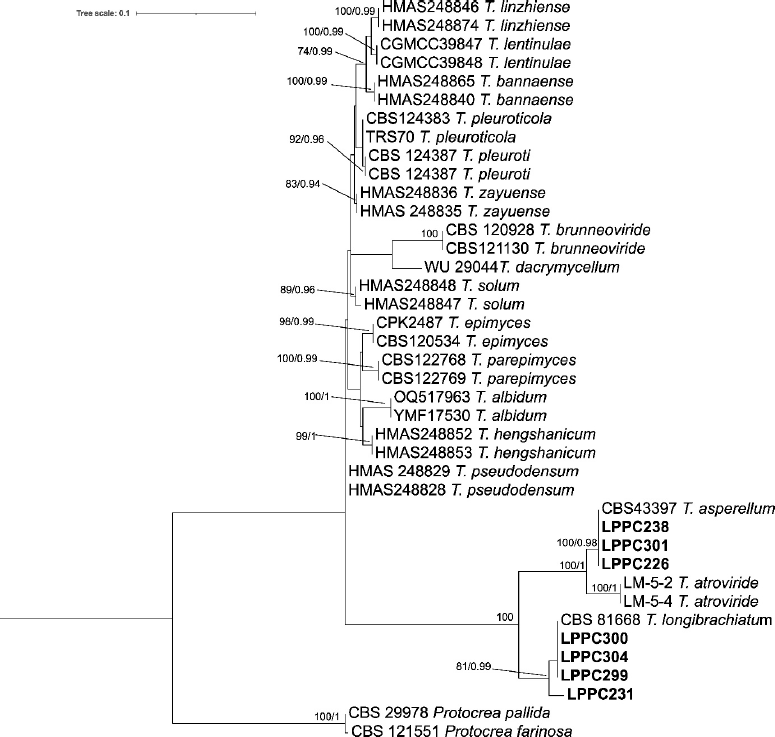
The analysis resolved the strains into two distinct phylogenetic species: Trichoderma longibrachiatum and Trichoderma asperellum (Figure 1). The T. longibrachiatum clade comprised the strains LPPC299, LPPC300, LPPC231, and LPPC304, with 81 % of bootstrap support and a posterior probability of 0.99. The T. asperellum clade included the strains LPPC226, LPPC238, and LPPC301, with 100 % of bootstrap support and a posterior probability of 0.98 (Figure 1).

Phylogenetic tree (Bayesian inference) based on ITS sequences of Trichoderma strains obtained from banana rhizospheres in the Ceará and Roraima states, Brazil. Numbers on branches indicate the bootstrap support (1,000 replicates).
The Trichoderma strains had rapid growth (reaching the edge of the Petri dish within 4 days) and were efficient in inhibiting the mycelial growth of F. kalimantanense. The inhibitions ranged from 14.85 to 22.44 %, with LPPC299 and LPPC300 (T. longibrachiatum), commercial input B, LPPC238 and LPPC301 (T. asperellum), and LPPC304 (T. longibrachiatum) differing statistically from the other treatments (Figure 2).

Mycelial growth inhibition of Trichoderma strains against Fusarium kalimantanense, using the dual culture method. LPPC231, LPPC300, LPPC299, and LPPC304: Trichoderma longibrachiatum; LPPC238, LPPC301, and LPPC226: Trichoderma asperellum. Bars followed by the same letter do not differ from each other according to the Scott-Knott test at 5 % of probability.
This study advances current knowledge by systematically evaluating the efficacy of Trichoderma strains, specifically T. longibrachiatum and T. asperellum, against F. kalimantanense, a recently characterized and highly persistent member of the Foc species complex (Maryani et al. 2019, Santos et al. 2023a, Santos 2025). While the observed mycelial growth inhibition rates (14.85 to 22.44 %) were lower than some previously reported values for other Trichoderma-Foc interactions (Taribuka et al. 2017, Silva Júnior et al. 2023), they fall within the moderate inhibition category as defined by Brzezinska & Jankiewicz (2012). Importantly, this study fills a critical gap by incorporating strains directly sourced from banana rhizospheres and comparing antagonistic effects under controlled conditions, something seldom addressed in recent literature (Tyskiewicz et al. 2022, Guzmán-Guzmán et al. 2023). The variability in inhibition efficacy is likely attributable to intrinsic differences among Trichoderma species and strains (Guzmán-Guzmán et al. 2023). Most strains showed rapid in vitro growth, reaching the periphery of Petri dishes within 4 days, indicating a strong competitiveness for space and nutrients, an advantage, given the nutrient sensitivity of many phytopathogens, including Fusarium species (Saldana-Mendoza et al. 2023). This study’s novelty lies in its integrative approach that combines phylogenetic identification, comparative antagonism, and application timing strategies for strains native to banana rhizospheres, thereby providing practical insights that extend beyond descriptive antagonism assays commonly reported (Long et al. 2023, Izquierdo-García et al. 2024, Cui et al. 2025).
By addressing the timing of antagonist application relative to pathogen presence, this study reveals crucial nuances influencing disease suppression and plant growth promotion factors underexplored in prior studies. Thus, it not only confirms the Trichoderma’s potential, but also refines biocontrol strategies tailored for F. kalimantanense, contributing with novel perspectives to sustainable banana disease management in the face of evolving pathogen complexity and environmental challenges (Klabunde et al. 2021, Woo et al. 2023).
The application of Trichoderma strains markedly reduced the severity of Panama disease, when compared with plants inoculated only with F. kalimantanense (control 2). The disease severity index in the shoot was significantly lower in plants treated with LPPC238 (T. asperellum), LPPC299 (T. longibrachiatum), LPPC300 ( T. longibrachiatum), LPPC301 (T. asperellum), LPPC304 (T. longibrachiatum), and biological input B than in the control 2 (plants inoculated only with F. kalimantanense), particularly under the post-inoculation strategy (M2) (Table 1; Figure 3). For instance, while the control 2 (plants inoculated only with F. kalimantanense) maintained an average shoot severity of 40 %, LPPC238 (T. asperellum), LPPC299 (T. longibrachiatum), and LPPC301 (T. asperellum) reduced values by nearly half, when applied before the pathogen, and biological input B decreased the disease severity index in the shoot to only 20 % under M2 (post-inoculation strategy). Although reductions in rhizome severity were less pronounced, all evaluated strains consistently maintained values comparable to or below those of the control 2 (plants inoculated only with F. kalimantanense), indicating a partial suppression of pathogen colonization in subterranean tissues.
Disease severity index in banana plants as a function of application method and Trichoderma strains.

Decomposition of the interaction between methods and strains for the disease severity index in the shoot of banana plants as a function of application method and Trichoderma strains. LPPC300, LPPC299, and LPPC304: Trichoderma longibrachiatum; LPPC238 and LPPC301: Trichoderma asperellum. Control 1: uninoculated plants; control 2: plants inoculated only with Fusarium kalimantanense. Distinct uppercase letters denote significant differences between methods, whereas distinct lowercase letters denote significant differences among treatments within each method, according to the Scott-Knott test (p < 0.05).
Disease severity was most effectively reduced when antagonists were applied after inoculation with F. kalimantanense (M2). Notably, the biological input B lowered the shoot severity index to 20 %, when compared to 40 % in the control 2 (plants inoculated only with F. kalimantanense). Although effects on the rhizome were less pronounced, values remained equal to or lower than those of the control 2, indicating that Trichoderma strains partially restricted subterranean colonization while mitigating shoot symptoms (Patil et al. 2024). These findings highlight the importance of application timing, as the plant-microorganism-pathogen interaction is highly dynamic and context-dependent (Malgioglio et al. 2022).
The superior efficacy of the post-inoculation strategy in reducing disease severity is likely attributable to the direct action of typical Trichoderma biocontrol mechanisms, including antibiosis, competition for space and nutrients, mycoparasitism, and siderophore production, which collectively constrain the progression of an established pathogen.
In addition, the Trichoderma strains originate from the rhizosphere of banana plants, and are better adapted to these conditions. This intrinsic characteristic of these strains likely explains the effect on inhibiting disease progression observed with the pathogen already established in the soil. Recent studies corroborate these observations: siderophore-producing T. virens significantly inhibited Fusarium growth in banana while enhancing plant vigor (Cui et al. 2025), and T. parareesei exhibited hyperparasitism, reducing F. oxysporum root colonization and resulting in less disease-affected plants (Long et al. 2023). Furthermore, field trials using T. reesei applied via pseudostem injection achieved control rates exceeding 70 % against Foc TR4, demonstrating the practical applicability of this strategy under commercial conditions (García-Bastidas et al. 2020). Collectively, these findings reinforce the efficacy of Trichoderma as a biocontrol agent against Panama disease, aligning closely with the results obtained in the present study.
In addition to disease suppression, Trichoderma inoculation promoted banana plant growth beyond the levels observed in uninoculated plants (control 1). Morphological traits such as plant height, pseudostem diameter, and root length were significantly improved by LPPC238 (T. asperellum), LPPC300 (T. longibrachiatum), LPPC301 (T. asperellum), LPPC304 (T. longibrachiatum), and biological input B, when compared with the control 1 (uninoculated plants) (Table 2; Figure 4). LPPC301 (T. asperellum) and LPPC304 (T. longibrachiatum) yielded the tallest plants, whereas LPPC300 (T. longibrachiatum) and LPPC301 (T. asperellum) produced the longest root systems. These results show that certain strains were not only able to counterbalance the pathogen’s negative effects, but also enhanced overall plant vigor under both inoculation strategies.
Height (H), pseudostem diameter (D), number of leaves (NL), and root length (RL) of banana plants as a function of application method and Trichoderma strains.

Decomposition of the interaction between methods and strains for height (A), pseudostem diameter (B), number of leaves (C), and root length (D) of banana plants as a function of application method and Trichoderma strains. LPPC300, LPPC299, and LPPC304: Trichoderma longibrachiatum; LPPC238 and LPPC301: Trichoderma asperellum. Control 1: uninoculated plants; control 2: plants inoculated only with Fusarium kalimantanense. Distinct uppercase letters denote significant differences between methods, whereas distinct lowercase letters denote significant differences among treatments within each method, according to the Scott-Knott test (p < 0.05).
Biomass accumulation confirmed the growth-promoting role of Trichoderma. Plants treated with LPPC238 (T. asperellum), LPPC301 (T. asperellum), LPPC304 (T. longibrachiatum), and biological input B accumulated higher fresh and dry masses of shoots and roots, if compared with the control 1 (uninoculated plants) (Table 3; Figure 5). Notably, LPPC301 (T. asperellum) and LPPC304 (T. longibrachiatum) produced total dry masses exceeding 45 g plant-1, outperforming the control 1 (uninoculated plants) (37 g). Under M2 (post-inoculation strategy), LPPC238 (T. asperellum) and biological input B almost doubled the shoot and root fresh mass relative to the control 1, highlighting their capacity to restore yield, even under pathogen challenge.
Shoot fresh mass (SFM), root fresh mass (RFM), shoot dry mass (SDM), root dry mass (RDM), and total dry mass (TDM) of banana plants as a function of application method and Trichoderma strains.

Decomposition of the interaction between methods and strains for shoot fresh mass (A), root fresh mass (B), shoot dry mass (C), root dry mass (D), and total dry mass (E) of banana plants as a function of application method and Trichoderma strains. LPPC300, LPPC299, and LPPC304: Trichoderma longibrachiatum; LPPC238 and LPPC301: Trichoderma asperellum. Control 1: uninoculated plants; control 2: plants inoculated only with Fusarium kalimantanense. Distinct uppercase letters denote significant differences between methods, whereas distinct lowercase letters denote significant differences among treatments within each method, according to the Scott-Knott test (p < 0.05).
Nutrient analyses further revealed the beneficial impact of Trichoderma. In the shoot, LPPC238 (T. asperellum), LPPC300 (T. longibrachiatum), LPPC301 ( T. asperellum ), LPPC304 (T. longibrachiatum), and biological input B significantly increased phosphorus, potassium, calcium, magnesium, and sulfur accumulation, when compared with the control 1 (uninoculated plants) (Table 4; Figure 6).
Macronutrient accumulation in the shoot of banana plants as a function of application method and Trichoderma strains.

Decomposition of the interaction between inoculation methods of Trichoderma strains and their influence on phosphorus (A), potassium (B), calcium (C), and magnesium (D) accumulation in the shoot of micropropagated banana plantlets. LPPC300, LPPC299, and LPPC304: Trichoderma longibrachiatum; LPPC238 and LPPC301: Trichoderma asperellum. Control 1: uninoculated plants; control 2: plants inoculated only with Fusarium kalimantanense. Distinct uppercase letters denote significant differences between methods, whereas distinct lowercase letters denote significant differences among treatments within each method, according to the Scott-Knott test (p < 0.05).
LPPC301 (T. asperellum) and LPPC304 (T. longibrachiatum) were particularly effective, with shoot P and K levels nearly doubling those of the control 1 (uninoculated plants). In roots, LPPC238 (T. asperellum), LPPC301 (T. asperellum), LPPC304 (T. longibrachiatum), and biological input B improved the phosphorus, calcium, and magnesium accumulation beyond the levels observed in the control 1 (Table 5; Figure 7), especially under M2 (post-inoculation strategy).

Decomposition of the interaction between inoculation methods of Trichoderma strains and their influence on phosphorus (A), sodium (B), calcium (C), and magnesium (D) accumulation in the root of micropropagated banana plantlets. LPPC300, LPPC299, and LPPC304: Trichoderma longibrachiatum; LPPC238 and LPPC301: Trichoderma asperellum. Control 1: uninoculated plants; control 2: plants inoculated only with Fusarium kalimantanense. Distinct uppercase letters denote significant differences between methods, whereas distinct lowercase letters denote significant differences among treatments within each method, according to the Scott-Knott test (p < 0.05).
Macronutrient accumulation in the root of banana plants as a function of application method and Trichoderma strains.
These results suggest enhanced nutrient uptake efficiency, which is consistent with Trichoderma-mediated stimulation of root development and rhizosphere interactions.
In contrast, when applied prior to pathogen inoculation (M1), Trichoderma primarily promoted vegetative growth and biomass accumulation, reflecting the activation of plant growth-promoting mechanisms. Significant increases were observed in plant height, pseudostem diameter, root length, and fresh and dry biomass in strains such as LPPC301 (T. asperellum), LPPC304 (T. longibrachiatum), and LPPC238 (T. asperellum), along with marked improvements in mineral nutrition, particularly P, K, Ca, Mg, and S. These results are consistent with previous reports showing that Trichoderma can stimulate the synthesis of plant hormones, including auxins, cytokinins, and gibberellins, as well as solubilize soil nutrients, thereby enhancing nutrient uptake efficiency (Contreras-Cornejo et al. 2024). Santos et al. (2021) demonstrated that inoculation of cashew plants with T. longibrachiatum not only induced siderophore production, but also enhanced calcium phosphate solubilization, ultimately promoting plant growth and improving nutrient acquisition. Similarly, Sanó et al. (2022) reported that T. longibrachiatum strains produced indole-3-acetic acid, siderophores, and the catalase enzyme, mechanisms that the authors associated with the promotion of growth in micropropagated banana plantlets. These findings support the role of Trichoderma species as multifunctional bioagents capable of simultaneously suppressing pathogens and enhancing host nutrition, aligning with the growth-promoting effects observed in the present study.
Recent reviews further highlight the role of Trichoderma in inducing systemic resistance by activating antioxidant defense pathways and enhancing plant resilience against both biotic and abiotic stresses (Guzmán-Guzmán et al. 2023, Woo et al. 2023). In banana, microbial biofungicides containing Trichoderma have been shown to reduce Foc R1-induced damage and restore plant physiological parameters (Izquierdo-García et al. 2024), a finding consistent with the capacity observed in the present study to recover biomass and nutrient content, even under infection conditions.
The convergence of these results with the current state of the art indicates that the evaluated strains, particularly LPPC301 (T. asperellum), LPPC304 (T. longibrachiatum), LPPC238 (T. asperellum), and biological input B, have substantial potential for integration into integrated management programs for Panama disease, offering a sustainable alternative to chemical fungicides. The study also emphasizes that application timing should be considered a strategic variable: while post-pathogen application maximizes disease suppression, pre-pathogen application physiologically and nutritionally primes the plant, enhancing its resilience.
An important next step involves evaluating the performance of these Trichoderma strains under field or commercial conditions. While the pot experiment demonstrated their effectiveness in reducing disease severity and improving nutrient uptake, the complexity of field environments, such as soil heterogeneity, variable climatic conditions, and interactions with native microbiota, may influence their efficacy. Large-scale trials in commercial banana plantations are therefore necessary to validate their potential as biofungicidal and growth-promoting agents. Such trials should also assess long-term impacts on yield stability, soil fertility, and cost-benefit ratios compared with conventional chemical management strategies, thereby providing a more comprehensive basis for the adoption of these isolates in sustainable banana production systems.
CONCLUSIONS
-
The efficacy of antagonists depends on application timing: post-pathogen application was more effective in reducing disease severity, especially with the strains LPPC238 (T. asperellum), LPPC301 (T. asperellum), and biological input B, whereas pre-pathogen application favored growth promotion and nutrient accumulation, particularly with LPPC301 (T. asperellum) and LPPC304 (T. longibrachiatum);
-
The strains LPPC301, LPPC238 (T. asperellum), and LPPC304 (T. longibrachiatum), and the biological input B showed promise in the sustainable management of fusarium wilt, offering an effective biocontrol and promoting banana plant growth.
Data Availability Statement:
Research data are only made available by authors upon request.
ACKNOWLEDGMENTS
João Marcos Rodrigues dos Santos is grateful to FUNCAP for the scholarship grant under Process nº BMD-0008-01029.01.08/23. The authors thank the Embrapa Agroindústria Tropical (SEG: 43.13.12.007.00.00) and Conselho Nacional de Desenvolvimento Científico e Tecnológico (CNPq), for funding this research (Proc. 444339/2014-0, 405401/2021-3, and 304901/2022-9).
REFERENCES
-
AGROFIT. Sistema de agrotóxicos fitossanitários 2025. Available at: https://agrofit.agricultura.gov.br/ Access in: July 2025.
» https://agrofit.agricultura.gov.br/ - ALFENAS, A. C.; MAFIA, R. G. Métodos em fitopatologia 2. ed. Viçosa: UFV, 2016.
- BORGES, A. L.; MESQUITA, A. L. M. Cultivo da bananeira para o agropolo Jaguaribe-Apodi, Ceará Fortaleza: Embrapa Agroindústria Tropical, 2014.
- BOX, G. E. P.; COX, D. R. An analysis of transformations. Journal of the Royal Statistical Society, v. 26, n. 2, p. 211-252, 1964.
- BRZEZINSKA, M. S.; JANKIEWICZ, U. Production of antifungal chitinase by Aspergillus niger LOCK 62 and its potential role in the biological control. Current Microbiology, v. 65, n. 6, p. 666-672, 2012.
- CONTRERAS-CORNEJO, H. A.; SCHMOLL, M.; ESQUIVEL-AYALA, B. A.; GONZÁLEZ-ESQUIVEL, C. E.; ROCHA-RAMÍREZ, V.; LARSEN, J. Mechanisms for plant growth promotion activated by Trichoderma in natural and managed terrestrial ecosystems. Microbiological Research, v. 281, e1276621, 2024.
- CUI, H.; CHENG, Q.; JING, T.; CHEN, Y.; LI, X.; ZHANG, M.; QI, D.; FENG, J.; VAFADAR, F.; WEI, Y.; LI, K.; ZHAO, Y.; ZHOU, D.; XIE, J. Trichoderma virens XZ11-1 producing siderophores inhibits the infection of Fusarium oxysporum and promotes plant growth in banana plants. Microbiall Cell Factories, v. 24, e22, 2025.
- DENNIS, C.; WEBSTER, J. Antagonistic properties of species-groups of Trichoderma: III. Hyphal interaction. Transactions of the British Mycological Society, v. 57, n. 3, p. 363-369, 1971.
- DITA, M.; BARQUERO, M.; HECK, D.; MIZUBUTI, E. S. G.; STAVER, C. P. Fusarium wilt of banana: current knowledge on epidemiology and research needs toward sustainable disease management. Frontiers in Plant Science, v. 19, e1468, 2018.
-
FOOD AND AGRICULTURE ORGANIZATION (FAO). Banana: market review 2023. 2024. Available at: https://openknowledge.fao.org/handle/20.500.14283/cd1721en Access in: July 2025.
» https://openknowledge.fao.org/handle/20.500.14283/cd1721en - FORTUNATO, A. A.; RODRIGUES, F. A.; NASCIMENTO, K. J. T. Physiological and biochemical aspects of the resistance of banana plants to fusarium wilt potentiated by silicon. Phytopathology, v. 102, n. 10, p. 957-966, 2012.
- GARCÍA-BASTIDAS, F. A.; QUINTERO-VARGAS, J. C.; AYALA-VASQUES, M.; SCHERMER, T.; SEDL, M. F.; SANTOS-PAIVA, M.; NOGUERA, A. M.; AGUILERA-GALVEZ, C.; WITTENBERG, A.; HOFSTEDE, R.; SORENSEN, A.; KEMA, G. H. J. First report of fusarium wilt tropical race 4 in cavendish bananas caused by Fusarium odoratissimum in Colombia. Plant Disease, v. 104, n. 3, p. 994-994, 2020.
- GHAG, S. B.; SHEKHAWAT, U. K. S.; GANAPATHI, T. R. Fusarium wilt of banana: biology, epidemiology and management. International Journal of Pest Management, v. 61, n. 3, p. 250-263, 2015.
- GUZMÁN-GUZMÁN, P.; KUMAR, A.; SANTOS-VILLALOBOS, S. L.; PARRA-COTA, F. I.; OROZCO-MOSQUEDA, M. D. C.; FADIJI, A. E.; HYDER, S.; BABALOLA, O. O.; SANTOYO, S. Trichoderma species: our best fungal allies in the biocontrol of plant diseases: a review. Plants, v. 17, e432, 2023.
- IZQUIERDO-GARCÍA, L. F.; CARMONA-GUTIÉRREZ, S. L.; MORENO-VELANDIA, C. A.; VILLARREAL-NAVARRETE, A. P.; BURBANO-DAVID, D. M.; QUIROGA-MATEUS, R. Y.; GÓMEZ-MARROQUÍN, M. R.; RODRÍGUEZ-YZQUIERDO, G. A.; BETANCOURT-VÁSQUEZ, M. Microbial-based biofungicides mitigate the damage caused by Fusarium oxysporum f. sp. cubense race 1 and improve the physiological performance in banana. Journal of Fungi, v. 10, e419, 2024.
- JIMÉNEZ-DÍAZ, R. M.; JIMÉNEZ-GASCO, M. D. M. Integrated management of fusarium wilt diseases. In: ALVES-SANTOS, F. M.; DIEZ, J. J. (ed.). Control of fusarium diseases Kerala: Transworld Research Network, 2011. p. 177-215.
- KLABUNDE, G. H. F.; PEREIRA, A.; SCHERER, R. F.; BELTRAME, A. B. Molecular screening in the Epagri’s banana germplasm collection to identify sources of resistance to Fusarium oxysporum f. sp. cubense tropical race 4. Agropecuária Catarinense, v. 34, n. 1, p. 57-62, 2021.
- LESLIE, J., SUMMERELL, B. The fusarium laboratory manual Iowa: Blackwell, 2006.
- LETUNIC, I.; BORK, P. Interactive tree of life (iTOL) v5: an online tool for phylogenetic tree display and annotation. Nucleic Acids Research, v. 49, n. W1, p. W293-W296, 2021.
- LONG, W.; CHEN, Y.; WEI, Y.; FENG, J.; ZHOU, D.; CAI, B.; QI, D.; ZHANG, M.; ZHAO, Y.; LI, K.; LIU, Y.-Z.; WANG, W.; XIE, J. A newly isolated Trichoderma parareesei N4-3 exhibiting a biocontrol potential for banana fusarium wilt by hyperparasitism. Frontiers in Plant Science, v. 14, e14, 2023.
- LÓPEZ-ARANDA, J. M.; DOMÍNGUEZ, P.; MIRANDA, L.; SANTOS, B. L.; TALAVERA, M.; DAUGOVISH, O.; SORIA, C.; CHAMORRO, M.; MEDINA, J. J. Fumigant use for strawberry production in Europe: the current landscape and solutions. International Journal of Fruit Science, v. 16, n. S1, p. 1-15, 2016.
- LÓPEZ-ZAPATA, S. P.; CASTAÑO-ZAPATA, J. Manejo integrado del mal de Panamá Fusarium oxysporum Schlechtend.: Fr. sp. cubense (EF SM.) WC Snyder & HN Hansen: una revisión. Revista UDCA Actualidad & Divulgación Científica, v. 22, e1240, 2019.
- MALGIOGLIO, G.; RIZZO, G. F.; NIGRO, S.; DU PREY, V. F.; HERFORTH-RAHMÉ, J.; CATARA, V.; BRANCA, F. Plant-microbe interaction in sustainable agriculture: the factors that may influence the efficacy of PGPM application. Sustainability, v. 14, e2253, 2022.
- MARYANI, N.; LOBARDI, L.; POERBA, Y. S.; SUBANDIYAH, S.; CROUS, P. W.; KEMA, G. H. J. Phylogeny and genetic diversity of the banana fusarium wilt pathogen Fusarium oxysporum f. sp. cubense in the Indonesian centre of origin. Studies in Mycology, v. 92, n. 1, p. 155-194, 2019.
- MCKINNEY, H. H. Influence of soil, temperature, and moisture on infection of wheat seedlings by Helminthosporium sativum Journal of Agricultural Research, v. 26, n. 5, p. 195-217, 1923.
- MIYAZAWA, M.; PAVAN, M. A.; MURAOKA, T.; CARMO, C. A. F. S.; MELO, W. J. Análise química de tecido vegetal. In: SILVA, F. (ed.). Manual de análises químicas de solos, plantas e fertilizantes 2. ed. Brasília, DF: Embrapa Informação Tecnológica, 2009. p. 191-233.
- MURRAY, M. G.; THOMPSON, W. F. Rapid isolation of high molecular weight plant DNA. Nucleic Acids Research, v. 8, n. 19, p. 4321-4326, 1980.
-
NATIONAL CENTER FOR BIOTECHNOLOGY INFORMATION (NCBI). GenBank 2025. Available at: https://www.ncbi.nlm.nih.gov/genbank/ Access on: Apr. 25, 2025.
» https://www.ncbi.nlm.nih.gov/genbank/ - NYLANDER, J. A. A. MrModeltest v2 Upsala: Uppsala University, 2004.
- PATIL, B.; GANESH, C. T.; KOTARI, P.; RATHINAVELU, R. Multifaceted and dual-edged native Trichoderma strains from subabul rhizospheric soil to combat fusarium wilt disease: a sustainable approach. Biocontrol Science and Technology, v. 34, p. n. 9, p. 843-857, 2024.
- PLOETZ, R. C. Fusarium wilt of banana is caused by several pathogens referred to as Fusarium oxysporum f. sp. cubense Phytopathology, v. 96, n. 6, p. 653-656, 2006.
- RONQUIST, F.; HUELSENBECK, J. P. MrBayes 3: Bayesian phylogenetic inference under mixed models. Bioinformatics, v. 19, e157231574, 2003.
- SALDANA-MENDOZA, A. S.; PACIOS-MICHELENA, S.; PALACIOS-PONCE, A. S.; CHÁVEZ-GONZÁLEZ, M. L.; AGUILAR, C. N. Trichoderma as a biological control agent: mechanisms of action, benefits for crops and development of formulations. World Journal of Microbiology and Biotechnology, v. 39, e269, 2023.
- SANÓ, L. O.; OLIVEIRA, L. L. B.; LEÃO, M. D. M.; SANTOS, J. E. A.; MEDEIROS, S. C.; SCHNEIDER, F.; SOUSA, A. B. O.; TANIGUCHI, C. A. K.; MUNIZ, C. R.; GRANGEIRO, T. B.; SILVA, C. F. B. Trichoderma longibrachiatum as a biostimulant of micropropagated banana seedlings under acclimatization. Plant Physiology and Biochemistry, v. 190, n. 1, p. 184-192, 2022.
- SANTOS, J. E. A.; SILVA, D. E. M.; VIEIRA, R. F. B. S.; CARVALHO, A. M. S.; SCHURT, D. A.; LIMA, M. A. S.; GASPAROTTO, L.; LIMA, C. S.; SILVA, C. F. B. First report of Fusarium kalimantanense causing fusarium wilt on banana tree in Brazil. Plant Disease, v. 107, e227, 2023a.
- SANTOS, J. E. A.; BRITO, M. V.; PIMENTA, A. T. A.; SILVA, G. S.; ZOCOLO, G. J.; MUNIZ, C. R.; MEDEIROS, S. C.; GRANGEIRO, T. B.; LIMA, M. A. S.; SILVA, C. F. B. Antagonism of volatile organic compounds of the Bacillus sp. against Fusarium kalimantanense World Journal of Microbiology and Biotechnology, v. 39, e60, 2023b.
- SANTOS, J. M. R.; TANIGUCHI, C. A. K.; SILVA, C. F. B.; NATALE, W.; ARTUR, A. G. Trichoderma in the promotion of growth and nutrition of dwarf cashew rootstock. Revista Ciência Agronômica, v. 52, e20207697, 2021.
- SANTOS, J. M. R. Underground warfare: mechanisms of trichoderma in the suppression of the march of fusarium in banana plants: advances, limitations and perspectives. Journal of Phytopathology, v. 173, n. 6, e70205, 2025.
- SHARMA, A.; GUPTA, B.; VERMA, S.; PAL, J.; AKANKSHA, M.; CHAUHAN, P. Unveiling the biocontrol potential of Trichoderma European Journal of Plant Pathology, v. 167, n. 2, p. 569-591, 2023.
- SHEN, N.; LI, S.; LI, S.; ZHANG, H.; JIANG, M. The siderophore-producing bacterium, Bacillus siamensis Gxun-6, has an antifungal activity against Fusarium oxysporum and promotes the growth of banana. Egyptian Journal of Biological Pest Control, v. 32, n. 1, p. 2-9, 2022.
- SIAMAK, S. B.; ZHENG, S. Banana fusarium wilt (Fusarium oxysporum f. sp. cubense) control and resistance, in the context of developing wilt-resistant bananas within sustainable production systems. Horticultural Plant Journal, v. 4, n. 5, p. 208-218, 2018.
- SILVA JÚNIOR, W. J.; ASSIS, T. C.; ANDRADE, D. E. G. T.; CARVALHO, R. R. C.; LARANJEIRA, D.; ROSA, R. C. T.; GURGEL, L. M. R.; CELESTINO, P. C. G. Isolados de Trichoderma sp. e óleos essenciais de Lippia sidoides no controle da fusariose da bananeira. Pesquisa Agropecúaria Pernambucana, v. 28, e2311282023, 2023.
- TARIBUKA, J.; WIBOWO, A.; SUMARDIYONO, C.; WIDYASTUTI, S. M. Potency of six strains of biocontrol agents endophytic Trichoderma against fusarium wilt on banana. Journal of Degraded and Mining Lands Management, v. 4, n. 2, p. 723-731, 2017.
- TYSKIEWICZ, R.; NOWAK, A.; OZIMEK, E.; JAROSZUK-SCISEL, J. Trichoderma: the current status of its application in agriculture for the biocontrol of fungal phytopathogens and stimulation of plant growth. International Journal of Molecular Sciences, v. 23, e2329, 2022.
- WOO, S. L.; HERMOSA, R.; LORITO, M.; MONTE, E. Trichoderma: a multipurpose, plant-beneficial microorganism for eco-sustainable agriculture. Nature Reviews Microbiology, v. 21, n. 5, p. 312-326, 2023.