 Dose-response and chemical characterization of an aqueous extract of Bidens pilosa against Oligonychus ilicis (Acari: Tetranychidae)1
ABSTRACT
The Oligonychus ilicis (McGregor) (Acari: Tetranychidae) mite is an important pest of Conilon coffee (Coffea canephora). Botanical extracts may offer a promising sustainable alternative for its management. This study aimed to evaluate the dose-response of an aqueous extract of Bidens pilosa against adult females and eggs of O. ilicis, as well as to quantify its total phenolic, tannin, and flavonoid contents. B. pilosa plants were used to prepare aqueous extracts at concentrations of 0.40, 0.65, 1.05, 1.71, 2.77, and 4.50 % (w/v), with Tween® 80 (0.05 % v/v) as an adjuvant. Both adult female mortality and egg unviability increased with extract concentration. The estimated LC₅₀ values were 0.92 % (w/v) for adult females and 1.21 % (w/v) for eggs. Chemical analyses quantified total phenolic, tannin, and flavonoid contents of 47.747 µg GAE mg-1 of extract, 25.774 µg GAE mg-1 of extract, and 33.535 µg QE mg-1 of extract, respectively.
KEYWORDS:
Coffea canephora
; blackjack; coffee red mite
RESUMO
O ácaro Oligonychus ilicis (McGregor) (Acari: Tetranychidae) é uma importante praga do café Conilon (Coffea canephora). Extratos botânicos podem representar uma alternativa mais sustentável para seu manejo. Objetivou-se avaliar a dose-resposta de um extrato aquoso de Bidens pilosa sobre fêmeas adultas e ovos de O. ilicis, bem como caracterizar os teores de fenólicos totais, taninos e flavonoides. Plantas de B. pilosa foram utilizadas no preparo de extratos aquosos nas concentrações de 0,40; 0,65; 1,05; 1,71; 2,77; e 4,50 % (p/v), com Tween® 80 (0,05 % v/v) como adjuvante. A mortalidade das fêmeas adultas e a inviabilidade dos ovos aumentaram à medida que aumentou a concentração do extrato. Os valores estimados de CL50 foram de 0,92 % (p/v) para fêmeas adultas e de 1,21 % (p/v) para ovos. As análises químicas quantificaram 47,747 µg EAG mg-1 de extrato de fenólicos totais, 25,77٤ µg EAG mg-1 de extrato de taninos e 33,535 µg EQ mg-1 de extrato de flavonoides.
PALAVRAS-CHAVE:
Coffea canephora
; picão-preto; ácaro-vermelho-do-cafeeiro
INTRODUCTION
The red coffee mite, Oligonychus ilicis (McGregor, 1917) (Acari: Tetranychidae), is a major pest of Conilon coffee (Coffea canephora Pierre ex A. Froehner) in Brazil (Fanton & Queiroz 2020). This species occurs primarily on the adaxial surface of coffee leaves, puncturing epidermal and mesophyll cells to ingest their extravasated contents. As infestation progresses, leaves lose their natural gloss, become bronzed, and exhibit reduced photosynthetic activity (Franco et al. 2009).
The management of O. ilicis under high infestation pressure relies primarily on synthetic acaricides. However, the repeated application of these chemicals can select resistant mite populations, potentially compromising long-term control efficacy (Kewedar et al. 2025). These limitations underscore the need for alternative control strategies compatible with integrated pest management.
Botanical acaricides have emerged as a promising alternative for mite management (Zhu et al. 2024). Plant-derived oils and extracts obtained from different plant parts exhibit considerable bioactive potential (Refaat et al. 2024, Velmurugan et al. 2025). Among the plant species with recognized acaricidal potential, Bidens pilosa L. (blackjack) is a medicinal member of the Asteraceae family native to South America that also thrives as a hardy, invasive weed (Mtenga & Ripanda 2022). In Brazil, B. pilosa is widely distributed across agricultural landscapes, particularly in vegetable-growing areas (Espinosa et al. 2019, Kato‐Noguch & Kurniadie 2024). The species is known for its antioxidant, antibacterial, wound-healing, and anti-inflammatory properties and contains flavonoids and other bioactive secondary metabolites (Borella et al. 2023).
This study evaluated the dose-response of an aqueous extract prepared from whole B. pilosa plants against adult females and eggs of O. ilicis and quantified its total phenolic, tannin, and flavonoid contents.
MATERIAL AND METHODS
The experiment was conducted from January to June 2024, at the Instituto Federal de Educação, Ciência e Tecnologia do Espírito Santo, in Colatina, Espírito Santo state, Brazil (19º29’52.7”S; 40º45’38.5”W). Bidens pilosa L. seeds were cultivated under greenhouse conditions at the experimental site without chemical treatments. Whole plants were collected, washed, placed in labeled paper bags, and transported to the laboratory. The plant material was dried in a forced-air oven at 60 ºC, for 72 h, and ground in a knife mill to obtain a fine, homogeneous powder.
Specimens of Oligonychus ilicis were collected from an untreated Coffea canephora plantation, and laboratory colonies were established using a modified version of the method described by Reis et al. (1997). Coffee leaves collected from the field were surface-sterilized with 5 % sodium hypochlorite for 5 min, rinsed with running distilled water, and placed in Petri dishes (14.0 × 1.5 cm) containing moistened cotton beneath and around the leaf discs to maintain turgor and prevent mite escape. The dishes were maintained in Bio-Oxygen Demand (BOD) incubators at 25 ± 1 ºC, 70 ± 10 % relative humidity (RH), and a 12-h photophase. Colonies were refreshed weekly by transferring adults to new Petri dishes.
A logarithmic concentration series was established following Carvalho et al. (2017), yielding final concentrations of 0.40, 0.65, 1.05, 1.71, 2.77, and 4.50 % (w/v). For each concentration, the appropriate mass of B. pilosa powder was weighed and diluted in 100 mL of distilled water containing Tween® 80 (0.05 % v/v). The mixtures were homogenized on a transverse shaker (700 rpm) for 24 h, filtered through voile fabric, and transferred to volumetric flasks. The control treatment consisted of distilled water containing Tween® 80 (0.05 % v/v).
The aqueous extract of B. pilosa was evaluated separately against adult females and eggs of O. ilicis. Adult females of known age were obtained from synchronized cohorts by placing 50 adult females and five males on each rearing plate for 24 h to allow oviposition. The adults were then removed, and the eggs were maintained under controlled conditions until adulthood.
For the egg bioassays, ten adult females and one male were transferred to each Petri dish for 24 h, to obtain freshly laid eggs. The adults and excess eggs were subsequently removed, leaving ten eggs per dish for spraying.
Each experimental unit consisted of a Petri dish (10.0 × 1.2 cm) containing a 4-cm-diameter coffee leaf disc placed on moistened cotton. For the adult bioassays, ten synchronized adult females were transferred to each leaf disc. Each treatment consisted of ten replicates, each containing ten adult females or ten eggs. One milliliter of each extract solution was sprayed directly onto the adult females or eggs on the leaf discs using an Alfa 2 airbrush connected to a compressor calibrated to a constant pressure of 1.3 psi. No additional individuals or eggs were introduced after application.
The experimental units were maintained in climate-controlled chambers at 25 ± 1 ºC, 70 ± 10 % RH, and a 12-h photophase. Adult mortality was assessed at 24, 48, and 72 h after spraying. Adult females that failed to move at least one body length in any direction when gently stimulated with the tip of a brush were considered dead. Egg viability was assessed daily from the fourth through the ninth day after spraying, and eggs that failed to hatch by the end of this period were recorded as unviable.
The total phenolic content was determined according to the method of Swain & Hillis (1959), with modifications. A calibration curve was constructed using gallic acid (1 mg mL-1), serially diluted to generate seven concentrations. Each reaction tube received 100 µL of gallic acid solution, 1.6 mL of distilled water, and 100 µL of Folin-Ciocalteu reagent. Absorbance was measured at 420 nm using a spectrophotometer. Extracts of B. pilosa (1 mg mL-1) were processed in the same manner. Results were expressed as micrograms of gallic acid equivalents per milligram of extract (µg GAE mg-1 extract).
Flavonoid quantification followed the aluminum chloride (AlCl3) colorimetric method described by Perdigão (2012), with modifications. A calibration curve was constructed using quercetin (5-40 µg mL-1). For each standard solution, 2 mL were transferred to a 25-mL volumetric flask, followed by the addition of 2.5 mL of 7.5 % AlCl3, 10 mL of a pyridine-water solution (1:4 v/v), and 0.6 mL of glacial acetic acid. The volume was adjusted to 25 mL with distilled water, and absorbance was measured at 420 nm. Extract samples (1 mg mL-1) were processed similarly, and the results were expressed as micrograms of quercetin equivalents per milligram of extract (µg QE mg-1 extract).
The tannin content was determined according to Pansera et al. (2003). A calibration curve was prepared using gallic acid (1 mg mL-1), serially diluted to generate seven concentrations. Each reaction tube received 500 µL of gallic acid solution and 500 µL of Folin-Denis reagent, followed by vortex mixing. After 3 min, 500 µL of 7.5 % sodium carbonate solution were added. The mixtures were incubated in the dark for 1 h, centrifuged at 2,000 rpm for 5 min, and absorbance was measured at 720 nm. Tannin content was expressed as micrograms of gallic acid equivalents per milligram of extract (µg GAE mg-1 extract).
The experiment followed a completely randomized design. Mortality data were corrected using the Abbott’s formula and subsequently analyzed by Probit regression (p ≤ 0.05) in the R software. For adult females, Probit analysis and estimation of LC50 and LC90 were based on cumulative mortality recorded at 72 h after application. For eggs, Probit analysis and estimation of LC50 and LC90 were based on the final proportion of eggs that failed to hatch by the ninth day after spraying. The control treatment was used solely for the Abbott’s correction and was not included in the Probit models. Consequently, the dose-response curves were fitted using the six non-zero extract concentrations.
RESULTS AND DISCUSSION
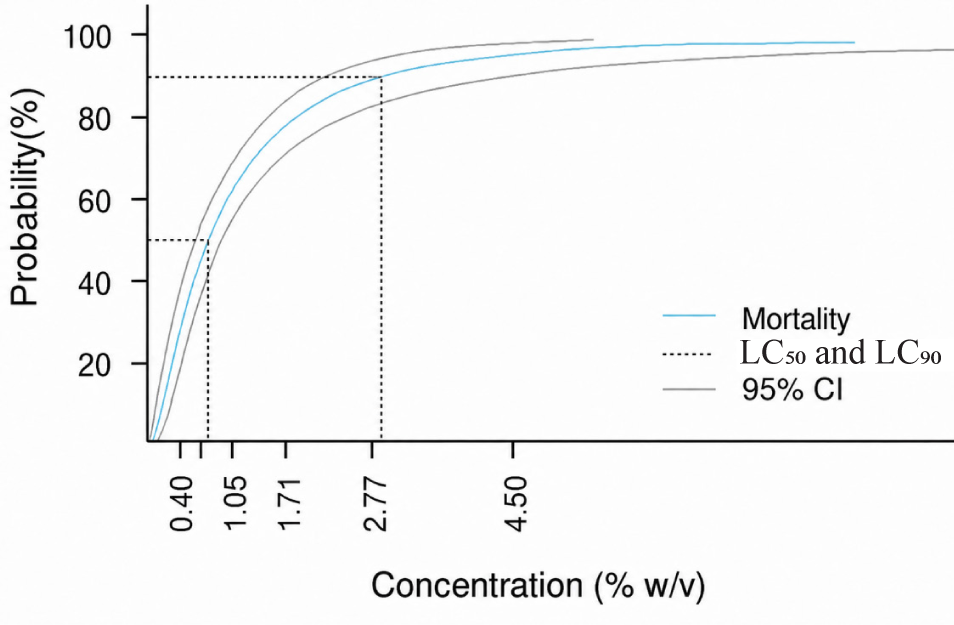
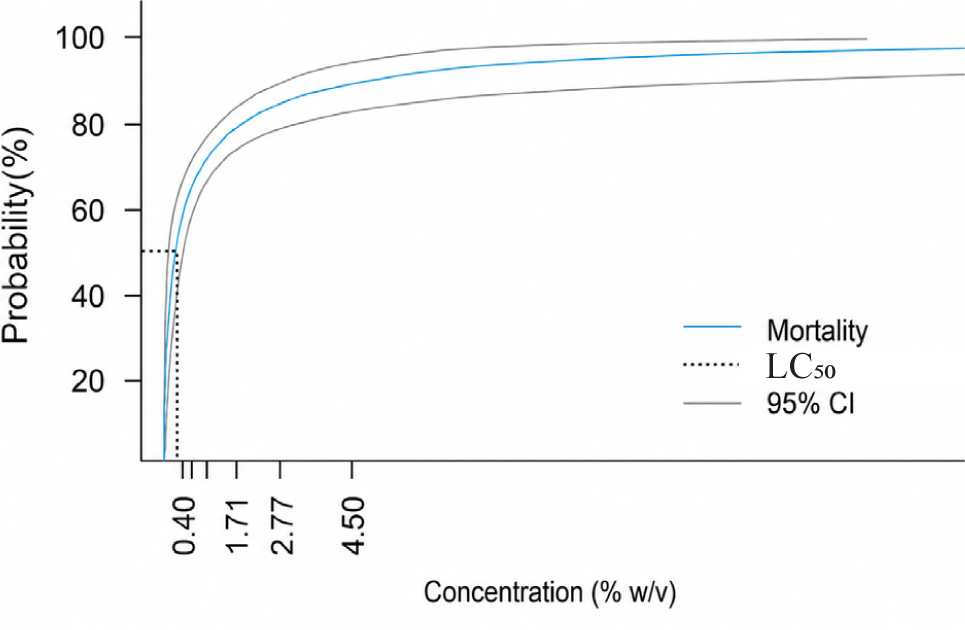
The Probit dose-response model showed that the mortality of adult females of Oligonychus ilicis increased with increasing concentrations of B. pilosa extract, reaching 100 % mortality at the highest tested concentration [4.50 % (w/v)] (Figure 1). Similarly, increasing the concentrations of Bidens pilosa extract progressively reduced egg viability, resulting in complete inhibition of egg hatching at the highest concentration [4.50 % (w/v)] (Figure 2).
Mortality of Oligonychus ilicis adult females exposed to an aqueous extract of Bidens pilosa. Dotted lines indicate the LC50 [0.92 % (w/v); 95 % CI: 0.77-1.08] and LC90 [3.13 % (w/v); 95 % CI: 2.49-4.35] estimated by Probit analysis.
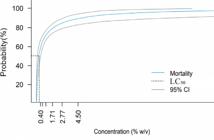
Ovicidal effect of an aqueous extract of Bidens pilosa at different concentrations on Oligonychus ilicis eggs. The dotted line indicates the LC50 [1.21 % (w/v); 95 % CI: 0.88-1.57] estimated by Probit analysis. The LC90 was estimated at 19.97 % (w/v) (95 % CI: 12.18-42.77), above the tested range, and is not shown.
The dose-response regression for adult females showed a slope of 2.42 ± 0.33, indicating that relatively small increases in extract concentration resulted in substantial increases in mortality. The estimated LC50 and LC90 values were 0.92 % (w/v) and 3.13 % (w/v), respectively, both of which fell within the range of concentrations tested (Table 1).
Parameters of the Probit dose-response model for Oligonychus ilicis exposed to an aqueous extract of Bidens pilosa.
For eggs, the slope of the dose-response regression line was 1.05 ± 0.23, indicating a shallower concentration-response relationship than that observed for adult females. Egg unviability increased with increasing extract concentration. The estimated LC50 and LC90 values for egg unviability were 1.21 % (w/v) and 19.97 % (w/v), respectively (Table 1). Because the estimated LC90 exceeded the highest concentration tested [4.50 % (w/v)], it should be interpreted with caution, since it represents an extrapolation from the Probit model.
Chemical analyses of the aqueous extract of B. pilosa revealed total phenolic, tannin, and flavonoid contents of 47.747 µg GAE mg-1 extract, 25.774 µg GAE mg-1 extract, and 33.535 µg QE mg-1 extract, respectively. Total phenolics were the predominant class of compounds, suggesting a possible contribution to the acaricidal activity observed.
One of the principal mechanisms by which plants defend themselves against herbivory is the synthesis of secondary metabolites (Mahanta et al. 2025). These compounds exhibit remarkable structural and functional diversity, and include alkaloids, amines, cyanogenic glycosides, glucosinolates, non-protein amino acids, organic acids, terpenoids, phenolics, quinones, polyacetylenes, and peptides (War et al. 2018, Wink 2018). Their composition and abundance are influenced by both abiotic conditions and herbivore pressure (Wink 2018). Botanical extracts prepared from shoot and underground plant tissues have also been reported to exhibit acaricidal properties, including deterrent and repellent activities (Souto et al. 2021). Collectively, these findings highlight the potential of plant-derived secondary metabolites to impair mite performance. In the present study, the aqueous extract prepared from whole B. pilosa plants contained phenolic compounds, tannins, and flavonoids, all of which may have contributed to the acaricidal and ovicidal activities observed.
Phenolic compounds were the predominant class of secondary metabolites detected in the extract. At high concentrations, these compounds are known to reduce herbivory by decreasing the palatability of plant tissues to phytophagous arthropods, thereby directly affecting their biology (Bhonwong et al. 2009, War et al. 2012, Marcucci et al. 2021). Consistent with these mechanisms, Radhakrishnan & Prabhakaran (2014) demonstrated that phenolic acid-rich extracts from B. pilosa flowers were highly effective against the tea red spider mite (Oligonychus coffeae). Similarly, El-Aswad et al. (2023) evaluated tannins isolated from Camellia sinensis, Urtica dioica, and Allium cepa against three economically important insects – Spodoptera littoralis (Boisduval) (Lepidoptera: Noctuidae), Sitophilus oryzae (Linnaeus) (Coleoptera: Curculionidae), and Musca domestica (Linnaeus) (Diptera: Muscidae). The isolated tannins exhibited pronounced antifeedant activity, inhibited larval growth, increased mortality, and produced repellent effects, further supporting the biological activity of phenolic derivatives.
Although present at lower concentrations than total phenolics, tannins were also detected in the extract. Like other phenolic compounds, tannins contribute to plant defense by reducing food digestibility through the precipitation of proteins and carbohydrates, inhibiting digestive enzymes, and inducing intestinal lesions in herbivorous insects (Peters & Constabel 2002, War et al. 2012). Their relatively high molecular weight further contributes to their toxicity toward pest organisms and certain microorganisms (Peters & Constabel 2002, War et al. 2012, War et al. 2018, Yuan et al. 2020). Supporting this interpretation, Silva et al. (2017) reported antimicrobial and bioactive activities in extracts of Synadenium carinatum and Polygonum acre, attributing these effects to the presence of flavonoids, tannins, saponins, and terpenoids, which reduced the bacterial population growth in treated media.
Flavonoids also represent an important class of compounds in the aqueous extract. Borges & Amorim (2020) reported that flavonoids in B. pilosa constitute an important subgroup of phenolics that protect plants against oxidative stress by absorbing excess light energy and minimizing photodamage. In addition to this antioxidant function, flavonoids act as chemical defenses against pathogens, insects, and herbivorous animals (War et al. 2018, Marcucci et al. 2021). They also influence insect behavior, growth, and development through their ability to scavenge reactive oxygen species and chelate metals involved in their formation (Treutter 2006, War et al. 2018). Comparable biological activity has been reported in mites. Pinheiro & Vasconcelos (2020) observed a significant mortality of Raoiella indica (Acari: Tenuipalpidae) following treatment with aqueous leaf extracts of Piper aduncum, P. callosum, P. hostmannianum, P. marginatum, and P. peltatum, attributing the observed effects to the phenolic and flavonoid contents of the extracts.
The acaricidal activity observed in the present study was likely influenced not only by the chemical composition of the extract, but also by factors related to its application and the biology of the target organism. Lima Neto et al. (2019) demonstrated that direct spraying of insecticides onto Myzus persicae (Hemiptera: Aphididae) produced mortality rates exceeding 90 %, suggesting that simultaneous cuticular contact and ingestion enhanced toxicity. Similarly, Damascena et al. (2023) reported a higher mortality in Spodoptera eridania (Lepidoptera: Noctuidae), Diaphania hyalinata (Lepidoptera: Crambidae), and Plutella xylostella (Lepidoptera: Plutellidae) following direct exposure to essential oils and purified compounds, with the exception of d-limonene. Together, these findings indicate that the mode of application can substantially influence the efficacy of botanical insecticidal compounds.
Susceptibility to botanical extracts also appears to vary with developmental stage. Damascena et al. (2023) found that essential oils were more effective against second-instar larvae than fourth-instar larvae, suggesting that ontogenetic differences in physiology and cuticular permeability may influence toxicity. Collectively, these findings reinforce the hypothesis that both the route of exposure and the developmental stage of the target organism are key determinants of acaricidal efficacy.
The lower slope of the egg dose-response curve, together with the higher estimated LC90 relative to that of adult females, indicates that eggs were less susceptible to the aqueous extract of B. pilosa. Although both life stages were directly sprayed, differences in their structural characteristics and routes of exposure likely influenced the observed responses. The egg chorion may function as a partial physical barrier, reducing or delaying the penetration of bioactive compounds into the embryo (Reggiori et al. 1990). Moreover, ovicidal activity in mites appears to depend not only on the chemical properties of the applied product, but also on its physical interaction with the egg surface and the hatching process (Takeda et al. 2020). By contrast, adult females were exposed through the body cuticle and remained in continuous contact with treated leaf discs following application. Because the cuticle is a major determinant of acaricide penetration in adult spider mites (Feng et al. 2025), differences in cuticular permeability and exposure duration may help to explain the contrasting concentration-response patterns observed between life stages. Since these mechanisms were not directly examined in the present study, this interpretation should be considered plausible rather than definitive.
From a practical standpoint, the acaricidal and ovicidal activities demonstrated here support further investigation of B. pilosa as a potential source of botanical products for managing O. ilicis. Because the species is widely distributed in agricultural environments, it may represent a readily available source of raw material for future development within integrated pest management programs. Nevertheless, translating these laboratory findings into effective field applications will require further research on extract standardization, formulation stability, efficacy under field conditions, and possible effects on non-target organisms, particularly natural enemies in coffee agroecosystems. Accordingly, the present study should be viewed as an initial step toward evaluating the feasibility of B. pilosa-based products as complementary tools for coffee red mite management.
CONCLUSIONS
-
The aqueous extract of Bidens pilosa exhibited concentration-dependent acaricidal and ovicidal activity against Oligonychus ilicis under laboratory conditions;
-
At the highest concentration tested [4.50 % (w/v)], it induced 100 % mortality for adult females and completely inhibited egg hatching;
-
Chemical characterization confirmed the presence of total phenolics, tannins, and flavonoids, compounds that may have contributed to the biological activity observed.
Data Availability Statement:
Research data are only made available by authors upon request.
ACKNOWLEDGMENTS
The authors acknowledge the Fundação de Amparo à Pesquisa e Inovação do Espírito Santo (FAPES), Conselho Nacional de Desenvolvimento Científico e Tecnológico (CNPq), and Instituto Federal de Educação, Ciência e Tecnologia do Espírito Santo (IFES) for their financial and institutional support.
REFERENCES
- BHONWONG, A.; STOUT, M. J.; ATTAJARUSIT, J.; TANTASAWAT, P. Defensive role of tomato polyphenol oxidases against cotton bollworm (Helicoverpa armigera) and beet armyworm (Spodoptera exigua). Journal of Chemical Ecology, v. 35, n. 1, p. 28-38, 2009.
- BORELLA, J. C.; SOUZA, R. S. de; CARRIEL, Y. G. M. Preliminary evaluation of the physicochemical stability of a healing lotion containing sunflower oil (Helianthus annuus) and black thistle extracts (Bidens pilosa). Visão Acadêmica, v. 23, n. 4, p. 4-23, 2023.
- BORGES, L. P.; AMORIM, V. A. Plant secondary metabolites. Revista Agrotecnologia, v. 11, n. 1, p. 54-67, 2020.
- CARVALHO, J. R.; PRATISSOLI, D.; VIANNA, U. R.; HOLTZ, A. M. Análise de Probit aplicada a bioensaios com insetos Colatina: IFES, 2017.
- DAMASCENA, A. P.; ARAUJO JUNIOR, L. M. de; TAMASHIRO, L. A. G.; VICENTE, D. N.; MENINI, L.; PRATISSOLI, D. Efficiency of essential oils and pure compounds in the management of Plutella xylostella, Spodoptera eridania and Diaphania hyalinata Biochemical Systematics and Ecology, v. 106, e104549, 2023.
- EL-ASWAD, A. F.; AISU, J.; KHALIFA, M. H. Biological activity of tannins extracts from processed Camellia sinensis (black and green tea), Vicia faba and Urtica dioica and Allium cepa essential oil on three economic insects. Journal of Plant Diseases and Protection, v. 130, n. 3, p. 495-508, 2023.
- ESPINOSA, R. Z.; LIBÓRIO, F. H. de M.; SILVA, L. I. da; ZONETTI, P. C.; MANNIGEL, A. R.; FELIPE, D. F.; BIDO, G. S. Atividade alelopática de extrato aquoso de Eucalyptus grandis Hill ex Maiden sobre alface (Lactuca sativa L.) e picão-preto (Bidens pilosa L.). Revista Valore, v. 4, n. 1, p. 1-14, 2019.
- FANTON, C. J.; QUEIROZ, R. B. Manejo de pragas do cafeeiro Conilon. Informe Agropecuário, v. 41, n. 309, p. 41-52, 2020.
- FENG, K.; ZHAO, M.; JIANG, Z.; CHEN, S.; YANG, Y.; CHEN, Q.; WEN, X.; XU, L.; YANG, Y.; XU, Z.; NIU, J.; DOU, W.; HE, L. Cuticle protein mediates the evolution of stress resistance by generating a decoy circular RNA in spider mite. Science Advances, v. 11, e3361, 2025.
- FRANCO, R. A.; REIS, P. R.; ZACARIAS, M. S.; ALTOÉ, B. F.; BARBOSA, J. P. R. A. D. Influência da infestação de Oligonychus ilicis (McGregor, 1917) (Acari: Tetranychidae) sobre a taxa de fotossíntese potencial de folhas de cafeeiro. Arquivos do Instituto Biológico, v. 76, n. 2, p. 205-210, 2009.
- KATO-NOGUCHI, H.; KURNIADIE, D. The invasive mechanisms of the noxious alien plant species Bidens pilosa Plants, v. 13, n. 3, e356, 2024.
- KEWEDAR, S.; CHEN, Q.; MOURAL, T.; LO, C.; UMBEL, E.; FORRENCE, P.; WALSH, D.; ZHU, F. Acaricide resistance monitoring and structural insights for precision Tetranychus urticae management. Insects, v. 16, n. 5, e440, 2025.
- LIMA NETO, J. E. L.; ROLIM, G. G.; MARIA, S. L. S. de; WATANABE, S. Y. M.; MENDES, T. C. L. Efficacy and toxicity of insecticides to green peach aphid. Revista de Ciências Agrárias, v. 62, e3093, 2019.
- MAHANTA, D. K.; KOMAL, J.; SAMAL, I.; BHOI, T. K.; KUMAR, P. V. D.; MOHAPATRA, S.; ATHULYA, R.; MAJHI, P. K.; MASTINU, A. Plant defense responses to insect herbivores through molecular signaling, secondary metabolites, and associated epigenetic regulation. Plant-Environment Interactions, v. 6, n. 1, e70035, 2025.
- MARCUCCI, M. C.; SALATINO, A.; OLIVEIRA, L. F. A. M.; GONÇALVES, C. P. Metodologias acessíveis para a quantificação de flavonoides e fenóis totais em própolis. Revista Virtual de Química, v. 13, n. 1, p. 61-73, 2021.
- MTENGA, D. V.; RIPANDA, A. S. A review on the potential of underutilized blackjack (Bidens Pilosa) naturally occurring in sub-Saharan Africa. Heliyon, v. 8, e09586, 2022.
- PANSERA, M. R.; SANTOS, A. C. A.; PAESE, K.; WASUM, R.; ROSSATO, M.; ROTA, L. D.; SERAFINI, L. A. Análise de taninos totais em plantas aromáticas e medicinais cultivadas no nordeste do Rio Grande do Sul. Revista Brasileira de Farmacognosia, v. 13, n. 1, p. 17-22, 2003.
- PERDIGÃO, T. L. Avaliação morfofisiológica, fitoquímica e mutagênica de Passiflora edulis Sims f. flavicarpa Deg. exposta a diferentes concentrações de alumínio 2012. Dissertação (Mestrado em Biologia Vegetal) - Universidade Federal do Espírito Santo, Vitória, 2012.
- PETERS, D. J.; CONSTABEL, C. P. Molecular analysis of herbivore-induced condensed tannin synthesis: cloning and expression of dihydroflavonol reductase from trembling aspen (Populus tremuloides). The Plant Journal, v. 32, n. 5, p. 701-712, 2002.
- PINHEIRO, E. C.; VASCONCELOS, G. J. N. de. Efeito letal de extratos de piperáceas ao ácaro-vermelho-das-palmeiras, Raoiella indica (Acari: Tenuipalpidae). Revista Verde de Agroecologia e Desenvolvimento Sustentável, v. 15, n. 3, p. 229-238, 2020.
- RADHAKRISHNAN, B.; PRABHAKARAN, P. Biocidal activity of certain indigenous plant extracts against red spider mite, Oligonychus coffeae (Nietner) infesting tea. Journal of Biopesticides, v. 7, n. 1, p. 29-35, 2014.
- REFAAT, A.; SHOKER, N.; ABUEL-HUSSIEN, B. Bio-efficacy of some plant extracts as a new acaricide for control of the house dust and stored product mites. International Journal of Acarology, v. 50, n. 7, p. 595-603, 2024.
- REGGIORI, F.; CAPRIOLI, V.; BETTARINI, F.; MASSARDO, P.; PICCARDI, P.; VALCAMONICA, C. Penetration of the nonconventional acaricide JH 388 into arthropod eggs. Phytoparasitica, v. 18, n. 2, p. 125-133, 1990.
- REIS, P. R.; ALVES, E. B.; SOUSA, E. O. Biologia do ácaro-vermelho do cafeeiro Oligonychus ilicis (McGregor, 1917). Ciência e Agrotecnologia, v. 21, n. 1, p. 260-266, 1997.
- SILVA, C. P.; RICCI, T. G.; ARRUDA, A. L. de; PAGLIOSA, F. M.; MACEDO, M. L. R. Extratos vegetais de espécies de plantas do Cerrado sul-matogrossense com potencial de bioherbicida e bioinseticida. Uniciências, v. 21, n. 1, p. 25-34, 2017.
- SOUTO, A. L.; SYLVESTRE, M.; TÖLKE, E. D.; TAVARES, J. F.; BARBOSA-FILHO, J. M.; CEBRIÁN-TORREJÓN, G. Plant-derived pesticides as an alternative to pest management and sustainable agricultural production: prospects, applications, and challenges. Molecules, v. 26, n. 16, e4835, 2021.
- SWAIN, T.; HILLIS, W. E. The phenolic constituents of Prunus domestica: I. The quantitative analysis of phenolic constituents. Journal of the Science of Food and Agriculture, v. 10, n. 1, p. 63-68, 1959.
- TAKEDA, N.; TAKATA, A.; ARAI, Y.; SASAYA, K.; NOYAMA, S.; WAKISAKA, S.; GHAZY, N. A.; VOIGT, D.; SUZUKI, T. A vegetable oil-based biopesticide with ovicidal activity against the two-spotted spider mite, Tetranychus urticae Koch. Engineering in Life Sciences, v. 20, n. 11, p. 525-534, 2020.
- TREUTTER, D. Significance of flavonoids in plant resistance: a review. Environmental Chemistry Letters, v. 4, n. 3, p. 147-157, 2006.
- VELMURUGAN, S.; ANANDHI, P.; ELAMATHI, S.; AHILA DEVI, P.; RAJARATHINAM, P.; LEENA, G. Bio efficacy of certain botanical extracts, oils and acaricide against two spotted spider mites [Tetranychus urticae (Koch)] on okra. Journal of Global Agriculture and Ecology, v. 17, n. 1, p. 22-30, 2025.
- WAR, A. R.; PAULRAJ, M. G.; AHMAD, T.; BUHROO, A. A.; HUSSAIN, B.; IGNACIMUTHU, S.; SHARMA, H. C. Mechanisms of plant defense against insect herbivores. Plant Signaling and Behavior, v. 7, n. 10, p. 1306-1320, 2012.
- WAR, A. R.; TAGGAR, G. K.; HUSSAIN, B.; TAGGAR, M. S.; NAIR, R. M.; SHARMA, H. C. Plant defense against herbivory and insect adaptations. AoB Plants, v. 10, n. 4, e037, 2018.
- WINK, M. Plant secondary metabolites modulate insect behavior: steps toward addiction? Frontiers in Physiology, v. 9, e364, 2018.
- YUAN, Y.; LI, L.; ZHAO, J.; CHEN, M. Effect of tannic acid on nutrition and activities of detoxification enzymes and acetylcholinesterase of the fall webworm (Lepidoptera: Arctiidae). Journal of Insect Science, v. 20, n. 1, e8, 2020.
- ZHU, Y.; WU, T.; HU, Q.; HE, W.; ZHENG, Y.; XIE, Y.; RAO, Q.; LIU, X. Plant essential oils: dual action of toxicity and egg-laying inhibition on Tetranychus urticae (Acari: Tetranychidae), unveiling their potential as botanical pesticides. Plants, v. 13, n. 6, e763, 2024.
-
Editor:
Luis Carlos Cunha Junior