 Management of Megathyrsus maximus cv. BRS Tamani intercropped with imidazolinone-tolerant sorghum1
ABSTRACT
There are knowledge gaps in the management of sorghum-forage intercropping during the off-season under Brazilian Savanna conditions due to the lack of selective herbicides. This study aimed to determine the optimal doses of the imazethapyr + imazapic ready-mix herbicide to manage Megathyrsus maximus cv. BRS Tamani intercropped with sorghum [Sorghum bicolor (L.) Moench], as well as to assess the effects of crop residue on the weed suppression and performance of the succeeding soybean crop. The experiment was carried out in a randomized block design, with four replications. The treatments included sorghum monoculture and intercropped with M. maximus, subjected to five doses of the Zelone® commercial herbicide (0, 18.75 + 6.25, 37.50 + 12.50, 56.25 + 18.75, and 75.00 + 25.00 g a.i. ha-1 of imazethapyr + imazapic). There was initial phytotoxicity in BRS Tamani, reaching 80 % at 14 days after the application, followed by a gradual recovery. The 1.05 and 1.4 L c.p. ha-1 doses provided an effective forage suppression. The sorghum yield was affected by the coexistence with BRS Tamani; however, the application of the 1.05 and 1.4 L c.p. ha-1 doses resulted in a yield similar to that of the sorghum monoculture. The residue from the intercropping system delayed the weed infestation, eliminating the need for pre-emergence herbicide application in the soybean without affecting the crop establishment or yield. It is necessary to suppress BRS Tamani when intercropped with sorghum using 1.05 and 1.4 L c.p. ha-1 herbicide doses. Mulch delayed the weed infestation without negatively affecting the soybean development or yield.
KEYWORDS:
Panicum; crop-livestock intercropping; grass weed; Brazilian Savanna.
RESUMO
Não há consenso sobre o manejo do consórcio sorgo-forrageiras durante a safrinha em condições de Cerrado, devido à escassez de herbicidas seletivos. Objetivou-se determinar doses adequadas da mistura pronta de imazetapir + imazapique para o manejo de Megathyrsus maximus cv. BRS Tamani consorciado com sorgo [Sorghum bicolor (L.) Moench], bem como avaliar os efeitos da palhada na supressão de plantas daninhas e desempenho da cultura da soja em sucessão. Foi adotado delineamento em blocos casualizados, com quatro repetições. Os tratamentos consistiram de sorgo em monocultivo e em consórcio com M. maximus, submetido a cinco doses do herbicida comercial Zelone® (0; 18.75 + 6.25; 37.50 + 12.50; 56.25 + 18.75; e 75.00 + 25.00 g i.a. ha-1 de imazetapir + imazapique). Houve fitotoxicidade inicial para a BRS Tamani, atingindo 80 % aos 14 dias após a aplicação, seguida de recuperação gradual. Doses de 1.05 e 1.4 L p.c. ha-1 proporcionaram supressão eficiente da forrageira. A produtividade do sorgo foi afetada pela convivência com BRS Tamani; no entanto, a aplicação das doses de 1.05 e 1.4 L p.c. ha-1 resultou em produtividade semelhante à do sorgo monocultivo. A palhada retardou a infestação de plantas daninhas, eliminando a necessidade de aplicação de herbicidas pré-emergentes na soja, sem comprometer o estabelecimento ou produtividade da cultura. É necessário suprimir a BRS Tamani, quando consorciada com sorgo, com as doses de 1.05 e 1.4 L p.c. ha-1 do herbicida. A palhada retardou a infestação de plantas daninhas sem afetar negativamente o desenvolvimento e a produtividade da soja.
PALAVRAS-CHAVE:
Panicum; integração lavoura-pecuária; gramíneas invasoras; Cerrado.
INTRODUCTION
Intercropping systems involving Urochloa or Megathyrsus species with corn (Zea mays) or sorghum [Sorghum bicolor (L.) Moench] enable grain crop production, early production of high-yield forage, and straw formation for no-tillage production of soybean or other grain crops (Soares et al. 2024). This strategy is important because the no-tillage system increases infestation by herbicide-tolerant and -resistant weeds when conducted in areas with low vegetation cover, reducing soybean yield, when compared to areas with adequate soil cover (Sharma et al. 2021).
Sorghum is widely cultivated in the Cerrado (Brazilian Savanna) as a second crop, especially in regions with low rainfall, due to its high drought tolerance and adaptability to different levels of soil fertility (Oliveira et al. 2020). However, certain forage grass species interfere with sorghum dry matter production and grain yield (Sodré-Filho et al. 2022). In this context, understanding the competitive behavior among intercropped species is essential, especially in production involving sorghum and Urochloa or Megathyrsus species, since there is still no consensus on the performance of these crops in intercropping systems in the Cerrado off-season (Sodré-Filho et al. 2022). In addition, the absence of selective herbicides that control or suppress forage grasses in sorghum represents a challenge, unlike in maize, for which there are selective products such as nicosulfuron, tembotrione, tolpiralate, and mesotrione (Martins et al. 2018, Martins et al. 2019, Silva et al. 2025).
Perennial forage species of the Megathyrsus genus have African origins, especially from the tropical region, and stand out for their high productive potential (Benabderrahim & Elfalleh 2021, Silva et al. 2023a). In 2015, Embrapa launched the first Megathyrsus maximus hybrid, cv. BRS Tamani, which is characterized by its high regrowth capacity and excellent nutritional quality, attributes that make it suitable for integration systems (Silva et al. 2023a). In these systems, it is essential to understand the competitive behavior between species intercropped by production factors to achieve satisfactory grain and biomass yields, preventing competition, which could make intercropping unfeasible (Liu et al. 2025).
Recently, a sorghum hybrid tolerant to acetolactate synthase (ALS) inhibitor herbicides, known as Igrowth technology, that confers tolerance to the imidazolinone chemical group, such as the imazethapyr + imazapic ready-made mix herbicide, was launched (Advanta Seeds 2024). Thus, it is necessary to identify herbicides of this chemical group with action on grasses for safe and efficient use in sorghum intercropped with forages.
The present study aimed to determine the appropriate doses of the imazethapyr + imazapic ready-made mix herbicide for the management of Megathyrsus maximus cv. BRS Tamani intercropped with sorghum, and to evaluate the effects of straw on weed suppression and development of the successor crop, soybean.
MATERIAL AND METHODS
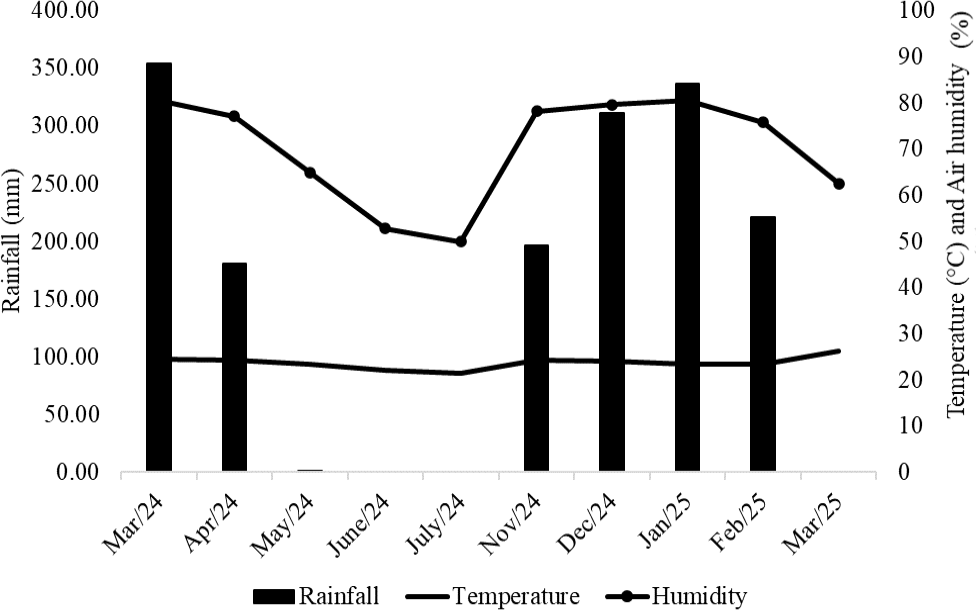
The experiment was carried out at the Centro de Inovação e Tecnologia, in Rio Verde, Goiás state, Brazil (17º48’58”S, 51º03’24”W, and altitude of 752 m), from March 2024 to March 2025. The climatic data referring to the period of the experiment are shown in Figure 1, and the soil chemical and physical characteristics are presented in Table 1.
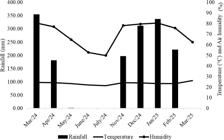
Climate data during the period of the experiment (Brasil 2025). March 2024: sorghum and forage crops sown, and treatment application; July 2024: sorghum harvest; November 2024: soybean sown; March 2025: soybean harvest.
The treatments were installed in a randomized block design, with four replications. They were composed of sorghum monoculture and intercropping between sorghum and Megathyrsus maximus cv. BRS Tamani treated with the imazethapyr + imazapic ready-made mix herbicide Zelone® (UPL, Brasil) at rates of 0 (0 g a.i. ha-1), 25 (18.75 + 6.25 g a.i. ha-1), 50 (37.50 + 12.50 g a.i. ha-1), 75 (56.25 + 18.75 g a.i. ha-1), and 100 % (75.00 + 25.00 g a.i. ha-1) of the commercial dose of 1.4 L ha-1 for a formulation of 75.0 g L-1 of imazethapyr and 25 g L-1 of imazapic.
Imidazolinone-tolerant sorghum hybrid ADV 1151 was sown on March 6, 2024, using a multiple seeder, with 5 rows spaced 0.50 m apart. At planting, Moltop® (fertilizer; 1.5 L c.p. ha-1) was applied in the planting furrow. Glyphosate (1 kg a.e. ha-1), glufosinate (400 g a.i. ha-1), and Hero® (zeta-cypermethrin + bifenthrin; 40 + 36 g a.i. ha-1) were also applied. During the crop development, other applications were carried out at 15, 30, and 45 days after emergence (DAE). Expedition® (sulfoxaflor + lambda-cyhalothrin; 30 + 50 g a.i. ha-1) was applied at all three timings. Score® (difenoconazole; 50 g a.i. ha-1) and Bioimmune® (8.4 g L-1) were applied at 30 DAE, and Priori Xtra® (azoxystrobin + cyproconazole; 60 + 24 g a.i. ha-1), Upymil® (methomyl; 537.5 g a.i. ha-1), and Complet Express® (1 L c.p. ha-1) were applied at 45 DAE.
The experimental plots consisted of 8 rows of sorghum that were 6 m in length. The area of each plot was 24.00 m2, in which the 6 central rows were evaluated. The herbicide was applied on Mar. 29, 2024, with a knapsack sprayer pressurized with CO2, maintaining a constant pressure of 2.0 bar, and the boom was equipped with four TT 110.02 nozzles spaced 1.00 m apart and calibrated to apply the equivalent of 180 L ha-1 of spray volume. The treatments were applied with 0.5 % of the adjuvant and adhesive spreader Top Oil Plus®, and Aclamado BR® (2 kg a.i. ha-1) was added to all plots in the tank mixture for better broadleaf control. Additionally, lone sorghum was weeded twice at 10 and 25 days after application (DAA). The environmental conditions were as follows: wind speed of 2.2 km h-1, temperature of 27.2 ºC, and relative humidity of 78.5 %.
At 30, 60, and 120 DAE, the plant height (obtained from the measurement between the distance from the soil and the basal end of the last leaf blade), stem diameter, and panicle length of sorghum were evaluated. In addition, 3 plants plot-1 were collected to evaluate the plant and reproductive dry mass, which were used to calculate the harvest index and 1,000-grain weight. At the harvest time (120 DAE), the number of plants in the useful area of the plots was determined to obtain the final stand, and the grain yield with moisture corrected to 13 % was determined in 4 m.
For the forage, phytotoxicity evaluations were carried out at 7, 14, and 28 DAA through visual evaluation, and scores were assigned ranging from 0 to 100 %, in which 0 represented no injury and 100 % plant death, according to the EWRC scale modified by Frans (1972). At 30 and 120 DAA, and 1 day before the desiccation of the forage for soybean planting, the accumulation of BRS Tamani was measured, and two samples of 1.0 m2 were collected and obtained at random in the plot by throwing a hollow metal square. The sampled material was stored in paper bags and dried in an oven with forced ventilation at 65 ºC, for 72 h, until it reached a constant mass. Then, the total dry mass was determined.
Soybean was cultivated in succession in the same area where sorghum intercropped with Megathyrsus maximus BRS Tamani was previously installed. Forage desiccation took place on Oct. 19, 2024, with the products glyphosate (2 kg a.e. ha-1) and adjuvant Agris® (0.5 L c.p. ha-1). Soybean Raptor I2X cultivar, which has an early cycle, was sown on Nov. 11, 2024. At soybean planting, the following products were applied in the planting furrow: Biomax Premium® (Bradyrhizobium japonicum; 0.3 L c.p. ha-1; 7 × 10⁹ cfu mL-1), Biomax Azum® (Azospirillum brasilense; 0.1 L c.p. ha-1; 3 × 10⁸ cfu mL-1), T Muvi® (0.1 L c.p. ha-1), and Moltop Concentrate® (fertilizer; 1.5 L c.p. ha-1).
The experiment was set up in a randomized block design, with four replications. The treatments correspond to the straw for no-tillage obtained by cultivating sorghum and forage in the intercropping system. Soybean was sown using a multiple seeder, with 0.50 m between rows. They were made up of 8 lines of 6 m in length and a useful area of 24.00 m2, in which the 6 central lines were evaluated.
Soybean cultural traits were evaluated at 25, 40, and 60 DAE. At 25 DAE, Versarya® (picoxystrobin + benzovindiflupir; 40 + 12.5 g a.i. ha-1) + Score Flexi® (propiconazole + difenoconazole; 50 + 50 g a.i. ha-1), and Hero® (zeta-cypermethrin + bifenthrin; 40 + 36 g a.i. ha-1) were applied. At 40 DAE, Fox Xpro® (bixafen + prothioconazole + trifloxystrobin; 62.5 + 87.5 + 75 g a.i. ha-1) + Unizeb Gold® (mancozeb; 1.125 kg a.i. ha-1), and Proclaim® (emamectin benzoate; 10 g a.i. ha-1) were applied. At 60 DAE, Orkestra® (fluxapyroxad + pyraclostrobin; 50.1 + 99.9 g a.i. ha-1), Absoluto Fix® (chlorothalonil; 720 g a.i. ha-1), and Sperto® (acetamiprid + bifenthrin; 50 + 50 g a.i. ha-1) were applied. In the fourth application, Absoluto Fix® (chlorothalonil; 720 g a.i. ha-1) and Elestal Neo® (spiropidone + acetamiprid; 30 + 24 g a.i. ha-1) were applied.
Foliar fertilization was carried out throughout the crop cycle. Purified® MAP (1.5 L ha-1) and magnesium sulfate (0.5 kg ha-1) were applied at 25, 40, and 60 DAE. At 25 DAE, Kellus Copper® (0.04 L c.p. ha-1), NHT Manganese® (0.15 L c.p. ha-1), and Concentrat Fix® (0.1 L c.p. ha-1) were applied. Concentrat Fix® (0.1 L c.p. ha-1) and oil (0.25 L c.p. ha-1) were applied at 40 DAE, and Almax® (0.5 L c.p. ha-1) and oil (0.5 L c.p. ha-1) were added at 60 DAE. Almax® (0.5 L c.p. ha-1) was applied at the final application.
At 30 DAE, the planting variables were determined by counting the number of failures and doubles in each meter, sampling 5 m plot-1. At harvest, 5 plants plot-1 were collected to evaluate the dry mass of the vegetative and reproductive parts, and the harvest index was calculated. The number of pods plant-1, number of grains pod-1, and 1,000-grain weight were also determined. The number of plants was counted in 6 linear meters to obtain the final stand, and the plants were collected to estimate the final yield with humidity corrected to 13 %.
The weed community was evaluated at 30 DAA of the herbicide, at harvest, during intercropping with sorghum, 10 days before forage desiccation, pre-planting of soybean, and when the soybean reached the vegetative stage of 3 true nodes (V3). Samples of 1 m2 were collected and identified at the species level, and the number of individuals counted to determine the plant density. After collection, the sampled material was placed in a forced ventilation oven at 65 ºC, for 72 h, until it reached a constant weight to measure the dry mass.
All data were submitted to the F-test using the ExpDes.pt package (Ferreira et al. 2021). When significant, comparisons among herbicide doses were performed using linear and quadratic regression models, adjusted using the easyreg package (Arnhold 2018), and the model with the lowest Bayesian Information Criterion (BIC) was selected. An analysis was also conducted to compare the cultivation systems, intercropped and monoculture, for sorghum and soybean. When there was statistical significance, a new analysis was performed comparing the herbicide doses with the control in a single crop for sorghum, and the straw from each treatment of the intercropping was compared to the control without straw in soybean using the Tukey test to compare the means. This analysis was carried out using the easyanova package (Arnhold 2013). The level of significance adopted in all analyses was 5 %. Statistical procedures were conducted using the R software (R Core Team 2025).
RESULTS AND DISCUSSION
Throughout the experiment, four weed evaluations were carried out, but weeds were only found on three occasions: at 30 DAA, at harvest, and at the soybean V3 stage. Eight species were identified in two families: sourgrass (Digitaria insularis), burrgrass (Cenchrus echinatus), crabgrass (Digitaria horizontalis), Urochloa decumbens, goosegrass (Eleusine indica), sorghum (Sorghum bicolor), wild sorghum (Sorghum arundinaceum) belonging to the Poaceae family, and warrave (Commelina benghalensis) belonging to the Commelinaceae family. Regarding the dry mass accumulation and density of these plants, no statistical differences were found among the herbicide doses at any of the evaluated times (Table 2).
Dry mass (g m-2) and density (plants m-2) of weeds observed along the succession system of sorghum intercropping with BRS Tamani and soybean with different imazetapyr + imazapic doses.
At the soybean V3 stage, analysis of variance was performed, considering the systems with and without straw. No statistical differences were found between the systems, either for dry mass (p = 0.131; with: 19.2 g m-2; without: 43.4 g m-2) or for plant density (p = 0.637; with: 17.4 plants m-2; without: 13.5 plants m-2).
For the first evaluation (30 DAA), despite the absence of statistical differences, two predominant species, namely wild sorghum (Sorghum arundinaceum) and goosegrass (Eleusine indica), represented 86 % of the total dry mass and 40 % of the total density. For the second evaluation (at harvest), the predominant weed was crabgrass (Digitaria horizontalis), representing 53 % of the total dry mass and 89 % of the total density of these plants. For the third evaluation (at the soybean V3 stage), the most commonly found species was goosegrass (Eleusine indica), which represented 58 % of the total dry mass and 32 % of the total density.
Seven of the eight species found in this study were narrow-leafed, showing the effectiveness of the latifolicide used for broadleaf control. According to Braz et al. (2019), invasive grasses are a constant concern in Sorghum bicolor due to the few selective herbicide options for this crop. The results presented here agree with these authors, since 88 % of the weed community and the three predominant species found in the present study belonged to the Poaceae family.
Sorghum arundinaceum was one of the most relevant species identified. This plant infests crops such as corn, soybean, sorghum, sugarcane, and cotton, causing significant damage (Tessele et al. 2014). In Brazil, the control of weeds from the Sorghum genus is hampered by the scarcity, or even non-existence, of selective active ingredients available on the market, especially for Sorghum bicolor (Tessele et al. 2014). Sorghum arundinaceum can reach up to 2.5 m in height, and, when coexisting with smaller crops, reduces the light incidence, leading to significant production losses (Martins et al. 2016). In addition, it has a dense and deep root system that is capable of accessing water after the depletion of the superficial soil layer, which gives it a high competitiveness under water scarcity conditions (Martins et al. 2016).
This weed can cause serious damage to several crops, especially Sorghum bicolor, due to the absence of selective herbicides. However, with the launch of the reference to the imidazolinone-tolerant hybrid, relative to the ready-made mixture of imazethapyr + imazapic, this may change. In the present study, S. arundinaceum was only observed in the treatment without herbicide application. In the others, the plants were already dead, showing clear symptoms of the product’s action. Thus, the Igrowth technology, which confers sorghum tolerance to imidazolinones, makes it possible to control this problematic species and to intercrop this cereal with forage grasses.
In the case of soybean cultivated after cereal-forage intercropping, the aim is to take advantage of the straw formed to suppress weeds (Silva et al. 2023b). In the present study, plants were evaluated four times. However, in the third scheduled evaluation (pre-planting of soybean before forage desiccation), there was no incidence of weeds, demonstrating the effect of straw on delaying weed infestation, which allowed one less herbicide application, when compared to the conventional soybean schedule.
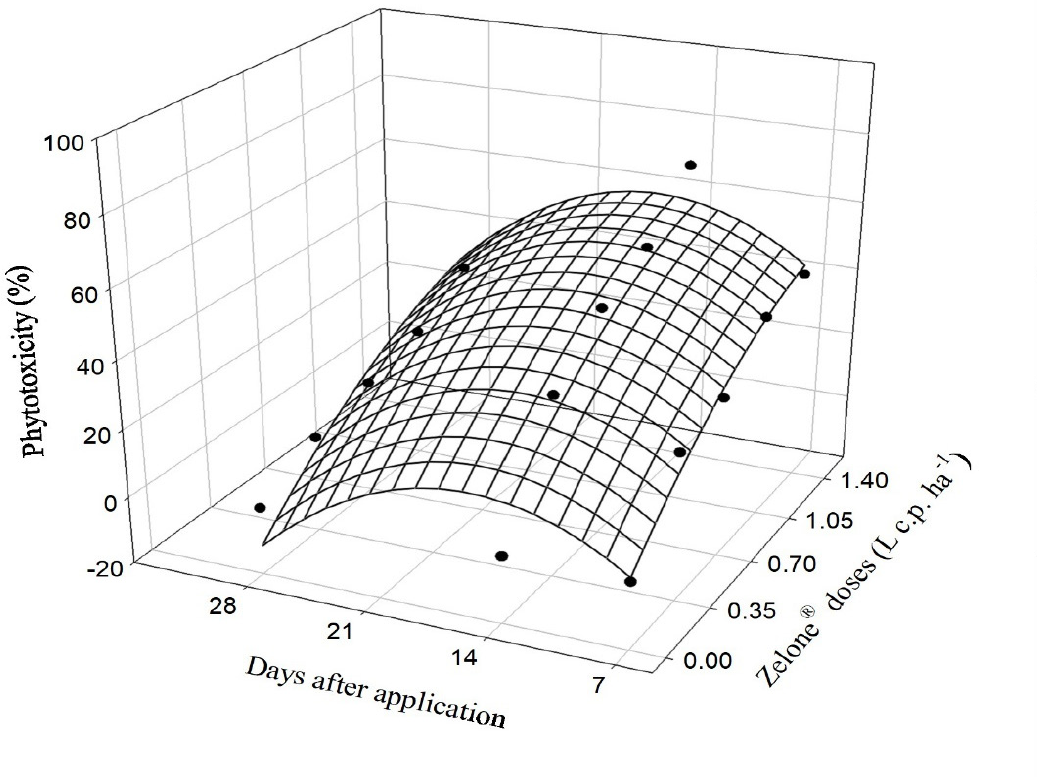
Figure 2 shows the results of the phytotoxicity evaluations in BRS Tamani resulting from the application of the imazethapyr + imazapic ready-made mix herbicide. With the increase in the dose and time after application, the injuries caused by the herbicide increased to a certain extent, reaching a peak of approximately 80 % of phytotoxicity at 14 DAA. After the peak, the phytotoxic effects were reduced, indicating forage recovery.
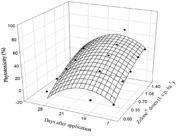
Phytotoxicity response surface of the BRS Tamani intercropped with sorghum as a function of the imazetapyr + imazapic ready-mix herbicide doses and the days after application. The points represent the average values. The fitted equation was: f = y₀ + ax + by + cx2 + dy2, with R2 = 0.89. The estimated coefficients were: y₀ = -32.0714 ± 12.7861; a = 51.8367 ± 14.9522; b = 6.0893 ± 1.6832; c = -14.5773 ± 10.2415; and d = -0.1913 ± 0.0463. Most parameters were significant at p ≤ 0.01. The parameter c was not significant. Model adjustments were performed considering the standard error of the coefficients and the standard error of the estimate (SEE = 8.1306). The coefficient of variation of the dataset was 35.86 %. Observed values represent the mean ± standard error. C.p.: commercial product; Zelone®: imazethapyr + imazapic.
The effects caused by the herbicide should not exceed 60 % of phytotoxicity up to 35 DAA (Cruvinel et al. 2021), without impairing forage performance. The results obtained in this study are in accordance with this range, indicating the potential use of this product for the suppression of BRS Tamani forage.
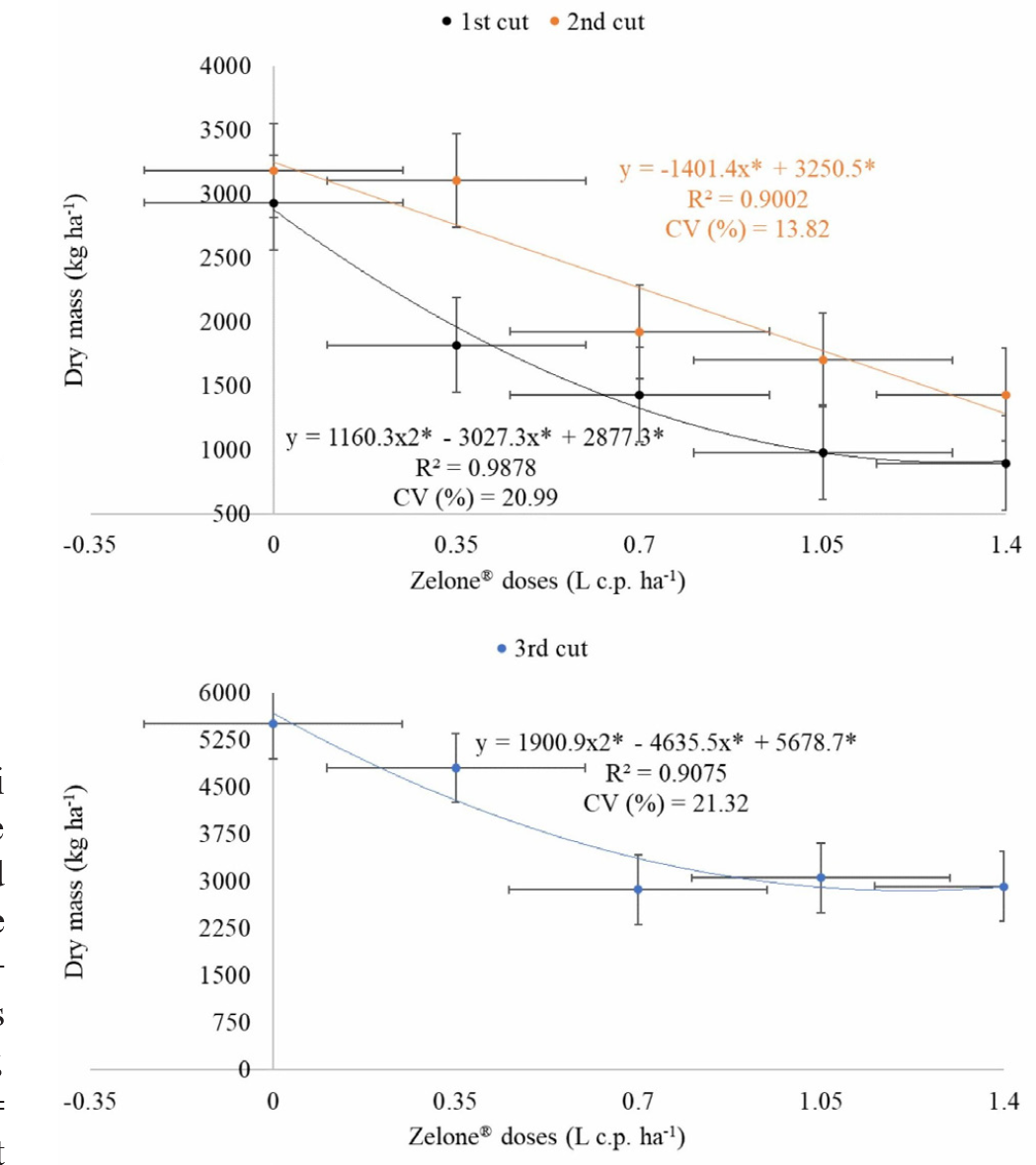
Table 3 shows the results of the analysis of variance for the dry mass yield of BRS Tamani in three cuts and the BIC for the models adopted in this study. There was a treatment effect in all of the cuts. For the first (30 DAA) and third cuts (pre-planting of soybean), the quadratic model had the best fit due to the lower BIC; whereas, in the second cut, the linear model presented the best fit.
Regression F test for the dry mass of BRS Tamani intercropped with sorghum and Bayesian Information Criterion (BIC) for the linear and quadratic models.
Figure 3 shows the average dry matter production of the forage and the regression models. In the first and third cuts, there was a reduction in this accumulation based on the increase in the dose, reaching stability at higher doses. In the second cut, whose linear model was the most adequate, there was a reduction in forage production with the increase in the dose. For each liter of the commercial product, there was a reduction of 1,401.4 (kg ha-1) in the dry matter accumulation of BRS Tamani.
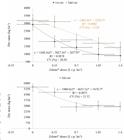
Dry mass regression curves of BRS Tamani intercropped with sorghum subjected to different imazethapyr + imazapic ready-mix herbicide doses. * Significant at 5 %. Error bars represent the standard error of the mean. CV: coefficient of variation. First cut: 30 days after application; second cut: harvest; third cut: soybean pre-planting; c.p.: commercial product; Zelone®: imazethapyr + imazapic.
To confirm the potential highlighted by the phytotoxicity results, the reduction in forage yield should not exceed 60 % or be less than 20 %, when compared to the control without application (Gheno et al. 2021, Cunha et al. 2025). At harvest, the reductions were 3, 40, 47, and 55 %, respectively with the doses of 0.35, 0.7, 1.05, and 1.4 L ha-1; of these, 0.7, 1.05, and 1.4 L ha-1 were within the mentioned range. However, such doses should not compromise the sorghum grain yield.
Table 4 shows the results of the analysis of variance for the sorghum variables evaluated in the cropping system. There was a significant treatment effect for grain yield, but there was no treatment effect for the others. When sorghum was grown alone, the yield was higher, if compared to intercropping with forage.
Analysis of variance and mean comparison of the cropping systems for sorghum variables intercropped with BRS Tamani.
Another analysis of variance was performed considering the herbicide doses, and the results are shown in Table 5. As in the first analysis, there was only one treatment effect for yield, and the linear model was the one that best fit the data.
Regression F test for the variables associated with sorghum intercropped with BRS Tamani, and Bayesian Information Criterion (BIC) for the linear and quadratic models.
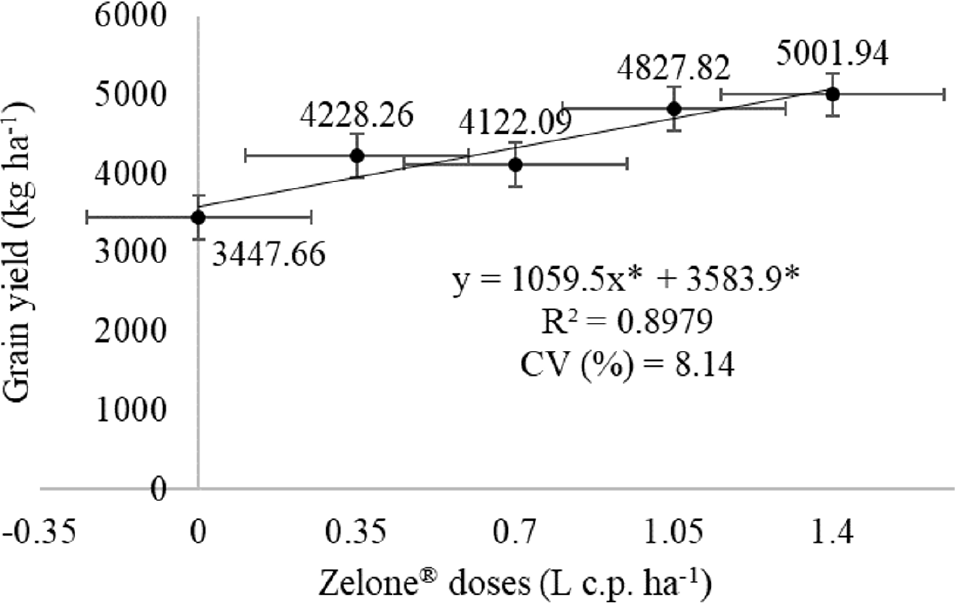
Figure 4 shows the regression for sorghum grain yield. With the increase in the herbicide dose, there was an increase in grain yield, in which, for each liter of the used product, there was a production increase of 1,059.5 (kg ha-1).
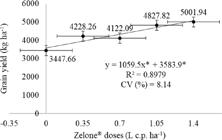
Grain yield regression curve of sorghum intercropped with BRS Tamani subjected to different imazethapyr + imazapic ready-mix herbicide doses. * Significant at 5 %. Error bars represent the standard error of the mean. CV: coefficient of variation; c.p.: commercial product; Zelone®: imazethapyr + imazapic.
As for grain yield, an increase was observed with the increase in herbicide doses. At the highest doses, there was a lower dry matter accumulation of BRS Tamani, both at 30 DAA and at harvest, indicating a lower competition intensity and higher sorghum yield. Compared to lone sorghum, the doses of 1.05 and 1.4 L ha-1 did not differ statistically, confirming their potential to suppress the forage BRS Tamani when intercropped with sorghum.
According to data provided by Conab (2025), the national average yield was 3,739 kg ha-1, and that of the Goiás state was 4,006 kg ha-1. The average found in the current study (4,325 kg ha-1) was higher than these values. Considering only the treatments with herbicide use, even at the lowest dose, the production was higher, if compared to the two aforementioned averages, showing the feasibility of using the herbicide during intercropping.
For soybean, the analysis of variance was also performed to compare the systems with and without straw, and the results are shown in Table 6. No treatment effects were observed for any of the analyzed variables.
Analysis of variance and comparison of means for soybean variables in succession to sorghum intercropping with BRS Tamani.
Table 7 shows the results of the F test, considering the doses of the imazethapyr + imazapic ready-made mix herbicide and BIC values for the adopted models. There was only a treatment effect for 1,000-grain weight, and a lower BIC was observed for the linear model.
Regression F test for soybean variables in succession to sorghum intercropped with BRS Tamani and Bayesian Information Criterion (BIC) for linear and quadratic models.
In intercropping systems, it is essential that the straw does not interfere with the planted successor crop (Nunes et al. 2024), soybean, in the present study. For this, the number of failures and double plants per meter were evaluated, and no significant effect of the treatments was observed. The values observed in both systems were less than one, indicating good soybean planting and showing that the straw from intercropping was not harmful. This result is supported by the population variable, which was not affected by the treatments.
There was no statistical difference in soybean yield between the systems with and without forage straw, or among the herbicide doses. Cortez et al. (2019) also found no direct effect of straw on soybean yield. However, several studies have shown an increase in soybean yield due to vegetation cover as a function of better water conditions, soil temperature, and greater nutrient cycling, resulting in better development conditions for the crop (Alves et al. 2024, Sodré Filho et al. 2024, Prado et al. 2025). Alves et al. (2024) found a satisfactory soybean yield under good water conditions. The water requirement of this crop was approximately 450-800 mm of water throughout its cycle (Petry et al. 2023). In the last harvest, the rainfall recorded in the experimental area was 978 mm (Brasil 2025). Therefore, there was no water restriction, which may explain the absence of a significant effect of straw on soybean yield, as observe by Alves et al. (2024).
CONCLUSIONS
-
1. It is necessary to suppress Megathyrsus maximus cv. BRS Tamani, when intercropped with sorghum, using 75 (1.05 L c.p. ha-1) or 100 % (1.4 L c.p. ha-1) of the commercial dose of imazethapyr + imazapic;
-
2. Regarding the effect of straw on weed suppression and soybean development, the presence of mulch delays weed infestation, eliminating the need for herbicide application in soybean pre-emergence, and the straw does not negatively interfere with soybean development or yield.
ACKNOWLEDGMENTS
The authors thank the Coordenação de Aperfeiçoamento de Pessoal de Nível Superior (Capes), for granting a scholarship to the first author; the financial support received from the Conselho Nacional de Desenvolvimento Científico e Tecnológico (CNPq; grant number 316743/2023-2); Grupo Associado de Pesquisa do Sudoeste Goiano (Gapes), for providing the experimental area; and Instituto Federal Goiano, Campus Rio Verde, for all the technical and institutional support.
Data Availability Statement:
Research data are only made available by authors upon request.
REFERENCES
-
ADVANTA SEEDS. igrowth®: a groundbreaking herbicide tolerance technology for maximizing sorghum yields. 2024. Available at: https://eams4dsalrs01.blob.core.windows.net/advanta-production/advantaseeds/pdfs/igrowth-Catalog.pdf Access on: Jan. 15, 2024.
» https://eams4dsalrs01.blob.core.windows.net/advanta-production/advantaseeds/pdfs/igrowth-Catalog.pdf - ALVES, M. S. S.; NASCIMENTO, N. M.; PEREIRA, L. A. F. M.; BARBOSA, T. A.; COSTA, C. H. M. da; GUIMARÃES, T. M.; BEZERRA, A. C. T. P.; MACHADO, D. L. Long-term effect of crop succession systems on soil chemical and physical attributes and soybean yield. Plants, v. 13, n. 16, e2217, 2024.
- ARNHOLD, E. Package in the R environment for analysis of variance and complementary analyses. Brazilian Journal of Veterinary Research and Animal Science, v. 50, n. 6, p. 488-492, 2013.
- ARNHOLD, E. R-environment package for regression analysis. Pesquisa Agropecuária Brasileira, v. 53, n. 7, p. 870-873, 2018.
- BENABDERRAHIM, M. A.; ELFALLEH, W. Forage potential of non-native guinea grass in north African agroecosystems: genetic, agronomic, and adaptive traits. Agronomy, v. 11, n. 6, e1071, 2021.
-
BRASIL. Instituto Nacional de Meteorologia. Banco de dados meteorológicos para ensino e pesquisa 2025. Available at: https://bdmep.inmet.gov.br Access on: Oct. 8, 2025.
» https://bdmep.inmet.gov.br - BRAZ, G. B. P.; MACHADO, F. G.; CARMO, E. L. do; ROCHA, A. G. C.; SIMON, G. A.; FERREIRA, C. J. B. Desempenho agronômico e supressão de plantas daninhas no sorgo em semeadura adensada. Revista de Ciências Agroveterinárias, v. 18, n. 2, p. 170-177, 2019.
- COMPANHIA NACIONAL DE ABASTECIMENTO (Conab). Safra de grãos 2024/25 Brasília, DF: Conab, 2025.
- CORTEZ, J. W.; FURLANI, C. E. A.; SILVA, R. P. da; ARCOVERDE, S. N. S. Manejo da palhada e adubação na produção da soja e cobertura do solo. Nativa, v. 7, n. 5, p. 506-512, 2019.
- CRUVINEL, A. G.; GONÇALO, T. P.; MORAES, K. L.; PEREIRA, B. C. S.; SOUSA, J. V. A. de; ANDRADE, D. N. de. Effects of herbicide underdoses on the vegetative development of Megathyrsus maximus cultivars. Científica, v. 49, n. 3, p. 121-127, 2021.
- CUNHA, F. P.; CRUZ, D. C.; SILVA, N. V. de S.; SILVA, J. O.; COSTA, E. M.; JAKELAITIS, A. Supressão da forrageira BRS Ipyporã com doses de imazetapir + imazapique. Observatorio de la Economía Latinoamericana, v. 23, n. 1, e88277, 2025.
-
FERREIRA, E. B.; CAVALCANTI, P. P.; NOGUEIRA, D. A. ExpDes.pt Version 1.2.2. 2021. Available at: https://CRAN.R-project.org/package=ExpDes.pt Access on: Oct. 8, 2025.
» https://CRAN.R-project.org/package=ExpDes.pt - FRANS, R. E. Measuring plant responses. In: WILKINSON, R. E. (ed.). Research methods in weed science Puerto Rico: Southern Weed Science Society, 1972. p. 28-41.
- GHENO, E. A.; FERREIRA, L. A.; MENDES, R. R.; BRAZ, G. B.; CONSTANTIN, J.; OLIVEIRA JÚNIOR, R. S. de. Herbicides to ruzigrass suppression in intercropping with corn. Weed Control Journal, v. 20, e202100736, 2021.
- LIU, H.; STRUIK, P. C.; ZHANG, Y.; JING, J.; STOMPH, T. J. Species combination determines whether forage mixtures gain in dry matter yield or crude protein concentration: a meta-analysis. Agronomy for Sustainable Development, v. 45, n. 4, e39, 2025.
- MARTINS, D. A.; JAKELAITIS, A.; CARDOSO, I. S.; COSTA, A. C.; SALES, J. D. F. Growth and physiological characteristics of the weed false johnsongrass (Sorghum arundinaceum (Desv.) Stapf). Revista Ceres, v. 63, n. 1, p. 16-24, 2016.
- MARTINS, D. A.; JAKELAITIS, A.; PEREIRA, L. S.; MOURA, L. M. F.; GUIMARÃES, K. C. Intercropping between corn and Urochloa brizantha managed with mesotrione underdoses. Planta Daninha, v. 37, e019186923, 2019.
- MARTINS, D. A.; TAVARES, C. J.; JAKELAITIS, A.; SOUSA, J. B.; MAIA, V. M. da S.; SOUSA, R. J. de; ARAÚJO, A. C. F. Management of the consortium between maize and Urochloa brizantha with tembotrione subdoses. Agrária, v. 13, n. 2, e5528, 2018.
- NUNES, J.; WALLACE, J.; ARNESON, N.; JOHNSON, W. G.; YOUNG, B.; NORSWORTHY, J. K.; WERLE, R. Planting soybean green: how cereal rye biomass and preemergence herbicides impact Amaranthus spp. management and soybean yield. Weed Science, v. 72, n. 5, p. 615-629, 2024.
- OLIVEIRA, S.; COSTA, K. A.; SEVERIANO, E.; SILVA, A. da; DIAS, M.; OLIVEIRA, G.; COSTA, J. V. Performance of grain sorghum and forage of the genus Brachiaria in integrated agricultural production systems. Agronomy, v. 10, n. 11, e1714, 2020.
- PETRY, M. T.; MAGALHÃES, T. F.; PAREDES, P.; MARTINS, J. D.; FERRAZZA, C. M.; HÜNEMEIER, G. A.; PEREIRA, L. S. Water use and crop coefficients of soybean cultivars of diverse maturity groups and assessment of related water management strategies. Irrigation Science, v. 42, n. 6, p. 1-16, 2023.
- PRADO, L. G.; COSTA, K. A. de P.; SILVA, L. M. da; SEVERIANO, E. da C.; VILELA, L.; COSTA, J. V. C. P.; MARTINEZ, C. A. Management of Brachiaria ruziziensis biomass affects soybean yield in integrated crop-livestock system. Journal of Agriculture and Food Research, v. 20, e101792, 2025.
- R CORE TEAM. R: a language and environment for statistical computing. Vienna: R Foundation for Statistical Computing, 2025.
- SHARMA, G.; SHRESTHA, S.; KUNWAR, S.; TSENG, T. M. Crop diversification for improved weed management: a review. Agriculture, v. 11, n. 5, e461, 2021.
- SILVA, C. H. D. L. E.; MELLO, C. E.; SILVA, J. O. D.; JAKELAITIS, A.; MARQUES, R. P.; SOUSA, G. D. D.; SILVA, E. J. D. Use of glyphosate in the management of Megathyrsus maximus cv. BRS Zuri intercropped with maize. Revista Brasileira de Engenharia Agrícola e Ambiental, v. 27, n. 10, p. 795-802, 2023a.
- SILVA, C. H. L.; MELLO, C. E. L.; SILVA, J. O. D.; JAKELAITIS, A.; MARQUES, R. P.; CRUZ, D. C. Use of nicosulfuron in the management of Megathyrsus maximus ‘BRS Zuri’ intercropped with maize. Revista Ciência Agronômica, v. 56, e202394128, 2025.
- SILVA, M. A.; NASCENTE, A. S.; FRASCA, L. L. de M.; LANNA, A. C.; LACERDA, M. C.; SILVA, C. B. da. Biomass, nutrient accumulation, and weed suppression by mix of cover crops. Revista Caatinga, v. 36, n. 4, p. 757-764, 2023b.
- SOARES, D. A.; LUPATINI, G. C.; SEKIYA, B. M. S.; MATEUS, G. P.; ANDRIGHETTO, C.; MODESTO, V. C.; SILVA, J. R. da; LUZ, J. H. S. da; GALINDO, F. S.; CRUSCIOL, C. A. C.; PAVINATO, P. S.; ANDREOTTI, M. Integrated crop-livestock systems as a strategy for the sustainable production of corn and soybean grain in tropical sandy soils. Agronomy, v. 14, n. 9, e2071, 2024.
- SODRÉ FILHO, J.; CARVALHO, A. M. D.; MARCHÃO, R. L.; CARMONA, R. Decomposition of sorghum, grass, and sorghum intercropped with grass and soybean performance in integrated systems in the Cerrado. Scientia Agricola, v. 81, e20230011, 2024.
- TESSELE, A.; FURTADO, R. C. N.; MORENO, G.; BORTOLUZZI, J.; LORENZETTI, D. J. G.; ALBRECHT, L. P.; ALBRECHT, A. J. P. Sorghum spp.: situação como planta daninha e manejo no Brasil. Journal of Agronomic Sciences, v. 3, n. esp., p. 256-273, 2014.
-
Editor:
Luis Carlos Cunha Junior