 Growth and nutrition of Selenicereus megalanthus in Ultisol subjected to liming1
ABSTRACT
Pitaya cultivation has been boosted around the world, but soil acidity can limit its development. This study aimed to evaluate the fertility of an Ultisol subjected to liming, as well as the growth and nutrition parameters of yellow pitaya (Selenicereus megalanthus) plants in the first year of cultivation. The experimental design was randomized blocks, with five treatments (0.00, 0.48, 0.96, 1.44, and 1.92 t ha-1 of limestone) and four replicates. Growth parameters such as total length, and number, diameter, and thickness of the cladodes, as well as the nutrient contents in the plants, were evaluated. The soil pH, calcium and magnesium concentrations, and base saturation increased with the limestone doses, whereas the potential acidity and exchangeable aluminum decreased. There was no difference among the treatments for the plant growth parameters and nitrogen, phosphorus, potassium, sulfur, copper, manganese, zinc, and boron contents. The calcium and magnesium contents in the plants increased, whereas the iron content decreased with the doses of the corrective. Liming improved the soil fertility, but did not alter the growth parameters of yellow pitaya in the first year of cultivation. The calcium and magnesium contents were higher and the iron content was lower with 1.92 t ha-1 of limestone.
KEYWORDS:
Yellow pitaya; soil acidity; agricultural limestone.
RESUMO
O cultivo de pitaia tem sido impulsionado em todo o mundo, mas a acidez do solo pode limitar o seu desenvolvimento. Objetivou-se avaliar a fertilidade de Argissolo Vermelho-Amarelo submetido a calagem, bem como os parâmetros de crescimento e nutrição de plantas de pitaia amarela (Selenicereus megalanthus), no primeiro ano de cultivo. O delineamento utilizado foi em blocos casualizados, com cinco tratamentos (0,00; 0,48; 0,96; 1,44; e 1,92 t ha-1 de calcário) e quatro repetições. Parâmetros de crescimento como comprimento total, número, diâmetro e espessura dos cladódios, bem como teor de nutrientes nas plantas, foram avaliados. O pH, as concentrações de cálcio e magnésio e a saturação por bases do solo aumentaram com as doses de calcário, enquanto a acidez potencial e o alumínio trocável diminuíram. Não houve diferença entre os tratamentos para os parâmetros de crescimento das plantas e os teores de nitrogênio, fósforo, potássio, enxofre, cobre, manganês, zinco e boro. Os teores de cálcio e magnésio nas plantas aumentaram e o de ferro diminuiu com as doses do corretivo. A calagem melhorou a fertilidade do solo, mas não alterou os parâmetros de crescimento da pitaia amarela no primeiro ano de cultivo. Os teores de cálcio e magnésio foram maiores e o de ferro menor com 1,92 t ha-1 de calcário.
PALAVRAS-CHAVE:
Pitaia amarela; acidez do solo; calcário agrícola.
INTRODUCTION
The commercial and nutritional value, as well as the variety of bioactive compounds, in pitaya pulp have increased the interest in the cultivation of this cactus around the world (Trivellini et al. 2020, Al-Mekhlafi et al. 2021, Carmen et al. 2023).
The plant adapts to different climatic conditions, with drought tolerance, high yield, and low incidence of diseases and pests (Wang et al. 2019). However, soil conditions can be a limiting factor for its cultivation. The development and yield of yellow pitaya (Selenicereus megalanthus) may be lower in acidic soils (Soto et al. 2023), due to low nutrient availability and higher concentrations of soluble toxic elements (Jouichat et al. 2024).
In this context, Ultisols are highly weathered, with low natural fertility, high acidity (Natale et al. 2012, Mackessy et al. 2024) and aluminum (Al3+) concentration, a toxic element to plants (Jouichat et al. 2024). Naturally, aluminosilicate minerals release Al3+ into the soil solution by the action of weathering, but the element is complexed at pH above 5.5 (Rheinheimer et al. 2024). Management practices that can effectively reduce soil acidification and maintain crop yield in the long term are essential to achieving agricultural sustainability (Li et al. 2019).
Among the management practices, liming rapidly reduces acidity (Delfim et al. 2022, van der Bauwhede et al. 2024), especially in soils from tropical regions, naturally acidified, such as Ultisols, providing exchangeable bases (calcium and/or magnesium), reducing acidity levels (hydrogen) and toxic elements such as aluminum, whereas increasing the effective cation exchange capacity (Bossolani et al. 2020). However, excessive limestone forms insoluble compounds, which can reduce the availability of micronutrients (Rodelo-Torrente et al. 2022).
Liming can improve the fertility of tropical soils and the development and nutrition of cultivated plants (Bossolani et al. 2022). Researchers observed better development and higher contents of phosphorus, calcium, and magnesium in pitaya plants (Hylocereus undatus and H. polyrhizus) when grown in soils with low acidity and high base saturation (70 %) (Reis et al. 2020). It was also found that the application of limestone improved soil fertility and, consequently, resulted in higher plant growth and yield in red pitaya (H. monacanthus) (Vieira et al. 2022). Thus, although these studies indicate substantial improvements in pitaya cultivation under liming, research on the effects of this management practice on the cultivation of yellow pitaya (S. megalanthus) is still scarce, but fundamental for the expansion of new planting areas (Vieira et al. 2022).
Therefore, the hypothesis of this study is that liming increases the availability of nutrients and neutralizes toxic aluminum in Ultisols, consequently improving the development and nutrition of yellow pitaya (S. megalanthus) plants. Thus, it aimed to evaluate the fertility of an Ultisol subjected to increasing doses of limestone, as well as the growth and nutrition parameters of yellow pitaya, in the first year of cultivation.
MATERIAL AND METHODS
The experiment was conducted at the Universidade Federal do Ceará, in Fortaleza, Ceará state, Brazil (03º43’02”S, 38º32’35”W, and 21 m of altitude), between November 2019 and October 2020. The climate of the region, according to the Köppen’s classification, is tropical rainy, with average annual temperature of 26.5 ºC. The accumulated rainfall in the municipality of Fortaleza during the experimental period was 1,973 mm, with the highest concentration of rains between January and June 2020.
The soil used in the experiment was an Ultisol (USDA 2022) or Argissolo Vermelho-Amarelo (Santos et al. 2013), collected from the 0-20 cm depth at the Fazenda Raposa, in Maracanaú, Ceará state, Brazil (3º50’53.5”S and 38º38’06.2”W). Potassium (K+), calcium (Ca2+), magnesium (Mg2+), sodium (Na+), exchangeable aluminum (Al3+), phosphorus (P), zinc (Zn), copper (Cu), iron (Fe), manganese (Mn), hydrogen potential (pH) (H2O), organic matter (OM), potential acidity (H + Al), sum of bases (SB), cation exchange capacity (CEC), base saturation (V%), and aluminum saturation (m%) were determined (Table 1).
The seedlings were prepared with cladodes from yellow pitaya plants (40-50 cm long) acquired from a commercial orchard. These cladodes were put to root in 8-dm3 polyethylene bags, with substrate formed by a mixture of crushed carnauba bagana (leaf fiber byproduct from wax production) and laying hen manure in the proportion of 3:1 (v:v), where they remained for 90 days. During this period, each seedling was watered with 100 mL of water, three times a week. The substrate was chemically characterized for ammonium (N-NH4+), nitrate (N-NO3-), P, K+, Ca2+, Mg2+, S, Na+, Zn, Fe, Mn, Cu, and Al3+ (Table 2).
The experimental design was randomized blocks, with five treatments and four replicates, with two plants per experimental plot, grown individually in pots, totaling 40 plants. The data were obtained by the averages of the two plants in each experimental plot. The blocks were defined based on the initial plant size: block 1 (40 cm); 2 and 3 (45 cm); and 4 (50 cm).
Liming was performed using 60 % of the base saturation for the calculations (Raij et al. 1997). The limestone doses corresponded to the treatments: zero (control) (T1), half (T2), necessary (T3), 1.5 times (T4), and 2 times the limestone dose required to raise the base saturation to 60 %, corresponding to 0.00, 0.48, 0.96, 1.44, and 1.92 t ha-1, respectively.
The limestone consisted of 32 and 15 % of calcium oxide (CaO) and magnesium oxide (MgO), respectively, with neutralizing value of 94.5 %, reactivity of 96 %, and total relative neutralizing value of 91 %. The limestone granulometry was 100, 98, and 94 % of the material that passed through 2.0, 0.84, and 0.3 mm mesh ABNT sieves n. 10, 20, and 50, respectively.
The limestone was homogenized to the soil using a concrete mixer, mixing one treatment at a time, with four replications, for 2 min. The mixture was poured into 25-L pots, which received 1.5 L of water. Then, the pots were wrapped with transparent plastic bags to prevent water loss through evaporation and kept closed for 45 days. After incubation, individual holes, with an approximate depth of 15 cm, were opened in the center of each pot, and received basal fertilization consisting of single superphosphate (120 g) and FTE-BR12 (1.4 g).
The pitaya seedlings were removed from the bags, and their roots were washed under running water to remove the adhered substrate. Then, they were transplanted, one per pot, previously prepared with the treatments, where they remained until the end of the experiment, with the objective of minimizing the effects of environmental variability. The plants were kept in a greenhouse for 60 days, with daily watering of 500 mL pot-1 of water, separated into blocks.
After this period, the pots with the pitaya plants were taken to the field and positioned next to 1.8-m-tall eucalyptus posts, and two plants were grown per post, supported by twine. In the field, the arrangement of treatments was maintained in blocks. The apex of the plants was cut when they reached 1.5 m in height, stimulating the formation of shoots (lateral cladodes) that grew on a tire support. Watering was carried out daily (except on rainy days), using 1 L pot-1 of water in the late afternoon. Crop practices were carried out manually, by weeding the area adjacent to the pots.
Due to the absence of specific recommendations for pitaya, the fertilization in the experiment was performed using sources of P and Zn (Corrêa et al. 2014); whereas, for N and K, the doses were twice that suggested by Almeida et al. (2014) for 6 months, considering that this study lasted 12 months. The doses (mg dm-3) were: 375.0 of P, applied in a single dose and incorporated into the soil during the transplanting of seedlings; 10.0 of Zn, half of which was incorporated into the soil during transplanting and the other half applied at 6 months, in topdressing; 750.0 of N and 375.0 of K, split for weekly application, in topdressing, always after irrigation, in the first year of cultivation. The used fertilizers were: urea (46 % of N); single superphosphate (18 % of P2O5; 16 % of Ca, and 12 % of S); potassium chloride (62 % of K2O); and FTE-BR12 (9 % of Zn; 1.8 % of B; 0.8 % of Cu; 2.0 % of Mn, and 0.1 % of Mo).
A soil sample was collected from each pot using a soil probe, at 45 days after limestone application. After collection, the samples were dried on the greenhouse bench and sent to the laboratory, where the pH (H2O), Ca2+ and Mg2+ concentrations, V%, H + Al, and Al3+ were determined (Silva et al. 2009).
Growth parameters such as total length (cm plant-1), number of cladodes (cladodes plant-1), cladode diameter and thickness (mm plant-1) were obtained per plant after 360 days of transplanting the seedlings to the pots.
The median part of a mature lateral cladode (15 cm long) of each plant was collected at 360 days after transplanting the seedlings. These cladodes were washed in water, hydrochloric acid solution (3 %) and deionized water, cut into pieces, placed in porous paper bags, identified, and kept in an oven with forced air circulation at 65 ºC, until reaching a constant mass.
The dried cladodes were crushed in a Wiley-type mill with 1-mm mesh, placed in polyethylene containers, identified, and sent to the laboratory, where the contents of the macronutrients N, P, K, Ca, Mg, and S, and the micronutrients Fe, Cu, Mn, Zn, and B were determined according to the methodology for chemical analysis of plant tissues (Miyazawa et al. 2009).
Normality and homoscedasticity assumptions were verified by the Shapiro-Wilk and Levene tests, respectively. The data were subjected to analysis of variance (Anova) and regression, using the Sisvar software (Ferreira 2011) version 5.3, at significance levels of 1 % (p < 0.01) and 5 % (p < 0.05). The principal component analysis was also performed by the correlation matrix of the standardized data, using the PROC PRINQUAL procedure, with the data of soil fertility (pH, Ca2+, Mg2+, V%, H + Al, and Al3+), plant growth (total length, number of cladodes, cladode diameter and thickness), and plant nutrition (N, P, K, Ca, Mg, S, Fe, Cu, Mn, Zn, and B). In addition, the Pearson’s correlation analysis (p < 0.05) was performed to assess which variables contributed the most to each principal component. The principal component analysis was performed and its graph was constructed using the SAS® OnDemand for Academics software (SAS Institute 2023).
RESULTS AND DISCUSSION
The soil pH increased with the limestone doses, when compared to the control (0.0 t ha-1), from 4.5 to 6.6 at the dose of 1.92 t ha-1 (Figure 1A). The Ca2+ and Mg2+ concentrations increased from 6.5 and 5.0 mmolc dm-3 in the control to 19.2 and 14.7 mmolc dm-3, respectively, and the base saturation increased from 28 to 82 % at the limestone dose of 1.92 t ha-1 (Figures 1B, 1C, and 1D). The potential acidity (H + Al) and exchangeable aluminum (Al3+) decreased from 36.0 and 1.4 mmolc dm-3, respectively, in the control treatment, to 8.0 and 0.0 mmolc dm-3 at the dose of 1.92 t ha-1 (Figures 1E and 1F).

Hydrogen potential (A); concentrations of calcium (Ca2+) (B) and magnesium (Mg2+) (C); base saturation (V%) (D); potential acidity (H + Al) (E); and exchangeable aluminum (Al3+) (F) in Ultisol with doses of limestone. Vertical lines represent the standard error of the mean (n = 4). ** Significant at 1 % of probability.
There was no significant difference between limestone treatments and control for the total length, number of cladodes, cladode diameter, and cladode thickness parameters, with values of 567-669 cm plant-1, 10.2-12.1 cladodes plant-1, 31.5-33.5 mm plant-1, and 5.2-5.6 mm plant-1, respectively (Table 3).
Total length (TL), number of cladodes (NC), cladode diameter (CD), and cladode thickness (CT) (mean ± standard error) of yellow pitaya plants under limestone doses in an Ultisol.
There was no significant difference between the limestone treatments and the control for the contents of the macronutrients N, P, K, and S in the plants, whose values ranged from 19.2 to 22.5, 2.6 to 4.0, 21.8 to 24.3, and 2.1 to 2.4 g kg-1, respectively. Similarly, there was no difference for the micronutrients Cu, Mn, Zn, and B, with contents of 4.5-5.3, 123.1-156.6, 180.7-240.0, and 32.1-36.4 mg kg-1, respectively.
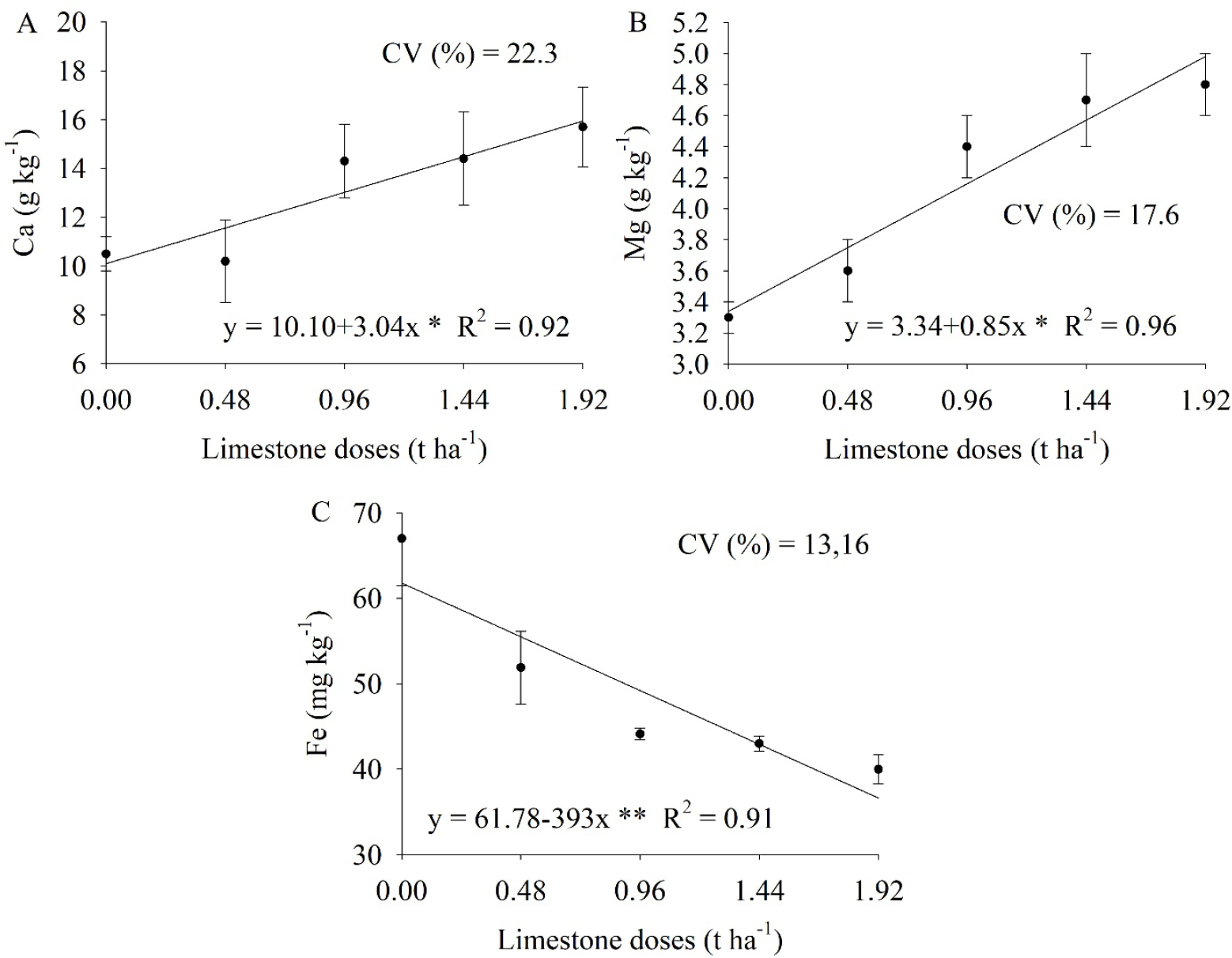
The Ca content in the pitaya plants increased by 48.5 % with the application of limestone, from 10.5 g kg-1 in the control to 15.6 g kg-1 at the dose of 1.92 t ha-1 (Figure 2A); and Mg by 18.9 %, from 3.7 g kg-1 in the control to 4.4 g kg-1 at the dose of 1.92 t ha-1 (Figure 2B); whereas the Fe content decreased by 40.2 %, from 67.0 mg kg-1 in the control to 40.0 mg kg-1 at the dose of 1.92 t ha-1 (Figure 2C).

Calcium (Ca) (A), magnesium (Mg) (B), and iron (Fe) (C) contents in yellow pitaya plants under doses of limestone in a Ultisol. Vertical lines represent the standard error of the mean (n = 4). ** and *: significant at 1 and 5 % of probability, respectively.
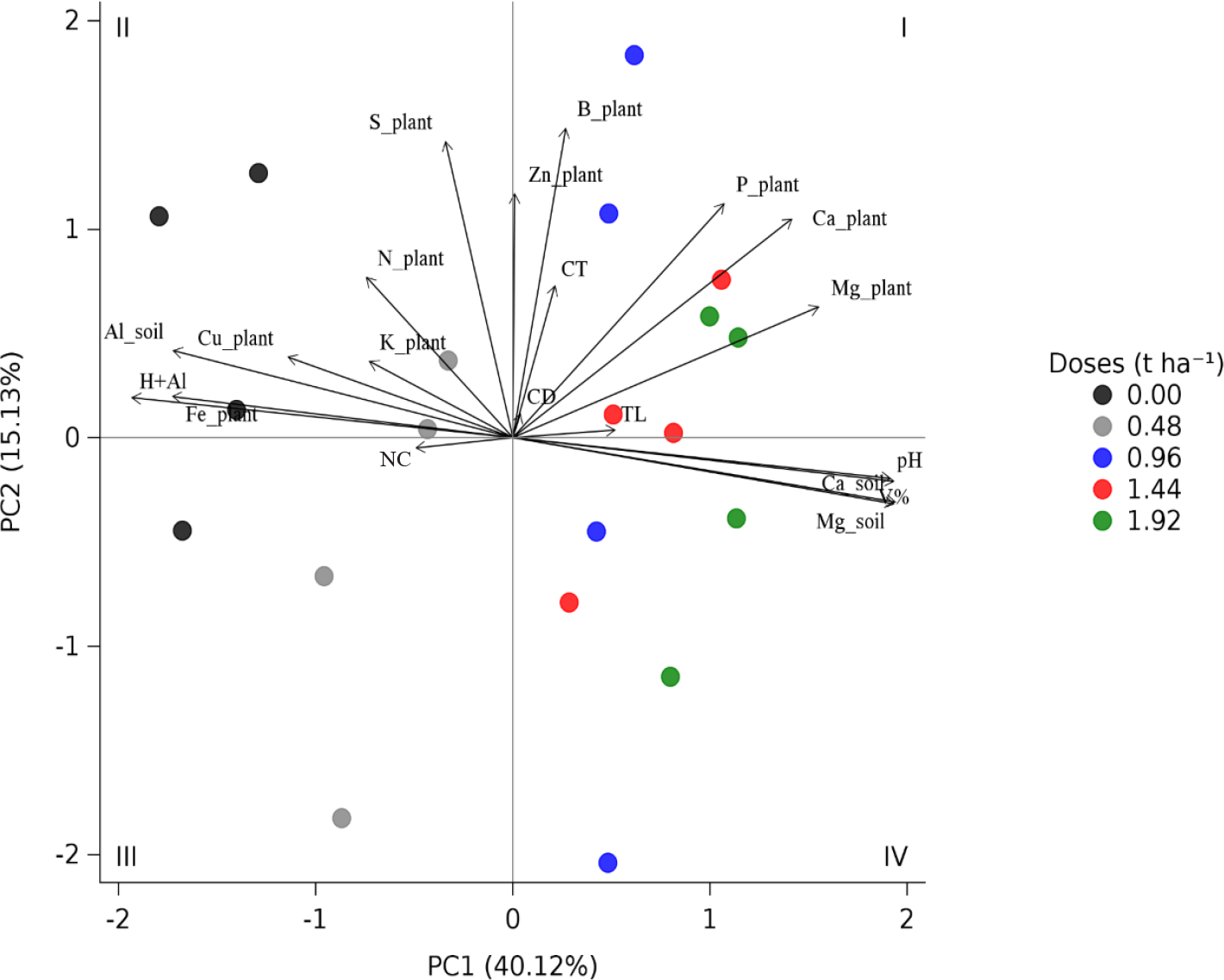
The principal component analysis (PCA) resulted in six components with eigenvalues > 1. Together, they explained 83.3 % of the data variability. However, only the first two principal components (PC) were considered for interpretation, since they concentrated most of the total variance (55.25 %), with 40.12 % explained by PC1 and 15.13 % by PC2 (Figure 3).

Principal component analysis (PC1 x PC2) with variables of soil fertility (pH, Ca2+, Mg2+, V%, H + Al, and Al3+), growth (TL: total length; NC: number of cladodes, CD: cladode diameter; and CT: cladode thickness), and nutrition (N, P, K, Ca, Mg, S, Cu, Mn, Zn, and B) of yellow pitaya plants under doses of limestone.
PC1 was positively correlated with soil fertility parameters (pH, Ca2+, Mg2+, V%) and Ca, Mg, and P contents in plants, and negatively correlated with variables associated with soil acidity (Al3+, H + Al) and with Fe and Cu contents (Figure 3). PC2 was positively correlated with P, Ca, S, B, and Zn contents in the plants, with no associated negative correlations (Figure 3).
The highest doses of limestone (1.44 and 1.92 t ha-1) were concentrated in the quadrants I and IV, being related to the increase in soil fertility (pH, Ca2+, Mg2+, and V%) and plant nutrition (Ca, Mg, and P), indicating that higher doses result in better soil fertility and plant nutrition. On the other hand, the lowest doses of limestone were distributed in the diametrically opposite quadrants (II and III), related to soil acidity (H + Al and Al3+) and to higher Fe and Cu contents in the plants (Figure 3).
The higher pH with the increase in limestone doses was similar to that reported by Vieira et al. (2022) for this type of soil, with an increase from 4.5 in the control to 6.7 at the corrective dose of 2.5 t ha-1. In the presence of water, limestone dissociates, as it is a salt, releasing carbonate (CO32-) (the accompanying ion), which, when receiving hydrogen (H+) from water, forms carbonic acid (H2CO3) and releases hydroxyls (OH-), which react with excessive H+ ions (which result in acidity) and neutralize them, raising the pH (Shaaban et al. 2020). Increasing the pH to values close to 6.5 increases the availability of nutrients in the soil (Goulding 2016), but pitaya can develop adequately in soils with variation in this parameter (5.8-7.0), according to Shah et al. (2023).
The increase in Ca2+ and Mg2+ concentrations with limestone doses is due to the release of these elements in the soil by calcium and magnesium carbonates (CaCO3 and MgCO3), respectively, present in limestone rock (Li et al. 2019). Ca2+ and Mg2+ concentrations are the main determinants of base saturation (V%), and an increase proportional to the increase in these elements is expected in soil samples (Campos et al. 2022). The values of these parameters were close to those reported by Vieira et al. (2022) for Ca2+ (20.1 mmolc dm-3), Mg2+ (16.5 mmolc dm-3), and base saturation (72.6 %), with the highest limestone dose (2.5 t ha-1) in Ultisol. The increase in Ca2+ and Mg2+ concentrations in the soil favors the absorption of these elements and improves pitaya nutrition in the first cycle (Vieira et al. 2022).
The higher potential acidity (H + Al) and exchangeable aluminum (Al3+) in the control, and the decrease in the values of these parameters with increased limestone doses are due to the adsorption of Ca2+ and Mg2+ ions to the cation exchange complex, displacing H+ and Al3+ to the soil solution, which are complexed by hydroxyl in the liming reaction (Delfim et al. 2022). The decrease of Al3+ and the greater availability of Ca2+ and Mg2+ in the soil improve the absorption of both macronutrients and the nutrition of yellow pitaya plants (Jing et al. 2024, Mackessy et al. 2024).
The total length of cladodes of yellow pitaya plants, similar in all treatments, was greater than that reported for H. setaceus pitaya, with 478.38 cm plant-1 (Lima et al. 2021). The number of cladodes of yellow pitaya plants did not vary with the applied limestone doses. In red pitaya (H. costaricensis), no variations were also observed (Oliveira et al. 2024). Similar values of cladode diameter and thickness at different limestone doses have also been reported for red pitaya (H. monacanthus) in the first year of cultivation (Vieira et al. 2022). The similar growth parameters total length, number of cladodes, cladode diameter, and cladode thickness of yellow pitaya with the limestone doses can be explained by the adaptability of this plant to various types of soils, including acidic soils, with low natural fertility (Trindade et al. 2023, Al-Qthanin et al. 2024). This is due to the morphophysiological changes of this plant, such as thorns instead of leaves, greater capacity to store water and nutrients in the cladodes, in addition to the crassulacean acid metabolism, increasing the efficiency of carbon absorption and its growth, even under adverse conditions (Tel-Zur 2022, Oliveira et al. 2024).
It is important to highlight that, even though there was no significant change in the pitaya growth parameters evaluated here, due to the relatively short time of the experiment (one year), these characteristics are expected to differentiate over time, indicating the benefits of applying correctives to this cactus species.
The N, P, and K contents observed in yellow pitaya plants, similar in the control and treatments with limestone doses, were higher than those reported by Alves et al. (2021) for this plant (8.6, 0.6, and 17.5 g kg-1, respectively) and close to those of red pitaya (H. monacanthus) at the beginning of the reproductive phase (18.4, 3.9, and 20.0 g kg-1, respectively) (Vieira et al. 2022). The high contents of N, P, and K are related to the phenological phase of the plant, because, in the first year of cultivation, the metabolism was focused on vegetative development to the detriment of fruit production, consequently leading to higher nutrient content in the cladodes (Lima et al. 2021).
A higher Ca content in yellow pitaya plants with the increase in limestone doses has also been observed in red pitaya (H. monacanthus) plants, from 18.5 to 25.8 g kg-1 (Vieira et al. 2022). The higher content of this nutrient in plant tissue is due to the increase in its availability in the soil after liming, given the composition of limestone (Moreira et al. 2024). Ca is the main element for the formation of cell walls in plant tissues (Bang et al. 2021), important in root development (Natale et al. 2012), and highly necessary for pitaya plants (Lima et al. 2021). At adequate levels in the roots, Ca increases the absorption of water and other nutrients, such as K and Mg (Jing et al. 2024). Fruiting, fruit yield, and pulp yield in pitaya plants depend on the Ca and Mg contents in the roots (Vieira et al. 2022).
The increase in Mg content in pitaya plants with the increase in limestone doses is due to the increase in the concentration of this element in the soil after liming and its greater absorption by the roots (Moreira et al. 2024). The Mg content observed with the highest dose of limestone was close to the value of 5.0 g kg-1 reported for red pitaya (H. monacanthus) (Vieira et al. 2022), and this element is important because it is one of the most required by these plants (Lima et al. 2021), acting as a constituent of the chlorophyll molecule and also participating in the activation of photosynthetic enzymes and nitrogen metabolism (Bang et al. 2021, Tian et al. 2021). In addition, the higher Mg content in pitaya plants may have increased the retention of this element at the root cell wall and plasma membrane binding sites, reducing the accumulation of toxic Al, which is common in acidic soils (Tian et al. 2021).
The reduction in Fe content in yellow pitaya plants with the increase in limestone doses is due to the lower availability of this element in the soil subjected to liming, reacting with the hydroxyls (OH-) generated and precipitating, forming iron hydroxide (Moreira et al. 2024). In addition, the adsorption of Ca and Mg to soil colloids, after liming, displaces Fe from binding sites, reducing its availability (Jing et al. 2024). However, even with the decrease, Fe contents in the yellow pitaya plants are close to the values of 51.0 mg kg-1 observed in cladodes of red pitaya (H. monacanthus), with no symptoms of deficiency in the first year of cultivation (Vieira et al. 2022).
The multivariate analysis confirmed the corrective effect of liming in tropical soils, with reduction in acidity and improvement in fertility, enabling chemical conditions conducive to plant development. The improvement in soil fertility enables greater availability of nutrients, resulting in greater absorption of elements such as Ca, Mg, and P, improving plant nutrition (Tang 2024). On the other hand, in the absence of limestone, the higher contents of Fe and Cu in plants reflect the higher solubility of these nutrients in acidic soils (Vieira et al. 2022).
CONCLUSIONS
-
1. Liming improved the fertility of the Ultisol, raising its pH, Ca and Mg availability, and reducing the concentration of exchangeable aluminum. However, this improvement did not alter the growth parameters of yellow pitaya in the first year of cultivation;
-
2. The alteration of the soil chemical characteristics with increasing doses of limestone was reflected in the nutritional status of the plants, with increases in Ca and Mg contents, and a lower Fe content.
ACKNOWLEDGMENTS
To the Coordenação de Aperfeiçoamento de Pessoal de Nível Superior (Capes) for the financial support; Embrapa Agroindústria Tropical for the laboratory analyses; and Graduate Programs in Soil Science (PPGCS) and Agronomy/Plant Science (PPGAF) of the Universidade Federal do Ceará for the support and collaboration.
Data Availability Statement:
Research data are only made available by authors upon request.
REFERENCES
- ALMEIDA, E. I. B.; CORRÊA, M. C. M.; CRISOSTOMO, L. A.; ARAÚJO, N. A.; SILVA, J. C. V. Nitrogênio e potássio no crescimento de mudas de pitaia [Hylocereus undatus (Haw.) Britton & Rose]. Revista Brasileira de Fruticultura, v. 36, n. 4, p. 1018-1027, 2014.
- AL-MEKHLAFI, N. A.; MEDIANI, A.; ISMAIL, N. H.; ABAS, F.; DYMERSKI, T.; LUBINSKA-SZCZYGEŁ, M.; VEARASILP, S.; GORINSTEIN, S. Metabolomic and antioxidant properties of different varieties and origins of dragon fruit. Microchemical Journal, v. 160, e105687, 2021.
- AL-QTHANIN, R.; SALIH, A. M. M. E.; ALHAFIDH, F. M. A.; ALMOGHRAM, S. A. M.; ALSHEHRI, G. A.; ALAHMARI, N. H. Assessing the suitability of pitaya plant varieties for cultivation in the arid climate of Saudi Arabia. Heliyon, v. 10, e21651, 2024.
- ALVES, D. A.; CRUZ, M. C. M.; LIMA, J. E.; SANTOS, N. C.; RABELO, J. M.; BARROSO, F. L. Productive potential and quality of pitaya with nitrogen fertilization. Pesquisa Agropecuária Brasileira, v. 56, e01882, 2021.
- BANG, T. C.; HUSTED, S.; LAURSEN, K. H.; PERSSON, D. P.; SCHJOERRING, J. K. The molecular-physiological functions of mineral macronutrients and their consequences for deficiency symptoms in plants. New Phytologist, v. 229, n. 5, p. 2446-2469, 2021.
- BOSSOLANI, J. W.; CRUSCIOL, C. A. C.; MERLOTI, L. F.; MORETTI, L. G.; COSTA, N. R.; TSAI, S. M.; KURAMAE, E. E. Long-term lime and gypsum amendment increase nitrogen fixation and decrease nitrification and denitrification gene abundances in the rhizosphere and soil in a tropical no-till intercropping system. Geoderma, v. 375, e114476, 2020.
- BOSSOLANI, J. W.; CRUSCIOL, C. A. C.; MOMESSO, L.; PORTUGAL, J. R.; MORETTI, L. G.; GARCIA, A.; FONSECA, M. C.; RODRIGUES, V. A.; CALONEGO, J. C.; REIS, A. R. Surface liming triggers improvements in subsoil fertility and root distribution to boost maize crop physiology, yield and revenue. Plant and Soil, v. 477, n. 1-2, p. 319-341, 2022.
- CAMPOS, M.; ROSSATO, O. B.; MARASCA, I.; MARTELLO, J. M.; SIQUEIRA, G. F.; GARCIA, C. P.; ROSSETTO, R.; CALONEGO, J. C.; CANTARELLA, H.; CRUSCIOL, C. A. C. Deep tilling and localized liming improve soil chemical fertility and sugarcane yield in clayey soils. Soil & Tillage Research, v. 222, e105425, 2022.
- CARMEN, F.; FRANCES, C.; BARTHE, L. Trends on valorization of pitaya fruit biomass through value-added and green extraction technology: a critical review of advancements and processes. Trends in Food Science and Technology, v. 138, n. 2, p. 339-354, 2023.
- CORRÊA, M. C. M.; ALMEIDA, E. I. B.; MARQUES, V. B.; SILVA, J. C. V.; AQUINO, B. F. Crescimento inicial de pitaia em função de combinações de doses de fósforo-zinco. Revista Brasileira de Fruticultura, v. 36, n. 1, p. 261-270, 2014.
- DELFIM, J. J.; SALVADOR, J. O.; MORAES, L. A. C.; MOREIRA, A. Effect of liming and phosphorus sources on soil fertility, growth, and nutritional status of guava seedlings in three tropical soils. Journal of Plant Nutrition, v. 45, n. 9, p. 1403-1412, 2022.
- FERREIRA, D. F. Sisvar: a computer statistical analysis system. Ciência e Agrotecnologia, v. 35, n. 6, p. 1039-1042, 2011.
- GOULDING, K. W. T. Soil acidification and the importance of liming agricultural soils with particular reference to the United Kingdom. Soil Use and Management, v. 32, n. 3, p. 390-399, 2016.
- JING, T.; LI, J.; HE, Y.; SHANKAR, A.; SAXENA, A.; TIWARI, A.; MATURI, K. C.; SOLANKI, M. K.; SINGH, V.; EISSA, M. A.; DING, Z.; XIE, J.; AWASTHI, M. K. Role of calcium nutrition in plant physiology: advances in research and insights into acidic soil conditions: a comprehensive review. Plant Physiology and Biochemistry, v. 210, e108602, 2024.
- JOUICHAT, H.; KHIARI, L.; GALLICHAND, J.; ISMAIL, M. Modelling temporal variation of soil acidity after the application of liming materials. Soil & Tillage Research, v. 240, e106050, 2024.
- LI, Y.; CUI, S.; CHANG, S. X.; ZHANG, Q. Liming effects on soil pH and crop yield depend on lime material type, application method and rate, and crop species: a global meta-analysis. Journal of Soils and Sediments, v. 19, n. 3, p. 1393-1406, 2019.
- LIMA, D. C.; MENDES, N. V. B.; DIÓGENES, M. F. S.; CORRÊA, M. C. M.; NATALE, W.; TANIGUCHI, C. A. K. Initial growth and nutrient accumulation in pitaya plants at different phenological stages. Revista Caatinga, v. 34, n. 3, p. 720-727, 2021.
- MACKESSY, F.; MCCARTHY, E.; BRODERICK, E.; O’DONNELL, B.; QUILLE, P. Investigating the accuracy and comparability of various lime prediction methods for Irish grassland mineral soils. Soil Use and Management, v. 40, n. 3, e13034, 2024.
- MIYAZAWA, M.; PAVAN, M. A.; MURAOKA, T.; CARMO, C. A. F. S.; MELO, W. J. Análise química de tecido vegetal. In: SILVA, F. C. (ed.). Manual de análises químicas de solos, plantas e fertilizantes Rio de Janeiro: Embrapa Solos, 2009. p. 191-234.
- MOREIRA, S. G.; MORAES, F. A.; PEIXOTO, D. S.; SILVA, J. C. R.; GAUDENCIO, J. R. F.; SILVA, B. M.; SILVA, M. M.; MACEDO, J. R. Deep incorporation of high limestones rates affects the macro and micronutrients availability and the accumulated grain yield in three acidic sites in Brazil. European Journal of Agronomy, v. 154, e127074, 2024.
- NATALE, W.; ROZANE, D. E.; PARENT, L. E.; PARENT, S. É. Acidez do solo e calagem em pomares de frutíferas tropicais. Revista Brasileira de Fruticultura, v. 34, n. 4, p. 1294-1306, 2012.
- OLIVEIRA, L. M.; MENDONÇA, V.; MOURA, E. A.; IRINEU, T. H. S.; FIGUEIREDO, F. R. A.; MELO, M. F.; CELEDONIO, W. F.; RÊGO, A. L. B.; MENDONÇA, L. F. M.; ANDRADE, A. D. M. Salt stress and organic fertilization on the growth and biochemical metabolism of Hylocereus costaricensis (red pitaya) seedlings. Brazilian Journal of Biology, v. 84, e258476, 2024.
- RAIJ, B. V.; CANTARELLA, H.; QUAGGIO, J. A.; FURLANI, A. M. C. Recomendação de adubação e calagem para o estado de São Paulo 2. ed. São Paulo: Fundação IAC, 1997.
- REIS, L. A. C.; CRUZ, M. D. C. M.; SILVA, E. D. B.; RABELO, J. M.; FIALHO, C. M. T. Effects of liming on the growth and nutrient concentrations of pitaya species in acidic soils. Australian Journal of Crop Science, v. 14, n. 11, p. 1756-1763, 2020.
- RHEINHEIMER, D. S.; BORTOLUZZI, E. C.; MOTERLE, D. F.; GUET, T. L.; BASTOS, M. C.; COELHO, L. L.; MEOTTI, B. L.; SANTANA, A. S.; TIECHER, T. Kinetics of soil re-acidification under no-tillage system. Soil and Tillage Research, v. 242, e106137, 2024.
- RODELO-TORRENTE, S.; TORREGROZA-ESPINOSA, A. C.; PALLARES, M. M.; OSORIO, D. P.; PATERNINA, A. C.; ECHEVERRÍA-GONZÁLEZ, A. Soil fertility in agricultural production units of tropical areas. Global Journal of Environmental Science and Management, v. 8, n. 3, p. 403-418, 2022.
- SANTOS, H. G.; JACOMINE, P. K. T.; ANJOS, L. H. C.; OLIVEIRA, V. A.; OLIVEIRA, J. B.; COELHO, M. R.; LUMBRERAS, J. F.; CUNHA, T. J. F. Sistema brasileiro de classificação de solos 3. ed. Rio de Janeiro: Embrapa Solos, 2013.
- SAS INSTITUTE. SAS/STAT® 15.3: user’s guide. Cary: SAS Institute, 2023.
- SHAABAN, M.; WU, Y.; WU, L.; HU, R.; YOUNAS, A.; NUNEZ-DELGADO, A.; XU, P.; SUN, Z.; LIN, S.; XU, X.; JIANG, Y. The effects of pH change through liming on soil N₂O emissions. Processes, v. 8, n. 6, e702, 2020.
- SHAH, K.; CHEN, J.; CHEN, J.; QIN, Y. Pitaya nutrition, biology, and biotechnology: a review. International Journal of Molecular Sciences, v. 24, n. 18, e13986, 2023.
- SILVA, F. C.; EIRA, P. A.; BARRETO, W. O.; PÉREZ, D. V.; SILVA, C. A. Manual de métodos de análises químicas para avaliação da fertilidade do solo. In: SILVA, F. C. (ed.). Manual de análises químicas de solos, plantas e fertilizantes Rio de Janeiro: Embrapa Solos, 2009. p. 107-184.
- SOTO, A. L.; CULMAN, S. W.; HERMS, C.; SPRUNGER, C.; DOOHAN, D. Managing soil acidity vs soil Ca:Mg ratio: what is more important for crop productivity? Crop, Forage and Turfgrass Management, v. 9, n. 1, e20210, 2023.
- TANG, L. Soil fertility, plant nutrition and nutrient management. Plants, v. 14, n. 1, e34, 2024.
- TEL-ZUR, N. Breeding an underutilized fruit crop: a long-term program for Hylocereus. Horticulture Research, v. 9, e078, 2022.
- TIAN, X. Y.; HE, D. D.; BAI, S.; ZENG, W. Z.; WANG, Z.; WANG, M.; WU, L. Q.; CHEN, Z. C. Physiological and molecular advances in magnesium nutrition of plants. Plant and Soil, v. 468, n. 1-2, p. 1-17, 2021.
- TRINDADE, A. R.; PAIVA, P.; LACERDA, V.; MARQUES, N.; LUÍS NETO; DUARTE, A. Pitaya as a new alternative crop for Iberian Peninsula: biology and edaphoclimatic requirements. Plants, v. 12, n. 18, e3212, 2023.
- TRIVELLINI, A.; LUCCHESINI, M.; FERRANTE, A.; MASSA, D.; ORLANDO, M.; INCROCCI, L.; MENSUALI-SODI, A. Pitaya: an attractive alternative crop for Mediterranean region. Agronomy, v. 10, n. 8, e1065, 2020.
- UNITED STATES DEPARTMENT OF AGRICULTURE (USDA). Soil Survey Staff. Keys to soil taxonomy 13. ed. Washington, DC: USDA Natural Resources Conservation Service, 2022.
- VAN DER BAUWEHDE, R.; MUYS, B.; VANCAMPENHOUT, K.; SMOLDERS, E. Accelerated weathering of silicate rock dusts predicts the slow-release liming in soils depending on rock mineralogy, soil acidity, and test methodology. Geoderma, v. 441, e116734, 2024.
- VIEIRA, I. G.; NATALE, W.; CORRÊA, M. C. M.; EVANGELISTA, F. L.; DINIZ, J. G. L.; TANIGUCHI, C. A. K.; LIMA NETO, A. J.; DIAS, C. T. S. Soil fertility, growth, nutrition and production of red pitaya subjected to liming. Journal of Plant Nutrition, v. 45, n. 15, p. 2277-2291, 2022.
- WANG, L.; ZHANG, X.; MA, Y.; QING, Y.; WANG, H.; HUANG, X. The highly drought-tolerant pitaya (Hylocereus undatus) is a non-facultative CAM plant under both well-watered and drought conditions. The Journal of Horticultural Science and Biotechnology, v. 94, n. 5, p. 643-652, 2019.