 Viability, germination, and storage of pollen from açaí palms and their implications for genetic conservation and breeding1
Abstract
Assessments of pollen viability can facilitate the enhancement of genetic breeding and resources conservation of Euterpe oleracea Mart. and E. precatoria Mart., species of socioeconomic relevance in the Amazon. This study aimed to evaluate the pollen viability of both species through colorimetric and in vitro germination tests, as well as analyze the effects of pollen storage temperatures and durations. Coloring methods using tetrazolium, trypan blue and cotton blue were tested, and a germination test was performed in medium with concentrations of sucrose, calcium, and boron. Cotton blue (0.05 %) presented the greatest efficiency, practicality, and reproducibility, with viability values exceeding 85 % for both species. The stored pollen maintained a viability above 70 % for up to 180 days, with a better performance at -20 ºC, a more economical and stable condition for conservation. For the in vitro germination, the medium containing 100 g L-1 of sucrose and 300 mg L-1 of Ca(NO3)2·4H2O provided the highest germination rates, whereas the addition of boron alone reduced the response. The pollen of the two species presents adequate viability when stored for use in controlled hybridization and genetic conservation by means of a pollen bank.
Keywords:
Euterpe oleracea
;
Euterpe precatoria
; in vitro germination
RESUMO
O estudo da viabilidade polínica pode contribuir para o avanço do melhoramento genético e conservação de recursos de Euterpe oleracea Mart. e E. precatoria Mart., espécies de relevância socioeconômica na Amazônia. Objetivou-se avaliar a viabilidade polínica das duas espécies por meio de testes colorimétricos e germinação in vitro, além de analisar o efeito de temperaturas e períodos de armazenamento do pólen. Foram testados métodos de coloração com uso de tetrazólio, azul de tripan e cotton blue, e realizado teste de germinação em meio com concentrações de sacarose, cálcio e boro. Cotton blue (0,05 %) apresentou maior eficiência, praticidade e reprodutibilidade, com valores de viabilidade superiores a 85 % para ambas as espécies. O pólen armazenado manteve viabilidade acima de 70 % por até 180 dias, com melhor desempenho a -20 ºC, condição mais econômica e estável para conservação. Na germinação in vitro, o meio contendo 100 g L-1 de sacarose e 300 mg L-1 de Ca(NO3)2·4H2O proporcionou as maiores taxas de germinação, enquanto a adição isolada de boro reduziu a resposta. O pólen das duas espécies apresenta viabilidade adequada quando armazenado para uso em hibridações controladas e conservação genética por meio de banco de pólen.
PALAVRAS-CHAVE:
Euterpe oleracea
;
Euterpe precatoria
; germinação in vitro
INTRODUCTION
Euterpe oleracea Mart. and Euterpe precatoria Mart. are palm trees of the Arecaceae family, native to the Amazon, and that stand out for their socioeconomic importance, especially because of the drink obtained from the pulp of their fruits, called açaí, one of the main non-timber forest products in northern Brazil (Pereira et al. 2025).
Açaí has been cultivated or managed for many years on indigenous land; however, in the last two decades, its recognition for quality and flavor in national and international markets resulted in a great increase in demand (Pereira et al. 2025). The growth of both markets has led to a growing demand for açaí production. Combined with favorable market prices, this has driven the expansion of cultivated areas. With the increase in interest in the cultivation of açaí, there have been demands for technologies that provide a greater profitability and sustainability of plantations, such as cultivars with higher yield and fruit quality, plants with lower growth in height and better distribution of fruit production throughout the year, among other industrial and agronomic characteristics (Rocha et al. 2025, Viégas et al. 2025).
Both species have a wide genetic variability, so it is expected that, with genetic breeding, it is possible to obtain cultivars adapted to different cultivation conditions and with better productive performance. Strategies with better results depend on the selection and recombination of parents and carrying out controlled crossings. Controlled hybridization depends on the availability of pollen at the appropriate time, so pollen storage methods that maintain high pollen viability are important for the species improvement (Lima & Oliveira 2023, Teixeira et al. 2025). In addition to intraspecific hybridization, hybridization between E. oleracea and E. precatoria can also be explored in the improvement of açaí, combining the high yield and precocity of E. oleracea, already enhanced by selection programs, with the rusticity, tolerance to water stress and higher anthocyanin content of E. precatoria (Marques et al. 2024, Rocha et al. 2025). Studies of pollen viability, in turn, are fundamental to enabling controlled crossbreeding and improving strategies for intra- and interspecific genetic improvement in the Euterpe genus.
Furthermore, crop improvement efforts, along with studies on pollen viability, contribute to genetic conservation from pollen banks, also known as gene banks, which are not only important for immediate use in agriculture, but also for long-term conservation. To achieve pollen conservation, it is necessary to develop appropriate methodologies, define optimal storage conditions, and keep the pollen viable in the long term (Ballesteros et al. 2025).
In the Amazon, seasonal hydroclimatic variations influence the reproductive phenology of E. oleracea, with likely implications for pollen release window and performance (Santos et al. 2025).
Climatic variability and pollinator dynamics across the ecosystems of E. oleracea and E. precatoria directly influence pollination efficiency and fruit set (Campbell et al. 2018).
Rapid tests of germination and viability of pollen are essential, because they enable quick assessments of the reproductive potential of plants, which can also identify fertile and functional pollen grains for application in agronomic research and in the optimization of agricultural production (Lima & Oliveira 2023, Rocha et al. 2025). These analyses subsidize genetic breeding programs, facilitate the selection of parents with higher fecundation capacity, and contribute to the success of hybridization (Salmiyati et al. 2025, Salomón-Torres et al. 2025). In addition, they are fundamental to the conservation of genetic resources and the management of pollen banks, ensuring the maintenance of variability and viability of stored material (Ballesteros et al. 2025). Viability rates of pollen from interspecific E. oleracea x E. precatoria hybrids exceeding 70 % were observed by Lima & Oliveira (2023), values considered suitable for pollination and controlled crossbreeds in genetic breeding (Salomón-Torres et al. 2025). However, staining tests must be followed by in vitro germination of the pollen tube to capture complementary “viability” dimensions (Li et al. 2023). The consistent and reliable assessment of pollen viability requires standardization of protocols for each species, and it should be considered that variations in response to genotypes within the same species may also occur (Kiliç et al. 2024, Ballesteros et al. 2025). In this context, it is important that pollen viability and germination tests are studied and validated on different genotypes.
Thus, this study aimed to estimate the pollen viability of E. oleracea and E. precatoria cultivated in the Amazon by means of colorimetric methods and in vitro germination, and evaluate the storage of pollen under different temperatures and periods.
MATERIAL AND METHODS
The inflorescences used in the experiments were collected from Euterpe precatoria plants of a commercial plantation located in Manacapuru (03º15’02.18805’’S; 60º36’48.82136’’W), and from E. oleracea planted in Manaus (2º53’29.14”S; 59º58’39.90”W), both in the Amazonas state, Brazil. The collection of pollen from E. precatoria was carried out in September 2020, and from E. oleracea in March 2021, periods in which the respective species present many plants in the flowering phase at the collection sites.
The analyses were carried out with pollen collected from three plants of E. precatoria and three of E. oleracea, which presented inflorescences with male flowers in anthesis releasing pollen. To avoid contamination with pollen from different plants, before the beginning of anthesis, the inflorescences were covered with a bag made with Failete fabric. From each inflorescence, one rachis was collected, and three pollen blades were analyzed, using four anthers per blade. The analyses were carried out with fresh pollen, soon after collection. For the preparation of the blades, the crushing technique was applied for the release of pollen. A homogenized suspension droplet containing pollen grains, obtained by dispersing the pollen in a solution of distilled water and glycerine (1:1, v/v), was added to each blade. Then, dye was applied, and the blade/lamina assembly was set up to observe the coloration pattern in a stereoscopic microscope.
For the feasibility test, the following dyes were used: tetrazolium (0.1 %) (Lakon 1949), cotton blue (0.05 %) (Käpylä 1991), and trypan blue (0.2 %) (Hayman 1970). In the tetrazolium test, if feasible, pollen becomes reddened after reaction. In the cotton blue test (0.05 %), the viable pollen grains become blue when in contact with the solution, and those that are not viable remain with unchanged coloration. Trypan blue colors the non-viable pollen in blue, because the damaged cell membrane allows the entry of dye, and living cells, with intact membranes, exclude the dye and remain colorless, allowing visual differentiation in a cell viability analysis.
The blades were identified according to the treatment used, with three replications for each treatment. In the test with tetrazolium, the prepared blades were covered with aluminum foil to avoid exposure to light, since the tetrazolium salt is photosensitive. The blades were then stored in a biological incubator (B.O.D.) for 2 hours, at a temperature of 37 ± 3 ºC. The samples prepared with cotton blue had the blades placed on a Petri dish with moistened filter paper and remained in the B.O.D. at 37 ± 3 ºC, for 30 min, whereas those with trypan blue remained at room temperature for 5 min.
The analysis of viable pollen grains was performed in a trinocular optical microscope (Coleman, Model N-180M), using 40x and 10x ocular lenses, resulting in a total increase of 400x. The reading of the blades was determined by the coloring pattern of the pollen grains. The criteria used to classify pollen grains as viable or not viable were based on the hue of the pollen grain, taking into account the specific reaction of each dye. The pollen viability was calculated by the following formula: pollen viability (%) = (number of viable pollen grains/number of total pollen grains) x 100.
The experiments were assembled in a completely randomized design, in a 3 x 3 factorial scheme, being three genotypes (individual plants) and three colorimetric methods, with three replications, and the experimental unit represented by a blade. On each blade, 200 grains of pollen were counted, and classified as viable or non-viable according to the color pattern. The percentage of viable pollen was obtained by the ratio between the number of viable grains and the total number of evaluated grains, multiplied by 100. The data were subjected to analysis of variance, and the averages compared by the Tukey test (p < 0.05). The analyses were performed using the Genes software (Cruz 2016).
The pollen grains used in the storage experiments were collected from an inflorescence of each species. The inflorescences were collected with male flowers in anthesis and releasing pollen early in the morning, placed in polyethylene bags, duly identified, and transported immediately to the laboratory, where each inflorescence rachis was removed and placed on aluminum trays, then taken to a greenhouse and dried for 24 hours at 37 ºC. After drying, all flowers and flower buds were removed from the rachis and placed in kraft paper bags. For the release of pollen grains from flowers and buttons, with a wooden roll, slight compression was carried out on the bag. Then, the contents of the package were poured onto a sieve with 106 µm (140 mesh) and a glass refractory underneath for pollen collection (Lima & Oliveira 2023).
After sieving, the pollen grains of each inflorescence, properly identified by origin, were collected and packed separately in Eppendorf-type tubes. At each of the three storage temperatures [4 ºC (refrigerator), -20 ºC (freezer), and -80 ºC (ultra freezer)], a tube with pollen was stored for each storage period (0, 30, 60, 90, and 180 days). The viability of pollen grains was evaluated by the colorimetric method, using cotton blue (0.05 %) (Käpylä 1991), according to the procedures described in the previous item. After being removed from the storage condition, before the viability test, the pollen grain samples were placed for hydration for 2 hours in a moistened filter paper in a Petri dish.
For each species, an experiment was conducted in a completely randomized design, using a 3 (temperatures) x 5 (storage periods) factorial scheme, with 3 replications, and experimental unit represented by a blade. The data were subjected to analysis of variance, and when a significant effect of the variation sources was observed (test F; p < 0.05), the pollen viability averages observed at different temperatures were compared by the Tukey test at 5 % of probability, and the effect of the storage period was evaluated using regression analysis. The analyses were performed in the Genes software (Cruz 2016).
The in vitro germination of the pollen grains was carried out with fresh pollen, shortly after the collection of flowers and extraction of pollen from anthers, in semisolid culture medium prepared with distilled water, agar (10 g L-1), sucrose (50 and 100 g L-1), boron (100 and 0 mg L-1), and calcium (300 and 0 mg L-1). After mixing and homogenizing the components, the culture medium was heated in a microwave oven and then poured into 9-cm diameter and 1-cm high Petri dishes with a volume of approximately 20 mL per dish. A suspension was prepared using distilled water with 0.010 g mL-1 of pollen of the species, from which 60 μL were applied on the surface of the culture medium in each Petri dish, making then the uniform distribution of the suspension in the culture medium with a Drigalsky handle. For each treatment, three plates were prepared, and, after the application of pollen suspension, the plates were placed in a B.O.D. at a constant temperature of 37 ± 3 ºC, for 4 hours (Brewbaker & Kwack 1963, Cysne et al. 2018).
At the end of the incubation period, the plates were observed under a binocular biological microscope with a 10-fold magnification lens, for counting germinated and ungerminated pollen grains. Pollen grains that had a pollen tube of length equal to or greater than the diameter of the pollen itself were counted as germinated (Cysne et al. 2018). On each plate, 200 grains of pollen were counted, between germinated and ungerminated. The percentage of viable pollen was obtained by calculating the total number of viable grains divided by the number of counted grains and multiplied by 100.
For each species, an experiment was conducted in a completely randomized design, in a 2 x 2 x 2 factorial arrangement, being 2 concentrations of sucrose, 2 of H3BO3, and 2 of Ca (NO3)2 4H2O, with three replications, and the experimental unit represented by a plate. The results were subjected to analysis of variance, and, when significant effects were observed for the treatments (F test; p < 0.05), the means were compared by the Tukey test at 5 % of probability. The analyses were performed in the Genes software (Cruz 2016).
RESULTS AND DISCUSSION
For both species, the analysis of variance showed significant genotype and coloring method effects on pollen viability, and the genotype x coloring method interaction was not significant (Table 1), suggesting that the coloring pattern of pollen grains is consistent across different genotypes. The low coefficient of variation (2.6 % for E. precatoria and 10.9 % for E. oleracea) (Table 1) reinforces the experimental accuracy and homogeneity of the obtained data.
Summary of the analysis of pollen viability variance (%) evaluated in Euterpe precatoria and E. oleracea, using three dye solutions (tetrazolium, cotton blue, and trypan blue) and three genotypes of each species.
For the E. precatoria pollen, the highest viability estimate was obtained using the cotton blue method (86.7 %), with statistically higher values than the other methods, followed by the value estimated by the tetrazolium test (80.5 %), which was statistically superior to the one obtained with trypan blue (74.8 %) (Figure 1; Table 2). A similar result was obtained with the E. oleracea pollen; however, the estimate obtained with cotton blue (93.5 %) did not differ statistically from that obtained by the tetrazolium test (82.8 %), which, in turn, did not differ from that observed with trypan blue (64.0 %) (Figure 1; Table 2). Considering the obtained results, the cotton blue colorimetric method is more suitable for analyzing the pollen viability of the two species, as it provides the highest estimates in E. precatoria and E. oleracea, although, in the latter, the value did not differ statistically from that obtained by the tetrazolium test (Figure 1).
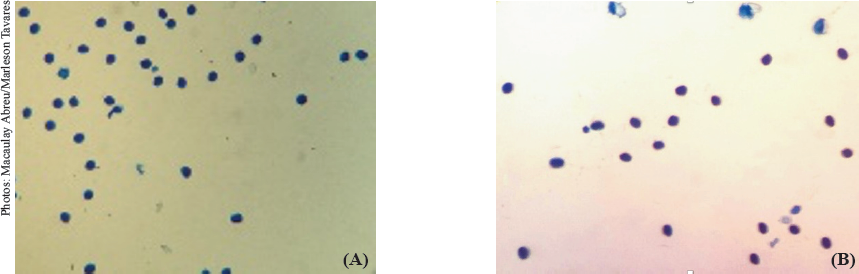
Pollen grains of Euterpe oleracea (A) and Euterpe precatoria (B). Viable pollen shows a dark blue coloration after staining with cotton blue (0.05 %), whereas non-viable pollen shows a light blue coloration or almost colorless. Images obtained under a 40x optical microscope lens.
Viability averages of fresh pollen (%) from Euterpe precatoria and E. oleracea evaluated with cotton blue, tetrazolium, and trypan blue.
The results show that, despite the observed differences, methods based on vital and enzymatic dyes are suitable for estimating the viability of pollen grains in the Euterpe genus. Methods based on cytoplasmic staining and enzymatic activity show a high correlation with in vitro germination, especially in species with thick polymeric walls, such as palm trees (Li et al. 2023). Tetrazolium and Baker tests are more sensitive and reproducible than the trypan blue, which tends to underestimate the real viability by relying solely on cell membrane integrity (Kiliç et al. 2024). The use of exclusion tests, such as trypan blue, has limitations under conditions of osmotic variation and hydration, which may result in a false indication of inviability (Liu et al. 2023). Methods that detect metabolic activity (tetrazolium) and vital coloration (Baker) allow for a more precise identification of functional grain vitality, correlating with germinative performance and reproductive success (Ballesteros et al. 2025).
The preparation time and operational simplicity should also be considered in choosing the method of pollen viability analysis. In these aspects, the method using cotton blue is more advantageous, as it requires less incubation time and provides immediate coloration and a clear distinction between viable and non-viable grains. The tetrazolium test, although accurate, requires additional incubation steps under controlled temperature and in a dark environment, which makes it less practical for routine use.
The storage period had a statistically significant effect on the pollen viability of both species, whereas the effects of storage temperature and storage period x storage temperature interaction were not significant (Table 3). The values of the coefficients of variation (3.2 % for E. precatoria and 7.2 % for E. oleracea) were low, indicating a good experimental accuracy. The results show that the storage temperature is a determining factor in reducing pollen viability.
Summary of the analysis of variance for the viability of pollen grains (%) from Euterpe precatoria and E. oleracea, evaluated by the colorimetric method with cotton blue, subjected to three temperatures (5, -20, and -80 ºC) and five storage periods (0, 30, 60, 90, and 180 days).
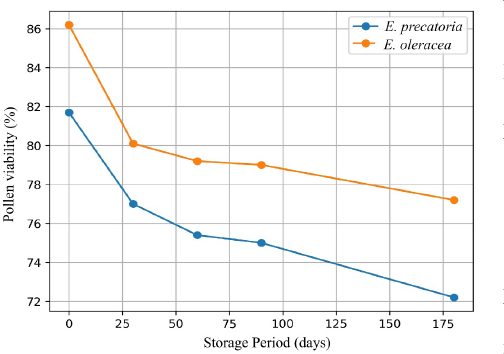
Considering that the storage period x storage temperature interaction was not statistically significant, a comparison of the means of the main effects was carried out (Figure 2). For both E. precatoria and E. oleracea, the averages obtained with different temperatures did not differ statistically among them. Regarding the storage period, for E. precatoria, the pollen viability decreased significantly over the period, reducing from 81.67 % at the beginning of storage (0 days) to 72.2 % in the final period (180 days); whereas, for E. oleracea, the observed reduction was not statistically significant among the evaluated periods (Figure 2). The results suggest that E. oleracea pollen has a greater storage tolerance than E. precatoria; however, for both species, the estimated pollen viability remained above 70 % after 180 days of storage, a value still considered suitable for use in hybridization (Althiab-Almasaud et al. 2024, Rane et al. 2024).

Pollen viability (%) of Euterpe precatoria and E. oleracea, evaluated by the colorimetric method with cotton blue, throughout the pollen storage period. The values represent the average storage temperatures.
In the comparison of temperatures, the highest averages were observed at -20 ºC, both for E. precatoria (76.9 %) and E. oleracea (81.9 %), although without significant statistical difference. This indicates that this temperature has a practical advantage, as it preserves viability with lower costs and infrastructure than freezing to -80 ºC; however, satisfactory results were also obtained with pollen storage at 4 ºC until 180 days of storage. The use of cotton blue showed to be suitable for distinguishing viable and non-viable grains, maintaining values close to those obtained with tetrazolium in Elaeis oleifera (Kunth) Cortés (Cysne et al. 2018). Osmotic and hydration variations can compromise the reading of vital colorations, producing false indications of unviability when the preparation parameters of the blades are not strictly standardized (Chen et al. 2025, Salmiyati et al. 2025, Salomón-Torres et al. 2025). For stored pollen, it is recommended to combine cytoplasmic dyes with in vitro germination tests, as the former may overestimate viability relative to physiological tests (Stokes & Geitmann 2025).
The quadratic polynomial regression adjusted for pollen viability over the storage period showed a high coefficient of determination for both evaluated species (Figure 3). For E. precatoria, the model presented R2 = 0.9397, indicating that approximately 93.97 % of the observed variation in pollen viability is explained by the storage period, evidencing a strong adjustment of the model to the experimental data. Similarly, for E. oleracea, R2 = 0.9024 was obtained, indicating that 90.24 % of the variation in pollen viability is explained by the adjusted model. These high R2 values demonstrate that polynomial regression adequately describes the trend of variation in pollen viability over storage.
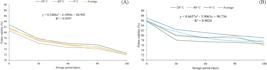
Pollen grain viability of Euterpe precatoria (A) and E. oleracea (B) analyzed with the use of cotton blue, in five storage periods (0, 30, 60, 90, and 180 days) and at three temperatures (-20, -80, and 4 ºC).
For the studied species, there is a tendency to gradually reduce pollen viability with an increase in storage period, indicating the effect of time on the maintenance of viability. The observed quadratic behavior suggests a progressive reduction over time, with greater stability in the initial periods and more pronounced decline in longer storage periods.
For both species, the pollen grains viability remained high (70 %) throughout the evaluated period (Figure 3), showing gradual decreases with increasing storage time. Considering that there was no significant interaction between storage period and storage temperature, the mean values of the three temperatures were used to adjust the regression equation that best represented the observed trend. Although no statistically significant differences were observed among the evaluated temperatures, the viability values of pollen stored at -20 ºC remained generally higher than those observed in the other storage conditions for both species (Figure 3).
The reduction of pollen viability over the storage period observed in this study is consistent with several studies that demonstrate that storage time has a strong influence on pollen longevity (Althiab-Almasaud et al. 2024, Rane et al. 2024, Salomón-Torres et al. 2025). In general, viability tends to decrease progressively as the storage period increases, regardless of the analyzed species (Calic et al. 2021, Li et al. 2025). Studies also report substantial reductions in viability after prolonged periods of storage, evidencing the gradual loss of pollen germination over time (Althiab-Almasaud et al. 2024, Rane et al. 2024, Chen et al. 2025, Salomón-Torres et al. 2025). These results corroborate the trend observed in the adjusted regressions in this study, in which pollen viability decreases with increasing storage time.
This behavior is also consistent with studies analyzing the viability of pollen stored at different temperatures in perennial and annual crops. In Phoenix dactylifera, for example, the initial viability (~96 %) decreased over time, but storage at -30 ºC preserved high and sufficient levels for pollination, with high fruiting values observed in the field (85 % with fresh pollen; 75 % at -30 ºC; 65 % at 4 ºC; and 45 % at 28 ºC) (Kadri et al. 2022).
The comparison between E. precatoria and E. oleracea indicates that both retain a high viability for up to 6 months of storage, with small differences in sensitivity between species and storage temperatures. The initial maintenance of viability followed by gradual decline is widely described in the literature (Chen et al. 2025, Flores-Guillén et al. 2025, Salomón-Torres et al. 2025). In other palm trees, a comparative study with Elaeis oleifera, E. guineensis, and their interspecific hybrids reinforces that viability and germination are central parameters for breeding programs, being possible to maintain high values during storage under low temperatures (Mosquera et al. 2021). The pattern of curves observed in this study, therefore, is consistent with that observed in other palm trees, such as those of the Elaeis genus, for which, at lower temperatures, a longer viability remains above the level useful for controlled crossbreeding (Salmiyati et al. 2025, Salomón-Torres et al. 2025).
Percentages of viable pollen above 70 % are classified as high and sufficient to ensure the success of controlled hybridization in breeding programs (Mosquera et al. 2021, Kadri et al. 2022). The values observed in this study demonstrate that the E. precatoria and E. oleracea pollen can be stored for extended periods without significant viability loss, ensuring its efficient use in intra- and interspecific crosses.
The variation coefficients of the experiments of the two species were close (E. precatoria = 10.7 %; E. oleraceae = 11.2 %) and indicated a good experimental accuracy. The effects of sucrose (S), boron (B), and calcium (Ca) and the B × S, Ca × S, and S × B × Ca interactions were significant for E. precatoria and E. oleraceae, whereas the B × Ca interaction was not significant (Table 5). Calcium and boron are critical regulators of the onset of germination and growth of the pollen tube, but their effects are dependent on concentration and osmotic/energy balance (sucrose), which may have led to significant interactions (Jia et al. 2022, Stokes & Geitmann 2025). In recent compendia and specific studies, Ca2+ acts at the apex of the tube, regulating polarity and vesicular flow; and B3+ stabilizes wall pectins (rhamnogalacturonana-II), but excesses can inhibit germination (Cai & Del Duca 2019, Gao et al. 2022, Jia et al. 2022, Del Duca et al. 2023).
Summary of the analysis of variance for in vitro pollen germination (%) from Euterpe precatoria and E. oleracea in culture medium with concentrations of sucrose, boron, and calcium.
The physiological responses of E. precatoria and E. oleracea pollen to culture medium are influenced by the interaction between carbohydrates and mineral nutrients (Figure 4; Table 6). The treatment containing 100 g L-1 of sucrose and 300 mg L-1 of Ca(NO3)2·4H2O resulted in the highest germination rates (≈ 71-79 %), significantly exceeding the treatment with 50 g L-1 of sucrose. The results are consistent with those found by Jia et al. (2022), who observed an almost linear increment of germination as sucrose rose in solid media up to the point of osmotic saturation, as well as the results of Brandoli et al. (2024), who reported a significant increase in the germination of Corylus avellana with sucrose elevation associated with the presence of calcium. The importance of calcium was also demonstrated in concentrations between 200 and 400 mg L-1, which optimized the pollen tube polarization and cell wall integrity (Jia et al. 2022), a behavior similar to that recorded in the two species of Euterpe analyzed in this study. Calcium increases the percentage of germination, whereas boron tends to reduce when isolated and at non-optimized levels, and, because the triple interaction (S × B × Ca) is significant (Table 5), it shows that an efficient germination requires high sucrose + Ca and low or absent B (Jia et al. 2022, Weng et al. 2023, Brandoli et al. 2024).

Germination of pollen grains and formation of pollen tubes in Euterpe oleracea (A) and E. precatoria (B), grown in agar medium (10 g L-1). The arrows indicate the emerging pollen tubes. Records obtained in optical microscope under a 40x lens.
In vitro germination averages of pollen from Euterpe precatoria and E. oleracea in agar medium (10 g L-1) plus concentrations of sucrose, boron, and calcium.
The addition of boron alone (100 mg L-1) caused a drastic reduction in germination (8-14 %), confirming that, although the element is essential to the cell wall structure, its optimal range is narrow, and excesses cause osmotic and cytotoxic effects (Jia et al. 2022, Weng et al. 2023). The antagonistic effect between boron and calcium, evidenced by the drop in germination to 46 % in E. precatoria and 35 % in E. oleracea, when both were combined, reinforces the result of the Anova (Table 5), which showed significance for the triple interaction (S × B × Ca). Recent studies confirm that the balance between these ions is determinative of mean lamella stability and apical growth direction (Weng et al. 2023, Jia et al. 2022).
Finally, the interspecies consistency, with E. oleracea reaching germination close to 80 %, is compatible with observations in other palm trees, such as Elaeis oleifera and E. guineensis, in which equivalent calcium concentrations resulted in germination rates above 70 % (Mosquera et al. 2021). Similar results were also obtained in tree species and cereals, where control of the medium and temperature determined functional pollen germination (Li et al. 2023).
CONCLUSIONS
-
Colorimetric and enzymatic methods are effective for estimating the pollen viability in the Euterpe genus, making them suitable tools for reproductive studies and applications in genetic breeding. Due to its efficiency and practicality of use, cotton blue (0.05 %) is recommended as the preferred method for rapid and reproducible analysis of pollen viability of Euterpe precatoria and E. oleracea, especially in genetic breeding programs, pollen storage, and conservation of genetic resources;
-
For a higher germination rate, the storage of pollen grains from E. precatoria and E. oleracea should be done at -20 ºC, but satisfactory results are also obtained with storage at 4 ºC. In these conditions, it is possible to obtain germination rates exceeding 70 % up to 180 days of storage;
-
For in vitro germination of pollen in agar medium (10 g L-1), the best germination rates are obtained with the addition of 100 g L-1 of sucrose and 300 mg L-1 of Ca(NO3)2·4H2O, both for E. precatoria and E. oleracea.
Data Availability Statement:
Research data are only made available by authors upon request.
ACKNOWLEDGMENTS
The authors would like to thank the Fundação de Amparo à Pesquisa do Estado do Amazonas (FAPEAM), for financial support and grant; and Conselho Nacional de Desenvolvimento Científico e Tecnológico (CNPq), for providing the research productivity grant to Maria Teresa Gomes Lopes (Process nº 306943/2025-5), Ricardo Lopes (Process nº 308815/2023-8), Carlos Henrique Salvino Gadelha Meneses (Process nº 306943/2025-5), and Santiago Linorio Ferreyra Ramos (Process nº 305280/2022-8).
REFERENCES
- ALTHIAB-ALMASAUD, R.; TEYSSIER, E.; CHERVIN, C.; JOHNSON, M. A.; MOLLET, J.-C. Pollen viability, longevity, and function in angiosperms: key drivers and prospects for improvement. Plant Reproduction, v. 37, n. 3, p. 273-293, 2024.
- BALLESTEROS, D.; CANÓN-PRIETO, J. L.; NEBOT, A.; PRITCHARD, H. W.; TU, Y.; CHEN, H.; FOLGADO, R.; WINKELJOHN, M.; PHILPOTT, M.; PENCE, V.; LÓPEZ PERALTA, A. M.; PRIETO, L.; FOSTER, J. Conserving the genetic resources of exceptional plant species through pollen banking. In: GANTAIT, S.; CHMIELARZ, P. (ed.). Conservation of plant genetic resources Singapore: Springer, 2025. p. 109-133.
- BRANDOLI, C.; CRISTOFORI, V.; SILVESTRI, C.; TODESCHINI, C.; SGARBI, E. The development of an improved medium for the in vitro germination of Corylus avellana L. pollen. Forests, v. 15, n. 7, e1095, 2024.
- BREWBAKER, J. L.; KWACK, B. H. The essential role of calcium ion in pollen germination and pollen tube growth. American Journal of Botany, v. 50, n. 9, p. 859-865, 1963.
- CAI, G.; DEL DUCA, S. Pollen tube and plant reproduction. International Journal of Molecular Sciences, v. 20, n. 3, e531, 2019.
- CALIC, D.; MILOJEVIC, J.; BELIC, M.; MILETIC, R.; ZDRAVKOVIC-KORAC, S. Impact of storage temperature on pollen viability and germinability of four Serbian autochthon apple cultivars. Frontiers in Plant Science, v. 12, e709231, 2021.
- CAMPBELL, A. J.; CARVALHEIRO, L. G.; MAUÉS, M. M.; JANDAKI, S.; ALVES, D. A.; CUNHA, A. M.; FREITAS, B. M. Anthropogenic disturbance of tropical forests threatens pollination services to açaí palm in the Amazon river delta. Journal of Applied Ecology, v. 55, n. 4, p. 1725-1736, 2018.
- CHEN, Y.; ZHANG, X.; YANG, J.; GUO, D.; WANG, X.; WANG, Z. Development and application of an in vitro pollen viability assay for comparative safety assessment of transgenic alfalfa (Medicago sativa L.). Plants, v. 14, n. 19, e3070, 2025.
- CRUZ, C. D. Genes software-extended and integrated with the R, Matlab and Selegen. Acta Scientiarum Agronomy, v. 38, n. 4, p. 547-552, 2016.
- CYSNE, A. Q.; GOMES, F. B.; LIMA, W. A. A. de; KRUG, C. Germinação in vitro de pólen de caiaué. Scientia Agraria Paranaensis, v. 17, n. 3, p. 305-310, 2018.
- DEL DUCA, S.; FERNÁNDEZ-GONZÁLEZ, D.; CAI, G. Editorial: regulation of pollen tube growth. Frontiers in Plant Science, v. 14, e1242416, 2023.
- FLORES-GUILLÉN, S.; SANDOVAL-FERNÁNDEZ, J.; AMORIM, E. P.; SEGURA-MENA, R.; ECHEVERRÍA- BEIRUTE, F. Determination of pollen viability and germination in banana (Musa acuminata) diploids under humid tropical conditions. Reproduction and Breeding, v. 5, n. 4, p. 222-230, 2025.
- GAO, Q.; WANG, C.; XI, Y.; SHAO, Q.; LI, L.; LUAN, S. A receptor-channel trio conducts Ca2+ signaling for pollen tube reception. Nature, v. 607, n. 7919, p. 534- 539, 2022.
- HAYMAN, D. S. Endogone spore numbers in soil and vesicular-arbuscular mycorrhiza in wheat as influenced by season and soil treatment. Transactions of the British Mycological Society, v. 54, n. 1, p. 53-63, 1970.
- JIA, W.; WANG, Y.; MI, Z.; WANG, Z.; HE, S.; KONG, D. Optimization of culture medium for in vitro germination and storage conditions of Exochorda racemosa pollen. Frontiers in Plant Science, v. 13, e994214, 2022.
- KADRI, K.; ELSAFY, M.; MAKHLOUF, S.; AWAD, M. A. Effect of pollination time, the hour of daytime, pollen storage temperature and duration on pollen viability, germinability, and fruit set of date palm (Phoenix dactylifera L.) cv. “Deglet Nour”. Saudi Journal of Biological Sciences, v. 29, n. 2, p. 1085-1091, 2022.
- KÄPYLÄ, M. Testing the age and viability of airborne pollen. Grana, v. 30, n. 2, p. 430-433, 1991.
- KILIÇ, T.; SINANOGLU, E.; KIRBAY, E.; KAZAZ, S.; ERCISLI, S. Determining appropriate methods for estimating pollen viability and germination rates in lisianthus. Acta Scientiarum Polonorum Hortorum Cultus, v. 23, n. 3, p. 33-42, 2024.
- LAKON, G. The topographical tetrazolium method for determining the germinating capacity of seeds. Plant Physiology, v. 24, n. 3, p. 389-394, 1949.
- LI, M.; JIANG, F.; HUANG, L.; WANG, H.; SONG, W.; ZHANG, X.; ZHANG, Y.; NIU, L. Optimization of in vitro germination, viability tests and storage of Paeonia ostii pollen. Plants, v. 12, n. 13, e2460, 2023.
- LI, W.; YANG, C.; LI, J.; HUANG, L.; GUO, J.; FENG, F. Optimization of in vitro germination, viability tests and storage of daylily (Hemerocallis spp.) pollen. Plants, v. 14, n. 12, e1854, 2025.
- LIMA, L. C. S.; OLIVEIRA, M. S. P. Flowering phases and pollen viability in interspecific hybrid accessions of açaí palm. Research, Society and Development, v. 12, n. 8, e5812842879, 2023.
- LIU, Q.; YANG, J.; WANG, X.; ZHAO, Y. Studies on pollen morphology, pollen vitality and preservation methods of Gleditsia sinensis Lam. (Fabaceae). Forests, v. 14, n. 2, e243, 2023.
- MARQUES, M. J.; BEZERRA, C. de S.; TOMAZ, J. S.; LOPES, R.; WREGE, M. S.; AGUIAR, A. V. de; RAMOS, S. L. F.; MENESES, C. H. S. G.; FRAXE, T. de J. P.; LOPES, M. T. G. Prediction of geographic distribution and ecological niche modeling of açaí palm trees in the Amazon. Pesquisa Agropecuária Tropical, v. 54, e78108, 2024.
- MOSQUERA, D. J. C.; SALINAS, D. G. C.; MORENO, G. A. L. Pollen viability and germination in Elaeis oleifera, Elaeis guineensis and their interspecific hybrid. Pesquisa Agropecuária Tropical, v. 51, e68076, 2021.
- PEREIRA, A. K. S.; SANTOS, J. P. B.; OLIVEIRA, P. R. S. de; FERREIRA, I. M.; RODRIGUES, A. B. L.; DIAS JÚNIOR, A. F. Açaí waste as raw material for bioactive compounds: a social context of the production chain and pathways for sustainable production in the Amazon rainforest. In: PEREIRA, A. K. S.; DIAS JÚNIOR, A. F. (ed.). Agro-industrial waste for new pharmaceuticals Cham: Springer, 2025. p. 105-107.
- RANE, P.; THAKRE, M.; VERMA, M. K.; KUMAR, C.; PRAKASH, J.; SRIVASTAVA, V.; SHASHANK, P. R.; MURUKAN, N.; CHAWLA, G.; MANDAL, P. K.; KUMAR, H.; JADHAV, A. K.; VARGHESE, E.; PATEL, V. B.; SINGH, S. K. Studies on pollen micro-morphology, pollen storage methods, and cross-compatibility among grape (Vitis spp.) genotypes. Frontiers in Plant Science, v. 15, e1353808, 2024.
- ROCHA, S. Y. N. D.; FERREIRA, M. J.; CLEMENT, C. R.; LOPES, R. Systematic review of the state of knowledge about açaí-do-amazonas (Euterpe precatoria Mart., Arecaceae). Plants, v. 14, n. 5, e2439, 2025.
- SALMIYATI; MUSDALIFA, I.; AZMI, Y. The effect of sieve size on pollen viability of several oil palm (Elaeis guineensis Jacq.) varieties. Bioprocessing and Biomass Technology, v. 4, n. 2, p. 59-63, 2025.
- SALOMÓN-TORRES, R.; ELHOUMAIZI, M. A.; ZAMBRANO-REYES, C.; ZAID, A. A.; RUISANCHEZ- ORTEGA, Y.; PEÑA-YAM, L. P.; GUTIÉRREZ-PACHECO, M. M. Effect of pollen storage duration on stainability, fruit set, and physical traits in date palm (Phoenix dactylifera L.) cultivar ‘Mejhoul’. Plants, v. 14, n. 20, e3189, 2025.
- SANTOS, J. T.; DANTAS, A. R.; GUEDES, M. C. Effect of hydroclimatic seasonality on the phenological behavior of Euterpe oleracea in the Amazon estuary. Plant Species Biology, v. 40, n. 3, p. 217-232, 2025.
- STOKES, M.; GEITMANN, A. Screening methods for thermotolerance in pollen. Annals of Botany, v. 135, n. 1-2, p. 71-88, 2025.
- TEIXEIRA, B.; TEIXEIRA, G.; DARNET, E.; SCHALLER, H.; ROGEZ, H.; DARNET, S. A review of the genus Euterpe: botanical and genetic aspects of açaí, the purple gold of the Amazon. Botanical Journal of the Linnean Society, v. 208, n. 1, p. 1-13, 2025.
- VIÉGAS, I. de J. M.; ALVES, J. D. N.; COSTA, M. G.; CORDEIRO, R. A. M.; FERREIRA, E. V. de O.; FRAZÃO, D. A. C.; CONCEIÇÃO, H. E. O.; SILVA, D. A. S. Elucidating the mechanisms of phosphorus accumulation and use efficiency in açaí palm plants at different cultivation ages. Scientific Reports, v. 15, e26936, 2025.
- WENG, Z.; DENG, Y.; TANG, F.; ZHAO, L.; ZHAO, L.; WANG, Y.; DAI, X.; ZHOU, Z.; CAO, Q. Screening and optimisation of in vitro pollen germination medium for sweetpotato (Ipomoea batatas). Plant Methods, v. 19, e93, 2023.