 Antecipe system: an alternative for early intercropped maize cultivation1
ABSTRACT
Second-crop maize cultivation in the eastern Maranhão state (Brazil) is constrained by the short duration of the rainy season and by the limited planting window after soybean harvest. This study aimed to evaluate the performance of the Antecipe system as an alternative for early intercropped cultivation, considering sowing dates and their effects on yield components. The experiment was conducted using a randomized block design, with three treatments and four replications. In the first treatment, the Fórmula Viptera 2 maize hybrid was sown between soybean rows, at 20 days before harvest. In the second, sowing was carried out at 13 days before harvest, whereas, in the third treatment, establishment occurred one day after soybean harvest. The second treatment exhibited the highest mean yield, which was attributed to increases in grain weight per ear and 1,000-grain weight. Advancing maize sowing by 13 days represents an effective strategy to enable the second-crop maize cultivation in eastern Maranhão, especially in areas where soybean is established from December onwards.
KEYWORDS:
Zea mays L.; sowing date; water balance.
RESUMO
O cultivo de milho segunda safra no leste maranhense é limitado pela curta duração do período chuvoso e pela janela restrita após a colheita da soja. Objetivou-se avaliar o desempenho do sistema Antecipe como alternativa de cultivo intercalar antecipado, considerando-se épocas de semeadura e seus reflexos nos componentes de produção. O experimento foi conduzido em delineamento de blocos casualizados, com três tratamentos e quatro repetições. No primeiro tratamento, o milho híbrido Fórmula Viptera 2 foi semeado nas entrelinhas da soja, com 20 dias de antecedência da colheita. No segundo, a semeadura ocorreu 13 dias antes da colheita, enquanto, no terceiro, a implantação foi realizada um dia após a colheita da soja. O segundo tratamento apresentou maior produtividade média, atribuída ao aumento do peso de grãos por espiga e peso de mil grãos. A antecipação da semeadura do milho em 13 dias representa uma estratégia eficaz para viabilizar o cultivo do milho segunda safra no leste maranhense, especialmente em áreas de soja implantadas a partir de dezembro.
PALAVRAS-CHAVE:
Zea mays L.; época de semeadura; balanço hídrico.
INTRODUCTION
The relevance of maize (Zea mays L.) in various production chains has been one of the main factors driving the expansion of its cultivation on a global scale (Miranda et al. 2021). In the 2023/2024 growing season, Brazil remained the third largest maize producer worldwide, reaching 119 million tons (USDA 2025).
In Brazil, maize, as well as soybean, are important summer cash crops (Siqueira et al. 2025), and are part of the so called first growing season, which reached a production of 22,962.2 thousand tons in the 2023/2024 agricultural year (Conab 2024). This occurs because the definition of maize sowing period is directly conditioned by the rainfall regime, since the water requirement of the crop throughout its entire cycle ranges, on average, from approximately 400 mm up to 900 mm, depending on the climatic conditions (Djaman et al. 2018, Bagula et al 2022). In contrast, second-crop maize is grown in succession to a summer crop, usually soybean, and its sowing is conditioned by the harvest of the previous crop, generally occurring between January and March. However, in the Chapadinha microregion (Maranhão state, Brazil), sowing is restricted to the month of April, which limits yield, when compared to the first growing season, due to lower rainfall availability, reduced solar radiation, and less favorable temperatures (Sousa et al. 2025).
The consolidation of second-crop maize as the main production system in Brazil results from the high efficiency of land use and its direct impact on farmers income, especially in Cerrado (Brazilian Savanna) regions, where cultivation in succession to soybean optimizes the productive capacity of the area (Ricchetti & Ceccon 2020). However, the success of second crop is directly conditioned to the adoption of appropriate technologies, such as the selection of adapted hybrids and management practices that allow the anticipation of sowing, aiming to align the critical phenological stages with greater residual soil water availability (Embrapa 2020). In this context, the straw input provided by second-crop maize also plays a strategic role in the sustainability of no-tillage systems, favoring soil conservation and nutrient cycling (Nunes et al. 2021).
In Maranhão, second-crop maize accounts for more than 65 % of the total maize production in the state, and is mainly cultivated between January and February, a period corresponding to the most suitable sowing window for the climatic conditions of eastern Maranhão (Conab 2022). However, the appropriate determination of the sowing date represents the main management strategy to mitigate the risk of yield losses, whether due to water deficit during critical stages of crop development or to the occurrence of low temperatures at the beginning or at the end of the cycle (Tura et al. 2024).
Ensuring that sowing occurs under favorable environmental conditions is essential to reduce losses and optimize crop development throughout the cycle (Khaeim et al. 2022). According to the agricultural climate risk zoning for the 2024/2025 growing season, in the Chapadinha microregion, the safest period for second-crop maize sowing begins in January and extends until March 20, considering a climatic risk of 20 %. After this date, the risk gradually increases and may reach 30 % in sandy or medium texture soils and up to 40 % after March 20, increasing the probability of losses due to adverse climatic conditions (Brasil 2025).
In this context, the definition of the sowing date must consider detailed knowledge of regional climatic patterns and the specific crop requirements at each stage of its development, especially during the most critical periods (Tura et al. 2024). The adoption of appropriate adaptation measures, combined with agricultural planning based on agroclimatological indicators, is essential to reduce production risks and ensure the sustainability of agricultural activity in the region (Campos et al. 2024).
According to Poersch et al. (2024), adequate water availability, both in volume and distribution throughout the crop cycle, is essential to ensure a good maize performance, especially during the most sensitive stages such as germination, flowering, and grain filling. When rainfall distribution is irregular, or when failures occur in irrigation management, negative impacts may arise on plant metabolic efficiency, compromising important physiological processes and consequently reducing the productive potential of the crop (Poersch et al. 2024).
The Antecipe system is configured as an innovative methodology for second-crop cultivation, based on the technique of intercropped maize sowing between soybean rows during the final stage of the oilseed crop cycle (Borghi et al. 2021, Borghi et al. 2023). In this system, maize reaches vegetative stages V4 to V5 at the time of soybean harvest, a phase in which partial leaf cutting occurs due to the passage of the harvester (Borghi et al. 2023). Despite this mechanical damage, maize growth is not impaired, since the meristematic tissue remains protected under the soil surface until the V5 stage, ensuring the resumption of vegetative development after soybean harvest (Nielsen 2019). This strategy allows a greater flexibility in sowing planning, both for the summer crop and the second-crop establishment under more favorable climatic conditions (Borghi et al. 2021). In addition, the Antecipe system has provided significant gains in maize yield, especially when compared to sowings performed outside the ideal windows defined by agricultural climate risk zoning (Karam et al. 2020).
This study is based on the hypothesis that the use of the Antecipe system is an efficient strategy to optimize the use of natural resources such as soil and water, when compared to conventional sequential cultivation, contributing to improved yield and greater crop stability, and making agricultural production more efficient and sustainable over time. Thus, it aimed to evaluate the performance of the Antecipe system on the development and production of second-crop maize at different sowing dates between soybean rows in the eastern Maranhão region.
MATERIAL AND METHODS
The study was conducted in a commercial soybean field located in the municipality of Brejo, eastern Maranhão mesoregion, Chapadinha microregion, Maranhão state, Brazil (03º42’11’’S, 42º56’19’’W and altitude of 100 m), between March 30 and August 30, 2023. According to the Köppen-Geiger classification, the climate of the region is classified as Aw, characterized as tropical, with two well defined seasons: a rainy season extending from December to July and a dry season occurring from July to November (Aparecido et al. 2022). The region presents annual rainfall ranging 1,600-2,000 mm, with mean temperature of 27 ºC and mean relative humidity of 76 %.
The soil of the study area is classified as Acrisol (IUSS Working Group WRB 2022), which corresponds to Plinthic Dystrocohesive Yellow Argisol, with sandy, medium and clayey texture (Santos et al. 2018). It is a soil with moderate A horizon, with epialic character, predominantly kaolinitic mineralogy, Tmb, hypoferric, inserted in a subdeciduous tropical Savanna phase and flat relief (Oliveira et al. 2020). Table 1 presents the soil chemical attributes in the experimental area.
The experiment was conducted using a randomized block design, with three treatments (Figure 1). In the treatment 1 (Antecipe), maize was mechanically sown between soybean rows on March 30, 2023, at 20 days before soybean harvest. In the treatment 2 (Antecipe), sowing was carried out on April 4, 2023, at 13 days before soybean harvest, whereas, in the treatment 3 (post soybean), it was performed on the day following soybean harvest (April 19, 2023). Each experimental plot consisted of six maize rows, with 3 m in length each. The spacing between rows was 0.50 m. Thus, the total area of each plot corresponded to 9.0 m2 (3 × 3 m), considering the effective width resulting from the row arrangement (6 rows × 0.50 m). For evaluation purposes, only the useful area was considered, disregarding the border plants of the two lateral rows and 0.5 m at the ends, when applicable. To ensure a greater reliability of the results, each treatment had four replications, and 3 m of maize were randomly collected within each experimental block.

Climatic-phenological diagram of second-season maize cultivated under three sowing systems in the eastern Maranhão region, Brazil. Daily rainfall (blue bars; mm) and air temperature, including mean (red line), maximum (orange line), and minimum (green line), are presented for the period from March 30 to August 30. Diagonal black lines indicate sowing dates for the treatments 1, 2, and 3, as well as soybean harvest and maize harvest. Treatment 1 corresponds to the intercropped maize sowing performed at 20 days before soybean harvest (Antecipe system), treatment 2 represents maize intercropped sowing at 7 days before soybean harvest, and treatment 3 refers to conventional second-season maize sowing after soybean harvest. Maize phenological stages are shown along the lower axis for each system, according to the scale proposed by Ritchie et al. (2003), where VE = emergence; V1-V8 = vegetative stages, defined by the number of fully expanded leaves; VT = tasseling; and R1-R6 = reproductive stages, including silking (R1), blister (R2), milk (R3), dough (R4), dent (R5), and physiological maturity (R6). The diagram highlights the alignment between phenological development and climatic conditions across the sowing systems.
Dates referring to second-crop maize sowing and crop harvest in each treatment, as well as the number of days of maize sowing anticipation in relation to soybean harvest, and the total maize cycle in each evaluated system, are presented in Table 2.
Dates of maize sowing and soybean harvest, days of maize anticipation before soybean harvest, dates of emergence, harvest and maize cycle (from emergence to harvest), during the experiment.
The Brasmax Domínio IPRO® soybean cultivar was sown on Dec. 29, 2022, with a mean cycle of 113 days, maturity group 8.4, 1,000-grain weight of 181 g, low branching and low fertility requirement (BG 2020). For maize, the Syngenta Fórmula Viptera 2® cultivar was used, characterized by a super early cycle, wide sowing window flexibility and excellent plant stature (SB 2021).
For maize sowing, a seed and fertilizer drill developed by Jumil, Justino de Morais Irmãos S. A., specifically for this cultivation system, was used, as described by Karam et al. (2020). The sowing density was adjusted to 2.9 seeds m-1, with 0.50 m spacing between rows, resulting in an estimated population of 58,000 plants ha-1.
For maize, the following variables were evaluated: 1,000-grain mass, grain weight per ear, and yield performance (bags ha-1). Measurements were performed using an analytical scale with precision of 0.0001 g.
All data obtained for the analyzed variables were subjected to analysis of variance (Anova), using the F test to verify differences among treatments. When statistical significance was observed, means were compared using the Tukey test, considering a significance level of p < 0.05. The analyses were performed using the R software, version 9.3.191230.
RESULTS AND DISCUSSION
Figure 1 presents the climatological phenological record of the experiment, integrating the meteorological conditions with the crop developmental stages. This integration allows a more accurate understanding of the influence of climate on each phenological phase and, consequently, provides a more consistent interpretation of the observed results.
During this period, the total accumulated rainfall was 633.9 mm (Figure 1). The treatment 1 received the largest portion of this volume (547.5 mm), corresponding to 86.4 % of the total. In the treatment 2, the accumulated rainfall reached 441 mm, representing 69.6 %, whereas the treatment 3 recorded only 284 mm, equivalent to 44.8 % of the total. These differences clearly reflect the direct influence of sowing dates on water availability throughout the critical stages of crop development.
The treatment 2 presented the highest grain weight per ear, reaching 42 g (Figure 2). When these results are associated with the climatological phenological record (Figure 1), it is observed that the total rainfall recorded for each cultivation period was 547, 441, and 284 mm, respectively for the treatments 1, 2, and 3. Only the treatments 1 and 2 remained within the minimum water demand range reported by Poersch et al. (2024) for maize, which ranges, on average, from 439 to 534 mm. Although the treatment 1 received a total water volume within the adequate range, the occurrence of water deficit between VT (tasseling) and R1 (silking) impaired the synchrony between tassel and ear, reducing pollination efficiency and resulting in lower grain weight per ear (Magalhães et al. 2002).

Grain weight per maize ear sown at different dates (treatment 1: 20 days of anticipation; treatment 2: 13 days of anticipation; treatment 3: post soybean). Error bars represent the mean standard error. Means followed by the same lowercase letter in the column do not differ by the Tukey test at 5 % of probability (p < 0.05).
With respect to 1,000-grain weight, the treatments 1 and 2 did not differ statistically from each other (Figure 3), although the treatment 1 showed a 4.7 % increase, in relation to the treatment 2. In contrast, the treatment 3 presented significantly lower values, with reductions of 25.7 and 20 %, when compared to the treatments 1 and 2, respectively. The increase in 1,000-grain weight, associated with sowing anticipation, corroborates the findings of Simão (2018), who related a greater grain mass to higher water availability during the reproductive period, a condition that was clearly evidenced in the climatic pattern recorded for the evaluated treatments.

One thousand-grain weight of maize sown at different dates (treatment 1: 20 days of anticipation; treatment 2: 13 days of anticipation; treatment 3: post soybean). Error bars represent the mean standard error. Means followed by the same lowercase letter in the column do not differ by the Tukey test at 5 % of probability (p < 0.05).
This performance is attributed to the greater water availability during the reproductive period, from R2 to R4, in the treatments 1 and 2, which received approximately 155 mm of rainfall, whereas the treatment 3 accumulated only about 30 mm during the same phenological interval. The greater water supply during the grain-filling stage favored the deposition of photoassimilates and, consequently, the higher individual grain weight in the treatments 1 and 2, in contrast to that observed in the treatment 3, which was subjected to more restrictive water conditions. Special emphasis is given to the absence of rainfall during the pollination stage, from VT to R1, in the treatment 1, a critical period whose sensitivity has already been discussed and which directly affected fertilization and reduced grain filling efficiency. This limitation led to a reduction in grain weight per ear in the treatment 1 (Figure 2), which differed statistically from the treatments 2 and 3, as indicated by the Tukey test.
Under these conditions, it is important to note that pollen grains maintain their viability for up to 24 hours, when environmental conditions are favorable, and ovule fertilization may occur between 12 and 36 hours after pollination (Davide 2009). This process is influenced, among other factors, by soil moisture content and air temperature, as highlighted by Karam et al. (2020), which reinforces the importance of properly defining the sowing date to ensure favorable conditions for crop development.
According to Cruz et al. (2013), shortly after the pollination and blister stages (R1), the grain-filling period begins and extends until physiological maturity. At this stage, the ears demand a greater amount of plant resources, acting as the main nutrient sinks. In addition, the position of the grains on the ear directly influences the source sink relationship, with grains located in the center and at the base of the ear having priority and a higher filling rate (Jin et al. 2013, Bonelli et al. 2016).
Based on the results, it is inferred that the lower 1,000-grain mass is directly associated with water availability during the critical stages of grain formation, which affects the source sink relationship. In the treatment 1, water limitation caused the plant to direct its resources toward a smaller volume of grain mass effectively accumulated per ear, in contrast to the treatments 2 and 3, which presented a higher grain weight per ear, as a reflection of more favorable water conditions. Because of this redistribution of assimilates, grains from the treatment 1 exhibited a greater density, when compared to those from the treatments 2 and 3.
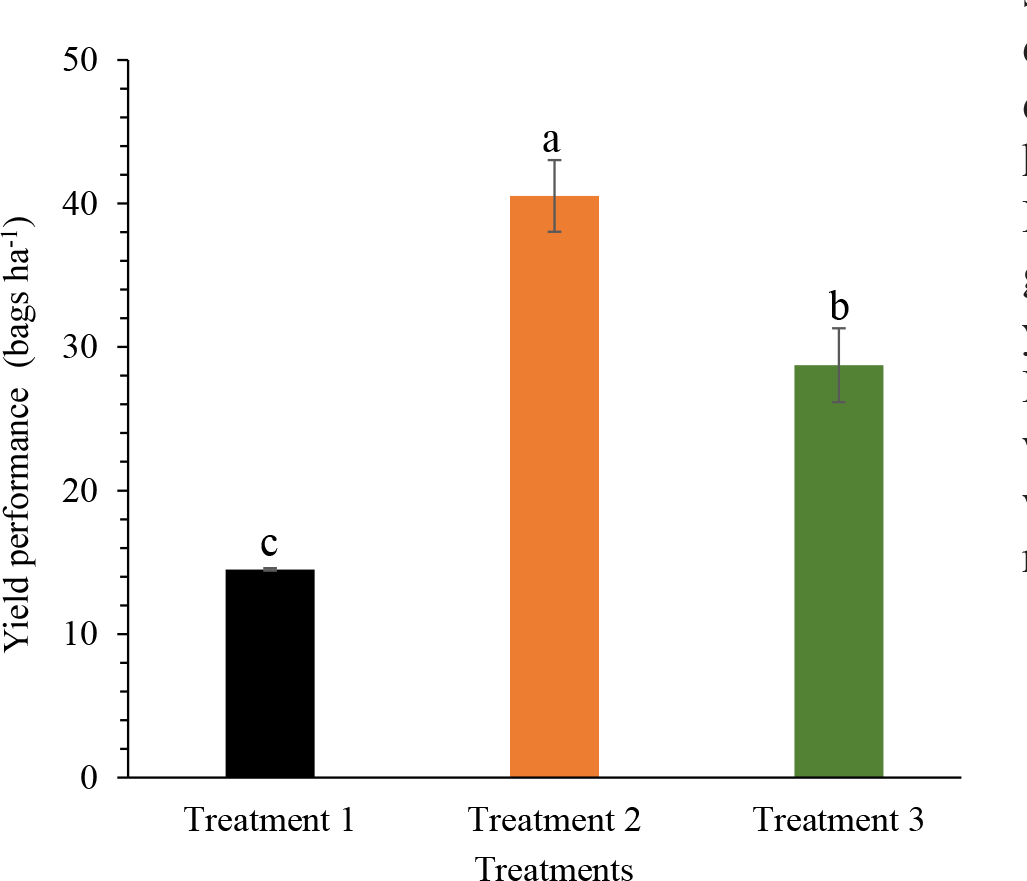
The treatment 2 achieved the highest yield (approximately 40 bags ha-1), differing from the treatment 3, with approximately 30 bags ha-1, and especially from the treatment 1, with approximately 15 bags ha-1 (Figure 4). The integration of climatic and agronomic results demonstrates that the treatment 2, throughout its development cycle, received 69.6 % of the total recorded rainfall (Figure 1). Its higher yield is justified by the fact that the most sensitive phases, from flowering to grain filling, coincided with an accumulated rainfall of approximately 150 mm. This result corroborates Ritchie et al. (2003), who emphasized that maize requires adequate water distribution throughout the entire cycle, with this requirement becoming even more determinant during the critical period comprising flowering and grain filling.

Maize grain yield sown at different dates (treatment 1: 20 days of anticipation; treatment 2: 13 days of anticipation; treatment 3: post soybean). Error bars represent the mean standard error. Means followed by the same lowercase letter in the column do not differ by the Tukey test at 5 % of probability (p < 0.05).
The treatment 1, although established with early sowing and having received the largest share of accumulated rainfall, corresponding to 86.4 %, positioned the critical flowering stage during a period characterized by water deficit, which compromised its productive potential and reduced the estimated yield. According to Westgate & Boyer (1985), the occurrence of water deficit limits the flow of assimilates within the plant, resulting in a marked reduction in the number of grains formed per ear. Similarly, Brito et al. (2013) emphasized that water stress during anthesis and shortly after fertilization may cause pollen abortion and desiccation of the styles and stigmas, even when pollination occurs, since the number of grains is directly dependent on the physiological conditions of the plant during flowering.
For the treatment 3, which was sown after soybean harvest, the productive cycle was concentrated during the transition to the dry period, and initially did not suffer significant impacts from water deficit or high temperatures during the critical flowering stages. However, the abrupt cessation of rainfall during the grain filling period, from R2 to R5, explains its lower yield, in comparison with the treatments 1 and 2. Bergamaschi et al. (2004) reported that, even in years with favorable climatic conditions, the occurrence of water deficit during the critical grain-filling period may result in substantial reductions in crop yield.
CONCLUSIONS
-
1. Advancing sowing by 13 days proved to be an efficient strategy for maximizing the productive performance of second-crop maize, promoting significant increases in grain weight per ear, 1,000-grain weight, and final crop yield;
-
2. The Antecipe system stood out in relation to conventional cultivation, presenting a higher productive efficiency, even in the presence of mechanical damage caused by soybean harvest operations;
-
3. The treatment 3 (sown after soybean harvest), characterized by late sowing, concentrated its reproductive cycle during the transition to the dry period, making it more susceptible to water stress and elevated temperatures, which resulted in lower yield;
-
4. Late sowing of second-crop maize is not recommended for the edaphoclimatic conditions of the eastern Maranhão state, and the Antecipe system represents the most appropriate alternative to reduce climatic risks and optimize regional yield.
ACKNOWLEDGMENTS
The authors would like to thank Jumil - Justino de Morais Irmãos S. A. for the technical support and for providing the seed-fertilizer drill used in the experiment; Fazenda Barbosa for granting access to the experimental area and for the operational support during field activities; Dr. Décio Karam, on behalf of the Empresa Brasileira de Pesquisa Agropecuária (Embrapa), for his technical and scientific contributions related to the Antecipe system; and Universidade Federal do Maranhão (UFMA) for the institutional and academic support that enabled the development of this research.
Data Availability Statement:
Research data are only made available by authors upon request.
REFERENCES
- APARECIDO, L. E. de O.; MENESES, K. C. de; LORENÇONE, P. A.; LORENÇONE, J. A.; MORAES, J. R. da S. C. de; ROLIM, G. de S. Climate classification by Thornthwaite (1948) humidity index in future scenarios for Maranhão state, Brazil. Environment, Development and Sustainability, v. 25, n. 6, p. 855-878, 2022.
- BAGULA, E. M.; MAJALIWA, J. G. M.; BASAMBA, T. A.; MONDO, J. G. M.; VANLAUWE, B.; GABIRI, G.; TUMUHAIRWE, J. B.; MUSHAGALUSA, G. N.; MUSINGUZI, P.; AKELLO, S. Water use efficiency of maize (Zea mays L.) crop under selected soil and water conservation practices along the slope gradient in Ruzizi watershed, eastern D. R. Congo. Land, v. 11, n. 10, e1833, 2022.
- BERGAMASCHI, H.; DALMAGO, G. A.; BERGONCI, J. I.; BIANCHI, C. A. M.; MÜLLER, A. G.; COMIRAN, F.; HECKLER, B. M. M. Distribuição hídrica no período crítico do milho e produção de grãos. Pesquisa Agropecuária Brasileira, v. 39, n. 9, p. 831-839, 2004.
- BONELLI, L. E.; MONZON, J. P.; CERRUDO, A.; RIZZALLI, R. H.; ANDRADE, F. H. Maize grain yield components and source-sink relationship as affected by the delay in sowing date. Field Crops Research, v. 198, n. 11, p. 215-225, 2016.
- BORGHI, E.; KARAM, D.; CORREA, F. C.; FOLONI, J. S. S.; GARCIA, R. A.; GAZZIERO, D. L. P. Recomendações técnicas do conjunto trator-semeadora adubadora para implantação do sistema Antecipe: cultivo intercalar antecipado. Sete Lagoas: Embrapa Milho e Sorgo, 2021. (Comunicado técnico, 253).
- BORGHI, E.; LINDOLFO, M. M.; KARAM, D.; KASUYA, L. H.; SILVA, J. R. O.; LEANDRO JUNIOR, G. de M. Sistema Antecipe: alternativa para o milho segunda safra na região oeste da Bahia. Sete Lagoas: Embrapa Milho e Sorgo, 2023.
-
BRASIL. Ministério da Agricultura e Pecuária. Zoneamento agrícola Available at: https://mapa-indicadores.agricultura.gov.br/publico/extensions/Zarc/Zarc.html Access on: July 1, 2025.
» https://mapa-indicadores.agricultura.gov.br/publico/extensions/Zarc/Zarc.html -
BRASMAX GENÉTICA (BG). Saiba tudo sobre a cultivar Brasmax Domínio IPRO 2020. Available at: https://www.brasmaxgenetica.com.br/blog/soja-brasmax-dominio-ipro/ Access on: June 10, 2025.
» https://www.brasmaxgenetica.com.br/blog/soja-brasmax-dominio-ipro/ - BRITO, M. E. B.; ARAÚJO FILHO, G. D.; WANDERLEY, J. A. C.; MELO, A. S.; COSTA, F. B.; FERREIRA, M. G. P. Crescimento, fisiologia e produção do milho doce sob estresse hídrico. Bioscience Journal, v. 29, n. 5, p. 1244-1254, 2013.
- CAMPOS, G. M.; SANTOS, G. O.; ALIEVI, L. A.; CANTÃO, V. C. G. Mudanças climáticas e seus efeitos sobre a água no solo no cultivo de soja e milho em sucessão no Cerrado. Observatório de la Economía Latinoamericana, v. 22, n. 5, e4833, 2024.
- COMPANHIA NACIONAL DE ABASTECIMENTO (Conab). Acompanhamento da safra brasileira de grãos: décimo segundo levantamento. Brasília, DF: Conab, 2024.
- COMPANHIA NACIONAL DE ABASTECIMENTO (Conab). Acompanhamento da safra brasileira: grãos: safra 2021/2022. Brasília, DF: Conab, 2022.
- CRUZ, J. C.; MAGALHÃES, P. C.; PEREIRA FILHO, I. A.; MOREIRA, J. A. A. Milho: o produtor pergunta, a Embrapa responde. 2. ed. Sete Lagoas: Embrapa Milho e Sorgo, 2013.
- DAVIDE, L. M. C.; PEREIRA, R. C.; ABREU, G. B.; SOUZA, J. C. de; VON PINHO, E. V. de R. Viabilidade de pólen de milho em diferentes períodos de armazenamento em baixa temperatura. Revista Brasileira de Milho e Sorgo, v. 8, n. 2, p. 199-206, 2009.
- DJAMAN, K.; O’NEILL, M.; OWEN, C. K.; SMEAL, D.; KOUDAHE, K.; WEST, M.; ALLEN, S.; LOMBARD, K.; IRMAK, S. Crop evapotranspiration, irrigation water requirement and water productivity of maize from meteorological data under semiarid climate. Water, v. 10, n. 4, e405, 2018.
- EMPRESA BRASILEIRA DE PESQUISA AGROPECUÁRIA (Embrapa). Sistema Antecipe: antecipação da semeadura do milho segunda safra. Sete Lagoas: Embrapa Milho e Sorgo, 2020.
- IUSS WORKING GROUP WRB. World reference base for soil resources: international soil classification system for naming soils and creating legends for soil maps. 4. ed. Vienna: IUSS, 2022.
- JIN, X.; FU, Z.; DING, D.; LI, W.; LIU, Z.; TANG, J. Proteomic identification of genes associated with maize grain-filling rate. PLoS One, v. 8, n. 3, e59353, 2013.
- KARAM, D.; BORGHI, E.; MAGALHÃES, P. C.; PAES, M. C. D.; PEREIRA FILHO, I. A.; MANTOVANI, E. C.; SOUZA, T. C. de; ADEGAS, F. S. Antecipe: cultivo intercalar antecipado. Brasília, DF: Embrapa, 2020.
- KHAEIM, H. M.; KENDE, Z.; JOLÁNKAI, M.; KOVÁCS, G. P.; GYURICZA, C.; TARNAWA, Á. Impact of temperature and water on seed germination and seedling growth of maize (Zea mays L.). Agronomy, v. 12, n. 2, e397, 2022.
- MAGALHÃES, P. C.; DURÃES, F. O. M.; CARNEIRO, N. P.; PAIVA, E. Fisiologia do milho Sete Lagoas: Embrapa Milho e Sorgo, 2002.
- MIRANDA, G. V.; BRAUN, E. M. W.; ALVES, M. E. V. B.; MACHADO, P.; RAMOS, A. de M. Desempenho de híbridos de milho em diferentes épocas de semeadura na segunda safra em baixa altitude no extremo oeste do estado do Paraná. Brazilian Journal of Development, v. 7, n. 4, p. 34794-34810, 2021.
- NIELSEN, R. L. Corny growing points of interest West Lafayette: Purdue University, 2019.
- NUNES, M. R.; DE, M.; MCDANIEL, M. D.; KOVAR, J. L.; BIRRELL, S.; KARLEN, D. L. Science-based maize stover removal can be sustainable. Agronomy Journal, v. 113, n. 4, p. 3178-3192, 2021.
- OLIVEIRA, V. A.; LUMBRERAS, J. F.; SILVA, M. B.; COELHO, M. R.; ALMEIDA, J. A.; ARAUJO FILHO, J. C.; MENDONÇA-SANTOS, M. L.; MOURA-BUENO, J. M.; SANTIAGO, C. M. Solos da XIII Reunião Brasileira de Classificação e Correlação de Solos (RCC do Maranhão). In: SILVA, M. B.; LUMBRERAS, J. F.; COELHO, M. R.; OLIVEIRA, V. A. de. (Org.). Guia de campo da XIII Reunião Brasileira de Classificação e Correlação de Solos: RCC do Maranhão. Rio de Janeiro: Embrapa, 2020. p. 755.
- POERSCH, A. H. et al. Exigências climáticas. In: PILECCO, I. B. et al. Ecofisiologia do milho: visando altas produtividades. 2. ed. Santa Maria: GR, 2024. p. 131-178.
- RICCHETTI, J. E.; CECCON, G. Viabilidade econômica da cultura do milho safrinha em Mato Grosso do Sul Durados: Embrapa Agropecuária Oeste, 2020.
- RITCHIE, S. W.; HANWAY, J. J.; BENSON, G. O. Como a planta do milho se desenvolve Piracicaba: Potafos, 2003.
- SANTOS, H. G.; JACOMINE, P. K. T.; ANJOS, L. H. C.; OLIVEIRA, V. A.; LUMBRERAS, J. F.; COELHO, M. R.; ALMEIDA, J. A.; ARAÚJO FILHO, J. C.; OLIVEIRA, J. B.; CUNHA, T. J. F. Sistema brasileiro de classificação de solos 5. ed. rev. ampl. Brasília, DF: Embrapa, 2018.
- SIMÃO, E. P.; RESENDE, A. V.; GONTIJO NETO, M. M.; BORGHI, E.; VANIN, A. Resposta do milho safrinha à adubação em diferentes épocas de semeadura. Revista Brasileira de Milho e Sorgo, v. 17, n. 1, p. 76-90, 2018.
- SIQUEIRA, G. N. de; TIECHER, T. L.; ALVES, L. A.; TASSINARI, A.; GRANDO, D. L.; DRESCHER, G. L.; BRUNETTO, G.; GOULART, R. Z.; BORDIGNON, V.; TIECHER, T. Short-term effects of winter cover crops and summer cash crops on soil properties in Ultisol under no-tillage system in Southern Brazil. Geoderma Regional, v. 40, e00935, 2025.
- SOUSA, A. M. de; CORRÊA, W. C.; MEDEIROS, A. de S.; GUERRA FILHO, P. A.; CARVALHO, M. W. L.; MACHADO, N. A. F. Variabilidade espaço-temporal das chuvas em função de índices climáticos na mesorregião leste do Maranhão, Brasil. Revista Brasileira de Geografia Física, v. 18, n. 3, p. 1645-1662, 2025.
-
SYNGENTA BRASIL (SB). Fórmula Viptera 2: produtividade e estabilidade com o melhor custo-benefício do mercado. 2021. Available at: https://portal.syngenta.com.br/sementes/nk-milho/formula-viptera-2 Access on: June 10, 2025.
» https://portal.syngenta.com.br/sementes/nk-milho/formula-viptera-2 - TURA, E. F. et al. Época de semeadura. In: PILECCO, I. B. et al. Ecofisiologia do milho: visando altas produtividades. 2. ed. Santa Maria: GR, 2024. p. 233-272.
- UNITED STATES DEPARTMENT OF AGRICULTURE (USDA). World agricultural production Washington, DC: USDA, 2025.
- WESTGATE, M. E.; BOYER, J. S. Carbohydrate reserves and reproductive development at low leaf water potentials in maize. Crop Science, v. 25, n. 5, p. 762-769, 1985.
-
Editor:
Luis Carlos Cunha Junior