 Essential oils on germination, physiological quality, and enzymatic activity of bean seeds
Abstract
The objective of this study was to evaluate the effects of essential oils from Thymus vulgaris (thyme) and Cymbopogon citratus (cymb oil) on the germination, physiological quality and enzymatic activities of common bean seeds. The oils were tested at different concentrations (0, 1, 3, and 5 mL kg-1), and effects were assessed through germination, and seedling emergence tests. In addition, the levels of chlorophylls, carotenoids, phenolic compounds, and activities of esterase and acid phosphatase enzymes were evaluated. Cymb oil inhibited germination at higher concentrations, with a germination rate of 66% at 5 mL kg-1, whereas thyme oil, at the highest dose, reduced root dry mass (0.12 g per seedling). At lower concentrations, thyme oil promoted higher chlorophyll contents than cymb oil. Furthermore, enzymatic analysis indicated an increase in acid phosphatase and esterase activities in seeds treated with cymb oil, suggesting distinct physiological responses. Overall, thyme oil at 1 mL kg-1 improved seedling growth and pigment contents, while higher doses impaired seed performance. In contrast, cymb oil at 1-3 mL kg-1 enhanced shoot length, root dry mass, and enzymatic activities, but inhibited germination at 5 mL kg-1.
Index terms:
Cymbopogon citratus; Phaseolus vulgaris; Thymus vulgaris; enzymes; seed quality; vigor.
Resumo
O objetivo deste trabalho foi avaliar os efeitos dos óleos essenciais de Thymus vulgaris (tomilho) e Cymbopogon citratus (capim-limão) na germinação, qualidade fisiológica e atividade enzimática de sementes de feijão. Os óleos foram testados em diferentes concentrações (0, 1, 3 e 5 mL kg-1) e analisados pelos testes de germinação e emergência. Além disso, os teores de clorofilas, carotenoides, compostos fenólicos e a atividade das enzimas esterase e fosfatase ácida foram avaliados. O óleo de capim-limão inibiu a germinação em altas concentrações, com uma taxa de 66% na dose de 5 mL kg-1, enquanto o óleo de tomilho, na maior concentração, reduziu a massa seca da raiz (0,12 g por plântula). Em concentrações mais baixas, o óleo de tomilho favoreceu maiores teores de clorofilas em comparação ao capim-limão. A análise enzimática revelou que o óleo de capim-limão aumentou a atividade de fosfatase ácida e esterase, indicando respostas fisiológicas distintas. O óleo de tomilho, nas doses de 1 mL kg-1, melhorou o crescimento das plântulas e os teores de pigmentos, enquanto doses mais altas prejudicaram o desempenho das sementes. Em contraste, o óleo de capim-limão, nas doses de 1-3 mL kg-1, aumentou o comprimento da parte aérea, a massa seca da raiz e as atividades enzimáticas, mas inibiu a germinação na dose de 5 mL kg-1.
Termos para indexação:
Cymbopogon citratus; Phaseolus vulgaris; Thymus vulgaris; enzimas; qualidade de semente; vigor.
Introduction
In recent years, research on natural alternatives to enhance seed physiological quality has gained increasing attention. A promising approach involves the use of essential oils, which have bioactive properties that can promote germination and enhance resistance to both biotic and abiotic stresses (Ben-Jabeur et al., 2019; Zheljazkov et al., 2021; Paul et al., 2022). Essential oils contain a diverse array of secondary metabolites with pesticidal potential and the ability to modulate physiological processes in seeds, depending on the species and concentration applied (Ben-Jabeur et al., 2019; Nikolova et al., 2025).
Among essential oils with potential applications in agriculture, species from the genera Thymus and Cymbopogon stand out for their plant growth-regulating effects, as well as their antimicrobial and allelopathic properties (Sunmonu et al., 2018; Ben-Jabeur et al., 2019; Oladeji et al., 2019; Khasanah et al., 2025). Thyme oil (Thymus vulgaris L.), which is rich in thymol, exhibits beneficial properties and low toxicity (Escobar et al., 2020; Niksic et al., 2021). In contrast, Cymbopogon citratus (DC.) Stapf, commonly known as lemongrass, contains citral and geraniol (Cherif et al., 2025; Khasanah et al., 2025). These oils can influence biochemical processes in seeds by modulating enzymatic activity and photosynthetic pigment content, as well as affecting seed germination and emergence (Sunmonu et al., 2018; Ben-Jabeur et al., 2019). The magnitude of these effects, however, depends on the concentration applied and the seed’s sensitivity to the treatment.
Seed germination is a complex process, influenced by both internal and external factors, which affect the mobilization of reserves and the activation of essential enzymes required for the initial growth of seedlings (Carrera-Castaño et al., 2020). Acid phosphatases, mainly phytases, and esterases are enzymes frequently associated with nutrient mobilization and energy metabolism during seed germination (Aparato & Suh, 2022; Bhadouria & Giri, 2022; Shen et al., 2022; Sommer et al., 2024). The modulation of these enzymes by bioactive compounds can provide insights into the physiological and biochemical processes involved in seed responses to priming with essential oils.
In addition to enzymatic activities, photosynthetic pigments play a crucial role in seedling establishment, influencing the plant’s capacity to convert light energy into carbohydrates. The regulation of chlorophyll and carotenoids can be influenced by various factors, including certain essential oils, which can modulate their synthesis or degradation (Ben-Jabeur et al., 2019; Oğuz et al., 2023), thereby affecting plant development.
In this context, the application of essential oils to seeds can influence key physiological processes. Common bean (Phaseolus vulgaris L.) is an important crop of high agronomic and nutritional value, but it is highly sensitive to environmental stresses, pests, and pathogens. This sensitivity makes bean seeds particularly suitable for evaluating the potential phytotoxic or stimulatory effects of essential oils. Furthermore, compared with other crops, there are still relatively few studies addressing the biochemical and physiological responses of bean seeds to essential oil treatments.
The objective of this work was to evaluate the effects of essential oils from Thymus vulgaris and Cymbopogon citratus on the physiological quality and enzymatic activities of common bean (Phaseolus vulgaris) seeds.
Materials and Methods
Seeds of the common bean (P. vulgaris) ‘Esplendor’ were treated with essential oils from cymb (C. citratus) and thyme (T. vulgaris) at concentrations of 0, 1, 3, and 5 mL kg-1 of seeds.
The plants used for essential oil extraction were cultivated in the municipality of Chapecó, state of Santa Catarina, Brazil. After harvest, the plant material was dried in a forced-air oven at 45°C, and the essential oils were extracted by hydrodistillation using a Clevenger-type apparatus, as described by Santos et al. (2004). The identification of the chemical components present in the oil was carried out by gas chromatography (GC) using a GC-FID 6890N system (Agilent Technologies, Santa Clara, CA, USA), equipped with a DB-5 capillary column (30 m × 0.32 mm; 0.50 mm) and connected to a flame ionization detector (FID). For gas chromatography-mass spectrometry (GC-MS) analyses, an AutoSystem XL GC-MS system (Agilent Technologies) was used, operating in electron ionization (EI) mode at 70 eV and equipped with a split/splitless injector set at 220°C. The relative amounts of individual components were calculated based on peak areas obtained from GC analyses (Boligon et al., 2013).
After oil extraction, the bean seeds were treated with the essential oils at concentrations of 0, 1, 3, and 5 mL kg-1 of seeds for 24 hours at room temperature before the germination test, using four replicates of 50 seeds each.
The germination test was conducted with three sheets of Germitest paper. The samples were maintained in a BOD-type germination chamber at a constant temperature of 25°C. Germination was assessed seven days after sowing, and the results were expressed as the percentage of normal seedlings (Brasil, 2009). Afterwards, seedlings’ shoots and roots were obtained from the germination test nine days after sowing, using four replicates of ten seedlings. For dry mass determination, the seedlings were placed in brown paper envelopes and dried in a forced-air oven at 70°C for 72 hours.
In the emergence test, samples of 50 seeds, previously kept in contact with the different concentrations of essential oils, were sown in polyethylene trays containing Planosol soil as substrate and maintained in a greenhouse. After sowing, the soil was moistened and remoistened whenever necessary. Seedling emergence was evaluated on the 21st day after sowing, and the results were expressed as the percentage of normal seedlings.
The determination of photosynthetic pigments was performed on fully expanded young leaves following the method proposed by Wellburn (1994). The leaves were collected at the V1 stage and immediately placed in an ice bath inside a polypropylene container. Initially, leaves were cut into small segments, discarding the central vein, and four replications of 0.02 g from each sample were weighed and placed into a test tube containing 7 mL of dimethyl sulfoxide (DMSO) neutralized with 5% calcium carbonate. The tubes were then incubated in a water bath at 65°C for 1 hour in the absence of light. After incubation, the tubes were cooled in the dark until they reached room temperature, and absorbance readings were taken at 480 nm, 649 nm, and 665 nm using a spectrophotometer (model SP-22, Biospectro, Curitiba, PR, Brazil). Chlorophyll a, chlorophyll b, total chlorophyll, and carotenoid contents were calculated using the following equations:
Chlorophyll a = (12.47 × A665) - (3.62 × A649)
Chlorophyll b = (25.06 × A649) - (6.50 × A665)
Total chlorophyll = chlorophyll a + chlorophyll b
Carotenoids = [(1,000 × A480) - (1.29 × chlorophyll a) - (53.78 × chlorophyll b)] / 220
The results were expressed in mg g-1 fresh mass (FM).
The extraction of phenolic compounds was performed following the method described by Bieleski & Turner (1966). Quantification was conducted using aliquots of the aqueous extract, to which 500 μL of 1 N Folin-Ciocalteu reagent was added, followed by vortex agitation. After 15 minutes at room temperature, 5 mL of 0.1 N alkaline reagent (a solution of sodium carbonate and sodium hydroxide) was added and vortexed again. After 60 minutes at room temperature, absorbance readings of the samples and phenolic acid standards (0-200 μg) were obtained using a spectrophotometer at 760 nm. The results were expressed in μg g-1 fresh mass (FM).
The expression of the isoenzymes esterase and acid phosphatase was assessed using vertical polyacrylamide gel electrophoresis. For this purpose, the seedlings were individually macerated in a porcelain mortar in an ice bath. Subsequently, four replications of 200 mg from each sample were transferred to microcentrifuge tubes and mixed with an extraction solution (0.2 M lithium borate at pH 8.3 + 0.2 M Tris-citrate at pH 8.3 + 0.15% 2-mercaptoethanol) at a 1:2 (w/v) ratio, following the methodology described by Malone et al. (2007).
Electrophoresis was performed on 7% polyacry-lamide gels, with 20 µL of each sample applied based on prior testing. The gels were placed in vertical electrophoretic chambers (Bio-Rad PowerPac Basic, Hercules, CA, USA) maintained in a cold chamber at a temperature between 4 and 6°C. Electrophoretic migration was carried out with a voltage gradient of 10 V cm-1 until the bromophenol blue front reached 9 cm from the application point. The staining systems used were those described by Scandálios (1969) and Alfenas (1998). Interpretation of the results was based on the visual analysis of the electrophoresis gels, considering the presence or absence of bands, and on the quantification of the bands performed using the Gel-Pro Analyzer 3.1 software (Media Cybernetics, Rockville, MD, USA).
The experimental design was completely randomized, following a 2 × 4 factorial scheme (two essential oils and four doses) with four replicates each. Initially, the data were subjected to a residual normality test using the Shapiro-Wilk’s test. The variables were then subjected to analysis of variance (ANOVA), and when significant effects were detected, polynomial regression analyses were performed to evaluate the relationship between the variables and the essential oil concentrations.
In addition, partial least squares regression (PLS-R) was performed to evaluate the multivariate relationships between biochemical markers and physiological seed performance. For this analysis, the predictor variables were standardized, while the response variables were kept on their original scale. The model was validated by cross-validation, and its performance was assessed based on the variance explained, root mean square error of prediction (RMSEP), variable importance in projection (VIP) scores, and graphical representation by biplots of scores and loadings. Statistical analyses were performed in the R software (R Core Team, 2024), using the pls package (Mevik & Wehrens, 2007).
Results and Discussion
In the essential oil of cymb, the major components identified were (-)-β-pinene, linalool, (S)-cis-verbenol, cis-verbenol, β-citral, geraniol, α-citral, 3,7-nonadien-2-one, and 4,8-dimethyl-7-methyl-Z-tetradecen-1-ol acetate, accounting for 96.63% of the total oil composition. Among these, citral was the predominant component, representing 79.61% of the total, divided into two isomers: β-citral (42.47%) and α-citral (37.14%). In the essential oil of thyme, the main constituents were thymol (60.45%), p-cymene (19.58%), γ-terpinene (4.12%), carvacrol (3.08%), and β-caryophyllene (2.40%). The high citral content in cymb oil is noteworthy, as citral is recognized for its strong allelopathic and phytotoxic effects, which can inhibit seed germination and alter metabolic processes (Graña et al., 2013). In contrast, the predominance of thymol in thyme oil is associated with lower phytotoxicity and potential protective effects on seeds (Ben-Jabeur et al., 2019; Dobreva et al., 2024).
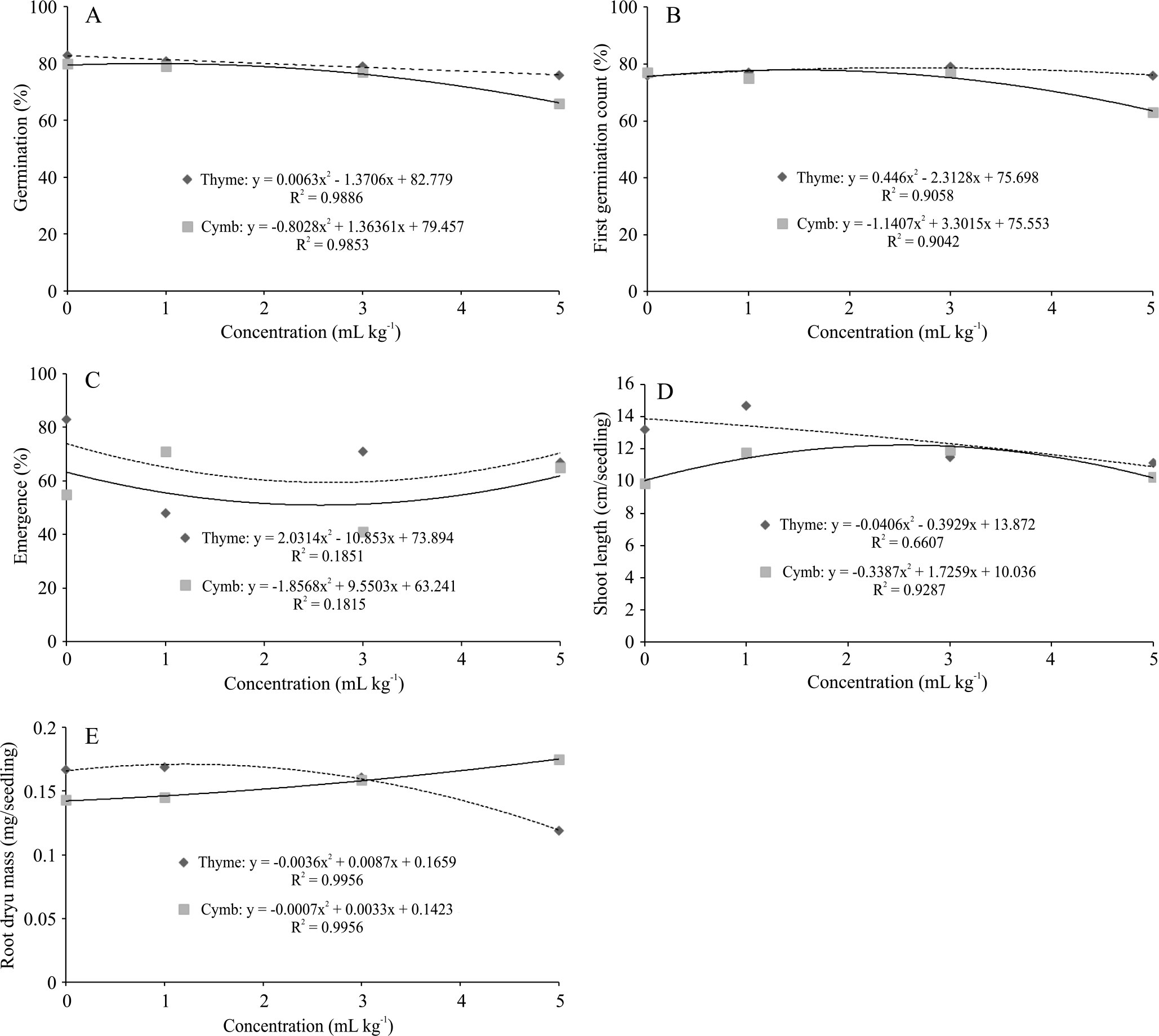
The essential oil of thyme did not affect seed germination at any tested concentration. In contrast, the application of cymb essential oil at 5 mL kg-1 resulted in lower germination (66%) (Figure 1 A). Similar results were observed for the first germination count for both essential oils (Figure 1 B). Regarding seedling emergence, the control treatment (0 mL kg-1) exhibited the highest emergence (83%). In contrast, for cymb, the highest emergence was observed at 1 mL kg-1 and 5 mL kg-1 (Figure 1 C).

Germination (A), first germination count (B), seedling emergence (C), shoot length (D), and root dry mass (E) of bean (Phaseolus vulgaris) seeds treated with 0, 1, 3, and 5 mL kg-1 of the thyme (Thymus vulgaris) and cymb (Cymbopogon citratus) essential oils.
The essential oils of cymb exhibited interactions that affected the germination of bean seeds, reflecting the allelopathic potential of these compounds on the physiological responses of seedlings depending on the tested doses. In contrast, thyme oil did not affect germination or the first count at any of the tested concentrations. This suggests that thyme oil has a less phytotoxic composition at moderate doses. A study by Dobreva et al. (2024) found that thymol, the main component of thyme, has less pronounced inhibitory effects compared to the compounds present in cymb.
In the analysis of shoot length and root dry mass, treatment with thyme essential oil resulted in higher values at 1 mL kg-1 than at 5 mL kg-1 (Figure 1 D) for shoot length, and lower values for root dry mass at 5 mL kg-1 (Figure 1 E). This suggests that thyme essential oil may have a dose-dependent effect on seedling growth, where lower concentrations promote shoot elongation and root biomass accumulation. At the dose of 5 mL kg-1 of thyme, a decrease in root dry mass may indicate a potential phytotoxic effect, likely caused by an excessive accumulation of certain compounds, which can interfere with metabolic pathways related to root development. This response is likely associated with the high thymol content in thyme oil, which can act as a biostimulant at low doses, and increased root and shoot development, chlorophylls, nitrogen balance index, abscisic acid, anthocyanins and flavonoids in leaves, as reported in wheat seeds (Ben-Jabeur et al., 2019). Therefore, the chemical composition of thyme oil is crucial in determining its impact on seed physiological quality, highlighting the importance of optimizing application rates to maximize benefits and minimize adverse effects on seedling development.
Regarding the analysis of pigments extracted from the seedlings, plants treated with thyme oil exhibited higher levels of chlorophyll a and of total chlorophyll at doses of 0, 1, and 3 mL kg-1 (Figure 2). However, at 5 mL kg-1, a reduction was observed for chlorophyll a, reaching 0.73 mg g-1 FM (Figure 2 A). The reduction in chlorophyll levels caused by thyme oil may compromise photosynthetic efficiency, leading to lower root dry mass production (Figure 1 E). This effect may be associated with changes in gene expression within the chlorophyll biosynthesis pathway, resulting in reduced enzymatic activity, as previously reported for other factors (Li et al., 2024).

Chlorophyll a (A), chlorophyll b (B), total chlorophyll (C), and carotenoids (D) in seedlings at the end of the germination test of bean (Phaseolus vulgaris) seeds treated with 0, 1, 3, and 5 mL kg-1 of the thyme (Thymus vulgaris) and cymb (Cymbopogon citratus) essential oils.
In the leaves, the highest phenolic concentration was observed at the 0 mL kg-1 concentration, reaching 0.57 mg g-1 FM (Figure 3 A). A more pronounced reduction was observed in cymb oil at 5 mL kg-1, where phenolic content dropped to 0.13 mg g-1 FM. Similarly, in the roots, the 0 mL kg-1 dose resulted in the highest concentration, reaching 0.28 mg g-1 FM (Figure 3 B).

Phenolic content in leaves (A) and roots (B) of seedlings at the end of the germination test of bean (Phaseolus vulgaris) seeds treated with 0, 1, 3, and 5 mL kg-1 of the thyme (Thymus vulgaris) and cymb (Cymbopogon citratus) essential oils.
The reduction in total phenol levels in the leaves and roots caused by thyme oil may be related to the inhibition of biosynthetic pathways, such as the shikimic acid and acetate-malonate pathways, due to the interaction of its bioactive compounds with key enzymes, such as phenylalanine ammonia-lyase and chalcone synthase (Cheynier et al., 2013; Zagoskina et al., 2023). Furthermore, at higher concentrations, essential oils are likely to suppress phenolic compound synthesis by reducing the activity of biosynthetic enzymes like phenylalanine ammonia-lyase, while simultaneously increasing the activity of other enzymes, such as acid phosphatases (Figure 4 A).

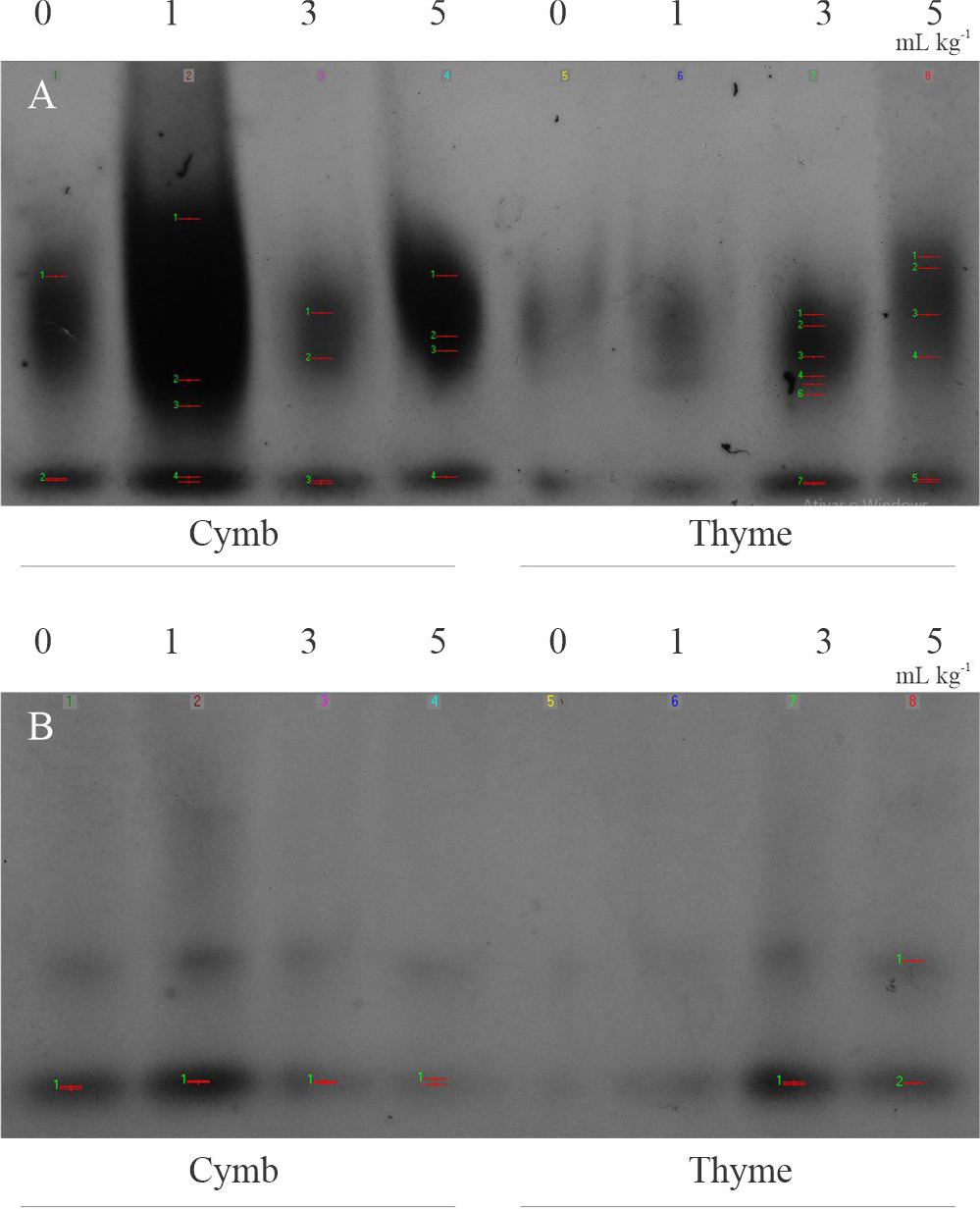
Activity of phosphatase (A) and esterase (B) in bean (Phaseolus vulgaris) seedlings treated with 0, 1, 3, and 5 mL kg-1 of the thyme (Thymus vulgaris) and cymb (Cymbopogon citratus) essential oils.
In agreement with these results, other studies highlight that phenolic compounds play a crucial role as natural stress alleviators, acting not only as direct antioxidants but also as modulators of signaling pathways that regulate plant defense responses (Saini et al., 2024). Thus, their reduction may weaken both antioxidant capacity and stress signaling, making seedlings more vulnerable to oxidative damage. This could explain the trade-off observed between decreased phenolic content (Figure 3) and increased phosphatase activity (Figure 4 A), as plants may reallocate metabolic resources to enzymatic mechanisms to sustain essential functions. Similar effects have been reported in wheat, where essential oils acted as metabolic disruptors, suppressing phenylpropanoid biosynthesis while enhancing enzymatic responses linked to stress adaptation (Ben-Jabeur et al., 2019).
The analysis of electrophoresis gels revealed that treatments with cymb and thyme essential oils induced significant alterations in the enzymatic activity patterns of acid phosphatase and esterase in seeds. Overall, the treatment with 1 mL kg-1 of cymb resulted in more intense bands for acid phosphatase and esterase, whereas thyme oil showed more intense bands at concentrations of 3 and 5 mL kg-1 (Figure 4).
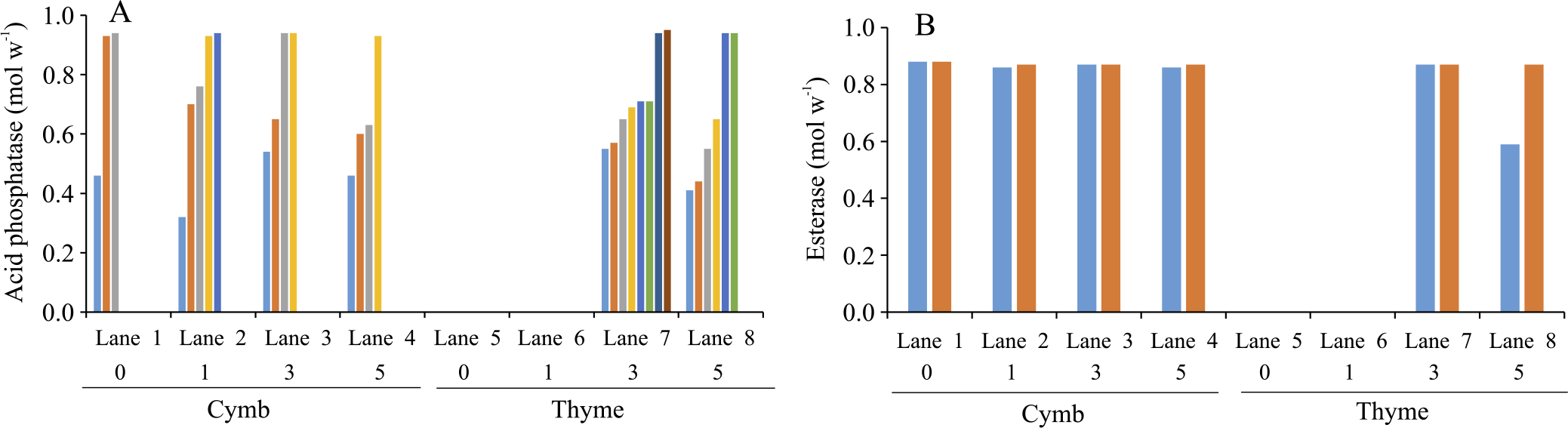
For acid phosphatase, the use of cymb oil resulted in two bands with approximate molecular weights of 0.94 and 0.6 mol w-1. In contrast, thyme oil exhibited molecular weights ranging from 0.41 to 0.95 mol w-1, but only when seeds were treated with doses of 3 and 5 mL kg-1 (Figure 5 A).

Molecular mass profiles of the acid phosphatase (A) and esterase (B) enzymes in bean (Phaseolus vulgaris) seedlings treated with 0, 1, 3, and 5 mL kg-1 of the thyme (Thymus vulgaris) and cymb (Cymbopogon citratus) essential oils. Different treatments are represented by lanes 1 to 8. Electrophoresis was performed on 7% polyacrylamide gels, with the application of 20 μL of each sample, based on prior testing.
Esterases could be modulated through direct interactions with the lipophilic components of the oils, which may alter cellular metabolism and redirect metabolic resources toward defense or adaptation mechanisms (Shen et al., 2022). In seeds, esterases play a central role in lipid reserve mobilization by hydrolyzing ester bonds, while acid phosphatases are involved in the hydrolysis of organic phosphate esters, releasing inorganic phosphate essential for energy metabolism and nucleic acid synthesis during germination (Prazeres et al., 2004; Sharma et al., 2023). In this study, cymb oil promoted more intense acid phosphatase and esterase bands, particularly at 1 mL kg-1, suggesting an upregulation of these enzymes associated with reserve mobilization and early metabolic processes required for seedling establishment.
In the PLS-R analysis, the first two components explained 81.3% of the total variation, separating the treatments with cymb and thyme essential oils (Figure 6). To refine the model, variables with low contribution (VIP < 1), including pigments (chlorophylls and carotenoids), were excluded, and the analysis was focused on phenolic compounds and enzymatic activity. Cymb treatments clustered in association with esterase and acid phosphatase, consistent with the biochemical assay that revealed stronger enzymatic activity, particularly at 1 mL kg-1, corroborating previous results where all cymb treatments exhibited molecular weights, with greater enzyme intensity at 1 mL kg-1 (Figure 5). In contrast, thyme treatments were more related to phenolic accumulation in leaves and roots, reflecting their role in maintaining seedling vigor and growth parameters.
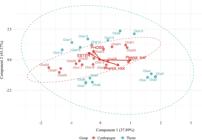
Partial least squares regression (PLS-R) biplot of the responses of bean (Phaseolus vulgaris) seedlings to treatments with the thyme (Thymus vulgaris) (blue points) and cymb (Cymbopogon citratus) (red points) essential oils, based on physiological and biochemical parameters. Component 1 explains 37.89% of the total variation and component 2, 43.37%, totaling 81.26% of the explained variance. Arrows represent the loading vectors of the analyzed variables. Acid phosphatase (PHOSP) and esterase (ESTER) are predominantly associated with cymb treatments, whereas phenolic compounds in leaves (Phenol_leaf) and roots (Phenol_root) are more related to thyme treatments.
Thus, thyme and cymb essential oils have different influences on seed germination and metabolic responses, likely due to their distinct chemical compositions. While thyme oil did not impair germination, its higher concentration was associated with reductions in shoot length, root dry mass and chlorophyll content, indicating a possible interference with pigment biosynthesis and energy allocation. In contrast, cymb oil, particularly at 5 mL kg-1, significantly inhibited germination, likely due to the high citral content, which is known for its allelopathic effects (Graña et al., 2013). The reduction in total phenolic compounds observed in both oils suggests a suppression of biosynthetic pathways, which could influence the antioxidant system and plant metabolism. Additionally, the increased phosphatase and esterase activities indicate alterations in nutrient mobilization and metabolic regulation, particularly in response to cymb oil. This highlights the importance of precisely adjusting essential oil concentrations in seed treatments to maximize benefits while minimizing potential negative effects.
Conclusions
-
1. Essential oils from thyme (Thymus vulgaris) and cymb (Cymbopogon citratus) exert distinct and dose-dependent effects on the physiological quality and enzymatic activity of common bean seeds.
-
2. Thyme oil at 1 mL kg-1 enhances seedling growth and pigment contents, whereas higher doses (5 mL kg-1) reduce seed performance.
-
3. Cymb oil at 1 and 3 mL kg-1 enhances shoot length and root dry mass, associated with increased chlorophyll a and b, phenolic compounds, and higher phosphatase and esterase activities. However, at 5 mL kg-1, cymb oil inhibits germination.
Acknowledgments
To Fundação de Amparo a Pesquisa do Estado do Rio Grande do Sul (FAPERGS), for financial support (Programa de Apoio à Fixação de Jovens Doutores no Brasil - Processo nº 23/2551-0001939-6).
Disclaimer/Publisher’s note
The statements, opinions, and data contained in all texts published in Pesquisa Agropecuária Brasileira (PAB) are solely those of the individual author(s) and not of the journal’s publisher, editor, and editorial team, who disclaim responsibility for any injury to people or property resulting from any referred ideas, methods, instructions, or products.
The mention of specific chemical products, machines, and commercial equipment in the texts published in this journal does not imply their recommendation by the publisher.
Declaration of use of AI technologies
During the preparation of this work, the author(s) used ChatGPT (OpenAI) in order to assist with the English language revision and improvement of grammar and readability. After this use, the author(s) reviewed and edited the content as needed and take full responsibility for it.
Data availability statement
Data available upon request: research data are only available upon reasonable request to the corresponding author.
References
- ALFENAS, A.C. (Ed.). Eletroforese de isoenzimas e proteínas afins: fundamentos e aplicações em plantas e microrganismos. Viçosa: UFV, 1998. 574p.
-
APARATO, V.P.M.; SUH, D.-Y. The functions and applications of GDSL esterase/lipase proteins in agriculture: a review. JSFA Reports, v.2, p.304-312, 2022. DOI: https://doi.org/10.1002/jsf2.70
» https://doi.org/10.1002/jsf2.70 -
BEN-JABEUR, M.; VICENTE, R.; LÓPEZ-CRISTOFFANINI, C.; ALESAMI, N.; DJÉBALI, N.; GRACIA-ROMERO, A.; SERRET, M.D.; LÓPEZ-CARBONELL, M.; ARAUS, J.L.; HAMADA, W. A novel aspect of essential oils: coating seeds with thyme essential oil induces drought resistance in wheat. Plants, v.8, art.371, 2019. DOI: https://doi.org/10.3390/plants8100371
» https://doi.org/10.3390/plants8100371 -
BHADOURIA, J.; GIRI, J. Purple acid phosphatases: roles in phosphate utilization and new emerging functions. Plant Cell Reports, v.41, p.33-51, 2022. DOI: https://doi.org/10.1007/s00299-021-02773-7
» https://doi.org/10.1007/s00299-021-02773-7 -
BIELESKI, R.L.; TURNER, N.A.; Separation and estimation of amino acids in crude plant extracts by thin-layer electrophoresis and chomatograghy. Analytical Biochemistry, v.17, p.278-293, 1966. DOI: https://doi.org/10.1016/0003-2697(66)90206-5
» https://doi.org/10.1016/0003-2697(66)90206-5 -
BOLIGON, A.A.; SCHWANZ, T.G.; PIANA, M.; BANDEIRA, R.V.; FROHLICH, J.K.; BRUM, T.F. de; ZADRA, M.; ATHAYDE, M.L. Chemical composition and antioxidant activity of the essential oil of Tabernaemontana catharinensis A. DC. leaves. Natural Product Research, v.27, p.68-71, 2013. DOI: https://doi.org/10.1080/14786419.2011.653971
» https://doi.org/10.1080/14786419.2011.653971 - BRASIL. Secretaria de Defesa Agropecuária. Regras para análise de sementes Brasília: MAPA/ACS, 2009.
-
CARRERA-CASTAÑO, G.; CALLEJA-CABRERA, J.; PERNAS, M.; GÓMEZ, L.; OÑATE-SÁNCHEZ, L. An updated overview on the regulation of seed germination. Plants, v.9, art.703, 2020. DOI: https://doi.org/10.3390/plants9060703
» https://doi.org/10.3390/plants9060703 -
CHERIF, A.; MANSOUR, R.; NCIBI, S.; HACHED, W.; GRISSA-LEBDI, K. Chemical composition and fumigant toxicity of five essential oils toward Tuta absoluta and its mirid predator Macrolophus pygmaeus Journal of Plant Diseases and Protection, v.132, art.34, 2025. DOI: https://doi.org/10.1007/s41348-024-01030-9
» https://doi.org/10.1007/s41348-024-01030-9 -
CHEYNIER, V.; COMTE, G.; DAVIES, K.M.; LATTANZIO, V.; MARTENS, S. Plant phenolics: recent advances on their biosynthesis, genetics, and ecophysiology. Plant Physiology and Biochemistry, v.72, p.1-20, 2013. DOI: https://doi.org/10.1016/j.plaphy.2013.05.009
» https://doi.org/10.1016/j.plaphy.2013.05.009 -
DOBREVA, K.; DIMOV, M.; VALEV, T.; ILIEV, I.; DAMYANOVA, S.; OPREA, O.B.; STOYANOVA, A. Chemical composition and antioxidant activities of three Bulgarian garden thyme essential oils. Applied Sciences, v.14, art.10261, 2024. DOI: https://doi.org/10.3390/app142210261
» https://doi.org/10.3390/app142210261 -
ESCOBAR, A.; PÉREZ, M.; ROMANELLI, G.; BLUSTEIN, G. Thymol bioactivity: a review focusing on practical applications. Arabian Journal of Chemistry, v.13, p.9243-9269, 2020. DOI: https://doi.org/10.1016/j.arabjc.2020.11.009
» https://doi.org/10.1016/j.arabjc.2020.11.009 -
GRAÑA, E.; SOTELO, T.; DÍAZ-TIELAS, C.; REIGOSA, M.J.; SÁNCHEZ-MOREIRAS, A.M. The phytotoxic potential of the terpenoid citral on seedlings and adult plants. Weed Science, v.61, p.469-481, 2013. DOI: https://doi.org/10.1614/WS-D-12-00159.1
» https://doi.org/10.1614/WS-D-12-00159.1 -
KHASANAH, L.U.; ARIVIANI, S.; PURWANTO, E.; PRASEPTIANGGA, D. Chemical composition and citral content of essential oil of lemongrass (Cymbopogon citratus (DC.) Stapf) leaf waste prepared with various production methods. Journal of Agriculture and Food Research, v.19, art.101570, 2025. DOI: https://doi.org/10.1016/j.jafr.2024.101570
» https://doi.org/10.1016/j.jafr.2024.101570 -
LI, X.; ZHANG, W.; NIU, D.; LIU, X. Effects of abiotic stress on chlorophyll metabolism. Plant Science, v.342, art.112030, 2024. DOI: https://doi.org/10.1016/j.plantsci.2024.112030
» https://doi.org/10.1016/j.plantsci.2024.112030 -
MALONE, G.; ZIMMER, P.D.; MENEGHELLO, G.E.; CASTRO, M.A. da S. de; PESKE, S.T. Expressão diferencial de isoenzimas durante o processo de germinação de sementes de arroz em grandes profundidades de semeadura. Revista Brasileira de Sementes, v.29, p.61-67, 2007. DOI: https://doi.org/10.1590/S0101-31222007000100009
» https://doi.org/10.1590/S0101-31222007000100009 -
MEVIK, B.-H.; WEHRENS, R. The pls package: principal component and partial least squares regression in R. Journal of Statistical Software, v.18, p.1-23, 2007. DOI: https://doi.org/10.18637/jss.v018.i02
» https://doi.org/10.18637/jss.v018.i02 - NIKOLOVA, M.; LYUBENOVA, A.; YANKOVA-TSVETKOVA, E.; GEORGIEV, B.; GAVRILOV, G.; GAVRILOVA, A. Satureja kitaibelii essential oil and extracts: bioactive compounds and pesticide properties. Agronomy, v.15, art.357, 2025.
- NIKSIC, H.; BECIC, F.; KORIC, E.; GUSIC, I.; OMERAGIC, E.; MURATOVIC, S.; MILADINOVIC, B.; DURIC, K. Cytotoxicity screening of Thymus vulgaris L. essential oil in brine shrimp nauplii and cancer cell lines. Scientific Reports, v.11, art. 13178, 2021.
-
OĞUZ, M.Ç.; OĞUZ, E.; GÜLER, M. Seed priming with essential oils for sustainable wheat agriculture in semi-arid region. PeerJ, v.11, e15126, 2023. DOI: https://doi.org/10.7717/peerj.15126
» https://doi.org/10.7717/peerj.15126 -
OLADEJI, O.S.; ADELOWO, F.E.; AYODELE, D.T.; ODELADE, K.A. Phytochemistry and pharmacological activities of Cymbopogon citratus: a review. Scientific African, v.6, e00137, 2019. DOI: https://doi.org/10.1016/j.sciaf.2019.e00137
» https://doi.org/10.1016/j.sciaf.2019.e00137 -
PAUL, S.; DEY, S.; KUNDU, R. Seed priming: an emerging tool towards sustainable agriculture. Plant Growth Regulation, v.97, p.215-234, 2022. DOI: https://doi.org/10.1007/s10725-021-00761-1
» https://doi.org/10.1007/s10725-021-00761-1 -
PRAZERES, J.N. dos; FERREIRA, C.V.; AOYAMA, H. Acid phosphatase activities during the germination of Glycine max seeds. Plant Physiology and Biochemistry, v.42, p.15-20, 2004. DOI: https://doi.org/10.1016/j.plaphy.2003.10.009
» https://doi.org/10.1016/j.plaphy.2003.10.009 -
R CORE TEAM. R: a language and environment for statistical computing. Vienna: R Foundation for Statistical Computing, 2024. Available at: <https://www.R-project.org/>. Accessed on: July 23 2024.
» https://www.R-project.org/ -
SAINI, N.; ANMOL, A.; KUMAR, S.; WANI, A.W.; BAKSHI, M.; DHIMAN, Z. Exploring phenolic compounds as natural stress alleviators in plantsa comprehensive review. Physiological and Molecular Plant Pathology, v.133, art.102383, 2024. DOI: https://doi.org/10.1016/j.pmpp.2024.102383
» https://doi.org/10.1016/j.pmpp.2024.102383 - SANTOS, A.S.; ALVES, S. de M.; FIGUEIRÊDO, F.J.C.; ROCHA NETO, O.G. da. Descrição de sistema e de métodos de extração de óleos essenciais e determinação de umidade de biomassa em laboratório Belém: Embrapa Amazônia Oriental, 2004. 6p. (Embrapa Amazônia Oriental. Comunicado técnico, 99).
-
SCANDÁLIOS, J.G. Genetic control of multiple molecular forms of enzymes in plants: a review. Biochemical Genetics, v.3, p.37-79, 1969. DOI: https://doi.org/10.1007/BF00485973
» https://doi.org/10.1007/BF00485973 -
SHARMA, L.; KAHANDAL, A.; KANAGARE, A.; KULKARNI, A.; TAGAD, C.K. The multifaceted nature of plant acid phosphatases: purification, biochemical features, and applications. Journal of Enzyme Inhibition and Medicinal Chemistry, v.38, art.2282379, 2023. DOI: https://doi.org/10.1080/14756366.2023.2282379
» https://doi.org/10.1080/14756366.2023.2282379 -
SHEN, G.; SUN, W.; CHEN, Z.; SHI, L.; HONG, J.; SHI, J. Plant GDSL esterases/lipases: evolutionary, physiological and molecular functions in plant development. Plants, v.11, art.468, 2022. DOI: https://doi.org/10.3390/plants11040468
» https://doi.org/10.3390/plants11040468 -
SOMMER, Â.S.; COELHO, C.M.M.; PADILHA, M.S.; NERLING, D. Hydrolytic enzyme activity (phytase and α-amylase) is decisive in the germination metabolism of maize seeds under salt stress. Ciência e Agrotecnologia, v.48, e003224, 2024. DOI: https://doi.org/10.1590/1413-7054202448003224
» https://doi.org/10.1590/1413-7054202448003224 -
SUNMONU, T.; NAIBI, A.M.; OSINEYE, S.; OLOYEDE, H. The effect of Cymbopogon citratus aqueous leaf extract on Solanum lycopersicum seed germination and seedling growth under saline conditions. South African Journal of Plant and Soil, v.35, p.161-164, 2018. DOI: https://doi.org/10.1080/02571862.2017.1340981
» https://doi.org/10.1080/02571862.2017.1340981 -
WELLBURN, A.R. The spectral determination of chlorophylls a and b, as well as total carotenoids, using various solvents with spectrophotometers of different resolution. Journal of Plant Physiology, v.144, p.307-313, 1994. DOI: https://doi.org/10.1016/S0176-1617(11)81192-2
» https://doi.org/10.1016/S0176-1617(11)81192-2 -
ZAGOSKINA, N.V.; ZUBOVA, M.Y.; NECHAEVA, T.L.; KAZANTSEVA, V.V.; GONCHARUK, E.A.; KATANSKAYA, V.M.; BARANOVA, E.N.; AKSENOVA, M.A. Polyphenols in plants: structure, biosynthesis, abiotic stress regulation, and practical applications (review). International Journal of Molecular Sciences, v.24, art.13874, 2023. DOI: https://doi.org/10.3390/ijms241813874
» https://doi.org/10.3390/ijms241813874 -
ZHELJAZKOV, V.D.; JELIAZKOVA, E.A.; ASTATKIE, T. Allelopathic effects of essential oils on seed germination of barley and wheat. Plants, v.10, art.2728, 2021. DOI: https://doi.org/10.3390/plants10122728
» https://doi.org/10.3390/plants10122728
Edited by
-
Chief editor:
Edemar Corazza
-
Edited by:
Mírian Baptista