 Bioactive coating containing yeast mycocin for the control of blue mold in postharvest apples
Abstract
The objective of this work was to evaluate the antifungal effect of a bioactive coating containing Hansenula wingei mycocin on the control of blue mold in post-harvest apples. The bioactive coating (FS+CFE) was prepared with a filmogenic solution (FS) and cell-free extract (CFE) of H. wingei. The bioactive coating was tested in vitro against Penicillium expansum, by measuring conidial germination and hyphal growth inhibition. In situ tests were conducted on apples coated with FS+CFE and stored at 25°C for 12 days, to evaluate the incidence of blue mold rot in apples, the occurrence of wounds infected by P. expansum, the severity of blue mold rot, and the effectiveness of lesion control. Physicochemical parameters such as pH, soluble solids, and mass loss were also analyzed. The coating FS+CFE showed a significant antifungal activity by inhibiting P. expansum conidial germination and hyphal growth, as well as reducing the progression of blue mold rot. Coated apples maintained their physicochemical and physical properties consistent with natural ripening. The bioactive coating with H. wingei mycocin is a promising strategy for controlling P. expansum in postharvest apples.
Index terms:
Hansenula wingei
;
Malus domestica
;
Penicillium expansum
; antagonism; biological control
Resumo
O objetivo deste trabalho foi avaliar o efeito antifúngico de um revestimento bioativo com micocina de Hansenula wingei sobre o controle de mofo-azul em maçãs pós-colheita. O revestimento bioativo (FS+CFE) foi elaborado a partir de uma solução filmogênica (FS) e do extrato sem células (CFE) de H. wingei. O efeito antifúngico do revestimento foi testado in vitro contra Penicillium expansum, tendo-se avaliado a inibição da germinação de conídios e do crescimento de hifas. Ensaios in situ foram realizados em maçãs revestidas com FS+CFE e armazenadas a 25°C, por 12 dias, tendo-se analisado a incidência de podridão-azul, a ocorrência de lesões infectadas por P. expansum, a severidade da podridão-azul e a eficácia do controle das lesões. Além disso, parâmetros físico-químicos, como pH, sólidos solúveis e perda de massa, também foram analisados. O revestimento FS+CFE mostrou atividade antifúngica significativa, ao inibir a germinação de conídios e o crescimento de hifas de P. expansum, além de reduzir a progressão da podridão-azul. As maçãs revestidas mantiveram propriedades físico-químicas e físicas compatíveis com o amadurecimento natural. O revestimento bioativo com micocina de H. wingei é uma estratégia promissora para o controle de P. expansum em maçãs pós-colheita.
Termos para indexação:
Hansenula wingei
;
Malus domestica
;
Penicillium expansum
; antagonismo; controle biológico
Introduction
Brazil is among the ten largest producers of apple (Malus domestica Borkh.) in the world, with production concentrated mainly in the southern region of the country (Rode et al., 2023). 'Fuji' and 'Gala' are the most important apple cultivars and are responsible for about 95% of the Brazilian production (Kvitschal et al., 2022). However, decay and superficial scald incidences are the main causes of ‘Fuji’ apple losses after harvest in Brazil (Argenta et al., 2021).
The incidence of rot in apples is mainly caused by Penicillium expansum, also known as blue mold (Luciano'-Rosario et al., 2020). The control of fungi in the field and of the postharvest of fruit has still been carried out through the use of chemical fungicides. However, new control alternatives are being investigated to minimize the environmental risks and reduce residues in the fruits (González-Estrada et al., 2017; Gutierrez-Martinez et al., 2018). An attractive alternative for preserving fresh fruit has been the use of natural compounds with antifungal properties (González-Estrada et al., 2017).
Antagonist yeast mycocins (killer toxins) are innocuous substances that inhibit the development of filamentous fungi (Nascimento et al., 2020). Candida guilliermondii and Pichia ohmeri have been reported to be successful inhibitors of Penicillium expansum on apple (Coelho et al., 2009). Ferreira et al. (2019) observed the in vitro antifungal effect of Hansenula wingei cell-free extract against P. expansum, with 96.49% inhibition of conidia germination, 78.34% inhibition of mycelial growth, and excellent inhibition against Aspergillus ochraceus. These effects indicated that different fungal species may be susceptible to the same antagonistic compound. However, the incorporation of H. wingei mycocin in edible apple coating has not yet been reported in the literature.
The objective of this work was to evaluate the antifungal effect of a bioactive coating containing Hansenula wingei mycocin on blue mold control in post-harvest apples.
Materials and Methods
'Fuji' apple plants – at a “commercial” mature stage (5–7 days postharvest) and kept under refrigeration in the market – were purchased from the wholesale trade in the municipality of Londrina, in the state of Paraná, Brazil. In the laboratory, apples were selected according to size, color, and absence of mechanical injuries. The selected apples were sanitized by immersion in 1% (v/v) sodium hypochlorite solution (NaClO, 2.5% active chlorine), for 10 min, washed twice with distilled water, and dried in a BOD oven at 25°C for two hours. Starch (87% purity) used as coating material was obtained from industrial oat waste (SL Cereais e Alimentos Ltda., Paraná state, Brazil). Glycerol (99.5% p.a., Sigma-Aldrich Brazil Ltda.) was used as plasticizer in the coating.
Penicillium expansum PE2 and Hansenula wingei AM2-2 (CMRP4947) isolated from apple and corn, respectively, in Brazil, were used. P. expansum PE2 and H. wingei AM2-2 (CMRP4947) were identified by polymerase chain reaction (PCR) and rapid yeast plus system (Remel, Lenexa, USA), respectively. H. wingei was stored in yeast medium tubes (YM) (glucose 20 g, yeast extract 5 g, sodium chloride 10 g, ammonium sulfate 5 g, and agar 18 g, dissolved in distilled water to the final volume of 1 L at 7°C (cold chamber). P. expansum was stored in potato dextrose agar (PDA) tubes at 7°C (cold chamber). To carry out the experiments, H. wingei was grown in YM broth (25 mL, 25°C, for 24 hours, in the dark), and P. expansum in YM agar (25°C, for 120 hours, in the dark). For antifungal assays, P. expansum was suspended in 0.1% (v/v) Tween 80 solution and standardized with 1x10⁵ conidia mL-1, with the aid of a Neubauer chamber.
An aliquot of 100 µL (3.0x10⁶ cells mL-1) of H. wingei AM2-2 previously grown in YM broth was transferred to an Erlenmeyer flask containing 50 mL of the same medium. This static culture was kept at 25°C for 96 hours, centrifuged (10,000 rpm per 15 min), and filtered (0.20 µm membrane) for cell removal, as described by Coelho et al. (2009). Then, the cell-free extract (CFE) containing mycocin as a bioactive compound was homogenized and stored in amber flasks at –20 °C.
For the formation of coating, two solutions were used: a filmogenic one (FS) containing mycocin as a bioactive compound (CFE), and an aqueous one (FSaq). These solutions were prepared as described by Costa et al. (2019), using the casting technique. In the procedure, to obtain the FS+CFE, oat starch was dispersed in the CFE, and glycerol was used as a plasticizer. Thus, 4 g of oat starch were incorporated into 90 mL of CFE, stirred for 15 min at room temperature, and solution A was obtained. In parallel, solution B was prepared, containing 0.8 mL of 20% glycerol in 9.2 mL of CFE. Then, solutions A and B were homogenized, heated to 90°C for 30 min, cooled to 30°C, and thus obtained the FS+CFE. The preparation of FS without mycocin (FSaq) and used as a negative control followed the same procedure above described, but sterile ater was used to replace CFE.
The in vitro antifungal property of FS+CFE was measured using the liquid antifungigram technique (Coelho et al., 2009). In the procedure, a test tube containing 1 mL of FS+CFE and the same volume of YM broth was used. For the positive control, a test tube containing 1 mL of intact CFE and 1 mL of YM broth was used. For negative controls, a test tube containing 1 mL of sterile distilled water and 1 mL of YM broth, and another test tube containing 1 mL of FSaq and 1 mL of YM broth were used. The test tubes were inoculated with 1x10⁵ P. expansum conidia mL-1 and incubated at 25°C for 12 hours. Then, these test tubes were centrifuged (10,000 rpm per 10 min); the pellet was used to measure the antifungal property through microscopic analysis, and the supernatant was discarded.
For microscopic analysis using magnitude 400X in a binocular optical microscope (BA210, Motic, Vancouver, Canada), the pellet was distributed in two slides. A random count of up to 100 germinated and ungerminated conidia was performed on one slide, and the percentage was calculated. On the other slide, the length of 40 developed hyphae was measured by using a calibrated ocular micrometer.
The antifungal property was measured in triplicate, totaling six results for the percentage of germinated conidia, and 120 results for the length of the hyphae. These measurements were obtained from arithmetic means and used to calculate the percentages described as follows .
The percentage of the inhibitory effect of germinated conidia
where: CC is the mean of germinated conidia in the negative control (water); and CT is the mean of conidia germinated in treatments CFE, FS+CFE and Fsaq;. and the percentage of inhibitory effect on hyphae growth where HC is the mean length of hyphae in the negative control (water), and HT is the average length of hyphae in treatments CFE, FS+CFE, and FSaq.For the analysis of the microstructure of coatings alone, the FS+CFE and FSaq coatings were dried in an oven with air circulation at 40°C, for 24 hours, and kept in a desiccator to complete drying. The samples were fixed in stubs with carbon tape and covered with a thin layer of gold in a sputter coater (BAL-TEC, model SCD-050, Balzers, Liechtenstein), and the microstructures were visualized in a Xope (SEM) (Philips, model FEI Quanta 200, Japan) with 20 kV acceleration power. The magnitude of the observation was 400X.
For the in situ assay, sanitized apples were subjected to the application of the bioactive coating and to the inoculation with P. expansum, in three treatments with or without coatings, as follows: (T1) 31 fruit coated with the bioactive coating (FS+CFE); (T2), 31 fruit coated with Fsaq; and (T3) 31 uncoated fruit. The experiments were carried out in triplicate, in which 93 fruit per replicate were used, totaling 279 fruit. In the treatments with coatings, the apples were individually immersed in FS at 30°C, for 1 min, and dried in a BOD oven at 25°C for 24 hours.
In the upper part of the fruit, two cuts were made (2.5 mm deep and 3.0 mm wide), followed by inoculation of 10 µL aliquot of P. expansum suspension (1x10⁵ conidia mL-1). The wounds caused to the fruit after the coating application simulate a disease prevention situation, since the coated fruit can be still subject to small punctures and injuries, both during the distribution to retailers and on shelves during sales. The coating, which acts at first as a barrier, is likely to undergo small breaks, allowing of the colonization by fungi and fruit deterioration.
Ten fruit of each treatment were individually placed in sterilized plastic pots (10 cm wide x 8.5 cm high), incubated in a BOD oven at 25°C, and stored for 12 days in the dark. Every two days of storage, the antifungal effect of the FS+CFE, FSaq, and the control treament (without coating) were evaluated.
Evaluations were performed for the incidence of blue mold rot on apples, the occurrence of wounds infected by P. expansum, the severity of blue mold rot, and for the effectiveness of lesion control, according to the methodology González-Estrada et al. (2017) with modifications.
Blue mold rot incidence of in apples was expressed as a percentage, considering that fruit were sick when they showed at least a sign of rot in the wound. The occurrences of wounds infected by P. expansum were expressed as percentages and considered positive when fruit wounds showed signs of development of fungal infection.
The severity of blue mold rot was expressed in millimeters (mm) and determined by the diameter of the rot (lesion) in the fruit wounds, with the aid of a universal analogic caliper (Mitutoyo, São Paulo, Brazil).
The effectiveness of lesion control (%LC) was determined as follows:
where: Dc is the mean diameter of the lesions in uncoated fruit (control); and Dt is the mean diameter of the lesions in fruit coated with FS+CFE and FSaq.Apples stored at 25°C for 12 days were also evaluated for physicochemical analyses (pH, soluble solids, and mass loss). To determine the percentage of mass loss of these fruit, a semianalytical electronic scale (S2202, Bel Engineering, Milano, Italy) was used, and the difference between the initial and final fruit weight was considered. The percentage of mass loss was calculated using the formula
where: Wi represents the initial fruit weight; and Wf denotes the final fruit weight.Unifactorial statistical designs were used in the in vitro assay (inhibitory effect of germinated conidia and hyphae growth inhibitory effect), and in the in situ experiments (for the incidence of blue mold rot in apples, occurrence of wounds infected by P. expansum, and the severity of blue mold rot). Unifactorial statistical designs were applied to physicochemical and physical analyses (pH, total soluble solids, and mass loss). The analysis of variance of data was performed using Statistica 12.0 software (Statsoft, USA), at 5% probability.
Results and Discussion
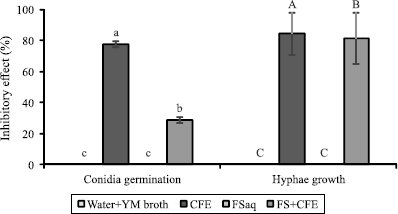
The inhibitory effect on conidia germination and on the growth of P. expansum hyphae was as follows: 31% and 62%, respectively (in the treatment with FS+CFE); while it was 79% and 68%, respectively, with intact cell-free extract (CFE) (Figure 1).

In vitro inhibitory effects of filmogenic aqueous solution on conidia germination and hyphae growth of Penicillium expansum, in the following treatments: CFE, cell-free extract with Hansenula wingei mycocin; FS+CFE, bioactive coating with Hansenula wingei mycocin; FSaq, treatment without Hansenula wingei mycocin. Different lowercase letters for spore germination (mean, n = 6) indicate significant differences for inhibitory effects of filmogenic solutions, by the Tukey’s test, at 5% probability. Different capital letters for hyphal growth (mean, n = 120) indicate significant differences for inhibitory effects of filmogenic solutions, by the Tukey’s test, at 5% probability. Error bar shows standard deviation.
The inhibitory effect of FS+CFE on P. expansum conidia germination was 2.5 times smaller than that of intact CFE. However, the inhibitory effect on the growth of hyphae for both treatments was greater than 60% (Figure 1), indicating that even when conidia germinate, FS+CFE will be effective to retard the mycelial development of the fungus.
The control treatment FSaq (prepared only with an aqueous solution) and negative control (sterile distilled water+YM broth) did not show any inhibition effect against P. expansum, indicating that the presence of mycocin in CFE added to FS for inhibition was significant (p<0.05) (Figure 1).
Starch and glycerol from FS+CFE probably had a negative influence to control the fungus. Fungi can use starch as a nutrient and favor conidia germination and mycelial growth (Abdullah et al., 2017). Another hypothesis may be related to the protective effect of glycerol, which helps fungus conidia viability (Stevenson et al., 2017).
The high antifungal activity of H. wingei is associated with mycocin production (killer toxin), as reported by Simer et al. (2014), for treatments against Nakaseomyces glabratus (Syn. Candida glabrata), C. albicans 12A, Pichia kluyveri CAY-15 and Aspergillus ochraceus. This property indicates that H. wingei extracts can be applied as a good biocontrol agent.
The inhibitory effect of FS+CFE on P. expansum, in the present work, showed also that mycocin was resistant to the time/temperature binomial of 90°C, for 30 min, when CFE was used for the preparation of the filmogenic solution. The resistance of this antifungal compound points to another characteristic that can favor its application as an edible coating.
To date, it can be noted that the use of H. wingei as a control agent in edible coatings is unprecedented. There are descriptions in the literature about the incorporation of cells from other antagonistic yeast species alive in the in vitro and/or in situ control of filamentous fruit spoilage fungi (Aloui et al., 2015; Karabulut & Cagri-Mehmetoglu, 2018).
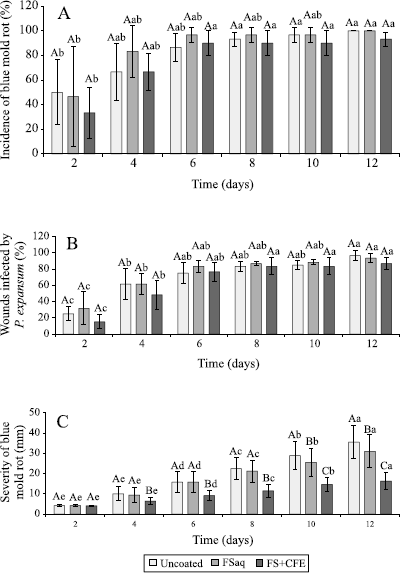
In fruit stored at 25°C, for 12 days, and regardless of the coating used, there was a high incidence of blue mold rot (Figure 2 A) and a high occurrence of wounds infected by P. expansum (Figure 2 B).
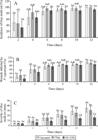
(A) Incidence of blue mold rot in apple (Malus domestica); (B) occurrence of wounds infected by Penicillium expansum; and (C) severity of blue mold rot in uncoated apples (control), as well as apples coated with a bioactive coating containing Hansenula wingei mycocin (FS+CFE) and a filmogenic solution (FS) prepared with only an aqueous solution (FSaq), stored at 25°C for up to 12 days. A: average percentage of blue mold rot in apples (n = 30); B, average percentage of wounds infected by P. expansum (n = 60); C, average severity of blue mold rot (n = 60). Error bar shows standard deviation. Different capital letters, in the same storage period, indicate significant differences among the antifungal effects, by the Tukey’s test, at 5% probability. Different lowercase letters, in the same treatment, indicate significant differences among the antifungal effects, by the Tukey’s test at 5% probability.
The control of severity of blue mold rot in apples coated with FS+CFE and stored at 25°C, for 12 days, was significant (p<0.05), and with 12 days of storage, the lesion control of blue mold (LC) was 54% (Figure 2 C). However, for fruit coated with FSaq, the LC was only 12.7%. Only after the tenth day of storage, the mean diameter of lesions in fruit without coating was different from fruit with FSaq. The absence of the fruit coating accelerated the deterioration stage, possibly due to a greater fruit exposure to the attack and proliferation of the fungus.
The diameter variation of the lesions in the fruit coated with FS+CFE was low and equal to 12.2 mm; at 2 and 12 days of storage, the diameters of the lesions were 4.1 mm and 16.3 mm, respectively. In fruit coated with FSaq and in uncoated ones (control), the diameter variation of the lesions was greater than and equal to 26.8 and 31.3 mm, respectively (Figure 2 C). However, at 2 and 12 days of storage, the percentage of lesion control in fruit with the bioactive coating (FS+CFE) ranged from 2.4 to 54.1%, while in fruit with the nonbioactive coating (FSaq) the variation was lower, from 0% to 12.7%, respectively. These variations of the control of fruit damage indicate that the bioactive coating had a positive effect in delaying fruit deterioration, comparison with the other treatments, FSaq, and control.
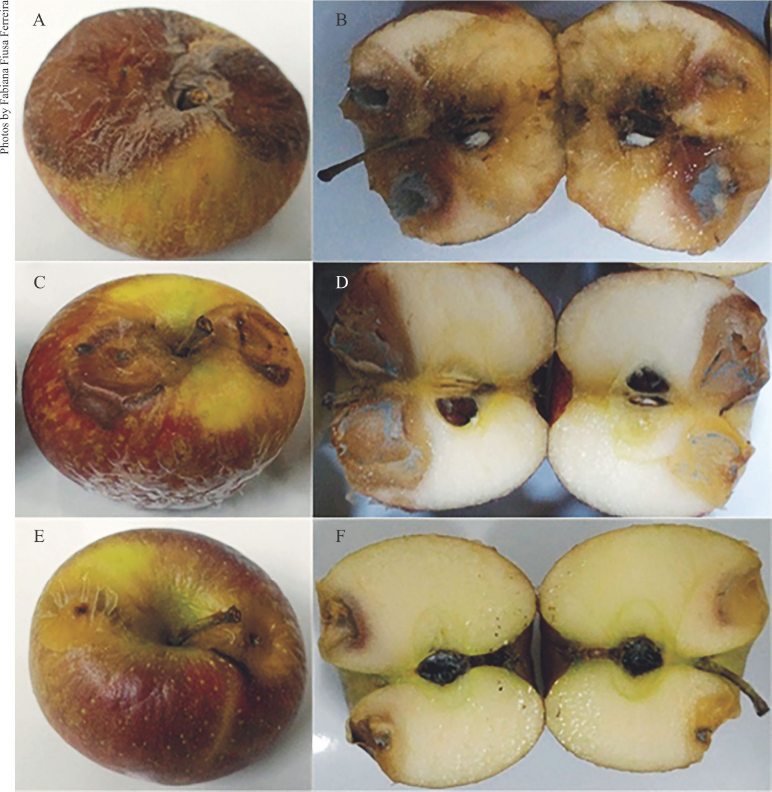
The images of lesions in apples with or without bioactive coating showed distinct characteristics (Figure 3). When conditions were favorable, conidia germinated (Figure 3 A, B, C, and D). However, when using the coating containing the bioactive compound (mycocin), the mycelial growth was impeded or retarded (Figure 3 E and F). These results show that the preventive treatment with a coating containing mycocin was positive for disease control.

Images of lesions on apples (Malus domestica) with or without antifungal coating, stored at 25 °C, for 12 days: (A) control, uncoated apple; (B) control, uncoated apple, cut in half; (C) FSaq, apple coated with a nonbioactive coating; (D) FSaq, apple coated with a nonbioactive coating, cut in half; E, FS+CFE, apple coated with bioactive coating; (F), FS+CFE, apple coated with bioactive coating, cut in half.
The production of H. wingei mycocin is spontaneous and not induced, as observed by Fontana et al. (2017), who purified partially H. wingei mycocin by ultrafiltration whose molar mass was higher than 30 kDa. The same authors reported that the antifungal activity of partially purified mycocin against conidial germination and hyphal development of P. expansum was similar to that of the mycocin present in the cell-free extract.
However, for the purpose of application as an antifungal, this high-cost purification technique would not be economically viable.
The use of killer yeasts as biocontrol agents had advantages and benefits. Furthermore, there are still no commercial formulations available. According to Díaz et al. (2020), killer proteins provide long-lasting effects and improve their potential in the biological control of microorganisms that are harmful to fruit.
The pH of fruit coated with the bioactive coating (FS+CFE) was higher after 6 to12 days of storage than the pH in the initial time (p<0.05), since P. expansum developed in a wide pH range. This fact indicates that pH 4.4 did not negatively influence the fungus development fungus (Table 1). The mean pH values between treatments with 12 days of storage did not show significant differences (Table 1). Therefore, pH did not influence the different responses of lesions caused by P. expansum. The pH values of fruit coated with FSaq and FS+CFE were 4.3 and 4.1 at the initial period, and 4.2 and 4.4 with 12 days of storage, and these pH values are close to that considered as an optimal pH for fungus development.
Physicochemical parameters of apple fruit (Malus domestica) coated with a filmogenic aqueous solution (FSaq) and a bioactive coating containing Hansenula wingei mycocin (FS+CFE), during 12 days of storage at 25°C(1).
Total soluble solids content (Table 1) in fruit with or without coating was higher after 12 days in comparison with the initial period (p<0.05), due to fruit ripening. The contents of total soluble solids of treatments in storage for 12 days did not differ (p>0.05), which indicates that this parameter did not influence the lesions caused by the fungus (Figure 2 C).
The mass loss of fruit coated with FSaq and FS+CFE gradually increased up to 12 days of storage (Table 2). It was observed that, in both treatments, on the 12th day of storage, the percentage of mass loss did not differ (p>0.05), and its mean value was 8.56%; however, the FSaq treatment showed a difference from the control (p<0.05).
Mass loss of apple fruit (Malus domestica) coated with a filmogenic solution (FSaq) and a bioactive coating (FS+CFE), during 12 days of storage at 25°C(1).
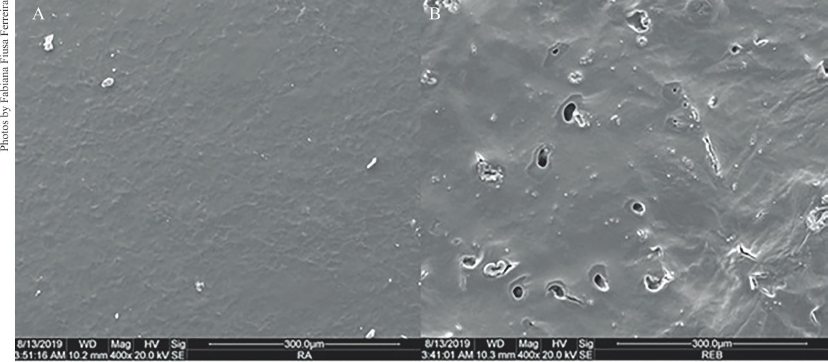
Coatings made with FSaq had an intact coating surface and no discontinuity zones (Figure 4 A). However, the coatings made with FS+CFE showed a formation of discontinuity zones between the starch and the cell-free extract that allowed of a greater permeability for gases, due to the increase of the respiratory rate and, consequently, of water loss (Figure 4 B).

Coating images (400X) obtained through scanning electron microscopy (SEM): (A) FSaq, surface of the coating prepared with aqueous solution; (B), FS+CFE surface of the coating formed with the incorporation of cell-free extract of Hansenula wingei mycocin.
The physicochemical parameters evaluated in fruit with or without coating and stored at 25°C, for 12 days, were not limiting for the development of the fungus, as they did not influence the control of lesions in apples coated with the bioactive compound. However, regardless of the treatment used, these parameters were favorable to provide ideal conditions for conidia germination and hyphae growth.
According to Miranda et al. (2024), when the edible coating is applied to apples, a semi-permeable membrane is formed, which allows of breathing, transpiration, and water evaporation. Thus, the process of fruit deterioration caused by the fungus is not the main cause of mass loss. The development of fungi, associated with storage conditions, can increase transpiration and, consequently, influence the mass loss of fruit with or without coatings. A film made with a cell-free extract containing the H. wingei mycocin was partially characterized by Costa et al. (2019); the coating showed a greater permeability to water vapor, greater resistance, and greater solubility than the film made with an aqueous solution; therefore, the greater resistance could provide a better protection to fruit against mechanical damage caused by impact.
The bioactive coating with the incorporation of cell-free extract of H. wingei containing mycocin as a bioactive compound can be used as a new strategy for the control of P. expansum in postharvest apples.
Conclusions
-
The bioactive coating with Hansenula wingei mycocin is a promising strategy for controlling Penicillium expansum in postharvest apples (Malus domestica).
-
The filmogenic solution with the cell-free extract of H. wingei shows antifungal activity which is confirmed by the significant in vitro inhibition of conidia germination and hyphae growth of P. expansum.
-
The bioactive coating on apples effectively controls the incidence of blue mold rot, reduces the number of wounds infected by P. expansum, mitigates the disease severity, and limits the development of lesions.
-
Apples coated with bioactive coating and stored at 25°C, for 12 days, maintain their physicochemical properties consistent with natural ripening
Acknowledgments
To Universidade Tecnológica Federal do Paraná and to the Programa de Pós-graduação em Tecnologia de Alimentos, for financial support; to Fundação Aruacária, for the scholarship in “Scientific Initiation” (Brazilian research program for undergraduates).
References
- ABDULLAH, R.; NADEEM, S.; IQTEDAR, M.; KALEEM, A.; IFTIKHAR, T.; NAZ, S. Influence of growth conditions on enhanced production of alpha amylase from Penicillium species in solid state fermentation. Indian Journal of Biotechnology, v.16, p.426-432, 2017.
-
ALOUI, H.; LICCIARDELLO, F.; KHWALDIA, K.; HAMDI, M.; RESTUCCIA, C. Physical properties and antifungal activity of bioactive films containing Wickerhamomyces anomalus killer yeast and their application for preservation of oranges and control of postharvest green mold caused by Penicillium digitatum International Journal of Food Microbiology, v.200, p.22-30, 2015. DOI: https://doi.org/10.1016/j.ijfoodmicro.2015.01.015
» https://doi.org/10.1016/j.ijfoodmicro.2015.01.015 -
ARGENTA, L.C.; FREITAS, S.T. de; MATTHEIS, J.P.; VIEIRA, M.J.; OGOSHI, C. Characterization and quantification of postharvest losses of apple fruit stored under commercial conditions. HortScience, v.56, p.608-616, 2021. DOI: https://doi.org/10.21273/HORTSCI15771-21
» https://doi.org/10.21273/HORTSCI15771-21 -
COELHO, A.R.; TACHI, M.; PAGNOCCA, F.C.; NOBREGA, G.M.A.; HOFFMANN, F.L.; HARADA, K.-I.; HIROOKA, E.Y. Purification of Candida guilliermondii and Pichia ohmeri killer toxin as an active agent against Penicillium expansum Food Additives & Contaminants: Part A, v.26, p.73-81, 2009. DOI: https://doi.org/10.1080/02652030802227227
» https://doi.org/10.1080/02652030802227227 - COSTA, D.R. da; FERREIRA, F.F.; SHIRAI, M.A.; SAKANAKA, L.S.; COELHO, A.R. Caracterização de filme à base de amido de resíduo de aveia com composto antifúngico natural. Higiene Alimentar, v.33, p.2739-2743, 2019.
-
DÍAZ, M.A.; PEREYRA, M.M.; PICÓN-MONTENEGRO, E.; MEINHARDT, F.; DIB, J.R. Killer yeasts for the biological control of postharvest fungal crop diseases. Microorganisms, v.8, art.1680, 2020. DOI: https://doi.org/10.3390/microorganisms8111680
» https://doi.org/10.3390/microorganisms8111680 - FERREIRA, F.F.; MARTINS, R.A.; COSTA, D.R. da ; TONIAL, I.B.; COELHO, A.R. Levedura antagonista no controle de fungos filamentosos deteriorantes de alimentos. Higiene Alimentar, v.33, p.2793-2797, 2019.
-
FONTANA, H.Y.Y.; PAIÃO, F.G.; PEDRÃO, M.R.; COELHO, A.R. Purificação parcial de toxina killer de hansenula wingei visando aplicação no controle do desenvolvimento de fungos filamentosos deteriorantes de alimentos. In: OLIVEIRA, A.F.; STORTO, L.J. (Org.). Tópicos em ciências e tecnologia de alimentos: resultados de pesquisas acadêmicas. Londrina: Blucher, 2017. v.3, p.199-218. DOI: https://doi.org/10.5151/9788580392722-08
» https://doi.org/10.5151/9788580392722-08 -
GONZÁLEZ-ESTRADA, R.R.; CARVAJAL-MILLÁN, E.; RAGAZZO-SÁNCHEZ, J.A.; BAUTISTA-ROSALES, P.U.; CALDERÓN-SANTOYO, M. Control of blue mold decay on Persian lime: application of covalently cross-linked arabinoxylans bioactive coatings with antagonistic yeast entrapped. LWT - Food Science and Technology, v.85, p.187-196, 2017. DOI: https://doi.org/10.1016/j.lwt.2017.07.019
» https://doi.org/10.1016/j.lwt.2017.07.019 -
GUTIERREZ-MARTINEZ, P.; LEDEZMA-MORALES, A.; ROMERO-ISLAS, L. del C.; RAMOS-GUERRERO, A.; ROMERO-ISLAS, J.; RODRÍGUEZ-PEREIDA, C.; CASAS-JUNCO, P.; CORONADO-PARTIDA, L.; GONZÁLEZ-ESTRADA, R. Antifungal activity of chitosan against postharvest fungi of tropical and subtropical fruits. In: DONGRE, R.S. (Ed.). Chitin-chitosan - myriad functionalities in science and technology. London: InTech, 2018. DOI: https://doi.org/10.5772/intechopen.76095
» https://doi.org/10.5772/intechopen.76095 -
KARABULUT, G.; CAGRI-MEHMETOGLU, A. Antifungal, mechanical, and physical properties of edible film containing Williopsis saturnus var. saturnus antagonistic yeast. Journal of Food Science, v.83, p.763-769, 2018. DOI: https://doi.org/10.1111/1750-3841.14062
» https://doi.org/10.1111/1750-3841.14062 - KVITSCHAL, M.V.; COUTO, M.; LEITE, G.B. Necessidade da diversificação de cultivares na cadeia produtiva da maçã no Brasil. Agropecuária Catarinense, v.35, p.7-10, 2022.
-
LUCIANO-ROSARIO, D.; KELLER, N.P.; JURICK II, W.M. Penicillium expansum: biology, omics, and management tools for a global postharvest pathogen causing blue mould of pome fruit. Molecular Plant Pathology, v.21, p.1391-1404, 2020. DOI: https://doi.org/10.1111/mpp.12990
» https://doi.org/10.1111/mpp.12990 -
MIRANDA, M.; BAI, J.; PILON, L.; TORRES, R.; CASALS, C.; SOLSONA, C.; TEIXIDÓ, N. Fundamentals of edible coatings and combination with biocontrol agents: a strategy to improve postharvest fruit preservation. Foods, v.13, art.2980, 2024. DOI: https://doi.org/10.3390/foods13182980
» https://doi.org/10.3390/foods13182980 -
NASCIMENTO, B.L.; DELABENETA, M.F.; ROSSETO, L.R.B.; JUNGES, D.S.B.; PARIS, A.P.; PERSEL, C.; GANDRA, R.F. Yeast mycocins: a great potential for application in health. FEMS Yeast Research, v.20, foaa016, 2020. DOI: https://doi.org/10.1093/femsyr/foaa016
» https://doi.org/10.1093/femsyr/foaa016 -
RODE, P.A.; BIZARRO, G.L.; SPOHR, G.A.; MALMANN, D.; SCHUSSLER, M.; FERLA, N.J. Mite fauna on apples in southern Brazil - Review and perspectives. Anais da Academia Brasileira de Ciências, v.95, e20221113, 2023. DOI: https://doi.org/10.1590/0001-3765202320221113
» https://doi.org/10.1590/0001-3765202320221113 - SIMER, P.; CALEGARI, R.P.; MACHADO-LUNKES, A.; HASHIMOTO, E.H.; COELHO, A.R. Biocontrole de fungos filamentosos por Hansenula wingei visando aplicação na pós-colheita de frutos. Magistra, v.26, p.630-635, 2014.
-
STEVENSON, A.; HAMILL, P.G.; MEDINA, Á.; KMINEK, G.; RUMMEL, J.D.; DIJKSTERHUIS, J.; TIMSON, D.J.; MAGAN, N.; LEONG, S.-L.L.; HALLSWORTH, J.E. Glycerol enhances fungal germination at the water-activity limit for life. Environmental Microbiology, v.19, p.947-967, 2017. DOI: https://doi.org/10.1111/1462-2920.13530
» https://doi.org/10.1111/1462-2920.13530