 Production and composition of litter from umbu tree genotypes
Abstract
The objective of this work was to evaluate the litter yield and the accumulated nutrient concentrations and amounts in the litter of umbu tree genotypes from different origins. The experiment was carried out in a completely randomized design with 14 treatments, during the 2020-2021 season, using 13-year-old trees at the time. The genotypes BGU-44, BGU-45, BGU-47, BRS-48, BGU-50, BGU-75, BRS-68, EPAMIG-03, EPAMIG-04, EPAMIG-05, EPAMIG-06, EPAMIG-07, EPAMIG-09, and EPAMIG-13 were evaluated, with three replicates, each one composed of one plant per plot. Yields and accumulated nutrient concentrations and amounts in the litter varied between genotypes. The decreasing order of macronutrient concentrations in the litter was Ca>N>Mg>K>S>P, and of micronutrients and Na was Fe>B>Mn>Na>Zn>Cu. The accumulated amounts of nutrients are more associated with the litter yield of the genotypes than with nutrient concentrations, since the concentrations varied little. The genotypes BGU-61, EPAMIG-07 and EPAMIG-06 express the highest litter yield and the highest accumulated nutrient amounts, while EPAMIG-05, BGU-75, BGU-44, BGU-50, and BGU-45 show the lowest accumulated nutrient amounts.
Index terms:
Spondias tuberosa
; acessions; fertilization; nutrient cycling
Resumo
O objetivo deste trabalho foi avaliar a produtividade, os teores e as quantidades acumuladas de nutrientes em serrapilheira de genótipos de umbuzeiro de diferentes origens. O experimento foi realizado em delineamento inteiramente ao acaso com 14 tratamentos, durante a safra 2020-2021, tendo-se utilizado plantas de 13 anos à época. Foram avaliados os genótipos BGU-44, BGU-45, BGU-47, BRS-48, BGU-50, BGU-75, BRS-68, EPAMIG-03, EPAMIG-04, EPAMIG-05, EPAMIG-06, EPAMIG-07, EPAMIG-09 e EPAMIG-13, com três repetições compostas de uma planta por parcela. As produtividades, teores e quantidades acumuladas de nutrientes da serrapilheira variaram entre os genótipos. A ordem decrescente da concentração de macronutrientes foi Ca>N>Mg>K>S>P, e a de micronutrientes foi Na, Fe>B>Mn>Na>Zn>Cu. As quantidades acumuladas de nutrientes estão mais associadas às produtividades de serrapilheira dos genótipos do que à concentração de nutrientes, já que as concentrações variaram pouco. Os genótipos BGU-61, EPAMIG-07 e EPAMIG-06 expressam maiores produtividades de serrapilheira e quantidades acumuladas de nutrientes, enquanto EPAMIG-05, BGU-75, BGU-44, BGU-50 e BGU-45, menores.
Termos para indexação
Spondias tuberosa
; acessos; adubação; ciclagem de nutrientes
Introduction
Umbu (Spondias tuberosa Arruda) is a fruit tree endemic to the Caatinga biome in Northeastern Brazil, which is tolerant to drought because of its morphophysiological adaptations that include water and nutrient-storing tubers, osmotic adjustment, leaves with high stomatal resistance, senescence, and leaf abscission during the dry season (Lima Filho & Aidar, 2016). These traits contribute to increase the water use efficiency (Santos et al., 2021b; Donato et al., 2022a) and enable the species to be cultivated under rainfed conditions. These facts constitute an important “technology” for the plants coexistence the semiarid conditions because of the scarcity of water resources that characterizes the region (Sudene, 2017). The water-limiting conditions can be worsened also by climate variability and the growing conflict among the multiple uses of water.
The exploitation of umbu tree has been more focused on extrativism aiming at selling its fruit for fresh consumption in urban centers. Recently, the participation of processed umbu products has increased through initiatives of associations or cooperatives of fruit collectors and/or family farmers (Fruto…, 2019; Boletim…, 2023).
However, in the last two decades, commercial orchards were established with umbu tree genotypes bearing large fruit (between 50 and 75 g) and giant ones (over 75 g) (Donato et al., 2024), which have been prospected and selected by research institutions such as Embrapa and Epamig (Donato et al., 2019b). These crops were spread further across Bahia state and the north of Minas Gerais state, thus requiring the development of crop management technologies (Donato et al., 2019c) and fertilization programs (Donato et al., 2022b).
Particularly important for umbu trees is the nutrient cycling ‒ such as the biochemistry between leaves, tubers, flowers, and fruit, as well as the geochemistry of washed nutrients from leaves to the ground, and the biogeochemistry of decomposing litter to the roots (Donato et al., 2019a, 2022b). In the litter, the accumulated amount of nutrients that may return to the plant through cycling may vary with the accession, mostly depending on the nutrient content and canopy size (Santos et al., 2020; Donato et al., 2022b; Donato & Neves, 2023).
The litter is responsible for retaining large quantities of nutrients, constituting an important way for mineral elements from vegetation to return to the soil, and the composition and quantity of these elements can vary depending on the time of the year, collection location, temperature, humidity, initial quality of the forming material, and soil organisms (Godinho et al., 2014). Elements that are part of the plant structure, such as Ca, are found more in the litter than mobile elements, such as K, which is not part of molecules and is easily washed away (Godinho et al., 2014). Even the management under the canopy, without weeding, favors the accumulation of organic residues on the soil surface, promoting the soil fertility and the productivity of plants (Morais et al., 2020). Cycling plays an even more crucial role in times of high input prices, particularly fertilizers, since nutrient cycling can reduce the dependence on external inputs, which is essential to the environmental and financial sustainability of crops commonly grown by family farmers.
In a study on the rate of retranslocation or biochemical cycling of nutrients between new and senescent leaves of umbu trees, Santos et al. (2020) found differences in rates between genotypes and cycles, and the following decreasing order of retranslocation: K>P>N>Mg. However, there is a demand for data on the quantity produced, nutrient levels accumulated in litter, and whether there are differences between umbu genotypes. This is important to estimate the theoretical biogeochemical cycling of nutrients and their possible contribution to the nutritional economy.
The objective of this work was to evaluate the litter yield and accumulated nutrient concentrations and amounts in the litter of umbu tree genotypes.
Materials and Methods
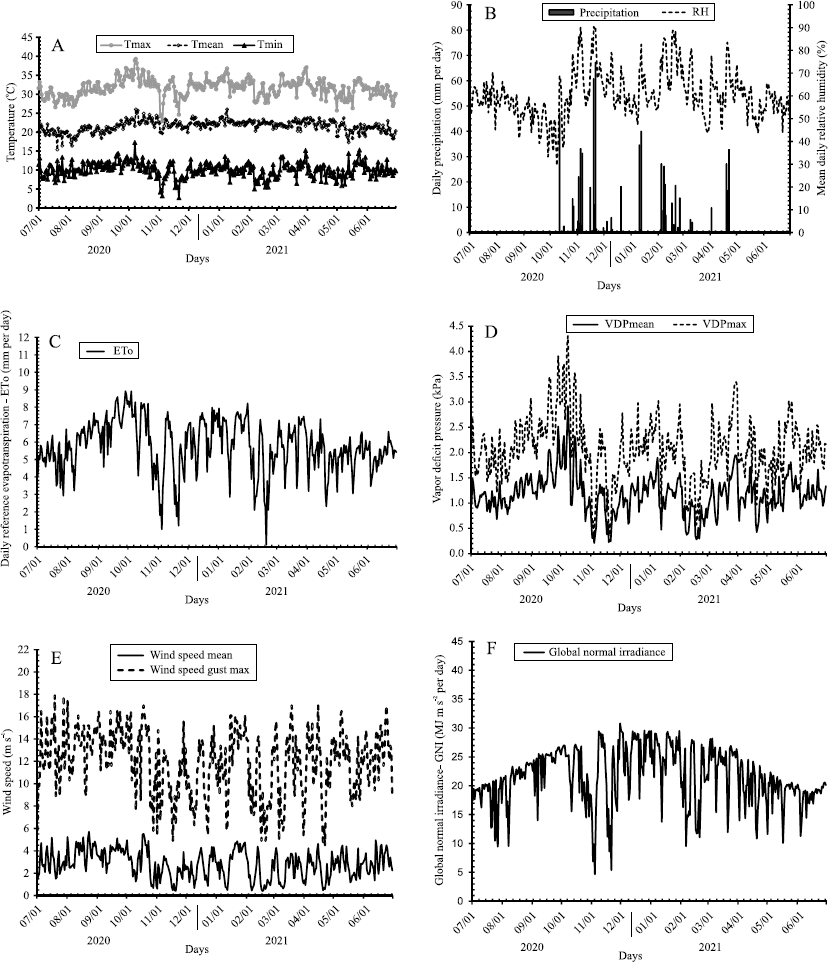
The experiment was carried out at the umbu tree genotype collection of Instituto Federal de Educação, Ciência e Tecnologia Baiano (IF Baiano), campus Guanambi, in the state of Bahia, Brazil (14º17'32"S, 42º41'34"W, at 547 m altitude). According to the Köppen-Geiger’s classification, the climate is hot and dry semiarid, with a well-defined dry season in the winter and a rainy period between October and March. The main meteorological data from the experiment site are shown in figure 1. The average annual precipitation is 671.5 mm, and the average annual temperature is 26ºC, considering the last 41 years, according to data recorded at the Ceraíma meteorological station Codevasf (1982–2006) and at the automatic meteorological station of IF Baiano (2007–2023), located 100 m from the experiment. The precipitation during the experimental period was 693.40 mm, with 365.74 mm concentrated between October and December 2020, and 327.66 mm between January and June 2021 (Figure 1).
Daily meteorological data recorded during the experimental period. A, maximum temperature (Tmax), minimum temperature (Tmin), and thermal amplitude; B, precipitation (P) and average relative humidity (RH); C, reference evapotranspiration (ETo); D, maximum (VDPmax) and average vapor pressure deficit (VDPmean); E, average wind speed (WSmean) and gust (WSgust); F, global normal irradiance (GNI). Data from the automatic meteorological station at IF Baiano, in Guanambi, BA, Brazil, from 07/01/2020 to 06/30/2021.
The soil in the experimental area is classified as Latossolo Vermelho-Amarelo, which is equivalent to Oxisol (Soil Survey Staff, 2014) and has a medium texture. Chemical characteristics were determined according to Claessen (1997). The soil is currently eutrophic, with base saturation between 60% and 80%, pH with weak acidity to weak alkalinity, low potential acidity, very high K levels, high Ca and Mg levels, medium to high P levels, and medium cation exchange capacity (CEC) (Table 1).
Soil chemical attributes from samples collected at 0–0.2 m soil depth, in each of the 14 umbu tree genotypes.
The work was performed during the 2020-2021 season, using 13-year-old trees at the time. The area was established in 2007, in 8x8x8 m spacing in a quincunx (180 plants ha-1). Crop practices, including fertilization, pest and disease control, mowing, pruning, and removal of shoots from the rootstock followed recommendations by Donato et al. (2019c).
The experiment was carried out in a completely randomized design, with 14 treatments (umbu tree genotypes) and three replicates of one plant per plot. The genotypes originate from the counties, in parenthesis, of the following Brazilian states: Bahia ‒ BGU-44 (Anagé), BGU-45 (Brumado), BGU-47 (São Gabriel), BRS-48 (América Dourada), BGU-50 (Santana), and BGU-75 (Macaúbas); and in the north of Minas Gerais state ‒ BRS-68/EPAMIG-01 (Lontra), EPAMIG-03, and EPAMIG-05 (Porteirinha); EPAMIG-04 (Janaúba), EPAMIG-06, EPAMIG-07 and BGU-61 (Januária), EPAMIG-13 (Mamonas) (Donato et al., 2019b).
The Empresa de Pesquisa Agropecuária de Minas Gerais (Epamig) has named the genotypes collected in the north of Minas Gerais, deposited in the collection of umbu tree genotypes of EPAMIG North, located in the municipality of Nova Porteirinha, in the state of Minas Gerais. BGU refers to accessions collected throughout the Brazilian Semiarid region, deposited at the active germplasm bank of umbu tree of Embrapa Semiárido, located in the municipality of Petrolina, in the state of Pernambuco; BRS refers to cultivars registered by Embrapa (Santos et al., 2021a).
Litter quantification from collections of different treatment was carried out at 30, 80, and 105 days after placing the collectors on March 17, 2021, with an interval defined according to the apparent litter amount deposited on the collectors. Two collectors were placed per plant on wooden quadrants, which consisted of a square-shaped frame measuring 1.00x1.00x0.15 m, whose bottom was covered by a nylon screen of 1.00 mm2 mesh (Brito et al., 2017). The collection period corresponded to the phenological stages of senescence and leaf abscission, followed by fruit harvest.
At each litter collection, the fresh mass was determined, followed by drying in an oven at 65ºC until constant mass was attained. Dried samples from the last collection were placed in paper bags and sent to the soil laboratory of Epamig North, in Nova Porteirinha, in Minas Gerais state. The samples were ground in a Wiley mill and passed through a sieve of 1 mm2 mesh for level determinations of P, K, Ca, Mg, and S (g kg-1), and Cu, Fe, Mn, Zn and Na (mg kg-1) (Malavolta et al., 1997).
Dry matter contents (DMC) were determined from the values of fresh (FLM) and dry (DLM) masses (g). With the totals accumulated in the three collections, litter yield (kg m-2) of fresh (FLY) and dry (DLY) masses, fresh (FLR) litterfall rate (t ha-1 per month), fresh (FLR) and dry matter (DLR), and the accumulated quantities (Q) of macro (kg ha-1) and micronutrients (g ha-1) in the litter, considering the dry matter contents and productivity, were determined.
The obtained data were subjected to the Shapiro-Wilk’s normality test and to the analysis of variance. The means were grouped using the Scott-Knott’s criterion, at 5% probability.
Results and Discussion
Except for K content, the other variables – fresh (FLM) and dry (DLM) leaf masses, dry matter content (DMC), fresh (FLY) and dry (DLY) litter yields, fresh (FLR) and dry (DLR) litterfall rates, accumulated nutrient concentrations and amounts (Q) in the litter – varied in accordance with the umbu tree genotypes (p≤0.05) (Table 2). This fact is justified by the genetic variability (Oliveira et al., 2004) associated with the ecoregions of origin of the genotypes (Santos et al., 1999; Balbino et al., 2018).
Analysis of variance with the respective mean squares of fresh (FLM) and dry (DLM) masses, dry matter content (DMC), fresh (FLY) and dry litter yield (DLY), and fresh (FLR) and dry litterfall rates (DLR), and of the concentrations and quantities of nutrients and sodium accumulated (Q) in the litter dry matter of 14 umbu tree genotypes, in the 2020-2021 season.
In addition to the difference between canopy sizes (Donato et al., 2022b; Donato & Neves, 2023), and, therefore, between amounts of material that makes up the litter, there is a difference between genotypes for the content of elements in the leaves (Santos et al., 2020).
For the variables FLM, FLY, and FLR, the highest values were recorded for the EPAMIG-07, BGU-61 and EPAMIG-06 genotypes, and the lowest values were observed in EPAMIG-05, followed by BGU-75 and BGU-50 (Table 3). These results may be associated with the larger canopy area in the EPAMIG-07, BGU-61, and EPAMIG-06 genotypes whose values were 37.24, 39.04, and 36.83 m², respectively, in comparison with EPAMIG-05 that showed a smaller canopy area (26.89 m²) when evaluated at 12 years of age (Donato & Neves, 2023). A greater canopy area suggests a greater quantity of leaves present on the tree and on the ground after abscission. However, there are exceptions, such as BGU-75 (45.05 m²) and BGU-50 (40.69 m²) that expressed larger canopy areas.
Means of fresh (FLM) and dry (DLM) leaf masses, dry matter content (DMC), fresh (FLY) and dry (DLY) litter yield, fresh (FLR) and dry (DLR) litterfall rate, in the litter of 14 umbu tree genotypes, in the 2020-2021 season(1).
Additionally, EPAMIG-07, BGU-61, and EPAMIG-06 originate in Januária, which is a municipality (in Minas Gerais state) located on the border of the Brazilian Semiarid, with higher average of annual precipitation of 934.2 mm (Inmet, 2023); therefore, these genotypes may have a greater probability of showing trees with larger canopies. In contrast, EPAMIG-05 originates from Porteirinha, in Minas Gerais state, and is a municipality with the lowest average rainfall in this state, according to a historical series from 1941–2012, showing only 650 mm annual average precipitation (Fonseca & Santos, 2020).
The canopy area is a varietal characteristic, including the influence of rootstocks (Donato et al., 2019a; Donato & Neves, 2023), but with environmental influence. However, 'BRS-68' originating from Lontra, Minas Gerais state, close to Januária, shows a canopy of 36.08 m² (Donato & Neves, 2023), which is close to the values recorded for EPAMIG-07, BGU-61, and EPAMIG-06, but with medium litter masses. This fact suggests that the genotypic differences with phenotypic expression in leaf shape and size can influence the total amount of litterfall, in addition to canopy size.
Phylogeography studies showed that ecogeographic regions may have modeled the population structure of the species, resulting in genetic differences, for instance between the Caatinga and interfaces (Balbino et al., 2018), such as between Januária and Porteirinha regions, both in the state of Minas Gerais, and Macaúbas, in the state of Bahia. This variability (Oliveira et al., 2004) can determine phenotypic differences for across ecoregions for fruit types (Santos et al., 1999), as well as for canopy architecture, diameter, and height (Donato & Neves, 2023), which explains the differences in the litterfall produced by the genotypes.
For DLM, DLY and DLR, the highest values were observed in the EPAMIG-07, EPAMIG-06, BGU-61, EPAMIG-13, and EPAMIG-04 genotypes. Overall, EPAMIG-05 and BGU-75 expressed lower values for mass, litter yield, and litterfall rates. The lowest dry matter content was recorded for BGU-44, and the highest values were recorded for BGU-50, EPAMIG-03, EPAMIG-04, EPAMIG-13, BGU-75, BGU-45, EPAMIG-07, EPAMIG-06, and BGU- 47.
In summary, the amount of litter produced can be influenced by species (Abreu et al., 2023), cultivars (Brito et al., 2017), and local climatic conditions (Abreu et al., 2023), with special accumulation in the Caatinga ecosystem due to the reduced precipitation (Lima et al., 2015), but also in other ecosystems (Godinho et al., 2014).
The order of macronutrient concentrations in the litter was Ca>N>Mg>K>S>P (Table 4). In newly mature, fully expanded leaves, and macronutrient concentrations the order was N>Ca>K>Mg>S>P. The order of biochemical cycling or rate of retranslocation of nutrients from leaves to other organs, such as fruit and xylopodia, was K>P>N>Mg, according to the study by Santos et al. (2020); and nutrient export by fruit order was K>N>P>Ca>Mg>S in the study by Donato et al. (2022b). These results highlight the high mobility of K, N, P, and Mg, and the low mobility of Ca in the plant and its consequent, significant return to the soil-plant system via leaf abscission, which is due to the average Ca concentration (44.40 g kg-1) that constitutes nutritional economy. The low mobility of Ca explains why this nutrient shows the highest content in the litter, even under different climates and biomes (Godinho et al., 2014).
Mean nutrient and sodium content in the dry matter of the litter from 14 umbu tree genotypes, in the 2020-2021 season(1).
As for macronutrients, K levels were not influenced by genotypes (Table 2), and the average value was 1.78 g kg-1 (Table 4). For N, the highest values were found in BGU-50, BGU-61, and BRS-68; and for P, in BRS-68 and BGU-61. For Ca, Mg, and S, more genotypes with higher levels were grouped, as following described. For Ca, the genotypes were: BGU-47, BGU-75, BGU-45, EPAMIG-04, EPAMIG-05, EPAMIG-06, BRS-48, EPAMIG-07, and EPAMIG-13. For Mg, the genotypes were: BGU-47, EPAMIG-07, EPAMIG-05, BRS-48, BGU-44, BGU-61, and BGU-45. For S, the genotypes were BGU-61, BGU-47, BRS-48, BRS-68, BGU-50, EPAMIG-05, and EPAMIG-03.
In general, the genotypes with the highest frequency of occurrence of the highest concentration of macronutrients were: BGU-61, BRS-68, BGU-47, BRS-48, and EPAMIG-05, while the highest frequencies of lower levels were recorded in BGU-75, EPAMIG-06, EPAMIG-13, BGU-44, and EPAMIG-04.
For micronutrients and Na, the decreasing concentration order in litter is Fe>B>Mn>Na>Zn>Cu. These results prove that Fe and Cu are, respectively, the micronutrients most and least exported by fruit (Donato et al., 2022b) and cycled by litter, as well as those with the highest and lowest concentration in the leaves (Santos et al., 2020). These results corroborate the information that Fe and Cu are the micronutrients with the highest and lowest concentrations in plant dry matter, respectively (Marschner, 2012).
Manganese (Mn) levels were similar among genotypes with 113.93 mg kg-1 average. Higher levels of micronutrients were found in the genotypes as follows: for B, in EPAMIG-13, BGU-44, BGU-50, BGU-45, EPAMIG-04, BGU-47, and EPAMIG-06; for Cu, in BGU-61, BRS-68, and BGU-50; for Fe, in BRS-68, with a value of 1,511.11 mg kg-1, which is twice the average between genotypes; for Zn, in BRS-68, BGU-61, EPAMIG-05, and BGU-50; and for Na, in EPAMIG-04. Overall, BRS-68 and BGU-50 followed by BGU-61 and EPAMIG-04 expressed a higher frequency of higher levels of micronutrients in the litter, whereas EPAMIG-07, EPAMIG-03, and BGU-75 had lower levels.
The highest accumulated amounts (Q) of macronutrients were found for N, P, and S, in BGU-61 accession; for K, in EPAMIG-06, BGU-61, EPAMIG-07, EPAMIG-03, and EPAMIG-13; for Ca, in EPAMIG-06 and EPAMIG-07; and for Mg, in EPAMIG-07 (Table 5). The accumulated quantities of macronutrients were greater and occurred more frequently in the litter from the BGU-61, EPAMIG-07, and EPAMIG-06 genotypes, while those with lower quantities were EPAMIG-05, BGU-75, BGU-44, BGU-50, and BGU-45.
Means of the accumulated quantities of nutrients (Q) and sodium in the dry matter of the litter of 14 umbu tree genotypes, in the 2020-2021 season(1).
The highest accumulated quantities (Q) of micronutrients were found in the umbu tree genotypes, as follows: for B, in EPAMIG-13, EPAMIG-06, EPAMIG-04, BGU-61, EPAMIG-07, BRS-48, and BGU-44; for Cu, in BGU-61; for Fe, in BRS-68, BGU-61, EPAMIG-07, EPAMIG-13, EPAMIG-03, and EPAMIG-04; for Mn, in EPAMIG-07, EPAMIG-06, BGU-61, EPAMIG-04, and EPAMIG-03; for Zn, in BGU-61 and EPAMIG-07; for Na, in EPAMIG-07, EPAMIG-06, EPAMIG-04, and BGU-61. Overall, the greater accumulated quantities of micronutrients were greater and occurred more frequently in the litter from the BGU-61, EPAMIG-07, EPAMIG-04, and EPAMIG-06 genotypes, while those with lower amounts were EPAMIG-05, BGU-75, BGU-47, BGU-50, BGU-44, and BGU-45.
There is agreement between genotypes with higher litter yields (BGU-61, EPAMIG-07 and EPAMIG-06) and higher accumulated quantities (Q) of nutrients, as well as lower yields (EPAMIG-05, BGU-75, BGU-44, BGU-50, and BGU-45) and lower Q. These facts show a greater association of Q with litter yield than with nutrient content, hence, a greater dependence on canopy sizes (Donato & Neves, 2003) because of genetic differences associated with the ecoregions of origin (Santos et al., 1999; Balbino et al., 2018), despite the previously discussed exceptions.
Nutrient inputs from plant biomass improve nutrient levels under the canopy, as well as crop productivity (Morais et al., 2020). In the present work, the data on the accumulated quantities of nutrients in the litter of the genotypes allow of the estimation of the theoretical biogeochemical cycling of nutrients. These data support the management of umbu tree as a crop with nutritional savings, although decomposition rate is slower in a dry environment (Moura et al., 2016) and depends on the quality of the substrate (Lima et al., 2015).
Conclusions
-
Yield, concentration, and accumulated quantities of nutrients in the litter vary among genotypes of umbu (Spondias tuberosa) trees.
-
The order of macronutrient concentration in the litter is Ca>N>Mg>K>S>P; for micronutrients and Na, the order is Fe>B>Mn>Na>Zn>Cu.
-
The accumulated quantities of nutrients are more associated with litter yield of the genotypes than with nutrient concentration.
-
The BGU-61, EPAMIG-07, and EPAMIG-06 genotypes express a higher litter yield and accumulated quantities of nutrients in the litter, while EPAMIG-05, BGU-75, BGU-44, BGU-50, and BGU-45 show lower amounts.
Acknowledgments
To Coordenação de Aperfeiçoamento de Pessoal de Nível Superior (CAPES), for financing, in part, this study (Finance Code 001); to Conselho Nacional de Desenvolvimento Científico e Tecnológico (CNPq), for financial support, and to Fundação de Amparo à Pesquisa do Estado de Minas Gerais (FAPEMIG), for the research incentive grant (process no. BIP-00054-24) to the author M. G. V. Rodrigues.
References
-
ABREU, J.C. de; SILVA, J.A.A. da; FERREIRA, R.L.C.; ROCHA, S.J.S.S. da; TAVARES JÚNIOR, I. da S.; FARIAS, A.A.; VILLANOVA, P.H.; VIANA, A.B.T.; SCHETTINI, B.L.S.; TELLES, L.A. de A.; SILVA, A.A. Mixed models for nutrients prediction in species of the Brazilian Caatinga biome. Revista Árvore, v.47, e4712, 2023. DOI: https://doi.org/10.1590/1806-908820230000012
» https://doi.org/10.1590/1806-908820230000012 -
BALBINO, E.; CAETANO, B.; ALMEIDA, C. Phylogeographic structure of Spondias tuberosa Arruda Câmara (Anacardiaceae): seasonally dry tropical forest as a large and continuous refuge. Tree Genetics & Genomes, v.14, art.67, 2018. DOI: https://doi.org/10.1007/s11295-018-1279-4
» https://doi.org/10.1007/s11295-018-1279-4 - BOLETIM DA SOCIOBIODIVERSIDADE. Brasília: Conab, v.7, p.1-32, 2023.
-
BRITO, C.F.B.; FONSECA, V.A.; BEBÉ, F.V.; RAMOS, A.G.O.; SILVA, G.B. Production, decomposition and chemical characteristics of banana litterfall. Revista Caatinga, v.30, p.45-52, 2017. DOI: https://doi.org/10.1590/1983-21252017v30n105rc
» https://doi.org/10.1590/1983-21252017v30n105rc - CLAESSEN, M.E.C. (Org.). Manual de métodos de análise de solo 2.ed. rev. e atual. Rio de Janeiro: EMBRAPA-CNPS, 1997. 212 p. (EMBRAPA-CNPS. Documentos, 1).
- DONATO, S.L.R.; ARANTES, A. de M.; GONÇALVES, N.P.; MATOS, F.S.; RODRIGUES, M.G.V.; SATURNINO, H.M. Aspectos ecofisiológicos, morfológicos, fenológicos e de produção do umbuzeiro e umbu-cajazeira. Informe Agropecuário, v.40, p.22-38, 2019a.
-
DONATO, S.L.R.; CASTRICINI, A.; RODRIGUES, M.G.V.; DEUS, J. da S. de; ARANTES, A. de M.; PIRES, E. de S. Proposal of classes for umbu commercialization. Revista Brasileira de Fruticultura, v.46, e-516, 2024. DOI: https://doi.org/10.1590/0100-29452024516
» https://doi.org/10.1590/0100-29452024516 - DONATO, S.L.R.; FONSECA, N.; GONÇALVES, N.P.; MACHADO, C. de F.; MATOS, F.S.; SATURNINO, H.M.; RODRIGUES, M.G.V. Práticas de cultivo do umbuzeiro. Informe Agropecuário, v.40, p.65-79, 2019b.
- DONATO, S.L.R.; GONÇALVES, N.P.; SANTOS, L.J.S.; SATURNINO, H.M.; ARANTES, A. de M.; LONDE, L.C.N.; CARDOSO, M.M. Prospecção e avaliação de acessos de umbuzeiro. Informe Agropecuário, v.40, p.52-64, 2019c.
- DONATO, S.L.R.; NEVES, O.S.C. Manejo agronômico do umbuzeiro. In: NEVES, O.S.C. (Org.). Umbuzeiro (Spondias tuberosa Arr. Câm.) uma alternativa para o semiárido 2.ed. rev., atual. e ampl. Vitória da Conquista: Edições UESB, 2023. p.65-99.
-
DONATO, S.L.R.; PIRES, E. de S.; ARANTES, A. de M.; BARROS, B.L. Photosynthetic response of umbu trees to vapor pressure deficit. Pesquisa Agropecuária Brasileira, v.57, e02827, 2022a. DOI: https://doi.org/10.1590/S1678-3921.pab2022.v57.02827
» https://doi.org/10.1590/S1678-3921.pab2022.v57.02827 - DONATO, S.L.R.; RODRIGUES, M.G.V.; CARDOSO, M.M.; CASTRICINI, A.; DEUS, J. da S. de; SOUSA, K.F.T. Caracterização e manejo nutricional de acessos de umbuzeiro Belo Horizonte: Epamig, 2022b. 80p. (Epamig. Boletim técnico 114).
- FONSECA, G.S.; SANTOS, M.R. dos. Impactos da seca em municípios de Minas Gerais. Humboldt, v.1, e52601, 2020.
-
FRUTO símbolo da caatinga, umbu gera desenvolvimento econômico no sertão do São Francisco. United Nations Development Programme, 2019. Available at: <https://www.br.undp.org/content/brazil/pt/home/presscenter/articles/2019/fruto-simbolo-da-caatinga--umbu-gera-desenvolvimento-economico-n.html>. Accessed on: Oct. 22 2024.
» https://www.br.undp.org/content/brazil/pt/home/presscenter/articles/2019/fruto-simbolo-da-caatinga--umbu-gera-desenvolvimento-economico-n.html -
GODINHO, T. de O.; CALDEIRA, M.V.W.; ROCHA, J.H.T.; CALIMAN, J.P.; TRAZZI, P.A. Quantificação de biomassa e nutrientes na serapilheira acumulada em trecho de Floresta Estacional Semidecidual Submontana, ES. Cerne, v.20, p.11-20, 2014. DOI: https://doi.org/10.1590/S0104-77602014000100002
» https://doi.org/10.1590/S0104-77602014000100002 -
INMET. Instituto Nacional de Metrologia, Qualidade e Tecnologia. Normal climatológica do Brasil 1991-2020 Available at: <https://portal.inmet.gov.br/uploads/normais/Normal-Climatologica-PREC.xlsx>. Accessed on: Nov. 14 2023.
» https://portal.inmet.gov.br/uploads/normais/Normal-Climatologica-PREC.xlsx - LIMA FILHO, J.M.P.; AIDAR, S. de T. Ecofisiologia. In: DRUMOND, M.A.; AIDAR, S. de T.; NASCIMENTO, C.E. de S.; OLIVEIRA, V.R. de (Ed.). Umbuzeiro: avanços e perspectivas. Brasília: Embrapa, 2016. p.117-145.
-
LIMA, R.P.; FERNANDES, M.M.; FERNANDES, M.R. de M.; MATRICARDI, E.A.T. Aporte e decomposição da serapilheira na Caatinga no Sul do Piauí. Floresta e Ambiente, v.22, p.42-49, 2015. DOI: https://doi.org/10.1590/2179-8087.062013
» https://doi.org/10.1590/2179-8087.062013 - MALAVOLTA, E.; VITTI, G.C.; OLIVEIRA, S.A. de. Avaliação do estado nutricional das plantas: princípios e aplicações. 2.ed. Piracicaba: Potafos, 1997. 319p.
- MARSCHNER, P. (Ed.). Marschner’s mineral nutrition of higher plants 3rd ed. Amsterdam: Elsevier, 2012. 651p.
-
MORAIS, G.M. de; LUSTOSA FILHO, J.F.; SARAIVA, J.P.B.; SOUSA, H.H. de F.; NEVES, J.C.L.; MENDONÇA, E. de S.; OLIVEIRA, T.S. de. Phytomass input and nutrient cycling under different management systems in dwarf cashew cultivation. Revista Brasileira de Ciência do Solo, v.44, e0200034, 2020. DOI: https://doi.org/10.36783/18069657rbcs20200034
» https://doi.org/10.36783/18069657rbcs20200034 -
MOURA, P.M.; ALTHOFF, T.D.; OLIVEIRA, R.A.; SOUTO, J.S.; SOUTO, P.C.; MENEZES, R.S.C.; SAMPAIO, E.V.S.B. Carbon and nutrient fluxes through litterfall at four succession stages of Caatinga dry forest in Northeastern Brazil. Nutrient Cycling in Agroecosystems, v.105, p.25-38, 2016. DOI: https://doi.org/10.1007/s10705-016-9771-4
» https://doi.org/10.1007/s10705-016-9771-4 -
OLIVEIRA, V.R. de; RESENDE, M.D.V. de; NASCIMENTO, C.E. de S.; DRUMOND, M.A.; SANTOS, C.A.F. Variabilidade genética de procedências e progênies de umbuzeiro via metodologia de modelos lineares mistos (REML/BLUP). Revista Brasileira de Fruticultura, Jaboticabal, v.26, p.53-56, 2004. DOI: https://doi.org/10.1007/s10705-016-9771-410.1590/S0100-29452004000100015
» https://doi.org/10.1007/s10705-016-9771-410.1590/S0100-29452004000100015 -
SANTOS, C.A.F.; NASCIMENTO, C.E. de S.; OLIVEIRA, M.C. de. Recursos genéticos do umbuzeiro: preservação, utilização e abordagem metodológica. In: QUEIROZ, M.A. de; GOEDERT, C.O.; RAMOS, S.R.R. (Ed.). Recursos genéticos e melhoramento de plantas para o Nordeste brasileiro Petrolina: Embrapa-CPTSA; Brasília: Cenargen, 1999. p.808-816. Available at: <https://www.embrapa.br/busca-de-publicacoes/-/publicacao/153831/recursos-geneticos-e-melhoramento-de-plantas-para-o-nordeste-brasileiro>. Accessed on: Nov. 4 2023.
» https://www.embrapa.br/busca-de-publicacoes/-/publicacao/153831/recursos-geneticos-e-melhoramento-de-plantas-para-o-nordeste-brasileiro -
SANTOS, L.J.S.; ARANTES, A. de M.; DONATO, S.L.R.; BRITO, C.F.B.; LIMA, M.A.C. de; RODRIGUES FILHO, V.A. Leaf contents and biochemical cycling of nutrients in accessions of umbu and umbu-caja. Revista Caatinga, v.33, p.690-701, 2020. DOI: https://doi.org/10.1590/1983-21252020v33n312rc
» https://doi.org/10.1590/1983-21252020v33n312rc -
SANTOS, R.T. dos S. e; SANTOS, C.A.F.; OLIVEIRA, V.R. de; AIDAR, S. de T.; RYBKA, A.C.P.; CASTRO, C.D.P. da C.; BIASOTO, A.C.T. The potential of “umbuzeiro” genotypes for the development of preserves. Ciência Rural, v.51, e20191008, 2021a. DOI: https://doi.org/10.1590/0103-8478cr20191008
» https://doi.org/10.1590/0103-8478cr20191008 -
SANTOS, W.R. dos; SOUZA, L.S.B. de; PACHECO, A.N.; JARDIM, A.M. da R.F.; SILVA, T.G.F. da. Eficiência do uso da água para espécies da Caatinga: uma revisão para o período de 2009-2019. Revista Brasileira de Geografia Física, v.14, p.2573-2591, 2021b. DOI: https://doi.org/10.26848/rbgf.v14.5.p2573-2591
» https://doi.org/10.26848/rbgf.v14.5.p2573-2591 - SOIL SURVEY STAFF. Keys to soil taxonomy 12th ed. Washington: USDA, 2014. 360p.
-
SUDENE. Superintendência do Desenvolvimento do Nordeste. Relatório final do grupo de trabalho para delimitação do Semiárido Brasília: Ministério da Integração Nacional, 2017. 429p. Available at: <https://www.gov.br/sudene/pt-br/centrais-de-conteudo/relatoriosemiarido-pdf>. Accessed on: Oct. 22 2024.
» https://www.gov.br/sudene/pt-br/centrais-de-conteudo/relatoriosemiarido-pdf