 Diversity of Pratylenchus zeae populations in sugarcane mills in the Brazilian Northeast region
Abstract
The objective of this work was to identity and characterize morphometric, molecular, and phylogenetic features of Pratylenchus spp. populations collected from sugarcane mills in the Brazilian Northeast region. Thirty populations of Pratylenchus were analyzed morphologically, morphometrically, and molecularly using the D2-D3 28S rDNA region. Samples were collected from sugarcane mills in the states of Paraíba, Pernambuco, and Rio Grande do Norte. Morphological analysis of Pratylenchus spp. collected from sugarcane mills suggests that the species present in the Brazilian Northeast region is P. zeae. Morphometric data show overlap with previous described Pratylenchus species but support the identification of P. zeae as the species present in the analyzed samples. Molecular analysis confirms that all Pratylenchus populations collected from sugarcane mills in the Brazilian Northeast region belong to the species P. zeae. Soil clay content and chemical characteristics affect the morphometry of P. zeae populations.
Index terms:
Saccharum; PCR; phylogeny; root-lesion nematode; variability.
Resumo
O objetivo deste trabalho foi identificar e distinguir as características morfométricas, moleculares e filogenéticas de populações de Pratylenchus spp. coletadas em usinas de cana-de-açúcar na região Nordeste do Brasil. Trinta populações de Pratylenchus foram analisadas morfológica, morfométrica e molecularmente utilizando a região D2-D3 do rDNA 28S. As amostras foram coletadas em usinas de cana-de-açúcar nos estados da Paraíba, Pernambuco e Rio Grande do Norte. A análise morfológica de Pratylenchus spp. coletados em usinas de cana-de-açúcar sugere que a espécie presente na região Nordeste do Brasil é P. zeae. Os dados morfométricos apresentam sobreposição com espécies de Pratylenchus descritas anteriormente, mas sustentam a identificação de P. zeae como a espécie presente nas amostras analisadas. A análise molecular confirma que todas as populações de Pratylenchus coletadas em usinas de cana-de-açúcar no Nordeste brasileiro pertencem à espécie P. zeae. O teor de argila no solo e as características químicas afetam a morfometria das populações de P. zeae.
Termos para indexação:
Saccharum; PCR; filogenia; nematoide das lesões radiculares; variabilidade.
Introduction
An economically important crop in Brazil, particularly in the Northeast region (IBGE, 2025), sugarcane (Saccharum spp.) is highly susceptible to various diseases. Among these, plant-parasitic nematodes, especially those of the genus Pratylenchus, commonly known as root-lesion nematodes, are a significant threat. These nematodes are responsible for considerable yield losses, exceeding 50% in susceptible sugarcane cultivars (Ramouthar & Bhuiyan, 2018).
Despite the economic significance of sugarcane for Brazil and the substantial yield losses attributed to root-lesion nematode parasitism, few studies have been dedicated to characterizing Pratylenchus spp. populations detected in this industrial crop. Characterizing these nematode populations in Brazilian sugarcane regions is essential because their dynamics can shift over time, and new species may be introduced. For instance, P. parazeae, a recently described species parasitizing sugarcane in China (Wang et al., 2015), could similarly impact sugarcane productivity in Brazil.
Despite the need for accurate diagnosis of nematode species occurring in sugarcane fields in Brazil to develop appropriate management strategies (Ramouthar, 2022), most published studies on these populations are based on a small number of samples or locations (Noronha et al., 2017; Silva et al., 2017; Jesus et al., 2020). Globally, P. brachyurus and P. zeae, along with ten other species, have been found associated with sugarcane (Castillo & Vovlas, 2007). In Brazil, P. zeae is the most widespread root-lesion nematode in sugarcane fields, causing yield losses of 20% to 50% (Gabia, 2019).
The morphological diagnosis of these root-lesion nematode species relies mainly on female characters (Loof, 1991 cited by Castillo & Vovlas, 2007), which is complicated by their high interspecific overlapping and intraspecific variability (Araya et al., 2016). To mitigate these complications, molecular analysis of gene sequences, specifically D2-D3 expansion segments of 28S rRNA, ITS of 18S rRNA and coxI mtDNA, has been combined with morphological features to confirm species identifications (Oliveira et al., 2011; Kumari, 2015; Araya et al., 2016; Bonfim Junior et al., 2016). This integrative analysis is used for reliable identification of nematode populations and is crucial for revealing cryptic species, which are morphologically indistinguishable but molecularly distinct (Oliveira et al., 2011; Wang et al., 2015; Janssen et al., 2017).
The objective of this work was to identity and characterize morphometric, molecular, and phylogenetic features of Pratylenchus spp. populations collected from sugarcane mills in the Brazilian Northeast region.
Materials and Methods
The study was conducted in the Brazilian Northeast region, comprising the states of Pernambuco, Paraíba, and Rio Grande do Norte. According to the Köppen climate classification (Köppen & Geiger, 1928), the climate is humid tropical in Pernambuco and Rio Grande do Norte, while Paraíba features a warm and humid tropical climate. Soil samples were collected from sugarcane fields with a history of Pratylenchus sp. infestation at the following sugarcane mills: Miriri (MR) and Japungu (JP) in Paraíba; Olho d’Água (OD) and São José (SJ) in Pernambuco; and Baía Formosa (BF) and Estivas (ES) in Rio Grande do Norte (Table 1). A total of 180 soil samples (0-20 cm) were collected, with five areas sampled per mill, and six composite samples taken from each area. A subsample was sent to a specialized soil laboratory (Laborsolo Laboratórios, Londrina, Paraná, Brazil) for soil chemical analysis and textural characterization, as shown in Tables 2 and 3.
Geographical data, population code, and GenBank access code for Pratylenchus zeae populations collected from sugarcane mills in the Brazilian Northeast region.
Physical analysis of soil samples collected from six sugarcane mills in the Brazilian Northeast region.
Chemical analysis of soil samples collected from six sugarcane mills in the Brazilian Northeast region(1).
Nematodes were extracted from a 50 cm3 soil subsample using Baermann funnel methodology (Machado & Silva, 2019). The extracted nematodes were killed by immersing them in hot water (60oC for 5 min) and then fixed in a TAF solution of 40% formalin, triethanolamine, and distilled water in a 7:2:91 v/v ratio (Courtney et al., 1955). For species identification and morphological and morphometrical characterization, adult female specimens of Pratylenchus sp. were mounted on microscope slides using TAF. The characteristics of ten females per sample were obtained following Castillo & Vovlas (2007) and Troccoli et al. (2016) methods.
The morphometric values of the studied populations were compared with those previously described for P. zeae. All observations and measurements, in µm, were taken using a light microscope Axio Scope A1 (Carl Zeiss, Oberkochen, Germany) with an attached camera Zeiss Axiocam 105 Color (Carl Zeiss, Oberkochen, Germany). The measured variables included maximum body diameter (ØC), body diameter at vulva level (ØV), body diameter at anus level (ØA), distance from vulva to posterior end (V), stylet length (St), width of stylet knobs (Øbst), height of stylet knobs (Abst), dorsal esophageal gland aperture (DGO), distance from the anterior end to pharyngo-intestinal junction (Po), esophagus (F), distance from vulva to anus (v-a), tail length (T), and post-uterine branch length (PUB). Additionally, the following ratios were calculated: body length/maximum body diameter (a), body length/esophagus length (b), body length/tail length (c), tail length/body diameter at anus level (c’), percentual relationship between the distance from anterior end to vulva and body length (V%).
The morphometric data was initially analyzed using one-way variance analysis (ANOVA). Before running the ANOVA, the necessary assumptions were verified using Shapiro-Wilk’s test for normality and Bartlett’s test for homogeneity of variance. To normalize data residuals, the Box-Cox procedure was applied, indicating that the specific transformations were required: the body diameter at vulva was transformed using log(y), dorsal gland opening was transformed using √(y+0.5), and post-uterine branch was transformed using √y. Means were compared using the Scott-Knott’s test with a significance level of p≤0.05, and multivariate techniques were also used to analyze the morphometrical data. A hierarchical clustering analysis, using the Ward’s method (Ward, 1963), was performed based on a principal component analysis (PCA) obtained a priori using average values for each morphometrical variable. Furthermore, morphometrical data were correlated to physical and chemical characteristics of soil samples (Tables 2 and 3) through multivariate canonical correspondence analysis. All the analyzes were carried out using R 2.15.2 software (R Core Team, 2015), ExpDes (Ferreira et al., 2014), and vegan (Oksanen et al., 2017) packages.
For molecular analysis, DNA was extracted from Pratylenchus sp. A single adult female from each sample was isolated and sectioned in two parts in 25 μL of Worm Lysis Buffer (WLB). This initial extraction was performed using a thermocycler under the following conditions: 4°C for 3 hours, 60°C for 1 hour, and 95°C for 15 min. Subsequent DNA extraction and molecular analyzes were carried out using ten females per sample. The D2-D3 rDNA amplification was performed using the universal primers D2Ab (5’-ACAAGTACCGTGAGGGAAAGTTG-3’) and D3B (5’-TCGGAAGGAACCAGCTACTA-3’) for D2/D3 expansion segments of the LSU rDNA (De Ley et al., 1999), which were synthesized by Sigma-Genesys (Foster City, California, USA). The PCR mixture contained 21 μL of the master mix Platinum PCR Supermix (Invitrogen, Waltham, MA USA), 2 μL of DNA, and 1 μL of each primer added to a 0.2 μL centrifuge tube. Amplification conditions were as follows: 94°C for 5 min, followed by 40 cycles of 94°C for 30 s, 55°C for 1 min, and 72°C for 2 min, and a final extension of 72°C for 7 min. Finally, the PCR products were purified using the Wizard SV Gel and PCR Clean-Up System (Promega, Madison, WI, USA), and sequenced using the Sanger method (Sanger et al., 1977) (Myleus Biotechnology, Belo Horizonte, MG, Brazil).
The DNA sequences were analyzed using the Bioedit program (http://www.mbio.ncsu.edu/bioedit/bioedit.html) and were compared to other Pratylenchus spp. sequences from GenBank (https://blast.ncbi.nlm.nih.gov) using BLASTN 2.2.19+ (Zhang et al., 2000). The sequences generated in this study were deposited into GenBank (Table 1). To confirm the identity of P. zeae isolates, their position in Bayesian phylogenetic tree was evaluated using both obtained sequences and sequences of P. zeae from Genbank (topotype KU198950; AB933457-AB933463; KU198951; MT227821; MH359159; EU130894; KT032999; KY424256; JN020930; KF765436; KP903446; KP903447) and P. parazeae (KF765433-KF765435; KP903440-KP903444). The investigation of genetic relationships were performed by two phylogenetic techniques: bayesian inference (BI) and maximum likelihood (ML). The ML tree was constructed and edited using MEGA v6.2 with 10,000 bootstrap replicates. Bayesian analysis was performed with MrBayes v.3.1.2 and four Markov chain Monte Carlo (MCMC) (Metropolis et al., 1953). The chain was run simultaneously for 1 x 10⁷ generations. The first 25% of sample trees were discarded as burn-in, and the consensus tree, along with posterior probability was assessed from the remaining trees.
Results and Discussion
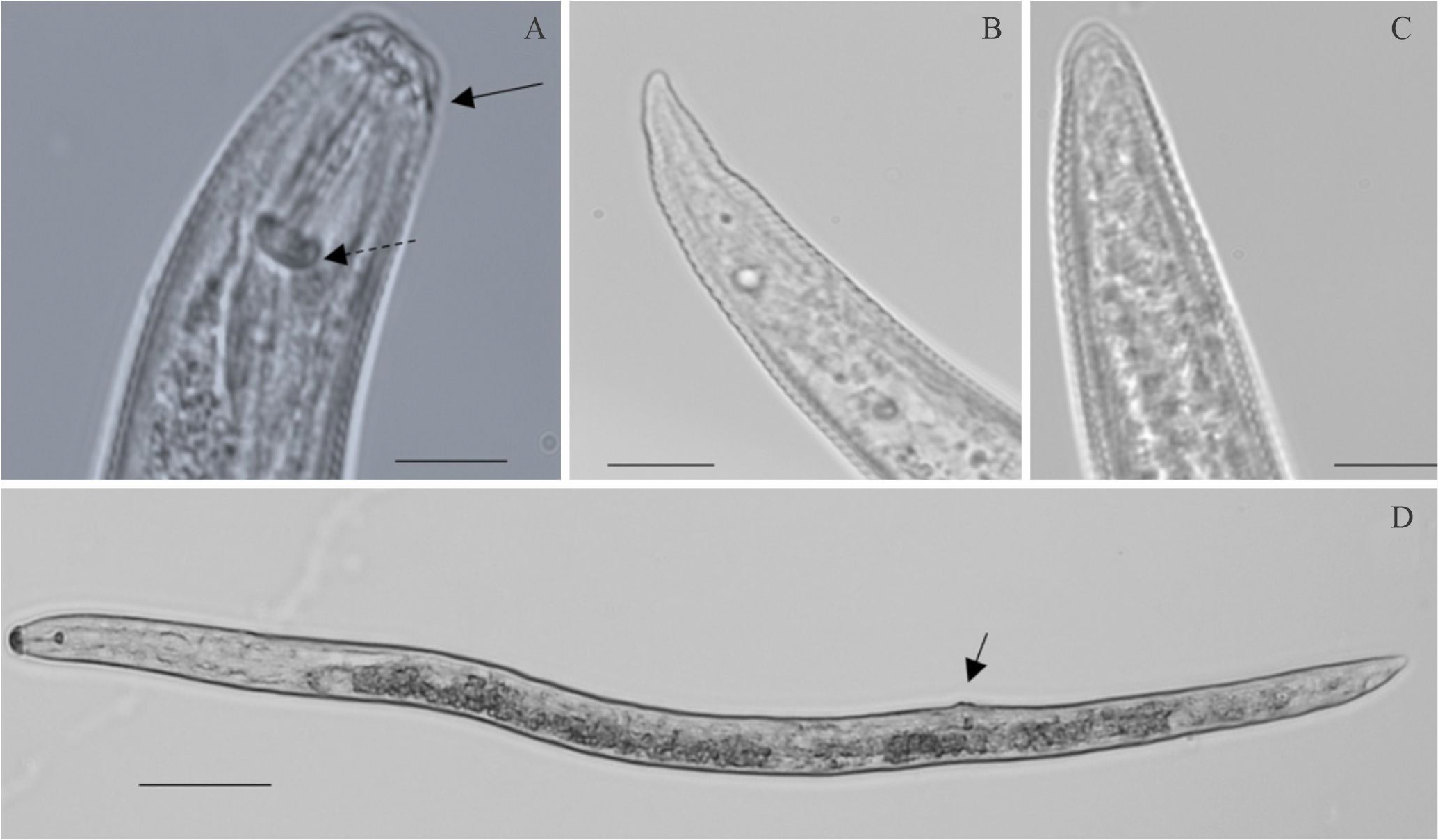
The study revealed that the morphological and morphometric characteristics of the females of all populations studied were consistent with established scientific descriptions cited in the literature (Graham, 1951 cited by Castillo & Vovlas, 2007; Sher & Allen, 1953 cited by Castillo & Vovlas, 2007; Troccoli et al., 2016). Males were not observed in any of the samples. A slender body that remained almost straight after death, with a not offset labial region, characterized the females (Figure 1 A). The body length (L) varied from 355 to 555 µm. Further analysis of variance showed that populations BF5, JP3, MR2, MR5, OD2, and SJ2 had the highest values of L for females, while ES3 and ES4 had the lowest values (Table 4).
Morphometric characters (µm) of Pratylenchus zeae populations collected from sugarcane mills in the Brazilian Northeast region(1).

Pratylenchus zeae female morphology: labial region not offset from the body (continuous arrow) and well-developed and flat stylet knobs (discontinuous arrow) (A); tail tip shapes (B and C); and entire female body, evidencing the anterior position of the vulva (arrow) (D). Scale bars correspond to 10 µm.
Body diameter was measured at three points, showing variation. At the anus (BDA), it ranged from 7.58 to 15.15 µm; at the vulva (BDV), from 12.62 to 22.72 µm; and in the middle of the body (BD), from 10.10 to 22.72 µm. The stylet length (St) was found to be robust, varying from 13.20 to 17.60 µm. Its basal structure was characterized by well-developed and flat basal knobs (Figure 1 A), confirmed by the measurements of the knob height (HStk), which varied from 2.02 to 5.05 µm and the knob width (WStk), ranging from 2.02 to 3.03 µm. Figure 2 shows the anterior end of a female from each sugarcane mill.

Anterior end morphology of Pratylenchus zeae females from six sugarcane mills: Baía Formosa (A); Japungu (B); Olho d´Água (C); Estivas (D); São José (E); Miriri (F). Scale bars correspond to 5 µm.
The identification of Pratylenchus spp. is often challenging due to the high degree of interspecific overlap in some morphological characteristics. However, the morphological and morphometric characteristics found in the females evaluated in this study were consistent with previous reports for P. zeae (Troccoli et al., 2016). Although the values for body length and stylet length varied, they fit the descriptions for P. zeae (Castillo & Vovlas, 2007). The presence of well-developed and flat stylet knobs is considered a diagnostic and characteristic feature of this particular nematode species (Loof, 1991 cited by Castillo & Vovlas, 2007).
The final morphological analysis revealed that the tail shape (Figures 1 B and C) varied from a pointed shape (Figure 1 B) to more rounded and subacute shapes (Figure 1 C), consistent with other P. zeae populations in Brazil described by Jesus et al. (2020). The tail length (T) varied from 15.15 to 40.40 µm, with the highest values observed in populations BF2, BF5, JP1, JP2, and JP3 (Table 4). Females’ anatomy showed an overlapping of the esophageal glands over the intestine and an anterior position of the vulva (Figure 1 D). The vulva position, measured from the labial region, expressed as a percentage of the total body length (V%), varied from 63.59 to 77.80 µm (Table 5), and post-uterine branch (PUB) length was noted to be highly variable across samples (Table 4).
Morphometric ratios and standard deviation of Pratylenchus zeae populations collected from sugarcane mills in the Brazilian Northeast region(1).
The lowest values for vulva position expressed as a percentage of total body length (V%) were found in the populations BF3, BF4, BF5, ES2, ES5, JP1, JP2, JP3, JP4, MR2, OD2, OD3, OD4, SJ4, and SJ5 (Table 5). V% was found to be a more stable variable for diagnosing P. zeae, since the species is characterized by low values of this variable (Castillo & Vovlas, 2007). Therefore, the overall morphometric values of P. zeae populations studied were in agreement with previous reports by Graham (1951) cited by Castillo & Vovlas, 2007 and revised values by Sher & Allen (1953) cited by Castillo & Vovlas, 2007 and the measurements from topotype specimens analyzed by Troccoli et al. (2016) (Table 6).
Comparative morphometrics (µm) of Pratylenchus zeae populations from Brazilian Northeast region with those of the original and revised descriptions.
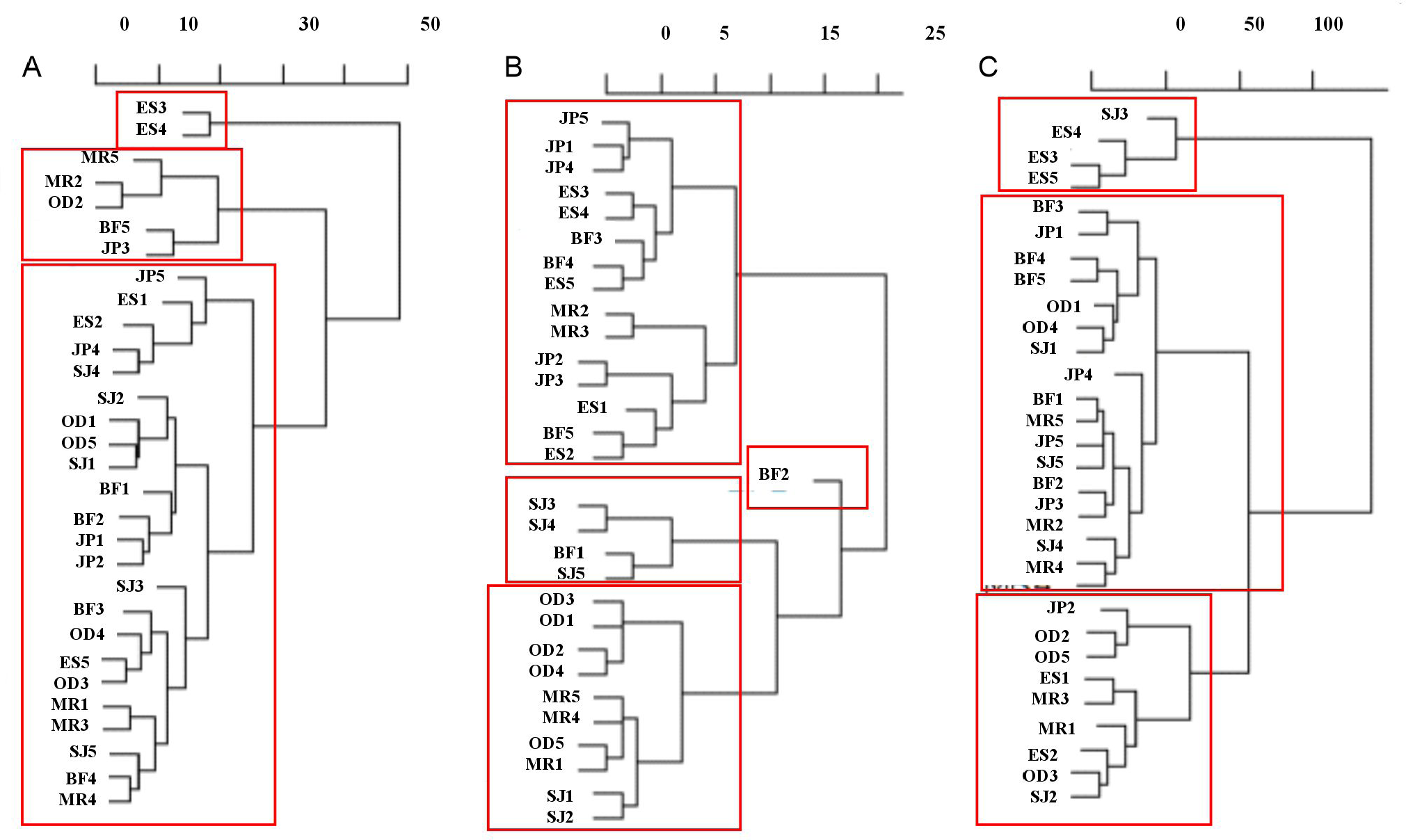
Principal component analysis (PCA), based on morphometric data and on the de Man’s indices, showed that 33.97% of the total variation was associated with the ratios tail length/ tail diameter at anus (c’) and 20.22% with the V%. Subsequent cluster analysis (Ward), derived from PCA scores, allowed the separation of the populations into three distinct and well-defined groups: ES3 and ES4; MR5, MR2, OD2, BF5, and JP3; and all the other populations (Figure 3 A). This intraspecific variation was also reported for other Pratylenchus species, such as P. brachyurus (Machado et al., 2015) and P. coffeae (Lira et al., 2014). Such morphological and morphometrical intraspecific variations within a species are often linked to environmental factors, with geographical isolation playing a critical role (Doucet et al., 2001). However, the results indicated that there is not a clear relationship between the morphometry of P. zeae populations and the localities where they were collected, since populations originating from the same sugarcane mill were grouped in distinct clusters.
Dendrograms illustrating the dissimilarity among Pratylenchus zeae populations determined by Ward algorithm, based on Euclidean distance, calculated from: the average of morphometrical characteristics (A), morphometrical characteristics and physical properties of soil samples (B), and morphometrical characteristics and chemical analysis of soil samples (C). The samples were collected from sugarcane mills in the Brazilian Northeast region: Baía Formosa-BF, Estivas-ES, Japungu-JP, Miriri-MR, Olho d’Água-OD, and São José-SJ.
The multivariate canonical correspondence analysis was utilized to link the P. zeae morphometric data with both physical (Table 2) and chemical characteristics of the soil samples (Table 3). The results showed that 77.30% was associated with sand and 62.27% with H+Al of the total variation, and only 22.70% was associated with clay and 23.70% with SB. Subsequent the cluster analysis based on morphometric data and physical characteristics of the soil, populations were divided into four distinct and well-defined groups: i) BF2, with the highest clay content in soil samples (74%); ii) SJ3, SJ4, BF1, and SJ5, with high silt content in the soil samples (> 20%); iii) OD3, OD1, OD2, OD4, MR5, MR4, OD5, MR1, SJ1, and SJ2, with high clay content of in soil samples (< 59%); and iv) all the other populations with high sand content (> 35%) (Figure 3 B). The clay content was the critical factor, separating population BF2 into an individual group due to its highest clay content. The effect of soil on the morphometric characteristics was observed in BF2 by its high value of the ratio body length/ greatest body diameter (‘a’), indicating that the clay content may have influenced the nematode’s body diameter.
The clustering analysis based on morphometric data and chemical characteristics of the soil (Table 3) separated populations into three groups: i) SJ3, ES4, ES3, and ES5, with the highest values of V and pH in the soil samples; ii) JP2, OD2, OD5, ES1, MR3, MR1, ES2, OD3, and SJ2, with high content of calcium; and III) all the other populations with the lowest values of V (< 49%) (Figure 3 C). Based on these results, the chemical characteristics of soil, V, pH, and calcium content, may be responsible for the morphological clustering.
Apparently, soil characteristics that influence host nutrition can affect the morphometry of P. zeae populations. Soils that provide adequate levels of nutrition, pH and V allow host plants to develop better, which, in turn, influence nematode characteristics. Olowe & Corbett (1984) reported that the body length of P. zeae was larger when the nematodes fed on host roots grown on White’s nutrient medium than those on Krusberg’s or Carew’s media.
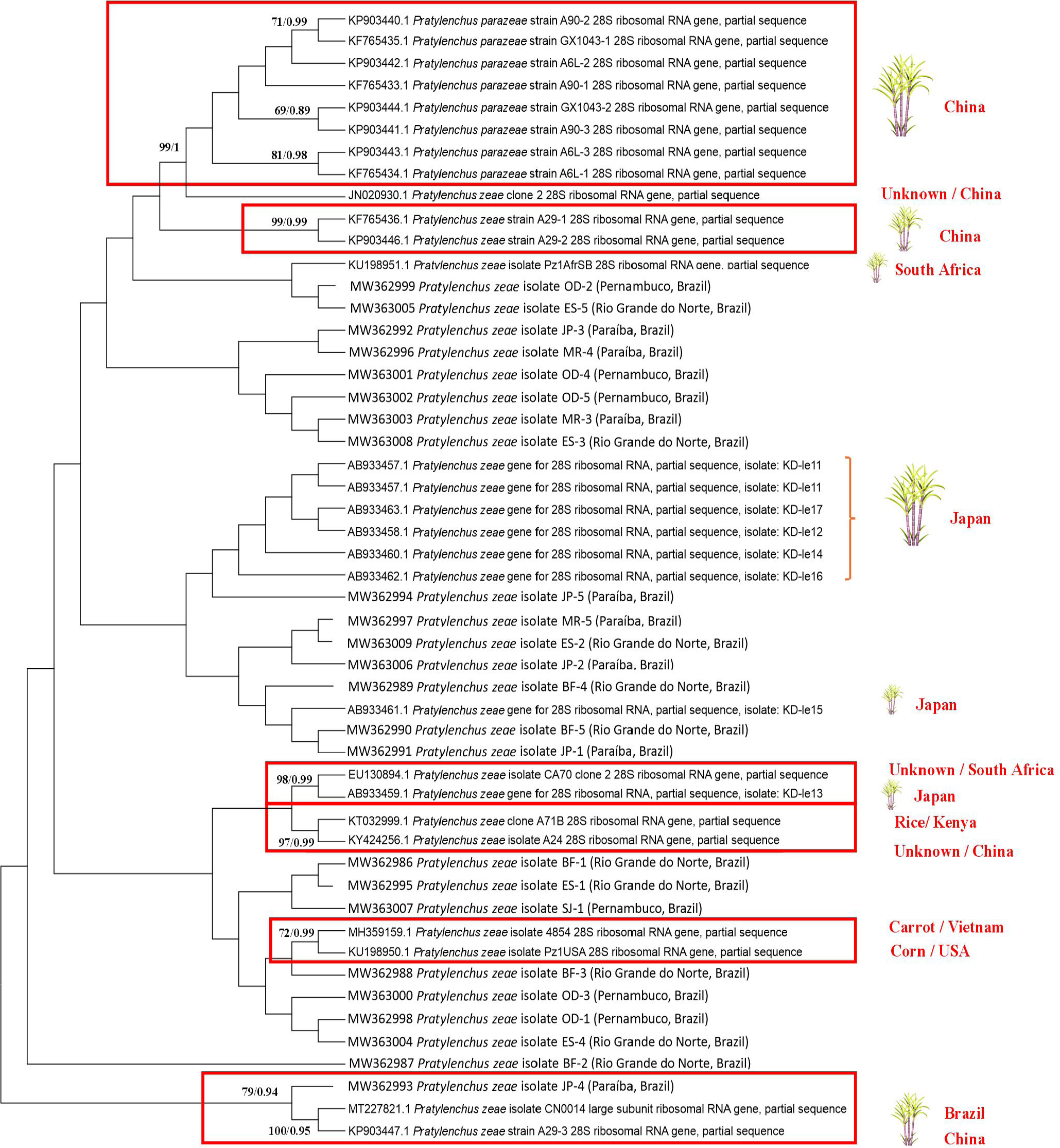
The phylogenetic analysis, comparing the studied sequences with other populations of P. zeae from GenBank, collected from various hosts and localities, suggested that the clustering was driven by the host, since the P. zeae populations collected in sugarcane fields were grouped together, independently of the locality.
BLAST analysis revealed homology (> 90%) with another P. zeae populations collected from sugarcane available in GenBank (Figure 4). Additionally, the amplifications resulted in fragments of 750 bp for D2-D3. Based on these sequences, a Bayesian phylogenetic tree was constructed in which all presently groups could be recognized with 89% to 100% support in their posterior probability. The tree inferred from the alignment of D2-D3 sequences (430 bp) of P. zeae populations, along with 19 D2-D3 sequences (430 bp) of P. zeae found in GenBank (AB933457-AB933463; KU198951; MT227821; MH359159; EU130894; KT032999; KY424256; JN020930; KF765436; KP903446; KP903447), including the topotype sequence KU198950 (Troccoli et al. 2016), and eight D2-D3 sequences (430 bp) of P. parazeae (KF765433-KF765435; KP903440-KP903444) from Wang et al. (2015). The tree indicated that all populations of P. parazeae grouped separately from P. zeae populations. The difficulty in distinguishing these species underscores the need to prevent the introduction of P. parazeae into Brazilian sugarcane growing regions, as its symptoms are similar to those caused by P. zeae or P. brachyurus, complicating diagnosis and, consequently, increasing the damage to the crop.

Phylogenetic tree generated by Bayesian inference and maximum likelihood, resulting from the alignment of the D2-D3 sequences of Pratylenchus zeae. The nematodes were found in soil samples collected in sugarcane mills from the Brazilian Northeast region: Baía Formosa-BF, Estivas-ES, Japungu-JP, Miriri-MR, Olho d’Água-OD, and São José-SJ. The P. zeae and P. parazeae D2-D3 sequences are from GenBank. Numbers on the branches are percentages of 10,000 replicates of MEGA6-maximum likelihood /Mr Bayes’ Bayesian posterior probabilities. The tree is unrooted.
Moreover, all P. zeae populations from sugarcane clustered together in the largest group, except MT227821 + KP903447, KP903446 + KF765436, and AB933459, which clustered together in separate groups. Furthermore, P. zeae populations collected from different hosts clustered in different groups, such as carrot (MH359159) and corn (KU198950), and rice (KT032999) and an unknown host (KY424256) (Figure 4). The basal branches separating these groups were supported by Bayesian posterior probabilities and booststrap, and some deeper internal branches of P. parazeae populations received strong support (99%/1.0).
Conclusions
-
1. Morphological analysis of Pratylenchus spp. collected from sugarcane mills suggests that the species present in the Brazilian Northeast region is P. zeae.
-
2. Morphometric data show overlap with previous described Pratylenchus species but support the identification of P. zeae as the species present in the analyzed samples.
-
3. Molecular analysis confirms that all Pratylenchus populations collected from sugarcane mills in the Brazilian Northeast belong to the species P. zeae.
-
4. Soil clay content and chemical characteristics affect the morphometry of Pratylenchus zeae populations.
Declaration of use of AI technologies
No generative artificial intelligence (AI) was used in this study.
Acknowledgment
To Conselho Nacional de Desenvolvimento Científico e Tecnológico (CNPq), for funding this research.
Disclaimer/Publisher’s note:
The statements, opinions, and data contained in all texts published in Pesquisa Agropecuária Brasileira (PAB) are solely those of the individual author(s) and not of the journal’s publisher, editor, and editorial team, who disclaim responsibility for any injury to people or property resulting from any referred ideas, methods, instructions, or products.
The mention of specific chemical products, machines, and commercial equipment in the texts published in this journal does not imply their recommendation by the publisher.
Data availability statement
Data available upon request: research data are only available upon reasonable request to the corresponding author.
References
-
ARAYA, T.Z.; PADILLA, W.P., YUSTE, A.A.; NAVARRETE, C.C.; LIÉBANAS, G.; RIUS, J.E.P.; CASTILLO, P. Root-lesion nematodes of the genus Pratylenchus (Nematoda: Pratylenchidae) from Costa Rica with molecular identification of P. gutierrezi and P. panamaensis topotypes. European Journal of Plant Pathology, v.145, p.973-998, 2016. DOI: https://doi.org/10.1007/s10658-016-0884-z
» https://doi.org/10.1007/s10658-016-0884-z -
BONFIM JUNIOR, M.F.; CONSOLI, E.A.; INOMOTO, M.M.; OLIVEIRA, C.M.G. First report of Pratylenchus crenatus in Brazil. New Disease Reports, v.34, p.7, 2016. DOI: https://doi.org/10.5197/j.2044-0588.2016.034.007
» https://doi.org/10.5197/j.2044-0588.2016.034.007 - CASTILLO, P.; VOVLAS, N. Pratylenchus (Nematoda: Pratylenchidae): diagnosis, biology, pathogenicity and management. Nematology monographs and perspectives Leiden- Boston: Brill Academic Publishers, 2007.
- COURTNEY, W.D.; POLLEY, D.; MILLER, V.I. TAF, an improved fixative in nematode techniques. Plant Disease Reporter, v.39, p.570-571, 1955.
-
DE LEY, P.; FÉLIX, M.A.; FRISSE, L.M.; NADLER, A.; STERNBERG, P.W.; THOMAS, W.K. Molecular and morphological characterisation of two reproductively isolated species with mirror-image anatomy (Nematoda: Cephalobidae). Nematology, v.1, p.519-612, 1999. DOI: https://doi.org/10.1163/156854199508559
» https://doi.org/10.1163/156854199508559 -
DOUCET, M.; LAX, P.; DI RIENZO, J.; PINOCHET, J.; BAUJARD, P. Temperature induced morphometrical variability in an isolate of Pratylenchus vulnus Allen e Jensen, 1951 (Nematoda: Tylenchida). Nematology, v.3, p.1-8, 2001. DOI: https://doi.org/10.1163/156854101300106829
» https://doi.org/10.1163/156854101300106829 -
FERREIRA, E.B.; CAVALCANTI, P.P.; NOGUEIRA, D.A. ExpDes: An R package for ANOVA and experimental designs. Applied Mathematics, v.5, p.2952-2958, 2014. DOI: https://doi.org/10.4236/am.2014.519280
» https://doi.org/10.4236/am.2014.519280 -
GABIA, A.A. Nematoides na cultura da cana-de-açúcar 2019. Available at: <https://promip.agr.br/nematoides-na-cultura-da-cana-de-acucar/>. Accessed on: Feb. 25 2023.
» https://promip.agr.br/nematoides-na-cultura-da-cana-de-acucar/ -
IBGE. Instituto Brasileiro de Geografia e Estatística. Produção de cana-de-açúcar 2025. Available at: <https://www.ibge.gov.br/explica/producao-agropecuaria/cana-de-acucar/br>. Accessed on: Feb. 25 2026.
» https://www.ibge.gov.br/explica/producao-agropecuaria/cana-de-acucar/br -
JANSSEN, T.; KARSSEN, G.; ORLANDO, V.; SUBBOTIN, A.A.; BERT, W. Molecular characterization and species delimiting of plant-parasitic nematodes of the genus Pratylenchus from the penetrans group (Nematoda: Pratylenchidae). Molecular Phylogenetic Evolution, v.117, p.30-48, 2017. DOI: https://doi.org/10.1016/j.ympev.2017.07.027
» https://doi.org/10.1016/j.ympev.2017.07.027 -
JESUS, A.M.; PEDROSA, E.M.R.; REIS, J.B.R.S.; PORTO, A.C.F. Morphological and morphometric characterization of Pratylenchus species in sugarcane cropping areas of Pernambuco state. Revista Caatinga, v.33, p.599-607, 2020. DOI: https://doi.org/10.1590/1983-21252020v33n303rc
» https://doi.org/10.1590/1983-21252020v33n303rc - KÖPPEN, W.; GEIGER, R. Klimate der Erde Gotha: Verlag Justus Perthes, 1928.
-
KUMARI, S. Characterization of Pratylenchus crenatus and P. neglectus (Nematoda: Pratylenchidae) associated with wheat crop. Helminthology, v.52, p.280-286, 2015. DOI: https://doi.org/10.1515/helmin-2015-0043
» https://doi.org/10.1515/helmin-2015-0043 - LIRA, V.L.; ROSA, J.M.O.; OLIVEIRA, A.S., OLIVEIRA, C.M.G.; MOURA, R.M. Morphometric and molecular analysis of Pratylenchus coffeae populations from yam tubers, Pernambuco State, Brazil. Nematropica, v.44, p.152-165, 2014.
-
MACHADO, A.C.Z.; SIQUEIRA, K.M.S.; FERRAZ, L.C.C.B.; INOMOTO, M.M.; BESSI, R.; HARAKAVA, R.; OLIVEIRA, C.M.G. Characterization of Brazilian populations of Pratylenchus brachyurus using morphological and molecular analyses. Tropical Plant Pathology, v.40, p.102-110, 2015. DOI: https://doi.org/10.1007/s40858-015-0013-0
» https://doi.org/10.1007/s40858-015-0013-0 - MACHADO, A.C.Z.; SILVA, S.A. Extração de nematoides. In: MACHADO, A.C.Z.; SILVA, S.A.; FERRAZ, L.C.C.B. (Eds.). Métodos em Nematologia Agrícola Piracicaba: Sociedade Brasileira de Nematologia, 2019. p.9-33.
-
METROPOLIS, N.; ROSENBLUTH, A.W.; ROSENBLUTH, M.N.; TELLER, A.H.; TELLER, E. Equation of state calculations by fast computing machines. The Journal of Chemical Physics, v.21, p.1087, 1953. DOI: https://doi.org/10.1063/1.1699114
» https://doi.org/10.1063/1.1699114 -
NORONHA, M.A.; MUNIZ, M.F.S.; CRUZ, M.M.; ASSUNÇÃO, M.C.; CASTRO, J.M.C.; OLIVEIRA, E.R.L.; MIRANDA, C.G.S.; MACHADO, A.C.Z. Meloidogyne and Pratylenchus species in sugarcane fields in the state of Alagoas, Brazil. Ciência Rural, v.47, p.1-3, 2017. DOI: https://doi.org/10.1590/0103-8478cr20151402
» https://doi.org/10.1590/0103-8478cr20151402 - OKSANEN, F.J.; BLANCHET, G.; FRIENDLY, M.; KINDT, R.; LEGENDRE, P.; MCGLINN, D.; PETER, R.; MINCHIN, P.R.; O’HARA, R.B.; SIMPSON, G.L.; SOLYMOS, P.; STEVENS, M.H.H.; SZOECS, E.; WAGNER, H. Vegan: Community Ecology Package 2017. R package version 2.4-3.
-
OLIVEIRA, C.M.G.; MONTEIRO, A.R.; BLOK, V.C. Morphological and molecular diagnostics for plant-parasitic nematodes: working together to get the identification done. Tropical Plant Pathology, v.36, p.65-73, 2011. DOI: https://doi.org/10.1590/S1982-56762011000200001
» https://doi.org/10.1590/S1982-56762011000200001 - OLOWE, T.; CORBETT, D.C.M. Morphology and morphometrics of Pratylenchus brachyurus and P. zeae II. Influence of environmental factors. Indian Journal of Nematology, v.14, p.30-35, 1984.
- R CORE TEAM. R A language and environment for statistical computing 2015. R Foundation for Statistical Computing, Vienna, Austria.
- RAMOUTHAR, P.V.; BHUIYAN, S.A. Nematode parasites of sugarcane. In: SIKORA, R.; COYNE, D.; HALLMANN, J.; TIMPER, P. (Eds.). Plant parasitic nematodes in subtropical and tropical agriculture 3rd edition, CAB International, Wallingford, UK, 2018. p.658-686.
- RAMOUTHAR, P. Pratylenchus in sugarcane: A diminishing problem? In: SIKORA, R.A.; DESAEGER, J.; MOLENDIJK, L.P.G. (Eds.). Integrated nematode management: State-of-the-art and visions for the future 1st edition, CABI International, Wallingford, UK, 2022, p.66-72.
- SANGER, F.; NICKLEN, S.; COULSON, A.R. DNA sequencing with chain-terminating inhibitors. Proceedings of the National Academy of Sciences, v.72, p.5463-5467, 1977.
-
SILVA, L.M.A.; PEDROSA, E.M.R.; VICENTE, T.F.S.; CARDOSO, M.S.O.; CASTRO, D.B.; ROLIM, M.M. Seasonal variation of plant-parasitic nematodes and relationship with nutritional and growth properties of sugarcane plantations. Tropical Plant Pathology, v.42, p.132-136, 2017. DOI: https://doi.org/10.1007/s40858-017-0129-5
» https://doi.org/10.1007/s40858-017-0129-5 -
TROCCOLI, A.; SUBBOTIN, S.A.; CHITAMBAR, J.J.; JANSSEN, T.; WAEYENBERGE, L.; STANLEY, J.D.; DUNCAN, L.W.; AGUDELO, P.; MÚNERA URIBE, G.; FRANCO, J.; INSERRA, R. Characterisation of amphimictic and parthenogenetic populations of Pratylenchus bolivianus Corbett, 1983 (Nematoda: Pratylenchidae) and their phylogenetic relationships with closely related species. Nematology, v.18, p.651-678, 2016. DOI: https://doi.org/10.1163/15685411-00002981
» https://doi.org/10.1163/15685411-00002981 -
WANG, H.; ZHUO, K.; YE, W.; LIAO, J. Morphological and molecular characterization of Pratylenchus parazeae n. sp. (Nematoda: Pratylenchidae) parasitizing sugarcane in China. European Journal of Plant Pathology, v.143, p.173-191, 2015. DOI: https://doi.org/10.1007/s10658-015-0674-z
» https://doi.org/10.1007/s10658-015-0674-z - WARD, J.H. Hierarchical grouping to optimize an objective function. Journal of the American Statistical Association, v.58, p.236-244, 1963.
-
ZHANG, Z.; SCHWARTZ, S.; WAGNER, L.; MILLER, W. A greedy algorithm for aligning DNA sequences. Journal of Computational Biology, v.7, p.203-214, 2000. DOI: https://doi.org/10.1089/1066527005008147
» https://doi.org/10.1089/1066527005008147
Edited by
-
Chief editor:
Edemar Corazza
-
Edited by:
Mírian Baptista