 Reproduction and symptoms caused by Meloidogyne enterolobii and Meloidogyne incognita in soybean
Abstract
The objective of this work was to evaluate the reproduction of Meloidogyne enterolobii and Meloidogyne incognita and the caused symptoms in two soybean (Glycine max) cultivars under different inoculum concentrations. Two greenhouse experiments were conducted using the M7198IPRO (moderately resistant to M. incognita) and IMA 731 IPRO (susceptible to M. incognita) soybean cultivars. Each plant was inoculated with 0, 300, 1,000, 3,000, 9,000, and 27,000 nematodes from both species. Meloidogyne enterolobii causes a more severe root galling in soybean plants and also exhibits a higher reproduction rate on soybean roots. Therefore, this species overcomes the resistance found in soybean cultivars that are moderately resistant to M. incognita.
Index terms:
Glycine max; cultivars; reproduction; root-knot nematodes.
Resumo
O objetivo deste trabalho foi avaliar a reprodução de Meloidogyne enterolobii e Meloidogune incognita e os sintomas causados em duas cultivares de soja (Glycine max) sob diferentes concentrações de inóculo. Foram conduzidos dois experimentos em casa de vegetação, tendo-se utilizado as cultivares de soja M7198IPRO (moderadamente resistente à M. incognita) e IMA 731 IPRO (suscetível à M. incognita). Cada planta foi inoculada com 0, 300, 1.000, 3.000, 9.000 e 27.000 nematoides de ambas as espécies. Meloidogyne enterolobii causa um galhamento radicular mais severo em plantas de soja e também apresenta uma taxa de reprodução mais elevada em raízes de soja. Portanto, essa espécie supera a resistência presente em cultivares de soja moderadamente resistentes à M. incognita.
Termos para indexação:
Glycine max; cultivares; reprodução; nematoides-das-galhas.
Introduction
The Meloidogyne enterolobii (Syn. Meloigdogyne mayaguensis) nematode was first detected in Brazil in 2001, where it caused damage to guava crops in the municipalities of Petrolina, Pernambuco, and Curaçá and Juazeiro, Bahia (Carneiro et al., 2001). In 2008, its presence was later confirmed in soybean crops when Almeida et al. (2008), while studying a Meloidogyne sp. population obtained from soybean roots exhibiting galls in the municipality of Ituverava, São Paulo, certified this as the first record of M. enterolobii in this crop in the country.
In the years following its initial detection, M. enterolobii was reported across various regions of Brazil, parasitizing a wide range of plant species, including vegetables, fruit trees, ornamental plants, cover crops, spice plants, medicinal plants, and weeds (Castro, 2019). A similar situation has been observed in several parts of the world. In the United States of America, M. enterolobii is considered one of the ten most important emerging plant-parasitic nematodes (Kantor et al., 2022; Gaudin et al., 2023).
Meloidogyne enterolobii is characterized by its ability to overcome resistance conferred by genes, such as Mir 1 gene, against other Meloidogyne spp. in several plant species, including soybean (Cetintas et al., 2008). So far, there have been no reports of severe damage caused by M. enterolobii in soybean crops (Sikora et al., 2018; Soares & Nascimento, 2022), which may partly be due to the misidentification of the nematode. The intense reproduction of this nematode in soybean fields is a key issue, considering that approximately 85% of cotton in Brazil is grown after soybean cultivation. Given that M. enterolobii has been characterized as more aggressive than M. incognita in cotton crops (Asmus et al., 2024), its establishment in the soybean-cotton rotation could create an ideal scenario for its rapid proliferation in the Brazilian Cerrado biome, potentially causing severe damage to cotton crops.
The objective of this work was to evaluate the reproduction of Meloidogyne enterolobii and Meloidogyne incognita and the caused symptoms in two soybean cultivars under different inoculum concentrations.
Materials and Methods
The study evaluated the reproduction and symptoms caused by increasing inoculum concentration of M. enterolobii and M. incognita in two soybean cultivars across two distinct greenhouse experiments. Experiment 1 was conducted in the municipality of Dourados, in the state of Mato Grosso do Sul, and Experiment 2 in Primavera do Leste, in the state of Mato Grosso, Brazil. The tested soybean cultivars were M7198IPRO, moderately resistant to M. incognita, and IMA 731 IPRO, susceptible to M. incognita. Both cultivars were inoculated with concentrations of 0, 300, 3,000, 9,000, and 27,000 nematode eggs and second-stage juveniles per plant. Experiment 1 included an additional inoculum concentration of 1,000 nematodes per plant.
The populations of M. incognita and M. enterolobii used in the experiments originated from parasitized cotton roots in the municipalities of Primavera do Leste, Mato Grosso, and Paracatu, in the state of Minas Gerais. Both species were previously characterized in earlier studies (Galbieri et al., 2020, 2021; Verssiani et al., 2023; Asmus et al., 2024) and were maintained and multiplied on ‘Rutgers’ tomato [Lycopersicon lycopersicum (L.) H.Karst.] plants.
The experiments followed a completely randomized design, in a 6×2×2 factorial arrangement, including six inoculum concentrations, two Meloidogyne species, and two soybean cultivars. The number of replicates varied between the two locations: six replicates in Dourados and eight replicates in Primavera do Leste.
Experiment 1 was initiated on February 17, 2023. Three untreated seeds of each soybean cultivar (M7198IPRO and IMA 731 IPRO) were sown in 2.25 L plastic pots containing 2.0 L of substrate composed of 683 g kg-1 sand, 4.8 g kg-1 silt, and 26.9 g kg-1 clay. The substrate had been disinfected via solarization and fertilized with 6.0 g of N-P-K (20-20-20). Five days after sowing, the seedlings were thinned to retain a single soybean plant per pot. Five days later, the plants were inoculated with different population densities of M. incognita and M. enterolobii. The inoculum containing in 5.0 mL suspensions was deposited in two holes approximately 2.0 cm deep and 1.0 cm away from the plant stem.
The pots were irrigated daily using drip irrigation in three watering cycles, totaling approximately 200 mL of water per plant per day. The experiment was conducted inside a greenhouse equipped with an automated temperature control system. The average air temperature within the greenhouse was approximately 28°C, with temperature extremes recorded at a minimum of 12.0 and maximum of 34.5ºC.
The final sampling and analysis occurred 60 days after inoculation on April 26, 2023. Shoots were harvested by cutting the stems at the base and were then placed in a drying oven at 55°C for seven days to determine the shoot dry matter (SDM). The roots were carefully cleaned of substrate under running water, dried on absorbent paper for approximately 20 minutes to remove excess moisture, and then weighed to determine the fresh weight. Subsequently, they were analyzed for the gall index (GI), using the Taylor & Sasser (1978) methodology, then processed for egg extraction following the Coolen & D’Herde (1972) method. Based on the fresh root mass and the number of eggs extracted from each root system, two parameters were calculated: the number of eggs per gram of root (NEMAG) and the reproduction factor (RF), defined as RF = total number of eggs extracted from the root / number of eggs used for inoculation.
Experiment 2, initiated on March 10, 2023, followed the same procedures used in Experiment 1, but with some specific adjustments. The experiment was conducted in a greenhouse with an automated temperature control system set to approximately 27°C. The substrate differed, containing 79.5 g kg-1 sand, 5.0 g kg-1 silt, and 15.5 g kg-1 clay, sterilized in autoclave at 120°C for 15 min, and fertilized with 2.0 g of N-P-K (20-20-20). Irrigation was performed manually as needed. Additionally, topdressing fertilization was applied 15 days after inoculation (DAI), using 2.0 g of a low-release N-P-K (14-14-14) formulation per pot. To manage aphids, an insecticide spray with Thiamethoxam (0.25 g a.i. per liter of water) was applied at 32 DAI.
The data obtained from both experiments were subjected to the analysis of variance (ANOVA). When the effect of the quantitative variable (nematode population density) was considered significant, an additional ANOVA for polynomial regression of treatment effects was performed. This analysis aimed to determine the best-fitting statistically significant function based on the highest coefficient of determination (R2). To meet the assumption of normal distribution before ANOVA, the data for NEMAG and RF variables were log-transformed (log(x+1)). All statistical analyses were conducted using the AgroEstat software (Barbosa & Maldonado Júnior, 2015).
Results and Discussion
The symptoms caused by M. incognita and M. enterolobii on soybean plants were evaluated using the shoot dry matter (SDM) and the gall index. The SDM of soybean plants from both cultivars was significantly affected by increasing inoculum concentrations of M. incognita and M. enterolobii (Table 1). This relationship followed a linear trend in both Experiment 1 (y = 37.0963 - 0.00021x; R2 = 0.68**) and Experiment 2 (y = 6.1644 - 0.00003x; R2 = 0.66**). Although no significant differences in SDM were observed between the Meloidogyne species, 'M7198IPRO' produced a significantly greater SDM than 'IMA 731 IPRO' (Table 1). Furthermore, no significant interactions were found among any of the factors tested.
Shoot dry matter (g) of the M7198IPRO and IMA 731 IPRO soybean (Glycine max) cultivars under root-knot nematode inoculation (Meloidogyne incognita vs. Meloidogyne enterolobii) in the municipalities of Dourados (Experiment 1) and Primavera do Leste (Experiment 2) in the states of Mato do Grosso do Sul and Mato Grosso, respectively, Brazil(1).
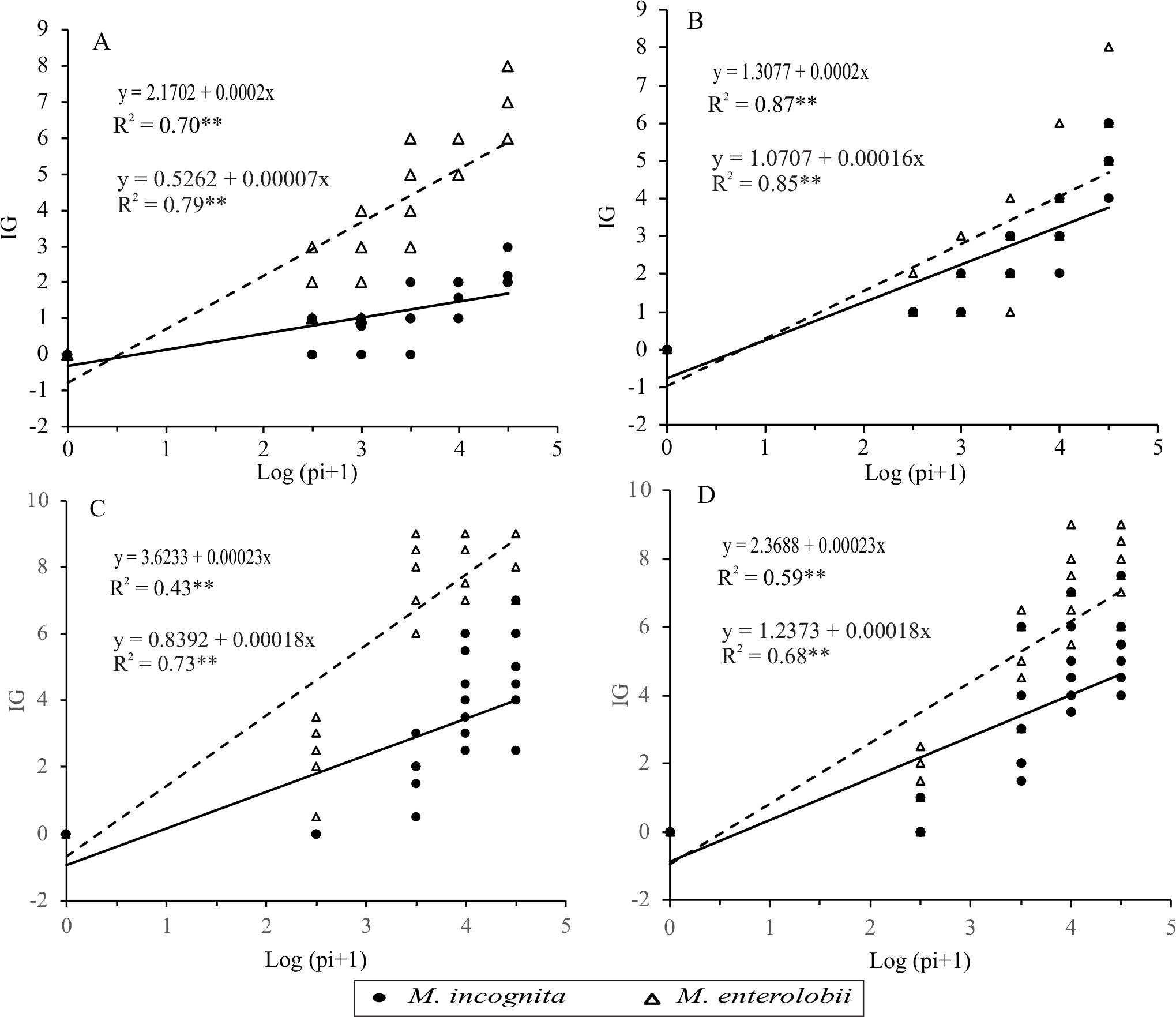
The gall index (GI) was significantly affected by increasing inoculum concentrations of M. incognita and M. enterolobii in both experiments (Figure 1). Significant interactions were observed among all factors in Experiment 1, and between inoculum density and cultivars in Experiment 2. Across both experiments, the GI was consistently higher in plants inoculated with M. enterolobii. While Experiment 1 showed no significant difference in GI between the two cultivars, in Experiment 2, 'M7198IPRO' exhibited a higher GI than 'IMA 731 IPRO' (Table 2).
Comparative gall index response of the M7198IPRO and IMA 731 IPRO soybean (Glycine max) cultivars to inoculation with Meloidogyne incognita (Mi) and Meloidogyne enterolobii (Me) in the municipalities of Dourados (Experiment 1) and Primavera do Leste (Experiment 2) in the states of Mato do Grosso do Sul and Mato Grosso, respectively, Brazil(1).

Root gall index as a function of increased inoculum concentrations (Pi) of Meloidogyne incognita (solid line) and Meloidogyne enterolobii (dashed line), obtained for the M7198IPRO and IMA 731 IPRO soybean (Glycine max) cultivars in Experiment 1 (A and B, respectively) and Experiment 2 (C and D, respectively).
The multiplication of M. incognita and M. enterolobii was assessed in the cultivars studied using two key parameters: nematodes per gram of root (NEMAG) and reproduction factor (RF). NEMAG quantified the total number of nematodes produced in the roots throughout the experimental period, while RF was calculated as the ratio between the total number of nematodes recovered from the roots at the end of the experiments and the initial number of nematodes inoculated on each soybean plant.
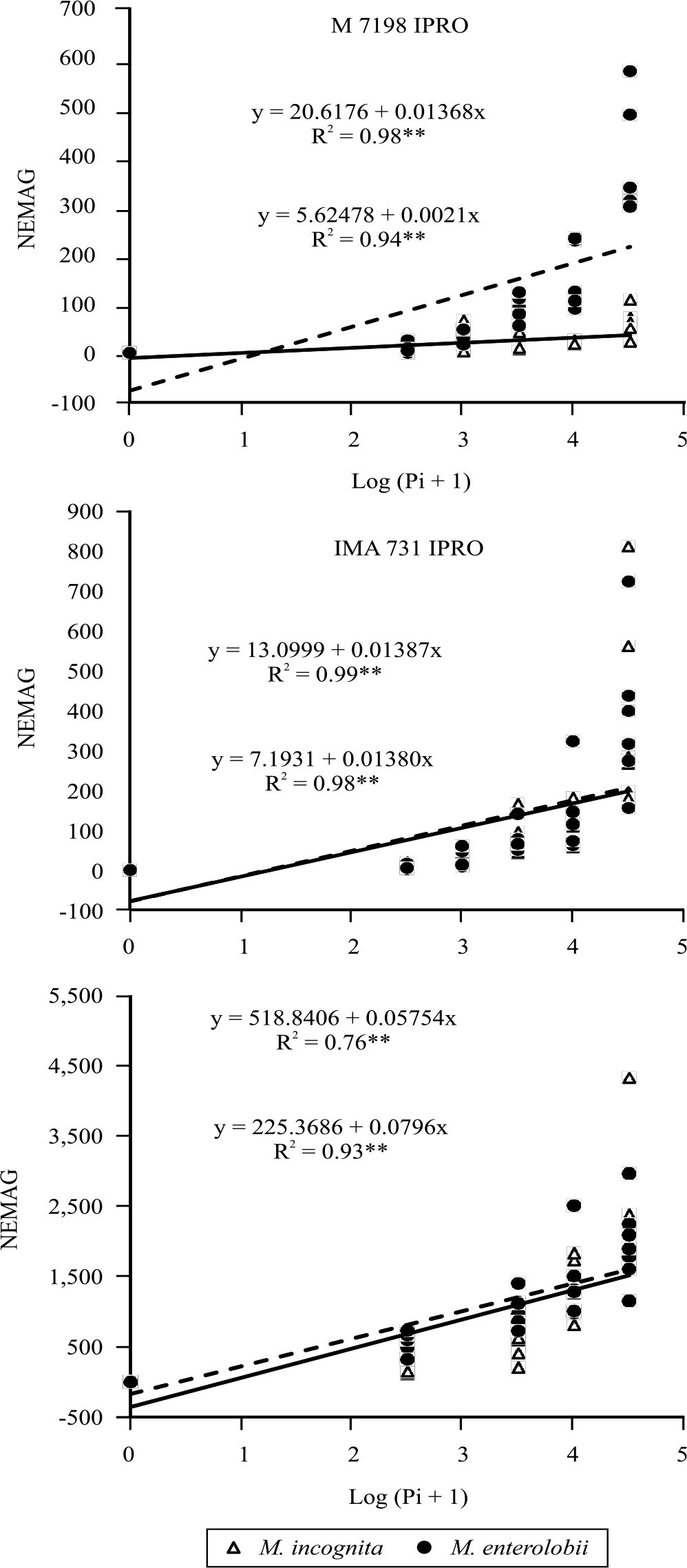
The number of nematodes per gram of root (NEMAG) was significantly affected by inoculum concentration in both experiments (Figure 2). In Experiment 2, there was no significant interaction between nematode inoculum concentrations and soybean cultivars, and no significant differences were found between cultivars or between M. incognita and M. enterolobii for this variable (Table 3). In contrast, Experiment 1 showed significant differences: the NEMAG of M. incognita on 'IMA 731 IPRO' was significantly higher than on 'M7198IPRO'. Furthermore, when considering only 'M7198IPRO', the NEMAG of M. enterolobii was significantly higher than that of M. incognita.
Nematode population density, expressed as the number of eggs and second-stage juveniles (J2) per gram of root for Meloidogyne incognita (Mi) and Meloidogyne enterolobii (Me) on the M7198IPRO and IMA 731 IPRO soybean (Glycine max) cultivars in the municipalities of Dourados (Experiment 1) and Primavera do Leste (Experiment 2) in the states of Mato do Grosso do Sul and Mato Grosso, respectively, Brazil(1).

Number of nematodes per gram of root (NEMAG), as a function of increased inoculum concentrations (Pi) of Meloidogyne incognita (solid line) and Meloidogyne enterolobii (dashed line), obtained for the M7198IPRO and IMA 731 IPRO soybean (Glycine max) cultivars in Experiment 1 (A and B, respectively). No significant differences were observed between the studied cultivars in Experiment 2 (C).
The RF was affected by inoculum concentrations of both M. incognita and M. enterolobii in both experiments. The reproduction of both nematodes was lower in Experiment 1, likely due to the low nighttime temperatures (<12.5°C) occurring in the second half of April. Nevertheless, significantly higher RF values were observed in plants inoculated with M. enterolobii and in 'IMA 731 IPRO' (Table 4). Furthermore, a significant interaction was detected between inoculum concentration and nematode species, showing that the response of RF to increasing inoculum concentrations was only significant for M. enterolobii, following the model y = 0.67282 + 0.00083x - 0.00000012x2 + 0.0000000000032154x3; R2 = 0.58**.
Reproduction factor of Meloidogyne incognita (Mi) and Meloidogyne enterolobii (Me) in roots of the M7198IPRO and IMA 731 IPRO soybean (Glycine max) cultivars in the municipalities of Dourados (Experiment 1) and Primavera do Leste (Experiment 2) in the states of Mato do Grosso do Sul and Mato Grosso, respectively, Brazil(1).
A significant interaction was observed among all factors in Experiment 2. A significant difference in RF for M. incognita between the two soybean cultivars was found only in Experiment 1. The high nematode population in Experiment 2 may have affected the expression of resistance in 'M7198IPRO', as it is classified as moderately resistant (Table 4). However, when inoculated with M. enterolobii, 'M7198IPRO' showed a significantly higher RF than 'IMA 731 IPRO' (Table 4). The effect of M. incognita and M. enterolobii inoculum concentrations on RF in both cultivars followed a linear model, with the following equations: for 'M7198IPRO', the equations were y = 33.8508 - 0.00135x (R2 = 0.16**) for M. incognita and y = 8.9999 - 0.00023x (R2 = 0.12**) for M. enterolobii; for 'IMA 731 IPRO', y = 19.6211 - 0.00072x (R2 = 0.18**) for M. incognita and y = 9.76661 - 0.00024x (R2 = 0.10**) for M. enterolobii.
Meloidogyne enterolobii is recognized as an emerging nematode in several economically important crops (Castro, 2019; Kantor et al., 2022). A major characteristic contributing to its increasing threat is its virulence, specifically its ability to overcome resistance genes that are effective against other Meloidogyne species (Gaudin et al., 2023).
Based on SDM, M. enterolobii was not found to cause greater damage than M. incognita to the two tested soybean cultivars. Furthermore, the reduction observed in the SDM as a function of nematode inoculum concentration was similar for both species. However, the greater pathogenicity of M. enterolobii compared with M. incognita was evident in the evaluation of the GI. 'M7198IPRO', which carries resistance to M. incognita, exhibited higher GI values than 'IMA 731 IPRO', which is susceptible to M. incognita.
The presence of galls in cultivars carrying resistance genes against other Meloidogyne species serves as an important indicator of M. enterolobii infestation. In cotton, for instance, the occurrence of galls in a cultivar carrying the qMi-C11 and qMi-C14 genes, which confer resistance to M. incognita, was an indicative sign of M. enterolobii presence, which was later confirmed in the crop (Galbieri et al., 2020). With the increasing adoption of M. incognita-resistant cultivars, whether in soybean or cotton, new detections of M. enterolobii will likely become more frequent, potentially altering its current geographic distribution.
The higher values of nematodes per gram of root (NEMAG) and the RF observed in plants inoculated with M. enterolobii indicate its greater reproductive capacity compared with M. incognita. This increased multiplication of M. enterolobii can be attributed to its shorter life cycle. In a study conducted by Collett et al. (2024), M. enterolobii completed its life cycle five days faster than both M. incognita and Meloidogyne javanica in soybean. Specifically, M. enterolobii required only 195 degree-days to reach the adult female oviposition stage, whereas M. incognita and M. javanica required longer periods of 264 and 248 degree-days, respectively, to reach the same developmental stage.
The results of this study showed that a rapid establishment and population growth of M. enterolobii could be anticipated in areas where it was introduced. Therefore, preventive sanitary measures could play a crucial role in avoiding the potential prevalence of this nematode in soybean and cotton production areas.
The cultivation of soybean cultivars resistant to M. enterolobii is a crucial management strategy for pest management. Currently, however, a limited number of available soybean cultivars in Brazil exhibit this resistance (Correia, 2023). Moreover, no soybean cultivars have yet demonstrated effective resistance against an M. enterolobii populations originating from cotton hosts. While recent research has identified moderate resistance (Verssiani et al., 2023), its efficacy requires further clarification and rigorous assessment under field conditions. Thus, crop rotation or the cultivation of cover crops (Khanal & Harshman, 2022) should be considered in areas confirmed to be infested with the nematodes.
The results indicate that M. enterolobii demonstrates greater pathogenicity than M. incognita, exhibiting a superior capacity to cause primary root galling symptoms and to multiply in soybean crops. It possesses the ability to overcome resistance to M. incognita and represents a potential threat to both soybean cultivation and subsequent cotton crops grown in rotation.
Conclusions
-
1. Meloidogyne enterolobii causes a more severe root galling than Meloidogyne incognita on soybean (Glycine max) plants.
-
2. Meloidogyne enterolobii exhibits a higher reproduction rate than M. incognita on soybean roots.
-
3. Meloidogyne enterolobii overcomes the resistance found in soybean cultivars that are moderately resistant to M. incognita.
Declaration of use of AI technologies
No generative artificial intelligence (AI) was used in this study.
Disclaimer/Publisher’s note:
The statements, opinions, and data contained in all texts published in Pesquisa Agropecuária Brasileira (PAB) are solely those of the individual author(s) and not of the journal’s publisher, editor, and editorial team, who disclaim responsibility for any injury to people or property resulting from any referred ideas, methods, instructions, or products.
The mention of specific chemical products, machines, and commercial equipment in the texts published in this journal does not imply their recommendation by the publisher.
Data availability statement
Data available upon request: research data are only available upon reasonable request to the corresponding author.
References
- ALMEIDA, E.J. de; SOARES, P.L.M.; SILVA; A.R. da, SANTOS, J.M. dos. Novos registros sobre Meloidogyne mayaguensis no Brasil e estudo morfológico comparativo com M. incognita Nematologia Brasileira, v.32, p.236-241, 2008.
-
ASMUS, G.L.; GALBIERI, R.; ARAUJO, A.L.X. de; BELOT, J.L. Comparative pathogenicity of Meloidogyne enterolobii and Meloidogyne incognita in cotton cultivars. Journal of Cotton Science, v.28, p.185-196, 2024. DOI: https://doi.org/10.56454/XFBG9925
» https://doi.org/10.56454/XFBG9925 - BARBOSA, J.C.; MALDONADO JÚNIOR, W. Experimentação Agronômica & AgroEstat: Sistema para análises estatísticas de ensaios agronômicos. Jaboticabal: Multipress, 2015. 396p.
- CARNEIRO, R.M.D.G.; MOREIRA, W.A.; ALMEIDA, M.R.A.; GOMES, A.C.M.M. Primeiro registro de Meloidogyne mayaguensis em goiabeira no Brasil. Nematologia Brasileira, v.25, p.223-228, 2001.
- CASTRO, J.M.C. Meloidogyne enterolobii e sua evolução nos cultivos brasileiros. Informe Agropecuário, v.40, p.41-48, 2019.
- CETINTAS, R.; BRITO, J.A.; DICKSON, D.W. Virulence of four Florida isolates of Meloidogyne mayaguensis to selected soybean genotypes. Nematropica, v.38, p.127-135, 2008.
- COOLEN, W.A; D’HERDE, C.J. A method for the quantitative extraction of nematodes from plant tissue Ghent: State Nematology end Entomology Research Station, 1972. 77p.
-
COLLETT, R.L.; RASHIDIFARD, M.; MARAIS, M.; DANEEL, M.; FOURIE, H. Insights into the life cycle development of Meloidogyne enterolobii, M. incognita and M. javanica on tomato, soybean and maize. European Journal of Plant Pathology, v.168, p.137-146, 2023. DOI: https://doi.org/10.1007/s10658-023-02741-9
» https://doi.org/10.1007/s10658-023-02741-9 - CORREIA, E.T. Resistência ou suscetibilidade de cultivares de soja a Meloidogyne enterolobii raça goiaba 2023. 44p. Trabalho de conclusão de curso (Bacharelado Engenharia Agronômica) - Universidade Estadual Paulista, Jaboticabal.
-
GALBIERI, R; DAVIS, R.F.; SCOZ, L.B.; BELOT, J.L.; SKANTAR, A.M. First report of Meloidogyne enterolobii on cotton in Brazil. Plant Disease, v.104, p.2295, 2020. DOI: https://doi.org/10.1094/PDIS-02-20-0365-PDN
» https://doi.org/10.1094/PDIS-02-20-0365-PDN -
GALBIERI, R.; KOBAYASTI, L.; ALBUQUERQUE, M.C.F.; SÁ, R.O. de; DUTRA, S.G.; TIMPER, P. Castor bean as an option for Meloidogyne incognita management in cotton. International Journal of Pest Management, v.70, p.102-110, 2021. DOI: https://doi.org/10.1080/09670874.2021.1953633
» https://doi.org/10.1080/09670874.2021.1953633 -
GAUDIN, A.G.; WUBBEN, M.J.; McCARTY Jr, J.C; JENKINS, J.N. Virulence of two isolates of Meloidogyne enterolobii (Guava Root-Knot Nematode) from North Carolina on cotton lines resistant to Southern Root-Knot Nematode (M. incognita) and Reniform Nematode (Rotylenchulus reniformis). Journal of Nematology, v.55, e2023-1, 2023. DOI: https://doi.org/10.2478/jofnem-2023-0021
» https://doi.org/10.2478/jofnem-2023-0021 -
KANTOR, M.; HANDOO, Z.; KANTOR, C.; CARTA, L. Top ten most important U.S.-regulated and emerging plant-parasitic nematodes. Horticulturae, v.8, art.208, 2022. DOI: https://doi.org/10.3390/horticulturae8030208
» https://doi.org/10.3390/horticulturae8030208 -
KHANAL, C.; HARSHMAN, D. Evaluation of summer cover crops for host suitability of Meloidogyne enterolobii Crop Protection, v.151, art.105821, 2022. https://doi.org/10.1016/j.cropro.2021.105821
» https://doi.org/10.1016/j.cropro.2021.105821 - SIKORA, R.A; CLAUDIUS-COLE, B.; SIKORA, E.J. Nematode parasites of food legumes. In: SIKORA, R.A. COYNE, D.; HALLMANN, J.; TIMPER, P. (Ed.). Plant parasitic nematodes in subtropical and tropical agriculture 3rd. ed. Boston: CABI, 2018. p.290-345.
- SOARES, P.L.M.; NASCIMENTO, D.D. Integrated nematode management of root lesion and root-knot nematodes in soybean in Brazil. In: SIKORA, R.A.; DESAERGER, J.; MOLENDIJK, L. (Eds.). Integrated nematode management: state-of-the-art and visions for the future. Boston: CABI, 2022. p.103-110.
- TAYLOR, A.L.; SASSER, J.N. Biology, identification and control of root-knot nematodes (Meloidogyne species). Raleigh: North Caroline State University, 1978. 111p.
-
VERSSIANI, J.B.S.; SOUZA, C.F.B.; SANTOS, P.S.; ARIAS, C.A.A.; CARES, J.E.; CARNEIRO, R.M.D.G. Reaction of soybean cultivars to two races of Meloidogyne enterolobii and their aggressiveness under plastic house conditions. Nematology, v.25, p.929-940, 2023. DOI: https://doi.org/10.1163/15685411-bja10266
» https://doi.org/10.1163/15685411-bja10266
Edited by
-
Chief editor:
Edemar Corazza
-
Edited by:
Célia Tremacoldi