 Acidity index of different buriti oil samples subjected to spectroscopy in infrared region and principal component analysis
Abstract
The objective of this work was to evaluate the use of chemometric tools associated with mid-infrared waves (ATR-MIR-FTIR) to determine the acidity index (AI) of Mauritia flexuosa oil extracted from plants from different locations. Thirty oil samples were collected in five municipalities of the state of Pará, Brazil. The principal component analysis, combined with Hotelling’s T² multivariate control test, was used to identify anomalous samples from the spectra. The ATR-MIR-FTIR analysis showed that the oil contains mainly monounsaturated acids, including oleic acid, which is directly correlated with AI. The first two principal components explained 99.93% of the cumulative variance. The statistical methods identified patterns of similarities between the samples with a close AI and tested an outlier from the sample with the highest AI. The application of ATR-MIR-FTIR, associated with chemometric methods, is appropriate to evaluate the acidity of buriti palm oil samples.
Index terms:
Mauritia flexuosa
; chemometric methods; mid-infrared spectroscopy; quality control
Resumo
O objetivo deste trabalho foi avaliar o uso de ferramentas quimiométricas associadas ao infravermelho médio (ATR-MIR-FTIR), para determinar o índice de acidez (IA) do óleo de Mauritia flexuosa extraído de plantas de diferentes localidades. Trinta amostras do óleo foram coletadas em cinco municípios do estado do Pará, Brasil. A análise de componentes principais, combinada com o teste de controle multivariado T² de Hotelling, foi utilizada para identificar amostras anômalas a partir dos espectros. A análise ATR-MIR-FTIR mostrou que o óleo contém, principalmente, ácidos monoinsaturados, inclusive o ácido oleico, correlacionado diretamente ao IA. Os dois primeiros componentes principais explicaram 99,93% da variância acumulada. Os métodos estatísticos identificaram padrões de similaridade entre as amostras com IA próximos e testaram um outlier, a partir da amostra com maior IA. A aplicação da ATR-MIR-FTIR, associada aos métodos quimiométricos, é apropriada para avaliar a acidez das amostras de óleo de buriti.
Termos para indexação:
Mauritia flexuosa
; método quimiométrico; espectroscopia de infravermelho médio; controle de qualidade
Introduction
The Brazilian fruit market has grown significantly due to its production potential and quality. Buriti (Mauritia flexuosa L.f.) is one of the fruits that stands out in this market (Souza et al., 2020). The market potential of buriti is excellent and continues to expand across the country (Barboza et al., 2022). Moreover, buriti fruit have ample technological potential for use in cooking, cosmetics, and medicine (Lamarão et al., 2017).
Vegetable oils are essential for human nutrition, as they provide high energy and essential fatty acids and vitamins (Ojha et al., 2024). Buriti oil, is known for its high oleic acid content and oxidative stability, which can be affected by climatic conditions, soil characteristics, and extraction methods that influence the oil chemical composition (Silva et al., 2023b). Studies, such as that by Ibiapina et al. (2022), indicate that these regional differences impact the acidity and other properties of buriti oil and highlight the importance of considering the geographic origin in the evaluation of product quality.
The guidelines that ensure the quality of vegetable oils were established based on the normative instruction n.° 87 of March 15, 2021, which determines that the acidity index is a quality parameter that should not exceed 4 mg KOH g-1 in cold-pressed and unrefined oils (Anvisa, 2021). Oil quality parameters can be evaluated by some available analytical methods, for which those by the American Oil Chemists’ Society (AOCS) are widely used (Codex Alimentarius Commission, 2023).
The quality of oils and fats is determined by the amount of free fatty acids present in their composition, usually oleic acid. When the oil or fat has a high level of acidity, it can begin to deteriorate (Gagour et al., 2024). Free fatty acids can be generated by the oxidation or degradation of oils and fats, either through the exposure to heat, humidity after extraction, or variations in the chemical composition of the soil, depending on the region where the fruits are collected (Polyak et al., 2024).
The attenuated total reflectance Fourier transform mid-infrared spectroscopy (ATR-FTIR-MIR) is an alternative method for vegetable oil characterization (Rodriguez-Saona et al., 2024). When compared to other analytical methods (titrimetry, chromatography, and mass spectrometry), the infrared spectroscopic techniques have some advantages, as they can be considered fast, safe, nondestructive, relatively cheaper, do not require sample preparation, and do not produce harmful waste to the environment (Bruni et al., 2021).
The use of mid-infrared analysis, combined with the acidity index analysis, has proven to be effective for the quality control of vegetable oils, by obtaining spectra and detailed descriptions of the chemical composition of the oils, including free fatty acids that are directly related to the acidity index (Xiang et al., 2023). By using the chemometric techniques, such as principal component analysis (PCA), in associations with mid-infrared spectral data, it is possible to correlate the obtained spectra with the acidity index of the samples (Akram et al., 2023; Cebi et al., 2023; El Haddad et al., 2023).
The principal component analysis (PCA) method was helpful in the discrimination of vegetable oil matrices, according to Farrés-Cebrián et al. (2016). The use of ATR-MIR-FTIR, combined with PCA, made it possible the estimation of the distinction between partially hydrogenated soybean oil and palm olein used in the industrial frying process, after thermal deterioration (Silva et al.. 2024).
The objective of this work was to evaluate the use of chemometric tools, associated with mid-infrared, to determine the acidity index (AI) of Mauritia flexuosa oil extracted from plants from different locations.
Materials and Methods
Thirty samples of buriti fruit were collected for oil extraction in five municipalities of Pará state, Brazil. The samples were collected as follows: 1, in Bujarú county (1°30'54"S, 48°02'42"W); 14, in Bragança (01°03'40"S, 46°45'16"W); 13, in Viseu county (1°11'49"S, 46°8'24"W); 1, in Igarapé-Mirim (1°58'30"S, 48°57'36"W); and 1, in Ilha das Onças, Barcarena city (1°27'10"S, 48°32'46"W). The collected fruit were disinfected with 1% sodium hypochlorite for 15 min, and subjected to drying, followed by heating at 45°C in an oven for 10 hours. The oil was vacuum- filtered, extracted by a mechanical press (ERT60, Scoot Tech, Vinhedo, SP, Brazil), and stored under refrigeration (10°C) in opaque containers to preserve its quality.
The acid index (AI) was obtained according to AOCS (2017). Thus, the free fatty acid content was calculated according to the following equation:
where: B represents (blank volume – mL); A represents (sample volume – mL); N is the normal KOH concentration; f is the KOH correction factor equal to 0.9935); and m represents (sample mass – g).
Mid-infrared spectroscopy (MIR) analyses were performed in an Agilent Cary 630 FTIR with ATR module and zinc selenide crystal. The resolution was 4 cm-1, with 32 scans. The experiments were performed with 20 µL of the sample, without prior preparation, with some modifications, following the report by Rohman & Che Man (2013).
Principal component analysis (PCA) was applied to the score, and weight plots were generated from autoscaling, using principal components (PCs) to account for the most significant variability in these original datasets (30 vegetable oil samples, and 451 spectral observations). Mathematical treatment was performed using the Matlab software, trial version R2022a (Mathworks Inc., 2021), and PLS Toolbox (Eigenvector Research Inc., 2021). Therefore, the spectra were preprocessed by applying the multiplicative signal correction (MSC) in the first derivative (1D), using the Savitzky-Golay algorithm with 15-point smoothing window and second-order polynomial (Silva et al., 2023a).
The construction of the multivariate classification model was carried out by analyzing the spectral data. Hotelling’s T2 test identified possible, apparent errors from anomalous samples (outliers). The tests were performed at a significance level, which was determined at 95%. When the p-value is less than 5%, the null hypothesis should be rejected.
Results and Discussion
The population standard deviation was ±3.09, which shows the consistency and reliability of the acidity measurements across the samples (Table 1). This indicates that most samples will have acidity values within a reasonable range around the mean. According to Prasad et al. (2024), processing methods, including oil extraction and refining, are being carried out consistently, avoiding significant variations of acidity and showing low-standard deviation.
The municipality of Bragança (sample BT27) had 1.43 mg of KOH g-1, which is the lowest AI value; and the municipality of Bujarú had 19.19 mg of KOH g-1, which is the highest AI value found (sample BT1). Weather, climate, and soil significantly influence the acidity of oils in different regions. Plant maturation, with very early or late harvests, can alter fatty acid profiles (Balık et al., 2024). Soil type, its pH, and organic matter content are also keys, as nutrient-rich soils produce better quality oils with lower acidity, while poor soils result in more acidic oils (Mirdoraghi et al., 2024).
Among the samples analyzed, 23 followed the maximum acidity index value for cold-pressed and unrefined oils (Anvisa, 2021; Codex Alimentarius Commission, 2023). Therefore, samples BT27 to BT3E can be used for food purposes. However, samples BT32, BT3F, BT33 and BT3A from the municipality of Viseu, BT2 from the municipality of Bragança, BT5 referring to Ilha das Onças and BT1 from Bujarú, which had values above 4 mg of KOH g-1, which could be evaluated for the production of cosmetics, or other nonfood economic activities (Akpambang, 2020).
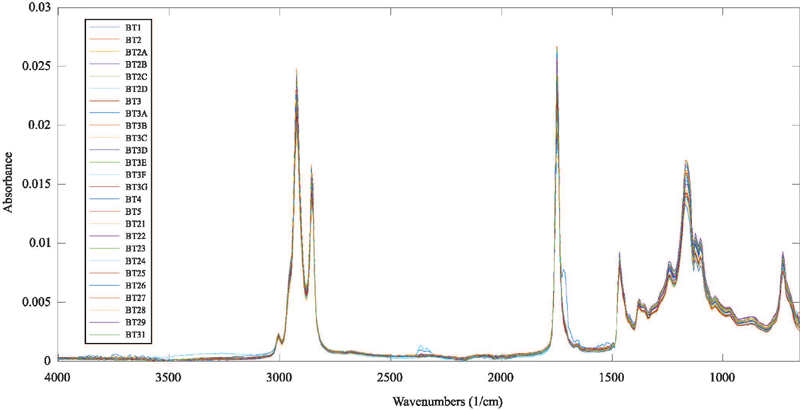
The spectral absorbance data showed 451 wavenumber values in the mid-infrared bands centered on the average of 30 buriti oil samples (Figure 1). Mid-infrared spectroscopy has been used together with chemometrics, to identify adulterated vegetable oils, or natural alterations, to ensure that they are suitable for consumption, contributing to the reliability and reputation of producers in the market (Sonvanshi et al., 2024).
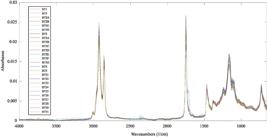
The spectra showed signals of the major oleic acid in specific frequency bands, such as the C=O stretching of methyl esters at 1743 cm-1, and other C-O stretching bands at 1170, 1195, and 1246 cm-1 (Ahluwalia, 2017). A weak signal at 1654 cm-1 was due to the C=C stretching frequency (Uçar et al., 2024). Intense and sharp signals at 2854 and 2926 cm-1 were due to the C-H stretching frequencies (Silva et al., 2023a). The absorbance at 3005 cm-1 indicated =C-H group. The observation of an absorption band at 733 cm-1 certified the equilibrium of CH2. The 3641 cm-1 band is associated with the O-H stretching, common in carboxylic acids, alcohols, and other substances with hydroxyl groups, which is related to the carboxylic group (-COOH) (Qi et al., 2024).
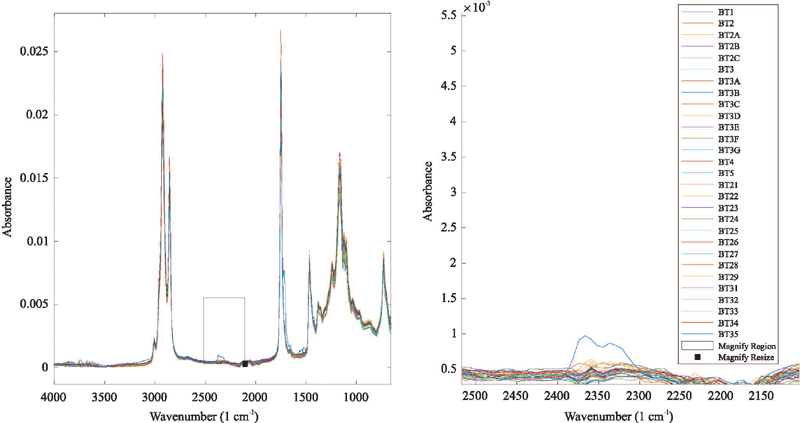
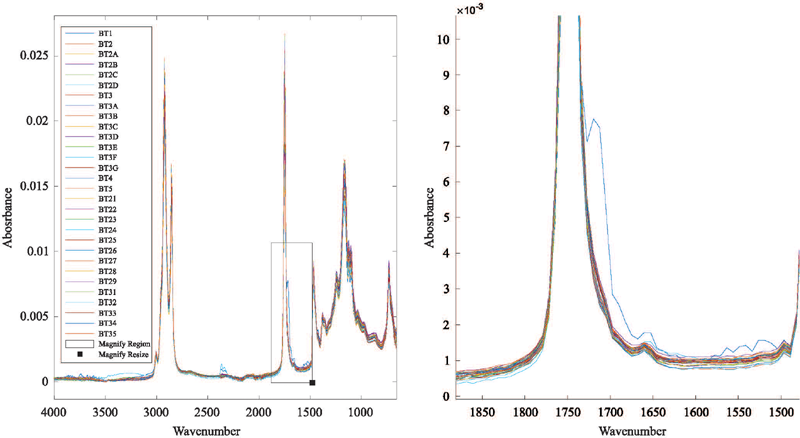
Two pieces of evidence of significant anomalies were observed in the spectra of buriti oil samples, occurring exclusively in the BT1 sample, from the municipality of Bujaru, where the highest acidity index was recorded (Figure 2).
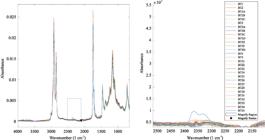
Evidence of anomaly in the spectral range from 2000 cm-1 to 2500 cm-1 of buriti (Mauritia flexuosa) vegetable oils by mid-infrared spectroscopy.
The first piece of evidence was in the region between 2000 cm-1 and 2500 cm-1, where alkyne and nitrile groups can be found. Peaks in these regions may indicate chemoprotective substances derived from nitriles, such as the glucosinolate metabolic group, at low concentration, but which may be present in younger plants that use the substance to fight natural predators (Jeschke et al., 2015). This is important, since high glucosinolate concentrations can lower the natural oil’s nutritional value (Licata et al., 2018).
The second piece of evidence of spectrum anomaly was limited to the range from 2000 cm-1 to 1500 cm-1 (Figure 3), which represents functional groups of esters, aldehydes, ketones, carboxylic acids, azides, aromatics, and amides (Pavia, 2010).
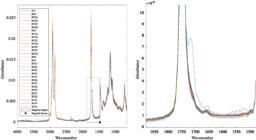
Evidence of anomaly in the spectral range from 2000 cm-1 to 1500 cm-1 of buriti (Mauritia flexuosa) vegetable oils by mid-infrared spectroscopy.
According to Machado et al. (2023), carboxylic acids, identifiable by bands about 1700 cm-1 (C=O stretch) and 2500–3500 cm-1 (O-H stretch), are mainly responsible for acidity, as an increase of the amount of free fatty acids raises the acidity index, indicating oil degradation.
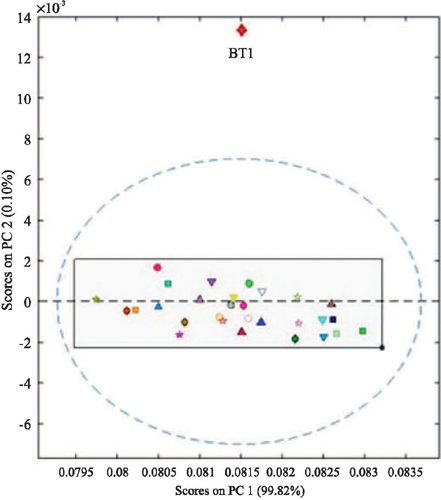
The first two principal components (PCs) explained 99.93% of the accumulated variance, representing 99.82% of PC1, which shows the segregation of types of oils for their degradation, and PC2 evidences 0.10% of the data variability (Figure 4). The model resulted in 95% confidence level.
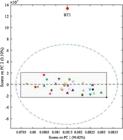
Principal component analysis grouping of buriti of buriti (Mauritia flexuosa) oil samples.
After plotting the resized spectral data, two regions were highlighted in the PCA. First, within the ellipse, the samples ranged from 1.43 to 9.32 mg of KOH g-1, representing the minimum and maximum AI values samples BT27 to BT36. In the second region, only sample BT1 was detected with 19.17 mg of KOH g-1AI. Thus, the multivariate calibration method identified that BT1 had an AI outside the standards of the other samples, which may have been caused by environmental factors, or simply by the processing of the vegetable oil (Sousa et al., 2019).
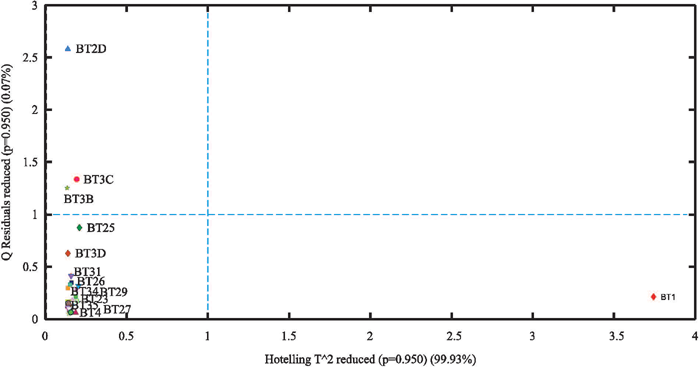
Hotelling’s T2 identify observations that are outside the expected behavior in a data set, considering the principal components in PCA. This test showed that three samples (BT2D, BT3C, and BT3B) had significant loadings in the second quadrant that are above the residual Q thresholds, but within the threshold (Figure 5). This fact suggests that these samples have a significant variability not explained by the model, although they are reasonably positioned in the principal component space.
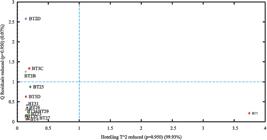
Sample BT1 had a notable impact on the third quadrant, which indicates that this sample has a large variability both explained and unexplained by the model, being treated as an anomaly. However, none of the samples overlapped the first quadrant, which shows samples that characterize a model with low precision. Hotelling’s T2 test has already been used in several rapid assessments of vegetable oil quality, using PCA added to spectral data in the mid-infrared Fourier transform (Laouni et al., 2023).
Conclusions
-
The mid-infrared waves (ATR-MIR-FTIR) analysis indicate vibrational bands of oleic acid of buriti (Mauritia flexuosa) oil correlated with acidity index.
-
The PCA model combined with the Hotelling’s T2 test is efficient to detect deteriorated buriti oil samples.
-
The chemometric tool presented by the association between ATR-MIR-FTIR and the specified principal component analyses can be used for screening acidity index in buriti oil samples.
Acknowledgments
To the Universidade Federal do Pará, Chemistry Postgraduate Program (PPGQ/UFPA), for the infrastructure using permission; and to Luiza Helena Meller da Silva, for the support in the ATR-MIR-FTIR analyses.
References
-
AHLUWALIA, G.K. Optical fibers. In: AHLUWALIA, G. (Ed.). Applications of Chalcogenides: S, Se, and Te. Cham: Springer, 2017. p.161-196. DOI: https://doi.org/10.1007/978-3-319-41190-3_4
» https://doi.org/10.1007/978-3-319-41190-3_4 -
AKPAMBANG, V.O.E. Physicochemical and trace metals characterization of edible vegetable oils. International Research Journal of Pure and Applied Chemistry, v.21, p.29-40, 2020. DOI: https://doi.org/10.9734/irjpac/2020/v21i730178
» https://doi.org/10.9734/irjpac/2020/v21i730178 -
AKRAM, U.; SAHAR, A.; SAMEEN, A.; MUHAMMAD, N.; AHMAD, M.H.; KHAN, M.I.; USMAN, M.; UR RAHMAN, H.U. Use of Fourier transform infrared spectroscopy and multi- variant analysis for detection of butter adulteration with vegetable oil. International Journal of Food Properties, v.26, p.167-178, 2023. DOI: https://doi.org/10.1080/10942912.2022.2158860
» https://doi.org/10.1080/10942912.2022.2158860 - ANVISA. Agência Nacional de Vigilância Sanitária. Instrução Normativa-IN nº 87, de 15 de março de 2021. Estabelece a lista de espécies vegetais autorizadas, as designações, a composição de ácidos graxos e os valores máximos de acidez e o índice de peróxidos para óleos e gorduras vegetais. Diário Oficial da União, 17 mar. 2021. Seção1, p.261-263.
- AOCS. American Oil Chemists Society. Official methods and recommended practices of the American Oil Chemists Society 7th ed. Urbana, 2017. Method Cd 3d-63 Acid value of fats and oils.
-
BALIK, H.I.; BALIK, S.K.; KARAKAYA, O.; OZTURK, B. How does harvest time affect the major fatty acids and bioactive compounds in hazelnut cultivars (Corylus avellana L.)? Grasas y Aceites, v.75, p.1-11, 2024. DOI: https://doi.org/10.3989/gya.0971231.2024
» https://doi.org/10.3989/gya.0971231.2024 -
BARBOZA, N.L.; CRUZ, J.M. dos A.; CORRÊA, R.F.; LAMARÃO, C.V.; LIMA, A.R.; INADA, N.M.; SANCHES, E.A.; BEZERRA, J. de A.; CAMPELO, P.H. Buriti (Mauritia flexuosa L. f.): an Amazonian fruit with potential health benefits. Food Research International, v.159, art.111654, 2022. DOI: https://doi.org/10.1016/j.foodres.2022.111654
» https://doi.org/10.1016/j.foodres.2022.111654 -
BRUNI, A.R. da S.; OLIVEIRA, V.M.A.T. de; FERNANDEZ, A.S.T.; SAKAI, O.A., MARÇO, P.H.; VALDERRAMA, P. Attenuated total reflectance Fourier transform (ATR- FTIR) spectroscopy and chemometrics for organic cinnamon evaluation. Food Chemistry, v.365, art.130466, 2021. DOI: https://doi.org/10.1016/j.foodchem.2021.130466
» https://doi.org/10.1016/j.foodchem.2021.130466 -
CEBI, N.; BEKIROGLU, H.; ERARSIAN, A.; RODRIGUEZSAONA, L. Rapid sensing: hand-held and portable FTIR applications for on-site food quality control from farm to fork. Molecules, v.28, art.3727, 2023. DOI: https://doi.org/10.3390/molecules28093727
» https://doi.org/10.3390/ molecules28093727 -
CODEX ALIMENTARIUS COMMISSION. Standard for named vegetable oils CXS 210-1999 Codex-Stan 210-1999. Rome: FAO, 2023. Available at: <https://tinyurl.com/46s68uzu>. Accessed on: Apr. 25 2023.
» https://tinyurl.com/46s68uzu -
EL HADDAD, Y.; FILALI-MALTOUF, A.; BELKADI, B.; FERRADOUS, A.; KAROUI, R.; ZAROUAL, H. Comparative study of the potentiality of front-face fluorescence, near- and mid-infrared spectroscopies to authenticate extra virgin argan oil using different chemometric tools. European Food Research and Technology, v.249, p.1857-1873, 2023. DOI: https://doi.org/10.1007/s00217-023-04260-7
» https://doi.org/10.1007/s00217-023-04260-7 -
FARRÉS-CEBRIÁN, M.; SERÓ, R.; SAURIAN, J.; NÚÑEZ, O. HPLC-UV polyphenolic profiles in the classification of olive oils and other vegetable oils via principal component analysis. Separations, v.3, art.33, 2016. DOI: https://doi.org/10.3390/separations3040033
» https://doi.org/10.3390/separations3040033 -
GAGOUR, J.; EL GHAILASSI, K.; IBOURKI, M.; SAKAR, E.H.; GHARBY, S. Physicochemical traits of olive fruit and oil from eight Moroccan wild olive (Olea europaea L. subsp. Oleaster) populations. Biocatalysis and Agricultural Biotechnology, v.56, art.103021, 2024. DOI: https://doi.org/10.1016/j.bcab.2024.103021
» https://doi.org/10.1016/j.bcab.2024.103021 -
IBIAPINA, A.; GUALBERTO, L. da S.; DIAS, B.B.; FREITAS, B.C.B.; MARTINS, G.A. de S.; MELO FILHO, A.A. Essential and fixed oils from Amazonian fruits: proprieties and applications. Critical Reviews in Food Science and Nutrition, v.62, p.8842-8854, 2022. DOI: https://doi.org/10.1080/10408398.2021.1935702
» https://doi.org/10.1080/10408398. 2021.1935702 -
JESCHKE, V.; GERSHENZON, J.; VASSÃO, D.G. Metabolism of glucosinolates and their hydrolysis products in insect herbivores. In: JETTER, D.G. The Formation, Structure and Activity of Phytochemicals Cham: Springer International Publishing, 2015. p.163-194. (Recent Advances in Phytochemistry, v.45). DOI: https://doi.org/10.1007/978-3-319-20397-3_7
» https://doi.org/10.1007/978-3-319-20397-3_7 -
LAMARÃO, C.V.; LEÃO, J.M.; SOARES, K.R.M.; PIERI, F.A. Amazon fruits: biodiversity, regionalism and artisanal and industrial by-products under fermentation processes. In: PENNA, A.L.B.; NERO, L.A.; TODOROV, S.D. (Ed). Fermented foods of Latin America Boca Raton: CRC Press, 2017. p.185-201. DOI: https://doi.org/10.1201/9781315369433-12
» https://doi.org/10.1201/9781315369433-12 -
LAOUNI, A.; EL ORCHE, A.; ELHAMDAOUI, O.; KARROUCHI, K.; EL KARBANE, M.; BOUATIA, M. A preliminary study on the potential of FT-IR spectroscopy and chemometrics for tracing the geographical origin of Moroccan virgin olive oils. Journal of AOAC INTERNATIONAL, v.106, p.804-812, 2023. DOI: https://doi.org/10.1093/jaoacint/qsac136
» https://doi.org/10.1093/jaoacint/qsac136 -
LICATA, M.; LA BELLA, S.; LAZZERI, L.; MATTEO, R.; LETO, C.; MASSARO, F.; TUTTOLOMONDO, T. Agricultural feedstocks of two Brassica oilseed crops and energy cogeneration with pure vegetable oil for a sustainable short agro-energy chain in Sicily (Italy). Industrial Crops and Products, v.117, p.140-148, 2018. DOI: https://doi.org/10.1016/j.indcrop.2018.02.032
» https://doi.org/10.1016/j.indcrop.2018.02.032 -
MACHADO, N.T.; MOTA, A. de A.M.D. da; SANTANNA, J. da S.; GAMA, V. de J.P. da; ZAMIAN, J.R.; BORGES, L.E.P.; MOTA, S.A.P. da. Catalytic cracking of palm oil: effect of catalyst reuse and reaction time of the quality of biofuels-like fractions. Energies, v.16, art.7063, 2023. DOI: https://doi.org/10.3390/en16207063
» https://doi.org/10.3390/en16207063 -
MIRDORAGHI, M.; FARAHANI, S.M.; REZAZADEH, A. Oilseeds in intercropping systems: strategies to increase oil quality and fatty acid profile, a review. Journal of Agriculture and Food Research, v.17, art.101229, 2024. DOI: https://doi.org/10.1016/j.jafr.2024.101229
» https://doi.org/10.1016/j.jafr.2024.101229 -
OJHA, P.K.; POUDEL, D.K.; ROKAYA, A.; MAHARJAN, S.; TIMSINA, S.; POUDEL, A.; SATYAL, O.; SETZER, W.N. Chemical compositions and essential fatty acid analysis of selected vegetable oils and fats. Compounds, v.4, p.37-70, 2024. DOI: https://doi.org/10.3390/compounds4010003
» https://doi.org/10.3390/compounds4010003 - PAVIA, D.L.; LAMPMAN, G.M.; KRIZ, G.S.; VYVYAN, J.R. Introdução à espectroscopia Tradução da 4ª edição norteamericana. São Paulo: Cengage Learning, 2010.
-
POLYAK, Y.M.; BAKINA, L.G.; MAYACHKINA, N.V.; CHUGUNOVA, M.V.; BITYUTSKII, N.P.; YAKKONEN, K.L.; SHAVARDA, A.L. Long-term effects of oil contamination on soil quality and metabolic function. Environmental Geochemistry and Health, v.46, art.13, 2024. DOI: https://doi.org/10.1007/s10653-023-01779-2
» https://doi.org/10.1007/s10653-023-01779-2 -
PRASAD, R.; SREEKANTH, C.; MUNIRAJ, R.; JARIN, T. Characterization and aging impact study on antioxidants with CaO catalyzed methyl ester from waste cooking oil as sustainable insulation as biorefinery approach. Biomass Conversion and Biorefinery, 18p., 2024. DOI: https://doi.org/10.1007/s13399-024-05724-w
» https://doi.org/10.1007/s13399-024- 05724-w -
QI, J.; WANG, X.; ZHANG, H.; LIU, X.; WANG, W.; HE, Q.; GUO, F. Biopolymer meets nanoclay: rational fabrication of superb adsorption beads from green precursors for efficient capture of Pb (II) and dyes. Nanomaterials, v.14, art.766, 2024. DOI: https://doi.org/10.3390/nano14090766
» https://doi.org/10.3390/nano14090766 -
RODRIGUEZ-SAONA, L.; YAO, S.; NUGURI, S.M. Mid-infrared spectroscopy analysis. In: ISMAIL, B.P.; NIELSEN, S.S. (Ed.). Nielsen’s food analysis laboratory manual 4th ed. Cham: Springer International Publishing, 2024. p.111-118. DOI: https://doi.org/10.1007/978-3-031-44970-3_12
» https://doi.org/10.1007/978-3-031-44970-3_12 -
ROHMAN, A.; CHE MAN, Y.B. Application of FTIR spectroscopy for monitoring the stabilities of selected vegetable oils during thermal oxidation. International Journal of Food Properties, v.16, p.1594-1603, 2013. DOI: https://doi.org/10.1080/10942912.2011.603874
» https://doi.org/10.1080/ 10942912.2011.603874 -
SILVA, B.S.F. da; FERREIRA, N.R.; ALAMAR, P.D.; SILVA, T. de M. e; PINHEIRO, W.B. de S.; SANTOS, L.N. dos; ALVES, C.N. FT-MIR-ATR associated with chemometrics methods: a preliminary analysis of deterioration state of Brazil nut oil. Molecules, v.28, art.6878, 2023a. DOI: https://doi.org/10.3390/molecules28196878
» https://doi.org/10.3390/molecules28196878 -
SILVA, J.A.; DOROCZ, E.L.; SANCHEZ, J.L.; SANTOS, L.D. dos; BENETI, S.C.; TANAMATI, A.; BONA, E.; TANAMATI, A.A.C. Multi-block analysis of the oxidative stability of the palm olein and hydrogenated soybean oil during the industrial deep-frying process. Journal of Food Composition and Analysis, v.126, art.105897, 2024. DOI: https://doi.org/10.1016/j.jfca.2023.105897
» https://doi.org/10.1016/j.jfca.2023.105897 -
SILVA, J.B.S. da; CABRAL, A.A.; BEZERRA, G.V.P.; CRUZ, N.C. da; CONCONI, C.C.; CRUZ, G. Buriti (Mauritia flexuosa L.) wastes as potential lignocellulosic feedstock for bioenergy production: physicochemical properties, thermal behavior, and emission factors. Industrial Crops and Products, v.206, art.117689, 2023b. DOI: https://doi.org/10.1016/j.indcrop.2023.117689
» https://doi.org/10.1016/j.indcrop.2023.117689 -
SONVANSHI, V.; GANDHI, K.; RAMANI, A.; SHARMA, R.; AETH, R. ATR-FTIR coupled with chemometric techniques to detect vanaspati ghee (hydrogenated vegetable oil) adulteration in milk fat. Results in Chemistry, v.7, art.101343, 2024. DOI: https://doi.org/10.1016/j.rechem.2024.101343
» https://doi.org/10.1016/j.rechem.2024.101343 -
SOUSA, E.R. de; FROTA, C.S.; COSTA, C.H.C.; SILVA, G.S. da; SAMPAIO, D.G. Avaliação da oxidação e de parâmetros de qualidade do óleo de babaçu por espectroscopia no infravermelho médio com transformada de Fourier (FTIR) e calibração multivariada. Revista Virtual de Química, v.11, p.849-865, 2019. DOI: https://doi.org/10.21577/1984-6835.20190059
» https://doi.org/10.21577/1984-6835.20190059 -
SOUZA, F.G. de; ARAÚJO, F.F. de; FARIAS, D. de P.; ZANOTTO, A.W.; NERI-NUMA, I.A.; PASTORE, G.M. Brazilian fruits of Arecaceae family: an overview of some representatives with promising food, therapeutic and industrial applications. Food Research International, v.138, art.109690, 2020. DOI: https://doi.org/10.1016/j.foodres.2020.109690
» https://doi.org/10.1016/j.foodres.2020.109690 -
UÇAR, B.; GHOLAMI, Z.; SCOBODOVÁ, K.; HRADECKÁ, I.; HÖNIG, V. A comprehensive study for determination of free fatty acids in selected biological materials: a review. Foods, v.13, art.1891, 2024. DOI: https://doi.org/10.3390/foods13121891
» https://doi.org/10.3390/foods13121891 - XIANG, F.; DING, C.-X.; WANG, M.; HU, H.; MA, X.-J., XU, X.-B.; ABUBAKAR, B.Z.; PIGNITTER, M.; WEI, K.-N.; SHI, A.-M.; WANG, Q. Vegetable oils: classification, quality analysis, nutritional value and lipidomics applications. Food Chemistry, v.439, art.138059, 2023.