
 Sowing density associated with the agronomic performance and linear relationships between the morphological traits of sunflower
Abstract
The objective of this work was to evaluate the effect of sowing density on sunflower morphological traits and on the linear relationships between these traits under second-crop conditions, in addition to identifying the traits that can assist in the indirect selection of sunflower hybrids. The experimental design was in randomized complete blocks, with four replicates and six treatments (sunflower sowing densities: 20, 30, 40, 50, 60, and 70 thousand plants per hectare). The sowing density of 51.45 thousand plants per hectare provides the maximum yield per area under second-crop conditions. Sowing density negatively influences the magnitude of the linear associations between the traits number of achenes and individual yield per plant and between plant height and thousand-achene mass. In addition, under a high sowing density, the association between plant height and thousand-achene mass becomes negative. The traits number of achenes per capitulum and capitulum diameter show the highest magnitudes of linear association with individual yield per plant and, therefore, can be used for the indirect selection of sunflower hybrids.
Index terms:
Helianthus annuus; Pearson’s correlation; plant population.
Resumo
O objetivo deste trabalho foi avaliar o efeito da densidade de semeadura sobre caracteres morfológicos do girassol e sobre as relações lineares entre esses caracteres em condições de segunda safra, além de identificar os caracteres que auxiliem na seleção indireta de híbridos de girassol. O delineamento experimental foi em blocos ao acaso, com quatro repetições e seis tratamentos (densidades de semeadura do girassol: 20, 30, 40, 50, 60 e 70 mil plantas por hectare). A densidade de semeadura de 51,45 mil plantas por hectare proporciona a máxima produtividade por área em condições de segunda safra. A densidade de semeadura influencia negativamente a magnitude das associações lineares entre os caracteres número de aquênios e produtividade individual por planta e entre altura de planta e massa de mil aquênios. Além disso, em condições de alta densidade de semeadura, a associação entre altura de planta e massa de mil aquênios passa a ser negativa. O número de aquênios por capítulo e o diâmetro do capítulo apresentam as maiores magnitudes de associação linear com a produtividade individual por planta, e, portanto, podem ser utilizados para seleção indireta de híbridos de girassol.
Termos para indexação:
Helianthus annuus; correlação de Pearson; população de plantas.
Introduction
Sunflower (Helianthus annuus L.) stands out worldwide as the third oilseed crop in raw material production, ranking only behind the soybean [Glycine max (L.) Merr.] and canola (Brassica napus L.) crops (Qadir et al., 2020). In the 2022/2023 growing season, the area grown with sunflower covered 28.02 million hectares, with a production of 52.39 million tons and a mean yield of 1,870 kg ha-1, being projected to reach 28.38 million hectares in 2023/2024, with an expected production of 56.80 million tons and a mean yield of 2,000 kg ha-1 (USDA, 2024).
In Brazil, the area estimated for sunflower cultivation was 55.4 thousand hectares in the 2023/2024 growing season, mainly in the Midwest, the main sunflower-producing region in the country (CONAB, 2023). The mean yield of the crop was 1,520 kg ha-1 in the 2022/2023 growing season (CONAB, 2023), which can be considered low compared with those of other sunflower-producing countries (Soares et al., 2019). According to Castro & Leite (2018), the main reasons for the low yield in Brazil are: the low technological level used in sunflower production, generally treated as a secondary crop; the weak transfer of technology and technical information to producers; and the limited investment in research on sunflower cultivation compared with that on other crops, such as soybean and corn (Zea mays L.).
Other factors that influence sunflower grain yield include climate conditions and phytosanitary and cultural management (Hiolanda et al., 2018). For an increased yield, the development of cultivars and improved hybrids, as well as cultural management, are the main factors to be considered (Gordeyeva et al., 2023).
Optimizing crop nutrition, sowing density, and sowing time is key for the cultural management of sunflower (Gordeyeva et al., 2023). Sowing density, for example, is one of the main agronomic practices that interfere with sunflower grain yield (Farweez et al., 2020), underscoring the need of determining the appropriate number of seeds per unit of area for yield improvement (Dong et al., 2023). However, information is still scarce regarding the recommendation of the ideal sowing density to be used for sunflower cultivation as a second crop, despite its agronomic and economic benefits for agricultural production systems (Santos et al., 2023).
The development of sunflower genotypes with a higher production potential is another important factor. However, the genotype-selection stage is one of the most difficult in the improvement process due to the complex traits related to grain yield (Carvalho et al., 2015), considered a quantitative trait with a low heritability. For this reason, genetic improvement frequently uses correlations to identify associations between traits, mainly for the indirect selection of cultivars (Riaz et al., 2019). The presence or absence of relationships between traits can contribute to improving the efficiency of the criteria for the selection of sunflower varieties (Radić et al., 2021). In this context, the knowledge of the relationships between traits is essential for studies aiming the improvement of sunflower cultivation (Nobre et al., 2018). However, there are no known reports in the literature quantifying the effect of sowing density on the correlations between sunflower morphological and production traits, which can lead to dubious and erroneous results, as well as to misleading comparisons between these traits’ associations.
The objective of this work was to evaluate the effect sowing density on sunflower morphological traits and on the linear relationships between these traits under second-crop conditions, in addition to identifying the traits that can assist in the indirect selection of sunflower hybrids.
Materials and Methods
The experiment was conducted in 2022 in an experimental area located in the municipality of Santa Maria, in the central region of the state of Rio Grande do Sul, Brazil (29°71'S, 53°70'W, at an altitude of 90 m).
According to Köppen-Geiger’s classification, the predominant climate in the region is Cfa, i.e., humid subtropical, with hot summers and no-defined dry season. The soil in the experimental area is managed under a no-tillage system and classified as an Argissolo, according to Brazilian Soil Classification System (Santos et al., 2018), equivalent to an Ultisol (Soil Survey Staff, 2022).
The experimental design was in randomized complete blocks, with four replicates and six treatments consisting of different sunflower sowing densities (20, 30, 40, 50, 60, and 70 thousand plants per hectare). Twenty-four experimental units were composed of four sowing rows with a length of 5.0 m and spacing of 0.50 m, totaling an area of 10 m2. The usable area of each plot was 4.0 m2, after excluding the borders. Sowing was conducted manually on 1/19/2022, with emergence on 1/26/2022. The ADV 5504 commercial hybrid was used.
Eight plants were marked in the usable area of each experimental plot during the phenological development of the crop. When the crop was at the R6 stage, the height (in meters) of these plants was measured using a measuring tape (Castiglioni et al., 1994), and, at harvest point, their capitula were collected. The total 192 plants were evaluated in the laboratory of the research group on annual-crop ecophysiology and management of Universidade Federal de Santa Maria. The measured traits were: capitulum diameter (in centimeters), thousand-achene mass (in grams), and individual production per plant (in grams). Yield per area (in kg ha-1) was determined by harvesting the usable area of each plot. Thousand-achene mass, individual production per plant, and yield per area were corrected to 13% moisture. The number of achenes per capitulum (NAC) was estimated using the following equation: NAC = (individual production per plant x 1,000)/thousand-achene mass.
The data were initially analyzed for adherence of residuals, as well as for normal distribution and homogeneity of variances by the Shapiro-Wilk and Bartlett tests, respectively, both at 5% probability, identifying compliance with statistical assumptions. The experimental data were subjected to the analysis of variance, and, when a significant effect was obtained, a polynomial regression was used to verify the effect of sowing densities on the evaluated variables.
To determine Pearson’s correlation coefficients, the observations of the experiment were arranged into three distinct groups regarding sowing density, namely: low density, 20 and 30 thousand plants per hectare; medium density, 40 and 50 thousand plants per hectare, which was the reference for cultivation in the main cropping season; and high density, 60 and 70 thousand plants per hectare.
The matrix of Pearson’s linear correlation coefficients (r) between the traits plant height, capitulum diameter, thousand-achene mass, NAC, and individual production per plant was estimated. The significance of the coefficients was verified using Student’s t-test.
Statistical analyses were conducted with the Microsoft Office Excel application and the R, version 4.0.4, software (R Development Core Team, 2021) through the Agricolae, Dplyr, and Corrplot packages, adopting a 5% significance level in all analyses. The Sigma Plot, version 14.5, software (Grafiti LLC, Palo Alto, CA, USA) was used to represent graphically the regressions.
Results and Discussion
The analysis of variance showed no significant effect of the density factor on the traits plant height and thousand-achene mass (Table 1). Similarly, Fonseca et al. (2020) found no increase in plant height with an increase in plant population up to a density of 80 thousand plants per hectare. Souza et al. (2014) also did not observe any significant effect of sowing density on the traits plant height and thousand-achene mass.
Mean squares of the analysis of variance of the sunflower (Helianthus annuus) traits evaluated in 2024 in the municipality of Santa Maria, in the state of Rio Grande do Sul, Brazil(1).
The behavior of capitulum diameter, number of achenes per capitulum, production per plant, and yield per area in response to the different experimental densities is shown in Figure 1. The increase in sowing density led to a decrease in capitulum diameter (Figure 1 A), number of achenes per capitulum (Figure 1 B), and individual production per plant (Figure 1 C). This finding is likely due to an increase, under a high density, in the intraspecific competition between plants for environmental resources, such as nutrients, water, and solar radiation, which reduces plant growth and limits individual production per plant (Li et al., 2019). Ferreira et al. (2023) observed a similar behavior for these traits. Likewise, Li et al. (2019) described a significant decrease in capitulum diameter with an increasing sowing density.
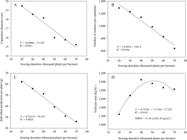
Behavior of the sunflower (Helianthus annuus) traits capitulum diameter (A), number of achenes per capitulum (B), individual production per plant (C), and yield per area (D), in 2024, in response to the experimental densities in the municipality of Santa Maria, in the state of Rio Grande do Sul, Brazil.
Yield per area increased with an increasing density until the sowing density of 51.45 thousand plants per hectare (Figure 1 D), when the point of maximum technical efficiency was obtained, corresponding to a yield of 2,021.52 kg ha-1. According to Kandil et al. (2017), sunflower yield increases with an increase in plant population to a certain level. In this line, Dong et al. (2023) added that sunflower yield is proportional to sowing density up to a critical density, beyond which there is no increase in yield. Therefore, it is fundamental to determine the optimal sowing density for the sunflower crop, which can maximize light interception, for example, contributing to a high yield (Li et al., 2019). However, the adequate density depends on the sunflower genotype to be used (Gordeyeva et al., 2023), as well as on the growing environment (Pinkovskyi & Tanchyk, 2021).
In Brazil, the recommended density for sunflower cultivation is generally in the range of 40 to 45 thousand plants per hectare (Castro & Leite, 2018). However, considering that the maximum technical efficiency was obtained with a sowing density of 51.45 thousand plants per hectare in the present study, the increase in plant population may be a potential strategy to mitigate the effects of restricted crop growth due to high summer temperatures. In this line, Pereira & Hall (2019) suggested that the potential sunflower yield might be increased by increasing the plant population above what is currently considered appropriate.
In the literature, Partal (2022), working with different sunflower sowing densities, obtained the highest mean yield of 2,226 kg ha-1 with a population of 50 thousand plants per hectare. In contrast, Stasiak et al. (2018), in a similar study, found a higher mean yield of 1,460.4 kg ha-1 when using a lower sunflower population of 47,150 thousand plants per hectare.
Pearson’s correlations were obtained between the traits of the sunflower plants grown at low (Figure 2 A), medium (Figure 2 B), and high (Figure 2 C) sowing densities. Under low sowing densities, the r between these traits ranged from -0.28 ≤ r ≤ 0.84 (Figure 2 A). The NAC x production per plant correlation showed a positive linear association of high magnitude (r = 0.84), whereas the correlations capitulum diameter x production per plant (r = 0.65), NAC x capitulum diameter (r = 0.44), and plant height x thousand-achene mass (0.42) were positive, with a moderate to weak degree of association. In addition, the NAC x thousand-achene mass correlation was negative, with a weak linear association (r = -0.28).

Frequency distribution (on the diagonal), dispersion of observations (on the right of the diagonal), and Pearson’s correlation (on the left of the diagonal) between sunflower (Helianthus annuus) traits evaluated at low (A), medium (B), and high (C) sowing densities, in 2024, in the municipality of Santa Maria, in the state of Rio Grande do Sul, Brazil. *Significant by the t-test, at 5% probability. PH, plant height; CAPD, capitulum diameter; TAM, thousand-achene mass; NAC, number of achenes per capitulum; and PROD, individual production per plant.
Under medium sowing densities, the r between sunflower traits ranged from -0.32 ≤ r ≤ 0.69 (Figure 2 B). The NAC x production per plant correlation showed a positive linear association of high magnitude (r = 0.69), while the correlations capitulum diameter x production per plant (r = 0.66), plant height x thousand-achene mass (r = 0.61), and plant height x capitulum diameter (r = 0.50) were positive, with a moderate to weak degree of association. Moreover, the NAC x thousand-achene mass correlation was negative, with a weak linear association (r = -0.32).
Under high sowing densities, the r between sunflower traits ranged from -0.60≤r≤0.91 (Figure 2 C). The NAC x production per plant correlation showed a positive linear association of high magnitude (r = 0.91), whereas the correlations capitulum diameter x production per plant (r = 0.49), NAC x capitulum diameter (r = 0.45), and plant height x NAC (r = 0.39) were positive, with a moderate to weak degree of association. The NAC x thousand-achene mass (r = -0.55) and plant height x thousand-achene mass (r = -0.60) correlations were negative, with moderate magnitudes of linear association.
Ghaffari et al. (2019) also observed significant correlations (r = 0.85 and r = 0.75, respectively) between number of achenes per capitulum and achene production per plant and between capitulum diameter and achene production per plant. Likewise, Reavanth et al. (2022) found that achene production per plant showed a positive linear correlation with capitulum diameter (r = 0.83). Amorim et al. (2008) obtained positive correlations between grain yield and capitulum diameter (r = 0.63), while Radić et al. (2021) reported a significant correlation (r = 0.75) between the number of achenes per capitulum and achene production per plant. Similarly, Abro et al. (2020) described a positive linear correlation (r = 0.83) between capitulum diameter and number of achenes per capitulum.
Pearson’s correlations between traits in the groups with a low (Figure 2 A), medium (Figure 2 B), and high (Figure 2 C) density showed a trend of a higher correlation between NAC x production per plant regardless of sowing density, indicating that an increase in the number of achenes per capitulum resulted in the maximization of individual sunflower yield. However, the magnitude of the NAC x production per plant correlation was higher in the groups with a low (r = 0.84) and high (r = 0.91) density than in the one with a medium density (r = 0.69).
The magnitude of the correlation between production per plant and capitulum diameter practically did not change in the groups with a low (r = 0.65) (Figure 2 A) and medium (r = 0.66) sowing density (Figure 2 B), only showing a slight reduction in the group with a high density (r = 0.49) (Figure 2 C). Moreover, the magnitude of the correlation between capitulum diameter and NAC did not undergo any significant changes in the groups with a low (r = 0.44), medium (r = 0.39), and high (r = 0.45) sowing density.
The magnitude of the correlation between plant height and thousand-achene mass was increased when comparing the groups with a low (r = 0.42) and medium (r = 0.61) density. However, in the high-density group, the direction of the linear association between the aforementioned pair of traits changed, no longer being positive but becoming negative with a moderate magnitude (r = -0.6).
The components related to achene yield and sunflower production are influenced by technological and environmental factors. The technological factors include inter-row spacing and plant population (Ion et al., 2015), whereas the environmental factors highlight the relationship between light interception and plant population. A lower population allows plants to receive more resources (water, sunlight, and nutrients) and to, consequently, have more leaves and achenes in their capitulum (Li et al., 2019). Contrastingly, an increased plant population leads to a reduction in the availability of resources per plant, causing the observed reduction in number of achenes per capitulum and individual production per plant.
The reduction in a certain component can be compensated by an increase in the influence of another (Bezerra et al., 2016). A reduction in the number of capitula can, for example, result in a larger capitulum diameter and in an increase in the number or mass of achenes per capitulum (Bezerra et al., 2016). These results are aligned with those obtained in the present study, in which changes were observed in the magnitude and direction of the linear associations between sunflower morphological traits depending on sowing densities, possibly due to the compensatory behavior of these traits in response to the modifications caused by the different tested densities.
Conclusions
-
1. The sowing density of sunflower (Helianthus annuus) influences capitulum diameter, number of achenes per capitulum, individual production per plant, and yield per hectare.
-
2. The use of a higher sowing density under second-crop conditions is recommended for the state of Rio Grande do Sul, Brazil, considering that the maximum yield per hectare under these conditions occurs at a sowing density of 51.45 thousand plants per hectare.
-
3. Sowing density negatively influences the magnitude and direction of the linear associations between the studied traits.
-
4. The traits number of achenes per capitulum and capitulum diameter show the highest magnitudes of linear association with individual production per plant regardless of sowing density, and, therefore, can be used for the selection of sunflower hybrids.
Declaration of use of AI technologies
No generative artificial intelligence (AI) was used in this study.
Acknowledgments
To Conselho Nacional de Desenvolvimento Científico e Tecnológico (CNPq), for scholarships to the researchers; and to Coordenação de Aperfeiçoamento de Pessoal de Nível Superior (CAPES), for financing, in part, this study (Finance Code 001).
Disclaimer/Publisher’s note:
The statements, opinions, and data contained in all texts published in Pesquisa Agropecuária Brasileira (PAB) are solely those of the individual author(s) and not of the journal’s publisher, editor, and editorial team, who disclaim responsibility for any injury to people or property resulting from any referred ideas, methods, instructions, or products.
The mention of specific chemical products, machines, and commercial equipment in the texts published in this journal does not imply their recommendation by the publisher.
Data availability statement
Data available upon request: research data are only available upon reasonable request to the corresponding author.
References
- ABRO, T.F.; OAD, P.K.; SOOTAHER, J.K.; MENGHWAR, K.K.; SOOMRO, T.A.; SHAIKH, A.A.; CHANNA, Z. Genetic variability and character association between grain yield and oil content traits in sunflower (Helianthus annuus L.). International Journal of Biology and Biotechnology, v.17, p.701-706, 2020.
-
AMORIM, E.P.; RAMOS, N.P.; UNGARO, M.R.G.; KIIHL, T.A. Correlations and path analysis in sunflower. Bragantia, v.67, p.307-316, 2008. DOI: https://doi.org/10.1590/S0006-87052008000200006
» https://doi.org/10.1590/S0006-87052008000200006 -
BEZERRA, F.T.C.; DUTRA, A.S.; PITOMBEIRA, J.B. Effect of spatial arrangement on the production components and yield of sunflower. Revista Ceres, v.63, p.214-222, 2016. DOI: https://doi.org/10.1590/0034-737X201663020013
» https://doi.org/10.1590/0034-737X201663020013 -
CARVALHO, C.G.P. de; OZAWA, E.K.M.; AMABILE, R.F.; GODINHO, V.; GONÇALVES, S.L.; RIBEIRO, J.L.; SEIFERT, A.L. Adaptabilidade e estabilidade de genótipos de girassol resistentes a imidazolinonas em cultivos de segunda safra. Revista Brasileira de Ciências Agrárias, v.10, p.1-7, 2015. DOI: https://doi.org/10.5039/agraria.v10i1a3804
» https://doi.org/10.5039/agraria.v10i1a3804 - CASTIGLIONI, V.B.R.; BALLA, A.; CASTRO, C.D.; SILVEIRA, J.D. Fases de desenvolvimento da planta de girassol Londrina: EMBRAPA-CNPSo, 1994. 24p. (EMBRAPA-CNPSo. Documentos, 58).
-
CASTRO, C.; LEITE, R.M.V.B.C. Main aspects of sunflower production in Brazil. OCL: Oilseeds & fats Crops and Lipis, v.25, D104, 2018. DOI: https://doi.org/10.1051/ocl/2017056
» https://doi.org/10.1051/ocl/2017056 -
CONAB. Companhia Nacional de Abastecimento. Acompanhamento da Safra Brasileira de Grãos 6° levantamento da Safra 2022/23. Brasília: Conab, v.10, n.6, março 2023. Available at: <https://www.conab.gov.br/info-agro/safras/graos/boletim-da-safra-de-graos>. Accessed on: May 19 2020.
» https://www.conab.gov.br/info-agro/safras/graos/boletim-da-safra-de-graos -
DONG, S.; WANG, G.; LI, X.; KANG, Y. A trade-off between the growing performance and sowing density of sunflower (Helianthus annuus L.) under fertigation in an arid saline area. Agronomy, v.13, 179, 2023. DOI: https://doi.org/10.3390/agronomy13010179
» https://doi.org/10.3390/agronomy13010179 -
FARWEEZ, M.R.; TEAMA, E.A.; EL-NAGER, G.R.; SAID, M.T. Effect of plant density and nitrogen fertilizer splitting on the production of sunflower. Assiut Journal of Agricultural Sciences v.51, p.64-73, 2020. DOI: https://doi.org/10.21608/ajas.2020.115957
» https://doi.org/10.21608/ajas.2020.115957 -
FERREIRA, B.G.C.; KIKUTI, H.; KIKUTI, A.L.P.; PEREIRA, C.E. Desempenho agronômico de variedades de girassol em função de populações de plantas. Revista de Ciências Agroveterinárias, v.22, p.378-384, 2023. DOI: https://doi.org/10.5965/223811712232023378
» https://doi.org/10.5965/223811712232023378 -
FONSECA, J.N.; AGUIRRE, T.R.; OLIVEIRA, C.P. de; NASCIMENTO, W.P. do; GOMES, V.V.; VILETE, V.F.; SILVA, T.A. da. Desenvolvimento vegetativo inicial de girassol em função da adubação potássica e densidade populacional em clima tropical. Brazilian Journal of Development, v.6, p.65136-65146, 2020. DOI: https://doi.org/10.34117/bjdv6n9-083
» https://doi.org/10.34117/bjdv6n9-083 - GHAFFARI, M.; DAVAJI, A.M.N.R.; GHADIMI, F.N. Oil yield determinant of sunflower in climatically different regions of Iran. Bulgarian Journal of Agricultural Science, v.25, p.67-71, 2019.
-
GORDEYEVA, Y.; SHELIA, V.; SHESTAKOVA, N.; AMANTAYEV, B.; KIPSHAKBAYEVA, G.; SHVIDCHENKO, V.; HOOGENBOOM, G. Sunflower (Heliánthus ánnuus) yield and yield components for various agricultural practices (sowing date, seeding rate, fertilization) for steppe and dry steppe growing conditions. Agronomy, v.14, 36, 2023. DOI: https://doi.org/10.3390/agronomy14010036
» https://doi.org/10.3390/agronomy14010036 -
HIOLANDA, R.; DALCHIAVON, F.C.; BIEZUS, E.; IOCCA, A.F.S.; CARVALHO, C.G.P. Contributo para o estudo do desempenho agronómico de híbridos na principal região produtora de girassol no Brasil (Chapadão do Parecis). Revista de Ciências Agrárias, v.41, p.11-20, 2018. DOI: https://doi.org/10.19084/RCA17159
» https://doi.org/10.19084/RCA17159 -
ION, V.; DICU, G.; BASA, A.G.; DUMBRAVA, M.; TEMOCICO, G.; EPURE, L I.; STATE, D. Sunflower yield and yield components under different sowing conditions. Agriculture and Agricultural Science Procedia, v.6, p.44-51, 2015. DOI: https://doi.org/10.1016/j.aaspro.2015.08.036
» https://doi.org/10.1016/j.aaspro.2015.08.036 -
KANDIL, A.A.; SHARIEF, A.E.; ODAM, A.M.A. Response of some sunflower hybrids (Helianthus annuus L.) to different nitrogen fertilizer rates and plant densities. International Journal of Environment, Agriculture and Biotechnology, v.2, p.2978-2994, 2017. DOI: https://doi.org/10.22161/ijeab/2.6.26
» https://doi.org/10.22161/ijeab/2.6.26 -
LI, J.; QU, Z.; CHEN, J.; YANG, B.; HUANG, Y. Effect of planting density on the growth and yield of sunflower under mulched drip irrigation. Water, v.11, 752, 2019. DOI: https://doi.org/10.3390/w11040752
» https://doi.org/10.3390/w11040752 -
NOBRE, D.A.C.; SILVA, F.C. dos S.; GUIMARÃES, J.F.R.; RESENDE, JC.F. de; MACEDO, W.R. Análise de trilha e correlação canônica nos componentes do desempenho de girassol. The Journal of Engineering and Exact Sciences, v.4, p.364-369, 2018. DOI: https://doi.org/10.18540/jcecvl4iss3pp0364-0369
» https://doi.org/10.18540/jcecvl4iss3pp0364-0369 -
PARTAL, E. Sunflower yield and quality under the influence of sowing date, plant population and the hybrid. Romanian Agricultural Research, v.1, p.463-470, 2022. DOI: https://doi.org/10.59665/rar3944
» https://doi.org/10.59665/rar3944 -
PEREIRA, M.L.; HALL, A.J. Sunflower oil yield responses to plant population and row spacing: vegetative and reproductive plasticity. Field Crops Research, v.230, p.17-30, 2019. DOI: https://doi.org/10.1016/j.fcr.2018.09.014
» https://doi.org/10.1016/j.fcr.2018.09.014 -
PINKOVSKYI, H.; TANCHYK, S. Management of productivity of sunflower plants depending on terms of sowing and density of standing in arid conditions of the Right-bank Steppe of Ukraine. Agronomy Science, v.76, p.21-38, 2021. DOI: https://doi.org/10.24326/as.2021.1.2
» https://doi.org/10.24326/as.2021.1.2 -
QADIR, M.; HUSSAIN, A.; HAMAYUN, M.; SHAH, M.; IQBAL, A.; MURAD, W. Phytohormones producing rhizobacterium alleviates chromium toxicity in Helianthus annuus L. by reducing chromate uptake and strengthening antioxidant system. Chemosphere, v.258, 127386, 2020. DOI: https://doi.org/10.1016/j.chemosphere.2020.127386
» https://doi.org/10.1016/j.chemosphere.2020.127386 -
RADIĆ, V.; BALALIĆ, I.; JAĆIMOVIĆ, G.; KRSTIĆ, M.; JOCKOVIĆ, M.; JOCIĆ, S. A study of correlations and path analyses of some traits in sunflower parental lines. Ratarstvo i Povrtarstvo, v.58, p.7-13, 2021. DOI: https://doi.org/10.5937/ratpov58-26782
» https://doi.org/10.5937/ratpov58-26782 - R CORE TEAM. R: a language and environment for statistical computing. Vienna: R Foundation for Statistical Computing, 2021.
-
REAVANTH, T.; MANIVANNAN, N.; SASIKALA, R.; RAJENDRAN, L. Genetic variability and association analysis for yield and its component traits in sunflower (Helianthus annuus L.). Madras Agricultural Journal, v.109, p.56-60, 2022. DOI: https://doi.org/10.29321/MAJ.10.000707
» https://doi.org/10.29321/MAJ.10.000707 -
RIAZ, A.; NADEEM TAHIR, M.H.; RIZWAN, M.; FIAZ, S.; CHACHAR, S.; RAZZAQ, K.; SADIA, H. Developing a selection criterion using correlation and path coefficient analysis in sunflower (Helianthus annuus L.). Helia, v.42, p.85-99, 2019. DOI: https://doi.org/10.1515/helia-2017-0031
» https://doi.org/10.1515/helia-2017-0031 -
SANTOS, E. G. dos; INOUE, M. H.; GUIMARÃES, A. C. D.; BASTOS, J. S. Q.; MENDES, K. F. Weed control and selectivity of four herbicides applied in pre-emergence on two sunflower cultivars. Crops, v.3, p.139-147, 2023. DOI: https://doi.org/10.3390/crops3020014
» https://doi.org/10.3390/crops3020014 - SANTOS, H.G. dos; JACOMINE, P.K.T.; ANJOS, L.H.C. dos; OLIVEIRA, V.A. de; OLIVEIRA, J.B. de; COELHO, M.R.; LUMBRERAS, J.F.; CUNHA, T.J.F. Sistema Brasileiro de Classificação de Solos 5. ed. rev. e ampl. Brasília: Embrapa, 2018. 356p.
-
SOARES, M.M.; FREITAS, C.D.M.; OLIVEIRA, F.S. de; MESQUITA, H.C. de; SILVA, T.S.; SILVA, D.V. Effects of competition and water deficiency on sunflower and weed growth. Revista Caatinga, v.32, p.318-328, 2019. DOI: https://doi.org/10.1590/1983-21252019v32n204rc
» https://doi.org/10.1590/1983-21252019v32n204rc - Soil Survey Staff. Keys to Soil Taxonomy 13th ed. Washington: Department of Agriculture, Natural Resources Conservation Service, 2022.
- SOUZA, L.H.B. de; PEIXOTO, C.P.; SILVEIRA, P.S. da; LEDO, C.A. da S.; LIMA, V.P.; SANTOS, A.P.S.G. dos. Características agronômicas e rendimento de girassol em diferentes épocas de semeadura e populações de plantas no recôncavo da Bahia. Bioscience Journal, v.30, p.90-100, 2014.
-
STASIAK, D.; DALCHIAVON, F.C.; BIRCK, M.; HIOLANDA, R.; IOCCA, A.F.S.; COLETTI, A.J.; CARVALHO, C.G.P. Agronomic characteristics of sunflower genotypes according to plant population. Revista de Ciências Agrárias (Portugal), v.41, p.4-13, 2018. DOI: https://doi.org/10.19084/RCA17152
» https://doi.org/10.19084/RCA17152 -
USDA. United States Department of Agriculture. World Agricultural Production: Circular Series WAP 3-24. March 2024. Available at: <https://apps.fas.usda.gov/psdonline/circulars/production.pdf>. Accessed on: May 18 2020.
» https://apps.fas.usda.gov/psdonline/circulars/production.pdf
Edited by
-
Chief editor:
Edemar Corazza
-
Edited by:
Daniel Kinpara


