
 Modeling of Brazil nut tree fruit production in the Eastern Amazon
Abstract
The objective of this work was to evaluate the variation in the fruit production of Brazil nut (Bertholletia excelsa) trees in the Eastern Amazon through geostatistical techniques and generalized linear models (GLMs). A nine-hectare permanent plot in the Cajari River extractive reserve was analyzed. All trees (61) with diameter at breast height (DBH) ≥10 cm were evaluated. Within each plot, 43 subplots of 250 m2 were established for sampling vegetation and soil at a depth of 0-20 cm. The data were processed using geostatistical techniques and the Poisson and negative binomial GLMs. The 20 evaluated variables showed spatial dependence. Although both models were fit to estimate fruit production, the negative binomial model better accommodated data variability. Tree diameter and soil physical attributes (density, clay, and water content) better explain the variation in fruit production, together with magnesium and carbon content that are the main chemical soil properties associated with higher yields.
Index terms:
Bertholletia excelsa; Brazil nut; generalized linear models; geostatistics; Rio Cajari extractive reserve; spatial dependence.
Resumo
O objetivo deste trabalho foi avaliar a variação na produção de frutos de castanheiras-do-brasil (Bertholletia excelsa) na Amazônia Oriental por meio de técnicas geoestatísticas e modelos lineares generalizados (GLMs). Foi analisada uma parcela permanente de 9,0 ha, localizada na Reserva Extrativista do Rio Cajari. Todas as árvores (61) com diâmetro na altura do peito (DAP) ≥10 cm foram avaliadas. Em cada parcela, 43 subparcelas de 250 m2 foram estabelecidas para levantamentos de vegetação e amostragem de solo à profundidade de 0-20 cm. Os dados foram processados com uso de técnicas geoestatísticas e dos GLMs de Poisson e binomial negativo. As 20 variáveis preditivas avaliadas mostraram dependência espacial. Embora ambos os modelos tenham ajustado os dados de produção de frutos, o binominal negativo acomodou melhor a variabilidade dos dados. O diâmetro das árvores e os atributos físicos do solo (densidade, argila e conteúdo de água) explicam melhor a variação na produção de frutos, juntamente com o teor de magnésio e carbono que são as principais propriedades químicas do solo associadas a maiores rendimentos.
Termos para indexação:
Bertholletia excelsa; castanha-do-brasil; modelos lineares generalizados; geoestatística; Reserva Extrativista do Rio Cajari; dependência espacial.
Introduction
The extraction of Brazil nut (Bertholletia excelsa Bonpl.) has been the subject of several researches in Brazil and around the world (Pastana et al., 2021; Firmino et al., 2025). Despite this growing scientific interest, there are still gaps regarding variation in fruit production. One of the current challenges is to explain the main edaphic, climatic, and vegetation-related factors that influence fruit-yield variation.
Since Brazil nut is one of the economically most important non-timber forest products in the Amazon, understanding fruit production and developing a model capable of forecasting yields is essential to valuing both the trees and their product (Jansen et al., 2021). However, the high variability in fruit production per individual Brazil nut tree and across populations makes it difficult to understand and properly estimate potential productivity in a given area or region (Guedes et al., 2023).
In the forest, the biotic and abiotic factors that are constantly interacting pose challenges for modeling and analysis, whereas certain attributes exhibit spatial dependence and must be analyzed using geostatistical techniques (Batista et al., 2016).
Modern geostatistical analysis techniques that are theoretically well-established are fundamental for identifying natural phenomena through spatial-pattern modeling (variography), being used to describe spatial variation and estimate values in unsampled locations through kriging (Kodong et al., 2023). In the literature, geostatistical techniques have been used in researches on dendrometric variables in forests to identify spatial dependence structures (Batista et al., 2016) and on soil attributes in Brazil nut groves to determine spatial variability (Guerreiro et al., 2017), highlighting the importance of spatial statistics in analyzing data from forest ecosystems.
Another methodology used to address modeling challenges involves generalized linear models (GLMs). GLMs offer advantages such as flexibility in the regression function, meaning that the relationship between the response variable and the linear combination of explanatory variables is expressed through a link function (Dobson, 2010).
Modeling efforts for fruit production have been conducted in Western Amazon, specifically using: the multiple linear regression model, including diameter at breast height (DBH), production classes, presence of lianas on the crown and trunk, crown shape and position (Wadt et al., 2005); and a mixed model incorporating tree variables (DBH, size, crown structure and position, and presence of lianas) and a set of soil variables derived from the principal component analysis (Kainer et al., 2007). However, these models have explained fruit production only partially and with a low predictive power. In addition, they have not yet fully utilized the potential of geostatistical approaches for spatially structured variables, considering there are no known studies on Brazil nut employing the combined approach of geostatistics and GLMs.
The objective of this work was to evaluate the variation in the fruit production of Brazil nut trees in the Eastern Amazon through geostatistical techniques and GLMs.
Materials and Methods
The study area is located in the Rio Cajari extractive reserve (Figure 1), known for intensive Brazil nut harvesting (Guedes et al., 2014), in the southernmost region of the state of Amapá, Brazil (0°34’59.63’’S, 52°13’25.09”W).
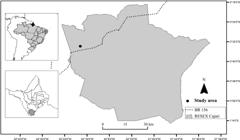
Study area in the Cajari extractive reserve (RESEX Cajari), in the southern region of the state of Amapá, in the Brazilian Eastern Amazon. BR 156, Brazilian federal highway.
The used data were obtained from the Kamukaia research network of Empresa Brasileira de Pesquisa Agropecuária (Embrapa), covering 9.0 ha standardized permanent plots installed throughout the Amazon (Guedes et al., 2023). In these plots, monitoring of Brazil nut production was conducted in 2012, including inventories of Brazil nut trees and surrounding vegetation, soil sampling, and ecological and management studies of the species (Guedes et al., 2023).
The vegetation of the study area consists of dense and open ombrophilous forest, considering the findings of Pastana et al. (2021). The climate of the region lies at the transition between tropical savanna (Aw) and tropical monsoon (Am) according to Köppen’s classification. The average annual temperature is around 25°C, ranging from 18 to 31.5°C, and annual rainfall is approximately 2,300 mm, concentrated between December and June (Alvares et al., 2013). Under upland rainforests at altitudes around 150 m, the soils include Xanthic Ferralsol and Haplic Ferralsol, with scattered occurrences of Plinthosol and a patch of Acrisol to the north (IUSS Working Group WRB, 2022).
For the study, a permanent plot measuring 9.0 ha (300x300 m) was analyzed by identifying and georeferencing all Brazil nut plants with DBH ≥ 10 cm. Within the plot, 43 subplots of 250 m2 (10x25 m) were systematically distributed to assess the surrounding arboreal vegetation, including all trees with DBH > 3.0 cm.
Data on Brazil nut fruit production were collected by counting the number of fruits fallen beneath the crown of each tree. For a realistic extractive context, the local harvest season was maintained and the same tools and traditional methods employed by the extractive communities in the region were used. Production was measured as the total number of fruits per tree during the harvest season from February to April 2012 after the majority of trees had completed fruit drop. Trees that were non-reproductive (zero fruit production) or those with overlapping canopies that compromised the attribution of individual production were excluded from the analysis.
Soil samples were collected across the plots after nut harvest in 2012, during the period of lowest rainfall. For this, a regular grid (30x50 m) was used, totaling 60 points, plus 15 additional random samples to improve the spatial dependence analysis. Samples for the chemical and particle-size analysis were collected at a 0-20 cm soil depth using a Dutch auger. For physical soil attributes, undisturbed samples were collected using 98 cm3 volumetric rings.
The samples were processed into air-dried fine earth (IUSS Working Group WRB, 2022). Then, the following attributes were analyzed: carbon, potassium, calcium, magnesium, iron, zinc, aluminum, and pH, as well as clay content, macroporosity (pore diameter ≥ 0.05 mm), microporosity (pore diameter ≤ 0.05 mm), soil water retention (at tensions of 6, 10, 30, 100, and 1,500 kPa) and bulk density according the methodology described by Teixeira et al. (2017).
Statistical analyses were performed using the geoR package (Ribeiro Jr & Diggle, 2001) in the R software (R Core Team, 2024) and the Spatial Geostatistical Analyst module of the ArcMap software (Esri, Redlands, CA, USA). The data analysis began with the assessment of spatial dependence among the explanatory variables from soil and tree vegetation (basal area and species richness). Initial exploratory data analyses were conducted to evaluate the general behavior of the variables, including summary statistics, spatial trend analysis (latitude and longitude), and outlier detection.
The variographic analysis was performed in sequence, involving the construction of the experimental semivariogram using Matheron’s estimator as described by Isaaks & Srivastava (1989), followed by fitting theoretical spatial models (spherical, exponential, and Gaussian) to each variable.
Model fitting to the experimental semivariogram was performed using the weighted least squares method. Model performance was evaluated using the degree of spatial dependence. Once fitted and selected, the spatial models were used to apply ordinary kriging and generate continuous surface maps with estimated values for unsampled locations.
The generated maps were used for modeling. From them, soil and vegetation values were extracted for each spatial location where Brazil nut individuals were found. These values were then used to analyze the relationships between variables and individual tree fruit production through model fitting.
The GLM theory was applied (Dobson, 2010), using two distribution families: Poisson (variance = mean) and negative binomial, since overdispersion (variance > mean) may occur in the response variable, given its discrete nature based on counts. Model covariates (explanatory variables) included the results of soil analyses (physicochemical) and arboreal vegetation (basal area and species richness). These data were associated with the spatial location and DBH of each Brazil nut tree and its corresponding fruit production (response variable).
Explanatory variables were selected using stepwise regression combined with the Akaike information criterion (AIC). Only the most contributing variables with the lowest AIC values were retained in the final model.
The residual analysis was also performed using deviance residuals to assess error trends (Dobson, 2010). Model evaluation was further supported using the standard error of estimate and the relative standard error (%). These analyses were conducted through the stats package in the R software (R Core Team, 2024).
Results and Discussion
The study area exhibits a high density of Brazil nut trees (10 per hectare), which is considered substantial compared with populations found in the Western Amazon (Wadt et al., 2005). A total of 76 trees with reproductive potential were identified, of which 61 met the criteria for the analysis, i.e., productive trees without overlapping crowns. Individual fruit production varied markedly, ranging from 3 to 1,027 fruits per tree, with a coefficient of variation (CV) = 107%, indicating substantial inter-individual variability (Table 1). Only 59% of the analyzed trees produced more than 100 fruits, 23% exceeded 200 fruits, and 27.8% produced fewer than 50 fruits in the harvest year under analysis. This confirms the wide variation in productivity reported in other studies (Kainer et al., 2007), underscoring the complexity of predicting yields in natural forest systems.
Descriptive statistics of the analyzed variables to explain fruit production of Brazil nut (Bertholletia excelsa) trees in the Cajari extractive reserve, in southern Amapá, Brazil.
In general, the chemical attributes of the soil showed a greater heterogeneity than its physical properties. Among the chemical and physical variables, magnesium exhibited the highest variability, as indicated by its CV, whereas soil bulk density presented the lowest variability, respectively. The basal area of the surrounding vegetation also showed a high variation, reflecting structural heterogeneity in the forest stand surrounding the Brazil nut trees.
The variographic modeling revealed that 4 variables exhibited a strong spatial dependence degree of > 75%, while 15 showed a moderate spatial dependence degree between 25-75% (Table 2). Only one variable, soil pH, displayed a weak spatial dependence.
Spatial dependence degree (SDD) for the fitted spatial models and respective estimated coefficients for the studied variables(1).
The observed spatial dependence is in alignment with that of other studies on soils under pasture in the state of Amazonas (Soares et al., 2015) and under forest in the southern region of the same state (Aquino et al., 2014). However, in a native forest with Brazil nut occurrence in the state of Pará, Guerreiro et al. (2017) only detected spatial dependence (moderate) for soil physical attributes. Sampling configuration may have been insufficient for this detection in chemical attributes.
For the tree vegetation variables (basal area and species richness) around Brazil nut trees, a spatial dependence structure was also detected, with a more pronounced correlation for basal area. Similar results were obtained by Roveda et al. (2016), who reported a moderate to strong spatial dependence degree for basal area in a fragment of ombrophilous forest. Batista et al. (2016) also verified spatial continuity and a strong spatial dependence degree for species diversity and richness.
After confirming spatial dependence, geostatistics enabled the spatialization of explanatory variables for subsequent fruit-production modeling. The spatial distribution of soil magnesium content by ordinary kriging in the study area can be related to the distribution and production of Brazil nut trees (Figure 2). This positive correlation in the modeling was confirmed by the fact that most of the productive Brazil nut trees are located in the southern portion of the plot, where a higher magnesium content is found.

Ordinary kriging map for magnesium content in the soil (A) and geographical location and production of Brazil nut (Bertholletia excelsa) trees with a diameter at breast height ≥10 cm (B), in the Cajari extractive reserve, in the southern region of the state of Amapá, in the Brazilian Eastern Amazon.
The large variation observed in fruit production suggests that other variables beyond the characteristics of the Brazil nut tree itself are important to explain production (Kainer et al., 2007). Soil nutrients, for example, are key factors in the fruit production of Brazil nut trees (Zuidema, 2003), together with soil physical attributes and the tree vegetation surrounding the species.
The variability in fruit production (CV = 107%) in the present work was higher than that found by Kainer et al. (2007) in the Western Amazon (CV = 88%). A high variability can make modeling the production of Brazil nut more challenging, also complicating management practices (Batista et al., 2019).
The Poisson model selected 17 relevant variables, whereas the negative binomial model selected only 12 (Table 3), as follows:
Statistics of the adjustment of the Poisson and negative binomial models, estimated coefficients, and standard error associated with the coefficients of the equation fitted for number of Brazil nut (Bertholletia excelsa) fruits(1).
Poisson model: ln(NF) = β0 + β1 * Y + β2 * DBH + β3 * Zn + β4 * soil density + β5 * Mg + β6 * particle density + β7 * C + β8 * clay content + β9 * soil water tension of 1,500 + β10 * microporosity + β11 * X + β12 * Ca + β13 * basal area + β14 * macroporosity + β15 * pH + β16 * Fe + β17 * K
Negative binomial model: ln(NF) = β0 + β1 * DBH + β2 * clay content + β3 * Zn + β4 * soil density + β5 * soil water tension of 1,500 + β6 * particle density + β7 * C + β8 * Mg + β9 * Y + β10 * macroporosity + β11 * X + β12 * Ca
where NF is a response variable (number of fruits produced), ln is the logarithm, and βi are the parameters of the studied models. The descriptive statistics of the explanatory variables are shown in Table 1.
The estimated coefficients of the Poisson and negative binomial models were significant at 1% probability; the exceptions were β12 and β17, which were significant at 5% for each model. Therefore, the use of the equation for this dataset ensures accuracy in the estimates of the number of fruits for the evaluated productive trees. The tested models explained more than 70% of the variation in fruit production. The expected number of fruits increased with the increase in DBH and soil magnesium content, carbon content, and microporosity, but decreased with the increase in soil zinc content, carbon content, density, and clay content (Table 3).
The equations showed low values for the standard error of the coefficient, resulting in narrower confidence intervals for the coefficients of the fitted equation. The Poisson model presented a higher AIC than the negative binomial model, taking into account the fitting criteria, the values of deviance, the AIC, and the relative standard error for the models using the logarithmic link functions.
Due to its lower deviance value of 64 and lower AIC, the negative binomial model provided a better fit and better accommodated the variability present in the obtained data. In the case of the Poisson model, its high deviance value of 1,815 is a strong indication of overdispersion.
The residual distribution for the Poisson and negative binomial models was similar (Figure 3). Both models showed homogeneity of the residuals, with distribution centered around zero and with a constant amplitude, i.e., with a mean of zero and unknown variance. Therefore, the errors tend to follow a random distribution around zero, and the models describe the real relationship between the covariates and the dependent variable (number of fruits).

Distribution of standardized residuals as a function of the estimated number of fruits for the Poisson (A) and negative binomial (B) models, as well as half-normal probability plots for the Poisson (C) and negative binomial (D) models fitted to the fruit production data for Brazil nut (Bertholletia excelsa) in the Brazilian Eastern Amazon.
For comparison, the Poisson model shows a greater dispersion of the residuals than the negative binomial model (Figure 3 A and B). The overdispersion of the Poisson model was once again confirmed by the normal probability plot, with residuals scattered outside the simulated envelope, indicating a lack of fit (Figure 3 C). This may have been caused by the high variability of the response, as well as by some outlying data. For the negative binomial model, the residuals were scattered within the simulated envelopes, without any apparent systematic pattern, indicating that the model was well fitted (Figure 3 D).
The 12 explanatory variables selected were common to both the Poisson and negative binomial models. DBH, for example, helps explain individual fruit production under a positive relationship, i.e., as DBH increases, fruit production also increases. In other studies, tree diameter explained just over 50% of the variation in fruit production (Wadt et al., 2005; Kainer et al., 2007). In the Western Amazon, Kainer et al. (2007) and Wadt et al. (2005) concluded that Brazil nut trees with a DBH between 80 and 150 cm were the most productive, that is, that the larger the tree diameter and the better the crown shape, the higher the fruit production.
In addition to DBH, soil chemical and physical attributes were found to be essential and statistically significant, at 1 and 5%, in explaining the variation in fruit production (Table 3), as also observed by Silva et al. (2021). The soil chemical variables that stood out were: zinc, magnesium, calcium, potassium, pH, iron, and carbon content. The soil physical variables were: clay content, particle density, soil density, microporosity, macroporosity, and soil water content.
In the state of Acre (Kainer et al., 2007), the number of fruits from Brazil nut trees was positively correlated with cation exchange capacity, but negatively correlated with phosphorus content. The former correlation was also verified in the present study (Table 3), but not the latter since none of the models selected phosphorus, possibly due to the nutrient’s low availability and variability in the study area (2.3 to 4.4 mg dm-3) and lowest CV (17%) among the evaluated chemical attributes. A reason for this difference could be that, in Acre, the soils are structured by volcanic material and under the Solimões geological formation (Kainer et al., 2007), with a higher phosphorus content and high-nutrient stocks, in addition to silt content.
In the state of Roraima, Costa et al. (2017) reported positive relationships between Brazil nut fruit production and cation exchange capacity and exchangeable bases, observing higher levels of calcium and magnesium in the soil under Brazil nut trees of the medium-production class. These authors also confirmed the high absorption of soil bases by the species through nutritional status assessment, while associating a higher fruit production with a higher base saturation, higher exchangeable aluminum content, and lower pH values.
The obtained results show that soil physical attributes were very important in explaining the variation in fruit production through soil density, particle density, clay content, and water content at a tension of 1,500. Soil density and clay content were negatively related to fruit production, while soil water content at 1,500, macroporosity, and microporosity were positively related (Table 3). The higher soil density in more clayey areas suggests that soil compaction may occur, which is one of the main causes of soil physical degradation, reducing or even preventing root growth, particularly of fine roots responsible for plant nutrition (Zhu et al., 2024). Contrastingly, a higher porosity favors root development, and a higher microporosity enhances water retention in the soil, representing scenarios where trees find water availability and suitable conditions for a better nutrient use in the soil solution (Zhu et al., 2024). The physical soil attributes (clay, silt, and macroporosity) were also strongly related to the occurrence of Brazil nut trees (Guerreiro et al., 2017).
Conclusions
-
1. Geostatistical techniques with the Poisson and negative binomial generalized linear models are able to explain the fruit production of Brazil nut (Bertholletia excelsa) trees in the Brazilian Eastern Amazon.
-
2. Soil physical (density, particle density, clay content, and water content) and chemical (zinc, magnesium, calcium, potassium, pH, iron, and carbon) attributes were important in explaining the variation in the fruit production of Brazil nut trees.
-
3. Tree diameter at breast height was selected to explain the variation in the fruit production of Brazil nut trees since, as it increases, the expected number of fruits also increases.
Declaration of use of AI technologies
No generative artificial intelligence (AI) was used in this study.
Acknowledgments
To our agroextractivist partners who allowed us to work on their properties and shared their many ecological and cultural insights; and to Coordenação de Aperfeiçoamento de Pessoal de Nível Superior (CAPES), for a graduate scholarship; to Conselho Nacional de Desenvolvimento Científico e Tecnológico, for financial support (CNPq/MCTI/FNDCT 18/2021, 422905/2021-6); Financiadora de Estudos e Projetos (FINEP), for financial support (01.23.05.74.00), and to Empresa Brasileira de Pesquisa Agropecuária (Embrapa), for financial support (NewCast project 20.24.00.041.00.00).
Disclaimer/Publisher’s note:
The statements, opinions, and data contained in all texts published in Pesquisa Agropecuária Brasileira (PAB) are solely those of the individual author(s) and not of the journal’s publisher, editor, and editorial team, who disclaim responsibility for any injury to people or property resulting from any referred ideas, methods, instructions, or products.
The mention of specific chemical products, machines, and commercial equipment in the texts published in this journal does not imply their recommendation by the publisher.
Data availability statement
Data available upon request: research data are only available upon reasonable request to the corresponding author.
References
-
ALVARES, C.A.; STAPE, J.L.; SENTELHAS, P.C.; GONÇALVES, J.L. de M.; SPAROVEK, G. Köppen’s climate classification map for Brazil. Meteorologische Zeitschrift, v.22, p.711-728, 2013. DOI: https://doi.org/10.1127/0941-2948/2013/0507
» https://doi.org/10.1127/0941-2948/2013/0507 -
AQUINO, R.E. de; CAMPOS, M.C.C.; MARQUES JÚNIOR, J.; OLIVEIRA, I.A.; MANTOVANELI, B.C.; SOARES, M.D.R. Geoestatística na avaliação dos atributos físicos em Latossolo sob floresta nativa e pastagem na região de Manicoré, Amazonas. Revista Brasileira de Ciência do Solo, v.38, p.397-406, 2014. DOI: https://doi.org/10.1590/S0100-06832014000200004
» https://doi.org/10.1590/S0100-06832014000200004 -
BATISTA, A.P.B.; MELLO, J.M. de; RAIMUNDO, M.R.; SCOLFORO, H.F.; REIS, A.A. dos; SCOLFORO, J.R.S. Species richness and diversity in shrub savanna using ordinary kriging. Pesquisa Agropecuária Brasileira, v.51, p.958-966, 2016. DOI: https://doi.org/10.1590/S0100-204X2016000800008
» https://doi.org/10.1590/S0100-204X2016000800008 -
BATISTA, A.P.B.; SCOLFORO, H.F.; MELLO, J.M. de; GUEDES, M.C.; TERRA, M.C.N.S.; SCALON, J.D.; GOMIDE, L.R.; SCOLFORO, P.G.V.; COOK, R.L. Spatial association of fruit yield of Bertholletia excelsa Bonpl. trees in eastern Amazon. Forest Ecology and Management, v.441, p.99-105, 2019. DOI: https://doi.org/10.1016/j.foreco.2019.03.043
» https://doi.org/10.1016/j.foreco.2019.03.043 -
COSTA, M.G.; TONINI, H.; MENDES FILHO, P. Atributos do solo relacionados com a produção da castanheira-do-brasil (Bertholletia excelsa). Floresta e Ambiente, v.24, e20150042, 2017. DOI: https://doi.org/10.1590/2179-8087.004215
» https://doi.org/10.1590/2179-8087.004215 - DOBSON, A.J. An introduction to generalized linear models 2nd ed. rev. London: Chapman & Hall/CRC, 2010.
-
FIRMINO, A.D.S.; KAINER, K.A.; WADT, L.H.O.; SILVA, H.J.P. da; GONÇALVES, D.A.; RODRIGUES, E.G.; GUEDES, M.C. Amazonian forest conservation through sustainable use: evidence based on Brazil nut life histories linked to human occupation. Environmental Conservation, v.52, p.98-107, 2025. DOI: https://doi.org/10.1017/S0376892925100143
» https://doi.org/10.1017/S0376892925100143 -
GUEDES, M.C.; NEVES, E. de S.; RODRIGUES, E.G.; PAIVA, P.; COSTA, J.B.P.; FREITAS, M.F.; LEMOS, L.M. de. ‘Castanha na roça’: expansão da produção e renovação dos castanhais em áreas de agricultura itinerante no Amapá. Boletim do Museu Paraense Emílio Goeldi - Ciências Naturais, v.9, p.381-398, 2014. DOI: https://doi.org/10.46357/bcnaturais.v9i2.532
» https://doi.org/10.46357/bcnaturais.v9i2.532 - GUEDES, M.C.; SOUSA, R.L.F. de; GONÇALVES, D.A.; RODRIGUES, E.G.; PASTANA, D.N.B.; COSTA, F.F. da; COSTA, P. da; SILVA. K.E. da; LIRA-GUEDES, A.C.; WADT, L.H. de O.; OLIVEIRA JÚNIOR, R.C. de. Estrutura populacional, dinâmica da produção de frutos e produtividade. In: WADT, L.H. de O.; MAROCCOLO, J.F.; GUEDES, M.C.; SILVA, K.E. da (Ed.). Castanha-da-amazônia: estudos sobre a espécie e sua cadeia de valor: ecologia e manejo de castanhais nativos: volume 3. Brasília: Embrapa, 2023. v.3, cap.4, p.99-128.
-
GUERREIRO, Q.L. de M.; OLIVEIRA JÚNIOR, R.C. de; SANTOS, G.R. dos; RUIVO, M. de L.P.; BELDINI, T.P.; CARVALHO, E.J.M.; SILVA, K.E. da; GUEDES, M.C.; SANTOS, P.R.B. Spatial variability of soil physical and chemical aspects in a Brazil nut tree stand in the Brazilian Amazon. African Journal of Agricultural Research, v.12, p.237-250, 2017. DOI: https://doi.org/10.5897/AJAR2016.11766
» https://doi.org/10.5897/AJAR2016.11766 - ISAAKS, E.H.; SRIVASTAVA, R.M. An introduction to applied geostatistics New York: Oxford University, 1989. 560p.
- IUSS WORKING GROUP WRB. World Reference Base for Soil Resources: international soil classification system for naming soils and creating legends for soil maps. 4th ed. Vienna: International Union of Soil Sciences, 2022.
-
JANSEN, M.; GUARIGUATA, M.R.; CHIRIBOGA-ARROYO, F.; QUAEDVLIEG, J.; QUISPE, F.M.V.; QUISPE, E.A.; ROCA, M.R.G.; CORVERA-GOMRINGER, R.; KETTLE, C.J. Forest degradation and inter-annual tree level Brazil nut production in the Peruvian Amazon. Frontiers in Forests and Global Change, v.3, art.525533, 2021. DOI: https://doi.org/10.3389/ffgc.2020.525533
» https://doi.org/10.3389/ffgc.2020.525533 -
KAINER, K.A.; WADT, L.H.O.; STAUDHAMMER, C.L. Explaining variation in Brazil nut fruit production. Forest Ecology and Management, v.250, p.244 255, 2007. DOI: https://doi.org/10.1016/j.foreco.2007.05.024
» https://doi.org/10.1016/j.foreco.2007.05.024 - KODONG, F.R.; ABDOLLAH, M.F.B.; OTHMAN, M.F.I.B. Geostatistics and digital image analysis for optimizing rice production. Journal of Theoretical and Applied Information Technology, v.101, p.5745-5758, 2023.
-
PASTANA, D.N.B.; MODENA, É. de S.; WADT, L.H. de O.; NEVES, E. de S.; MARTORANO, L.G.; LIRA-GUEDES, A.C.; SOUZA, R.L.F. de; COSTA, F.F.; BATISTA, A.P.B.; GUEDES, M.C. Strong El Niño reduces fruit production of Brazil-nut trees in the eastern Amazon. Acta Amazonica, v.51, p.270-279, 2021. DOI: https://doi.org/10.1590/1809-4392202003702
» https://doi.org/10.1590/1809-4392202003702 -
R CORE TEAM. R: a language and environment for statistical computing. Available at: <www.r-project.org>. Accessed on: Sept. 1 2024.
» www.r-project.org - RIBEIRO JR, P.J.; DIGGLE, P.J. geoR: a package for geostatistical analysis. R News, v.1/2, p.15-18, 2001.
- ROVEDA, M.; FIGUEIREDO FILHO, A.; PELISSARI, A.L.; SANTOS, R.M.M. dos. Spatial continuity in a mixed ombrophilous forest with different size and shape of sample units. Cerne, v.22, p.189-196, 2016.
-
SILVA, C.S. da; SILVA, L.M. da; WADT, L.H. de O.; MIQUELONI, D.P.; SILVA, K.E. da; PEREIRA, M.G. Soil classes and properties explain the occurrence and fruit production of Brazil nut. Revista Brasileira de Ciência do Solo, v.45, e0200188, 2021. DOI: https://doi.org/10.36783/18069657rbcs20210001
» https://doi.org/10.36783/18069657rbcs20210001 -
SOARES, M.D.R.; CAMPOS, M.C.C.; SOUZA, Z.M. de; BRITO, W.B.M.; FRANCISCON, U.; CASTIONI, G.A.F. Variabilidade espacial dos atributos físicos do solo em área de Terra Preta Arqueológica sob pastagem em Manicoré, AM. Revista de Ciências Agrárias, v.58, p.434-441, 2015. DOI: https://doi.org/10.4322/rca.1975
» https://doi.org/10.4322/rca.1975 - TEIXEIRA, P.C.; DONAGEMMA, G.K.; FONTANA, A.; TEIXEIRA, W.G. (Ed.). Manual de métodos de análise de solo 3.ed. rev. e ampl. Brasília: Embrapa, 2017. 574p.
-
WADT, L.H.O.; KAINER, K.A.; GOMES-SILVA, D.A.P. Population structure and nut yield of a Bertholletia excelsa stand in Southwestern Amazonia. Forest Ecology and Management, v.211, p.371 384, 2005. DOI: https://doi.org/10.1016/j.foreco.2005.02.061
» https://doi.org/10.1016/j.foreco.2005.02.061 -
ZHU, X.; PENG, W.; XIE, Q; RAN, E. Effects of soil compaction stress combined with drought on soil pore structure, root system development, and maize growth in early stage. Plants, v.13, art.3185, 2024. DOI: https://doi.org/10.3390/plants13223185
» https://doi.org/10.3390/plants13223185 - ZUIDEMA, P.A. Ecology and management of the Brazil nut tree (Bertholletia excelsa) Riberalta: PROMAB, 2003. 111p. (PROMAB - Scientific Series 6).
Edited by
-
Chief editor:
Edemar Corazza
-
Edited by:
Mírian Baptista


